Introduction
In learning a written language, learners come to acquire interconnected lexical constituents (orthography, phonology and semantics) that allow written words to be processed for their meaning and pronunciation. In many literacy contexts, this involves a set of mappings between a single set of graphs (e.g., Roman, Cyrillic or Korean alphabetic letters; Arabic abjad letters; Chinese characters) and spoken language units that can vary across the phoneme, the syllable, and the morpheme. Chinese, however, brings an interesting addition to this learning process. The early stage of Chinese learning involves Pinyin, an alphabet of Roman letters that map onto Chinese phonemes. Although children learn some simple Chinese characters as well, reading Pinyin instruction provides the basis for initial reading and as a scaffold for learning the pronunciation of characters, especially in the first two years of primary school (Chinese Curriculum Standards for Compulsory Education, 2016). Beyond this early phase of Pinyin plus characters, literacy depends almost exclusively on reading Chinese characters. Adult native readers of Chinese rarely encounter Pinyin. Learning Chinese as a second language typically involves this same sequence – at first Pinyin plus characters, then only characters.
In this context, the question we raise is how readers, as they increase their skill in character reading, access meaning when reading Pinyin. The obvious possibility is that Pinyin, which is perfectly decodable, brings access to meaning through the spoken language. Thus reading would involve two independent systems, one for Pinyin and one for characters. An alternative, especially with high levels of character reading skill, is that character orthography becomes the gateway to access word meaning. On this alternative, with either character or Pinyin input, meaning is accessed through the orthographic representation of the character. This gateway hypothesis assumes that as characters become the dominant form encountered in reading, encounters with the now less-familiar Pinyin lead to the activation of the corresponding characters. Specifically, because the character has become the more familiar form and has developed a strong connection to meaning, reading Pinyin for meaning will activate the corresponding character.
The background for this gateway hypothesis lies in the special importance of visuo-orthographic information in Chinese reading, which is attested in both behavioral and brain imaging studies. For example, more ventral visual-spatial processing is found in Chinese character recognition than in English (Sun, Yang, Desroches, Liu & Peng, Reference Sun, Yang, Desroches, Liu and Peng2011). Further, visual orthographic skills predict Chinese reading success at early beginning of school learning (Li, Shu, McBride-Chang, Liu & Peng, Reference Li, Shu, McBride-Chang, Liu and Peng2012; Siok & Fletcher, Reference Siok and Fletcher2001). Although reading shares both common procedures and neural pathways across different orthographies (Bolger, Perfetti & Schneider, Reference Bolger, Perfetti and Schneider2005; Perfetti, Cao & Booth, Reference Perfetti, Cao and Booth2013), the large number of characters required by the morpho-syllabic structure of Chinese puts a premium on visual processing. The abundant homophones of Chinese (one syllable maps, on average, to 11 characters without regard to tone) weaken the value of phonology-to-meaning connections, even though native Chinese readers show activation of phonology during reading (Perfetti, Liu & Tan, Reference Perfetti, Liu and Tan2005). These facts together create conditions for a more direct connection between orthography and meaning, compared with alphabetic writing.
Chen, Zhong, Leng and Mo (Reference Chen, Zhong, Leng and Mo2014) studied implicit character activation in Pinyin reading by native Chinese speakers by use of a modified Stroop task. Their study extended an English implicit priming study of Tanenhaus, Flanigan and Seidenberg (Reference Tanenhaus, Flanigan and Seidenberg1980), who reported that color naming latency was longer when primes and targets were orthographically similar in both visual and auditory presentation modes. Chen et al had readers make meaning judgments on words written in Pinyin (bēi zi, “cup”, corresponding to characters杯子) and then immediately judge the color of a following character. Interference in the color decision occurred when the character (怀) was visually similar to one of the characters (杯) corresponding to the Pinyin, relative to an unrelated control character (五). This interference effect implies that the character form was automatically activated by reading the Pinyin, which then was subject to competition from the appearance of a similar character, drawing attention resources from color processing (MacLeod, Reference MacLeod1991). In contrast to the standard Stroop color interference task, where conflict occurs in between the word and the color name (Biederman & Tsao, Reference Biederman and Tsao1979; Chen & Ho, Reference Chen and Ho1986; Mägiste, Reference Mägiste1984; Qiu, Luo, Wang, Zhang & Luo, Reference Qiu, Luo, Wang, Zhang and Zhang2006; Sumiya & Healy, Reference Sumiya and Healy2004, Reference Sumiya and Healy2008), the task of Chen et al. (Reference Chen, Zhong, Leng and Mo2014) had no conflict between written words and color names. The characters and the colors were unrelated in meaning, pronunciation and orthography. The task reflected implicit character processing in a general way that does not depend on color vocabulary knowledge.
Interestingly, reading the Pinyin silently without an explicit meaning task produced no effect. This result suggests that access to meaning through writing involves the character as an orthographic gateway, consistent with the Lexical Constituency Model (Perfetti et al., Reference Perfetti, Liu and Tan2005). Without a meaning task, Pinyin can be decoded with perhaps only weak activation of candidate meanings. To evaluate the meaning of a Pinyin spelling, the mental representation of the character is activated and mediates the decision, reflecting the binding of orthography and meaning in the Chinese written lexicon. Related research in spoken language processing has found orthographic facilitation in an auditory lexical decision task (Zou, Desroches, Liu, Xia & Shu, Reference Zou, Desroches, Liu, Xia and Shu2012): When the first syllable of a two-syllable prime word (cháng chéng, corresponding to characters “长城”, “Great Wall”) and a target word (zhǎng guān, corresponding to characters “长官”, “commander”) corresponded to the same character “长” (with different meaning and pronunciation), lexical decision times were faster than for a control condition of unrelated orthography. No such effects were found when the spoken task involved the judgment of the syllable onset rather than its lexicality.
Second language learners
Character-based literacy is also the goal for the second language learner, just as for the native speaker. Pinyin is primarily a starting point and later an aid to pronunciation, as character learning accelerates. Even during the first term of learning Chinese, adult learners show a sensitivity to visual information contained in characters, showing similarity-based orthographic priming effects prior to meaning and phonological priming (Liu, Perfetti & Wang, Reference Liu, Perfetti and Wang2006; Liu, Wang & Perfetti, Reference Liu, Wang and Perfetti2007). Another demonstration of this rapid learning comes from an ERP study by Yum, Midgley, Holcomb and Grainger (Reference Yum, Midgley, Holcomb and Grainger2014). After 10 sessions of laboratory L2 Chinese learning, character learning was reflected in a left-lateralized N170, an index of orthographic processing. However, an important difference between CFL (Chinese as a foreign language) learners and native speakers is that CFL learners acquire Chinese orthography nearly at the same time as they are learning Chinese phonology, rather than having an already in-place spoken language.
Our question then is whether character orthography comes to have a special gateway status for Chinese learners. Experimentally, the questions are whether a character interference effect occurs for adult learners of Chinese as a second language and whether any such effect depends on Chinese language proficiency.
The lexical constituency model of Chinese reading (Perfetti et al., Reference Perfetti, Liu and Tan2005), applied to L2 learners of Chinese by Liu, Wang & Perfetti (Reference Liu, Wang and Perfetti2007), provides a general framework for addressing these questions. For low proficiency L2 learners of Chinese, the connection between orthography and phonology is weaker than the connection of orthography and meaning (Liu et al., Reference Liu, Wang and Perfetti2007). Applied to Pinyin reading, this implies that low proficiency L2 learners decode the Pinyin and use the spoken language form (if they know the form) as the route to meaning. The character corresponding to this form is not automatically activated because its link with phonology is not strong enough. The expected result is less orthographic interference when a similar character is then presented for color judgment.
If the development of a robust character lexicon is necessary for implicit orthographic interference effects, then the emergence of such effects should be an indicator of character knowledge and thus of proficiency in Chinese. Learners of Chinese should show this effect only with sufficient character knowledge.
Our strategy was to begin with a fairly experienced group of Chinese learners, whom we refer to as “intermediate” proficiency. Two experiments required participants to make a meaning judgment on a Pinyin word, whether it referred to a man-made object or not. Immediately following their response, a character was presented for a color decision (red or blue). Based on Chen et al. (Reference Chen, Zhong, Leng and Mo2014), if character orthography is activated during Pinyin processing, we expect an orthographic interference effect relative to the control condition: When a character is presented for a color decision, the time for a decision will be slower when the character is similar in orthographic form to the character that corresponds to the Pinyin.
Experiment 1
Experiment 1 tested the implicit orthographic interference effect in Pinyin reading among CFL learners at the intermediate level, with a substantial vocabulary of 1200 words.
Method
Participants
Nineteen adult CFL learners with a mean age of 25 years participated in the experiment. All participants were from the School of Foreign Languages, Sun Yat-sen University. Participants were defined as intermediate level students, because they had passed the fourth level (the intermediate level with a vocabulary of 1200 words and 1064 characters) of the Chinese Proficiency Test (HSK, http://www.chinesetest.cn) but not the sixth (the highest level with knowledge of more than 5000 words and 2663 characters). The HSK is a standardized test of Chinese language proficiency for non-native speakers that distinguishes six levels of proficiency. The six levels of HSK from first to sixth correspond, respectively, to A1, A2, B1, B2, C1 and C2 of the Common European Framework of Reference for Languages (CEF). Both the fourth and sixth level tests include three sections, listening, reading and writing that have a maximum score of 100 for each section. Students who reach 180 are qualified for passing the tests. Knowledge of word spoken form, word written form and word meaning are all tested in the HSK. The listening section mainly focuses on the connection from word pronunciation to meaning; the reading and writing sections mainly focus on the connections from orthography to meaning and from meaning to orthography, respectively. The first language background for participants is as follows: twelve Korean, two each Japanese, Vietnamese and Thai, and one Indonesian.
Stimuli
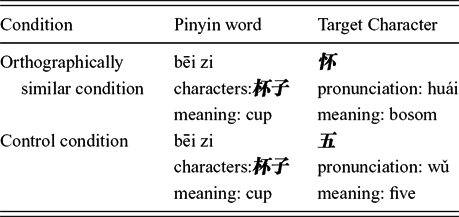
The stimuli included 32 sets of Pinyin words and their corresponding target characters. All characters are simplified Chinese. Two target conditions were designed: an orthographically similar condition, in which the target character was orthographically similar to the character that corresponds to the Pinyin word (with unrelated meaning and pronunciation). Of the stimuli in the orthographically similar condition, 31% shared a semantic component and 34.5% shared a phonetic component with the target character; the remainder had visual similarity without a shared component. In the control condition, the target character was orthographically, semantically, and phonologically unrelated to the character that corresponded to the Pinyin word. Actually, in the orthographically similar condition, in two pairs of stimuli the onset was the same, and in three pairs of stimuli the rime was the same. In the control condition, one pair shared the onset and two pairs shared the rime. However, the data pattern was similar, after excluding the stimuli that shared onset or rime. Each Pinyin word was assigned to both the orthographically similar condition and the control condition. The design and sample stimuli are presented in Table 1.
Experiment 1 design and sample stimuli.

Nearly all Chinese syllables correspond to more than one character. To avoid confusion, the experimental words were two syllables, written in Pinyin as two alphabetic spelled syllables and corresponding to two characters. Each two-syllable word was unique in its pronunciation, i.e., no other word has the same pronunciation. Thus each Pinyin word corresponded to only one two-character sequence. For example, the Pinyin “bēi zi” corresponds to the two-character word “杯子” uniquely. All two-character words that corresponded to the Pinyin were high frequency words from the A grade and B grade of the Vocabulary and Character Syllabus of Chinese Level (2011) and are in common use. The average word frequency of the two-character word that corresponded to the Pinyin was 50/million (Cai & Brysbaerts, 2010), and its average number of strokes was 11.
The experimental manipulation focused on the orthography of the first character (corresponding to the first Pinyin syllable). The second character was either the nominal suffix “子” (marking the word as a noun) or a duplication of the first character. For example, the Pinyin “gū gū” (aunt on father's side) has the same two characters “姑姑”. This manipulation promotes focus on the first character and minimizes interference from activation of the second character.
Frequency, strokes, and structure type of the target character in the two conditions were counterbalanced. The average number of strokes of target characters in the orthographically similar condition and control condition was matched (7.6 and 7.7, respectively, t(62) = 0.08, p = .94). The average character frequency was also matched, 278/million in each condition (t(62) = 0.001, p = .99).
The orthographic similarity of the critical first character of the Pinyin word and the target character for the color decision was assessed by another 22 intermediate Chinese learners. Ratings were made on a 5 point scale, with 5 defined as most similar. The mean similarities were 3.64 and 1.28 in the orthographically similar condition and control condition, respectively, t(21) = 20.09, p < .001, r 2pb = 0.95. In addition, the participants reported that they were familiar with the stimuli.
Procedure
The experiment was carried out in a quiet room with participants tested individually, seated approximately 50 cm from a computer display screen. To begin each trial, a fixation signal (a black “+”) appeared in the center of the screen for 1000ms, at which point a Pinyin word appeared. Each Pinyin word was approximately 5cm×2cm (width×height). Participants were required to make a semantic judgment, whether the word indicated a man-made object, by pressing designated buttons on keyboard. Participants were instructed to respond as quickly and accurately as possible. The Pinyin word remained until participants made a response. Immediately following this response, a character appeared printed in either red or blue. Participants had 2 seconds to respond by pressing a red button with their right index finger or a blue button with their left index finger. Trials were separated by a 500ms blank screen. Each Pinyin word was presented twice, once in the orthographically similar condition and once in the control condition, with condition order determined randomlyFootnote 1. Each participant received four practice trials before the formal experiment in order to become familiar with the procedure.
Trials with incorrect responses were excluded in the analysis of semantic judgments (14.6%) and color judgments (6.4%). Responses more than 3 SD above or below each participant's mean were excluded from the RT analyses of semantic judgments (1.5%) and color judgments (1%).
Results and discussion
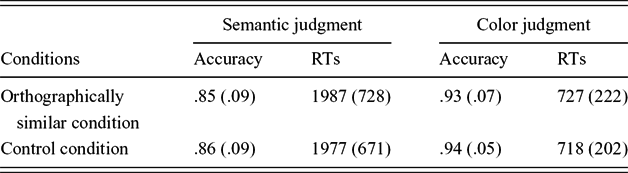
The main result of interest was color judgment reaction times. These did not differ between the orthographically similar and control conditions. Thus, we have no evidence for interference resulting from implicit character orthography, and thus no evidence that orthography is automatically activated during Pinyin processing for these intermediate Chinese leaners. Color judgment performance on the target character is shown in Table 2 along with semantic judgment performance on the Pinyin words. The following paragraphs describe the results in detail. t values are reported by participants (t 1) and by items (t 2).
Means and standard deviations (in parentheses) of accuracy and reaction time for semantic judgment and color judgment in Experiment 1.

Color judgment on target characters
RTs in the orthographically similar condition were not different from the control condition, t 1 (18) = 0.64, p = .53, r 2p b = 0.02; t 2(62) = 0.39, p = .7, Cohen's d = 0.1. Thus there is no evidence for implicit character interference in the color judgment of the target character. Importantly, the two conditions produced statistically equivalent color judgment accuracy (t 1(18) = 1.12, p = .28, r 2p b = 0.07; t 2(62) = 0.90, p = .37, Cohen's d = 0.17). Nor were there differences in the Pinyin semantic judgment accuracies (t 1(18) = 0.36, p = .72, r 2p b = 0.007; t 2(31) = 0.43, p = .67, r 2p b = 0.006) or reaction times (t 1(18) = 0.19, p = .86, r 2p b = 0.002; t 2(31) = 0.06, p = .95, r 2p b = 0.0001).
The results do not show an implicit orthographic interference effect for intermediate learners, in contrast to native Chinese speakers (Chen et al., Reference Chen, Zhong, Leng and Mo2014). This suggests that intermediate Chinese learners have not developed orthographic representations that are sufficiently interconnected to pronunciation and meaning to be activated automatically by reading Pinyin for meaning. Next we examined whether more advanced learners would show the implicit orthographic interference effect.
Experiment 2
Experiment 2 examined the implicit orthographic interference effect in more proficient Chinese learners, compared with the intermediate learners of Experiment 1.
Method
Participants
A total of twenty-five adult CFL learners from the School of Foreign Languages, Sun Yat-sen University, mean age 26 years participated in this experiment. All participants had passed the sixth (highest) grade of the Chinese Proficiency Test (HSK) and achieved a mean vocabulary of 5000 words. The first language background for participants is as follows: 8 Vietnamese, 4 Korean, 3 Thai, 2 Indonesian and 8 Malaysian. Contrast with other participants, the Malaysians had learned both Malaysian and Chinese at their early age and three of them can speak CantoneseFootnote 2.
Materials, design and procedure
Materials, design and procedure were same with Experiment 1.
Trials with incorrect responses were excluded in the analysis of RTs in semantic judgments (13.1%) and color judgments (4.5%). Responses more than 3 SD above or below each participant's mean were excluded from the analyses of RTs for semantic judgments (1.8%) and color judgments (0.8%).
Results and discussion
Color judgment RTs differed significantly between the two conditions. The orthographically similar condition produced longer times for color judgment of the target character than the control condition. The results indicate that the advanced Chinese learners accessed character orthography during Pinyin semantic processing, which led to interference in color judgment. Color judgment performance on the target character and semantic judgment performance for Pinyin words are in Table 3; statistical details are provided below.
Means and standard deviations (in parentheses) of accuracy and reaction time for semantic judgment and color judgment in Experiment 2.

RTs in the orthographically similar condition were longer than in the control condition, t 1(24) = 3.45, p < .005, r 2p b = 0.33; t 2(62) = 2.84, p < .01, Cohen's d = 0.71. The accuracies of color judgments did not differ (t 1(24) = 0.22, p = .83, r 2p b = 0.002; t 2(62) = 0.28, p = .78, Cohen's d = 0.25). Pinyin semantic judgments did not differ in either accuracies (t 1(24) = 0.56, p = .58, r 2p b = 0.01; t 2(31) = 0.61, p = .54, r 2p b = 0.02) or RTs (t 1(24) = 1.23, p = .23, r 2p b = 0.06; t 2(31) = 0.75, p = .46, r 2p b = 0.02).
The results show the emergence of an implicit orthographic interference effect for the proficient learners, in contrast to the intermediate learners of Experiment 1. This suggests that with sufficient experience with characters, a learner of Chinese comes to have high quality character representations. These characters can be activated by their meanings, which are accessed through pronunciations conveyed by Pinyin spelling.
Combined Analyses of the Experiments
To statistically compare the results of Experiment 1 (no implicit character interference effect for intermediate learners) with those of Experiment 2 (an implicit character interference effect for advanced learners), we combined data from the two experiments in a single mixed-effects model (Baayen, Davidson & Bates, Reference Baayen, Davidson and Bates2008). The model tested the effects of the within-participants orthographic factor (similar vs. control) and the between-participants proficiency factor (intermediate CFL learners vs. advanced CFL learners) on color judgment reaction times. The best fit model, which was implemented in lme4 packages in R (Maechler & Bates, Reference Maechler and Bates2010,) included two fixed factors (orthographic similarity, language proficiency) and random intercepts for participants and items.
To determine whether there was a main effect of orthographic similarity, we compared a full model with orthographic similarity as a fixed effect against a reduced model without orthographic similarity. The two models differed significantly, χ 2 = 6.59, p < .05, indicating that orthographic similarity is needed to account for variance in performance. Although the model that included the language proficiency factor did not differ significantly from the model that excluded the language factor as main effect, χ 2 = 2.06, p > .1; there was an interaction between orthographic similarity and proficiency, χ 2 = 4.28, p < .05. The interaction indicated that the high proficiency readers were more affected by orthographic similarity than were low proficiency readers. When we added language background as a fixed factor in the model, the pattern of significant effects is the same.
The combined analysis confirms that the orthographic interference effect depends on Chinese character reading experience.
General discussion
The results of the two experiments show the emergence of an implicit character interference effect with sufficient learning of Chinese. Although students with a vocabulary of 1200 words did not show this effect (Experiment 1), students with knowledge of 5000 words did show implicit character interference (Experiment 2). This proficiency effect is confirmed in a combine LME model that combined data from the two experiments. In this implicit orthographic effect, reading the Pinyin two-syllable word bēi zi for meaning (杯子, meaning: cup) affects the response to a following character (怀) that is not read, but viewed only for its color. This occurs because “怀” is similar in form to “杯子”, the two characters that correspond to bēi zi. Thus, we infer that “杯子” was automatically activated while retrieving the meaning of the bēi zi.
Pinyin processing for adult Chinese learners
Proficient Chinese learners (knowledge of 5000 words) showed the implicit character interference effect, just as native Chinese readers do (Chen et al., Reference Chen, Zhong, Leng and Mo2014); whereas less proficient readers (knowledge of 1200 words) did not show this effect. We believe this difference reflects the experience-based development of high quality orthographic representations. In Pinyin reading, for less proficient CFL learners, the connection of orthography with phonology is weaker than the connection of orthography with meaning (Liu et al., Reference Liu, Wang and Perfetti2007). These less experienced learners decode Pinyin and use phonological information as the route to meaning. With increasing experience in character reading and writing, CFL learners establish high quality orthographic representations, with full connections among lexical constituents (Guan, Liu, Chan, Ye & Perfetti, Reference Guan, Liu, Chan, Ye and Perfetti2011; Tan, Spinks, Eden, Perfetti & Siok, Reference Tan, Spinks, Eden, Perfetti and Siok2005).
It appears that Pinyin must be processed for meaning in order for the implicit character activation to occur. Although the present study did not have a comparison condition that did not involve meaning processing, Chen et al. (Reference Chen, Zhong, Leng and Mo2014) found that merely reading Pinyin silently without meaning judgments did not produce implicit priming among native speakers. It is likely that the same result would be found for Chinese learners. This suggestion is consistent with the structure of Chinese writing and the reading procedures that accommodate it. Pinyin is merely a learning and pronunciation tool for Chinese, whereas the writing system is based on the character. The character becomes the written point of access to meaning and pronunciation, representing both a meaning-bearing morpheme and syllable, reducing the cost of Chinese homophony (Perfetti et al., Reference Perfetti, Liu and Tan2005). In contrast, reading a Pinyin syllable, even with tones marked, does not usually allow a unique meaning, but instead activates multiple meanings. In the present study, we eliminated multiple meaning activation at the word level by using 2-syllable words that require two characters to be written, thus eliminating the ambiguity that can result from the Pinyin spelling of a single syllable.
Although the most important aspect of proficiency concerns the role of character knowledge, we note that Pinyin reading itself showed an interesting proficiency result. First, probably because the Pinyin were high frequency words, intermediate and advanced learners showed the same high level of meaning judgment accuracy (around 87%) for Pinyin words. However, the advanced CFL learners showed longer times (around 2700ms) than intermediate CFL learners (around 2000ms) to make these semantic judgments. The explanation for this is not clear. One possibility is that intermediate CFL learners were in a phase of learning that involved more recent or more frequent exposure to Pinyin, and thus were more familiar with reading it for meaning. An alternative is that the advanced learners took more time because they had a larger vocabulary and had to verify their judgments in the context of similar words. In this study, the 2-syllable Pinyin word is unique to a 2-character word. The first syllable of the word usually corresponds to more than one character. The advanced Chinese learners need to access meaning through orthography. The extra operation costs more time. In contrast, the immediate CFL learners accessed meaning through Pinyin directly.
Character knowledge and orthographic processing
Learning to read characters proceeds incrementally and continuously. It takes considerable practice to develop connections of a character to meaning and pronunciation that are strong enough so that the character can be activated through either connection. Adult learners fairly quickly show a general sensitivity to the visual forms of Chinese characters, being able to discriminate between legally constructed characters and non-characters (Wang, Perfetti & Liu, Reference Wang, Perfetti and Liu2003). However, they show great difficulty in mapping phonological information onto orthographic form (Wang et al., Reference Wang, Perfetti and Liu2003), for which more precise knowledge of character forms is needed. Interestingly, character-to-character priming based on similar visual form has been observed within one term of learning Chinese (Liu, et al., Reference Liu, Wang and Perfetti2007). Implicit priming of the character by its Pinyin equivalent is a different matter, dependent not just on similar visual forms, but on connections from a) pronunciation to meaning, b) meaning to character and c) pronunciation to character. As these connections strengthen with experience, they bring a character-centered lexical quality to the learner's written Chinese lexicon.
Our implicit character interference effect can be placed in the context of explicit character processing effects. The model of threshold-style processing of Chinese orthography (Perfetti et al., Reference Perfetti, Liu and Tan2005) suggests that character interference effects should emerge with a longer SOA. Visually similar orthographic primes have been found to be facilitative at short SOAs (43ms, Perfetti & Tan, Reference Perfetti and Tan1998; 50ms, Weekes, Chen & Lin, Reference Weekes, Chen and Lin1998), before becoming inhibitory with increasing SOA in both naming (Perfetti & Tan, Reference Perfetti and Tan1998) and lexical decision, where an SOA of 243ms can produce inhibition (Feldman & Siok, Reference Feldman and Siok1999). In the present Pinyin study, the SOA between the Pinyin word and the target character is dependent on the meaning response to the Pinyin word, averaging from 2000ms to 2700ms across the two experiments, well into the range where inhibition would emerge in an explicit orthography priming task. In a semantic categorization paradigm, Leck, Weekes and Chen (Reference Leck, Weekes and Chen1995) also found characters that are visually similar to the targets but with different pronunciation yielded an interference effect.
We believe that the explanation for the implicit character interference effect has to refer to a general adaptation of reading that occurs to Chinese writing. Characters become the dominant written form through experience. Characters solve the meaning ambiguity problem posed by syllables and become the gateway to meaning and pronunciation. When Pinyin is read for meaning, the activation of meaning causes an automatic activation of the associated character.
In conclusion, we found that reading a Pinyin spelling of a Chinese word implicitly activates the character that corresponds to the Pinyin word – provided the reader has sufficient proficiency in Chinese. Intermediate CFL learners (with a vocabulary of 1200 words) did not show evidence for implicit character activation, whereas advanced learners (with a vocabulary of 5000 words) did. Our study does not show how large a written vocabulary is is necessary for this effect – our two samples suggest that a knowledge of 5000 words brings about sufficient character knowledge to produce the implicit character activation effect. An important aspect of language experience is the role of spoken language experience. This was higher in our population of Chinese learners, because they were residing in China during their studies, than it would be when learners in settings where opportunities to speak Chinese would be more limited.
For the main conclusion, we stress that substantial practice in character based reading is needed to build a character lexicon in which a large number of characters have strong enough constituent connections to be activated by phonology and meaning. The amount of practice needed to establish strong character-based reading depends on a number of factors. Knowledge of 5000 words might not be necessary, but it is likely that substantial character practice is needed. That learners with substantial experience can show the native reader pattern in this task encourages the conclusion that learners can come to approximate the orthographic knowledge that native speakers develop.
Stimuli of Experiment 1 and 2.