Introduction
The prevalence and burden of mental illness is high worldwide, with a need for psychiatrists to help meet the growing demand for care (Geng Reference Geng2007; Wu & Duan Reference Wu and Duan2015). However, evidence suggests that medical students may have somewhat negative perceptions of psychiatry as a specialty (Economou et al. Reference Economou, Kontoangelos, Peppou, Arvaniti, Samakouri, Douzenis and Papadimitriou2017). Although the number of psychiatric residents has increased in the U.S. and other Western countries (Moran Reference Moran2017), increases are not being seen worldwide (Warnke et al. Reference Warnke, Gamma, Buadze, Schleifer, Canela, Strebel, Tényi, Rössler, Rüsch and Liebrenz2018), including many low- and middle-income countries where there are severe shortages of psychiatrists (Hailesilassie et al. Reference Hailesilassie, Kerebih, Negash, Girma, Siebeck and Tesfaye2017). Therefore, many countries are suffering from a shortage of qualified psychiatrists to meet the current demands of their populations (Lau et al. Reference Lau, Zamani, Lee, Asli, Gill, Brager, Hawa, Song, Gill, Fitzpatrick, Menezes, Pham, Douglass, Allain, Meterissian, Gagnon, Toeg and Murphy2015).
Ghana, a lower middle-income country which is the focus of this study, is a coastal country located in Sub-Saharan Africa. Ghana has a population of 28 million, with most of the population concentrated in the southern half of the country, primarily near the Atlantic coast (CIA et al. 2018). Mental health care in Ghana is government-funded, receiving less than 1% of the overall health budget and less than 1% of gross domestic product (Saxena et al. Reference Saxena, Sharan, Garrido and Saraceno2006; WHO 2007). Despite evidence of high prevalence of mental health conditions in Ghana (WHO 2007), including that approximately 41% of the population suffers from some type of psychological disorder (GHS 2018), recent figures indicate there are only 18 psychiatrists in the public mental healthcare system. Thus, Ghana has a psychiatrist-to-patient ratio of one per two million people (Ghana News 2017).
Ghana has four public medical schools and a post-graduate residency program in psychiatry offered through the Ghana College of Physician and Surgeons. Recruitment into the psychiatry specialty training is through an entrance examination, similar to recruitment to all other specialty training programs. No incentives are offered to doctors who choose to train in psychiatry relative to other medical specialties.
The purpose of the current study is to gain an understanding of the perception of Ghanaian medical students regarding psychiatry as a specialization, including how these perceptions impact career interest in psychiatry. We hypothesize based on anecdotal evidence and also views expressed by community mental health workers in Ghana (Agyapong et al. Reference Agyapong, Osei, Farren and McAuliffe2015a, Reference Agyapong, Osei, Farren and McAuliffe2015b, Reference Agyapong, Osei, Farren and McAuliffe2015c, Reference Agyapong, Osei, Farren and McAuliffe2015d; Agyapong et al. Reference Agyapong, Farren and McAuliffe2016) that the majority of Ghanaian medical students will identify that the poor infrastructure for mental health care and training in Ghana and their perceptions about risk and stigma as well as low remuneration for psychiatrists in Ghana are important factors that dissuade them from considering psychiatry as a career option. We further hypothesize that Ghanaian medical students will favourably view incentives to train in psychiatry, and there will be gender differences in the perspectives of the medical students, consistent with literature which suggests that female medical students have a more positive attitude toward psychiatry careers (Budd et al. Reference Budd, Kelley, Day, Variend and Dogra2011).
Methods
Study design and institutional review board approval
This is a cross-sectional survey of 5th and 6th year medical students in four public medical schools in Ghana. The study received institutional ethics review approval from the committee on human research, publication and ethics at the College of Health Sciences at the Kwame Nkrumah University of Science and Technology.
Data collection and analysis
Initially, we developed a self-report questionnaire (Appendix 1 in online supplement) based on anecdotal evidence in Ghana and relevant factors identified in published literature. The questionnaire comprised predominantly of closed-ended questions requiring Likert scales and was administered in paper format anonymously to participants in October 2017 by representatives of the Federation of Ghanaian Medical Students Association who served as research assistants. The questionnaires took about 15 minutes to complete, and no incentives were provided for completion. The data were analyzed via descriptive and inferential statistics, including using Chi-square and Fisher’s exact tests, with IBM SPSS statistical software for Windows, Version 20.
Results
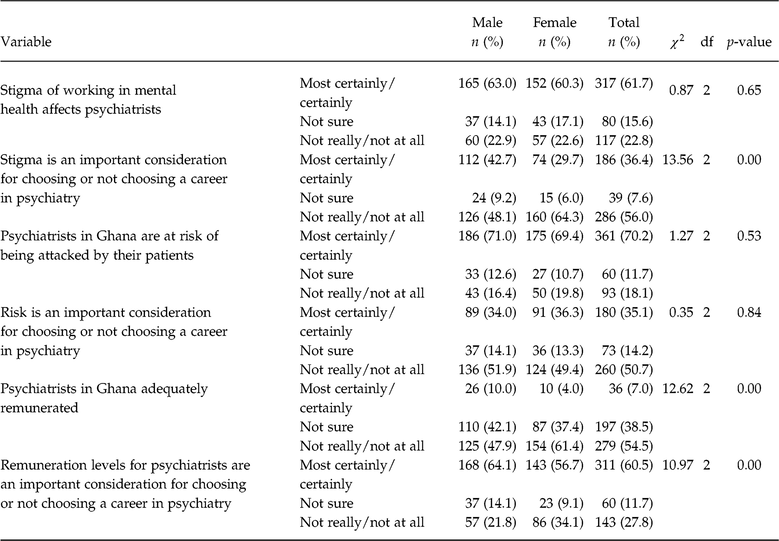
In all, 545 out of 1041 clinical-year medical students participated in the cross-sectional survey giving a response rate of 52%. The sample was approximately evenly distributed between gender (52% male v. 48% female) and clinical year (52% 6th year v. 48% 5th year). Analyses regarding gender differences in the perception of Ghanaian medical students regarding the impact of stigma, risk and remuneration for psychiatrists on their likelihood for considering careers in psychiatry are presented in Table 1.
Gender differences in the perception of Ghanaian medical students about the impact of stigma, risk and remuneration for psychiatrists on their likelihood for considering a career in psychiatry

Table 1 suggests that around three out of five medical students perceived that stigma of working in mental health affects psychiatrists in Ghana; however, only around a third of the medical students were certain that stigma is an important consideration for them to choose or not to choose a career in psychiatry. Significantly, more male medical students perceived that stigma was an important consideration for choosing a career in psychiatry compared to their female counterparts (42.7% v. 29.7%, respectively); however, there were no gender differences in the perceptions of the medical students regarding risk in psychiatry. Over half of the medical students perceived that psychiatrists in Ghana are not well remunerated, and about 60% of respondents endorsed that remuneration for psychiatrists is an important consideration for them to consider careers in psychiatry. Although a significantly higher proportion of female medical students perceived that psychiatrists in Ghana are not well remunerated, a significantly higher proportion of male medical students expressed certainty that remuneration was an important consideration for them to consider a psychiatry career.
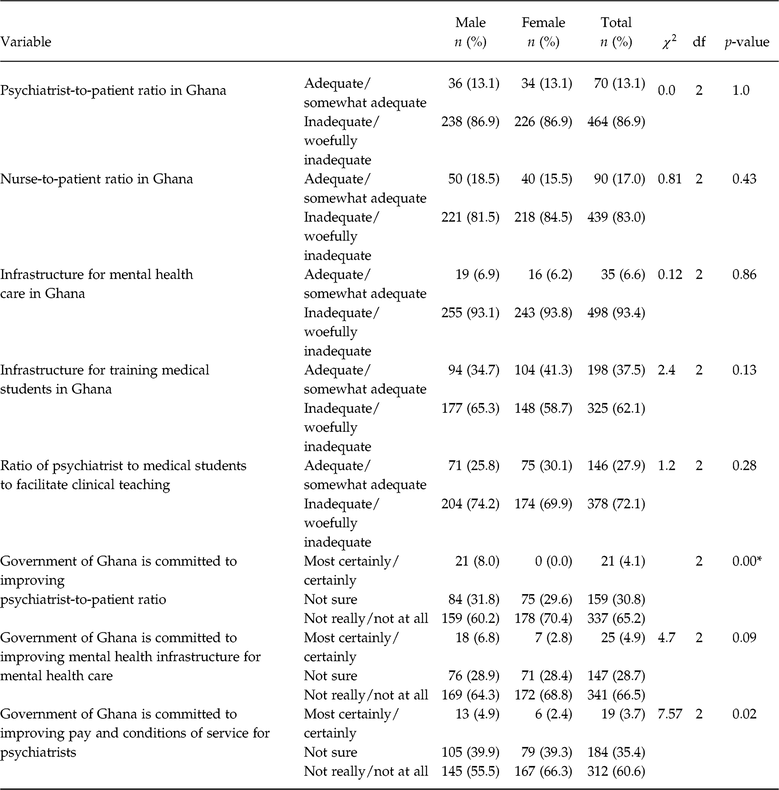
In Table 2, we assessed the gender differences in the perception of Ghanaian medical students regarding the state of Ghana’s human resources and infrastructure for mental health delivery and psychiatric training.
Gender differences in the perception of Ghanaian medical students about the state of Ghana’s human resources and infrastructure for mental health delivery and psychiatric training

Table 2 shows that the majority of Ghanaian clinical-year medical students perceived as inadequate or woefully inadequate the psychiatrists- and nurse-to-patient ratio in Ghana as well as the psychiatrists-to-medical student ratio to facilitate effective clinical teaching. The majority of Ghanaian clinical-year medical students also perceive the infrastructure for mental health care delivery and clinical training in psychiatry to be inadequate or woefully inadequate. There were no gender differences in these perceptions expressed by the medical students. Around two-thirds of medical students did not believe the Government of Ghana was committed to either improving the psychiatrists-to-patient ratio or the infrastructure for mental health delivery in Ghana. There was a statistically significant gender difference in the perception that the government of Ghana was not committed to improving the psychiatrists-to-patient ratio, with more female medical students (70.4%) holding this view, compared to their male counterparts (60.2%). About three out of every five medical students did not believe that the Government of Ghana was committed to improving the pay and remuneration for psychiatrists in Ghana with significantly more female medical students (66.3%) than male medical students (55.5%) holding this view.
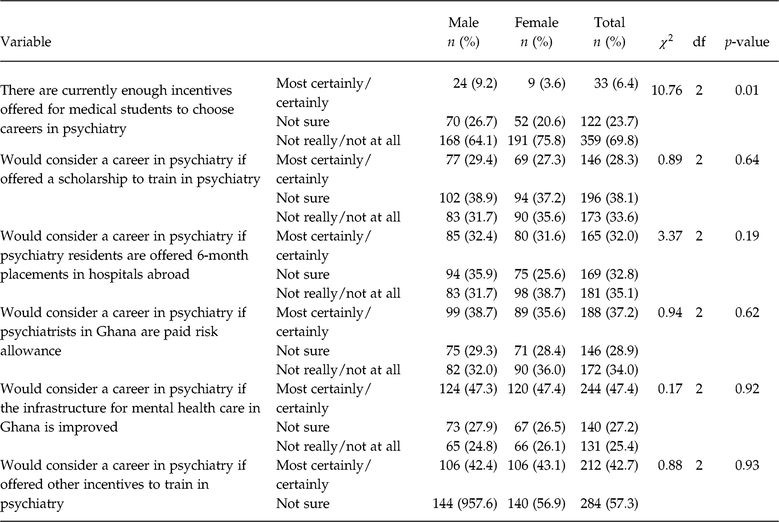
Table 3 presents data suggesting that there are gender differences in the perception of Ghanaian medical students about potential incentives that can stimulate their interest to consider careers in psychiatry.
Gender differences in the perceptions of Ghanaian medical students about the incentives to stimulate them to consider careers in psychiatry

Table 3 suggests that about 7 out of 10 medical students perceive that there are not enough incentives currently for them to consider careers in psychiatry, with a higher proportion of female medical students expressing this view compared to their male counterparts (75.8% v. 64.1%, respectively). Around 3 out of every 10 medical students were certain they will consider careers in psychiatry if they were offered scholarships to train in psychiatry or they were offered 6-month placement in hospitals abroad as part of their psychiatry residency training in Ghana. Furthermore, around 4 out of every 10 medical students expressed they will consider training in psychiatry if offered risk allowance, and about half of all the medical students reported they will consider careers in psychiatry if the infrastructure for mental health was to improve. Approximately 40% suggested they would consider careers in psychiatry if offered other incentives. There were no significant gender differences in incentive-related items on the survey.
Discussion
Our study achieved a response rate of 52%, which is comparable to response rates achieved in similar studies evaluating medical student attitudes to psychiatry (Yager et al. Reference Yager, Lamotte, Nielsen and Eaton1982; Feifel et al. Reference Feifel, Moutier and Swerdlow1999). Ghanaian medical students reported many barriers to choosing a career in psychiatry, including stigma, risk, poor infrastructure for mental health and low remuneration. Previous literature has suggested that stigma associated with mental illness is an influential decision in selecting psychiatry as a profession (Cutler et al. Reference Cutler, Alspector, Harding, Wright and Graham2006; Wiesenfeld et al. Reference Wiesenfeld, Abbey, Takahashi and Abrahams2014; Lau et al. Reference Lau, Zamani, Lee, Asli, Gill, Brager, Hawa, Song, Gill, Fitzpatrick, Menezes, Pham, Douglass, Allain, Meterissian, Gagnon, Toeg and Murphy2015). Although a majority of respondents in this study reported that practicing psychiatrists in Ghana is affected by the stigma of mental health, only a much smaller proportion indicated that the stigma surrounding psychiatric practice was a barrier in their choice to pursue psychiatry as a career. Thus, stigma was not a particularly salient deterrent to a career in psychiatry among our respondents.
Similarly, 70% of the respondents in the study reported that psychiatrists were at risk of assault by their patients; however, only 35% considered this a major contributor into their decision to pursue psychiatry. As well, the respondents reported that the psychiatrist-to-patient ratio, the nurse-to-patient ratio and the infrastructure for mental health were inadequate. The perception of the medical students in our study regarding the inadequate human resource and infrastructural deficits for mental health delivery system in Ghana is consistent with previous work regarding perceptions among community mental health workers, psychiatrists and health policy directors in Ghana (Agyapong et al. Reference Agyapong, Osei, Farren and McAuliffe2015a; Agyapong et al. Reference Agyapong, Farren and McAuliffe2016), as well as opinion expressed in the Lancet global mental health series and by the WHO (Saxena et al. Reference Saxena, Thornicroft, Knapp and Whiteford2007; Kakuma et al. Reference Kakuma, Minas, van Ginneken, Dal Poz, Desiraju, Morris, Saxena and Scheffler2011; WHO 2011). In general, our study did not find conclusive evidence of different attitudes toward psychiatry between the male and female medical students. Mixed findings regarding gender differences in attitudes toward psychiatry have been reported in the literature (Singh et al. Reference Singh, Baxter, Standen and Duggan1998; Kuhnigk et al. Reference Kuhnigk, Strebel, Schilauske and Jueptner2007; Khan et al. Reference Khan, Yousafzai, Mehir and Inam-ul-Haq2008; Sartorius et al. Reference Sartorius, Gaebel, Cleveland, Stuart, Akiyama, Arboleda-Flórez, Baumann, Gureje, Jorge, Kastrup, Suzuki and Tasman2010).
Remuneration was an important consideration factor for the medical students in our study, with 61% of respondents reporting it was a major consideration in choosing psychiatry as their specialty. As well, the majority of the medical students (55%) reported that remuneration for Ghanaian psychiatrists was not adequate for their practice. This is not surprising, as many surveys even in the Western world, including the U.S., have found that psychiatrists rank in the bottom third in pay of all specialties, with only minor changes to pay from year to year (Cassels Reference Cassels2013).
Respondents in this study reported limited government support in improving the ratio of psychiatrists-to-patients and that there was limited governmental support for improving the pay and conditions of service for practicing psychiatrists. Of note, female respondents were more likely to hold this view. While programs such as task shifting are being put into place (Agyapong et al. Reference Agyapong, Osei, Farren and McAuliffe2015a, Reference Agyapong, Osei, Farren and McAuliffe2015b, Reference Agyapong, Osei, Farren and McAuliffe2015c, Reference Agyapong, Osei, Farren and McAuliffe2015d; Agyapong et al. Reference Agyapong, Farren and McAuliffe2016), there remains a large deficit for care of many patients in the outlying areas of Ghana (Hailesilassie et al. Reference Hailesilassie, Kerebih, Negash, Girma, Siebeck and Tesfaye2017).
Over one-third of Ghanaian medical students responded that they would consider the pursuit of a practice in psychiatry if some incentive were offered. These incentives included scholarships to practice psychiatry, 6-month placements in a hospital abroad or payment of a risk allowance. In our study, no differences were found between the genders in relation to who would consider a career in psychiatry if offered these incentives. An innovative inter-medical schools public speaking competition in Ghana which sponsors winners to undertake psychiatric electives at St. Patrick’s Mental Health Services in Dublin was found to stimulate the interest of medical students in psychiatry both as a subject and as a career option (Agyapong & McLoughlin Reference Agyapong and McLoughlin2012; Agyapong et al. Reference Agyapong, Hrabok, Gerald, Khinda, Owusu-Antwi, Osei, Ohene, Ulzen and Gilligan2018).
Our study has a number of important limitations. First, the survey tool is not a validated instrument and, therefore, its external validity cannot be ascertained. Second, we achieved a response rate of only 52%, and our findings may not be generalizable to all Ghanaian medical students. Notwithstanding these limitations, our study presents important and novel findings in the context of a lower middle-income country which can assist health policy planners and medical training institutions to formulate policies and programs that will increase the number of psychiatry residents and thereby increase the psychiatrist-to-patient ratio in Ghana and other lower middle-income countries. An increase in the budgetary allocation for public mental health would allow for infrastructure development, public education and mental health promotion to reduce stigma, improved security and remuneration for psychiatrists and improved availability of psychotropic medication and psychotherapies for mental health patients.
Acknowledgments
The authors are grateful to the 2017/2018 Executive Committee of the Federation of Ghana Medical Students Association for supporting the data collection.
Financial supports
The study was funded by Vincent Agyapong Professional Cooperation.
Conflict of interest
All authors declare no conflicts of interest.
Ethical Standards
The authors assert that all procedures contributing to this work comply with the ethical standards of the relevant national and institutional committee on human experimentation with the Helsinki Declaration of 1975, as revised in 2008. The study received institutional ethics review approval from the committee on human research, publication and ethics at the College of Health Sciences at the Kwame Nkrumah University of Science and Technology.
Authors’ contributions
The study was conceived and designed by VIOA who coordinated data collection and conducted an analysis of the data as well as jointly drafted the initial manuscript with ROA and AR. ROA and AR contributed to the study design and jointly drafted the initial manuscript with VIOA. GA-O and HK contributed to the study design, data compilation and reviewing and revising the initial manuscript. MH, SO, TU and AO contributed to study design and to reviewing and revising the initial manuscript. All authors approved the final manuscript.
Supplementary materials
To view supplementary material for this article, please visit https://doi.org/10.1017/ipm.2019.38