Introduction
The leafminer fly, Liriomyza trifolii (Burgess), is an invasive, polyphagous insect pest that inflicts losses in both horticultural and agricultural crops worldwide (Spencer, Reference Spencer and Göttingen1973). The larvae of L. trifolii injure plants by forming tunnels in foliage, whereas the adults injure leaves during feeding and oviposition (Johnson et al., Reference Johnson, Welter, Toscano, Tingi and Trumble1983; Parrella et al., Reference Parrella, Jones, Youngman and Lebeck1985; Reitz et al., Reference Reitz, Kund, Carson, Phillips and Trumble1999). The host range of L. trifolii is wide and includes crops in the Leguminosae, Solanaceae, Cucurbitaceae, and Cruciferae families (Spencer, Reference Spencer and Göttingen1973). The damage caused by Liriomyza spp. has escalated due to the increased use of indoor facilities for agricultural purposes. At present, chemicals are the most common method used to control L. trifolii; unfortunately, the frequent and often unreasonable use of chemical pesticides has led to increased resistance in L. trifolii (Gao et al., Reference Gao, Reitz, Wei, Yu and Lei2012, Reference Gao, Reitz, Xing, Ferguson and Lei2017; Reitz et al., Reference Reitz, Gao, Lei and Trdan2013), and this has also led to changes in interspecies competition among Liriomyza spp (Gao et al., Reference Gao, Reitz, Wei, Yu and Lei2012; Reitz et al., Reference Reitz, Gao, Lei and Trdan2013; Chang et al., Reference Chang, Wang, Zhang, Iqbal, Lu, Gong and Du2020a). Effective control of Liriomyza spp. has become increasingly difficult, thus warranting new strategies and approaches.
Physical control strategies, including microwave radiation, are an important part of integrated pest management and are safe, convenient and do not pollute the environment (Kang et al., Reference Kang, Cheng, Huang, Wei, Zhang and Yang2009; Sang et al., Reference Sang, Gao, Zhang, Huang, Lei and Wang2022). Microwave radiation is generated by the violent vibration of molecules in a high-frequency electromagnetic field. With respect to killing insects, the biological effects of microwave radiation can be divided into thermal and nonthermal (Hoz et al., Reference Hoz, Díaz-Ortiza and Morenoa2005). Microwave technology has been used in studies aimed at preventing and controlling pests of stored plant products (Bedi and Singh, Reference Bedi and Singh1992; Zhang et al., Reference Zhang, Jin, Wang, Sun, Qin and Zhang2007; Lu et al., Reference Lu, Zhou, Xiong and Zhao2010). For example, 100% mortality was observed for all developmental stages of the cowpea weevil when exposed to 400 W of power for 28 s (Purohit et al., Reference Purohit, Jayas, Yadav, Chelladurai, Fields and White2013). In another study, cowpea grains infested with larvae of the cowpea weevil were exposed to 240 W, which reduced the number of emerging insects and increased the egg-to-adult developmental period (Barbosa et al., Reference Barbosa, Fontes, Silva, Neves, de Melo and Esteves2017). In contrast, there are relatively few studies using microwave radiation to prevent and control agricultural pests in the field (Chen et al., Reference Chen, Lin, Lai, Shi, Weng and Cai2018; Zhang et al., Reference Zhang, Yi, Chu, Yuan, Zhan, Leng, Li, Hu and Li2020).
Microwave radiation was shown to increase the expression of genes encoding heat shock protein (Hsps) in the maize weevil, Sitophilus zeamais (Tungjitwitayakul et al., Reference Tungjitwitayakul, Tatun, Vajarasathira and Sakurai2016). Although we are unware of other studies on the mechanism of microwave radiation in insects, the effects of other nonionizing forms of radiation on insects indicated that genes encoding Hsps and antioxidant enzymes are involved (Tungjitwitayakul et al., Reference Tungjitwitayakul, Tatun, Vajarasathira and Sakurai2016; Su et al., Reference Su, Yang, Meng, Zhou and Zhang2021; Yang et al., Reference Yang, Meng, Yao and Zhang2021). For instance, the response of the tephritid fruit fly, Bactrocera dorsalis, to UV radiation indicated that antioxidant enzyme activity was irreversibly reduced (Cui et al., Reference Cui, Zeng, Reddy, Gao, Li and Zhao2021). In Tribolium castaneum, the expression of Hsp27, Hsp68, and Hsp83 and the cytochrome P450 genes, CYP6BQ4 and CYP6BQ8, were significantly increased during short-term exposure to UV-A (Sang et al., Reference Sang, Ma, Qiu, Zhu and Lei2012).
The effects of microwave radiation on growth, development and gene expression in L. trifolii have not been previously reported. In this study, the effects of microwave radiation on L. trifolii pupae were evaluated, and gene expression was investigated by comparative transcriptomics and RNA interference. The results of this study provide a reference for further study on the insecticidal mechanism of microwave radiation and its use to control pests.
Materials and methods
Insects and microwave treatments
Populations of L. trifolii were originally collected from Yangzhou (32.39°N, 119.42°E), China, and reared in the laboratory at 26°C with a 16:8 h (L: D) photoperiod as described previously (Chen and Kang, Reference Chen and Kang2002). Larvae and adults were reared on kidney beans, and leaves with larval tunnels were collected for pupation. Pupae were collected in test tubes for microwave radiation, which was generated with a household microwave oven (P70D20TL-D4, Galanz, Foshan, China).
Two-day-old L. trifolii pupae were exposed to microwave radiation (700 W) at 0, 30, 60, 90, and 120 s. The microwave frequency is 2450 MHz and the wavelength is 122 mm. Pupae (n = 30) were collected and transferred to 1.5 ml tubes and placed in the middle of the microwave oven tray for microwave radiation and emergence rates were measured. Five biological replicates were evaluated for each treatment.
Transcriptome sequencing, annotation and verification of DEGs
Total RNA was extracted from microwave-irradiated L. trifolii pupae using the SV Total RNA Isolation System (Promega, Fitchburg, WI, USA). RNA integrity and purity were assessed as described previously (Chang et al., Reference Chang, Zhang, Lu, Gong and Du2020b), and three biological replicates were included for microwave treatments and the non-irradiated control. Libraries were generated and sequenced by Biomarker Technologies (Biomarker, Beijing, China) as described previously (Chang et al., Reference Chang, Zhang, Lu, Gong and Du2020b). RNA-seq data were deposited at the National Center for Biotechnology Information (NCBI) in the Sequence Read Archives, accession no. PRJNA823487.
Raw sequence data were filtered to remove adapter sequences, and clean data were analyzed for GC content, Q20, Q30, and sequence duplication. The clean data were assembled with Trinity v. 2.1.1 to obtain a high-quality unigene library (Grabherr et al., Reference Grabherr, Haas, Yassour, Levin, Thompson, Amit, Adiconis, Fan, Raychowdhury, Zeng, Chen, Mauceli, Hacohen, Gnirke, Rhind, di Palma, Birren, Nusbaum, Lindblad-Toh, Friedman and Regev2011; Cui et al., Reference Cui, Zhu, Gao, Bi, Xu and Shi2018). BLAST searches (e-value < 10−5) of unigenes were queried against the following protein databases: COG (Clusters of Orthologous Groups), GO (Gene Ontology), KEGG (Kyoto Encyclopedia of Genes and Genomes), KOG (euKaryotic Orthologous Groups), Pfam (Protein family), Swiss-Prot, TrEMBL, eggNOG and NR (NCBI nonredundant database).
The fragments per kilobase of transcript sequence per million (FPKM) nucleotides were calculated, read counts were mapped, and the assembled transcriptomes of microwave-treated samples were compared with controls. The DESeq2 R package was used to determine differential expression as described (Anders and Huber, Reference Anders and Huber2010; Varet et al., Reference Varet, Brilletguéguen, Coppée and Dillies2016). The Benjamini–Hochberg protocol for controlling false discovery rates (FDR) was used to adjust P values. FDR < 0.05 and fold-change |FC| ≥ 1.5 were used to determine differential expression of unigenes. In addition, genes commonly associated with stress tolerance (e.g., genes encoding Hsps and antioxidant enzymes) were screened and compared, and heat maps were constructed using GraphPad Prism v. 8.0. Ten unigenes were chosen from sequencing results, and their expression was validated by quantitative real-time PCR (qPCR). Primers (table 1) were designed with Primer Premier v. 5.0. Total RNA (0.5 μg) was reverse-transcribed, and qPCR was performed in 20 μl reaction volumes as described (Chang et al., Reference Chang, Chen, Lu, Gao, Tian, Gong, Zhu and Du2017). Samples were assessed in triplicate.
Primers used in RT-qPCR for validation of differentially expressed genes (DEGs) and functional verification of selected genes

Note: F, forward; R, reverse; underscored nucleotides indicate the T7 polymerase promoter sequence.
Functional verification of key genes based on RNAi
Two highly expressed unigenes encoding cuticular protein and protein takeout (GenBank accession nos. ON716450 and ON716451, respectively) were selected for further study. These genes were analyzed with siDirect v. 2.0 (http://sidirect2.rnai.jp/) to select potential small interfering RNA (siRNA) sequences that could be used to design dsRNA primers. A T7 promoter sequence (TAATACGACTCACTATAGGGAGA) was incorporated into the 5′ end of sense and antisense primers to facilitate transcription from both cDNA strands. The control consisted of a dsRNA specific to green florescence protein (GFP) (table 1). Purified DNA templates (1.5 μg) were used to synthesize dsRNA, and products were purified with the MEGAscript™ RNAi Kit (Thermo, Waltham, MA, USA). The quality and quantity of dsRNA were evaluated by gel electrophoresis and spectrophotometry, respectively.
Prepupae that were newly emerged from leaf tissue were used in RNAi experiments; these were transferred to Petri dishes containing 600 ng μl−1 dsRNA and 1% RNATransMate (Sangon Biotech, Shanghai, China). Prepupae were immersed in this solution, after 10 s immersion, removed the excess droplets of dsRNA using a soft brush, to prevent it from blocking the stomata and affecting pupation, and the dsRNA-treated prepupae were used in subsequent experiments. Each treatment contained 10 prepupae and was repeated three times; dsGFP was used as the control. Pupae were collected for RNA extraction, and silencing efficiency was analyzed by qPCR. Emergence rates for pupae were calculated for each dsRNA group (n = 10 represented one repetition) and radiated at 90 s to recorded the numbers of eclosion. To evaluate the efficiency of delivering dsRNA, Ultra GelRed (Vazyme, Nanjing, China) was used to dye dsRNA, and the fluorescence of pupae was observed using a gel imaging system (fig. S1).
Statistical analysis
Expression levels of unigenes were evaluated using the 2−ΔΔCt method (Livak and Schmittgen, Reference Livak and Schmittgen2001), and Actin served as a reference gene (Chang et al., Reference Chang, Chen, Lu, Gao, Tian, Gong, Zhu and Du2017). GraphPad Prism was used to analyze the correlation between qPCR and RNA-seq data. Using linear fitting, P < 0.05 was considered to represent significant correlation. For transcriptome validation and silencing efficiency, the relative abundance of target genes and survival rates were compared to the dsGFP control. The Student's t-test was used to compare differences in gene expression, and one-way ANOVA followed by Tukey's multiple comparison was used to compare differences in survival/mortality data with SPSS v. 16.0. For ANOVA, survival/mortality data were transformed by using arcsine square root, and differences were considered significant at P < 0.05.
Results
Microwave radiation bioassay
To examine microwave tolerance in L. trifolii, survival was evaluated in response to different time intervals of microwave radiation. Although survival rates at 30, 60 and 90 s were not significantly different from the control, survival of pupae dramatically decreased with increasing time and only 3.33% pupae emerged after a 120 s exposure (F 4,10 = 17.004; P < 0.05). The 90 s treatment resulted in 60–70% survival rates and was used for transcriptome analysis (fig. 1).
Impact of microwave radiation on L. trifolii survival. Different lowercase letters indicate significant differences among treatments. Tukey's multiple range test was used for pairwise comparison of means (P < 0.05).

Transcriptome sequencing and functional annotation of DEGs
RNA-seq was used to quantify L. trifolii gene expression in response to the presence and absence of microwave radiation, and 40.44 Gb of clean sequence was obtained. The GC content was 39.73–40.44%, and the Q30 values were ≥93.71% (table 2). Trinity software was used to assemble high-quality reads into transcripts. In total, 219,440 transcripts representing 33,247 unigenes were obtained. The average length of transcripts and unigenes was 1444.45 and 1380.34 bp and N50 lengths were 2628 and 2574 bp, respectively. Functional annotation revealed that 3846, 10,854, 11,173, 9525, 11,128, 10,383, 14,661, 12,286 and 14,687 unigenes mapped to COG, GO, KEGG, KOG, Pfam, Swiss-Prot, TrEMBL, eggNOG, and NR, respectively.
Summary of statistics and annotation of L. trifolii transcriptomes

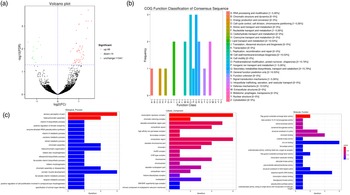
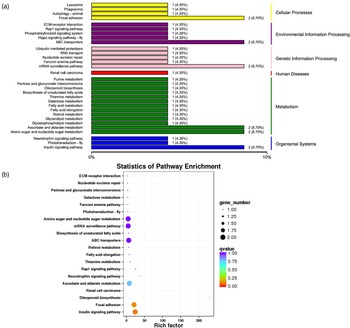
Pairwise comparison of transcriptomes in irradiated and control treatments indicated that 62 unigenes were differentially expressed during microwave exposure; 48 unigenes were induced and the remaining 14 were repressed (fig. 2a). Fourteen, 45, 42, 36, 45, 39, 56, 49, and 56 DEGs were obtained and functionally annotated using the COG, GO, KEGG, KOG, Pfam, Swiss-Prot, TrEMBL, eggNOG, and NR databases, respectively. The COG classification results are shown in fig. 2b. DEGs were primarily assigned to ‘post-translational modification, protein turnover, chaperones’ (15.79%), ‘secondary metabolite biosynthesis, transport and catabolism’ (15.79%), ‘lipid transport and metabolism’ (10.53%), ‘general function prediction only’ (10.53%), ‘defense mechanisms’ (10.53%) and ‘cell wall/membrane/envelope biogenesis’ (10.53%). GO enrichment analysis results were categorized into three groups: e.g. biological processes, cellular components, and molecular functions. With respect to genes in biological processes, the results showed that ‘sensory perception of pain’, ‘heterochromatin assembly’, and ‘somatic muscle development’ were enriched and expressed. The cellular component categories were enriched for ‘transcription repressor complex’, ‘extracellular region’ and ‘obsolete extracellular region part’. In the molecular function grouping, ‘zinc ion binding’, ‘sequence-specific DNA binding’ and ‘chromatin binding’ were the most frequent categories represented in response to microwave radiation (fig. 2c). DEGs were compared to KEGG database entries to further elucidate gene functions. A total of 31 pathways were identified for 37 DEGs; the 20 most-enriched KEGG pathways are shown in fig. 3. In response to microwave radiation, enriched pathways were assigned to the ‘insulin signaling pathway’, ‘focal adhesion’ and ‘ABC transporters’ (fig. 3).
Differentially expressed genes (DEGs) and its functional annotation in L. trifolii under microwave radiation. (a) Volcano plot of microwave treatment vs. control. The y-axis represents −log10 significance, whereas the x-axis represents log2-fold change. Red dots indicate induced unigenes, whereas green dots indicate repressed unigenes; (b) Functional classification of DEGs into clusters of orthologous groups (COG); (c) Gene ontology (GO) enrichment assignments of annotated DEGs: biological processes, cellular components, molecular function.

(A) DEGs based on pathways in the KEGG database. The x-axis indicates the percentages of genes that are annotated to a specific pathway; y-axes indicate the categories in the KEGG repository; (B) The twenty most enriched KEGG pathways among DEGs under microwave radiation. The Rich factors represent the ratio of DEG numbers vs. the number of genes annotated in the pathway. Larger Rich factors indicate a greater level of enrichment. The q values are corrected P values ranging from 0 to 1, with lower values indicating greater enrichment.

Annotation and validation of DEGs
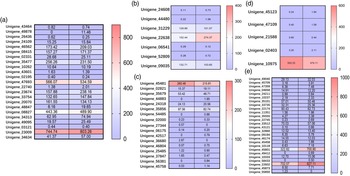
The top ten upregulated DEGs in L. trifolii exposed to microwave radiation are shown in table 3. DEGs related to reproduction, insect immunity, and growth and development pathways were significantly expressed in response to microwave radiation. Induced DEGs included ‘ejaculatory bulb-specific protein 3’, ‘transmembrane protease serine 11D’, and ‘cuticle protein 2’, whereas repressed DEGs encoded ‘20-hydroxyecdysone protein’, ‘serine protease inhibitor 42Dd’ and ‘chitin-binding type-2 domain-containing protein’ (table 3). Interestingly, we compared two types of genes related to stress tolerance and found no significant difference between genes encoding Hsps and antioxidant-related enzymes after microwave radiation (fig. 4). Ten DEGs with distinct expression patterns were selected to validate RNA-seq data by qPCR. The expression of the ten genes by qPCR correlated with RNA-seq data (R 2 = 0.9593; P < 0.05) (fig. 5), indicating that the latter data are reliable.
Heatmap of genes encoding Hsps (a) and antioxidant enzymes related genes (b: CAT; c: POD; d: SOD; E: GST) under microwave radiation. Color scale from red to blue indicates log2 transcription ratios.

Validation of gene expression patterns by RT-qPCR. (a) Means (±SE) were used to determine transcript levels with the 2−ΔΔCt method. The y-axes indicate log-transformed FPKM values (right) and log-transformed relative expression (left). (b) Linear correlation analysis of RNA-seq and RT-qPCR data.

Annotated DEGs of L. trifolii exposed to microwave treatment

Functional verification of selected DEGs by RNAi
DEGs encoding cuticular protein (CP, unigene_08138) and protein takeout (TO, unigene_22373) were chosen for RNAi experiments based on fold-change values (fig. 5). RNA interference studies were conducted by immersing L. trifolii prepupae in solutions containing dsRNA specific for CP and TO. There was a significant reduction in CP expression when prepupae were immersed with dsCP (24.76%) in comparison to the dsGFP control (t = 3.030; P < 0.05) (fig. 6a). Similar expression patterns were observed for TO expression, which was significantly reduced (38.53%) when prepupae were immersed in dsTO (t = 9.717; P < 0.05) (fig. 6b). When L. trifolii was exposed to 90 s of microwave radiation after dsRNA treatment, mortality increased by 33.99 and 42.78% for dsCP and dsTO, respectively, as compared to dsGFP (26.48%) (fig. 6b). Mortality was further increased to 54.85% when prepupae were treated with both dsCP and dsTO and exposed to 90 s of microwave radiation, and this difference was significantly higher than the dsGFP control (F 3,8 = 5.569; P < 0.05) (fig. 6b).
RNAi-mediated knockdown of CP and TO genes expressions in L. trifolii immersed with dsCP and dsTO (a) and mortality rate of L. trifolii after 90 s microwave radiation (b).

Discussion
It is well-established that microwave radiation negatively impacts insect colonization of stored products (Bedi and Singh, Reference Bedi and Singh1992; Zhang et al., Reference Zhang, Jin, Wang, Sun, Qin and Zhang2007; Lu et al., Reference Lu, Zhou, Xiong and Zhao2010; Purohit et al., Reference Purohit, Jayas, Yadav, Chelladurai, Fields and White2013; Barbosa et al., Reference Barbosa, Fontes, Silva, Neves, de Melo and Esteves2017); however, little research has been conducted to address the underlying mechanisms of microwave radiation on agricultural and invasive pests (Chen et al., Reference Chen, Lin, Lai, Shi, Weng and Cai2018; Zhang et al., Reference Zhang, Yi, Chu, Yuan, Zhan, Leng, Li, Hu and Li2020). For example, the application microwave radiation at 600 W for 13 min was consisted to be a possible control method for Empoasca onukii, the tea green leafhopper (Chen et al., Reference Chen, Lin, Lai, Shi, Weng and Cai2018). In the current study, microwave radiation was shown to significantly inhibit the emergence of L. trifolii pupae. RNA-seq was used to study the effects of microwave radiation on gene expression, and the role of two DEGs in conferring tolerance to microwaves was evaluated using RNAi.
The biological effects of microwave radiation can be divided into thermal and non-thermal effects (Hoz et al., Reference Hoz, Díaz-Ortiza and Morenoa2005). The mechanisms involved in the lethal action of microwave radiation could be due to the high oscillation frequency of water molecules in the bodies of the insects. Microwave heating is based on the transformation of electromagnetic field energy into thermal energy and can kill insects (Lu et al., Reference Lu, Zhou, Xiong and Zhao2010); however, there is no research on genome-wide changes in gene expression during microwave irradiation. The reproductive process of insects has been extensively studied because of its importance in species propagation and its potential as a target for control methods (Roy et al., Reference Roy, Saha, Zou and Raikhel2018). In this study, ‘ejaculatory bulb-specific protein’ was highly expressed, which suggests that microwave radiation impacts reproduction in L. trifolii. In another study, the expression of genes encoding vitellogenin and its receptor were upregulated in Ostrinia furnacalis during exposure to UV-A (Liu et al., Reference Liu, Meng, Yang and Zhang2020). In M. persicae, exposure to microwave radiation at different frequencies and durations had variable effects on the mortality and reproduction of apterous adults. Short-term microwave radiation promoted the reproduction of one-day-old apterous adults of M. persicae; apterous aphids had the greater fertility when subjected to microwave radiation for 30 s but their reproduction was inhibited when subjected to radiation for 15 and 120 s (Zhang et al., Reference Zhang, Yi, Chu, Yuan, Zhan, Leng, Li, Hu and Li2020). In addition, the use of microwave radiation is different from sterile insect technique (SIT), where ionizing radiation is used to produce sterile males of target insects, resulting in declining pest populations in defined regions (Knipling, Reference Knipling1959; Robinson, Reference Robinson, Dyck, Hendrichs and Robinson2005). However, for microwave radiation, the detection of specific spawning at different radiation times needs to be supplemented to prove this point.
In response to UV-A radiation, comparative transcriptome analysis between UV-treated and control groups in O. furnacalis indicated the involvement of pathways associated with signal transduction, detoxification, the stress response, immune defense, and antioxidative systems (Su et al., Reference Su, Yang, Meng, Zhou and Zhang2021). Meanwhile, antiviral and FcγR-mediated phagocytosis of immune-related genes were induced during exposure to UV-B radiation, which indicates that insects have strong immune-adaptive functions (Adamo, Reference Adamo2012, Reference Adamo2017; Yang et al., Reference Yang, Meng, Yao and Zhang2021). In the current study, microwave radiation significantly reduced the expression of several immune-related genes, including serine protease inhibitor and serine/threonine-protein phosphatase. These results indicate that the underlying mechanism of microwave radiation is different from other nonionizing forms of radiation. The thermal effects of microwave radiation can accelerate cell division and reproductive rates in organisms, which are conducive to the cells in the division stage (Pang and Zhang, Reference Pang and Zhang2001). However, in our study, genes involved in growth and 20-hydroxyecdysone (20E) synthesis were down-regulated; the latter is especially significant since 20E controls and coordinates development in insects during metamorphosis (Riddiford et al., Reference Riddiford, Cherbas and Truman2000; Dubrovsky, Reference Dubrovsky2005).
In Myzus persicae exposed to UV-A radiation, DEGs were associated with antioxidants and detoxification, metabolism and protein turnover, the immune response, and stress-related signal transduction; furthermore, the shd gene, which encodes 20-hydroxylase and converts ecdysone into 20E, was significantly down-regulated during UV-B exposure. The synthesis of 20E in M. persicae may be inhibited by UV-B, which needs to be confirmed by further experiments (Yang et al., Reference Yang, Meng, Yao and Zhang2021). In the present study, genes encoding cuticular protein in L. trifolii were significantly up-regulated in response to microwave radiation. This is notable because the insect exoskeleton is an assembly of chitin and cuticular proteins (Charles, Reference Charles2010). Interestingly, multiple genes encoding cuticular proteins genes were significantly down-regulated in M. persicae during UV-B stress (Shang et al., Reference Shang, Ding, Ye, Yang, Chang, Xie, Tang, Niu and Wang2020), suggesting that radiation stress impacts insects differentially.
Microwave radiation induces thermal activity (Lu et al., Reference Lu, Zhou, Xiong and Zhao2010), and it likely that the increased temperature due to microwave irradiation was responsible for the induction of Szhsp70 and Szhsp90 in the maize weevil, S. zeamais (Tungjitwitayakul et al., Reference Tungjitwitayakul, Tatun, Vajarasathira and Sakurai2016). Similarly, microwave radiation induced Hsp70 expression in chick embryos (Shallom et al., Reference Shallom, Di Carlo, Ko, Penafiel, Nakai and Litovitz2002) and human neuroblastoma cells (Calabrò et al., Reference Calabrò, Condello, Currò, Ferlazzo, Caccamo, Magazù and Ientile2012). The effects of other nonionizing radiation treatments have been reported in insect pests, and genes encoding Hsps and antioxidant enzymes have been studied as mechanisms that provide some tolerance to radiation (Tungjitwitayakul et al., Reference Tungjitwitayakul, Tatun, Vajarasathira and Sakurai2016; Su et al., Reference Su, Yang, Meng, Zhou and Zhang2021; Yang et al., Reference Yang, Meng, Yao and Zhang2021). In S. zeamais, Szhsp70 and Szhsp90 were induced after UV-C radiation, and Szhsp70 was expressed at a much higher level than Szhsp90 (Tungjitwitayakul et al., Reference Tungjitwitayakul, Tatun, Vajarasathira and Sakurai2016). The response of Hsp70 to irradiation has also been reported for T. castaneum (Sang et al., Reference Sang, Ma, Qiu, Zhu and Lei2012), where Hsp70 was the most highly up-regulated Hsp in response to microwave treatment. In another study, exposure to UV radiation significantly increased mortality of the tephritid fruit fly, B. dorsalis, during the pre-oviposition period, significantly reduced the number of eggs deposited, and lowered the activities of several antioxidant enzymes (Cui et al., Reference Cui, Zeng, Reddy, Gao, Li and Zhao2021). In contrast, our results showed no significant difference in the expression of genes encoding antioxidants or Hsps when L. trifolii was exposed to microwave radiation.
Physical control techniques are important components of pest management and provide alternatives to chemical control. Physical methods are safe, convenient and do not pollute the environment (Sang et al., Reference Sang, Gao, Zhang, Huang, Lei and Wang2022). Recently, the use of microwaves to sterilize insects has attracted attention (Bedi and Singh, Reference Bedi and Singh1992; Lu et al., Reference Lu, Zhou, Xiong and Zhao2010; Purohit et al., Reference Purohit, Jayas, Yadav, Chelladurai, Fields and White2013; Barbosa et al., Reference Barbosa, Fontes, Silva, Neves, de Melo and Esteves2017). In our study, two DEGs, namely CP and TO, were examined by RNAi to evaluate their role in response to microwave-mediated radiation stress. Our results showed that the knockdown of CP and TO significantly reduced the survival of L. trifolii exposed to microwave radiation. The combination of microwave radiation and RNAi has potential application in the control of insect pests. In RNAi, which is widely used to study gene function (Joga et al., Reference Joga, Zotti, Smagghe and Christiaens2016); dsRNA is used to trigger the degradation of homologous mRNA. The dsRNA can be delivered in dietary form or by immersion or microinjection; however, the latter is limited due to the difficulty in using it for controlling pests in the field. Delivery of dsRNA to pests as a dietary supplement requires that insects feed and absorb dsRNA via the midgut; however, barriers to the midgut may reduce RNAi efficiency in some insects (Burand and Hunter, Reference Burand and Hunter2013; Baum and Roberts, Reference Baum and Roberts2014; Joga et al., Reference Joga, Zotti, Smagghe and Christiaens2016). The immersion method is another potential method of delivering to RNAi to pests (Tabara et al., Reference Tabara, Grishok and Mello1998; Zhang et al., Reference Zhang, Li, Guan and Miao2015), In this study, dsRNA was delivered to prepupae by the direct immersion method. The prepupal stage can morph into pupae within a few hours (Parrella, Reference Parrella1987), and dsRNA may be encapsulated in the insect body to facilitate delivery. The development of portable devices to deliver microwave radiation and dsRNA would significantly improve the use of RNAi technology in the field. In terms of pest control, the potential impact of dsRNA on the quality of agricultural products should be evaluated, and recommended dosages would need to be determined for large-scale application trials.
In general, our study showed that microwave radiation can inhibit the emergence of L. trifolii pupae. Transcriptome analysis of L. trifolii exposed to microwave radiation revealed significant expression of genes involved in reproduction, immunity, and growth and development; these were generally more highly expressed than stress-related genes encoding Hsps or antioxidant enzymes. Microwave irradiation combined with RNAi would be facilitated by better comprehension of fundamental physiological mechanisms and represents a new direction for pest management, especially for invasive insects.
Supplementary material
The supplementary material for this article can be found at https://doi.org/10.1017/S0007485322000578.
Acknowledgements
This research was funded by the national natural science foundation of China (32202275), the start-up project of high-level talent of Yangzhou University (137012465), the science and innovation fund project of Yangzhou University (X20220618), the earmarked fund for Jiangsu agricultural industry technology system (JATS [2021] 346), the Jiangsu science & technology support program (BE2014410), the special fund for detection and identification of sudden major agricultural pests in Nanjing Area and special finance project of Pukou district of Nanjing City.
Conflict of interest
The authors declare no conflict of interest.