Introduction
In this study we explored bilingual and monolingual children's ability to give metalinguistic judgements on the grammaticality of specific and generic plural Noun Phrases (NPs) in English and in Italian. So far none of the research on bilinguals’ acquisition of nominals has investigated how children deal with the semantics of plural NPs (Müller, Reference Müller1994; Granfeldt, Reference Granfeldt2000; Serratrice, Reference Serratrice2000; Kupisch; Reference Kupisch2004, Reference Kupisch2007). Specific and generic plural NPs are an interesting case to consider in the context of English–Italian bilingual acquisition as the two languages differ in the distribution of the definite article to mark specificity and genericity. Plural NPs in subject position in Italian, as in other Romance languages like Spanish, always require a definite article regardless of their semantic interpretation. By contrast, in English plural NPs in subject position can appear with or without a definite article, depending on whether they are interpreted as specific or as generic (Longobardi, Reference Longobardi1994, Reference Longobardi2001).
The aims of this study were the following: to examine whether primary school bilingual and monolingual children can discriminate between specific and generic readings of plural NPs in English as a function of the semantic context, whether they correctly reject bare plural NPs in Italian, regardless of context, and whether bilingual children's linguistic judgements in one language are affected by knowledge of the other language. We also explored how the language of the community and the typological relatedness between a bilingual's two languages affect linguistic performance. In essence we wanted to find out whether bilinguals’ grammaticality judgements are affected by cross-linguistic influence, and whether the effect can be predicted by cross-linguistic differences in the distribution of the definite article, by the amount of input they receive in each language, and by the typological relation between the two languages. In other research (Sorace, Serratrice, Filiaci and Baldo, Reference Sorace, Serratrice, Filiaci and Baldo2009) we found significant differences between 6–7-year-olds and 8–10-year-olds in a forced-choice task testing the acceptability of overt and null pronouns. In this study we therefore tracked children's performance between six and at ten years of age to determine whether performance changes over time as a function of increased exposure to the language.
Cross-linguistic influence as a function of properties of the target language and frequency of exposure
The issue of cross-linguistic influence and the nature of syntactic representations in simultaneous bilingual children have been the object of a debate ever since systematic investigation of bilingual first language acquisition started in the late 1970s (Volterra and Taeschner, Reference Volterra and Taeschner1978; Taeschner, Reference Taeschner1983; Genesee, Reference Genesee1989). The current prevailing understanding is that bilingual children who are regularly exposed to two languages from birth or thereafter have separate syntactic representations for each of their two languages. The bulk of the evidence for this claim comes from studies focusing on cross-linguistic differences in word order where young bilinguals have been shown to use language-specific word order in each of their languages (Meisel, Reference Meisel, Hyltenstam and Obler1989, Reference Meisel1994; Paradis and Genesee, Reference Paradis and Genesee1996). If language A has the word order X1–X2 and language B has the word order X2–X1 and a bilingual child acquiring languages A and B uses the appropriate word order in each of her languages, then we can conclude that this child has separate syntactic representations for the two languages and that there is no evidence for cross-linguistic influence. More interestingly, however, recent work has started to shed light on the nature of syntactic representations and on the mechanisms of language comprehension and production in cases where there is no such clear-cut opposition between the two languages, but where there is a degree of cross-linguistic overlap (Bernardini, Reference Bernardini and Müller2003; Nicoladis, Reference Nicoladis2006; van der Linden and Blok-Boas, Reference van der Linden, Blok-Boas, Foster-Cohen, García-Mayo and Cenoz2005). For example, if language A has both word order X1–X2 and word order X2–X1, and language B only has X1–X2 the prediction is that the word order attested in both languages (X1–X2) will be preferred in the language that has both and it will be extended to contexts in which it is not grammatical or pragmatically acceptable. This does not mean that bilingual children are expected to use the overlapping X1–X2 word order in inappropriate contexts in a systematic fashion. In fact, most of the time bilinguals use language-specific appropriate word orders in both of their languages. Structural overlap is simply “predictive of morphosyntactic transfer, although cross-linguistic transfer is not limited to cases of structural overlap” (Nicoladis, Reference Nicoladis2006: 26). Döpke (Reference Döpke1998), for instance, found that German–English bilingual children overgeneralized the VO order in German, where both VO and OV are possible, under the influence of English where VO is the only possible order. Van der Linden and Blok-Boas (Reference van der Linden, Blok-Boas, Foster-Cohen, García-Mayo and Cenoz2005) reported that three French–Dutch bilingual children and one Italian–Dutch bilingual child growing up in the Netherlands had a tendency to use the Romance word order (possessee–possessor) in Dutch nominal possessive constructions more often than Dutch monolingual children. Both possessee–possessor and possessor–possessee constructions exist in Dutch while Italian only has the possessee–possessor order. Along similar lines, Bernardini (Reference Bernardini and Müller2003) showed that Swedish-dominant Swedish–Italian bilingual children overused the Swedish Adj–N word order in Italian where the preferred word order is N–Adj but the Adj–N order also exists. In a study of adjective placement in English–French bilingual children, Nicoladis (Reference Nicoladis2006) likewise reported the overgeneralization of the English Adj–N word order in French where both Adj–N and N–Adj exist.Footnote 1 At the clause level, Argyri (Reference Argyri2006) and Argyri and Sorace (Reference Argyri and Sorace2007) observed a preference for SV word order in wh-embedded clauses in the Greek of English-dominant English–Greek bilinguals. Both SV and VS are possible word orders in Greek while only SV is attested in English. Once again, the preference for SV is attributed to cross-linguistic influence from English.
In sum, there seems to be an emerging body of evidence suggesting that a degree of cross-linguistic influence is indeed attested in simultaneous bilingual children. Additional support for this hypothesis comes from studies investigating this issue in terms of the interface between syntax and discourse pragmatics (Hulk and Müller, Reference Hulk and Müller2000; Paradis and Navarro, Reference Paradis and Navarro2003; Serratrice, Sorace and Paoli, Reference Serratrice, Sorace and Paoli2004). More specifically, the argument has been made that constructions whose distribution is constrained by discourse pragmatics are particularly vulnerable to cross-linguistic influence when they partially overlap across languages.
Besides properties of the target languages, variables such as language dominance as measured by children's Mean Length of Utterance (MLU), amount of talk, and vocabulary composition have also been investigated as possible contributing factors to cross-linguistic influence (Yip and Matthews, Reference Yip and Matthews2000; Kupisch, Reference Kupisch2007). The role of dominance intended as the amount of input children receive in each language has been systematically investigated by Argyri and Sorace (Reference Argyri and Sorace2007) in a study of bilingual children acquiring Greek and English simultaneously in the UK or in Greece. The results of this study showed that input played a significant role in the magnitude of cross-linguistic influence. Only the Greek of bilinguals in the UK was affected by their knowledge of English, the Greek-dominant bilinguals in Greece behaved like their Greek monolingual peers.
Although not specifically concerned with the issue of cross-linguistic influence but with the issue of children's linguistic awareness more in general, the work of Gathercole also provides substantial evidence for the role of input in bilinguals’ metalinguistic judgements. In three large-scale studies Gathercole (Reference Gathercole2002a, Reference Gathercoleb, Reference Gathercole2007) explored the role of the amount of input as a predictor of linguistic performance in school-age Spanish–English bilingual children in Miami, and of Welsh–English bilingual children in Wales. The findings of the Miami studies were that, overall, the bilinguals performed less accurately than the monolinguals on two grammaticality tasks in Spanish. The bilinguals’ performance was correlated with the amount of Spanish they received at home. Children in homes where only Spanish was spoken performed significantly better than children in whose homes only English was spoken. Similar results on the role of input are reported by Gathercole (Reference Gathercole2007) for the comprehension and production of gender, and the identification of subjects and objects in Welsh–English bilingual children. In both the Miami and the Welsh studies the differences between monolinguals and bilinguals and across the bilingual groups diminished over time as children acquired a critical mass of items necessary to abstract a pattern for the structures in questions.
In view of the role played by language exposure in the child's environment, both on a daily basis and over time, the present study includes the variables of language of the community (Italian, English), and age (6–7-year-olds, 8–10-year-olds), alongside typological relatedness (English–Italian, Spanish–Italian), to address the issue of cross-linguistic influence. Before formulating specific predictions on the directionality of influence, we introduce the theoretical linguistic background on the differences between English and Italian in the distribution of the definite article in plural NPs.
The Nominal Mapping Parameter
In a seminal paper Chierchia (Reference Chierchia1998) framed the empirical observation of cross-linguistic differences in the distribution of definite articles with singular and plural count and mass nouns within the variation of a semantic parameter. According to Chierchia's hypothesis, formalized in the Nominal Mapping Parameter (NMP), natural languages can be divided into three types according to the different ways in which they refer to kinds. Nouns appear to play a double role inasmuch as they can be predicates (e.g. the predicate “a doctor” in “John is a doctor”) or arguments when they refer to kinds (e.g. the argument “a doctor” in “A doctor rang this morning”). The mapping of the syntactic category Noun onto its semantic interpretation as predicate or argument is constrained cross-linguistically by the language-specific setting of the NMP as [± argument] and [± predicate]. Although in principle four combinations of these two features are possible [+arg, +pred], [+arg, −pred] [−arg, +pred] [−arg, −pred], the setting in which nouns cannot be mapped onto either predicates or arguments is clearly an impossibility. From the three settings that are actually attested, Chierchia derives cross-linguistic variation in the availability of bare arguments, the extension of all nouns to mass, and the existence of plurals. Languages like Chinese and Japanese, where the setting is [+arg, −pred], are languages where nouns refer to kinds, therefore bare count nouns occur freely as arguments (e.g. “Girl hugs boy”). In these languages all nouns are also mass and therefore plural marking does not exist. The two remaining settings [−arg, +pred] and [+arg, +pred] are the ones that are more closely relevant to the present study as the former is the setting in Italian, Spanish and the rest of the Romance languages, while the latter is the setting in English and in most of the Germanic languages. In a [−arg, +pred] language all nouns are, by default, predicates and therefore they require a Determiner to be turned into arguments (e.g. *“Ragazza abbraccia ragazzo”/“Girl hugs boy”). There is, however, cross-linguistic variation within the Romance family itself as to the availability of a phonological null Determiner. Languages like Italian and Spanish allow bare NPs in a lexically governed position, while French (3) does not. This is illustrated in (1)–(3).
- (1)
a.

“Women arrived last night.”
b. Ho comprato patate e pane al mercato.
“(I) bought potatoes and bread at the market.”
- (2)
a.
“Women arrived last night.”
b. Compré pan y leche al mercado.
“(I) bought potatoes and bread at the market.”
- (3)
a.
“Women arrived last night.”
b. *J'ai acheté pommes de terre et pain au marché.
“I bought potatoes and bread at the market.”

None of the Romance languages allow bare NPs with a generic interpretation in a non-governed position, but require the projection of a Determiner in the shape of a definite article.
(4) I dinosauri sono vissuti milioni di anni prima dell'arrivo dell'uomo.
“(The) dinosaurs lived millions of years before the arrival of man.”
(5) Los dinosaurios vivieron millones de años antes de la aparición del hombre.
“(The) dinosaurs lived millions of years before the arrival of man.”
(6) Les dinosaures ont vécu des millions d'années avant l'arrivée de l'homme.
“(The) dinosaurs lived millions of years before the arrival of man.”
The definite article is interpreted as í, an operator that selects the greatest element from the extension of a predicate but which can be intensionalized, and thus becomes equivalent to the type shifting operator ∩ in generic sentences and with individual level predicates.
With respect to the availability of count and mass nouns, [−arg, +pred] languages are predicted to have both since the mass/count distinction relates to the extension of predicates. It also follows that those nouns that are count can appear with an overt plural marking.
As regards the last class of languages that are identified by the NMP, i.e. [+arg, +pred] languages like English, Chierchia's proposal is that nouns can either denote kinds (arguments) or predicates. Nouns that denote kinds [+arg] will have mass denotation, as a consequence they will be able to appear as bare NPs in any syntactic position and they will not be marked for plural.
(7) Advice is available online.
(8) I need advice on this issue.
(9) *Advices are always welcome.
Nouns that denote predicates will have count denotation. As such they will not be able to appear as bare arguments in the singular, and they will take plural marking.
(10) *Chair is next to the table.
(11) I moved the chairs into the room next door.
Bare plural arguments do however exist in English, they appear in generic sentences, with individual level predicates, and they are allowed in any syntactic position, unlike in Italian and Spanish where they are restricted to lexically-governed argumental positions.
(12) Dogs are friendly animals.
(13) I like dogs.
The presence of bare plural nouns in English rests on the availability of the type shifter ∩ which can freely apply to plural nouns to yield a kind as in (12) and (13). Because a kind is the totality of its instances it follows that the type shifting operation can apply only to plural nouns and not to singular nouns. Singular count nouns only identify a part and not the totality of the plurality they belong to. Note, however, that English also has definite articles; therefore in principle an intensionalization of the definite article in appropriate semantic contexts should be possible in the same way as it is possible in Romance languages. Contrary to this prediction the sentence in (14) is indeed ungrammatical.
(14) *The dinosaurs became extinct 65 million years ago.
Chierchia's solution to this conundrum is to appeal to the economy-based constraint of “Avoid Structure”. Unlike Romance languages, which have no option but to resort to the intensionalization of the definite article, English does have a type shifting operation that applies to bare nouns to turn them into arguments in generic sentences and with individual level predicates. Because this type shifter can apply as early as the NP level, and it can generate the required semantic interpretation without the extra projection of a Determiner, this solution is preferable in terms of economy considerations and it therefore blocks the use of the definite article.
Monolingual acquisition of specificity and genericity
The NMP offers a theoretical account of the observed cross-linguistic differences between Germanic and Romance languages in the distribution of bare NPs and their interpretation. The presence of a definite article with plural NPs is the crucial difference between English and Romance languages on which we will focus in the present study; there are however other cues that children can exploit to discover the existence of generic and non-generic interpretations of plural NPs. Gelman and Raman (Reference Gelman and Raman2003) identified three main sets of cues that English-speaking children can rely upon to distinguish the generic from the non-generic reading of plural NPs: morphosyntactic cues, pragmatic cues and world-knowledge cues. Morphosyntactic cues include determiners, tense and aspect. As shown above, the presence of a definite article with a plural noun is a very direct and reliable cue (“The dogs bark” vs. “Dogs bark”), so are tense (“A cow says ‘moo’” vs. “A cow said ‘moo’”) and aspect (“Cats meow” vs. “Cats are meowing”). In Romance languages only tense and aspect are potentially useful cues given that definite articles are obligatory in both the generic and the non-generic reading, at least in subject position.
Pragmatic cues include the interpretation of pronouns as co-referential with a specific antecedent (“These are my gerbils. They like to eat sunflower seeds.”) or not (“This is a gerbil. They like to eat sunflower seeds.”). We would add that other pragmatic cues that might point children in the right direction are the understanding of adjuncts like “in general”, “as a whole”, as opposed to “in this story”, “here in this picture”, etc. Both in English and in Romance languages children will have this type of pragmatic cues at their disposal.
There is experimental evidence that English-speaking children as young as three can appreciate the morphosyntactic determiner cue and the pragmatic anaphoric cue to distinguish between a generic and a specific reading (Gelman and Raman, Reference Gelman and Raman2003). In a cross-linguistic study, Pérez-Leroux, Munn, Schmitt and DeIrish (Reference Pérez-Leroux, Munn, Schmitt and DeIrish2004), assessed pre-school children's sensitivity to the determiner and the tense morphosyntactic cues in the generic/non-generic interpretation of plural NPs in English and in Spanish. The results of two experiments with monolingual English-speaking and monolingual Spanish-speaking pre-school and school-age children showed a high rate of generic responses with definite plural NPs (between 40% and 80%), while in the Gelman and Raman's (Reference Gelman and Raman2003) study the authors reported rates of generic responses to definite plural NPs between 8% and 15%. This obvious discrepancy in the rate of generic readings with non-generic wording is probably due to important methodological differences between the two studies. In both the Gelman and Raman (Reference Gelman and Raman2003) study and the Pérez-Leroux et al. (Reference Pérez-Leroux, Munn, Schmitt and DeIrish2004) study, the English-speaking participants were presented with drawings of atypical entities (e.g. spotted zebras), and were asked either a generic question (e.g. “Do zebras have spots?”), or a non-generic question (e.g. “Do the zebras have spots?”). However, while in the Gelman and Raman's experiments the questions were only preceded by a brief statement (e.g. “Here are two birds. Can birds fly?/Can the birds fly?”), in the Pérez-Leroux et al. (Reference Pérez-Leroux, Munn, Schmitt and DeIrish2004) experiment the target question was preceded by a story in which the two entities were identified by a proper name (e.g. “Zippy the zebra and Suzy the zebra are spotted”). Because the animals in the stories were introduced by name, using a definite NP to make subsequent reference to them may have been perceived by the children as discourse-pragmatically odd. A more natural way to identify the animals would have been to use their proper name; the use of an NP might have led the children to rule out the option that the experimenter was talking about the recently named animals, hence the high number of generic interpretations.
The performance of the Spanish-speaking children in Pérez-Leroux et al.'s second set of experiments showed that in the presence of a definite plural NP which can have both a generic and a non-generic interpretation in the language, three-to-five-year-olds and six-year-olds opted for the generic interpretation in the vast majority of cases. Interestingly, although this tendency remained high, it diminished significantly when the question containing the plural definite NP was in the past tense (“¿Los tigres comían carne?”/“Were the tigers eating meat?”). Unlike the English-speaking children, the Spanish-speaking children in this study were able to interpret an imperfective past tense form of a natural kind in current existence as a cue to the non-generic reading.
Although Romance languages like Spanish do not have a dichotomy between plural definite NPs with a specific reading and bare plural NPs with a generic reading in subject position, these two options are indeed available in object position. Gavarró, Pérez-Leroux and Roeper (Reference Gavarró, Pérez-Leroux, Roeper, Torrens and Escobar2006) conducted an experiment with monolingual Catalan-speaking three-, four- and five-year-olds to assess to what extent children differentiate between the specific and the generic reading of an NP in object position on the basis of the presence/absence of the definite article. The results showed that three-year-olds could not reliably exploit the presence/absence of the definite article to give either the intended specific or generic interpretation. The four-year-olds were somewhat more successful, although they still gave incorrect generic answers to a specific question, the five-year-olds never interpreted a specific question as a generic but they gave a specific answer to a generic question approximately 40% of the time, while the adults’ performance was at ceiling in both specific and generic contexts.
The picture that emerges from the studies reviewed here is somewhat inconclusive with respect to young children's ability to discriminate between specific and generic readings of plural NPs. On the one hand, Gelman and Raman (Reference Gelman and Raman2003) provide data in support for systematic differentiation as early as 2;8 in monolingual English speakers. On the other hand, Pérez-Leroux et al. (Reference Pérez-Leroux, Munn, Schmitt and DeIrish2004) and Gavarró et al. (Reference Gavarró, Pérez-Leroux, Roeper, Torrens and Escobar2006) present data showing that Catalan-speaking children as old as 4 and monolingual English-speaking children as old as 5 provide incorrect generic responses with non-generic wording up to 40% of the time. Gavarró et al. also found that Catalan-speaking five-year-olds interpreted a generic wording as specific almost 60% of the time. These discrepancies are however likely to be due to methodological differences in the experimental paradigms adopted. While Gelman and Raman (Reference Gelman and Raman2003) used the prototypical/atypical paradigm, Gavarró et al. (Reference Gavarró, Pérez-Leroux, Roeper, Torrens and Escobar2006) used a task in which the non-specific reading included the specific referent, hence the reason for the lack of sensitivity to the bare noun distinction in the children they tested.
We are not aware of any data on older bilingual children's linguistic awareness of generic and specific readings of plural NPs in English. The main aim of the present study was to use grammaticality judgement tasks to assess whether English–Italian bilingual school-age children and monolingual peers rely on the presence of the definite article in English in conjunction with pragmatic information provided by adverbial adjuncts like “here” or “in general” to discriminate between generic and specific readings of plural NPs. At the same time we wanted to find out whether, because of their knowledge of Italian, the bilinguals would be more inclined to reject bare NPs. For Italian we investigated whether English–Italian bilinguals, Spanish–Italian bilinguals and Italian monolinguals would reject bare NPs as ungrammatical, regardless of specific or generic context, and whether English–Italian bilinguals would be more likely to accept bare NPs, especially in generic contexts, as a result of the availability of bare NPs in their other language.
Predictions
In a number of recent studies cross-linguistic influence has been reported in situations where the two languages are in a subset–superset relationship with respect to a given construction. If a language has two options (e.g. null and overt pronominal subjects in Italian) and one language only has one option (e.g. overt pronominal subjects in English), the option that is common to both languages (e.g. overt pronominal subjects) has been observed to extend to inappropriate contexts in the language that has both (e.g. overt pronominal subjects are used in Italian where null subjects would be more pragmatically felicitous) (Montrul, Reference Montrul2004; Tsimpli, Sorace, Heycock and Filiaci, Reference Tsimpli, Sorace, Heycock and Filiaci2005; Sorace and Filiaci, Reference Sorace and Filiaci2006; Serratrice, Reference Serratrice2007). By this rationale, we should predict that the directionality of cross-linguistic influence for the distribution of definite articles with plural NPs should go from Italian (only definite articles with plural NPs) to English (both definite plural DPs and bare plural NPs) where definite plural NPs should become acceptable with a generic reading. This is in line with Hulk and Müller's (Reference Hulk and Müller2000) and Müller and Hulk's (Reference Müller and Hulk2001) original cross-linguistic influence hypothesis based on structural overlap.Footnote 2
There is however another alternative: it is possible that cross-linguistic influence is driven by more abstract economy considerations. If this hypothesis is correct we would expect the opposite pattern: cross-linguistic influence from English to Italian. English has the opportunity to give bare plural NPs kind reference through type shifting, a more economical operation than the projection of an extra Determiner. If economy considerations underlie cross-linguistic influence, then the more economical option to achieve a generic reading should, at least occasionally, be preferred in Italian over the more costly projection of a DP.
Regardless of which of the two alternative proposals – the subset–superset hypothesis or the economy hypothesis – proves to be a better fit to the data, the input variable is likely to be playing a role in the magnitude of the cross-linguistic influence. If the subset–superset hypothesis is along the right lines we would expect a larger effect in the English of English–Italian bilinguals raised in Italy who will inevitably get more input in Italian and therefore would receive more evidence for the availability of a generic reading with plural definite NPs. Conversely, if cross-linguistic influence is driven by economy consideration, we expect that English–Italian bilingual children raised in the UK would show a significantly larger acceptance rate of bare plural NPs with a generic reading in Italian than their counterparts living in Italy.
In this study we also wanted to explore to what extent the performance of bilingual children is indeed an effect of the typological differences between the two languages that they are acquiring, rather than the effect of having to learn two languages instead of one. Should we observe a significant difference between the English–Italian bilinguals and their monolingual Italian peers, we would still need to establish to what extent the bilinguals’ behaviour is the result of cross-linguistic influence from English, or rather the more general effect of learning two languages simultaneously. This latter possibility has in fact received some preliminary support from studies of the acquisition of Italian by L1 Spanish speakers (Bini Reference Bini and Liceras1993), which found similar error patterns for the use of subject pronouns as those observed in L1 English speakers of Italian, despite the equivalence of the pronoun systems in Spanish and Italian (see Sorace and Filiaci, Reference Sorace and Filiaci2006 for discussion). The additional entailment of this hypothesis is that certain forms have the status of unmarked options that are used by bilingual speakers to overcome temporary processing difficulties or knowledge gaps (Sorace Reference Sorace, Cornips and Corrigan2005, Reference Sorace, Fanselow, Fery, Schlesewsky and Vogel2006).Footnote 3 To ascertain the role of typology vs. bilingualism we therefore included an additional group of age-matched Spanish–Italian bilinguals who are acquiring two languages that behave in the same way with respect to the distribution of definite plural NPs and their specific and generic interpretation. If the typological difference between Italian and English is the cause of cross-linguistic influence, we would expect the English–Italian bilinguals to behave significantly differently both from the monolingual Italian peers and the Spanish–Italian bilinguals, and no significant differences should be observed between the latter two groups. If, conversely, learning any two languages simultaneously is going to significantly affect the performance of bilingual children compared to their monolingual peers, we would not expect significant differences between the bilingual groups, regardless of language combination. At the same time we would expect them to be significantly different from their monolingual Italian peers.
Lastly, we considered the effect of age. If a significant gap between bilingual and monolingual children exists at a given point in time we wanted to find out whether it is likely to narrow over time, so that older bilingual children behave more like their monolingual peers than do younger bilinguals, as we have observed in other research (Sorace et al., Reference Sorace, Serratrice, Filiaci and Baldo2009).
Methods
Participants
A total of 167 children between the ages of 6;2 and 10;10 participated in the study, together with 30 monolingual English-speaking adults, and 30 monolingual Italian-speaking adults. There were two groups of English–Italian bilingual children, one group living in the UK (N = 20) and one group living in Italy (N = 39). The bilinguals in Italy were recruited among the pupils of international or American primary schools in Milan, where English is the medium of instruction. Those in the UK were recruited by word of mouth and through an online forum for Italian nationals (http://www.corriere.it/solferino/severgnini). The Spanish–Italian bilingual children living in Spain (N = 31) were recruited among Italian or mixed origin families in Spain and Italy, and among pupils at the Italian School of Barcelona.Footnote 4 The criteria for the selection of the bilingual children were the following: between six and ten years of age, no history of language impairment or hearing loss; regular exposure to both English and Italian from birth; regular use of both languages on a daily basis; similar perceived fluency in both languages. The parents of suitable children completed a questionnaire on the pattern of language use in their family, and on their perception of the children's ability to use both of their languages in everyday situations effectively.
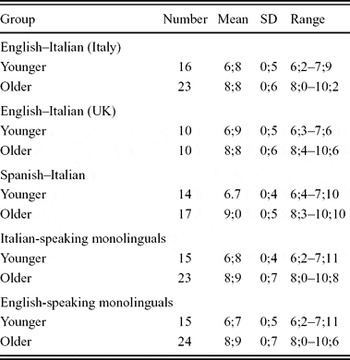
A group of monolingual English-speaking children in the UK (N = 39) and a group of monolingual Italian-speaking children in Italy (N = 38) were also included for control purposes. The criteria for the selection of the monolingual participants were the following: no history of language impairment or hearing loss; no exposure to a language other than Italian or English. The children were recruited to match in age the bilinguals and were therefore between six and ten years of age. The monolingual children were recruited from primary schools in northern Italy and in Scotland. The children were divided into a younger (6;2–7;11) and an older group (8;0–10;10). No statistical age differences existed between the groups either for the younger (F < 1) or the older group (F < 1). The monolingual adults were recruited among university students in Italy and in England. Details for the child participants are provided in Table 1.
Mean age, SD and age range of child participants.

Materials
The English and the Italian versions of the task each included six pairs of test sentences and three pairs of filler sentences. Each pair of sentences was presented together with a picture of prototypical objects or animals. The test sentences included six generic contexts and six specific contexts. In the specific contexts the sentences were introduced by “Here”/“Qui” and in the generic contexts they were prefaced by “In general”/“In genere”. For each picture the participants heard a sentence containing a subject plural NP in a specific context and a sentence with a subject plural NP in a generic context. The presence of the definite article was manipulated to obtain four different conditions so that participants heard three grammatical and three ungrammatical sentences in the specific condition and three grammatical and three ungrammatical sentences in the generic condition. Examples of grammatical and ungrammatical sentences are provided in (15)–(18) below; a full list of test and filler items in English and in Italian is provided in the appendix.
- (15)
a.
b. Qui le fragole sono rosse. (specific grammatical)
“Here the strawberries are red.”
- (16)
a.
b.
“Here strawberries are red.”
- (17)
a.
b.
“In general the sharks are dangerous.”
- (18)
a.
b.
“In general sharks are dangerous.”
The participants' task was to judge whether the sentence they had just heard was okay in English/Italian or not. Instead of using a task where participants were presented only with grammatical options as in the Gelman and Raman (Reference Gelman and Raman2003) studies, we opted for an acceptability judgment task because the aim of this study was precisely to investigate to what extent bilingual children were prepared to accept an option that is ungrammatical in one language but acceptable in the other language. The nature of the task was clearly different in two languages. In Italian children simply had to rely on the presence/absence of the article to accept or reject the sentence as articles are always required in Italian regardless of context. In English, by contrast, children had to use the initial adjunct to decide whether the sentence was acceptable with or without the article. Evidence from comparable metalinguistic tasks administered to Spanish–English bilinguals and monolinguals by Galambos and Goldin-Meadow (Reference Galambos and Goldin-Meadow1990) shows that, both in English and in Spanish, children between the ages of 4 and 7 found it difficult to reject an ungrammatical sentence like “Yesterday I am cleaning the boat” where they had to integrate the temporality of the adverbial adjunct (“yesterday”) and of the auxiliary verb (“am”). Spanish-speaking children rejected these sentences a mere 34% of the time, while the English speakers fared somewhat better at 63%. The same children found it easier to judge ungrammatical sentences with a missing article as in “Boy jumped over the high wall”. The missing article was noticed 55% of the time in Spanish and 69% of the time in English.
The sentences in the English task in this study also called for the integration of the semantics of the adjunct with the semantics of the plural NP, a somewhat more difficult undertaking that noticing the presence or absence of an article in the Italian sentences. The expectation is therefore that performance in the English task should be overall worse than in Italian. We nevertheless predicted that if cross-linguistic difference affects the English–Italian bilingual children they should still perform significantly worse in English according to the subset–superset hypothesis by accepting plural NPs with a definite article in generic contexts, or significantly worse in Italian according to the economy hypothesis by accepting bare NPs in generic contexts.
Procedure
The participants were seen individually in a quiet room at home, at school or on university premises by a female researcher. The English–Italian bilinguals took part in both the English and in the Italian version of the experiment on separate days at least a week apart. Half of the children participated in the English study first and half in the Italian study first. The experiment was preceded by a series of instructions and by two practice items. The participants were told that they would be looking at a series of pictures of objects and animals and that at the same time they would hear some statements about the specific objects and animals in the pictures, and some statements about those objects and animals in general. Their task was to say whether the sentences they heard in those contexts were okay in English/Italian or not. During the practice items participants were asked to pay particular attention to the form of the sentences they were presented with. If they found the sentences unacceptable they were encouraged to provide an acceptable alternative. If the participants did not detect the source of the ungrammaticality the experimenter provided the grammatical alternative herself drawing the participants’ attention to the anomaly in the stimulus sentence. All the children and the adults understood what was required of them during the practice session and no participant failed to complete the task.
English results
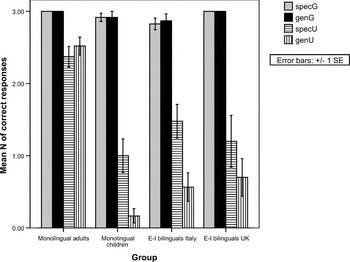
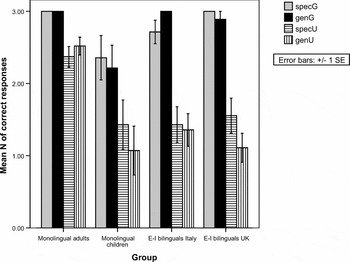
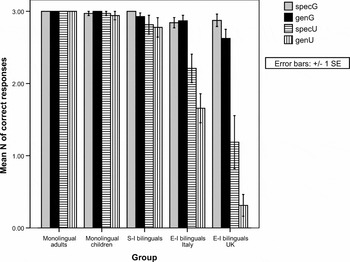
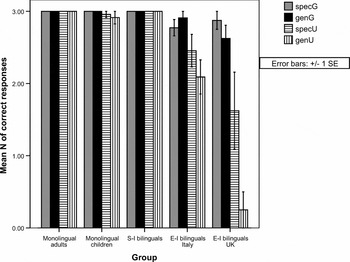
Figure 1 and Figure 2 report the mean number of acceptances of grammatical sentences and the mean number of rejections of ungrammatical sentences in specific and generic contexts for the younger children (6;2–7;11), the older children (8;0–10;10), and the adults.Footnote 5
Mean accuracy scores for the younger children in English.

Mean accuracy scores for the older children in English.

Overall all groups at all ages performed more accurately in specific than in generic contexts, and they were more likely to accept grammatical sentences than to reject ungrammatical ones. To analyse the effects of language background and age on the participants’ responses we performed a mixed-design ANOVA with context (specific, generic) and grammaticality (grammatical, ungrammatical) as within-subjects variables, and age (younger children, older children, adults), and language background (monolingual English-speaking adults, monolingual English-speaking children, English–Italian bilinguals in Italy, English–Italian bilinguals in the UK) as between-subjects variables. The analysis revealed a significant effect of context (F(1,114) = 8.62, p < .01, partial η2 = .07) confirming that items in the specific condition were responded to more accurately than items in the generic condition. There was also a highly significant effect of grammaticality (F(1,114) = 250.22, p < .001, partial η2 = .68), evidence that participants were more likely to accept a grammatical sentence than to reject an ungrammatical one. There was no significant effect of the age variable. Tukey HSD post-hoc tests revealed that this was due to the lack of a significant difference between the younger and the older children (p > .05). The adults however performed significantly better than both groups of children (p > .001). There were also a significant effect of group (F(2,114) = 7.98, p < .01, partial η2 = .12), a significant interaction between grammaticality and age (F(1,114) = 11.27, p < .01, partial η2 = .09), and a significant interaction between context and grammaticality (F(2,114) = 6.97, p < .01, partial η2 = .05).
To further explore the group differences and these interactions we conducted additional one-way ANOVAs for the younger and the older children separately (Tukey HSD post-hoc tests were used in the pairwise comparisons). In the younger group, the only significant difference in the mean number of correct acceptances of grammatical sentences in the specific context (F(3,60) = 3.88, p < .01, partial η2 = .16) was between the adults and the monolingual children (p < .05). The younger monolinguals also accepted significantly fewer grammatical sentences than the adults (p < .01), the bilinguals in the UK (p < .05) and the bilinguals in Italy (p < .01) in the generic context (F(3,60) = 6.75, p < .01, partial η2 = .25). No other differences were significant in this condition.
With respect to the mean number of rejections of ungrammatical sentences in the specific context, the only significant differences were between the adults and the monolingual children (p < .05), and the adults and the bilingual children in Italy (p < .05) (F(3,60) = 5.08, p < .01, partial η2 = .20). Finally, the adults also correctly rejected a significantly higher number of ungrammatical sentences in the generic context than all the child groups (all ps < .01) (F(3,60) = 5.08, p < .01, partial η2 = .39).
In the older group there were no significant differences as a function of language background in the acceptance of grammatical sentences, either in the specific or the generic context (specific context F(3,80) = 2.25, p > .05); generic context F(3,80) = .82, p > .05). There were significant differences in the rejection of specific and generic ungrammatical sentences (specific context F(3,80) = 8.48, p < .001, partial η2 = .24; generic context F(3,80) = 53.18, p > .001, partial η2 = .66), but in both contexts the only significant differences were between the adults and the three groups of children (all ps < .05), while the children did not different significantly as a function of language background.
Response patterns within the groups
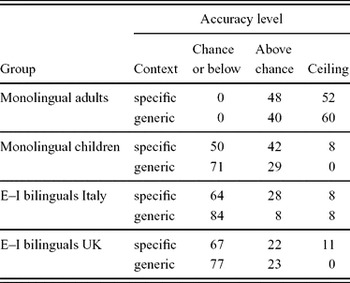
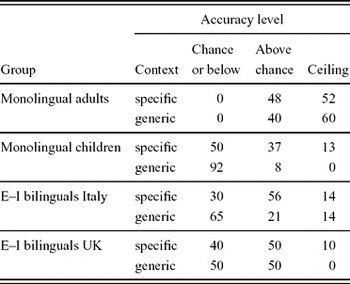
In addition to the analyses of mean group data we provide information on within-group response patterns. Table 2 (adults and younger children) and Table 3 (adults and older children) report the percentage of participants in each group as a function of the number of correct responses in the specific and in the generic conditions. The maximum number of correct responses in each condition was six (three correct acceptances of grammatical sentences, and three correct rejections of ungrammatical sentences). A score of 6 indicates ceiling performance, a score of 3 or below corresponds to chance or below chance performance, and a score between 4 and 5 is indicative of above chance performance.
Within-group response patterns in English for the adults and the younger children.

Within-group response patterns in English for the adults and the older children.

The profile for the younger children is fairly consistent for both conditions and for all groups, with half to two thirds of children performing at chance or below chance level. In the older group the monolingual children did not perform any better than their younger counterparts; if anything, fewer children were above chance level in the generic condition. Both groups of older bilingual children were more accurate than the younger bilinguals, especially in the specific condition. In the generic condition more bilingual children performed at above chance level only in the UK group.
Interestingly, although the adults performed consistently better as a group, only half of them performed at ceiling in either condition. Possible reasons for this pattern of behaviour will be offered in the general discussion.
Discussion
The results of the acceptability judgement task in English show an overall poor level of performance both for the two groups of bilinguals and for the monolingual children. The children in this study correctly accepted plural NPs with a definite article in specific contexts and bare plurals in generic contexts. However, they also accepted ungrammatical bare plurals in specific contexts and definite articles with plural NPs in generic contexts. Both bare plurals and plural NPs with a definite article are grammatical in English, but their grammaticality crucially depends on the semantic context. Contrary to our expectations, the adverbial adjuncts used in this task failed to set up unambiguously specific or generic contexts. Similarly to the children in the Galambos and Goldin-Meadow's (Reference Galambos and Goldin-Meadow1990) study the children in this study had obvious difficulties integrating the semantics of the adjunct with the semantics of the presence/absence of the article. This difficulty was also compounded by the fact that the adjuncts we used were not 100% successfully recognized even by the adults. Nevertheless, aside from the overall poor performance, there was no evidence that the bilingual children tended to accept more sentences with a definite article in generic contexts as predicted by the subset–superset hypothesis.
Italian results
Figure 3 and Figure 4 report the mean number of acceptances of grammatical sentences and the mean number of rejections of ungrammatical sentences in specific and generic contexts for the younger children (6;2–7;11), the older children (8;0–10;10), and the adults. Unlike in English, where the performance of the monolinguals was far from perfect, in Italian the adult monolinguals scored 100% correct in both contexts, the younger and older monolinguals, and the older Spanish–Italian bilinguals were equally accurate. The younger Spanish–Italian bilinguals did not perform at ceiling, but their performance was well above chance in all contexts. In contrast, the English–Italian bilinguals, and especially those in the UK, accepted more ungrammatical sentences, particularly in the generic contexts, than all other groups. To analyse the effects of language background and age on the participants’ responses we performed a mixed-design ANOVA with context (specific, generic) and grammaticality (grammatical, ungrammatical) as within-subjects variables, and age (younger children, older children, adults), and language background (monolingual Italian-speaking adults, monolingual Italian-speaking children, Spanish–Italian bilinguals, English–Italian bilinguals in Italy, English–Italian bilinguals in the UK) as between-subjects variables. Tukey HSD post-hoc tests were used for all the pairwise comparisons. The analysis revealed a significant effect of context (F(1,135) = 31.58, p < .001, partial η2 = .19) showing that items in the specific condition were responded to more accurately than items in the generic condition. The effect of grammaticality was highly significant (F(1,135) = 108.13, p < .001, partial η2 = .68), confirming that participants were more likely to accept grammatical sentences than to reject ungrammatical ones. There was a significant effect of age (F(1,135) = 9.18, p < .01, partial η2 = .06), with the expected differences between younger children, older children and adults (all ps < .01). There were also a significant effect of group (F(3,135) = 47.82, p < .001, partial η2 = .51), with significant differences between the two bilingual groups and the other three groups of monolingual children, monolingual adults and Spanish–Italian bilinguals (all ps < .001); a significant interaction between context, group and age (F(3,135) = 5.86, p < .01, partial η2 = .11) showing that response accuracy varied as a function of the generic or specific context, as a function of age and as a function of language background, with English–Italian bilingual children giving significantly fewer correct responses than monolingual and Spanish–Italian bilingual children. Finally, we also found a significant interaction between context, grammaticality and group (F(1,135) = 3.43, p < .01, partial η2 = .07), showing that response accuracy varied as a function of context (specific vs. generic), and of grammaticality (acceptance of grammatical sentences, rejection of ungrammatical sentences) with the English–Italian bilingual children performing less accurately than the monolinguals and the Spanish–Italian bilinguals.
Mean accuracy scores for the younger children in Italian.

Mean accuracy scores for the older children in Italian.

To further explore the meaning of these interactions we conducted additional one-way ANOVAs for the younger and the older children separately (Tukey HSD post-hoc tests were used for all the pairwise comparisons). In the younger group, there was no significant difference in the mean number of correct acceptances of grammatical sentences in the specific context (F(4,69) = .99, p > .05). The difference in the mean number of correct acceptances of grammatical sentences in the generic context was barely significant (F(4,69) = 2.66, p = .04, partial η2 = .13), with the only significant group differences being between the bilinguals in the UK and the monolingual adults (p < .01), and between the bilinguals in the UK and the monolingual children (p < .05). The pattern for the mean number of correct rejection of ungrammatical sentences was similar in the specific (F(4,69) = 13.51, p < .001, partial η2 = .43) and in the generic contexts (F(4,69) = 38.08, p < .001, partial η2 = .68), with the only non-significant differences between the monolingual groups and the Spanish–Italian bilinguals, all other pairwise comparisons were significant (all ps < .01). In both the specific and in the generic contexts the worst performers were the English–Italian bilinguals in the UK who accepted significantly more bare plural NPs than all the other groups.
In the older group there was a significant difference in the mean number of acceptances of grammatical sentences in the specific condition between the five groups (F(4,94) = 3.13, p < .05, partial η2 = .11). The English–Italian bilinguals in Italy accepted fewer sentences than all the other groups (all ps < .01), except than the bilinguals in the UK. In the generic condition there was a significant effect of language background (F(4,94) = 4.35, p < .01, partial η2 = .15); this time it was the English–Italian bilinguals in the UK who rejected the highest number of grammatical sentences than any other group (all ps < .01). There were significant group differences also in the ungrammatical specific context (F(4,94) = 9.27, p < .001, partial η2 = .28) and in the ungrammatical generic context (F(4,94) = 42.04, p < .001, partial η2 = .64). In both conditions the only non-significant differences were between the monolingual children, the adults and the Spanish–Italian bilinguals, all other group differences were significant (all ps < .01).
Response patterns within the groups
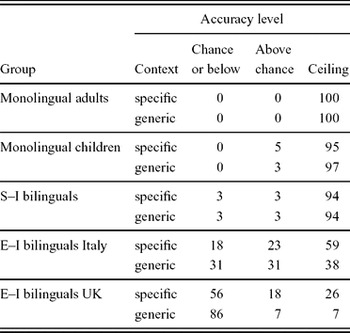
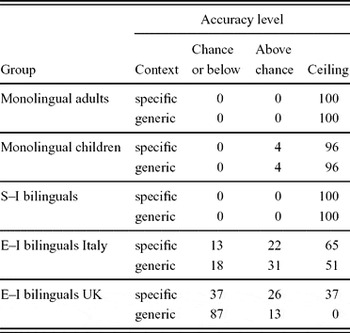
Table 4 (adults and younger children) and Table 5 (adults and older children) report the percentage of participants in each group as a function of the number of correct responses in the specific and in the generic conditions.
Within-group response patterns in Italian for the adults and the younger children.

Within-group response patterns in Italian for the adults and the older children.

Unlike in English, where only half of the adults performed at ceiling, in Italian all the adults achieved 100% accuracy scores in both conditions. In the younger group of children more than 94% of the Spanish–Italian bilinguals and of the monolingual children scored at ceiling in both conditions. By contrast, the same level of accuracy in the specific condition was obtained by 59% of the English–Italian bilinguals in Italy and by a mere 26% of the bilinguals in the UK. Performance in the generic condition was even worse for the two groups of English–Italian bilinguals with only 38% of those in Italy and 7% of those in the UK scoring at ceiling. In the older group the monolingual children's performance was the same as for the younger monolinguals, while all of the Spanish bilinguals scored 100% correct in both conditions. The percentage of English–Italian bilinguals in Italy at the highest end of the performance scale also increased to reach 65% of the group in the specific condition and 51% in the generic condition. In contrast the percentage of the bilinguals in the UK at ceiling increased only in the specific condition (from 26% to 37%), while no children achieved perfect accuracy in the generic condition in the older age group.
Discussion
The results of the Italian task show a strikingly different pattern of performance from the results of the English task. In Italian bare plural NPs in subject position are always ungrammatical. We did not anticipate that the use of adverbial adjuncts would make any difference for the monolingual participants and the Spanish–Italian bilinguals, but our rationale for using them was to find out whether they would make a difference for the English–Italian bilinguals. The Italian-speaking monolingual children in both age groups, and in both conditions, performed virtually at ceiling, like the adults. They correctly accepted plural NPs with a definite article in both specific and generic contexts and at the same time they rejected ungrammatical bare plurals in both conditions. The Spanish–Italian bilingual children were also at ceiling in both conditions but only in the older age group; in the younger group three out of 14 children accepted some ungrammatical bare plurals in either the specific and in the generic condition (two children) or in the generic condition alone (one child); differences with their monolingual peers were however not statistically significant. The evidence from the monolingual children and from the Spanish–Italian bilinguals indicates that their ability to discriminate between ungrammatical and grammatical plural NPs in this type of metalinguistic task is well established at age 6. They had no problems in consistently rejecting sentences without a definite article; these sentences are always ungrammatical in Italian, regardless of context. Children never hear bare plurals in subject position in Italian; rejecting an unattested construction is undoubtedly easier than deciding between two constructions that are both in use, but in different contexts, as in English. Despite the relative ease of this task, the English–Italian bilingual children were significantly less accurate than the Spanish–Italian bilinguals and than the monolinguals in both conditions and in both age groups. Overall they accepted grammatical plural NPs with a definite article but they were unable to consistently reject ungrammatical bare plurals. Crucially, their performance was worse in generic contexts where bare NPs are indeed acceptable in English, but performance in the specific contexts was also generally poorer than for the monolinguals. The acceptance of bare NPs in generic contexts suggests that these children are treating these NPs as [+arg] with no need to project a Determiner, an option that is grammatical in English because of the different setting of the NMP. If these children treat Italian, at least occasionally as a [+arg, +pred] language like English, the acceptance of bare NPs in specific contexts is likely to be a more indirect effect of the difficulty to integrate the semantics of the adjunct with the absence of the article, similarly to what was observed for the English task.
As far as the role of input is concerned there is clear evidence that the bilinguals in Italy consistently outperform their counterparts in the UK in both conditions, although as they grow older both groups of children become better at rejecting specific plural NPs without a definite article. Crucially, with respect to the generic condition only the bilinguals in Italy show significant progress, while the bilinguals in the UK remain at chance level.
General discussion
The main aim of the present study was to establish whether English–Italian bilingual children would be significantly different from English- and Italian-speaking monolingual peers in rejecting bare NPs in Italian, especially in generic contexts, and in accepting plural NPs with a definite article, especially in generic contexts in English. We initially formulated two contrasting hypotheses on the directionality of cross-linguistic influence. According to the subset–superset hypothesis we predicted that Italian (the language with only definite plural NPs) would influence English (the language that has both definite plural NPs and bare plurals). As a consequence, English–Italian bilingual children should be willing to accept plural NPs with a definite article in a generic context in English significantly more often than monolingual children. The result of cross-linguistic influence from Italian to English would thus result in a higher acceptance rate of ungrammatical definite NPs. Conversely, if cross-linguistic influence exists but is driven by more abstract economy considerations, rather than by the surface overlap of definite articles, we would expect, following Chierchia's (Reference Chierchia1998) Nominal Mapping Parameter, that English should influence Italian. The more economical type shifting operation would be preferred over the more costly projection of a Determiner to turn a plural NP into an argument. The assumption here is that bilingual English–Italian children would treat, at least occasionally, Italian as a [+arg, +pred] language like English. When nouns denote kinds [+arg], and type shifting applies at the level of the plural NP to turn bare nouns into arguments, as it does in [+arg, +pred] languages, there is no need to project a Determiner for the same purpose, and it is therefore undesirable to do so on economy grounds (“Avoid Structure”).
Our results did not show a significant difference between the English–Italian bilinguals and the English-speaking monolinguals in the accuracy scores in the generic condition, but we did find significant differences between the English–Italian bilinguals and their monolingual Italian peers in the generic condition. In English the bilinguals performed at chance level in both the generic and the specific condition and were equally as likely as the monolinguals to accept a plural NP with a definite article in a generic context or a bare NP in a specific context. Crucially the English–Italian bilinguals were no more likely than the monolinguals to accept definite NPs in generic contexts.
In contrast, in Italian the English–Italian bilinguals were significantly more likely than the monolinguals to accept a bare plural in a generic context, an option that the Italian children rejected 100% of the time. These findings suggest that cross-linguistic influence from English to Italian did take place as a result of the adoption of the more economical English setting of the NMP [+arg, +pred] in Italian, for a substantial number of English–Italian bilinguals, especially those with English as the language of the community.
The nature of the grammaticality tasks
Although the results are clear-cut in the asymmetry between English and Italian, it is worth commenting further on the performance pattern of all groups in both conditions in the English task, and in the specific condition in the Italian task. Aside from the bilingual children, the monolingual English-speaking children also performed at chance level in both conditions and even the adults did not perform at ceiling. We believe that it is precisely the different nature of the two grammaticality tasks that is the cause for the strikingly different behaviour in the two languages. In Italian the occurrence of bare plurals is narrowly confined to lexically governed positions, and a bare plural in subject position is obviously ungrammatical, as shown by the categorical rejection even by the youngest Italian speakers. In English, both definite plural NPs and bare plurals are found in subject position, albeit in different contexts. The sheer availability of these two types of NPs in the input makes it more difficult for the English speakers to reject either outright. The participants failed to match the semantics of the adjuncts “Here”/“In general” introducing the sentences in the specific and in the generic condition respectively. In a sense it is always possible for the English-speaking participants to conjure up a context in which the sentence is grammatical, while this possibility is not available to the Italian-speaking participants because of the overall ban on bare plural subjects. Paying attention to the pragmatics of the initial adjuncts calling for either a specific (“Here”) or a generic context (“In general”) was crucial to the task. The results of the English task show that children, and even adults to some extent, found this difficult and were inclined to override the pragmatics of the adjunct and consider a context in which the sentence would indeed be acceptable. This is probably also due to the fact that, although the adjunct created a bias, it was not as strong as we had anticipated. These results are very similar to the findings reported by Galambos and Goldin-Meadow (Reference Galambos and Goldin-Meadow1990) for sentences in which there was a mismatch between a temporal adverbial adjunct (e.g. “yesterday” = past) and the tense of the auxiliary verb (“am” = present). In a comprehension task of specific and generic plural NPs in Catalan, Gavarró et al. (Reference Gavarró, Pérez-Leroux, Roeper, Torrens and Escobar2006) report a similar overinterpretation of the context in which children, and even some adults, treated plural NPs with and without a definite article as having both a specific and a generic reading. In a recent study of the effect of specificity on clitic omission in Spanish, Borgonovo, Bruhn de Garavito, Guijarro-Fuentes, Prévost and Valenzuela (Reference Borgonovo, Bruhn de Garavito, Guijarro-Fuentes, Prévost, Valenzuela, Foster-Cohen, Medved Krajnovic and Mihaljević Djigunović2006) reported another instance in which participants behaved in an unexpected way. When choosing between two answers to a question containing a non-specific bare noun (e.g. “¿Compraste leche?”/“Did (you) buy milk?”) the native speakers and the L2 learners selected the answer with a clitic (“Sí, la compré”/“Yes (I) bought it”) 15.7% and 40% of the time respectively, when in fact they should have chosen the sentence without a clitic (“Sí, compré”/“Yes (I) bought”) 100% of the time because the NP in the question (“leche”/“milk”) was non-specific. Clearly, the participants treated the bare noun in the question as if it was in fact preceded by a definite article (“¿Compraste la leche?”/“Did (you) buy the milk?”), a specific context in which indeed the sentence with the clitic would have been appropriate.
This tendency of comprehenders to disregard crucial semantic, syntactic or pragmatic information in the interpretation of written language has been recently explored in the language processing literature (Christianson, Hollingworth, Halliwell and Ferreira, Reference Christianson, Hollingworth, Halliwell and Ferreira2001; Ferreira, Bailey and Ferraro, Reference Ferreira, Bailey and Ferraro2002; Ferreira, Reference Ferreira2003). In a series of experiments, Ferreira and associates have shown that comprehenders do not always compute the full syntactic structure of a sentence. Instead, it appears that they rely on shallow processing guided by a simple NVN strategy (e.g. the subject of a sentence is also the agent, and the object is the patient) rather than on the full computation of semantic and syntactic structure. For example, in a passive sentence the subject is not the agent but the patient, abiding by the NVN strategy in the processing of a non-canonical sentence will therefore lead to the wrong thematic role assignment.
In sum, there is evidence that comprehenders of all ages and linguistic backgrounds are willing to ignore the context provided by the experimenter and accept a sentence as grammatical if the option is somehow available in their language. What is important for the present study, however, is the fact that the English–Italian bilingual children did not accept definite NPs in generic contexts in English significantly more often than the monolingual children. This would be expected if the obligatoriness of definite articles in Italian were affecting their judgments in English. In addition we argue that the difficulty that the bilingual children experienced in integrating the semantics of the adjunct and the semantics of the NP in English, and the availability of both bare and definite plural NPs also spilled over into Italian. While the Italian monolinguals and the Spanish–Italian bilinguals simply relied on the morphosyntactic cue provided by the presence/absence of the article, the English–Italian bilinguals brought to the task their knowledge of the availability of both bare and definite plural NPs in their other language, and their inefficient matching of the semantics of adjuncts and NP form. What is crucial in terms of the cross-linguistic influence hypothesis is that performance in generic contexts was significantly worse than performance in specific context. Over and beyond the issues outlined above, in the generic contexts there was the added contribution made by the fact that children in English are indeed exposed to grammatical bare plural NPs in these contexts.
With respect to the issue of unidirectionality of cross-linguistic influence, we acknowledge that the use of an initial adverbial adjunct did not create as strong a bias as expected in English. As a consequence, the results from this task cannot categorically rule out the possibility that we might have also found influence from Italian to English, as predicted by the structural overlap hypothesis, if the adjuncts had elicited clearer specific and generic readings. Only between 10% and 50% of monolingual children performed at ceiling on this task, in contrast to the virtual 100% correct performance of their Italian counterparts. To completely exclude the possibility that the English–Italian bilinguals are accepting more ungrammatical definite NPs in generic contexts in English one would ideally have a situation in which the semantic context is unambiguously associated with either a specific or a generic reading of the plural NP. The expectation would therefore be that the monolingual children would behave at ceiling (as the Italian children did), and any differences with the bilinguals could be considered more clearly an effect of cross-linguistic influence due to structural overlap. Although we cannot completely rule out the possibility that influence from Italian to English might be possible, we do have a clear-cut set of results in Italian showing cross-linguistic influence from English. It may indeed be possible that both structural overlap and economy considerations might play different roles in conjunction with language dominance, as suggested by Foroodi-Nejad and Paradis (Reference Foroodi-Nejad and Paradis2007). As discussed below, we did find that the likelihood that an English–Italian bilingual child would accept a bare plural NP in a generic context was significantly greater if they lived in the UK, suggesting that the amount of input accounted for a significant proportion of the variance.
The role of input
The second prediction formulated in connection with the directionality of cross-linguistic influence concerns the role of input. We have observed a unidirectional effect from English to Italian, therefore, if the language of the community plays an important part in the magnitude of the differences between bilingual children and their monolingual peers, we predicted that the bilingual children in the UK would perform significantly less accurately than the bilinguals in Italy. Although both groups of English–Italian bilinguals scored significantly lower in the generic condition than the monolinguals in both the younger and the older group, we did find that the bilinguals in Italy consistently outperformed their bilingual counterparts in the UK. This suggests that the frequency with which Italian is heard and spoken by the children must have an effect on the likelihood of accepting a bare plural as an acceptable generic phrase. In a number of large-scale studies on the metalinguistic awareness of bilingual and monolingual children Gathercole (Reference Gathercole2002a, Reference Gathercoleb, Reference Gathercole2007) consistently reported that frequency of input in each of a bilingual's two languages is a significant predictor of the child's performance in each of her languages. The higher the input, the more accurate the performance. Similar findings are reported by Argyri and Sorace (Reference Argyri and Sorace2007) in their study on language dominance and cross-linguistic influence. These results and those of the present study indicate that the role of input is non-trivial and should therefore be considered as an explanatory variable in future research.
The role of typological relatedness
To our knowledge this is also the first relatively large-scale study to compare groups of bilingual children who are acquiring two different language combinations.Footnote 6 Our rationale for doing so was to explore whether any differences we might find between the English–Italian bilinguals and the Italian monolinguals are indeed the effect of the different parametric setting between English and Italian or more generally the consequence of the simultaneous acquisition of two languages. Italian and English have different settings of the NMP (Nominal Mapping Parameter), English is [+arg, +pred] while Italian is [−arg, +pred]. Although it is very likely that significant differences between bilinguals and monolinguals in Italian are due to the fact that the English–Italian bilinguals get interference from speaking and hearing English in addition to Italian, we cannot a priori rule out the eventuality that the effect is due to learning two languages rather than one. If we take this second possibility seriously we can formulate two sets of predictions. Because Spanish and Italian have the same [−arg, +pred] setting of the NMP, we would expect Spanish–Italian bilingual children to behave like monolinguals and significantly better than English–Italian bilinguals, if what drives the likelihood of accepting a bare plural in a generic context is indeed the availability of the [+arg] setting in English. If, alternatively, accuracy in this discrimination task is affected by the number of languages spoken we would expect Spanish–Italian and English–Italian bilingual children to behave alike and significantly worse than monolingual Italian children. Our results show that the Spanish–Italian bilinguals behaved significantly more like the Italian monolinguals than like the English–Italian bilinguals, suggesting that learning two languages with the same NMP setting did not affect their performance on the task.
The role of age
Finally, our results also address the issue of development over time and convergence on the performance of monolinguals. In English the older bilingual children were no more accurate than the younger ones, but neither were the monolinguals. In Italian the monolingual children were already at ceiling in the younger group, the younger Spanish–Italian bilinguals were not quite at ceiling but their performance was already very accurate. They had a margin for improvement which they took advantage of to reach 100% correct responses in the older group. As for the English–Italian bilinguals, improvement was observed for both groups in the specific condition, but in the generic condition, of greater interest here, only the bilinguals in Italy showed a significant improvement. This interaction between age and language of the community suggests that convergence on the monolingual target might depend crucially on frequency of use and exposure to the language. As a consequence, significant differences between bilingual and monolingual performance might persist over time, and perhaps never disappear, in the language with reduced native input.
Conclusion
The results of this study showed unidirectional cross-linguistic influence from the language with the most economical setting of the NMP which indicates that structural overlap is not always necessary for cross-linguistic influence to take place. Bare plural NPs in Italian with a generic reading are not found in subject position in Italian, in contrast to English, but English–Italian children did accept them as a grammatical option, especially if their community language was English. Whether bidirectional cross-linguistic influence is also possible, and whether structural overlap and economy considerations are both viable are open questions that await further research.