Introduction
Hearing loss is associated with a loss of health and well-being. Patients receiving a bone-anchored hearing aid (BAHA) experience well documented improvements in quality of life indicators, when measured with the Glasgow Benefit Inventory, Medical Outcome Study Short-Form 36 Health Survey, EuroQol-5D and Hearing Handicap Inventory for Adults.Reference Sánchez-Camón, Lassaletta, Castro and Gavilán1–Reference Wazen, Spitzer, Ghossaini, Kacker and Zschommler9
However, hearing loss has complex social consequences affecting the quality of our interactions with others. The impact is felt not only by the patient but by all those with whom he or she communicates. Efforts to remediate hearing loss are also likely to affect others in the patient's social environment, perhaps as much as the patient. This is particularly true when considering the intense communication present between a patient and their spouse or partner. Current literature has shown that partners experience an improved quality of life after their spouse receives hearing augmentation via conventional hearing aids and cochlear implants.Reference Stark and Hickson10–Reference Kennedy, Stephens and Fitzmaurice12 However, this effect has been far less explored for patients with BAHAs.
Patients' partners can also provide a different viewpoint, and may notice functional changes in their spouse, after rehabilitation, which are not recognised by the patient themself. For example, the effect of a significant reduction in the volume of a shared television may be quite evident to the more normal hearing partner, but may have minimal impact on the hearing-impaired partner.
The more normal hearing partner may also be more acutely aware of communication that is missed, and of the change that occurs after hearing augmentation. It is not uncommon for partners to report in frustration, ‘he doesn't even know what he's missing!’, while the poorer hearing spouse remains oblivious.
The current study was designed to determine whether the subjective quality of life improvements noted by BAHA recipients were also noted by their partners.
Materials and methods
Population
The study was approved by the relevant institutional ethics board prior to commencement (see below).
All adult patients who received BAHAs through our institution from July 2002 to July 2008 were identified (n = 172).
Eleven patients were excluded, for the following reasons: three patients were deceased; three were deemed incompetent to complete a relatively high level written questionnaire because of cognitive issues; three had moved outside the immediate region; and two had had their BAHA removed.
Surveys were sent to the remaining 161 BAHA recipients.
Survey
A survey package was mailed to each BAHA recipient, which included a cover letter, survey and return envelope.
The survey contained three sections.
The first section consisted of multiple-choice and short-answer questions regarding the BAHA recipient's overall perception of the success of their aid, along with usage patterns and complications.
The second section was directed towards the BAHA recipient's partner. It contained a modified Hearing Handicap Inventory for Adult Screening. The partner was asked to use this questionnaire to rate the BAHA recipient's response to particular scenarios, both before and after receiving their BAHA. Each ‘before’ and ‘after’ scenario was assessed by 10 questions regarding the BAHA recipient's degree of handicap; valid responses comprised ‘no’, ‘sometimes’ and ‘yes’.
The third section consisted of the Speech, Spatial and Qualities of Hearing Scale survey, and was directed towards the BAHA recipient. The results of this survey were not analysed in the current study, which focussed on partner responses.
Approximately four weeks after the initial survey mailing, non-responders were contacted by members of the research team to offer assistance in returning the survey.
Statistical analysis
The partners' responses to the Hearing Handicap Inventory for Adult Screening were scored by assigning a value of 0 to ‘no’, 2 to ‘sometimes’ and 4 to ‘yes’. The sum of responses (range 0–40) before and after BAHA fitting were compared using the Wilcoxon signed-rank test.
The patient's partner-reported pre-BAHA handicap (assessed using the Hearing Handicap Inventory for Adult Screening) was compared to their pre-BAHA pure tone average (PTA) in both the better and poorer hearing ear, using the Spearman rank order correlation coefficient. Subgroup analysis was performed for patients with single-sided versus non-single-sided deafness.
Each patient's partner-reported change in handicap (pre- versus post-BAHA, assessed using the Hearing Handicap Inventory for Adult Screening; possible values from −40 to 40) was compared to the patient's soundfield threshold at their initial BAHA fitting, as well as to their improvement in PTA (pre- versus post-BAHA). The Spearman rank order correlation coefficient was used to calculate correlation and significance. Subgroup analysis was performed for patients with single-sided versus non-single-sided deafness.
Patients' partner-reported changes in handicap were also compared to their own perceptions of the degree of success of their BAHA (1 = great or moderate failure, 2 = partial failure, 3 = no change, 4 = partial success, 5 = moderate or great success).
Ethical considerations
The study protocol was reviewed and accepted by the Capital Health Research Ethics Board (Halifax, Nova Scotia, Canada).
Survey packages included a letter outlining the purpose of the study. Patients were advised that neither agreement nor refusal to participate in the study would affect their ongoing care.
Every effort was made to ensure participant confidentiality. Surveys and return envelopes did not contain patient names. Surveys were marked with a code decipherable only by the research team, to facilitate subsequent follow-up telephone calls.
Results and analysis
Ninety-one (56.5 per cent) of the contacted BAHA recipients returned completed surveys. Of these, 73 (80.2 per cent) reported having a partner, and 71 had complete pre- and post-BAHA audiograms available for analysis.
Of these 71 patients, nine had single-sided deafness.
Partners' perceptions of patients' hearing handicap
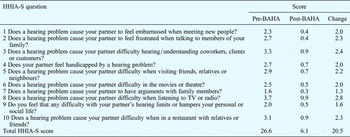
The patients' mean ± standard deviation (SD) partner-reported Hearing Handicap Inventory for Adult Screening score was 26.6 ± 10.1 before BAHA fitting and 6.1 ± 8.4 after BAHA fitting; this represented a statistically significant improvement of 20.5 (p < 0.0001).
Of the 710 scenarios presented to partners in the Hearing Handicap Inventory for Adult Screening (i.e. 71 partners answering 10 questions each), partners indicated the presence of a pre-BAHA functional deficit in 548 (77 per cent). When a pre-BAHA deficit existed, partners noted a post-BAHA improvement in 85.0 per cent of cases, no change in 14.6 per cent and deterioration in 0.4 per cent. Ninety-seven per cent of partners reported a functional improvement for at least one Hearing Handicap Inventory for Adult Screening scenario.
Partners were most likely to report an improvement in listening to radio or television (84 per cent), in restaurants (75 per cent), and in work environments (75 per cent). The reported improvement in Hearing Handicap Inventory for Adult Screening scores is outlined in Table I and Figure 1.
Reduction in partners' Hearing Handicap Inventory for Adult Screening (HHIA-S) score pre vs post bone-anchored hearing aid (BAHA) fitting; outliers indicate 95 per cent confidence intervals.

Modified HHIA-S: mean scores pre- and post-BAHA

HHIA-S = Hearing Handicap Inventory for Adult Screening; BAHA = bone-anchored hearing aid
Audiometric results
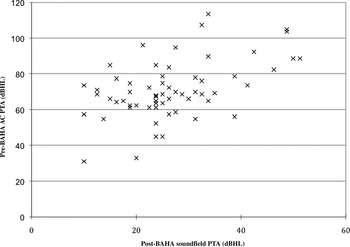
Patients' pre-BAHA air conduction PTAs ranged from 31 to 114 (mean ± SD = 73 ± 18) in the poorer hearing ear and from 1 to 93 in the better hearing ear (mean ± SD = 43 ± 22). Patients' soundfield thresholds post-BAHA fitting ranged from 9 to 51 (mean ± SD = 25 ± 10). A comparison of pre- versus post-BAHA soundfield thresholds in the BAHA-fitted ear is shown in Figure 2.
Patients' pre versus post bone-anchored hearing aid (BAHA) pure tone averages (PTAs). AC = air conduction

Comparison of partner handicap scores vs audiometric measurement
Partners' pre-BAHA Hearing Handicap Inventory for Adult Screening scores were not significantly associated with patients' pre-BAHA PTAs, for either the better ear (Spearman rank order correlation coefficient (ρ) = 0.048, p = 0.69) or the poorer ear (ρ = −0.039, p = 0.74). Similarly, no statistically significant association was found within the non-single-sided deafness subgroup (better ear: ρ = 0.104, p = 0.42; poorer ear: ρ = −0.042, p = 0.75) or the single-sided deafness subgroup (poor ear: ρ = −0.0042, p = 0.991). However, a strongly negative association was found between the pre-BAHA better ear PTA of patients with single-sided deafness and their partner's pre-BAHA Hearing Handicap Inventory for Adult Screening score (ρ = −0.931, p = 0.00025). This means that, in patients with only one hearing ear, the worse the hearing ear, the larger the hearing handicap reported by the patient's partner.
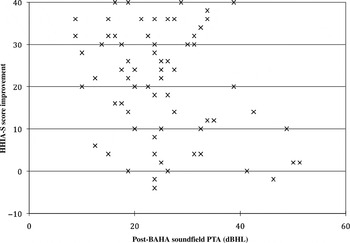
Partners' reported improvement in Hearing Handicap Inventory for Adult Screening score, pre- versus post-BAHA, was moderately but significantly associated with patients' final soundfield PTA (ρ = −0.24, p = 0.048) (Figure 3). The negative ρ value reflects the fact that greater improvements in Hearing Handicap Inventory for Adult Screening score correlated with lower post-BAHA soundfield PTAs. This association was also found in the non-single-sided deafness subgroup (ρ = −0.26, p = 0.045), but not in the single-sided deafness subgroup (ρ = −0.35, p = 0.36).
Patients' post bone-anchored hearing aid (BAHA) soundfield pure tone average (PTA) versus post-BAHA improvement in partners' Hearing Handicap Inventory for Adult Screening (HHIA-S) score.

Improvement in partners' reported Hearing Handicap Inventory for Adult Screening score was not significantly associated with the magnitude of improvement in patients' PTA (pre- versus post-BAHA; ρ = −0.23, p = 0.051).
Comparison of partners' vs patients' impressions
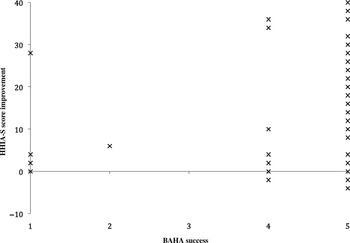
Partners' Hearing Handicap Inventory for Adult Screening scores were compared to patients' subjective ranking of the success of their BAHA fitting. The Spearman rank order correlation coefficient for this comparison was 0.28 (p = 0.016) (Figure 4).
Partners' Hearing Handicap Inventory for Adult Screening score improvement versus patients' ranking of the success of their BAHA fitting (1 = great or moderate failure; 5 = moderate or great success).

Discussion
In the current study, partners of BAHA recipients reported a dramatic reduction in their spouse's hearing handicap after BAHA fitting, as assessed subjectively using a modified version of the Hearing Handicap Inventory for Adult Screening questionnaire. This result was validated by a moderate but statistically significant correlation between the change in partner-assessed Hearing Handicap Inventory score, pre- versus post-BAHA fitting, and the BAHA recipient's post-BAHA fitting soundfield PTA.
This is important information, since partners of BAHA recipients will often notice different effects of BAHA fitting than the BAHA recipients themselves, and further validates the utility of this intervention.
Ideally, we would have preferred to measure simultaneously the Hearing Handicap Inventory for Adult Screening scores of both the BAHA recipients and their partners. However, we did not, for two reasons. Firstly, we believed that there would be significant collusion if patients and their partners were both filling out the same questionnaire, with one inevitably influencing the scores the other assigned for any given question. Secondly, the Speech, Spatial and Qualities of Hearing Scale questionnaire completed by the BAHA recipients is a very long questionnaire, and we were concerned about ‘questionnaire fatigue’ and the impact of this on the quality of data collection.
Analysis of study results was revealing in several ways.
As shown in Figure 4, one patient rated their BAHA as a complete failure, while their partner indicated a large improvement in functional status. Similarly, for those patients who rated their BAHA a complete success, partner impressions varied widely. It was surprising that partners occasionally had a completely opposite viewpoint to that of their spouses.
It was also interesting that partners indicated the greatest impact of BAHA fitting in the scenario described in the Hearing Handicap Inventory question 8 (a mean improvement of 2.8), i.e. listening to TV or radio, an activity that is usually shared (see Figure 2). Most other dimensions of hearing handicap were perceived to be approximately equally improved, apart from those tested in the Hearing Handicap Inventory question 7 (‘Does a hearing problem cause your partner to have arguments with family members?’; mean improvement 1.3) and question 9 (‘Do you feel that any difficulty with your partner's hearing limits or hampers your personal or social life?; mean improvement 1.6). These scenarios generated the least score changes (pre- versus post-BAHA); however (as can be seen in Table I), this was because they were the lowest rated problems prior to BAHA fitting. Similarly, question 8, which generated the greatest score change, was rated as the biggest problem prior to BAHA fitting.
Handicap assessment using Hearing Handicap Inventory for Adult Screening
Several screening tools have been used to assess the emotional and social effects of hearing impairment. Two 25-item questionnaires, the Hearing Handicap Inventory for the Elderly and the Hearing Handicap Inventory for Adults, have been shown to be both valid and reliable, with a statistically significantly relationship with pure tone sensitivity and word recognition ability.Reference Newman, Weinstein, Jacobson and Hug13–Reference Weinstein and Ventry16
A 10-item screening version of the Hearing Handicap Inventory for the Elderly has subsequently been developed to minimise administration time, and has been demonstrated to be valid, repeatable, highly sensitive and highly specific.Reference Lichtenstein, Bess and Logan17 A version of this screening questionnaire for adults, the Hearing Handicap Inventory for Adult Screening, contains two modified questions which address the psychosocial impact on a broader range of adults, including occupational concerns. This latter questionnaire has also been shown to have high internal consistency and reliability, as well as a low standard error of measurement.Reference Newman, Weinstein, Jacobson and Hug14
The present study further modified the Hearing Handicap Inventory for Adult Screening. Questions were framed in order to assess the BAHA recipient's partner's assessment of their spouse's handicap. Patients’ partners were asked to respond to each question from both a pre- and post-BAHA perspective.
Limitations
Although efforts were made to increase survey response rates by telephoning patients four weeks after the initial mailing, the final response rate was 56.5 per cent. This low number may be due to the large number of survey questions (86, including the Speech, Spatial and Qualities of Hearing Scale section (unreported in this study)) and also the complexity of the survey, which requested responses from both the BAHA recipient and their partner, covering both pre- and post-BAHA perspectives.
To our knowledge, no previous study has investigated BAHA patients' hearing handicap as assessed by the patient's partner or ‘significant other’. Thus, the modified Hearing Handicap Inventory for Adult Screening used in the present study has not been externally validated.
The validity of the present survey is also potentially affected by two significant modifications. Firstly, the Hearing Handicap Inventory for Adult Screening was completed by the patient's partner, not the patient themself. Secondly, the partner was asked to complete the survey twice, i.e. from both a pre- and post-BAHA perspective. Ideally, the pre-BAHA questions would have been completed prospectively, before BAHA fitting. However, this would probably have decreased the number of partners available to respond. Also, while this probably limited partners' estimate of patients' actual pre-BAHA handicap, it probably increased the accuracy of their estimation of change in hearing handicap, because partners could manipulate pre- and post-BAHA scores to more accurately reflect the change they perceived. Hence, we propose that the Hearing Handicap Inventory for Adult Screening is a valuable measure of BAHA recipients' partners' perception of the benefit received by their spouse from hearing intervention.
• Hearing loss has complex social consequences and reduces the quality of interactions for both patients and their partners
• Patients fitted with bone-anchored hearing aids (BAHAs) experience significant improvement in both audiometric performance and quality of life
• Partners of BAHA recipients perceive a significant improvement in the emotional and social effects of their spouse's hearing impairment, post-BAHA fitting
• Partners of potential BAHA recipients should be included in clinical decision-making and evaluation
Finally, BAHA recipients' partners' Hearing Handicap Inventory for Adult Screening scores were compared with scores for a single multiple-choice questionnaire, completed by BAHA recipients, ranking the overall success of BAHA fitting. While this comparison indicated a high level of agreement, the latter questionnaire was not externally validated.
Conclusion
It is well known that BAHAs are helpful in improving patient satisfaction and quality of life. These improvements may be underestimated or overestimated by the patient. This study demonstrates that partners of BAHA recipients may also perceive a significant improvement in their spouse's hearing handicap following BAHA fitting. The degree of improvement correlated with the patient's post-BAHA fitting soundfield PTA.
We would encourage clinicians to involve the partners of potential BAHA recipients in the decision-making and evaluation process.