Psychiatric research has been traditionally guided by the de facto assumption that diagnostic categories correspond to homogeneous syndromes, despite substantial etiological, pathophysiological, and phenotypic heterogeneity in psychiatric disorders (Fair, Bathula, Nikolas, & Nigg, Reference Fair, Bathula, Nikolas and Nigg2012). An example – and focus of the current study – is attention-deficit/hyperactivity disorder (ADHD); an early-onset (Kieling et al., Reference Kieling, Kieling, Rohde, Frick, Moffitt, Nigg and Castellanos2010), chronic (Faraone, Biederman, & Mick, Reference Faraone, Biederman and Mick2006), prevalent and costly disorder (Le et al., Reference Le, Hodgkins, Postma, Kahle, Sikirica, Setyawan and Doshi2014). Historically, heterogeneity in ADHD symptoms and associated features (e.g., comorbidities, affective dysregulation [Barkley, Reference Barkley2010; Bunford, Evans, & Wymbs, Reference Bunford, Evans and Wymbs2015c; Musser, Galloway-Long, Frick, & Nigg, Reference Musser, Galloway-Long, Frick and Nigg2013], neuropsychological deficits [Bunford et al., Reference Bunford, Brandt, Golden, Dykstra, Suhr and Owens2015a; Kofler et al., Reference Kofler, Alderson, Raiker, Bolden, Sarver and Rapport2014], temperamental or personality dimensions [Karalunas et al., Reference Karalunas, Fair, Musser, Aykes, Iyer and Nigg2014; Martel & Nigg, Reference Martel and Nigg2006]) and functional impairments (American Psychiatric Association, 2013) was treated as error variance (Kofler et al., Reference Kofler, Sarver, Spiegel, Day, Harmon and Wells2017). Today, this heterogeneity is recognized as informative about causes, maintaining factors, and maximally effective, personalized intervention. Of interest to the current study is heterogeneity in developmental pathways to early adolescent symptoms.
Pathway models of ADHD suggest that atypical brain functioning in networks underlying cognitive and motivational processes correspond to impairments in executive functions and reward-system regulation (Sonuga-Barke, Reference Sonuga-Barke2002), leading to the disorder's observable manifestations. Although data indicate an association between ADHD and reward-system dysregulation, the exact nature of that association is unclear.
Behaviorally, ADHD is associated with altered performance in reward paradigms. For example, relative to typical peers, children with ADHD exhibit quicker devaluation of monetary rewards (i.e., temporal discounting) (Scheres, Lee, & Sumiya, Reference Scheres, Lee and Sumiya2008), prefer immediate, smaller rewards above delayed, greater ones (i.e., delay aversion) (Sonuga-Barke, Sergeant, Nigg, & Willcutt, Reference Sonuga-Barke, Sergeant, Nigg and Willcutt2008), and show impaired reinforcement learning (Haenlein & Caul, Reference Haenlein and Caul1987). Children with ADHD exhibit perseverative responses when previously reinforced behaviors are no longer reinforced (extinction) or are punished (reversal learning) (Itami & Uno, Reference Itami and Uno2002). Finally, reward-system dysregulation is observed in ADHD youths’ unaffected siblings, suggesting it may be a risk factor, or endophenotype (Uebel et al., Reference Uebel, Albrecht, Asherson, Börger, Butler, Christiansen and Rothenberger2011).
Accordingly, there is agreement that ADHD is associated with reward-system dysregulation (Holroyd & Coles, Reference Holroyd and Coles2002). Nevertheless, 30 years of research has failed to yield a consensus about the exact direction and nature of this relation. Some findings indicate ADHD is associated with hyposensitivity to reward (e.g., ventral striatal hypoactivation during reward anticipation [Plichta & Scheres, Reference Plichta and Scheres2014]), whereas others indicate it is associated with hypersensitivity (e.g., orbitofrontal hyperactivation to reward anticipation [Ströhle et al., Reference Ströhle, Stoy, Wrase, Schwarzer, Schlagenhauf, Huss and Heinz2008]). We hypothesize that heterogeneity in ADHD etiology and phenotype may at least partly explain why the literature is inconclusive. Here, we focus on heterogeneity in symptom dimensions and temperament.
Theory and prior research indicate reward-system dysregulation may be particularly applicable to the hyperactive–impulsive (H/I) and combined symptom presentations but less so for the inattentive (IA) presentation (Sagvolden, Johansen, Aase, & Russell, Reference Sagvolden, Johansen, Aase and Russell2005). Altered delay of reward gradient, linked to the meso-limbic dopamine branch associated with reward circuitry, corresponds to atypicalities in motivational style and underlies H/I symptoms, with high behavioral activation/ approach characterizing youth high on H/I symptomology (Sonuga-Barke, Reference Sonuga-Barke2002). On the other hand, altered inhibitory control of attention, competing stimuli, or interference (Barkley, Reference Barkley1997), linked to the meso-cortical dopamine branch projecting to cortical control centers, underlies IA symptoms (Sonuga-Barke, Reference Sonuga-Barke2002). These considerations are indirect support for reward-system dysregulation being applicable to H/I but less so to IA. In terms of direct evidence, delay aversion is more strongly related to H/I than IA in community samples (Scheres et al., Reference Scheres, Lee and Sumiya2008; Thorell, Reference Thorell2007) and H/I, but not IA, is correlated with ventral striatum response to reward anticipation (Scheres, Milham, Knutson, & Castellanos, Reference Scheres, Milham, Knutson and Castellanos2007). However, H/I and IA tend to be highly correlated, especially in clinical samples (Bunford et al., Reference Bunford, Brandt, Golden, Dykstra, Suhr and Owens2015a) and thus diagnostic subclassifications (permutations of H/I and IA) may not best capture the pertinent, reward responsiveness-related distinction. A more contemporary, empirically derived classification of ADHD subgroups into an irritable, a surgent, and a mild subgroup might better capture such distinction (Karalunas et al., Reference Karalunas, Fair, Musser, Aykes, Iyer and Nigg2014). According to this classification, in contrast to the irritable group which may be lower on reward responsiveness and PE, the surgent group would have highest reward responsiveness and PE.
The reward system is part of the larger appetitive or approach system, which, in turn, is part of an architecture of attention- and motivation-regulating systems (described in the most recent formulation of the Reinforcement Sensitivity Theory; McNaughton & Corr, Reference McNaughton and Corr2004; McNaughton & Gray, Reference McNaughton and Gray2000) whose underlying reactivity contributes to individual differences in temperament (Derryberry & Rothbart, Reference Derryberry and Rothbart1997). Leading models of temperament (Martel, Reference Martel2016) converge on four major behavioral and regulatory traits: extraversion/surgency (i.e., high positive affect and sociability), negative emotionality (NE, i.e., high anger, fear, and sadness), and effortful (i.e., deliberate, effortful regulation), and reactive (i.e., affectively driven, reflexive regulation) control (Kostyrka-Allchorne, Wass, & Sonuga-Barke, Reference Kostyrka-Allchorne, Wass and Sonuga-Barke2019; Martel, Reference Martel2016). There traits, as intermediate phenotypes, represent another promising yet understudied individual difference variable along which to parse heterogeneity in ADHD. Compared to typically developing peers, those with ADHD exhibit higher negative affect/neuroticism, higher extraversion/surgency, lower conscientiousness/effortful control (Martel, Reference Martel2016). Consistent with reward-system dysregulation being potentially more applicable to H/I than to IA, the observed associations between personality and ADHD symptom domains also show specificity. High extraversion/surgency (Martel & Nigg, Reference Martel and Nigg2006; Nigg, Blaskey, Huang-Pollock, & Rappley, Reference Nigg, Blaskey, Huang-Pollock and Rappley2002) as well as approach-system dysregulation (Mitchell, Reference Mitchell2010) and high positive emotionality (PE) (Forslund, Brocki, Bohlin, Granqvist, & Eninger, Reference Forslund, Brocki, Bohlin, Granqvist and Eninger2016) have been linked to greater H/I, whereas low conscientiousness/effortful control is related to greater IA (Martel & Nigg, Reference Martel and Nigg2006; Nigg, Blaskey, et al., Reference Nigg, Blaskey, Huang-Pollock and Rappley2002).
Physiological correlates of reward responsiveness and ADHD
The general association between ADHD and reward-system dysregulation has been supported by psychophysiological data indicating that reward and punishment differentially affect heart rate in typical youth but this difference is smaller in children with ADHD (Groen, Mulder, Wijers, Minderaa, & Althaus, Reference Groen, Mulder, Wijers, Minderaa and Althaus2009). Structural and functional neuroimaging findings suggest abnormalities in frontal–striatal systems in ADHD (Bush, Valera, & Seidman, Reference Bush, Valera and Seidman2005). The available literature at the physiological or circuit level of analysis comprises primarily studies with structural or functional imaging methods, despite the complementary advantages of electroencephalography (EEG), which has better temporal sensitivity.
An event-related potential (ERP) component relevant to reward responsiveness is the reward positivity (RewP). The RewP is a positivity in the ERP waveform that is increased for reward compared to loss feedback, evident ~250–300 ms following feedback over frontocentral sites (Kujawa, Proudfit, & Klein, Reference Kujawa, Proudfit and Klein2014). The RewP is associated with ventral striatum and medial prefrontal cortex (PFC) response to reward (Carlson, Foti, Mujica-Parodi, Harmon-Jones, & Hajcak, Reference Carlson, Foti, Mujica-Parodi, Harmon-Jones and Hajcak2011) and behavioral and self-report measures of PE (Kujawa et al., Reference Kujawa, Proudfit, Kessel, Dyson, Olino and Klein2015). Relevant studies with small, cross-sectional samples suggest that ADHD may be characterized by alterations in the RewP (e.g., hypersensitivity to monetary reward [Holroyd, Baker, Kerns, Müller, & Muller, Reference Holroyd, Baker, Kerns, Müller and Muller2008] and unfavorable outcomes [Van Meel, Heslenfeld, Oosterlaan, Luman, & Sergeant, Reference Van Meel, Heslenfeld, Oosterlaan, Luman and Sergeant2011]).
Taken together, there is heterogeneity in ADHD symptoms and associated features, potentially due to heterogeneity in pathogenic pathways. Although evidence indicates that reward-system dysregulation is key to one such pathway, individual differences in symptom presentation and temperament may be important in understanding the reward-system dysregulation–ADHD relation.
Although ADHD was historically conceptualized as a childhood-limited disorder, follow-up studies now show that of childhood cases, depending on assessment method and source (Sibley et al., Reference Sibley, Swanson, Arnold, Hechtman, Owens, Stehli and Stern2017), up to 49.9% meet diagnostic criteria (Roy et al., Reference Roy, Hechtman, Roy, Arnold, Sibley, Molina and Stern2016), and 65% have impairing symptoms in young adulthood (Faraone et al., Reference Faraone, Biederman and Mick2006). A greater number of symptoms in adolescence and young adulthood is associated with greater functional impairments at home and in peer relations, as well as lower life satisfaction and job preparedness, and higher rates of generalized anxiety, depression, conduct problems, and marijuana dependence (Agnew-Blais et al., Reference Agnew-Blais, Polanczyk, Danese, Wertz, Moffitt and Arseneault2016). This underscores the importance of examining developmental pathways to greater adolescent symptoms, given its associations with increased impairment. There is little research on neural predictors of greater early adolescent ADHD symptoms, though available data indicate ventrolateral prefrontal cortex activation during a go/no-go task differentiate adolescents with lower from those with higher symptoms severity, with the latter group showing greater activation (Schulz, Newcorn, Fan, Tang, & Halperin, Reference Schulz, Newcorn, Fan, Tang and Halperin2005). Extending these results to additional neural indices of relevant characteristics such as reward responsiveness is key to pinpointing early-appearing and potentially malleable determinants of adolescent symptom severity.
The current study
Our goals were to examine (a) associations between observed temperamental emotionality (PE and NE) at age 3 years, initial response to reward (i.e., processes evoked by the initial presentation of a positive reinforcer as reflected by behavioral and neural responses) (NIMH, 2011) indexed by the RewP at age 9 years, and ADHD symptoms at age 12 years, (b) and whether the longitudinal association between temperament and ADHD symptoms in early adolescence is mediated by initial response to reward indexed by the RewP. Data were obtained in a prospective study of a large sample of youth, initially assessed at age 3 (Klein & Finsaas, Reference Klein and Finsaas2017) and then followed-up 6 and 9 years later.
H/I and IA symptom dimensions were examined separately given theory (Sonuga-Barke, Reference Sonuga-Barke2002) and empirical data (Scheres et al., Reference Scheres, Lee and Sumiya2008; Thorell, Reference Thorell2007) that ADHD-H/I but not ADHD-IA is associated with altered reward responsiveness. PE and NE were also examined separately as we were interested in the specificity of distinct aspects of temperamental emotionality.
It was hypothesized that greater PE at age 3 would predict greater ADHD-H/I symptoms 9 years later, controlling for prior ADHD symptoms, and that these associations would be mediated by enhanced reward responsiveness at age 9 years, respectively. As the current study is the first wherein these complex associations are considered, there is insufficient prior data that would allow for specific hypotheses regarding the association between PE and ADHD-IA, or the role of NE in the observed associations.
Method
Participants
Participants were part of a larger prospective study in the United States (Klein & Finsaas, Reference Klein and Finsaas2017), initially recruited using commercial mailing lists when children (N = 559) were 3 years old. Children without a developmental disability or significant medical condition, who were living with at least one biological, English-speaking parent, were eligible. The sample was evaluated again at ages 9 and 12, at which times the reward task and clinical interviews were administered, respectively (see Kujawa et al., Reference Kujawa, Proudfit and Klein2014 for additional details).
Data on NE and PE at age 3 years and RewP at age 9 years were available for 427 children and of these, data for 42 were excluded for noisy EEG data, leaving a sample of 385 children. Of these, data were excluded for 1 for being an outlier on NE and of the remaining 384, data on ADHD symptoms at age 9 and 12 years were available for 354 children, who comprised the analysis sample. The sample at the age-12 assessment (M age = 152.12 months, SD = 5.19) was 44.6% female, regarding ethnicity, 10.7% Hispanic and regarding race, 94.9% Caucasian, 1.4% African American, 3.1% Asian, and 0.6% other.
Procedure
Temperament was assessed via laboratory observation when children were 3 years old. To conduct EEG assessments to assess RewP, children were invited back to the laboratory as close to their ninth birthday as possible. Finally, to assess child psychiatric symptoms, children and their parents completed semi-structured clinical interviews around age 9 and 12.
Measures
Negative and positive emotionality
Laboratory observation of temperament included a standardized set of 12 episodes designed to allow for observation of individual differences in expression of emotion and other temperament-relevant behaviors. Eleven episodes were from the Laboratory Temperament Assessment Battery (Lab-TAB) (Goldsmith, Reilly, Lemery, Longley, & Prescott, Reference Goldsmith, Reilly, Lemery, Longley and Prescott1995) and one was adapted from a Lab-TAB episode. The episodes and corresponding tasks, in order of presentation, were as follows: in the “Risk Room” children explored a set of ambiguous and novel stimuli, including a balance beam, a black box, and a Halloween mask; for the “Tower of Patience”, children and an experimenter alternated turns in building a tower, with the experimenter taking increasing amounts of time to place her blocks on the tower; for “Arc of Toys” children played with toys independently for 5 min before the experimenter asked the child to clean up; in “Stranger Approach” children were briefly left alone in the room before a male accomplice entered, speaking to the child while slowly walking closer; and for “Make That Car Go” children and an experimenter raced remote-controlled cars. In “Transparent Box” an experimenter locked an attractive toy in a transparent box, leaving the child alone with a set of non-working keys. After a few minutes, the experimenter returned and told the child that she had left the wrong set of keys. The child used the new keys to open the box and play with the toy; for “Exploring New Objects” children were given the opportunity to explore a set of ambiguous and novel stimuli, including a mechanical spider, a mechanical bird, and sticky soft gel balls; for “Pop-Up Snakes” children and an experimenter surprised the parent with a can of potato chips that contained coiled snakes; in “Impossibly Perfect Green Circles” the experimenter repeatedly asked the child to draw a circle on a large piece of paper, mildly criticizing each attempt, and in “Popping Bubbles” children and an experimenter played with a bubble-shooting toy. For “Snack Delay”, children were instructed to wait for the experimenter to ring a bell before eating a snack and the experimenter systematically increased the delay before ringing the bell, and in “Box Empty” children were given an elaborately wrapped box to open under the impression that a toy was inside. After the child discovered the box was empty, the experimenter returned with several toys for the child to keep (see Kujawa et al., Reference Kujawa, Proudfit, Kessel, Dyson, Olino and Klein2015 for additional details).
Coding of PE and NE followed previously established guidelines (Durbin, Klein, Hayden, Buckley, & Moerk, Reference Durbin, Klein, Hayden, Buckley and Moerk2005), and was based on bodily, facial, and vocal displays of anger, fear, sadness, and positive affect in each episode. Ratings were summed separately for each domain (bodily, facial, vocal) across the 12 episodes. PE consisted of the sum of the standardized positive affect and interest/engagement variables (Dyson, Olino, Durbing, Goldsmith, & Klein, Reference Dyson, Olino, Durbing, Goldsmith and Klein2012). Positive affect was defined as frequency and intensity of joyful body movements, smiling, and positive verbalizations, with each occurrence rated on a 3-point scale (low, moderate, high) and summed within each episode, and then summed across episodes. Interest/engagement was a global rating based on all behavior, for example, child comments about the activity and engagement in play, rated on a 4-point scale (none, low, moderate, and high) for each episode and ratings were summed across episodes. Each occurrence of anger, fear, and sadness was also rated on a 3-point scale (low, moderate, high), summed within each episode, and then summed across episodes. NE consisted of the sum of the anger, sadness, and fear variables. Raters were assigned to code specific episodes (rather than one rater coding all episodes for a participant). PE and NE exhibited adequate internal consistency (α = .82 and .74, respectively) and interrater reliability (intraclass correlation coefficients [ICCs] = .89 and .82, respectively; n = 35). To reduce skewness and kurtosis, a constant was added to NE scores to eliminate negative values and then a log transformation was applied. Transformations were unnecessary for PE scores.
Prior data indicate moderate temporal stability of laboratory ratings of temperament from age 3 to 7 years and moderate concurrent and longitudinal associations between Lab-TAB ratings and home observations (Durbin, Hayden, Klein, & Olino, Reference Durbin, Hayden, Klein and Olino2007). Lab-TAB ratings predict self- and informant-rated PE and NE in early adolescence (Kopala-Sibley, Olino, Durbin, Dyson, & Klein, Reference Kopala-Sibley, Olino, Durbin, Dyson and Klein2018).
Reward task
The “Doors” reward task has been used to elicit a RewP in children and adolescents (Bress, Smith, Foti, Klein, & Hajcak, Reference Bress, Smith, Foti, Klein and Hajcak2012) and is reliable across development (Kujawa et al., Reference Kujawa, Carroll, Mumper, Mukherjee, Kessel, Olino and Klein2018). We have previously found modest associations between age-3 PE and age-9 RewP in this sample (Kujawa et al., Reference Kujawa, Proudfit, Kessel, Dyson, Olino and Klein2015). The task consisted of 60 trials (30 gain, 30 loss), presented in three blocks of 20 trials and in a random order. At the beginning of each trial, children were told that they have to pick one of two doors and, depending on their pick, could either win $0.50 or lose $0.25. Next, children were presented with an image of two doors and instructed to choose one by clicking the left or right mouse button. Once children selected a door, a fixation mark (+) appeared for 1,000 ms, and feedback (gain or loss) was presented for 2,000 ms. A gain or win was indicated by a green up arrow (↑) and a loss was indicated by a red down arrow (↓). Gain or loss feedback were presented in a pseudorandom order and not contingent on response. After feedback, a fixation mark appeared for 1,500 ms, followed by instruction to click a mouse button to continue onto the next trial. Children were told that they could win up to $5 in the task and all received $5 in cash afterwards.
EEG data acquisition and processing
The continuous EEG was recorded using a 34-channel Biosemi system based on the 10/20 system (32 channel cap with Iz and FCz added). Two electrodes were placed on the left and right mastoids, and the electrooculogram from eyeblinks and movements was recorded from facial electrodes above and below one eye, left of the left eye, and right of the right eye. Data were digitized at 24-bit resolution with a Least Significant Bit (LSB) value of 31.25 nV and a sampling rate of 1,024 Hz. Off-line analysis was performed using Brain Vision Analyzer software (Brain Products). Data were referenced to a linked mastoid reference, band-pass filtered with cutoffs of 0.01 and 30 Hz, segmented for each trial 500 ms before feedback onset and continuing for 1,000 ms after onset. The EEG was corrected for eyeblinks (Gratton, Coles, & Donchin, Reference Gratton, Coles and Donchin1983). Artifact rejection was completed using semiautomated procedures and the following criteria: voltage step >50 μV between data points, voltage difference of 300 μV within a trial, and a voltage difference <.50 μV within 100-ms intervals. Visual inspection was used to remove additional artifacts. Data were baseline corrected using the 500-ms interval prior to feedback.
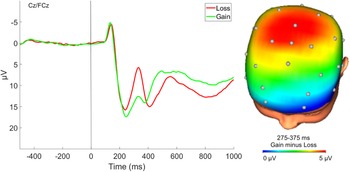
ERPs were averaged across gain and loss trials, and analyses focused on the RewP difference score, which was calculated as the mean amplitude on gain trials minus the mean amplitude on loss trials, with more positive values indicating greater differentiation. The RewP was scored as the mean amplitude 275–375 ms following feedback, where the difference between gain and loss waves was maximal (Kujawa et al., Reference Kujawa, Proudfit and Klein2014) across frontocentral sites (FCz and Cz), consistent with previous research (Kujawa et al., Reference Kujawa, Proudfit and Klein2014; Kujawa, Hajcak, & Klein, Reference Kujawa, Hajcak and Klein2019).
ADHD symptoms
At ages 9 and 12, the Schedule of Affective Disorders and Schizophrenia for School-Age Children – Present and Lifetime (K-SADS-PL) (Axelson, Birmaher, Zelazny, Kaufman, & Gill, Reference Axelson, Birmaher, Zelazny, Kaufman and Gill2009) was administered by master's-level clinicians and clinical psychology doctoral students (supervised by a child psychiatrist and clinical psychologist) first to one parent (typically the mother) and then the child. Parent and child symptom ratings report were combined to derive summary symptom ratings.
Current symptoms of ADHD were rated on a 3-point scale (0 = not present; 1 = subthreshold; 2 = threshold). The ADHD-IA and H/I variables were created by summing scores of the nine IA and the nine H/I items, respectively. To assess interrater reliability, a second rater independently rated the symptoms of 25 participants based on videotaped interviews. ICCs for ADHD symptoms were .97 at age 9 and .98 at age 12.
Analytic plan
To examine the association among study variables, bivariate correlations were computed. To examine whether associations between PE and ADHD symptoms and NE and ADHD symptoms are mediated by initial responsiveness to reward (i.e., RewP), we used PROCESS Version 3.5 (Hayes, Reference Hayes2018) to calculate 95% CIs around the indirect effect with 5,000 bootstrap resamples,Footnote 1 implementing a heteroscedasticity-consistent standard error estimator. For all mediation findings, we report the completely standardized indirect effect(s).
Simple mediation models were tested by controlling for age-9 ADHD symptoms and also for the other, age-12 symptom domain (i.e., controlling for age-12 H/I in models with age-12 IA as the outcome and controlling for age-12 IA in models with age-12 H/I as the outcome) (see Bunford et al., Reference Bunford, Brandt, Golden, Dykstra, Suhr and Owens2015a for precedent and rationale). Regarding age-9 ADHD symptoms, IA and H/I were combined, given that our aim was to control for childhood ADHD risk generally and also evidence indicating that ADHD symptoms are less differentiated (mathematically, less tightly clustered) during earlier relative to later developmental periods (e.g., in preschool, they cluster into a single-cluster network, in childhood, into a two-cluster network, and in adolescence they cluster into a least three-cluster network, Martel, Levinson, Langer, & Nigg, Reference Martel, Levinson, Langer and Nigg2016). Although trajectories are complex and both IA and H/I symptoms decline with age (Langberg et al., Reference Langberg, Epstein, Altaye, Molina, Arnold and Vitiello2008), it can be generally stated that hyperactivity symptoms in particular become subtler during the teenage years (Wolraich et al., Reference Wolraich, Wibbelsman, Brown, Evans, Gotlieb, Knight and Wilens2005) and many youths diagnosed with the combined presentation (IA and H/I) in childhood better fit the inattentive presentation in adolescence, when ADHD presentations appear to stabilize (Langberg et al., Reference Langberg, Epstein, Altaye, Molina, Arnold and Vitiello2008). Given high comorbidity between ADHD and oppositional defiant (ODD) and conduct disorder (CD) symptoms (Bendiksen et al., Reference Bendiksen, Svensson, Aase, Reichborn-Kjennerud, Friis, Myhre and Zeiner2017) and the relevance of reward processing to these disorders (Tenenbaum et al., Reference Tenenbaum, Musser, Raiker, Coles, Gnagy and Pelham2018), more conservative follow-up analyses adjusting for ODD and CD symptoms were conducted for supported mediational models.
Data availability
The datasets generated and/or analyzed during the current study are available from the corresponding author on reasonable request.
Results
Bivariate correlation analyses
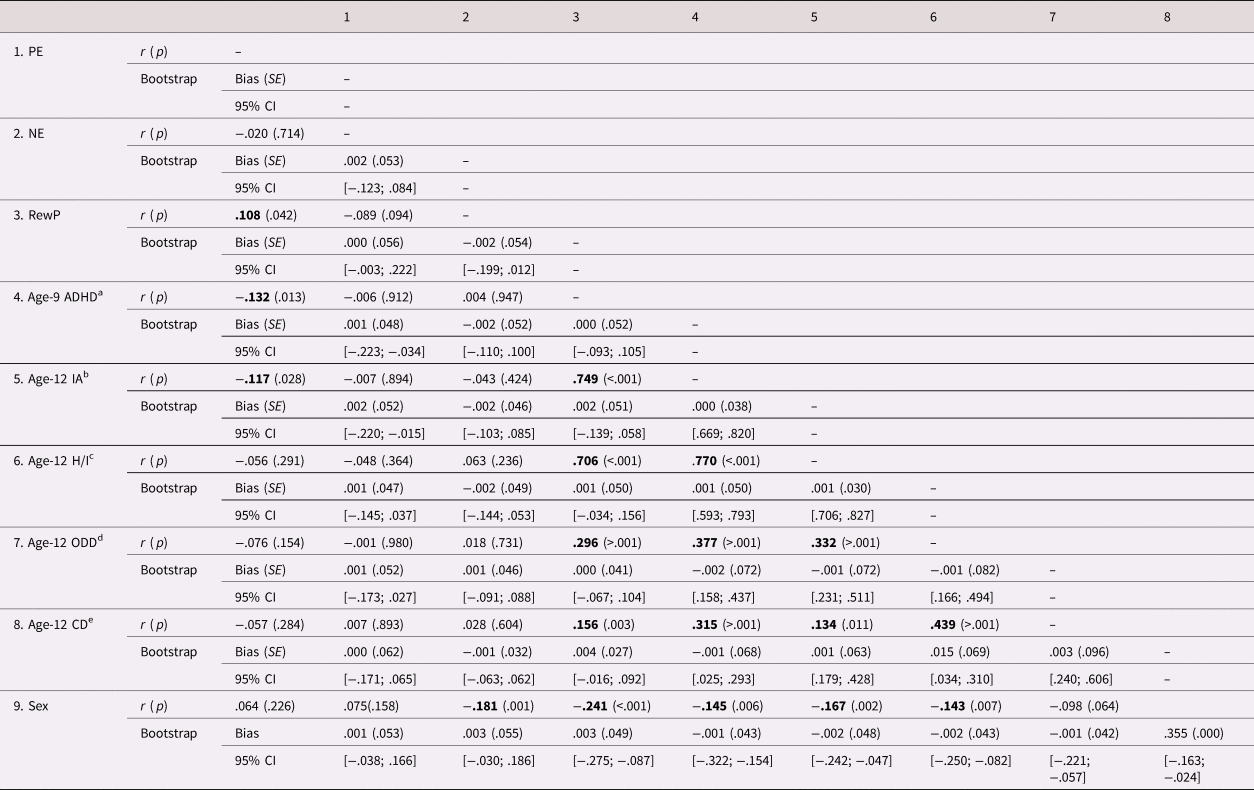
Greater PE was associated with enhanced RewP and lower age-9 ADHD and lower age-12 ADHD-IA but PE was not associated with sex. NE was not associated with PE, RewP, the ADHD variables, or sex. RewP was not associated with the ADHD variables. Greater age-9 ADHD was associated with greater age-12 ADHD-IA and H/I, and greater age-12 ADHD-IA was associated with greater age-12 ADHD-H/I. RewP, age-9 ADHD and age-12 ADHD-IA and H/I showed negative correlations with sex; boys had higher scores on these variables (Table 1). For grand average ERPs and scalp distribution depicting the gain minus loss difference, see Figure 1.
Grand average evoked response potentials (ERPs) and scalp distribution depicting the gain minus loss difference in the 275–375 ms time window for the entire sample.

Bivariate correlations among study variables of interest

Note. Unless otherwise noted, bootstrap results are based on 1,000 bootstrap samples. ADHD = attention-deficit/hyperactivity disorder symptoms; CD = conduct disorder symptoms; H/I = ADHD hyperactivity/ impulsivity symptoms; IA = ADHD inattention symptoms; NE = negative emotionality; ODD = oppositional defiant disorder symptoms; PE = positive emotionality; RewP = reward positivity gain-loss difference.
a = M age 9 ADHD = 4.304, SD = 8.114, range: 0–34;
b = M age 12 ADHD-IA = 2.237, SD = 4.602, range: 0–16;
c = M age 12 ADHD-H/I = .738, SD = 2.018, range: 0–12.
d = M age 12 ODD = .817, SD = 2.385, range: 0–13;
e =M age 12 CD = .118, SD = .560, range: 0–7
Mediation analyses with PE
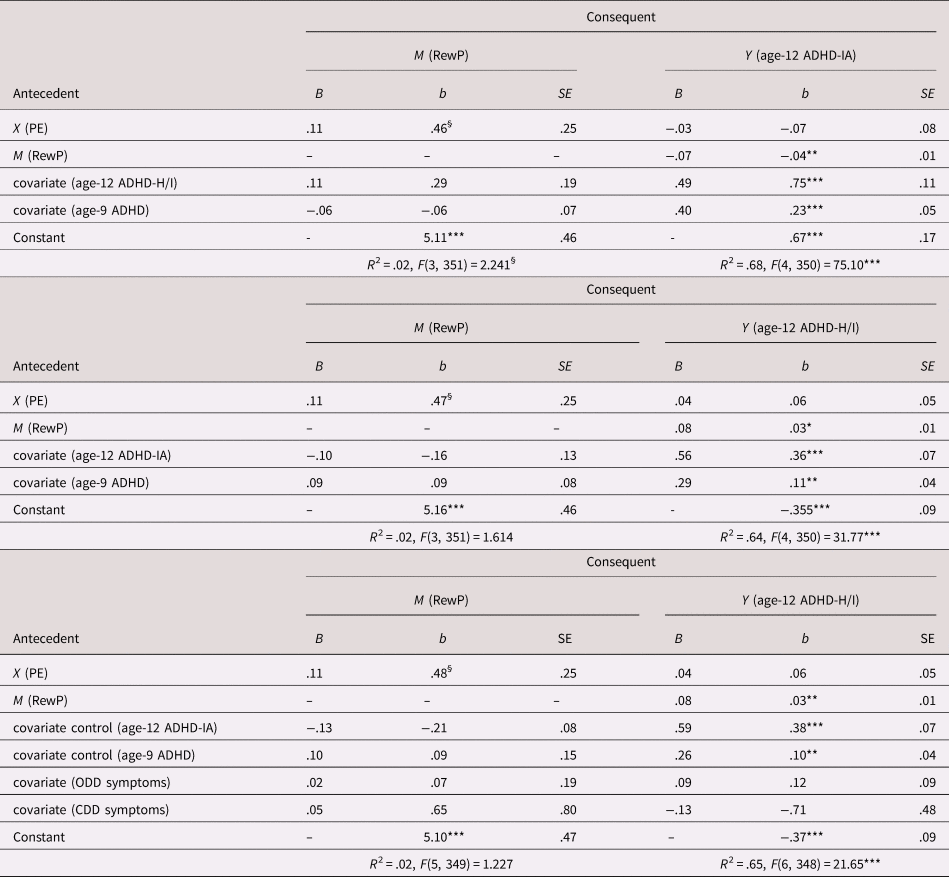
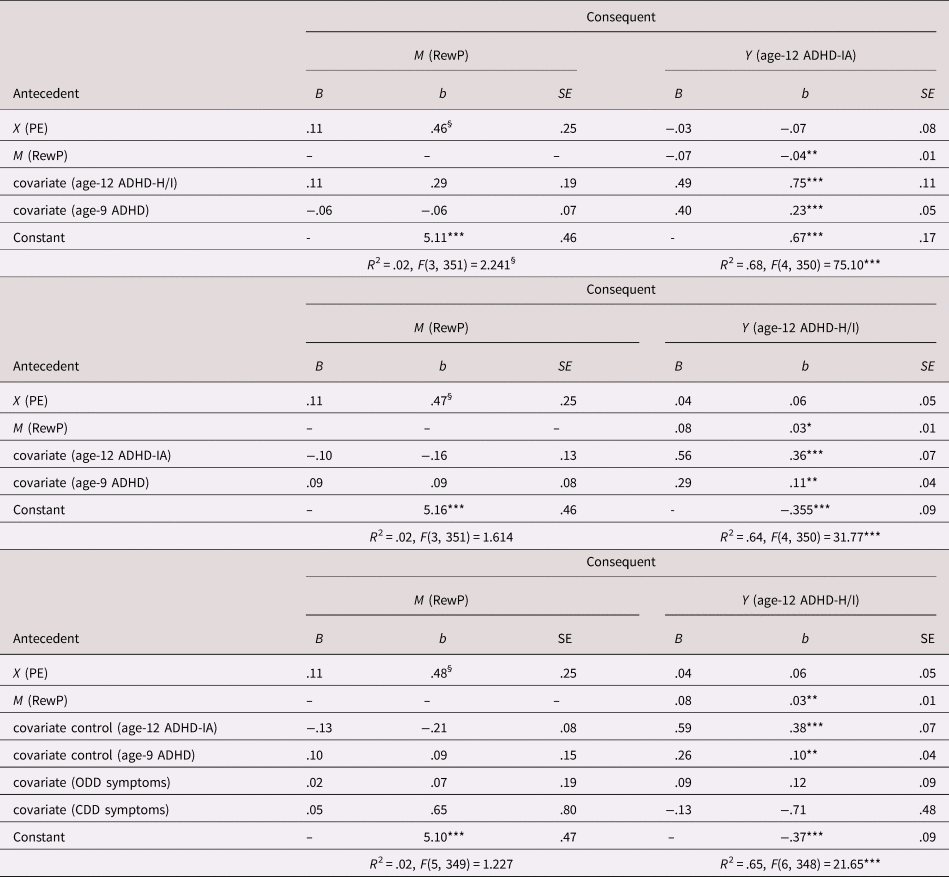
The indirect effect of PE on ADHD-IA through RewP was not significant (95%CIs: [−.019;.001]) (Table 2).
Model coefficients for simple mediation models testing effects of age 3 positive emotionality through age-9 initial responsiveness to reward to age-12 attention-deficit/hyperactivity disorder (ADHD) symptoms
Note. ***: p<.001; **: p<.01; *: p<.05; §: .1>p<.05;
B = standardized regression coefficients; b = unstandardized coefficients; CD = conduct disorder symptoms; H/I = ADHD hyperactivity/ impulsivity symptoms; IA = ADHD inattention symptoms; ODD = oppositional defiant disorder symptoms; PE = positive emotionality; RewP = reward positivity gain-loss difference SE = heteroscedasticity-consistent standard error estimator.
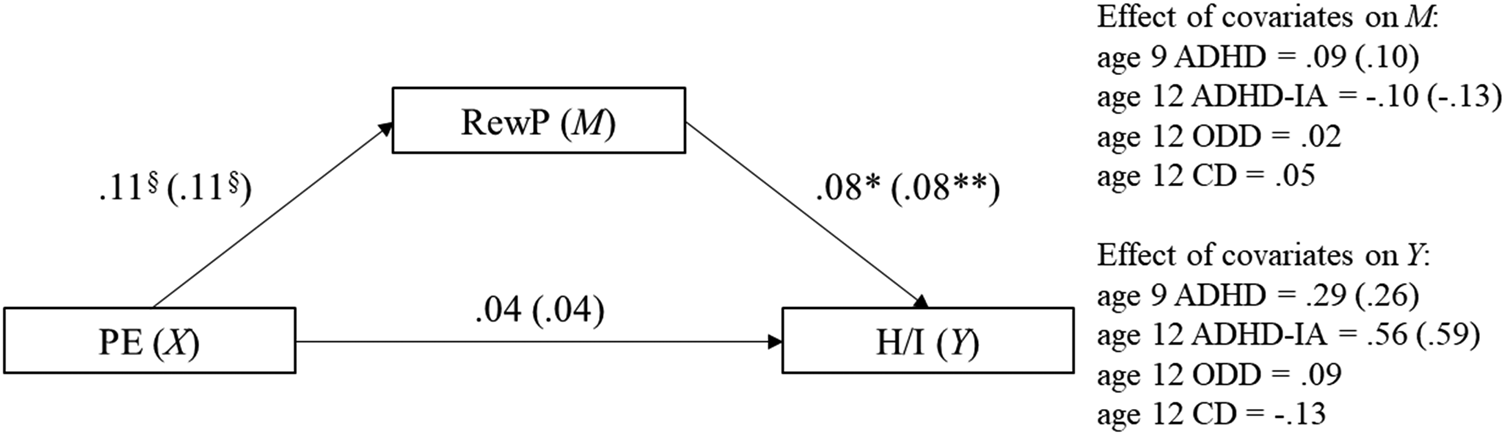
RewP mediated the association between PE and ADHD-H/I (point estimate = .009; SE = .006; 95%CIs [.001;.022]). Greater PE was associated with enhanced RewP at a trend level and enhanced RewP was associated with greater ADHD-H/I (the association between PE and ADHD-H/I was positive but nonsignificant, p = .159). Jointly, RewP, PE, and statistical controls (i.e., age-9 ADHD and age-12 ADHD-IA) accounted for 64% of the variance in H/I (Table 2).
Follow-up mediation analyses with PE, accounting for ODD and CD
With age-12 ODD and CD symptoms as covariates, RewP mediated the association between PE and ADHD-H/I (point estimate = .009; SE = .006; 95%CIs [.001;.023]). Greater PE was associated with enhanced RewP at a trend level, and enhanced RewP was associated with greater ADHD-H/I (the association between PE and ADHD-H/I and between ODD and ADHD-H/I was positive but nonsignificant, and the association between CD and ADHD-H/I was negative but nonsignificant). Jointly, RewP, PE, and statistical controls (i.e., age 9 ADHD and age-12 ADHD-IA, ODD, and CD) accounted for 65% of the variance in H/I (Table 2).
There was no significant moderation by sex (see Supplementary Information).
Mediation analyses with NE
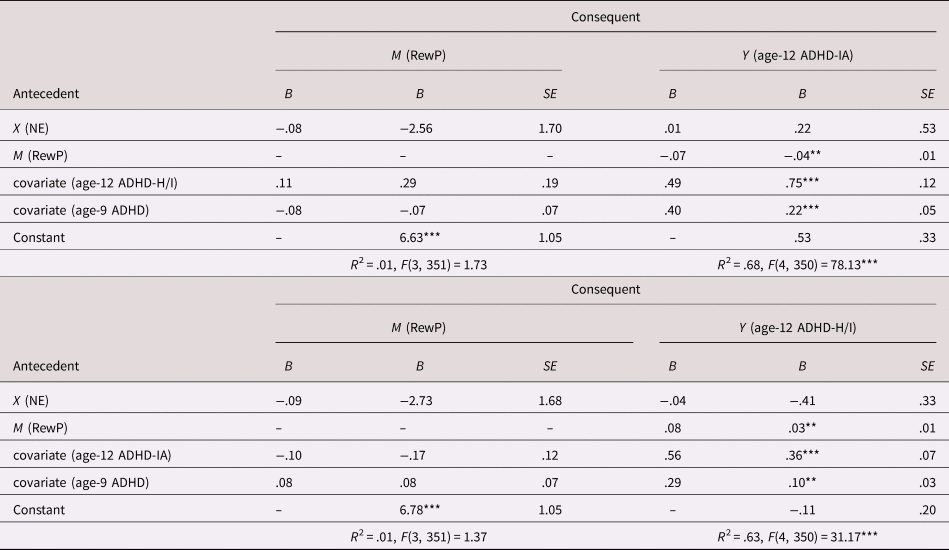
Neither the indirect effect of NE on ADHD-IA through RewP (95%CIs [−.002;.018]) nor the indirect effect of NE on ADHD-H/I through RewP ([−.019;.001]) was significant (Table 3).
Model coefficients for simple mediation models testing effects of age-3 negative emotionality through age-9 initial responsiveness to reward to age-12 attention-deficit/hyperactivity disorder (ADHD) symptoms

Note. ***: p<.001; **: p<.01; *: p<.05; §: .1>p<.05;
B = standardized regression coefficients; b = unstandardized coefficients; H/I = ADHD hyperactivity/ impulsivity symptoms; IA = ADHD inattention symptoms; NE = negative emotionality; RewP = reward positivity gain-loss difference; SE = heteroscedasticity-consistent standard error estimator.
There was no significant moderation by sex (see Supplementary Information).
For visual summary of mediation resultsFootnote 2 see Figure 2.
Visual summary of simple mediation result, with reward positivity (RewP) mediating the association between positive emotionality (PE) and hyperactive–impulsive (H/I), with age-9 attention-deficit/hyperactivity disorder (ADHD) and age-12 ADHD-IA, oppositional defiant (ODD), and conduct disorder (CD) symptoms covaried. Note: Coefficients are standardized regression weights, with values outside the parentheses representing path coefficients when only age-9 ADHD and age-12 ADHD- inattention (IA) symptoms are covaried and values inside the parentheses representing path coefficients when in addition to these ADHD variables, age-12 ODD and CD symptoms are also covaried. **: p<.01; §: .1>p<.05.

Discussion
There is considerable heterogeneity in ADHD symptom presentation and associated features, potentially reflecting differences in etiological and pathophysiological pathways, and in corresponding clinical manifestations. The focus of this longitudinal, multimethod study was on heterogeneity in developmental pathways to ADHD symptoms in adolescence vis-à-vis initial responsiveness to monetary reward and early temperamental emotionality. Our goals were to examine: (a) associations between preschool PE and NE; late childhood neural initial responsiveness to reward probed by a simple monetary reward task and indexed by the RewP; and young adolescent IA and H/I symptoms and (b) initial responsiveness to reward as mediator of the association between temperamental emotionality and age-12 ADHD symptoms, beyond effects of age-9 ADHD.
Findings indicated, as expected, that greater PE was associated with an enhanced RewP. Contrary to expectations, greater PE was associated with lower age-9 ADHD and age-12 ADHD-IA. Observed NE at age 3 was not associated with any study variables. Further, bivariate analyses did not reveal associations between RewP and ADHD variables. As also expected, boys exhibited greater reward responsiveness than girls (Kujawa et al., Reference Kujawa, Proudfit, Kessel, Dyson, Olino and Klein2015) and more ADHD symptoms at both ages. A greater number of associations were observed when more complex relations among variables (i.e., mediation) were considered; age-9 initial responsiveness to reward mediated the associations between age-3 PE and age-12 ADHD-H/I, even adjusting for age-9 ADHD and age-12 ODD and CD symptoms. Enhanced RewP was associated with greater H/I, consistent with clinical presentation of youth with H/I as high on behavioral activation/approach. Greater PE was associated at a trend level with an enhanced RewP. Albeit nonsignificant, greater PE was linked to greater H/I.
Of note, in overall mediation models, the association between RewP and PE was nonsignificant. The association between RewP and PE was significant in bivariate correlation analyses and even in the absence of a significant direct effect, there can be a significant indirect effect in mediation analyses.
Conceptual implications
RewP mediated the association between PE and ADHD-H/I and enhanced reward responsiveness predicted greater hyperactivity/impulsivity. Thus, by the time youth with high preschool PE reach early adolescence, individual differences in neural reward responsiveness during late childhood may be differentially associated with ADHD dimensions. Implications with regard to the pathogenesis and pathophysiology of ADHD are that deviation from typical reward response subsequent to preschool PE, does not appear to be a risk factor for greater IA symptoms in early adolescence. However, those with greater than typical response to reward as a sequalae of high PE are at increased risk for greater H/I symptoms. Certainly, additional variables influencing this trajectory will need to be identified and explored to better understand the observed relations and optimize early identification and prevention. Together, the findings are largely consistent with dual-pathway models of ADHD, where atypicalities in motivational style linked to reward circuitry (and thus greater activation and approach) underlie (not IA but) H/I symptoms (Sonuga-Barke, Reference Sonuga-Barke2002).
In small samples, others have found that alterations in intrinsic functional brain organization is associated with ADHD persistence, with attenuated posterior cingulate cortex–medial PFC connectivity in adults with ADHD, both in studies with retrospective determination of childhood ADHD (Castellanos et al., Reference Castellanos, Margulies, Kelly, Uddin, Ghaffari, Kirsch and Milham2008) and in samples followed prospectively (persistent cases differed from remitters and neurotypical controls) (Mattfeld et al., Reference Mattfeld, Gabrieli, Biederman, Spencer, Brown, Kotte and Whitfield-Gabrieli2014). As noted earlier, differences in task-activation is also linked to ADHD persistence. Persistent relative to remitting adolescents have been found to exhibit enhanced ventrolateral PFC activation during a go/no-go task (Schulz et al., Reference Schulz, Newcorn, Fan, Tang and Halperin2005) and persistent relative to remitting adults to exhibit enhanced left PFC and premotor cortex activationFootnote 3 during a continuous performance task (Schneider et al., Reference Schneider, Krick, Retz, Hengesch, Retz-Junginger, Reith and Rösler2010). Of note, there is some overlap between regions highlighted in prior work on ADHD symptom persistence and networks involved in reward processing, including, for example, the ventromedial PFC-premotor network has been found to process vicarious reward (Shimada, Matsumoto, Takahashi, Yomogida, & Matsumoto, Reference Shimada, Matsumoto, Takahashi, Yomogida and Matsumoto2016), the lateral and medial PFC are functionally coupled in cognitive control for integrating expected rewards and learned rules in strategy selection (Duverne & Koechlin, Reference Duverne and Koechlin2017), and the premotor cortex has also been shown to encode reward in macaques (Ramkumar, Dekleva, Cooler, Miller, & Kording, Reference Ramkumar, Dekleva, Cooler, Miller and Kording2016). Accordingly, although whether differences in reward-related processes are related to ADHD symptom persistence was not explicitly tested either in these prior imaging or in the current study, taken together, findings indicate this is a reasonable hypothesis to test in future research.
There is ongoing debate as to whether ADHD is associated with reward-system dysregulation independent of comorbid disruptive behavior disorder symptomology (Tenenbaum et al., Reference Tenenbaum, Musser, Raiker, Coles, Gnagy and Pelham2018). It has been argued that shared risk factors may contribute to ADHD commonly co-occurring with ODD and CD; better understanding of distinct and shared etiological influences or risk factors across these disorders may ultimately improve personalization of intervention and prediction of intervention response. The current findings add to the body of work indicating that ADHD-related reward-system dysregulation – at least with regard to H/I symptoms – is not completely explainable by comorbid disruptive behavior disorder symptoms (Luman, Oosterlaan, & Sergeant, Reference Luman, Oosterlaan and Sergeant2005).
NE was not associated with any study variables in bivariate or mediational models. This is prima facie unexpected in light of the body of work indicating ADHD is associated with high parent- and teacher report NE and self-report neuroticism (Healey, Marks, & Halperin, Reference Healey, Marks and Halperin2011; Martel & Nigg, Reference Martel and Nigg2006; Nigg, John, et al., Reference Nigg, John, Blaskey, Huang-Pollock, Willcutt, Hinshaw and Pennington2002; Singh & Waldman, Reference Singh and Waldman2010), and dysregulation of negative emotions (Bunford et al., Reference Bunford, Brandt, Golden, Dykstra, Suhr and Owens2015a; Bunford, Evans, Becker, & Langberg, Reference Bunford, Evans, Becker and Langberg2015b; Bunford, Evans, & Langberg, Reference Bunford, Evans and Langberg2018). Yet, it has been argued that as both NE and neuroticism are associated with a large number of disorders, they may be general markers of psychopathology (Lahey, Reference Lahey2009), and as rating scale measures of NE include items reflecting anger and irritability, NE may be more closely related to the externalizing spectrum generally, and ODD specifically, than to ADHD per se (Nigg, Goldsmith, & Sachek, Reference Nigg, Goldsmith and Sachek2004). Indeed, in some samples, compared to the number of children with ADHD characterized by low control or high surgency, only a very small subgroup are characterized by high negative affect (Martel, Reference Martel2016). In addition, although ADHD is associated with high NE in some cross-sectional rating scale studies, such concurrent associations are conceptually and empirically different from longitudinal associations involving observational methods, as examined – and was the case – in the current study.
Clinical implications
The RewP has been conceptualized as reflecting neural processes of reinforcement learning (Holroyd & Coles, Reference Holroyd and Coles2002). Ability to learn from feedback is essential for behavioral adjustment in service of desired outcomes. Following this conceptualization, our findings indicate that individual differences in feedback response (i.e., to reward relative to loss), reflect a psychobiological process that contributes to the development of H/I symptoms.
The RewP is also thought to be sensitive to unexpected reward and to reflect encoding the degree to which an outcome is beneficial towards a goal (Hämmerer, Li, & Müller, Reference Hämmerer, Li and Müller2010). In this context, those with early emerging PE may be hyperresponsive to reward, resulting in exaggerated stimulus–response learning and thus creating overly strong associations between reward cues and specific response patterns. These associations may increase set-like decision-making (a grouping of cognitive processes actively maintained through performance) with such deviant decision-making contributing to deficient behavioral adjustment to changing contingencies (e.g., impaired reinforcement-learning) as is seen in ADHD (Castellanos & Tannock, Reference Castellanos and Tannock2002).
Establishing that an early-emerging characteristic may be a protective or risk factor for later psychopathology enhances conceptualization of developmental trajectories to such outcomes. Arguably, however, the practical significance of such a characteristic and its role is closely linked to the degree to which it is a promising intervention – prevention or treatment – target and that is largely determined by the degree to which it is malleable. Available data indicating reinforcement sensitivity is malleable are encouraging, as deficient reinforcement learning may partly account for poor response to traditional behavioral management treatments in some youth with ADHD (Evans, Owens, & Bunford, Reference Evans, Owens and Bunford2014; Evans, Owens, Wymbs, & Ray, Reference Evans, Owens, Wymbs and Ray2018). For example, transcranial magnetic stimulation (TMS) speeds learning of associations between behaviors and rewards (Ahn, Kim, & Kim, Reference Ahn, Kim and Kim2013). Further, transcranial magnetic stimulation has been shown to improve low reward responsiveness in depression (O'Reardon et al., Reference O'Reardon, Solvason, Janicak, Sampson, Isenberg, Nahas and Sackeim2007) and theta burst stimulation decreases hypersensitivity and enhances hyposensitivity (using different pulse patterns) to primary rewards predicting sexual behaviors (Prause, Siegle, Deblieck, Wu, & Iacoboni, Reference Prause, Siegle, Deblieck, Wu and Iacoboni2016). Further, changes in (but not baseline) reward sensitivity during the first two weeks of pharmacotherapy are associated with depressive symptom reduction post-treatment (Allen et al., Reference Allen, Lam, Milev, Rizvi, Frey, MacQueen and Quilty2019). To counter atypical stimulus-response learning and thus, for example, behavior reflecting perseverative decision-making, training interventions (TIs) may be necessary, where youth are trained to continuously consider feedback and modify/update behavior accordingly (Evans et al., Reference Evans, Owens and Bunford2014, Reference Evans, Owens, Wymbs and Ray2018). In addition to changing reward responsiveness, interventions may also capitalize on reinforcement principles to modify behavior. Behavioral interventions for ADHD do just that, albeit without sufficient consideration for the heterogeneity of etiological contributors to symptoms and functional impairments. Our findings suggest that the effectiveness of such interventions for reinforcement techniques may be improved if they are personalized (e.g., those low in reward responsiveness may need more concrete, salient rewards to change behavior). In support, individual differences in RewP predict treatment response in anxiety and depression (Burkhouse et al., Reference Burkhouse, Kujawa, Kennedy, Shankman, Langenecker, Phan and Klumpp2016; Kujawa, Burkhouse, et al., Reference Kujawa, Burkhouse, Karich, Fitzgerald, Monk and Phan2019a), but whether they also predict treatment response in ADHD is a testable hypothesis that remains to be explored.
Limitations and future directions
As only one aspect of reward processing was probed and only one type of reward was manipulated in our paradigm, future research may examine whether these findings generalize to other aspects of reward processing and nonmonetary reward. Similarly, in the current study, our interest was in reactivity as opposed to regulation variables but subsequent research may explore relations involving the latter, for example, effortful and reflexive regulation with variables indexing reward response regulation. Further, whether children found monetary gain rewarding was not assessed and future work may determine the association between neural reward responsiveness and subjective experience. It was necessary to have an asymmetry between magnitude of gains ($0.50) and losses ($0.25), to have an equal number of trials/condition while allowing participants to accumulate money. Related, the emotional impact of gains is weaker than of loss (Tversky & Kahneman, Reference Tversky and Kahneman1981). Nevertheless, this asymmetry may have influenced results.
As observational temperament data were only collected in early childhood, we were unable to examine the extent to which later (e.g., age 9) temperament explained the results of the mediational models, although for assessment of the developmental pathways that were of interest here, a longitudinal design with clear temporal ordering of variables is preferable.
The effects between temperamental emotionality, the RewP, and symptom measures were generally modest. For example, although in combination, variables in supported models accounted for a large portion of variance in the outcome (e.g., jointly, RewP, PE, and statistical controls accounted for 65% of the variance in H/I), the contributions of PE and reward responsiveness were relatively small. This is consistent with meta-analytic results suggesting that although temperamental traits are early risk markers of later psychopathology, the effects are small, with individual temperamental traits accounting for between 7% and 19% of the variance in later psychopathology (Kostyrka-Allchorne et al., Reference Kostyrka-Allchorne, Wass and Sonuga-Barke2019). Accordingly, there are likely other extrinsic and intrinsic factors that modulate the links between temperament and later psychopathology. Similarly, evidence from large samples (which generate more reliable/less variable effect sizes) suggests that the association between neural/physiological measures and psychopathology is likely quite modest (Kujawa & Burkhouse, Reference Kujawa and Burkhouse2017; Yancey, Venables, & Patrick, Reference Yancey, Venables and Patrick2016), underscoring the importance of constructing multimethod models, as we have done here, to improve prediction of outcomes and understanding of pathways across levels of analysis.
Finally, the current sample was a community-based sample, with the majority of youth Caucasian. It will be important to examine whether results generalize to clinical populations, ethnic minorities and other racial groups as well as to collect data on symptoms, beyond children and parents, from teachers. It will be especially key to assess such generalizability in case of NE, as the NE behaviors measured in the current study likely have a lower base rate in community samples of young children.
Conclusion
Heterogeneity in ADHD symptom presentation is informative for conceptualization, early identification, and personalized prevention and treatment. Individual differences in reward responsiveness may underlie ADHD symptomology but the literature has been limited and mixed. This is the first study where neural correlates of preschool temperament, specifically PE and NE, and their association with early adolescent ADHD symptoms was examined in a longitudinal design. Individual differences in late childhood reward responsiveness subsequent to greater early childhood PE represent a risk factor for greater adolescent ADHD symptoms, with enhanced reward response conferring risk for H/I.
Supplementary Material
The supplementary material for this article can be found at https://doi.org/10.1017/S0954579420002199
Acknowledgments
During the preparation of this article, Nóra Bunford was supported by the MTA Lendület (“Momentum”) Programme (LP2018-3/2018). We thank Steven W. Evans for his valuable comments.
Funding Statement
This work was supported by a National Institute of Mental Health Grant RO1MH069942 to Daniel N. Klein.
Conflicts of Interest
None