INTRODUCTION
Anecdotal accounts of pronoun reversal – e.g. the use of you to refer to oneself, and I or me to refer to an addressee – have appeared in the language acquisition literature for over a century (e.g. Cooley, Reference Cooley1908). These deictic errors have often been described as characteristic of certain populations of children, particularly the autistic, the congenitally blind and the hearing impaired. Pronoun reversal is regarded as fairly rare outside of these populations; however, there have been several case studies of typically developing children who reversed large proportions of their personal pronouns, generally between the ages of 1 ; 7 and 2 ; 4 (e.g. Chiat, Reference Chiat1982; Schiff-Myers, Reference Schiff-Myers1983; Oshima-Takane, Reference Oshima-Takane1992). One cross-sectional study has provided evidence that the population of precocious talkers may also be prone to reversal errors (Dale & Crain-Thoreson, Reference Dale and Crain-Thoreson1993).
Many researchers have put forth hypotheses explaining who reverses pronouns under what conditions, but there is still no global understanding of the mechanisms that underlie this phenomenon. This is partly due to a lack of systematic, longitudinal studies, in which it is possible to observe the timecourse of pronoun development. Such studies have been in short supply as cases of consistent pronoun reversal are rarely noted (Chiat, Reference Chiat, Fletcher and Garman1986). Interestingly, however, of the six children studied as part of the Providence Corpus (Demuth, Culbertson & Alter, Reference Demuth, Culbertson and Alter2006), two children – Naima and Ethan – produced I/you reversals with great regularity for several months between 1 ; 6 and 3 ; 0, as in (1) and (2) below.
(1) naima: There's blueberry on your [=my] face. (2 ; 2·02)
(2) ethan: I [=you] got you [=me] out? (1 ; 10·11)
Neither of these children was delayed in language acquisition; in fact, they are the two most precocious talkers in the corpus, beginning to speak early (both at 0 ; 11) and scoring very high on measures of vocabulary size. However, they differ from each other along one key dimension. The girl, Naima, was an extremely verbal, typically developing child, but the boy, Ethan, was diagnosed with Asperger's syndrome at age five, after the conclusion of data collection for the Providence Corpus. This circumstance allows us to compare directly the trajectories of pronoun reversal in a typically developing child and one with Autism Spectrum Disorder (ASD). By characterizing the patterns of pronoun use and reversal in each child, as well as the contextual factors that affect reversal, we hope to provide a better understanding of pronoun reversal as a phenomenon in language development. Specifically, we investigate whether these two pronoun-reversing children appear to be treating personal pronouns in the same way. Below, we review the particular challenges language learners encounter with personal pronouns, the cognitive skills that may be necessary for the mastery of pronouns, and several influential hypotheses on the mechanism(s) underlying pronoun reversal errors.
The challenge of learning personal pronouns
Dale and Crain-Thoreson (Reference Dale and Crain-Thoreson1993) identify four key reasons for the particular difficulty personal pronouns pose for children acquiring language, while also noting that most children do not reverse pronouns, and when errors do occur they are seldom consistent. First, deictic terms – words that shift their meanings depending on the speech roles or spatial arrangement of the speaker and addressee (e.g. personal pronouns, demonstratives, locatives and verbs such as come and go) – are unusual in language and are unmarked grammatically in English. Second, young children are known to possess a high degree of cognitive egocentrism, which is an obstacle to understanding the relationship between speech roles and pronoun use. Third, the input generally does not provide a good model for correct personal pronoun use, particularly for second person pronouns. Fourth, the high frequency of personal pronouns in everyday speech creates pressure for early use, perhaps before children have the cognitive abilities necessary to use them correctly. We explore these last two points further below. As a result, perhaps, of these factors, children do not tend to master the full personal pronoun system (in English) until around age three (Wales, Reference Wales1996).
Many researchers of pronoun acquisition have noted that a good model of personal pronoun use, particularly for second person pronouns, may not be present in the input children receive (e.g. Shipley & Shipley, Reference Shipley and Shipley1969; Oshima-Takane, Reference Oshima-Takane1992). In order to learn how to use you and other second person forms correctly, children must be able both to attend to and learn from speech that is addressed to someone other than themselves (Oshima-Takane & Benaroya, Reference Oshima-Takane and Benaroya1989). Only then is it clear that you always refers to the individual being addressed and not specifically the child. First person pronouns are a somewhat easier case, as each of a child's individual interlocutors will use I to refer to him or herself. So as long as a child has more than one interlocutor, the meaning of I ought to be more or less transparent. Although some pronoun reversers have shown difficulty with I, most pronoun reversal errors involve the misuse of you and other second person forms for self-reference. The relative importance of non-addressed input to second person pronoun learning may be responsible for this difference.
That being said, most children must be capable of learning from non-addressed speech, or else children in cultures that do not practice child-directed speech would never acquire language (Oshima-Takane, Goodz & Derevensky, Reference Oshima-Takane, Goodz and Derevensky1996). It may be that those children who cannot or do not attend to this input are those same children who reverse pronouns. Oshima-Takane has proposed that such a failure or impaired ability to attend to overheard speech may underlie pronoun reversal in a variety of populations, including autistic (Oshima-Takane & Benaroya, Reference Oshima-Takane and Benaroya1989), hearing-impaired (Oshima-Takane, Cole & Yaremko, Reference Oshima-Takane, Cole and Yaremko1993), and typically developing talkers (Oshima-Takane, Reference Oshima-Takane1992). Both autistic and non-autistic children have been shown to make gains in personal pronoun acquisition after participating in modeling experiments during which they were deliberately exposed to pronouns in non-addressed speech and tested for comprehension (Oshima-Takane & Benaroya, Reference Oshima-Takane and Benaroya1989; Oshima-Takane, Reference Oshima-Takane1988).
Eldest and only children may also fail to learn from overheard speech, since they are less likely to participate in triadic discourse than children with siblings and therefore have less opportunity to hear non-addressed speech. A child who hears his parents addressing his sister with the same kind of pronouns they use when addressing him will receive a better model of pronoun use than an only child who generally interacts with one adult at a time. Oshima-Takane et al. (Reference Oshima-Takane, Goodz and Derevensky1996) found that second-born children were more advanced than first-born children in their ability to produce and comprehend personal pronouns in general, although second-borns' language abilities as a whole were not superior. On this account, reversers are predicted often to be eldest children; this is true of both children in the current study.
Although a good model of pronoun use may be lacking in a child's linguistic input, personal pronouns themselves are very frequent, creating pressure for early acquisition, a fact to which Dale and Crain-Thoreson (Reference Dale and Crain-Thoreson1993) attributed some of learners' difficulties. They suggested that some children – particularly precocious talkers – might use pronouns before they have the necessary cognitive abilities to do so correctly. Seventeen out of their sample of thirty highly precocious talkers aged 1 ; 8 made at least one reversal during two hours of observation. They also found a correlation between reversal errors and degree of precocity (indicated by MLU, vocabulary and grammatical morpheme index, among other measures) in a larger (though still linguistically above-average) sample. Dale and Crain-Thoreson suggested that reversers use more personal pronouns, especially second person forms, earlier than those who do not reverse, and that non-reversers actively avoid using pronouns until they can do so correctly. These assertions were supported by the fact that the reversers in their study actually used more second person pronouns correctly than the total number of second person pronouns used by the non-reversers. Indeed, informal analysis of the pronoun use of William, a non-precocious, non-pronoun-reversing child from the Providence Corpus, revealed that he used pronouns much later and more infrequently than either of the reversers in the current study. It seems, then, that all children may make errors in their early use of pronouns; reversers make errors of commission, whereas non-reversers make errors of omission.
Dale and Crain-Thoreson (Reference Dale and Crain-Thoreson1993) focused on processing capacity as a limiting factor for correct pronoun use, but other work has indicated that basic role-playing and perspective-taking skills are also necessary for the understanding of deixis. Role-play, in which children adopt the role of another person through pretend play, is seen in children as young as two (Harris, Reference Harris2000). The shift in perspective inherent in role-play can sometimes be reflected in a child's use of pronouns; that is, the pretending child may use pronouns corresponding to the part he is playing, rather than to himself (Harris, Reference Harris2000). The development of the cognitive abilities underlying this form of play could have an effect on the behavior of pronoun reversers. Interestingly, Schiff-Myers (Reference Schiff-Myers1983) noted that for her pronoun-reversing daughter, Lauren, her transition to correct pronoun usage coincided with her incipient ability to role-play at about 2 ; 1. Thus, once Lauren attained some knowledge of different perspectives, she was able to use personal pronouns correctly. Loveland (Reference Loveland1984) also reported evidence from both cross-sectional and longitudinal studies that correct use of I and you is correlated with knowledge of multiple spatial points of view. Ricard, Girouard and Décarie (Reference Ricard, Girouard and Décarie1999) similarly found that knowledge of Level One Perspective-Taking was correlated with successful comprehension and production of all personal pronouns between 1 ; 10 and 2 ; 6. These basic Level One skills involve knowledge about what objects others can and cannot see, rather than how objects appear to others (Ricard et al., Reference Ricard, Girouard and Décarie1999). Note that these studies involved typically developing children; children with ASD are known to have trouble with perspective-taking and show difficulty engaging in pretend play (e.g. Hess, Reference Hess2006).
Recall that most children do not have a full pronoun system until around age three (Wales, Reference Wales1996), at which point some amount of perspective-taking skill can be assumed to be present in typically developing children. It could be that all pronoun reversers are deficient in these skills – either because they have not yet developed in children who use pronouns early, or because they are impaired in children with ASD. A model incorporating the interaction of these factors with the nature of the input, i.e. the amount of non-addressed speech to which children attend, could allow researchers to predict which children may be expected to make pronoun reversal errors. We return to this issue in the ‘General Discussion’ below.
Imitation in pronoun reversal
Deficits in the pragmatic or social aspects of language are typically observed in children with pervasive developmental disorders, including Asperger's syndrome, which is not typically characterized by language delay (Tager-Flusberg & Caronna, Reference Tager-Flusberg and Caronna2007; Freitag, Kleser & von Gontardf, Reference Freitag, Kleser and von Gontardf2006). Indeed, children with Asperger's often have superior language skills relative to their peers (Tager-Flusberg & Caronna, Reference Tager-Flusberg and Caronna2007). One manifestation of the pragmatic deficit in this population is a tendency for imitation, sometimes referred to as ‘echolalia’ or ‘scripted speech’ (e.g. Fay, Reference Fay1971; Tager-Flusberg & Caronna, Reference Tager-Flusberg and Caronna2007). A classic hypothesis regarding the source of pronoun reversal has attributed the phenomenon to echolalia, with the thought that children are simply repeating the pronouns used in adult speech, and not using them referentially (Bartak & Rutter, Reference Bartak and Rutter1974).
The imitative speech of children on the autism spectrum has been divided into two categories: ‘immediate echolalia’, or the repetition of a model utterance immediately or closely following its production by an interlocutor, and ‘delayed echolalia,’ in which such utterances are repeated a significant time after the model utterance was produced (Prizant & Rydell, Reference Prizant and Rydell1984). We will refer to these as immediate and delayed ‘repetition,’ rather than ‘echolalia,’ to avoid some of the connotations of the latter term. Shapiro (Reference Shapiro1977) has clarified delayed repetition as ‘unrestructured old forms used in new situations.’ This often co-occurs with pronoun reversal in autistic populations, and researchers have associated the two very closely in the past (e.g. Bartak, Rutter & Cox, Reference Bartak, Rutter and Cox1975; Charney, Reference Charney1980a). These delayed repetitions can have a number of discourse functions aside from being self-stimulatory, including facilitating the child's ability to interact with others verbally, to participate in routines and to make requests (Tager-Flusberg & Caronna, Reference Tager-Flusberg and Caronna2007). These utterances are generally memorized and repeated as unanalyzed (or partially analyzed – see Snow, Reference Snow1981) chunks, which, due to the superior short-term memory of the autistic child relative to other skills, can become quite long (Hermelin & O'Connor, Reference Hermelin and O'Connor1970).
Many children, not just those with ASD, tend to imitate at least some of their adult interlocutors' utterances during the process of language acquisition. Schiff-Myers (Reference Schiff-Myers1983) presented a case study of her non-autistic but ‘imitative’ daughter, Lauren, who made pronoun reversal errors between the ages of 1 ; 7 and 2 ; 1. Schiff-Myers attributed her daughter's reversals to her tendency to imitate, causing her to produce pronouns before she could understand them. The child's pronoun errors then decreased as her imitative language decreased. On the other hand, in their study of thirty precocious talkers (age 1 ; 8), Dale and Crain-Thoreson (Reference Dale and Crain-Thoreson1993) found that the children who made reversal errors were less imitative or only as imitative as those who did not reverse. However, they also found that over half of the observed reversals occurred in imitative language. Thus, the importance of imitation to pronoun reversal is yet to be fully determined.
The cause of pronoun reversal is quite a separate question from that of reversers' underlying semantic representations of pronouns. We now turn to a discussion of the various hypotheses researchers have proposed to explain patterns of pronoun reversal errors in terms of these representations.
Competence- and performance-based hypotheses of pronoun reversal
During the middle of the twentieth century, most discussion of pronoun reversal was carried out by psychologists and centered on the particular linguistic deficits of children with autism and the congenitally blind, whose speech was thought to resemble that of autistic children (e.g. Fay, Reference Fay1971). Difficulty with the acquisition of personal pronouns and the particular habit of using the wrong pronoun for the wrong referent was often seen as a symptom of an impaired ego, where the child could not distinguish between self and others (Charney, Reference Charney1980a). However, emerging evidence of this same phenomenon in typically developing and even precocious talkers created the need for a new explanation of pronoun reversal for these other populations. As Oshima-Takane (Reference Oshima-Takane1992) has pointed out, a child having difficulty distinguishing between self and others should not be expected to use proper names correctly. Such a difficulty was not detected, however, in any of the studies of typically developing talkers discussed here, nor was there other evidence of an impaired awareness of self. Researchers have since hypothesized a variety of different mechanisms that might underlie pronoun reversal errors. These explanations can be characterized according to whether they attribute pronoun reversal to a problem with competence or with performance. Competence-based hypotheses assume that underlying the pronoun reversal error phenomenon is a deficient or non-adult-like understanding of how personal pronouns work. Conversely, performance-based accounts look to on-line processing limitations to explain pronoun errors.
The classic competence-based explanation for pronoun reversal errors is the idea that reversers are treating pronouns as if they have fixed referents rather than treating them as deictic terms. This is referred to as either the name hypothesis (Clark, Reference Clark, Bruner and Garton1978) or the person hypothesis (Charney, Reference Charney1980b). Thus, children hear their caretakers calling themselves I and the child you, and carry those terms over into their own speech. That is, they are using pronouns like names and are not attending to the effect that speech roles have on shifting reference. A child who has adopted this semantic interpretation of personal pronouns would be expected to make consistent reversal errors.
Oshima-Takane (Reference Oshima-Takane1992) presented a case study of David, a typically developing only child who made consistent pronoun reversal errors from 1 ; 11 to 2 ; 4, both with first person (94 percent at 1 ; 11) and second person (100 percent at 1 ; 11) pronouns. His behavior seemed to indicate he was treating these pronouns as if they had fixed referents: you for self and I/me for his mother. Oshima-Takane termed this ‘semantic confusion’ and attributed it to a lack of a good model of pronoun usage in the input. She pointed out that David's transition to correct personal pronoun reference coincided with a trip abroad to visit relatives, where he would have had an opportunity to interact verbally with more adults than just his parents. The consistency of David's production errors, coupled with an observed deficit in comprehension, matches the prediction of the Name/Person Hypothesis. To our knowledge, this has been the only direct evidence for this hypothesis to date.
There are, of course, less extreme forms of ‘semantic confusion’ than a complete omission of deixis that could lead to pronoun reversal errors. Various studies have reported cases of using you to refer to children and/or I to refer to adults, although these reports are mostly anecdotal (e.g. Cooley, Reference Cooley1908; Halliday, Reference Halliday1975). Furthermore, difficulty with you, does not necessarily entail a corresponding difficulty with I. Especially given the colloquial use of you as a generic, impersonal pronoun in English, it is possible that some children might over-apply you to themselves, while producing and comprehending I and me correctly.
Charney (Reference Charney1980b) formulated a slightly different competence-related hypothesis, the person-role hypothesis. This predicts that children are sensitive to speech roles from the beginning, but that this sensitivity is limited by cognitive egocentrism. That is, children are only cognizant of the speech roles they themselves are occupying. However, since this hypothesis predicts omissions of yet-to-be-comprehended forms, rather than commission errors, it does not have much to offer as an explanation for frequent pronoun reversal.
Chiat (Reference Chiat1982) presented a study of Matthew, a typically developing English-speaking boy who made frequent if inconsistent pronoun reversal errors but appeared to comprehend pronouns with no difficulty. Chiat proposed that the inconsistency in Matthew's pronoun productions, together with the disparity between his production and comprehension abilities, suggested that Matthew's reversals were, in some sense, intentional, indicating a shift away from his own perspective. She called this hypothesis plurifunctional pronouns, since pronouns could be used both in the normal way and in a second, non-adult way, indicating a shift in perspective, possibly to that of the addressee. In a sense, Matthew was predicting what his addressee might be about to say or do. Chiat's notion of plurifunctional pronouns is, by her own admission, not fully developed, and her analysis suffers from the fact that she had Matthew's production data only from age 2 ; 4 to 2 ; 5, and therefore could not determine if the pattern persisted or was simply transitory. Her proposal is an interesting one, however, in that it suggests that children may have full command of personal pronouns as they are used in adult speech, but still make apparent reversal ‘errors’ by speaking from multiple perspectives. One can also think of this as children saying what they want or expect their interlocutors to say; Horgan (Reference Horgan, Teller and White1980) has documented this type of behavior. For children who do this, pronoun reversal would not result from poor semantic competence so much as from an issue with discourse–pragmatic competence.
In analyzing the errors of a visually impaired, persistent reverser, Pérez-Pereira (Reference Pérez-Pereira1999) found that a ‘multiplex explanation’ for reversal was necessary, including an effect of imitation and possible difficulty in ‘establishing a definite perspective’, that is, separating his point of view from those of others. This work indicates that not all cases of pronoun reversal may look the same, and that some theories may obscure individual differences among reversers. Pérez-Pereira's technique of analyzing pronoun use by discourse context provides a valuable framework for further study of this issue.
In a departure from these various competence-based hypotheses, Dale and Crain-Thoreson's (Reference Dale and Crain-Thoreson1993)processing complexity hypothesis is a performance-based explanation of pronoun reversal. The Processing Complexity Hypothesis contends that deictic shifts command cognitive resources and so are ‘at risk’ to be dropped in complex contexts where the child's processing load is already high. Dale and Crain-Thoreson formulated their hypothesis after finding that reversal errors for their thirty precocious infants aged 1 ; 8 were more likely to arise in more complex utterances, especially clauses with two-place predicates and semantically reversible verbs. This type of performance-based hypothesis for pronoun reversal would seem to predict a gradual tapering-off of errors as the child's cognitive and linguistic abilities improve. There has been little opportunity to date for testing this hypothesis empirically, although Pérez-Pereira (Reference Pérez-Pereira1999) did not find the same relationship between complexity and reversal with his subject.
The current study
In the following sections we present case studies of Naima (0 ; 11–2 ; 6) and Ethan (0 ; 11–2 ; 11), the two pronoun reversers from the Providence Corpus. For the purposes of this study, we focused only on first and second person singular pronouns (I, me, my, mine, you, your, yours), which comprised the majority of pronoun data. Each child's use of these pronouns was examined in terms of correct or reversed deixis and intended referent. The children's resulting patterns were compared and assessed with respect to possible underlying deficits and possible semantic representations. We investigated the overall frequency and consistency of pronoun reversal errors, the differences in reversal errors between first versus second person forms and, in the absence of consistent behavior, the possibility that complexity or discourse factors might account for variability in production. In so doing, we looked for evidence of consistent, competence-based reversal (i.e. the Name/Person Hypothesis: Clark, Reference Clark, Bruner and Garton1978; Charney, Reference Charney1980b), of reversal mediated by discourse–pragmatic factors (Plurifunctional Pronouns: Chiat, Reference Chiat1982), and of performance errors attributable to utterance complexity (Processing Complexity Hypothesis: Dale & Crain-Thoreson, Reference Dale and Crain-Thoreson1993). Our driving concern was to discover whether these two children exhibited the same or different behavior with respect to personal pronoun use.
The analysis of pronoun reversal in previously collected corpus data, of course, has certain limitations. In particular, it is not possible to complement the spontaneous production data with tests of pronoun comprehension or general cognitive abilities. Nonetheless, the large amount of naturalistic production data available for both children, including sessions preceding the onset of reversal, provides a valuable data source for examining these two children's use of correct and reversed pronouns over time.
METHOD
The data for this study were drawn from the Providence Corpus (Demuth et al., Reference Demuth, Culbertson and Alter2006), a longitudinal corpus of audiovisual recordings of spontaneous speech interaction between mothers and one- to three-year-olds collected in the home from 2002 to 2005. The utterances were transcribed using CHAT conventions and are available as part of the CHILDES database (MacWhinney, Reference MacWhinney2000).
Participants
The present study analyzed the personal pronoun use of one girl (Naima) and one boy (Ethan), from the onset of speech at 0 ; 11 to either the end of reversal (Naima: 2 ; 5) or the end of the data (Ethan: 2 ; 11). These were the two most verbally precocious of the six children in the Providence Corpus. Both scored in the 99th percentile on the MacArthur-Bates Developmental Inventories (CDI: Words and Sentences; Fenson et al., Reference Fenson, Dale, Reznick, Thal, Bates, Hartung, Pethick and Reilly1993) at 1 ; 6 (Naima: 433/690 vocabulary items; Ethan: 566/690 vocabulary items) and in the 95th–99th percentile several months later (Naima at 1 ; 9: 538/690; Ethan at 1 ; 11: 569/690). Ethan also had CDI scores at 2 ; 6, at which point he scored in the 80th percentile (620/690).
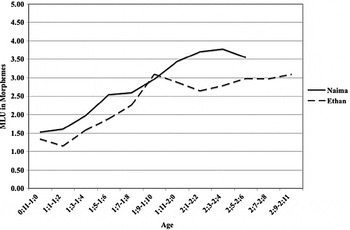
Figure 1 shows both children's MLU in morphemes throughout the period examined in this study. These were computed using the MLU program in CLAN and collapsed bimonthly across sessions. It must be noted that Naima's tendency to repeat herself, as in (3) below, and thus to produce rather long utterances, may have artificially inflated this measure in her case.
(3) naima: You know, I think you need soap, some more soap in there. (2 ; 2·17)
Neither child had been diagnosed with any communicative or developmental disorders at the time of data collection, though Ethan was later diagnosed with Asperger's syndrome. More information about each child is provided under ‘Case Study One: Naima’ and ‘Case Study Two: Ethan’.
Bimonthly MLU in morphemes for Naima and Etan.

Data and coding
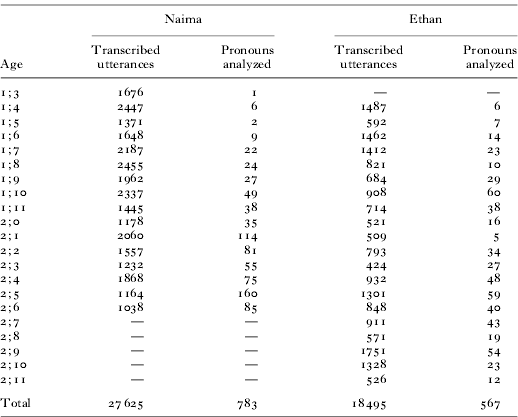
For the current study, we examined the set of singular pronouns in the first and second person (I, me, my, mine vs. you, your, yours, respectively). CLAN programs were used to extract all child utterances containing these target items. Table 1 shows the total number of child utterances examined as well as the number of pronouns analyzed for this study. Although third person pronouns and their associated referents are certainly of interest in a study of pronoun acquisition, they were not included in the present analysis for several reasons. First, since the recording sessions typically had only two participants, there was no opportunity for reference to a non-addressed (but present) listener. Second, since the main focus of the pronoun reversal literature is the I/you alternation, we felt justified in restricting the scope of inquiry to these items, along with their accusative and possessive forms.
Total number of utterances and pronouns analyzed for each child
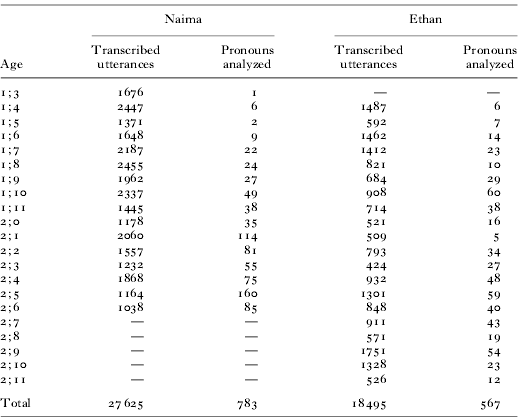
The pronoun counts indicated in Table 1 were taken after the exclusion of several types of utterances unsuited for analysis. These were pronouns produced in immediate self-repetitions or self-corrections (Naima: n=266; Ethan: n=188), in the context of a recited story, song or rhyme (Naima: n=68; Ethan: n=144), those occurring in wordplay (Ethan: n=13), or within a frozen expression (Naima: n=403; Ethan: n=17). Examples of frozen expressions include I love you, Oh my goodness!, lemme ‘[: let me],’ thank you, excuse me and See you later, Alligator!
Naima, particularly between the ages of 2 ; 1 and 2 ; 2, went through a stage of beginning nearly all utterances with I think. This phrase was considered to be a routine, and thus was counted as a frozen expression. In total, 344 tokens of I think were excluded from Naima's data, accounting for the higher number of frozen expressions in her speech as compared to in Ethan's. In addition, fragmented or unintelligible utterances, for which it was not possible to determine the context or referent of a pronoun, were also excluded from the analysis (Naima: n=281; Ethan: n=264).
Each remaining pronoun (Naima: n=994; Ethan: n=799) was coded for two deictic variables, referent and reversal. Referent could be either self, parent (almost always the mother), the genericyou as in (4) below, other (e.g. a non-human referent such as a toy), or ambiguous, when the context licensed more than one possible referent.
(4) ethan: That's how you [=generic] make a square. (2 ; 10·05)
Pronouns with ambiguous (Naima: n=163, Ethan: n=165), generic/impersonal (Naima: n=23; Ethan: n=38), or non-human referents (Naima: n=25; Ethan: n=29) were omitted from our analyses, so that the final data reflect only unambiguous pronominal references to the child or the parent. Accordingly, we analyzed 783 of Naima's pronouns and 567 of Ethan's.
The second deictic variable, reversal, had two possible values: correct, meaning the pronoun was used with an appropriate referent (i.e. ‘self’ for first person pronouns, ‘parent’ for second person pronouns), or reversed, meaning the pronoun was used with an incorrect referent (‘parent’ for first person pronouns, ‘self’ for second person pronouns).
We looked for positive proof of either correct or reversed pronoun use, coding tokens as ambiguous if we could not be reasonably certain of the referent or if the referent was truly ambiguous in context. In some cases, it was clear from the content of the utterance that the pronoun was either reversed or correct, as in (5) and (6), respectively.
(5) ethan: Dad gave me [=you] that ring. (2 ; 4·02)
mother: Who gave me that ring?
(6) ethan: I want bottle. (1 ; 7·00)
We also relied on the mother's responses to the child's utterances to determine deictic correctness, as in (7). Although it is possible that a mother occasionally misunderstood her child's intended meaning, her insight into her child's language and the discourse context were more reliable than that of a third party.
(7) ethan: You [=I] made a circle. (1 ; 10·11)
mother: You did make a circle.
The original transcribers of the corpus were aware of these children's tendency to reverse pronouns, and they occasionally noted reversals in their transcription of the video footage, such as in (8), which is printed as originally transcribed. The transcriber's opinion was always taken into account, although it was neither a necessary nor a sufficient condition for coding a pronoun as reversed.
(8) ethan: You [=I] squeeze on the paper. (2 ; 3·21)
All coding was carried out by the first author or by a trained research assistant. Ten percent of the data was re-coded by a second coder for both reversal and referent, with inter-coder reliability on each measure of 91% and 88%, respectively. Subsequent discussion between coders raised agreement to nearly 100%.
CASE STUDY ONE: NAIMA
SUBJECT
Naima was the first-born child of an upper-class, Standard American English speaking family living in southern New England. Her mother was her primary caretaker and main source of language input, although her father was sometimes also present during recording sessions. Naima's recording sessions began at age 0 ; 11, coinciding with the onset of word production, and continued on a weekly or biweekly basis until 3 ; 10. For the purposes of this study, only Naima's sessions between 0 ; 11 and 2 ; 6 are used, for a total of 62 hour-and-a-half sessions. Naima was extremely verbal, with a great sense of humor and a love of wordplay and rhyming. Her mother was aware of her tendency to reverse pronouns, often prompting her to specify her intended referent. Both of them used proper names (Naima, mommy) in place of pronouns in some cases. After following the conventions for data inclusion and exclusion outlined above, the final analysis of Naima's data included 783 pronouns – 477 first and 306 second person pronouns, respectively.
RESULTS
Between 0 ; 11 and 2 ; 6, Naima reversed 3% of first person pronouns and 79% of second person pronouns. Examples (9) through (11) below are typical of her pronoun use. Example (9) includes two instances of the routinized I think, alongside three reversed second person pronouns. Example (11) includes one of Naima's infrequent first person reversals.
(9) naima: I think you [=I] peed in your [=my] diaper.
mother: Just now?
naima: I think you [=I] did. (2 ; 1·17)
(10) naima: There's blueberry on your [=my] face. (2 ; 2·02)
(11) naima: I'm [=you're] cutting the kiwi for you [=me]. (2 ; 1·17)
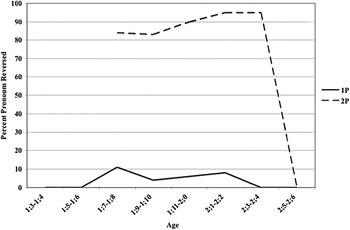
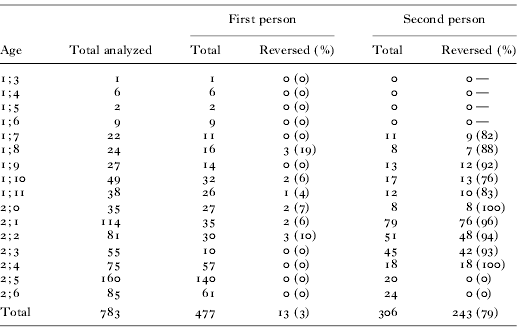
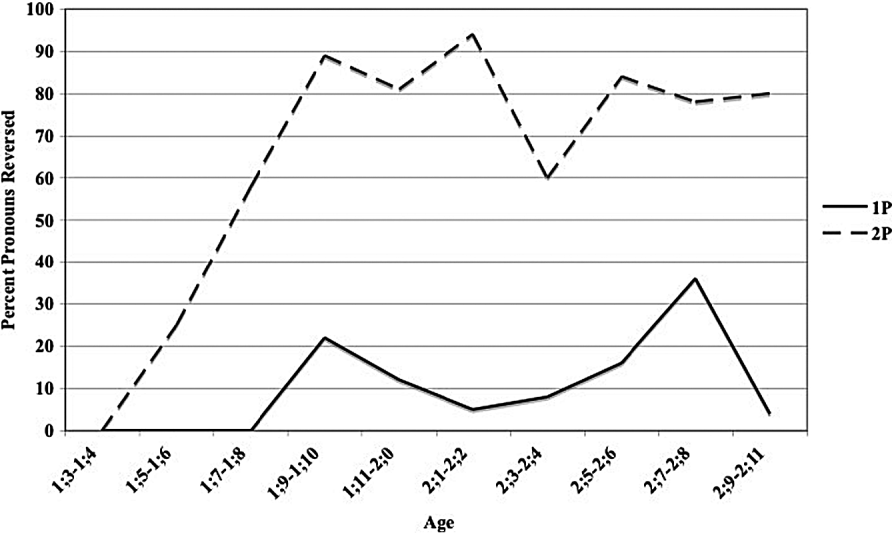
Figure 2 shows Naima's rates of reversal for first and second person pronouns from her first unambiguously referential pronoun use (1 ; 3: first person; 1 ; 7: second person) until 2 ; 6. The corresponding raw data are presented in Table 2.
Percent of first person (1P) and second person (2P) pronouns reversed by Naima.

Number (percent) of Naima's reversed pronouns by month
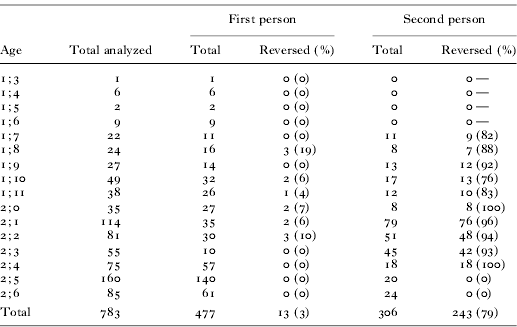
These data have five notable features. First, as the literature leads us to expect, second person pronouns were reversed more frequently than first person pronouns. Second, the rates are extreme; first person pronouns were almost never reversed, whereas second person pronouns were almost always reversed.
Third, Naima's rates of first and second person pronoun reversal were remarkably stable from the onset of reversal at 1 ; 7 until 2 ; 4. Although Figure 2 shows a slight increase in the rate of second person pronoun reversal between 1 ; 7–1 ; 8 and the end of reversal at 2 ; 3–2 ; 4, the difference was not significant under chi-square analysis (χ2(1,82)=2·62, p=0·106). Thus, her behavior is fully consistent throughout this age range.
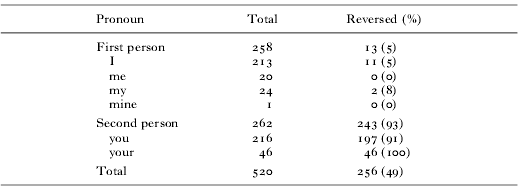
Fourth, Naima's high rate of second person pronoun reversal was in place at 1 ; 7, as soon as she began to use you and your. Finally, Naima's pronoun reversal came to an abrupt end at 2 ; 4: she went from reversing 100% of her second person pronouns at 2 ; 4 to reversing none between 2 ; 5 and 2 ; 6. Together, these observations allow us to define a reversal period for Naima from 1 ; 7 to 2 ; 4, with no transitional phase on either side. Table 3 summarizes Naima's total pronoun reversals, all of which took place during the reversal period, by pronoun and person. Note that these data are a subset of the data presented in Table 2.
Naima's total pronoun reversals from 1 ; 7 to 2 ; 4 (subset of Table 2)

We performed three subanalyses on Naima's data to investigate whether individual pronouns, utterance complexity or imitation had an effect on reversal. We performed one 2×2 chi-square test on her second person pronouns (you vs. your) and one 2×3 chi-square test on her first person pronouns (I vs. me vs. my), comparing the proportions of correct and reversed pronouns in each condition (yours and mine were excluded from these analyses due to sparse data). There was no effect of pronoun among the first person pronouns I, me and my (χ2(2,257)=1·61, p=0·447), but there was a significant difference between the second person pronouns you and your (χ2(1,262)=4·36, p=0·037), with the possessive being more consistently reversed.
Given Dale and Crain-Thoreson's (Reference Dale and Crain-Thoreson1993) observation that precocious talkers' reversal errors tended to occur in complex contexts, we then compared the average utterance lengths (in words) and average number of personal pronouns per utterance between Naima's reversed and correct pronouns in unpaired t-tests. There was a trend for reversed pronouns to occur in slightly longer utterances (M=5·96, SD=2·75) and in ones that contained more pronouns (M=1·32, SD=0·54) than correct pronouns did (length: M=5·39, SD= 2·58; pronouns: M=1·21, SD=0·47). In both cases the trend reached significance (length: t(518)=2·41, p=0·016; pronouns: t(518)=2·44, p=0·015). As we discuss below, however, the implications of these results are unclear.
Finally, given our findings in ‘Case Study Two’, which are reported below, we identified all of Naima's personal pronouns that were contained in immediate or delayed imitations of parental utterances. Conventions followed for the coding of imitations are documented under ‘Case Study Two’. The primary purpose of this analysis was to determine if Naima's consistent reversal of second person pronouns was due to her passing through a highly imitative stage. We determined that only 3% (25 out of 783) of her total pronouns and 5% (14 out of 256) of her reversed pronouns occurred in the context of imitation. It therefore appears that imitation is not a significant factor in Naima's reversal behavior.
DISCUSSION
Naima's data showed a very high, consistent level of second person pronoun reversal (you, your), commencing as soon as she began using these forms referentially at 1 ; 7, and continuing through 2 ; 4, after which she shifted abruptly to correct use. These characteristics are consistent with competence-based reversal or accounts of ‘semantic confusion’ (Oshima-Takane, Reference Oshima-Takane1992), restricted to second person pronouns. As noted above, the meanings of second person pronouns are less transparent to language learners than those of first person pronouns, especially for children lacking the ability or opportunity to attend to non-addressed speech. Naima evidently misunderstood you in her parents' speech as referring specifically to herself, and used it that way in her own speech – as if it were another name for herself. Notice that she also used first person pronouns as well as her own name for self-reference, but made only infrequent pronominal references to her interlocutor. The nature of the corpus data prevents any corroboration of these observations through comprehension tests, but a semantic account is by far the simplest explanation of the observed patterns.
Although the data are quite clear in illustrating the nature of Naima's pronominal difficulties, it is less certain why this particular child should exhibit this fairly uncommon aspect of language development. She does have several characteristics associated with pronoun reversal in non-disordered populations. Oshima-Takane et al. (Reference Oshima-Takane, Goodz and Derevensky1996) indicated that first-born or only children, who have less opportunity than second children to participate in triadic discourse, are slower to master personal pronouns and may be therefore prone to errors. It is therefore important to note that during the time period considered here, Naima was still an only child. Interestingly, Naima's mother reported that her second daughter, also extremely verbally precocious, also went through a brief period of pronoun reversal. However, except for the routinized carry you ‘[=me]’, this ended around 1 ; 5.
As a precocious child, Naima falls into another class identified by Dale and Crain-Thoreson (Reference Dale and Crain-Thoreson1993) as being prone to reversal errors. However, they described such reversal errors as ‘sporadic’ in their population, which is not the case with Naima. Dale and Crain-Thoreson also had found reversal errors to be related to utterance complexity, and while Naima's reversed pronouns tended to occur in longer utterances and those containing multiple personal pronouns, the implications of this are somewhat inconclusive. In Naima's data, deictic correctness is inevitably confounded with person (first vs. second). Recall that nearly all of Naima's reversed pronouns were second person forms and nearly all correct pronouns were first person forms. It is not possible to analyze Naima's first and second person pronouns separately for complexity effects because of the extreme imbalance in the number of correct and reversed pronouns within each person. Thus, although Naima's few incorrect first person forms might be attributable to random, performance-based error, her consistent second person errors require the semantic explanation. Given Dale and Crain-Thoreson's results, a prediction could be made that utterance complexity might influence random deictic errors, the direction of which would be determined by the child's underlying semantic representation. That is, if Naima represented you as referring to herself, a random performance error influenced by utterance complexity would result in a seemingly correct production. With a larger data set, the relationship between utterance complexity and deictic correctness (relative to a child's underlying representation) could be directly tested; it cannot be tested here.
Perhaps the most striking aspect of Naima's pronoun reversal is how suddenly it ended at the age of 2 ; 5. This provides strong support for an explanation of ‘semantic confusion’, since such a hypothesis predicts an across-the-board shift, rather than a gradual transition to correct usage. Examples (12) through (14) illustrate Naima's sudden shift from incorrect to correct second person pronoun use. The utterance in (12) is taken from one of the final sessions during which Naima reversed consistently. Here, she persists in her use of you for self, even under her mother's pointed questioning. This exchange makes perfect sense if Naima thought of you as another term for herself. Notice the co-occurrence of reversed pronouns and proper names, which was typical of both Naima's and her mother's speech. Such a substitution has been proposed as a coping mechanism for children who have not yet mastered the use of pronouns (Dale & Crain-Thoreson, Reference Dale and Crain-Thoreson1993).
(12) naima: You [=I] want Mommy to get Naima's nursie for you [=me].
mother: Does that mean you wanna nurse?
mother: Is that what that means?
naima: Yeah.
naima: You [=I] do want. (2 ; 4·16)
Example (13) was taken ten days later, from the final session in which Naima produced pronoun reversals. At this point, she seems to betray a bit of confusion about which form to use, correcting herself from a first, to a second, and back to a first person pronoun, before resorting to the demonstrative this.
(13) mother: Oh, you're reading Daddy's flap book.
naima: No, I'm reading my flap book.
naima: I mean your [=my] flap book
naima: I'm reading my flap book.
mother: You want some papaya?
mother: Whatcha doin'?
mother: You're having a little more?
naima: I'm reading this flap book. (2 ; 4·26)
By the end of 2 ; 6, Naima had shifted completely to correct pronoun use. In (14), her mother illustrates this fact nicely by prompting her daughter to specify her referent and then confirming it herself.
(14) naima: You also read them.
mother: Who also reads them?
naima: You, Mommy.
mother: I do also read those. (2 ; 6·26)
There are at least two potential, non-mutually-exclusive explanations for this abrupt shift, both of which find some support in previous case studies. The first possibility is an external factor – a change in the input significant enough to trigger a change in the child's semantic representation of a word. Oshima-Takane (Reference Oshima-Takane1992) reported that the cessation of David's pronoun reversal coincided with a visit to his grandparents, during which he would have been consistently exposed to more interlocutors than in his family home and thus able to observe more non-addressed speech. The endpoint of Naima's reversal period appears also to have coincided with a family vacation. This change of setting and company may have facilitated both children's acquisition of the semantic rules underlying personal pronoun use. However, as David consistently reversed first as well as second person pronouns, and he passed through a ‘transitional’ period between consistently incorrect to consistently correct use, the two cases are not totally analogous.
The second possible explanation for the shift in pronoun use is an internal, maturational change. Naima may have attained a new level of cognitive skill around 2 ; 4 that allowed her to puzzle out the correct relationship between pronouns and speech roles. Both Naima and David (Oshima-Takane, Reference Oshima-Takane1992) stopped reversing pronouns consistently at almost the exact same age, a coincidence lending support to the possibility that a maturational process, rather than an external event, may have been responsible for the shift to correct pronoun use. It is possible that the skills in question are the perspective-taking abilities integral to role-play, as Schiff-Myers (Reference Schiff-Myers1983) proposed to be the case with her daughter, Lauren. Again, these two explanations – the external and the internal – are not mutually exclusive, and it might be that the timing of external events relative to cognitive development is key to bringing about a change in representation.
We now turn to the study of our second precocious pronoun reverser, with an eye to the similarities between his and Naima's behavior, as well as the distinctions between the two.
CASE STUDY TWO: ETHAN
SUBJECT
Ethan was also the first-born child of an upper-middle-class, Standard American English speaking family living in southern New England. His main source of language input was his mother, who was his primary caretaker. At the time of data collection, he had not been diagnosed with any communicative or cognitive disorders. At age five, he was diagnosed with Asperger's syndrome. Ethan's recording sessions began at age 0 ; 11, coinciding with the onset of word production, and continued on a biweekly basis until 2 ; 11, for a total of fifty one-hour sessions. Ethan and his mother were the only participants in the recordings, which covered a variety of everyday activities, mostly free play with toys (especially trains) and book reading. Ethan was fairly quiet and shy with others, but interacted freely with his mother. After following the procedures outlined above for data inclusion or exclusion, we analyzed 567 of Ethan's personal pronouns. Of these, 309 were first person forms and 258 were second person forms.
RESULTS
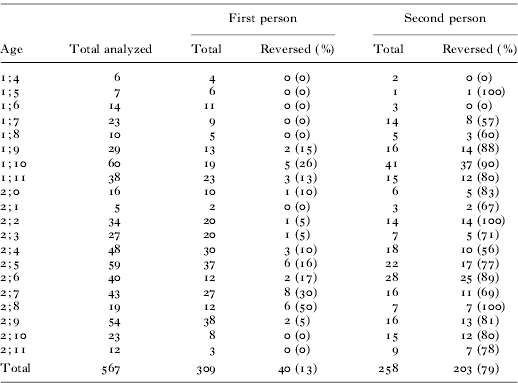
Between 0 ; 11 and 2 ; 11, Ethan reversed 13% of first person pronouns and 79% of second person pronouns. Once again, a ‘correct’ first person pronoun had a ‘self’ referent, and a ‘reversed’ first person pronoun had a ‘mother’ referent, with the opposite being true for second person pronouns. Figure 3 shows Ethan's rates of reversal for first and second person pronouns from his first unambiguously referential pronoun use (1 ; 4 for both first and second person) until 2 ; 11, at which point his data end. The corresponding raw data are presented in Table 4.
Percent of first person (1P) and second person (2P) pronouns reversed by Ethan.
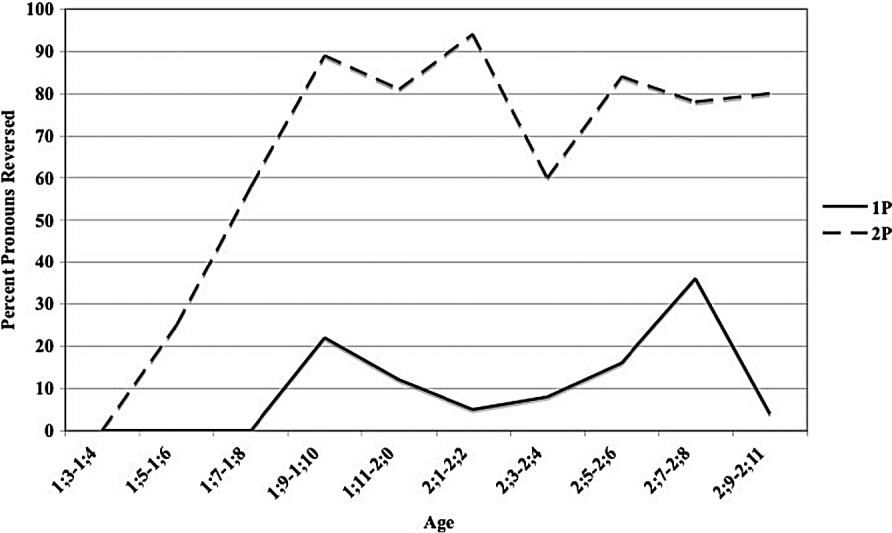
Number (percent) of Ethan's reversed pronouns by month
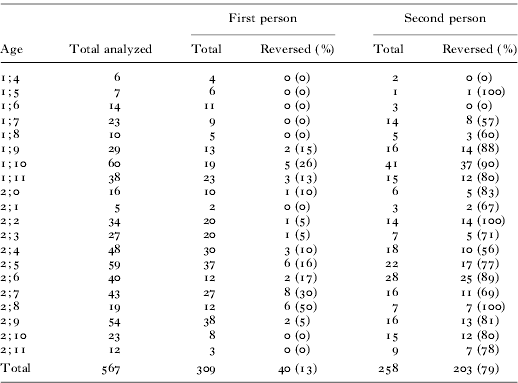
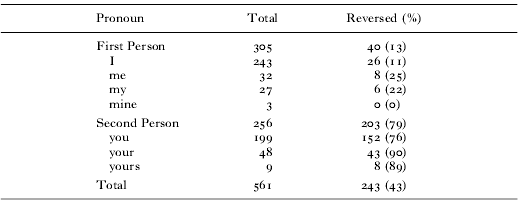
Table 5 summarizes Ethan's pronoun reversal behavior between 1 ; 5, when he made his first reversal error, and 2 ; 11. Since he was still reversing at a high rate at the end of his participation in corpus data collection, we cannot define a definite reversal period for him as we could for Naima.
Ethan's total pronoun reversals from 1 ; 5 to 2 ; 11 (subset of Table 4)
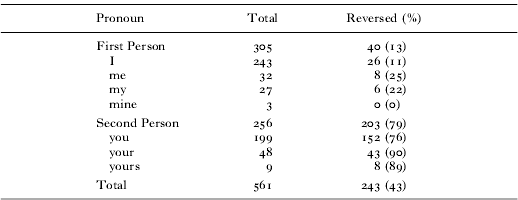
We performed the same two subanalyses on Ethan's data that were reported above for Naima. Unlike Naima, Ethan showed no significant difference in reversal among the second person pronouns you, your and yours (χ2(2,256)=4·63, p=0·099), although his higher reversal rate for me and my compared with I was significant (χ2(2,302)=7·11, p=0·029). On the measures of complexity, an unpaired t-test showed no effect of utterance length on reversal (correct: M=4·07, SD=1·45, n=316; reversed: M=4·14, SD=1·50, n=243; t(557)=0·818, p=0·570). There was, however, a significant trend for reversed compared to correctly used pronouns to occur in utterances containing more personal pronouns (correct: M=1·09, SD=0·32, n=316; reversed: M=1·20, SD=0·40, n=243; t(557)=3·638, p<0·001).
COMPARISON BETWEEN THE TWO PRONOUN REVERSERS
Initially, Ethan's pattern of pronoun reversal appears very similar to Naima's. Both reversed second person pronouns at a very high rate and first person pronouns at a much lower rate, and both reversed at a fairly steady rate. For both children, the onset of frequent reversals occurred around 1 ; 7. There were, however, a few notable differences between the behaviors of the two children. First, Naima reversed nearly all of her second person pronouns from the outset, whereas Ethan's reversals began more gradually. Second, although Naima ceased abruptly to reverse at 2 ; 5, Ethan was still reversing at a high rate at 2 ; 11. Since there are no data for Ethan after 2 ; 11, we cannot be certain exactly when he ceased to reverse his personal pronouns, nor we can we know how abrupt or gradual that transition may have been.
Third, Ethan's reversal rates for first and second person pronouns were not as extreme as Naima's. During Naima's reversal period, she reversed second person pronouns more consistently than Ethan (93% vs. 79%). Conversely, while Naima reversed just 5% of first person pronouns from 1 ; 7 to 2 ; 4, Ethan reversed 13% of his tokens of I, me, my and mine – nearly three times as many.
Finally, although we did not observe a clear pattern to Naima's ‘exceptions’ (un-reversed second person pronouns and reversed first person pronouns), there did appear to be an underlying difference in Ethan's data between his ‘exceptions’ and those exhibiting his more frequent pattern (correct first person and reversed second person pronouns). Informal examination of his un-reversed second person pronouns (21%), revealed that many of these pronouns occurred in requests from Ethan toward his mother – that is, utterances that were rooted in Ethan's own perspective that were intended to produce some result for his benefit, as shown in (15) and (16) below.
(15) ethan: Can I [correct] erase this? (2 ; 8·10)
(16) ethan: You [correct] put on. (2 ; 5·05)
Further examination of Ethan's reversed pronouns (both in first and second person) revealed that many of these occurred in immediate (17) or delayed repetitions (18–19) of his mother's utterances. Example (20) is a good illustration of a delayed repetition, although, as the pronoun it contains is, in context, ambiguous as to referent, it was not included in the analysis.
(17) mother: Should we trace your hand?
ethan: Trace your [=my] hand? (2 ; 9·21)
(18) ethan: Mommy will help you [=me]. (2 ; 10·18)
(19) ethan: Dad gave me [=you] that ring.
mother: Who gave me that ring? (2 ; 4·02)
(20) ethan: Okay, what do you [ambiguous] want to be for Halloween? (1 ; 10·11)
Together, these observations led to the hypothesis that discourse–pragmatic factors affected Ethan's use of personal pronouns. Thus, we reanalyzed Ethan's data, examining the effects of discourse type on pronoun reversal, the results of which are reported below.
REANALYSIS OF ETHAN'S REVERSAL: DISCOURSE TYPES
Each of Ethan's utterances containing either a reversed or correct pronoun was coded as one of three possible discourse categories: request, imitation and other. The category ‘imitation’ roughly corresponds to the immediate and delayed repetitions common to children with ASD and discussed above (e.g. Prizant & Rydell, Reference Prizant and Rydell1984). Here we use this category specifically for repetitions of parental speech, although so-called ‘delayed echolalia’ has elsewhere included those repetitions of stories and songs that we previously excluded from our data set (e.g. Tager-Flusberg & Caronna, Reference Tager-Flusberg and Caronna2007). Instances of delayed imitation were inevitably less easily identified than those of immediate imitation, because the model utterance might not have been captured in the corpus data. Coders needed to use some discretion and apply the label ‘imitation’ to non-immediate repetitions only when it was highly probable Ethan's utterance had a context-specific model in the input. For example, (21) illustrates an utterance Ethan produced on a number of occasions when his mother mixed up the names of two of his toy trains; this was evidently something she herself had said before on making this particular mistake.
(21) ethan: I [=you] always mix them up. (2 ; 4·20)
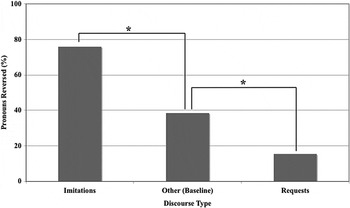
The first author carried out all discourse coding. Ten percent of the data was recoded by a trained research assistant, with between-coder reliability of 97%. Out of 567 utterances, 133 (23%) were imitations (evenly split between immediate and delayed imitations) and 110 (19%) were requests. The remaining 324 (57%) were neither of these and were classified as ‘other.’ Figure 4 shows the percent of pronouns that Ethan reversed within each discourse type. To determine the effect of discourse type (imitation and request) on reversal, we used 2×2 chi-square tests to compare the proportion of reversed pronouns in each of those two groups to the same measure in the ‘other’ group. This was a reasonable basis for comparison since the rate of reversal within the ‘other’ group (125/324 pronouns reversed, or 39%) was very close to Ethan's baseline reversal rate of 43% overall.
Percent of Ethan's pronouns reversed within each discourse type.

Ethan's pronoun reversal showed a significant effect of discourse type: pronouns in imitative utterances were reversed significantly more often than those in the ‘other’ group (χ2(1,457)=53·04, p<0·001). Chi-squared analysis also showed that pronouns embedded in requests were reversed significantly less often than those in other types of utterances (χ2(1,434)=19·78, p<0·001).
Recall that Ethan's reversed pronouns tended to occur in utterances with more personal pronouns, one of our metrics of utterance complexity. Given the results of the discourse analysis, we compared the number of pronouns in Ethan's imitative utterance to the number of pronouns in all other utterances in an unpaired t-test to determine if there was a confound between complexity and discourse type. Indeed, imitative utterances contained significantly more personal pronouns than did other types of utterances (imitations: M=1·25, SD=0·43; others: M=1·10, SD=0·32; t(557)=4·38, p<0·001). Because we know that Ethan showed a very strong correlation between discourse type and pronoun reversal, the results of the earlier complexity analysis are rendered less informative.
DISCUSSION
As is expected from the literature on ASD, Ethan's pronoun reversal errors are closely associated with his imitative behavior, including both immediate repetitions of adult utterances and delayed repetitions of previous interactions within the same discourse context. Recall that utterances recited from songs, books or rhymes were excluded from our analyses; Ethan had more than twice as many such utterances as Naima, despite the fact that she had a higher number of utterances overall. Such utterances also qualify as instances of ‘delayed repetition’, although it does not make sense to think of these in terms of correct and reversed pronominal reference, so they were not analyzed here.
We hypothesize that in most cases, parental child-directed speech refers more often to the child than it does to the parent. Such a disparity, along with the cognitive egocentrism of young children, would explain the steady high versus low rates of reversal in second compared to first person pronouns, respectively. Ethan made few mother-references compared to self-references, resulting in fewer opportunities for correct second or reversed first person pronoun use. If the input were similarly skewed, with more of the mother's utterances pertaining to Ethan than to herself, it follows that less of Ethan's imitative and formulaic speech would refer to her. Thus, if Ethan memorized these verbal routines as unanalyzed wholes, the pronouns they contain would not actually function as deictic terms (Tager-Flusberg & Caronna, Reference Tager-Flusberg and Caronna2007).
Ethan's reversal behavior cannot, however, be attributed wholly to imitation, since slightly less than half of his reversed pronouns occurred in imitative contexts. This observation, coupled with the fact that Naima's reversal was fully consistent and not so closely associated with imitation, illustrates that pronoun reversal in general is not purely the by-product of a natural (Schiff-Myers, Reference Schiff-Myers1983) or pathological (Bartak & Rutter, Reference Bartak and Rutter1974) tendency to imitate adult speech. Instead we suggest that, in Ethan's case, imitative and formulaic speech represent one factor in a ‘multiplex explanation’ of pronoun reversal (Pérez-Pereira, Reference Pérez-Pereira1999). That would indicate that imitation and pronoun reversal might be two manifestations of the same underlying cognitive deficit. Although Ethan's diagnosis makes this discourse–pragmatic difficulty unsurprising, the fact that his requests were less likely to contain reversed pronouns is intriguing.
Ethan's pattern of pronoun reversal is at least partially compatible with Chiat's (Reference Chiat1982) Plurifunctional Pronoun Hypothesis, which suggests that some children may be able to produce and comprehend pronouns correctly while still producing ‘errors’ that indicate a shift away from the child's own perspective. From the point where Ethan's reversals began, he produced at least some correct second person pronouns – a significantly greater proportion than in Naima's case. This indicates that he was capable of using personal pronouns appropriately. Furthermore, our analysis has shown that his reversals were less likely to occur in requests, a type of discourse rooted in Ethan's own perspective. Rather, his reversals were more likely to occur in immediate or delayed imitations of adult utterances, which often corresponded to his mother's perspective. Chiat's hypothesis postulated a purposeful adjustment of pronouns to indicate a change in perspective; however, given the known cognitive deficits of children with ASD, it is unlikely that Ethan was performing such a double correction. What we are seeing is either a failure to adjust pronominal references within ‘parent-like’ utterances to correspond to the speech roles of the participants, or possibly Ethan attempting to speak for his mother, saying what he wants or expects her to say at a given moment. This may be comparable to the ‘difficultly establishing a definite perspective’ that Pérez-Pereira (Reference Pérez-Pereira1999) observed in his vision-impaired subject. The evidence therefore points to an underlying discourse–pragmatic deficit with ties to perspective-taking, rather than purely a difficulty with the semantics of deixis per se.
GENERAL DISCUSSION
In this study, we examined the personal pronoun use of two verbally precocious children: a typically developing girl, and a boy who was subsequently diagnosed with Asperger's syndrome. Both children made frequent pronoun reversal errors over a number of months, primarily by using second person pronouns (you, your, yours) to refer to themselves.
A comparison of the reversal patterns of the two children revealed quantitative and qualitative differences, indicating different underlying difficulties in personal pronoun use. The girl, Naima, reversed 93% of her second person pronouns during her reversal period, which lasted from 1 ; 7 to 2 ; 4. During the same period, she reversed just 5% of first person pronouns. All reversals ceased abruptly at 2 ; 5. This type of very consistent second person pronoun reversal indicates a competence problem, or ‘semantic confusion’ with the meaning of you (cf. Oshima-Takane, Reference Oshima-Takane1992). This behavior is mostly compatible with the Name/Person Hypothesis (Clark, Reference Clark, Bruner and Garton1978; Charney, Reference Charney1980b), which predicts an across-the-board omission of deixis, although in this case the difficulty was restricted to second person forms.
Although Ethan's reversal rates for first and second person pronouns were similar to Naima's, his reversal was not as consistent, and it continued through the end of data collection at 2 ; 11. Further analysis revealed that he reversed significantly more pronouns in immediate or delayed imitations of adult speech – a category related to ‘immediate and delayed echolalia/repetition’ in the ASD literature (Prizant & Rydell, Reference Prizant and Rydell1984). Conversely, however, he reversed significantly fewer pronouns in requests, giving some support to a discourse–pragmatic competence theory of pronoun reversal. This interaction between perspective and reversal provides some support for Chiat's hypothesis of Plurifunctional Pronouns (1982), although his diagnosis of ASD renders an intentional manipulation of perspectives through deixis less plausible. Recall that Chiat's subject, Matthew, was typically developing; it appears that interactions between pronoun use and perspective-taking can occur in various populations of children and are not limited to those with ASD.
Both children also showed some tendency to reverse more possessive and accusative than nominative pronouns, a pattern also found in Chiat's (Reference Chiat1982) subject. This is not surprising given the lower overall frequency of possessive compared to nominative pronouns used by the children (cf. Tables 3 and 5).
Neither child's pronoun reversal behavior can be explained by the Processing Complexity Hypothesis (Dale & Crain-Thoreson, Reference Dale and Crain-Thoreson1993), which proposes that verbally precocious children may commit sporadic reversal errors in complex contexts because of limited processing capacity. Both children in the present study reversed far too consistently for this explanation to be completely satisfactory. Naima did show a significant trend of reversals occurring in longer utterances, and both children's reversal tended to occur in utterances with multiple pronouns, but these measures of complexity were confounded with person (for Naima) and discourse type (for Ethan).
The current findings hold important implications for the continued study of pronoun reversal. Oshima-Takane and colleagues (e.g. Oshima-Takane & Benaroya, Reference Oshima-Takane and Benaroya1989) have suggested that the underlying cause for most cases of pronoun reversal, in both typical and disordered populations, is semantic confusion resulting from a failure to attend to non-addressed speech. The current results do not necessarily undermine this idea. We suggest that pronoun reversal in these two cases, although dissimilar in some characteristics, arose through a similar convergence of circumstances. Neither subject had any siblings at the time of study, and therefore probably had limited opportunities for triadic discourse, which can provide a good model of pronoun use. Furthermore, both children were precocious and used pronouns earlier than is typical, and therefore both may have lacked the cognitive prerequisites of deixis during their reversal periods. This is doubly true for Ethan, whose diagnosis of Asperger's indicates these perspective-taking and role-playing abilities were likely impaired; that his reversal continued for many months longer than Naima's supports this idea.
For the two children studied here, we observed patterns of behavior that appeared to be very similar on the surface, but which exhibited subtle qualitative and quantitative differences. The results indicate that there may be multiple paths into pronoun reversal, involving different combinations of impaired (or as yet undeveloped) cognitive skills, and the possibility of various non-adult-like semantic representations of pronouns. Furthermore, it appears that typically developing reversers and reversers with ASD may not approach pronouns in the same way, even though both populations may have above-average linguistic abilities and exhibit similar surface patterns of reversal.
It is apparent that one hypothesis of pronoun reversal will not suffice to account for the behavior of every reverser; instead, the data call for the development of a model, encompassing aspects of the input as well as of linguistic precocity and cognitive abilities, which could explain which children are most likely to become pronoun reversers and how their reversals might manifest given individual characteristics. If both internal and external factors are necessary to induce consistent pronoun reversal, it would explain why such behavior is relatively rare, especially among typically developing children. Further cross-sectional and longitudinal studies of pronoun acquisition could lead to the development of such of model, while improving further our understanding of this phenomenon and its pervasiveness in the population at large.