1. Introduction
I want to address the conference theme of ‘teaching academic writing across and in the disciplines’ through the lens of genre. I've chosen to focus on genre as many teachers are uncertain of what it is and because it has been quite slow to take off in academic literacy courses in Europe. I get the impression that teachers often see genre as a research tool rather than a teaching one, but this is a misconception. Genre is actually a robust pedagogical approach perfectly suited to the teaching of academic writing in many contexts as it serves a key instructional purpose: that of illuminating the constraints of social contexts on language use. A genre-based approach, in other words, brings research and teaching much closer and turns us all into students of texts. This process, I think, can make us better teachers.
Today, genre is one of the most important and influential concepts in literacy education. Basically, it is concerned with making explicit what experts produce when they write. An understanding of the concept enables us to look beyond content, composing processes and grammatical forms to see texts as socially situated attempts to communicate with readers. In other words, it helps teachers to identify the kinds of texts that students will have to write in their target contexts and to organise their courses to meet these needs, ensuring that curriculum materials and activities are devised directly to support learners writing in their disciplines. I'll organise this paper by briefly introducing genre and then go on to look at disciplinary differences in academic writing before saying something about the implications of genre for the classroom.
2. What is genre?
Genre is a concept over-burdened with definitions so I'll keep mine simple – it is a term for grouping texts together, representing how writers typically use language to respond to recurring situations. It is, in other words, both a social and a cognitive concept. It helps us to theorise the common-sense labels we use to categorise texts and the situations where they occur. Essentially, it is based on the idea that members of a community usually have little difficulty in recognising similarities in the texts they use frequently and are able to draw on their repeated experiences with such texts to read, understand and perhaps write them relatively easily.
This is, in part, because writing is a practice based on expectations. The process of writing involves creating a text that the writer assumes the reader will recognise and expect. And the process of reading involves drawing on assumptions about what the writer is trying to do. Hoey (Reference Hoey2001) says that this is like dancers following each other's steps, each assembling sense from a text by anticipating what the other is likely to do by making connections to prior texts. While writing, like dancing, allows for creativity and the unexpected, established patterns often form the basis of any variations. We know immediately, for example, whether a text is a recipe, a joke or a love letter and can respond to it immediately and even construct a similar one if we need to. As teachers, we develop the use of more specialised genres such as lesson plans, student reports, and teacher feedback (Hyland & Hyland Reference Hyland2006), bringing a degree of expertise to the ways we understand or write these familiar texts.
More precisely, we possess a schema of prior knowledge which we share with others and can bring to our writing to express ourselves efficiently and effectively. Genre reminds us that when we write we follow conventions for organising messages so that our reader can recognise our purpose and follow our ideas. In other words we stage the development of our purposes through a series of moves or rhetorically distinct sub-purposes, like the introduction–body–conclusion pattern that you may have learnt to write essays at school, or the problem–solution pattern of the narrative genre:

Simple structures like this have been refined and developed so that, as I'll discuss shortly, move analyses can inform our understanding of text organisation and language use in sophisticated ways.
In sum, by frequently writing or reading this genre we develop a schema which allows us to recognise an effective narrative. If one part is missing we have trouble understanding it and, as teachers, we can recognise this absence and help students address it.
3. Genre patterns
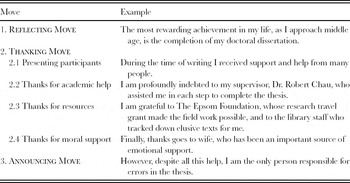
Genre approaches encourage us to look for organisational patterns and salient features, and we find these in even the most apparently interpersonal and expressive kind of writing. In an analysis of the acknowledgments in 240 Ph.D. and M.A. dissertations written by Hong Kong speakers of English (Hyland Reference Hyland2004a), for example, I found students used the structure shown in Table 1.
Move structure of dissertation acknowledgements (based on Hyland Reference Hyland2004a).

As we can see, the acknowledgement structure consists of a main Thanking move sandwiched between optional Reflecting and Announcing moves. So the writer opens with a brief introspection on his or her research experience. Then there is the core Thanking Move where credit is given to individuals and institutions for help with the dissertation, and this can consist of up to four steps. First, a sentence introducing those to be thanked, followed by thanks for academic help. This was the only step that occurred in every single text. Supervisors were always mentioned, and always before anyone else, but sometimes other academics such as teachers appeared here too. Next there is thanks for providing resources such as clerical, technical and financial assistance or access to data, followed by thanks for moral support from family and friends who gave encouragement, friendship, sympathy, etc., and this occurred in two-thirds of all texts. The final Announcing Move was uncommon, but here writers accepted responsibility to reclaim the thesis and show that it is not simply the work of those who supported them.
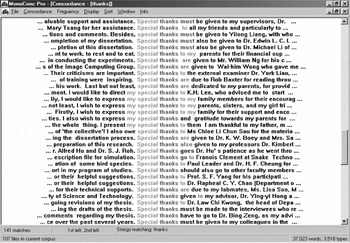
The analysis showed that this structure was common in almost all the acknowledgements and that where steps occurred they did so in this described sequence. It also told me something about the ways thanks is expressed in this genre. So of all the ways of expressing thanks (I am grateful to, I appreciate, I want to thank, etc.) the noun thanks was used in over half of all cases. Also interesting is that it was modified by only three adjectives: special, sincere, and deep, with special comprising over two-thirds of all cases. Figure 1 shows just one screen of a concordance for this structure in the corpus.
MonoConc concordance of ‘special thanks’ in acknowledgements.

When analysing these texts I also found that virtually all thanks included the reason for acknowledging the person, as in these examples:
- (1)
a. First of all, my grateful thanks to my supervisor, Dr. Angel Lin, for her consistent and never-failing encouragement, support and help.
b. My special gratitude goes to my family who made it possible for me to embark on writing a Ph.D. thesis at all.
c. I should also thank my wife, Su Meng, who spent days and nights alone with our daughter taking care of all the tasks that should have been shared by me as a father and a husband.
This suggests that writers weren't only addressing the people they acknowledged, who presumably knew the help they had given, but a much wider audience. Interviews with students subsequently showed that writers used the acknowledgement as a strategy to represent themselves as good researchers and sympathetic human beings who are deserving of the degree. So, looking at specific genres tells us a lot about how we create meanings; both the purposes writers are trying to achieve and the language they are using to do it.
4. Advantages of genre-based academic writing instruction
The main potential advantages of genre-based writing instruction can be summarised like this (Hyland Reference Hyland2004b). Genre teaching can be:
Explicit Makes clear what is to be learnt to facilitate the acquisition of writing skills.
Systematic Provides a coherent framework for focusing on both language and contexts.
Needs-based Ensures that course objectives and content are derived from students' needs.
Supportive Gives teachers a central role in scaffolding students' learning and creativity.
Empowering Provides access to the patterns and possibilities of variation in valued texts.
Critical Gives students the resources to understand and challenge valued discourses.
Consciousness-raising Increases teachers' awareness of texts confidently to advise students on writing.
I am not claiming that all of these characteristics are unique to genre pedagogy, but I can think of no other approach which seeks to realise them all. Perhaps the most important feature is that the approach sets out to provide students with an explicit understanding of how target texts are structured and why they are written in the ways they are. This explicitness gives teachers and learners something to aim at, making writing outcomes clear rather than relying on hit-or-miss inductive methods where learners are expected to acquire the genres they need from simply writing or the teacher's feedback on their essays (Hyland Reference Hyland2003). In other words, providing writers with a knowledge of appropriate language forms shifts writing instruction from the implicit and exploratory to a conscious manipulation of language and choice. As Christie (Reference Christie and Reid1987: 45) observes, making clear ‘the ways in which patterns of language work for the shaping of meanings’ empowers both writers and teachers.
5. Genre and community
While genre has provided a powerful way of understanding situated language use, I think it has led us to over-emphasise resemblances between texts at the expense of differences. This is because genre helps us to generalise: grouping together texts that have similar purposes, structures and contexts. Swales (Reference Swales1990) has made clear, however, that we need to see community and genre together to offer a framework of how meanings are socially constructed in writing. This draws on Faigley's (Reference Faigley1986: 535) claim that writing ‘can be understood only from the perspective of a society rather than a single individual’ and Geertz's (Reference Geertz1973) view that knowledge and writing depend on the actions of members of local communities. Community, in fact, helps us not only interpret and understand genre use better but also to explain genre variation across different groups.
On the most general level, this is one reason why writing in English is so difficult for speakers of other languages. While all possibilities are available to all users, what is seen as logical, engaging, relevant or well-organised in writing often differs across cultures. Culture isn't the only explanation of course, and we can't simply predict the ways students are likely to write on the basis of assumed cultural preferences. But it is clear there are different ways of organising ideas and structuring arguments in different languages which can have implications for teachers of academic writing. Research suggests, for instance, that compared with many languages, academic texts in English tend to be more explicit about structure and purposes, to be less tolerant of digressions, to be more cautious in making claims, and to use more sentence connectors (such as therefore, in addition, however). Hinds (Reference Hinds, Connor and Kaplan1987) believes that this has a lot to do with the fact that English makes the writer rather than the reader responsible for clarity and this is very different from German, Korean, Chinese and Japanese, where the reader is expected to dig out the meaning from a dense text.
More specifically, researchers have become more sensitive to the ways genres are written and responded to by individuals acting as members of social groups. Such ideas as communicative competence in applied linguistics, situated learning in education, and social constructionism in the social sciences have contributed to a view which places community at the heart of writing and speech. This community-based orientation to literacy therefore focuses on the importance of communicating, and learning to communicate, as an insider. The concept draws attention to the idea that we communicate as members of social groups, each with its own norms, categorisations, sets of conventions, and ways of doing things.
Essentially, the idea of community draws together a number of key aspects of context that are crucial to the production and interpretation of spoken and written discourse: knowledge of a cultural and interpersonal situation, knowledge of interlocutors, knowledge of the world, and knowledge of texts and conventions for saying things. This is how Swales puts it:
In-group abbreviations, acronyms, argots, and other special terms flourish and multiply; beyond that, these discourse communities evolve their own conventions and traditions for such diverse verbal activities as running meetings, producing reports, and publicizing their activities. These recurrent classes of communicative events are the genres that orchestrate verbal life. These genres link the past and the present, and so balance forces for tradition and innovation. They structure the roles of individuals within wider frameworks, and further assist those individuals with the actualization of their communicative plans and purposes. (Swales Reference Swales1998: 20)
Emphasis therefore tends to be on what is ‘shared’ by a community (e.g. Swales Reference Swales1990), and this has led critics to see the concept as too structuralist, static, and deterministic (e.g. Canagarajah Reference Canagarajah2002). We obviously need to recognise that membership can imply huge diversity and variation, and our own experience of belonging to groups tells us that they are not monolithic and conformist but often disparate and divergent. Communities are composed of antagonistic groups and discourses, contested theories, peripheral contributors, and occasional members. Nobel Prize winners, influential gatekeepers, and high-profile professors interact with, and use the same texts and genres as, student neophytes, research assistants, and lab rats. They may, however, use them for different purposes, with different questions, and with different degrees of engagement.
Nor is it entirely clear what exactly constitutes a community or how we might reconcile local and global interpretations, that is, how we square the idea of large, amorphous and dispersed groups of like-minded individuals with groups who typically work together and subscribe to common practices of communication (e.g. Killingsworth & Gilbertson Reference Killingsworth and Gilbertson1992). Do we look for communities, for example, in disciplines (such as applied linguistics), in specialisms (such as EAP or genre analysis) or domains (like social sciences)? After all, they are all collectivities of academic participation which help structure and are themselves structured by different discourses (Hyland Reference Hyland2008). But despite these problems, the concept of discourse community, understood as a group who have texts and practices in common, is important as a way of joining writers, texts and readers together. It foregrounds the conceptual frames that individuals use to organise their experience and get things done using language. In particular it offers insights into how writing works in different disciplines and allows us to explore genre variation systematically.
6. Academic communities and genre differences
Disciplinary genre variation is based on the fact that academic genres represent writers' attempts to anticipate possible negative reactions to their views and establish their claims. To do this they must display familiarity with the practices of their disciplines – encoding ideas, employing warrants, and framing arguments in ways that their audience will find most convincing. Based on their previous experience with texts, writers make predictions about how readers are likely to react to their arguments. They know what they are likely to find persuasive, where they will need help in interpreting the argument, what objections they might raise, and so on. Therefore, this process of audience evaluation helps writers to construct an effective line of reasoning. At the same time it points to the ways language is related to specific institutional contexts (Hyland Reference Hyland2001a).
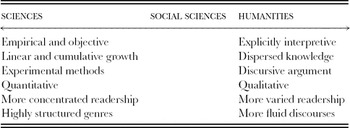
In other words, persuasion in academic genres is much like any other field of writing in that it involves the use of language to relate independent beliefs to shared experience. Writers galvanise support, express collegiality, resolve difficulties, and negotiate disagreement through patterns of rhetorical choices which connect their texts with their disciplines. Most simply, physicists don't write like philosophers nor lawyers like applied linguists. Writers have to establish a professionally acceptable voice and an appropriate attitude, both to their readers and to their arguments, and the analysis of genres helps to show how disciplines create a view of the world through their genre conventions. Communities have different ideas about what is worth communicating, how it can be communicated, what readers are likely to know, how they might be persuaded, and so on. In this way, we can see disciplines as spread along a cline, with the ‘hard knowledge’ sciences and ‘softer’ humanities at opposite ends, as shown in Table 2.
Continuum of academic knowledge (Hyland Reference Hyland2006).

We can understand the cline in this way. In the sciences, new knowledge is accepted by experimental proof. Science writing reinforces this by highlighting a gap in knowledge, presenting a hypothesis related to this gap, and then reporting experimental findings to support this. The humanities, on the other hand, rely on case studies and narratives while claims are accepted on strength of argument. The social sciences fall between these extremes. While they have partly adopted methods of the sciences, in applying these to human data they have to give more attention to explicit interpretation.
In practice this means that different disciplines value different kinds of argument and different writing tasks. So in the humanities and social sciences analysing and synthesising information from multiple sources is important while in science and technology subjects activity-based skills like describing procedures, defining objects, and planning solutions are required. It also means that different fields require different genres, so that chemists tend to write lab reports, mathematicians write article surveys, computer scientists write program documentation and social scientists write project reports. We can't, of course, always generalise about student writing needs in this way as the same genre labels may hide different rhetorical patterns. It does, however, point to the realities of variation and the need to research genres in our students' target contexts.
7. Some genre comparisons across disciplines
As writers, our knowledge of genres is often only vague and schematic, but it extends beyond the kind of higher level organisational move structures I've been talking about so far to the more local aspects of expression. Genre knowledge also refers to a shared sense of the conventions of grammar, vocabulary, content, and so on which allow us to express the values and identities that relate to our particular discipline.
I now illustrate some of the these disciplinary differences by picking out a few features from a series of studies I've done into published research articles over the past few years. This research is based on a 1.5-million-word corpus of 240 articles from eight disciplines and interviews with 30 academics.
Essentially, this research describes how writers in different disciplines represent themselves, their work and their readers in very different ways. About 75% of all the features which mark author visibility in a text – such as self-mention, personal evaluation and explicit interaction with readers, for example – occur in humanities and social sciences articles. Admittedly this probably doesn't seem too surprising. After all, science attempts to represent the truths it finds in the lab without the use of rhetoric. It seeks to stamp its claims with a guarantee of reliable knowledge, which, through induction, experimentation and falsification, give us direct access to the external world. But the impersonality of scientific discourse is not an absence of rhetoric but a different kind of rhetoric. It is based, like all writing, on an assumed agreement of how language works. Let's take a few examples.
7.1 Hedges and boosters
These are the ways we express our commitments to our claims, either conveying caution and acknowledging others' views by hedging, or stressing our commitment and closing out alternatives with boosters. Hedges are devices like possible, might, likely, etc., which withhold complete commitment to a proposition, implying that a claim is based on plausible reasoning rather than certain knowledge. Boosters, such as certain, definitely and demonstrate, on the other hand, allow writers to express certainty in what they say and to mark involvement with the topic and solidarity with readers.
Both devices represent a writer's personal intrusion into a text to evaluate material, and these are two-and-a-half times more common in humanities and social science papers than in the hard sciences. One reason for this is because there is less control of variables, more diversity of research outcomes, and fewer clear bases for accepting claims than in the sciences. Writers can't report research with the same confidence of shared assumptions so papers rely far more on recognising alternative voices, and arguments have to be expressed more cautiously by using more hedges. This means that we tend to find more statements like this in the soft fields:
- (2)
a. Wilson leaves us disappointed, it seems to me, in the sense that his theory is far from being general. (Sociology)
b. We tentatively suggest that The Sun's minimalist style creates an impression of working-class language, or restricted code . . . (Applied Linguistics)
c. As far as I know, this account has gone unchallenged. (Philosophy)
But because methods and results are more open to question, writers also work harder to establish the significance of their work against alternative interpretations. They often seek to present their own research more forcefully to create different rhetorical effects and different understandings with readers. Personal credibility, getting behind your arguments, is an important part of creating a convincing discourse in the humanities and social sciences and this means we find more boosters. So while writers might use hedges to soften criticisms, establish a gap, or present an argument, they often leave readers in no doubt of their own contribution to the debate. Two comments from informants underline this. First, a sociologist informant told me:
It's important to show where you stand. The people who are best known have staked out the extreme positions. The people who sit in the middle and use words like ‘suggest’, no one knows their work.
And a philosopher echoed these sentiments:
I'm very much aware that I'm building a façade of authority when I write. I really like to get behind my work and get it out there. Strong. Committed. That's the voice I'm trying to promote, even when I'm uncertain I want to be behind what I say.
In the hard sciences, positivist epistemologies mean that the authority of the individual is subordinated to the authority of the text and facts are meant to ‘speak for themselves’. Writers often disguise their interpretative responsibilities behind linguistic objectivity and the less frequent use of hedges and boosters is one way of minimising the researcher's role to suggest that results would be the same whoever conducted the research. Another is the preference for modal verbs over cognitive verbs. This is because modals can more easily combine with inanimate subjects to downplay the person making the evaluation and ‘objectify’ the research. So instead of finding patterns such as those in (3), where responsibility for the evaluation is explicit, we tend to find patterns like (4), which disguise the source of the interpretation:
- (3)
a. We suspect that the type of product used in this study may have contributed to the result. (Marketing)
b. I want to suggest that these principles apply to the choices that people make within the legally coercive structures of justice. (Philosophy)
- (4)
a. For V. trifidum, ANOVA showed a significant increase from L to L' and FI, which could be interpreted as reflecting the dynamics of fungal colonization. (Biology)
b. The deviations at high frequencies may have been caused by the noise measurements . . . (Electronic Engineering)
Scientists tend to be concerned with generalisations rather than individuals, so they put greater weight on the methods, procedures and equipment used rather than the argument. This helps to reinforce a view of science as an impersonal, inductive enterprise and allows scientists to see themselves as discovering truth rather than constructing it.
7.2 Citation
Citation is another example of how writing works differently across fields. The inclusion of references to the work of other authors is obviously central to academic persuasion. This is because it not only helps establish a persuasive framework for the acceptance of arguments by showing how a text depends on previous work in a discipline, but also as it displays the writer's credibility and status as an insider. It helps align him or her with a particular community or orientation and confirms that this is someone who is aware of, and is knowledgeable about, the topics, approaches, and issues which currently interest and inform the field. This helps to explain why I found around 70 citations per paper in a study of 80 research articles in 8 disciplines (Hyland Reference Hyland2004c). But because discourse communities see the world in different ways they also write about it in different ways, with two thirds of all the citations in the corpus in the philosophy, sociology, marketing and applied linguistics papers, twice as many as in the science disciplines.
Basically, the differences reflect the extent writers can assume a shared context with readers. In Kuhn's (Reference Kuhn1962) ‘normal science’ model, natural scientists produce public knowledge through cumulative growth. Problems tend to emerge on the back of earlier problems as results throw up further questions to be followed up with further research, so writers don't need to report research with extensive referencing. The people who read those papers are often working on the same problems and are familiar with the earlier work. They have a good idea about the procedures used, whether they have been properly applied, and what results mean. In the humanities and social sciences, on the other hand, the literature is more dispersed and the readership more heterogeneous, so writers can't presuppose a shared context but have to build one far more through citation.
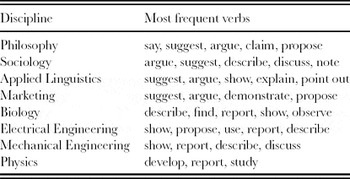
There are also major differences in the ways writers report others' work, with results suggesting that writers in different fields draw on very different sets of reporting verbs to refer to their literature. Among the higher frequency verbs, almost all instances of say and 80% of think occurred in philosophy and 70% of use in electronics. It turns out, in fact, that engineers show, philosophers argue, biologists find and applied linguists suggest. The most common forms across the disciplines are shown in Table 3.
Most frequent reporting verbs.

These preferences seem to reflect broad disciplinary purposes. So, the soft fields largely used verbs which refer to writing activities, like discuss, hypothesise, suggest, argue, etc. These involve the expression of arguments and allow writers to discursively explore issues while carrying a more evaluative element in reporting others' work:
- (5)
a. Lindesmith's (1965) classic work indicated the . . .
b. Davidson defends this claim on the grounds that . . .
c. Ballard and Clanchy (2001) argue that . . .
Engineers and scientists, in contrast, preferred verbs which point to the research itself like observe, discover, show, analyse, calculate, which represent real-world actions.
- (6)
a. Edson et al. (1993) showed processes were induced . . .
b. . . . the structure was studied by Mazur [7] and Tech et al. [8] . . .
c. . . . using (4) special process and design, or by adding (5), or removing (6) a mask.
This emphasis on real-world activities helps scientists represent knowledge as proceeding from impersonal lab activities rather than from the interpretations of researchers. Two scientist informants commented on this kind of use:
Of course, I make decisions about the findings I have, but it is more convincing to tie them closely to the results. (Physics interview)
You have to relate what you say to your colleagues and we don't encourage people to go out and nail their colours to the mast as maybe they don't get it published. (Biology interview)
The conventions of impersonality in science articles thus play an important role in reinforcing an objective ideology by portraying the legitimacy of hard science knowledge as built on socially invariant criteria. Again, it removes the author from the text to give priority to the unmediated voice of nature itself.
7.3 Self-mention
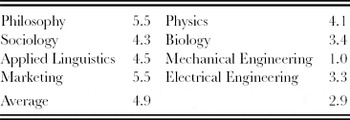
Another important feature of research writing is the writer's reference to self: how far they want to personally intrude into their texts though use of ‘I’ or ‘we’, or use impersonal forms. Presenting a discoursal self is central to the writing process, and we can't avoid projecting an impression of ourselves and how we stand in relation to our arguments, discipline, and readers. To some extent we have to see this as a personal preference determined by seniority, experience, confidence, personality, and so on, but the presence or absence of explicit author reference is a conscious choice by writers to adopt a particular community-situated authorial identity. My 240 research articles, once again, show broad disciplinary preferences with two-thirds of cases in the social sciences and humanities papers (Table 4).
Self-mention in research articles (per 1000 words).

The reason for this is again that the strategic use of self-mention allows writers to claim authority by expressing their convictions, emphasising their contribution to the field, and seeking recognition for their work (Kuo Reference Kuo1999; Hyland Reference Hyland2001b). It sends a clear indication to the reader of the perspective from which statements should be interpreted and distinguishes the writer's own work from that of others. Successful communication in the soft fields depends far more on the author's ability to invoke a real writer in the text, emphasising their own contribution to the field while seeking agreement for it.
- (7)
a. I argue that their treatment is superficial because, despite appearances, it relies solely on a sociological, as opposed to an ethical, orientation to develop a response. (Sociology article)
b. I bring to bear on the problem my own experience. This experience contains ideas derived from reading I have done which might be relevant to my puzzlement as well as my personal contacts with teaching contexts. (Applied Linguistics article)
c. So self-mention can help construct an intelligent, credible, and engaging colleague by presenting a confident and authoritative authorial self:
Using ‘I’ emphasises what you have done. What is yours in any piece of research. I notice it in papers and use it a lot myself. (Sociology interview)
d. The personal pronoun ‘I’ is very important in philosophy. It not only tells people that it is your own unique point of view, but that you believe what you are saying. It shows your colleagues where you stand in relation to the issues and in relation to where they stand on them. It marks out the differences. (Philosophy interview)
In the hard sciences, as I noted earlier, researchers are generally seeking to downplay their personal role in the research to highlight the phenomena under study, the replicability of research activities, and the generality of the findings. Scientists, then, try to distance themselves from interpretations in ways that are familiar to most EAP teachers. Either using the passive voice, as in (8), dummy ‘it’ subjects, as in (9), or by attributing agency to inanimate things, as in (10).
- (8)
a. This suggestion was confirmed by the observation that only plants carrying the pAG-I::GUS transgene showed a gain of GUS staining in leaves of clf-2 plants. (Biology article)
b. . . . the ST's components were demonstrated to relate to the magnetization vector components . . . (Physics article)
- (9)
a. It was found that a larger stand-off height would give a smaller maximum shear strain when subjected to thermal fatigue . . . (Mechanical Engineering article)
b. It is assumed that the circuit simulator which uses this model applies the nodal method in the solution process. (Electrical Engineering article)
- (10)
a. The design model above suggests specific requirements for software tools for the physical design of microstructures. (Electrical Engineering article)
b. The images demonstrate that the null point is once again well resolved and that diffusion is symmetric. (Physics article)
Writers are interested in establishing the objectivity of what they report uncontaminated by human activity. One of my respondents expressed this view clearly:
I feel a paper is stronger if we are allowed to see what was done without ‘we did this’ and ‘we think that’. Of course we know there are researchers there, making interpretations and so on, but this is just assumed. It's part of the background. I'm looking for something interesting in the study and it shouldn't really matter who did what in any case . . . In theory anyone should be able follow the same procedures and get the same results. Of course reputation is important and I often look at the writer before I look at a paper, but the important thing is whether the results seem right. (Biology interview)
8. Genre teaching
So what might all this mean in the classroom? Clearly teachers work in widely differing situations with different resources, constraints, and students, and these differences demand creativity and flexibility in the ways methods are implemented. While responsive to the diverse contexts in which EAP is taught, however, genre pedagogies are essentially based on the principle that an awareness of texts facilitates writing development. The key idea, then, is that writing instruction will be more successful if students are aware of what target discourses look like.
It is this reproductive element, however, which critics have latched on to. The argument is that the explicit teaching of genres can straightjacket creativity through conformity to restrictive formulae so that genres might be taught as moulds into which students just pour their own content (e.g. Raimes Reference Raimes1991). I have to admit, of course, that there is always some danger of reifying genres. That we might fail to acknowledge variation and choice and apply what Freedman (Reference Freedman, Freedman and Medway1994: 46) calls ‘a recipe theory of genre’. Obviously this danger exists and must be guarded against, but there is nothing inherently prescriptive in a genre approach. I can see no reason why providing students with an understanding of discourse should be any more prescriptive than, say, providing them with a description of a clause, or of stages in a writing process.
I want to mention four classroom practices in this section which EAP teachers might find helpful in employing a genre approach and avoiding prescriptivism: needs analysis, the teaching–learning cycle, comparison tasks, and mixed genre portfolios.
8.1 Needs analysis
First, one clear implication is that we need to base teaching on a study of the texts students will need in target contexts rather than our impressions of writing. Genre teaching means taking the world outside the writing classroom into account by going beyond grammar and vocabulary to prepare students for their future experiences using the most detailed needs analysis that time allows.
While all teaching starts with where the students are and takes their backgrounds, language proficiencies, teaching and learning preferences seriously, the central question for genre-based instructors when beginning a course is ‘why are these students learning to write?’. Needs analysis expresses the fact that literacy acquisition does not occur in a vacuum. It seeks to ensure that learning to write is seen both in the context in which it occurs and the contexts in which these skills will be used: it is the means of establishing the how and what of a course. Many EAP teachers struggle to produce courses for their students which take account of both a present situation analysis, concerning information about learners' current proficiencies, perceptions and ambitions and a target situation analysis, the linguistic skills and knowledge they will need to perform competently in their future roles (Dudley-Evans & St John Reference Dudley-Evans and St John1998). Helping students move from current to target proficiencies determines the objectives, materials, and tasks of a course. Focusing on the features of target genres, and recycling instruction at increasing levels of difficulty, can be a solution in many cases.
While sometimes seen as a kind of educational technology designed to measure goals precisely, needs are always influenced by the preconceptions of the analyst. As a result, they are likely to be defined differently by different stakeholders, with administrators, subject tutors, literacy instructors and learners perhaps having different views (Hyland Reference Hyland and Hyland2006). Decisions about what to teach and how to teach it are therefore not neutral professional questions but reflect the ideologies of the most powerful parties in any context with important consequences for learners. In fact, treating need as something existing and measurable is itself an ideological stance, and we might reflect on the dangers of conflating students' needs and institutional demands (e.g. Benesch Reference Benesch2001). It is important, then, to involve students in the process of assessing their options so we can use needs analyses to support learners in taking active responsibility for their learning, a point which resonates with the literature on autonomy in language learning.
Reflection on the complexity of needs can also assist us in seeing that teaching writing is not simply a neutral transfer of skills complying with institutional understandings. Exploration of genres helps learners to see the assumptions and values which are implicit in those genres and helps them understand the relationships and interests in that context. In other words, seeing ‘needs’, contexts, and genres together is both a means of considering writing in a wider frame and a basis for both developing the skills students' need to participate in academic or professional communities and their abilities to critically understand those communities.
8.2 Grammar and writing
A second implication of a genre approach to writing instruction is that it means attending to grammar, but this is not the traditional idea of a grammar, as a system of rules independent of contexts and users. Here grammar is a resource for producing texts: a repertoire of available choices for achieving particular purposes in particular contexts. A knowledge of grammar thus concerns how meanings can be codified in distinct and recognisable ways, shifting writing from the implicit and hidden to the conscious and explicit. In genre-based writing instruction this is a top–down procedure, starting with texts, which
first considers how a text is structured and organised at the level of the whole text in relation to its purpose, audience and message. It then considers how all parts of the text, such as paragraphs and sentences, are structured, organised and coded so as to make the text effective as written communication. (Knapp & Watkins Reference Knapp and Watkins1994: 8)
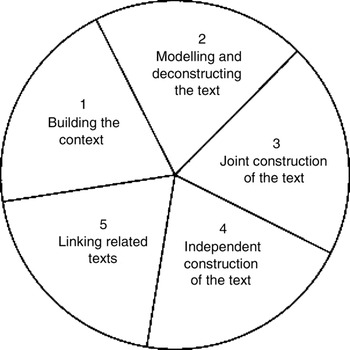
In learning to write, students also not only begin to understand how to create meanings but also need to develop an understanding of how language itself works, acquiring a vocabulary they can use to talk about language and its role in texts. But while EAP has tended to focus on grammatical consciousness-raising (e.g. Swales & Feak Reference Swales and Feak2000) and on the elaboration of genre moves, methods to develop students' genre-based grammatical competence have largely come from Systemic Functional Linguistics (SFL). Both approaches privilege communicative purpose in defining genres and emphasise the formal properties of texts, but SFL sees genres in the wider rhetorical structures fundamental to various forms of communication in a culture, like narration, description and exposition, which can combine to form our everyday genres such as research papers, lab reports and recipes (Martin Reference Martin1992). Pedagogically, there are also differences, as SFL genre teaching possesses a more systematic model of language than EAP and makes extensive use of a metafunctional grammar based on the work of Michael Halliday (e.g. Halliday Reference Halliday1994). Many EAP teachers find it useful to borrow from SFL in their classes and one approach seems particularly fruitful. This is the teaching–learning cycle as expressed by Feez (Reference Feez1998) and represented as Figure 2.
The teaching–learning cycle (Feez Reference Feez1998: 28).

The cycle helps us plan classroom activities by showing the process of learning as a series of linked stages which support learners towards understanding texts. Here the teacher provides initial explicit knowledge and guided practice, moves to sharing responsibility for developing texts, and gradually withdraws support until the learner can work alone. The key stages of the cycle are:
(i) Setting the context: to reveal genre purposes and the settings in which it is commonly used. Key questions here are who writes it, with whom, who for, why, etc.? What is the relationship between the writer and reader, are there status or power differences, etc.?
(ii) Modelling: analysing representative samples of the genre to identify its stages and key features and the variations which are possible. Activities here identify the main tenses, themes, vocabulary, and so on, and teachers might ask students to sequence and label text stages, re-organise scrambled paragraphs or re-write unfinished ones.
(iii) Joint construction: involves guided, teacher-supported practice in the genre through tasks which focus on particular stages or functions of the text. Students here write with considerable teacher support, perhaps writing a parallel text.
(iv) Independent construction: here students write independently, producing a target text with the teacher monitoring progress.
(v) Comparing: at this point students relate what they have learnt to other genres and contexts to understand how genres are designed to achieve particular social purposes. They can compare the target genre with others they know already and how it is linked to other texts in a situation.
Therefore, each of these stages seeks to achieve a different purpose, and so is associated with different types of classroom activities and teacher–learner roles (Hyland Reference Hyland2004b: 130–140). The cycle is intended to be used flexibly, allowing students to enter at any stage depending on their existing knowledge of the genre and to enable teachers further to develop the literacy skills gained by working through a new cycle at a more advanced level of expression.
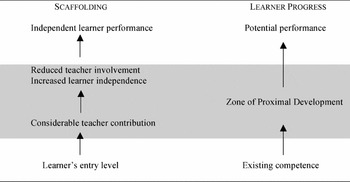
In terms of pedagogic theory, the teaching–learning cycle draws on modern theories of learning in giving considerable recognition to the importance of collaboration, or peer interaction, and scaffolding, or teacher supported learning. Most obviously, it supports learners through what Vygotsky called the ‘the zone of proximal development’, or the gap between their current and potential performance. Figure 3 shows that as teachers move around the cycle, direct teacher instruction is reduced and students gradually get more confidence and learn to write the genre on their own. In other words, students' autonomy increases with their writing competence as they gain greater control over the genre.
Scaffolding and collaboration in the learning cycle.

8.3 Consciousness-raising
The notion of scaffolding is also implicit in another approach to genre-based writing instruction known as rhetorical consciousness-raising. Consciousness-raising attempts to create better writers rather than better texts by encouraging learners to see grammatical features as ‘the on-line processing component of discourse and not the set of syntactic building blocks with which discourse is constructed’ (Rutherford Reference Rutherford1987: 104). The writing teacher's goal is to demystify the genres that matter to students by making their key features salient. This is done through noticing and reflection, guiding students to explore key lexical, grammatical and rhetorical features of representative samples of target genres, and then to use this knowledge to construct their own examples of the genre.
Rhetorical consciousness-raising should always involve some kind of focus on texts, and this can be achieved by asking students to conduct mini-analyses of the genres they have to write or of their own writing. For example, teachers can ask students to identify where writers have chosen to use or avoid ‘I’ and determine possible reasons for this. A simple task could involve the following steps (Hyland Reference Hyland2004b):
• Mark all occurrences of ‘I’ in a typical paper from the target discipline, count and tabulate the findings.
• Compare the results with a classmate (preferably in a different discipline). Can you explain any differences?
• Notice how impersonal and personal forms change in the text. Why might this be?
• Select FIVE places where ‘I’ can be replaced with a passive. What effect does this have on the meaning of each sentence?
• What main verbs occur most often with ‘I’ in this text? Can you group them in any way?
• Do they correspond to the following rhetorical functions?
∘ explaining what was done (‘We interviewed ten teachers from six schools.’)
∘ structuring the discourse (‘First, I will discuss the method, then present my results.’)
∘ showing a result (‘My findings show that the animation distracted the pupils.’)
∘ making a claim (‘I think two factors are particularly significant in this regard.’)
• Now write a report to present your findings.
Comparison tasks are often helpful for raising awareness of language features. For instance, it can be useful to encourage students to compare the advice found in style guides and textbooks with the actual practices of academic writers. These materials play an important part in literacy education at university and students should learn to view their advice critically. Often textbooks rely heavily on intuition and conventional wisdom rather than analysis of real language use, and by analysing texts, considering advice, and discussing uses, students can work towards a more informed understanding of language use.
8.4 Mixed genre portfolios
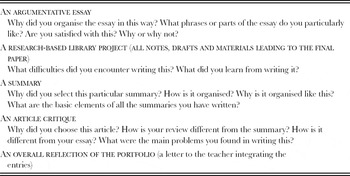
Finally, I want to mention Ann Johns' idea of mixed genre portfolios (Johns Reference Johns1997) as a way of raising students' awareness of text features by encouraging reflection on similarities and differences across genres. These portfolios require students to write a range of genres over a semester or course and then collect them together in a folder for assessment together with a brief commentary on each one. Table 5, adapted from Johns, shows a mixed-genre portfolio with some example reflective questions.
A genre portfolio with reflective questions.

Essentially, the purpose of portfolios is to get a more accurate picture of students' writing, what they can do and how they can vary their language for particular purposes and readers. But they also have a consciousness-raising function by getting students to think about similarities and differences between the genres they are asked to write. The reflection questions encourage them to see how language varies for particular purposes and readers.
9. Conclusion
I have tried to say something about genre and disciplinary variation in writing, suggesting something of what genre analysis can tell us about writing in the disciplines and how it might be a useful approach for teachers preparing students for writing at university. I have argued that an understanding of the ways language is used to create meanings in writing empowers students by offering them ways to analyse texts and reflect on the workings of language, and that it gives teachers the tools to understand writing and give more robust and targeted support for learners. Because they emphasise the importance of making known what is to be learnt and assessed, genre approaches give teachers a more central role in preparing individuals to write in their disciplines.
The fact that we need to consider community as well as genre in our instruction underlines the fact that writing isn't just words on a page or the activity of isolated individuals. It is always a social practice, influenced by cultural and institutional contexts. For teachers, genre offers us a tool to analyse texts in ways that we can distinguish regularities of structure and form, showing how language typically works within particular disciplines. By becoming researchers of the specific genres our students will need in their fields of study we can help them understand the reasons for language choices and scaffold their effective use of them.
Ken Hyland is Professor of Education and Director of the Centre for Academic and Professional Literacies at the Institute of Education. Before coming to London, he taught overseas for 26 years, mainly in Asia and Australasia, and has published over 130 articles and 12 books on language education and academic writing. His most recent publications are English for Academic Purposes: An advanced resource book (Routledge, 2006), Feedback in second language writing (edited with Fiona Hyland; Cambridge University Press, 2006), and Academic discourse (Continuum, 2008). He is co-editor of the Journal of English for Academic Purposes (Elsevier).