Introduction
El Hajj Ahmadou Ahidjo resigned as Cameroon’s president in 1982, peacefully handing over power to Paul Biya. During a period when leaders all too often clung to power or were forced out by political or social violence, Ahidjo’s resignation after twenty-two years as president set an important example. But in less than one year, relations between Ahidjo and Biya had unraveled. Accused of masterminding an attempted coup, Ahidjo stood trial in absentia and was sentenced to death. He left Cameroon in 1983, never to return, dying in 1989 in exile in Senegal. When the news broke that Ahidjo had died, “Paul Biya breathed a sigh of relief, [and] wished his predecessor’s soul a speedy journey to hell,” wrote Victor Le Vine (Krieger Reference Krieger2015:87).
Ahidjo’s regime left an indelible impact on his nation. Despite his role in shaping Cameroon holistically, scholars have generally focused on Ahidjo’s domestic policy rather than on his foreign policy accomplishments (DeLancey Reference DeLancey2007; Efouba Reference Efouba2018; Johnson Reference Johnson1970; Joseph Reference Joseph1978; Takougang & Krieger Reference Takougang and Krieger1998). Scholars routinely portray him as ruthless, authoritative, and vicious (Eyinga Reference Eyinga and Joseph1978; Bayart Reference Bayart1973). Ahidjo, Jean François Bayart wrote, was “the source of all power in the state” and ruled in “an active and personal manner” (Reference Bayart and Richard1978:66). Abel Eyinga likened the use of torture to that of South Africa’s apartheid government agents, adding that “asphyxiation, hanging, electric shocks, to outright murders” were common practices tolerated or even encouraged by the Ahidjo regime (Reference Eyinga and Joseph1978:109).
Yet Ahidjo rose in stature and was repeatedly praised by leaders around the world for his external actions. Yakubu Gowon was grateful for Ahidjo’s role in mediating the Nigerian Civil War (Torrent Reference Torrent2012). Sammy Kum Buo wrote that Ahidjo was “widely respected by his colleagues in the Organization of African Unity” (Reference Buo1973:32). Western diplomats described him as a “highly intelligent leader” who brought stability and economic growth to Cameroon (Torrent Reference Torrent2012:6). The U.S. Department of State affirmed, “Most of modern Cameroon was built and paved under Ahidjo’s reign,” though it added, “Under his rule, Cameroon’s human rights record was dismal.”Footnote 1 The Ahidjo presidency, like that of Léopold Senghor and others in the continent, presents a paradox in postcolonial African politics; it has been a subject of renewed interest to historians of decolonization and independence (Bamba Reference Bamba2016; Durand Reference Durand2007; Ripert Reference Ripert2021).
A proliferation of studies about the Biya regime has also brought renewed attention to the Ahidjo presidency (Anyefru Reference Anyefru2017; Kamé Reference Kamé2018; Konings & Nyamnjoh Reference Konings and Nyamnjoh2003; Pommerolle & Heungoup Reference Pommerolle and De Marie Heungoup2017). The recurring question is this: How could a nation that started with so much promise descend so quickly into a quagmire of such significant political, economic, and social problems?Footnote 2 To answer this question and others, scholars have scoured libraries and archives in search of correspondence and other official records that may have been previously overlooked. While some authors have focused on domestic policy (Takougang & Amin Reference Takougang and Amin2018), others have examined the shaping of Cameroon’s foreign policy, producing works on Cameroon’s relations with France, Britain, China, and Nigeria (Torrent Reference Torrent2012; Tesi Reference Tesi2017). In some respects, the objectives of Ahidjo’s foreign policy were all-encompassing—nonalignment, total liberation of Africa, nonintervention, respect of each nation’s sovereignty, and promotion of peace through the support of organizations such as the United Nations (Kombi Reference Kombi1996). Present at the creation of the Organization of African Unity (OAU), Ahidjo stood by the principles of the organization, especially those that dealt with the “total liberation of Africa” and abiding by territorial boundaries established at the time of independence (Ahidjo Reference Ahidjo1964). Cameroon’s 1961 constitution and subsequent amendments gave its president the authority to make foreign policy, to decide on the nation’s agreements, to ratify treaties, and to determine the nations with which to establish diplomatic relations.Footnote 3
Although scholars agree that the nation’s foreign policy trajectory originated with Ahidjo, many disagree about the effectiveness of the methods he employed (Le Vine Reference Le Vine1971; Peter & Mbida Mbida Reference Peter, Mbida, Warner and Shaw2018). Scholarship frames Ahidjo’s foreign policy in three distinct ways: weak, makeshift, and pragmatic. Based on extensive and previously unexamined archival documents and interviews located in Cameroon’s archives in Yaoundé and Buea, along with a variety of other published primary and secondary sources relating to Ahidjo’s foreign policy, a new perspective emerges in this scholarly debate: Ahidjo designed Cameroon-U.S. relations as a means to protect his nation’s sovereignty and promote economic development while simultaneously ensuring his own grip on power, an approach that determined the course of the nation’s foreign policy for decades.
The Post-Colonial Archive of Modern Cameroon
Cameroon’s postcolonial archive is dispersed across the globe; it includes repositories located in both Yaoundé and Buea. Previously unexamined archival materials are able to shed light on the behind-the-scenes discussions, decisions, and nuances that took place as Ahidjo formulated his policies. The Ministry of External Relations archives in Yaoundé houses many boxes containing letters, correspondence, memoranda, reports, and other documents pertaining to Cameroon’s foreign relations. Many of those boxes remained sealed, partly because scholars have not requested access to them, and because scholars of Cameroon foreign policy have mainly focused on the country’s relations with France while ignoring relations with the U.S. This author, along with research assistant Pulchérie Irène Pieumi, submitted a request and gained access to the boxes which focus on Cameroon-U.S. relations. The documents therein provide a context for a better understanding of Ahidjo’s decisions. For example, a detailed report submitted on January 2, 1980, by Cameroon’s ambassador in Washington, D.C., to the minister of external relations in Yaoundé contained information about U.S. global challenges and actions and about Congressional deliberations on aid to developing countries.Footnote 4 The following year, another report contained a summary and critique of the new direction of American policy toward Africa.Footnote 5 Another example documented Cameroon’s weighing its options for leveraging the importance of its geographical location and bilingualism, as the U.S. sought to expand its influence into the countries of Union douanière et économique de l’Afrique centrale (UDEAC).Footnote 6
The available reports were irregular and varied in depth and analysis, but taken together, they highlight policies that were carefully thought out, based on the gathering of information supplied by Cameroonian diplomats in the U.S. The problem of incomplete documents in archives is not unique to Cameroon. Nana Osei-Opare’s study of worker discontent in Ghana challenges notions that disparage local archives and argues that those archives are essential in “rethinking and constructing postcolonial histories from the voices of nonelite persons.” Problems such as “limit[ed] access to sources, waste [of] researcher’s time, or even destroy[ing] documents,” he continues, “are not unique to African history” (Reference Osei-Opare2021:64). Kate Skinner concurs. Skinner’s reappraisal of the assassination of Togo’s first president, Sylvanus Olympio, delves into the challenges of working with archives across nations on both sides of the Atlantic; she argues that although the documents she consulted were incomplete and scattered, it is the researcher’s responsibility to carefully analyze all the available documents and to go “wider in search of the connections between one fragment and actual, potential, or absent others” (Reference Skinner2020:17).
While research for this article encountered similar challenges, the newly available documents confirmed the centrality of local archives in the study of African diplomatic history. Among other things, these archives enable historians to analyze the political, economic, and socio-cultural contexts in which African leaders created and executed their foreign policies. For example, documents relating to Ahidjo’s 1962 visit to the U.S. were divided between the two archives in Cameroon and the John F. Kennedy Library, and some events during that visit as shown in the documents were interpreted differently, depending on the viewpoints of the documents’ creators.
Speeches by Cameroonian embassy officials to different communities in the U.S. designed to bolster their country’s image reflected an understanding of the craft of diplomacy in a new age. Soon after taking office, President Kennedy informed his ambassadors that diplomacy entailed going into the local community to mingle with local people. Cameroonian diplomats in Washington, D.C., were already engaged in such actions.Footnote 7 This research would show that Kennedy’s creation of the Peace Corps reflected that thinking. Boxes containing copies of Nouvelles du Cameroun, a newsletter published intermittently by the Cameroonian embassy in Washington, D.C., showcased Cameroon as a peaceful and stable nation. Taken together, these documents offer a vital new perspective for revisiting the crafting of Cameroon’s foreign relations with the U.S. At the National Archives in Yaoundé, director Esther Olembe provided access to documents that had been recently cataloged. At the Peace Corps Office in Yaoundé, then-country director LaHoma Romocki provided access to archival materials which were vital to evaluating the performance of the volunteers. In addition, supplemental interviews and questionnaires pursued lines of questioning that emerged from these documents.
Between 2008 and 2011, Pulchérie and I conducted interviews with Peace Corps volunteers and their Cameroonian co-workers in seven of the country’s ten regions; we also interviewed employees at the Peace Corps office in Yaoundé. In the U.S., Freedom of Information Act (FOIA) requests furnished documentation pertaining to U.S.-Cameroon policy and Peace Corps operations, and a declassification process resulted in the new availability of hundreds of pages of relevant information. For example, our FOIA filings brought to light documents showing tension in U.S.-Cameroon relations. These documents attest to Ahidjo’s determination to protect Cameroon’s sovereignty while simultaneously promoting the nation’s development. Assembled and viewed together, these materials challenge prevailing views that Ahidjo was completely a “yes man” to the major powers, especially France (Kombi Reference Kombi1996). In addition, newly accessible documents and interviews raise questions about Peace Corps effectiveness in Cameroon. They point to Ahidjo’s discomfort with racism and with other efforts to encourage African Americans to come to Cameroon to assist in the nation’s development. In short, they reveal a level of hard-nosed realism that has been neglected or overlooked in scholarly treatments of Ahidjo’s foreign policy.
A long overdue reappraisal of Ahidjo’s foreign policy is important, for several reasons. Because the United States is a superpower and because its foreign relations matter globally, its attention to its relationship with Cameroon speaks to the significance of Africa in U.S. calculations. Cameroon’s geographical location at the “Armpit of Africa,” between West and Central Africa, makes it strategically significant. Serving as a gateway between the former British and French colonies in the region, the country is known as the “laboratory of African Unity” because of its official Franco-Anglo bilingualism and bicultural structure. It is often referred to as “Africa in miniature” or “the microcosm of Africa” as well; from the multiplicity of ethnicities and languages spoken inside its borders to its diverse climate and geography, Cameroon has come to represent the many faces of Africa as well as the continent’s deep complexities. Repeatedly, those attributes of Cameroon factored into the U.S. appraisal of the region. In the 1960s, the U.S. sought to use Cameroon as an important gateway into UDEAC countries. Cameroon’s Commercial Attaché in New York, Elias Bah Chamfor, noted that the U.S. considered Cameroon to be “most stable and attractive,” adding “the nation had the weight of UDEAC behind it in addition to the bilingual nature of the country.”Footnote 8 The U.S. and other major powers understood and acknowledged the nation’s importance.
A foreign policy focus also sheds light on wider U.S. regional operations on the African continent in the early 1960s and the hub-like status of Cameroon. Although the U.S. established diplomatic relations with oil-rich Equatorial Guinea in 1968, between 1970 and 1981, and again from 1995 to 2006, the U.S. controlled and monitored its interest in Equatorial Guinea from Yaoundé, Cameroon’s capital.Footnote 9 Cameroon, Thierry Virocoulon wrote, was and remains an important nation in the region (Reference Vircoulon2015:2). (See Map, Figure 1.) In the post-World War II era, the U.S. looked at Africa through the lens of the Cold War, and U.S. interventions were motivated by the overriding goal of defeating communism (Nwaubani Reference Nwaubani2001; Mahoney Reference Mahoney1983). Given Cameroon’s strategic location and diversity and the presence of the Union des Populations Du Cameroun (UPC), the nation readily attracted U.S. interest. Robert Foulon, who established the first U.S. consulate in Yaoundé, stated that the Cold War was the prime motivator of American interests.Footnote 10 In addition, the U.S. sought to promote democratic institutions and free-market systems in Cameroon, as well as in the entire West and Central African regions.
Map of Cameroon showing the administrative regions. Source: Library of Congress [https://www.loc.gov/item/2005631064/; accessed June 8, 2021]

These newly available archival materials demonstrate Cameroon’s centrality to U.S. security interests in the West Africa region. The two countries have collaborated militarily at different levels since the beginning of Cameroon’s independence.Footnote 11 A close look at U.S.-Cameroon foreign relations helps to unpack some of the complexity involved in the analysis of the Ahidjo presidency. While Ahidjo professed nonintervention, he did not hesitate to meet with America’s oldest civil rights organization, the National Association for the Advancement of Colored People (NAACP) to discuss racism in America.
Finally, building on existing work on U.S. diplomacy toward francophone African nations, a focus on Cameroon adds and contributes to the evolving literature in the region. Former U.S. Ambassador Leland Barrows’s criticism of a preoccupation with Anglophone Africa at the expense of French-speaking Africa remains valid (Reference Barrows1971:4). Recent scholarship on Franco-American competition in Africa has drawn attention to the region. Abou Bamba (Reference Bamba2016) explains that in Côte d’Ivoire, the U.S. promoted its interests through economic investment and aid. Relatedly, Yohann C. Ripert (Reference Ripert2021) identifies measures by which America achieved its post-World War II objectives in Senegal. Pierre-Michel Durand (Reference Durand2007) looks at Franco-American competition in West Africa. Analyzing Cameroon’s place in this debate is important and speaks to the significance of francophone Africa in the development of U.S. diplomacy and interests. The newly available archival materials personalize Cameroon-U.S. diplomacy and point to how relations between individual African nations and the U.S. are also the product of the efforts and initiatives of individuals.
Debating Ahidjo’s Foreign Policy Tactics
Analyses of Ahidjo’s foreign policy are far from unanimous in their conclusions. A decade after independence, Le Vine argued that Cameroon’s foreign policy had few “specific objectives” but rather had “such vague goals as broader economic, social, and political cooperation” (Reference Barrows1971:174). A decade later, Ndiva Kofele-Kale described Ahidjo’s foreign policy as weak, makeshift, and “conservative.” Unlike other African leaders, Ahidjo lacked a coherent ideology or catchy phrase for his policy, like Kwame Nkrumah’s Consciencism and Pan-Africanism, Julius Nyerere’s Ujamaa, or Léopold Senghor’s Négritude (Kofele-Kale Reference Kofele-Kale1981:198–99). Kofele-Kale and Le Vine paved the way for more in-depth analysis of the nation’s foreign policy. Virocoulon supported the makeshift theory, arguing that the nation’s foreign policy drifted from the beginning because of failures by the president to lead Cameroon as a “pivotal country” and because its leaders squandered opportunities to move the nation into a position to be a major player in the region (Reference Vircoulon2015:2). Ada Peter and Remi Mbida Mbida concurred, arguing that Ahidjo’s approach to foreign policy was “confrontational,” shortsighted, and naive and “effectively alienated Cameroon from the international community.” His failure to join the British Commonwealth of Nations after reunification, while entering a series of binding cooperation agreements with France, they added, cemented the foundation for future problems of “political unrest, complaints of marginalization, and the threat of separation along colonial lines” (Reference Peter, Mbida, Warner and Shaw2018:356). Julius Amin’s (Reference Amin1999) survey of U.S.-Cameroon relations, Peter Agbor-Tabi’s (Reference Agbor-Tabi1984) overview of U.S. aid to Cameroon, and Narcisse Mouelle Kombi’s (Reference Kombi1996) work on Cameroon’s role in international organizations did not, however, engage in an analysis of the major factors that shaped U.S-Cameroon relations.
While these studies are important, the authors’ lack of access to many primary sources in Cameroon’s Ministry of External Relations and related materials in the national archives in Yaoundé and Buea means their analyses were based on an incomplete picture. Notwithstanding this omission, they paved the way for new directions in the study of Cameroonian foreign policy. Mélanie Torrent disagreed with the characterization of Ahidjo’s diplomacy toward France and Britain as makeshift and weak. Based on her extensive use of archival sources in France, Britain, and Cameroon, Torrent argues that Ahidjo capitalized on his country’s dual colonial heritage to gain more leverage and “instilled a strong sense of realism in Cameroonian diplomacy.” Ahidjo, Torrent continued, was aware of the “constraints that limited resources placed” on his foreign policy actions and as a result remained extremely “cautious and pragmatic” (Reference Torrent2012:6). Moses Tesi (Reference Tesi2017) agreed, adding that Ahidjo navigated complex situations to protect Cameroon’s sovereignty and promote the nation’s development.
Building on these observations, the newly available archival materials enable scholars to expand their analysis to incorporate Cameroon’s relationship with the United States. In their focus on Cameroon’s economic, military, and cultural agreements with the United States and their exploration of the impact of the Peace Corps, the new archival materials reveal that Ahidjo was savvier with regard to foreign policy than was previously believed. The evidence shows that, unlike other African leaders, Ahidjo did not restrict his policy to specific dogmas. He was flexible and, in many cases, chose to act rather than to wait. Evidence also shows that in Cameroon’s relations with the U.S., Ahidjo focused on initiatives to safeguard his nation’s sovereignty and to promote its development. These accounts suggest that Ahidjo’s policy directions—specifically during the 1960s, when he developed most of his foundational policies—outlasted him and continued under the Biya regime.
The United States and the Evolution of African Foreign Policy
Immediately after World War II, the need for a more coordinated U.S. African foreign policy became apparent. Before the start of the Cold War, the United States generally maintained a hands-off policy with regard to Africa (Schraeder Reference Schraeder1996). But the post-World War II ideological conflict changed things, and the person who championed the creation of a revised African policy was John F. Kennedy. In the 1950s, Kennedy warned of the emerging forces of nationalism in the developing areas and called on America to adjust. In 1957, he informed France that “their overseas territories are eventually going to break free and look with suspicion on Western nations who impeded their steps to independence.” Though the brickbats were quick to fall, he did not back down, insisting that America’s failure to side with Africa’s nationalist movements was being “exploited by the Soviets” (Mahoney Reference Mahoney1983:20).
But political calculations also influenced Kennedy’s focus on Africa. His team was aware of the interactions, common past, and historic relationship between Africans and African Americans. In 1957, prominent African Americans including Ralph Bunche, Rev. Dr. Martin Luther King Jr., and Asa Philip Randolph attended Ghana’s independence celebration. Later, Bunche remarked about the relationship between the two groups, stating, “We embrace you because we are brothers” (Blyden Reference Blyden2019:182). In addition, Dr. King’s sermon “The Birth of a New Nation,” delivered after his trip to Ghana in 1957, linked the colonization of Africa with Jim Crow practices in America: “Both segregation in America and colonialism in Africa … were based on the same thing—white supremacy and contempt for life.”Footnote 12 In 1959, when Sékou Touré, the first president of Guinea, visited Harlem, he experienced an outpouring of support. Nemata Amelia Ibitayo Blyden has written that African Americans saw Ghanaian President Kwame Nkrumah and Touré as a “source of pride … and symbols of black potential” (Reference Blyden2019:183). Kennedy’s pro-Africa message was a calculated move to earn votes from African Americans. Kennedy, Thomas Noer wrote, “courted black votes …[and] effectively used the Africa issue to appeal to voters” (Reference Noer1985:58–59). Kennedy’s victory in the 1960 presidential election translated into a victory for new directions in U.S.-African policy.
Cameroon and Cold War Diplomacy
The end of World War II ushered in the beginning of the Cold War, and the two superpowers, the United States and the USSR, struggled to promote their ideologies and expand their zones of influence, first in Europe and later in developing areas. In 1947, U.S. President Harry S. Truman responded to a request for help from Greece and Turkey by issuing the Truman Doctrine, committing America to resisting the spread of communism anywhere. Truman’s successor, Dwight D. Eisenhower, developed a policy he called “massive retaliation,” promising to use America’s bombs to stop the spread of communism. In addition, he expanded the role of America’s Central Intelligence Agency (CIA) from gathering information to conducting subversive acts against those he considered to be communist suspects. Patrice Lumumba of the Democratic Republic of the Congo was among those targeted. CIA Director Allen Dulles described him as “a Castro or worse” (Noer Reference Noer1985:138). Kennedy’s addition to the policy of containment was the strategy of “flexible response,” which meant America would use any tool in its arsenal to stop communism (Gaddis Reference Gaddis2005).
Washington was determined that Africa not become “aligned with the USSR.” Africa, Ebere Nwaubani has written, had to be “acculturated into a global setting conducive to United States national security interest … thereby warding off countervailing influences such as ‘communism’ and non-alignment” (Reference Nwaubani2001:32). To accomplish this goal, America had to confront the legacy of European colonialism. Kennedy began that process in the 1950s and continued with it throughout his presidency. Charles de Gaulle and officials in Paris were livid at Kennedy’s pronouncements, but Kennedy was not deterred. Repeatedly, he stated, “I want the people in … Africa … to start to look to America … what the President of the United States is doing, not … Khrushchev or the Chinese Communists” (Sorenson Reference Sorenson1965:199). Though Kennedy did not intend for America to take over France’s position in Africa, Philip E. Muehlenbeck has argued that he wanted to “compete” with de Gaulle in the region and requested the establishment of an American embassy in each Francophone African country (Reference Muehlenbeck2014:166–67; Durand Reference Durand2007:131).
Whatever the rights and wrongs of Franco-American competition in Africa may have been, America’s involvement in West Africa was consistent with Washington’s objectives. In Côte d’Ivoire, Bamba has argued that on the heels of America’s investment came the establishment of a consulate office in 1956. In 1957, the U.S. State Department sent Foulon to establish a consulate office in Yaoundé, and Foulon stated that Cameroon was important to the U.S. in the “Cold War context.”Footnote 13 He added that working in Yaoundé was challenging because of the pro-communist UPC activities.
Established in 1948, the UPC stood for reunification of the two Cameroons along with full independence. The party’s leadership—Ruben Um Nyobè, Félix-Roland Moumié, Théodore Mayi-Matip, Ernest Ouandié, and Abel Kingué—mobilized the masses, secured inroads into rural areas, and vowed not to rest until they had achieved their objectives. Following a strike in 1955, French officials banned the UPC, and the organization took its activities underground. In addition to the uncertainty presented by the UPC, the French perceived Foulon and his team as “intruders” in the city. Regardless of the situation, the consulate office formally opened on July 5, 1957, and in two years, the consulate became a consulate general, placing relations with Ahidjo on good footing. On March 17, 1959, Ahidjo visited Eisenhower in the White House. Ahidjo was in the United States to address the United Nations General Assembly and to garner support for Cameroon’s upcoming independence in 1960. Those two events mortified the UPC leadership, which asked the major countries to push for a UN-sponsored plebiscite to determine whether Cameroonians supported France’s plan for the territory’s independence. They insisted that the struggle in Cameroon was larger than a “domestic matter within the French community.” Moumié appealed to Eisenhower to support a plan in which “each state defines its future position in relation to the African continent.” Eisenhower dismissed him as “an exiled communist-influenced politician” and did not respond to his letter (White Reference White2005:35–36). On January 1, 1960, French Cameroon declared its independence and became the Republic of Cameroon. In 1961, the U.S. upgraded the American consular office in Yaoundé to an embassy, and four years later, an embassy office opened in Douala. Simultaneously, Cameroon created an embassy in Washington, D.C., and a permanent mission to the UN in New York. During the Kennedy era, positive Cameroon-U.S. relations began to become a reality.
The Architecture of Cameroon-U.S. Policy
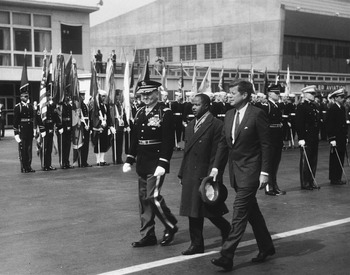
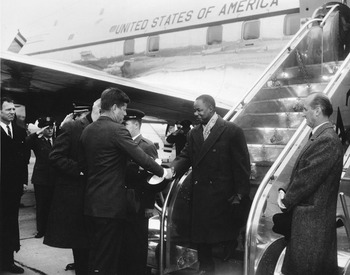
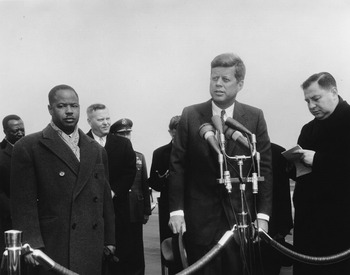
On January 19, 1961, Ahidjo sent a congratulatory message to Kennedy on his inauguration; in response, Kennedy praised Ahidjo as a man whose leadership had “won for him the respect of world leaders.”Footnote 14 To dramatize this new directions in diplomatic relations, Kennedy invited Ahidjo to the U.S. for an official visit. On March 13, 1962, Ahidjo arrived in Washington for a five-day visit to the United States. Kennedy himself welcomed Ahidjo at the airport. While in the U.S., Ahidjo met with Kennedy, visited New York, and met with the NAACP, the City Council of the District of Columbia, the heads of various diplomatic missions, and the leaders of the Overseas Press Club.Footnote 15 (See Figures 2, 3, and 4.)
President John F. Kennedy and the President of Cameroon, Ahmadou Ahidjo (center), inspect troops during arrival ceremonies for Ahidjo. Military Air Transport Service (MATS) Terminal, Washington National Airport, Washington, D.C., March 13, 1962.
Source: [https://www.jfklibrary.org/asset-viewer/archives/JFKWHP/1962/Month 03/Day 13/JFKWHP-1962-03-13-A; accessed June 9, 2021].

President John F. Kennedy shakes hands with the President of Cameroon, Ahmadou Ahidjo, upon Ahidjo’s arrival at the Military Air Transport Service (MATS) Terminal, Washington National Airport, Washington, D.C., March 13, 1962.
Source: [https://www.jfklibrary.org/asset-viewer/archives/JFKWHP/1962/Month 03/Day 13/JFKWHP-1962-03-13-A; accessed on May 15, 2021].

President John F. Kennedy speaks at the arrival ceremonies for the President of Cameroon, Ahmadou Ahidjo. Military Air Transport Service (MATS) Terminal, Washington National Airport, Washington, D.C., March 13, 1962.
Source: [https://www.jfklibrary.org/asset-viewer/archives/JFKWHP/1962/Month 03/Day 13/JFKWHP-1962-03-13-A; accessed on May 15, 2021].

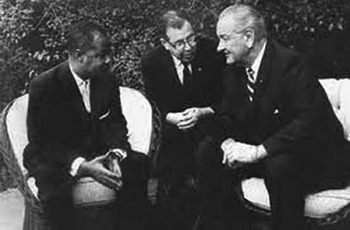
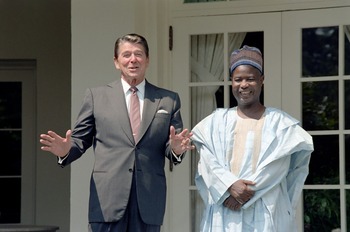
Perhaps the most remarkable aspect of Ahidjo’s visit to America was the frank nature of his conversations with Kennedy. In a single sentence, he articulated the goals of Cameroon’s foreign policy: “My country bases its relationships with other nations on the principles of equality, non-interference, and mutual respect of sovereignty.” Ahidjo also noted that the world should not rest until all of Africa was liberated from colonial chains. “We feel it is extremely urgent to accelerate the process of decolonization,” he stated.Footnote 16 Later in a dinner toast speech, Ahidjo emphasized his nation’s non-alignment position, adding that Cameroon would neither be a participant nor a “testing ground in the Cold War,” but rather a place for “genuine relationship.”Footnote 17 Irrespective of who occupied the White House, Ahidjo’s message was consistent. He focused on assistance, cooperation, complete liberation of Africa, and peace. Four years later, on October 24, 1967, he told President Lyndon B. Johnson, “Cooperation today in our world is a basic requirement,” adding that it led to the advancement of all.Footnote 18 In 1982 in Washington D.C., a few months before he resigned as president, he emphasized to President Ronald Reagan the urgent need to dismantle South Africa’s apartheid policy and for Reagan to support a “framework of cooperation between industrialized and developing countries as part of global negotiations to usher in a new international economic order.”Footnote 19 (See Figures 5 and 6.)
President Ahmadou Ahidjo (left) and President Lyndon B. Johnson (right), in the garden of the White House, October 24, 1967. The interpreter sits between the two Heads of State.
Source: [http://web.archive.org/web/20170221095220/ https://photos.state.gov/libraries/cameroon/231771/PDFs/070605_photofocus2.pdf; accessed May 15, 2021].

President Ronald Reagan at a working visit of President Ahmadou Ahidjo of the United Republic of Cameroon in the Rose Garden, July 26, 1982.
Source: [https://catalog.archives.gov/search?q=photographs, ahmadou ahidjo, accessed June 9, 2021].

In his dealings with U.S. leaders, Ahidjo repeatedly espoused globalist causes of peace and justice. He used his standing within the world’s community to leverage assistance for his country, and this did not go unnoticed. “British diplomats,” Torrent wrote, lauded “Cameroon’s essentially realist and pragmatist approach to foreign affairs and diplomacy” (Reference Torrent2012:222). Yet few world leaders paid attention to the brutal regime Ahidjo presided over at home. Given the importance of Cameroon’s strategic location for peace in the West and Central African region, America and other major powers focused on the nation’s stability irrespective of the means by which that peace was maintained.
One particularly important topic addressed by Ahidjo during his visit to the U.S. was anti-black racism. According to him, racism was at the root of the debasement of blacks globally. He wrote in the Contribution to National Construction, “Each time a black man [woman] is humiliated anywhere in the world, all Negroes the world over are hurt” (Reference Ahidjo1964:44–45). He met with the NAACP and praised the organization for its willingness to unite with Africa “in a world-wide movement to fight against the evils of racial discrimination, injustice, racial prejudices, and hatred.”Footnote 20 In addition, he invited NAACP officials to visit Cameroon.
Economic, Military, and Cultural Relations
From the very inception of Cameroon’s independence, U.S. assistance has played a significant role in the nation’s economic development. Cameroon emerged from colonialism with very weak educational and economic systems. The situation was worse in former British Southern Cameroons, where education, hospitals, and economic establishments were in short supply. During most of the British trusteeship over Cameroon, Nigeria governed British Southern Cameroons as a colony, and at the time of independence, almost nothing worked there. The infrastructure was basically nonexistent, and electric power and water systems were severely limited (Amaazee Reference Amaazee1990). Ahidjo had every reason to request urgent economic assistance for his country. After his first visit to the former British Southern Cameroons, he expressed disbelief at the low level of development there (Nfi Reference Nfi2014).
Ahidjo’s visit with Kennedy was a critically important event. Yet the contexts in which discussions between both leaders occurred provide insight into Ahidjo’s approach to diplomacy. Declassified documents received through FOIA requests show that relations between both countries were “strained” prior to Ahidjo’s visit. Ahidjo resented the U.S. for not supporting Cameroon’s position at the UN after British Northern Cameroons voted in a plebiscite to join Nigeria. Ahidjo protested the results of the plebiscite, but nothing changed. He was angered that Washington officials were not “favorably impressed by the caliber of Cameroonian leaders.” The U.S. had asked that Cameroon’s Ambassador in Washington Raymond Aimé-N’Thepe be recalled because he “threatened a fencing contractor with a gun.”Footnote 21 A November 18, 1961, memorandum described him “as an anti-white racist and is highly emotional and unstable when excited or placed under pressure.”Footnote 22 Also, Ahidjo’s government was furious that U.S. Secretary of Labor Arthur J. Goldberg’s visit to Cameroon was canceled on a twenty-four hour notice, with no concrete reason given for the cancellation. Determined to reset the faltering relationship, Washington officials were eager to repair things, and noted that “our invitation to President Ahidjo has been very well received by him and his government.”Footnote 23
During the visit, both leaders discussed a variety of political, economic, and educational assistance packages for Cameroon.Footnote 24 Ahidjo expressed to Kennedy his concerns over the ongoing security threats posed by the UPC in Cameroon, proposing that the United States assist Cameroon “to fight against ideological influences contrary to our principles and our common ideals.”Footnote 25 At a time when Washington’s containment policy made no distinction between nationalist uprisings for legitimate reforms and communist insurrections, Kennedy readily accepted Ahidjo’s characterization of the UPC as a communist organization. In addition, Ahidjo asked Kennedy for help in neutralizing the excessive influence and domination of his country by France. Ahidjo’s request was a gutsy move. Publicly, Ahidjo praised France’s assistance to Cameroon, writing that France “has never ceased to give Cameroon proof of her friendship and her concern” (Ahidjo Reference Ahidjo1964:47). Given the role played by France in his ascension to power, its assistance to his country, and the ongoing war against the UPC, Ahidjo’s action revealed the nuances of his diplomacy. Ahidjo’s desire to curtail France’s influence in his country was not unique. In Senegal, Ripert has argued that Léopold Senghor sought to use America to “alleviate the power of France’s economic influence” (Reference Ripert2021:5). Felix Houphouët-Boigny, Bamba has argued, employed a similar approach in Côte d’Ivoire. In a 1965 oral interview archived at the Kennedy Library, William Attwood, who served as ambassador during the Kennedy era, stated that African leaders appreciated Kennedy because he treated them with respect. The Kennedy “legend is very great” in Africa, he added.
Ahidjo also spoke to Kennedy about Cameroon’s twenty-year plan, indicating that he “would like U.S. aid [to] be adapted to meet long range needs in the plan.”Footnote 26 Prior to Ahidjo’s visit, America was already sending aid to Cameroon, and Kennedy promised more help through USAID. The Peace Corps was also available to contribute to the nation’s development. On December 8, 1961, Cameroon and the United States signed an agreement for economic, technical, and related assistance.Footnote 27 In an October 7, 1963, memorandum to McGeorge Bundy at the White House, Benjamin H. Read, executive secretary at the Department of State, noted that “US-Cameroon relations improved noticeably following that visit and they have continued good since that time.”Footnote 28 Basking in the positive relations, Ahidjo stated that Kennedy was his “hero” (Barrows Reference Barrows1971:11).
Soon after Ahidjo’s visit to Washington, D.C., significant aid began to flow to Cameroon. In July 1963, U.S. Assistant Secretary of State of African Affairs Mennen Williams visited Cameroon. His visit “reaffirmed the positive relations which exist between both countries.”Footnote 29 In 1963, Cameroonians were studying in the United States under the U.S. Educational Exchange Program and the Afro-American Institute.Footnote 30 In 1963, USAID provided road equipment to Cameroon’s Public Works Department (PWD), the agency charged with road development in West Cameroon. The equipment included Caterpillar tractors, farm-size tractors, front-end loaders, motor graders, trucks, rear-end dump trucks, low-bed trailers, pneumatic rollers, air compressors and attachments, and a portable crushing and screening plant (Amin Reference Amin1992). A foundation was also formed for collaboration in trade. On October 31, 1964, Frank Coffin, then the U.S. representative to the Development Assistance Committee of the Organization for Economic Cooperation and Development, attended the ceremony to formally launch the construction of the Trans-Cameroon Railroad. The United States contributed USD9.2 million for the project.Footnote 31 This marked the beginning of more trade and investment initiatives during the Ahidjo era. Private organizations, including Operation Crossroads Africa (OCA), also provided developmental aid to Cameroon.Footnote 32 On April 18, 1966, Decree No. 65-DF-186 extended to the entire country the agreement for assistance between Cameroon and Catholic Relief Services, (initially signed on November 28, 1960) by the organization and the Republic of Cameroon.Footnote 33 The U.S. government designed and funded self-help programs to “benefit a large population.”Footnote 34 Between 1974 and 1975, programs received funding in several regions, including Nyong et Kele, Sanaga-Maritine, Bui, Donga-Mantung, Fako, Manyu, Meme, and Ndian.Footnote 35
Though Washington considered the 1960s to be the “Development Decade” for Africa (Grubbs Reference Grubbs2009), progress in the continent remained slow. Cameroon’s economy still depended on foreign assistance. But the U.S. fulfilled Kennedy’s promise to establish diplomatic relations and provide aid to each Francophone African nation. By the end of the decade, the United States had well-established relations with Cameroon, and aid programs to Cameroon included the Peace Corps, USAID, and several initiatives through non-profit organizations.
In 1971, Cameroon signed an agreement to renovate the Douala seaport and residences for professors at the Higher School of Agriculture.Footnote 36 In 1974, Cameroon and the Near East Foundation signed an agreement to improve “poultry production and horticulture and vegetable production.”Footnote 37 The same year, the U.S. government allocated USD5 million for development projects in Cameroon to improve health systems, nutrition, water systems, education, and other initiatives of national interest. In 1982, the Agricultural Education Project, in collaboration with USAID, supported the creation of a government university in Dschang focusing on agriculture. The goal of the project was to create a university to “enhance productivity of the agricultural sector.”Footnote 38 In the post-Ahidjo years, the United States would expand programs in Cameroon in a variety of areas, including collaboration with agencies such as the U.S. Centers for Disease Control and Prevention to prevent the spread of a variety of viruses.Footnote 39
Though Cameroon needed aid, the leadership frequently sought and received information about private initiatives toward development prior to inviting them into the country. For example, in 1973 when the Lutheran World Relief, Inc. requested permission to come to Cameroon to carry out development projects in the Adamaoua/Benue region, the Cameroon government hesitated because it was a Christian organization attempting to move into an overwhelmingly Muslim-dominated area.Footnote 40 Along similar lines, when the Lang Engineering Corporation, based in Coral Cables, Florida, applied for permission to work in Cameroon, the Cameroon government requested information about the company from the U.S. embassy.Footnote 41 Cameroonian officials worked to ensure foreign aid was consistent with national policies.
Trade between Cameroon and the United States grew steadily from 1960 onward. In 1960, Cameroon’s exports to the United States totaled XOF1,503 billion; in 1963, that amount increased to XOF2,365 billion. During the same period, U.S. imports from Cameroon rose from XOF833 million to XOF1,552 billion.Footnote 42 Over 50 percent of the exports to the United States were raw materials, including cocoa, timber, rubber, and petroleum products.
Ahidjo’s policies created a pathway for the future, and much development took place after he left office. For example, Cameroon became a member of the African Growth and Opportunity Act (AGOA), which allowed Cameroonian goods to enter the American market duty-free. Many U.S. agencies and companies—including Overseas Private Investment Corporations (OPIC), U.S. Department of Agriculture (USDA), Export-Import Bank of the United States, and the U.S. Trade and Development Agency—operated in Cameroon. In 2008, the United States was one of the largest foreign direct investors in Cameroon because of its large equity in the Chad-Cameroonian oil pipeline and power sector.Footnote 43
Military collaboration has been particularly significant in Cameroon-U.S. relations. During the Ahidjo era, members of the Cameroon military trained at different institutions in the United States. In the 1980s, Cameroon became a participant in the Service Academy Foreign Student Program, whereby qualified Cameroonians gained admission into the U.S. Army, Air Force, Navy, and Coast Guard academies.Footnote 44 About 12 percent of U.S. aid to Cameroon was geared toward national security, with the United States helping Cameroon to better police its borders and providing biometric capability for tracking criminals and preventing human trafficking.
Cameroon and the United States have collaborated extensively on a variety of issues, including military, human rights, and refugees, and the record shows that the foundation established during the Ahidjo years remains the guiding framework of the continuing relationship. Documents at Cameroon’s Ministry of External Relations show frequent visits from U.S. military officers, congressional delegations, and government representatives to Yaoundé, confirming that Cameroon remains a valuable U.S. partner in the region.Footnote 45
Cameroonian Development and the U.S. Peace Corps
Capitalizing on the new relationship with Kennedy, Ahidjo moved quickly to sign an agreement for U.S. Peace Corps volunteers to serve in his country. It was a significant move. In 1961, after French-speaking East Cameroon and English-speaking British Southern Cameroons (West Cameroon) reunited to form the Federal Republic of Cameroon, the nation’s economic and social institutions were in a sorry state. Reunification ended West Cameroon’s favorable trade arrangement with the Commonwealth countries, and that aggravated an already desperate economic situation. Though Cameroon’s first five year plan (1961–66) prioritized road construction and educational improvement as most essential for national development, there was a critical shortage of trained manpower to bring those goals to fruition. At the time of reunification, there were too few primary and secondary schools in West Cameroon. In addition, the only technical school in the region, the Government Trade Centre (GTC) located at Ombe, had closed its doors because its staff, mostly composed of British expatriates, had left Cameroon. As was the case with Ombe, primary schools lacked qualified teachers, textbooks, teaching aids, and adequate classrooms. In 1961, over 60 percent of the primary school teachers were ill equipped, ill prepared, and uncertified, and many were hired on a temporary basis. Classrooms contained the “barest essentials—wooden desks, benches, and a single blackboard” (Amin Reference Amin1992:61). Secondary schools faced similar problems. There was a critical shortage of qualified teaching staff in those schools as well. The fact that the budget to purchase basic necessities such as chalk, pens, and books was grossly inadequate compounded the problem (Mengot Reference Mengot1967). Given the chronic shortages of trained personnel, it was no surprise that Ahidjo turned to the Peace Corps, an action which exemplified his pragmatism.
The Peace Corps was created at the height of the Cold War and charged with assisting developing nations in meeting “their needs for trained manpower, and to help promote a better understanding of the American people on the part of the peoples served and a better understanding of other peoples on the part of the American people.”Footnote 46 During its nearly sixty years’ presence in Cameroon, the Peace Corps has made a difference in the country’s material and cultural development. Its impact has been felt in education, agriculture, community development, small-enterprise development (SED), women empowerment, health care, and HIV/AIDS awareness and prevention.Footnote 47 On July 23, 1962, Peace Corps officials signed an agreement with the Cameroon government, and in September, the first cohort of volunteers arrived. A new group has arrived in the country annually since then, bringing the total number of volunteers to over 3680 since the program’s inception.Footnote 48
The Peace Corps was responsible for expanding education during its first decade in Cameroon. By 1964, the 77 volunteers in West Cameroon made up 30 percent of the post-primary teaching personnel; the previous year, there had been 83 volunteers teaching. In short, West Cameroon’s educational system depended heavily on the Peace Corps volunteers. By the end of their first year of service, West Cameroon Prime Minister John Ngu Foncha praised the volunteers’ work as “exemplary and admirable.”Footnote 49
For all the Peace Corps’ successes, recruitment and preparation for service in Cameroon included some disturbing aspects. During much of the 1960s, training took place in the United States, and after that it moved to Cameroon. During training, volunteers learned local languages, cross-cultural skills, and related issues. But those sessions failed to teach specific skills, and the language instruction proved to be inadequate. Jack Vaughn, the Peace Corps’s second director, underscored the problem: Volunteers “arrived overseas with an inadequate knowledge of the host country language, an incomplete appreciation of the host country culture, and insufficient amount of technical skill” (Schwarz Reference Schwarz1991:51). Fifty years later, the same problems remained. In Post Books and journals, volunteers blamed their shortcomings on their mediocre knowledge of local culture.Footnote 50 The Peace Corps has yet to transition to the recruitment of volunteers with specific skills.
Take the area of teaching, for example. The volunteers were unfamiliar with the educational system. Moreover, the main qualification of many of those assigned to the teaching of English as a foreign language (TOEFL) program was that they were native speakers of English, and that was insufficient. Only a few volunteers majored in English or education, and they lacked the pedagogical skills to serve as teachers. A 2011 Peace Corps host country impact study on Cameroon concluded that volunteers lacked “training in pedagogy.” But this was a common problem with the Peace Corps, as Jonathan Zimmerman concluded: “For many Volunteer teachers in Africa lesson planning, lecturing, homework assignments, and student discipline all proved enormous hurdles for Americans” (Reference Zimmerman2006:143). Associate Peace Corps country director Sammy Enyong, himself a former student of volunteers, supervised volunteers’ teaching for almost two decades. Enyong stated that “some of them were not just qualified for the job they came to perform.” Some were in Cameroon “for tourism” and “a 2-year paid vacation,” he added. Robert Strauss, former Peace Corps country director in Cameroon, concurred: It is “much less clear what inexperienced Americans have to offer” to Cameroonians. Another longtime Peace Corps employee in Cameroon agreed: “The volunteers who come do not have any experience, are not qualified, they are very young. Most often, the objectives of these volunteers are not in line with that of Peace Corps.” Volunteers “have diplomas without experience” and were in Cameroon “just to improve their academic c.v.,” others stated.Footnote 51
Making matters worse was a general suspicion during the early years that the Peace Corps volunteers were members of the CIA. In one 1963 memo, West Cameroon’s assistant chief of security, P. Bessala, said the Volunteers were “instructed … to be social and amicable” to locals in order to obtain as much information from them as possible, adding that volunteers’ “activities in the Territory are under observation by all services as it is feared they are doing ESPIONAGE as ALLEN DULLES, the Director of U.S. Intelligence Service, did in Russia.”Footnote 52
Given the Cold War and the CIA activities in Africa, those suspicions were widespread. Nkrumah of Ghana described volunteers as “subversive agents” recruited by the CIA, adding that the Peace Corps was an “instrument of … Western psychological warfare.” One Peace Corps evaluator wrote that in Ghana, volunteers were repeatedly asked, “You are not a spy, are you?” (Richter Reference Richter1965:7; Hoffman Reference Hoffman1998:160–61). On his visit to Touré’s Guinea, David Hapgood, a Peace Corps evaluator, noted immense “cynicism about why the Peace Corps was in Guinea,” and one angry volunteer told him, “I have gone through hell this past two years. Why did the Peace Corps do this to me?” (Reference Hapgood1965:29).
In Nigeria, there was an outcry following the Margery Michelmore incident. Soon after her arrival in Nigeria in 1961, Michelmore wrote a postcard to send back to family in the United States in which she described the “squalor and absolutely primitive living conditions rampant in the city and in the bush” in Nigeria, but on the way to the post office, the card fell out of her purse and ended up in the hands of students from the University of Ibadan. The response was swift. The students were livid and demanded the eviction of the volunteers from Nigeria, labeling them “America’s international spies” and the program a “scheme designed to foster neo-colonialism” (Rice Reference Rice1985:241–42). Eventually a major crisis was averted. The Peace Corps did not leave Nigeria but learned to be more careful in their criticism of the host country. The early years of volunteers’ service were fraught with problems.
Those weaknesses and problems did not overshadow the friendship and goodwill shared between Peace Corps volunteers and locals. In Guinea, after the eviction of the volunteers, locals made it a point to thank them and inform them that their problem was the U.S. government and not the volunteers (Guinea 1966). In Cameroonian villages, volunteers were frequently at neighbors’ homes dining and planning future projects. Cameroonians overwhelmingly appreciated the volunteers’ services.Footnote 53 Peace Corps service and diplomacy imploded previous notions of the “ugly America” image and replaced it with a lasting goodwill toward the U.S.
Yet Peace Corps service in Cameroon and the rest of Africa must also be judged based on the goals of the organization. During the agency’s nearly sixty years in Africa, it can justifiably be stated that the Peace Corps achieved two of its three goals. Volunteers made friends for the United States and helped to educate locals about American life. However, their performance in the more important goal of providing “trained manpower” to developing nations remains at best mediocre.
Conclusion
Ahidjo was president of Cameroon for twenty-two years, and by the time he left office, he had shaped the nation’s foreign policy for generations. Cameroonian foreign policy would be conducted the Ahidjo way going forward. Programs which Ahidjo started and that defined the U.S.-Cameroon relationship have remained intact—from the Peace Corps and USAID to military collaboration, nonintervention in Cameroon’s domestic policy, planned liberalism, and economic development. Ahidjo mastered the use of foreign policy to leverage his grip on power and divert attention from the brutal regime he created at home. A protagonist of the policy of nonalignment, Ahidjo developed friendships with communist and non-communist countries alike. He visited Washington, Moscow, Beijing, London, and many other places, forming alliances with leaders who lived in those capital cities. He effectively leveraged and convinced major powers of the strategic importance of his country as a gateway to peace and security in the West African and Central African regions. He did not waver in his crusade against South Africa’s apartheid. His meeting with the NAACP reminded Africans to seek avenues to collaborate with African Americans. By the time he stepped down, he had become one of the more reputable statesmen in the continent. On the strength of his foreign policy initiatives, Cameroon had a reputation for stability and peace.
Ahidjo bequeathed to his successor a foreign policy that placed primacy on the nation’s sovereignty and development. He stood up to France at key moments and resisted attempts by the U.S. to undermine his country. In 1961, when the U.S. delayed a meeting between Cameroon’s ambassador in Washington and Kennedy, the Cameroon government informed Washington that “unless Ambassador N’Thepe is allowed to see President Kennedy to present his new Letter and say goodbye, the Cameroon Government no longer will receive the American Ambassasdor.”Footnote 54 The policy of asserting its authority and sovereignty continued in the post-Ahidjo years. Repeatedly, Cameroonian officials warned U.S. officials in Yaoundé to steer clear of Cameroon’s internal politics (Morse Reference Morse2019). In later years, events such as removing the offices of USAID from Yaoundé to Accra and the loss of membership in AGOA showed that Cameroon was willing to pay any price to safeguard its national sovereignty.
The situation in Cameroon was not unique. Other African nations in the region had acted similarly. When the United States declined to sell weapons to Kenneth Kaunda of Zambia, Kaunda turned to Russia. When the United States followed France’s decision to deny assistance to Touré’s Guinea, Touré turned to Russia. When the Western nations placed restrictive conditions on Africa’s request for assistance, China saw an opening, created the Forum on China-Africa Cooperation (FOCAC), and used slogans of “respect for sovereignty and non-interference” and “peace, equality, justice, and freedom” to woo African leaders to its side. Cameroon was a member of FOCAC from the beginning. For all Ahidjo’s weaknesses, his foreign policy earned Cameroon respect around the world.
But those achievements created a false sense of security, as Ahidjo increasingly misread the signs of the times. Like the rabbit in the Brer Rabbit folktales, he overestimated his ability to navigate complex situations, and a miscalculation ended his political career. “Domestic policy can only defeat us;” Kennedy often stated, adding “but foreign policy can kill us.” In this case, that statement held true. For a brief period, it looked as if Ahidjo had gained the measure of independence from France that he had requested when he first met Kennedy. Ahidjo took the opposite position against France in the Nigerian Civil War. He pulled Cameroon out of Air Afrique, bought airplanes from America’s Boeing company instead of the European-based Airbus, and was among the first leaders in Francophone Africa to “Africanize” the country’s civil service. Eventually, France grew tired of his machinations. Apparently tricked by French doctors during a medical check-up in Paris, Ahidjo hurriedly resigned and handed over power to his successor. His abdication served as a lesson to leaders of Francophone African nations that those who cross France may not last much longer in power. France’s allies in the western alliance system refused to assist African leaders, irrespective of the cordial state of their relations, as was the case with Ahidjo. However, this close examination of official files and documents confirms the lasting legacy of Ahidjo’s approach to foreign policy, particularly with regard to Cameroon’s relationship with the U.S.
Acknowledgments
My thanks go to Dr. Jason Pierce, Dean of the College of Arts & Sciences for providing financial support for my research in Cameroon. I especially thank my research assistant, Pulchérie Irène PIEUMI, whose dedication and commitment opened up doors at Cameroon’s archives for us. Dr. Romocki LaHoma gave me access to Peace Corps papers in Yaoundé, and Dr. Esther OLEMBE provided much assistance at the national archives in Yaoundé. Finally, I extend my gratitude to the anonymous readers and editorial staff of ASR for their insightful suggestions on the manuscript.