























1 Introduction
The mathematical study of dynamical systems with holes, called open dynamical systems, was first proposed by Pianigiani and Yorke [Reference Pianigiani and Yorke27] in 1979. In recent years, open dynamical systems have received considerable attention from both theoretical and applied perspectives (cf. [Reference Demers, Wright and Young13–Reference Demers and Young15]). In the general setting, one considers a discrete dynamical system
 $(X, T)$
, where X is a compact metric space and
 $T: X\to X$
is a continuous map having positive topological entropy. Let
 $H\subset X$
be an open connected set, called the hole. It is interesting to study the set of points
 $x\in X$
whose orbit
 $\{T^{n}(x): n\ge 0\}$
never hits the hole H. In other words, we are interested in the survivor set
 $$ \begin{align*} K(H)=\{x\in X: T^{n}(x)\notin H \text{ for all } n\ge 0\}=X\setminus\bigcup_{n=0}^{\infty} T^{-n}(H). \end{align*} $$
It is known that the size of
 ${K}(H)$
depends not only on the size but also on the position of the hole H (cf. [Reference Bunimovich and Yurchenko7]). In [Reference Urbański29, Reference Urbański30], Urbański considered
 $C^{2}$
-expanding, orientation-preserving circle maps with a hole of the form
 $(0,t)$
. In particular, he proved that for the doubling map
 $T_{2}$
on the circle
 $\mathbb R/\mathbb Z\sim [0,1)$
, that is,
 $T_{2}:[0,1)\to [0,1); x\mapsto 2x\pmod 1$
, the Hausdorff dimension of the survivor set
 $ K_{2}(t):=\{x\in [0,1): T_{2}^{n}(x)\notin (0,t) \text { for all } n\ge 0\} $
depends continuously on the parameter
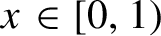
 $t\in [0,1)$
. Furthermore, he showed that the dimension function
 $\eta _{2}: t\mapsto \dim _{H} K_{2}(t)$
is a devil’s staircase, and studied its bifurcation set. Carminati and Tiozzo [Reference Carminati and Tiozzo9] showed that the function
 $\eta _{2}$
has an interesting analytic property: the local Hölder exponent of
 $\eta _{2}$
at any bifurcation point t is equal to
 $\eta _{2}(t)$
. For the doubling map
 $T_{2}$
with an arbitrary hole
 $(a,b)\subset [0,1)$
, Glendinning and Sidorov [Reference Glendinning and Sidorov18] studied (i) when the survivor set
 $K_{2}(a,b)=\{x\in [0,1): T_{2}^{n} (x)\notin (a,b) \text { for all } n\ge 0\}$
is non-empty; (ii) when
 $K_{2}(a,b)$
is infinite; and (iii) when
 $K_{2}(a,b)$
has positive Hausdorff dimension. They proved that when the size of the hole
 $(a,b)$
is strictly smaller than
 $0.175092$
, the survivor set
 $K_{2}(a,b)$
has positive Hausdorff dimension. The work of Glendinning and Sidorov was partially extended by Clark [Reference Clark10] to the
 $\beta $
-dynamical system
 $([0,1), T_{\beta })$
with a hole
 $(a,b)$
, where
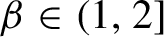
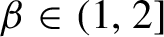
 $\beta \in (1,2]$
and
 $T_{\beta }(x):=\beta x\pmod 1$
.
Motivated by the above works, Kalle et al [Reference Kalle, Kong, Langeveld and Li20] considered the survivor set in the
 $\beta $
-dynamical system
 $([0, 1), T_{\beta })$
with a hole at zero. More precisely, for
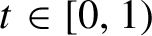
 $t\in [0,1)$
, they determined the Hausdorff dimension of the survivor set
 $$ \begin{align*} K_{\beta}(t)=\{x\in[0,1): T_{\beta}^{n} (x)\notin (0,t) \text{ for all } n\ge 0\}, \end{align*} $$
and showed that the dimension function
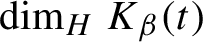
 $\eta _{\beta }: t\mapsto \dim _{H} K_{\beta }(t)$
is a non-increasing Devil’s staircase. So there exists a critical value
 $\tau (\beta )\in [0,1)$
such that
 $\dim _{H} K_{\beta }(t)>0$
if and only if
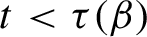
 $t<\tau (\beta )$
. Kalle et al [Reference Kalle, Kong, Langeveld and Li20] gave general lower and upper bounds for
 $\tau (\beta )$
. In particular, they showed that
 $\tau (\beta )\le 1-{1}/{\beta }$
for all
 $\beta \in (1,2]$
, and the equality
 $\tau (\beta )=1-{1}/{\beta }$
holds for infinitely many
 $\beta \in (1,2]$
. They left open the interesting question to determine
 $\tau (\beta )$
for all
 $\beta \in (1,2]$
. In this paper, we give a complete description of the critical value
 $$ \begin{align} \tau(\beta)=\sup\{t: \dim_{H} K_{\beta}(t)>0\}=\inf\{t: \dim_{H} K_{\beta}(t)=0\} \end{align} $$
for each
 $\beta \in (1,2]$
. Qualitatively, our main result is the following.
Theorem 1.
-
(i) The function
 $\tau : \beta \mapsto \tau (\beta )$
is left continuous on
$(1,2]$
with right-hand limits everywhere (càdlàg), and, as a result, has only countably many discontinuities.
-
(ii)
$\tau $
has no downward jumps. -
(iii) There is an open set
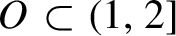
$O\subset (1,2]$
, whose complement
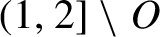
$(1,2]\setminus O$
has zero Hausdorff dimension, such that
$\tau $
is real-analytic, convex, and strictly decreasing on each connected component of O.


Quantitatively, the main results are Theorem 2 and Propositions 6.2 and 6.3. Together with Proposition 1.12, they specify the value of
 $\tau (\beta )$
for all
 $\beta \in (1,2]$
. In Proposition 1.9 below, we give an explicit description of the discontinuities of the map
 $\tau $
, which shows that the dimension
 $\dim _{H} K_{\beta }(t)$
is not jointly continuous in
 $\beta $
and t. The closures of the connected components of the set O in Theorem 1(iii) form a pairwise disjoint collection
 $\{I_{\alpha }\}$
of closed intervals which we call basic intervals (see Definition 1.5). In the remainder of this introduction, we describe these basic intervals by using certain substitutions on Farey words. We then give a formula for
 $\tau (\beta )$
on each basic interval (see Theorem 2) and decompose the complement
 $(1,2]\backslash \bigcup _{\alpha } I_{\alpha }$
into countably many disjoint subsets (see Theorem 3), which are of two essentially different types. We then calculate
 $\tau (\beta )$
on each subset.
To describe the critical value
 $\tau (\beta )$
, we first introduce the Farey words, also called standard words (see [Reference Lothaire24, Ch. 2.2]). Following a recent paper of Carminati, Isola, and Tiozzo [Reference Carminati, Isola and Tiozzo8], we define recursively a sequence of ordered sets
 $(F_{n})_{n=0}^{\infty }$
. Let
 $F_{0}=(0,1)$
, and for
 $n\ge 0$
, the ordered set
 $F_{n+1}=(v_{1},\ldots , v_{2^{n+1}+1})$
is obtained from
 $F_{n}=(w_{1},\ldots , w_{2^{n}+1})$
by inserting for each
 $1\le j\le 2^{n}$
the new word
 $w_{j}w_{j+1}$
between the two neighboring words
 $w_{j}$
and
 $w_{j+1}$
. So,
 $$ \begin{align} &F_{1}=(0,01,1),\quad F_{2}=(0,001,01,011,1),\nonumber\\[3pt] F_{3}&=(0,0001,001,00101,01,01011,011,0111,1), \end{align} $$
and so on (see §2 for more details on Farey words). Set
 $\Omega _{F}^{*}:=\bigcup _{n=1}^{\infty } F_{n}\setminus F_{0}$
. Then each word in
 $\Omega _{F}^{*}$
is called a non-degenerate Farey word. Note that any word in
 $\Omega _{F}^{*}$
has length at least two, and begins with digit
 $0$
and ends with digit
 $1$
. We will use the Farey words as basic bricks to construct infinitely many pairwise disjoint closed intervals so that we can explicitly determine
 $\tau (\beta )$
for
 $\beta $
in each of these intervals. Furthermore, we will show that these closed intervals cover
 $(1,2]$
up to a set of zero Hausdorff dimension.
The construction of these basic intervals depends on certain substitutions of Farey words. For this reason, we need to introduce a larger class of words, called Lyndon words; see [Reference Kalle, Kong, Langeveld and Li20, Lemma 3.2].
Definition 1.1. A word
 $ {\mathbf {s}}=s_{1}\ldots s_{m}\in \{0,1\}^{*}$
is Lyndon if
 $$ \begin{align*} s_{i+1}\ldots s_{m}\succ s_{1}\ldots s_{m-i}\quad\text{for all } 0<i<m. \end{align*} $$
Here and throughout the paper, we use lexicographical order
 $\succ $
between sequences and words; see §2. The words
 $0$
and
 $1$
are (vacuously) Lyndon. Let
 $\Omega _{L}^{*}$
denote the set of all Lyndon words of length at least two. Then by Definition 1.1, each
 $ {\mathbf {s}}\in \Omega _{L}^{*}$
has a prefix
 $0$
and a suffix
 $1$
. It is well known that each Farey word is Lyndon (cf. [Reference Carminati, Isola and Tiozzo8, Proposition 2.8]). Thus
 $\Omega _{F}^{*}\subset \Omega _{L}^{*}$
.
Now we define a substitution operator
 $\bullet $
in
 $\Omega _{L}^{*}$
. This requires the following notation. By a word we mean a finite string of zeros and ones. For any two words,
 $\mathbf u=u_{1}\ldots u_{m}, \mathbf v=v_{1}\ldots v_{n}$
, we denote by
 $\mathbf u\mathbf v=u_{1}\ldots u_{m} v_{1}\ldots v_{n}$
their concatenation. Furthermore, we write
 $\mathbf u^{\infty }$
for the periodic sequence with periodic block
 $\mathbf u$
. For a word
 $\mathbf w=w_{1}\ldots w_{n}\in \{0,1\}^{n}$
, we denote
 $\mathbf w^{-}:=w_{1}\ldots w_{n-1}{0}$
if
 $w_{n}=1$
, and
 $\mathbf w^{+}:=w_{1}\ldots w_{n-1}{1}$
if
 $w_{n}=0$
. Furthermore, we denote by
 $\mathbb {L}(\mathbf w)$
the lexicographically largest cyclic permutation of
 $\mathbf w$
. Now for two words
 $ {\mathbf {s}}=s_{1}\ldots s_{m}\in \Omega _{L}^{*}$
and
 $ {\mathbf {r}}=r_{1}\ldots r_{\ell }\in \{0,1\}^{\ell }$
, we define
 $$ \begin{align} {\mathbf{s}}\bullet {\mathbf{r}}:=c_{1}\ldots c_{\ell m}, \end{align} $$
where
 $$ \begin{align*}c_{1}\ldots c_{m}=\left\{\begin{array} {@{}lll} {\mathbf{s}}^{-}&\textrm{if } r_{1}=0,\\[3pt] \mathbb{L}( {\mathbf{s}})^{+}&\textrm{if } r_{1}=1, \end{array} \right.\end{align*} $$
and for
 $1\le j<\ell $
,
 $$ \begin{align*} c_{jm+1}\ldots c_{(j+1)m}=\left\{\begin{array} {@{}lll} \mathbb{L}( {\mathbf{s}})&\textrm{if } r_{j}r_{j+1}=00,\\[3pt] \mathbb{L}( {\mathbf{s}})^{+}&\textrm{if } r_{j}r_{j+1}=01,\\[3pt] {\mathbf{s}}^{-}&\textrm{if } r_{j}r_{j+1}=10,\\[3pt] {\mathbf{s}} &\textrm{if } r_{j}r_{j+1}=11. \end{array} \right. \end{align*} $$
For an equivalent definition of the substitution operator
 $\bullet $
, see §3.
Example 1.2. Let
 $ {\mathbf {r}}=01, {\mathbf {s}}=001$
, and
 $ {\mathbf {t}}=011$
be three words in
 $\Omega _{F}^{*}$
. Then
 $\mathbb {L}( {\mathbf {r}})=10$
and
 $\mathbb {L}( {\mathbf {s}})=100$
. So, by equation (1.3), it follows that
 $$ \begin{align*} {\mathbf{r}}\bullet {\mathbf{s}}&= {\mathbf{r}}\bullet 001= {\mathbf{r}}^{-}\mathbb{L}( {\mathbf{r}})\mathbb{L}( {\mathbf{r}})^{+}=001011\in\Omega_{L}^{*},\\[3pt] {\mathbf{s}}\bullet {\mathbf{t}}&= {\mathbf{s}}\bullet 011= {\mathbf{s}}^{-}\mathbb{L}( {\mathbf{s}})^{+} {\mathbf{s}}=000\,101\,001\in\Omega_{L}^{*}. \end{align*} $$
Then
 $\mathbb {L}( {\mathbf {r}}\bullet {\mathbf {s}})=110010$
, and thus
 $$ \begin{align*} ( {\mathbf{r}}\bullet {\mathbf{s}})\bullet {\mathbf{t}}=( {\mathbf{r}}\bullet {\mathbf{s}})\bullet 011=( {\mathbf{r}}\bullet {\mathbf{s}})^{-}\mathbb{L}( {\mathbf{r}}\bullet {\mathbf{s}})^{+}( {\mathbf{r}}\bullet {\mathbf{s}})=001010\,110011\,001011, \end{align*} $$
and
 $$ \begin{align*} {\mathbf{r}}\bullet( {\mathbf{s}}\bullet {\mathbf{t}})&= {\mathbf{r}}\bullet 000101001 \\[3pt] &= {\mathbf{r}}^{-}\mathbb{L}( {\mathbf{r}})\mathbb{L}( {\mathbf{r}})\mathbb{L}( {\mathbf{r}})^{+} {\mathbf{r}}^{-}\mathbb{L}( {\mathbf{r}})^{+} {\mathbf{r}}^{-}\mathbb{L}( {\mathbf{r}})\mathbb{L}( {\mathbf{r}})^{+}=00\,10\,10\,11\,00\,11\,00\,10\,11. \end{align*} $$
Hence,
 $( {\mathbf {r}}\bullet {\mathbf {s}})\bullet {\mathbf {t}}= {\mathbf {r}}\bullet ( {\mathbf {s}}\bullet {\mathbf {t}})$
, suggesting that the operator
 $\bullet $
is associative. However, observe that
 $ {\mathbf {r}}\bullet {\mathbf {s}}=00\, 10\, 11\ne 000\,101= {\mathbf {s}}\bullet {\mathbf {r}}$
. So
 $\bullet $
is not commutative.
From Example 1.2, we see that
 $\Omega _{F}^{*}$
is not closed under the substitution operator
 $\bullet $
, since
 $ {\mathbf {r}}\bullet {\mathbf {s}}=001011\not \in \Omega _{F}^{*}$
. Hence we need the larger collection
 $\Omega _{L}^{*}$
. It turns out that
 $\Omega _{L}^{*}$
is a non-Abelian semi-group under the substitution operator
 $\bullet $
.
Proposition 1.3.
 $(\Omega _{L}^{*},\bullet )$
forms a non-Abelian semi-group.
Remark 1.4. The substitution operator
 $\bullet $
defined in equation (1.3) is similar to that introduced by Allaart [Reference Allaart1], who used it to study the entropy plateaus in unique q-expansions.
Let
 $$ \begin{align} \Lambda:=\{ {\mathbf{S}}= {\mathbf{s}}_{1}\bullet {\mathbf{s}}_{2}\bullet\cdots\bullet {\mathbf{s}}_{k}:{\mathbf{s}}_{i}\in\Omega_{F}^{*}\textrm{ for any }1\le i\le k;k\in\mathbb{N}\} \end{align} $$
be the set of all substitutions of Farey words from
 $\Omega _{F}^{*}$
. Then by Proposition 1.3 it follows that
 $\Omega _{F}^{*}\subset \Lambda \subset \Omega _{L}^{*}$
. Moreover, both inclusions are strict. For instance,
 $001011=01\bullet 001\in \Lambda \backslash \Omega _{F}^{*}$
by Example 1.2 and Proposition 2.4 below, and
 $0010111\in \Omega _{L}^{*}\backslash \Lambda $
.
Given
 $\beta \in (1,2]$
, for a sequence
 $(c_{i})\in \{0,1\}^{\mathbb {N}}$
, we write
 $$ \begin{align*} ((c_{i}))_{\beta}:=\sum_{i=1}^{\infty}\frac{c_{i}}{\beta^{i}}. \end{align*} $$
Now we define the basic intervals.
Definition 1.5. A closed interval
 $I=[\beta _{\ell },\beta _{*}]\subset (1,2]$
is called a basic interval if there exists a word
 $ {\mathbf {S}}\in \Lambda $
such that
 $$ \begin{align*} (\mathbb{L}( {\mathbf{S}})^{\infty})_{\beta_{\ell}}=1\quad\textrm{and}\quad (\mathbb{L}( {\mathbf{S}})^{+} {\mathbf{S}}^{-}\mathbb{L}( {\mathbf{S}})^{\infty})_{\beta_{*}}=1. \end{align*} $$
The interval
 $I=I^ {\mathbf {S}}$
is also called a basic interval generated by
 $ {\mathbf {S}}$
.
The subscripts for the endpoints
 $\beta _{\ell }$
and
 $\beta _{*}$
of a basic interval will be clarified when we define the Lyndon intervals (see Definition 1.8 below). Our second main result gives a formula for
 $\tau (\beta )$
when
 $\beta $
lies in a basic interval
 $I^ {\mathbf {S}}$
.
Theorem 2.
-
(i) The basic intervals
$I^ {\mathbf {S}}, {\mathbf {S}}\in \Lambda $
are pairwise disjoint. -
(ii) If
$I^ {\mathbf {S}}$
is a basic interval generated by
$ {\mathbf {S}}\in \Lambda $
, then (1.5)
$$ \begin{align} \tau(\beta)=( {\mathbf{S}}^{-}\mathbb{L}( {\mathbf{S}})^{\infty})_{\beta}\quad\textrm{for {every} } \beta\in I^ {\mathbf{S}}. \end{align} $$
-
(iii) The function
$\tau $
is strictly decreasing on
$I^ {\mathbf {S}}$
, and is real-analytic and strictly convex in the interior of
$I^ {\mathbf {S}}$
.


Remark 1.6. Note that (iii) follows immediately from (ii). For the special case when
 $ {\mathbf {S}}\in \Omega _{F}^{*}$
, the formula (1.5) was stated without proof by Kalle et al [Reference Kalle, Kong, Langeveld and Li20].
Example 1.7.
-
(i) Let
$ {\mathbf {s}}=01\in \Omega _{F}^{*}$
. Then by Definition 1.5, the basic interval
$I^{01}=[\beta _{\ell },\beta _{*}]$
satisfies By numerical calculation, we get
$$ \begin{align*} & (\mathbb{L}(01)^{\kern-0.1pt\infty})_{\beta_{\ell}}\kern1.5pt{=}\kern1.5pt((10)^{\kern-0.1pt\infty})_{\beta_{\ell}} \kern1.5pt{=}\kern1.5pt 1 \!\quad\textrm{and}\quad\! (\mathbb{L}(01)^{\kern-0.1pt+}(01)^{\kern-0.1pt-}\mathbb{L}(01)^{\kern-0.1pt\infty})_{\beta_{*}}\kern1.5pt{=}\kern1.5pt(1100(10)^{\infty})_{\beta_{*}}\kern1.5pt{=}\kern1.5pt1. \end{align*} $$
$I^{01} \approx [1.61803, 1.73867]$
(see Figure 1). In fact,
$\beta _{\ell }=(1+\sqrt {5})/2$
. Theorem 2 yields that
$$ \begin{align*} \tau(\beta)=(00(10)^{\infty})_{\beta}=\frac{1}{\beta(\beta^{2}-1)}\quad\text{for all }\beta\in I^{01}. \end{align*} $$
-
(ii) Let
$ {\mathbf {s}}_{1}= {\mathbf {s}}_{2}=01\in \Omega _{F}^{*}$
. Then
$ {\mathbf {S}}= {\mathbf {s}}_{1}\bullet {\mathbf {s}}_{2}=01\bullet 01=0011$
. By Definition 1.5, the basic interval
$I^{ {\mathbf {s}}_{1}\bullet {\mathbf {s}}_{2}}=I^{0011}=[\beta _{\ell },\beta _{*}]$
is given implicitly by Numerical calculation gives
$$ \begin{align*} (\mathbb{L}(0011)^{\infty})_{\beta_{\ell}}&=((1100)^{\infty})_{\beta_{\ell}}=1,\\[3pt] \quad (\mathbb{L}(0011)^{+}(0011)^{-}\mathbb{L}(0011)^{\infty})_{\beta_{*}}&=(11010010(1100)^{\infty})_{\beta_{*}}=1. \end{align*} $$
$I^{0011}\approx [1.75488, 1.78431]$
(see Figure 1), and Theorem 2 implies
$$ \begin{align*} \tau(\beta)=( {\mathbf{S}}^{-}\mathbb{L}( {\mathbf{S}})^{\infty})_{\beta}=(0010(1100)^{\infty})_{\beta}=\frac{1}{\beta^{3}}+\frac{1+\beta}{\beta^{2}(\beta^{4}-1)}\quad\text{for all }\beta\in I^{0011}. \end{align*} $$


Graph of the critical value function
 $\tau (\beta )$
for
 $\beta \in (1,2]$
. We see that
 $\tau (\beta )\le 1-1/\beta $
for all
 $\beta \in (1,2]$
, and the function
 $\tau $
is strictly decreasing in each basic interval
 $I^ {\mathbf {S}}$
. For example, the basic interval generated by the Farey word
 $01$
is given by
 $I^{01}=[\beta _{\ell }, \beta _{*}]\approx [1.61803,1.73867]$
with
 ${((10)^{\infty })_{\beta _{\ell }}=(1100(10)^{\infty })_{\beta _{*}}=1}$
. Furthermore, for any
 $\beta \in I^{01}$
, we have
 $\tau (\beta )=(00(10)^{\infty })_{\beta }={1}/{\beta (\beta ^{2}-1)}$
; see Example 1.7 for more details.

Next, we introduce the Lyndon intervals.
Definition 1.8. For each Lyndon word
 $ {\mathbf {S}}\in \Omega _{L}^{*}$
, the interval
 $J^ {\mathbf {S}}=[\beta _{\ell }^ {\mathbf {S}},\beta _{r}^ {\mathbf {S}}]\subset (1,2]$
is called a Lyndon interval generated by
 $ {\mathbf {S}}$
if
 $$ \begin{align*} (\mathbb{L}( {\mathbf{S}})^{\infty})_{\beta_{\ell}^ {\mathbf{S}}}=1\quad\textrm{and}\quad (\mathbb{L}( {\mathbf{S}})^{+} {\mathbf{S}}^{\infty})_{\beta_{r}^ {\mathbf{S}}}=1. \end{align*} $$
If in particular
 $ {\mathbf {S}}\in \Omega _{F}^{*}$
, we call
 $J^ {\mathbf {S}}$
a Farey interval.
We remark that the Farey intervals defined in [Reference Kalle, Kong, Langeveld and Li20, Definition 4.5] are half-open intervals, which is slightly different from our definition. It turns out that the discontinuity points of
 $\tau $
are precisely the right endpoints of the Lyndon intervals
 $J^ {\mathbf {S}}$
with
 $ {\mathbf {S}}\in \Lambda $
.
Proposition 1.9. The function
 $\tau $
is continuous on
 $(1,2]\backslash \{\beta _{r}^ {\mathbf {S}}: {\mathbf {S}}\in \Lambda \}$
. However, for each
 $ {\mathbf {S}}\in \Lambda $
, we have
 $$ \begin{align} \lim_{\beta\searrow\beta_{r}^ {\mathbf{S}}}\tau(\beta)=( {\mathbf{S}}^{\infty})_{\beta_{r}^ {\mathbf{S}}}>( {\mathbf{S}} 0^{\infty})_{\beta_{r}^ {\mathbf{S}}}=\tau(\beta_{r}^ {\mathbf{S}}). \end{align} $$
Remark 1.10. Proposition 1.9 implies that although the dimension
 $\dim _{H} K_{\beta }(t)$
is continuous in t for fixed
 $\beta $
, it is not jointly continuous in
 $\beta $
and t. In particular, when
 $t=\tau (\beta _{r}^ {\mathbf {S}})$
for
 $ {\mathbf {S}}\in \Lambda $
, the function
 $\beta \mapsto \dim _{H} K_{\beta }(t)$
has a jump at
 $\beta _{r}^ {\mathbf {S}}$
.
It was shown in [Reference Kalle, Kong, Langeveld and Li20, §4] that the Farey intervals
 $J^ {\mathbf {s}}, {\mathbf {s}}\in \Omega _{F}^{*}$
are pairwise disjoint, and the exceptional set
 $$ \begin{align*} E:=(1,2]\setminus\bigcup_{ {\mathbf{s}}\in\Omega_{F}^{*}}J^ {\mathbf{s}} \end{align*} $$
has zero Hausdorff dimension. We strengthen this result slightly and show in Proposition 5.6(i) that E is uncountable and has zero packing dimension.
From Definitions 1.5 and 1.8, it follows that
 $I^ {\mathbf {S}}\subset J^{ {\mathbf {S}}}$
for any
 $ {\mathbf {S}}\in \Lambda $
, and the two intervals
 $I^ {\mathbf {S}}$
and
 $J^ {\mathbf {S}}$
have the same left endpoint (see Proposition 5.1.) In Proposition 5.6(ii), we show that for any
 $ {\mathbf {S}}\in {\Lambda }$
, the Lyndon intervals
 $J^{ {\mathbf {S}}\bullet {\mathbf {r}}}, {\mathbf {r}}\in \Omega _{F}^{*}$
are pairwise disjoint subsets of
 $J^ {\mathbf {S}}\setminus I^ {\mathbf {S}}$
, and the relative exceptional set
 $$ \begin{align*} E^ {\mathbf{S}}:=(J^ {\mathbf{S}}\setminus I^ {\mathbf{S}})\setminus\bigcup_{ {\mathbf{r}}\in\Omega_{F}^{*}}J^{ {\mathbf{S}}\bullet {\mathbf{r}}} \end{align*} $$
is also uncountable and has zero box-counting dimension. In Proposition 5.1, we show that the Lyndon intervals
 $J^ {\mathbf {S}}, {\mathbf {S}}\in \Lambda $
have a tree structure. This gives rise to the set
 $$ \begin{align} E_{\infty}:=\bigcap_{k=1}^{\infty}\bigcup_{ {\mathbf{S}}\in\Lambda(k)}J^{ {\mathbf{S}}}, \end{align} $$
where
 $\Lambda (k):=\{ {\mathbf {S}}= {\mathbf {s}}_{1}\bullet \cdots \bullet {\mathbf {s}}_{k}:~ {\mathbf {s}}_{i}\in \Omega _{F}^{*} \text { for all } 1\le i\le k\}$
. We call
 $E_{\infty }$
the infinitely Farey set, because its elements arise from substitutions of an infinite sequence of Farey words. It follows at once that
 $E_{\infty }$
is uncountable; we show in Proposition 5.8 that it has zero Hausdorff dimension.
Combining the above results, we obtain our last main theorem.
Theorem 3. The interval
 $(1,2]$
can be partitioned as
 $$ \begin{align*} (1,2]=E\cup E_{\infty}\cup\bigcup_{ {\mathbf{S}}\in\Lambda}E^{ {\mathbf{S}}}\cup\bigcup_{ {\mathbf{S}}\in\Lambda}I^{ {\mathbf{S}}}, \end{align*} $$
and the basic intervals
 $\{I^{ {\mathbf {S}}}: {\mathbf {S}}\in \Lambda \}$
cover
 $(1,2]$
up to a set of zero Hausdorff dimension.
Remark 1.11. It is worth mentioning that the Lyndon intervals
 $J^ {\mathbf {S}}$
and the relative exceptional sets
 $E^ {\mathbf {S}}$
constructed in our paper have similar geometrical structure as the relative entropy plateaus and relative bifurcation sets studied in [Reference Allaart and Kong2], where they were used to describe the local dimension of the set of univoque bases.
The following result was established in the proof of [Reference Kalle, Kong, Langeveld and Li20, Theorem D].
Proposition 1.12. For any
 $\beta \in (1,2]$
, we have
 $\tau (\beta )\le 1-{1}/{\beta }$
. Furthermore,
 $$ \begin{align*} \tau(\beta)=1-\frac{1}{\beta}\quad\textrm{for any } \beta\in E. \end{align*} $$
Thus, in view of Theorem 3, it remains to determine
 $\tau (\beta )$
for
 $\beta \in E^ {\mathbf {S}}$
with
 $ {\mathbf {S}}\in \Lambda $
and for
 $\beta \in E_{\infty }$
. In Proposition 6.2, we compute
 $\tau (\beta )$
for
 $\beta \in E^ {\mathbf {S}}$
by relating the relative exceptional set
 $E^ {\mathbf {S}}$
to the exceptional set E via a renormalization map
 $\Psi _ {\mathbf {S}}$
. Proposition 6.3 gives an expression for
 $\tau (\beta )$
when
 $\beta \in E_{\infty }$
. As an illustration of the latter, in Proposition 6.4, we construct in each Farey interval
 $J^ {\mathbf {s}}$
a transcendental base
 $\beta _{\infty }^ {\mathbf {s}}\in E_{\infty }$
and give an explicit formula for
 $\tau (\beta _{\infty }^ {\mathbf {s}})$
. Here we point out an interesting connection with unique
 $\beta $
-expansions: Let
 $\beta \approx 1.78723$
be the Komornik–Loreti constant (cf. [Reference Komornik and Loreti21]); that is,
 $\beta $
is the smallest base in which 1 has a unique expansion. Then it follows from Proposition 6.4 that
 $\beta =\beta _{\infty }^{01}\in E_{\infty }$
, and
 $\tau (\beta )=({2-\beta })/({\beta -1})\approx 0.270274$
.
The rest of the paper is organized as follows. In §2, we recall some properties of Farey words and Farey intervals, as well as greedy and quasi-greedy
 $\beta $
-expansions. In §3, we give an equivalent definition of the substitution operator
 $\bullet $
, and prove Proposition 1.3. The proof of Theorem 2 is given in §4. At the heart of the argument is Proposition 4.1, which clarifies the role of the special Lyndon words
 $ {\mathbf {S}}\in \Lambda $
and is used in several settings to derive the upper bound for
 $\tau (\beta )$
. The relative exceptional sets
 $E^ {\mathbf {S}}, {\mathbf {S}}\in \Lambda $
and the infinitely Farey set
 $E_{\infty }$
are studied in detail in §5, where we show that all of these sets have zero Hausdorff dimension, proving Theorem 3. In §6, we determine the critical value
 $\tau (\beta )$
for
 $\beta $
in the relative exceptional sets
 $E^ {\mathbf {S}}$
and the infinitely Farey set
 $E_{\infty }$
. Finally, in §7, we show that the function
 $\beta \mapsto \tau (\beta )$
is càdlàg, and prove Proposition 1.9 and Theorem 1.
2 Farey words and Farey intervals
In this section, we recall some properties of Farey words, which are vital in determining the critical value
 $\tau (\beta )$
. We also recall from [Reference Kalle, Kong, Langeveld and Li20] the Farey intervals, and review basic properties of greedy and quasi-greedy
 $\beta $
-expansions.
First we introduce some terminology from symbolic dynamics (cf. [Reference Lind and Marcus23]). Let
 $\{0,1\}^{\mathbb {N}}$
be the set of all infinite sequences of zeros and ones. Denote by
 $\sigma $
the left shift map. Then
 $(\{0,1\}^{\mathbb {N}}, \sigma )$
is a full shift. By a word we mean a finite string of zeros and ones. Let
 $\{0, 1\}^{*}$
be the set of all words over the alphabet
 $\{0,1\}$
together with the empty word
 $\epsilon $
. For a word
 $ {\mathbf {c}}\in \{0,1\}^{*}$
, we denote its length by
 $| {\mathbf {c}}|$
, and for a digit
 $a\in \{0,1\}$
, we denote by
 $| {\mathbf {c}}|_{a}$
the number of occurrences of a in the word
 $ {\mathbf {c}}$
. For two words
 $\mathbf c=c_{1}\ldots c_{m}$
and
 $\mathbf d=d_{1}\ldots d_{n}$
in
 $\{0,1\}^{*}$
, we write
 $\mathbf {cd}=c_{1}\ldots c_{m}d_{1}\ldots d_{n}$
for their concatenation. For
 $n\in \mathbb {N}$
, we denote by
 $\mathbf c^{n}$
the n-fold concatenation of
 $\mathbf c$
with itself, and by
 $\mathbf c^{\infty }$
the periodic sequence with period block
 $\mathbf c$
.
Throughout the paper, we will use the lexicographical order ‘
 $\prec , \preccurlyeq , \succ $
’ or ‘
 $\succcurlyeq $
’ between sequences and words. For example, for two sequences
 $(c_{i}), (d_{i})\in \{0,1\}^{\mathbb {N}}$
, we say
 $(c_{i})\prec (d_{i})$
if
 $c_{1}<d_{1}$
, or there exists
 $n\in \mathbb {N}$
such that
 $c_{1}\ldots c_{n}=d_{1}\ldots d_{n}$
and
 $c_{n+1}<d_{n+1}$
. For two words
 $\mathbf c, \mathbf d$
, we say
 $\mathbf c\prec \mathbf d$
if
 $\mathbf c 0^{\infty }\prec \mathbf d 0^{\infty }$
. We also recall from §1 that if
 $\mathbf c=c_{1}\ldots c_{m}$
with
 $c_{m}=0$
, then
 $\mathbf c^{+} =c_{1}\ldots c_{m-1}1$
; and if
 $\mathbf c=c_{1}\ldots c_{m}$
with
 $c_{m}=1$
, then
 $\mathbf c^{-} =c_{1}\ldots c_{m-1}0$
. Finally, for a word
 $\mathbf {c}=c_{1} c_{2}\ldots c_{n}$
, we denote its reflection by
 $\overline {\mathbf {c}}:=(1-c_{1})(1-c_{2})\ldots (1-c_{n})$
.
2.1 Farey words
Farey words have attracted much attention in the literature due to their intimate connection with rational rotations on the circle (see [Reference Lothaire24, Ch. 2]) and their one-to-one correspondence with the rational numbers in
 $[0,1]$
(see equation (2.1) below). In the following, we adopt the definition from a recent paper of Carminati, Isola, and Tiozzo [Reference Carminati, Isola and Tiozzo8].
First we recursively define a sequence of ordered sets
 $F_{n}, n=0,1,2,\ldots $
. Let
 $F_{0}=(0,1)$
; and for
 $n\ge 0$
, the ordered set
 $F_{n+1}=(v_{1}, \ldots , v_{2^{n+1}+1})$
is obtained from
 $F_{n}=(w_{1},\ldots , w_{2^{n}+1})$
by
 $$ \begin{align*} \left\{ \begin{array} {@{}ll} v_{2i-1}=w_{i}&\textrm{for } 1\le i\le 2^{n}+1,\\[3pt] v_{2i}=w_{i}w_{i+1}&\textrm{for } 1\le i\le 2^{n}. \end{array} \right. \end{align*} $$
In other words,
 $F_{n+1}$
is obtained from
 $F_{n}$
by inserting for each
 $1\le j\le 2^{n}$
the new word
 $w_{j}w_{j+1}$
between the two neighboring words
 $w_{j}$
and
 $w_{j+1}$
. See equation (1.2) for examples. Note that for each
 $n\ge 0$
, the ordered set
 $F_{n}$
consists of
 $2^{n}+1$
words which are listed from the left to the right in lexicographically increasing order. We call
 $w\in \{0,1\}^{*}$
a Farey word if
 $w\in F_{n}$
for some
 $n\ge 0$
, and we denote by
 $\Omega _{F}:=\bigcup _{n=1}^{\infty } F_{n}$
the set of all Farey words. As shown in [Reference Carminati, Isola and Tiozzo8, Proposition 2.3], the set
 $\Omega _{F}$
can be bijectively mapped to
 $\mathbb {Q}\cap [0,1]$
via the map
 $$ \begin{align} \xi: \Omega_{F}\to\mathbb Q\cap[0,1];\quad {\mathbf{s}}\mapsto\frac{| {\mathbf{s}}|_{1}}{| {\mathbf{s}}|}. \end{align} $$
So,
 $\xi ( {\mathbf {s}})$
is the frequency of the digit
 $1$
in
 $ {\mathbf {s}}$
.
For each
 $n\ge 1$
, set
 $$ \begin{align*} F_{n}^{*}:=F_{n}\setminus\{0,1\}, \end{align*} $$
and
 $$ \begin{align*} F_{n}^{0}:=\{w\in F_{n}^{*}: |w|_{0}>|w|_{1}\},\quad F_{n}^{1}:=\{w\in F_{n}^{*}: |w|_{1}>|w|_{0}\}. \end{align*} $$
For example,
 $F_{1}^{*}=(01), F_{2}^{*}=(001, 01, 011)$
, and
 $F_{2}^{0}=(001), F_{2}^{1}=(011)$
. The following decomposition can be deduced from [Reference Carminati, Isola and Tiozzo8, Proposition 2.3].
Lemma 2.1. For any
 $n\ge 2$
, we have
 $F_{n}^{*}=F_{n}^{0}\cup F_{1}^{*}\cup F_{n}^{1}$
.
The ordered sets
 $F_{n}^{*},n\ge 1$
can also be obtained via substitutions. We define the two substitution operators by
 $$ \begin{align} U_{0}:\left\{\begin{array}{@{}l} 0 \mapsto 0,\\[3pt] 1\mapsto 01, \end{array} \right.\textrm{ and }\quad U_{1}:\left\{ \begin{array}{@{}l} 0 \mapsto 01,\\[3pt] 1 \mapsto 1. \end{array} \right. \end{align} $$
Then
 $U_{0}$
and
 $U_{1}$
naturally induce a map on
 $\{0,1\}^{*}$
or
 $\{0,1\}^{\mathbb {N}}$
. For example,
 $$ \begin{align*} U_{0}: \{0,1\}^{*}\to\{0,1\}^{*};\quad c_{1}\ldots c_{n}\mapsto U_{0}(c_{1})\ldots U_{0}(c_{n}). \end{align*} $$
The following result was proven in [Reference Carminati, Isola and Tiozzo8, Proposition 2.9].
Lemma 2.2. For each
 $a\in \{0,1\}$
, the map
 $U_{a}: F_{n}^{*}\to F_{n+1}^{a}$
is bijective.
By Lemmas 2.1 and 2.2, it follows that the ordered sets
 $F_{n}^{*}$
can be obtained by the substitution operators
 $U_{0}$
and
 $U_{1}$
on the set
 $F_{1}^{*}=(01)$
. We will clarify this in the next proposition. Let
 $\Omega _{F}^{*}$
be the set of all non-degenerate Farey words, that is,
 $$ \begin{align*} \Omega_{F}^{*}=\bigcup_{n=1}^{\infty} F_{n}^{*}. \end{align*} $$
For a word
 $\mathbf c=c_{1}\ldots c_{m}\in \{0,1\}^{*}$
, let
 $\mathbb {S}(\mathbf c)$
and
 $\mathbb {L}(\mathbf c)$
be the lexicographically smallest and largest cyclic permutations of
 $\mathbf c$
, respectively. In other words,
 $\mathbb {S}(\mathbf c)$
is the lexicographically smallest word among
 $$ \begin{align*} c_{1}c_{2}\ldots c_{m}, \quad c_{2}\ldots c_{m} c_{1},\quad c_{3}\ldots c_{m} c_{1}c_{2},\quad \ldots,\quad c_{m}c_{1}\ldots c_{m-1}; \end{align*} $$
and
 $\mathbb {L}(\mathbf c)$
is the lexicographically largest word in the above list. The following properties of Farey words are well known (see, e.g., [Reference Carminati, Isola and Tiozzo8, Proposition 2.5]).
Lemma 2.3. Let
 $ {\mathbf {s}}=s_{1}\ldots s_{m}\in \Omega _{F}^{*}$
. Then the following hold.
-
(i)
$\mathbb {S}( {\mathbf {s}})= {\mathbf {s}}$
and
$\mathbb {L}( {\mathbf {s}})=s_{m}s_{m-1}\ldots s_{1}$
. -
(ii)
${ {\mathbf {s}}^{-}}$
is a palindrome; that is,
$s_{1}\ldots s_{m-1}(s_{m}-1)=(s_{m}-1)s_{m-1}s_{m-2}\ldots s_{1}$
. -
(iii) The word
$ {\mathbf {s}}$
has a conjugate
$\tilde { {\mathbf {s}}}\in \Omega _{F}^{*}$
, given by (2.3)
$$ \begin{align} \tilde{ {\mathbf{s}}}:=\overline{\mathbb{L}( {\mathbf{s}})}=0\,\overline{s_{2}\ldots s_{m-1}}\,1. \end{align} $$


The last equality in equation (2.3) follows from statements (i) and (ii). In terms of the correspondence equation (2.1), if
 $\xi ( {\mathbf {s}})=r\in \mathbb {Q}\cap [0,1]$
, then
 $\xi (\tilde { {\mathbf {s}}})=1-r$
. Note also that the conjugate of
 $\tilde { {\mathbf {s}}}$
is simply
 $ {\mathbf {s}}$
itself.
The following explicit description of
 $\Omega _{F}^{*}$
will be useful in §4 to prove the upper bound for
 $\tau (\beta )$
.
Proposition 2.4.
 $\Omega _{F}^{*}$
consists of all words in one of the following forms:
-
(i)
$01^{p}$
or
$0^{p} 1$
for some
$p\in \mathbb {N}$
; -
(ii)
$01^{p} 01^{p+t_{1}}\ldots 01^{p+t_{N}}01^{p+1}$
for some
$p\in \mathbb {N}$
and Farey word
$0 t_{1}\ldots t_{N}1\in \Omega _{F}^{*}$
; -
(iii)
$0^{p+1}10^{p+t_{1}}1\ldots 0^{p+t_{N}}10^{p} 1$
for some
$p\in \mathbb {N}$
and Farey word
$0 t_{1}\ldots t_{N}1\in \Omega _{F}^{*}$
.


Proof. Note that
 $01=U_{1}(0)=U_{0}(1)\in F_{1}^{*}\subset \Omega _{F}^{*}$
. Furthermore, for
 $p\in \mathbb {N}$
and
 $0 t_{1}\ldots t_{N}1\in \Omega _{F}^{*}$
, we have
 $$ \begin{align*} 01^{p}=U_{1}(01^{p-1})&=U_{1}^{p-1}(U_{0}(1)),\\[3pt] 0^{p}1=U_{0}(0^{p-1}1)&=U_{0}^{p-1}(U_{1}(0)),\\[3pt] 01^{p} 01^{p+t_{1}}\ldots 01^{p+t_{N}}01^{p+1}&=U_{1}^{p}(U_{0}(0t_{1}\ldots t_{N}1)),\\[3pt] 0^{p+1}10^{p+t_{1}}1\ldots 0^{p+t_{N}}10^{p} 1&=U_{0}^{p}(U_{1}(0\,\overline{t_{1}\ldots t_{N}}\,1)). \end{align*} $$
By Lemma 2.3(iii), if
 $0 t_{1}\ldots t_{N}1\in \Omega _{F}^{*}$
, then
 $0\,\overline {t_{1}\ldots t_{N}}\,1\in \Omega _{F}^{*}$
as well. Hence by Lemma 2.2, all the above words lie in
 $\Omega _{F}^{*}$
.
To prove the converse, it suffices to show that each word in
 $\Omega _{F}^{*}$
is of the form
 $U_{0}^{p}(U_{1}( {\mathbf {t}}))$
or
 $U_{1}^{p}(U_{0}( {\mathbf {t}}))$
for some
 $p\geq 0$
and Farey word
 $ {\mathbf {t}}\in \Omega _{F}$
. This is clearly true for
 $01=U_{0}^{0}(U_{1}(0))$
, where
 $U_{0}^{0}$
denotes the identity map. Let
 $n\geq 1$
and suppose the statement is true for all Farey words in
 $F_{n}^{*}$
. Take
 $ {\mathbf {s}}\in F_{n+1}^{*}$
with
 $ {\mathbf {s}}\neq 01$
. By Lemmas 2.1 and 2.2,
 $ {\mathbf {s}}=U_{0}( {\mathbf {t}})$
or
 $ {\mathbf {s}}=U_{1}( {\mathbf {t}})$
for some Farey word
 $ {\mathbf {t}}\in F_{n}^{*}$
. We assume the former, as the argument for the second case is similar. By the induction hypothesis, either
 $ {\mathbf {t}}=U_{0}^{p}(U_{1}(\mathbf {u}))$
for some
 $\mathbf {u}\in \Omega _{F}$
and
 $p\geq 0$
, in which case
 $ {\mathbf {s}}=U_{0}^{p+1}(U_{1}(\mathbf {u}))$
; or
 $ {\mathbf {t}}=U_{1}^{p}(U_{0}(\mathbf {u}))$
for some
 $\mathbf {u}\in \Omega _{F}$
and
 $p\geq 1$
, in which case
 $ {\mathbf {s}}=U_{0}(U_{1}(\mathbf {v}))$
, where
 $\mathbf {v}=U_{1}^{p-1}(U_{0}(\mathbf {u}))\in \Omega _{F}$
. In both cases,
 $ {\mathbf {s}}$
is of the required form.
Observe that the two types of words in Proposition 2.4(i) are each others conjugates, and the conjugate of a Farey word of type (ii) is a Farey word of type (iii), and vice versa. For more properties of Farey words, we refer to the book of Lothaire [Reference Lothaire24] and the references therein.
2.2 Quasi-greedy expansions, Farey intervals, and Lyndon intervals
Given
 $\beta \in (1,2]$
, let
 $\delta (\beta )=\delta _{1}(\beta )\delta _{2}(\beta )\ldots \in \{0,1\}^{\mathbb {N}}$
be the quasi-greedy
 $\beta $
-expansion of
 $1$
(cf. [Reference Daróczy and Kátai11]), that is,
 $\delta (\beta )$
is the lexicographically largest sequence not ending with
 $0^{\infty }$
such that
 ${(\delta _{i}(\beta ))_{\beta }=1}$
. The following property of
 $\delta (\beta )$
is well known (cf. [Reference Baiocchi and Komornik6]).
Lemma 2.5.
-
(i) The map
$\beta \mapsto \delta (\beta )$
is an increasing bijection from
$\beta \in (1,2]$
to the set of sequences
$(a_{i})\in \{0,1\}^{\mathbb {N}}$
not ending with
$0^{\infty }$
and satisfying
$$ \begin{align*} \sigma^{n}((a_{i}))\preccurlyeq (a_{i})\quad\text{for all } n\ge 0. \end{align*} $$
-
(ii) The map
$\beta \mapsto \delta (\beta )$
is left continuous everywhere on
$(1,2]$
with respect to the order topology, and it is right continuous at
$\beta _{0}\in (1,2)$
if and only if
$\delta (\beta _{0})$
is not periodic. Furthermore, if
$\delta (\beta _{0})=(a_{1}\ldots a_{m})^{\infty }$
with minimal period m, then
$\delta (\beta )\searrow a_{1}\ldots a_{m}^{+} 0^{\infty }$
as
$\beta \searrow \beta _{0}$
.


Recall from Definition 1.1 that for a word
 $ {\mathbf {s}}=s_{1}\ldots s_{m} \in \Omega _{L}^{*}$
, we have
 $s_{i+1}\ldots s_{m}\succ s_{1}\ldots s_{m-i}$
for all
 $1\le i<m$
. The following basic fact can be found in [Reference Allouche and Shallit5, Theorem 1.5.3].
Lemma 2.6. Let
 $ {\mathbf {c}}=c_{1}\ldots c_{m}\in \{0,1\}^{*}$
, and suppose two cyclic permutations of
 $ {\mathbf {c}}$
are equal (that is,
 $c_{i+1}\ldots c_{m} c_{1}\ldots c_{i}=c_{j+1}\ldots c_{m} c_{1}\ldots c_{j}$
, where
 $i\neq j$
). Then
 $ {\mathbf {c}}$
is periodic; in other words,
 $ {\mathbf {c}}= {\mathbf {b}}^{k}$
for some word
 $ {\mathbf {b}}$
and
 $k\geq 2$
.
In fact, the length of
 $ {\mathbf {b}}$
in Lemma 2.6 can be taken to equal
 $\gcd (|i-j|,m)$
.
Lemma 2.7. Let
 $ {\mathbf {s}} \in \Omega _{L}^{*}$
and
 $ \mathbf {a}=\mathbb {L}( {\mathbf {s}})=a_{1}\ldots a_{m}$
. Then
 $$ \begin{align} a_{i+1}\ldots a_{m}\prec a_{1}\ldots a_{m-i}\quad\text{for all}\ 1\le i<m. \end{align} $$
Furthermore,
 $$ \begin{align} \sigma^{n}( \mathbf{a}^{+}{ {\mathbf{s}}^{-}} \mathbf{a}^{\infty})\preccurlyeq \mathbf{a}^{+}{ {\mathbf{s}}^{-}} \mathbf{a}^{\infty}\quad\text{for all } n\ge 0. \end{align} $$
Proof. First we prove equation (2.4). Since
 $ {\mathbf {s}}$
is Lyndon, it is not periodic. Hence
 $ \mathbf {a}=\mathbb {L}( {\mathbf {s}})$
is not periodic, because any cyclic permutation of a periodic word is periodic. Since
 $ \mathbf {a}=\mathbb {L}( {\mathbf {s}})$
, we have
 $$ \begin{align*} a_{i+1}\ldots a_{m}\preccurlyeq a_{1}\ldots a_{m-i}\quad\text{for all } 1\le i<m. \end{align*} $$
Suppose equality holds for some i. Then
 $$ \begin{align*} a_{i+1}\ldots a_{m} a_{1}\ldots a_{i}=a_{1}\ldots a_{m-i} a_{1}\ldots a_{i}\succcurlyeq a_{1}\ldots a_{m-i} a_{m-i+1}\ldots a_{m}= \mathbf{a}, \end{align*} $$
so
 $a_{i+1}\ldots a_{m} a_{1}\ldots a_{i}=\mathbb {L}( {\mathbf {s}})= \mathbf {a}$
by definition of
 $\mathbb {L}( {\mathbf {s}})$
. By Lemma 2.6, this cannot happen, since
 $ \mathbf {a}$
is not periodic.
Next we prove equation (2.5). Since
 $ {\mathbf {s}}=s_{1}\ldots s_{m}$
is a Lyndon word, any word of length
 $k\in \{1, \ldots , m-1\}$
occurring in
 $ \mathbf {a}=\mathbb {L}( {\mathbf {s}})$
is lexicographically larger than or equal to
 $s_{1}\ldots s_{k}$
. By equation (2.4), it follows that
 $$ \begin{align} a_{k+1}\ldots a_{m}^{+} s_{1}\ldots s_{k}\preccurlyeq a_{1}\ldots a_{m-k}a_{m-k+1}\ldots a_{m}\prec a_{1}\ldots a_{m}^{+} \end{align} $$
for all
 $0<k<m$
. Hence, by equations (2.6) and (2.4), we conclude that
 $\sigma ^{n}( \mathbf {a}^{+}{ {\mathbf {s}}^{-}} \mathbf {a}^{\infty })\prec \mathbf {a}^{+}{ {\mathbf {s}}^{-}} \mathbf {a}^{\infty }$
for all
 $n\ge 1$
. This completes the proof.
Lemma 2.8. Let
 $\beta \in (1,2)$
. Then
 $\delta (\beta )$
is periodic if and only if
 $\delta (\beta )=\mathbb {L}( {\mathbf {s}})^{\infty }$
for some Lyndon word
 $ {\mathbf {s}}$
of length at least two.
Proof. Suppose
 $\delta (\beta )=(a_{1}\ldots a_{m})^{\infty }$
with minimal period block
 $ \mathbf {a}=a_{1}\ldots a_{m}$
. Then
 $m\ge 2$
since
 $\beta <2$
. Take
 $ {\mathbf {s}}:=\mathbb {S}( \mathbf {a})$
. Then
 $ \mathbf {a}=\mathbb {L}( {\mathbf {s}})$
, and
 $$ \begin{align} s_{i+1}\ldots s_{m}\succcurlyeq s_{1}\ldots s_{m-i} \quad\text{for all}\ 1\leq i<m. \end{align} $$
If equality holds for some i, then we deduce just as in the proof of Lemma 2.7 that
 $ {\mathbf {s}}$
is periodic. However, then
 $ \mathbf {a}$
is also periodic, contradicting that m is the minimal period of
 $\delta (\beta )$
. Hence, strict inequality holds in equation (2.7), and
 $ {\mathbf {s}}$
is Lyndon. The converse is trivial.
Recall the Farey intervals and Lyndon intervals from Definition 1.8. The following properties of Lyndon intervals and Farey intervals were established in the proof of [Reference Kalle, Kong, Langeveld and Li20, Theorem C].
Lemma 2.9.
-
(i) The Farey intervals
$J^ {\mathbf {s}}, {\mathbf {s}}\in \Omega _{F}^{*}$
are pairwise disjoint, and their union is dense in
$(1,2]$
. -
(ii) Any two Lyndon intervals are either disjoint or one is contained in the other.
-
(iii) For any Lyndon interval
$J^ {\mathbf {S}}, {\mathbf {S}}\in \Omega _{L}^{*}$
, there exists a unique Farey interval
$J^ {\mathbf {r}}$
such that
$J^ {\mathbf {S}}\subset {J^ {\mathbf {r}}}$
.


Note that (iii) follows immediately from (i) and (ii).
2.3 Greedy expansions and the symbolic survivor set
Given
 $\beta \in (1,2]$
and
 $t\in [0,1)$
, we call the sequence
 $(d_{i})\in \{0,1\}^{\mathbb {N}}$
a
 $\beta $
-expansion of t if
 $((d_{i}))_{\beta }=t$
. Note that a point
 $t\in [0,1)$
may have multiple
 $\beta $
-expansions. We denote by
 $b(t,\beta )=(b_{i}(t,\beta ))\in \{0,1\}^{\mathbb {N}}$
the greedy
 $\beta $
-expansion of t, which is the lexicographically largest expansion of t in base
 $\beta $
. Since
 $T_{\beta }(t)=\beta t\pmod 1$
, it follows that
 $b(T_{\beta }^{n}(t), \beta )=\sigma ^{n}(b(t,\beta ))=b_{n+1}(t,\beta )b_{n+2}(t,\beta )\ldots $
. The following result was established by Parry [Reference Parry26] and de Vries and Komornik [Reference de Vries and Komornik12, Lemma 2.5 and Proposition 2.6].
Lemma 2.10. Let
 $\beta \in (1,2]$
. The map
 $t\mapsto b(t,\beta )$
is an increasing bijection from
 $[0,1)$
to
 $$ \begin{align*} \{(d_{i})\in\{0,1\}^{\mathbb{N}}: \sigma^{n}((d_{i}))\prec \delta(\beta) \text{ for all } n\ge 0\}. \end{align*} $$
Furthermore:
-
(i) the map
$t\mapsto b(t,\beta )$
is right-continuous everywhere in
$[0,1)$
with respect to the order topology in
$\{0,1\}^{\mathbb {N}}$
; -
(ii) if
$b(t_{0},\beta )$
does not end with
$0^{\infty }$
, then the map
$t\mapsto b(t,\beta )$
is continuous at
$t_{0}$
; -
(iii) if
$b(t_{0},\beta )=b_{1}\ldots b_{m} 0^{\infty }$
with
$b_{m}=1$
, then
$b(t, \beta )\nearrow b_{1}\ldots b_{m}^{-}\delta (\beta )$
as
$t\nearrow t_{0}$
.


Recall that the survivor set
 $K_{\beta }(t)$
consists of all
 $x\in [0,1)$
whose orbit
 $\{T^{n}_{\beta }(x): n\ge 0\}$
avoids the hole
 $(0,t)$
. To describe the dimension of
 $K_{\beta }(t)$
, we introduce the topological entropy of a symbolic set. For a subset
 $X\subset \{0,1\}^{\mathbb {N}}$
, its topological entropy
 $h_{\mathrm {top}}(X)$
is defined by
 $$ \begin{align*} h_{\mathrm{top}}(X):=\liminf_{n\to\infty}\frac{\log\#B_{n}(X)}{n}, \end{align*} $$
where
 $\#B_{n}(X)$
denotes the number of all length n words occurring in sequences of X. The following result for the Hausdorff dimension of
 $K_{\beta }(t)$
can be essentially deduced from Raith [Reference Raith28] (see also [Reference Kalle, Kong, Langeveld and Li20]).
Lemma 2.11. Given
 $\beta \in (1,2]$
and
 $t\in [0,1)$
, the Hausdorff dimension of
 $K_{\beta }(t)$
is given by
 $$ \begin{align*} \dim_{H} K_{\beta}(t) =\frac{h_{\mathrm{top}}(\mathbf K_{\beta}(t))}{\log\beta}, \end{align*} $$
where
 $$ \begin{align*} \mathbf K_{\beta}(t)=\{(d_{i})\in\{0,1\}^{\mathbb{N}}: b(t,\beta)\preccurlyeq\sigma^{n}((d_{i}))\prec \delta(\beta) \text{ for all } n\ge 0\}. \end{align*} $$
To determine the critical value
 $\tau (\beta )$
for
 $\beta $
inside any Farey interval
 $J^ {\mathbf {s}}$
, we first need to develop some properties of the substitution operator
 $\bullet $
from equation (1.3). We do this in the next section.
3 Substitution of Lyndon words
In this section, we give an equivalent definition of the substitution operator in
 $\Omega _{L}^{*}$
introduced in equation (1.3), and prove that
 $\Omega _{L}^{*}$
forms a semi-group under this substitution operator. This will play a crucial role in the rest of the paper.
3.1 An equivalent definition of the substitution
Given a Lyndon word
 $ {\mathbf {s}}\in \Omega _{L}^{*}$
with
 $ \mathbf {a}=\mathbb {L}( {\mathbf {s}})$
, we construct a directed graph
 $G=(V, E)$
as in Figure 2. The directed graph G has two starting vertices ‘Start-
 $0$
’ and ‘Start-
 $1$
’. The directed edges in the graph G take labels from
 $\{0,1\}$
, and the vertices in G take labels from
 $\{{ {\mathbf {s}}^{-}}, {\mathbf {s}}, \mathbf {a}, \mathbf {a}^{+}\}$
. Denote by
 $\mathcal L^{E}$
the edge labeling and by
 $\mathcal L^{V}$
the vertex labeling. Then for each directed edge
 $e\in E(G)$
, we have
 $\mathcal L^{E}(e)\in \{0,1\}$
, and for each vertex
 $v\in V(G)$
, we have
 $\mathcal L^{V}(v)\in \{{ {\mathbf {s}}^{-}}, {\mathbf {s}}, \mathbf {a}, \mathbf {a}^{+}\}$
. The labeling maps
 $\mathcal L^{E}$
and
 $\mathcal L^{V}$
naturally induce the maps on the infinite edge paths and infinite vertex paths in G, respectively. For example, for an infinite edge path
 $e_{1}e_{2}\ldots $
, we have
 $$ \begin{align*} \mathcal L^{E}(e_{1}e_{2}\ldots)=\mathcal L^{E}(e_{1})\mathcal L^{E}(e_{2})\ldots~\in\{0,1\}^{\mathbb{N}}. \end{align*} $$
Here we call
 $e_{1}e_{2}\ldots $
an infinite edge path in G if the initial vertex of
 $e_{1}$
is one of the starting vertices and for any
 $i\ge 1$
, the terminal vertex
 $t(e_{i})$
equals the initial vertex
 $i(e_{i+1})$
. Similarly, for an infinite vertex path
 $v=v_{1}v_{2}\ldots $
, we have
 $$ \begin{align*} \mathcal L^{V}(v_{1}v_{2}\ldots)=\mathcal L^{V}(v_{1})\mathcal L^{V}(v_{2})\ldots~\in\{{ {\mathbf{s}}^{-}}, {\mathbf{s}}, \mathbf{a}, \mathbf{a}^{+}\}^{\mathbb{N}}, \end{align*} $$
where we call
 $v_{1}v_{2}\ldots $
an infinite vertex path in G if
 $v_{1}$
is one of the starting vertices and for any
 $i\ge 1$
, there exists a directed edge
 $e\in E(G)$
such that
 $i(e)=v_{i}$
and
 $t(e)=v_{i+1}$
.
The directed graph
 $G=(V, E)$
with the edge labels from
 $\{0, 1\}$
and vertex labels from
 $\{{ {\mathbf {s}}^{-}}, {\mathbf {s}}, \mathbf {a}, \mathbf {a}^{+}\}$
, where
 $ {\mathbf {s}}\in \Omega _{L}^{*}$
and
 $ \mathbf {a}=\mathbb {L}( {\mathbf {s}})$
.

Let
 $X_{E}=X_{E}(G)$
be the edge shift consisting of all labelings of infinite edge paths in G, that is,
 $$ \begin{align*} X_{E}:=\{\mathcal L^{E}(e_{1}e_{2}\ldots): e_{1}e_{2}\ldots\textrm{ is an infinite edge path in }G\}. \end{align*} $$
One can verify easily that
 ${X_{E}=\{0,1\}^{\mathbb {N}}}$
. Also, let
 $X_{V}=X_{V}(G)$
be the vertex shift which consists of all labelings of infinite vertex paths in G, that is,
 $$ \begin{align*} X_{V}:=\{\mathcal L^{V}(v_{1}v_{2}\ldots): v_{1}v_{2}\ldots\textrm{ is an infinite vertex path in }G\}. \end{align*} $$
Then any sequence in
 $X_{V}$
is an infinite concatenation of words from
 $\{{ {\mathbf {s}}^{-}}, {\mathbf {s}}, \mathbf {a}, \mathbf {a}^{+}\}$
. Observe that the edge shift
 $X_{E}$
is right-resolving, which means that out-going edges from the same vertex have different labels (cf. [Reference Lind and Marcus23]). Moreover, different vertices have different labels. So for each
 $(d_{i})\in X_{E}$
, there is a unique infinite edge path
 $e_{1}e_{2}\ldots $
in G such that
 $d_{1}d_{2}\ldots =\mathcal L^{E}(e_{1}e_{2}\ldots ).$
Definition 3.1. The substitution map
 $\Phi _ {\mathbf {s}}$
from
 $X_{E}$
to
 $X_{V}$
is defined by
 $$ \begin{align*} \Phi_ {\mathbf{s}}: X_{E}\to X_{V};\quad \mathcal L^{E}(e_{1}e_{2}\ldots)\mapsto \mathcal L^{V}(t(e_{1})t(e_{2})\ldots), \end{align*} $$
where
 $t(e_{i})$
denotes the terminal vertex of the directed edge
 $e_{i}$
.
We can extend the substitution map
 $\Phi _ {\mathbf {s}}$
to a map from
 $B_{*}(X_{E})$
to
 $B_{*}(X_{V})$
by
 $$ \begin{align} \Phi_ {\mathbf{s}}: B_{*}(X_{E})\to B_{*}(X_{V});\quad \mathcal L^{E}(e_{1}\ldots e_{n})\mapsto \mathcal L^{V}(t(e_{1})\ldots t(e_{n})), \end{align} $$
where
 $B_{*}(X_{E})$
consists of all labelings of finite edge paths in G and
 $B_{*}(X_{V})$
consists of all labelings of finite vertex paths in G. So, by equations (1.3) and (3.1), it follows that for any two words
 $ {\mathbf {s}}\in \Omega _{L}^{*}$
and
 $ {\mathbf {r}}\in \{0,1\}^{*}$
, we have
 $$ \begin{align} {\mathbf{s}}\bullet {\mathbf{r}}=\Phi_ {\mathbf{s}}( {\mathbf{r}}). \end{align} $$
Example 3.2. Let
 $ {\mathbf {s}}=01$
and
 $ {\mathbf {r}}=001011$
. Then
 $ {\mathbf {s}}\in \Omega _{F}^{*}$
and
 $ {\mathbf {r}}\in \Omega _{L}^{*}\setminus \Omega _{F}^{*}$
. Furthermore,
 ${ {\mathbf {s}}^{-}}=00, \mathbf {a}=\mathbb {L}( {\mathbf {s}})=10, \mathbf {a}^{+}=11$
. So by the definition of
 $\Phi _ {\mathbf {s}}$
, it follows that
 $$ \begin{align*} \Phi_ {\mathbf{s}}( {\mathbf{r}})&=\Phi_ {\mathbf{s}}( 001011 )={ {\mathbf{s}}^{-}} \mathbf{a} \mathbf{a}^{+}{ {\mathbf{s}}^{-}} \mathbf{a}^{+} {\mathbf{s}}=001011001101, \\[3pt] \Phi_ {\mathbf{s}}( {\mathbf{r}}^{-})&= \Phi_ {\mathbf{s}}( 001010)={ {\mathbf{s}}^{-}} \mathbf{a} \mathbf{a}^{+}{ {\mathbf{s}}^{-}} \mathbf{a}^{+}{ {\mathbf{s}}^{-}}=001011001100. \end{align*} $$
Observe that
 $\Phi _ {\mathbf {s}}( {\mathbf {r}}^{-})=\Phi _ {\mathbf {s}}( {\mathbf {r}})^{-}$
. By Definition 1.1, one can check that
 $\Phi _ {\mathbf {s}}( {\mathbf {r}})\in \Omega _{L}^{*}$
. Furthermore,
 $$ \begin{align*} \Phi_ {\mathbf{s}}(\mathbb{L}( {\mathbf{r}}))=\Phi_ {\mathbf{s}}( 110010) = \mathbf{a}^{+} {\mathbf{s}}{ {\mathbf{s}}^{-}} \mathbf{a} \mathbf{a}^{+}{ {\mathbf{s}}^{-}}=110100101100=\mathbb{L}(\Phi_ {\mathbf{s}}( {\mathbf{r}})),\end{align*} $$
and
 $$ \begin{align*} \Phi_ {\mathbf{s}}( {\mathbf{r}}^{\infty})= \Phi_ {\mathbf{s}}((001011)^{\infty})=({ {\mathbf{s}}^{-}} \mathbf{a} \mathbf{a}^{+}{ {\mathbf{s}}^{-}} \mathbf{a}^{+} {\mathbf{s}})^{\infty}=(001011001101)^{\infty}=\Phi_ {\mathbf{s}}( {\mathbf{r}})^{\infty}. \end{align*} $$
3.2 Properties of the substitution
Motivated by Examples 1.2 and 3.2, we study the properties of the substitution
 $\Phi _ {\mathbf {s}}$
. We will show that
 $\Omega _{L}^{*}$
forms a semi-group under the substitution operator defined in Definition 3.1. First we prove the monotonicity of
 $\Phi _ {\mathbf {s}}$
.
Lemma 3.3. Let
 $ {\mathbf {s}}\in \Omega _{L}^{*}$
. Then the map
 $\Phi _ {\mathbf {s}}$
is strictly increasing in
 $X_{E}=\{0,1\}^{\mathbb {N}}$
.
Proof. Let
 $(d_{i})$
and
 $(d_{i}^{\prime })$
be two sequences in
 $X_{E}$
, and let
 $(e_{i}), (e_{i}^{\prime })$
be their corresponding edge paths; thus,
 $(d_{i})=\mathcal L^{E}((e_{i}))$
and
 $(d_{i}^{\prime })=\mathcal L^{E}((e_{i}^{\prime }))$
. Suppose
 $(d_{i})\prec (d_{i}^{\prime })$
. Then there exists
 $k\in \mathbb {N}$
such that
 $d_{1}\ldots d_{k-1}=d_{1}^{\prime }\ldots d_{k-1}^{\prime }$
and
 $d_{k}<d_{k}^{\prime }$
. If
 $k=1$
, then
 $d_{1}=0$
and
 $d_{1}^{\prime }=1$
. So,
 $\mathcal L^{V}(t(e_{1}))={ {\mathbf {s}}^{-}}$
and
 $\mathcal L^{V}(t(e_{1}^{\prime }))= \mathbf {a}^{+}$
. By Definition 3.1, it follows that
 $\Phi _ {\mathbf {s}}((d_{i}))\prec \Phi _ {\mathbf {s}}((d_{i}^{\prime }))$
.
If
 $k>1$
, then
 $e_{1}\ldots e_{k-1}=e_{1}^{\prime }\ldots e_{k-1}^{\prime }$
, which implies that the initial vertices of
 $e_{k}$
and
 $e_{k}^{\prime }$
coincide. Since
 $d_{k}<d_{k}^{\prime }$
, by the definition of
 $\mathcal L^{V}$
, it follows that (see Figure 2)
 $$ \begin{align*} \mathcal L^{V}(t(e_{k}))\prec\mathcal L^{V}(t(e_{k}^{\prime})). \end{align*} $$
By Definition 3.1, we also have
 $\Phi _ {\mathbf {s}}((d_{i}))\prec \Phi _ {\mathbf {s}}((d_{i}^{\prime }))$
. This completes the proof.
Lemma 3.4. Let
 $ {\mathbf {s}}\in \Omega _{L}^{*}$
. Then for any word
 $ {\mathbf {d}}=d_{1}\ldots d_{k}\in B_{*}(X_{E})$
with
 $k\ge 2$
, we have
 $$ \begin{align*} \left\{ \begin{array}{@{}ll} \Phi_ {\mathbf{s}}( {\mathbf{d}}^{-})=\Phi_ {\mathbf{s}}( {\mathbf{d}})^{-}&\textrm{if } d_{k}=1,\\[3pt] \Phi_ {\mathbf{s}}( {\mathbf{d}}^{+})=\Phi_ {\mathbf{s}}( {\mathbf{d}})^{+}&\textrm{if } d_{k}=0. \end{array} \right. \end{align*} $$
Proof. Since
 $ {\mathbf {d}}=d_{1}\ldots d_{k}\in B_{*}(X_{E})$
, there exists a unique finite edge path
 $e_{1}\ldots e_{k}$
such that
 $\mathcal L^{E}(e_{1}\ldots e_{k})= {\mathbf {d}}$
. If
 $d_{k}=1$
, then
 $ {\mathbf {d}}^{-}=d_{1}\ldots d_{k-1}0$
can be represented by a unique finite edge path
 $e_{1}^{\prime }\ldots e_{k}^{\prime }$
with
 $e_{1}^{\prime }\ldots e_{k-1}^{\prime }=e_{1}\ldots e_{k-1}$
. By the definition of
 $\mathcal L^{V}$
, it follows that
 $\mathcal L^{V}(t(e_{k}^{\prime }))=\mathcal L^{V}(t(e_{k}))^{-}$
. Therefore, by Definition 3.1, it follows that
 $$ \begin{align*} \Phi_ {\mathbf{s}}( {\mathbf{d}}^{-})=\Phi_ {\mathbf{s}}(\mathcal L^{E}(e_{1}^{\prime}\ldots e_{k}^{\prime})) &= \Phi_ {\mathbf{s}}(\mathcal L^{E}(e_{1}\ldots e_{k-1}e_{k}^{\prime}))\\[3pt] &=\mathcal L^{V}(t(e_{1})\ldots t(e_{k-1})t(e_{k}^{\prime})) \\[3pt] &=\mathcal L^{V}(t(e_{1})\ldots t(e_{k}))^{-}=\Phi_ {\mathbf{s}}( {\mathbf{d}})^{-}. \end{align*} $$
This proves the first equality of the lemma. The second equality follows analogously.
Recall the operator
 $\bullet $
from equation (3.2). In the following, we prove Proposition 1.3 by showing that
 $\Omega _{L}^{*}$
is closed under
 $\bullet $
and that
 $\bullet $
is associative. The proof will be split into a sequence of lemmas. First we prove that
 $\Omega _{L}^{*}$
is closed under
 $\bullet $
.
Lemma 3.5. For any
 $ {\mathbf {s}}, {\mathbf {r}}\in \Omega _{L}^{*}$
, we have
 $ {\mathbf {s}}\bullet {\mathbf {r}}\in \Omega _{L}^{*}$
.
Proof. Let
 $ {\mathbf {s}}=s_{1}\ldots s_{m}\in \Omega _{L}^{*}$
and
 $ \mathbf {a}=\mathbb {L}( {\mathbf {s}})$
. Then there exists
 $j\in \{1,\ldots ,m-1\}$
such that
 $$ \begin{align} \mathbf{a}=s_{j+1}\ldots s_{m} s_{1}\ldots s_{j}. \end{align} $$
Let
 $ {\mathbf {r}}=r_{1}\ldots r_{\ell }\in \Omega _{L}^{*}$
. Then we can write
 $ {\mathbf {s}}\bullet {\mathbf {r}}=\Phi _ {\mathbf {s}}( {\mathbf {r}})=b_{1}\ldots b_{m\ell }$
. Furthermore, there exists a finite edge path
 $e_{1}\ldots e_{\ell }$
representing
 $ {\mathbf {r}}$
such that
 $$ \begin{align*}\Phi_ {\mathbf{s}}( {\mathbf{r}})=\mathcal L^{V}(t(e_{1}) \ldots t(e_{\ell}))=: {\mathbf{b}}_{1}\ldots {\mathbf{b}}_{\ell},\end{align*} $$
where each block
 $ {\mathbf {b}}_{i}\in \{{ {\mathbf {s}}^{-}}, {\mathbf {s}}, \mathbf {a}, \mathbf {a}^{+}\}$
. Note that
 $ {\mathbf {b}}_{1}={ {\mathbf {s}}^{-}}$
since the block
 $ {\mathbf {r}}$
begins with
 $r_{1}=0$
. By Definition 1.1, it suffices to prove
 $$ \begin{align} b_{i+1}\ldots b_{m\ell}\succ b_{1}\ldots b_{m\ell-i}\quad\textrm{for any }0<i<m\ell. \end{align} $$
We split the proof of equation (3.4) into two cases.
Case I.
 $i=km$
for some
 $k\in \{1, 2,\ldots , \ell -1\}$
. Then
 $b_{i+1}\ldots b_{m\ell }= {\mathbf {b}}_{k+1}\ldots {\mathbf {b}}_{\ell }$
. Since
 $ {\mathbf {r}}$
is a Lyndon word, we have
 $r_{k+1}\ldots r_{\ell }\succ r_{1}\ldots r_{\ell -k}$
. So, equation (3.4) follows directly by Lemma 3.3.
Case II.
 $i=km+p$
for some
 $k\in \{0,1,\ldots , \ell -1\}$
and
 $p\in \{1,\ldots , m-1\}$
. Then
 $b_{i+1}\ldots b_{m\ell }=b_{i+1}\ldots b_{i+m-p} {\mathbf {b}}_{k+2}\ldots {\mathbf {b}}_{\ell }$
. In the following, we prove equation (3.4) by considering the four possible choices of
 $ {\mathbf {b}}_{k+1}\in \{{ {\mathbf {s}}^{-}}, {\mathbf {s}}, \mathbf {a}, \mathbf {a}^{+}\}$
. If
 $ {\mathbf {b}}_{k+1}= {\mathbf {s}}$
, then by using that
 $ {\mathbf {s}}\in \Omega _{L}^{*}$
, we conclude that
 $$ \begin{align*}b_{i+1}\ldots b_{i+m-p}=s_{p+1}\ldots s_{m}\succ s_{1}\ldots s_{m-p}=b_{1}\ldots b_{m-p},\end{align*} $$
proving equation (3.4). Similarly, if
 $ {\mathbf {b}}_{k+1}= \mathbf {a}^{+}$
, then by equation (3.3), one can also prove that
 $b_{i+1}\ldots b_{i+m-p} \succ b_{1}\ldots b_{m-p}$
. Now we assume
 $ {\mathbf {b}}_{k+1}={ {\mathbf {s}}^{-}}$
. Then by using
 $ {\mathbf {s}}\in \Omega _{L}^{*}$
, it follows that
 $$ \begin{align} b_{i+1}\ldots b_{i+m-p}=s_{p+1}\ldots s_{m}^{-}\succcurlyeq s_{1}\ldots s_{m-p}=b_{1}\ldots b_{m-p}. \end{align} $$
Observe that the word
 ${ {\mathbf {s}}^{-}}$
can only be followed by
 $ \mathbf {a}$
or
 $ \mathbf {a}^{+}$
in G (see Figure 2). So
 $ {\mathbf {b}}_{k+2}\in \{ \mathbf {a}, \mathbf {a}^{+}\}$
. Since
 $ \mathbf {a}=\mathbb {L}( {\mathbf {s}})$
, we obtain that
 $$ \begin{align} b_{i+m-p+1}\ldots b_{i+m}=a_{1}\ldots a_{p}\succcurlyeq s_{m-p+1}\ldots s_{m}\succ s_{m-p+1}\ldots s_{m}^{-}=b_{m-p+1}\ldots b_{m}. \end{align} $$
Thus, by equations (3.5) and (3.6), we conclude that
 $b_{i+1}\ldots b_{i+m}\succ b_{1}\ldots b_{m}$
, proving equation (3.4). Finally, suppose
 $ {\mathbf {b}}_{k+1}= \mathbf {a}$
. Note that the word
 $ \mathbf {a}$
can only be followed by
 $ \mathbf {a}$
or
 $ \mathbf {a}^{+}$
in G. Then by equation (3.3) and using
 $ {\mathbf {s}}\in \Omega _{L}^{*}$
, we have
 $$ \begin{align*} b_{i+1}\ldots b_{i+m}\succcurlyeq s_{1}\ldots s_{m}\succ b_{1}\ldots b_{m}. \end{align*} $$
This completes the proof.
Say a finite or infinite sequence of words
 $ {\mathbf {b}}_{1},\ldots , {\mathbf {b}}_{n}$
or
 $ {\mathbf {b}}_{1}, {\mathbf {b}}_{2},\ldots $
is connectible if for each i, the last digit of
 $ {\mathbf {b}}_{i}$
differs from the first digit of
 $ {\mathbf {b}}_{i+1}$
. Thus, for instance, the sequence
 $1101, 00111$
is connectible whereas the sequence
 $11010, 0111$
is not.
Lemma 3.6.
-
(i) Let
$ {\mathbf {b}}_{1}, {\mathbf {b}}_{2},\ldots $
be a (finite or infinite) connectible sequence of words. Then for any
$ {\mathbf {s}}\in \Omega _{L}^{*}$
,
$$ \begin{align*} \Phi_ {\mathbf{s}}( {\mathbf{b}}_{1} {\mathbf{b}}_{2}\ldots)=\Phi_ {\mathbf{s}}( {\mathbf{b}}_{1})\Phi_ {\mathbf{s}}( {\mathbf{b}}_{2})\ldots. \end{align*} $$
-
(ii) Let
$ {\mathbf {s}}, {\mathbf {r}}\in \Omega _{L}^{*}$
. Then
$\Phi _ {\mathbf {s}}( {\mathbf {r}}^{\infty })=\Phi _ {\mathbf {s}}( {\mathbf {r}})^{\infty }$
and
$\Phi _ {\mathbf {s}}(\mathbb {L}( {\mathbf {r}})^{\infty })=\Phi _ {\mathbf {s}}(\mathbb {L}( {\mathbf {r}}))^{\infty }$
.


Proof. To prove (i), it suffices to show that if
 $ {\mathbf {b}}_{1}, {\mathbf {b}}_{2}$
is a connectible sequence, then
 $\Phi _ {\mathbf {s}}( {\mathbf {b}}_{1} {\mathbf {b}}_{2})=\Phi _ {\mathbf {s}}( {\mathbf {b}}_{1})\Phi _ {\mathbf {s}}( {\mathbf {b}}_{2})$
; the statement then extends to arbitrary connectible sequences by induction.
Without loss of generality, by the symmetry of the edge-labels in Figure 2, we may assume that
 $ {\mathbf {b}}_{1}$
ends in the digit 0 and
 $ {\mathbf {b}}_{2}$
begins with the digit 1. However, note that in the directed graph in Figure 2, if we travel along an edge labeled 0 followed by an edge labeled 1, we always end up at the vertex labeled
 $ \mathbf {a}^{+}$
, which is also the first vertex visited after traveling along an edge labeled 1 from the ‘Start-1’ vertex. Thus,
 $\Phi _ {\mathbf {s}}( {\mathbf {b}}_{1} {\mathbf {b}}_{2})=\Phi _ {\mathbf {s}}( {\mathbf {b}}_{1})\Phi _ {\mathbf {s}}( {\mathbf {b}}_{2})$
.
Statement (ii) follows from (i) since
 $ {\mathbf {r}}$
begins with digit 0 and ends with digit 1, so
 $ {\mathbf {r}}$
is connectible to itself; and similarly,
 $\mathbb {L}( {\mathbf {r}})$
begins with digit 1 and ends with digit 0, so
 $\mathbb {L}( {\mathbf {r}})$
is connectible to itself.
To prove that
 $\bullet $
is associative, we need the following result, which says that the two operators
 $\bullet $
and
 $\mathbb {L}$
commute.
Lemma 3.7. For any
 $ {\mathbf {s}}, {\mathbf {r}}\in \Omega _{L}^{*}$
, we have
 $\mathbb {L}( {\mathbf {s}}\bullet {\mathbf {r}})= {\mathbf {s}}\bullet \mathbb {L}( {\mathbf {r}})$
.
Proof. The proof is similar to that of Lemma 3.5. Let
 $ {\mathbf {r}}=r_{1}\ldots r_{\ell }\in \Omega _{L}^{*}$
. First we show that
 $ {\mathbf {s}}\bullet \mathbb {L}( {\mathbf {r}})$
is a cyclic permutation of
 $ {\mathbf {s}}\bullet {\mathbf {r}}$
. Note that
 $\mathbb {L}( {\mathbf {r}})=r_{j+1}\ldots r_{\ell } r_{1}\ldots r_{j}$
for some
 $1<j<\ell $
. Then
 $r_{j}=0$
and
 $r_{j+1}=1$
, so Lemma 3.6(i) implies that
 $$ \begin{align} {\mathbf{s}}\bullet {\mathbf{r}}=\Phi_ {\mathbf{s}}(r_{1}\ldots r_{\ell})=\Phi_ {\mathbf{s}}(r_{1}\ldots r_{j})\Phi_ {\mathbf{s}}(r_{j+1}\ldots r_{\ell}). \end{align} $$
However, since
 $ {\mathbf {r}}\in \Omega _{L}^{*}$
, we have
 $r_{\ell }=1$
and
 $r_{1}=0$
, so by Lemma 3.6(i), we obtain that
 $$ \begin{align*} {\mathbf{s}}\bullet\mathbb{L}( {\mathbf{r}})=\Phi_ {\mathbf{s}}(r_{j+1}\ldots r_{\ell} r_{1}\ldots r_{j})=\Phi_ {\mathbf{s}}(r_{j+1}\ldots r_{\ell})\Phi_ {\mathbf{s}}(r_{1}\ldots r_{j}). \end{align*} $$
This, together with equation (3.7), proves that
 $ {\mathbf {s}}\bullet \mathbb {L}( {\mathbf {r}})$
is indeed a cyclic permutation of
 $ {\mathbf {s}}\bullet {\mathbf {r}}$
. It remains to prove that
 $ {\mathbf {s}}\bullet \mathbb {L}( {\mathbf {r}})$
is the lexicographically largest cyclic permutation of itself.
Write
 $ {\mathbf {s}}=s_{1}\ldots s_{m}\in \Omega _{L}^{*}$
with
 $ \mathbf {a}=\mathbb {L}( {\mathbf {s}})=a_{1}\ldots a_{m}$
, and write
 $\mathbb {L}( {\mathbf {r}})=c_{1}\ldots c_{\ell }$
. Then by Lemma 2.7, it follows that
 $$ \begin{align} a_{i+1}\ldots a_{m}&\prec a_{1}\ldots a_{m-i}\quad\text{for all } 0<i<m;\nonumber\\[5pt] c_{i+1}\ldots c_{\ell}&\prec c_{1}\ldots c_{\ell-i}\quad \text{for all } 0<i<\ell. \end{align} $$
Write
 $ {\mathbf {s}}\bullet \mathbb {L}( {\mathbf {r}})= {\mathbf {b}}_{1}\ldots {\mathbf {b}}_{\ell }=b_{1}\ldots b_{m\ell }$
, where each
 $ {\mathbf {b}}_{i}\in \{{ {\mathbf {s}}^{-}}, {\mathbf {s}}, \mathbf {a}, \mathbf {a}^{+}\}$
. Then it suffices to prove that
 $$ \begin{align} b_{i+1}\ldots b_{m\ell}\prec b_{1}\ldots b_{m\ell-i}\quad\text{for all } 0<i<m\ell. \end{align} $$
Since
 $\mathbb {L}( {\mathbf {r}})$
has a prefix
 $c_{1}=1$
, we see that
 $b_{1}\ldots b_{m}= {\mathbf {b}}_{1}= \mathbf {a}^{+}$
. So, by using equation (3.8) and the same argument as in the proof of Lemma 3.5, we can prove equation (3.9).
The next lemma will be used in the proof of Lemma 5.3 and Proposition 6.2.
Lemma 3.8. Let
 $ {\mathbf {s}}\in \Omega _{L}^{*}$
, and take two sequences
 $(c_{i}), (d_{i})\in \{0,1\}^{\mathbb {N}}$
.
-
(i) If
$d_{1}=1$
, then
$$ \begin{align*} \sigma^{n}((c_{i}))\prec (d_{i}) \quad\text{for all } n\ge 0\quad\Longrightarrow\quad \sigma^{n}(\Phi_ {\mathbf{s}}((c_{i})))\prec \Phi_ {\mathbf{s}}((d_{i})) \quad\text{for all } n\ge 0. \end{align*} $$
-
(ii) If
$d_{1}=0$
, then
$$ \begin{align*} \sigma^{n}((c_{i}))\succ (d_{i}) \quad\text{for all } n\ge 0\quad\Longrightarrow\quad \sigma^{n}(\Phi_ {\mathbf{s}}((c_{i})))\succ \Phi_ {\mathbf{s}}((d_{i})) \quad\text{for all } n\ge 0. \end{align*} $$


Proof. (i) Suppose
 $d_{1}=1$
and
 $\sigma ^{n}((c_{i}))\prec (d_{i})$
for all
 $n\ge 0$
. Then
 $\Phi _{ {\mathbf {s}}}((d_{i}))$
begins with
 $\mathbb {L}( {\mathbf {s}})^{+}$
. If
 $n\equiv 0\pmod {| {\mathbf {s}}|}$
, then by Lemma 3.3, it follows that
 $\sigma ^{n}(\Phi _ {\mathbf {s}}((c_{i})))\prec \Phi _ {\mathbf {s}}((d_{i}))$
. If
 $n\ne 0\pmod {| {\mathbf {s}}|}$
, then by using
 $\Phi _ {\mathbf {s}}(d_{1})=\mathbb {L}( {\mathbf {s}})^{+}$
and the same argument as in the proof of Lemma 3.7, one can verify that
 $\sigma ^{n}(\Phi _ {\mathbf {s}}((c_{i})))\prec \Phi _ {\mathbf {s}}((d_{i}))$
. The proof of (ii) is similar.
Finally, we show that
 $\bullet $
is associative.
Lemma 3.9. For any three words
 $ {\mathbf {r}}, {\mathbf {s}}, {\mathbf {t}}\in \Omega _{L}^{*}$
, we have
 $( {\mathbf {r}}\bullet {\mathbf {s}})\bullet {\mathbf {t}}= {\mathbf {r}}\bullet ( {\mathbf {s}}\bullet {\mathbf {t}})$
.
Proof. Let
 $ {\mathbf {r}}=r_{1}\ldots r_{m}, {\mathbf {s}}=s_{1}\ldots s_{n}$
, and
 $ {\mathbf {t}}=t_{1}\ldots t_{\ell }$
. Then we can write
 $( {\mathbf {r}}\bullet {\mathbf {s}})\bullet {\mathbf {t}}$
as
 $$ \begin{align} ( {\mathbf{r}}\bullet {\mathbf{s}})\bullet {\mathbf{t}}=\mathbf B_{1}\mathbf B_{2}\ldots \mathbf B_{\ell}, \end{align} $$
where each
 $\mathbf B_{i}\in \{( {\mathbf {r}}\bullet {\mathbf {s}})^{-}, {\mathbf {r}}\bullet {\mathbf {s}}, \mathbb {L}( {\mathbf {r}}\bullet {\mathbf {s}}), \mathbb {L}( {\mathbf {r}}\bullet {\mathbf {s}})^{+}\}$
. Since
 $t_{1}=0$
, we have
 ${\mathbf B_{1}=( {\mathbf {r}}\bullet {\mathbf {s}})^{-}}$
. Furthermore, by the definition of
 $\Phi _{ {\mathbf {r}}\bullet {\mathbf {s}}}$
it follows that for
 $1<i\le \ell $
,
 $$ \begin{align} \mathbf B_{i}=\left\{ \begin{array} {@{}ll} \mathbb{L}( {\mathbf{r}}\bullet {\mathbf{s}})&\textrm{if } t_{i-1}t_{i}=00,\\[3pt] \mathbb{L}( {\mathbf{r}}\bullet {\mathbf{s}})^{+}&\textrm{if } t_{i-1}t_{i}=01,\\[3pt] ( {\mathbf{r}}\bullet {\mathbf{s}})^{-}&\textrm{if } t_{i-1}t_{i}=10,\\[3pt] {\mathbf{r}}\bullet {\mathbf{s}}&\textrm{if } t_{i-1}t_{i}=11. \end{array} \right. \end{align} $$
Similarly, we can write
 $$ \begin{align*} {\mathbf{s}}\bullet {\mathbf{t}}= {\mathbf{b}}_{1} {\mathbf{b}}_{2}\ldots {\mathbf{b}}_{\ell}, \end{align*} $$
where each
 $ {\mathbf {b}}_{i}\in \{{ {\mathbf {s}}^{-}}, {\mathbf {s}}, \mathbb {L}( {\mathbf {s}}), \mathbb {L}( {\mathbf {s}})^{+}\}$
, and it follows from the definition of
 $\Phi _ {\mathbf {s}}$
that
 $$ \begin{align} {\mathbf{b}}_{i}=\left\{ \begin{array} {@{}ll} \mathbb{L}( {\mathbf{s}})&\textrm{if } t_{i-1}t_{i}=00,\\[3pt] \mathbb{L}( {\mathbf{s}})^{+}&\textrm{if } t_{i-1}t_{i}=01,\\[3pt] { {\mathbf{s}}^{-}}&\textrm{if } t_{i-1}t_{i}=10,\\[3pt] {\mathbf{s}}&\textrm{if } t_{i-1}t_{i}=11, \end{array} \right. \end{align} $$
for
 $1<i\le \ell $
. Comparing equations (3.11) and (3.12) and using Lemmas 3.4 and 3.7, it follows that
 $$ \begin{align*}\Phi_ {\mathbf{r}}( {\mathbf{b}}_{i})=\mathbf{B}_{i}\quad\text{for all } i\ge 1.\end{align*} $$
Moreover, the sequence
 $ {\mathbf {b}}_{1}, {\mathbf {b}}_{2},\ldots , {\mathbf {b}}_{\ell }$
is connectible because
 $ {\mathbf {b}}_{1} {\mathbf {b}}_{2}\ldots {\mathbf {b}}_{\ell }=\Phi _ {\mathbf {s}}( {\mathbf {t}})$
arises from a walk along the directed graph in Figure 2. Hence, Lemma 3.6 and equation (3.10) yield
 $$ \begin{align*} {\mathbf{r}}\bullet( {\mathbf{s}}\bullet {\mathbf{t}})=\Phi_ {\mathbf{r}}( {\mathbf{b}}_{1} {\mathbf{b}}_{2}\ldots {\mathbf{b}}_{\ell})=\Phi_ {\mathbf{r}}( {\mathbf{b}}_{1})\Phi_ {\mathbf{r}}( {\mathbf{b}}_{2})\ldots\Phi_ {\mathbf{r}}( {\mathbf{b}}_{\ell})=\mathbf{B}_{1}\mathbf{B}_{2}\ldots\mathbf{B}_{\ell}=( {\mathbf{r}}\bullet {\mathbf{s}})\bullet {\mathbf{t}}, \end{align*} $$
as desired.

4 Critical values in a basic interval
In this section, we will prove Theorem 2. Recall from equation (1.4) that
 $\Lambda $
consists of all words
 $ {\mathbf {S}}$
of the form
 $$ \begin{align*} {\mathbf{S}}= {\mathbf{s}}_{1}\bullet {\mathbf{s}}_{2}\bullet\cdots\bullet {\mathbf{s}}_{k},\quad k\in\mathbb{N}, \end{align*} $$
where each
 $ {\mathbf {s}}_{i}\in \Omega _{F}^{*}$
. By Proposition 1.3, it follows that
 $\Lambda \subset \Omega _{L}^{*}$
, and each
 $ {\mathbf {S}}\in \Lambda $
can be uniquely represented in the above form. Take
 $ {\mathbf {S}}\in \Lambda $
. As in Definition 1.5, we let
 $I^ {\mathbf {S}}:=[\beta _{\ell }^ {\mathbf {S}}, \beta _{*}^ {\mathbf {S}}]$
be the basic interval generated by
 $ {\mathbf {S}}$
. Then by Lemmas 2.5 and 2.7, it follows that
 $$ \begin{align} \delta(\beta_{\ell}^ {\mathbf{S}})=\mathbb{L}( {\mathbf{S}})^{\infty}\quad\textrm{and}\quad \delta(\beta_{*}^ {\mathbf{S}})=\mathbb{L}( {\mathbf{S}})^{+} {\mathbf{S}}^{-}\mathbb{L}( {\mathbf{S}})^{\infty}. \end{align} $$
To prove Theorem 2, we first prove the following proposition, which provides one of the key tools in this paper and will be used again in §6.
Proposition 4.1. For any
 $ {\mathbf {S}}\in \Lambda $
, the set
 $$ \begin{align} \Gamma( {\mathbf{S}}):=\{(x_{i}): {\mathbf{S}}^{\infty} \preccurlyeq \sigma^{n}((x_{i}))\preccurlyeq \mathbb{L}( {\mathbf{S}})^{\infty} \text{ for all } n\ge 0\} \end{align} $$
is countable.
We point out that the specific form of
 $ {\mathbf {S}}$
is essential in this proposition: it is not enough to merely assume that
 $ {\mathbf {S}}$
is a Lyndon word. For instance, take
 $ {\mathbf {S}}=0010111\in \Omega _{L}^{*}$
. Then
 $\mathbb {L}( {\mathbf {S}})=1110010$
, and it is easy to see that
 $\Gamma ( {\mathbf {S}})\supset \{10,110\}^{\mathbb {N}}$
.
For
 $ {\mathbf {S}}= {\mathbf {s}}\in \Omega _{F}^{*}$
, Proposition 4.1 follows from the following stronger result, proved in [Reference Kalle, Kong, Langeveld and Li20, Proposition 4.4].
Lemma 4.2. For any
 $ {\mathbf {s}}=s_{1}\ldots s_{m}\in \Omega _{F}^{*}$
, the set
 $$ \begin{align*} \Gamma( {\mathbf{s}}):=\{(x_{i}): { {\mathbf{s}}^{\infty}}\preccurlyeq \sigma^{n}((x_{i}))\preccurlyeq \mathbb{L}( {\mathbf{s}})^{\infty} \text{ for all } n\ge 0\} \end{align*} $$
consists of exactly m different elements.
To reduce the technicalities in the proof of Proposition 4.1, we extend the definition from Lemma 2.3(iii) and define the conjugate of any word
 $ {\mathbf {S}}\in \Lambda $
by
 $$ \begin{align*} \varphi( {\mathbf{S}}):=\overline{\mathbb{L}( {\mathbf{S}})}. \end{align*} $$
Lemma 4.3. The function
 $\varphi :\Lambda \to \{0,1\}^{*};\ {\mathbf {S}}\mapsto \varphi ( {\mathbf {S}})$
is a semigroup automorphism on
 $(\Lambda ,\bullet )$
. That is,
 $\varphi $
maps
 $\Lambda $
bijectively onto itself, and
 $$ \begin{align} \varphi( {\mathbf{s}}_{1}\bullet\cdots\bullet {\mathbf{s}}_{k})=\varphi( {\mathbf{s}}_{1})\bullet\cdots\bullet\varphi( {\mathbf{s}}_{k}) \quad\text{for all } {\mathbf{s}}_{1},\ldots, {\mathbf{s}}_{k}\in\Omega_{F}^{*}. \end{align} $$
Furthermore,
 $\varphi $
is its own inverse:
 $$ \begin{align} \varphi(\varphi( {\mathbf{S}}))= {\mathbf{S}} \quad\text{for all } {\mathbf{S}}\in\Lambda. \end{align} $$
Proof. We prove equations (4.3) and (4.4) simultaneously by induction on the degree k of
 $ {\mathbf {S}}= {\mathbf {s}}_{1}\bullet \cdots \bullet {\mathbf {s}}_{k}$
. For
 $k=1$
, equation (4.3) is trivial and equation (4.4) follows from Lemma 2.3(iii). Now suppose equations (4.3) and (4.4) both hold for any word
 $ {\mathbf {S}}= {\mathbf {s}}_{1}\bullet \cdots \bullet {\mathbf {s}}_{k}$
of degree k, and consider
 $ {\mathbf {S}}\bullet {\mathbf {r}}$
with
 $ {\mathbf {r}}\in \Omega _{F}^{*}$
. Set
 $\widetilde { {\mathbf {S}}}:=\varphi ( {\mathbf {S}})$
. We claim first that for any word
 $ {\mathbf {t}}\in \{0,1\}^{*}$
,
 $$ \begin{align} \Phi_ {\mathbf{S}}(\overline{ {\mathbf{t}}})=\overline{\Phi_{\widetilde{ {\mathbf{S}}}}( {\mathbf{t}})}. \end{align} $$
The expression on the right is well defined since, by equation (4.3),
 $\widetilde { {\mathbf {S}}}=\varphi ( {\mathbf {s}}_{1})\bullet \cdots \bullet \varphi ( {\mathbf {s}}_{k})\in \Omega _{L}^{*}$
.
Write
 $ {\mathbf {A}}:=\mathbb {L}( {\mathbf {S}})$
and
 $\widetilde { {\mathbf {A}}}:=\mathbb {L}(\widetilde { {\mathbf {S}}})$
. By equation (4.4),
 $\varphi (\widetilde { {\mathbf {S}}})= {\mathbf {S}}$
, so we have
 $$ \begin{align} \overline{ {\mathbf{A}}}=\widetilde{ {\mathbf{S}}}\quad \textrm{and} \quad\widetilde{ {\mathbf{A}}}=\overline{ {\mathbf{S}}}. \end{align} $$
Now note the rotational skew-symmetry in the edge labels of the directed graph in Figure 2. The edge path corresponding to the word
 $\overline { {\mathbf {t}}}$
is just the
 $180^{\circ }$
rotation about the center of the figure of the edge path corresponding to
 $ {\mathbf {t}}$
. However, replacing the vertex labels
 $ {\mathbf {S}}, {\mathbf {S}}^{-}, {\mathbf {A}}$
, and
 $ {\mathbf {A}}^{+}$
by
 $\widetilde { {\mathbf {S}}}=\overline { {\mathbf {A}}}$
,
 $\widetilde { {\mathbf {S}}}^{-}=\overline { {\mathbf {A}}^{+}}$
,
 $\widetilde { {\mathbf {A}}}=\overline { {\mathbf {S}}}$
, and
 $\widetilde { {\mathbf {A}}}^{+}=\overline { {\mathbf {S}}^{-}}$
, respectively, and rotating the whole graph by
 $180^{\circ }$
, we get the original graph back except that all the vertex labels and edge labels are reflected. This implies equation (4.5).
Now we can apply equation (4.5) to
 $ {\mathbf {t}}=\overline {\mathbb {L}( {\mathbf {r}})}$
and obtain:
 $$ \begin{align} \varphi( {\mathbf{S}})\bullet \varphi( {\mathbf{r}})=\widetilde{ {\mathbf{S}}}\bullet\varphi( {\mathbf{r}})=\Phi_{\widetilde{ {\mathbf{S}}}}(\overline{\mathbb{L}( {\mathbf{r}})})=\overline{\Phi_ {\mathbf{S}}(\mathbb{L}( {\mathbf{r}}))} =\overline{ {\mathbf{S}}\bullet\mathbb{L}( {\mathbf{r}})}=\overline{\mathbb{L}( {\mathbf{S}}\bullet {\mathbf{r}})}=\varphi( {\mathbf{S}}\bullet {\mathbf{r}}). \end{align} $$
Since
 $ {\mathbf {r}}\in \Omega _{F}^{*}$
was arbitrary, the induction hypothesis of equations (4.3) and (4.7) give
 $$ \begin{align} \varphi( {\mathbf{s}}_{1}\bullet\cdots\bullet {\mathbf{s}}_{k}\bullet {\mathbf{s}}_{k+1})=\varphi( {\mathbf{s}}_{1})\bullet\cdots\bullet\varphi( {\mathbf{s}}_{k})\bullet\varphi( {\mathbf{s}}_{k+1}) \quad\text{for all } {\mathbf{s}}_{1},\ldots, {\mathbf{s}}_{k+1}\in\Omega_{F}^{*}. \end{align} $$
Thus, equation (4.3) holds for
 $k+1$
in place of k. Next, by Lemma 2.3(iii),
 $\varphi ( {\mathbf {s}}_{i})\in \Omega _{F}^{*}$
and
 $\varphi (\varphi ( {\mathbf {s}}_{i}))= {\mathbf {s}}_{i}$
for each i, so applying equation (4.8) with
 $\varphi ( {\mathbf {s}}_{i})$
in place of
 $ {\mathbf {s}}_{i}$
for each i, we conclude that
 $\varphi (\varphi ( {\mathbf {S}}^{\prime }))= {\mathbf {S}}^{\prime }$
for every
 $ {\mathbf {S}}^{\prime }\in \Lambda $
of degree
 $k+1$
also.
Thus, we have proved equations (4.3) and (4.4) by induction. Now the remaining statements of the lemma follow immediately: by equation (4.3), Lemma 2.3(iii), and Proposition 1.3, it follows that
 $\varphi ( {\mathbf {S}})\in \Lambda $
for every
 $ {\mathbf {S}}\in \Lambda $
, whereas equation (4.4) implies that
 $\varphi : \Lambda \to \Lambda $
is bijective. Therefore,
 $\varphi $
is an automorphism of
 $(\Lambda ,\bullet )$
.
Define
 $$ \begin{align*} \overline{\Gamma( {\mathbf{S}})}:=\{\overline{(x_{i})}: (x_{i})\in\Gamma( {\mathbf{S}})\}, \quad {\mathbf{S}}\in\Lambda. \end{align*} $$
It is clear that
 $\overline {\Gamma ( {\mathbf {S}})}$
has the same cardinality as
 $\Gamma ( {\mathbf {S}})$
. Observe also by equation (4.6) that
 $$ \begin{align} \overline{\Gamma( {\mathbf{S}})}&=\{(y_{i}): {\mathbf{S}}^{\infty}\preccurlyeq \sigma^{n}(\overline{(y_{i})})\preccurlyeq \mathbb{L}( {\mathbf{S}})^{\infty}\ \text{ for all } n\geq 0\}\nonumber\\[3pt] &=\{(y_{i}): \overline{ {\mathbf{S}}}^{\infty}\succcurlyeq \sigma^{n}((y_{i}))\succcurlyeq \overline{\mathbb{L}( {\mathbf{S}})}^{\infty}\ \text{ for all } n\geq 0\}\nonumber\\[3pt] &=\{(y_{i}): \mathbb{L}(\varphi( {\mathbf{S}}))^{\infty} \succcurlyeq \sigma^{n}((y_{i}))\succcurlyeq \varphi( {\mathbf{S}})^{\infty}\ \text{ for all } n\geq 0\}\nonumber\\[3pt] &=\Gamma(\varphi( {\mathbf{S}})). \end{align} $$
Proof of Proposition 4.1
For
 $ {\mathbf {S}}= {\mathbf {s}}\in \Omega _{F}^{*}$
, the proposition follows from Lemma 4.2. So it suffices to prove that if
 $\Gamma ( {\mathbf {S}})$
is countable for an
 $ {\mathbf {S}}\in \Lambda $
, then
 $\Gamma ( {\mathbf {S}}\bullet {\mathbf {r}})$
is also countable for any
 $ {\mathbf {r}}\in \Omega _{F}^{*}$
.
Fix
 $ {\mathbf {S}}\in \Lambda $
with
 $\Gamma ( {\mathbf {S}})$
countable; fix
 $ {\mathbf {r}}\in \Omega _{F}^{*}$
, and note that
 $ {\mathbf {r}}$
begins with
 $0$
and
 $\mathbb {L}( {\mathbf {r}})$
begins with
 $1$
. Therefore,
 $ {\mathbf {S}}\bullet {\mathbf {r}}$
begins with
 $ {\mathbf {S}}^{-}$
and
 $\mathbb {L}( {\mathbf {S}}\bullet {\mathbf {r}})= {\mathbf {S}}\bullet \mathbb {L}( {\mathbf {r}})$
begins with
 $\mathbb {L}( {\mathbf {S}})^{+}$
. So
 $$ \begin{align} ( {\mathbf{S}}\bullet {\mathbf{r}})^{\infty}\prec {\mathbf{S}}^{\infty}\quad\textrm{and}\quad \mathbb{L}( {\mathbf{S}}\bullet {\mathbf{r}})^{\infty}\succ \mathbb{L}( {\mathbf{S}})^{\infty}. \end{align} $$
By equations (4.2) and (4.10), it follows that
 $$ \begin{align*} \Gamma( {\mathbf{S}})\subseteq\{(x_{i}): ( {\mathbf{S}}\bullet {\mathbf{r}})^{\infty}\preccurlyeq\sigma^{n}((x_{i}))\preccurlyeq \mathbb{L}( {\mathbf{S}}\bullet {\mathbf{r}})^{\infty} \text{ for all } n\ge 0\}=\Gamma( {\mathbf{S}}\bullet {\mathbf{r}}). \end{align*} $$
Since
 $\Gamma ( {\mathbf {S}})$
is countable, it suffices to prove that the difference set
 $\Gamma ( {\mathbf {S}}\bullet {\mathbf {r}})\setminus \Gamma ( {\mathbf {S}})$
is countable. By Proposition 2.4, the word
 $ {\mathbf {r}}$
must be of one of the following four types:
-
(I)
$ {\mathbf {r}}=01^{p}$
for some
$p\in \mathbb {N}$
; -
(II)
$ {\mathbf {r}}=0^{p} 1$
for some
$p\in \mathbb {N}$
; -
(III)
$ {\mathbf {r}}=01^{p}01^{p+t_{1}}\ldots 01^{p+t_{N}}01^{p+1}$
for some
$p\in \mathbb {N}$
and
$0t_{1}\ldots t_{N} 1\in \Omega _{F}^{*}$
; -
(IV)
$ {\mathbf {r}}=0^{p+1}10^{p+t_{1}}1\ldots 0^{p+t_{N}}10^{p}1$
for some
$p\in \mathbb {N}$
and
$0t_{1}\ldots t_{N} 1\in \Omega _{F}^{*}$
;


Since the words in (II) and (IV) are the conjugates of the words in (I) and (III), respectively, it suffices by Lemma 4.3 and the relationship of equation (4.9) to consider cases (I) and (III). Let
 $ {\mathbf {A}}:=\mathbb {L}( {\mathbf {S}})$
.
Case I.
 $ {\mathbf {r}}=01^{p}$
for some
 $p\in \mathbb {N}$
. Note that
 $ {\mathbf {S}}\bullet {\mathbf {r}}=\Phi _ {\mathbf {S}}(01^{p})= {\mathbf {S}}^{-} {\mathbf {A}}^{+} {\mathbf {S}}^{p-1}$
and
 $\mathbb {L}( {\mathbf {S}}\bullet {\mathbf {r}})= {\mathbf {S}}\bullet \mathbb {L}( {\mathbf {r}})=\Phi _ {\mathbf {S}}(1^{p} 0)= {\mathbf {A}}^{+} {\mathbf {S}}^{p-1} {\mathbf {S}}^{-}$
. Then
 $\Gamma ( {\mathbf {S}}\bullet {\mathbf {r}})$
consists of all sequences
 $(x_{i})\in \{0,1\}^{\mathbb {N}}$
satisfying
 $$ \begin{align} ( {\mathbf{S}}^{-} {\mathbf{A}}^{+} {\mathbf{S}}^{p-1})^{\infty}\preccurlyeq \sigma^{n}((x_{i}))\preccurlyeq ( {\mathbf{A}}^{+} {\mathbf{S}}^{p-1} {\mathbf{S}}^{-})^{\infty}\quad\text{for all } n\ge 0. \end{align} $$
Take a sequence
 $(x_{i})\in \Gamma ( {\mathbf {S}}\bullet {\mathbf {r}})\setminus \Gamma ( {\mathbf {S}})$
. Then by equations (4.2) and (4.11), it follows that
 $x_{k+1}\ldots x_{k+m}= {\mathbf {S}}^{-}$
or
 $ {\mathbf {A}}^{+}$
for some
 $k\ge 0$
. If
 $x_{k+1}\ldots x_{k+m}= {\mathbf {S}}^{-}$
, then by taking
 $n=k$
in equation (4.11), we obtain
 $$ \begin{align*} x_{k+m+1}x_{k+m+2}\ldots \succcurlyeq ( {\mathbf{A}}^{+} {\mathbf{S}}^{p-1} {\mathbf{S}}^{-})^{\infty}. \end{align*} $$
However, by taking
 $n=k+m$
in equation (4.11), we see that the above inequality is indeed an equality. So,
 $x_{k+1}x_{k+2}\ldots =( {\mathbf {S}}^{-} {\mathbf {A}}^{+} {\mathbf {S}}^{p-1})^{\infty }$
.
If
 $x_{k+1}\ldots x_{k+m}= {\mathbf {A}}^{+}$
, then by taking
 $n=k$
in equation (4.11), we have
 $$ \begin{align} x_{k+m+1}x_{k+m+2}\ldots\preccurlyeq( {\mathbf{S}}^{p-1} {\mathbf{S}}^{-} {\mathbf{A}}^{+})^{\infty}. \end{align} $$
Note by equation (4.11) that
 $x_{i+1}\ldots x_{i+m}\succcurlyeq {\mathbf {S}}^{-}$
for all
 $i\ge 0$
. So by equation (4.12), there must exist a
 $j\in \{k+m, k+2m, \ldots , k+pm\}$
such that
 $x_{j+1}\ldots x_{j+m}= {\mathbf {S}}^{-}$
. Then by the same argument as above, we conclude that
 $x_{j+1}x_{j+2}\ldots =( {\mathbf {S}}^{-} {\mathbf {A}}^{+} {\mathbf {S}}^{p-1})^{\infty }$
. So,
 $\Gamma ( {\mathbf {S}}\bullet {\mathbf {r}})\setminus \Gamma ( {\mathbf {S}})$
is at most countable.
Case III.
 $ {\mathbf {r}}=01^{p}01^{p+t_{1}}\ldots 01^{p+t_{N}}01^{p+1}$
, where
 $p\in \mathbb {N}$
and
 $\hat {\mathbf {r}}:=0 t_{1}\ldots t_{N} 1\in \Omega _{F}^{*}$
. Consider the substitution
 $$ \begin{align*} \eta_{p}:=U_{1}^{p}\circ U_{0}: 0\mapsto 01^{p};\quad 1\mapsto 01^{p+1}. \end{align*} $$
Then
 $ {\mathbf {r}}=\eta _{p}(\hat {\mathbf {r}})$
, as shown in the proof of Proposition 2.4. Note by Lemma 2.3 that
 $ \mathbb {L}( {\mathbf {r}})=1^{p+1}01^{p+t_{1}}01^{p+t_{2}}\ldots 01^{p+t_{N}}01^{p}0$
and
 $\mathbb {L}(\hat {\mathbf {r}})=1 t_{1}\ldots t_{N} 0$
. Then
 $$ \begin{align} \mathbb{L}( {\mathbf{r}})^{\infty}&=\sigma((01^{p+1}01^{p+t_{1}}{{\kern-1.5pt}\ldots{\kern-1.5pt}} 01^{p+t_{N}}01^{p})^{\infty}) =\sigma(\eta_{p}((1t_{1} {{\kern-1.5pt}\ldots{\kern-1.5pt}} t_{N} 0)^{\infty}))=\sigma(\eta_{p}(\mathbb{L}(\hat {\mathbf{r}})^{\infty})). \end{align} $$
Claim. If
 $(x_{i})\in \Gamma ( {\mathbf {S}}\bullet {\mathbf {r}})$
begins with
 $x_{1}\ldots x_{m}= {\mathbf {S}}^{-}$
, then there exists a unique sequence
 $(z_{i})\in \{0,1\}^{\mathbb {N}}$
such that
 $(x_{i})=\Phi _ {\mathbf {S}}(\eta _{p}(z_{1}z_{2}\ldots ))$
.
Note that
 $ {\mathbf {r}}$
begins with
 $01^{p}0$
and
 $\mathbb {L}( {\mathbf {r}})$
begins with
 $1^{p+1}0$
. Then
 $ {\mathbf {S}}\bullet {\mathbf {r}}$
begins with
 $\Phi _ {\mathbf {S}}(01^{p}0)= {\mathbf {S}}^{-} {\mathbf {A}}^{+} {\mathbf {S}}^{p-1} {\mathbf {S}}^{-}$
and
 $\mathbb {L}( {\mathbf {S}}\bullet {\mathbf {r}})= {\mathbf {S}}\bullet \mathbb {L}( {\mathbf {r}})$
begins with
 $\Phi _ {\mathbf {S}}(1^{p+1}0)= {\mathbf {A}}^{+} {\mathbf {S}}^{p} {\mathbf {S}}^{-}$
. Let
 $(x_{i})\in \Gamma ( {\mathbf {S}}\bullet {\mathbf {r}})$
with
 $x_{1}\ldots x_{m}= {\mathbf {S}}^{-}$
. Then
 $$ \begin{align} {\mathbf{S}}^{-} {\mathbf{A}}^{+} {\mathbf{S}}^{p-1} {\mathbf{S}}^{-}\preccurlyeq x_{n+1}\ldots x_{n+m(p+2)}\preccurlyeq {\mathbf{A}}^{+} {\mathbf{S}}^{p} {\mathbf{S}}^{-}\quad\text{for all } n\ge 0. \end{align} $$
By taking
 $n=0$
in equation (4.14), it follows that
 $$ \begin{align} x_{m+1}\ldots x_{m(p+2)}\succcurlyeq {\mathbf{A}}^{+} {\mathbf{S}}^{p-1} {\mathbf{S}}^{-}. \end{align} $$
However, by taking
 $n=m$
in equation (4.14), we have
 $$ \begin{align} x_{m+1}\ldots x_{m(p+3)}\preccurlyeq {\mathbf{A}}^{+} {\mathbf{S}}^{p} {\mathbf{S}}^{-}. \end{align} $$
By equations (4.14)–(4.16), it follows that
 $$ \begin{align*} \textrm{either}\quad x_{m+1}\ldots x_{m(p+2)}= {\mathbf{A}}^{+} {\mathbf{S}}^{p-1} {\mathbf{S}}^{-}\quad\textrm{or}\quad x_{m+1}\ldots x_{m(p+3)}= {\mathbf{A}}^{+} {\mathbf{S}}^{p} {\mathbf{S}}^{-}. \end{align*} $$
Observe that in both cases, we obtain a block ending with
 $ {\mathbf {S}}^{-}$
. Then we can repeat the above argument indefinitely, and conclude that
 $$ \begin{align} (x_{i})\in\{ {\mathbf{S}}^{-} {\mathbf{A}}^{+} {\mathbf{S}}^{p-1}, {\mathbf{S}}^{-} {\mathbf{A}}^{+} {\mathbf{S}}^{p}\}^{\mathbb{N}}=\{\Phi_ {\mathbf{S}}(\eta_{p}(0)), \Phi_ {\mathbf{S}}(\eta_{p}(1))\}^{\mathbb{N}}. \end{align} $$
Since
 $\eta _{p}(0)=01^{p}$
and
 $\eta _{p}(1)=01^{p+1}$
, it follows from equation (4.17) and Lemma 3.6 that
 $$ \begin{align} (x_{i})=\Phi_ {\mathbf{S}}(\eta_{p}(z_{1}))\Phi_ {\mathbf{S}}(\eta_{p}(z_{2}))\ldots =\Phi_ {\mathbf{S}}(\eta_{p}(z_{1})\eta_{p}(z_{2})\ldots)=\Phi_ {\mathbf{S}}(\eta_{p}(z_{1}z_{2}\ldots)) \end{align} $$
for some sequence
 $(z_{i})\in \{0,1\}^{\mathbb {N}}$
. The uniqueness of
 $(z_{i})$
follows by the definition of the substitutions
 $\eta _{p}$
and
 $\Phi _ {\mathbf {S}}$
. This proves the claim.
Now take a sequence
 $(x_{i})\in \Gamma ( {\mathbf {S}}\bullet {\mathbf {r}})\setminus \Gamma ( {\mathbf {S}})$
. Then by equations (4.2) and (4.14), we can find an
 $n_{0}\ge 0$
such that
 $x_{n_{0}+1}\ldots x_{n_{0}+m}= {\mathbf {S}}^{-}$
or
 $ {\mathbf {A}}^{+}$
. If
 $x_{n_{0}+1}\ldots x_{n_{0}+m}= {\mathbf {A}}^{+}$
, then by equation (4.14), there must exist
 $n_{1}>n_{0}$
such that
 $x_{n_{1}+1}\ldots x_{n_{1}+m}= {\mathbf {S}}^{-}$
. So, without loss of generality, we may assume
 $x_{n_{0}+1}\ldots x_{n_{0}+m}= {\mathbf {S}}^{-}$
. Then by the claim there is a unique sequence
 $(z_{i})\in \{0,1\}^{\mathbb {N}}$
that
 $x_{n_{0}+1}x_{n_{0}+2}\ldots =\Phi _ {\mathbf {S}}(\eta _{p}(z_{1}z_{2}\ldots ))\in \Gamma ( {\mathbf {S}}\bullet {\mathbf {r}})$
. By the definition of
 $\Gamma ( {\mathbf {S}}\bullet {\mathbf {r}})$
, it follows that
 $$ \begin{align} ( {\mathbf{S}}\bullet {\mathbf{r}})^{\infty} \preccurlyeq\sigma^{n}(\Phi_{ {\mathbf{S}}}(\eta_{p}(z_{1}z_{2}\ldots)))\preccurlyeq \mathbb{L}( {\mathbf{S}}\bullet {\mathbf{r}})^{\infty}\quad\text{for all } n\ge 0. \end{align} $$
Note by
 $ {\mathbf {r}}=\eta _{p}(\hat { {\mathbf {r}}})$
and Lemma 3.6(ii) that
 $( {\mathbf {S}}\bullet {\mathbf {r}})^{\infty }=\Phi _ {\mathbf {S}}( {\mathbf {r}}^{\infty })=\Phi _ {\mathbf {S}}(\eta _{p}(\hat {\mathbf {r}}^{\infty }))$
. Similarly, by Lemmas 3.6(ii), 3.7, and equation (4.13), it follows that
 $\mathbb {L}( {\mathbf {S}}\bullet {\mathbf {r}})^{\infty }=\Phi _ {\mathbf {S}}(\mathbb {L}( {\mathbf {r}})^{\infty })=\Phi _ {\mathbf {S}}(\sigma (\eta _{p}(\mathbb {L}(\hat {\mathbf {r}})^{\infty })))$
. Thus, equation (4.19) can be rewritten as
 $$ \begin{align*} \Phi_ {\mathbf{S}}(\eta_{p}(\hat {\mathbf{r}}^{\infty})) \preccurlyeq\sigma^{n}(\Phi_ {\mathbf{S}}(\eta_{p}(z_{1}z_{2}\ldots)))\preccurlyeq\Phi_ {\mathbf{S}}(\sigma(\eta_{p}(\mathbb{L}(\hat {\mathbf{r}})^{\infty})))\quad\text{for all } n\ge 0. \end{align*} $$
By Lemma 3.3, this implies that
 $$ \begin{align} \eta_{p}(\hat {\mathbf{r}}^{\infty})\preccurlyeq \sigma^{n}(\eta_{p}(z_{1}z_{2}\ldots))\preccurlyeq \sigma(\eta_{p}(\mathbb{L}(\hat {\mathbf{r}})^{\infty})\big)\quad\text{for all } n\ge 0. \end{align} $$
Note
 $(c_{i})\prec (d_{i})$
is equivalent to
 $\eta _{p}((c_{i}))\prec \eta _{p}((d_{i}))$
. So, by equation (4.20) and the definition of
 $\eta _{p}$
, it follows that
 $$ \begin{align*} \hat {\mathbf{r}}^{\infty}\preccurlyeq \sigma^{n}(z_{1}z_{2}\ldots)\preccurlyeq \mathbb{L}(\hat {\mathbf{r}})^{\infty}\quad\text{for all } n\ge 0, \end{align*} $$
and hence
 $(z_{i})\in \Gamma (\hat {\mathbf {r}})$
. Since
 $\hat {\mathbf {r}}\in \Omega _{F}^{*}$
, we know that
 $\Gamma (\hat {\mathbf {r}})$
is finite by Lemma 4.2. Hence there are only countably many choices for the sequence
 $(z_{i})$
, and thus by the claim, there are only countably many choices for the tail sequence of
 $(x_{i})$
. Therefore,
 $\Gamma ( {\mathbf {S}}\bullet {\mathbf {r}})\setminus \Gamma ( {\mathbf {S}})$
is at most countable.
Recall from Lemma 2.11 the symbolic survivor set
 $\mathbf K_{\beta }(t)$
. To prove Theorem 2, we also recall the following result from [Reference Kalle, Kong, Langeveld and Li20, Lemma 3.7].
Lemma 4.4. Let
 $\beta \in (1,2]$
and
 $t\in [0,1)$
. If
 $\sigma ^{m}(\delta (\beta ))\preccurlyeq b(t,\beta )$
, then
 $$ \begin{align*} \mathbf K_{\beta}(t)=\{(d_{i}): b(t,\beta)\preccurlyeq\sigma^{n}((d_{i}))\preccurlyeq (\delta_{1}(\beta)\ldots \delta_{m}(\beta)^{-})^{\infty} \text{ for all } n\ge 0\}. \end{align*} $$
Proof of Theorem 2
That the basic intervals
 $I^ {\mathbf {S}}, {\mathbf {S}}\in \Lambda $
are pairwise disjoint will be shown in Proposition 5.1 below. In what follows, we fix a basic interval
 $I^ {\mathbf {S}}=[\beta _{\ell }^ {\mathbf {S}}, \beta _{*}^ {\mathbf {S}}]$
. Take
 $\beta \in I^ {\mathbf {S}}$
, and let
 $t^{*}=(\Phi _ {\mathbf {S}}(0^{\infty }))_{\beta }= ( {\mathbf {S}}^{-} {\mathbf {A}}^{\infty })_{\beta }$
, where
 $ {\mathbf {A}}=\mathbb {L}( {\mathbf {S}})=A_{1}\ldots A_{m}$
. Then by equation (4.1) and Lemma 2.5, it follows that
 $$ \begin{align} {\mathbf{A}}^{\infty}=\delta(\beta_{\ell}^ {\mathbf{S}})\preccurlyeq \delta(\beta)\preccurlyeq \delta(\beta_{*}^ {\mathbf{S}})= {\mathbf{A}}^{+} {\mathbf{S}}^{-} {\mathbf{A}}^{\infty}. \end{align} $$
Since
 $ {\mathbf {S}}= {\mathbf {s}}_{1}\bullet \cdots \bullet {\mathbf {s}}_{k}$
with each
 $ {\mathbf {s}}_{i}\in \Omega _{F}^{*}$
, by Proposition 1.3, we have
 $ {\mathbf {S}}\in \Omega _{L}^{*}$
. If
 $\beta \in (\beta _{\ell }^ {\mathbf {S}}, \beta _{*}^ {\mathbf {S}}]$
, then by Lemma 2.7, we have
 $$ \begin{align*} \sigma^{n}( {\mathbf{S}}^{-} {\mathbf{A}}^{\infty})\preccurlyeq {\mathbf{A}}^{\infty}\prec\delta(\beta)\quad\text{for all } n\ge 0; \end{align*} $$
and by Lemma 2.10, it follows that
 $ {\mathbf {S}}^{-} {\mathbf {A}}^{\infty }$
is the greedy
 $\beta $
-expansion of
 $t^{*}$
, that is,
 $b(t^{*}, \beta )= {\mathbf {S}}^{-} {\mathbf {A}}^{\infty }$
. If
 $\beta =\beta _{\ell }^ {\mathbf {S}}$
, then
 $\sigma ^{n}( {\mathbf {S}}^{-} {\mathbf {A}}^{\infty })\preccurlyeq {\mathbf {A}}^{\infty }=\delta (\beta )$
for all
 $n\ge 0$
; and in this case, one can verify that the greedy
 $\beta $
-expansion of
 $t^{*}$
is given by
 $b(t^{*}, \beta )= {\mathbf {S}}0^{\infty }$
.
First we prove
 $\tau (\beta )\ge t^{*}$
. Note that
 $ {\mathbf {A}}=A_{1}\ldots A_{m}$
. Let
 $t_{N}:= (( {\mathbf {S}}^{-} {\mathbf {A}}^{N} A_{1}\ldots A_{j})^{\infty })_{\beta },$
where the index
 $j\in \{1,\ldots , m\}$
satisfies
 $ {\mathbf {S}}=\mathbb {S}( {\mathbf {A}})=A_{j+1}\ldots A_{m} A_{1}\ldots A_{j}.$
Note by Lemma 2.7 that
 $A_{i+1}\ldots A_{m}\prec A_{1}\ldots A_{m-i}$
for any
 $0<i<m$
. Then by equation (4.21), one can verify that
 $$ \begin{align*} \sigma^{n}(( {\mathbf{S}}^{-} {\mathbf{A}}^{N} A_{1}\ldots A_{j})^{\infty})&=\sigma^{n}( {\mathbf{S}}^{-} {\mathbf{A}}^{N+1}(A_{1}\ldots A_{j}^{-} {\mathbf{A}}^{N+1})^{\infty})\\[3pt] &\prec {\mathbf{A}}^{\infty}\preccurlyeq\delta(\beta)\quad \text{for all } n\ge 0. \end{align*} $$
So,
 $b(t_{N}, \beta )=( {\mathbf {S}}^{-} {\mathbf {A}}^{N} A_{1}\ldots A_{j})^{\infty }$
. This implies that any sequence
 $(x_{i})$
constructed by arbitrarily concatenating blocks of the form
 $$ \begin{align*} {\mathbf{S}}^{-} {\mathbf{A}}^{k} A_{1}\ldots A_{j},\quad k>N \end{align*} $$
satisfies
 $( {\mathbf {S}}^{-} {\mathbf {A}}^{N} A_{1}\ldots A_{j})^{\infty }\preccurlyeq \sigma ^{n}((x_{i}))\prec \delta (\beta )$
for all
 $n\ge 0$
. So,
 $$ \begin{align*} \{ {\mathbf{S}}^{-} {\mathbf{A}}^{N+1}A_{1}\ldots A_{j}, {\mathbf{S}}^{-} {\mathbf{A}}^{N+2}A_{1}\ldots A_{j}\}^{\mathbb{N}}\subset\mathbf K_{\beta}(t_{N}). \end{align*} $$
By Lemma 2.11, this implies that
 $\dim _{H} K_{\beta }(t_{N})>0$
for all
 $N\ge 1$
. Thus,
 $\tau (\beta )\ge t_{N}$
for all
 $N\ge 1$
. Note that
 $t_{N}\nearrow t^{*}$
as
 $N\to \infty $
. We then conclude that
 $\tau (\beta )\ge t^{*}$
.
Next we prove
 $\tau (\beta )\le t^{*}$
. By equation (4.21) and Lemma 4.4, it follows that
 $$ \begin{align} \mathbf K_{\beta}(t^{*})&\subset\{(x_{i}): {\mathbf{S}}^{-} {\mathbf{A}}^{\infty}\preccurlyeq \sigma^{n}((x_{i}))\prec {\mathbf{A}}^{+} {\mathbf{S}}^{-} {\mathbf{A}}^{\infty} \text{ for all } n\ge 0\}\nonumber\\[3pt] &=\{(x_{i}): {\mathbf{S}}^{-} {\mathbf{A}}^{\infty}\preccurlyeq \sigma^{n}((x_{i}))\preccurlyeq {\mathbf{A}}^{\infty} \text{ for all } n\ge 0\}=:\Gamma. \end{align} $$
Note by Proposition 4.1 that
 $\Gamma ( {\mathbf {S}})=\{(x_{i}): {\mathbf {S}}^{\infty }\preccurlyeq \sigma ^{n}((x_{i}))\preccurlyeq {\mathbf {A}}^{\infty } \text { for all } n\ge 0\}$
is a countable subset of
 $\Gamma $
. Furthermore, any sequence in the difference set
 $\Gamma \setminus \Gamma ( {\mathbf {S}})$
must end with
 $ {\mathbf {S}}^{-} {\mathbf {A}}^{\infty }$
. As a result,
 $\Gamma $
is also countable. By equation (4.22), this implies that
 $\dim _{H} K_{\beta }(t^{*})=0$
, and thus
 $\tau (\beta )\le t^{*}$
. This completes the proof.
5 Geometrical structure of the basic intervals and exceptional sets
In this section, we will prove Theorem 3. The proof will be split into two subsections. In §5.1, we demonstrate the tree structure of the Lyndon intervals
 $J^ {\mathbf {S}}, {\mathbf {S}}\in \Lambda $
, and the relative exceptional sets
 $E^ {\mathbf {S}}, {\mathbf {S}}\in \Lambda $
, from which it follows that the basic intervals
 $I^ {\mathbf {S}}=[\beta _{\ell }^ {\mathbf {S}}, \beta _{*}^ {\mathbf {S}}]$
,
 $ {\mathbf {S}}\in \Lambda $
are pairwise disjoint. We show that each relative exceptional set
 $E^ {\mathbf {S}}$
has zero box-counting dimension, and the exceptional set E has zero packing dimension. In §5.2, we prove that the infinitely Farey set
 $E_{\infty }$
has zero Hausdorff dimension.
5.1 Tree structure of the Lyndon intervals and relative exceptional sets
Given
 $ {\mathbf {S}}\in \Lambda $
, recall from Definitions 1.5 and 1.8 the basic interval
 $I^ {\mathbf {S}}=[\beta _{\ell }^ {\mathbf {S}},\beta _{*}^ {\mathbf {S}}]$
and the Lyndon interval
 $J^ {\mathbf {S}}=[\beta _{\ell }^ {\mathbf {S}}, \beta _{r}^ {\mathbf {S}}]$
generated by
 $ {\mathbf {S}}$
, respectively. Then by Lemmas 2.5 and 2.7, it follows that
 $$ \begin{align} \delta(\beta_{\ell}^ {\mathbf{S}})=\mathbb{L}( {\mathbf{S}})^{\infty},\quad \delta(\beta_{*}^ {\mathbf{S}})=\mathbb{L}( {\mathbf{S}})^{+} {\mathbf{S}}^{-}\mathbb{L}( {\mathbf{S}})^{\infty}\quad\textrm{and}\quad \delta(\beta_{r}^ {\mathbf{S}})=\mathbb{L}( {\mathbf{S}})^{+} {\mathbf{S}}^{\infty}. \end{align} $$
First we show that the Lyndon intervals
 $J^ {\mathbf {S}}, {\mathbf {S}}\in \Lambda $
have a tree structure.
Proposition 5.1. Let
 $ {\mathbf {S}}\in {\Lambda }$
. Then
 $I^ {\mathbf {S}}\subset J^{ {\mathbf {S}}}$
. Furthermore,
-
(i) for any
$ {\mathbf {r}}\in \Omega _{F}^{*}$
, we have
$J^{ {\mathbf {S}}\bullet {\mathbf {r}}}\subset J^ {\mathbf {S}}\setminus I^ {\mathbf {S}}$
; -
(ii) for any two different words
$ {\mathbf {r}}, {\mathbf {r}}^{\prime }\in \Omega _{F}^{*}$
, we have
$J^{ {\mathbf {S}}\bullet {\mathbf {r}}}\cap J^{ {\mathbf {S}}\bullet {\mathbf {r}}^{\prime }}=\emptyset $
.


Proof. Let
 $I^ {\mathbf {S}}=[\beta _{\ell }^ {\mathbf {S}}, \beta _{*}^ {\mathbf {S}}]$
and
 $J^{ {\mathbf {S}}}=[\beta _{\ell }^ {\mathbf {S}}, \beta _{r}^ {\mathbf {S}}]$
. Then by equation (5.1), it follows that
 $$ \begin{align*} \delta(\beta_{*}^ {\mathbf{S}})=\mathbb{L}( {\mathbf{S}})^{+} {\mathbf{S}}^{-}\mathbb{L}( {\mathbf{S}})^{\infty}\prec \mathbb{L}( {\mathbf{S}})^{+} {\mathbf{S}}^{\infty}=\delta(\beta_{r}^ {\mathbf{S}}), \end{align*} $$
which implies
 $\beta _{*}^ {\mathbf {S}}<\beta _{r}^ {\mathbf {S}}$
by Lemma 2.5. So
 $I^ {\mathbf {S}} \subset J^ {\mathbf {S}}$
.
For (i), let
 $ {\mathbf {r}}\in \Omega _{F}^{*}$
. Then
 $ {\mathbf {r}}$
begins with digit
 $0$
and ends with digit
 $1$
. By Lemmas 3.6(ii) and 3.7, this implies that
 $$ \begin{align*} \delta(\beta_{\ell}^{ {\mathbf{S}}\bullet {\mathbf{r}}})&= \mathbb{L}( {\mathbf{S}}\bullet {\mathbf{r}})^{\infty}=( {\mathbf{S}}\bullet\mathbb{L}( {\mathbf{r}}))^{\infty}=\Phi_ {\mathbf{S}}(\mathbb{L}( {\mathbf{r}})^{\infty})\\[3pt] &\succ \Phi_ {\mathbf{S}}(10^{\infty})=\mathbb{L}( {\mathbf{S}})^{+} {\mathbf{S}}^{-}\mathbb{L}( {\mathbf{S}})^{\infty}=\delta(\beta_{*}^ {\mathbf{S}}). \end{align*} $$
So,
 $\beta _{\ell }^{ {\mathbf {S}}\bullet {\mathbf {r}}}>{\beta _{*}^ {\mathbf {S}}}$
. Furthermore, by Lemmas 3.4, 3.6(ii), and 3.7, it follows that
 $$ \begin{align*} \delta(\beta_{r}^{ {\mathbf{S}}\bullet {\mathbf{r}}})&=\mathbb{L}( {\mathbf{S}}\bullet {\mathbf{r}})^{+}( {\mathbf{S}}\bullet {\mathbf{r}})^{\infty}\\[3pt] &=\Phi_ {\mathbf{S}}(\mathbb{L}( {\mathbf{r}})^{+})\Phi_ {\mathbf{S}}( {\mathbf{r}}^{\infty})=\Phi_ {\mathbf{S}}(\mathbb{L}( {\mathbf{r}})^{+} {\mathbf{r}}^{\infty})\\[3pt] &\prec \Phi_ {\mathbf{S}}(1^{\infty})=\mathbb{L}( {\mathbf{S}})^{+} {\mathbf{S}}^{\infty}=\delta(\beta_{r}^ {\mathbf{S}}). \end{align*} $$
This proves
 $\beta _{r}^{ {\mathbf {S}}\bullet {\mathbf {r}}}<\beta _{r}^ {\mathbf {S}}$
. Hence,
 $J^{ {\mathbf {S}}\bullet {\mathbf {r}}}=[\beta _{\ell }^{ {\mathbf {S}}\bullet {\mathbf {r}}}, \beta _{r}^{ {\mathbf {S}}\bullet {\mathbf {r}}}]\subset (\beta _{*}^ {\mathbf {S}}, \beta _{r}^ {\mathbf {S}}]=J^ {\mathbf {S}}\setminus I^ {\mathbf {S}}$
.
Next we prove (ii). Let
 $ {\mathbf {r}}, {\mathbf {r}}^{\prime }$
be two different Farey words in
 $\Omega _{F}^{*}$
. By Lemma 2.9(i), it follows that
 $J^{ {\mathbf {r}}}\cap J^{ {\mathbf {r}}^{\prime }}=\emptyset $
. Write
 $J^{ {\mathbf {r}}}=[\beta _{\ell }^ {\mathbf {r}}, \beta _{r}^ {\mathbf {r}}]$
and
 $J^{ {\mathbf {r}}^{\prime }}=[\beta _{\ell }^{ {\mathbf {r}}^{\prime }}, \beta _{r}^{ {\mathbf {r}}^{\prime }}]$
. Since
 $J^ {\mathbf {r}}$
and
 $J^{ {\mathbf {r}}^{\prime }}$
are disjoint, we may assume
 $\beta _{r}^ {\mathbf {r}}<\beta _{\ell }^{ {\mathbf {r}}^{\prime }}$
. By equation (5.1) and Lemma 2.5, it follows that
 $$ \begin{align} \mathbb{L}( {\mathbf{r}})^{+} {\mathbf{r}}^{\infty}=\delta(\beta_{r}^ {\mathbf{r}})\prec \delta(\beta_{\ell}^{ {\mathbf{r}}^{\prime}})=\mathbb{L}( {\mathbf{r}}^{\prime})^{\infty}. \end{align} $$
Then by equations (5.1), (5.2), and Lemma 3.3, we obtain that
 $$ \begin{align*} \delta(\beta_{r}^{ {\mathbf{S}}\bullet {\mathbf{r}}})&=\mathbb{L}(S\bullet {\mathbf{r}})^{+}(S\bullet {\mathbf{r}})^{\infty}=\Phi_ {\mathbf{S}}(\mathbb{L}( {\mathbf{r}})^{+} {\mathbf{r}}^{\infty})\\[3pt] &\prec\Phi_ {\mathbf{S}}(\mathbb{L}( {\mathbf{r}}^{\prime})^{\infty})=\mathbb{L}( {\mathbf{S}}\bullet {\mathbf{r}}^{\prime})^{\infty}=\delta(\beta_{\ell}^{ {\mathbf{S}}\bullet {\mathbf{r}}^{\prime}}). \end{align*} $$
It follows that
 $\beta _{r}^{ {\mathbf {S}}\bullet {\mathbf {r}}}<\beta _{\ell }^{ {\mathbf {S}}\bullet {\mathbf {r}}^{\prime }}$
, and hence
 $J^{ {\mathbf {S}}\bullet {\mathbf {r}}}\cap J^{ {\mathbf {S}}\bullet {\mathbf {r}}^{\prime }}=\emptyset $
.
Remark 5.2. Proposition 5.1 implies that the Lyndon intervals
 $J^ {\mathbf {S}}, {\mathbf {S}}\in \Lambda $
have a tree structure. More precisely, we say
 $J^{\mathbf R}$
is an offspring of
 $J^ {\mathbf {S}}$
if there exists a word
 $\mathbf T\in \Lambda $
such that
 $\mathbf R= {\mathbf {S}}\bullet \mathbf T$
. Then any offspring of
 $J^ {\mathbf {S}}$
is a subset of
 $J^ {\mathbf {S}}$
. Furthermore, if
 $J^{ {\mathbf {S}}^{\prime }}$
is not an offspring of
 $J^ {\mathbf {S}}$
and
 $J^ {\mathbf {S}}$
is not an offspring of
 $J^{ {\mathbf {S}}^{\prime }}$
, then Proposition 5.1 implies that
 $J^{ {\mathbf {S}}^{\prime }}\cap J^ {\mathbf {S}}=\emptyset $
. Consequently, the basic intervals
 $I^ {\mathbf {S}}, {\mathbf {S}}\in \Lambda $
are pairwise disjoint.
Recall from §1 the exceptional set
 $E=(1,2]\setminus \bigcup _{ {\mathbf {r}}\in \Omega _{F}^{*}}J^ {\mathbf {r}}$
and the relative exceptional sets
 $E^ {\mathbf {S}}=(J^ {\mathbf {S}}\setminus I^ {\mathbf {S}})\setminus \bigcup _{ {\mathbf {r}}\in \Omega _{F}^{*}}J^{ {\mathbf {S}}\bullet {\mathbf {r}}}$
with
 $ {\mathbf {S}}\in \Lambda $
. Next we will show that E is bijectively mapped to
 $E^ {\mathbf {S}}$
via the map
 $$ \begin{align} \Psi_ {\mathbf{S}}: (1,2]\to J^ {\mathbf{S}}\setminus I^ {\mathbf{S}}=(\beta_{*}^ {\mathbf{S}}, \beta_{r}^ {\mathbf{S}}];\quad \beta\mapsto \delta^{-1}\circ\Phi_ {\mathbf{S}}\circ\delta(\beta), \end{align} $$
where
 $\delta (\beta )$
is the quasi-greedy
 $\beta $
-expansion of
 $1$
.
We mention that
 $\Psi _ {\mathbf {S}}$
is not surjective, which somewhat complicates the proof of Proposition 5.4 below. For example, let
 $ {\mathbf {S}}=011$
. Then
 $\delta (\beta _{*}^ {\mathbf {S}})=111010(110)^{\infty }$
and
 $\delta (\beta _{r}^ {\mathbf {S}})=111(011)^{\infty }$
. Take
 $\beta \in (\beta _{*}^ {\mathbf {S}}, \beta _{r}^ {\mathbf {S}}]$
such that
 $\delta (\beta )=1110110^{\infty }$
. One can verify that
 $\beta \notin \Psi _ {\mathbf {S}}((1,2])$
, since
 $\delta (\beta )$
cannot be written as a concatenation of words from
 $\{ {\mathbf {S}}, {\mathbf {S}}^{-},\mathbb {L}( {\mathbf {S}}),\mathbb {L}( {\mathbf {S}})^{+}\}$
.
Lemma 5.3. For any
 $ {\mathbf {S}}\in \Lambda $
, the map
 $\Psi _ {\mathbf {S}}$
is well defined and strictly increasing.
Proof. Let
 $ {\mathbf {S}}\in \Lambda $
with
 $ {\mathbf {A}}=\mathbb {L}( {\mathbf {S}})$
. First we show that the map
 $\Psi _ {\mathbf {S}}: (1,2]\to J^ {\mathbf {S}}\setminus I^ {\mathbf {S}}=(\beta _{*}^ {\mathbf {S}}, \beta _{r}^ {\mathbf {S}}]$
is well defined. Note that
 $$ \begin{align} \delta(\beta_{*}^ {\mathbf{S}})= {\mathbf{A}}^{+} {\mathbf{S}}^{-} {\mathbf{A}}^{\infty}=\Phi_ {\mathbf{S}}(10^{\infty})\quad\textrm{and}\quad \delta(\beta_{r}^ {\mathbf{S}})= {\mathbf{A}}^{+} {\mathbf{S}}^{\infty}=\Phi_ {\mathbf{S}}(1^{\infty}). \end{align} $$
Take
 $\beta \in (1,2]$
. Then
 $10^{\infty }\prec \delta (\beta )\preccurlyeq 1^{\infty }$
. By Lemma 3.3 and equation (5.4), it follows that
 $$ \begin{align*} \delta(\beta_{*}^ {\mathbf{S}})\prec\Phi_ {\mathbf{S}}(\delta(\beta))\preccurlyeq \delta(\beta_{r}^ {\mathbf{S}}). \end{align*} $$
Thus, by Lemma 2.5, it suffices to prove that
 $$ \begin{align} \sigma^{n}(\Phi_ {\mathbf{S}}(\delta(\beta)))\preccurlyeq\Phi_ {\mathbf{S}}(\delta(\beta))\quad\text{for all } n\ge 0. \end{align} $$
Note by Lemma 2.5 that
 $\sigma ^{n}(\delta (\beta ))\preccurlyeq \delta (\beta )$
for all
 $n\ge 0$
, and
 $\delta (\beta )$
begins with digit
 $1$
. Thus, equation (5.5) follows by Lemma 3.8(i), and we conclude that the map
 $\Psi _ {\mathbf {S}}$
is well defined.
The monotonicity of
 $\Psi _ {\mathbf {S}} =\delta ^{-1}\circ \Phi _ {\mathbf {S}}\circ \delta $
follows since both maps
 $\delta $
and
 $\Phi _ {\mathbf {S}}$
are strictly increasing by Lemmas 2.5 and 3.3, respectively. This completes the proof.
Proposition 5.4. For any
 $ {\mathbf {S}}\in \Lambda $
, we have
 $\Psi _ {\mathbf {S}}(E)=E^ {\mathbf {S}}$
.
Proof. We first prove that
 $$ \begin{align} \Psi_ {\mathbf{S}}(\beta_{\ell}^ {\mathbf{r}})=\beta_{\ell}^{ {\mathbf{S}}\bullet {\mathbf{r}}}\quad\textrm{and}\quad \Psi_ {\mathbf{S}}(\beta_{r}^ {\mathbf{r}})=\beta_{r}^{ {\mathbf{S}}\bullet {\mathbf{r}}} \quad\text{for all } {\mathbf{r}}\in{\Omega_{L}^{*}}. \end{align} $$
Observe that
 $\delta (\beta _{\ell }^ {\mathbf {r}})=\mathbb {L}( {\mathbf {r}})^{\infty }$
. Then by Lemmas 3.6(ii) and 3.7, it follows that
 $$ \begin{align*} \Phi_ {\mathbf{S}}(\delta(\beta_{\ell}^ {\mathbf{r}}))=\Phi_ {\mathbf{S}}(\mathbb{L}( {\mathbf{r}})^{\infty})=( {\mathbf{S}}\bullet\mathbb{L}( {\mathbf{r}}))^{\infty}=\mathbb{L}( {\mathbf{S}}\bullet {\mathbf{r}})^{\infty}=\delta(\beta_{\ell}^{ {\mathbf{S}}\bullet {\mathbf{r}}}), \end{align*} $$
so
 $\Psi _ {\mathbf {S}}(\beta _{\ell }^ {\mathbf {r}})=\beta _{\ell }^{ {\mathbf {S}}\bullet {\mathbf {r}}}$
. Similarly, since
 $\delta (\beta _{r}^ {\mathbf {r}})=\mathbb {L}( {\mathbf {r}})^{+} {\mathbf {r}}^{\infty }$
, Lemmas 3.4, 3.6(ii), and 3.7 imply that
 $$ \begin{align*} \Phi_ {\mathbf{S}}(\delta(\beta_{r}^ {\mathbf{r}}))&=\Phi_ {\mathbf{S}}(\mathbb{L}( {\mathbf{r}})^{+} {\mathbf{r}}^{\infty})=\Phi_ {\mathbf{S}}(\mathbb{L}( {\mathbf{r}})^{+})\Phi_ {\mathbf{S}}( {\mathbf{r}}^{\infty})\\[3pt] &=( {\mathbf{S}}\bullet\mathbb{L}( {\mathbf{r}}))^{+}\Phi_ {\mathbf{S}}( {\mathbf{r}})^{\infty}=\mathbb{L}( {\mathbf{S}}\bullet {\mathbf{r}})^{+}( {\mathbf{S}}\bullet {\mathbf{r}})^{\infty}=\delta(\beta_{r}^{ {\mathbf{S}}\bullet {\mathbf{r}}}). \end{align*} $$
We conclude that
 $\Psi _ {\mathbf {S}}(\beta _{r}^{ {\mathbf {r}}})=\beta _{r}^{ {\mathbf {S}}\bullet {\mathbf {r}}}$
. This proves equation (5.6).
Note by Lemma 2.5(ii) that the map
 $\beta \mapsto \delta (\beta )$
is left continuous in
 $(1,2]$
, and is right continuous at a point
 $\beta _{0}$
if and only if
 $\delta (\beta _{0})$
is not periodic. Hence by Lemma 2.8, it follows that the map
 $\beta \mapsto \delta (\beta )$
is continuous at
 $\beta _{0}$
if and only if
 $\delta (\beta _{0})$
is not of the form
 $\mathbb {L}( {\mathbf {r}})^{\infty }$
for a Lyndon word
 $ {\mathbf {r}}$
. Since
 $\Phi _ {\mathbf {S}}$
is clearly continuous with respect to the order topology and the map
 $\delta ^{-1}$
is continuous, it follows that
 $\Psi _ {\mathbf {S}}$
is continuous at
 $\beta _{0}$
if and only if
 $\delta (\beta _{0})$
is not of the form
 $\mathbb {L}( {\mathbf {r}})^{\infty }$
for a Lyndon word
 $ {\mathbf {r}}$
. Moreover,
 $\Psi _ {\mathbf {S}}$
is left continuous everywhere.
Note that if
 $\delta (\beta _{0})=\mathbb {L}( {\mathbf {r}})^{\infty }$
, then by Lemma 2.5(ii), it follows that as
 $\beta $
decreases to
 $\beta _{0}$
, the sequence
 $\delta (\beta )$
converges to
 $\mathbb {L}( {\mathbf {r}})^{+}0^{\infty }$
with respect to the order topology, that is,
 $\lim _{\beta \searrow \beta _{0}}\delta (\beta )=\mathbb {L}( {\mathbf {r}})^{+}0^{\infty }$
. Since
 $\Psi _ {\mathbf {S}}$
is increasing, it follows that
 $$ \begin{align*} \Psi_ {\mathbf{S}}((1,2])=(J^ {\mathbf{S}}\backslash I^ {\mathbf{S}})\backslash \bigcup_{ {\mathbf{r}}\in\Omega_{L}^{*}} (p^{ {\mathbf{r}}},q^{ {\mathbf{r}}}], \end{align*} $$
where
 $\delta (p^ {\mathbf {r}})=\Phi _ {\mathbf {S}}(\mathbb {L}( {\mathbf {r}})^{\infty })$
and
 $\delta (q^ {\mathbf {r}})=\Phi _ {\mathbf {S}}(\mathbb {L}( {\mathbf {r}})^{+}0^{\infty })$
. Note that
 $(p^ {\mathbf {r}},q^ {\mathbf {r}}]\subset J^{ {\mathbf {S}}\bullet {\mathbf {r}}}$
. By Lemma 2.9(iii), there is a (unique) Farey word
 $\hat { {\mathbf {r}}}$
such that
 $J^ {\mathbf {r}}\subset J^{\hat r}$
. Applying equation (5.6) to both
 $ {\mathbf {r}}$
and
 $\hat { {\mathbf {r}}}$
, and using Lemma 5.3, we conclude that
 $J^{ {\mathbf {S}}\bullet {\mathbf {r}}}\subset J^{ {\mathbf {S}}\bullet \hat { {\mathbf {r}}}}$
. Hence,
 $(p^ {\mathbf {r}},q^ {\mathbf {r}}]\subset J^{ {\mathbf {S}}\bullet \hat { {\mathbf {r}}}}$
. Therefore, if
 $\beta \in E^ {\mathbf {S}}=(J^ {\mathbf {S}}\backslash I^ {\mathbf {S}})\backslash \bigcup _{ {\mathbf {r}}\in \Omega _{F}^{*}} J^{ {\mathbf {S}}\bullet {\mathbf {r}}}$
, then
 $\beta $
lies in the range of
 $\Psi _ {\mathbf {S}}$
. This implies that
 $$ \begin{align} E^ {\mathbf{S}}\subset\Psi_ {\mathbf{S}}((1,2]). \end{align} $$
Now assume first that
 $\beta \in \Psi _ {\mathbf {S}}(E)$
. Then
 $\beta =\Psi _ {\mathbf {S}}({\hat \beta })$
, where
 ${\hat \beta }\not \in J^ {\mathbf {r}}$
for any
 $ {\mathbf {r}}\in \Omega _{F}^{*}$
. Hence,
 $\beta \not \in J^{ {\mathbf {S}}\bullet {\mathbf {r}}}$
for any
 $ {\mathbf {r}}\in \Omega _{F}^{*}$
by equation (5.6) and since
 $\Psi _ {\mathbf {S}}$
is increasing. Therefore,
 $\beta \in E^ {\mathbf {S}}$
.
Conversely, suppose
 $\beta \in E^ {\mathbf {S}}$
. By equation (5.7),
 $\beta =\Psi _ {\mathbf {S}}({\hat \beta })$
for some
 ${\hat \beta }\in (1,2]$
. If
 ${\hat \beta }\in J^ {\mathbf {r}}$
for some
 $ {\mathbf {r}}\in \Omega _{F}^{*}$
, then
 $\beta \in \Psi _ {\mathbf {S}}(J^ {\mathbf {r}})\subset J^{ {\mathbf {S}}\bullet {\mathbf {r}}}$
by equation (5.6), contradicting that
 $\beta \in E^ {\mathbf {S}}$
. Hence,
 ${\hat \beta }\in E$
and then
 $\beta \in \Psi _ {\mathbf {S}}(E)$
. This completes the proof.
Kalle et al proved in [Reference Kalle, Kong, Langeveld and Li20, Theorem C] that the Farey intervals
 $J^ {\mathbf {r}}, {\mathbf {r}}\in \Omega _{F}^{*}$
cover the whole interval
 $(1,2]$
up to a set of zero Hausdorff dimension. Here we strengthen this result and show that the exceptional set E is uncountable and has zero packing dimension. Furthermore, we show that each relative exceptional set
 $E^ {\mathbf {S}}$
is uncountable and has zero box-counting dimension. The proof uses the following simple lemma.
Lemma 5.5. Let
 $J^ {\mathbf {S}}=[\beta _{\ell }^ {\mathbf {S}},\beta _{r}^ {\mathbf {S}}]=:[p,q]$
be any Lyndon interval. Then the length of
 $J^ {\mathbf {S}}$
satisfies
 $$ \begin{align*} |J^ {\mathbf{S}}|\leq \frac{q}{q-1}q^{-| {\mathbf{S}}|}. \end{align*} $$
Proof. Since
 $\delta (p)=\mathbb {L}( {\mathbf {S}})^{\infty }$
and
 $\delta (q)=\mathbb {L}( {\mathbf {S}})^{+} {\mathbf {S}}^{\infty }$
, we have
 $$ \begin{align*} (\mathbb{L}( {\mathbf{S}})^{+}0^{\infty})_{p}=1=(\mathbb{L}( {\mathbf{S}})^{+} {\mathbf{S}}^{\infty})_{q}=:((c_{i}))_{q}. \end{align*} $$
It follows that
 $$ \begin{align*} |J^ {\mathbf{S}}|=q-p=\sum_{i=1}^{| {\mathbf{S}}|}\frac{c_{i}}{q^{i-1}}+\sum_{i=| {\mathbf{S}}|+1}^{\infty}\frac{c_{i}}{q^{i-1}}-\sum_{i=1}^{| {\mathbf{S}}|}\frac{c_{i}}{p^{i-1}} \le\sum_{i=| {\mathbf{S}}|+1}^{\infty}\frac{1}{q^{i-1}}=\frac{q}{q-1}q^{-| {\mathbf{S}}|}, \end{align*} $$
as required.
Proposition 5.6.
-
(i) The exceptional set
is uncountable and has zero packing dimension.
$$ \begin{align*} E=(1,2]\setminus\bigcup_{ {\mathbf{r}}\in\Omega_{F}^{*}}J^{ {\mathbf{r}}} \end{align*} $$
-
(ii) For any
$ {\mathbf {S}}\in \Lambda $
, the relative exceptional set is uncountable and has zero box-counting dimension.
$$ \begin{align*} E^ {\mathbf{S}}=(J^ {\mathbf{S}}\setminus I^ {\mathbf{S}})\setminus \bigcup_{ {\mathbf{r}}\in\Omega_{F}^{*}}J^{ {\mathbf{S}}\bullet {\mathbf{r}}} \end{align*} $$


Proof. (i) First we prove
 $\dim _{P} E=0$
. Let
 $\rho _{N}\in (1,2]$
such that
 $\delta (\rho _{N})=(10^{N-1})^{\infty }$
. Then by Lemma 2.5, it follows that
 $\rho _{N}\searrow 1$
as
 $N\to \infty $
. Thus
 $E=\bigcup _{N=1}^{\infty }(E\cap [\rho _{N},2])$
. By the countable stability of packing dimension (cf. [Reference Falconer16]), it suffices to prove that
 $$ \begin{align} \dim_{B}(E\cap[\rho_{N},2])=0\quad\textrm{for all } N\in\mathbb{N}. \end{align} $$
Let
 $N\in \mathbb {N}$
. Take a Farey interval
 $J^ {\mathbf {s}}:=[p, q]\subset [\rho _{N}, 2]$
with
 $ {\mathbf {s}}=s_{1}\ldots s_{m}\in \Omega _{F}^{*}$
such that
 $$ \begin{align} m> N+2-3\log_{2}(\rho_{N}-1). \end{align} $$
Write
 $\mathbb {L}( {\mathbf {s}})=a_{1}\ldots a_{m}$
. Then
 $\delta (p)=(a_{1}\ldots a_{m})^{\infty }$
. Since
 $p\ge \rho _{N}$
, by Lemma 2.5, we have
 $(a_{1}\ldots a_{m})^{\infty }=\delta (p)\succcurlyeq \delta (\rho _{N})=(10^{N-1})^{\infty }$
, which implies that
 $a_{1}\ldots a_{N+1}\succcurlyeq 10^{N-1}1$
. Then by Proposition 2.4, we conclude that
 $$ \begin{align} s_{1}\ldots s_{N+1}\succcurlyeq 0^{N}1. \end{align} $$
Note that
 $$ \begin{align*} (\mathbb{L}( {\mathbf{s}})^{+} 0^{\infty})_{p}=1=(\mathbb{L}( {\mathbf{s}})^{+}{ {\mathbf{s}}^{\infty}})_{q}=:((c_{i}))_{q}. \end{align*} $$
So, by equation (5.10), it follows that
 $$ \begin{align*} \sum_{i=1}^{m}\frac{c_{i}}{p^{i}}=1=\sum_{i=1}^{m}\frac{c_{i}}{q^{i}}+\sum_{i=m+1}^{\infty}\frac{c_{i}}{q^{i}}>\sum_{i=1}^{m} \frac{c_{i}}{q^{i}}+\frac{1}{q^{m+N+1}}, \end{align*} $$
which implies
 $$ \begin{align*} \frac{1}{q^{m+N+1}}<\sum_{i=1}^{\infty}\bigg(\frac{1}{p^{i}}-\frac{1}{q^{i}}\bigg)=\frac{q-p}{(p-1)(q-1)}. \end{align*} $$
Whence,
 $$ \begin{align} |J^ {\mathbf{s}}|=q-p>\frac{(p-1)(q-1)}{q^{N+1}}q^{-m}\ge \frac{(\rho_{N}-1)^{2}}{2^{N+1}}q^{-m}. \end{align} $$
However, by Lemma 5.5, it follows that
 $$ \begin{align} |J^ {\mathbf{s}}|\le \frac{q}{q-1}q^{-m}\le\frac{2}{\rho_{N}-1}q^{-m} {\leq \frac{2}{\rho_{N}-1}\rho_{N}^{-m}}. \end{align} $$
Now we list all of the Farey intervals in
 $[\rho _{N},2]$
in a decreasing order according to their length, say
 $J^{ {\mathbf {s}}_{1}}, J^{ {\mathbf {s}}_{2}}, \ldots $
. In other words,
 $|J^{ {\mathbf {s}}_{i}}|\ge |J^{ {\mathbf {s}}_{j}}|$
for any
 $i<j$
. For a Farey interval
 $J^ {\mathbf {s}}$
, if
 $J^ {\mathbf {s}}=J^{ {\mathbf {s}}_{k}}$
, we then define its order index as
 $o(J^ {\mathbf {s}})=k$
.
Set
 $C_{N}:=2\log 2/\log \rho _{N}$
. Let
 $J^{ {\mathbf {s}}^{\prime }}$
be a Farey interval with
 $| {\mathbf {s}}^{\prime }|>C_{N} m$
. Then by equations (5.9), (5.11), and (5.12), it follows that
 $$ \begin{align*} |J^{ {\mathbf{s}}^{\prime}}|\le\frac{2}{\rho_{N}-1}\rho_{N}^{-C_{N} m}=\frac{2}{\rho_{N}-1}2^{-2m}<\frac{(\rho_{N}-1)^{2}}{2^{N+1}}2^{-m}\le |J^ {\mathbf{s}}|. \end{align*} $$
This implies that
 $$ \begin{align} o(J^ {\mathbf{s}})\le\sum_{k=1}^{\lfloor C_{N} m\rfloor}\#\{ {\mathbf{s}}^{\prime}\in\Omega_{F}^{*}: | {\mathbf{s}}^{\prime}|=k\}\le\sum_{k=1}^{\lfloor C_{N} m\rfloor}(k-1)< C_{N}^{2} m^{2}, \end{align} $$
where the second inequality follows by equation (2.1) since the number of non-degenerate Farey words of length k is at most
 $k-1$
(see [Reference Carminati, Isola and Tiozzo8, Proposition 2.3]). Together with equation (5.12), equation (5.13) implies that
 $$ \begin{align*} \liminf_{i\to\infty}\frac{-\log|J^{ {\mathbf{s}}_{i}}|}{o(J^{ {\mathbf{s}}_{i}})}&=+\infty. \end{align*} $$
Note that
 $[\rho _{N},2]\cap E=[\rho _{N},2]\setminus \bigcup _{ {\mathbf {s}}\in \Omega _{F}^{*}}J^ {\mathbf {s}}$
. So, by [Reference Falconer17, Proposition 3.6], we conclude equation (5.8). This proves
 $\dim _{P} E=0$
.
Next we prove that E is uncountable. For
 $ {\mathbf {s}}\in \Omega _{F}^{*}$
, let
 $\hat J^ {\mathbf {s}}=(\beta _{\ell }^ {\mathbf {s}}, \beta _{r}^ {\mathbf {s}})$
be the interior of the Farey interval
 $J^ {\mathbf {s}}=[\beta _{\ell }^ {\mathbf {s}},\beta _{r}^ {\mathbf {s}}]$
. By Lemma 2.9(i), it follows that the compact set
 $$ \begin{align*} \hat E:=[1,2]\setminus\bigcup_{ {\mathbf{s}}\in\Omega_{F}^{*}}\hat J^ {\mathbf{s}} \end{align*} $$
is non-empty and has no isolated points. Hence,
 $\hat E$
is a perfect set and is therefore uncountable. Since
 $\hat {E}\backslash E$
is countable, it follows that E is uncountable as well.
(ii) In a similar way, we prove
 $\dim _{B} E^ {\mathbf {S}}=0$
. Note that
 $E^ {\mathbf {S}}=(\beta _{*}^ {\mathbf {S}}, \beta _{r}^ {\mathbf {S}}]\setminus \bigcup _{ {\mathbf {r}}\in \Omega _{F}^{*}}J^{S\bullet {\mathbf {r}}}$
. Fix a Farey word
 $ {\mathbf {r}}=r_{1}\ldots r_{m}$
. Then the Lyndon interval
 $J^{ {\mathbf {S}}\bullet {\mathbf {r}}}=[\beta _{\ell }^{ {\mathbf {S}}\bullet {\mathbf {r}}}, \beta _{r}^{ {\mathbf {S}}\bullet {\mathbf {r}}}]=:[p_ {\mathbf {r}}, q_ {\mathbf {r}}]$
satisfies
 $$ \begin{align*} {(\mathbb{L}( {\mathbf{S}}\bullet {\mathbf{r}})^{+} 0^{\infty})_{p_ {\mathbf{r}}}=1=(\mathbb{L}( {\mathbf{S}}\bullet {\mathbf{r}})^{+} \; ( {\mathbf{S}}\bullet {\mathbf{r}})^{\infty})_{q_ {\mathbf{r}}}=:((d_{i}))_{q_ {\mathbf{r}}}.} \end{align*} $$
So,
 $$ \begin{align*} \sum_{i=1}^{m| {\mathbf{S}}|}\frac{d_{i}}{p_ {\mathbf{r}}^{i}}=1=\sum_{i=1}^{m| {\mathbf{S}}|}\frac{d_{i}}{q_ {\mathbf{r}}^{i}}+\sum_{i=m| {\mathbf{S}}|+1}^{\infty}\frac{d_{i}}{q_ {\mathbf{r}}^{i}}>\sum_{i=1}^{m| {\mathbf{S}}|}\frac{d_{i}}{q_ {\mathbf{r}}^{i}}+\frac{1}{q_ {\mathbf{r}}^{(m+1)| {\mathbf{S}}|+1}}, \end{align*} $$
where the inequality follows by observing that
 $ {\mathbf {S}}\in \Omega _{L}^{*}$
and thus
 $ {\mathbf {S}}\bullet {\mathbf {r}}^{\infty }\succcurlyeq 0^{| {\mathbf {S}}|}10^{\infty }$
. Therefore,
 $$ \begin{align*} \frac{1}{q_ {\mathbf{r}}^{(m+1)| {\mathbf{S}}|+1}}\le \sum_{i=1}^{\infty}\bigg(\frac{1}{p_ {\mathbf{r}}^{i}}-\frac{1}{q_ {\mathbf{r}}^{i}}\bigg)=\frac{q_ {\mathbf{r}}-p_ {\mathbf{r}}}{(p_ {\mathbf{r}}-1)(q_ {\mathbf{r}}-1)}, \end{align*} $$
which implies
 $$ \begin{align*} |J^{ {\mathbf{S}}\bullet {\mathbf{r}}}|=q_ {\mathbf{r}}-p_ {\mathbf{r}}\ge \frac{(p_ {\mathbf{r}}-1)(q_ {\mathbf{r}}-1)}{q_ {\mathbf{r}}^{| {\mathbf{S}}|+1}}q_ {\mathbf{r}}^{-| {\mathbf{S}}\bullet {\mathbf{r}}|}>\frac{(\beta_{*}^ {\mathbf{S}}-1)^{2}}{2^{| {\mathbf{S}}|+1}}q_ {\mathbf{r}}^{-| {\mathbf{S}}\bullet {\mathbf{r}}|}. \end{align*} $$
However, by Lemma 5.5, it follows that
 $$ \begin{align*} |J^{ {\mathbf{S}}\bullet {\mathbf{r}}}|\leq \frac{q_ {\mathbf{r}}}{q_ {\mathbf{r}}-1}q_ {\mathbf{r}}^{-m| {\mathbf{S}}|}\le\frac{2}{\beta_{*}^ {\mathbf{S}}-1}q_ {\mathbf{r}}^{-| {\mathbf{S}}\bullet {\mathbf{r}}|}. \end{align*} $$
Now let
 $(J^{ {\mathbf {S}}\bullet {\mathbf {r}}_{i}})$
be an enumeration of the intervals
 $J^{ {\mathbf {S}}\bullet {\mathbf {r}}}$
,
 $ {\mathbf {r}}\in \Omega _{F}^{*}$
, arranged in order by decreasing length. Then by a similar argument as in (i) above, we obtain
 $$ \begin{align*} \liminf_{i\to\infty}\frac{-\log|J^{ {\mathbf{S}}\bullet {\mathbf{r}}_{i}}|}{\log o(J^{ {\mathbf{S}}\bullet {\mathbf{r}}_{i}})}{=+\infty}. \end{align*} $$
Thus,
 $\dim _{B} E^ {\mathbf {S}}=0$
.
Finally, since we showed in (i) that E is uncountable, we conclude by Lemma 5.3 and Proposition 5.4 that
 $E^ {\mathbf {S}}=\Psi _ {\mathbf {S}}(E)$
is also uncountable. This completes the proof.
5.2 The infinitely Farey set
Recall from equation (1.7) that
 $$ \begin{align*} E_{\infty}=\bigcap_{n=1}^{\infty}\bigcup_{ {\mathbf{S}}\in\Lambda(n)}J^ {\mathbf{S}}, \end{align*} $$
where
 $$ \begin{align*} \Lambda(n)=\{ {\mathbf{s}}_{1}\bullet {\mathbf{s}}_{2}\bullet\cdots\bullet {\mathbf{s}}_{n}: {\mathbf{s}}_{i}\in\Omega_{F}^{*} \textrm{ for all } 1\le i\le n\}. \end{align*} $$
In particular,
 $\Lambda (1)=\Omega _{F}^{*}$
and
 $\Lambda =\bigcup _{n=1}^{\infty }\Lambda (n)$
. Note that
 $(1,2]=E\cup \bigcup _{ {\mathbf {s}}\in \Omega _{F}^{*}}J^ {\mathbf {s}}$
. Furthermore, for each word
 $ {\mathbf {S}}\in \Lambda $
, we have
 $$ \begin{align*} J^ {\mathbf{S}}\setminus I^ {\mathbf{S}}=E^ {\mathbf{S}}\cup\bigcup_{ {\mathbf{r}}\in\Omega_{F}^{*}}J^{ {\mathbf{S}}\bullet {\mathbf{r}}}. \end{align*} $$
By iteration of the above equation, we obtain the following partition of the interval
 $(1,2]$
.
Lemma 5.7. The interval
 $(1,2]$
can be partitioned as
 $$ \begin{align*} (1,2]=E\cup E_{\infty}\cup\bigcup_{ {\mathbf{S}}\in\Lambda}E^ {\mathbf{S}}\cup\bigcup_{ {\mathbf{S}}\in\Lambda}I^ {\mathbf{S}}. \end{align*} $$
To complete the proof of Theorem 3, we still need the following dimension result for
 $E_{\infty }$
.
Proposition 5.8. We have
 $\dim _{H} E_{\infty }=0$
.
Proof. Note by equation (1.7) that
 $$ \begin{align} E_{\infty}=\bigcap_{n=1}^{\infty}\bigcup_{ {\mathbf{S}}\in\Lambda(n)}J^ {\mathbf{S}} \subset \bigcap_{n=1}^{\infty}\bigcup_{ {\mathbf{S}}\in\Lambda:| {\mathbf{S}}|\geq n}J^ {\mathbf{S}}. \end{align} $$
This suggests covering
 $E_{\infty }$
by the intervals
 $J^ {\mathbf {S}}$
for
 $ {\mathbf {S}}\in \Lambda $
with
 $| {\mathbf {S}}|\geq n$
for a sufficiently large n. To this end, we first estimate the diameter of
 $J^ {\mathbf {S}}$
. Take
 $ {\mathbf {S}}\in \Lambda $
with
 $| {\mathbf {S}}|=m$
, and write
 $J^ {\mathbf {S}}=[p,q]$
. Then
 $\delta (p)=\mathbb {L}( {\mathbf {S}})^{\infty }$
and
 $\delta (q)=\mathbb {L}( {\mathbf {S}})^{+} {\mathbf {S}}^{\infty }$
, and it follows from Lemma 5.5 that
 $$ \begin{align} {|J^ {\mathbf{S}}|\leq \frac{q}{q-1}\cdot q^{-m}.} \end{align} $$
Let
 $(\beta _{n})$
be an arbitrary sequence in
 $(1,2)$
decreasing to
 $1$
. We will use equation (5.15) to show that
 $\dim _{H} (E_{\infty }\cap (\beta _{n},2])=0$
for all
 $n\in \mathbb {N}$
, so the result will follow from the countable stability of Hausdorff dimension (cf. [Reference Falconer16]). Fix
 $n\in \mathbb {N}$
. Observe that if
 $J^ {\mathbf {S}}=[p,q]$
intersects
 $(\beta _{n},2]$
, then
 $q>\beta _{n}$
and so by equation (5.15),
 $$ \begin{align} |J^ {\mathbf{S}}|\leq \frac{2}{\beta_{n}-1}\beta_{n}^{-m}=:C_{n}\beta_{n}^{-m}. \end{align} $$
Next, we count how many words
 $ {\mathbf {S}}\in \Lambda $
there are with
 $| {\mathbf {S}}|=m$
. Call this number
 $N_{m}$
. Observe that if
 $ {\mathbf {S}}= {\mathbf {s}}_{1}\bullet {\mathbf {s}}_{2}\bullet \cdots \bullet {\mathbf {s}}_{k}$
and
 $| {\mathbf {s}}_{i}|=l_{i}$
for
 $i=1,\ldots ,k$
, then
 $| {\mathbf {S}}|=l_{1} l_{2}\ldots l_{k}$
. Note by [Reference Carminati, Isola and Tiozzo8, Proposition 2.3] that
 $\#\{ {\mathbf {r}}\in \Omega _{F}^{*}: | {\mathbf {r}}|=l\}\le l-1$
for any
 $l\ge 2$
. Thus, for any given tuple
 $(l_{1},\ldots ,l_{k})$
, the number of possible choices for the words
 $ {\mathbf {s}}_{1},\ldots , {\mathbf {s}}_{k}$
is at most
 $l_{1} l_{2}\ldots l_{k}=| {\mathbf {S}}|=m$
. It remains to estimate how many ordered factorizations of m there are, that is, to estimate the number
 $$ \begin{align*} f_{m}:=\#\{(l_{1},\ldots,l_{k}): k\in\mathbb{N}, \ l_{i}\in\mathbb{N}_{\geq 2}\ \text{for all } i \mbox{ and } l_{1}l_{2}\ldots l_{k}=m\}. \end{align*} $$
By considering the possible values of
 $l_{1}$
, it is easy to see that
 $f_{m}$
satisfies the recursion
 $$ \begin{align*} f_{m}=\sum_{d|m, d>1}f_{m/d}, \end{align*} $$
where we set
 $f_{1}:=1$
. (See [Reference Hille19].) We claim that
 $f_{m}\leq m^{2}$
. This is trivial for
 $m=1$
, so let
 $m\geq 2$
and assume
 $f_{n}\leq n^{2}$
for all
 $n<m$
; then
 $$ \begin{align*} f_{m}=\sum_{d|m, d>1}f_{m/d}\leq \sum_{d|m, d>1}\bigg(\frac{m}{d}\bigg)^{2} \leq m^{2}\sum_{d=2}^{\infty} \frac{1}{d^{2}}=m^{2}\bigg(\frac{\pi^{2}}{6}-1\bigg)<m^{2}. \end{align*} $$
This proves the claim, and we thus conclude that
 $N_{m}\leq m^{3}$
. Now, given
 $\varepsilon>0$
and
 ${\delta>0}$
, choose N large enough so that
 $C_{n} (\beta _{n})^{-N}<\delta $
. Using equations (5.14) and (5.16), we obtain
 $$ \begin{align*} \mathcal H_{\delta}^{\varepsilon}(E_{\infty{\cap(\beta_{n},2]}})\leq \sum_{ {\mathbf{S}}\in\Lambda: | {\mathbf{S}}|\geq N,\ J^ {\mathbf{S}}\cap(\beta_{n},2]\neq\emptyset} |J^ {\mathbf{S}}|^{\varepsilon}\leq \sum_{m=N}^{\infty} m^{3} {C_{n}^{\varepsilon}\beta_{n}^{-m\varepsilon}}\to 0 \end{align*} $$
as
 $N\to \infty $
. This shows that
 $\dim _{H} {(E_{\infty }\cap (\beta _{n},2])}=0$
, as desired.
6 Critical values in the exceptional sets
By Proposition 1.12, Theorem 2, and Theorem 3, it suffices to determine the critical value
 $\tau (\beta )$
for
 $$ \begin{align*} \beta\in \bigcup_{ {\mathbf{S}}\in\Lambda}E^ {\mathbf{S}}\cup E_{\infty}. \end{align*} $$
First we compute
 $\tau (\beta )$
for
 $\beta \in \bigcup _{ {\mathbf {S}}\in \Lambda }E^ {\mathbf {S}}$
. Recall from Lemma 5.3 and Proposition 5.4 that for each
 $ {\mathbf {S}}\in \Lambda $
, the map
 $\Psi _ {\mathbf {S}}$
bijectively maps the exceptional set
 $E=(1,2]\setminus \bigcup _{ {\mathbf {s}}\in \Omega _{F}^{*}}J^ {\mathbf {s}}$
to the relative exceptional set
 $E^ {\mathbf {S}}= (J^ {\mathbf {S}}\setminus I^ {\mathbf {S}})\setminus \bigcup _{ {\mathbf {r}}\in \Omega _{F}^{*}}J^{ {\mathbf {S}}\bullet {\mathbf {r}}}$
.
Lemma 6.1. Let
 $\hat {\beta }\in E\backslash \{2\}$
with
 $\delta (\hat {\beta })=\delta _{1}\delta _{2}\ldots .$
Also let
 $ {\mathbf {S}}\in \Lambda $
, and set
 $\beta :=\Psi _ {\mathbf {S}}(\hat {\beta })$
. Then
-
(i)
$b(\tau (\hat {\beta }),\hat {\beta })=0\delta _{2}\delta _{3}\ldots ;$
and -
(ii) the map
$\hat {t}\mapsto (\Phi _ {\mathbf {S}}(b(\hat {t},\hat {\beta })))_{\beta }$
is continuous at
$\tau (\hat {\beta })$
.


Proof. First we prove (i). Note by Proposition 1.12 that
 $\tau (\hat \beta )=1-{1/\hat \beta }=(0\delta _{2}\delta _{3}\ldots )_{\hat \beta }$
. So by Lemma 2.10, it suffices to verify that
 $$ \begin{align} \sigma^{n}(0\delta_{2}\delta_{3}\ldots)\prec \delta_{1}\delta_{2}\ldots\quad\text{for all } n\ge 0. \end{align} $$
By Lemma 2.5, it is immediate that
 $\sigma ^{n}(0\delta _{2}\delta _{3}\ldots )\preccurlyeq {(\delta _{i})}$
for all
 $n\geq 0$
. If equality holds for some n, then
 $\delta (\hat {\beta }){=(\delta _{i})}$
is periodic with period
 $m\geq 2$
(since
 $\hat {\beta }\neq 2$
), so by Lemma 2.8,
 $\delta (\hat {\beta })=\mathbb {L}( {\mathbf {r}})^{\infty }$
for some Lyndon word
 $ {\mathbf {r}}$
. This implies
 $\hat {\beta }={\beta _{\ell }^{ {\mathbf {r}}}}\in J^{ {\mathbf {r}}}$
. However, then by Lemma 2.9,
 $\hat {\beta }\in J^ {\mathbf {s}}$
for some Farey word
 $ {\mathbf {s}}$
, and so
 $\hat {\beta }\not \in E$
, a contradiction. This proves equation (6.1), and then yields statement (i).
For (ii), note by Lemma 2.10(ii) that the map
 $\hat {t}\mapsto b(\hat {t},\hat {\beta })$
is continuous at all points
 $\hat {t}$
for which
 $b(\hat t,\hat \beta )$
does not end with
 $0^{\infty }$
. Furthermore, the map
 $\Phi _ {\mathbf {S}}$
is continuous with respect to the order topology. So, by statement (i), it follows that the map
 $\hat {t}\mapsto (\Phi _ {\mathbf {S}}(b(\hat {t},\hat {\beta })))_{\beta }$
is continuous at
 $\tau (\hat {\beta })$
, completing the proof.
Proposition 6.2. Let
 $ {\mathbf {S}}\in \Lambda $
. Then for any
 $\beta \in E^ {\mathbf {S}}$
, we have
 $$ \begin{align*} \tau(\beta)= (\Phi_ {\mathbf{S}}{(0\delta_{2}\delta_{3}\ldots)})_{\beta}, \end{align*} $$
where
 $1\delta _{2}\delta _{3}\ldots $
is the quasi-greedy expansion of
 $1$
in base
 $\hat \beta :=\Psi _ {\mathbf {S}}^{-1}(\beta )$
.
Proof. Let
 $\beta \in E^ {\mathbf {S}}$
. Then by Lemma 5.3 and Proposition 5.4, there exists a unique
 $\hat \beta \in E$
such that
 ${\hat \beta }=\Psi _ {\mathbf {S}}^{-1}(\beta )\in E$
, in other words,
 $\delta (\beta )=\Phi _ {\mathbf {S}}(\delta ({\hat \beta }))$
. Write
 $\delta ({\hat \beta })=\delta _{1}\delta _{2}\ldots $
and set
 $t^{*}:=(\Phi _ {\mathbf {S}}(0\delta _{2}\delta _{3}\ldots ))_{\beta }$
. We will show that
 $\tau (\beta )=t^{*}$
, by proving that
 $h_{\mathrm {top}}(\mathbf K_{\beta }(t))>0$
for
 $t<t^{*}$
, and
 $\mathbf K_{\beta }(t)$
is countable for
 $t>t^{*}$
. We consider separately the two cases: (i)
 $\hat {\beta }<2$
and (ii)
 $\hat {\beta }=2$
.
Case I.
 $\hat {\beta }<2$
. First, for notational convenience, we define the map
 $$ \begin{align*} \Theta_{ {\mathbf{S}},\hat{\beta}}: (0,1)\to (0,1); \quad \hat{t}\mapsto (\Phi_ {\mathbf{S}}(b(\hat{t},\hat{\beta})))_{\beta}. \end{align*} $$
Since by Lemma 6.1 the map
 $\Theta _{ {\mathbf {S}},\hat {\beta }}$
is continuous at
 $\tau (\hat {\beta })$
and
 $t^{*}=\Theta _{ {\mathbf {S}},\hat {\beta }}(\tau (\hat \beta ))=(\Phi _ {\mathbf {S}}(0\delta _{2}\delta _{3}\ldots ))_{\beta }$
, it is, by the monotonicity of the set-valued map
 $t\mapsto \mathbf K_{\beta }(t)$
, sufficient to prove the following two things:
 $$ \begin{align} \hat{t}<\tau(\hat{\beta}) \quad \Longrightarrow \quad h_{\mathrm{top}}(\mathbf K_{\beta}(\Theta_{ {\mathbf{S}},\hat{\beta}}(\hat{t})))>0, \end{align} $$
and
 $$ \begin{align} \hat{t}>\tau(\hat{\beta}) \quad \Longrightarrow \quad \mathbf K_{\beta}(\Theta_{ {\mathbf{S}},\hat{\beta}}(\hat{t}))\ \mbox{is countable}. \end{align} $$
First, take
 $\hat {t}<\tau (\hat {\beta })$
and set
 $t:=\Theta _{ {\mathbf {S}},\hat {\beta }}(\hat {t})=(\Phi _ {\mathbf {S}}(b(\hat t, \hat \beta )))_{\beta }$
. Since
 $\sigma ^{n}(b(\hat {t},\hat {\beta }))\prec \delta (\hat {\beta })$
for all
 $n\geq 0$
, Lemma 3.8 implies that
 $$ \begin{align*} \sigma^{n}(\Phi_ {\mathbf{S}}(b(\hat{t},\hat{\beta})))\prec \Phi_ {\mathbf{S}}(\delta(\hat{\beta}))=\delta(\beta) \quad\text{for all } n\geq 0. \end{align*} $$
Hence,
 $b(t,\beta )=\Phi _ {\mathbf {S}}(b(\hat {t},\hat {\beta }))$
. Now
 $$ \begin{align*} \Phi_ {\mathbf{S}}(\mathbf K_{\hat\beta}(\hat{t}))&=\{\Phi_ {\mathbf{S}}((x_{i})): b(\hat{t},\hat{\beta})\preccurlyeq \sigma^{n}((x_{i}))\prec\delta(\hat{\beta}) \text{ for all } n\geq 0\}\\[3pt] &\subset \{\Phi_ {\mathbf{S}}((x_{i})): \Phi_ {\mathbf{S}}(b(\hat{t},\hat{\beta}))\preccurlyeq \sigma^{n}(\Phi_ {\mathbf{S}}((x_{i})))\prec\Phi_ {\mathbf{S}}(\delta(\hat{\beta})) \text{ for all } n\geq 0\}\\[3pt] &=\{\Phi_ {\mathbf{S}}((x_{i})): b(t,\beta)\preccurlyeq \sigma^{n}(\Phi_ {\mathbf{S}}((x_{i})))\prec \delta(\beta) \text{ for all } n\geq 0\}\\[3pt] &\subset \{(y_{i}): b(t,\beta)\preccurlyeq \sigma^{n}((y_{i})) \prec \delta(\beta) \text{ for all } n\geq 0\}=\mathbf K_{\beta}(t), \end{align*} $$
where the first inclusion again follows by Lemma 3.8. We deduce that
 $$ \begin{align*} h_{\mathrm{top}}(\mathbf K_{\beta}(t))\geq h_{\mathrm{top}}(\Phi_ {\mathbf{S}}(\mathbf K_{\hat\beta}(\hat{t})))=| {\mathbf{S}}|^{-1}h_{\mathrm{top}}(\mathbf K_{\hat\beta}(\hat{t}))>0, \end{align*} $$
where the last inequality follows since
 $\hat {t}<\tau (\hat {\beta })$
. This gives equation (6.2).
Next, let
 $\hat {t}>\tau (\hat {\beta })$
and set
 $t:=\Theta _{ {\mathbf {S}},\hat {\beta }}(\hat {t})$
. Then, by the same argument as above, we have
 $b(t,\beta )=\Phi _ {\mathbf {S}}(b(\hat t,\hat \beta ))$
. Since
 $\hat {\beta }\in E$
, there exists a sequence of Farey intervals
 $J^{ {\mathbf {r}}_{k}}=[\beta _{\ell }^{ {\mathbf {r}}_{k}}, \beta _{r}^{ {\mathbf {r}}_{k}}]$
with
 $ {\mathbf {r}}_{k}\in \Omega _{F}^{*}$
such that
 $\hat q_{k}:=\beta _{\ell }^{ {\mathbf {r}}_{k}}\searrow \hat \beta $
as
 $k\to \infty $
.
We claim that
 $b(\hat {t},\hat {\beta })\succ ( {\mathbf {r}}_{k})^{\infty }$
for all sufficiently large k. This can be seen as follows. As explained in the proof of Lemma 6.1,
 $\delta (\hat {\beta })$
is not periodic, and therefore by Lemma 2.5(ii), the map
 $\beta ^{\prime }\mapsto \delta (\beta ^{\prime })$
is continuous at
 $\hat {\beta }$
(where we use
 $\beta ^{\prime }$
to denote a generic base). This implies
 $\delta (\hat {q}_{k})\searrow \delta (\hat {\beta })=1\delta _{2}\delta _{3}\ldots $
as
 $k\to \infty $
. However,
 $\delta (\hat {q}_{k})=\delta (\beta _{\ell }^{ {\mathbf {r}}_{k}})=\mathbb {L}( {\mathbf {r}}_{k})^{\infty }$
, and by Lemma 2.3,
 $\mathbb {L}( {\mathbf {r}}_{k})$
is the word obtained from
 $ {\mathbf {r}}_{k}$
by flipping the first and last digits. Thus,
 $( {\mathbf {r}}_{k})^{\infty }$
converges to
 $0\delta _{2}\delta _{3}\ldots $
in the order topology. Since
 $\hat {t}>\tau (\hat {\beta })$
implies
 $b(\hat {t},\hat {\beta })\succ b(\tau (\hat {\beta }),\hat {\beta })=0\delta _{2}\delta _{3}\ldots $
, the claim follows.
We can now deduce that for all sufficiently large k,
 $$ \begin{align*} \mathbf K_{\beta}(t)&=\{(y_{i}):b(t,\beta)\preccurlyeq\sigma^{n}((y_{i}))\prec \delta(\beta) \text{ for all } n\ge 0\}\\[3pt] &=\{(y_{i}):\Phi_ {\mathbf{S}}(b(\hat t, \hat\beta))\preccurlyeq\sigma^{n}((y_{i}))\prec \Phi_ {\mathbf{S}}(\delta(\hat\beta)) \text{ for all } n\ge 0\}\\[3pt] &\subset \{(y_{i}): \Phi_ {\mathbf{S}}(( {\mathbf{r}}_{k})^{\infty})\preccurlyeq \sigma^{n}((y_{i}))\prec \Phi_ {\mathbf{S}}(\mathbb{L}( {\mathbf{r}}_{k})^{\infty}) \text{ for all } n\ge 0\}\\[3pt] &=\{(y_{i}): ( {\mathbf{S}}\bullet {\mathbf{r}}_{k})^{\infty}\preccurlyeq \sigma^{n}((y_{i}))\prec \mathbb{L}( {\mathbf{S}}\bullet {\mathbf{r}}_{k})^{\infty} \text{ for all } n\ge 0\}, \end{align*} $$
where the inclusion follows using the claim and
 $\delta (\hat {\beta })\prec \delta (\hat {q}_{k})=\mathbb {L}( {\mathbf {r}}_{k})^{\infty }$
. Hence,
 $\mathbf K_{\beta }(t)$
is countable by Proposition 4.1. This establishes equation (6.3).
Case II.
 $\hat {\beta }=2$
. In this case,
 $\delta (\hat {\beta })=1^{\infty }$
, so
 $\delta (\beta )=\Phi _ {\mathbf {S}}(\delta (\hat {\beta }))=\mathbb {L}( {\mathbf {S}})^{+} {\mathbf {S}}^{\infty }$
and
 $t^{*}=(\Phi _ {\mathbf {S}}(01^{\infty }))_{\beta }=( {\mathbf {S}}^{-}\mathbb {L}( {\mathbf {S}})^{+} {\mathbf {S}}^{\infty })_{\beta }=( {\mathbf {S}} 0^{\infty })_{\beta }$
. Recall that
 $\beta =\beta _{r}^ {\mathbf {S}}$
is the right endpoint of the Lyndon interval
 $J^ {\mathbf {S}}$
.
If
 $t<t^{*}$
, then
 $b(t,\beta )\prec b(t^{*},\beta )= {\mathbf {S}} 0^{\infty }$
, so by Lemma 2.10(iii), there exists
 $k\in \mathbb {N}$
such that
 $b(t,\beta )\preccurlyeq {\mathbf {S}}^{-}\mathbb {L}( {\mathbf {S}})^{+} {\mathbf {S}}^{k} 0^{\infty }$
. It follows that
 $$ \begin{align*} \mathbf K_{\beta}(t)&=\{(x_{i}): b(t,\beta)\preccurlyeq \sigma^{n}((x_{i}))\prec\delta(\beta) \text{ for all } n\geq 0\}\\[3pt] &\supset \{\mathbb{L}( {\mathbf{S}})^{+} {\mathbf{S}}^{k} {\mathbf{S}}^{-},\mathbb{L}( {\mathbf{S}})^{+} {\mathbf{S}}^{k+1} {\mathbf{S}}^{-}\}^{\mathbb{N}}, \end{align*} $$
and hence
 $h_{\mathrm {top}}(\mathbf K_{\beta }(t))>0$
.
Now suppose
 $t>t^{*}$
. Then
 $b(t,\beta )\succ b(t^{*},\beta )= {\mathbf {S}} 0^{\infty }$
, so by Lemma 4.4,
 $$ \begin{align*} \mathbf K_{\beta}(t)&=\{(x_{i}): b(t,\beta)\preccurlyeq \sigma^{n}((x_{i}))\prec\mathbb{L}( {\mathbf{S}})^{+} {\mathbf{S}}^{\infty} \text{ for all } n\geq 0\}\\[3pt] &\subset \{(x_{i}): {\mathbf{S}} 0^{\infty}\preccurlyeq \sigma^{n}((x_{i})){\prec} \mathbb{L}( {\mathbf{S}})^{+} {\mathbf{S}}^{\infty} \text{ for all } n\geq 0\}\\[3pt] &=\{(x_{i}): {\mathbf{S}}^{\infty}\preccurlyeq \sigma^{n}((x_{i}))\preccurlyeq \mathbb{L}( {\mathbf{S}})^{+} {\mathbf{S}}^{\infty} \text{ for all } n\geq 0\}\\[3pt] &= \{(x_{i}): {\mathbf{S}}^{\infty}\preccurlyeq \sigma^{n}((x_{i}))\preccurlyeq \mathbb{L}( {\mathbf{S}})^{\infty} \text{ for all } n\geq 0\}, \end{align*} $$
where the second equality follows by using
 $ {\mathbf {S}}\in \Omega _{L}^{*}$
, so
 $\sigma ^{n}((x_{i}))\succcurlyeq {\mathbf {S}} 0^{\infty }$
for all
 $n\ge 0$
if and only if
 $\sigma ^{n}((x_{i}))\succcurlyeq {\mathbf {S}}^{\infty }$
for all
 $n\ge 0$
. Therefore,
 $\mathbf K_{\beta }(t)$
is countable by Proposition 4.1. This completes the proof.
Next we will determine the critical value
 $\tau (\beta )$
for
 $\beta \in {E_{\infty }}$
. Recall from equation (1.7) that
 $$ \begin{align*} {E_{\infty}=\bigcap_{n=1}^{\infty}\bigcup_{ {\mathbf{S}}\in\Lambda(n)}J^ {\mathbf{S}},} \end{align*} $$
where for each
 $n\in \mathbb {N}$
, the Lyndon intervals
 $J^ {\mathbf {S}}, {\mathbf {S}}\in {\Lambda }(n)$
are pairwise disjoint. Thus, for any
 $\beta \in {E_{\infty }}$
, there exists a unique sequence of words
 $( {\mathbf {s}}_{k})$
with each
 $ {\mathbf {s}}_{k}\in \Omega _{F}^{*}$
such that
 $$ \begin{align*} \{\beta\}=\bigcap_{n=1}^{\infty} J^{ {\mathbf{s}}_{1}\bullet\cdots\bullet {\mathbf{s}}_{n}}. \end{align*} $$
We call
 $( {\mathbf {s}}_{k})$
the coding of
 $\beta $
.
Proposition 6.3. For any
 $\beta \in {E_{\infty }}$
with its coding
 $( {\mathbf {s}}_{k})$
, we have
 $$ \begin{align*} \tau(\beta) =\lim_{n\to\infty} ( {\mathbf{s}}_{1}\bullet\cdots\bullet {\mathbf{s}}_{n} 0^{\infty})_{\beta}. \end{align*} $$
Proof. Take
 $\beta \in E_{\infty }$
. For
 $k\ge 1$
, let
 $ {\mathbf {S}}_{k}:= {\mathbf {s}}_{1}\bullet \cdots \bullet {\mathbf {s}}_{k}$
and write
 $t_{k}:=( {\mathbf {S}}_{k} 0^{\infty })_{\beta }$
. Note that
 $\beta \in J^{ {\mathbf {S}}_{k}}=[\beta _{\ell }^{ {\mathbf {S}}_{k}}, \beta _{r}^{ {\mathbf {S}}_{k}}]$
for all
 $k\ge 1$
. Hence,
 $$ \begin{align} \delta(\beta)\succ\delta(\beta_{\ell}^{ {\mathbf{S}}_{k}})=\mathbb{L}( {\mathbf{S}}_{k})^{\infty}, \end{align} $$
which implies that
 $b(t_{k},\beta )= {\mathbf {S}}_{k} 0^{\infty }$
for all
 $k\ge 1$
. Observe that
 $ {\mathbf {S}}_{k+1}= {\mathbf {S}}_{k}\bullet {\mathbf {s}}_{k+1}$
begins with
 $ {\mathbf {S}}_{k}^{-}$
. Therefore,
 $$ \begin{align*} t_{k+1}= ( {\mathbf{S}}_{k+1}0^{\infty})_{\beta}< ( {\mathbf{S}}_{k} 0^{\infty})_{\beta}=t_{k}, \end{align*} $$
so the sequence
 $(t_{k})$
is decreasing. Since
 $t_{k}\ge 0$
for all
 $k\ge 1$
, the limit
 $t^{*}:=\lim _{k\to \infty }t_{k}$
exists. We will now show that
 $\tau (\beta )=t^{*}$
.
First we prove
 $\tau (\beta )\le t^{*}$
. Since
 $t_{k}$
decreases to
 $t^{*}$
as
 $k\to \infty $
, it suffices to prove that
 $\tau (\beta )\le t_{k}$
for all
 $k\ge 1$
. Let
 $q_{k}:=\beta _{r}^{ {\mathbf {S}}_{k}}$
for all
 $k\geq 1$
. Then
 $q_{k}>\beta $
since
 $\beta \in J^{ {\mathbf {S}}_{k}}$
, and
 $q_{k}\searrow \beta $
as
 $k\to \infty $
. Set
 $t_{k}^{\prime }:=( {\mathbf {S}}_{k} 0^{\infty })_{q_{k}}$
. Since
 $q_{k}>\beta $
, one can verify that
 $b(t_{k}^{\prime }, q_{k})= {\mathbf {S}}_{k}0^{\infty }=b(t_{k},\beta )$
. So,
 $$ \begin{align} \mathbf K_{\beta}(t_{k})&=\{(x_{i}):b(t_{k},\beta)\preccurlyeq\sigma^{n}((x_{i}))\prec \delta(\beta) \text{ for all } n\ge 0\}\nonumber\\[3pt] &\subset\{(x_{i}): {\mathbf{S}}_{k} 0^{\infty} \preccurlyeq\sigma^{n}((x_{i}))\prec \delta(q_{k}) \text{ for all } n\ge 0\}=\mathbf K_{q_{k}}(t_{k}^{\prime}). \end{align} $$
Note by Proposition 6.2 and Case II of its proof that
 $\tau (q_{k})=( {\mathbf {S}}_{k} 0^{\infty })_{q_{k}}=t_{k}^{\prime }$
. This implies that
 $\dim _{H} K_{q_{k}}(t_{k}^{\prime })=0$
, and thus by equation (6.5), we have
 $\dim _{H} K_{\beta }(t_{k})=0$
. Hence,
 $\tau (\beta )\le t_{k}$
for any
 $k\ge 1$
. Letting
 $k\to \infty $
, we obtain that
 $\tau (\beta )\le t^{*}$
.
Next we prove
 $\tau (\beta )\ge t^{*}$
. Note that
 $\beta =\Psi _{ {\mathbf {S}}_{k}}(\beta _{k})$
, where
 $\beta _{k}\in E_{\infty }$
has coding
 $( {\mathbf {s}}_{k+1}, {\mathbf {s}}_{k+2},\ldots )$
. Let
 $a(\hat t,\beta _{k})$
denote the quasi-greedy expansion of
 $\hat t$
in base
 $\beta _{k}$
(cf. [Reference de Vries and Komornik12, Lemma 2.3]). Observe that the map
 $\hat t\mapsto a(\hat t, \beta _{k})$
is strictly increasing and left continuous everywhere in
 $(0,1)$
, and thus the map
 $\hat t\mapsto (\Phi _{ {\mathbf {S}}_{k}}(a(\hat t,\beta _{k})))_{\beta }$
is also left continuous in
 $(0,1)$
. So, by the same argument as in the proof of equation (6.2), it follows that
 $$ \begin{align*} \tau(\beta)\geq (\Phi_{ {\mathbf{S}}_{k}}(a(\tau(\beta_{k}),\beta_{k})))_{\beta}\geq (\Phi_{ {\mathbf{S}}_{k}}(0^{\infty}))_{\beta}>( {\mathbf{S}}_{k}^{-}0^{\infty})_{\beta} \end{align*} $$
for every
 $k\in \mathbb {N}$
, and letting
 $k\to \infty $
gives
 $\tau (\beta )\geq t^{*}$
.
To illustrate Proposition 6.3, we construct in each Farey interval
 $J^ {\mathbf {s}}$
a transcendental base
 $\beta \in E_{\infty }$
and give an explicit formula for the critical value
 $\tau (\beta )$
. Recall from [Reference Allouche and Shallit4] that the classical Thue–Morse sequence
 $(\theta _{i})_{i=0}^{\infty }=01101001\ldots $
is defined recursively as follows. Let
 $\theta _{0}=0$
; and if
 $\theta _{0}\ldots \theta _{2^{n}-1}$
is defined for some
 $n\ge 0$
, then
 $$ \begin{align} \theta_{2^{n}}\ldots \theta_{2^{n+1}-1}=\overline{\theta_{0}\ldots \theta_{2^{n}-1}}. \end{align} $$
By the definition of
 $(\theta _{i})$
, it follows that
 $$ \begin{align} \theta_{2k+1}=1-\theta_{k},\quad \theta_{2k}=\theta_{k}\quad\textrm{for any }k\ge 0. \end{align} $$
Komornik and Loreti [Reference Komornik and Loreti21] showed that
 $$ \begin{align} \theta_{i+1}\theta_{i+2}\ldots \prec \theta_{1}\theta_{2}\ldots\quad\text{for all } i\ge 1. \end{align} $$
Proposition 6.4. Given
 $ {\mathbf {s}}=s_{1}\ldots s_{m}=0 {\mathbf {c}} 1\in \Omega _{F}^{*}$
, let
 $\beta :=\beta _{\infty }^ {\mathbf {s}}\in (1,2]$
such that
 $$ \begin{align*} (\theta_{1} {\mathbf{c}}\theta_{2}\,\theta_{3} {\mathbf{c}}\theta_{4}\,\ldots\,\theta_{2k+1} {\mathbf{c}}\theta_{2k+2}\ldots)_{\beta}=1. \end{align*} $$
Then
 $\beta \in E_{\infty }\cap J^ {\mathbf {s}}$
is transcendental, and
 $$ \begin{align*} \tau(\beta)=\frac{2\sum_{j=2}^{m} s_{j}\beta^{m-j}+\beta^{m-1}-\beta^{m}}{\beta^{m}-1}. \end{align*} $$
We point out that in the above proposition,
 $ {\mathbf {c}}$
may be the empty word. To prove the transcendence of
 $\beta $
, we recall the following result due to Mahler [Reference Mahler25].
Lemma 6.5. (Mahler, 1976)
If z is an algebraic number in the open unit disc, then the number
 $ Z:=\sum _{i=1}^{\infty }\theta _{i} z^{i} $
is transcendental.
Proof of Proposition 6.4
Let
 $ {\mathbf {s}}=s_{1}\ldots s_{m}=0 {\mathbf {c}} 1\in \Omega _{F}^{*}$
. First we prove that
 $$ \begin{align} \delta(\beta)=\theta_{1} {\mathbf{c}}\theta_{2}\,\theta_{3} {\mathbf{c}}\theta_{4}\,\ldots\,\theta_{2k+1} {\mathbf{c}}\theta_{2k+2}\ldots=:(\delta_{i}). \end{align} $$
By Lemma 2.5, it suffices to prove that
 $\sigma ^{n}((\delta _{i}))\preccurlyeq (\delta _{i})$
for all
 $n\ge 1$
. Note by Lemma 2.3 that
 $\delta _{1}\ldots \delta _{m}=1 {\mathbf {c}} 1=\mathbb {L}( {\mathbf {s}})^{+}=:{a_{1}\ldots a_{m}^{+}}$
. Take
 $n\in \mathbb {N}$
, and write
 $n=mk+j$
with
 $k\in \mathbb {N}\cup \{0\}$
and
 $j\in \{1,2,\ldots ,m\}$
. We will prove
 $\sigma ^{n}((\delta _{i}))\prec (\delta _{i})$
in the following three cases.
Case I.
 $j\in \{1,2,\ldots , m-2\}$
. Note by equation (6.7) that
 $\theta _{2k}=1-\theta _{2k+1}$
. This implies that
 $\sigma ^{n}((\delta _{i}))$
begins with either
 $a_{j+1}\ldots a_{m}$
or
 $a_{j+1}\ldots a_{m}^{+}s_{1}\ldots s_{m-1}$
. By Lemma 2.7, it follows that
 $\sigma ^{n}((\delta _{i}))\prec (\delta _{i})$
.
Case II.
 $j=m-1$
. Then
 $\sigma ^{n}((\delta _{i}))$
begins with
 $\theta _{2k}\theta _{2k+1} {\mathbf {c}}$
for some
 $k\in \mathbb {N}$
. If
 $\theta _{2k}=0$
, then it is clear that
 $\sigma ^{n}((\delta _{i}))\prec (\delta _{i})$
since
 $\delta _{1}=1$
. Otherwise, equation (6.7) implies that
 $\theta _{2k}\theta _{2k+1} {\mathbf {c}}=10 {\mathbf {c}}=1 s_{1}\ldots s_{m-1}$
. Hence,
 $$ \begin{align*} \sigma^{n}((\delta_{i}))=1 s_{1}\ldots s_{m-1}\,\delta_{n+m+1}\delta_{n+m+2}\ldots\prec 1 a_{2}\ldots a_{m}^{+} \delta_{m+1}\delta_{m+2}=(\delta_{i}), \end{align*} $$
where the strict inequality follows since
 $s_{1}\ldots s_{m-1}\preccurlyeq a_{2}\ldots a_{m}$
.
Case III.
 $j=m$
. Then
 $$ \begin{align*} \sigma^{n}((\delta_{i}))&={\theta_{2k+1} {\mathbf{c}}\theta_{2k+2}\,\theta_{2k+3} {\mathbf{c}}\theta_{2k+4}\ldots} \prec \theta_{1} {\mathbf{c}}\theta_{2}\,\theta_{3} {\mathbf{c}}\theta_{4}\ldots=(\delta_{i}), \end{align*} $$
where the strict inequality is a consequence of equation (6.8).
Therefore, by Cases I–III, we establish equation (6.9). Next we show that
 $\beta \in E_{\infty }$
. For
 $k\in \mathbb {N}$
, let
 $ {\mathbf {S}}_{k}:= {\mathbf {s}}_{1}\bullet {\mathbf {s}}_{2}\bullet \cdots \bullet {\mathbf {s}}_{k}$
with
 $ {\mathbf {s}}_{1}= {\mathbf {s}}$
and
 $ {\mathbf {s}}_{i}=01$
for all
 $2\le i\le k$
. Then
 $ {\mathbf {S}}_{k}\in \Lambda $
for all
 $k\in \mathbb {N}$
. So it suffices to show that
 $\beta \in J^{ {\mathbf {S}}_{k}}$
for all
 $k\ge 1$
. First we claim that
 $$ \begin{align} {\mathbf{S}}_{k}=\overline{\theta_{1}} {\mathbf{c}}\overline{\theta_{2}}\,\overline{\theta_{3}} {\mathbf{c}}\overline{\theta_{4}}\ldots \overline{\theta_{2^{k}-1}} {\mathbf{c}}\overline{\theta_{2^{k}}}^{+},\quad \mathbb{L}({ {\mathbf{S}}_{k}})=\theta_{1} {\mathbf{c}}\theta_{2}\,\theta_{3} {\mathbf{c}}\theta_{4}\,\ldots\theta_{2^{k}-1} {\mathbf{c}}\theta_{2^{k}}^{-} \end{align} $$
for all
 $k\ge 1$
.
Since
 $ {\mathbf {S}}_{1}= {\mathbf {s}}=0 {\mathbf {c}} 1=\overline {\theta _{1}} {\mathbf {c}}\overline {\theta _{2}}^{+}$
and
 $\mathbb {L}( {\mathbf {S}}_{1})=1 {\mathbf {c}} 0=\theta _{1} {\mathbf {c}}\theta _{2}^{-}$
, equation (6.10) holds for
 ${k=1}$
. Now suppose equation (6.10) holds for a given
 $k\in \mathbb {N}$
. Then
 $$ \begin{align*} {\mathbf{S}}_{k+1}= {\mathbf{S}}_{k}\bullet(01) = {\mathbf{S}}_{k}^{-}\mathbb{L}( {\mathbf{S}}_{k})^{+}&=\overline{\theta_{1}} {\mathbf{c}}\overline{\theta_{2}}\ldots \overline{\theta_{2^{k}-1}} {\mathbf{c}}\overline{\theta_{2^{k}}}\;\theta_{1} {\mathbf{c}}\theta_{2}\,\ldots\theta_{2^{k}-1} {\mathbf{c}}\theta_{2^{k}}\\[3pt] &=\overline{\theta_{1}} {\mathbf{c}}\overline{\theta_{2}}\ldots\overline{\theta_{2^{k+1}-1}} {\mathbf{c}}\overline{\theta_{2^{k+1}}}^{+}, \end{align*} $$
where the last equality follows since, by the definition of
 $(\theta _{i})$
in equation (6.6),
 $\theta _{2^{k}+1}\ldots \theta _{2^{k+1}}=\overline {\theta _{1}\ldots \theta _{2^{k}}}^{+}$
. Similarly, by the induction hypothesis and Lemma 3.7, we obtain
 $$ \begin{align*} \mathbb{L}( {\mathbf{S}}_{k+1})=\mathbb{L}( {\mathbf{S}}_{k}\bullet (01))= {\mathbf{S}}_{k}\bullet\mathbb{L}(01)&= {\mathbf{S}}_{k}\bullet(10)=\mathbb{L}( {\mathbf{S}}_{k})^{+} {\mathbf{S}}_{k}^{-}\\[3pt] &=\theta_{1} {\mathbf{c}}\theta_{2}\,\ldots\theta_{2^{k}-1} {\mathbf{c}}\theta_{2^{k}}\,\overline{\theta_{1}} {\mathbf{c}}\overline{\theta_{2}}\ldots \overline{\theta_{2^{k}-1}} {\mathbf{c}}\overline{\theta_{2^{k}}}\\[3pt] &=\theta_{1} {\mathbf{c}}\theta_{2}\,\ldots\theta_{2^{k+1}-1} {\mathbf{c}}\theta_{2^{k+1}}^{-}. \end{align*} $$
Hence, by induction, equation (6.10) holds for all
 $k\ge 1$
.
Next, recall that the Lyndon interval
 $J^{ {\mathbf {S}}_{k}}=[\beta _{\ell }^{ {\mathbf {S}}_{k}}, \beta _{r}^{ {\mathbf {S}}_{k}}]$
satisfies
 $$ \begin{align} \delta(\beta_{\ell}^{ {\mathbf{S}}_{k}})=\mathbb{L}( {\mathbf{S}}_{k})^{\infty}\quad\textrm{and}\quad \delta(\beta_{r}^{ {\mathbf{S}}_{k}})=\mathbb{L}( {\mathbf{S}}_{k})^{+} {\mathbf{S}}_{k}^{\infty}. \end{align} $$
By equations (6.9) and (6.10), it follows that
 $\delta (\beta )$
begins with
 $\mathbb {L}( {\mathbf {S}}_{k})^{+}$
, so by equation (6.11),
 $\delta (\beta )\succ \mathbb {L}( {\mathbf {S}}_{k})^{\infty }=\delta (\beta _{\ell }^{ {\mathbf {S}}_{k}})$
. Thus,
 $\beta>\beta _{\ell }^{ {\mathbf {S}}_{k}}$
for all
 $k\ge 1$
. However, by equations (6.9), (6.10), and Lemmas 3.7 and 3.9, we see that
 $\delta (\beta )$
also begins with
 $$ \begin{align*} \mathbb{L}( {\mathbf{S}}_{k+2})^{+}&=\mathbb{L}( {\mathbf{S}}_{k}\bullet(01\bullet 01))^{+}=\mathbb{L}( {\mathbf{S}}_{k}\bullet(0011))^{+}\\[3pt] &=( {\mathbf{S}}_{k}\bullet\mathbb{L}(0011))^{+}=( {\mathbf{S}}_{k}\bullet (1100))^{+} =\mathbb{L}( {\mathbf{S}}_{k})^{+} {\mathbf{S}}_{k} {\mathbf{S}}_{k}^{-}\mathbb{L}( {\mathbf{S}}_{k})^{+}, \end{align*} $$
which is strictly smaller than a prefix of
 $\delta (\beta _{r}^{ {\mathbf {S}}_{k}})^{+}={\mathbb {L}( {\mathbf {S}}_{k})^{+}} {\mathbf {S}}_{k}^{\infty }$
. This implies that
 $\beta <\beta _{r}^{ {\mathbf {S}}_{k}}$
for all
 $k\ge 1$
. Hence,
 $\beta \in J^{ {\mathbf {S}}_{k}}$
for all
 $k\ge 1$
, and thus
 $\beta \in E_{\infty }\cap J^ {\mathbf {s}}$
. Furthermore, by equations (6.9), (6.10), and Proposition 6.3, it follows that
 $$ \begin{align*} \tau({\beta})&=\lim_{k\to\infty}( {\mathbf{S}}_{k} 0^{\infty})_{\beta}=(\overline{\theta_{1}} {\mathbf{c}}\overline{\theta_{2}}\,\overline{\theta_{3}} {\mathbf{c}}\overline{\theta_{4}}\ldots)_{\beta}\\[3pt] &=\sum_{k=0}^{\infty}\bigg(\frac{1}{\beta^{m k+1}}+2\sum_{j=2}^{m-1}\frac{s_{j}}{\beta^{m k+j}}+\frac{1}{\beta^{m k+m}}\bigg)-({\theta_{1}} {\mathbf{c}}{\theta_{2}}{\theta_{3}} {\mathbf{c}}\theta_{4}\ldots)_{\beta}\\[3pt] &=\frac{\beta^{m-1}+2\sum_{j=2}^{m-1}s_{j}\beta^{m-j}+1}{\beta^{m}-1}-1\\[3pt] &=\frac{2\sum_{j=2}^{m} s_{j}\beta^{m-j}+\beta^{m-1}-\beta^{m}}{\beta^{m}-1}, \end{align*} $$
where we recall that
 $ {\mathbf {c}}=s_{2}\ldots s_{m-1}$
, and the last equality uses that
 $s_{m}=1$
.
Finally, the transcendence of
 $\beta $
follows by using equation (6.9), Lemma 6.5, and a similar argument as in the proof of [Reference Kong and Li22, Proposition 5.2].
Remark 6.6.
-
(i) When
$ {\mathbf {s}}=01$
, the base
$\beta _{\infty }^{01}\approx 1.78723$
given in Proposition 6.4 is the Komornik–Loreti constant (cf. [Reference Komornik and Loreti21]), whose transcendence was first proved by Allouche and Cosnard [Reference Allouche and Cosnard3]. In this case, we obtain
$\tau (\beta _{\infty }^{01})=(2-\beta _{\infty }^{01})/(\beta _{\infty }^{01}-1)\approx 0.270274$
. -
(ii) When
$ {\mathbf {s}}=001$
, the base
$\beta _{\infty }^{001}\approx 1.55356$
is a critical value for the fat Sierpinski gaskets studied by Li and the second author in [Reference Kong and Li22]. In this case, we have
$\tau (\beta _{\infty }^{001})\approx 0.241471$
.


By Proposition 6.4 and numerical calculation, we give in Table 1 the triples
 $( {\mathbf {s}}, \beta _{\infty }^ {\mathbf {s}}, \tau (\beta _{\infty }^ {\mathbf {s}}))$
for all
 $ {\mathbf {s}}\in F_{3}^{*}\subset \Omega _{F}^{*}$
. Based on Proposition 6.4, we conjecture that each base
 $\beta \in E_{\infty }$
is transcendental.
The triples
 $( {\mathbf {s}}, \beta _{\infty }^ {\mathbf {s}}, \tau (\beta _{\infty }^ {\mathbf {s}}))$
with
 $ {\mathbf {s}}\in F_{3}^{*}\subset \Omega _{F}^{*}$
.

7 Càdlàg property of the critical value function
In this section, we prove Proposition 1.9 and Theorem 1. Recall by Lemma 5.7 that the interval
 $(1,2]$
can be partitioned as
 $$ \begin{align} (1,2]=E\cup\bigcup_{ {\mathbf{s}}\in\Omega_{F}^{*}}J^ {\mathbf{s}}=E \cup E_{\infty}\cup\bigcup_{ {\mathbf{S}}\in\Lambda}E^ {\mathbf{S}}\cup\bigcup_{ {\mathbf{S}}\in\Lambda}I^ {\mathbf{S}}. \end{align} $$
Here we emphasize that the exceptional set E, the relative exceptional sets
 $E^ {\mathbf {S}}$
and the infinitely Farey set
 $E_{\infty }$
featuring in equation (7.1) all have Lebesgue measure zero in view of Propositions 5.6 and 5.8. Hence the basic intervals
 $I^ {\mathbf {S}}, {\mathbf {S}}\in \Lambda $
, and then certainly the Lyndon intervals
 $J^ {\mathbf {S}}, {\mathbf {S}}\in \Lambda $
, are dense in
 $(1,2]$
. This allows for approximation of points in
 $E, E^ {\mathbf {S}}$
, and
 $E_{\infty }$
by left and/or right endpoints of such Lyndon intervals. We also recall from Theorem 2 that for any basic interval
 $I^ {\mathbf {S}}=[\beta _{\ell }^ {\mathbf {S}}, \beta _{*}^ {\mathbf {S}}]$
with
 $\delta (\beta _{\ell }^ {\mathbf {S}})=\mathbb {L}( {\mathbf {S}})^{\infty }$
and
 $\delta (\beta _{*}^ {\mathbf {S}})=\mathbb {L}( {\mathbf {S}})^{+} {\mathbf {S}}^{-}\mathbb {L}( {\mathbf {S}})^{\infty }$
, the critical value is given by
 $$ \begin{align} \tau(\beta)=(\Phi_ {\mathbf{S}}(0^{\infty}))_{\beta}=( {\mathbf{S}}^{-}\mathbb{L}( {\mathbf{S}})^{\infty})_{\beta}\quad\textrm{for any } \beta\in I^ {\mathbf{S}}. \end{align} $$
Moreover, by Proposition 6.2, it follows that for each
 $\beta \in E^ {\mathbf {S}}$
, we have
 $$ \begin{align} \tau(\beta)={(\Phi_ {\mathbf{S}}(0\delta_{2}\delta_{3}\ldots))_{\beta}}, \end{align} $$
where
 $1\delta _{2}\delta _{3}\ldots =\delta ({\hat \beta })$
with
 ${\hat \beta }={\Psi _ {\mathbf {S}}}^{-1}(\beta )\in E$
. In particular, when
 $\beta \in E$
, we have
 $\tau (\beta )=1-{1}/{\beta }$
(see Proposition 1.12). When
 $\beta \in E_{\infty }$
, it follows by Proposition 6.3 that
 $$ \begin{align} \tau(\beta)=\lim_{n\to\infty}( {\mathbf{s}}_{1}\bullet {\mathbf{s}}_{2}\bullet\cdots\bullet {\mathbf{s}}_{n} 0^{\infty})_{\beta}, \end{align} $$
where
 $( {\mathbf {s}}_{k})$
is the unique coding of
 $\beta $
(that is,
 $\beta \in J^{ {\mathbf {s}}_{1}\bullet \cdots \bullet {\mathbf {s}}_{k}}$
for all
 $k\in \mathbb {N}$
).
From equation (7.2), it is clear that the critical value function
 $\tau $
is continuous inside each basic interval
 $I^ {\mathbf {S}}=[\beta _{\ell }^ {\mathbf {S}}, \beta _{*}^ {\mathbf {S}}]$
. So, in view of equation (7.1), we still need to consider the continuity of
 $\tau $
for
 $\beta \in {E\cup E_{\infty }\cup \bigcup _{ {\mathbf {S}}\in \Lambda }(E^ {\mathbf {S}}\setminus \{\beta _{r}^ {\mathbf {S}}\})}$
, the left continuity of
 $\tau $
at
 $\beta =\beta _{\ell }^ {\mathbf {S}}$
and
 $\beta =\beta _{r}^ {\mathbf {S}}$
, and the right continuity of
 $\tau $
at
 $\beta =\beta _{*}^ {\mathbf {S}}$
. We need the following lemma.
Lemma 7.1. If
 $\beta \in (1,2)$
and
 $\delta (\beta )$
is periodic, then
 $\beta \in \bigcup _{ {\mathbf {S}}\in \Lambda } I^ {\mathbf {S}}$
.
Proof. Assume
 $\delta (\beta )$
is periodic. In view of equation (7.1), it suffices to prove
 $$ \begin{align*} \beta\notin E\cup E_{\infty}\cup\bigcup_{ {\mathbf{S}}\in\Lambda}E^ {\mathbf{S}}. \end{align*} $$
First we prove
 $\beta \notin E$
. By Lemma 2.8,
 $\delta (\beta )=\mathbb {L}( {\mathbf {S}}^{\prime })^{\infty }$
for some Lyndon word
 $ {\mathbf {S}}^{\prime }$
. This means
 $\beta $
is the left endpoint of a Lyndon interval, so by Lemma 2.9,
 $\beta \in J^ {\mathbf {s}}$
for some Farey word
 $ {\mathbf {s}}$
. Hence,
 $\beta \not \in E$
.
Next, suppose
 $\beta \in E^ {\mathbf {S}}$
for some
 $ {\mathbf {S}}\in \Lambda $
. Clearly,
 $\beta \ne \beta _{r}^ {\mathbf {S}}$
since
 $\delta (\beta _{r}^ {\mathbf {S}})=\mathbb {L}( {\mathbf {S}})^{+} {\mathbf {S}}^{\infty }$
is not periodic. Thus
 $\beta \in (\beta _{*}^ {\mathbf {S}}, \beta _{r}^ {\mathbf {S}})\setminus \bigcup _{r\in \Omega _{F}^{*}}J^{ {\mathbf {S}}\bullet {\mathbf {r}}}$
. So, by Proposition 5.6, there is a sequence
 $( {\mathbf {r}}_{k})$
of Farey words such that
 $\beta _{\ell }^{ {\mathbf {S}}\bullet {\mathbf {r}}_{k}}\searrow \beta $
. Write
 $\delta (\beta )=(a_{1}\ldots a_{n})^{\infty }$
with minimal period n. Then by Lemma 2.5, it follows that
 $\delta (\beta _{\ell }^{ {\mathbf {S}}\bullet {\mathbf {r}}_{k}})\searrow a_{1}\ldots a_{n}^{+} 0^{\infty }$
, so for all sufficiently large k,
 $\delta (\beta _{\ell }^{ {\mathbf {S}}\bullet {\mathbf {r}}_{k}})$
contains a block of more than
 $2m$
zeros, where
 $m:=| {\mathbf {S}}|$
. However, this is impossible, since
 $\delta (\beta _{\ell }^{ {\mathbf {S}}\bullet {\mathbf {r}}_{k}})=\mathbb {L}( {\mathbf {S}}\bullet {\mathbf {r}}_{k})^{\infty }$
is a concatenation of blocks from
 $ {\mathbf {S}}, {\mathbf {S}}^{-}, \mathbb {L}( {\mathbf {S}})$
, and
 $\mathbb {L}( {\mathbf {S}})^{+}$
. These blocks all have length m, and only
 $ {\mathbf {S}}^{-}$
could possibly consist of all zeros, while
 $ {\mathbf {S}}^{-}$
can only be followed by
 $\mathbb {L}( {\mathbf {S}})$
or
 $\mathbb {L}( {\mathbf {S}})^{+}$
. Thus,
 $\delta (\beta _{\ell }^{ {\mathbf {S}}\bullet {\mathbf {r}}_{k}})$
cannot contain a block of
 $2m$
zeros. This contradiction shows that
 $\beta \not \in E^ {\mathbf {S}}$
.
Finally, suppose
 $\beta \in E_{\infty }$
. Then there is a sequence
 $( {\mathbf {S}}_{k})$
of words in
 $\Lambda $
such that
 $\beta $
lies in the interior of
 $J^{ {\mathbf {S}}_{k}}$
for each k. Note that
 $\beta =\beta _{\ell }^{ {\mathbf {S}}^{\prime }}$
is the left endpoint of
 $J^{ {\mathbf {S}}^{\prime }}$
. Thus,
 $J^{ {\mathbf {S}}^{\prime }}\cap J^{ {\mathbf {S}}_{k}}\neq \emptyset $
, and therefore by Lemma 2.9, it must be the case that
 $J^{ {\mathbf {S}}^{\prime }}\subset J^{ {\mathbf {S}}_{k}}$
for all k. However this is impossible, since
 $|J^{ {\mathbf {S}}_{k}}|\to 0$
. Hence,
 $\beta \not \in E_{\infty }$
.
Proof of Proposition 1.9
First fix
 $\beta _{0}\in (1,2]\setminus \{\beta _{r}^ {\mathbf {S}}: {\mathbf {S}}\in \Lambda \}$
. It is sufficient to prove that
-
(*) for each
$N\in \mathbb {N}$
, there exists
$r>0$
such that if
$\beta \in (1,2]$
satisfies
$|\beta -\beta _{0}|<r$
, then there is a word
$s_{1}\ldots s_{N}$
such that
$\tau (\beta )$
has a
$\beta $
-expansion beginning with
$s_{1}\ldots s_{N}$
, and
$\tau (\beta _{0})$
has a
$\beta _{0}$
-expansion beginning with
$s_{1}\ldots s_{N}$
.


For, if
 $\tau (\beta )=(s_{1}\ldots s_{N} c_{1} c_{2}\ldots )_{\beta }$
and
 $\tau (\beta _{0})=(s_{1}\ldots s_{N} d_{1} d_{2}\ldots )_{\beta _{0}}$
, then
 $$ \begin{align*} |\tau(\beta)-\tau(\beta_{0})|&\leq |(s_{1}\ldots s_{N} c_{1} c_{2}\ldots)_{\beta}-(s_{1}\ldots s_{N} c_{1} c_{2}\ldots)_{\beta_{0}}|\\[3pt] &\quad + |(s_{1}\ldots s_{N} c_{1} c_{2}\ldots)_{\beta_{0}}-(s_{1}\ldots s_{N} d_{1} d_{2}\ldots)_{\beta_{0}}|\\[3pt] &\leq \sum_{i=1}^{\infty} \bigg|\frac{1}{\beta^{i}}-\frac{1}{\beta_{0}^{i}}\bigg|+\sum_{i=N+1}^{\infty} \frac{1}{\beta_{0}^{i}}\\[3pt] &=\frac{|\beta-\beta_{0}|}{(\beta-1)(\beta_{0}-1)}+\frac{1}{(\beta_{0}-1)\beta_{0}^{N}}\\[3pt] &<\frac{r}{(\beta-1)(\beta_{0}-1)}+\frac{1}{(\beta_{0}-1)\beta_{0}^{N}}, \end{align*} $$
and this can be made as small as desired by choosing N sufficiently large and r sufficiently small. In view of equation (7.1), we prove
 $(*)$
by considering several cases.
Case I.
 $\beta _{0}\in (\beta _{\ell }^ {\mathbf {S}},\beta _{*}^ {\mathbf {S}})$
for some basic interval
 $I^ {\mathbf {S}}=[\beta _{\ell }^ {\mathbf {S}},\beta _{*}^ {\mathbf {S}}]$
with
 $ {\mathbf {S}}\in \Lambda $
. It is clear from Theorem 2 that
 $(*)$
holds in this case.
Case II.
 $\beta _{0}\in E$
. Then by Proposition 5.6, there exists a sequence of Farey intervals
 $J^{ {\mathbf {s}}_{k}}=[\beta _{\ell }^{ {\mathbf {s}}_{k}}, \beta _{r}^{ {\mathbf {s}}_{k}}]$
such that
 $\beta _{\ell }^{ {\mathbf {s}}_{k}}\to \beta _{0}$
as
 $k\to \infty $
. Furthermore,
 $|J^{ {\mathbf {s}}_{k}}|\to 0$
as
 $k\to \infty $
. This implies that the length
 $| {\mathbf {s}}_{k}|$
of the Farey word
 $ {\mathbf {s}}_{k}$
goes to infinity as
 $k\to \infty $
. Let
 $N\in \mathbb {N}$
be given. We can choose
 $r>0$
small enough so that if a Farey interval
 $J^ {\mathbf {s}}$
intersects
 ${(\beta _{0}-r,\beta _{0}+r)}$
, then
 $| {\mathbf {s}}|>N$
and
 $$ \begin{align} \delta_{1}(\beta)\ldots \delta_{N}(\beta)=\delta_{1}(\beta_{0})\ldots \delta_{N}(\beta_{0}). \end{align} $$
We can guarantee equation (7.5) because for
 $\beta _{0}\in E\setminus \{2\}$
, the expansion
 $\delta (\beta _{0})$
is not periodic by Lemma 7.1, so by Lemma 2.5, the map
 $\beta \mapsto \delta (\beta )$
is continuous at
 $\beta _{0}$
. Furthermore, for
 $\beta _{0}=2$
, the map
 $\beta \mapsto \delta (\beta )$
is left continuous at
 $\beta _{0}$
.
Let
 $\beta \in (\beta _{0}-r, \beta _{0}+r)$
. By equation (7.1), we have either
 $\beta \in E$
or
 $\beta \in J^ {\mathbf {s}}$
for some
 $ {\mathbf {s}}\in \Omega _{F}^{*}$
. If
 $\beta \in E$
, then by Proposition 1.12, it follows that
 $\tau (\beta )=1-{1}/{\beta }=(0\delta _{2}(\beta )\delta _{3}(\beta )\ldots )_{\beta }$
and
 $$ \begin{align} \tau(\beta_{0})=1-\frac{1}{\beta_{0}}=(0\delta_{2}(\beta_{0})\delta_{3}(\beta_{0})\ldots)_{\beta_{0}}, \end{align} $$
so
 $(*)$
holds by equation (7.5).
Next we assume
 $\beta \in J^ {\mathbf {s}}$
with
 $ {\mathbf {s}}=s_{1}\ldots s_{m}\in \Omega _{F}^{*}$
. By our choice of r, it follows that
 $m=| {\mathbf {s}}|>N$
, and equation (7.5) holds. Since
 $\beta \in J^ {\mathbf {s}}=[\beta _{\ell }^ {\mathbf {s}}, \beta _{r}^ {\mathbf {s}}]$
, we have
 $\mathbb {L}( {\mathbf {s}})^{\infty }\preccurlyeq \delta (\beta )\preccurlyeq \mathbb {L}( {\mathbf {s}})^{+}{ {\mathbf {s}}^{\infty }}$
. Write
 $\mathbb {L}( {\mathbf {s}})=a_{1}\ldots a_{m}$
; then by equation (7.5), it follows that
 $$ \begin{align} \delta_{1}(\beta_{0})\ldots\delta_{N}(\beta_{0})=\delta_{1}(\beta)\ldots \delta_{N}(\beta)=a_{1}\ldots a_{N}. \end{align} $$
Observe by equations (7.1)–(7.4) and Lemma 2.3 that
 $\tau (\beta )$
has a
 $\beta $
expansion beginning with
 ${ {\mathbf {s}}^{-}}=0a_{2}\ldots a_{m}$
. Hence, by equation (7.7),
 $\tau (\beta )$
has a
 $\beta $
-expansion with prefix
 $$ \begin{align} s_{1}\ldots s_{N}=0a_{2}\ldots a_{N}=0\delta_{2}(\beta_{0})\ldots \delta_{N}(\beta_{0}). \end{align} $$
This, together with equation (7.6), gives
 $(*)$
.
Case III.
 $\beta _{0}\in E^ {\mathbf {S}}\backslash \{\beta _{r}^ {\mathbf {S}}\}$
for some
 $ {\mathbf {S}}\in \Lambda $
. The proof is similar to that of Case II, but there are some extra details involving the substitution operator. By Proposition 5.6, it follows that
 $$ \begin{align} {\beta_{0}}\in(\beta_{*}^ {\mathbf{S}}, \beta_{r}^ {\mathbf{S}})\setminus\bigcup_{ {\mathbf{r}}\in\Omega_{F}^{*}}J^{ {\mathbf{S}}\bullet {\mathbf{r}}}, \end{align} $$
and there exists a sequence
 $( {\mathbf {r}}_{k})$
of Farey words such that
 $\beta _{\ell }^{ {\mathbf {S}}\bullet {\mathbf {r}}_{k}}\to {\beta _{0}}$
as
 $k\to \infty $
. This implies that
 $| {\mathbf {r}}_{k}|\to \infty $
as
 $k\to \infty $
.
Let
 $N\in \mathbb {N}$
be given; without loss of generality, we may assume that
 $N=N^{\prime }| {\mathbf {S}}|$
for some integer
 $N^{\prime }$
. By Lemma 7.1, we can choose
 $r>0$
sufficiently small so that if a Lyndon interval
 $J^{ {\mathbf {S}}\bullet {\mathbf {r}}}$
intersects
 $(\beta _{0}-r,\beta _{0}+r)$
, then
 $| {\mathbf {r}}|>N^{\prime }$
and
 $$ \begin{align} \delta_{1}(\beta)\ldots \delta_{N^{\prime}| {\mathbf{S}}|}(\beta)=\delta_{1}(\beta_{0})\ldots\delta_{N^{\prime}| {\mathbf{S}}|}(\beta_{0})= {\mathbf{S}}\bullet(\delta_{1}({\hat\beta_{0}})\ldots\delta_{N^{\prime}}({\hat\beta_{0}})) \end{align} $$
for any
 $\beta \in (\beta _{0}-r,\beta _{0}+r)$
, where
 ${\hat \beta _{0}}=\Psi _ {\mathbf {S}}^{-1}(\beta _{0})\in E$
.
Now take
 $\beta \in (\beta _{0}-r, \beta _{0}+r)$
. By equation (7.9), it follows that either
 $\beta \in E^ {\mathbf {S}}$
or
 $\beta \in J^{ {\mathbf {S}}\bullet {\mathbf {r}}}$
for some
 $ {\mathbf {r}}\in \Omega _{F}^{*}$
. If
 $\beta \in E^ {\mathbf {S}}$
, we let
 ${\hat \beta }=\Psi _ {\mathbf {S}}^{-1}(\beta )$
. Then equation (7.10) yields
 $$ \begin{align*} {\mathbf{S}}\bullet(\delta_{1}(\hat\beta)\ldots\delta_{N^{\prime}}(\hat\beta))=\delta_{1}(\beta)\ldots\delta_{N^{\prime}| {\mathbf{S}}|}(\beta) = {\mathbf{S}}\bullet(\delta_{1}(\hat{\beta}_{0})\ldots\delta_{N^{\prime}}(\hat{\beta}_{0})), \end{align*} $$
which implies
 $\delta _{1}(\hat \beta )\ldots \delta _{N^{\prime }}(\hat \beta )=\delta _{1}(\hat {\beta }_{0})\ldots \delta _{N^{\prime }}(\hat {\beta }_{0})$
. So, by equation (7.3), it follows that
 $\tau (\beta )$
has a
 $\beta $
-expansion with a prefix
 $$ \begin{align*} {\mathbf{S}}\bullet(0\delta_{2}(\hat\beta)\ldots \delta_{N^{\prime}}((\hat\beta))= {\mathbf{S}}\bullet(0\delta_{2}(\hat{\beta}_{0})\ldots \delta_{N^{\prime}}(\hat{\beta}_{0})), \end{align*} $$
which coincides with a prefix of a
 $\beta _{0}$
-expansion of
 $\tau (\beta _{0})$
. This gives
 $(*)$
.
If
 $\beta \in J^{ {\mathbf {S}}\bullet {\mathbf {r}}}$
for some
 $ {\mathbf {r}}=r_{1}\ldots r_{m}\in \Omega _{F}^{*}$
, then by our assumption on r, we have
 $m>N^{\prime }$
. Furthermore,
 $$ \begin{align*} ( {\mathbf{S}}\bullet\mathbb{L}( {\mathbf{r}}))^{\infty}=\mathbb{L}( {\mathbf{S}}\bullet {\mathbf{r}})^{\infty}\preccurlyeq \delta(\beta)\preccurlyeq \mathbb{L}( {\mathbf{S}}\bullet {\mathbf{r}})^{+}( {\mathbf{S}}\bullet {\mathbf{r}})^{\infty}=( {\mathbf{S}}\bullet\mathbb{L}( {\mathbf{r}}))^{+}( {\mathbf{S}}\bullet {\mathbf{r}})^{\infty}. \end{align*} $$
Therefore, writing
 $\mathbb {L}( {\mathbf {r}})=b_{1}\ldots b_{m}$
, it follows from equation (7.10) that
 $$ \begin{align} {\mathbf{S}}\bullet(b_{1}\ldots b_{N^{\prime}})=\delta_{1}(\beta)\ldots\delta_{N^{\prime}| {\mathbf{S}}|}(\beta)= {\mathbf{S}}\bullet(\delta_{1}(\hat{\beta}_{0})\ldots \delta_{N^{\prime}}(\hat{\beta}_{0})). \end{align} $$
This shows that
 $b_{1}\ldots b_{N^{\prime }}=\delta _{1}(\hat {\beta }_{0})\ldots \delta _{N^{\prime }}(\hat {\beta }_{0})$
. Now observe by equations (7.1)–(7.4) and Lemma 2.3 that
 $\tau (\beta )$
has a
 $\beta $
-expansion beginning with
 $( {\mathbf {S}}\bullet {\mathbf {r}})^{-}= {\mathbf {S}}\bullet (0 b_{2}\ldots b_{m})$
. So, by equations (7.3) and (7.11), it follows that
 $\tau (\beta )$
has a
 $\beta $
-expansion with a prefix
 $$ \begin{align*} {\mathbf{S}}\bullet(0b_{2}\ldots b_{N^{\prime}})= {\mathbf{S}}\bullet(0\delta_{2}(\hat{\beta}_{0})\ldots \delta_{N^{\prime}}(\hat{\beta}_{0})) \end{align*} $$
of length N, which is also a prefix of a
 $\beta _{0}$
-expansion of
 $\tau (\beta _{0})$
. This again gives
 $(*)$
.
Case IV.
 $\beta _{0}=\beta _{\ell }^ {\mathbf {S}}$
for some
 $ {\mathbf {S}}\in \Lambda $
. Here the right continuity of
 $\tau $
at
 $\beta _{0}$
follows from Theorem 2. The left continuity can be seen as follows. If
 $ {\mathbf {S}}\in \Omega _{F}^{*}$
, then
 $\tau (\beta _{0})$
has a
 $\beta _{0}$
-expansion
 $0\delta _{2}(\beta _{\ell }^ {\mathbf {S}})\delta _{3}(\beta _{\ell }^ {\mathbf {S}})\ldots $
, and the left continuity follows by the argument in Case II, using the left continuity of the map
 $\beta \mapsto \delta (\beta )$
at
 $\beta _{0}$
. Otherwise,
 $ {\mathbf {S}}= {\mathbf {S}}^{\prime }\bullet {\mathbf {r}}$
for some
 $ {\mathbf {S}}^{\prime }\in \Lambda $
and
 $ {\mathbf {r}}\in \Omega _{F}^{*}$
, and
 $\tau (\beta _{0})$
has a
 $\beta _{0}$
-expansion
 $\Phi _{ {\mathbf {S}}^{\prime }}(0\delta _{2}(\beta _{\ell }^ {\mathbf {r}})\delta _{3}(\beta _{\ell }^ {\mathbf {r}})\ldots )$
. In this case the left continuity follows from the argument in Case III.
Case V.
 $\beta _{0}=\beta _{*}^ {\mathbf {S}}$
for some
 $ {\mathbf {S}}\in \Lambda $
. Here the left continuity at
 $\beta _{0}$
follows from Theorem 2. The right continuity can be seen as follows. First note that
 $$ \begin{align*} \delta(\beta_{*}^ {\mathbf{S}})=\mathbb{L}( {\mathbf{S}})^{+} {\mathbf{S}}^{-}\mathbb{L}( {\mathbf{S}})^{\infty} \quad\mbox{and}\quad \tau(\beta_{*}^ {\mathbf{S}})=({\mathbf{S}}^{-}\mathbb{L}( {\mathbf{S}})^{\infty})_{\beta_{*}^ {\mathbf{S}}}. \end{align*} $$
Observe also that
 $\beta _{*}^ {\mathbf {S}}=\lim _{\hat {\beta }\searrow 1}\Psi _ {\mathbf {S}}(\hat {\beta })$
, so by Lemma 2.5,
 $\Phi _ {\mathbf {S}}(\delta (\hat {\beta }))\searrow \delta (\beta _{*}^ {\mathbf {S}})$
as
 $\hat {\beta }\searrow 1$
.
Now let
 $N\in \mathbb {N}$
be given. As in Case III, we may assume that
 $N=N^{\prime }| {\mathbf {S}}|$
for some integer
 $N^{\prime }$
. We choose
 $r>0$
small enough so that if
 $ {\mathbf {r}}\in \Omega _{F}^{*}$
and
 $J^{ {\mathbf {S}}\bullet {\mathbf {r}}}$
intersects
 ${(\beta _{0},\beta _{0}+r)}$
, then
 $| {\mathbf {r}}|>N^{\prime }$
. Now take
 $\beta \in (\beta _{0},\beta _{0}+r)$
. If
 $\beta \in E^ {\mathbf {S}}$
, then
 $\beta =\Psi _ {\mathbf {S}}(\hat {\beta })$
for some
 $\hat {\beta }\in E$
, and
 $\delta (\beta )=\Phi _ {\mathbf {S}}(\delta (\hat {\beta }))$
. Note that if
 $\beta \searrow \beta _{0}$
, then
 $\hat {\beta }\searrow 1$
and so
 $\delta (\hat {\beta })\searrow 10^{\infty }$
. Thus, we may also assume r is small enough so that
 $\delta (\hat {\beta })$
begins with
 $10^{N^{\prime }-1}$
. Then
 $\tau (\beta )$
has a
 $\beta $
-expansion beginning with
 $\Phi _ {\mathbf {S}}(0^{N^{\prime }})= {\mathbf {S}}^{-}\mathbb {L}( {\mathbf {S}})^{N^{\prime }-1}$
, which is also a prefix of length N of a
 $\beta _{0}$
-expansion of
 $\tau (\beta _{0})$
.
Similarly, if
 $\beta \in J^{ {\mathbf {S}}\bullet {\mathbf {r}}}$
, then we may assume r is small enough so that
 $ {\mathbf {r}}$
begins with
 $0^{N^{\prime }-1}$
. Then
 $\tau (\beta )$
has a
 $\beta $
-expansion beginning with
 $( {\mathbf {S}}\bullet {\mathbf {r}})^{-}$
, and therefore beginning with
 $ {\mathbf {S}}^{-}\mathbb {L}( {\mathbf {S}})^{N^{\prime }-1}$
, and we conclude as above.
Case VI.
 $\beta _{0}\in E_{\infty }$
. Then there exists a sequence
 $( {\mathbf {s}}_{k})$
of Farey words such that
 $$ \begin{align*} \{\beta\} =\bigcap_{k=1}^{\infty} J^{ {\mathbf{S}}_{k}}, \end{align*} $$
where
 $ {\mathbf {S}}_{k}:= {\mathbf {s}}_{1}\bullet {\mathbf {s}}_{2}\bullet \cdots \bullet {\mathbf {s}}_{k}$
. Note that
 $J^{ {\mathbf {S}}_{k}}\supset J^{ {\mathbf {S}}_{k+1}}$
for all
 $k\ge 1$
, and
 $| {\mathbf {S}}_{k}|\to \infty $
as
 $k\to \infty $
.
Let
 $N\in \mathbb {N}$
be given, and choose k so large that
 $| {\mathbf {S}}_{k}|>N$
. Choose
 $r>0$
sufficiently small so that
 $(\beta _{0}-r, \beta _{0}+r)\subset J^{ {\mathbf {S}}_{k}}$
. Take
 $\beta \in (\beta _{0}-r, \beta _{0}+r)$
. Then
 $\beta \in J^{ {\mathbf {S}}_{k}}$
, so by equations (7.1)–(7.4), it follows that
 $\tau (\beta )$
has a
 $\beta $
-expansion beginning with
 $ {\mathbf {S}}_{k}^{-}$
, which is also a prefix (of length at least N) of a
 $\beta _{0}$
-expansion of
 $\tau (\beta _{0})$
. Hence, we obtain
 $(*)$
.
Finally, we consider
 $\beta _{0}=\beta _{r}^ {\mathbf {S}}$
for
 $ {\mathbf {S}}\in \Lambda $
. The left continuity at
 $\beta _{0}$
(that is, the analog of
 $(*)$
for
 $\beta \in (\beta _{0}-r,\beta _{0})$
) follows just as in Case III. The jump at
 $\beta _{0}$
(that is, equation (1.6)) can be seen as follows. Since
 $\tau (\beta _{0})=( {\mathbf {S}} 0^{\infty })_{\beta _{0}}<( {\mathbf {S}}^{\infty })_{\beta _{0}}$
by Proposition 6.2 (or rather, Case II of its proof), it suffices to show that
 $$ \begin{align} \lim_{\beta\searrow\beta_{0}}\tau(\beta)=( {\mathbf{S}}^{\infty})_{\beta_{0}}. \end{align} $$
First assume
 $ {\mathbf {S}}\in \Omega _{F}^{*}$
. Then
 $\delta (\beta _{0})=\mathbb {L}( {\mathbf {S}})^{+} {\mathbf {S}}^{\infty }$
, and by Lemma 2.3, it follows that
 $ {\mathbf {S}}^{\infty }=0\delta _{2}(\beta _{0})\delta _{3}(\beta _{0})\ldots $
. So, by the same argument as in Case II, we obtain equation (7.12).
Next suppose
 $ {\mathbf {S}}= {\mathbf {S}}^{\prime }\bullet {\mathbf {r}}$
for some
 $ {\mathbf {S}}^{\prime }\in \Lambda $
and
 $ {\mathbf {r}}\in \Omega _{F}^{*}$
. Then
 $$ \begin{align*} \delta(\beta_{0})=\mathbb{L}( {\mathbf{S}})^{+} {\mathbf{S}}^{\infty}=( {\mathbf{S}}^{\prime}\bullet\mathbb{L}( {\mathbf{r}}))^{+}( {\mathbf{S}}^{\prime}\bullet {\mathbf{r}})^{\infty}=\Phi_{ {\mathbf{S}}^{\prime}}(\mathbb{L}( {\mathbf{r}})^{+}{ {\mathbf{r}}^{\infty}})=\Phi_{ {\mathbf{S}}^{\prime}}(\delta(\hat \beta_{0})), \end{align*} $$
where
 $\hat \beta _{0}=\Psi _{ {\mathbf {S}}^{\prime }}^{-1}(\beta _{0})\in E$
. This implies that
 $$ \begin{align*} \Phi_{ {\mathbf{S}}^{\prime}}(0\delta_{2}(\hat\beta_{0})\delta_{3}(\hat\beta_{0})\ldots)=\Phi_{ {\mathbf{S}}^{\prime}}({ {\mathbf{r}}^{\infty}})=( {\mathbf{S}}^{\prime}\bullet {\mathbf{r}})^{\infty}= {\mathbf{S}}^{\infty}. \end{align*} $$
The same argument as in Case III then yields equation (7.12).
Acknowledgements
The authors thank the anonymous referee for several helpful comments. P.A. is partially supported by Simons Foundation grant # 709869. D.K. thanks Charlene Kalle for some useful discussions when she visited Chongqing University in November 2019. He is supported by NSFC No. 11971079 and the Fundamental and Frontier Research Project of Chongqing No. cstc2019jcyj-msxmX0338 and No. cx2019067. Derong Kong is the corresponding author.



