I. Introduction
In the last decade, comparative judicial politics scholars have paid increasing attention to the mechanisms by which courts’ agendas are set. As many studies have pointed out, deciding cases at the right time is decisive for courts wanting to establish a politically relevant role for themselves (Epstein, Knight, and Shvetsova Reference Epstein2001; Ginsburg Reference Ginsburg2003; Fontana Reference Fontana2011). Even for courts whose political power is already consolidated, however, the issue of timing might matter at least as much as which questions are decided and how judges face them. Indeed, in many ways, timing might shape the very substance of the decision. On the one hand, if we assume judges behave as strategic decision makers, decision timing may drastically change the likelihood that losing parties will engage in political attacks on the court. In this sense, to paraphrase Gibson (Reference Gibson1983, 9), decision timing might determine what judges perceive as feasible or prudent to do with the powers at their disposal.Footnote 1
On the other hand, timing affects the very outcome of judicial decisions in ways that go beyond strategic behavior toward the external political environment. Depending on judicial appointment mechanisms, the passage of time might give a different court—with different moral, political, and legal views—the opportunity to make a decision. From the point of view of judges who are interested in making their views prevail in the decision, therefore, ruling on a case now or later might actually mean winning or losing on the merits (Benesh, Brenner, and Spaeth Reference Benesh2002).
Timing can thus help to shape a court’s political standing and legitimacy, as well as the actual substance of its decisions. But, with so much at stake, how can courts and judges deliberately make timing work in their favor, instead of just relying on luck? In other words, how can courts exercise timing control? The answer to this question depends, to a large extent, on deliberate institutional design. Courts with generous standing rules, no docket control mechanisms, and expansive mandatory jurisdiction, for example, would endure a large likelihood of facing several inconvenient or untimely cases. They could and would typically rely only on indirect strategies of avoidance in order to escape from facing inconvenient constitutional questions (or facing the right questions at inconvenient times; Comella Reference Comella2004). In this sense, even in the absence of docket control, a court in this situation might decide the dangerous issue by focusing on procedural aspects of the concrete case or controversy being litigated or by solving the problem by means of statutory interpretation instead of engaging in constitutional review.
But indirect avoidance strategies can go only so far. In a recent paper, Fontana (Reference Fontana2011) suggests that straightforward docket control—the power to discretionarily choose whether to accept or decline a case—would be the ultimate mechanism for timing control. Differently from other avoidance strategies, docket control allows a court not to say anything on a given issue. If a question put before the court is sufficiently controversial, any kind of decision—even one that dodges the substantive constitutional question—might be interpreted by the involved political and social actors as a defeat, potentially triggering retaliation from these losing parties. When the court can simply refuse to hear the case, however, it draws much less political attention (Fontana Reference Fontana2011). Discretionary docket control would be the ultimate mechanism for timing control in the sense that it does not expose the court to criticism by the losing party, as it will be harder to identify a “losing party” in the first place—and even harder to blame the defeat on the court.
Docket control, however, is not a necessary condition for timing control. In fact, a court can enjoy the benefits described by Fontana—most notably the very low level of exposure to retaliation by losing parties—even in the absence of docket control and even with generous standing rules and mandatory jurisdiction. Moreover, it can do so by mechanisms that are not related to the more familiar indirect avoidance strategies, which still force the court to say something about a case. In this article, we aim to show that this has been precisely the case of the Brazilian Supreme Federal Court (Supremo Tribunal Federal, or STF), which has developed mechanisms to control the timing of its decisions that do not depend on formal docket control. The Brazilian Court’s case suggests that, when judges are not under an obligation to provide some answer to a given case within a certain period of time—be it ruling on its merits or declining to review it—they might not really need docket control. Their time is theirs to control, and while the refusal to rule on a case is still a decision that might draw attention and therefore leave the court exposed, it is harder to keep track of the judicial power than to simply remain silent.
A system that allows the court to simply remain silent is not a purely theoretical possibility. Indeed, we observe it in the institutional design and recurring practices of the STF. A design that grants a court the power to indefinitely wait (without saying anything about a case) might raise a number of legitimacy concerns. But STF justices do not seem to incur such risks, because the power to silently wait—for years, even decades—is not officially recognized. Instead of being explicitly located at the level of the Court as an institution, it is informally assigned to individual justices. Moreover, this individual agenda-setting power has been largely ignored by mainstream scholarly analyses of the Brazilian system of constitutional review. Formal rules and, with a few exceptions, legal scholarship have provided a smokescreen for the actual design of timing control mechanisms in the STF.
By which means, then, can the individual justices force the Court to remain silent for long periods of time? Brazilian courts’ rules of procedure have traditionally granted judges the prerogative of making a pedido de vista, a “request to view” (the case files). In Brazil, collegial judicial bodies deliberate in public. Moreover, deliberations typically happen by means of each judge or justice announcing his or her opinion, one at a time, according to a preestablished order (Silva Reference Silva2013). The (randomly assigned) case reporter presents the facts of the case, followed by his opinion; other justices vote, in order of increasing seniority (i.e., the most recently appointed justice votes right after the reporter); the chief justice is the last to announce his opinion. Opinions are seriatim. At any time during such verbal announcements of opinions in a trial session, any of the judges present can request to view the case. This suspends the trial and causes the case files to be sent to the judge’s office for a closer examination. The official purpose of the vista is therefore to enable a judge to better analyze the facts and arguments of a given case whose judgment has already started. The trial will not ensue until the judge returns the case files, typically accompanied by a written opinion that is the expected result of a vista request.
In this article, we argue that the vistas mechanism functions as an individual veto power by which justices can simply remove “wrong” cases from the agenda or prevent the “right” cases from being judged at the “wrong” time. Be it for concerns with the Court’s legitimacy in a delicate political context (i.e., for institutional concerns) or because they know that a current composition of the Court would not agree with their preferred position (i.e., for personal concerns), or maybe even a combination of both kinds of concerns, STF justices can use vistas to indefinitely suspend deliberation on unwanted cases, without ever having to announce or admit they are doing so.
Two alternative narratives would minimize the independent role that vistas play in Supreme Court adjudication. The first one focuses on the deadlines that limit the justices’ use of vistas. Because the STF’s rules of procedure require the case to be sent back for judgment in a matter of weeks, the vistas should not have much of an impact in the timing of the Court’s decisions. The second narrative would seem to be grounded on more empirical intuitions: even if the length of vistas can at times exceed the legal deadline, this is but a consequence of the Court’s notoriously excessive workload. Because the Court had no discretionary mechanisms to shape its docket until a few years ago, cases tended to accumulate over time.Footnote 2 This makes it more likely that judges will have to resort to vistas and exceed the legal deadlines. Once again, therefore, we would have no reason to think of the vistas as a relevant variable to explain the timing of the Court’s decisions. The rules limit what judges can do with the vistas, and when the rules are disobeyed, this is but the consequence of the Court’s notorious workload. In 2005, for example, the Brazilian Supreme Court received more than 110,000 new cases (Falcão, Cerdeira, and Arguelhes Reference Falcão2011). The workload has since decreased and stabilized at approximately 80,000 new cases per year in the last 5 years (Supremo Tribunal Federal 2016, 25).
In this article, by means of a combination of quantitative analysis of all vista requests at the level of the Supreme Court between 1988 and 2013, we argue against both these views. Complying with the vista deadlines is the exception, not the rule. Extremely long vistas appear as a normal—although selective—practice. STF justices ask for vistas in only a handful of cases, but when they do so, they typically keep the cases away from the plenary far beyond the formal deadlines—for years, and sometimes decades. Our evidence also shows that there is no correlation between workload (and the justices’ speed in dealing with cases in general) and the use of vistas. It would be wrong to explain away vista delays as simply the combination of an excessive workload plus an overly expansive system of near-mandatory appeals.
The vista patterns suggest a design that is arguably unusual in comparative terms, in contrast to both the US Supreme Court and the more familiar European Constitutional Courts, in at least two dimensions. First, even in the absence of formal docket control mechanisms, the Court has no obligation to answer the question of whether or not it will hear a given case. In practice, it can simply wait. This makes docket control unnecessary for the specific purposes of timing control. In deciding whether to try a case right away or postpone it for later—often years later, when the controversy becomes moot—the Court enjoys a degree of freedom that is at least as significant as the one enjoyed by courts that can decide, at their discretion, whether or not to accept the case, like the US Supreme Court. Second, this decisive power is not, however, activated by an institutional, collegial decision, but is instead assigned to each individual justice. By means of the vista mechanism and the institutional practice that has developed from it, each and every STF justice is a veto player. A single justice cannot force the Court to hear a case, but she can, all by herself, prevent the Court from hearing it. This means that agenda setting in the Brazilian Supreme Court is radically individualized, in contrast to the US Supreme Court’s mechanism of certiorari.Footnote 3
The Brazilian Supreme Court’s experience shows that, when there are no mechanisms to force the Court to comply with deadlines, the importance of formal mechanisms of docket control is overrated, and the absence of discretionary case selection mechanisms might actually mean very little. Coupled with the justices’ freedom to indefinitely postpone the insertion of cases in the agenda, the Court’s mandatory jurisdiction means only that, over the years, the justices will have a wide-ranging pool of cases from which to pick one, at the convenient time, and decide an underlying constitutional question. In contrast to the typical docket control mechanisms, the vista veto does not even require a justice to announce to the parties and to society that she will not decide the case. How such a mechanism compares to formal docket control in terms of costs and effectiveness, from the point of view of the justices, is an open question. But our reconstruction of the Brazilian case suggests that the possibility that a court does not face the need to decide at all, or to say anything about a case for long periods of time, should be taken into account in studies of timing control. In fact, because timing control is so important for the political survival of courts in new democracies, it might be the case that the absence of docket control might actually lead these institutions to develop alternative ways of protecting their agenda from dangerous cases or inconvenient issue timing.Footnote 4
II. Pedidos de Vista in the Brazilian Supreme Court
In February 1990, RMS 21053, a case concerning freedom of association and labor union legislation, was filed before the Brazilian Supreme Court. In 1991, the chief justice scheduled the case to be brought to the full Court for oral arguments and deliberation, which in Brazil take place in public. But it was only in November 2010 that the case was actually decided. Why did it take the Court 20 years to rule on this constitutional claim? The usual suspect is the Court’s incredibly vast workload (with tens of thousands of cases entering the docket each year), which is boosted by the low cost of legal services and the vast array of grounds for appeals. Coupled with the lack of docket control mechanisms, this would make it impossible for the justices to decide all but a few cases in a timely fashion. Far from being exceptional, RMS 21053 would simply show, in a particularly dramatic way, how the timing of the Court’s decisions is largely determined by external factors. But there is a twist. In 1991, when the plenary Court had started to rule on the case, one justice interrupted the judgment by asking that the case files be sent to his chambers for further study. That justice retired before allowing the trial to proceed, and his successor returned the case files only a year after joining the Supreme Court. It was only in 2010 that the judgment came to an end. The justice’s request relied on a prerogative that Brazilian courts’ rules of procedure have traditionally granted to judges: the pedido de vista, a “request to view” the case’s files.
This judicial prerogative is an old tradition in Brazilian judicial procedure. In the original version of the Civil Procedure Code of 1973, article 555, Unique Section stipulated that “any judge belonging to a panel can request to view a case until the next panel session, if they are not able to announce their opinion right away,” although they could review the case in this fashion only until the next trial session was up.Footnote 5 The members of Brazil’s highest court are guaranteed the same prerogative. Article 134 of the Brazilian Supreme Court’s Internal Regiment states that “if any of the Justices requests to view the case files, they must present them back, in order for voting to proceed, until the second regular session after the request.”
In 2003, the administrative resolution number 278 was passed by the then chief justice.Footnote 6 It created a control mechanism whereby failure to meet the deadline to return the case files caused the chief justice to demand the files back from the justice who made the request. Starting in 2003, the justices could hold on to the case for an initial period of 10 days, which could be extended twice—first automatically and then upon presenting a justification. The maximum total time amounted to 30 days. After 30 days the files would therefore be called back. In 2006, another resolution (no. 322) was enacted that changed the rules once again. The resolution suppressed the provision that ordered the chief justice to request the case files back after the deadline was reached. The second extension was also done away with, causing the current rules to provide for a maximum deadline of 20 days.
The literature on judicial procedure discusses the pedido de vista sparingly. The prerogative is exercised when the judge feels he or she does not have a grasp of the issues involved in the case and needs to study the underlying facts and arguments (Moreira Reference Moreira2006, 668; Fux Reference Fux2008, 765; Machado Reference Machado2008, 1024; Marcato Reference Marcato2008; Montenegro Filho Reference Montenegro Filho2010, 659). In all Brazilian courts, the tentative majority opinion is written by the reporter of the case, before the session in which the case will be discussed; moreover, these tentative opinions are typically presented to the other members of the Court for the first time in session, as the reporter reads them in their entirety for his fellow judges (Silva Reference Silva2013). The request is therefore a tool to ensure that judges will not be forced to announce an opinion during the trial session if they lack knowledge of the facts or the law that is to be applied. It also operates as an escape valve for any uneasiness that might strike judges and make them momentarily doubt their abilities to decide the case (Marcato Reference Marcato2008).
When a case or appeal is filed at a regional or high court, one of the judges sitting in that court is randomly assigned to be that case’s rapporteur. It is this judge who better studies the issues and, when he or she sees fit, gives notice to the panel president to schedule the trial. This would mean that, in theory, the rapporteur would not have any reason to request to view the case during the session, when the opinions are being announced. However, a few peculiarities of the typical Brazilian judicial decision-making procedures create a different scenario in practice. The rapporteur must present her opinion both before the oral arguments and before hearing her fellow judges’ positions on that particular case. The oral arguments presented by a counsel at the beginning of the session could thus raise an issue that was overlooked by the rapporteur or even make her question the decision she had previously arrived at.
Moreover, the standard official practice of Brazilian judges is to announce their opinions in a public session. The opinion announced by another judge after the rapporteur can therefore bring to the rapporteur’s attention—in the middle of the session, and before the eyes of the public—certain issues that she might have overlooked. The rapporteur is thus also entitled to request to view the case’s files during the session (Machado Reference Machado2008, 1024). In fact, any judges or justices can require to view the case even after they announced their decision because they are entitled to change their opinion at any time before all the votes are tallied and the collegiate ruling is called. This logic is reflective of the understanding described by the literature of the pedido de vista’s purpose: it is about allowing the judge more time to fully appreciate the complexity of the issues at stake. In other words, the judge requests to view the case in private in order to further study it (Fux Reference Fux2008, 766).
In the procedure law literature we mapped, there was not a single reference to different purposes that the pedido de vista might serve other than granting a judge or justice extra time to deal with particularly complex or unforeseen elements of a given case; we found only a warning that a judge might forget the case’s details, and end up making a poor decision, if he takes too long to return the files for judgment (Moreira Reference Moreira2006, 668). We found no systematic account of the judicial practices regarding compliance with the legal deadlines for the pedido de vista. The mainstream narrative is that vistas give judges the time they need to study and reflect on a case they are not familiar with, thus allowing them to better perform their judicial role.
In the last decade, however, some observers have pointed to instances in which vistas are used by the Court, together with other (often informal) mechanisms, to postpone the decision for long periods of time (Machado Reference Machado2006; Verissimo 2008; Klafke Reference Klafke2010; Pereira Reference Pereira2010; Ribeiro Reference Ribeiro2011; Silva Reference Silva2013). Some of these analyses have focused on specific instances in which inconvenient, politically dangerous, or generally untimely issues have been postponed by the Court (Rocha Reference Rocha2004, Reference Rocha2014; Benvindo Reference Benvindo2015). These analyses raise suspicion of the traditional explanation’s accuracy, especially when it comes to the Supreme Court and other high courts. This mistrust tends to resonate with the Brazilian press. There are several well-known anecdotes of cases that should have been decided by the Court years or even decades ago but that have been suspended by vistas by one—and sometimes several—of the justices (e.g., Carneiro Reference Carneiro2013).
In their interviews for the Oral History of the Supreme Court project at FGV Direito Rio, some current and former Supreme Court justices expressed views on the vistas that are more convergent with the mainstream, traditional view than with the recent suspicions raised by scholars and the press.Footnote 7 They tend to insist on the traditional, professional narrative that the vistas serve the purpose of allowing further study of a case’s files, even if some of them concede that the internal rules of the Court do not really constrain the use of vistas and that delays can be an issue for the Court’s decision-making process.Footnote 8 And they always stop short of saying that the vistas can be deliberately used to influence the timing of a decision or for other purposes unrelated to the merits of the case, although a couple of them seem to approach making such a suggestion.Footnote 9 Still, when they discuss explanations for the frequent delays, they tend to focus on either the legal complexity of a case, the court’s workload (the regimental deadlines for returning the vista are “unrealistic,” says Justice Peluso), or the inexperience of junior justices.Footnote 10 The justices tend to reinforce the narrative that vistas primarily serve their official purpose—allowing more time for a nonreporter justice to analyze a case.
Such a narrative, however, is at odds with the anecdotal evidence available from a handful of recent case studies on the Supreme Court. Which view better accounts for how vistas work in the Court’s decision-making process? Can they be a deliberate timing control mechanism and, if so, how often? Or, as the Supreme Court justices would have us believe, whatever effect they have on timing is accidental and can be explained. Quantitative answers to these questions so far have been unavailable, as there still are no large-n studies on the practice of vista requests in the Supreme Court and comprehensive data on how this prerogative is used have never been compiled. There have been but two academic publications focusing specifically on this issue since 1974. The first predates the current 1988 Constitution by 14 years and was written at a time when the applicable rules were significantly different (Junior Reference Junior1974). A recent empirical study (Pereira Reference Pereira2010) employed quantitative methods to look at vistas within the Brazilian Supreme Court, but it focuses just on 63 abstract review decisions, which account for a very small fraction of the Court’s caseload (Falcão et al. Reference Falcão2011). That study’s main finding was that, in those 63 cases, the deadline rule was not followed or enforced by the justices, and the pedidos de vista were responsible for a 21.64% increase in the length of these proceedings (Pereira Reference Pereira2010, 36). In the next section, we will conduct broader empirical tests of the usual interpretations of the role of vistas in Supreme Court adjudication.
III. Methodology and Research Questions
Our empirical investigation aims at mapping vista practices in the Brazilian Supreme Court and testing whether existing scholarship can account for the results. We then discuss our findings and offer a new description of the vista’s mechanism. We focus on the Supreme Court for two reasons. First and foremost, it plays the role of a last appeals stance for all matters of Brazilian law. The Brazilian STF is a hybrid court in comparative terms. It is both a constitutional court-like institution, with the monopoly over abstract review challenges, and a (very busy) court of cassation. It has received nearly 1.7 million cases between 1988 and 2015, working largely as a regular appeals court instead of a pure constitutional court (Falcão et al. Reference Falcão2011, 21; Supremo Tribunal Federal 2016, 26). The second reason is a practical one. While compiling data about requests to view by judges from lower courts is nearly impossible because of technical and accessibility barriers, we have access to the Supreme Court’s database of docket entries through Supreme Court in Numbers, a project of FGV Law School in Rio de Janeiro.
We use the database to test two hypotheses that originate in usual accounts on how vistas work within the Supreme Court: (i) the request to view the case is significantly limited by legal deadlines, and (ii) variations in its frequency and length are correlated with variations in the Court’s workload. To produce the data, we used the results of a Supreme Court in Numbers study on the pedido de vista. Although the Court’s website offers access to data on all cases freely, the size of the data set—1.5 million cases—makes it impossible to pinpoint each vista request by hand. With access to an SQL database of all Supreme Court cases and docket entries between 1988 and 2013, software was programmed in Python to search for docket entries that register a request made and those that identify the later return of the case files for trial. We provide technical details on how this software was developed in the appendix.
The data on the requests to view a case were part of a Supreme Court in Numbers report published in September 2014 (Falcão, Hartmann, and Chaves Reference Falcão2014). The numbers we use here were collected in the last phase mentioned above. While we are aware that the data employed in the following analysis may still not be 100% accurate, we feel they are accurate enough to use for the purposes of this article. The remaining discrepancies are minor and do not at all affect the conclusions drawn or the arguments made in the discussion at the end of the article.
The major source of possible errors is docket entries incorrectly registered in the database by the Court staff. These entries are not changed. Instead, they input a “docket entry error” entry that comes usually—but not always—right after the incorrect one in the case sequence. This means the software could pick up a vista request entry that is actually incorrectly registered and add this to the analysis. We have no reason to suspect that these errors are not random, and we have found only 32,109 such entries—0.22% of the total number of entries—in 28,296 cases—1.9% of the total number of cases in the database.
Another source of possible discrepancy is the types of docket entries used to register a vista request or its return. They do not follow a perfect pattern: there are dozens of entry types related to collegiate decision making. Sometimes they are used for a vista request and other times for a ruling in a case in which there is not a vista. The software could go through an entry that is interpreted as a ruling when it is actually a vista request. This would be a false negative. While false positives (in which we identify a docket entry as a vista request when it actually is not one) have been almost entirely corrected through successive calibrations in the software and later by human analysis, false negatives are a much harder problem to solve. In order to avoid that, we initially cast a wide net, which resulted in several instances of false positives in the first iterations of the software, as previously discussed. At the time of writing, the software remains under continuous improvement. These two types of possible errors could cause us to either overcount or undercount the number of vista requests.
Finally, although the main gist of our research is quantitative, we will employ a qualitative analysis to better contextualize the vistas and understand how they are employed by Supreme Court justices. For these purposes, we used a database of interviews with the justices who have served on the Court since 1988—a total of 28. This is the result of the Oral History of the Brazilian Supreme Court, a still ongoing project at FGV Law School in Rio de Janeiro.Footnote 11 The database therefore does not yet contain interviews of all justices, but we had firsthand access to the transcripts of 19 interviews.
IV. Results
We now turn to the results of the research carried out to recognize the characteristics of the actual use of the request to view by justices of the Brazilian Supreme Court. By mapping the requests made in all cases between 1988 and 2013 using the Supreme Court in Numbers database, we found 2,987 instances of pedidos de vista in 2,214 cases: because all justices have the right to ask for a vista, multiple requests can be made in a single case. Out of the 2,987, the return of 2,863 was found on the database. Thus 124 vistas were still ongoing by the date last recorded in the database (December 31, 2013). Only 648 (22.6%) of these requests were returned within the regimental deadline (30 days). In order to get a sense of what these 2,987 requests in 2,214 cases mean, we calculated the percentage of cases in which the requests were made. There is an important caveat to be made, however. Some 87% of the Supreme Court cases are decided by individual rulings (Falcão, Cerdeira, and Arguelhes Reference Falcão2012, 299), and vistas can occur only in collegiate trials. Between 1988 and 2013 we found collegiate rulings on 99,876 cases. This means that pedidos de vista are made on 2.2% of the cases in which this request is an actual possibility. Even with this narrowing of the universe of cases, however, the incidence of vistas is still very low.
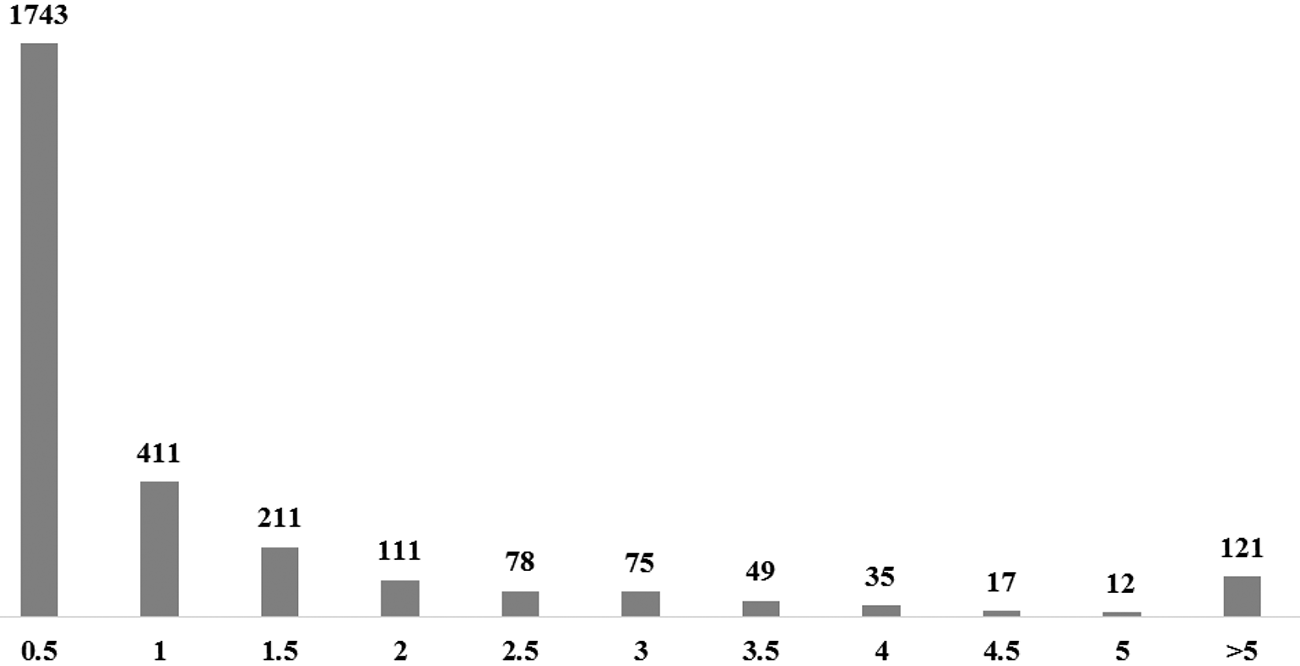
Returned requests last an average of 346 days. The 124 nonreturned vistas were ongoing for an average of 1,095 days up until December 31, 2013. Figure 1 shows the distribution of returned vistas, plotted according to their duration in years.
Distribution of vistas per duration in years
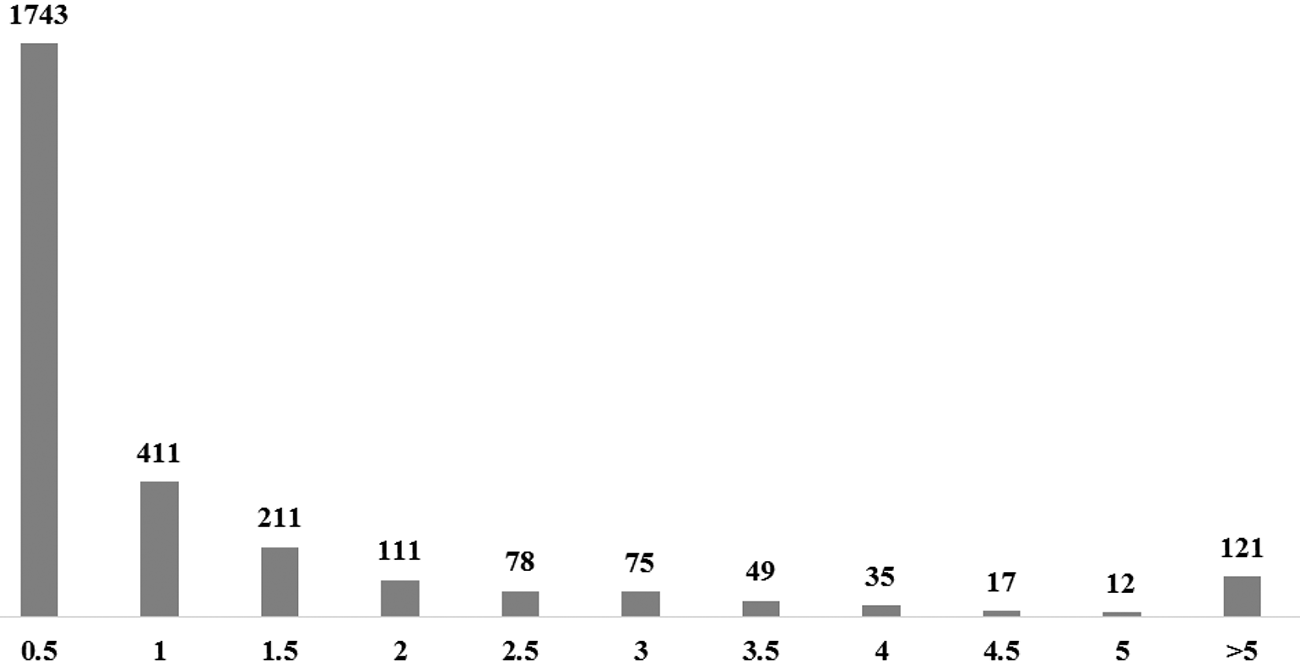
The distribution appears to follow a power law, not a bell curve. The vast majority of requests are returned under the average of 346 days. The median duration of returned vistas is 120 days. There are hundreds of vistas, as the graph shows, that lasted over a year and 121 that lasted more than 5 years. More often than not a retiring justice has a collection of case files that have been requested and never returned. Sometimes it takes a couple of years before his or her successor returns these files to allow for the trial to resume. Other times a justice will return a case a few years after it was requested.
In order to get a sense of what kinds of cases cause the justices to “view” them for so long, we picked a few examples out of the top 10 cases that were suspended the longest because of vistas. In the mid-1990s, Brazilian public telecommunications companies were privatized in a series of multi–billion dollar auctions. The statute that regulated the auctions was challenged in 1996 (an abstract constitutional review suit: ADI 1491). Two vistas by different justices suspended the course of the proceedings in 1997 for a few months. Then a justice made a request in June 1998, which was renewed in July. The case files were returned for trial in April 2011, several years after that justice had retired. The case is still pending. The total of all the vistas is 4,638 days.
An appeal reached the Court in 1989 regarding the levying of unpaid taxes by the government against a company in São Paulo (AI 132755). A first vista came that lasted half a year. Then a request was made in April 1990. The case files were returned in November 2009—again, several years after the justice had retired. The appeal was ruled moot in 2011. The vistas amounted to 7,111 days. In another case, in 1989, the Supreme Court received an appeal questioning the application of new rules on retirement pensions (RE 118074). In November 1991 a vista was requested. In May 2004, the appeal was dismissed for procedural reasons. The vista lasted 4,558 days.
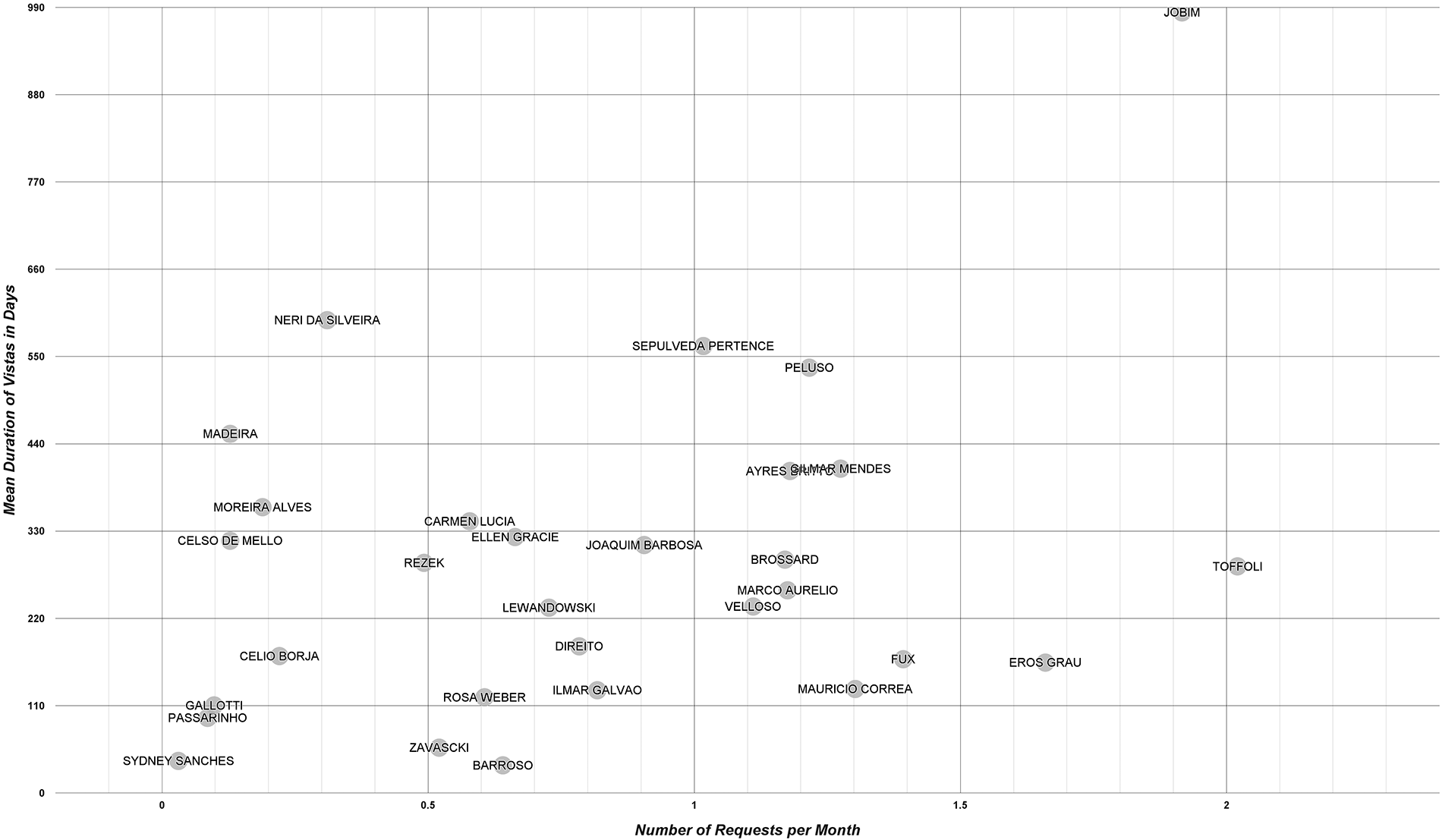
In order to understand the behavior of different justices with vistas, we produced individual data. Figure 2 plots the justices who have requested to view a case since 1988 according to the average requests per month (y-axis) and the average time it takes them to return the files (x-axis).
Requests to view the case in the Brazilian Supreme Court, 1988–2013
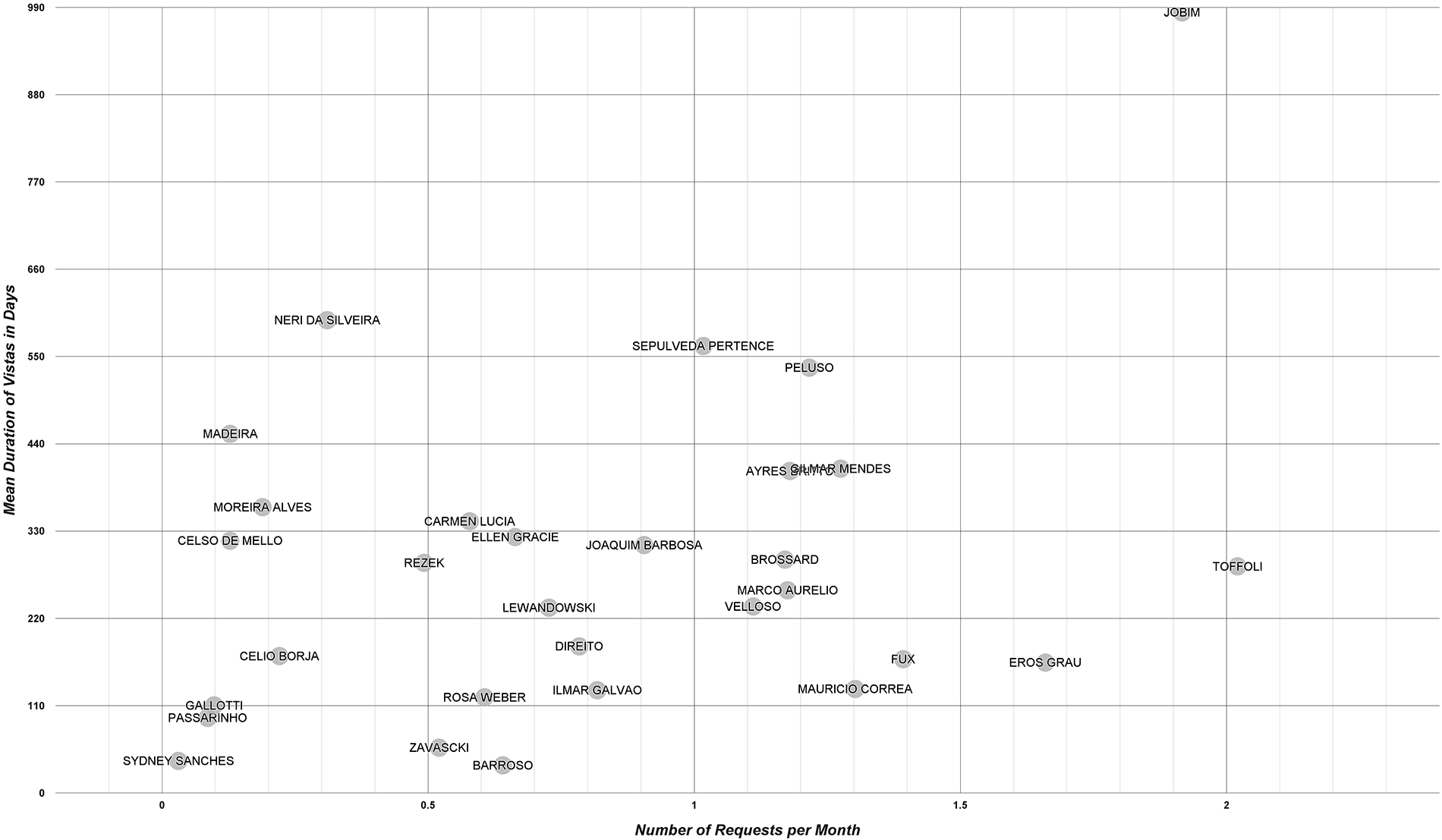
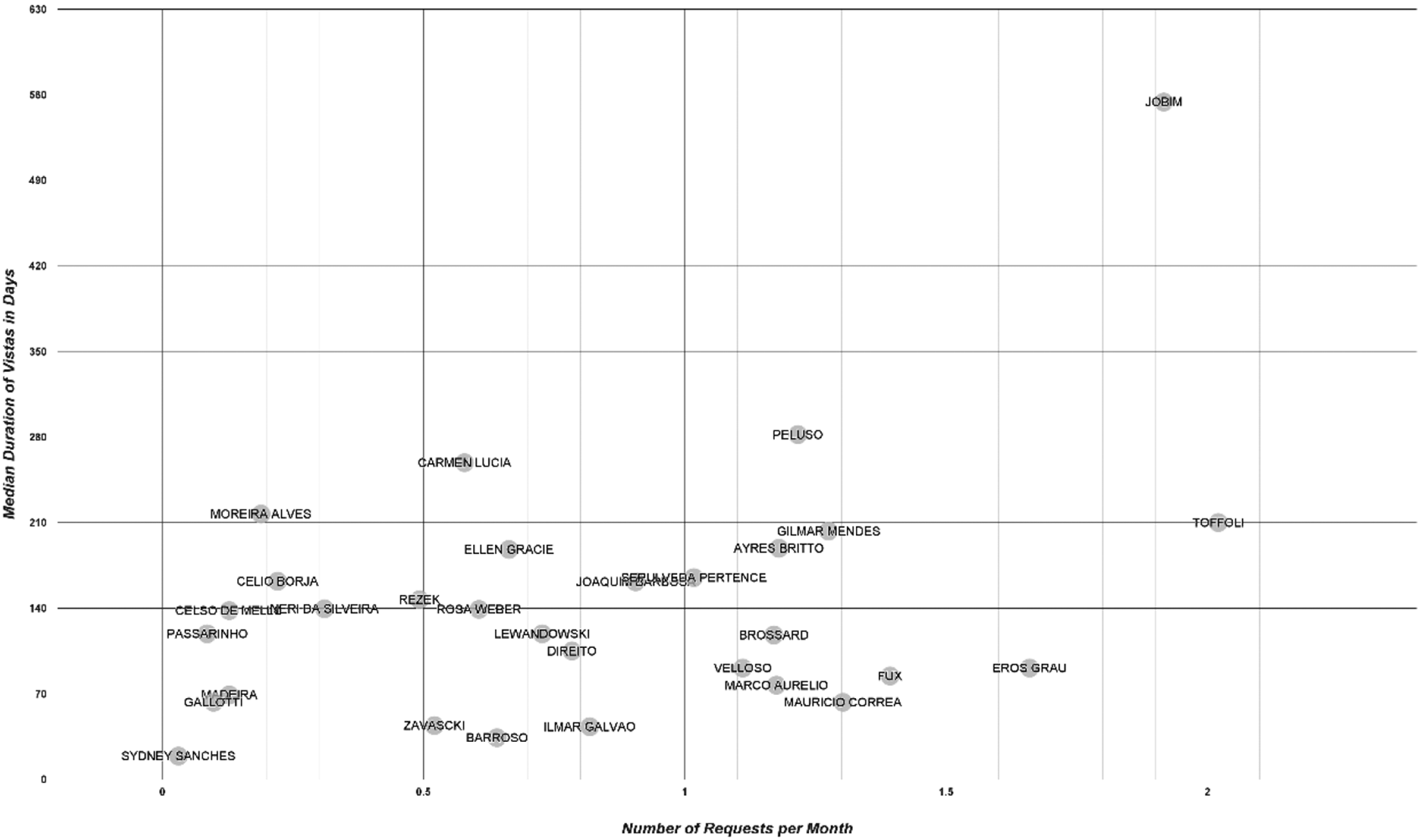
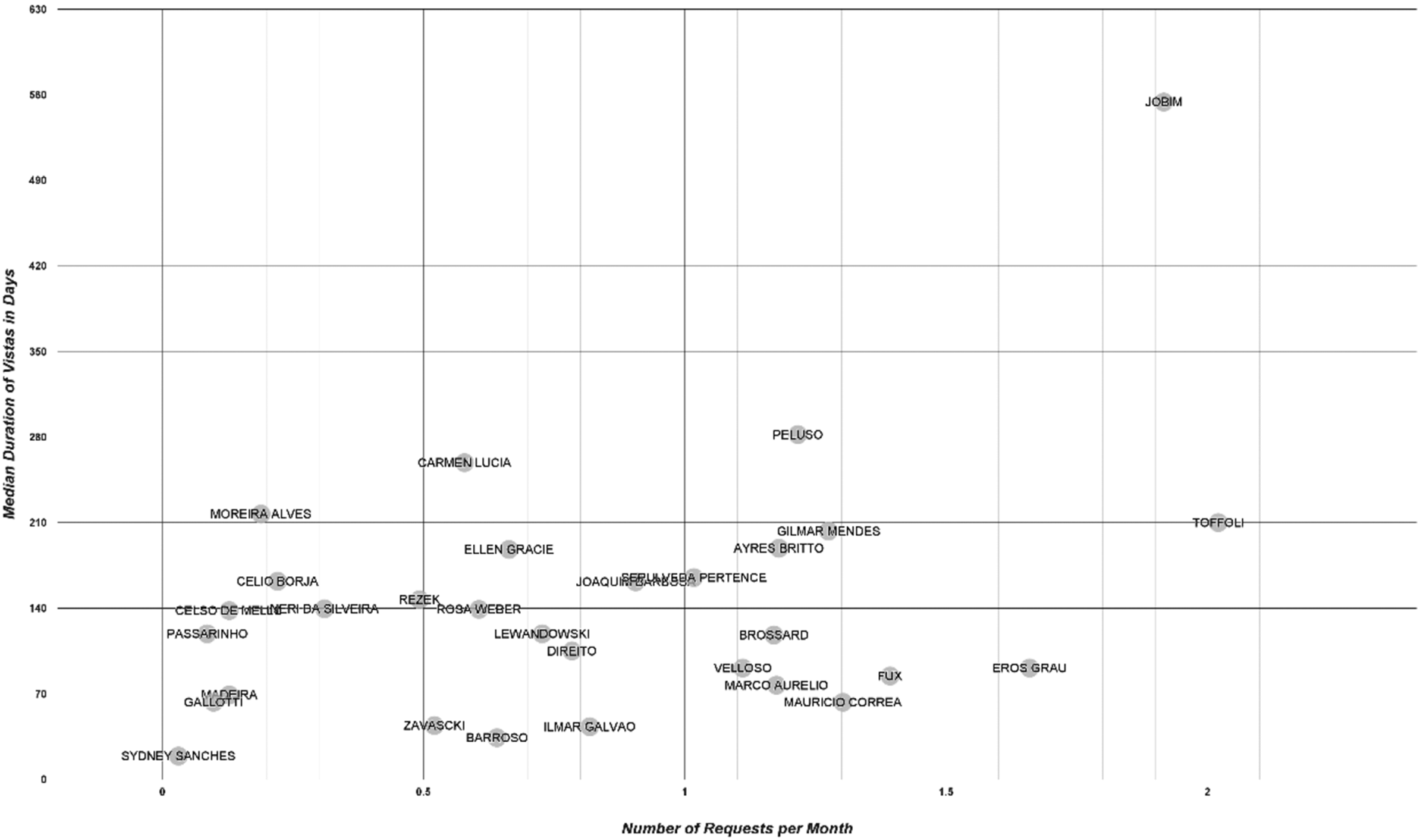
If justices request to view cases in order to study them and better understand them, then we would expect a negative correlation between the number of vistas and the time he or she takes to return them. The justices’ time is, after all, finite. Either a justice requests many cases and has little time to carefully study each one or she requests very few cases and has plenty of time to devote to each. The justices in the scatter plot would slope from the upper left to the lower right. What we see instead is a lack of correlation that would suggest that the requests to view the case are not used in the way that the Brazilian procedure law literature says they are. Because even one single case can outweigh the relevance of a hundred others that a justice might have requested to view, we feel that it makes more sense to take outliers into account and use the mean duration of cases. As when it comes to the duration of vistas the mean (346 days) is indeed radically different from the median (120 days), we plotted the same graph using the median duration for each justice. As the results in figure 3 can attest, the lack of correlation persists.
Requests to view the case in the Brazilian Supreme Court, 1988–2013
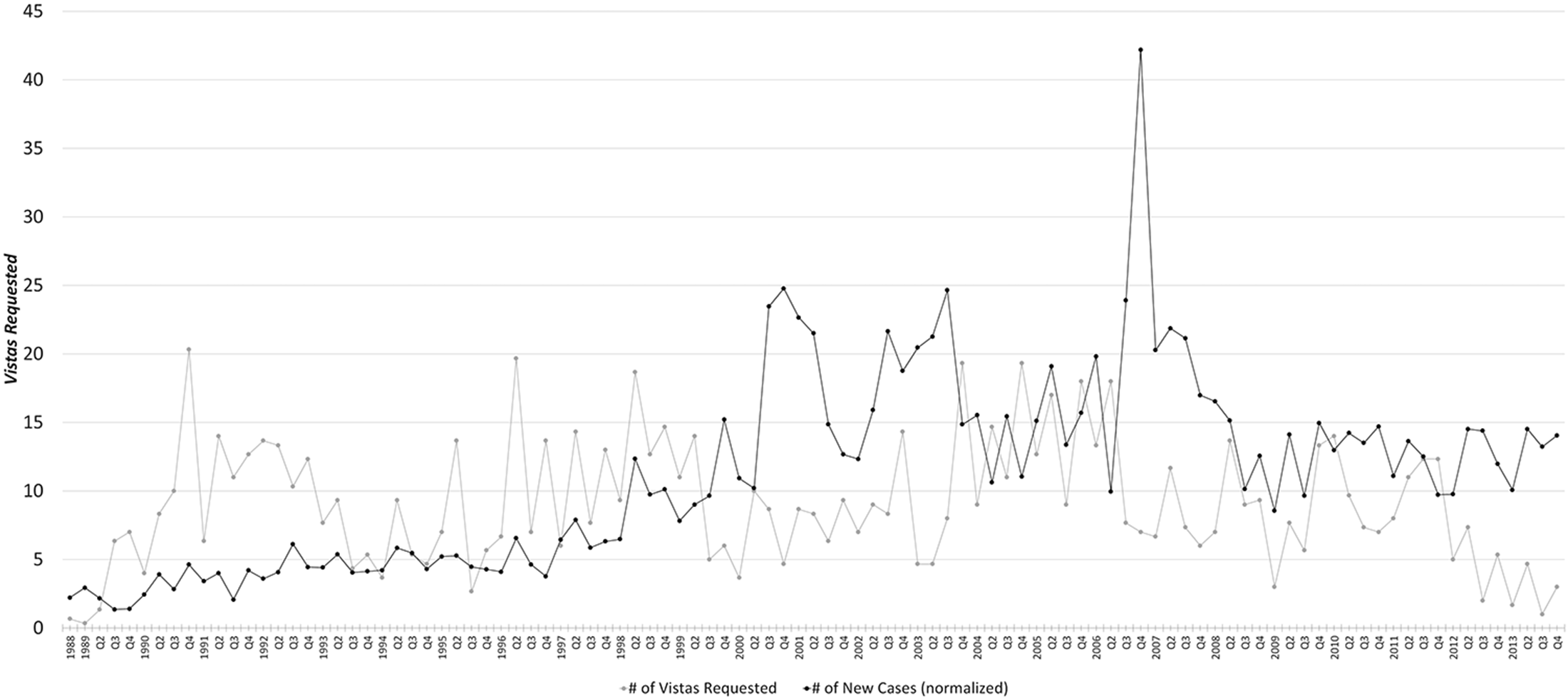
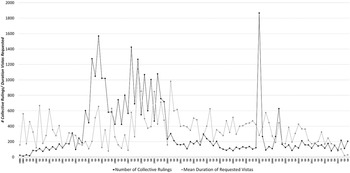
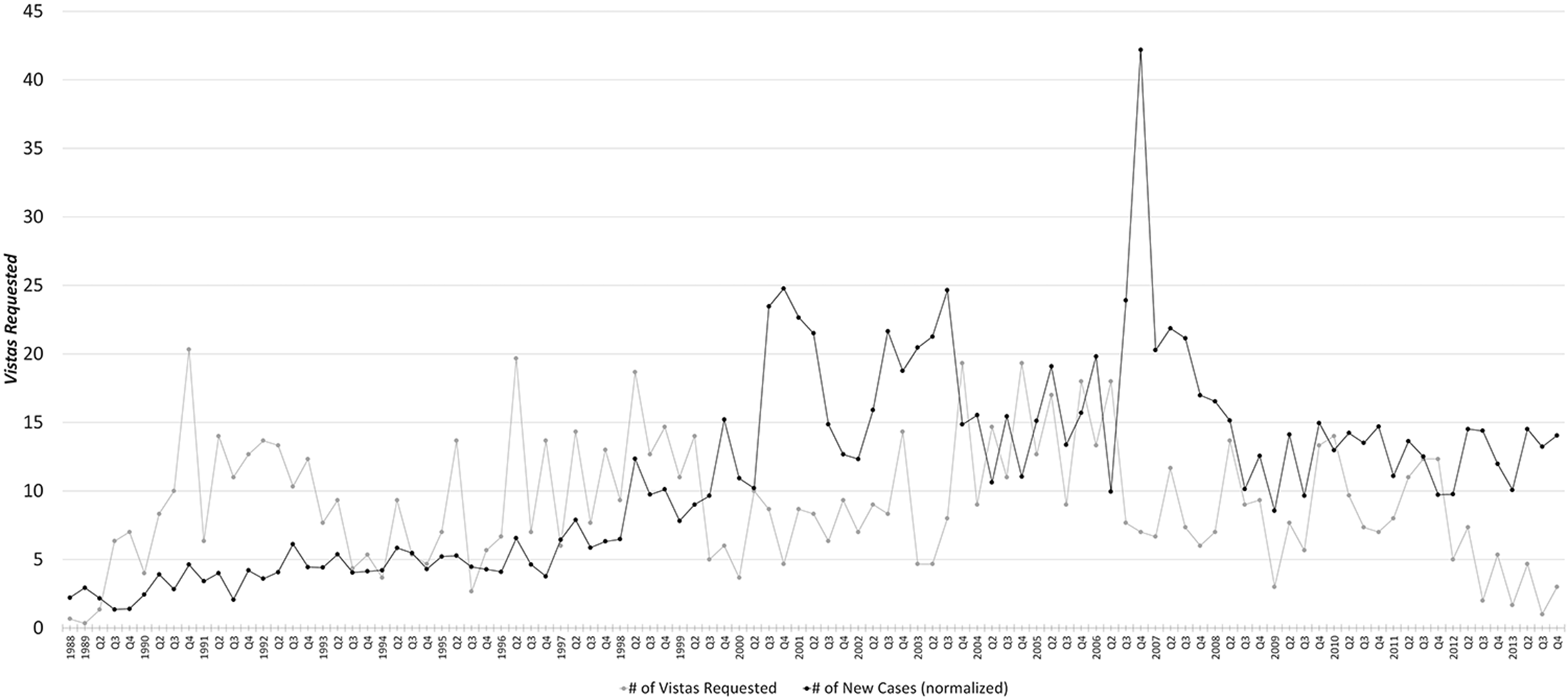
This evidence is, of course, insufficient. The high average and even the median time they take to return cases could only suggest that perhaps some of the vistas were requested with a purpose other than carefully studying the case. There is, however, a very reasonable counterargument for this interpretation: increasing workloads, coupled with the lack of judicial control over the Court’s docket. Tens of thousands of cases enter the Brazilian Supreme Court’s docket each year. While in the past 5 years the number has remained just under 70,000, there were years when it surpassed 100,000. The 11 justices certainly have a hard time with this caseload, and therefore, it is normal that a few trials are delayed for a year or so. If this were the case, we would expect a positive correlation between the number of vistas and the time it takes for the justices to analyze each case and the number of new cases pending trial. Moreover, the justice’s choice to request a vista on a case is made at the trial session. Justices are informed of the cases that will be tried in a specific session only a few days in advance. They then have some time to look into the cases on the list, but it would follow that if more cases are scheduled, they will have less time to go over each of them and therefore will be more likely to request a vista. In figures 4 and 5, we thus plotted the number of cases decided in the same circumstances in which a vista could be made—a ruling from the plenary or a chamber.
Vista use versus new cases (normalized)
Collective rulings versus duration of vistas
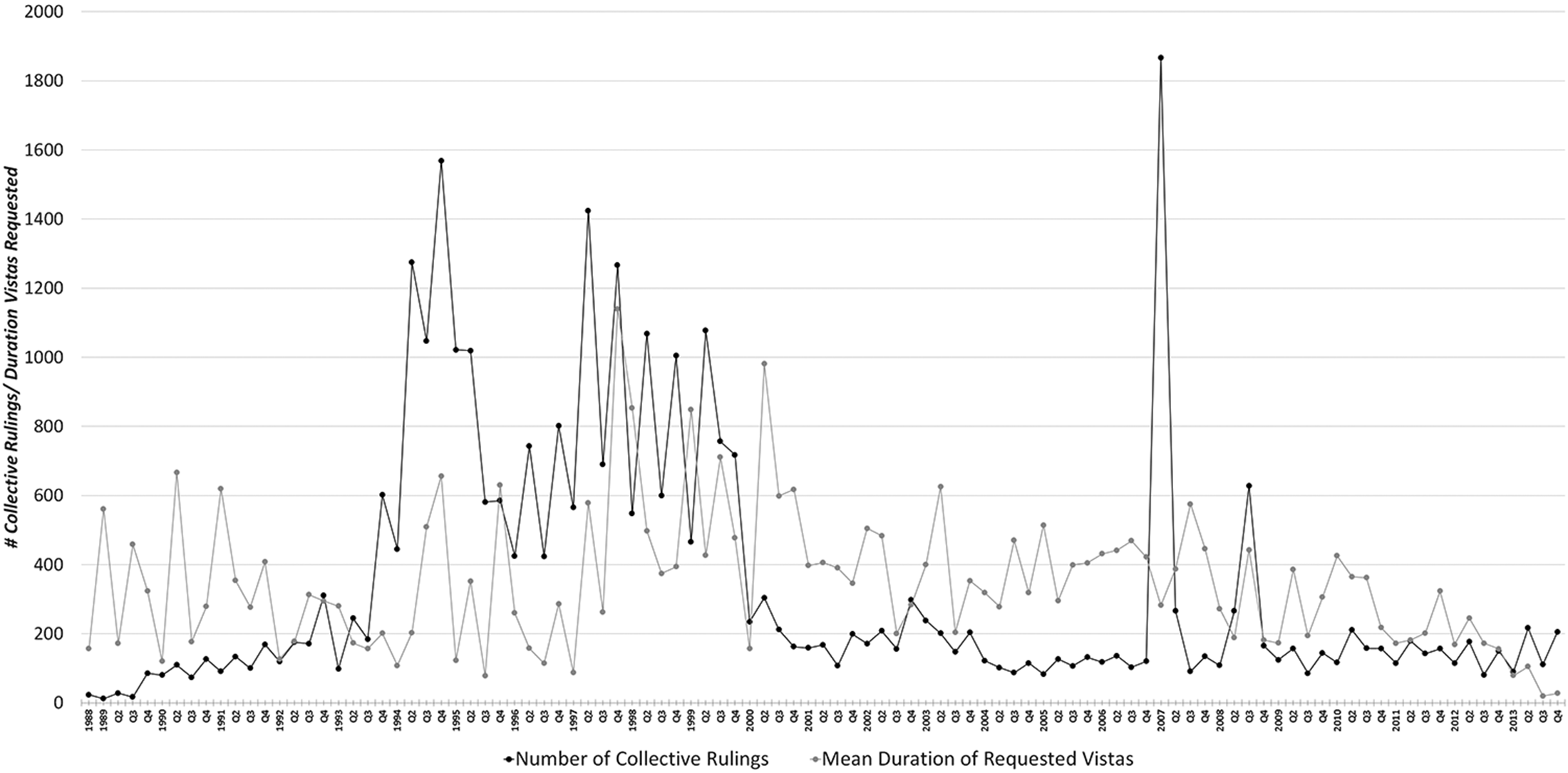
Both the average duration of vistas and their number decrease in the last 3 or 4 years. The partial reason is that we are plotting only the returned vistas and the majority of the ongoing requests were made in these last few years. Apart from that, it is clear that the number of requests did not increase accordingly when the workload skyrocketed after 1999. While the average duration of vistas does increase at that time, it had a higher peak back in 1997. Then in 2006, when the all-time high in new cases and collective rulings was recorded, the number of vista requests actually decreased. And the mean duration of vistas requested during 2006 remained within the variation of the 3 previous years. Overall, it seems clear that the two lines we would expect to go together the most—the number of collective rulings and the number of vistas requested—do not in any way coincide. Here again the data seem to disprove the use of the request to view the case presented by the literature and, in general, by former Supreme Court justices.
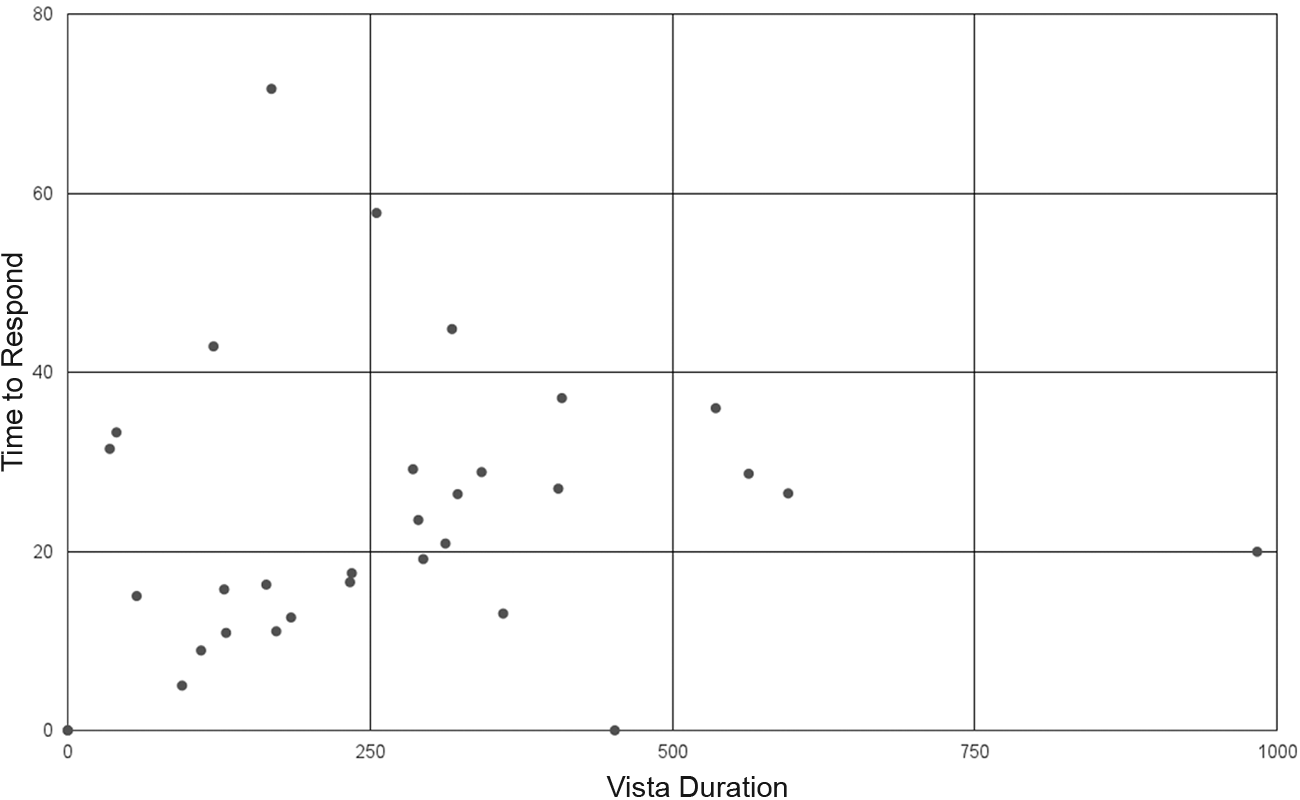
Admittedly, all the data up to here are not effective at comparing the way in which a specific justice employs vistas with the way the same justice behaves in similar situations. It might still be the case that the difference in behavior can be explained away by something like justices’ individual “speed” in dealing with their workload instead of “outcome” concerns. So, in order to further test the notion that vistas are made when a justice needs to take a better look at the case, we tested the correlation of the average number of days each justice took to return the cases with the average number of days each justice took to perform other comparable tasks. We searched for different situations in which the workload and a justice’s ability to cope with it are similar to those in the vistas. We found two such situations that are very similar to the request to view the case and two that are somewhat similar. We call the first two “direct parameters” and the latter two “indirect parameters.”
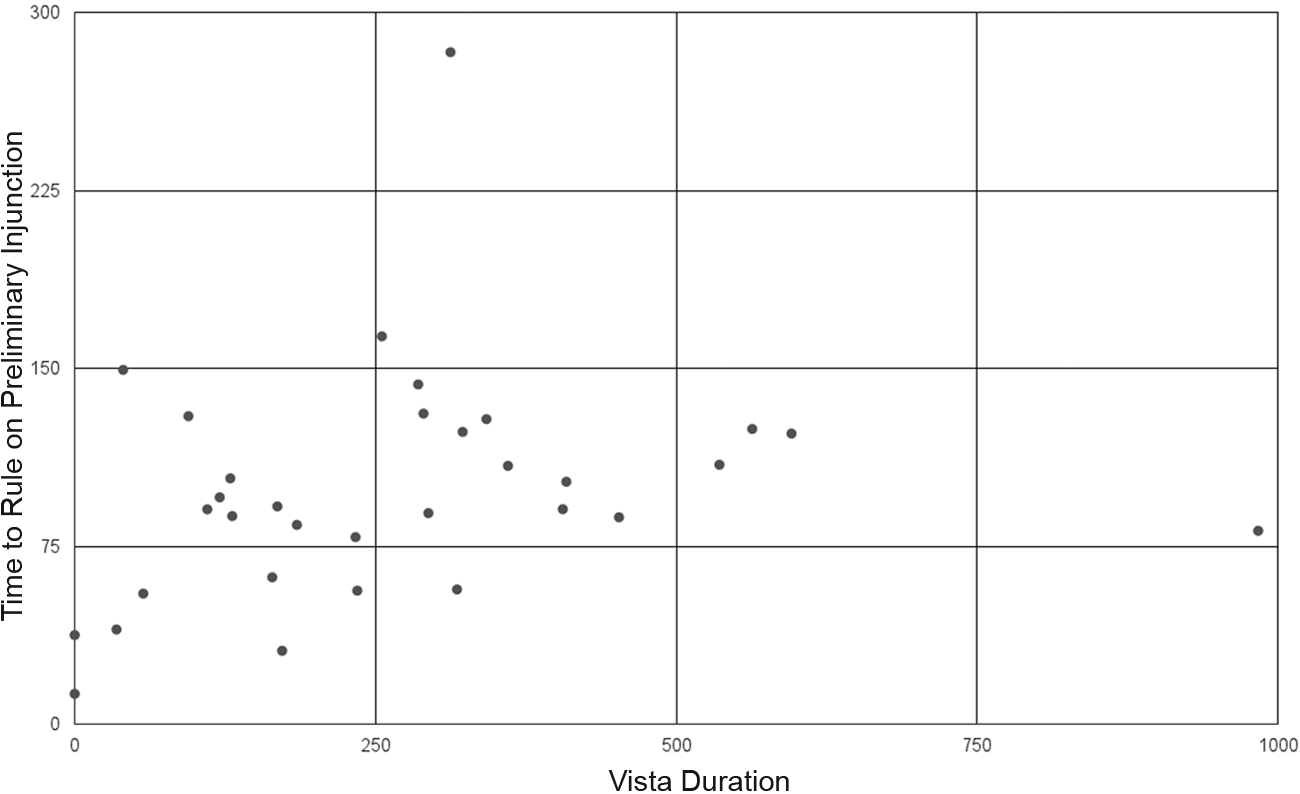
The first direct parameter is the time a case stays with a justice pending a decision needed from him or her. This can occur before a ruling on an injunction, on the merits of the case or appeal, or even when a simpler reaction is called for, such as the response to a request made by a party to attach a document to the case files or even to view them. Here we identified the docket entry related to such a situation (“files submitted to the justice”) and calculated the number of days until the subsequent docket entry, regardless of what it was. We found 736,560 “submission” entries for all justices. The second direct parameter is the time it takes a justice to rule on a preliminary injunction request. Such judgments can be made individually, but also by the full bench or one of the two chambers. We thus mapped only those injunctions granted or declined by an individual ruling. We found 21,483 of those and calculated the average time it took for the ruling starting the day the case was subjected to the respective justice.
It would seem that injunctions follow a different timing rationale because of their typical urgency. Nevertheless, in the STF, the average time to rule on an injunction is 44 days. That is 50% longer than the deadline to return a vista request. Even on habeas corpus writs (in which many of the defendants are imprisoned) the average time to rule is 27 days. On more than one occasion, the Court decided an injunction on a relevant case 10 years after it was filed (Falcão et al. Reference Falcão2014). Vistas, on the other hand, would seem at least just as pressing as injunctions since they pause an ongoing trial for which other justices have already issued their opinions. Furthermore, unlike vista requests, injunction rulings have no legal deadline.
The degree to which the duration of that specific phase in the case is dependent on the rapporteur alone is very high in these two situations. On the following two, however, it is medium to low as the outcome is influenced by requests that the parties might make or the performance of other justices. That is why we have decided to use them as merely indirect parameters. Because the rapporteur in any event is still responsible for the adequate development of her case, we feel that they are still a measure of how a justice deals with the workload and how agile she is in making the case reach its outcome. For example, requests from the parties can be denied or their fulfillment sped up, while fellow justices can be persuaded to take less or even more time in producing their opinions.
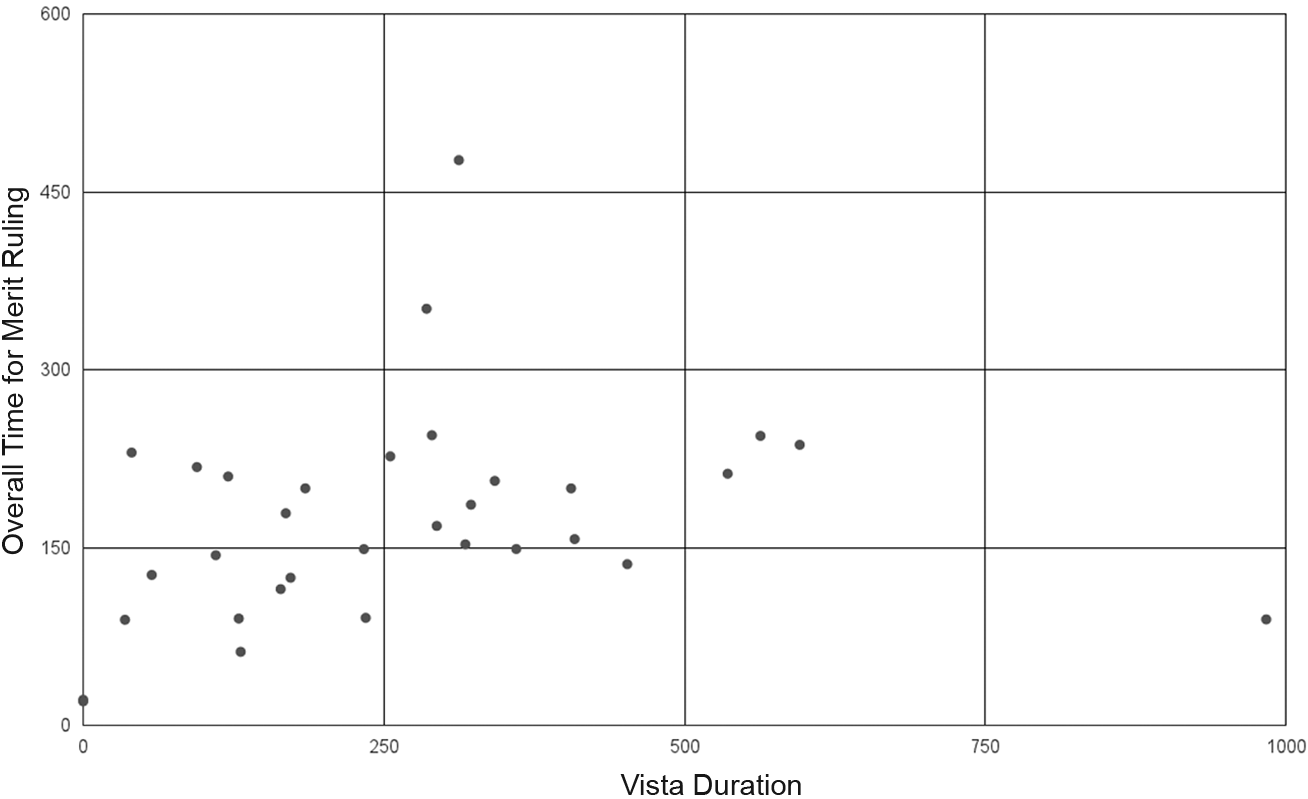
The first indirect parameter is the time it takes a case to reach a merit ruling. Again, we separated the cases in which such a ruling was made by an individual justice in order to insulate the rapporteur’s performance from delays caused by other justices. We found 1,057,482 of these rulings. The second indirect parameter is the time it takes for a collegiate ruling to be published. That is, after the trial session the justices who chose to add written (dissenting or concurring) opinions must prepare them and send them to the rapporteur. The rapporteur’s office is then responsible for putting everything together, including the summary, and delivering it for publication in the official daily records. More often than not the rapporteur is the only one who writes an opinion. Whether a ruling had only one written opinion or several is not a variable mapped on the database, which prevents us from isolating the collegiate rulings with single opinions. We found 87,565 collegiate rulings whose rapporteur can be traced.
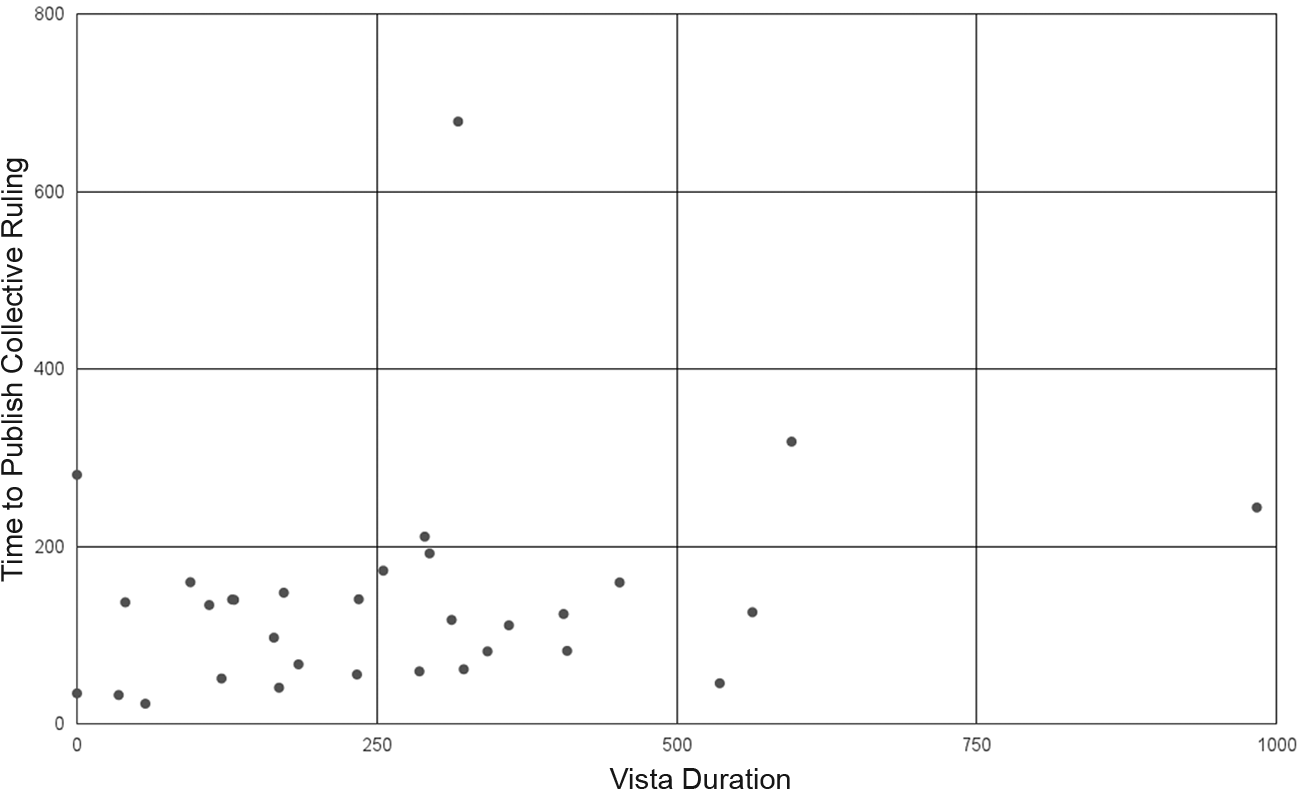
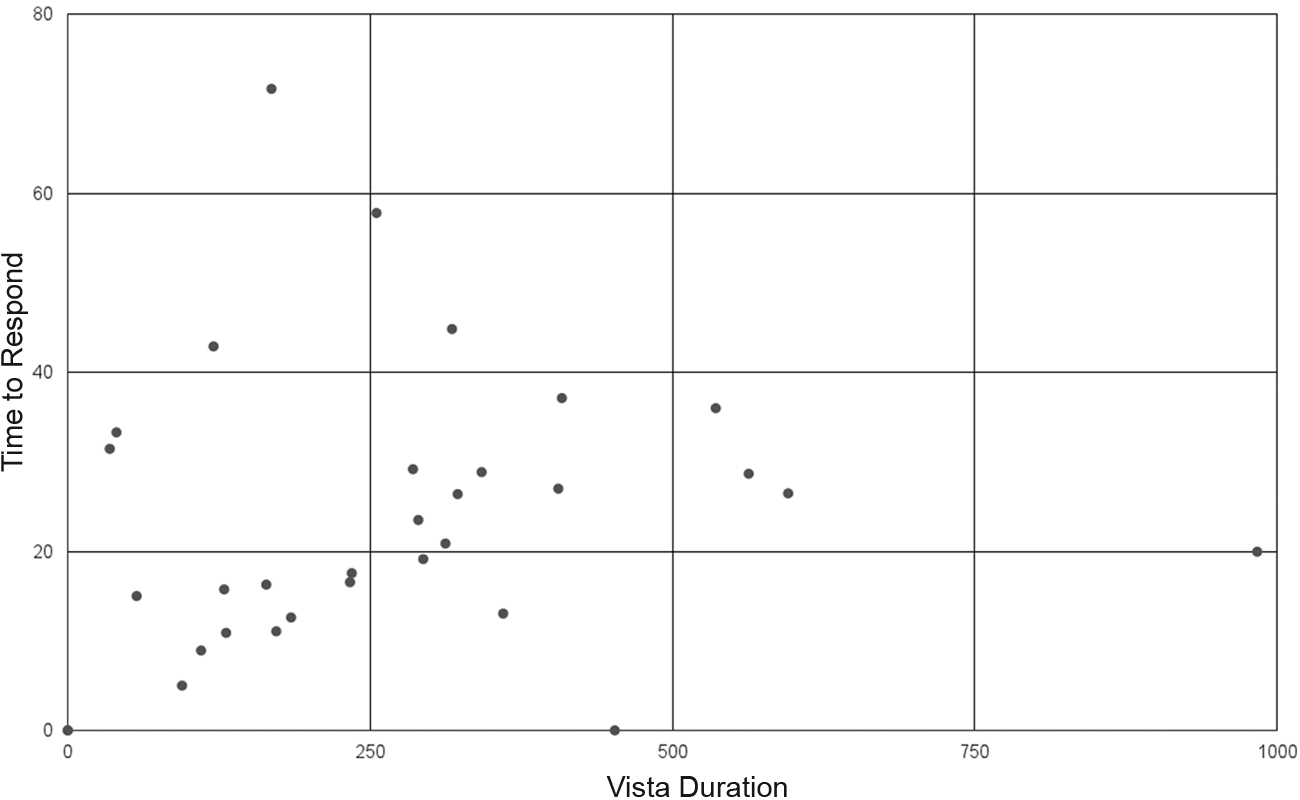
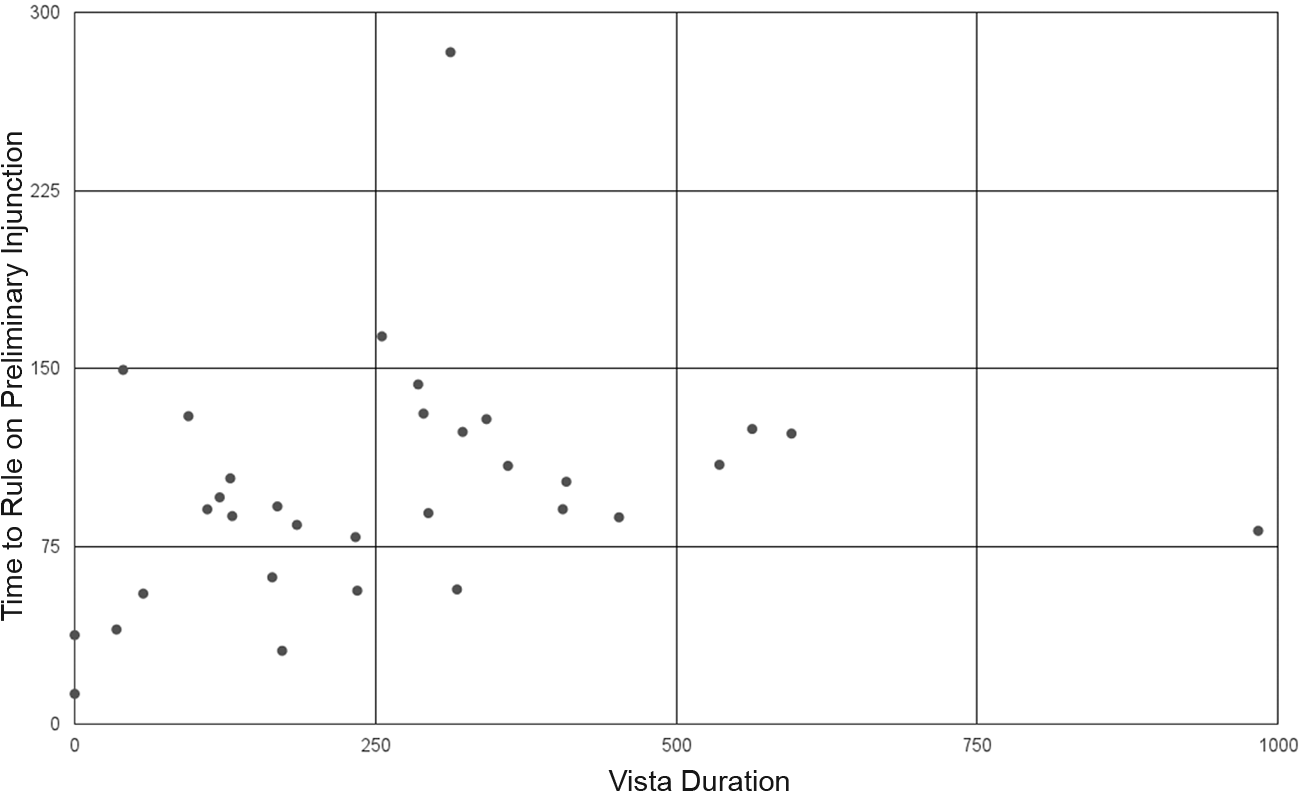
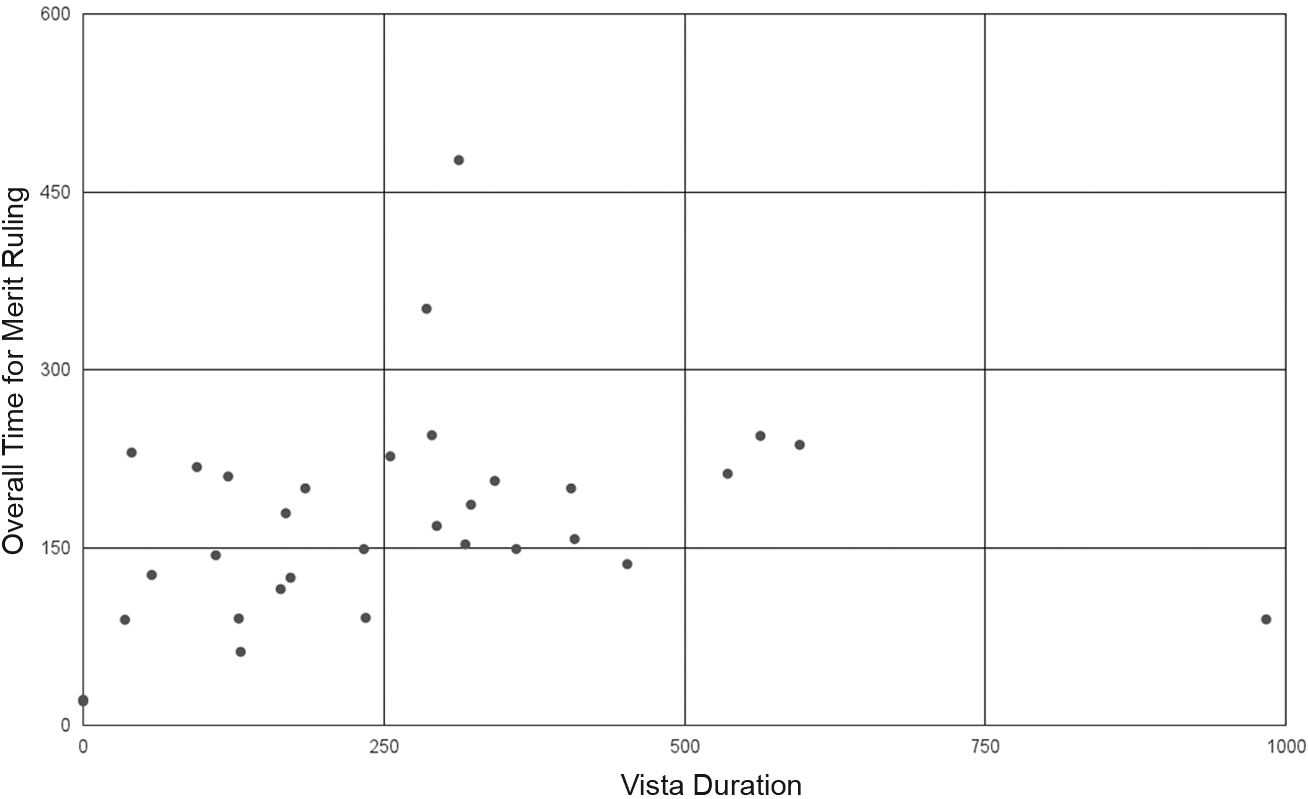
The correlation is close to nonexistent between the average duration of requests to view the case and the average time to respond (.152; fig. 6). It is a little higher, but still not relevant, between vista duration and the time to rule on preliminary injunctions (.242; fig. 7). The same goes with the overall time to rule on the merits (.229; fig. 8) and with the time to publish a collective ruling (.238; fig. 9). The scatter plots confirm this lack of correlation.
Vista duration versus time to respond
Vista duration versus time to rule on preliminary injunction
Vista duration versus overall time for merit ruling
Vista duration versus time to publish collective ruling
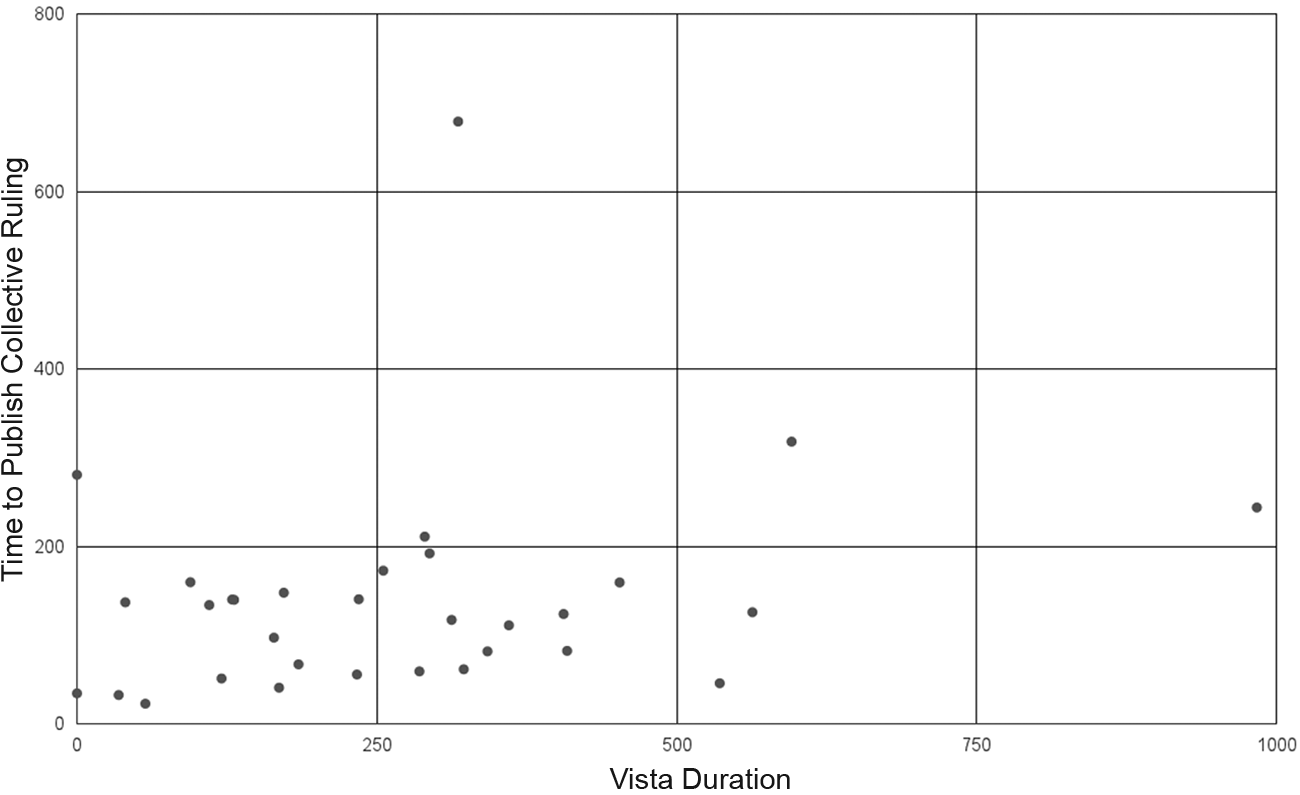
If the requests to view the case could indeed be explained purely by the need and wish to better understand the intricacies of certain lawsuits, then the average time it takes a justice to return the case files would vary depending on caseload and their management skills, in a similar way as to how the average time to complete other time-consuming and attention-demanding tasks varies. We found no evidence of such correlation.
V. Discussion and Implications of the Results
A. Are Vistas Employed to Further Study the Case?
The most obvious finding we obtained from the quantitative data described in the previous section is that a pedido de vista that falls within the legal deadline of 30 days is an uncommon event. Regardless of what the Court’s rules of procedure and the legal scholars say, the vistas tend to last very long periods of time. Our data show a clear general pattern, to which all the justices contribute, of keeping the case files requested in vistas for periods of time that are much longer than 30 days. If the aggregate data showed a pattern of relative compliance with the legal deadline, we could frame the few instances of excessive length as outliers. Given that the applicable law provides for no sanctions to the justices who disobey the vista deadline, these outliers would not necessarily be surprising. After all, in the scenario described above, and especially if we consider the notoriously large workload justices have to face, it would hardly be unexpected to find that they are often unable to comply with the deadline of 30 days when trying to closely analyze a case before issuing their opinion.
The data show, however, a scenario very different from the one described in the previous paragraph. Pedidos de vista returned from the justices’ chambers before 30 days are the exception; it is compliance with the legal deadline, not exceeding it, that characterizes the outliers in our data. As we mentioned earlier, only 20.4% of returned vistas met the deadline. It is therefore safe to say that there is a widespread practice of requesting vistas for longer periods of time. By itself, however, this finding does not allow us to understand the role the vista plays in the Court’s internal dynamics. After all, it does not tell us why this mechanism is used by the justices in a way that makes it unlikely for them to comply with the legal deadline. Even when we set aside the outliers, there seems to be a general practice of retaining the case files for (in some cases extremely) long periods of time. The scenario depicted in the data cannot be the result of purely individual behavior by specific justices. Rather, it points to a more general practice—one that seems to have intensified since the 1990s, as both the number of pedidos de vista and their duration seem to have increased over time.
As we have seen, the official discourse on the pedidos de vista frames it as a mechanism for extended analysis of particularly complex cases. The longer the time needed to study a case, therefore, the more the length of the vista would distance itself from the expected deadline of 30 days. This does not require us to assume that justices care about complying with the deadline; it simply assumes that there is a correlation between the length of the pedido de vista and the time the justice devotes to that specific case. There should therefore be a trade-off between the number of vistas requested and the amount of time it takes for these vistas to end and the case files to be returned to Court. Such a theory on the purpose of vistas, however, would not allow us to make sense of the data we have. First, our data show no correlation between increases in the justices’ workload and the vistas or between an individual justice’s “speed,” as measured by both indirect parameters and the number and duration of her vistas. No dramatic changes in the justices’ workload since 1988 are reflected in the number of or average duration of vistas requested. If there is a clear pattern in the data, it is the lack of correlation between how each justice deals with vistas and with similar attention-absorbing demands. Second, the length of these vistas that most exceeded the legal deadline cannot be easily explained by the complexity of the respective case. It seems safe to say, therefore, that the data are not consistent with the view that the vistas are related to the need to study the cases, their complexity, or the justices’ workload management.
As we have previously made clear, our main goal was to test this hypothesis. We find that the quantitative data disprove it. This is a significant step, given the official version for the use of vistas that is still advanced by the literature on civil procedure and by the justices themselves. Our research would be incomplete, however, if we made no effort to propose alternative explanations for the use of vistas. The data gathered thus far do not fully substantiate any of the other possible motivations for vistas, and we hope that future studies will be successful in producing such evidence.
Our data suggest that the practice of the vista cannot be explained by a single, overarching purpose (such as “complying with the 30-day deadline” or “further studying of a complex case”) that would be shared by all Supreme Court justices. Any theory that purports to account for the data would require leaving room for great variation, between justices, of the reasons and goals that might explain their pedidos de vistas—their timing and duration. If we consider the way the vista prerogative is regulated within the Court, however, this outcome should not come as a surprise. After all, the Regimento Interno assigns the power to unilaterally ask for a vista to each individual justice, and both our quantitative and qualitative analyses suggest that there is no external, institutional mechanism that would allow the other justices or the chief justice to interrupt a vista by force.
B. Vistas and Strategic Judicial Behavior
We have no positive hypothesis as to why justices use the vistas in a large number of cases. However, shedding light on how this prerogative can be employed by the justices helps uncover key aspects of the Court’s internal power dynamics. In collecting evidence indicating that vistas are not used to study the case, we have also found some evidence pointing toward other individual goals that might underlie the use of this prerogative. We considered other controlling variables mentioned in the judicial politics literature. Although procedural rules and institutional arrangements can give rise to several different incentives and reasons for postponing a given decision (e.g., Epstein, Landes, and Posner Reference Epstein2015), we focused on two broad judicial goals related to strategic behavior: (i) justices’ use of the vista to wait until a case can be judged in a more favorable composition, with a majority that will agree with their preferred decision (“outcome concerns”); and (ii) justices’ concerns with the consequences of the decision’s timing in the political environment, which can affect the Court’s legitimacy (“legitimacy concerns”).
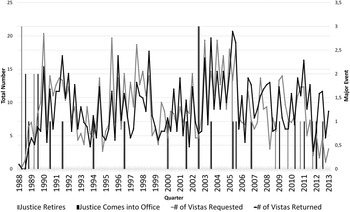
In a first attempt at testing the “legitimacy concerns” hypothesis, we plotted vista use against the backdrop of presidential elections. With the exception of an unusually high number of vistas requested right before the 2002 presidential elections, there did not seem to be a visible correlation. We then proceeded to a first exploration of the outcome concerns hypothesis by comparing vistas with changes in court composition. Figure 10 has two lines: number of vistas requested and vistas returned (both quarterly). Two types of bars appear: in months in which a justice retires and when he comes into office. We are looking for changes in the number of vistas requested (more) shortly before a justice retires and in the number of vistas returned (more) right after a justice retires.
Vistas’ behavior versus court composition
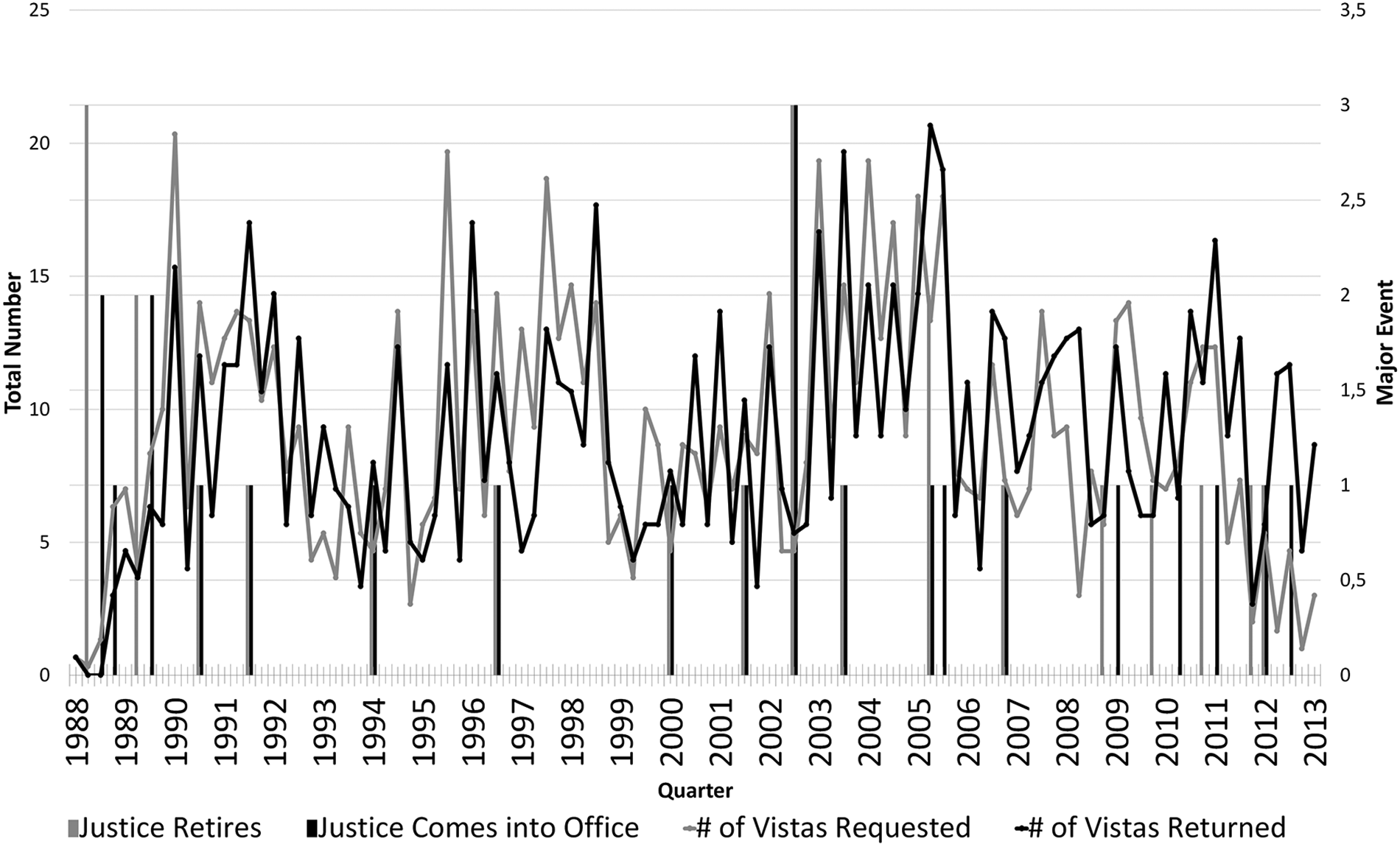
In some months, it seems that changes in court composition do influence how vistas are used. In 1992, an unusually high number of vistas came before a retirement. Around 2003 and 2004, the Court went through its most momentous generational change since democratization, as the last three justices appointed by the pre-1988 dictatorship finally retired.Footnote 12 In a couple of years after this transformation, we see a marked increase in the number of returned vistas. In fact, there is a significant increase both in the number of vistas returned and in the number of vistas requested during the shift and in the couple of years following it. The retirement of the last group of predemocratization justices led to a process of deep readjustments in the Court’s agenda. Finally, we see that, in 2006, the retirement of Justice Sepúlveda Pertence coincided with a record number of vistas returned.
We take these court composition changes as indication that the justices could use and have used vistas for other purposes than simply “studying the case.” Our data show a possible correlation between changes in the Court’s composition and the ways in which justices employ vistas. It is possible that at least some of them are using these powers with strategic concerns in mind. Our results point to a Court in which individual justices can freely decide to indefinitely remove a case from the agenda, for whatever reason: because of a lack of time or strategic concerns such as winning a majority or avoiding deciding sensitive issues in uncertain political environments. No single justice can decide that the time is ripe for deciding a given case, but the reason is precisely that each and every one of the Court’s members can, if they want, permanently postpone the deliberation and decision on that case. The Court cannot officially control its docket, but each of its justices can force the whole Court to go silent on a given case if she feels the need to do so.Footnote 13
But how can this work in practice? It is really possible that justices freely use vistas to shape the timing of the Court’s decisions for institutional reasons and outcome-related reasons, apart from the need to study a case, over and above the legal deadlines, without any relevant constraints on their power to do so? Between 2014 and 2015, one case in the Supreme Court provided an extremely useful public example of the powerful uses that vistas can have (a) as a means for one justice to influence the timing of a court’s decisions and (b) in order to promote either institutional or outcome-related reasons. On April 2, 2014, sitting en banc, the Court resumed deciding ADI 4650, an abstract review challenge filed by the National Bar Association (OAB) against many parts of the legal framework of campaign financing in Brazilian elections. The most consequential of the OAB’s claims was that the mere fact that existing laws allowed private companies to make campaign contributions was unconstitutional, as the constitution granted people, not legal entities, the right to vote and to participate in elections.
The Court started deciding in December 2013, when the reporter, Justice Fux, had issued his opinion agreeing with the OAB’s argument. Justice Zavascki asked for a vista, which was returned a few weeks later, and the judgment was rescheduled to be continued on April 2. Zavascki returned the vista disagreeing with Fux in this aspect, but as that session approached its end, five other justices had followed the reporter’s opinion regarding the unconstitutionality of campaign financing by private companies. Although the judgment had not ended and technically any justice can change his opinion before the final result, a 6–1 majority was enough for the OAB’s case to prevail regardless of how the remaining five justices voted. It was then, however, that Justice Gilmar Mendes requested a vista.
Justice Mendes’s vista would last 1 year and 5 months. In the context of our data, this is not a particularly long vista. For our purposes here, however, this is particularly relevant because of what he said to the press during this period—and of how other actors inside and outside the court reacted to his delay in returning the vista. First, from the very beginning, Mendes made clear that he did not feel bound by the deadlines, nor was he interested in further studying the case files; he would keep the case files as long as necessary for the debate to reach a point of maturity in Brazilian society. Mendes claimed that such an important issue could not be decided hastily, much less with the 2014 elections looming so close in the horizon, such that a decision changing existing campaign finance rules would create legal uncertainty (Conti Reference Conti2015; Vasconcellos Reference Vasconcellos2015).
Second, throughout his vista, Mendes made little effort to hide what would be his ultimate decision on the merits. In interviews, he displayed his disagreement with Fux and the majority, explicitly criticizing their arguments and taking a stance against prohibiting companies from making campaign contributions (Recondo Reference Recondo2015b). This would seem to clash with his other interviews, described in the preceding paragraph, in which he expresses his concerns with legal certainty and with the Court making a “hasty” decision. It is one thing to prevent the Court from deciding because the time is not right for a decision, whatever its substance; but stalling a final decision because you disagree with the outcome is a different matter. While the former is more of an “institutional concern,” in our terms, the latter is an “outcome-centered concern”: Mendes could be seen as using the vista to delay the inevitable in a case in which he knew he would lose. Both interpretations are consistent with his public attitude and interviews on this issue. Defenders of his vista tended to emphasize the institutional reasons, while his detractors focused on his avoidance of a seemingly inevitable defeat in the final outcome.
Third, although over time public pressure reached an extreme, with Mendes being criticized in the mainstream media for several weeks in 2015, nothing could be done to force the case files to be returned nor to discipline him for using the vista power this way. As Mendes not only kept the case files for many months but gave many interviews explicitly saying he was taking for himself the responsibility of controlling the timing of that decision, people started to take notice (Benvindo Reference Benvindo2015). Social movements and student organizations organized protests in front of the Supreme Court building and at universities or conferences in which Justice Mendes was scheduled to appear, bringing with them a huge cake or hundreds of candles to celebrate the vista’s 1-year anniversary (Brígido 2015; Ribeiro Reference Ribeiro2015); a major newspaper that, in principle, agreed with Justice Mendes on the merits wrote an editorial specifically asking for him to return the case files (Arguelhes and Hartmann Reference Arguelhes2015; Folha de São Paulo 2015); an online petition against his vista obtained almost 250,000 signatures;Footnote 14 and an internet hashtag, #devolvegilmar (literally, “return it, Gilmar”), was created and became a hit on Twitter (Schreiber Reference Schreiber2015).
As Justice Mendes himself acknowledged when he finally returned the vista on September 2015, “never before had a vista request been so controversial” (Frota Reference Frota2015). And, yet, the unprecedented public controversy was insufficient to force the judgment to resume. There was simply nothing to be done as an institutional matter. A member of Congress formally requested the National Council of Justice (CNJ) to start disciplinary proceedings against Justice Mendes (Portal Fórum 2015). The request, however, ultimately led nowhere, as the CNJ has so far considered that it does not have competence to investigate, prosecute, or discipline Supreme Court justices. In March 2015, the chief justice, Ricardo Lewandowski, threatened to schedule this and other cases with pending vistas back to judgment, as an indirect way of pressuring the respective justices (Recondo Reference Recondo2015a). But he ended up not adopting this policy in the case of Justice Mendes’s vista; and even if he had done so, under existing law, Mendes would have been under no actual obligation to bring the case back for judgment (J. Falcão Reference Falcão2015). He would return the case files only many months after the protests and media criticisms had reached their peak. In the Court session when the judgment finally resumed, Mendes seemed unrepentant. He remarked that at that point the country had information about corruption scandals involving the government and campaign contributions, a sign, according to Mendes, that “the hand of God” itself had guided him in requesting a vista and halting deliberation for almost 2 years (Carneiro and Recondo Reference Carneiro2015; M. Falcão 2015).
This case illustrates the general points we make in this article by showing, in practice, how the vista actually can work as a timing control mechanism. Mendes asked for a vista in a case he had already lost, as a practical matter, making it clear from the start he had no intention of respecting the legal deadlines. During the more than 17 months he kept the case files in his chambers, he gave interviews and issued public statements justifying his suspension of the decision both for institutional concerns and, at least implicitly, for outcome-centered concerns. Public pressure reached unprecedented levels, but there was no institutional mechanism by which his colleagues in the Court, or any other institution, could cancel his vista or punish him for using it in this way and for these purposes. Mendes’s stalling of the decision in ADI 4650 shows how the vista mechanism allows individual justices to negatively shape the timing of a decision on a given issue, for a variety of reasons unrelated to the need to study a complex legal issue or novel arguments, and under no clear constraints beyond public pressure. Answering the question of how often vistas are used in such a fashion, however, is a matter for future research.
C. Timing Control as an Unconstrained “Free-for-All”?
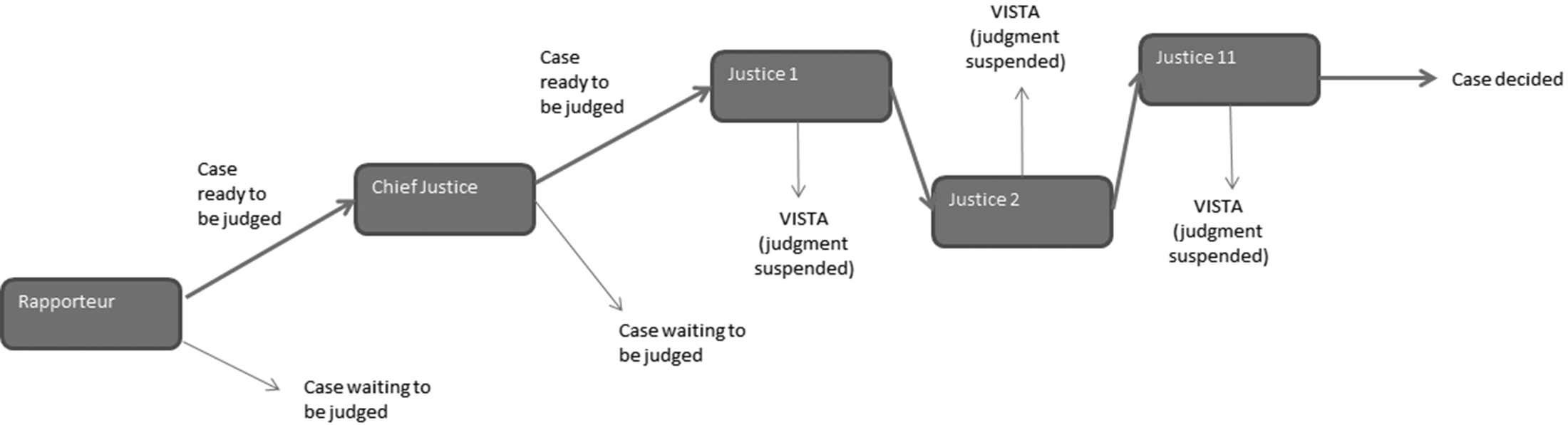
What emerges from these results, and as exemplified in the brief case analysis in the preceding section, is a Court that is somewhat singular in comparative terms. As we have seen, the Court’s rules of procedure grant each individual justice the power to unilaterally remove a case from the agenda. There is no explicit legal mechanism for such a request to be denied, and although theoretically the chief justice and the rest of the Court’s members could override the Regimento and deny the request made by a single justice, we have been unable to find instances of this happening in the Court’s practice. In practice, the individual power to request a vista is not in any relevant way circumscribed by the legal deadlines. Considering all this, we depict in figure 11 the Brazilian Supreme Court’s internal structure for deciding when a particular case should be decided.
Internal structure of the Brazilian Supreme Court

The boxes represent institutional actors with veto powers regarding when a given case is ready to be decided. The rapporteur and the chief justice make relevant decisions on this issue before the case is brought, in session, to the other members of the Court. The other justices engage in determining the timing of a given decision after the case is presented, by the reporter, to the rest of the Court. Because all justices, including the chief justice and the reporter herself, can request a vista after the case is presented in session and opinions start to be announced, the complete decision tree would have to include 11 boxes, one for each Supreme Court justice, each of them with the power to unilaterally request a vista, stopping the judgment and preventing other justices from issuing their opinions.
In important aspects, such an arrangement can be contrasted with two typical models of high court power to set its own agenda in contemporary comparative constitutional scholarship (Comella Reference Comella2004).Footnote 15 On the one hand, there is what we could call the “Supreme Court model,” in which the court has at its disposal many resources to decide not to rule on a given issue. These resources might include (i) a discretionary power to decide which cases to hear or (ii) the freedom to avoid deciding on constitutional grounds whenever narrower grounds (centering on the facts of the case or on infra-constitutional interpretation) are available. In contrast, the “constitutional court model” gives these institutions very little room to avoid deciding constitutional disputes whenever they are judicialized by external actors. They do not have formal control of its docket, and although it is always possible to avoid a difficult case by rejecting it on procedural grounds, they cannot simply refuse to hear a case. For many reasons resulting from institutional design, a typical constitutional court tends to have much less freedom to determine what to decide and when to decide it (Comella Reference Comella2004; but see Fontana Reference Fontana2011).
Thinking in terms of the two models sketched above enables us to raise some possible implications of what we have observed in our data. In our reconstruction, the Brazilian Supreme Court possesses features that ought to be singled out. Although in official discourse the Brazilian Supreme Court does not have discretionary control over its docket, which positions it closer to the “constitutional court” side of the spectrum, our data suggest otherwise. The Brazilian Court has at least one relevant mechanism that, in practice, allows justices to decide that a given case will not be judged for the time being: the pedidos de vista. Differently from both the typical Supreme Court model and from the constitutional court model, in this case power is ascribed not to the Court as an institution or by someone who can officially act in the name of the institution, such as the chief justice. Neither is it granted to a majority or plurality of justices. Rather, it is assigned to each and every individual justice, making the vista a purely individual power to influence (even if only negatively) the agenda for one’s own purposes. Other than media pressure on specific cases, there are no institutional mechanisms for the other justices to interfere with the individual vista. Brazil has recently witnessed, in the case involving the Mensalão corruption scandal, how public pressure and media coverage can indeed be a direct and decisive influence on the reporter’s and the chief justice’s decision to include a specific case in the agenda (Falcão Reference Falcão2013).
Moreover, and in contrast to the US Supreme Court, the design that emerges from our data does not simply give the Court (or each justice, in the case of Brazil) the power to refuse to hear a case. The Brazilian Supreme Court is forced to rule on all the cases it gets, but each of its members can postpone—as much as they want to—the moment of deciding that case. The implications of this feature of the model are significant, as individual justices can force the Court to wait and act on their own personal conceptions of when and on which kind of cases the Court should act. What is more, each justice can subject the whole institution to her individual strategies of waiting for a more favorable composition of the Court.
Such a power could be subject to other kinds of constraints, especially external ones. In particular, all mechanisms of agenda setting within the Court might be constrained by factors such as public opinion or the oversight of the political branches. In a particularly important constitutional dispute, when the whole country is paying attention, a single justice might not be willing to face public criticism by preventing the whole Court from deciding that important issue. Still, that would not change the fact that, institutionally speaking, the individual justice had the power to do so. The possibility of individual calculations in how to best deploy this power does not change the fact that the power is there in the first place. If a given justice has strong opinions on the outcome of a specific case, she need only ask for a vista and wait for the right time, when changes in the membership will have made it easier for her to secure a majority. How often justices use vistas for such a purpose is an open question. But we have shown that, if she decides to do so, there is nothing in the Court’s actual decision-making practices to prevent it.
VI. Conclusion and Further Research Questions
The possible existence of a peculiar timing control mechanism at the service of Brazilian Supreme Court justices is ignored in existing scholarship—including the vast majority of literature specifically on vistas. The official account is that justices request to look at cases in order to better understand the legal matters involved. We took that as our main hypothesis and conclusively showed that it simply does not stand. Our quantitative empirical research shows that vistas are not used to study complex cases. Furthermore, some of the quantitative data, as well as the case study, indicate that the justices instead have been engaged in a delicate and diffuse exercise of agenda-setting power. Any single justice can remove a case from the docket for as long as she wants—up to 20 years, as evidenced by our research—and knows that all her colleagues can do the same.
We propose that the decision-making relationships that develop in such a system have profound implications for the role that the Court actually plays in Brazilian law. The Court’s dynamics makes it hard to fit in any of the typical “constitutional court” or “Supreme Court” models: there is no docket control, like the former, but there are clearly significant powers of timing control, like the latter. Moreover, the Brazilian mechanism does not have exactly the same implications as the US Supreme Court’s certiorari. Future studies could investigate if, as compared to its US counterpart, perhaps the Brazilian Supreme Court has greater room to avoid deciding unwanted cases at inconvenient times, as any individual justice has a veto power that, in most instances, is sufficient to keep the Court completely silent on a given “inconvenient” case.
We have conclusive evidence of what the vistas are not used for. The quantitative data on what they are actually used for are inconclusive. Nevertheless, a plausible reconstruction of the vistas has emerged from the quantitative and qualitative data, and we have attempted to describe their characteristics and dynamics in Section II of this article. If our description is accurate, however, it would seem impossible for the Court to decide anything remotely consequential. All it would require for a case to be postponed indefinitely is the will of a single justice. But the actual behavior of the Court seems to be incompatible with this prediction, as it has decided many landmark cases in the last few years. We expect, therefore, that further studies would show that the use of vistas by individual justices is limited in ways that are not captured in our current analysis. For example, vistas can be constrained by external pressures on the justices—be it from the press or from the litigating parties and their political allies. We expect to explore these possibilities in future studies on Supreme Court decision making in Brazil.
Appendix Details on the Software Designed to Identify the Vistas and Respective Justices within the Docket Entries
As explained in the article, we used the results of a Supreme Court in Numbers study on the pedido de vista. Although the Court’s website offers access to data on all cases freely, the size of the data set—1.5 million cases—makes it impossible to pinpoint each vista request by hand. With access to an Oracle SQL database of all Supreme Court docket entries between 1988 and 2013, software was programmed in Python to search for docket entries that register a request made and those that identify the later return of the case files for trial.
Because the entries made by the Court’s administrative staff in the database do not observe a fixed pattern, there are some five different types of docket entries that can mean either a vista request made by a justice or something else. For example, an entry from July 1 about a trial session sometimes conveys information in free language format about a vista that occurred on that day, but also about vistas that were requested on previous sessions, causing the registration of these later vistas on the database to be duplicated. The same goes for the docket entries that refer to the return of the case file from the chambers of the justice who requested a vista. Here the problem is that the Court’s staff does not always register when the vista was returned. So the only entry that can be used to signal such an event is that of the next trial session. However, sometimes a ruling on an issue incidental to the merits of the case can be issued and registered after the vista request and before the next trial session. This often misleads software programmed to identify the docket entry conveying the decision on the merits.
When mapping requests made in a trial session, the first thing the software had to be programmed to do was identify such an entry. Below is an example of free text in a docket entry. It describes the events that occurred during the session: “Decisão: Após o voto do Senhor Ministro Ricardo Lewandowski (relator), desprovendo o recurso, pediu vista dos autos o Senhor Ministro Eros Grau. Ausente, justificadamente, o Senhor Ministro Joaquim Barbosa. Presidência do Senhor Ministro Gilmar Mendes. Plenário, 12.06.2008.”Footnote 16
There were also docket entries registered in the same fashion as a trial session, but that contained information on a justice’s ruling regarding a party’s request to view the case instead of a justice’s. The biggest challenge and the one that demanded more complex natural language processing techniques was the identification of the justice responsible for making the vista request. While this information is mapped in some entries, it remains unmapped in many others. Consider the example above: four justices are mentioned in the trial session description: the case rapporteur, an absent justice, the chief justice, and the one who actually made the request to view. Here’s another example: “Após os votos dos ministros relator Marco Aurélio, Carlos Velloso, Sepúlveda Pertence e Aldir Passarinho que rejeitavam os embargos de declaração, pediu vista dos autos o Sr. Min. Paulo Brossard.”Footnote 17 Again, several other justices were mentioned (four) in addition to the one who made the vista request. The algorithm had to be designed in a way that would correctly recognize Justice Paulo Brossard as the one who requested to view the case and not, for instance, Justice Marco Aurélio. This was especially complicated given that yet another group of entries looked like this: “Sepúlveda Pertence. Decisão: Adiado o julgamento pelo pedido de vista do Min. Sepúlveda Pertence, Presidente, depois do voto do Min. Carlos Velloso (relator), que deferia parcialmente a medida liminar com interpretação conforme a Constituição.”Footnote 18
If the code were programmed to simply identify the first justice mentioned, it would have correctly processed this last kind of entry (of which there are hundreds). But it would have incorrectly identified Justice Marco Aurélio as the one responsible for the vista in the previous example. Under these conditions, the use of advanced natural language processing algorithms was crucial to enable us to map not only the requests to view that were made but also the justices who made them. To deal with these problems, the code was fine-tuned over time in order to make correct identifications until the data it produced were accurate enough to pass random sample checks. At that point, a research assistant (a law student) manually checked every single request found by confirming the information on the Supreme Court’s website. This last step uncovered still a small number of mistakes—in approximately 10% of the vistas—made by the software that were subsequently corrected.Footnote 19
This process started in November 2012 with a version of the database covering all cases filed up to June 2011. In March and April 2014, the software was used again to map the vistas in an updated version of the database: all cases filed up to December 31, 2013.