The first of the nineteenth-century books about Washington, D.C., that I read at the start of my dissertation research, John Forney's Anecdotes of Public Men (1873), included this description of one of the capital's residents:
What a delicious volume that famous man of the world, Sam Ward, who is every body's friend, from black John who drives his hack to the jolly Senator who eats his dinners and drinks his wine—from the lady who accepts his bouquet to the prattling child who hungers for his French candies—what a jewel of a book he could make of the good things he has heard at his thousand “noctes ambrosianae!”Footnote 1
After lecturing the House Ways and Means Committee in 1875 on the hazards of lobbying and the importance of dining well, Sam Ward told congressmen a parable about a clever cook, the King of Spain, and a meal with one unusual ingredient. In this cartoon from the New York Daily Graphic, Ward cooks up a pot of $1,000 pigs' ears himself. New York Daily Graphic, December 20, 1876.

Sam Ward? I had never heard of him or his ambrosial nights, but this “man of the world” seemed of a piece with Washington in the Gilded Age. This was the place and the era to which I was drawn. I lived there, and I saw every day in the striking contrast between the elaborate mansions near Dupont Circle and the sober townhouses around much older Lafayette Square brick and marble evidence that something dramatic had happened in the capital's development in the years after the Civil War.
Already I had learned that this post-war transformation involved far more than the scale and style of buildings. The scale and scope of the federal government had also changed, and so had the cast of characters in the capital. Sam Ward, Forney's gallant, generous, gregarious gourmet, might be one more of the outsized personalities new in town. It would, however, be years before I would return to him, and when I did it would be via biography, a genre that was new to me and that often poses difficulties for historians. The scattered condition of surviving evidence of Ward compelled me to research, in effect, by triangulation.
Back when I first read John Forney's assessment of Washington, I was exploring what was unique about the capital city. More than a century younger than Boston, New York, and Philadelphia, Washington was created by fiat from largely empty acres as the home of the new federal government. As a one-company town, with no manufacturing or commercial base, Washington would expand less in times of prosperity than in periods of war; and it wouldn't prove attractive to European immigrants nor witness the labor unrest that bedeviled industrial cities.
It was a few lines from Mark Twain and Charles Dudley Warner's bitter and hilarious The Gilded Age: A Tale of Today (1873) that helped me to narrow my focus to the dissertation-size topic that grew again into my first book. Would-be sophisticate Harry Brierly explains the capital's special qualities to country girl Laura Hawkins: “It doesn't need a crowbar to break your way into society there as it does in Philadelphia. It's democratic, Washington is. Money or beauty will open any door.”Footnote 2 Was Brierly right? Did the distinctions that set the city apart in other ways also shape a unique high society in Washington? Indeed they did. The city's status as the capital and its experience of civil war were especially responsible for the fluid upper-class world on which Twain and Warner remarked.
Philadelphia might have its centuries-old families recognized as society leaders by virtue of antiquity and wealth, but Washington alone would have an official society based on iron-clad rules of protocol: whoever held the office, no matter how low-born or venal, laid claim to that office's assigned place at table. Prior to the Civil War, Washington was a Southern town. Its residential and official social elites were dominated by Southern Democrats for whom the war spelled abrupt disaster. Suddenly this Southern elite was gone—dispersed, defeated, disgraced, and impoverished. Into the vacuum rushed a host of newcomers, northerners and midwesterners, officials and private citizens, many of them rich, often newly rich, and eager to fill the social vacancies. With no Cerberus to guard them, the gates to the capital's post-war high society stood open to the nouveaux riches who had had no luck storming them elsewhere.Footnote 3
The more I read about social life in Washington, the more I saw Sam Ward's name. In an April 1860 diary entry penned shortly after he arrived in the capital, for example, California senator Milton Latham noted that Sam Ward, a Forty-Niner he had known in San Francisco, had invited him to a dinner he was giving for General Winfield Scott that ended with “a pyramid of candies representing the different battles in which General Scott had been engaged, surmounted by the Goddess of Liberty with the American flag in her right hand and in her left the scales of justice.”Footnote 4
In a February 1881 dispatch, Emily Edson Briggs, one of the first female correspondents in Washington, told her readers, “The last time Sam Ward was seen he was marching across the Capitol Rotunda, his short, full arm around another man's waist. . . . He is the brother of Julia Ward Howe, the author of the Battle Hymn of the Republic.”Footnote 5 Other reporters referred to him as the “King of the Lobby” in their articles. In The Education of Henry Adams, Adams declared that Sam Ward “knew more of life than all the departments of the Government together, including the Senate and the Smithsonian.”Footnote 6
I wrote far too much about Ward in the draft of a dissertation chapter, which John Higham, my advisor, returned with a note to the effect that, while interesting, much of it was off-topic and had to go. Higham saw in Sam Ward, however, the potential to tell a different tale about the Gilded Age. Keep those deleted pages, he counseled: Ward might be worth a second look someday.
Someday, but not yet. My next book focused again on Washington and the Gilded Age, this time on monuments and memory. How would the Union celebrate its heroes, commemorate a civil war, and honor the dead, against the backdrop of the capital city? This time it was a photograph that galvanized my interest—an image of the magnificent equestrian statue of General George Thomas in recently developed Thomas Circle, enfolded within two enormous American flags, and the thousands of Union veterans who had traveled for days by train to be at its November 1879 dedication. The “New Washington,” full of traffic circles and squares begging for embellishment, coincided with a recently won war. The powerful Grand Army of the Republic and other veterans' groups were eager to set their stamp on the memory of that war that would be handed down to succeeding generations, while Congress was filled with Union veterans willing to appropriate funds for the bronze heroes who would, they were certain, make tangible the enormous sacrifices necessary for victory.
To my surprise, amid this new research on bronze heroes and not society dinners, I was still finding references to Sam Ward, whose sister Louisa was married to sculptor Thomas Crawford. When Crawford died in 1857, leaving Louisa in Rome with four small children, the government still owed him a considerable amount of money for the doors and pediments he had designed for the extension of the Capitol, as well as for the statue of Freedom for atop the new dome. Congress seemed in no hurry to pay what Louisa was owed for her artist-husband's work. Ward stepped in, pulled the necessary strings, and got his widowed sister paid.Footnote 7
After I finished Testament to Union,Footnote 8 Higham suggested that I follow it with a biography of Sam Ward. I loved biographies. When I was about nine years old, a publisher came out with a series of biographies for children. There were dozens of them, all with easy-to-spot red, white, and blue spines. I checked out three or four each week and still remember snippets of the lives of Louis Pasteur, Marie Curie, and Gregor Mendel. However, reading biographies and writing one are different things. I had sympathized with friends who had abandoned biographies for want of sources and sympathy and commiserated with others who forced themselves to complete biographies of subjects they had come to loathe, but I had never contemplated writing one myself. Nor had I given much thought to what made some biographies compelling, others easy to put down.
Fortunately, others have: successful biographies not only tell the story of a life but use that life as a hook on which to hang a tale or multiple tales of place, class, gender, a movement, an invention, of tension, mobility, or change. Whether a biography of Mendel, which explained sweet pea genetics in terms a nine-year-old could understand, or Robert Caro's Means of Ascent, with its vivid description of the desolate Texas hill country whose residents sent Lyndon Johnson to the House in 1937, good biographies are not just the story of a life but, as so many nineteenth-century biographies proclaimed in their titles, “the life and times of….”Footnote 9
Washington during the decades after the Civil War was still a powerful magnet holding my interest, and biography, the story of a life, offered a different lens through which to view these times. This lens would focus on the personal—on births and deaths, friendships and love and marriage, reversal and renewal, finding one's niche—within the context of these decades. The lens of one man's life also held out the promise of spending more time with primary sources other than society columns, congressional hearings, and commission records. A biography held out the opportunity to read other peoples' mail. It was, in fact, a cache of letters that spurred me on.
At Houghton Library there are more than 350 letters between Sam Ward and his good friend Henry Wadsworth Longfellow. They had met in Heidelberg in 1836, when Ward was a student and Longfellow a young Harvard professor. In one of his first letters, in the warm and vivid prose that typified both men's styles, Longfellow wrote, “You will write me soon, I trust; and when the shuttle of thought gets once fairly in motion, we will weave such a motley and gorgeous epistolary tapestry, as has never yet been woven on the ‘loom of time.’ What do you think of that?”Footnote 10 Ward thought that was a fine idea, and the two friends wove their “epistolary tapestry” over the next fifty years.
Surely Sam Ward, a Forty-Niner, brother of Julia Ward Howe, King of the Lobby, friend of Henry Wadsworth Longfellow, and, as I learned, of Charles Sumner, William Makepeace Thackeray, and Oscar Wilde, deserved a biography. His life could be the hook on which to hang a tale of his times; but which tale? His highly variegated life lent itself to several. A tale of finance and speculation? Of male friendship? Of the consequences when a romantic bon vivant, a round peg, is squeezed into the square hole of Wall Street? Of American culinary history? Of a fluid society in which a man could earn and squander several fortunes and reinvent himself time after time?
Although his life lent itself to all of these tales, and all would find their way into his biography, it was Sam Ward, King of the Lobby, that intrigued me most. I knew that in the years after the Civil War the lobby was taking a beating in the press, blamed for everything that seemed to be going awry in the nation. No terms were too harsh to describe lobbyists. They were “birds of prey,” “leeches,” “vagrants,” “that great army of bloodsuckers,” men “destitute of patriotism” who were out to “rob the public treasury,” “a swarm of adventurers.”Footnote 11
Still, here was Sam Ward, who somehow escaped being tarred with this black brush. The press called him “the King of the Lobby” with no trace of irony or contempt. The title never seemed to be an epithet but to be used good-naturedly. Ward was proud of it. He gave a dinner for his friend Speaker of the House James G. Blaine and presented him with a silver bowl inscribed from “Rex Vestiari,” without embarrassing Blaine or himself.Footnote 12
How could a man with this much chutzpah and the lobby of leeches over which he reigned and which he changed in significant ways, not be engaging? Weaving together a history of the lobby and the life of Sam Ward proved absorbing from the start, but researching the latter proved the harder of the two.
Forney was right—Sam Ward could have written a delicious autobiography—and after his widely reported defense of the lobby before the House Ways and Means Committee in 1875, Ward wrote Longfellow that publishers were beating a path to his door. He never took them up on their offers, however, and he went out of his way to make it difficult for anyone else to write a book about him.Footnote 13
Early in my research, among the Howe family papers at the Schlesinger Library, I found a tantalizing, unsigned note from 1903 in a handwriting I still don't recognize:
Mr. Samuel Ward, fourth of that name, and well-known in New York and Washington a generation ago, as “Uncle Sam” or “Sam Ward” was very decidedly a man of sentiment who could not bear to destroy aught that might remind him of his friends. Hence the mass of his correspondence found after his death some nineteen years ago, was very voluminous. In the several large chests needed to contain it, were found interesting letters from many distinguished men, notes of invitation, recipes and menus of the dinners for which he was famous, and mementos of many sorts.Footnote 14
My excitement was short-lived. In another note in another box, Ward's niece Laura Howe Richards wrote that her Uncle Sam had instructed her mother to burn all of his correspondence after his death. Sometime between that note in 1903 and her death in 1910 Julia Ward Howe did so. The papers that escaped her bonfire fill just eight slim boxes of the Samuel Ward collection at the New York Public Library. They include heartbreakingly cold letters from his father to little Sam off at Round Hill School; pocket diaries from his student years in Paris with cryptic notes about Florentine, Josephine, and Paquita; household accounts from his marriage to Emily Astor, granddaughter of millionaire John Jacob Astor, listing the rose bushes and champagne (one dozen bottles—$12 total) they purchased and then the pink hat and dress that heralded the arrival of their daughter; and his ship-board journal when, broke and escaping creditors, he rounded Cape Horn on his way to the California gold fields.
These documents contain clues that help to explain Ward's lifelong craving for affection, his eagerness to please, his love of the good life. They attest to his talent for friendship, his romantic nature, his glib tongue, his gullibility, his desire to get rich quick, and his skills at mediation. There just aren't many of them and almost none from his years in Washington.
For me to track the postwar life and career of the King of the Lobby was going to require a more circuitous route, one familiar to biographers whose long-dead subjects have intentionally or inadvertently left few personal papers behind. Research by triangulation requires casting a wide net to capture not only a subject's correspondence among the letters saved by their recipients, but also the comments that her or his friends, enemies, family, and in Ward's case, clients and guests wrote about him in their letters to third parties and in their diaries and memoirs.Footnote 15
The charts of each name Ward dropped, and of where he was, when, and with whom, soon looked like six-degrees-of-separation diagrams. Online catalogs and databases yielded more than fifty manuscript collections at two dozen archives and scores of books and articles concerning the people, places, and events of Ward's life. One trip to Widener Library yielded an armful of relevant books on his cousin, the “snob of snobs” Ward McAllister, Delmonico's restaurant, Paraguay, and horse breeding.
Sam Ward's family was a prominent one, and other New Yorkers took notice. For example, when Ward's mother died of puerperal fever, and his father turned to religion and temperance, diarist Philip Hone was among those horrified when widower Ward, his neighbor, destroyed all of the wine in his well-stocked cellar: “He became all of a sudden a total abstinence man . . . and drank nothing but water.”Footnote 16
In April 1837, seventeen-year-old George Templeton Strong offered his acid opinion of the books young Ward, home after four years in Europe, had shipped back: “Walked up with the two Wards to see the library Samuel Ward has brought out from Germany with him . . . It is a splendid collection though I fancy more for show than use.” In 1852, Strong voiced what I suspect was being said sub rosa in New York social circles about Ward's second wife: “Mrs. Sam Ward, who's living in Paris while her husband's in California, said to be the mistress of a Russian Prince.”Footnote 17
News of Sam Ward's marriage to Medora Grymes of New Orleans in 1843, two years after Emily Astor Ward's death, filled correspondence among New Yorkers and within the family. In a letter to Washington Irving, the American minister to Spain, Henry Brevoort shared the latest gossip about their mutual friend Sam Ward and the Astors, who were livid over his remarriage: “Old Mr. Astor still holds out [he was 80] . . . An untoward event has just happened in his family, which has stirred his ire, a thing which always does him good. Master Sam W— has married Miss Medora Grymes.” Brevoort concluded, “Sam, albeit not one of the wisest of men, has probably made a silly match.”Footnote 18
I was lucky that all of the Wards were prolific letter writers. At Houghton Library more than two dozen manuscript collections contain letters Sam Ward wrote to his three sisters, his brother Marion, and nieces and nephews, as well as the letters they all wrote to one another about him. For example, Julia Ward Howe, in Europe on her honeymoon, heard rumors that her brother had pursued Medora Grymes while she was engaged to another man and wrote to her sister Louisa, “I am given to understand that he is making a donkey of himself by sending Medora Grymes bouquets which she gives away, boxes, and a riding whip which he himself deserves to feel.”Footnote 19
Also at Houghton are those Ward/Longfellow letters. To no one else, save his sister Julia, did Ward open his heart so wide. Their letters are filled with the language of the intimate male friendships that enriched the lives of many nineteenth-century men. Theirs was unusual only in that it endured for so many decades.Footnote 20 Longfellow also wrote about Ward to others. Laboring at his father's banking house, Ward saw Longfellow as his link to the academy, a world he felt certain was right for him. Longfellow knew better. Fondly but accurately sizing up his friend's personality, Longfellow wrote to his friend and Ward's cousin George Greene that “he [Ward] is wholly unfitted for going through the drudgery of a professor's life.” Nor could Ward, Longfellow recognized, ever throttle down his “sixty-horse-power temperament” to the pace of the counting house. Neither Longfellow nor Ward nor Ward's father had a solution to the problem of a fitting vocation for Ward.Footnote 21
It was to Longfellow that Ward confided his grief over his father's death in 1839 and his wife's death and then that of his newborn son in 1841. It took a year for him to regain his emotional footing, but by 1842 many letters from “Sambo” to “Longo” ended with “Give my love to the boys,” which led me to a fascinating group of letters among a remarkable group of friends.
“The boys” were three of Longfellow's closest friends: Cornelius Felton, a professor of Greek at Harvard; Doctor Samuel Gridley Howe, who had fought in the Greek revolution and was the director of Boston's Perkins Institution for the Blind; and Charles Sumner, a rising young Boston lawyer. They welcomed the young widower into their circle. Ward would travel to Cambridge, where the five would smoke cigars, drink German wine, and talk for hours in Longfellow's rooms at Craigie House. Sometimes, “the boys” trooped to New York to stay with Ward. None of them were rich men, and they were all in awe of his gracious lifestyle. After one group visit, Sumner wrote Ward with thanks: “We all returned plethoric with happiness.” After he and Howe had stayed with Ward, Felton wrote to Longfellow, who was in Europe: “We enjoyed this visit beyond anything this mortal life often turns up . . . Howe says he has never experienced anything like it except two or three expeditions against the Turks.” “Such meetings are the wine of life,” Longfellow wrote to Ward.Footnote 22
In their letters, the five friends gossiped about acquaintances and each other and discussed books and love. Longfellow, Howe, and Sumner were suspected of being in love with Ward's sisters, and Felton, who was already married, suggested that each marry one of “the three graces.” Howe did just that, sweeping Julia off her feet and setting off a flurry of letters among “the boys” and the Ward siblings. Although Ward professed to be pleased, he saw in Howe flashes of his father's authoritarianism. When Howe objected to Julia's desire to continue to write after their marriage, Ward came to her defense, and a fissure in their friendship opened that grew wider over the years.Footnote 23
The Howes married and, after a long, rocky courtship, so did Longfellow and Fanny Appleton. That left Sumner and Ward. Although Sumner had once opined to Ward, “I wish I could find somebody to love,” by Longfellow's wedding he was telling all of “the boys” that he was going to wait to wed until he was 40. (He waited until he was 55, and the union was unhappy and brief.) Ward, not yet 30 and one of the best “catches” in New York, made no such vow. There had been rumors for months among “the boys” that he had already been “caught” by Medora Grymes.Footnote 24
There are few letters from Ward to anyone in the years right after he and Medora married, lit up the New York social scene, and had two sons in quick succession. The spectacular crash of Prime, Ward & Company in 1847, which was almost entirely Ward's fault, is documented in the New York newspapers. Ward seems to have sent only a handful of letters back from the California gold fields where he fled after this debacle. There is scant news in his own words about the fortune he won and lost in San Francisco real estate, his mysterious missions to Europe and Central America, or his appointment in 1858 as secretary to a diplomatic mission to Paraguay. From this trip, he somehow returned with a secret agreement sealed with 1,000 pounds sterling to lobby in Washington on Paraguay's behalf.Footnote 25
He picked up his pen again when he arrived in the capital, already “a powder magazine” awaiting a match, in 1859. By means of the elegant dinners that would make him famous, he began to lobby for Paraguay and soon for any other client he could pick up. Ward was a Democrat; he believed in gradual emancipation and compensation for slave owners, stances that alienated him from Sumner, his brother-in-law Howe, and even Julia for a time. There was no question, however, that he would remain loyal to the Union. The story of his wartime adventures is told not through letters to his sisters or to Longfellow but to William Henry Seward, through the dispatches of British journalist William Howard Russell, and the reminiscences of California senator William Gwin.
On February 16, 1861, Ward wrote to Secretary of State-designate Seward, “Dr. Gwin dines alone with me today at five and thought that, if not elsewhere engaged, you might find it a relief from cares and questions to join us, which I should esteem a great pleasure as well as a high honor. There will be no other guests.”Footnote 26 Despite the note's casual tone, the meeting that evening was anything but. The story is a long one, but Seward was in a tight spot. While he was still hoping to avert civil war, he could hardly communicate directly with Confederate leaders in Montgomery. He needed a go-between, someone Southerners would trust, and he hit upon his Senate colleague Gwin, a Southerner who still owned land and slaves in Mississippi. Reluctantly, Gwin agreed, but both men knew that they could not be seen conferring together. Gwin suggested their mutual friend, Sam Ward, as their cover. Gwin and Seward would be just two among the many men who dropped in at Ward's home for a good dinner.Footnote 27
Seward's efforts fell apart, and Gwin left town, but Ward was about to become useful in another way. On April 9, in another letter to Seward marked “PRIVATE,” Ward wrote, “I have resolved . . . to set forth for Montgomery . . . and should esteem it a great favor if you could afford me the honor of a five minute interview this PM at any moment convenient to you.” When they met, Ward must have gone over his plans and received Seward's approval or at least acquiescence. They apparently also agreed on the ruse for their future communications and talked about his companion on this trip to the heart of the Confederacy, London Times correspondent Russell.Footnote 28
Thackeray had introduced Russell and Ward in London in 1860. When Russell arrived in Washington in the spring of 1861 to cover the mounting tension, he made Ward's house his headquarters, but he was eager to see the impending crisis from the Southern perspective, and he needed a guide. Ward knew that Seward wanted news from inside the South, and Ward had a wide network of family and friends there. On April 11, he set out for Charleston. Fort Sumter was in flames when his train pulled into the station. After Russell joined him, the pair was wined and dined all over town. Russell's gleanings from these evenings filled his dispatches. Ward's filled secret letters to Seward.Footnote 29
For Sam Ward to send reports from deep inside the Confederacy back to the secretary of state in Washington was a tricky business, and both men knew it. Seward would be embarrassed if it was revealed that he was corresponding with a Democrat previously soft on the South. Ward, if discovered, could fare much worse—he might be hanged as a Northern spy. Probably at their meeting on April 9, he and Seward agreed that his letters, smuggled out under cover of Russell's dispatches, would be addressed to Seward's loyal friend and subordinate at the State Department, George Ellis Baker. Ward would use a pseudonym that he probably suggested, “Charles Lopez.”Footnote 30
The first of Ward's/Lopez's more than fifty letters to “My Dear George” contained information on fortifications, including the number and names of the ships in Charleston's harbor. From Savannah, he sent off an eleven-page letter stuffed with information about the number, caliber, and placement of Fort Pulaski's armaments. More letters followed from Macon, Montgomery, Selma, Mobile, New Orleans, Baton Rouge, Natchez, Vicksburg, Jackson, and Memphis.
Back in Washington, Ward again conferred with Seward, who must have approved a new plan that he proposed. Ward headed for New York, taking rooms at the New York Hotel, a favorite of Southerners and Copperheads, and sent a new stream of letters filled with the rumors he picked up in the lobby and bar flowing back to Seward.
Why did Ward risk these covert undertakings? Money? Although his costs in the South were covered by Russell's expense account, in New York he paid his own bills. Patriotism? If so, it was most uncharacteristic of him not to brag about his exploits afterward to Longfellow or to Julia Ward Howe to prove that he was as much a Union man as her husband. Was it the element of intrigue? He loved secret missions and aliases. Or, the motivation I think most likely, did he want to curry favor with Seward? Ward fancied himself a born diplomat. With his command of several languages and knowledge of the world, he was in fact more qualified than many of the political hacks awarded foreign posts. However, if this was his motive, he was barking up the wrong tree. Even if Seward had wanted to reward him for his services, he could hardly have done so without raising eyebrows. Republicans would never have swallowed this Democrat's appointment to a position that could have rewarded one of their own.
Ever hopeful, Ward was ever disappointed. Finally, exasperated, he wrote Seward one last letter expressing his “mortification” at being “not deemed worthy to serve his country in his capacity of linguist, diplomat, poet, and philosopher.” He made one final request: “Pray do not leave my letters at the State Department.” However, as he had with all of Ward's/Lopez's other letters, Seward saved this one in his files for researchers like me to find.Footnote 31
When the war ended, Ward wrote to Julia Ward Howe, “All my bank accounts are overdrawn. I have to go back to Washington . . . to get some money.” Within weeks, he had reactivated his client list and revived his lobby dinners. Once, when Longfellow probed for details about what exactly his friend did in Washington, Ward had coyly promised, “The mystery of my Washington work shall entertain you some evening, with a bottle of Burgundy and two glasses between us,” but if the two ever had that conversation, neither ever alluded to it. Ward put almost nothing in writing to friends or family about his “Washington work.” Trying to figure out what he did there, how he did it, and for whom meant mining the papers of a different group of men and women.
Sam Ward wrote to, was written to, and was written about by a “who's who” of postwar politicians and power brokers. Blaine, Chester Arthur, William Evarts, Thomas Bayard, Samuel “Sunset” Cox, Joseph “Uncle Joe” Cannon, Manton Marble, and many more left behind manuscript collections, some of which contained useful accounts of Ward.Footnote 32
The papers at the Huntington Library of Samuel Latham Mitchill Barlow, a millionaire and a prominent Democrat as well as Ward's chief client and close friend, proved to be the Comstock Lode of insight into his “Washington work.” Ward often stayed with the Barlows when he was in New York, but when he and Barlow were apart, the hundreds of letters they exchanged, which often began “For Your Eyes Only,” are filled with candid discussions between client and lobbyist. From Barlow came legislation, regulations, subsidies, nominations, and claims that he wanted pushed or squashed, requests and thanks for political gossip, annoyance when one of his efforts failed, but more often congratulations when one succeeded. From Ward came requests for information to boost his arguments, updates on whose offices he had visited and whom he had invited to dinner, insider information about pending fiscal policy, news of either victory or defeat, and, no matter which, a bill.Footnote 33
The diary and letters of James A. Garfield helped me understand who was invited to Ward's dinners and most likely why. Ward and Garfield met in 1865 and their mutual love of the classics cemented their friendship. Garfield was a rising Republican star in the House, and at various times his committee assignments included the House Ways and Means Committee, the Banking and Currency Committee, and the Appropriations Committee, all important to Ward's clients.
With his wife in Ohio, Garfield was also lonely. He was more than happy to accept Ward's invitations to dinner two and three times a week. Afterward, he went home and wrote in his diary the names of all the others at the table—a remarkable bipartisan roster of senators, representatives, cabinet members, lawyers, editors, railroad men, bankers, foreign ministers—and sometimes their conversation as well. Armed with dates and names, biographical dictionaries, congressional directories, committee assignments, and floor and committee debates, I could begin to piece together what pending legislation might account for the timing of a dinner and the names on the guest list. Most frequently, the focus was on fiscal policy. Ward could count on Garfield to explain to his wavering colleagues the importance of hard money and to listen to the concerns of the financiers and insurance executives paying the dinner bills.Footnote 34
Garfield was not naïve. He knew that Ward was called the King of the Lobby, but he was still happy to dine with him, as were dozens of others. Attesting to Ward's unusual position among lobbyists in the capital, these men reciprocated his hospitality. Garfield ran into Sam Ward at dinners and receptions all over town at the homes of men he had befriended at Round Hill School and Columbia University, men who had danced with his sisters and he with theirs.
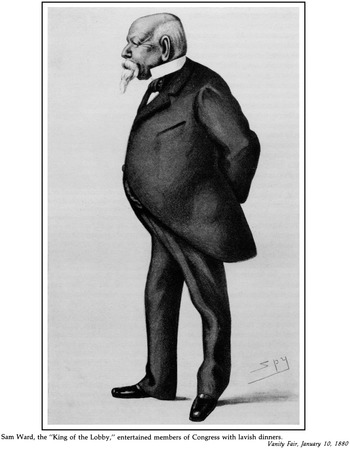
After his visit to England in 1880, the London Vanity Fair ran a glowing article about Sam Ward, complete with a caricature by “Spy.” Dubbed “the Prince of good livers,” Ward was described as a man who “often controlled legislation and decided the fate of important measures.” Vanity Fair, January 10, 1880.

The Barlow and Garfield papers and those of other Washington insiders reveal that the list of Ward's domestic clients included insurance and telegraph companies, steamship and railroad lines, and banking, mining, and manufacturing interests, whereas his foreign clients were involved in shipping, finance, and mines and railroads in the American West and Central and South America. For all of them, he put his knowledge of the federal bureaucracy, his friendships with key players of both parties, his divining of officials' preferences—who would enjoy a case of red wine and who white—and his dinners to work to slide certain bills through Congress and sidetrack others.
There was another source that I had hoped might yield material about Ward, and that was his descendants. I tracked down several of them, but, sadly, they confirmed that they knew of no cache of Ward papers still in private hands. Sam Ward lives on in the family not through letters but through lore in which he is remembered as a charming spendthrift and through namesakes, artifacts, and lovely photographs. Although none inherited his papers, all two dozen of his great-great-grandsons, -granddaughters, -nieces, and -nephews whom I met have inherited Ward's graciousness and generosity. They shared the stories they know, the objects they treasure, and, best of all, their enthusiasm and encouragement for this project.
Sam Ward's relatives were surprised to learn how widely his death was broadcast and with what fondness he was eulogized. Within days of his passing on May 19, 1884, on the Riviera (fleeing creditors once again at seventy years old, he had bobbed up first in London, then in Italy), obituaries appeared in a dozen newspapers. The Times of London, the London Saturday Review, the New York Tribune, New York Sun, New York Commercial Advertiser, New York World, New York Herald, plus newspapers in Washington, Boston, and Chicago, ran stories with headlines that read, “A Famous Lobbyist Dead,” “Sam Ward—Exit,” and, from the National Police Gazette, “Sam Ward's Career: His Adventures as a Lobbyist, Philosopher, Speculator, and Lover.” The New York Times's obituary filled two columns with more than 4,000 words.Footnote 35
In its obituary, the Tribune spelled out nicely what I have come to see as Sam Ward's most significant contribution to the lobby. His
greatest achievement was establishing himself in Washington at the head of a profession which, from the lowest depths of disrepute, he raised almost to the dignity of a gentlemanly business. . . . He never resorted to vulgar bribery; he excelled rather in composing the enmities and cementing the rickety friendships which play so large a part in political affairs, and he tempted men not with the purse, but with banquets, graced by vivacious company, and the conversation of wits and people of the world.
Sam Ward was not the first lobbyist. Before the Capitol's lobbies were finished, indeed before the federal government even moved to Washington, special interest groups—shipwrights, merchants, veterans—began lining up to exercise their First Amendment right to petition the government for redress of grievances.
Sam Ward didn't invent what, by the time he died, the press had begun to call the social lobby: In March 1790, crusty Pennsylvania senator William Maclay had groused in his diary about the New York merchants who plied his colleagues with “treats, dinners, attentions” in an effort to delay passage of a tariff bill.Footnote 36 However, Sam Ward perfected it and reigned as its king for a decade. No one had ever before used canvas-back ducks and Maryland terrapin, fine wines and savoir faire to lobby as systematically, with as much forethought, or to better effect than he. As several other obituaries noted, he never used dirty tricks or bribery or blackmail to win his ends. He used dinners and conversation. Carefully crafted evenings where, as he said, his guests went home pleased with themselves and each other were Sam's supremely effective lobbying tactics.
The Tribune also concluded of Sam Ward, “What a puzzle . . . was this universal favorite, whom the sternest moralist could not find it in his heart to dislike, and the boldest lobby agent could yet call his comrade…!” I've read a great deal by and about Ward and his family, friends, colleagues, and clients, but pieces of his story are still missing or askew.
I had wanted to write a biography of the King of the Lobby to better understand the personal side of Sam Ward and, by extension, the lives of the men and women who peopled the capital and the Capitol that Twain and Warner lampooned in The Gilded Age. In many ways, thanks to those letters and diaries that I was eager to track down, I do. I know, for example, what they wore when Ward arrived in 1859: Upper-class women's dresses were low-cut and featured small hoops and yards of gauze and illusion garlanded with roses, clematis, and violets, whereas for their male counterparts, black swallowtail evening dress formed the background for spectacular colored vests of satin, velvet, and brocade and a coordinated silk cravat. I know what they ate after the war that had rarely graced tables before it: lettuce, thanks to improvements in refrigeration; bananas, thanks to faster ships; and loftier layer cakes and softer bread, thanks to reliable baking powder, commercially available yeast, white flour, and refined sugar.
More important, I learned from many deeply personal sources a great deal about the language of grief, the depth of men's mourning, and the camaraderie forged among men who had lost loved ones, about the many shades of relationships between fathers and sons and sisters and brothers, the power of friendship, the joys of a happy marriage and the bitterness of one that has soured, as they relate to Sam Ward specifically and to his peers generally, just as I hoped I would. Still, it is exactly aspects of the personal that still puzzle me about Sam Ward. I keep coming back to questions about his personal life, and there are no sources to give me answers. His relationships with his children, with his second wife, with posterity, and with the lobby are examples.
When news of Ward's engagement to Medora Grymes reached their summer estate where Louisa Ward and five-year-old Maddie were visiting, the Astors had Louisa shown to the door. They demanded custody of Maddie, and Ward acquiesced.Footnote 37 If he or his three sisters, who had doted on their little niece, ever wrote a word about his decision to relinquish his daughter, I have not found it.
The Astors were an extraordinarily powerful family: John Jacob Astor, its gouty patriarch, was the richest man in America. Ward, who knew well that money opened doors, would not have wanted to jeopardize Maddie's inheritance, and he probably never dreamed how little contact with her the Astors would permit. Still, his decision to give up his daughter, seemingly without a fight, troubles me. With the prospect before him of lighting up New York society once again with a gorgeous new wife, might a little daughter from his first marriage have seemed like an encumbrance? Perhaps Medora wasn't eager to be stepmother to a child who was a constant reminder of her dead mother and urged her husband to start fresh? I've found no hints anywhere, but somehow Ward's later letters to Julia in which he complained about his grown daughter's indifference ring hollow for me. Maybe she felt he had abandoned her; maybe she had good reason to feel that way.
In June 1864, while scanning the obituaries in the New York World, Ward was stunned to read: “Ward—On May the 26th, at Luxembourg, John Randolph Ward, son of Medora Ward and grandson of the late John Randolph Grymes of Louisiana.” His youngest son had been dead for two weeks, and his wife, who had been living in Europe with her mother footing the bills, had not wired him.Footnote 38 Ward's sons, Samuel (Wardie) and Randolph, had been studying mining in Luxembourg, and he was paying their expenses. He went to Europe often. Did he attempt to visit them? How hard did he try, if at all, to remain a part of their lives? He almost never mentioned them in his letters.
Ward hadn't seen Medora for several years prior to Randolph's death, although he heard reports of her hedonistic life on the Riviera. Two years after Randolph's death, Wardie died in Paris, and shortly after that, in 1867, Medora died in Europe as well. Ward made no reference to either of these losses. He and Medora were married to the end. If either contemplated divorce, which was far from common in the 1860s, they left no record. Had he been holding out hope for a reconciliation? Had Medora decided that being an adulteress was better than being a divorcée? Why did Ward not remarry after her death? He was only fifty-three. Although he flirted with his nieces' friends, there is no suggestion that he ever fell in love again.
Ward's two brothers, his two wives, his three sons including his namesake, and his daughter (who left behind ten young children) all predeceased him. While his sisters had a dozen children—Howes, Crawfords, Terrys, and Mailliards—among them, there wouldn't be another Samuel Ward or any more Wards at all from their branch of the family tree. Did it grieve him, the fourth Samuel Ward in as many generations, to know that there wouldn't be a fifth? If it did, he never shared this sorrow with Longfellow or his sisters, with whom he shared so many others.
When I give talks about Sam Ward, my fondness for him, possible shortcomings and all, is clear. So at first I was taken aback by how intensely some audience members, who had never heard of him before, disliked him. How could anyone like a lobbyist? All lobbyists, their reasoning goes, echoing those journalists in the Gilded Age who lumped them all together and condemned the whole heap, are and have always been a pox on the body politic.
When I began this project, I harbored some of these same sweeping prejudices about lobbying in the Gilded Age and now. Thanks to the work of many historians and political scientists, I have finished it with a more nuanced view of and a greater respect for the lobby's function and place in the political system. I grasped the potential of the lobby in the years after the Civil War to perform useful services, such as unclogging logjams in a Congress overwhelmed by an explosion of legislation, with an effectiveness no other entity could match.Footnote 39
I know now that, although railroad lobbyists were buying up the votes of congressmen, the war and Reconstruction schooled reformers in the uses of federal power to effect social change. Spokesmen—lobbyists—for all types of causes flocked to Washington to plead their cases before the government's new agencies, committees, and departments. People lobbied for well-connected businesses, to be sure, but also for the poor and the sick, for criminals, for temperance and education, for civil service reform, for the abolition of capital punishment, for civil rights for African Americans, for justice for American Indians, for votes for women, and for fair treatment of labor.
As the Supreme Court's Citizens United decision in 2010 unleashed a tidal wave of money and lobbyists on Washington, I again saw the potential within both of these for abuse. I have learned that tinkering with the lobby, whether in the 1870s or the 2010s, is a tricky business. Effective lobbyist registration, control of the social lobby (Sam Ward no doubt rolled over in his grave when the 1995 Lobbying Disclosure Act forbid congressmen and their aides from accepting free meals from lobbyists), and greater transparency are difficult to achieve without throwing the baby out with the dirty bath water. Despite diverse efforts at reform, as the Jack Abramoff investigation made clear, a few lobbyists will still find members of Congress who rise to the bait of golfing trips to Scotland and sky boxes at sporting events.
Although this is my “take away” about the lobby, what I really want to know more about is what Sam Ward thought about his profession, about other lobbyists, and about the waves of scandals washing over Washington while he was active there. His eloquent defense of lobbying before the House Ways and Means Committee was a rare instance of reflection on his part. If he and Barlow or others ever discussed the merits and faults of the lobby, it must have been face to face, perhaps with a bottle of good Burgundy, and not in writing. He wrote almost nothing, for example, about the Credit Mobilier scandal that rocked Washington in 1872, even though his friends Garfield, Blaine, and Schulyer Colfax were caught up in the mess. I am sure that Ward knew the era's other prominent lobbyists such as William Chandler and Grenville Dodge; at times all three men worked for the same railroads. Did he respect them, have a drink with them at John Chamberlain's bar? He wrote barely a word about them, and they wrote nothing about him.
That Sam Ward was stingy with his words—at least in the surviving record—when it came to fitting some of the pieces of his puzzle into place was and is frustrating. He was generous in so many other ways. Whenever he had money, he sent casks of olive oil, bushels of oysters, wheels of cheese, boxes of cigars, baskets of peaches, and cases of wine to family, friends, and near-strangers. With his final fortune, he paid off the mortgage on the California ranch of his sister Annie Mailliard and bought Julia Ward Howe a house in Boston.
He has given me gifts, too: new perspectives on the lobby and the Gilded Age, new acquaintances, and new adventures. When we first met, for example, Sam Ward's great-great-niece Julia Terry pulled out a little sack, shook into my palm the dazzling five-carat sapphire and diamond ring that he brought back from Paraguay and wore for the rest of his life, and urged me to wear it through lunch.
Another adventure, one that Ward, who aspired to be a diplomat, surely would have enjoyed involved his signature cocktail, a “Sam Ward”—cracked ice, a thin peel of lemon, and yellow, not green, Chartreuse. Plans to serve Sam Wards at the book launch were fading after I learned the cost of Chartreuse, until a wine-writer friend located a young man whose title is “American ambassador of Chartreuse” and whose job is hosting “Chartreuse nights” at up-scale bars around the country. I met the “ambassador” at a Boston bar, turned over a copy of the book, and got three bottles of Chartreuse in return!
Sam Ward also introduced me to the tantalizing mystery surrounding “The Diary of a Public Man,” the anonymous diary entries purportedly written during the winter of 1860–61 and published in the North American Review in 1879. Contemporaries had scoured every sentence for clues to the author's identity, and several historians had tried to solve the puzzle. In 1948, one of them, Frank Maloy Anderson, revealed the man he was certain was the author: Sam Ward.Footnote 40
Ward met many of Anderson's criteria—he loved subterfuge, for example. Still for a variety of reasons, I was certain that he was not “the Public Man.” What I was not certain about was how to deal with “the Public Man” in the book, but then a serendipitous e-mail arrived from historian Daniel Crofts at the College of New Jersey. Crofts, on his own mission to unmask “the Public Man,” was also certain that Ward was not the author of these entries, which he believes are actually a clever, after-the-fact construct. Our correspondence, as we shared ideas and sources, enriched us both. In A Secession Crisis Enigma: William Henry Hurlbert and “The Diary of a Public Man,” Crofts argues that “the Public Man” was not Sam Ward, although he may have been in on the hoax, but his brilliant and erratic friend Hurlbert. I feel that Ward, who craved attention all his life, would be delighted to have his name bandied about in not one but two new books.Footnote 41
Difficult as he made it to know him when he instructed his sister to destroy his papers, Ward's best gift to me was himself. The main challenge was to find a path around the ashes of his personal papers and through the manuscript collections and memoirs of the large cast of characters with whom he interacted. Eventually his checkered life and times yielded ample grist for my first biography and a great deal more. I now know, for example, the difference between service à la russe and service à l'américaine, that my favorite Longfellow poem is “Paul Revere's Ride,” and that Chartreuse, made by Carthusian monks in the French Alps since the mid-1700s, is an acquired taste.Footnote 42
I have not yet acquired a taste for Chartreuse or for Sam Wards (the cocktail), but, just as I had hoped, I have never tired of the real Sam Ward. The journey in search of his life and times has been as delicious as his famous dinners, made all the sweeter by the letter-writing family, friends, clients, and guests who peopled his seventy years and the lobby, evolving along with the Congress and the expanding nation, over which he reigned.