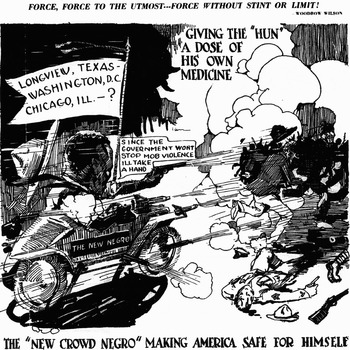
The exuberance of postwar New York was infectious. With returning soldiers parading through mid-town streets, the city was alive with the wild cheers of those who turned out to welcome them home.Footnote 1 The energy that suffused Manhattan made its way uptown to Harlem as well. The enthusiastic reception that African Americans gave to returning black soldiers, however, was especially charged with a new determination to push for equal justice here at home. Having fought for democracy abroad, they reasoned that it was now time to see the principles of freedom and democracy—the principles used to justify the Great War—fully implemented in the United States.Footnote 2 This resolve to challenge racism and discrimination with renewed vigor was a core feature of the militant new spirit that African Americans exhibited in the postwar years.Footnote 3 Writing for The Messenger, a radical journal that styled itself as “the only magazine of scientific radicalism in the world published by Negroes,” co-founder A. Philip Randolph insisted that this focus of what he called New Crowd Negroes to pursue economic, political, and social freedom would only grow and become “more articulate, aggressive, and bold from year to year.”Footnote 4 As the Harlem Renaissance flourished in the years between the end of World War I and the onset of the Great Depression, African American intellectuals, artists, and radicals of all stripes helped to give a potent new voice to African Americans' aspirations of equality and bear out Randolph's prediction in dramatic ways.Footnote 5
Randolph's The Messenger applauds New Negro militancy in the aftermath of World War I. The Messenger, Sept. 1919.

Generally speaking, the literature on the New Negro follows one of two lines of thought. The first concentrates on the New Negro's association with the racial militancy of the Harlem Renaissance, sometimes dividing the movement between “cultural New Negroes” who sought to enlist the sympathies of whites through artistic expression and “New Negro radicals” who set out to modify American society through interracial class cooperation.Footnote 6 The second point of view on the New Negro is linked to the small, but significant, African American professional/entrepreneurial class that emerged in northern cities in the war years. These New Negroes focused on cultivating the growing political and economic strength of black communities to demand greater recognition of their right to participate in urban society on a more equal basis.Footnote 7 Both interpretations offer meaningful insights into the cultural, political, and social dynamics of emerging African American communities in the urban North during the war years and beyond. However, neither view comfortably accommodates the position of key African American radicals like A. Philip Randolph, noted socialist and organizer of the Brotherhood of Sleeping Car Porters (BSCP), or Frank R. Crosswaith, a general organizer for the International Ladies' Garment Workers' Union (ILGWU) and one-time Messenger correspondent.
Following the war Randolph and Crosswaith began to devise a distinct conception of social justice focused on ensuring the equal right of all individuals, regardless of race, to benefit from society's advances. Arguing that genuine social justice was predicated on a kind of open participation by all, they fashioned a program of reform that drew on black racial identity to frame their vision of class-consciousness. They adopted an egalitarianism that, in some ways, paralleled the points of view outlined by contemporaries like W. E. B. Du Bois, Charles S. Johnson, and Alain Locke. This outlook sought to mobilize the cultural production of Harlem in the 1920s in defense of African American humanity.Footnote 8 Rather than searching for proof of black humanity in African American arts and letters or emphasizing African Americans' unique cultural contributions, Randolph and Crosswaith insisted that all people were equally entitled to benefit from the advances of modern society because “the contributions of all the so-called races” made such progress possible.Footnote 9 They certainly shared a common interest with Du Bois, Johnson, and Locke in fostering greater equality for African Americans, but they looked to construct a framework of race- and class-consciousness rooted in egalitarian terms to bring about such social change.
Their conception of social justice also differed markedly from that of other New Negro radicals like Hubert Harrison, Richard B. Moore, or Cyril Briggs. Like most socialists, Randolph and Crosswaith came to view the transformation of industrial capitalism and inter-racial class cooperation as integral steps for promoting economic and social justice.Footnote 10 However, rather than grounding their critique of industrial capitalism in a conventional theory of “producers' rights,”Footnote 11 Randolph and Crosswaith framed their assessment in terms that emphasized the incompatibility of capitalist competition with the kind of democratic openness they viewed as central to genuine social justice. This key difference in the basic premise underlying their critique of industrial capitalism not only underscores the need for a more nuanced understanding of the New Negro that accounts for Randolph and Crosswaith's point of view, but also makes clear that, although generally shaped by contemporary socialism, their notions of social justice developed to a significant degree from independent roots.
Randolph and Crosswaith's conception of social justice not only distinguished them from the energetic cohort of African American intellectuals and radicals in and around Harlem in the 1920s, but also challenges one of the core criticisms of black intellectuals raised by Harold Cruse in his book, The Crisis of the Negro Intellectual (1967). In his stinging appraisal of the pan-Africanists and black power theorists of the 1960s, Cruse lamented the lack of a black intellectual tradition that recognized and effectively understood the vital role of indigenous political, economic, and cultural institutions in developing a forceful alternative to the racist mainstream. Since the nineteenth century, he insisted, African American assimilationists had largely fallen prey to the domination and manipulation of paternalistic whites, while black separatists mostly eschewed electoral politics and allowed the political parties of the racist status quo to go unchallenged. As a result, he concluded, African Americans failed to develop a “functional corps of intellectuals able to confront and deal perceptively with American realities on a level that social conditions demand.”Footnote 12
The egalitarian emphasis at the core of Randolph and Crosswaith's criticisms of industrial capitalism directly challenges Cruse's essential assertion that black intellectuals of the 1920s and 1930s failed to devise genuinely independent programs for change that authentically represented the needs and interests of African Americans. Despite their glaring lack of success in selling socialism to African Americans, Randolph and Crosswaith nonetheless articulated a program of reform that drew on black racial identity to frame their vision of class-consciousness for black workers.Footnote 13 By stressing an egalitarian rationale for challenging industrial capitalism rather than the conventional class critique put forward by most socialists of the period, they gave voice to an independent strain of black radicalism in the war years that was not intellectually beholden to whites. Reexamining their views in this light not only gives new shape and dimension to the New Negro movement that followed the war, but it also suggests new lines of inquiry into the evolution of black radicalism in the interwar years.
—————
In 1925 Frank R. Crosswaith, chairman of the Harlem Labor Committee and a general organizer for the ILGWU, emphatically declared that the New Negro was a union worker. In a circular titled “To the Negro Members of the I.L.G.W.U.,” he explained that generations of African Americans had fallen victim to all manner of industrial discrimination and social injustice but the New Negro was both proud of his race and its achievements and learning to “stand together with his fellow white workers” to protect and advance their common class interests. This new race- and class-consciousness, Crosswaith continued, meant that the days of Negroes falling prey to every “vulgar barker selling poison to weaken” his fight for complete equality and justice were over. The New Negro, intelligent and on guard against every form of exploitation, was race-conscious, willing to stand with white workers to protect mutual class interests, and here to stay.Footnote 14
In asserting a fundamental connection between African American equality and economic justice for the working class, Crosswaith's appeal to African American garment workers represented a substantially new and different approach to the problem of social justice. Harlem radicals like Harrison, Moore, and Briggs had certainly argued that economic exploitation was central to the kind of discrimination that plagued African Americans.Footnote 15 However, in the postwar years Randolph and Crosswaith began to highlight the twin concepts of race- and class-consciousness in arguing that New Negroes should stand “ready and willing” to fight for the rights that were the “just and rightful heritage of all.” Under no circumstances should African Americans “compromise, surrender, or retreat” from racial discrimination but instead should “with iron will and inflexible determination” pursue the full measure of their civil rights.Footnote 16 Even as they promoted socialism and class solidarity, then, Randolph and Crosswaith also worked to define a new kind of dual consciousness located within a more egalitarian notion of basic social justice.
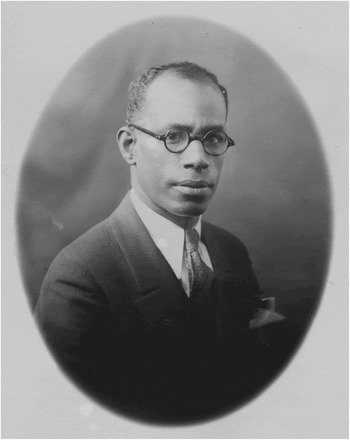
Frank R. Crosswaith, ca. 1915. Courtesy of Photographs and Prints Division, Schomburg Center for Research in Black Culture, The New York Public Library, Astor, Lenox, and Tilden Foundation.

Born on the isle of St. Croix in the Virgin Islands in July 1892, Frank R. Crosswaith bore the deep imprint of class that came to characterize his subsequent labor activism from a very early age. The mixed-race son of a painter and a cook, he immigrated to the United States in 1907 and was immediately struck by two realizations that “more than any others” shaped his future course.Footnote 17 In reflecting back, Crosswaith remembered that one of his first thoughts upon arriving in Harlem was that “the Negro race . . . was utterly unaware of the economic nature of its problems.” This lack of awareness, he suspected, led the average Negro to believe that the only way to win his “rightful place” in the world was to beg. Determined to throw off this subservient mien, Crosswaith came to a second key insight: even as a boy, he recalled, “I had long been convinced . . . that no group could ever win its rights anywhere in the world by merely begging for those rights.” His later efforts to push black workers toward industrial unionism reflected his firm conviction that only the “cooperative thinking and cooperative acting” of organized labor could “correct the age-long injustice to the non-white peoples of the world.”Footnote 18
After some years in the Navy, Crosswaith “shed the uniform of an American sailor” and began taking classes at the Rand School of Social Science. Founded in 1916 by the Socialist Party, the Rand School trained workers in economics, politics, and labor union tactics and ultimately put him in contact with some of New York City's most prominent socialist intellectuals. Like Randolph, Chandler Owen, and other African Americans associated with the Rand School in the war years, Crosswaith strengthened his early class sensibilities with course work and through interaction with socialists like Scott Nearing, Max Eastman, and Norman Thomas. He emerged from this instruction ever more convinced that if the New Negro was “to successfully fight for his rights, his place must be alongside his brother whose skin may be white but whose economic needs are exactly those of the Negro.”Footnote 19
Though it is not exactly clear how or when Randolph and Crosswaith first met, their paths most certainly crossed in the years leading up to America's entry into the war. After Randolph began publishing The Messenger in 1917, the Rand School approached him and his partner, Chandler Owen, about presenting a lecture series titled “The Economics and Sociology of the Negro Problem.”Footnote 20 Around this time, Crosswaith finished his course work and joined the Rand School faculty as a lecturer. It is not clear whether or not Crosswaith attended any of Randolph's lectures, but their respective teaching positions certainly would have presented an opportune moment for an introduction. Moreover, both Randolph and Crosswaith were active participants in the public lecture circuit that surrounded Harlem's street corners in these years.Footnote 21 As Crosswaith fondly recollected, he spent many nights “speaking on the street corner . . . together with A. Philip Randolph and others” on subjects like “the economic life-line of the New Negro.”Footnote 22 However their acquaintance began—whether through the Rand School, on a Harlem street corner, or some other occasion—their relationship took shape out of a shared belief that economic exploitation and racial discrimination were twin aspects of the Negro Problem.
In the years that followed, Randolph and Crosswaith's relationship deepened. Crosswaith was one of the first correspondents to join Randolph and Owen on The Messenger's staff. When Randolph undertook organizing black Pullman porters into the Brotherhood of Sleeping Car Porters in 1925, Crosswaith joined his staff and became a leading organizer for the union. In his account of those years, Crosswaith recalled throwing himself into “the porters' fight with remarkable recklessness and unselfish devotion.” Though he ultimately resigned his position with the brotherhood in the spring of 1928 over a financial dispute with some members of the union's executive board, Randolph remained one of his most ardent supporters.Footnote 23 Even while working for the ILGWU, Crosswaith continued to support the porters' cause avidly and wrote numerous commentaries lauding Randolph's efforts. When the Negro Labor Committee (NLC) was formed in 1935, Randolph nominated Crosswaith to serve as the group's first president. The NLC worked to promote trade unionism in Harlem and assisted with local union activities for a variety of groups like the ILGWU. In a letter soliciting funds to support the NLC's organizing work, Randolph wrote that in the “paramount objective” of settling “the many problems confronting inter-racial relationships for the advancement of organized labor as well as furthering Democracy for Americans,” he could think of no better leader than Frank R. Crosswaith.Footnote 24 In a September 1939 letter to New York City mayor Fiorello LaGuardia, with whom Randolph had worked closely through the years, he wholeheartedly endorsed Crosswaith's nomination for New York City Council. He made clear that he thought Crosswaith would be a “worthy and valuable asset” to the council. Randolph confidently stated his belief that Crosswaith would serve “the cause of good government with honor, intelligence, and devotion” and “reflect credit upon the Negro people in particular and the citizens of New York in general.”Footnote 25 Despite this strong endorsement, Crosswaith's bid for a city council seat failed. However, he and Randolph remained close friends and colleagues until Crosswaith's death in June 1965.Footnote 26
The close personal and professional relationship that Randolph and Crosswaith shared was also reflected in a synchronicity of their views of the New Negro and social justice. Both accepted the standard socialist proposition that “economic justice is at the basis of social and political equality,” but over the span of twenty years they both also devoted considerable energy to constructing a dual framework of race- and class-consciousness that addressed the particular challenges that confronted black workers. The basic contours of their views took shape in The Messenger where in essays like Randolph's “A New Crowd—A New Negro,” published in the May–June 1919 issue, they demanded “complete social, economic, and political justice” and pushed African Americans to join with white radicals to build an open, color-blind democratic society.Footnote 27 This sentiment also shaped Crosswaith's Harlem Labor Committee and Trade Union Committee for Organizing Negro Workers that worked to unionize barbers, laundry workers, and elevator operators in Harlem. Both groups carried the message of race-consciousness and interracial class cooperation through the early 1920s and pushed trade unionism as an effective means for achieving equal rights. The Brotherhood of Sleeping Car Porters and the campaign to organize Pullman porters extended this effort. As Crosswaith argued in a 1936 article for the Black Worker, the official organ of the BSCP, the Brotherhood's fight not only represented “a group of workers seeking to organize as a necessary first step to a higher standard of wages and work conditions, but a fight involving the manhood, womanhood and self respect of the Negro group.”Footnote 28
Their organizing efforts in these years reflected a shared understanding of the race/class dialectic confronting black workers and the problem of social justice that set them apart from other radicals, reformers, and civil rights proponents of their day. Through speeches and the pages of The Messenger, Randolph and Crosswaith drew upon a broadly constructed vision of social justice to define the New Negro and channel the rising tide of postwar racial militancy among African Americans toward industrial reform.Footnote 29 Like most other black socialists, they certainly believed that African Americans' ultimate emancipation would require the wholesale overthrow of industrial capitalism. This view, however, did not blind them to the special problems caused by racial discrimination. Throughout the postwar years they steadfastly argued that the fruits of modern society rightfully belonged to all and worked to define the New Crowd Negro in terms that linked African Americans' intensifying postwar militancy to the growing labor radicalism of the period. In so doing, they hoped to transform New Negroes into even more “effective soldiers in the great army of all races” fighting for social justice.Footnote 30
—————
Their determined effort to connect New Negro militancy to labor radicalism also largely reflected their unconventional vision of social justice. In the face of the widespread appeal of Marcus Garvey's Universal Negro Improvement Association (UNIA) and his message of racial separation,Footnote 31 Randolph and Crosswaith vigorously argued that the “absolute and unequivocal social equality” that New Negroes wanted would only come from a just society “composed of social equals.” They repeatedly argued that racial distinction, be it discrimination in organized labor or Black Zionism—a term Randolph used in The Messenger to describe Garveyites in particular—cut against the fundamental humanity that all people shared.Footnote 32 They encouraged New Negroes to settle for nothing less than the “full product” of their toil and discard “political promissory notes” that ignored African Americans' broad social and political interests.Footnote 33 While other Harlem radicals moved toward a more race-first point of view in the postwar years,Footnote 34 Randolph and Crosswaith maintained that New Negroes should persistently demand social and political equality and universal suffrage. In holding this line against the racial chauvinism that shaped the views of a growing number of African Americans in the 1920s, Randolph and Crosswaith focused on a dual awareness of race and class to emphasize a vision of social justice rooted in the shared humanity of all races of people.
Their emphasis on the shared humanity of mankind became even more prominent as their efforts to sell socialism in Harlem increasingly lost out to Garvey's strong appeal.Footnote 35 Even as Randolph focused more and more on the fundamental connection between social justice and industrial change, he realized that most of the “black audiences who came out to listen to The Messenger editors and other black radical speakers were not so much concerned about the exposition of Marxist and socialist thought as they were in listening to the attacks by the speakers on conservative advocates.” Citing the basic political, social, and economic conservatism of black workers as a key roadblock to the development of a dynamic mass movement of black socialists, he conceded that most African Americans in Harlem were far more interested in “seeing and listening to a black radical” than they were in “becoming involved in such a militant movement.”Footnote 36 By stressing an egalitarian conception of social justice, Randolph and Crosswaith hoped to broaden the appeal of class-consciousness and industrial reform especially among black workers suspicious of white labor unions.Footnote 37
Undaunted by the large crowds drawn to Garvey and UNIA, Randolph and Crosswaith continued to construct their vision of the future around a conception of the New Negro as “ever conscious” of his vital mission to liberate his people in particular and the human race in general.Footnote 38 Whereas Debs and other socialists were pushing labor solidarity to encourage the development of the cooperative commonwealth, Randolph and Crosswaith maintained that African Americans should join in transforming industrial society to encourage a “new society . . . of equals without class, race, caste, or religious distinction.”Footnote 39 They certainly accepted the proposition that racial discrimination was a distinct feature of the economic exploitation intrinsic to industrial capitalism.Footnote 40 However, they also recognized that class-consciousness alone was insufficient for African Americans to attain the “stature of a full man, a free race, and a new world” free from the “fatal, insidious inferiority complex of the present” that worked to arrest the progress of the New Negro manhood movement.Footnote 41 African Americans, they determined, needed to understand clearly the particular ways that racial discrimination operated in modern American industrial society. By linking social justice and industrial change to a distinctly race-conscious appeal to New Negroes, Randolph and Crosswaith hoped to redirect some of the militant momentum coursing through postwar Harlem toward socialism.
Randolph and Crosswaith's assessment of socialism's radical potential to counter racial discrimination aligned closely with the basic position that Eugene Debs took on race and the Socialist Party. Despite the clear racial animosity that both leaders and rank-and-file members openly expressed from the party's inception, Debs recognized and strongly argued that racism and racial discrimination fundamentally violated the party's core principles and mission. Though he was equally susceptible to the kind of personal failings on race that he so forthrightly criticized in others, Debs insisted that economic freedom and political equality went hand-in-hand.Footnote 42 This reasoning fit with the sense of open participation at the center of Randolph and Crosswaith's notion of social justice. Even as Socialist Party leaders and rank-and-file members continued to exhibit deep racial hostility, Debs's position on economic justice and racial equality largely matched key aspects of Randolph and Crosswaith's appraisal of African Americans' plight.
This link between industrial reform, freedom from racial oppression, and New Negro militancy that Randolph and Crosswaith wove into a vision of social justice also helped to form the basis of a distinct kind of race- and class-consciousness that they set out to foster in these years. It was exactly this kind of dual-awareness that Crosswaith highlighted in his blistering criticism of African American journalists reporting on black workers and the labor movement. Instead of simply “interpreting to the outside world the life and conduct of this race in terms purely sensational, comical and religio-fanatical,” he challenged black newspapers to take greater notice of the fact that “negro working men and women today in ever encouraging numbers are learning the efficacy and importance of economic organization.” In his view, the growth of union membership among African Americans was a “highly significant phenomenon” to the “millions of our tormented kinsmen in the United States and the world” because it indicated that the “vast army of New Negroes . . . are learning how to rely upon the organized might of their class and race as the way out of our present social and economic Gethsemane.”Footnote 43 In highlighting this kind of dual race- and class-consciousness, Crosswaith further underscored the basic connection between industrial change and social justice that was central to the socialist vision that he and Randolph began to adopt in the 1920s.
In their estimation, social equality rested on the notion that all people regardless of race should be able to participate fully in American life because every segment of society had “contributed its quota of knowledge, experience, and culture to the sum total of what we call civilization.” However, as Crosswaith explained in a Depression-era speech titled “The Negro at the Crossroads,” such conditions of equality could not exist “under our present socio-economic setup.” Capitalism, he argued, ultimately rested upon inequality. As capitalism's maturation promoted the kind of centralization and monopolization that places more and more power in the hands of an ever smaller group, it became evermore “futile and meaningless” to extol principles of equality, democracy, liberty, and other such “myths.” Crosswaith and Randolph asserted that the social justice and equality that New Negroes wanted required a kind of open participation that could not coexist with unrepentant capitalism. They reckoned that the nation could only realize the full measure of “true democracy, liberty, fraternity, and equality” when human rights took precedence over property rights.Footnote 44 Ultimately, Crosswaith and Randolph both concluded that socialism was the most “useful intellectual tool” for fighting for racial justice while “remaining ever mindful of the fact that racial justice is not social justice.” Racial justice simply enabled African Americans to participate in the great moral struggle to secure genuine social justice.Footnote 45
Randolph extended these points in explaining the economic roots of racism and the need to transform industrial capitalism as part of a broader agenda for fostering social justice. In addition to equal access to the social and political fruits of civilization's progress, Randolph went on to explain that genuine social justice required the overthrow of any “profit economy” achieved “at the cost of a lower level of income and social well-being for the majority of the population.” In his view, any economic system that allowed one group to appropriate all or part of what another produced without “equivalent” compensation amounted to “economic injustice.”Footnote 46 In challenging the moral character of the voracious competition at capitalism's core, Randolph contended that socialism was best equipped to address the “course of socio-economic change from capitalism and the basic causes of the present plight of mankind.”Footnote 47 For both Randolph and Crosswaith, then, socialism seemed to be the most likely mechanism for creating the kind of basic equality necessary for fostering genuine social justice.
—————
As Randolph and Crosswaith stepped up their efforts to promote socialism in Harlem in the postwar years, they continued to frame their appeal around an egalitarian conception of social justice and race. Describing the need for greater labor organization among African Americans, Crosswaith posited that it “ought to be plain to all who possess observing eyes” that the day was fast approaching when the injustice “of which the Negro has been the peculiar victim” would “stretch its treacherous hands across lines of class and nationality and so-called race.” He claimed that, like all workers, African Americans faced a particularly critical crossroads. In one direction lay “the beaten path of the status quo” that followed a road “lavishly strewn with the blood and bones of all workers,” but that was especially littered with the “bleached bones and charred bodies of Negroes.” Built on structures of “exploitation, of war, of race prejudice, of lynching, of segregation and disfranchisement,” Crosswaith stated that this was the “path of capitalism with its inherent injustices and inequalities” where “capitalist competition and human exploitation for private gain” held sway. The other path led in the direction of “peaceful cooperation, to social and economic and political equality of all God's children who usefully serve society, regardless of race, creed, or color.” Crosswaith reasoned that because industrial capitalism promoted the kind of economic and social competition that allowed the “exploiters of labor to keep the working class divided” by race and effectively “rob, rule, and exploit both black and white labor,” the clear “logic” of contemporary economic and social development pointed “unerringly to socialism.”Footnote 48
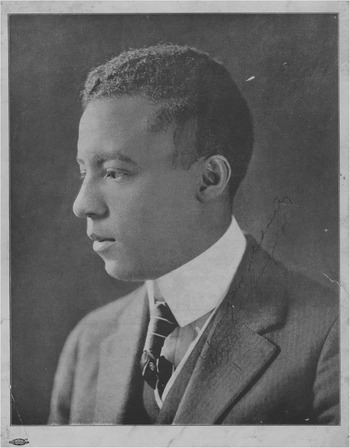
A. Philip Randolph, after his arrival in New York, ca. 1911. Courtesy of Photographs and Prints Division, Schomburg Center for Research in Black Culture, New York Public Library.

The underlying premise of Crosswaith's critique, that the competition intrinsic to capitalism fundamentally undermined basic human dignity and justice, is also central to understanding Randolph's view of socialism. Randolph believed that war, unemployment, and militarism amounted to “unmistakable proof that our present political and economic capitalist order is unable to satisfy the needs of modern man or to keep him from disaster.” He thought the “problem” of industrial capitalism was “organic” in that the system had “never been able to supply sufficient purchasing power to feed itself.” Despite a standard of living higher than that found in Europe, he insisted that the wage scale for American workers had “never been high enough [for them] to consume the products that needed to be consumed in order to keep the productive plant operating.” Moreover, because big business could always “take back most of labor's gains through the manipulation of prices,” industrial capitalism created the conditions by which “one section of the population appropriates a part of the product which others have produced without giving any equivalent exchange.” For Randolph, this “technical defect” associated with insufficient purchasing power endemic to capitalist economic systems was more than economic injustice, it was deliberate economic exploitation.
He felt strongly that industrial organization was key to labor's efforts to secure its “moral right to its share of work” and the “resulting value” it produced. Unionization was also essential to African Americans' struggle for equality. Because wealth was “primarily” the result of the “combination of labor, land, capital, and management,” he concluded that workers could only secure their rights through concerted action according to their economic interests. Moreover, so long as there was no strong labor organization bringing black and white workers together to neutralize capitalist competition, there was little chance of fostering the kind of open participation necessary to bring about genuine social justice for all.Footnote 49 Randolph pointed to the suffrage movement and the struggle over voting rights for women to illustrate the connection between effective organization and expanding democratic participation. He explained that, although women were “entitled to the right to vote years and years before they secured it,” their ability to exercise that right depended on the “practical and scientific functions” of “organizing their forces.” In his view, neither labor nor African Americans could expect to do less if either intended to throw off the exploitation of industrial capitalism and its stifling impact on economic and social justice. It was vitally important, he concluded, for all workers but, especially for African Americans, to understand the “basic principles” that underlined the struggle for freedom against all forms of exploitation.Footnote 50
Having explained the basic flaws of industrial capitalism and the implications for social justice, Randolph went on to argue that the ability to address these problems effectively depended on whether or not the nation could work out a constructive understanding between the “democracy” expressed in the Declaration of Independence and the United States Constitution and the “change in our social and economic system we now need.” He stressed that the inherently competitive nature of industrial capitalism was antithetical to open social, political, and economic participation by all. He warned that the “socio-economic-political debacle” of capitalism fundamentally threatened the participatory nature of the nation's core democratic ideals. “If the democratic forces of the people do not decide . . . who shall control our economic life and to what end,” Randolph cautioned, “the fascist forces inherent in monopoly capitalism and in the nature of the state will.” The only meaningful solution to the shortcomings of capitalism, Randolph argued, was a system of democratic socialism that would “constitute a break with the old political and economic order.” The only hope for realizing genuine social justice was “a socialized economy and a democratized society.”Footnote 51
—————
By the time Randolph and Crosswaith joined the Socialist Party it had lost much of the organizational cohesion of its first years.Footnote 52 Nevertheless, they still viewed it as African Americans' best political option. Portraying the plight of black workers as fundamentally caused by the impact of racial discrimination on their ability to “sell their labor in the market effectively,” they were convinced that the solution to this problem lay in greater labor organization and overhauling industrial capitalism.Footnote 53 They and others maintained that the competition at capitalism's core accentuated the economic roots of racism. The Socialist Party's determination to redress the ills of industrial capitalism and promote unionization led Randolph and Crosswaith to believe that it was central to challenging racial discrimination and fostering the kind of social justice that they envisioned. It was this link between unionization and social justice that propelled them into the Socialist Party and became such a central component of the radical message that they preached in the postwar years.
Founded in 1901, the Socialist Party of America brought together a diverse coalition of left-wing organizations that strongly opposed the rapid advance of industrialization that followed the Civil War. Drawing on previous radical movements like the Grangers, Single-Taxers, and Populists, the core support for the party grew out of “constructivists” elements lead by Victor Berger in Milwaukee and Morris Hillquit in New York, the revivalist tradition of the Dust Bowl states that fused socialist theory with the emotionalism of the camp meeting, the remnants of the industrial American Railway Union organized by Eugene V. Debs, and the western syndicalists of the Industrial Workers of the World (IWW). Initially sharing little but a generally anticapitalistic view of the country's future, representatives of each of these factions arrived at the party's founding convention in Indianapolis, Indiana, with competing ideas of how best to foster the “cooperative commonwealth.” The tensions that resulted from their differing approaches, however, were substantially overshadowed by the convention delegates' abiding faith in the party's eventual triumph over industrial capitalism. In his comprehensive study of the party's founding, David A. Shannon concluded in The Socialist Party of America that it was “this faith in the party's success that is one of the keys to understanding the Socialist Party before the 1920s.”Footnote 54
This synopsis of the optimism surrounding the party's founding certainly can be applied with equal affect to Randolph and Crosswaith's view of the party nearly twenty years later.Footnote 55 Despite the blatant racism of socialist leaders like Victor Berger,Footnote 56 Randolph, for instance, recalled the “delightful” and “extremely serious” party meetings that he attended. He was especially struck by the discussions of the “baneful effects of uncontrolled capitalism upon the working classes and the role of socialism in ushering in the dawn of a new day for the oppressed and disinherited toiling masses.”Footnote 57 Sharing the basic faith in the potential of industrial reform that characterized the party's founding, Randolph was willing to downplay the significant philosophical differences that eroded party unity after 1912 and overlook the clear racial antipathy of many white socialists.Footnote 58 So long as all these factions shared a common criticism of capitalist exploitation, both Randolph and Crosswaith could ignore the significant differences that divided the party. Thus, he commended conservatives like Berger and Hillquit for “steadfastly” holding to principles of individual liberty and a “philosophy of democracy and pluralistic sources of authority and power in the national community”; and he credited the party's left for vigorously challenging the process of “government by injunction” that used “courts to prevent the workers from building their wage structure, reducing hours of work, improving working conditions, and achieving a more abundant life.”Footnote 59 At a time when factional infighting irrevocably damaged the party's national profile, Randolph's near singular focus on industrial capitalism's fundamental inability to “provide for the enjoyment of basic freedoms by all people of the country” led him to find common ground with conservatives on the party's right, western syndicalists on the party's left, and Eugene V. Debs at its moral center.Footnote 60
Crosswaith, too, had an idealized vision of the Socialist Party that largely blinded him to these party fractures. His determination that “the Negro must find his place” in the fight against “modern problems predicated upon a highly mechanized industrial order, concentrated wealth, and intensified class antagonism” overshadowed any misgivings he might have had about entrenched racism in the party.Footnote 61 He, like other black radicals, sincerely believed that, despite the racial views of many prominent socialists, African Americans' ultimate emancipation would come only when the world was rid of the “monstrosity of private ownership for profit in the socially necessary means of life.”Footnote 62 With the “potent” threats of dictatorship, Hitlerism, and “other foes of civilized progress” on the march, African Americans needed to align with other progressive forces to move “out of the shadows of social and economic slavery” and onto the path of “power and pride regained.”Footnote 63
In leading their respective party locals in Milwaukee and New York, Victor Berger and Morris Hillquit both pursued an electoral strategy that sought to build political alliances with local trade unions to win elective office.Footnote 64 Both firmly believed that, without clear evidence of capitalism's imminent demise, the basic mission of the Socialist Party should be winning over workers to socialism's cause and ensuring that all workers were conscious of their class interests. Consequently, Berger set out to ameliorate the harsh conditions of the shop floor by pushing progressive reforms to address the daily concerns of workers, whereas Hillquit wanted to transform industrial capitalism by gradually implementing social and economic reform through political action. Although Berger was more supportive of the American Federation of Labor (AFL) than Hillquit, both agreed that the party's main objectives could be best achieved by working within the AFL rather than supporting dual unionism and the IWW. Ultimately Berger and Hillquit both believed that gradual improvements in work conditions on the shop floor and progressive reforms were preferable to the unchecked hegemony of industrial capitalism.Footnote 65
For Randolph, Crosswaith, and the small group of African Americans recruited into the New York Socialist Party's Twenty-first Assembly District in Harlem,Footnote 66 this commitment to progressive reform and political mobilization was attractive. Randolph and Crosswaith in particular recognized the significant, if unintended, implications embedded in this electoral strategy for African Americans “seeking human status and full freedom.”Footnote 67 The participatory nature inherent in drawing workers into local and regional politics fit neatly with their conception of social justice. As Crosswaith explained years later in reflecting back on his role in building interracial trade unions, he and Randolph understood that “the nation's labor could not exist half-slave and half-free.” They looked to mobilization and interracial labor solidarity to promote the kind of industrial democracy that would ensure an “equality of responsibility and equality of benefits” for all workers.Footnote 68 In fact, their willingness to turn a blind eye to clear racial antipathy in the party seemed largely predicated on the argument that African Americans could only “become a power to be feared and respected throughout this nation” by joining the Socialist Party.Footnote 69 Their belief that the party's emphasis on social and economic reform could be turned to the specific advantage of African Americans certainly seemed to have factored into Randolph's decisions to accept the party's nomination to run for New York state comptroller in 1920 and secretary of the state assembly in 1921. Even if Berger and Hillquit never really intended to engage an agenda of social justice for African Americans, Randolph and Crosswaith nonetheless found meaningful resonance between the reform strategies they promoted and the conception of social justice he and Crosswaith were formulating.
Randolph also found common cause with the syndicalist element of the Socialist Party concentrated in the mining and lumber states of the Mountain West. Primarily organized around William “Big Bill” Haywood's Western Federation of Miners that gave rise to the IWW in 1905, this wing of the party endorsed industrial sabotage and violence as acceptable protest tactics and believed that workers should use the ballot to gain administrative control over government's police powers to protect striking workers.Footnote 70 They adamantly opposed any program of progressive reform on the grounds that it merely forestalled the inevitable workers revolution. Instead, Haywood and the IWW pushed for a general strike to reorganize society around factories, mines, and other places of production.Footnote 71 Haywood was an especially strong advocate of industrial unionism. Focusing almost exclusively on labor's immediate demands, he looked to organize all workers into one vast and well-disciplined labor organization with enough political power to successfully challenge their opponents. Most importantly perhaps for Randolph, Haywood and the IWW attacked all divisions of the working class—racial, religious, and ethnic—as detrimental to the cause of overthrowing of industrial capitalism.Footnote 72 This decidedly inclusive organizational policy fit neatly with Randolph and Crosswaith's conception of social justice and their determination to bring African Americans into the working-class fold.
Largely personifying the Socialist Party for more than twenty-five years, Eugene V. Debs stood squarely at the party's moral center.Footnote 73 Like Berger, Hillquit, and other party conservatives, Debs opposed dual unionism on the grounds that it created internecine competition that undermined working-class political power. Debs, however, also a member of the IWW through 1913, adamantly opposed the craft-oriented character of the AFL and exhibited a deep commitment to radically opposing industrial capitalism that aligned him to a large degree with the party's left. He was convinced that industrial capitalism as directed by ever-growing corporations like Standard Oil and U.S. Steel was a fundamental threat to the core values of industry, diligence, frugality, and sobriety that comprised the old Protestant ethic.Footnote 74 It was this sort of assessment of capitalism's perils that shaped Debs's evolving view of the essential meanings of manhood, community, and justice.Footnote 75 Increasingly he articulated a view of a free labor economic system that stressed both individual mobility and political activism and drew heavily on the free agency theology of evangelical Protestantism to bolster his assertion of a paramount need for workers to unite to protect their rights as citizen.Footnote 76
Debs's sincerity and moral conviction struck Randolph in an especially profound way. In fact, Randolph ultimately listed Debs, along with his father James Randolph, as one of the people who “most influenced me during my career.”Footnote 77 As Randolph indicated, he came to admire Debs “greatly” for his “great spiritual” leadership of the Socialist Party.Footnote 78 Debs's moral convictions about the essence of social and economic justice created a context for Randolph and Crosswaith to view the party as a crucial agent in pursuing genuine social justice for African Americans. Like Debs, Randolph and Crosswaith ultimately came to see labor organization as vital to safeguarding the economic, political, and social position of the working class. “As the economic system of private monopoly and human exploitation continues to demonstrate its unworkability,” Crosswaith declared, “the Negro worker must play a heroic part” if the “working masses everywhere” were to hold onto “the full social value of their labor” and the nation was to overcome “the dangers to all our democratic institutions” that became more perilous by the day.Footnote 79 Debs's emphasis on basic justice for workers seemed to speak directly to Randolph and Crosswaith's vision of open political, economic, and social participation. Even if most white socialists exhibited little if any interest in directly challenging racial discrimination,Footnote 80 Randolph and Crosswaith construed Debs's deep moral conviction about the central role of the working class in preserving core democratic principles in ways that implicitly included racial justice for African Americans.Footnote 81 In this way, Debs made class consciousness a comfortable container for Randolph and Crosswaith's explicit racial world view that sought to bind more closely the surge of black radicalism in Harlem in the 1920s to postwar labor radicalism.
Randolph and Crosswaith's views, however, did differ from the views of mainstream socialists in significant ways. Randolph more so than Crosswaith seemed to identify closely with Hillquit and other New York intellectuals who encouraged cooperation with the AFL on the grounds that only through such class collaboration could labor hope to challenge the hegemony of capital. Randolph, in fact, served as Hillquit's point person in Harlem during his 1917 mayoral campaign. However, Randolph also reasoned that black and white workers had to join forces as “a powerful lesson to the capitalist of the solidarity of labor” and harshly criticized racial discrimination in the labor movement.Footnote 82 He condemned the AFL as “criminally negligent . . . in either ignoring or opposing Negro workers.”Footnote 83 Randolph and Crosswaith's alignment with Debs was just as nuanced. Debs's critique of industrial society blended the progressive traditions of populism and social Christianity that sought to ensure a civic role for workers commensurate with their economic contributions to society with a firm belief in the efficacy of industrial unionism to secure economic justice.Footnote 84 Still, the emphasis that he placed on the economic roots of workers' rights differed from the more egalitarian foundation Randolph and Crosswaith emphasized in their conception of social justice. They insisted that all people regardless of race, creed, or class were entitled to equal social, political, and economic participation. Thus, even as Debs's progressive position on race helped to make the Socialist Party a comfortable place for Randolph and Crosswaith and their program of racial advancement, their longstanding association with the party should not be mistaken as an unequivocal endorsement of the party's strictly class-based vision of social justice.
Though Randolph and Crosswaith were both committed socialists, their attachment to class theory remained fundamentally shaped by their determination to pursue genuine social justice for African Americans. In distinctly pragmatic ways, they moved fluidly between the party's right, left, and center to accentuate those views and positions that best served this basic goal. Believing fully that industrial change was essential to fostering the kind of social justice that they envisioned, Randolph and Crosswaith embraced the Socialist Party and its class-based outlook because they recognized implicit benefits for African Americans in the broad reform agenda the party pursued.Footnote 85 The ability to shift back and forth between party factions was an important aspect of their effort to draw African Americans toward socialism and into the party. However, in emphasizing those characteristics that served their vision of social justice, they also sought to expand the intentions of industrial reform beyond a strictly class-conscious view.
—————
In the years immediately following World War I, A. Philip Randolph and Frank R. Crosswaith began devising a notion of social justice that set them apart from other African American radicals in Harlem and mainstream white socialists. Although they too believed that transforming industrial capitalism was central to combating racial discrimination, they rooted their assessment of modern industrial society in a conception of social justice that stressed the shared humanity of all and insisted that all were equally entitled to benefit from society's advances. In fashioning their critique in these terms rather than the more standard producer theory associated with mainstream socialism, Randolph and Crosswaith articulated a position that set out to adapt the broader spirit of postwar reform to the particular conditions and concerns of Harlem. Even as their message of interracial cooperation in organized labor was simultaneously drowned out by the powerful appeal of Garveyism, ignored by white labor unions, and undermined by the Socialist Party's inability to address the Negro question, the conception of social justice that Randolph and Crosswaith formulated in these years creatively fused black racial identity and class consciousness into an authentic and largely independent strain of black radicalism.