


1. Introduction
Motion planning is one of the essential tasks for mobile robots. It aims to generate a collision-free trajectory for each robot moving around in an environment with obstacles. Various motion planning methods, classified into traditional methods and heuristic approaches [Reference Hichri, Gallala, Giovannini and Kedziora1], have been proposed in the literature, such as state lattice [Reference Krnjak, Draganjac, Bogdan, Petrović, Miklić and Kovačić2], cell decomposition [Reference Gonzalez, Kloetzer and Mahulea3], roadmap [Reference Kemna, Rogers, Nieto-Granda, Young and Sukhatme4], sampling [Reference LaValle5], potential fields [Reference Vlantis, Vrohidis, Bechlioulis and Kyriakopoulos6], velocity obstacles [Reference v. d. Berg, Guy, Lin and Manocha7], mathematical programing [Reference Zhou, Hu, Liu, Lin and Ding8, Reference Jiao, Chen, Xin, Li, Zheng and Zhao9], fuzzy logic [Reference Tang, Zhou, Zhang, Liu, Liu and Ding10], and evolutionary algorithm [Reference Tan, Ouyang, Zhang, Lao and Wen11]. Due to the crowded, dynamic, and unpredictable obstacles in the open environments, real-time and robust motion planning is necessary but challenging.
With the rapid development of deep learning technologies, deep reinforcement learning (DRL) has become a promising method for motion planning since it leverages offline training to improve online computation efficiency. Several agent-based DRL methods have been proposed, which take the states of the robot and the obstacles, either raw data (e.g., image) or post-processing data, as inputs and compute the corresponding motion commands [Reference Chen, Liu, Everett and How12–Reference Bao, Zhang, Peng, Shao and Song19]. For example, the authors in ref. [Reference Everett, Chen and How14] proposed a model combining Long Short-Term Memory (LSTM) and DRL to deal with a varying number of obstacles, where the obstacles are sorted according to their distances to the robot. Later, the work in ref. [Reference Xu, Wu, Zhou, Hu, Ding and Liu16] improves this method by sorting the obstacles based on their collision criticality to the robot, as the relative distance cannot reflect the importance of an obstacle to the robot’s collision avoidance.
Current DRL methods usually assume that the robot can retrieve accurate positions of its surrounding obstacles, including other robots. However, the robot is vulnerable to various physical and cyberattacks in the real world, resulting in receiving wrong information about the obstacles [Reference Sun, Balakrishnan, Su, Bhuyan, Wang and Qiao20–Reference Khazraei, Meng and Pajic24]. Obstacle localization attacks (OLAs) are one of the widely existing attacks in robotic systems, where an attacker can tamper with the positions of environmental obstacles and send malicious data to the robot [Reference Fu, Qin, Shi, Zheng and Kang25–Reference Wang, Han, Liu and Lü27]. For example, an attacker may obtain access to other robots unauthorizedly and send wrong-position messages to a robot [Reference Deng, Zhou, Xu, Zhang and Liu26]. An attacker may also perform cyberattacks against the communication network among robots to modify the transmitted position signals [Reference Wang, Han, Liu and Lü27]. Consequently, the robot will make wrong decisions and cause severe accidents, for example, collisions, after receiving the wrong information. Although attacks may be relatively rare in the real world, they still occur frequently and lead to serious consequences. Therefore, it is crucial to develop effective and advanced mitigation methods before mobile robots are widely deployed.
The existing attack mitigation approaches predominantly focus on strategies that rely on attack detectors to identify attacks or compromised data [Reference Wang, Zhao, Wang, Zhang and Wang28–Reference Wang, Masoud and Khojandi31]. For example, a cumulative sum detector is proposed in ref. [Reference Wang, Zhao, Wang, Zhang and Wang28] to detect attacks before a mitigation operation; a Bayesian inference-based detector is designed to activate the mitigation module [Reference Castellano-Quero, Fernández-Madrigal and García-Cerezo29]; in ref. [Reference Akowuah, Prasad, Espinoza and Kong30], the mitigation module is triggered when a time-window-based detector detects an attack; an observer-based anomaly detection method is proposed in ref. [Reference Wang, Masoud and Khojandi31] as a prerequisite for conducting the mitigation operation. However, they encounter two primary challenges: First, the design of attack detectors necessitates tailoring to distinct attack types, imposing a considerable burden in terms of development and maintenance. Second, the accuracy of attack detectors is paramount, as inaccuracies can trigger unnecessary mitigation actions and erroneous identification of normal data as compromised.
In response to these two challenges in the existing attack mitigation methods, we introduce a pioneering method that circumvents the dependence on attack detectors, a significant advancement not adequately addressed in the literature. Nevertheless, mitigation without detectors must overcome a critical challenge: devising a unified method capable of addressing normal and attack scenarios. Intuitively, some robust position estimation methods for a single robot could be repurposed to predict the obstacles’ positions, such as multi-sensor fusion techniques [Reference Liu, Mo, Mo, Lv, Mihankhah and Wang32–Reference Alkhawaja, Jaradat and Romdhane35] and complex filters [Reference Elsisi, Altius, Su and Su36–Reference Zhang, Wang and Chen39]. For example, in ref. [Reference Liu, Mo, Mo, Lv, Mihankhah and Wang32], the measurements from global positioning system (GPS), light detection and ranging (LiDAR), and inertial measurement unit (IMU) are fused to provide more reliable state estimation; the information from GPS, inertial navigation system (INS), and odometer sensors is fused to improve the accuracy of localization [Reference Yousuf and Kadri33]. In addition, Kalman filter (KF) [Reference Elsisi, Altius, Su and Su36, Reference Suliman, Cruceru and Moldoveanu37] and particle filter (PF) [Reference Gosala, Bühler, Prajapat, Ehmke, Gupta, Sivanesan, Gawel, Pfeiffer, Bürki, Sa, Dubé and Siegwart38, Reference Zhang, Wang and Chen39] are widely applied filters to generate robust state estimation. However, their performance will degrade significantly when they are applied to mitigate OLAs (Experimental results will be given in Section 4.3). Hence, it is of great necessity and significance to design detector-agnostic and unified mitigation strategies that can generate approximately correct data for both normal and attacked data.
Motivated by generative adversarial network (GAN) models, which can generate synthetic realistic data by learning the underlying data distribution, we introduce the application of GANs to design our detector-agnostic mitigation strategy. Benefiting from the adversarial training mechanism of GANs, one can train a generator to generate realistic positions for robots using the guidance provided by an auxiliary discriminator model. Consequently, a well-trained generator can effectively preserve normal positions while correcting compromised positions within a unified framework. Therefore, our method simplifies traditional attack mitigation methods’ detection and mitigation steps into a single step.
In detail, focusing on the mitigation of OLAs against a robot, we propose a detector-agnostic motion planning method ObsGAN-DRL in this paper. ObsGAN-DRL consists of two modules: the security module and the functionality module. The security module leverages a generator model from a well-trained GAN to learn the distribution of the real data and approximate the accurate value of faked positions. Therefore, the security module can maintain benign positions while correcting attacked ones without any attack detector. The functionality module takes the robot’s state and the mitigated states of obstacles as input and computes collision-free motion commands. Therefore, any motion planning algorithm can be used as long as it is appropriate for the robot’s operating environment. For example, a dynamic environment requires the motion planning method to handle dynamic obstacles. In this paper, we apply the DRL model proposed in ref. [Reference Xu, Wu, Zhou, Hu, Ding and Liu16] to deal with a varying number of obstacles in the environment and guarantee real-time computation efficiency. In detail, the states, including the corrected positions, of the obstacles and the robot are fed to the DRL model, which will infer a motion command to maximize the cumulative rewards.
We conduct comprehensive experiments to evaluate the effectiveness and efficiency of ObsGAN-DRL on two kinds of OLAs: disturbance attacks, which add random values to the original data, and replacement attacks, which use random values to replace the original positions. The results show that (1) the GAN-based mitigation strategy does not reduce the performance of benign scenarios significantly; (2) ObsGAN-DRL can effectively mitigate different OLAs, improving the success rates from 68.3% to 95.5% under disturbance attacks and from 52.2% to 96.3% under replacement attacks; (3) ObsGAN-DRL outperforms the KF and PF methods (95.5% vs 64.5% for disturbance attacks and 96.3% vs 64.65% for replacement attacks); and (4) the GAN-based mitigation strategy is compatible with other motion planning methods. Therefore, our method exhibits the following advantages: (1) it is detector-agnostic and planner-agnostic, meaning it can integrate into different motion planners without requiring any attack detectors; (2) our method can handle varying numbers of obstacles in different environments; and (3) our method can mitigate various attacks against obstacle locations.
The main contributions of this paper are threefold:
-
• We propose the first GAN-based strategy to mitigate OLAs against a robot without any attack detector. Moreover, it is planner-agnostic and generalizes to different attacks.
-
• We propose a two-module robust motion planning framework, ObsGAN-DRL, for a robot moving around in adversarial environments with a varying number of robots.
-
• We conduct extensive experiments to demonstrate the effectiveness and efficiency of ObsGAN-DRL.
The rest of this paper is organized as follows. Section 2 states the theoretical basis and the problem statement. Section 3 provides the detailed design and algorithm of ObsGAN-DRL. The experimental results are described in Section 4. Conclusion and future work are finally provided in Section 5.
2. Background and problem statement
2.1. Robot motion planning
For environment perception, a robot is equipped with different sensors, such as GPS and LiDAR, to identify its surrounding obstacles’ states, that is, positions and velocities. The motion task for the robot is to move from the initial position
 $\mathbf{p}_I = (x_{0}, y_{0})$
to the goal position
 $\mathbf{p}_G = (x_{g}, y_{g})$
with a prefer speed
 $v_{f}$
. Suppose the robot’s safe radius is
 $\rho$
, and the time is discretized into a set of time instants with an equal time step
 $\Delta t$
. At any time instant
 $t$
,
 $t\in \{0,1,2,\ldots \}$
, the state of the robot is described as
 $s_t = (\mathbf{p}_t, \mathbf{v}_{t-1}, \mathbf{p}_g, v_f, \rho )\in \mathbb{R}^{8}$
, where
 $\mathbf{p}_t = (x_{t}, y_{t})$
is the robot’s position at
 $t$
, and
 $\mathbf{v}_{t-1} = (vx_{t-1}, vy_{t-1})$
is the velocity in the time duration
 $[(t-1)\Delta t, t\Delta t)$
. The motion command at
 $t$
is
 $\mathbf{v}_{t}$
, that is, the velocity in the duration
 $[t\Delta t, (t+1)\Delta t)$
. Note that for unicycle kinematics,
 $\mathbf{v}_t$
can be represented by
 $(v, \theta )$
, that is, the speed and the orientation, resulting in
 $vx_t = v\cos{\theta }$
and
 $vy_t = v\sin{\theta }$
. The set of detected obstacles at
 $t$
is denoted as
 $\mathcal{O}_t =\{o_1, \ldots, o_{m_t}\}$
, and the state of each obstacle
 $o_i$
is denoted as
 $s^i_t = (\mathbf{p}^i_{t}, \mathbf{v}^i_t, \rho _i)$
, where
 $\mathbf{p}^i_{t} = (x^{i}_t, y_t^i)$
,
 $\mathbf{v}^i_t = (vx^i_t,vy^i_t)$
, and
 $\rho _i$
are the position, velocity, and safe radius of
 $o_i$
at
 $t$
, respectively. The state sequence of the obstacles at
 $t$
is denoted as
 $s(\mathcal{O}_t)$
. Hence, the motion problem for the robot can be described as:
 \begin{eqnarray} & \mathop{\arg \min }\limits _{\mathbf{v}_0, \mathbf{v}_1, \ldots, \mathbf{v}_{T-1}} T \end{eqnarray}
 \begin{eqnarray} s.t.\quad & \mathbf{p}_{t+1} = \mathbf{p}_t + \mathbf{v}_t \Delta t, \forall t\in \{0, 1, \ldots, T-1\}; \end{eqnarray}
 \begin{eqnarray} & \|\mathbf{p}_t - \mathbf{p}^i_t \| \geq \rho +\rho _i, \forall o_i \in \mathcal{O}_t, t\in \{0, 1, \ldots, T\}; \end{eqnarray}
 \begin{eqnarray} & \mathbf{p}_0 = \mathbf{p}_I, \ \mathbf{p}_T = \mathbf{p}_G. \end{eqnarray}
According to [Reference Chen, Liu, Everett and How12, Reference Everett, Chen and How14], such a problem can be resolved efficiently with the DRL framework by maximizing the value function:
 \begin{eqnarray*} \mathbf{v}^*_t =\arg \max \limits _{\mathbf{v}\in \mathcal{A} } R(s_t, s(\mathcal{O}_t), \mathbf{v})+\gamma ^{\Delta t v_{f}} V^*(s_{t+1,\mathbf{v}}, s(\mathcal{O}_{t+1})),\\[5pt] V^*(s_{t}, s(\mathcal{O}_{t})) = \sum _{t'=t}^{T-1} \gamma ^{(t'-t)\Delta t v_f} R((s_{t'}, s(\mathcal{O}_{t'})),\mathbf{v}^*_{t'}). \end{eqnarray*}
where
 $\mathcal{A}$
is the set of predefined actions,
 $\gamma \in [0, 1]$
is a discount factor,
 $R(s_t, s(\mathcal{O}_t), \mathbf{v}_t)$
is one-step reward at
 $s_t$
by taking
 $\mathbf{v}_t$
, and
 $s_{t+1,\mathbf{v}}$
is the robot’s next state under the action
 $\mathbf{v}$
. Following [Reference Everett, Chen and How14], the reward function is defined as follows:
 \begin{equation*} R(s_t,s(\mathcal {O}_t), \mathbf {v}_t) =\left \{ \begin {array}{ll} 1, & \mathbf {p}_{t+1} = \mathbf {p}_g \\[5pt] -0.25, & d_{\min } \leq 0\\[5pt] -0.1 + 0.5 d_{\min }, & 0 \lt d_{\min } \leq 0.2\\[5pt] 0, & otherwise \end {array} \right . \end{equation*}
where
 $d_{\min }$
is the minimal distance between the robot and the obstacles in
 $\mathcal{O}_t$
during the time duration
 $[t\Delta t, (t+1) \Delta t]$
.
2.2. Obstacle localization attacks (OLAs)
2.2.1. Threat model
In this paper, we consider OLAs against a robot. Particularly, as shown in Fig. 1, a robot has two ways to retrieve the surrounding obstacles’ positions. The first one is to retrieve the obstacles’ positions via the equipped sensors, such as cameras and LiDARs. The second one is via communication: When a robot can communicate with the surrounding obstacles, such as other robots in a multi-robot system, it can also retrieve the obstacles’ positions via communication. We assume that the retrieved positions may be malicious and can be modified by the adversary. Several reasons make this assumption realistic. (1) The equipped sensors may suffer from attacks, such as jamming attacks and spoofing attacks, such that they cannot be used to localize the positions of obstacles. (2) The communication network among robots is vulnerable to communication attacks [Reference Yaacoub, Noura, Salman and Chehab40, Reference Zhou, Tzoumas, Pappas and Tokekar41], and the attacker can modify data-in-transit or even cut off communication among robots [Reference Zhou and Kumar42]. (3) Some robots may be intruded into via the system vulnerabilities of the robot and send malicious messages to others [Reference Deng, Zhou, Xu, Zhang and Liu26].
The adversary performs obstacle localization attacks in a robot system via different attack ways.

We assume that a robot can be under attack at some time instant while attack-free at another time instant. Hence, as shown in Fig. 1, we assume that during the motion of robots, the attacker has one of the following three capabilities: (1) interfering with the related sensors (e.g., LiDAR) such that they cannot localize the surrounding obstacles accurately, (2) modifying the positions transmitted in the communication network, and (3) manipulating a robot to send a fake position to the communication network. We also assume the attacker cannot access the control software and hence cannot bypass ObsGAN-DRL. This assumption can be guaranteed via different technologies, such as partitioning operating systems [Reference Zhao, Sanán, Zhang and Liu43]. In addition, all robots are assumed to be able to locate their own positions accurately. Several technologies can guarantee this assumption, such as multiple sensor fusion [Reference Han, Zhan, Zhao, Pan, Zhang, Wang and Liu44].
2.2.2. Example of OLAs
Under OLAs, a robot may receive fake positions of the obstacles. As shown in Fig. 2,
 $o_1$
and
 $o_2$
are two robots that can communicate with the robot
 $r$
. At the current time
 $t$
, the real position of
 $o_2$
is
 $\textbf{p}_t^2=(x_t^2, y_t^2)$
. However, due to OLAs, the received position by
 $r$
is
 $\tilde{\textbf{p}}_t^2=(\tilde{x}_t^2, \tilde{y}_t^2)$
.
Effects of position errors on the motion planning of a robot. The circles represent the real positions of the two obstacle robots. The arrows indicate their motion velocities. The red dashed circle represents
 $r$
’s received position of
 $o_2$
.

2.3. Motivation and problem statement
In the case of OLAs, there are errors between the real positions and the retrieved positions of the surrounding obstacles. Such errors may lead the robot to make a wrong decision and cause collisions. For example, as shown in Fig. 2, the robot and the two obstacles are at
 $\textbf{p}_t$
,
 $\textbf{p}^1_t$
, and
 $\textbf{p}^2_t$
, respectively. Therefore, the robot is expected to plan the blue path to move to the target
 $\textbf{p}_G$
. However, due to OLAs, the robot
 $r$
received a wrong position of
 $o_2$
, that is,
 $\tilde{\textbf{p}}_t^2$
. According to the wrong position,
 $r$
will move directly to the target. Consequently, the robot
 $r$
collides with
 $o_2$
at the position
 $\textbf{p}_c^2$
.
Therefore, to generate a collision-free trajectory in an adversarial environment with OLAs, the robot needs to mitigate the detrimental effects of OLAs. Hence, the problem studied in this paper can be described as follows:
Problem 1: Given a robot navigating through an adversarial environment with OLAs and varying obstacles, design a robust motion planning method such that the robot can move toward its target safely and efficiently without any attack detector.
Remark 1. Note that following other research [Reference Hichri, Gallala, Giovannini and Kedziora1, Reference Chen, Everett, Liu and How13, Reference Everett, Chen and How14, Reference Chen, Liu, Kreiss and Alahi15, Reference Khlif, Nahla and Safya18], we focus on the design of a motion planner for a robot and assume that the functionalities of other modules can always work well. It means that given an input, the corresponding module can output the right output with respect to the input. However, these inputs may be attacked, resulting in fake outputs from the modules. Specifically, in this paper, we focus on the attacks against the input of the perception module and the communication network that can result in fake positions of the surrounding objects, e.g., other robots.
3. ObsGAN-DRL: robust approach against OLAs with GAN
In this section, we will introduce our robust motion planning algorithm. The main idea is to approximate the real positions of the obstacles before they are used to compute a collision-free method. Fig. 3 shows the general architecture. It contains two modules: the security module, which is used to mitigate the attacked data and generate the approximation of the benign data, and the functionality module, which is used to generate the motion command.
The general architecture of our robust motion planning method.

The architecture and training process of generative adversarial network model for obstacle localization attacks mitigation.

3.1. GAN-based attack mitigation module
In this section, we detail the GAN-based attack mitigation strategy. Besides the primary objective of GAN models, which is generating synthetic data by learning the underlying data distribution, our method should also ensure that the generated positions accord with the kinematic constraints. Hence, we need to modify the general loss function in GAN. To correct the robot’s attacked positions, we train a GAN model to generate the potential positions of the robot under OLAs. The main training purpose is to guide the generator in learning the real data distribution and the latent features of the real positions, so the generator can approximate the real data based on historical records. Fig. 4 shows the training process of our GAN model. Since the position of an obstacle relies on the position and velocity at the previous time instant, the training data should contain the previous state to learn the latent features of the real positions. Hence, the training data can be described as
 $Z=\{(\textbf{p}_{t-1}, \textbf{v}_{t-1}, \textbf{p}_t)\}$
. At each episode, we sample a subset
 $Z_1$
to generate a set of synthetic data
 $\hat{Z}_1$
for the training of the generator and a subset
 $Z_2$
for the training of the discriminator.
(1) Generator
The generator
 $G$
is a multi-layer perceptron (MLP). The input of
 $G$
is a faked data set
 $\hat{Z}_1$
from the sampled real data set
 $Z_1$
, where
 \begin{align*} \hat{Z}_1= \{\hat{z}^i_{t}= (\textbf{p}^i_{k-1},\textbf{v}^i_{t-1}, \hat{\textbf{p}}^i_{t})| \forall z_t^i = (\textbf{p}^i_{t-1},\textbf{v}^i_{t-1},{\textbf{p}}^i_{t}) \in Z_1\} \end{align*}
where
 $\hat{\textbf{p}}^i_{t} = (\hat{x}^i_{t}, \hat{y}^i_{t})$
is a random value simulating the results of OLAs;
 $\textbf{p}^i_{t-1} = (x_{t-1}, y_{t-1})$
and
 $\textbf{v}^i_{t-1} = (vx_{t-1},vy_{t-1})$
are the recorded position and velocity at the previous time step. Note that during the inference stage, the position at
 $t-1$
is the position generated by the generator at
 $t-1$
, rather than the retrieved one. The output of
 $G$
is the potential position of an obstacle:
 $\tilde{\textbf{p}}^i_{t} =(\tilde{x}_{t},\tilde{y}_{t})$
. Hence, we have
 \begin{align} \tilde{\textbf{p}}^i_{t} = G(z_t;\; \theta _G) \end{align}
where
 $\theta _G$
are the parameters of
 $G$
that need to be learned. According to the generated positions, we can obtain a set of generated samples:
 $\tilde{Z}_1 = \{\tilde{z}_t^i = (\textbf{p}_{t-1}^i,\textbf{v}_{t-1}^i,\tilde{\textbf{p}}_t^i) | \tilde{\textbf{p}}_t^i=G(\hat{z}_t;\; \theta _G)\}$
.
(2) Discriminator
The discriminator
 $D$
is another MLP. It takes a real dataset
 $Z_2=\{z_t^i = (\textbf{p}^i_{t-1},\textbf{v}^i_{t-1},{\textbf{p}}^i_t)\}$
and the generated dataset
 $\tilde{Z}_1=\{{\tilde{z}_t^i}=(\textbf{p}_{t-1}^i,\textbf{v}_{t-1}^i,\tilde{\textbf{p}}_t^i)\}$
as inputs and generates the classification result
 $l_t^i=D(z;\; \theta _D)$
for each
 $z\in \tilde{Z}_1 \bigcup Z_2$
, where
 $\theta _D$
are the parameters of
 $D$
to be learnt.
(3) Loss Functions
As the general GAN models, the loss function for the discriminator can be written as:
 \begin{equation*} Loss_D = \mathbb {E}_{{z}\in {Z}_2}[\log D({z};\; \theta _D)] + \mathbb {E}_{\tilde {z}\in \tilde {Z}_1}[\log (1-D(\tilde {z}, \theta _D)] \end{equation*}
The loss function for the generator is written as:
 \begin{equation*} Loss_G = \mathbb {E}_{\tilde {z}\in \tilde {Z}_1}[\log (1-D(\tilde {z};\; \theta _D)] + \frac {\sum _{z_t^i \in Z_1} \| z_t^i - \tilde {z}_t^i\|}{|Z_1|} \end{equation*}
Note that
 $\tilde{z}$
is function of
 $\theta _G$
.
Hence, the training process is to maximize
 $Loss_D$
while minimizing
 $Loss_G$
, which is shown in Algorithm 1. It is performed by optimizing the following two optimization problems in sequence via gradient descent.
 \begin{equation} \min \limits _{\theta _D} -Loss_D \end{equation}
 \begin{equation} \min \limits _{\theta _G} Loss_G \end{equation}
Training of GAN model.

3.2. Robust motion planning
Following the GAN-based mitigation strategy, we propose our robust motion planning method ObsGAN-DRL. The architecture of ObsGAN-DRL is shown in Fig. 5, and the detailed motion planning process with ObsGAN-DRL is given in Algorithm 2. At any time instant, suppose the detected obstacles’ states are
 ${S}_t = \{s_t^i=({\textbf{p}}_t^i, \textbf{v}_t^i, \rho ^i) | o_i \in \mathcal{O}_t\}$
. Under ObsGAN-DRL,
 ${S}_t$
is processed by the well-trained generator (Lines 5–10); then, the resulting states
 $\tilde{S}_t = \{\tilde{s}_t^i=(\tilde{\textbf{p}}_t^i, \textbf{v}_t^i, \rho ^i) | o_i \in \mathcal{O}_t\}$
, where
 $\tilde{\textbf{p}}_t^i$
is generated by the generator, are sent to the DRL model to generate the corresponding command (Lines 11–17). Note that the training of the DRL model can be referred to ref. [Reference Xu, Wu, Zhou, Hu, Ding and Liu16]. In the DRL model, the obstacles are sorted in ascending order with respect to their collision criticality based on the states
 $\tilde{S}_t$
; then, the corresponding LSTM model takes the sorted obstacles’ states as input and generates a unified hidden state; finally, the MLP model in the DRL model takes the robot’s state and the hidden state as input, computes the corresponding values for all action candidates, and returns the one with the maximal value. The motion is completed if the robot reaches its destination within a given error tolerance
 $\varepsilon$
or a collision is detected during the movement from
 $\textbf{p}_t$
to
 $\textbf{p}_{t+1}$
(Line 21).
Motion planning with ObsGAN-DRL.

The framework of ObsGAN-DRL.

4. Experimental evaluation
In this section, we conduct simulations to validate the performance of attack mitigation of ObsGAN-DRL in different scenarios. Specifically, we first evaluate the performance of ObsGAN-DRL with a varying number of obstacles under two OLAs (Section 4.2). Then, we compare our GAN-based mitigation strategy with the KF and PF, which are the state-of-the-art mitigation methods for OLAs (Section 4.3). Thirdly, we evaluate the compatibility of the GAN-based with the socially attentive reinforcement learning (SARL) method [Reference Chen, Liu, Kreiss and Alahi15], another DRL method for motion planning, and optimal reciprocal collision avoidance (ORCA), a conventional motion planning method (Section 4.4). Finally, in Section 4.5, we evaluate our method via realistic simulation experiments on the well-established simulator Gazebo with Robot Operating System (ROS). Three AscTec Firefly drones are simulated in Gazebo, where one is controlled by our method and the other two are obstacles.
4.1. Simulation setup
For the training of the GAN model, we collect 1,055,791 samples via ORCA [Reference Van Den Berg, Guy, Lin and Manocha45]. The network architectures of the generator and the discriminator are
 $(6,128,64,2)$
and
 $(6,128,64,1)$
, respectively. We train the generator and the discriminator iteratively for 50 epochs, with a batch size of 64. Their initial learning rates are 0.001. In the training phase of the generator, to simulate OLAs, the attacked position
 $\hat{\textbf{p}}_t$
in each
 $z_t$
is generated from the Gaussian distribution
 $N(0, 1)$
.
For training of the DRL model, the preferred speed
 $v_f = 1$
, the safe radius
 $\rho = 0.3$
, and the action space
 $\mathcal{A} = \{(v_i\cos{\theta _j}, v_i\sin{\theta _j})| v_i=(e^{i/5}-1)/(e-1), \theta _j=j/8, i = 0, 1, \cdots, 5,j=0,\cdots, 7 \}$
. In each replay, each obstacle is randomly located and needs to move to the opposite location with respect to the origin of the coordinates. In addition,
 $\eta _{gan}=10,000$
,
 $\mu =1$
,
 $\omega =50$
,
 $T_m=100$
,
 $\Delta t = 0.25$
, and
 $\gamma =0.9$
. The exploration rate of
 $\epsilon$
-greedy policy decreases linearly from 0.5 to 0.1 in the first 4,000 episodes and stays at 0.1 for the remaining episodes. The dimension of the LSTM’s hidden state is
 $50$
, and it is initialized with a zero vector. The architecture of the value network is (150, 100, 100, 1). The LSTM model and value network are trained simultaneously with 10 obstacles. The number of obstacles during the testing varies from 1 to 14. During the training phase, the learning rate is 0.001. All models are implemented in PyTorch. Please refer to ref. [Reference Xu, Wu, Zhou, Hu, Ding and Liu16] for the performance of the DRL-based planner under a different number of obstacles.
To show the mitigation capacity of ObsGAN-DRL, we investigate two kinds of attacks. The first one is disturbance attacks, where the position of each obstacle is modified by adding a random value. The second kind is replacement attacks, where the positions of other robots are replaced by random values. All the random values are generated from the standard normal distribution. Moreover, the attacks are launched at the 5th time step.
For testing scenarios, we randomly generate 10 test sets, each of which contains five groups based on the number of obstacles in the test cases: {1, 2, 3, 4}, {5}, {6, 7, 8, 9}, {10}, and {11, 12, 13, 14}. Each group in each set contains 300 test cases, resulting in each test set containing 1,500 test cases. We perform six experiments on the 10 test sets:
-
•
 $normal$
: It is the baseline where the test cases are tested without any attacks or mitigations;
-
•
$disturbance$
: It is an attacked situation where the test cases are executed under disturbance attacks; -
•
$replacement$
: It is another attacked situation where the test cases are executed under replacement attacks; -
•
$normal$
+
$GAN$
: It is the situation in which each test case is pre-processed by the generator; -
•
$disturbance$
+
$GAN$
: It is the application of ObsGAN-DRL under disturbance attacks; -
•
$replacement$
+
$GAN$
: It is the application of ObsGAN-DRL under replacement attacks.


4.2. Overall performance of ObsGAN-DRL
In this section, we present the experimental results of ObsGAN-DRL. Table I illustrates the overall performance across the six experiments on the ten test sets. Notably, the last two columns provide specific insights into the quality of the generated paths. From the table, we can find that the attacks not only significantly diminish the success rate (0.954 vs. 0.619 for the disturbance attack and 0.954 vs. 0.453 for the replacement attack) but also degrade the path quality, manifested in increased motion time and reduced cumulative rewards. Therefore, an attack mitigation method is necessary for adversarial environments with OLAs.
Overall performance analysis of our generative adversarial network (GAN)-based mitigation.

Note: The sum of success, collision, and timeout rates may not equal 1 due to rounding.
From Table I, we also note a marginal decrease in the success rates for the GAN-based scenarios. To identify the reasons, we investigate the average success rates for each test group. Recall that the test cases in each test set are grouped based on the number of obstacles present. The results are given in Fig. 6. The figure shows that in the normal experiment, the average group success rate for the group with 11 to 14 obstacles is 0.821, significantly lower than the success rates for other groups (
 $\geq$
0.96). This, in turn, causes the performance of the GAN-based method to degrade from an average of 0.955 in the first four groups to 0.668 in the group with 11 to 14 obstacles. Moreover, in the GAN-based experiments, the average group success rates after GAN mitigation in this group are 0.671 and 0.680 for disturbance and replacement attacks, respectively, while the corresponding average success rates without mitigation are 0.362 and 0.178, resulting in 85.4% and 282% improvement in the average success rate. We can find that our strategy can still mitigate attacks significantly in the group with 11–14 obstacles. The primary reason for the lower success rate than other groups after mitigation is that the current normal DRL method may not perform optimally in the scenarios with 11–14 obstacles. From the results, we can conclude that the success rate of our method is dependent on the success rate of the original motion planning methods. The results indicate that the effectiveness of a mitigation method depends on both the mitigation technique itself and the original motion planning methods. Therefore, it is essential to focus not only on attack mitigation strategies but also on the development of effective motion planning methods.
Average success rates for different groups in different experiments.

Therefore, in the subsequent analysis, we focus on the first four groups, that is, test cases where the number of obstacles varies from 1 to 10. It is important to note that it does not compromise the effectiveness of our method. Table II shows the overall performance of ObsGAN-DRL on the refined test cases, that is, test cases with 1–10 obstacles, and Fig. 7 shows the corresponding average success rate in each test set (10 test sets in total). Note that
 $disturbance$
+
 $GAN$
and
 $normal$
+
 $GAN$
show very similar performance, so their success rates are almost overlapped in Fig. 7. From the results of
 $normal$
and
 $normal$
+
 $GAN$
, we can find that the GAN-based security module does not significantly reduce the performance of the DRL-based functionality module (the average success rates are 0.988 and 0.956, respectively, and the average motion time for a scenario is 7.77 s and 7.80 s). Compared with
 $disturbance$
and
 $disturbance$
+
 $GAN$
, ObsGAN-DRL improves the performance significantly under disturbance attacks, increasing the success rate by 42.75% (0.955 vs. 0.669). Similarly, ObsGAN-DRL significantly improves the performance of the DRL model under replacement attacks, from 0.573 to 0.963. Moreover, according to the average motion time, the attacks increase the motion time of success scenarios and reduce the reward significantly due to the high collision rate, while the motion time and reward are similar to the normal case after GAN-based mitigation.
Overall performance analysis for test cases with 1–10 obstacles.

Note: The sum of success, collision, and timeout rates may not equal 1 due to rounding.
Average success rates for the test cases with 1–10 obstacles in the 10 sets.

In the sequel, we show the results of an example with two obstacles. Fig. 8 shows the paths under different situations, and Fig. 9 virtualizes the actual and attacked paths of the two obstacles. Fig. 8a shows the paths of the obstacles and the robot in the normal situation, while Figs. 8b and 8c show the robot’s paths under disturbance and replacement attacks, respectively. Due to the attacks, the robot collides with the obstacles without any mitigation strategy. Figs. 8d, 8e, and 8f are the paths of the robot in normal and under disturbance and replacement attacks, respectively. From the figures, we can find that the mitigated paths can achieve a similar performance to the normal one. Note that as shown in Fig. 9, the two attacks are different.
An illustrative example to show the effectiveness of ObsGAN-DRL, where the circles are the end positions of the robot and the obstacles.

The attacks generated in Fig. 8.

To further validate the significant improvement of ObsGAN-DRL, the analysis of statistical significance between the situations without and with GAN mitigation is conducted. In this paper, we perform t-test for equal means. The results are shown in Table III. According to the t-test results, we can conclude that the results are significant, which means that ObsGAN-DRL can mitigate attacks rather than by chance.
Finally, we show the mitigation performance of our strategy under different attacks. In detail, we generate new attacked positions from a new Gaussian distribution
 $N(0,2)$
and a uniform distribution
 $Uniform(\!-\!4,4)$
, respectively, for the disturbance and replacement attacks. The comparison results are given in Table IV. From the results, we can find that even though the original motion planning method shows different performance under different attacks, our GAN-based mitigation strategy can guarantee that the motion planning method achieves similar success rates to the normal one.
Therefore, we can conclude that ObsGAN-DRL is a general mitigation method that can effectively mitigate different OLAs against the surrounding obstacles’ positions.
4.3. Performance comparison with other mitigation methods
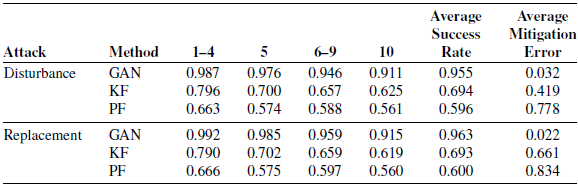
Currently, there is little work on the mitigation of OLAs in terms of obstacles. Hence, in this section, we show the performance comparison with the KF [Reference Suliman, Cruceru and Moldoveanu37] method and the PF [Reference Zhang, Wang and Chen39] method. In detail, KF combines the sensor readings and the predicted positions to provide more accurate position estimations. PF uses a set of weighted particles to increase localization robustness and accuracy. We use Matlab’s System Identification Toolbox to generate the dynamics for the prediction stage of KF. For PF, we initialize 50 particles using the Monte Carlo method. Fig. 10 shows the comparison of the average success rate for three mitigation methods in each test set. From the results, we can find that the proposed GAN method outperforms the other two. Specifically, compared with KF, the average success rate of the GAN method increases from 0.694 to 0.955 for disturbance, and increases from 0.693 to 0.963 for replacement. Compared with PF, the GAN method also shows a significant performance improvement (0.596 vs 0.955 for disturbance and 0.600 vs 0.963 for replacement). Table V shows the performance of the three mitigation methods in each group in terms of the average success rate. From the table, we can find that under KF, the performance reduces significantly when the number of obstacles increases, from 0.796 to 0.625 under disturbance attacks and from 0.790 to 0.619 under replacement attacks, while our GAN method can keep a relatively stable success rate. For PF, a similar diminishing trend can be observed, decreasing from 0.663 to 0.561 under disturbance attacks and from 0.666 to 0.560 under replacement attacks when the number of obstacles increases.
Significance test for the deep reinforcement learning (DRL) model and ObsGAN-DRL under different attacks.

Average success rate for test cases with 1–10 obstacles under different attack strengths.

To investigate the reason for the outperformance of the GAN model, we further calculate the mitigation error of three mitigation methods. The results show that the GAN method significantly outperforms the other two methods, achieving the lowest average mitigation errors of 0.032 and 0.022 for disturbance attack and replacement attack, respectively. The reason is that by precisely correcting the attacked positions via the well-trained generator, the positions received by the DRL model are closer to the real ones. Therefore, ObsGAN-DRL can generate better motion commands.
Comparison of success rates of the generative adversarial network, Kalman filter, and particle filter mitigation strategies in each test set.

Finally, to further validate the performance of ObsGAN-DRL, we perform t-test for equal mean checking. The results are shown in Table VI, which indicates the results are significant. It means that ObsGAN-DRL can achieve better performance than KF-based and PF-based methods.
4.4. Mitigation performance with other motion planning methods
Finally, we evaluate the compatibility of the GAN-based mitigation with other motion planning algorithms. In this paper, we select ORCA [Reference Van Den Berg, Guy, Lin and Manocha45] and SARL [Reference Chen, Liu, Kreiss and Alahi15]. The former is a conventional motion planning algorithm. In ORCA, each robot takes the responsibility of avoiding pairwise collisions evenly, and then the optimal action for each agent is determined by solving a low-dimensional linear program. The latter is a DRL-based method, which contains four MLPs: the first one is an embedding model, which transfers the input state to an embedding vector; the second is an attention model, which takes the embedding vector as input and computes the attention score for each obstacle; the third one is a feature module, which generates a feature vector for each obstacle; and the last is the value network, which takes the weighted feature and the robot’s state as input to compute the values. The architecture of each model can be found in ref. [Reference Chen, Liu, Kreiss and Alahi15]. The parameters for the training are the same as those given in Section 4.1.
Fig. 11 shows the success rates of either method in each test set. For ORCA, the GAN-based mitigation strategy improves the average success rate from 0.172 to 0.908 under the disturbance attack, and from 0.15 to 0.91 under the replacement attack. For SARL, the GAN-based mitigation strategy improves the average success rate from 0.66 to 0.95 under the disturbance attack, and from 0.446 to 0.956 under the replacement attack. We can find that on one hand, learning-based methods are more robust against OLAs than conventional methods; on the other hand, our proposed mitigation method can significantly improve the success rates for both conventional and learning methods. Hence, our GAN-based mitigation strategy can be compatible with other motion planning methods.
Comparison of average success rates in each group under different mitigation strategies.
Significance test for generative adversarial network (GAN), Kalman filter (KF), and particle filter (PF) mitigation strategies under different attacks.

The success rates of the generative adversarial network mitigation strategy with different motion planning algorithms.

4.5. Experiments in Gazebo
We evaluate our algorithm on RotorS, a well-established and high-fidelity Gazebo simulator. Gazebo is the mainstream open-source platform that can accurately reflect the physical characteristics of real-world robots. Three AscTec Firefly drones are developed to simulate the robot and obstacles in an environment. They can communicate via the topic subscription and publication in ROS. Each drone is simulated with a ROS node deployed on Ubuntu 18.04 with ROS Melodic, to execute the motion planning algorithms and generate motion commands. The safety radius of each drone is 0.3 m, and the robot drone is required to move from
 $(0, -4)$
to
 $(0, 4)$
. Note that since the rotation of rotors will cause changes in the surrounding airflow, the safety radius is larger than the physical radius of the drones. All videos of simulations can be found at https://obsgan-drl.github.io/.
4.5.1. Experiments with disturbance attack
In this scenario, the two obstacle drones are required to move from
 $(3.389, 1.731)$
to
 $(\!-\!2.067, -0.997)$
and from
 $(\!-\!2.313, -3.121)$
to
 $(1.939, 2.319)$
, respectively. Fig. 12a shows the initial states of three drones. As shown in Fig. 12b, due to the disturbance attack, the robot drone causes a collision with obstacle 0 and falls to the ground. Fig. 12c shows the real trajectories of the three drones. As shown in Figs. 13a
–13c, with the proposed GAN-based mitigation strategy, the robot drone can correct attacked positions of the surrounding obstacles and navigate itself to its target successfully.
RotorS experiments with two obstacles under the disturbance attack. The robot causes a collision with the obstacle and falls completely.

RotorS experiments with two obstacles under the disturbance attack and mitigation. The robot arrives at the target position successfully.

4.5.2. Experiments with replacement attack
In this scenario, the two obstacle drones are required to move from
 $(\!-\!3.471, -2.182)$
to
 $(2.651, 1.628)$
and from
 $(\!-\!3.510, 2.054)$
to
 $(2.171, -1.354)$
, respectively. Figure 14a shows the initial states of three drones. As shown in Fig 14b, due to the replacement attack, the robot drone affected the rotors of obstacle drone 0 first, and then obstacle drone 0 affected the rotors of obstacle drone 1, losing the stability of the three drones. Figure 14c shows the traveled trajectories of three drones. From Figs. 15a
–15c, we can find that the GAN-based mitigation strategy can deal with the attack successfully and navigate the robot drone to its target.
RotorS experiments with two obstacle robots under the replacement attack. The rotors of the robot and the obstacle cause a collision.

RotorS experiments with two obstacle robots under the replacement attack and mitigation. The robot arrives at its target successfully.

4.6. Discussion
In this paper, we proposed a GAN-based strategy to deal with position attacks against the surrounding obstacles. Our simulation experiments show that the proposed method can deal with such attacks efficiently. However, it also suffers from some threats concerning the training of the GAN model. On one hand, the available attack data might be limited in terms of the types and diversity of attacks in the real world, and it is challenging to collect comprehensive datasets that cover the entire spectrum of potential attacks. They will affect the generalization of the trained GAN model. To mitigate this limitation, we focus on the final influence of attacks, that is, the value of obstacle positions, which can reduce the influence of attack types and diversity; we also implement two ways to generate attacked locations. On the other hand, our attack data are generated from a simulation environment, which introduces the sim-to-real gap. Therefore, the GAN model trained in simulations may not perform as expected when deployed in the real world. To mitigate this limitation, we generate diverse data in simulations to enhance the model’s ability to handle real-world variations.
5. Conclusion
In this paper, we propose a detector-agnostic method ObsGAN-DRL based on GAN and DRL models to mitigate OLAs in environments with a varying number of obstacles. The proposed method contains a security module, which leverages the GAN model to generate approximate accurate positions of the surrounding obstacles, and a functionality module, which leverages the LSTM-guided DRL method to deal with a varying number of obstacles and generate collision-free commands. The results show that the proposed can mitigate OLAs with good performance and compatibility.
In the future, we will integrate ObsGAN-DRL with more DRL methods and compare their performance and scopes of application. We will also study more complex attack scenarios and design unified attack mitigation methods to enhance the security and robustness of mobile robot systems. In addition, we will focus on obtaining more effective and robust motion planning methods.
Author contributions
All authors conceived and designed the study. Fenghua Wu and Yuan Zhou implemented the research, completed the computational experiments, and wrote the manuscript. Wenbing Tang developed the GAN-based attack mitigation module, completed the simulation experiments, and wrote the manuscript. Shang-Wei Lin, Zuohua Ding, and Yang Liu monitored the research and edited the manuscript.
Financial support
This work was supported in part by the National Research Foundation, Singapore, and DSO National Laboratories under the AI Singapore Programme (AISG Award No: AISG2-GC-2023-008), the NRF Investigatorship NRF-NRFI06-2020-0001, Academic Research Fund Tier 2 by Ministry of Education in Singapore under Grant Nos. MOE-T2EP20120-0004, the Ministry of Education, Singapore under its Academic Research Fund Tier 2 (Proposal ID: T2EP20223-0043; Project ID: MOE-000613-00), the Natural Science Foundation of China under Grant Nos. 61972150 and 62132014, and Zhejiang Provincial Key Research and Development Program of China under Grant 2022C01045. Any opinions, findings and conclusions, or recommendations expressed in this material are those of the author(s) and do not reflect the views of the Ministry of Education, Singapore.
Competing interests
The authors declare that no conflicts of interest exist.
Ethical approval
None.



