

1. Introduction
Bridging culture and institutions has been a recurrent theme within the institutional economic literature in recent years (De Jong, Reference De Jong2011; Guiso et al., Reference Guiso, Sapienza and Zingales2016; Tabellini, Reference Tabellini2008). The role of culture in different economic outcomes and measures of nations performance is increasingly being emphasised (Berggren et al., Reference Berggren, Ljunge and Nilsson2019; Cruz-García and Peiró-Palomino, Reference Cruz-García and Peiró-Palomino2019; Tabellini, Reference Tabellini2010). However, the inter-play between cultural and institutional aspects remains underexplored (Alesina and Giuliano, Reference Alesina and Giuliano2015; Guiso et al., Reference Guiso, Sapienza and Zingales2006; Hodgson, Reference Hodgson2006), particularly regarding the role of culture in individuals' attitudes towards rent-seeking behaviour and compliance with the law (Alm et al., Reference Alm, Bernasconi, Laury, Lee and Wallace2017; Hodgson and Jiang, Reference Hodgson and Jiang2007). We aim to bridge this gap by investigating the relationship between individual-level cultural value orientation and tax morale, commonly defined as intrinsic non-pecuniary motivations towards tax compliance.
Institutions, commonly understood as those set of norms and rules able to constrain human behaviour and social relations, do provide ‘norms of governance’ that should reduce rent-seeking behaviour (Hodgson, Reference Hodgson2006; North, Reference North1990).Footnote 1 Nevertheless, the institutional economic debate (Hodgson, Reference Hodgson2006; Ostrom, Reference Ostrom2010) addressed a specific key question: why do those behaviours that institutions seek to constrain, such as tax evasion, persist? We argue that cultural values influence individual attitude towards institutional compliance. This is because culture shares with institutions the ability of influencing individuals as well as collective preferences and attitudes. In other words, culture and institutions refer to beliefs and values through which individuals' conjecture what is right and what is wrong (Greif, Reference Greif2006; Hodgson and Jiang, Reference Hodgson and Jiang2007). These values and beliefs work as long as they are internalised, maintained and communicated within a group of individuals, a cohort and or a socio-economic geographical space such as countries and regions (Greif, Reference Greif1994; Hofstede, Reference Hofstede1980; Schwartz, Reference Schwartz, van de Vijver, Chasiotis and Breugelmans2011). Focusing on tax morale is ideal for our purpose since it narrows the attention on the individuals' cognitive determinants of tax compliance, a moral duty and, hence, tax evasion – an improper behaviour (Frey and Torgler, Reference Frey and Torgler2007).
The focus on tax morale has two additional advantages. Firstly, it challenges mainstream economic theory by arguing that the probability of audits and the degree of punishment do not fully explain tax evasion (Filippin et al., Reference Filippin, Fiorio and Viviano2013; Lago-Penas and Lago-Penas, Reference Lago-Penas and Lago-Penas2010; Torgler, Reference Torgler2005). Secondly, it embraces the institutional economic view according to which social and economic exchanges do not occur outside the moral sphere (Traxler, Reference Traxler2010). Culture might thus be especially relevant since it influences individuals' view about their own responsibility and role within their community as well as their view about the responsibility and the role of the public institutions (Hakhverdian and Mayne, Reference Hakhverdian and Mayne2012). Accordingly, ‘norms of governance’, including those of tax compliance, rely not only upon institutional enforcement, but also on the individuals' normative commitment and psychological temperament (Bowles, Reference Bowles1998). We inevitably emphasise the central role of cultural values since they will condition and shape individuals' commitments to norms of governance and attitudes towards compliance to formal institutions (Alesina and Giuliano, Reference Alesina and Giuliano2015). We thus conceptualise cultural norms as informal institutions, which contribute to explaining how formal rules are fulfilled in practice. This approach is typical of the literature on ‘institutions-as-rules’, where informal institutions are often conceptualised as the missing link between formal rules and behaviour (Greif and Kingston, Reference Greif, Kingston, Schofield and Caballero2011). In addition, culture is commonly interpreted as a way to measure informal institutions in empirical research (e.g. Williamson, Reference Williamson2009).
Following the above theoretical perspective, we operationalise cultural value orientations by using the four cultural dimensions proposed by Hofstede (Reference Hofstede1980, Reference Hofstede2001) namely individualism versus collectivism, power distance, femininity versus masculinity and uncertainty avoidance.
Our analysis of tax morale exploits four waves of the European Value Survey (EVS 1981–2010) across a total of 48 countries, mostly Europeans with the addition of USA and Canada. The current study exploits individual level data with a potential total number of 164,997 observations across all waves. The cultural dimensions are constructed using a polychoric principal component analysis (PCA) on a set of relevant survey items consistent with the approach used in Davis and Williamson (Reference Davis and Williamson2019) and in Beugeldijsk et al. (Reference Beugelsdijk, Maseland and Van Hoorn2015).
Our baseline model relies on ordered logit estimations where individual's tax morale is a function of those four cultural variables, initially one-by-one and then in a ‘horse race’ regression, and an extensive set of covariates including demographic, contextual and temporal variables. As suggested by Tabellini (Reference Tabellini2010) and Duranton et al. (Reference Duranton, Rodríguez-Pose and Sandall2009), the baseline model considers country fixed effect in order to capture possible omitted time-invariant cross-country differences. Our empirical evidence reveals that individual values are significantly associated with tax morale. Values of individualism and femininity are indeed positively associated with individual's tax morale, while power distance and uncertainty avoidance are negatively associated with it.
These results provide an important empirical contribution to the literature and confirm theoretical claims that cultural dimensions should relate to individuals' rent-seeking attitudes such as tax morale. Let's analyse them in order.
First, values of individualism promote self-determination as well as an in-depth sense of individual's responsibility towards legal rules and institutional compliance. This might increase the level of tax morale among citizens whose attitudes are driven by such values.
Regarding the role of femininity, unlike values of masculinity that emphasise personal achievement and material success, values of femininity reflect the importance of solidarity and cooperative behaviour for a more sustainable society and improvement in the overall human well-being (Hofstede, Reference Hofstede2001). This might drive individuals to be more morally and ethically inclined towards tax compliance.
Regarding power distance, this indicates the extent to which unequal distribution of power and hierarchical relations are accepted in a society without additional justification. Consistently, power distance values drive individual's perception of public authority exploiting the use of power for the benefit of the elite, at the cost of a more unequal redistribution of public resources. This is likely to undermine individual's civic conscience and moral attitude towards institutional and tax compliance, since tax collection is viewed as a system with redistributive goals (Hofstede, Reference Hofstede2001).
Finally, regarding the role of uncertainty avoidance within the state-citizens relationship, the literature shows controversial perspectives. Values of uncertainty avoidance promote low individual's tolerance towards ambiguity and drives individual's preferences towards conditions of predictability and transparency (Hofstede, Reference Hofstede2001). Accordingly, we might expect that where public processes, including tax systems, are perceived transparent and accountable, individual's compliance with rules increases. However, the complexity of the tax system and the lack of transparency of the tax collection procedures might lower the moral cost of rent-seeking behaviour such as tax evasion (Torgler, Reference Torgler2005). As a result, individual's driven by values of uncertainty avoidance may be more inclined to tax evade as they are also strongly averse to feelings of ambiguity and lack of clarity, and would thus avoid engaging with a complex tax system (Richardson, Reference Richardson2008).
We further demonstrate that these results are robust to the inclusion or exclusion of different contextual and attitudinal covariates including variables of institutional trust and prosocial behaviour, potential explanatory factors in the tax morale literature. This indicates that cultural values matter per se, rather than through mediation by other values expected to respond to them, such as institutional trust and pro-sociality.
We also report a series of sensitivity analyses and model extensions. In particular, to mitigate possible endogeneity problems, we extend our baseline model, since tax morale and culture might be co-determined by some latent factors omitted in our baseline model, following Alesina et al. (Reference Alesina, Giuliano and Nunn2013), we increase the level of granularity of our analysis. Hence, we replicate our model by investigating within-region variation and, subsequently, by considering within-cohort variation in tax morale.
The remaining of the paper is structured as follows. Section 2 discusses a literature review. Section 3 introduces data and sources. Section 4 presents the empirical analysis and robustness checks. Section 5 finally concludes.
2. Relevant literature
2.1 Tax morale, institutions and culture
Rent-seeking behaviours, such as tax evasion, are a violation of institutional compliance. Tax collection systems are more effective when the public authority has the ability to enforce contracts, as well as increase individuals' compliance to institutions (Savoia and Sen, Reference Savoia and Sen2015). This inevitably passes through the quality of the bureaucracy. Consistent evidence shows that bureaucracies recruiting civil servants on a merit-basis reduce the spread of corruption and other rent-seeking behaviour (Dahlström and Lapuente, Reference Dahlström and Lapuente2017). There is, although, an increasing consensus that fiscal capacity may rely on the complementarity between objective measures of formal institutions and subjective measures of individuals' values and beliefs driving taxpayers' motivations to comply with taxes (Savoia and Sen, Reference Savoia and Sen2015). In other words, cultural values, which partly shape individual values, are important informal institutions explaining how formal rules are followed in practice (Williamson, Reference Williamson2009). In fact, empirical studies show that tax evasion not only varies across countries, but also across different regions subject to the same national government system (Lago Penas and Lago Penas, Reference Lago-Penas and Lago-Penas2010; Torgler, Reference Torgler2005). Appropriate institutions should reduce rent-seeking problems, since institutions are set of norms and rules able to shape and constrain human behaviours (Hodgson, Reference Hodgson2006; North, Reference North1990, Ostrom, Reference Ostrom2010). However, there is an increasing consensus that institutional conformity requires social support and public engagement besides appropriate formal institutions (Tavits, Reference Tavits2010). In other words, institutional conformity is possible if citizens' attitudes towards institutional conformity are positively motivated, and if cultural values are complementary and supportive of formal rules. Within this perspective, tax morale is argued to connect attitudes to behaviour, as it reflects a positive predictor of citizens complying with their tax duty (Cummings et al., Reference Cummings, Martinez-Vasquez, McKee and Torgler2009; Torgler, Reference Torgler2012). Tax morale, generally defined as individuals' intrinsic non-pecuniary motivations to pay taxes (Frey, Reference Frey1997), looks at tax compliance as a matter of individual's moral considerations rather than a mere taxpayers' reaction to law enforcement (Traxler, Reference Traxler2010). Social values can strengthen these intrinsic motivations, as they are likely to influence individual's choices and behaviours (Luttmer and Singhal, Reference Luttmer and Singhal2014). In the literature to date, the two main channels that have been used to explain individual's tax morale are the following. On the one hand, tax morale increases among individuals that are more prosocial and, hence, willing to cooperate towards the public good, especially if they expect that other citizens will do so (Frey and Torgler, Reference Frey and Torgler2007). On the other hand, tax morale increases among individuals who trust public institutions as they are confident that public authority will act on the interest of tax contributors (Daude et al., Reference Daude, Gutiérrez and Melguizo2013; Feld and Frey, Reference Feld and Frey2002; Torgler, Reference Torgler2012). If the State's commitment is perceived to be low, the moral cost of tax evading decreases (Torgler, Reference Torgler2005). Hence, citizens might feel less inclined to respect obligations, such as paying taxes, and less concerned about being sanctioned for their rent-seeking behaviour (Frey and Torgler, Reference Frey and Torgler2007).
To our knowledge, however, the cultural perspective of tax morale has been only marginally explored. Particularly, considering that individual's cultural values might influence what individual conjectures as right or wrong (Greif, Reference Greif2006). This means that a set of internalised values and beliefs contribute to regulate not only social exchanges between peers (co-citizens), but also those occurring between individuals and ruling public institutions. This is because social values influence individuals' view about their own responsibility and role within their community as well as their view about the responsibility and the role of the public institutions (Hakhverdian and Mayne, Reference Hakhverdian and Mayne2012).
In the few pioneering studies conducted so far in laboratory experiments and survey-based research, culture assumes a secondary role and is mainly identified with the country of origin of the participants to the experiments or to the survey (Cummings et al., Reference Cummings, Martinez-Vasquez, McKee and Torgler2009; Torgler, Reference Torgler2006). To isolate the impact of culture on tax morale, holding constant economic and institutional factors, some studies use linguistic cultural aspects of distinct groups (Torgler and Schneider, Reference Torgler and Schneider2007) or the level of tax morale in the country of origin of migrants (Kountouris and Remoundou, Reference Kountouris and Remoundou2013).
This literature has crucially increased the attention towards the importance of culture, encouraging further and more consistent research in this direction (Alesina and Giuliano, Reference Alesina and Giuliano2015). More recently, criticisms have been raised on the importance of adopting indicators able to capture the multifaceted nature of culture and to exploit cultural variations within country and across individuals who are subject to the same institutional and environmental framework (Luttmer and Singhal, Reference Luttmer and Singhal2014). Such indicators would dramatically improve the empirical strategy and help building a more consistent conceptual and theoretical framework better able to trace the relational mechanisms between tax morale and its determinants.
2.2 Cultural dimensions
Culture is understood as a repetition of common behaviours and practiced codes of conduct that structure interactions within societies (Alesina and Giuliano, Reference Alesina and Giuliano2015; North, Reference North1990). It has been also defined as values and ideas specific to a group and passed-on down the generations (e.g. Guiso et al., Reference Guiso, Sapienza and Zingales2006) or among peers through communication and social learning (Greif, Reference Greif1994; Spranz et al., Reference Spranz, Lenger and Goldschmidt2012; Tavits, Reference Tavits2010). The simple inter-generational transmission of contents is not enough, although. Douglass North (Reference North, Ménard and Shirley2008: 24) underlines that learning is a tool that individuals use in order to reduce uncertainty. Values and beliefs embedded in a society can thus be said to represent the cumulative learning of that society, facilitating decision-making in response to specific situations (North, Reference North, Ménard and Shirley2008).
Individuals' attitudes and behaviours are influenced by their values and beliefs acquired and consolidated through learning, repeated and consistent interactions and social exchanges with other members of society (Spranz et al., Reference Spranz, Lenger and Goldschmidt2012). Values and ideas are drivers of human behaviour as they provide guidelines regarding good versus bad, or appropriate versus inappropriate behaviour within specific groups and contexts (Greif, Reference Greif2006).
The empirical literature is rich in examples in which the values shared by a group have been shown to be meaningful and relevant concepts. For example, Guiso et al. (Reference Guiso, Sapienza and Zingales2006), Tabellini (Reference Tabellini2008) and Alesina and Giuliano (Reference Alesina and Giuliano2015) all present detailed literature reviews illustrating the relevance of beliefs and values in economics – but we note that none of them seems to have tackled tax compliance.
Cross-cultural studies have for long recognised the importance of national culture, and taxonomies have been developed to accurately define and label cultural values that allow for an effective discrimination or identification of contrasting cultural groups. These taxonomies are, by definition, empirical constructs, which have been validated, through time, thanks to their repeated use in studies investigating a broad range of behaviours. The one we use in our analysis, and widely considered both in economics and cultural studies, is the one proposed by Hofstede (Reference Hofstede1980, Reference Hofstede2001). Hofstede treats culture as ‘the collective programming of the mind’ able to distinguish an individual or a group of individuals from another. By ‘mind’, he refers to individual's cognitive skills such as thinking, feeling and acting (Hofstede, Reference Hofstede2001). On the basis of this background perspective, Hofstede distinguishes four fundamental cultural dimensions: (i) collectivism versus individualism, (ii) uncertainty avoidance, (iii) power distance and (iv) femininity versus masculinity.Footnote 2 These four dimensions capture specific aspects of the mental map individuals rely on to guide their decisions. They are associated with very specific values and beliefs, shared by those who were socialised in a specific country (Hofstede, Reference Hofstede2001). Originally, these dimensions have been constructed to analyse employees’ work-related values within a multinational corporation. Later on, Hofstede's taxonomy of culture has been increasingly employed in cross-cultural and business studies (Beugelsdijk and Welzel, Reference Beugelsdijk and Welzel2018; Kaasa, Reference Kaasa2015), economics and institutional studies (Davis and Williamson, Reference Davis and Williamson2019; Tarabar, Reference Tarabar2019).
Collectivism as opposed to individualism reflects the extent to which individuals are self-reliant or embedded in groups (Hofstede, Reference Hofstede2001). In individualistic societies, people act as individuals and not as members of a group. Their attitudes and behaviours are driven by values of individual freedom, autonomy and self-determination. This implies that individuals respond less to social pressure and, at the same time, they are assumed to take responsibility for their own actions. On the contrary, in highly collectivistic societies, values of amoral familism a-la Banfield (Reference Banfield1958) dominate individual behaviour and attitude, as individuals act with the interests of their small reference group in mind, even though this implies higher moral and economic cost for the entire collective (Kaasa, Reference Kaasa2015). Beyond Hofstede, this is a concept that has generated a large amount of empirical evidence (see e.g. Gorodnichenko and Roland, Reference Gorodnichenko and Roland2017).
Uncertainty avoidance typically promotes order, consistency and values predictability. Changes are, thus, considered with suspicion. On the contrary, in societies with low uncertainty avoidance, people will typically be more willing to take risk and may be inclined to see change as an opportunity. High uncertainty avoidance is thus often associated with a greater reliance on rules and regulations, or established processes, to guide more precisely how people are expected to act (House et al., Reference House, Hanges, Javidan, Dorfman and Gupta2004). Regarding the state-citizens' relationship, contexts scoring high in uncertainty avoidance can count on a large number of precisely written laws and unwritten rules necessary to fill the gap of ambiguity, even though all these rules cannot be respected and even though the procedures and applications of these formal rules are very long. In high uncertainty avoidance context, citizens tend to hold negative views towards politicians, civil servants and the legal systems as well as towards young people and change (Hofstede et al., Reference Hofstede, Hofstede and Minkov2010).
Power distance pertains to the degree of hierarchy prevailing in a given society. Societies scoring high on power distance are characterised by an unequal distribution of wealth and power, generally accepted by individuals without further scrutiny. Individuals are expected to know their place in society and accept the authority of higher rank individuals. In low power distance societies, social structures are less rigid, and hierarchy/authority is more easily challenged. These societies are characterised by more equal opportunities (Hofstede et al., Reference Hofstede, Hofstede and Minkov2010).
In societies characterised by femininity, individuals emphasise social relationships, quality of life, notions of care and nurturing. Feminine values emphasise the importance of welfare society and the goal of equal opportunity against poverty and economic exclusions (Hofstede, Reference Hofstede2001). Feminine value-oriented societies such as the ones in Scandinavian countries have been reported to prefer large welfare functional state recording low level of tax evasion and high individuals' propensity to cooperate in favour of the public good (Hofstede, Reference Hofstede2001). On the contrary, masculine value-oriented societies give more importance to achievements, heroism and material success (Hofstede, Reference Hofstede2001).
Other taxonomies exist, including the one developed by Schwartz (Reference Schwartz, van de Vijver, Chasiotis and Breugelmans2011), as well as other measures of culture, such as those proposed by Tabellini (Reference Tabellini2008, Reference Tabellini2010): including trust, respect, obedience and control for example. However, Hofstede's remain the most popular one. It has been extensively validated as providing a meaningful characterisation of people's mental schemes (Beugelidijsk and Welzel, Reference Beugelsdijk and Welzel2018), and it is thus the one we will be using in our empirical analysis. In fact, the cultural dimensions of Hofstede have been identified in a growing number of empirical studies as predictors of different aspects of institutional performance (Gorodnichenko and Roland, Reference Gorodnichenko and Roland2017) including contract enforcement efficiency (Cline and Williamson, Reference Cline and Williamson2017), efficiency-enhancing reforms (Tarabar, Reference Tarabar2017), rule of law, reduced corruption and quality of governance (Kyriacou, Reference Kyriacou2016). From a more socio-economic perspective, evidence using individual data from the World Values Survey reports that the cultural dimension of individualism increases gender equality in terms of employment, income, education and political leadership (Davis and Williamson, Reference Davis and Williamson2019). Individualism appears also to provide a socio-cultural background favouring economic development, economic growth, higher rate of innovation and increasing wealth (Gorodnichenko and Roland, Reference Gorodnichenko and Roland2017).
Some have emphasised the persistence of national culture (Kaasa and Minkov, Reference Kaasa and Minkov2020). In this context, culture is measured as ‘cultural traits’ persistent through time and within a social group – such as Hofstede's cultural dimensions for example (Reference Hofstede2001). This also means that culture can be appropriately proxied through specific exogenous characteristics (e.g. country of origins for migrants, language structure, etc.) relevant to the socialisation context of individuals, and thus to the internalisation of those cultural constructs.
Alternatively, other schools of thoughts emphasise the idea of change and evolution of culture. Such an approach would be more in line with Inglehart's dynamic conceptualisation of culture (see Beugelsdijk and Welzel, Reference Beugelsdijk and Welzel2018 for a discussion of both approaches). In this literature, culture is seen as changing through time, in particular to reflect changes in economic circumstances and their impact on expressed needs. Recent studies using public opinion surveys have shown that the values typically used to measure culture have indeed changed through time and across generations (Beugelsdijk et al., Reference Beugelsdijk, Maseland and Van Hoorn2015). Economists have however sometimes interpreted a change in values through time as a reason to doubt the validity of the relevant indicator of culture. Indeed, some economists would interpret instability in the concepts as noise (see Zanella and Bellani, Reference Zanella and Bellani2019). Here, we want to explicitly control for this individual-specific time-variant values, to test the extent to which they inform behaviour.
3. Data and variables
We use individual level data from four waves of the European Values Survey (EVS)Footnote 3 covering the time span between 1981 and 2009. This allows us to assess different values and beliefs for up to 164,997 respondents across 48 countries.Footnote 4
The variable on tax morale originates from a question asking to what extent the respondent thinks that cheating on taxes is justifiable, with 1 reflecting that cheating on taxes is ‘Always justifiable’ and 10 ‘Never justifiable’. Although the majority of the respondents across all countries find cheating on taxes largely unjustifiable, we found interesting variations across time and countries which contribute to motivating the current study.
Consistent with Davis and Williamson (Reference Davis and Williamson2019) and Beugeldijsk et al. (Reference Beugelsdijk, Maseland and Van Hoorn2015), each of Hofstede's cultural dimensions is calculated using a PCA on a set of relevant survey items from the EVS, selected to reflect Hofstede's definitions. This approach allows us to construct a composite variable representing an underlying concept in the initial set of variables analysed, relying on the empirically observed level of correlation among these variables (Hair et al., Reference Hair, Black, Babin and Anderson2014). More specifically, given the non-continuous nature of some items, we use polychoric PCA, which relies on polychoric rather than Pearson correlations. Polychoric PCA has been specifically designed by Kolenikov and Angeles (Reference Kolenikov and Angeles2004) for this kind of variable and uses ‘maximum likelihood to calculate how that continuous variable would have to be split up in order to produce the observed data’ (Moser and Felton, Reference Moser, Felton, Addison, Hulme and Kanbur2009: 108). It therefore produces more accurate factors than a regular PCA. From each PCA we extracted components with an eigenvalue greater than 1, and for each of these, we created synthetic indices as weighted sums of the variables charging with a factor loading of at least 0.4, as standard in the literature (e.g. Hair et al., Reference Hair, Black, Babin and Anderson2014). We eliminated the components which did not generate a construct with the expected signs variables' loading. This allows us to construct new composite indicators that capture a substantial share of the variance in the original set of variables, while reflecting unidimensional underlying concepts consistent with Hofstede's original cultural dimensions (as in Beugelsdijk et al., Reference Beugelsdijk, Maseland and Van Hoorn2015). This led us to select a unique construct for each of Hofstede's cultural dimension (see formulas below), which we then standardised:


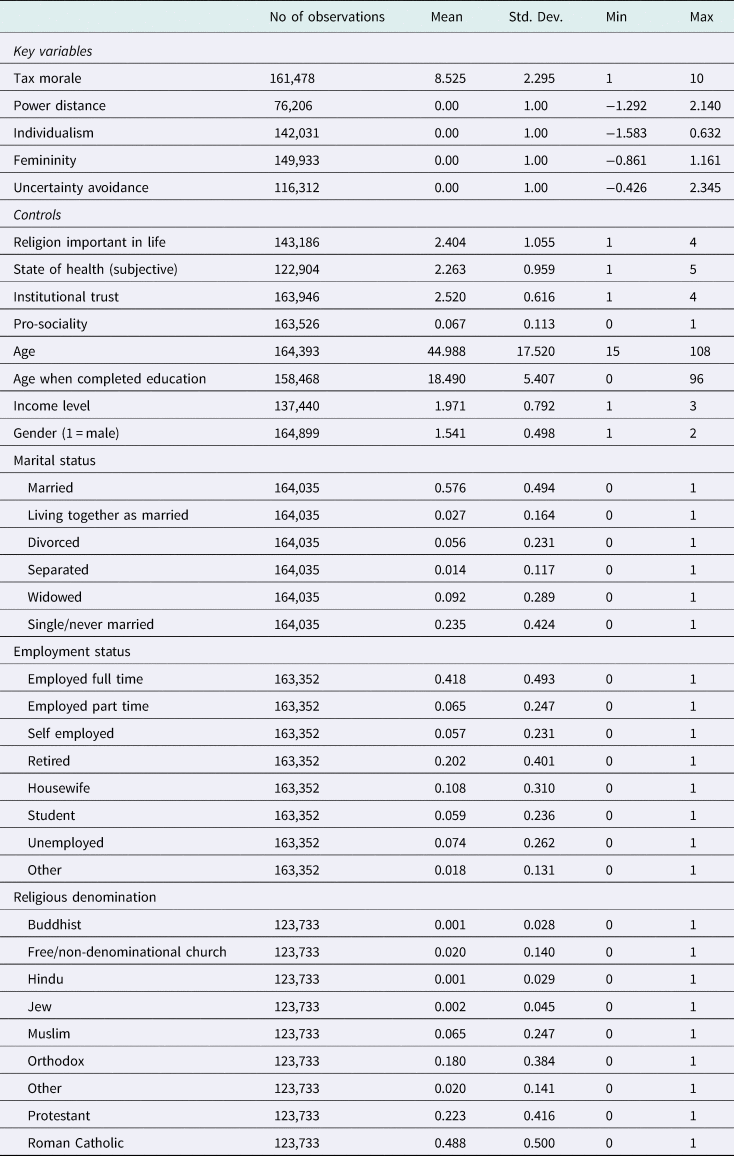
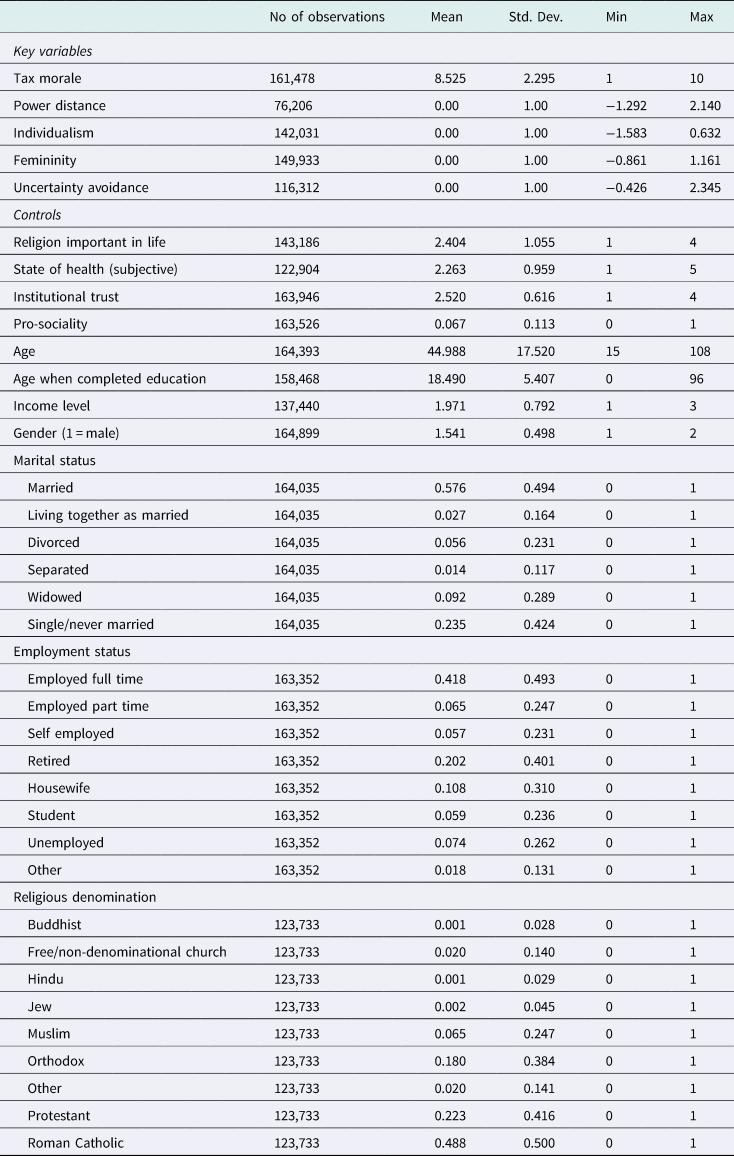
Following the literature on tax morale, we also control for other independent variables such as institutional trust (Alm and Torgler, Reference Alm and Torgler2006; Daude et al., Reference Daude, Gutiérrez and Melguizo2013), prosocial behaviour (Frey and Torgler, Reference Frey and Torgler2007),Footnote 5 religiosity (Torgler, Reference Torgler2006) and a series of socio-economic and demographic covariates including gender, year of birth, marital status, religious denomination, years in education, employment status, income level,Footnote 6 region of residence at NUTS2 level and cohort. We report the construction of the latter in the next section. Table A1 reports summary statistics.
3.1 Creation of the cohorts
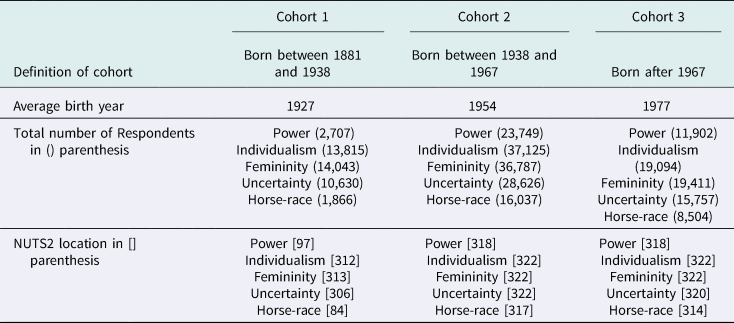
Following Beugelsdijk et al. (Reference Beugelsdijk, Maseland and Van Hoorn2015), we build a detailed decomposition of the cohort groupings by exploiting two elements that we regard as exogenous features of interviewees' characteristics, or in other words not directly linked to a personal choice: age bracket (people cannot decide when to be born) and location within a NUTS2 region (people cannot decide where to be bornFootnote 7). Let us comment on them in order. As far as age is concerned, we posit that a ‘generational’ change of culture is only possible after at least two/three decades and therefore we split the groupings in people born before World War II, people born during the war up to the late 60s (watershed moment on shift of cultural values at the world level) and finally born in more recent decades. Location is a key ‘institutional element’ shaping the way we think and process information, in turn driving our actions. Therefore, a fine-grained NUTS2 classification is a comprehensive way to identify the institutional roots of our individual responses. The top panel of Table 1 describes the ‘Age-Based’ cohort decomposition into three parts, showing for each cultural value how many individuals are counted in our dataset, the ‘()’ brackets. In the same table, the bottom part describes the location decomposition, showing for each of the cultural trait/age bracket how many locations we can account for the ‘[]’ brackets.
Birth-location cohort characteristics

Authors computations based on EVS, four waves.
4. Empirical analysis
4.1 Baseline model
In our baseline empirical model, individual's tax morale is a function of the four cultural variables we generated following Hofstede's conceptualisation and an extensive set of covariates including demographic, contextual and temporal variables. We consider country fixed effect in order to capture possible omitted time-invariant cross-country differences (Duranton et al., Reference Duranton, Rodríguez-Pose and Sandall2009; Tabellini, Reference Tabellini2010). As noted elsewhere in the literature (e.g. Beugeldijsk et al., Reference Beugelsdijk, Maseland and Van Hoorn2015), our cultural dimensions of interest are partially correlated between themselves and therefore are regressed one by one as well as all together (i.e. in a ‘horse-race’ regression fashion).
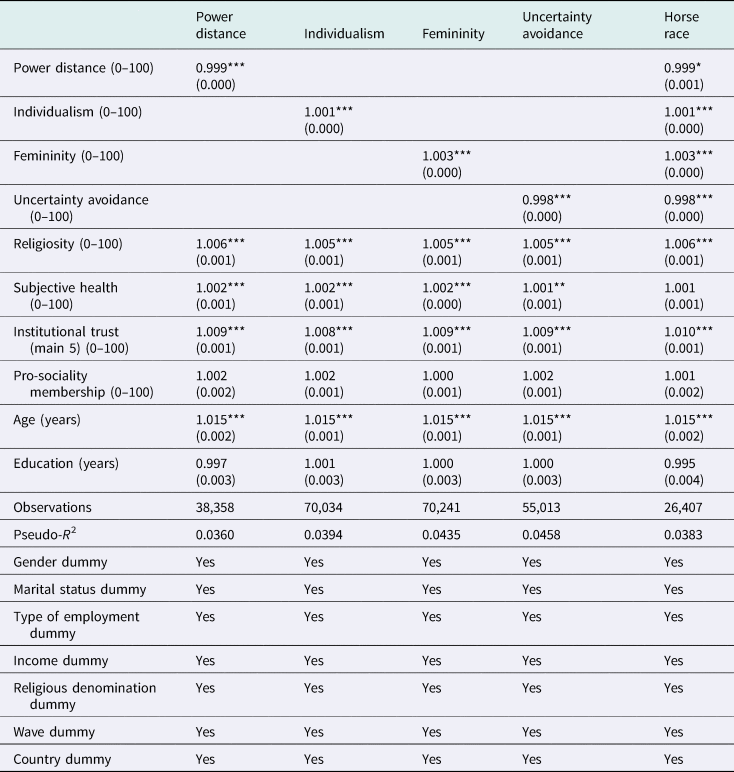
Table 2 reports the ordered logit estimations of our baseline model. As far as our cultural dimensions are concerned, we do find in all specifications a stable effect of culture on tax morale.
Baseline ordered logit regressions – coefficients reported in odds ratios*

Robust standard errors clustered at the level of the country in parentheses, ***p < 0.01, **p < 0.05, *p < 0.1.
Reported Odd-ratios (ordered logit ‘eform’, see text). Notice that estimations reported in odd-ratio imply that a coefficient indicates a positive effect if it is above the value 1 and a negative effect if it is below value 1. All regressions include control dummies for gender, marital status, type of employment, self-reported income brackets, religion denomination, EVS wave and country.
Our results show that values of individualism are positively associated with tax morale: for a one-unit increase in the individualism score, the odds of high tax morale versus the combined middle and low categories are 1.001 times higher,Footnote 8 ceteris paribus. Indeed, the relationship between individualism/collectivism and law compliance may help explain this result. Individualism is characterised by self-determination and self-expression rather than subjecting one's choice to the approval of a specific reference group. This would support individual's initiative as well as individual's responsibility towards legal rules and institutional compliance. In contrast, a society dominated by collectivistic values is characterised by low civic morality a-la Banfield (Reference Banfield1958). In such society, social exchanges are set upon mutual obligations within the members of the reference group rather than on rule-of-law norm. In this case, enforcement and individual's compliance are more likely to occur within than outside the reference group (Greif, Reference Greif1994).
With respect to power distance, our models report that values of power distance are negatively correlated with tax morale. For a one-unit increase in the power distance score, the odds of high tax morale versus the combined middle and low categories are 0.999 times smaller, ceteris paribus. It is well argued that citizens consider tax evasion more immoral in contexts with a stronger rule of law (Frey and Torgler, Reference Frey and Torgler2007; Torgler, Reference Torgler2005). In such contexts, the individual's predisposition towards compliance is not solely the result of the punishment effect employed by the public authority in case of tax evasion. For example, Filippin et al. (Reference Filippin, Fiorio and Viviano2013) find that tax morale is driven by individual traits rather than external elements. It also stems from the value attached to law abiding and civic duty (Orviska and Hudson, Reference Orviska and Hudson2003). The former can be related to objective responsibilities defined by the law, the latter to the subjective responsibilities within a code of conduct and behaviour. Both law abidance and civic duty contribute to the individuals' moral attitude towards institutional compliance since, if violated, they can provide an individual with a feeling of guilt for having committed a wrong act and for having failed in complying with recognised ethical rules (Orviska and Hudson, Reference Orviska and Hudson2003). Regarding our results, high power distance signifies a negative view of power and wealth (Hofstede, Reference Hofstede1980; Licht et al., Reference Licht, Goldschmidt and Schwartz2007). More specifically, power distance values drive individuals to perceive the authority as exploiting the use of power for the benefit of the elite at the cost of a more unequal redistribution of public resources. This is likely to undermine individual's civic conscience of considering tax evasion wrong. On the contrary, values of low power distance feed the idea that the use of power should be subject to the rule of law which, in turn, should guarantee everyone the same rights regardless of their social status. Taxation, therefore, is viewed as a system with redistributive goal (Hofstede et al., Reference Hofstede, Hofstede and Minkov2010) driving individuals to perceive tax compliance as morally correct.
With respect to uncertainty avoidance, our results suggest that higher individuals' values of uncertainty avoidance are associated with lower tax morale. For a one-unit increase in the uncertainty avoidance score, the odds of high tax morale versus the combined middle and low categories are 0.998 times smaller, ceteris paribus.
High uncertainty avoidance reflects societies with low tolerance for uncertainty and ambiguity. Values of uncertainty avoidance drive individuals to prefer clear organisational structure and procedures in their institutions that help make events more predictable (Hofstede et al., Reference Hofstede, Hofstede and Minkov2010). This could lead one to expect uncertainty avoidance to be associated with greater tax morale, as citizens might value the predictability of the tax code. However, the tax collection process is often complex, and can be perceived by citizens to lack transparency. Recent institutional studies show that tax systems perceived as transparent and accountable by taxpayers increase their tax compliance (Ricciuti et al., Reference Ricciuti, Savoia and Sen2019). On the contrary, the moral cost of rent-seeking behaviour such as corruption and tax evasion reduces when citizens perceive that the tax administration lacks of transparent procedures and when laws are too complex for citizens to understand without legal advice (Torgler, Reference Torgler2005). In this context, people with high uncertainty avoidance might be more willing to tax evade, as complex tax systems and procedures may generate a greater feeling of ambiguity and lack of clarity (Richardson, Reference Richardson2008). Indeed, evidence in the public economics literature suggests that complexity in tax system rules and procedures are associated with more tax evasion (Richardson, Reference Richardson2006).
Our results also suggest that values of femininity are positively associated with tax morale. For a one-unit increase in the femininity score (less masculinity), the odds of high tax morale versus the combined middle and low categories are 1.003 times higher, given the other variables are held constant in the model. With respect to tax compliance and rent-seeking behaviour the literature provides controversial results. On the one hand, masculinity values could be associated with a higher propensity to promoting one's own success (Wingate, Reference Wingate1997), thus attracting scrutiny – including from tax auditors (Tsakumis et al., Reference Tsakumis, Curatola and Porcano2007) – and hence it could boost consciousness of tax compliance and rules conformity. On the other hand, it is argued that high masculinity emphasises individual success and achievement also at the cost of violating legal rules such as those of tax compliance (Richardson, Reference Richardson2008). Our results clearly support this second perspective. Indeed, values of femininity commonly lie on societal goals of welfare and social care. They favour the development of a society socio-economically sustainable and inclusive supported by a well-established welfare system (Hofstede, Reference Hofstede2001). This perspective clearly combines with the importance of tax compliance and the moral and ethical duty to conform to the tax law.
Importantly, we show that our results regarding the relationship between tax morale and Hofstede's cultural dimensions are consistent across different specifications. In particular, the sign and significance of our key relationships of interest does not change in specifications with or without controls for religiosity, pro-sociality and institutional trust. This thus shows that the cultural dimensions we investigate matter per se to explain tax morale, and not through a mediated effect via religiosity, pro-sociality or institutional trust.Footnote 9 On an additional note, as argued in the literature on tax morale, institutional trust signals citizens' higher confidence about the effectiveness and the accountability of the public authorities (Hooghe et al., Reference Hooghe, Dassonneville and Marien2015). This increases citizens' loyalty towards public institutions and, hence, citizens' moral motivations to comply with tax rules (Feld and Frey, Reference Feld and Frey2002). Similarly, tax morale increases with pro-sociality as prosocial individuals tend to be natural co-operator with a stronger moral duty in contributing towards the public good (Frey and Torgler, Reference Frey and Torgler2007).
As in Torgler (Reference Torgler2006), our results also report that tax morale is higher among respondents declaring to be more religious. In Torgler's analysis, religiosity increases tax morale as commitment to religious doctrines might inhibit illegal behaviour considered morally wrong and unacceptable (Torgler, Reference Torgler2006).
4.2 Model extension: within regions variation and the role of cohorts
Although most of the literature so far has analysed the inter-play between cultural and institutional aspects within a country or using a cross-country focus, little attention has, to date, been devoted to the within-region and within-cohort dimensions.
Despite the important insights that previous studies have produced through a cross-country level and within-country variation approach (e.g. Davis and Williamson, Reference Davis and Williamson2019), this country-based perspective carries two limitations. Within-country variations might ignore subtle differences in values at lower levels of aggregation (such as region or cohort) and, hence, they might mask important differences in the data that are interesting in themselves. Additionally, neglecting these differences might reduce the relevance of the relationships identified, due to omitted variable bias.
Indeed, from a conceptual perspective, culture is more likely to assume a regional dimension. Cultural differences occur across regions, even within the same country (Kaasa, Reference Kaasa2015). In explaining differences in institutional quality between the north and south of Italy, the seminal study of Putnam et al. (Reference Putnam, Leonardi and Nanetti1993) stresses the importance of analysing the impact of individuals' values and social norms of trust and cooperation within regional variation. This perspective lays upon the argument that these values and norms might be affected by cultural aspects deep-rooted in a more narrowly defined local history rather than in the national one. Accordingly, other insightful studies on the impact of values and norms on different institutional and economic performance have considered the regional dimension. For instance, in detecting the impact of individual's altruistic values Guiso et al. (Reference Guiso, Sapienza and Zingales2004) show that values driving individuals to become blood donors are determined by the regional origins of the respondents. Similarly, recent study on inter-generational change in values has also shed new light on the slow process of change in time that can affect cultural values (Beugelsdijk et al., Reference Beugelsdijk, Maseland and Van Hoorn2015; Tarabar, Reference Tarabar2019).
From an empirical perspective, within country analyses can suffer from endogeneity problems due to reverse causality and omitted variable bias, particularly when the analysis focuses on the role of cultural aspects in other institutional outcomes (Alesina and Giuliano, Reference Alesina and Giuliano2015). In the context of our own analysis, endogeneity could arise if tax morale and culture where somehow co-determined, if specific variables explaining tax morale are omitted or if cultural variables were imprecisely measured (measurement error bias), as can be the case for any variable constructed from survey data. Following Alesina et al. (Reference Alesina, Giuliano and Nunn2013), our model extensions partly address these issues and explore whether the relationships identified with our cultural dimensions remain unaltered when adding increasingly narrowly defined fixed effects for regions, cohorts and regions × cohorts. In other words, we extend our baseline model by increasing the level of granularity within regions and within cohorts.
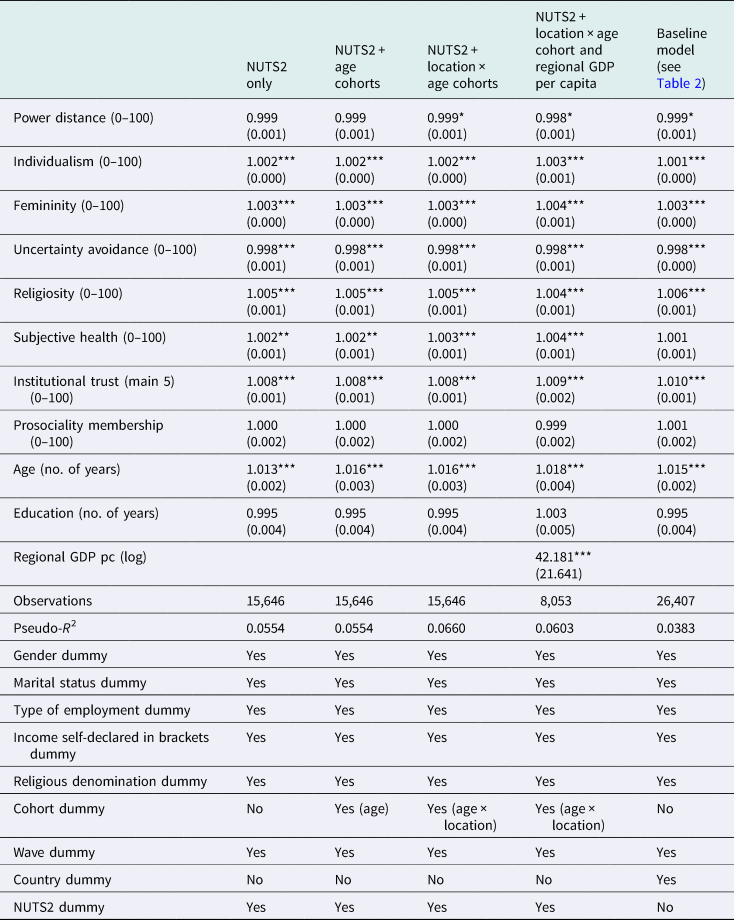
In Table 3 column 1 we run the baseline model using up-to 326 NUTS2 region dummies instead of country dummies. The impact of our cultural dimensions on individual's tax morale remain broadly unalteredFootnote 10 even if in the horse-race we are left with around 15,000 observations only. In column 2, we further add three-period cohort dummies (before 1938, 1939–1968, after 1968). The results remain fully consistent. Finally, in column 3 we interact the three-period dummies (before 1938, 1938–1967, after 1967) with NUTS2 regions, as proxy for a fine-grained cohorts' measurement and this entails an even more cogent definition of long-run cultural trait. Finally, in column 4 we control for regional GDP per capita. The results are again fully consistent.
Ordered logit with granular controls: NUTS2, cohort, cohort × location, regional GDPpc

Coefficients reported in odd-ratios.
Robust standard errors in parentheses: columns 1 and 2 clustered at the NUTS2 level; columns 3 and 4 clustered at the cohort level (age × location); column 5 clustered at the country level (as in Table 2), ***p < 0.01, **p < 0.05, *p < 0.1.
Reported odd-ratios (ordered logit ‘eform’, see text). Notice that estimations reported in odd-ratio imply that a coefficient indicates a positive effect if it is above the value 1 and a negative effect if it is below value 1. All regressions include control dummies for gender, marital status, type of employment, self-reported income brackets, religion denomination, Wave and -with the exception of the last column that is reported from Table 2 – NUTS2 dummies.
We test for the null hypothesis whether the three cohort dummies (cohort born before 1938 included; cohort born between 1939 and 1968; cohort born after 1968) are statistically different from each other as far as the conditional mean tax morale is concerned. We reject null the hypothesis with p-value 0.000, and therefore there is no statistically supported evidence of a difference.
5. Conclusions
Compliance is equivalent to a cooperative solution to the collective action problem. Therefore, understanding the factors that help to sustain cooperation might help promote compliance. The Hobbesian solution to these problems lay on government coercion and, hence, deterrence. Individuals are legally bound to contribute to the public good if they do not want to incur punishment. However, monitoring the government represents the second-order collective action problem where government coercion is not a solution any longer. In other words, in Hobbes analysis the missing link is the role of the individuals and of the values driving their preferences and attitudes towards the contribution to the public good. Without neglecting the importance of system-level institutional quality, compliance with rules, in this specific case with tax rules, is the ultimate results of individual's preferences. According to mainstream economics, these preferences are mainly driven by a cost-benefit analysis, in agreement with the Hobbesian solution mechanism (Becker, Reference Becker1974). The institutional economic approach, stresses, instead, the fact that individuals' preferences are subject to norms and values, as well as moral motivations (Frey and Torgler, Reference Frey and Torgler2007; Hodgson, Reference Hodgson2006; Ostrom, Reference Ostrom2010).
In this study, we have argued that cultural values influence individuals' predisposition towards tax compliance and we supported this perspective with consistent and robust evidence. These values matter because they provide each individual with a mental map of what is right and what is wrong (Greif, Reference Greif2006), affect individuals' view about their role and responsibilities within their society and shape individuals' perception of the role and responsibilities of the public authorities (Hakhverdian and Mayne, Reference Hakhverdian and Mayne2012). In this respect, our results suggest that although values of femininity and individualism are positively associated with individuals' tax morale, values of power distance and uncertainty avoidance show a negative association with tax morale.
We, however want to be cautious on what can be inferred from our analyses. We recognise that changes in individual cultural values over time are possible and consistent with evidence elsewhere in the literature (e.g. Beugelsdijk and Welzel, Reference Beugelsdijk and Welzel2018), and could be related to endogenous institutional change (as discussed in Mahoney and Thelen, Reference Mahoney, Thelen, Mahoney and Thelen2009). It would be too speculative, although, to discuss this type of institutional change on the basis of our results. This is because our analysis employs repeated cross-sections, suitable to report relationships that are static, within one-period, rather than dynamics. That said, exploring such dynamics would make for a very insightful follow-up on our current research.
Even though the non-tangible nature of such values makes it difficult to pinpoint specific policy implications (Cline and Williamson, Reference Cline and Williamson2017), our results suggest policymakers should proceed with caution when they want to implement a tax reform or when they would like to modify tax policies. Indeed, cultural values matter and cannot be neglected. It is thus important that policymakers learn from the effect that these cultural traits produce on individuals' attitudes. As the literature on the economics of culture rightly underlines, suggesting specific policy recommendations for optimal solutions has two main drawbacks which, at the same time, may represent two learning outcomes. Firstly, as culture is slow moving, new policies are unlikely to immediately speed up cultural evolutions (Davis and Williamson, Reference Davis and Williamson2019). This should thus encourage policymakers to proceed with caution when they want to implement a tax reform or when they would like to modify tax policies in view of a more efficient fiscal capacity. Secondly, cultural differences suggest that the same policies might function more in some contexts than in others according to the dominant cultural values (Cline and Williamson, Reference Cline and Williamson2017; Grimmelikhuijsen and Porumbescu, Reference Grimmelikhuijsen and Porumbescu2013). This is indeed reflected already in the variability observed in terms of tax compliance within the same country and thus within populations exposed to the same tax system. In this respect, although policymakers might be constrained regarding the implementation of tax policies set at a country level, they might have more flexibility in implementing tax policies targeted for specific socio-economic groups or local areas.
Appendix A
Summary statistics