

INTRODUCTION
In the Parliament Library of the Islamic Republic of Iran there reposes a four-folio manuscript entitled al-Masāʾil fī ayyām al-buḥrān fī al-amrāḍ al-ḥādda (“Questions on the Critical Days in Acute Illnesses”).Footnote 1 It is dated eleventh century A.H. and ascribed to the ninth-century Baghdad physician Qusṭā ibn Lūqā (d. c. 912/3). It comprises fifteen questions and answers, through which its author presents a condensed version of a tool of ancient medical prognosis known as the critical days. The critical days, and the associated concept of medical crisis, were central to therapy in Greek medical practice in illnesses involving periodic fevers and entered into the new Arabic medical tradition via the 9th century translations.Footnote 2 Qusṭā's Masāʾil provides an occasion to discuss these ancient medical ideas in detail and to contextualize them within the scientific methodologies that were being discussed in ninth-century Baghdad. An emended transcription and translation of this brief work was appended to my recent edition of Galen's Critical Days, since I referred to it in my discussion of the historical background of the critical days in Arabic and the chronology of Ḥunayn's translations.Footnote 3 There, I merely summarized its contents, since the principal focus of my argument was al-Kindī's contribution to the theory of the critical days. The present article represents a deeper investigation into the origins of the Qusṭā's Masāʾil and its meaning and significance. The translation (slightly improved) is included within the commentary in the present article, and a further emended Arabic text is also included. In the book, I discussed Qusṭā's text in passing, focusing on the analysis of al-Kindī's treatise on the critical days. In the present article, however, the emphasis is reversed: Qusṭā's text, its origins, meaning, and significance are the focus, and al-Kindī's text is summarized and cited only to shed light on these issues.
After a brief introduction to the life and work of Qusṭā I shall demonstrate that Qusṭā's text is drawn from a much larger treatise by Galen, De diebus decretoriis (“The Critical Days”). There then follows a translation of the text and a commentary that elucidates Qusṭā's text by referring to Galen's; then follows a discussion in which the approach to medical science taken by Galen and Qusṭā is compared to that of Qusṭā's contemporary al-Kindī. The article concludes with a comparison of these approaches to that of the famous astrologer, Abū Maʿšar, a contemporary of al-Kindī, Qusṭā, and Ḥunayn ibn Isḥāq, by way of suggestions for further research. I propose that the historical importance of this treatise lies, partly, in that Qusṭā and al-Kindī present contrasting approaches to natural philosophy, a dichotomy that not only prepares the ground for the Baghdad Aristotelians in the next century,Footnote 4 to debate the nature of valid scientific explanation, but also foreshadows the empiricist-rationalist debates over the nature of science of a later era. Abū Maʿšar contributes to this discussion by incorporating the basically Aristotelian conception of scientific theory in his extremely influential work on astrology. Furthermore, as I indicate, although central to therapy in Greek medicine, the crises and critical days are little understood by modern scholars of Greek medicine in Arabic, and so the present article is intended to introduce this important subject for further investigation.
QUSṬĀ IBN LŪQĀ
Qusṭā ibn Lūqā al-Baʿalbakī (c. 214/830-c. 300/912–3),Footnote 5 was a native Greek speaker from Baʿalbak in the Lebanon, said to have been accomplished in several fields,Footnote 6 including: mathematics,Footnote 7 medicine,Footnote 8 and astronomy.Footnote 9 Qusṭā is reported to have translated many books from Greek into Arabic.Footnote 10 Extant sources list over sixty treatises authored by him, most of which are medical,Footnote 11 as well as seventeen translations. Qusṭā was considered a medical authority by both al-RāzīFootnote 12 and Ibn al-Ǧazzār,Footnote 13 and, judging from the varied medical titles of his works,Footnote 14 he had wide-ranging interests. Sezgin lists only one work connected with the critical days, namely, the text presently being considered, yet there are at least two other titles involving critical days, still to be accounted for.
The Greco-Arabic translation movement was in full swing during the time Qusṭā worked in Baghdad. Qusṭā brought Greek manuscripts with him when he arrived in Baghdad to translate for potential patrons.Footnote 15 While there is no question that Qusṭā was an important contributor to Baghdad intellectual life, and to the translation movement in particular, the precise relationship he had, if any, with other translators, such as Ḥunayn ibn Isḥāq, or other intellectuals, such as al-Kindī, remain open questions.Footnote 16 It seems likely that Qusṭā knew Ḥunayn, since Qusṭā dedicated his Kitāb fī al-madḫal ilā ʿilm al-handasa (“Introduction to Geometry”) to Abū al-Ḥasan ʿAlī al-Munaǧǧim (d. 275/888–9), to whom Ḥunayn also addressed his famous Risāla.Footnote 17 Originally of Persian Zoroastrian origin, several members of the Banū Munaǧǧim family were important intellectuals with close connections to the caliphs. Their name derives from the father of this ʿAlī, namely, Yaḥyā Abū ʿAlī (d. c. 930–2), who was a prominent astronomer at the court of al-Maʾmūn. Moreover, as Christians Ḥunayn and Qusṭā were both involved in a theological debate over the prophethood of Muḥammad with the (Muslim) son of this ʿAlī, namely, Abū Aḥmad Yaḥyā ibn ʿAlī (d. 912),Footnote 18 although Qusṭā seems to have added his response after Ḥunayn's death. He spent his last years at the court of Sanḥārīb, ruler of Armenia.Footnote 19
None of the extant lists of Qusṭā's works has a title that corresponds precisely with that of the present treatise. The Fihrist mentions a Kitāb ayyām al-buḥrān (“Treatise on the Critical Days”).Footnote 20 Furthermore, Ibn Abī Uṣaybiʿa notes a Kitāb fī ayyām al-buḥrān fī al-amrāḍ al-ḥādda (“Treatise Concerning the Crisis in Acute Illnesses”), composed for a certain Abū Muḥammad al-Ḥasan ibn Muḥammad, said to be qāḍī al-quḍāt,Footnote 21 one of the several highly placed bureaucrats who commissioned translations from Qusṭā. Still, a masāʾil (“questions”) is not the same as a kitāb (“book,” “treatise”), being catechistic in form rather than a carefully reasoned treatise. There is also a Kitāb fī al-nabḍ wa-maʿrifat al-ḥummayāt wa-ḍurūb al-buḥrānāt (“Treatise on the Pulse, Recognizing Fevers, and the Species of Crises”), indicating Qusṭā's further interest in crises in their diagnostic and prognostic contexts.
The masāʾil or question-and-answer genre was used in several fields, from Qurʾanic exegesis to the sciences, and it suggests an educational context.Footnote 22 Ḥunayn ibn Isḥāq employed this form in his influential al-Masāʾil fī al-ṭibb (“Medical Questions”)Footnote 23 and his Kitāb al-Masāʾil fī al-ʿayn (“Questions about the Eye”), prepared for his sons Dāwūd and Isḥāq.Footnote 24 Furthermore, Ḥunayn employed this form when summarizing Greek medical works. M. Ullmann mentions a Masāʾil abīḏīmiyā (“Questions on the Epidemics [of Hippocrates]”) by Ḥunayn, which he describes as being in the katechetische form.Footnote 25 Another treatise of Qusṭā's – on sexual hygieneFootnote 26 written for a certain Abū Muḥammad al-Ḥasan ibn Maḫlad ibn al-Ǧarrāḥ (d. after 269/882), the vizier of al-Muʿtamid (r. 870–92) – has the following descriptive phrase appended: ʿalā ṭarīq al-masāʾil wa-al-ǧawāb (“according to the method of questions and answers”).Footnote 27Masāʾil in the title of the present text might also be rendered “catechism” were it not for the religious overtones of that term in English.Footnote 28
DERIVATION OF THE “QUESTIONS ON THE CRITICAL DAYS IN ACUTE ILLNESSES”
The Masāʾil appears to be derived from Galen's treatise Critical Days,Footnote 29 although Galen is not mentioned. To demonstrate that the Masāʾil derives from the Critical Days, a two-fold argument is presented. It will be shown that (1) the medical concepts are parallel, even though the terminology of the Masāʾil differs from Ḥunayn's Arabic translation of the Critical Days; and (2) the Masāʾil stops at a logical breaking point in Galen's argument, after the critical day series is empirically established but before Galen explained it theoretically. The critical days listed in the Masāʾil, moreover, are the same as Galen's.Footnote 30 There were other distinct lists of critical days available from other sources, including those found in the Hippocratic writings and those that al-Kindī derived, which shall be discussed below. In contrast to other medical authors, Galen derived his list through a sophisticated process of data analysis and theoretical model-building.Footnote 31 Therefore, the fact that Qusṭā's list and Galen's coincide cannot be mere coincidence.
1. Parallel Medical Concepts
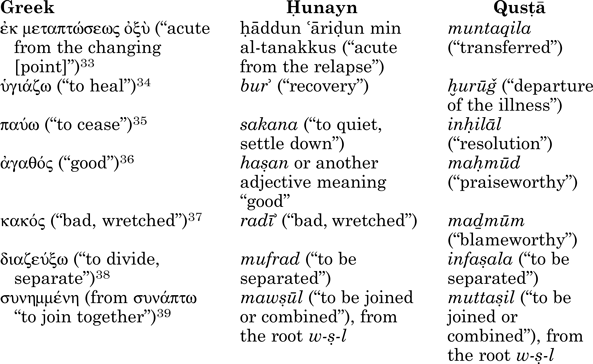
The Masāʾil discusses several medical concepts relevant to crises and critical days, but the terminology adopted (or coined) by Qusṭā differs from what became the standard Arabic translation of the Critical Days, namely, that of Ḥunayn ibn Isḥāq.Footnote 32 The following chart depicts the renderings of various key terms, by Ḥunayn and Qusṭā, respectively (Table 1).
Comparison of Terminology

Ḥunayn's rendering of the Greek phrase ἐκ μεταπτώσεως ὀξὺ (“acute from the changing [point]”) is the longer and more precise ḥāddun ʿāriḍun min al-tanakkus (“acute from the relapse”). Galen's original context suggests that the patient has suffered a relapse and that the illness has returned in an acute form. The other examples in the chart show how Ḥunayn's rendering of this technical vocabulary tends to be more faithful to the Greek. With regard to the idiosyncratic method of counting the week and half-week periods of the critical days, however, the two translators are more in agreement. Some contiguous periods, such as half-weeks within a week, or the second and third weeks, are counted with one overlapping day. However, the counting of the first and second weeks proceeds from days seven and eight with no overlap.Footnote 40 For the former case, which is the manner musical intervals are counted – i.e., the second medical week concludes on the fourteenth day and the third begins on the same day – both men use terms derived from the root w-ṣ-l: Qusṭā has muttaṣil “to be joined or combined,” and Ḥunayn uses mawṣūl with similar meaning, for Greek συνημμένη (from verb συνάπτω “to join together”). In the latter case, separated periods, the first week concludes on the seventh day, and the second begins on the eighth. Qusṭā employs the verb infaṣala “to be separated,” whereas Ḥunayn employs mufrad with similar meaning, for Greek διαζεύξω (“to divide, separate”).
From this we may conclude that, although the content of Qusṭā's text ultimately derives from Galen's treatise, it must be completely unrelated to Ḥunayn's translation of that work. Furthermore, Qusṭā's rendering of Galen's terminology is less precise than Ḥunayn's.
2. Logical Break-Off Point
The fifteen questions and answers of the Masāʾil summarize general concepts that are discussed in great detail in the first two books of Galen's treatise; then the Masāʾil breaks off at a point corresponding to the end of Galen's Book II. Rather than indicating that Qusṭā or his patron were uninterested in the contents of Galen's Book III, the absence of material from that book most probably reflects Qusṭā's attitude toward Galen's explanation of the critical days, specifically Galen's version of astrological medicine, to which Critical Days Book III is mainly devoted.
Galen employs two kinds of astrology in his theory of critical days: (1) natural astrology, a general kind of influence of the celestial bodies on the mundane world, such as on the weather, which was consistent with the natural philosophy of the time and which most intellectuals accepted;Footnote 41 and (2) judicial astrology, which was the attempt to make specific predictions based, for example, on planetary positions at a specific moment of time. The former type pervades Galen's entire treatise, while the latter appears in Book III alone. While the relationship of astrology to medicine was always controversial, disputes mainly concerned whether judicial (or divinatory) astrology was even possible, let alone medically useful.Footnote 42 Qusṭā was one of the thinkers who accepted natural but not judicial astrology, so it is not surprising that there is no hint in the Masāʾil of the judicial astrology that figures so prominently in Galen's Book III.Footnote 43
It is also possible that Qusṭā's patron was interested in the applied aspects of the critical days rather than in the theoretical, and thus less in the contents of Galen's treatise, which was also almost completely theoretical in character and directed – as Galen stated – to those physicians who aspired to a philosopher's understanding of medicine.Footnote 44 So although it seems certain that the Masāʾil ultimately derives from Galen's Critical Days treatise, Qusṭā's purpose in preparing it is not clear from the information that we have.
TRANSLATION AND COMMENTARY
In this section, a translation of the Masāʾil is presented; where applicable, Qusṭā's question and answer is followed by discussion of its medical concepts, preceded by ~.
In the ancient classification (nosology), diseases are broadly of two kinds: acute (ὀξύς / ḥādd) and chronic (χρόνιος / muzmin). The acute were understood to be the more severe and to kill most patients.Footnote 45 The sense of “sharp” in the meaning literally refers to the patient's suffering,Footnote 46 but also refers metaphorically to the rapidity of changes in the patient's condition, which could involve sweating, discharges (including the crisis), and periodic climaxes in the fever's intensity (παροξυσμός “paroxysm,” nawba, pl. nawāʾib). The temporal profile of the illness has sharp peaks and valleys, reflecting this rapidly changing condition.Footnote 47 Chronic illnesses, by contrast, do not change very much, and their temporal profile is smoother. The full title of the Masāʾil makes clear that Qusṭā's primary concern was with acute illnesses.
1.Q: In how many ways can the departure of the illnesses occur?
A: The departure of the illnesses can happen in two ways: one is departure of the illness via a crisis, and the other is a departure from it that occurs via a dissolution alone without a crisis.Footnote 48
~ Illnesses are thought to reside in the body, or to alter the body's internal conditions. “Departure (ḫurūǧ) of the illness” here must mean that something is expelled or that the illness vanishes after humoral balance is restored and the internal organs or tissue are no longer being damaged.Footnote 49
Galen exerts much effort to determine when the illness actually begins,Footnote 50 and he eventually settles on the moment when the patient is so affected by the illness that he must lie down on his bed. This moment, called the “hour of decumbiture” (waqt al-iḍṭiǧāʿ),Footnote 51 is significant because the critical days form a series in time, counted from the beginning of the illness. If the beginning is known, the series can be calculated with reasonable confidence, and hence what to expect on specific days from the onset of the illness can be forecast.Footnote 52 Determining this moment also assists medical astrology, since the hour of decumbiture is considered to be the moment the illness was “born”, and the astrologer could determine a natal chart for it, i.e. the “horoscope” of the illness.
There are multiple ways for the illness to depart, the two most important being via a crisis, which involves an expulsion of something dangerous from the body, or a dissolution – something dissolved, or transformed, as into an abscess or swelling (ἀπόστασις / ḫurāǧ)Footnote 53 – agitated by a crisis. The abscession represents the segregation or evacuation of the diseased humors from the healthy, and their gathering to a specific place in the patient's body, whence they could perhaps be drained.Footnote 54 Although crisis (buḥrān) was a concept already familiar in Syriac medical literature – buḥrān is in fact a Syriac translation of the Greek term κρίσις, imported directly into Arabic and made standard Arabic usage through the translations of Ḥunayn – it is not a simple concept.Footnote 55 It has been defined as the “turning point of a disease, sudden change for better or worse,”Footnote 56 which, however, covers only the surface meaning. Galen developed the concept comprehensively in his two treatises, De crisibus (“Crises”) and the Critical Days, where it is clear that this turning point is usually accompanied by an expulsion of harmful or putrid humors from the body.Footnote 57
This question calls to mind one of the central concepts of Greek medicine, namely, that in a state of health the fluid humors of the body are allowed to flow freely, through as well as in and out of the body. Illness usually involves an obstruction of some sort that must be removed, since obstructed humors can putrefy and their corruption can spread to surrounding organs or tissue, making the situation particularly dangerous for the patient.
In the Hippocratic-Galenic medical tradition, two humoral pathologies were developed. The first emphasized the maintenance of the balance of bodily humors for health and its restoration in the case of illness, which was understood as an imbalance of these humors. The second, different though not incompatible with the first, emphasizes the presence of a diseased substance within the body, usually within a humor that has been transformed from its essential nature to a destructive entity, which can destroy tissues and organs.Footnote 58 Treatment in the latter case focuses on encouraging the body to expel the harmful substance from the body as quickly as possible. The former conception emphasized prevention; the latter, healing by removing the harmful cause. The former is discussed, e.g., in Hippocrates, Nature of Man Footnote 59 and Galen's On Temperaments;Footnote 60 the latter in the Critical Days and the Crises.Footnote 61 In his survey of ancient Greek medicine Vivian Nutton describes how Plato in the Timaeus (82a–84c) presented two kinds of humoral pathologies similar to the dichotomy I have described,Footnote 62 which he takes to be the beginnings of these notions in Greek medicine. It is noteworthy that both perspectives were linked conceptually by the idea of health requiring unobstructed pathways for the humors to freely flow.Footnote 63 Obstruction leads to either imbalance, or putrefaction of the humors, or both.
One of the few modern scholars who addresses this second type of humoral pathology is Volker Langholf, who has examined closely the concepts of crisis and critical days in the Hippocratic corpus, showing how the concepts of krisis (κρίσις / buḥrān), apostasis (ἀπόστασις / ḫurāǧ “segregation”) and pepsis (πέψις / naḍǧ “cooking” or “ripening”) are connected.Footnote 64 The harmful matter, Langholf notes, is not designated by an explicit term in the Hippocratic writings, but later physicians referred to it by coining terms such as materia peccans (“corrupting substance”), or humor purulentus (“putrid humor”).Footnote 65 The natural process, as conceived, was for the body via its innate heat to cook the diseased humor, and then to expel it completely via a crisis, through sputum, urine, perspiration, or excreta, or through a segregation, usually in the form of a swelling. The expulsion event was called a crisis, and usually involved traumatic symptoms: convulsions, vomiting, sweating, tremor, etc.Footnote 66 Galen mentions crises in the De usu partium as graphic and persuasive proof of nature's method of healing.Footnote 67 Therapy and prognosis centered around the crisis event, namely, preparing the patient to maximize the chances of experiencing a beneficial crisis and inspecting the above-mentioned secretions for signs indicating when the crisis would occur, both for diagnosis and prognosis.Footnote 68 The challenge for the physician was to accomplish this without causing further harm to the patient.Footnote 69
2.Q: How many classes of illnesses are there that conclude via a crisis?
A: The illnesses that conclude via a crisis are of two classes. One class comprises the acute illnesses, and the other the illnesses that transfer from the acute illnesses, which are called “transferring illnesses.”
~ “To conclude” is a different concept than “departure” in that there is no hint of anything emerging, only that the illness is terminated, with a definite result. The transferring illnesses are rendered by Ḥunayn as “acute from the relapse.”Footnote 70 (See the discussion of this concept earlier in the Introduction).
3.Q: What are the acute illnesses, and what are the illnesses that transfer from the acute?
A: The acute illnesses are those that conclude within twenty days. The illnesses that transfer from the acute are those that conclude between twenty and forty days.
~ Both kinds of illness conclude before forty days. Acute illnesses, especially the more severe ones, usually resolve by the twentieth day, either by death or by becoming less severely acute or by recovery. Furthermore, the patient with an acute fever will have experienced at least one crisis by day twenty. The transformation from an acute illness to a less severe form produces a class of illnesses called “acute from the relapse” (see discussion of terminology earlier), or as here, “transferring illnesses.” The traditional boundary between acute and chronic illnesses was forty days, or a quarantine, because by that time any acute illness would have either run its lethal course, or abated, or become a less severe chronic illness.Footnote 71 Greek physicians had explained epidemic diseases by corrupt air from swamps or garbage dumps, which affect the local population, rather than being transmitted contagiously from person to person.Footnote 72 In the period after Qusṭā, Muslim physicians in the wake of the 14th century Black Death began to question prophetic hadiths that denied the existence of contagion. For example, Ibn al-Ḫaṭīb (d. 776/1374) argued that empirical evidence, derived from the devastating experience of the plague, necessitated the rejection of those hadiths.Footnote 73 Similar reasoning in western Europe led to the institutionalized quarantine, later adopted in the Islamic world.Footnote 74
4.Q: Which illnesses conclude via a gradual dissolution without a crisis?
A: The illnesses that conclude after forty days do not resolve via a crisis. Rather they conclude by diminishing gradually until they come to an end.
~ After forty days come the non-acute (i.e., chronic) illnesses. They have no crisis (i.e., they are non-critical), but they gradually diminish in intensity until they conclude. The Hippocratic writings suggested a greater pattern extending to periods of seven months and multiples of seven years, mentioned by Galen, though without offering proof.Footnote 75 This way of thinking informed Galen's discussion of the viability of the seven-month child but the non-viability of the eighth-month child, for which Galen also invokes the lunar periods.Footnote 76 Here Galen took a rule of thumb known by practicing physicians, namely, the supposed special character of the seven-month period in human gestation, and used (quasi-)empirical arguments derived from astronomy/astrology to show why it really is so.
5.Q: In how many ways can the departure of the illnesses occur via crisis and its dissolution without a crisis?
A: The departure of the illnesses via a crisis, as well as those without a crisis, follows two courses: one has a regular manner and the other an irregular manner.
~ The departure of critical and non-critical illnesses is either according to a natural system or a non-natural one (regular vs. irregular). The important term here is niẓām, normally rendered “system,” which is the central idea behind the entire Galenic scheme of the critical days.Footnote 77 As a clue to what niẓām means in this context, in the Critical Days, it refers to the order inherent in the superlunary realm of celestial bodies, the influence of which, although it permeates our sublunary world, is impeded by matter, which is inherently chaotic and resistant to such regularizing influences.Footnote 78
The underlying concept at work here is expounded by Galen in Book II when he states that, if nature were allowed to function unimpeded, the illnesses would unfold so that the critical days series would be perfectly regular. However, extraneous factors – such as violent thunderstorms, domestic disturbances next door, barking dogs, the patient falling victim to robbers, collapsing roofs, flooding, or fire, or mistakes on the part of the patient or physicianFootnote 79 – often intervene in the patient's situation and cause the regular pattern of the illness to be disturbed. The natural system (niẓām, the equivalent of Greek ἁρμονία, “(cosmic) harmony”) behind the critical days is distorted when a crisis is compelled to occur prematurely.Footnote 80 The sense is that the ideal state is one where all factors operate in harmony, and the mistakes introduce discordant notes. Galen's term for mistake, πλημμελέω [lit. “to play a wrong note”], is rich with musical associations,Footnote 81 which are not carried over into Arabic, as all references to this concept are rendered simply by Form IV (aḫṭaʾa) of ḫaṭiʾa “to make a mistake”.Footnote 82 The physician's job is to ascertain the perturbing effect that such discordant factors introduce into the natural system, and compensate for them.
Thus, a departure in the regular manner is when all natural conditions are optimal, and irregular when there are mistakes or perturbing factors that knock the system off its natural course. The import of this for therapy is that a crisis that would, under optimal conditions, occur on one critical day, will now either come early or be delayed. In either case, its deviation from the natural pattern will harm the patient: if early, the crisis might overwhelm a body that has not been prepared to face the trauma; if late, the illness has done more damage than expected by remaining in the body longer, before the crisis brings it to a conclusion. Galen provides an example of what happens when the natural system (niẓām) behind the critical days is disrupted by an error in therapy, resulting in the premature occurrence of the crisis, and dangerous consequences for the patient.Footnote 83
6.Q: What happens when the departure of the illnesses (occurs) via a crisis, as well as without a crisis, when it has a regular manner?
A: In the case of the illnesses with a departure, the regular character (of this departure) derives from the beginning (of the illness), and, in the first instance, up to the twentieth day it follows four-day intervals, and, in the second, from the twentieth day to the fortieth it follows seven-day intervals, and, in the third, from the fortieth day to the hundred and twentieth day it follows twenty-day intervals. So, the first of the days that proceed by four-day intervals is the fourth day, followed by the seventh, the twelfth, the fourteenth, the seventeenth, and the twentieth.Footnote 84 And the first of the days that progress in a regular manner by seven-day intervals is the twentieth, followed by the twenty-seventh, the thirty-fourth,Footnote 85 and the fortieth days. And the first of the days that progress in a regular manner by twenty-day intervals is the fortieth day, followed by the sixtieth, the eightieth, the hundredth, and the hundred and twentieth days. After the hundred and twentieth day, however, the dissolution of illnesses that progress in a regular manner occurs in a seven-month interval, followed by a seven-year interval, and then a double seven-year interval, and then in a triple seven-year interval.
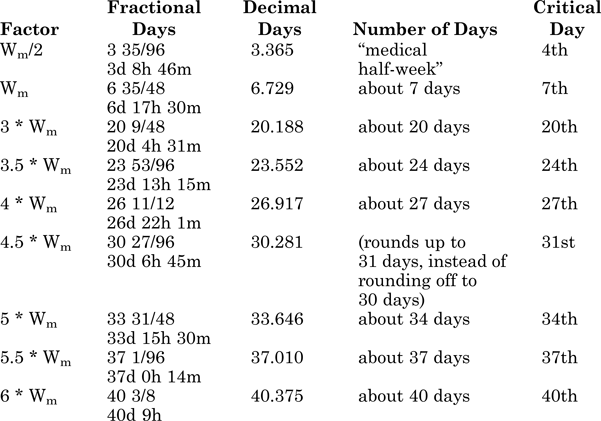
~ The regular manner of departure, in both critical and non-critical illnesses, is said to derive from four-day, seven-day, and twenty-day intervals (Table 2). The Critical Days, however, does not present the matter so simply, as Galen employs much of Books I and II to derive this list from the data of Hippocrates's Epidemics I and III. Galen's results appear to require an idiosyncratic way of counting, which actually results from successively adding non-integer periods.Footnote 86
The intervals and their associated critical days are as follows:
Note that the first segment is not straightforwardly derived from four-day intervals. (This is unlike the scheme that al-Kindī developed, based on whole seven days intervals, and their halves, which will be discussed later). It becomes clear after Galen does his lunar calculations and derives the “medical week” (Critical Days, Book III) that the apparent overlapping and separating of these intervals results from the repeated adding of a four-day interval that is actually a medical half-week of slightly less than 3.5 days (i.e., 3 35/96, or about 3.36 days).Footnote 87 Furthermore, in the group of critical days said to be derived from the seven-day interval, there is a similar anomaly that is explained by repeatedly adding a “medical week” of 6 35/48, or about 6.73 days.
The distribution of illnesses after the 120th dayFootnote 88 is a seven-month period, followed by seven years, fourteen years, and twenty-one years. These periods must refer to chronic illnesses the existence of which is more hypothetical than empirically demonstrated.
7.Q: What happens when the departure of the illnesses is irregular?
A: When the dissolution of the illnesses is irregular, their dissolution occurs in time intervals other than these that we have defined, so that the dissolution of the illness occurs via a crisis on the third day, or on the fifth day, or on the sixth, [or on the tenth,]Footnote 89 or on the ninth, or on the tenth, or on the twelfth, or on the thirteenth, or on some other day that falls between the four-day and the seven-day intervals. In a similar manner the dissolution of chronic illnesses is irregular when it occurs in the time intervals that fall outside of the boundaries that we have defined, i.e., a crisis will occur between the twentieth and the fortieth days, on other days as they happen to occur, and between the fortieth and sixtieth on a random day. After this, [a crisis will occur] on the days and the months and the years that fall within the time intervals that we have defined.
~ The irregular manner of departure means that the illness resolves on different days from those in the list. That is to say, the illness has been perturbed from its natural course by extraneous factors. Galen discusses at length the consequences of this situation for the patient.Footnote 90
8.Q: Are all the critical days equally praiseworthy or blameworthy, or are they unequal in this?
A: The days on which the crises occur are not equal [in praiseworthiness or blameworthiness], but they compete with each other, so that the praiseworthy days have degrees of blameworthiness, and the blameworthy days have degrees of praiseworthiness,Footnote 91 and between these two are days that are intermediate between praiseworthy and blameworthy.
~ The critical days are not all of the same valence, good or bad. In fact, most of them have mixtures of good and bad qualities. The subsequent questions attempt to rank the critical days in order of these qualities.
9.Q: How are the praiseworthy days ranked in order of praiseworthiness?
A: The best of all the critical days are the seventh and the fourteenth days. After these two are the ninth, the eleventh, and the twentieth. Next in rank are the seventeenth and the fifth days,Footnote 92 followed by the fourth, the third, and after these the eighteenth.
~ The ranking of the good days follows the same order as found in the Critical Days. The coinciding of the best critical days with periods of one week and two weeks, although slightly less than an integer set of days, is what led Galen to invoke the lunar period and the moon's influence on the critical days – developed in Book III – and is the source of Galen's “astrological” medicine.
Qusṭā gives the shorthand classification of the critical days as good or bad, but Galen actually qualifies the crises with six (binary) parameters: quality (good/bad), completeness, trustworthiness, prior indication, safety, and distinctness.Footnote 93 The good critical days tend to produce crises with more of the positive parameters, while the bad critical days tend to produce crises with more of the negative parameters.
10.Q: How are the blameworthy days ranked in order of blameworthiness?
A: The most malicious and the most wretched of all the critical days is the sixth day, whose crisis follows the opposite course to that of the seventh day, and after it the eighth and the tenth days, and after these the twelfth and the sixteenth days, and then the nineteenth day. The days that are between the praiseworthy and the blameworthy are the thirteenth and the fifteenth days.
~ The sixth day, which is the worst, represents a crisis coming prematurely – before the best critical day, the seventh – which is dangerous since the patient is unprepared for it. Galen compares the sixth day to a tyrant who enjoys inflicting torture on his subjects, and the seventh day to a benevolent king who has the best interests of his subjects in mind.Footnote 94 Galen further observes that the thirteenth day is the least likely to have a crisis,Footnote 95 so that if one occurs it will inevitably be premature and bad. This does not appear in Qusṭā's ranking.
Questions 11 and 12 present the good and bad critical days in chronological order, as they would be encountered by the patient in time, not in order of their good or bad qualities.
11.Q: How are the praiseworthy critical days counted, not following their ranking in praiseworthiness?
A: The praiseworthy critical days, in order of counting, are the third, fourth, fifth, seventh, ninth, eleventh, fourteenth, seventeenth, eighteenth, and twentieth days.
12.Q: How are the blameworthy critical days counted, not following their ranking in blameworthiness?
A: The blameworthy critical days, in order of counting, are the sixth, eighth, tenth, twelfth, sixteenth, and nineteenth days. Those between them and the praiseworthy (critical) days, are the thirteenth and the fifteenth days.
13.Q: In what manner do acute illnesses conclude, and in what manner do illnesses that transfer from acute conclude?
A: The acute illnesses that conclude in twenty days resolve via a crisis, and the illnesses that transfer from the acute illnesses resolve on the days between the twentieth day [and the fortieth day].Footnote 96
~ The conclusion of acute illnesses varies according to the interval in which they resolve. If they resolve before the twentieth day, they are by definition acute without qualification. However, if they do not resolve until the interval between the twentieth and fortieth days, they are by definition “transferring from the acute” illnesses (previously discussed in questions 2 and 3).
14.Q: Which of the days after the twentieth, on which (the illness) concludes, are praiseworthy, and which of them are blameworthy, and how are they ranked?
A: The best of all of the days after the twentieth are the twenty-seventh, the thirty-fourth, and the fortieth, and after them the twenty-fourth, the thirty-first, and the thirty-seventh. However, there is no crisis at all on the days that fall between the twentieth and the fortieth days.
~ I am not sure what to make of Qusṭā's assertion that there are no crises on the days occurring between the twentieth and the fortieth, since that would imply that there are no critical days in that interval either.
15.Q: For what reason does the third week end with twenty days and not twenty-one?
A: The weeks of the crises are counted according to two counting schemes: according to one [scheme], the one week is separated from the other week; and according to the other [scheme], two weeks will overlap, sharing one day between them.
Thus, the first and second weeks are counted as separate – the end of the first week is the seventh day and the beginning of the second week is the eighth day – but the second and the third weeks are counted as overlapping, sharing a day between them, namely, the fourteenth day. So it is counted as the end of the second week and as the beginning of the third week, and, since the fourteenth day is the beginning of the third week, [the third week] ends on the twentieth day, not on the twenty-first. Both the decisive test (of experience) and the counting testify to the soundness of this doctrine.
~ Qusṭā reproduces the original question that spurred Galen to investigate the whole phenomenon of the critical days. As a young medical student, Galen tells us, he puzzled over why in the medical context three weeks was counted as twenty and not twenty-one days.Footnote 97 His investigation also answered how the smaller critical days can follow an interval of four days. The counting scheme of separated and overlapping days, which is described in detail in the Critical Days, is a rule of thumb for the practicing physician, for whom the addition of fractional days may be impractical.Footnote 98
Galen's calculations to arrive at a medical week (Wm) of 6 35/48 days explain how to derive the critical day series from the figure for Wm by rounding to the nearest whole day.Footnote 99 (The figures in Table 3 are given to three decimal places).
The Critical Days as Multiples of a Medical “Half-Week”
Note that, with the exception of 4.5 * Wm, all numbers are rounded off to the nearest day and closely follow the critical days that fall between days twenty and forty as answered in Question 14.
QUSṬĀ'S CONTEMPORARY AL-KINDĪ AND HIS MATHEMATICAL THEORY OF THE CRITICAL DAYS
Qusṭā's contemporary, Abū Yūsuf Yaʿqūb ibn Isḥāq al-Kindī (d. c. 870),Footnote 100 took a very different approach to the critical days. This is found in a short treatise that has survived only in Judaeo-Arabic, the Risāla fī ʿillat al-baḥārīn li-al-amrāḍ al-ḥādda (“Epistle Concerning the Causes of Crises in Acute Illnesses”).Footnote 101 A translation and discussion of this treatise was included in the Introduction and as an appendix to my edition of the Critical Days.Footnote 102 It is necessary, however, to summarize al-Kindī's text here, to be able to compare his approach to Qusṭā's.
Through his wide ranging interests, al-Kindī inaugurated an Arabic philosophical tradition, possibly reinventing philosophy as a discipline from scratch,Footnote 103 using the demonstrative logical format of geometry and mathematics.Footnote 104 Al-Kindī, therefore, employed this approach in organizing his theory of the critical days, an approach wholly without precedent in Greek or Arabic.
Al-Kindī's approach, which imposes pre-conceived mathematical relationships on the critical days before experience, and which he shares with Plato and Pythagoras, was opposed to that of another group of more empirical natural philosophers, among whom were Aristotle and Galen.Footnote 105 Galen is not mentioned by al-Kindī, which suggests that he either did not know of, or ignored, Galen's Critical Days treatise. Galen in fact heaped scorn upon this approach to medicine in general,Footnote 106 especially on those who exaggerated the significance of numerical relationships in nature.Footnote 107
Because the critical days form a subset of the natural numbers, Al-Kindī's theory involves a discussion of arithmetic.Footnote 108 He begins by discussing the series of square numbers and shows how they are connected to the series of odd numbers.Footnote 109 He then divides the natural numbers into three classes, named for geometrical shapes:Footnote 110square numbers (sg. murabbaʿ), which can be decomposed into two equal factors (e.g., 2 × 2 = 4); rectangular numbers (described as a figure of unequal sides) can be decomposed into unequal factors (e.g., 3 × 4 = 12); and linear numbers (sg. ḫaṭṭ) represent prime numbers.
Al-Kindī thought that better crises occurred on the odd-numbered critical days, and so he shows why those days are stronger. He proceeds to demonstrate how the series of odd numbers, when added up, produces the series of squares,Footnote 111 suggesting that the odd integers are components of more complex number series. The even numbers, however, lack such a quality, for when likewise summed, they yield only rectangular numbers.Footnote 112 Even numbers, he concludes, are inferior to odd numbers, which are more elemental, resembling the Monad, namely, the Pythagorean origin of all things. This is why, al-KindīFootnote 113 claims, Hippocrates taught that the odd-numbered critical day will produce more beneficial crises than the even-numbered one.Footnote 114
Like Galen, al-Kindī concluded that the moon provokes crises in patients, since there is a correspondence between the major critical days, and the endpoints of the weeks of the month.Footnote 115 Al-Kindī lists eight lunar half-weeks, each lasting 3.5 days, which add up to 28 days.Footnote 116 The week of seven whole days (equivalent to two of these 3.5 day phases) for al-Kindī is the fundamental unit of his critical days scheme, since he considers the seventh, fourteenth, and twenty-first days to be the most powerful of the critical days because they correspond to the most significant and powerful lunar phases.Footnote 117 It seems surprising that al-Kindī could have failed to note the fact that the month can vary in length between 29 and 30 days, slightly more than the 28 days of al-Kindī's scheme – especially given the centrality of the lunar month in Islam. The additional days seem to be accounted for from the times of conjunction, which can add an additional day or two.Footnote 118 Galen's empirically more sophisticated scheme takes into account the two most common actual month lengths, the sidereal,Footnote 119 or the time for the moon to return to the same ecliptic longitude (about 27⅓ days) and the synodic,Footnote 120 or the time between full moons (about 29.5 days on average).Footnote 121 Al-Kindī's scheme differs from Galen and Hippocrates, who counted these phases as four day periods. Their scheme yields, for 20 days, six 4 day periods, but counted in an odd way that cannot be based on whole days. Al-Kindī apparently didn't know about this strange way of counting in Hippocrates, which for Galen was the crucial clue he needed to find the fractional basis of the scheme.
It is also noteworthy that Qusṭā translated the Arithmeticae of Diophantus (3rd century) into Arabic, and so we can conclude that Qusṭā's knowledge of numbers extended far beyond that of al-Kindī.Footnote 122 The Arithmeticae, which works out integer solutions to 130 more or less complex equations, while not offering a general method of solution, does require a more sophisticated grasp of the concept of number than what al-Kindī shows in his Risāla, which is more numerological in character. Whereas al-Kindī's approach was more speculative, as we have seen, in that he tried to connect disparate realms of the natural world – number and human physiology – when the Arithmeticae became available in Arabic, it became possible to see how number could be treated as a self-contained field of study.
A PARALLEL DISCUSSION IN THE ASTROLOGICAL WRITINGS OF ABŪ MAʿŠAR
There is significant parallel to this discussion of scientific methodology in the writings of the contemporary astrologer, Ǧaʿfar ibn Muḥammad Abū Maʿšar al-Balḫī (787–886). In his Great Introduction to Astrology (kitāb al-madḫal al-kabīr ʿalā ʿilm aḥkām al-nuǧūm), which appeared c. 849/850,Footnote 123 the purpose of which was to present a comprehensive natural philosophy with astrology as the “master science”,Footnote 124 he describes how the two principles, experience (taǧriba) and reason (qiyās) must work together to create sound natural knowledge.Footnote 125 For astrology, experience must include the observations of past people, since a single lifetime is too brief to observe the long planetary cycles, and to note their effects on the earth.Footnote 126 Reason is primarily analogical, or inference from known particulars to other unknowns, via a general rule abstracted from the data.Footnote 127 Furthermore, as a master science, astrology is for Abū Maʿšar metaphysically prior to all other sciences, especially medicine. In his view, astrology provides the principles (awwaliyya) of medical knowledge,Footnote 128 or is the “cause” of medicine.Footnote 129
Galen devoted much space in the Critical Days and other works to discussing how experience and reason must be used together to create medical knowledge, effectively resolving the dichotomy between medical Dogmatists and Empiricists that had prevailed for centuries before his time.Footnote 130 Although Abū Maʿšar's position on this issue is similar to Galen's, and diverges from al-Kindī's in a manner similar to Galen's, it is unnecessary to suppose that Abū Maʿšar was influenced by the Critical Days (which I have argued was unavailable as yet), or even by Galen's other doctrines, for he could have derived these ideas from the Aristotelian tradition, in common with Galen. Indeed, Abū Maʿšar's writings are so imbued with Aristotelianism, that R. Lemay has shown how his astrological works introduced Latin Europe to key Aristotelian ideas long before the Latin translations of Galen or Aristotle became available.Footnote 131
CONCLUSION
The historical importance of this document is at least three-fold: 1) Because there were at least two versions of Galen's crisis doctrines in Arabic at the same time, written by contemporaries who likely knew one another, Ḥunayn and Qusṭā, this casts doubt on the popular view that the Greco-Arabic Translation Movement was a grand cooperative enterprise. Rather, the actual situation suggests that two of the leading figures of this movement were operating independently of one another. This would be especially true, if Qusṭā's text was written in order to attract a patron to finance the translation of a text that Ḥunayn had already translated.
2) The distinct approaches to the critical days, that of al-Kindī on the one hand, and that of Galen (via Ḥunayn and Qusṭā) on the other show that both a mathematical/rationalist and an empiricist approach to natural philosophy coexisted for a time in mid-9th century Baghdad, and suggests that the proper form of a scientific theory was being discussed. The appearance of a similar discussion in Abū Maʿšar, though perhaps derived directly from Aristotle, supports this. Certainly by the next generation, intellectuals had acquired enough of the tools of Greek logic to ask even more sophisticated questions about scientific form and method.Footnote 132 However, this later discussion would not have been possible without the groundwork of Kindī/Ḥunayn/Qusṭā in the 9th century.
Finally, 3) Qusṭā's text introduces medical concepts within a humoral pathology that were important in Greco-Arabic medical therapy, but have been little studied, and thus poorly understood by modern scholars of Greek medicine in Arabic. The subject is better understood by modern scholars of the medieval European physicians, who were beneficiaries of the Arabo-Latin Translation Movement. For example, a recent survey of medieval medicine in the Islamic world that is in many ways excellent, mentions neither crises nor critical days, in spite of their importance in theory, at least. In their discussion of humoral pathology, Pormann and Savage-Smith mention only the first type I described earlier.Footnote 133 Yet, although the concepts of obstruction, flow, crises, and critical days appear prominently in Ibn Sīnā's Qānūn, apart from the 9th century, there seem to have few Arabic treatises that explicitly discuss them.Footnote 134 There are the paraphrases from Hippocrates and Galen on crises and critical days in al-Rāzī's Ḥāwī, which suggests continued interest in the subject beyond the 9th century. This subject appears to have been of much greater interest to the later Latin physicians, who practiced a more “astrologized” medicine.
It would be useful, for example, to examine the Arabic case histories, such as are found in al-Rāzī (d. 925), to determine how Arabic physicians used these theoretical ideas about crises and critical days in actual practice. This has been done in general by Iskandar and Álvarez Millán, who have shown that, as was the case with certain Latin physicians, theory and practice diverged on these points.Footnote 135 Al-Rāzī was himself formatively influenced by the Hippocratic Epidemics tradition and Galen in his own clinical reports of patients, but especially the former.Footnote 136 He took a critical stance toward Galen, as indicated by his treatise al-Šukūk ʿalā Ǧālīnūs (“Doubts against Ptolemy”), as well as in specific accounts discussed by Iskandar.Footnote 137 Moreover, his case histories form an extremely important source for the history of the development of clinical practice under Islam.Footnote 138
A. Z. Iskandar, in his seminal study of al-Rāzī's clinical accounts,Footnote 139 shows, via many examples, how al-Rāzī used his own observations to critique and reject much Galenic medical doctrine, such as his highly differentiated conception of fevers, as well as specific treatments. Furthermore, al-Rāzī criticized earlier Arabic medical authorities, when his own observations disagreed with theirs. In this effort, al-Rāzī was self-consciously privileging personal clinical observation (taǧriba) over received theory.
C. Álvarez Millán, moreover, has published much on al-Rāzī's clinical accounts, comparing them with Greco-Roman accounts, as well as analyzing them per se.Footnote 140 In a recent study, she has vividly documented how medical theory was often ignored in practice, in order to answer the question of how reliable medieval Islamic medical accounts are for reconstructing actual practice.Footnote 141 There is a need for such detailed investigation, since modern studies of Islamic medicine have focused on theoretical aspects. She finds that sometimes the clinical accounts must be used with caution, especially when part of an established literary genre, since their authors were writing to please a ruler patron or to advance their own fame. However, she determined that al-Rāzī's rich sources of his clinical experiences, the Kitāb al-Ḥāwī and the Kitāb al-Taǧārib were case notes not intended for publication, and so may be taken to reflect actual practice.Footnote 142
As per the first point mentioned earlier, while the relation between Qusṭā's short medical piece on the critical days and Ḥunayn's earlier translation of the Critical Days, if any, is uncertain, what is certain is that al-Kindī's and Qusṭā's (or Galen's) approaches coexisted in Baghdad in the mid-ninth century. It is tempting to speculate about chronology and its implications within the context of the Greco-Arabic translation movement, and my purpose in so doing is merely to adumbrate possible avenues of investigation for others to pursue.
Because his terminology and approach is so different from the others, it seems likely that al-Kindī wrote his Risāla before either Qusṭā's Masāʾil or Ḥunayn's translation of Galen's Critical Days became available. Also, had al-Kindī known of Qusṭā's (or Galen's) empirical approach to the critical days, one wonders whether he would have seen a need to explain them mathematically as he did. As can be seen from his other works, al-Kindī was not strictly anti-empiricist. Given the astrological interest of his time as well as his own writings in that field, as well as his influence on the most important Arabic astrologer, Abū Maʿšar, he might rather have attempted to clarify Galen's confused astrological medicine in the Critical Days than to supplant Galen's entire theory of the critical days.Footnote 143
Ḥunayn's translation seems not to have been available to Qusṭā either. As argued above, the terminology of Qusṭā's Masāʾil is independent of Ḥunayn's translation, which strongly suggests that it derives directly from the Greek version of the Critical Days. With his knowledge of Greek, Qusṭā coined a new Arabic terminology, independent of the Syro-Arabic medical terminology of al-Kindī and Ḥunayn. It is tempting to conclude from this that Ḥunayn's translation was not at that time available to Qusṭā for, if he did have access to it, why would he create a different terminology from Ḥunayn's?Footnote 144 It is also possible that the Masāʾil was prepared for a patron who desired to know whether the contents of the Critical Days were worth paying for a translation of the entire text, as was sometimes done.Footnote 145 Or, perhaps Qusṭā was merely reporting on the main elements of the doctrine of the critical days for the sake of discussion with his circle, also a common practice, as exemplified by al-Kindī and his circle.Footnote 146
Furthermore, given that Qusṭā came to Baghdad some time after al-Kindī's fall from official favor, which occurred during the reign of al-Mutawakkil (r. 847–61), and the fact that the Critical Days was translated before 856,Footnote 147 this seems to imply that Ḥunayn's translation was not in the public domain for at least a decade. This further suggests that the patron who sponsored its translation, Muḥammad ibn Mūsā (d. 873), did so for his own personal use. If that is the case, then the traditional scenario of translators and scholars working together and discussing newly discovered and translated texts in a bayt al-ḥikma needs to be revised.Footnote 148
As the first Muslim natural philosopher, al-Kindī advanced many original ideas that were challenged or refined as more tools and understanding came to light from the Greek tradition. His theory of the critical days was evidently one of those that was discarded, since after Qusṭā's Masāʾil or Ḥunayn's translation of Galen the availability of the empirical approach to the critical days seems to have rendered al-Kindī's rational approach obsolete. Because Galen's approach is consistent with Aristotle's philosophy, his became the favored approach after Aristotelianism became the dominant Greek-derived philosophy in Baghdad a generation or so later. Nevertheless, Galen's astrological approach was also found wanting in the Arabic critical days tradition, as the presence of Galen's version of the critical days series, but without his judicial astrology, in the Qānūn of Ibn Sīnā would suggest.Footnote 149 However, the presence of similar Aristotelian ideas in the influential astrological writings of Abū Maʿšar ensured that medicine and judicial astrology would continue to be associated by other Arabic authors, and be transmitted to the Latin West in a later age.
[ص ١] مسائل جمعها قسطا بن لوقا اليوناني
في أيّام البحران في الأمراض الحادّة
[١] على كم جهة يجري الخروج من الأمراض؟
الخروج من الأمراض يكون على جهتين : أحدهما الخروج من المرض ببحران والآخر خروج منه يكون بانحلال فقط <بغير> بحرانFootnote 1.
[٢] كم أصناف الأمراض التي تنقضي ببحران؟
أصناف الأمراض التي تنقضي ببحران صنفان أحدهما أمراض حادّةوالآخر أمراض تنتقل من الأمراض الحادّة وتسمّى أمراض منتقلة.
[٣] ما الأمراض الحادّة وما الأمراض المنتقلة عن الحادّة؟
الأمراض الحادّة من التي يكون انقضاؤها في عشرين يوماً والأمراض [ص ٢] المنتقلةFootnote 2 عن الحادّةFootnote 3 من التي يكون انقضاؤها فيما بين عشرين يوماً إلى أربعين يوماً.
[٤] أيّ الأمراض يكون انقضاؤها بتحليل يعرض رويداً رويداً بغير بحران؟
الأمراض التي يكون انقضاؤها بعد أربعين يوماً لا تنقضي ببحران وإنّما يكون انقضاؤها بأن تنقص رويداً رويداً حتّى تنتهي.
[٥] على كم جهة يكون الخروج من الأمراض ببحران وانحلال بغير بحران؟
فالخروج من الأمراض ببحران وبغير بحران يكون على طريقتين : أحدهما بنظام والآخر بغير نظام.
[٦] كيف يجري الأمر في الخروج من الأمراض ببحران وبغير بحران على النظام؟
الأمراض التي يكون الخروج منها يكون نظامها من الأوّل وفي اليوم العشرين على روابيع ومن اليوم العشرين إلى يوم الأربعين على سوابيع، ومن اليوم الأربعين إلى اليوم العشرين والمائة على عشرين عشرين. فالأيّام التي تجري على روابيع أوّلها اليوم الرابع، ثمّ السابع، ثمّ الحادي عشر، ثمّ الرابع عشر، ثمّ السابع عشر، ثمّ العشرين. والأيّام التي يجري نظامها على سوابيع أوّلها العشرينFootnote 4، ثمّ السابع والعشرين، ثمّ الرابعFootnote 5 والثلاثين، ثمّ الأربعين. والأيّام التي يجري نظامها على عشرين عشرين أوّلها الأربعين، ثمّ الستّين، ثمّ الثمانين، ثمّ المائة ثمّ المائة [ص ٣] والعشرين وبعد المائة والعشرين يكون انحلال الأمراض التي تجري على نظام في سبعة أشهر، ثمّ في أسبوع من السنين، ثمّ في أسبوعين من السنين، ثمّ في ثلثة أسابيع من السنين.
[٧] كيف يجري الأمر في الخروج من الأمراض على غير نظام؟
الأمر يجري في انحلال الأمراض على غير نظام إذا كان انحلالها في غير هذه الأوقات التي حددناها حتّى يكون انحلال المرض ببحران في اليوم الثالث، أو في اليوم الخامس، أو في اليوم السادس [أو في العاشر]Footnote 6 أو في التاسع، أو في العاشر، أو في الثاني عشر، أو في الثالث عشر أو غير ذلك من الأيّام التي تقع بين الروابيع والسوابيع، وكذلك يكون انحلال الأمراض المزمنة على غير نظام إذا كان في الأزمان الخارجة عن الحدود التي حددنا أعني يكون بين العشرين والأربعين بحران من غير الأيّام التي حدث وبين الأربعين والستّين في يوم اتّفق. وبعد ذلك من الأيّام والشهور والسنين التي تقع بين الأوقات التي حددنا.
[٨] هل تجري أيّام البحران كلّها في الإحماد والذمّ مجرى واحدا ومتفاضل في ذلك؟
الأيّام التي تكون فيها البحارين لا تجري مجرى واحدا لكن تتفاضل كثيراFootnote 7 فإنّ الأيّام المحمودة لها في الذمّ مراتب والأيّام المذمومة لها في الإحمدFootnote 8 مراتب وبينهما أيّام متوسّطة بين المحمودة والمذمومة.
[٩] كيف يجري [ص ٤] الأمرFootnote 9 في الأيّام المحمودة على مراتبها في الإحماد؟
أفضل أيّام البحران كلّها اليوم السابع والرابع عشر وبعد هذين اليومين التاسع والحادي عشر والعشرون وبعدها السابع عشر والخامس وبعدها الرابع والثالث وبعدها الثامن عشر.
[١٠] كيف يجري الأمر في الأيّام المذمومة على مراتبها في الذمّ؟
أشرّ أيّام البحران كلّها وأردؤها اليوم السادس وهو على خلاف ما يجري عليه بحران اليوم السابع وبعده الثامن والعاشر وبعدهما الثاني عشر والسادس عشر والتاسع عشر وفيما بين أيّامFootnote 10 المحمودة والمذمومة اليوم الثالث عشر والخامس عشر.
[١١] كيف يجري الأمر في أيّام البحارين المحمودة على ترتيب العدد لا على ترتيبها في الإحماد؟
الأيّام المحمودة من أيّام البحران على تواليها من الثالث والرابع والخامس والسابع والتاسع والحادي عشر والرابع عشر والسابع عشر والثامن عشر والعشرين.
[١٢] كيف يجري الأمر في أيّام البحران المذمومة على ترتيب العدد لا على مراتبها في الذمّ؟
الأيّام المذمومة في البحران على توالي الأعداد من السادس والثامن والعاشر والثاني عشر والسادس عشر والتاسع عشر وفيما بينها وبين الأيّام المحمودة اليوم الثالث عشر والخامس عشر.
[١٣] كيف [ص ٥] يكون انقضاء الأمراض الحادّة وكيف يكون انقضاء الأمراض المنتقلة عن الحادّة؟
الأمراض الحادّة التي يكون انقضاؤها في عشرين يوماً يكون انحلالها ببحران والأمراض التي تنتقل عن الأمراض الحادّة يكون انقضاؤها فيما بين اليوم العشرين <واليوم الأربعين>Footnote 11.
[١٤] أيّ الأيّام بعد العشرين من الأيّام التي ينقضى فيها محمودة وأيّها مذمومة وكيف يجري الأمر في ترتيبها؟
الأيّام التي بعد العشرين أفضلها كلّها السابع والعشرينFootnote 12 والرابع والثلاثين والأربعين وبعدها الرابع والعشرين والواحد والثلاثين والسابع والثلاثين. فأمّا الأيّام التي بين هذه العشرين إلى الأربعين فليس فيها بحران البتّة.
[١٥] لماذا صار الأسبوع الثالث ينتهي في عشرين يوماً لا في واحد والعشرين؟
أسابيع البحارين تحسب على جنسين من الحساب :أحدهما ينفصل فيه الأسبوع من الأسبوع والآخر يجتمع فيه الأسبوعان، ويكون يوم واحد وهو اليوم الذي بينهما مشترك لهما. فالأسبوع الأوّل والثاني يحسبان على انفصال فيكون آخر الأسبوع الأوّل اليوم السابع وأوّل الأسبوع الثاني اليوم الثامن. فأمّا الأسبوع الثاني والثالث فيعدّان متّصلين ويشتركان في اليوم الذي بينهما وهو اليوم الرابع عشر. فإنّه يعدّFootnote 13 آخر الأسبوع الثاني وأوّل الأسبوع الثالث وإذا كان اليوم الرابع عشر [ص ٦] أوّلFootnote 14 الأسبوع الثالث كان آخره اليوم العشرين لا في اليوم الواحد والعشرين. والمحنة والحساب تشهد على صحّة هذا القول.