Implications
High on-farm mortality of beef calves and youngstock is economically unfavourable and reflects poor health and welfare status. The present study identified causes and risk factors for extensively managed beef calves. Lack of studies exist covering risk factors and mortality causes of older beef youngstock. Due to large investments to rearing death of fattening bulls before slaughter and loss of heifers before first calving is economically disadvantageous. The present study used registry data of older beef youngstock to identify causes and risk factors for mortality providing new hypotheses for further research.
Introduction
In Europe, beef production is the third-largest branch of the meat industry (Eurostat, 2011). Production of calves is the essential part of beef cattle farming, with the aim of raising, fattening, and selling cattle, and rearing replacement heifers to be included in the production herd. Loss of youngstock due to on-farm mortality (unassisted death and euthanasia) hampers that aim and is a serious concern affecting the profitability of beef production farms. Increasing the proportion of calves that survive to weaning is economically desirable (Azzam et al., Reference Azzam, Kinder, Nielsen, Werth, Gregory, Cundiff and Koch1993). High on-farm mortality is a consequence of high morbidity and poor animal welfare (de Vries et al., Reference de Vries, Bokkers, Dijkstra, van Schaik and de Boer2011), and it is therefore alarming that an increasing mortality rate (MR) in dairy cows and perinatal calves has been confirmed in many countries, as reviewed by Compton et al. (Reference Compton, Heuer, Thomsen, Carpenter, Phyn and McDougall2017).
Estonia is a sparsely populated country with an excess of grasslands having sufficient natural resources for cattle farming. The total number of suckler cows in 2015 was 25 023, and the number was 9% higher compared with the previous year. The number of beef cattle farmers has also increased by 7% from 2014 to 2015, for a total of 1593 beef farmers in 2015 (Estonian Agricultural Registers and Information Board, 2016). The main herd type for beef is the extensive cow-calf production. More than 60% of cows calve between March and June (Mõtus et al., Reference Mõtus and Emanuelson2017) and cow-calf pairs are kept in the pasture in summertime. Calves are usually weaned in autumn between the ages of 6 and 8 months. Feeding is mainly based on roughage, and additional grain-feeding is sometimes used for fattening cattle. Beef cattle are sold for slaughter and exported in roughly equal quantities. In 2015 the total number of marketed beef cattle in Estonia was 18 946 (Estonian Agricultural Registers and Information Board, 2016).
Calf mortality is a concern worldwide, according to available research about beef cattle mortality. A high incidence of beef calf mortality during the pre-weaning period has been found in several studies (Wittum et al., Reference Wittum, Salman, King, Mortimer, Odde and Morris1994; Ganaba et al., Reference Ganaba, Bigras-Poulin, Bélanger and Couture1995; Dutil et al., Reference Dutil, Fecteau, Bouchard, Dutremblay and Paré1999; Tarrés et al., Reference Tarrés, Casellas and Piedrafita2005; Bleul, Reference Bleul2011; Perrin et al., Reference Perrin, Ducrot, Vinard, Morignat, Calavas and Hendrikx2012; Pannwitz, Reference Pannwitz2015). In our previous study we showed that the MR is highest in young calves up to 3 months of age, declining sharply after that period and increasing again after the age of 1.5 years (Mõtus et al., Reference Mõtus and Emanuelson2017). Similar distribution of the MR over age was also confirmed by Pannwitz (Reference Pannwitz2015) and Perrin et al. (Reference Perrin, Ducrot, Vinard, Morignat, Calavas and Hendrikx2012) in German and French cattle populations, respectively.
Considerable research is available that identified risk factors for the mortality of young calves. Examples include dystocia, climatic conditions during calving, length of the calving period, large calf birth weight and male sex of the newborn calf (Azzam et al., Reference Azzam, Kinder, Nielsen, Werth, Gregory, Cundiff and Koch1993; Ganaba et al., Reference Ganaba, Bigras-Poulin, Bélanger and Couture1995; Tarrés et al., Reference Tarrés, Casellas and Piedrafita2005; Bleul, Reference Bleul2011, Pannwitz, Reference Pannwitz2015). In young beef calves, it is known that diarrhoea and respiratory disease are the two most common causes of mortality (Ganaba et al., Reference Ganaba, Bigras-Poulin, Bélanger and Couture1995; Dutil et al., Reference Dutil, Fecteau, Bouchard, Dutremblay and Paré1999). However, no detailed studies of risk factors covering a broad range of animal and herd-level factors are available for the Estonian beef population. Also, most detailed risk-factor studies are relatively old and need to be updated, as beef cattle farming is a fast-developing sector worldwide. Information obtained from this study would also be valuable to other countries with similar climatic conditions that are expanding their beef cattle sector under extensive management conditions.
Although studies show that MRs of beef cattle are considerably lower than of dairy cattle in general (Perrin et al., Reference Perrin, Ducrot, Vinard, Morignat, Calavas and Hendrikx2012; Pannwitz, Reference Pannwitz2015; Mõtus et al., Reference Mõtus and Emanuelson2017; Reimus et al., Reference Reimus, Orro, Emanuelson, Viltrop and Mõtus2017), the same studies have demonstrated that the MR in beef youngstock between the ages of 1 to 2 years is relatively comparable to that in dairy herds in Estonia and elsewhere. Assuming that dairy cattle are mostly reared in intensive conditions, and the clear majority of beef cattle in those populations are reared in extensive conditions, the MR in beef youngstock is expected to be somewhat lower. Few studies have covered risk factors and mortality causes in older beef youngstock compared with young calves (Waldner et al., Reference Waldner, Kennedy, Rosengren and Clark2009; Mõtus et al., Reference Mõtus and Emanuelson2017); however, this could be valuable information for the farmers, as mortality among fattening cattle and replacement heifers is economically undesirable.
The first objective of this study was to examine the individual and herd-level risk factors for beef calf and youngstock mortality. Also, we aimed to identify the reasons for mortality.
Material and methods
Study design
This cross-sectional study used data from Estonian Livestock Performance Recording (ELPR) Ltd (Recording Centre), which is a voluntary electronic data collection system used by around 12.5% of Estonian beef cattle keepers. This study covers nearly 50% of suckler cows and youngstock present in the Estonian beef cattle population (Estonian Livestock Performance Recording (ELPR), 2014 and 2015). The animal-level data were requested retrospectively for the period between 1 January 2013 and 31 December 2015, for all the participating herds, which had more than 10 cow-years in each of the three study years. The Recording Centre database does not contain information about the type of animal exit (e.g. death, euthanasia, slaughter and selling), but includes only the reason of exit stated by the farmer (e.g. digestive disorders and fertility problems). The data about date and type of exit was requested from the Estonian Agricultural Registers and Information Board (Animal Register). The two datasets were merged, and each exit recorded in the Recording Centre database was merged with the type of exit available from the Animal Register data. Animal selling was also included in the Recording Centre database as an exit event; therefore dates of the two datasets were compared in order to attribute a correct reason of exit to each mortality event. According to law, Estonian farmers have an obligation to report all events related to animal movements, deaths and slaughters within 7 days to the Animal Register (Riigi Teataja, 1999). The speed for notifying the Recording Centre of the respective data is not strictly specified. This may induce some differences in the exit dates in the two databases, and was the reason for allowing two exit dates to differ up to 7 days when connecting the exit events of the two datasets based on dates.
Data handling
The data obtained from the Recording Centre included all calves and youngstock that were present in beef herds during animal performance testing between 1 January 2013, and 31 December 2015, and which met the herd size criteria. The data included date of birth, the farm where the animal was born, sex of an animal, whether it was a single or twin/triplet, breed details, birth weight, parity of the mother and presence of dystocia. Herd-level data included information about the number of cow-years, number of purebred cows and heifers, number of primiparous cows, average calving interval, average age at first calving and herd number of abortions and stillbirths for each of the 3 years of the study. For the herd-level variables average values of the three study years were calculated. Also, the data set included sale dates for animals, which were used to split the observation period of an animal and merge these periods with a correct herd-level data.
In the occurrence of death events the farmers´ stated reasons were analysed. Reasons for cattle exit were categorised into larger categories that consisted of reasons with similar meaning. The category ‘Claw/leg disorders’ included ‘leg disorders’. The category ‘Respiratory and infectious diseases’ included ‘respiratory diseases’ and ‘infectious diseases’. The category ‘Metabolic and digestive disorders’ included ‘metabolic disorders’ and ‘digestive disorders’. The category ‘Fertility problems’ included ‘fertility problems’ and ‘abortion’. The category ‘Trauma and accident’ included ‘accident’ and ‘traumas’. Reasons of death that occurred in single cases and which could not be reasonably associated with mortality (conformation flaws, fattener slaughtered for meat, animal sale, move to production herd, lost animal) were interpreted as recording errors and were categorised as ‘unknown reason’. The category ‘other’ was one of the Recording Centre’s pre-defined categories that the farmers could select.
Statistical analyses
The overall observation period for an animal started from the day of its birth. The date of the beginning of the study period (1 January 2013) started the observation period for those animals that were born before that date, to account for the left truncation in the analyses. In these cases, the option ‘enter’ specified the date the animal entered the study when declaring data to be survival-time data (stset command in Stata®) (Cain et al., Reference Cain, Harlow, Little, Nan, Yosef, Taffe and Elliott2011). The ‘enter’ date was: (i) date of birth for animals that were born between 1 January 2013, and 31 December 2015, (ii) 1 January 2013, for animals that were born before that date and present in a study population on that date or (iii) date of purchase during the study period. The overall observation period for an animal lasted until the failure event, date of calving for heifers or date of first breeding events for young bulls or right censoring. Animals that were sold to herds not participating in the ELPR data collection programme or slaughtered during the study period were regarded as censored. In the event an animal was sold to another herd that participated in the ELPR system, the observation period of an animal was divided between the sale date and factors of the new herd, which were linked with the time-at-risk period of an animal in that herd. The event of interest was on-farm mortality, including unassisted death and euthanasia occurring on the farm, and was specified as ‘failure’ in the stset command. To avoid exclusion of observations that started and ended on the same day, half a day was added to exit dates for all observations.
To identify the associations between potential risk factors and on-farm mortality, a Cox proportional hazard model was chosen. The mortality curve is very much dependent on the animals´ age (Tarrés et al., Reference Tarrés, Casellas and Piedrafita2005; Perrin et al., Reference Perrin, Ducrot, Vinard, Morignat, Calavas and Hendrikx2012; Pannwitz, Reference Pannwitz2015), which is one reason why this study stratified the youngstock period into age bands based on the already-evaluated survival curve (Perrin et al., Reference Perrin, Ducrot, Vinard, Morignat, Calavas and Hendrikx2012; Pannwitz, Reference Pannwitz2015; Mõtus et al., Reference Mõtus and Emanuelson2017); the stratification also met the requirement for roughly constant hazard of an individual around the baseline hazard over time, which is an assumption for semi-parametric survival analysis (Dohoo et al., Reference Dohoo, Martin and Stryhn2009). Also, we expected that risk factors may differ across animal age groups. For this reason, four age bands were created to build separate models: the first included calves up to 30 days of age allocated to highest mortality risk, the second category (1 to 5 months) included older calves up to weaning, the third age group contained youngstock 6 to 19 months and the last included youngstock ⩾20 months of age. In Estonia, the average age of first calving in beef heifers was 31.9 and 33.1 months in 2014 and 2015, respectively (Estonian Livestock Performance Recording (ELPR), 2015 and 2016), meaning that heifers will probably be introduced to the breeding group at around 20 months of age. This cut-off was used to separate breeding group (⩾20 months of age) from younger heifers and fatteners. Univariable Cox regression models (‘stcox’ command in STATA®) were used for screening the significance of association between variables and outcome of interest. The model specified a Breslow method for handling ties, and also included a random effect for herd by specifying farm identification number in ‘shared’ option of ‘streg’ command in STATA®. Variables with a liberal P value <0.20 in univariable analysis were considered for inclusion in the multivariable models. A causal diagram was drawn to detect the causal associations between variables and detect possible confounders. Collinearity between predictor variables was assessed according to the variance inflation factor, and values over 10 were considered to indicate a significant collinearity. For reducing the multivariable model, a manual backward elimination method was used to exclude variables not significantly associated (P>0.05) with the outcome. Coefficients of the two models with and without excluded variables were compared to assess whether the variable acted as a confounder in the model. A change of more than 20% in the values of coefficients after removing the variable and possible confounding nature of the variable (according to the causal diagram) were the criteria for defining the variable as a confounder and leaving it in the model. Biologically plausible interactions were tested in the model. Likelihood ratio tests for nested models and AIC values for non-nested models were used to compare the models (Dohoo et al., Reference Dohoo, Martin and Stryhn2009). In order to estimate the effect of year in the models the observation period was split at 1 January 2013, 2014 and 2015 by using stsplit command in STATA®.
To detect the log-linear association between a hazard ratio and continuous predictor, a square term (centred) was offered in the model. Further, a smoothed graph of scaled Schoenfeld residuals v. log(time) was created for significant continuous variables, to ascertain whether the effect of the continuous predictor was constant over time. For categorical variables, the assumption of proportional hazards was checked graphically by creating log-log plots of survival curve and by a statistical test using Schoenfeld residuals (Dohoo et al., Reference Dohoo, Martin and Stryhn2009).
Results
Descriptive statistics
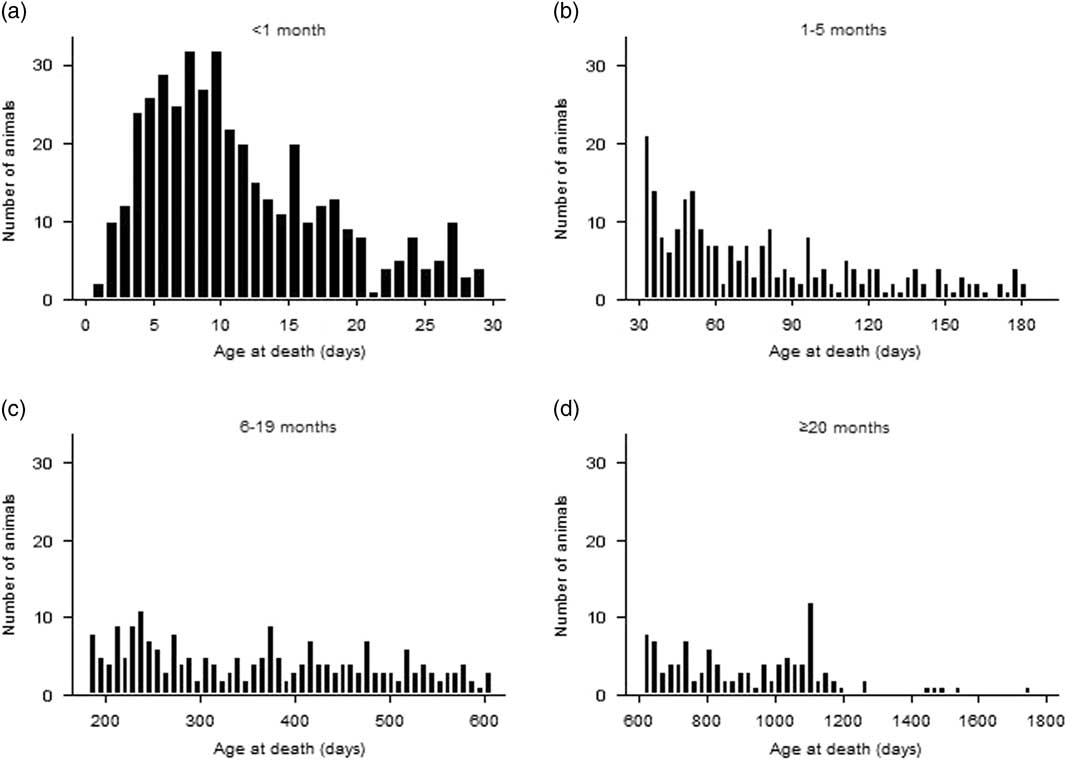
The data set included observations of 21 075 calves up to 30 days of age providing 622 579 animal-days at risk. In this age group, there were 416 mortality events including 408 (98.1%) unassisted deaths and 8 (1.9%) euthanasia events. The MR in that age group was 24.4/100 animal-years (95% CI 22.2; 26.9). The age range with the highest number of deaths was between days 4 and 10, which included 52.2% of the deaths (Figure 1).
Distribution of deaths across age in four age categories ((a) calves <1 month, (b) calves 1 to 5 months, (c) youngstock 6 to 19 months, (d) youngstock ⩾20 months) in Estonian beef cattle herds between 1 January 2013 and 31 December 2015.

A total of 21 116 individuals contributed 3 519 899 days at risk in the age category of 1 to 5 months. Among 234 on-farm deaths 28 (12.0%) were euthanasia events. The overall MR in this age category was MR=2.9 (95% CI 2.6; 3.3)/100 animal-years. Death events were more common in the second month of life compared with subsequent months (Figure 1).
In the age category 6 to 19 months, there were 22 637 animals providing a total of 8 351 726 animal-days at risk. The number of failures was 220 (MR=1.5/100 animal-years, 95% CI 1.4; 1.8) out of which 37 (16.8%) were euthanasia events, and the distribution of mortality events were relatively even across the age band (Figure 1).
The category with cattle from 20 months of age had data for 9582 cattle contributing a total of 5 524 636 animal-days at risk. In this age category, 109 cattle died (MR=1.9/100 animal-years, 95% CI 1.6; 2.3) and 20 (18.4%) of the mortality events were euthanasia events. The number of deaths was highest around 1100 days of age in that age group (Figure 1).
Risk-factor analysis
Descriptive statistics for the four age groups about the distribution of variables, as well as the univariable association between variables and mortality hazard, are provided in the Supplementary Tables S1 (continuous variables) and S2 (categorical variables).
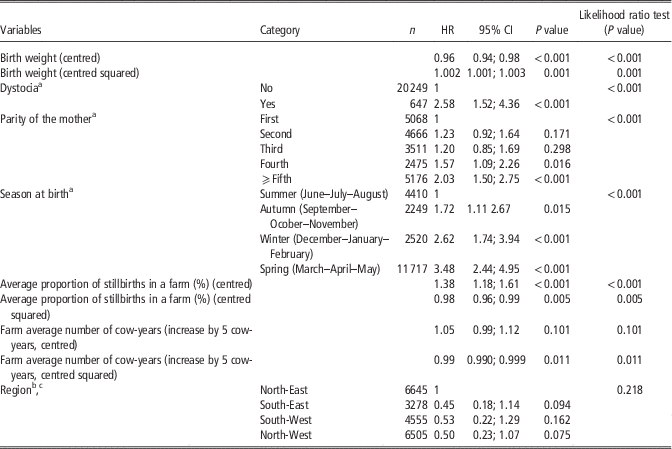
According to the results of the multivariable Cox proportional hazard model, presence of dystocia was associated with higher mortality hazard in calves up to 1 month of age compared with calves born without dystocia. Across all four seasons the highest mortality hazard occurred in calves that were born in the spring compared with summer, whereas summertime was associated with a significantly lower mortality hazard of calves compared with other seasons. The mortality hazard was dependent on the parity of the mother. Calves of cows with parity of one to three experienced a similar mortality hazard, but it was higher in calves of older cows. Larger birth weight was associated with lower mortality hazard, but the association was not linear. A higher herd average proportion of stillbirths was associated with higher mortality hazard; however, the significant square term in the model indicated a non-linear association (Table 1). A farm’s average number of cow-years and its region were controlled in the present and in other models due to the confounding effect (Tables 1 to 4).
Results of multivariable Cox model for risk factors of mortality in 20 896 calves up to 30 days of age (herds n=182)

HR=hazard rate ratio; CI=confidence intervals.
Between-herd variance (var)=3.03, SE=0.56.
a Number of animals.
b Number of observations.
c Northeast Estonia: Ida-Viru, Lääne-Viru, Jõgeva, Järva county; Southeast Estonia: Tartu, Valga, Võru, Põlva county; Southwest Estonia: Pärnu, Viljandi, Saare county; Northwest Estonia: Harju, Rapla, Lääne, Hiiu county.
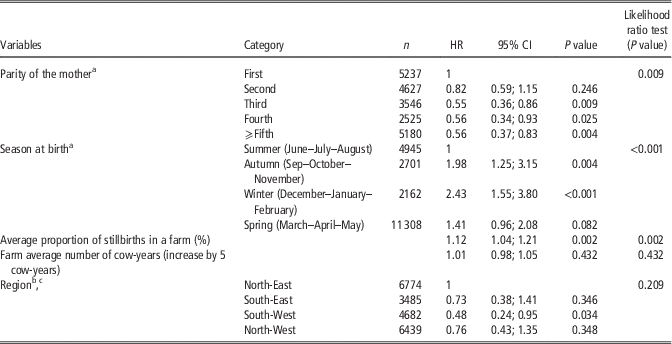
Results of multivariable Cox model for risk factors of mortality in 21 115 calves 1 to 5 months of age (herds n=182)

HR=hazard rate ratio; CI=confidence intervals.
Between-herd variance (var)=1.1, SE=0.3.
a Number of animals.
b Number of observations.
c Northeast Estonia: Ida-Viru, Lääne-Viru, Jõgeva, Järva county; Southeast Estonia: Tartu, Valga, Võru, Põlva county; Southwest Estonia: Pärnu, Viljandi, Saare county; Northwest Estonia: Harju, Rapla, Lääne, Hiiu county.
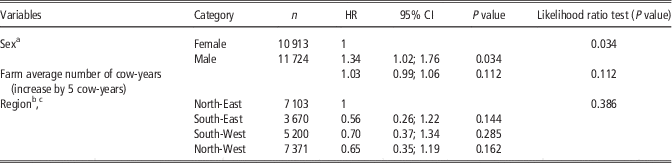
Results of multivariable Cox model for risk factors of mortality in 22 637 youngstock 6 to 19 months of age (herds n=182)

HR=hazard rate ratio; CI=confidence intervals.
Between-herd variance (var)=1.5, SE=0.4.
a Number of animals.
b Number of observations.
c Northeast Estonia: Ida-Viru, Lääne-Viru, Jõgeva, Järva county; Southeast Estonia: Tartu, Valga, Võru, Põlva county; Southwest Estonia: Pärnu, Viljandi, Saare county; Northwest Estonia: Harju, Rapla, Lääne, Hiiu county.
Results of multivariable Cox model for risk factors of mortality in 9582 youngstock ⩾20 months of age (herds n=181)

HR=hazard rate ratio; CI=confidence intervals.
Between-herd variance (var)=2.2, SE=0.7.
a Number of animals.
b Number of observations.
c Northeast Estonia: Ida-Viru, Lääne-Viru, Jõgeva, Järva county; Southeast Estonia: Tartu, Valga, Võru, Põlva county; Southwest Estonia: Pärnu, Viljandi, Saare county; Northwest Estonia: Harju, Rapla, Lääne, Hiiu county.
Calves at the age of 1 to 5 months born in autumn or winter had a significantly higher mortality hazard compared with calves born in summer. There was no significant difference in mortality hazard in calves born in spring compared with those born in summer. Calves of primiparous cows had a significantly higher mortality hazard compared with calves of third or higher parity dams. There was a significant difference in mortality hazard between calves from the South-West and North-East regions. All the estimates were adjusted for the variable ‘farm average number of cow-years’, which itself was not a significant predictor in the model (Table 2).
The multivariable Cox model for mortality in 6- to 19-month-old youngstock included a significant effect of sex, with higher mortality hazard in young bulls compared with heifers (Table 3).
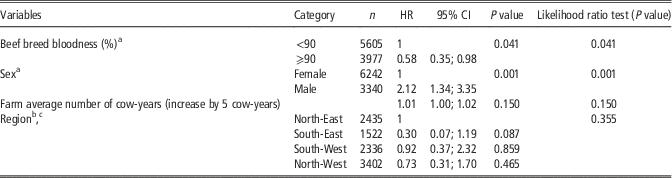
In the multivariable model of youngstock over 20 months of age bulls had significantly higher on-farm mortality risk compared with heifers. Beef breed bloodness of ⩾90% was associated with lower mortality hazard compared with category with a lower percentage (Table 4).
Effect of the year was tested in all four models but due to no consistent improvement of the models the effect of year was not included in the final multivariable models.
Between-herd variances estimated by the random-effect models were highest for the calf model up to 30 days of age (var=3.0, SE=0.6) and the model of the oldest age group (youngstock ⩾20 months of age) (var=2.2, SE=0.7), and lower in the calf models 1 to 5 months of age (var=1.1, SE=0.3) and 6 to 19 months of age (var=1.5, SE=0.4) (Tables 2 to 5).
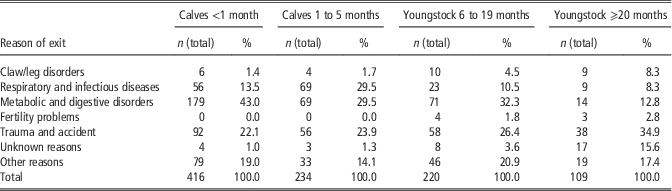
Descriptive statistics of farmers’ stated reasons for on-farm mortality of Estonian beef youngstock between 2013 and 2015

Farmers’ stated reasons of mortality
The main reason for on-farm death in calves less than 1 month of age included ‘metabolic and digestive disorders’ and ‘trauma and accident’. In calves 1 to 5 months of age the dominant reasons for deaths were ‘metabolic and digestive disorders’ and ‘respiratory and infectious diseases’. ‘Metabolic and digestive disorders’ were the most frequently stated category of reasons for on-farm deaths in 6- to 20-month-old youngstock followed by ‘trauma and accident’. The latter was also the most frequently reported cause of death in cattle over 20 months of age (Table 5).
Discussion
Mortality of calves up to 30 days of age
As registry data may miss the first-week mortality cases (Pannwitz, Reference Pannwitz2015), the data has limited value in estimating perinatal mortality, but is applicable once calves are ear-tagged. Therefore, the mortality hazard in the first age group (up to 30 days) of calves is underestimated. The MR estimated for calves up to 30 days in this study is very similar to that reported in Germany (Pannwitz, Reference Pannwitz2015) and in France (Perrin et al., Reference Perrin, Ducrot, Vinard, Morignat, Calavas and Hendrikx2012), which was calculated from registry data referring to comparable health and welfare state.
The highest risk period for mortality was between 4 and 10 days of age, and the most common cause of death reported by the farmers were metabolic and digestive disorders. Although studies have indicated that farmers’ perception in defining the cause of death based on antemortem histories can be incorrect in nearly half of the cases in dairy cows (McConnel et al., Reference McConnel, Garry, Lombard, Kidd, Hill and Gould2009; Thomsen et al., Reference Thomsen, Dahl-Pedersen and Jensen2012), we have not found studies that evaluated farmers’ perception for the cause of death in calves. As the range of diseases affecting calves is presumably smaller, and disease signs in calves are clearer than in adult cows, we may expect the farmers to have somewhat higher precision in defining the reasons of death.
Dystocia was associated with a higher risk of dying during the first 30 days of life, which is consistent with what other studies have found (Azzam et al., Reference Azzam, Kinder, Nielsen, Werth, Gregory, Cundiff and Koch1993; Ganaba et al., Reference Ganaba, Bigras-Poulin, Bélanger and Couture1995; Tarrés et al., Reference Tarrés, Casellas and Piedrafita2005; Bleul, Reference Bleul2011). Calves born without dystocia have a shorter interval from birth to standing, make better connection with their dams and have greater antibody absorption compared with calves that are born with dystocia (Murray et al., Reference Murray, Veira, Nadalin, Haines, Jackson, Pearl and Leslie2015). Failure of transfer of passive immunity is associated with increased risk of bovine respiratory disease, diarrhoea and overall morbidity of calves (Raboisson et al., Reference Raboisson, Trillat and Cahuzac2016). Therefore, to reduce loss of calves during the neonatal and early postnatal periods, more efforts should be put on the prevention of dystocia.
Larger calf birth weight was non-linearly associated with smaller risk of mortality of young calves, also after considering calving difficulty. This agrees with a study of Tarrés et al. (Reference Tarrés, Casellas and Piedrafita2005) who found that calves with medium and large birth weights had the lowest risk of death during the pre-weaning period. We can conclude that after the neonatal and early postnatal period, larger weight is a protective factor for mortality, as larger calves may be more vigorous and resistant to adverse climatic conditions. Still, the association should be interpreted cautiously due to possible inaccuracy on measuring birth weight in newborn calves.
Calves born in summer (June to August) experienced the lowest mortality hazard during the first 30 days, whereas the highest mortality hazard occurred for calves born in winter (December to February) and spring (March to May). Previous studies confirmed that neonatal mortality is highest when calves are born in very cold months (Azzam et al., Reference Azzam, Kinder, Nielsen, Werth, Gregory, Cundiff and Koch1993; Ganaba et al., Reference Ganaba, Bigras-Poulin, Bélanger and Couture1995). Further, higher mortality hazard in colder months has been confirmed for beef calves during the postnatal period (Bleul, Reference Bleul2011; Perrin et al., Reference Perrin, Ducrot, Vinard, Morignat, Calavas and Hendrikx2012; Elghafghuf et al., Reference Elghafghuf, Stryhn and Waldner2014; Pannwitz, Reference Pannwitz2015). According to our data, 56% of the calves were born during spring, which is a clear majority. Elghafghuf et al. (Reference Elghafghuf, Stryhn and Waldner2014) showed that the hazard of calf mortality increased as the calving season progressed with an increasing number of calves in the herd. Therefore, we might conclude that cold stress partly explains the higher calf mortality hazard, but accumulation of the calvings may create favourable conditions for infection spread and lack of individual human care and available resources.
Calves born to younger cows (up to three calvings) were at lower risk for death during the first 30 days of life. The same association has also been found for calves in the neonatal and postnatal periods (Wittum et al., Reference Wittum, Salman, King, Mortimer, Odde and Morris1994; Elghafghuf et al., Reference Elghafghuf, Stryhn and Waldner2014). We may assume that after the critical perinatal period, cows have equally good maternity skills independent of the parity. Younger cows might also be treated differently from older cows.
In our models, we detected higher mortality hazard for calves born to cows with more than three parities compared with first-parity cows. According to our previous study on risk factors for mortality in beef cows, we identified that the mortality hazard was significantly higher for older cows, and the period with highest risk occurred during the first 30 days after calving (Mõtus and Emanuelson, Reference Mõtus, Reimus, Orro, Viltrop and Emanuelson2017). As calves are highly dependent on the health condition of the mother during the first month of life, there might be a cause-effect association which needs to be studied further.
Mortality of calves 1 to 5 months of age
Calves in the age range 1 to 5 months included calves that were not weaned yet but had passed the high-risk period during the first month of life. Within that age range, the second month of life included an outstandingly higher mortality hazard, whereas the main reasons for mortality were respiratory and infectious diseases as well as metabolic and digestive disorders.
Calves born in autumn and winter had a significantly higher mortality risk compared with calves born in spring or summer. Calves born in fall or winter endure adverse climatic conditions during the first 6 months, and the quality of feeds and housing conditions are different compared with the summer grazing season. Further, spring is the calving season for the majority of the cows in Estonia, so calves born before that time may also be threatened by the favoured spread of infectious diseases due to higher numbers of susceptible animals in the herd, lower immunity level and stress related to calving, as well as crowding of animals. This is confirmed by our previous study in which it was shown that calving season is a high-risk period for mortality in all age groups (Mõtus et al., Reference Mõtus and Emanuelson2017).
Calves born to young cows had significantly higher mortality hazard during 1 to 5 months of age than calves of older cows. We may speculate that lower milk yield in cows of lower parities (Mummed, Reference Mummed2012) may have an influence on the overall calf well-being and health. Younger cows may also have lower colostrum immunoglobulin content compared with older parity cows (Conneely et al., Reference Conneely, Berry, Sayers, Murphy, Lorenz, Doherty and Kennedy2013) and colostral antibodies might be less specific to farm pathogens. Low level of maternal antibodies is a risk factor for respiratory disease in calves (Wittum and Perino, Reference Wittum and Perino1995), however the association between failure of passive immunity and neonatal calf diarrhoea is not that evident (Trotz-Williams et al., Reference Trotz-Williams, Leslie and Peregrine2007; Windeyer et al., Reference Windeyer, Leslie, Godden, Hodgins, Lissemore and LeBlanc2014). Respiratory disease most commonly affects older suckling calves which might be the reason for finding significant association between parity of the dam and mortality of the calves in this age group and not among the youngest calves.
Mortality of 6- to 19-month-old youngstock
In this age group, the mortality hazard was the lowest compared with other age groups, and mortality events were equally distributed across the age band. According to the causes of deaths reported by the farmers, it is essential to take a good care for the feeding conditions and avoid parasitic diseases that may result in metabolic and digestive disorders in this age group. Further, management conditions avoiding traumas are essential for reducing loss of young heifers and fatteners.
In this age group, we did not find any other strong risk factors associated with mortality except male sex of the animal. In Estonia keeping, feeding and management conditions are not substantially different in heifers and bulls/steers after weaning but frequency of observation and other activities might differ between these groups. To make sound conclusions, more information would be needed about the feeding and management of bulls and steers of this age to identify the causative risk factors.
Mortality of youngstock over 20 months of age
Although the MR fluctuated over age in this group of animals, a peak in deaths could be confirmed around 37 months of age. That is close to the average age of first calving in beef cows in Estonia (ELPR, 2014 and 2015), meaning that the observed increase could be due to mortality during first calving. The long right tale of mortality distribution in old cattle (Figure 1) may also be the consequence of unreported calving events, and thus misclassifying cows as old youngstock. In this age group, it is important to lower the risk of traumas to lower the mortality incidence. The uncertainty about the reasons of mortality was proportionally the highest for this group, meaning that pregnant heifers and fattening bulls are observed less frequently, or that disease signs are not as clear as in younger calves and youngstock.
Similar to the younger age group, fattening bulls and steers were at higher risk of death. Bulls and steers of this age are fattening cattle and ready to be sold for slaughter. Therefore, loss of these cattle has a severe negative impact on the production and loss of investment. Higher proportion of beef breed bloodness was a protective factor for mortality in this age group. In our previous study, we confirmed that dairy breed cattle have a higher risk of mortality compared with beef breeds (Mõtus et al., Reference Mõtus and Emanuelson2017), probably because the living and feeding conditions in beef herds are not suitable for the demands of dairy breeds.
Implications and limitations
High herd-level stillbirth rate was positively associated with mortality in the models of calves up to 30 days of age and calves 1 to 5 months of age. High stillbirth and MRs are both variables that correlate with the herd welfare status (Nyman et al., Reference Nyman, Lindberg and Sandgren2011), and thus, the MR could be a useful parameter in identifying problematic herds in terms of health and welfare in the Estonian beef population.
We also identified a higher between-herd variance in the age groups with the highest MRs. This means that, although cattle of those age groups have a higher risk of death, the effect is highly dependent on the farm factors. This shows that there is a need for subsequent studies in which more herd-level variables reflecting housing, feeding and management are included.
Herds in this study were enrolled in the voluntary and chargeable animal performance recording system. Therefore, these herds might share different targets influencing the management of the herd and behaviour of the farmers, thus causing the difference in the results of these two studies.
Conclusion
The present study provides insight into reasons for and risk factors of mortality in beef youngstock. Although considerable research has been published about factors associated with calf perinatal and postnatal mortality during the pre-weaning period, older age groups were rarely included in these studies. We revealed that to combat the high mortality in beef calves during their first 6 months of life, it is necessary to apply measures that reduce the incidence of diarrhoea and respiratory disease, as well as traumas and accidents. Reducing the incidence of dystocia will most likely improve the survival potential of young calves. Further, to reduce cold stress in young newborn calves, it is advisable to time the calving period for the warmer spring or early summer months, which would create the best environmental and feeding conditions for calves during the most critical period of their lives. We found that fattening bulls and steers experienced a considerably higher MR compared with replacement heifers. More information about the differences in management in heifers and bulls/steers would be needed to explain this difference.
Acknowledgements
The authors thank Olle Antson from the Estonian Agricultural Registers and Information Board and Inno Maasikas from the Estonian Livestock Performance Recording Ltd for data query. This project was funded by the Estonian University of Life Sciences Strategic Development Fund (contract no. HMX170041).
Supplementary material
To view supplementary material for this article, please visit https://doi.org/10.1017/S1751731117003548