Introduction
Mealybugs (Hemiptera: Pseudococcidae) are important pests for many agricultural crops worldwide (Franco et al., Reference Franco, Zada, Mendel, Ishaaya and Horowitz2009; Daane et al., Reference Daane, Almeida, Bell, Walker, Botton, Fallahzadeh, Mani, Miano, Sforza, Walton, Zaviezo, Bostanian, Isaacs and Vincent2012). Like in many other pests, their management is based on their correct identification. Identification is key because different mealybug species have different ecological characteristics, such as the number of generations per year, phenology, the severity of the damages caused on plants, most efficient natural enemies, etc. (Varela et al., Reference Varela, Smith, Battany and Bentley2006; Daane et al., Reference Daane, Almeida, Bell, Walker, Botton, Fallahzadeh, Mani, Miano, Sforza, Walton, Zaviezo, Bostanian, Isaacs and Vincent2012). In mealybugs, accurate identification has been a recurrent problem. Indeed, mealybug morphological identification is only possible for adult females and is often challenging when the species are very closely related (Gimpel & Miller, Reference Gimpel and Miller1996; Wakgari & Giliomee, Reference Wakgari and Giliomee2005; Park et al., Reference Park, Jin Leem, Hahn, Suh, Hong and Oh2010). To solve these identification problems, several techniques based on molecular characterization have been used in recent years (Rung et al., Reference Rung, Scheffer, Evans and Miller2008; Saccaggi et al., Reference Saccaggi, Krüger and Pietersen2008; Pieterse et al., Reference Pieterse, Muller and Vuuren2010; Correa et al., Reference Correa, Aguirre, Germain, Hinrichsen, Zaviezo, Malausa and Prado2011; Malausa et al., Reference Malausa, Fenis, Warot, Germain, Ris, Prado, Botton, Vanlerberghe-Masutti, Sforza, Cruaud, Couloux and Kreiter2011a ). So far, such techniques have been mainly used for identification at the level of species, and have brought only limited information at the intraspecific level. However, intraspecific differences in biological characteristics can also impact the management strategies. For example, in France two populations of Pseudococcus viburni (Signoret), presenting different cytochrome oxidase haplotypes, responded differentially to biological control releases (Abd-Rabou et al., Reference Abd-Rabou, Shalaby, Germain, Ris, Kreiter and Malausa2012). Also, population differentiation according to the host plant was observed on Maconellicoccus hirsutus (Green), using AFLP markers (Rosas-García et al., Reference Rosas-García, Sarmiento-Benavides, Villegas-Mendoza, Hernández-Delgado and Mayek-Pérez2010).
Microsatellite markers are cost-efficient and informative tools for studies at the intraspecific level (Selkoe & Toonen, Reference Selkoe and Toonen2006; Guichoux et al., Reference Guichoux, Lagache, Wagner, Chaumeil, Léger, Lepais, Lepoittevin, Malausa, Revardel, Salin and Petit2011). Studies using microsatellites have revealed the occurrence of cryptic taxa with clear ecological differences (Malausa et al., Reference Malausa, Dalecky, Ponsard, Audiot, Streiff, Chaval and Bourguet2007), structured population in agroecosystems (Sanchez et al., Reference Sanchez, La-Spina, Guirao and Cánovas2013) and were able to differentiate between taxa (Kothera et al., Reference Kothera, Zimmerman and Richards2009) for insect pest species.
However, extensive problems have been reported for the isolation and development of microsatellite molecular markers for different insect groups (Meglécz et al., Reference Meglécz, Petenian, Danchin, Coeur D'Acier, Rasplus and Faure2004, Reference Meglécz, Anderson, Bourguet, Butcher, Caldas, Cassel-Lundhagen, Coeur D'Acier, Dawson, Faure, Fauvelot, Franck, Harper, Keyghobadi, Kluetsch, Muthulakshmi, Nagaraju, Patt, Péténian, Silvain and Wilcock2007). Nevertheless, the use of microsatellites acquired by the use of multiplex-enriched libraries and 454 GS-FLX Titanium pyrosequencing has been instrumental to overcome these problems thanks to the increased number of sequences available to design markers (Martin et al., Reference Martin, Pech, Meglécz, Ferreira, Costedoat, Dubut, Malausa and Gilles2010; Gilles et al., Reference Gilles, Meglécz, Pech, Ferreira, Malausa and Martin2011; Malausa et al., Reference Malausa, Gilles, Meglécz, Blanquart, Duthoy, Costedoat, Dubut, Pech, Castagnone-Sereno, Délye, Feau, Frey, Gauthier, Guillemaud, Hazard, Le Corre, Lung-Escarmant, Malé, Ferreira and Martin2011b ).
To what extent microsatellites could be easily and efficiently used for mealybugs is still to be determined. Until now, the only mealybug species for which microsatellite markers have been developed is Planococcus citri (Risso), an important agronomic pest associated to Citrus (Franco et al., Reference Franco, Suma, Silva, Blumberg and Mendel2004) and grapevine (Daane et al., Reference Daane, Almeida, Bell, Walker, Botton, Fallahzadeh, Mani, Miano, Sforza, Walton, Zaviezo, Bostanian, Isaacs and Vincent2012) crops worldwide. Microsatellites were isolated using the 454 GS-FLX technology, yielding 15 polymorphic microsatellites (Martins et al., Reference Martins, Zina, Da Silva, Rebelo, Figueiredo, Mendel, Paulo, Franco and Seabra2012a ). Nevertheless, the family Pseudococcidae is large and comprises several subfamilies (e.g., Planococcinae, Pseudococcinae and Phenacoccinae) (Hardy et al., Reference Hardy, Gullan and Hodgson2008) that may differ in their genomic structure and composition.
In this work, we have produced microsatellite DNA libraries for three mealybug species. Two species, Ps. viburni and Pseudococcus comstocki (Kuwana), are divergent species within the subfamily Pseudococcinae, with 8.26% divergence at cytochrome oxidase subunit I (COI) (Malausa et al., Reference Malausa, Fenis, Warot, Germain, Ris, Prado, Botton, Vanlerberghe-Masutti, Sforza, Cruaud, Couloux and Kreiter2011a ). The third species, Heliococcus bohemicus Sulc, is from the subfamily Phenacoccinae. Additionally, we compared the libraries obtained for these three species to the library obtained by Martins et al. (Reference Martins, Zina, Da Silva, Rebelo, Figueiredo, Mendel, Paulo, Franco and Seabra2012b ) for Pl. citri, a member of the Planococcinae.
To develop markers and test their efficiency for the genotyping of populations, we selected the species Ps. viburni. This species is the most abundant mealybug species associated with fruit crops in Chile (Sazo et al., Reference Sazo, Araya and De la Cerda2008; Correa et al., Reference Correa, Germain, Malausa and Zaviezo2012) and it is also present in more than 54 countries worldwide (Ben-Dov et al., Reference Ben-Dov, Miller and Gibson2010). This species has been formerly called Dactylopius affinis, Pseudococcus affinis, Pseudococcus obscurus and Pseudococcus maritimus, before the situation was clarified (Miller, Reference Miller1985; Beuning et al., Reference Beuning, Murphy, Wu, Batchelor and Morris1999). Nevertheless, it is still suggested that Ps. viburni may be a complex of species, due to the remarkable variability of its morphological diagnostic characters (Gimpel & Miller, Reference Gimpel and Miller1996) and remarkable variability of conserved genomic regions (Malausa et al., Reference Malausa, Fenis, Warot, Germain, Ris, Prado, Botton, Vanlerberghe-Masutti, Sforza, Cruaud, Couloux and Kreiter2011a ; Abd-Rabou et al., Reference Abd-Rabou, Shalaby, Germain, Ris, Kreiter and Malausa2012; Beltrà et al., Reference Beltrà, Soto and Malausa2012; Correa et al., Reference Correa, Germain, Malausa and Zaviezo2012). For this reason, the management of Ps. viburni worldwide would benefit from a better understanding of the taxonomy of the mealybugs that currently are referred to as Ps. viburni. Population genetics analyses, using microsatellite markers, would be particularly useful in this context.
Materials and methods
Multiplex-enriched microsatellites libraries
Microsatellite DNA libraries were produced following the method described in Malausa et al. (Reference Malausa, Gilles, Meglécz, Blanquart, Duthoy, Costedoat, Dubut, Pech, Castagnone-Sereno, Délye, Feau, Frey, Gauthier, Guillemaud, Hazard, Le Corre, Lung-Escarmant, Malé, Ferreira and Martin2011b ). Briefly, this method involves: (i) the isolation of DNA fragments containing microsatellite motifs by multiplex microsatellite enrichment and (ii) the pyrosequencing of the fragments on a 454 GS-FLX Titanium platform. The microsatellite motifs targeted by the method, via the use of hybridization to biotin-labeled oligonucleotides, are (AG)10, (AC)10, (AAC)8, (AGG)8, (ACG)8, (AAG)8, (ACAT)6 and (ATCT)6.
This protocol was applied to samples from each of the three species, Ps. viburni, H. bohemicus and Ps. comstocki, consisting of a solution containing DNA extracted from 10 to 30 mealybug individuals, in order to reach a DNA quantity >1 μg. The same protocol and equipment (at Genoscreen, Lille, France) was used by Martins et al. (Reference Martins, Zina, Da Silva, Rebelo, Figueiredo, Mendel, Paulo, Franco and Seabra2012b ) for Pl. citri.
In an attempt to provide a microsatellite library as representative as possible of the microsatellites of Ps. viburni, the data obtained in the present work and that of Malausa et al. (Reference Malausa, Gilles, Meglécz, Blanquart, Duthoy, Costedoat, Dubut, Pech, Castagnone-Sereno, Délye, Feau, Frey, Gauthier, Guillemaud, Hazard, Le Corre, Lung-Escarmant, Malé, Ferreira and Martin2011b ) were pooled for bioinformatics analyses.
Library analysis
The 454 sequences were analyzed and primers for amplification of the microsatellite motifs were designed using the QDD program (Meglécz et al., Reference Meglécz, Costedoat, Dubut, Gilles, Malausa, Pech and Martin2010), version 2.1. QDD uses an analysis pipeline in three steps: (i) it removes the sequences proving that are too short or that do not contain microsatellite motifs, (ii) then it creates consensus sequences when a same microsatellite locus has been sequenced several times, and (iii) it proposes primer pairs to amplify the maximum possible number of identified microsatellite loci. The parameters used in this work were the default QDD parameters, except for the following: (i) the minimum percentage similarity of sequences to be included in the construction of consensus sequences was 90%, (ii) the proportion of sequences that must have the same base on the aligned site to accept it as a consensus was 0.66, (iii) the minimum length of polymerase chain reactions (PCR) product for primer design was 80 bp, (iv) the maximum length of PCR product for primer design was 500 bp, (v) the maximum length of a primer was 32 bp and (vi) the maximum acceptable difference between the melting temperatures of primers was 4 °C. We also applied the same analysis to the raw microsatellite library of Pl. citri from Martins et al. (Reference Martins, Zina, Da Silva, Rebelo, Figueiredo, Mendel, Paulo, Franco and Seabra2012b ), kindly provided by Dr Sofia Seabra, from Faculdade de Ciências da Universidade de Lisboa, Portugal.
Ps. viburni microsatellite molecular markers development
Microsatellites markers for Ps. viburni were developed by testing and multiplexing part of the PCR primers selected after the QDD analysis. Criteria for microsatellites sequences selection and primers design used were similar to those of Malausa et al. (Reference Malausa, Gilles, Meglécz, Blanquart, Duthoy, Costedoat, Dubut, Pech, Castagnone-Sereno, Délye, Feau, Frey, Gauthier, Guillemaud, Hazard, Le Corre, Lung-Escarmant, Malé, Ferreira and Martin2011b ): (i) the motif of the microsatellite they target, to obtain markers targeting different types of motifs, (ii) microsatellites with at least seven repeats and (iii) the size of the expected PCR products (we selected primers amplifying markers homogenously distributed in terms of size within the range 80–500 bp).
In total, 105 primer pairs were tested for DNA amplification in seven individuals of Ps. viburni of different geographical origins (table 1). The DNA of these individuals was extracted using the DNAeasy Blood & Tissue kit (QIAGEN, Hilden, Germany). They were identified as belonging to Ps. viburni by DNA sequencing using the COI region (Malausa et al., Reference Malausa, Fenis, Warot, Germain, Ris, Prado, Botton, Vanlerberghe-Masutti, Sforza, Cruaud, Couloux and Kreiter2011a ; Correa et al., Reference Correa, Germain, Malausa and Zaviezo2012). Only populations displaying a sequence similarity over 99% with Ps. viburni sequences published in GenBank (Accessions GU134686 and GU134685) were kept. PCR for each primer pair were performed in a total volume of 10 μl containing 1× of the buffer QIAGEN Multiplex PCR kit, 0.2 μm of each primer and 2 μl of extracted genomic DNA (approximately 2–10 ng). The PCR cycling conditions consisted of an initial denaturation step of 15 min at 95 °C, followed by 35 cycles with 30 s at 94 °C for denaturation, 90 s at 60 °C for hybridization and 60 s at 72 °C for elongation and a final extension step of 30 min at 60 °C. The PCR products were then electrophoresed in an agarose gel (2.5%) and stained with ethidium bromide. We retained for the following steps only those PCR primer pairs that allowed microsatellite amplification at the expected size for all the seven individuals tested. For the retained pairs, a fluorescent-labeled version of the forward primer was ordered (Applied Biosystems, Woolston, UK). The fluorescent 5’ labeled forward primer and the associated reverse primer were used to amplify again the DNA of the same individuals as above. PCR conditions were the same as mentioned above, but with 30 cycles instead 35. Two microliter of the obtained PCR products plus 9 μl of a mix of formamide and 500 LIZ GeneScanTM (Applied Biosystems, Woolston, UK) size standard (25 μl of LIZ 500 size standard for 1 ml of formamide) were separated by electrophoresis using an ABI 3700 sequencer (Applied Biosystems). Sizes of the amplified fragments were scored with Genemarker™ version 1.75 software (SoftGenetics LLC).
Origin of the individuals used for testing the first set of Ps. viburni microsatellites.

Primer pairs that provided an unambiguous genotype were kept for the design of multiplex kits. These kits consisted of multiplex PCR combining 8–15 compatible markers in terms of expected size range and fluorescent color (NED, FAM, VIC or PET). Around 20 combinations were tested, until a combination allowed simultaneous amplification of all markers. Primer concentrations were then adjusted to reach homogeneous fluorescence intensities for all markers.
The two resulting multiplex PCR reactions used cycling conditions as described above, but with the number of cycles reduced to 25. These PCR were then tested on two Ps. viburni populations. One population was collected from a vineyard near Nancagua city, O'Higgins Region, Chile (45 individuals), and the other from an apple orchard in Saint-Remy-de-Provence, Bouches du Rhône, France (43 individuals).
GenePop version 4.2 (Rousset, Reference Rousset2008) was used to test deviations from Hardy–Weinberg equilibrium (HWE), to estimate the expected and observed heterozygosities, to test for genotypic linkage disequilibrium and to compute Fst estimates between the two populations. P-values of tests were corrected for multiple tests using the False Discovery Rate approach (FDR), except for the linkage disequilibrium tests among markers where a standard Bonferroni correction was applied because of the non-independence of these tests. When deviations from HWE were detected, the occurrence of null alleles was checked using Micro-Checker (Van Oosterhout et al., Reference Van Oosterhout, Hutchinson, Wills and Shipley2004).
Cross-species amplification
The two multiplex PCR reactions were further tested using DNA from 19 other mealybug species: Pseudococcus meridionalis Prado, Pseudococcus cribata González, Ps. near maritimus (Malausa et al., Reference Malausa, Fenis, Warot, Germain, Ris, Prado, Botton, Vanlerberghe-Masutti, Sforza, Cruaud, Couloux and Kreiter2011a ), Pseudococcus calceolariae (Maskell), Ps. comstocki, Ps eudococcus cryptus Hempel, Ps eudococcus longispinus (Targioni-Tozzetti), Pseudococcus microadonidum Beardsley, Pss eudococcus jackbeardsleyi Gimpell and Miller, Paracoccus marginatus Williams and Granara de Willink, Phenacoccus aceris (Signoret), Phenacoccus solani Ferris, Phenacoccus parvus Morrison, Pl. citri, Planococcus ficus (Signoret), Planococcus lilacinus (Cockerell), Rhizoecus americanus (Hambleton), M. hirsutus and Nipaecoccus nipae (Maskell).
Results and discussion
Libraries
The microsatellite libraries analyzed had an average of 25 823 raw sequences. The numbers of sequences with a length greater than 80 bp ranged from 2254 (H. bohemicus) to 9823 (Ps. comstocki). Markers identified from more than one sequence (i.e., designed from a consensus sequence of several raw sequences) were over 35%, with a maximum of 89% for Pl. citri. Between 80 and 84% of the primers designed by QDD targeted perfect microsatellite motifs (perfect repeats, without interruptions). Pairwise comparisons of this percentage between the species (two-tailed Chi-square) revealed no difference (P>0.05, after FDR correction for multiple testing) (table 2).
Microsatellite library characterization and primer design for the mealybug species.

The predominant motif types found for the four mealybug libraries were the dinucleotides AC and AG and the trinucleotide AAC (table 3). Interestingly, Ps. viburni had 17% of microsatellites with an AGG motif and Pl. citri displayed 14% of ACG, whereas the other mealybug species displayed frequencies for these motifs under 10%. The highest percentage of one microsatellite motif was 25% in the case of AC for Ps. comstocki. Unlike most insect microsatellite libraries, the motif relative abundances observed here do not display one single dominant motif (e.g., with a proportion over 40%). For example, using the same library production method, Malausa et al. (Reference Malausa, Gilles, Meglécz, Blanquart, Duthoy, Costedoat, Dubut, Pech, Castagnone-Sereno, Délye, Feau, Frey, Gauthier, Guillemaud, Hazard, Le Corre, Lung-Escarmant, Malé, Ferreira and Martin2011b ) found that most insect taxa displayed one dominant isolated motif, e.g., AG in Venturia canescens (Gravenhorst) (Hymenoptera) [62%], AC in Euphydryas aurinia Rottemburg (Lepidoptera) [41%] or AAG in Diabrotica virgifera virgifera LeConte (Coleoptera) [60%]. This result is rather positive for the use of microsatellite markers in mealybugs because one can easily develop markers targeting various microsatellite motifs and thus displaying a range of mutation rates. Indeed, mutation rates are known to depend on the motif size and microsatellites with larger motifs are supposed to evolve slowly (Chakraborty et al., Reference Chakraborty, Kimmel, Stivers, Davison and Deka1997)
Motif types found in mealybug libraries and comparison with libraries of other insects (from Malausa et al., Reference Malausa, Gilles, Meglécz, Blanquart, Duthoy, Costedoat, Dubut, Pech, Castagnone-Sereno, Délye, Feau, Frey, Gauthier, Guillemaud, Hazard, Le Corre, Lung-Escarmant, Malé, Ferreira and Martin2011b ).

Ps. viburni microsatellite markers
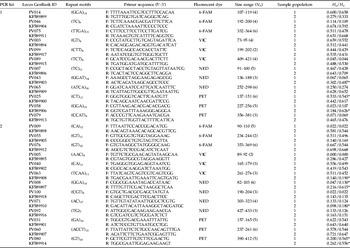
Out of the 105 primer pairs tested, 29 amplified the expected DNA fragments in the seven Ps. viburni test individuals (table 1). From these 29 putative markers, 25 lead to unambiguous electrophoregrams after capillary electrophoresis in an automated sequencer. These 25 markers were selected for the design of the multiplex PCR. The multiplexing of all 25 markers was possible using two PCR combining 12 and 13 markers (table 4).
Characteristics of microsatellite loci of Ps. viburni (population 1=45 individuals, Nancagua city, O'Higgins Region, Chile; population 2=43 individuals, Saint-Remy-de-Provence, Bouches du Rhône, France) Abbreviations as follow: N A=total numbers of alleles over the two populations, H o=observed heterozygosity, H e=expected heterozygosity.

* Indicates a significant deviation from HWE after FDR correction.
Applying the designed multiplex PCR protocol on the samples from the two test populations revealed total numbers of alleles (NA) ranging from 2 to 6, depending on the locus. Nei's gene diversity (expected heterozygosity) ranged from 0.00 to 0.721. In the Chilean population, after applying FDR corrections on P values (Benjamini & Hochberg, Reference Benjamini and Hochberg1995), deviations from HWE were detected in four markers (PV025, PV058, PV008 and PV080), whereas one marker was monomorphic (PV005). In the French population, deviations from HWE, after FDR correction, were detected in three markers (PV058, PV008 and PV080). For the markers displaying deviations from HWE, Micro-Checker suggested the presence of null alleles as the most probable cause of the deviation. After Bonferroni corrections significant linkage disequilibrium was detected among four markers (PV046 and PV092; PV025 and PV060) in the population from Chile and between two markers for the French population (PV043 and PV058). Since the markers displaying linkage disequilibrium were not the same for each population, it is difficult to determine whether the detected linkage disequilibrium is caused by the structure of the population, sampling biases or by the markers themselves. At this stage, we propose to retain all markers and check for linkage disequilibrium problems in studies including more populations.
Using the markers not displaying evidence of deviation from HWE (excluding the markers PV025, PV058, PV008 and PV080), the Fst estimate between the two populations was 0.266.
Cross-species amplification
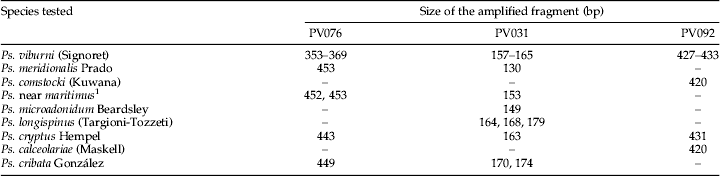
Of the 25 microsatellite markers designed, three amplified DNA fragments in other mealybug species, and only on species belonging to the genus of the target species, i.e., Pseudococcus (table 5). This differs from the results obtained by Martins et al. (Reference Martins, Zina, Da Silva, Rebelo, Figueiredo, Mendel, Paulo, Franco and Seabra2012a ), where cross-species amplification, from the 15 markers they used, was obtained for eight markers in one species of the same genus and three markers for one species from a different genus.
Amplification of Ps. viburni microsatellite markers from DNA of other Pseudococcus species, including reference size of Ps. viburni microsatellites.

Conclusions
Our fast benchmark on several mealybugs of the most up-to-date techniques to isolate and use microsatellites has revealed no key difficulty. Microsatellite motifs are isolated in large quantities in the genome without the need of excessive sequencing efforts, and the resulting markers are easy to develop within a few weeks. Isolated microsatellites displayed a variety of motifs (di-, tri- and tetra-nucleotide) at relatively balanced frequencies, most of them being perfect repeats (perfect repeats representing around 80%). Because microsatellites with different motifs are supposed to evolve at different speeds (Chakraborty et al., Reference Chakraborty, Kimmel, Stivers, Davison and Deka1997) and because microsatellites with non-interrupted motifs (perfect repeats) are more likely to follow a stepwise mutation model (Guichoux et al., Reference Guichoux, Lagache, Wagner, Chaumeil, Léger, Lepais, Lepoittevin, Malausa, Revardel, Salin and Petit2011), the produced libraries offer the possibility to design of markers according to research projects’ needs.
The use of markers to genotype mealybug populations in routine applications, also appears cost-efficient, based on our experience with Ps. viburni (using 25 loci that could be multiplexed in two PCR). Markers are easy to amplify and analyze, and they provide informative data for population genetics analyses. This is in sharp contrast to taxonomic groups for which microsatellite use is known to be challenging because of the massive occurrence of null alleles, i.e., Lepidoptera and Orthoptera (Meglécz et al., Reference Meglécz, Petenian, Danchin, Coeur D'Acier, Rasplus and Faure2004; Chapuis & Estoup, Reference Chapuis and Estoup2007).
The availability of microsatellites for these three mealybug species, all of which are the vectors of grapevine-infecting ampelo- and vitiviruses (Almeida et al., Reference Almeida, Daane, Bell, Blaisdell, Cooper, Herrbach and Pietersen2013; Herrbach et al., Reference Herrbach, Le Maguet, Hommay and Brownin press) will also benefit to studies in population genetics, population dynamics and virus epidemiology.
Acknowledgements
MCG Correa received financial support from: Chile Conicyt Doctoral fellowship #21110864, Conicyt ‘Tesis en la Industria’ #7812110011 and a grant from the Program ‘Ecos-Conicyt-Ambassade de France au Chili’. We especially thank B. Raga and G. Bermond for their support. This research was also funded by the French grant ANR-10-JCJC-1708 ‘BICORAMICS’, and the European Union FP7 grants IRSES ‘IPRABIO’ #269196, KBBE ‘PURE’ #265865 and IAPP ‘COLBICS’ #324475. J Le Maguet received a doctoral grant from CIVC, CIVA, BIVB and ANRT; thanks are also due to FranceAgriMer for financial support.