On Saturday morning, 17 May 1572, during the first session of Elizabeth I's fourth Parliament, the “Bill Concerning Rites and Ceremonies” was quietly introduced in the House of Commons. It was composed of a lengthy preamble and three provisions, each section more brazen than the last. It opened by characterizing the 1559 Act of Uniformity as a stopgap measure, a product of the “late backslidynge of the people from true religion to supersticion” during Mary I's reign. Thankfully, since the institution of the act, the kingdom had been privileged with the “longe continuance of thexercise of the preaching of the Gospell,” as well as a rise in the “greate number of lerned pastors and zealous ministers.” Under these favorable spiritual conditions, the preamble continued, “many Congregationes [were now] growen to desire of atteyning to some further sinceritie than in that book [of Common Prayer] is prescribed.” The bill did not scruple to hide that ministers had already been “puttyng in some godlie exercises for the better instruction and edifying of theire congregaciones” and “omitt[ing] the precise rule and strayt observacion” of the official liturgy, for which they had supposedly received “the favorable permission of some godlie Bishopes and Ordinaries.”Footnote 1
As a result, the bill proposed that the “penalties … expressed for the violatying and infrynginge” of the Act of Uniformity (loss of one year's income and six months’ imprisonment for a first offense alone) be made to apply only “against such persons … as do or shall use anie manner of papisticall service, rites, or ceremonies by the same act abolished”; and that “every person vicar, and minister being a preacher … and having the charge of any congregacion” be allowed, with the consent of “the Bishops of that dioces” to both “omytt and leave any parte” of the Book of Common Prayer and (incredibly) to use “any part of the prayers, rites, or ceremonyes … as the righte godlie reformed Churches nowe do use in the ffrench and douche [Dutch stranger] congregacions.”Footnote 2
The next reading of the bill did not attract any fanfare either, its bold content overshadowed by the introduction of two bills against Mary Stuart, the disgraced Catholic-Scottish claimant to the throne. On its third reading, however, the bill was, as Speaker Robert Bell reported to the principal secretary, Lord Burghley, “long debated” in a series of evocative exchanges that have survived in the diary of Thomas Cromwell, MP.Footnote 3 In his letter, Bell carefully avoided mentioning the names of the bill's supporters or sponsors, but on the floor of the House, he urged “some further reformacion” of the bill “that it may have the freer passage.”Footnote 4 To this end, the bill was entrusted to a committee of twelve, which produced a substantially neutered version overnight, softening the rhetoric of the preamble, requiring the consent of a majority of bishops for the second provision, and eliminating the third one entirely.Footnote 5
Even these concessions, however, were not enough to ensure the bill's survival, for on Thursday, 22 May, the queen intervened decisively, sending for both versions. Sir Francis Knollys, treasurer of the royal household, reported on 23 May that “her Majestie did very much mislike the first and the bringer in thereof and did also mislike in us that wee did accept the same.”Footnote 6 In an audience with Elizabeth, Knollys defended the revised version of the bill, claiming that it originated from “zeale to reforme the mischiefs and inconveniences growen to good subjects for diverse small causes, and not of malice,” dauntlessly reminding his sovereign that “the order [of liturgy was] daily broken aswell in her owne chapel as in her closet.”Footnote 7 By then, however, the bill was already a dead letter, the period from its unveiling to demise having lasted less than a week. A brief flash, it seems, and then a (near) total departure from the archival record, for not three weeks later there appeared on the streets of London the Admonition to the Parliament, a blistering Presbyterian manifesto penned by the young ministers John Field and Thomas Wilcox, which ended up far eclipsing the bill in both contemporary and modern scholarly discourse.Footnote 8
The aim of this article is not only to recover the murky origins of the “Bill Concerning Rites and Ceremonies” but to stake a claim (or several) for its significance in the history of early Elizabethan politics and religion (and in Reformation history more broadly). Elizabeth I's decision, upon her accession in 1558, to establish a state church with a uniform order of worship cut against both the international currents of the Reformation and the local improvisation that was the lifeblood of early Protestantism. The bill's creativity lay in its recovery of both of these elements and its determination to nurture them within the existing structure and context of the English church. Thus, Peter Lake's description of Presbyterianism as an “attempt systematically to think through how the demands of Protestant ideology … might institutionally be met” can be applied to this bill, which was also aimed at reconciling the variegated development of Protestantism with the integrity and identity of a large territorial church.Footnote 9 In place of further rules and sanctions, the bill sought reprieve from punishment; in place of blanket orders and bans, it was content with the patchwork diffusion of godly and continental practices.
The bill's proponents were not the only Englishmen to dispute the necessity of ceremonial uniformity, of course. In his essay “The Battle for Indifference in Elizabethan England,” Ethan Shagan analyzes a number of arguments from the 1580s and 1590s by men such as Laurence Chaderton, first master of Emmanuel College, Cambridge, and Robert Beale, appointed clerk of the Privy Council in July 1572, in favor of leaving certain matters “to the discretion of individual Christians,” thus “allowing [some] latitude for conscientious belief and practice.”Footnote 10 The “Bill Concerning Rites and Ceremonies,” however, does not feature in this essay, while its status as a legal proposal with substantial backing in the Commons marks it out as different in kind, approach, and scope from the tracts and position papers under Shagan's consideration. Moreover, the bill's emergence at a very specific juncture, after the statutory confirmation of the Thirty-Nine Articles in 1571, illustrates how godly Protestants sought to use newly ratified regulatory powers to their advantage and to establish that only theological, not liturgical, uniformity mattered for a functional and true national church.
Third, the bill was legally innovative, proposing to use episcopal power in disaggregated ways, thus institutionalizing the exceptions in worship that individual bishops had informally granted to the ministers under their supervision. Even the second, neutered version of the bill could be construed to permit liturgical changes through informal means, without requiring the bishops to meet face-to-face or as a convocational body. Finally, the existence of the bill (and its coincidence with the stalled attempts to deal with Mary Stuart by either “act or axe”) is a reminder that more was at stake in the Elizabethan succession question than a reversion to Catholicism or the official maintenance of Protestantism. With a more flexible monarch at the helm, England could have embarked on a different post-Reformation path, one that decoupled Protestant uniformity (in ceremonial matters, at least) from narratives about the safety and integrity of the state.
J. E. Neale and Patrick Collinson are the only historians to have discussed the bill in any detail, with subsequent scholars offering only brief variations on, or emendations of, these original two hypotheses.Footnote 11 Neale's contention that the bill and the Admonition were part of the same agenda, with the latter intended to support the former, is quickly undermined by a comparison of their attitudes toward church governance and the condition of the Elizabethan church. Although Neale characterizes the preamble to the bill as an “astounding piece of effrontery”—and it was certainly that, in parts—it also portrayed the status of the post-1558 church in a fairly positive light, certainly compared to the Admonition’s assessment of the “great unlikeness betwixt” the “true … church reformed” and “this our English church: you may learne … with a perfect hatred to detest the one, and with a singular love to embrace … the other.”Footnote 12 While the centerpiece of the bill was the leverage of episcopacy to the benefit of the godly, Field and Wilcox condemned unequivocally the “lordly lords” and the most “fowlie perverted and turned upside down” format of the existing church.Footnote 13 (G. R. Elton accepts Neale's conclusion that there was “provable coordination” between the unknown authors of the bill and Field and Wilcox. At the same time, by disagreeing with Neale that the events of the 1572 session derived from “a concerted and anti-episcopal Puritan program,” he undercuts his argument regarding coordination, since the Admonition was nothing if not anti-episcopal.Footnote 14)
Finally, Neale's assessment that the bill would have “protected Puritan ministers and their lay patrons while they remorselessly destroyed the church from within” is also hyperbolic, considering that the uniqueness of the bill lay in its implicit questioning of the definition of the English church.Footnote 15 Was the essential core of the church contained in its liturgical practice or in its episcopal structure and its doctrinal uniformity, neither of which the bill proposed to touch? (The answers that various members of Parliament proffered to this question are analyzed in greater detail in the following sections.) Thomas Freeman's conclusion that the passage of the bill “would have made it impossible for the bishops to enforce conformity to the prayer book” is nearer the mark, though still overstated.Footnote 16 As explained below, the voiding of the Act of Uniformity's sanctions (as applied by assize court judges) would not have precluded the bishops from denying requests to deviate from the official liturgy or from using both informal pressure and the ecclesiastical courts to enforce their denials.
Compared with Neale, Collinson is much more attuned to the reasons why a pamphlet that ferociously assailed the bishops would have proven to be poor propaganda for the bill. He posits that the bill's passage would have placated Field and Wilcox for the time being and that it was only their frustration with its quick defeat that prompted them to openly rebuke Parliament. “It is surely significant,” he notes, “that it was after [Elizabeth's injunction on 22 May], rather than earlier in the session, that the Admonition appeared.” Then there was no more “talk of the ‘godly minded prelates’ which could still be found in the Parliament bill of a month before,” only “references to prelates whose ‘government’ was ‘antichristian and devilish and contrary to the scriptures.”Footnote 17 Yet the bishops had no hand in the failure of the bill, which never made it out of the Commons. The sudden shift in language that Collinson observes is therefore really not a shift but further evidence that the two pieces were originally written at cross purposes, by men who already possessed fundamentally incompatible views on the legitimacy of episcopacy (and had not diverged on this issue in the space of only three weeks). Nor can Field and Wilcox have been shocked at the bill's fortunes; instead, it makes more sense to see the timing of the Admonition as an opportunistic move, one designed to take advantage of the attention and discursive space freed by the bill's demise.
Viewing the bill and the Admonition as two projects conceived by two different groups of godly ministers throws into greater relief the unique and innovative qualities of the first document, while at the same time further obscuring its already mysterious origins. What follows is a reconsideration of the evidence that historians have relied on to date to explore the genesis and development of the bill. Both Neale and Collinson draw heavily on a report by Richard Bancroft, Elizabeth's last bishop of London (in his 1593 anti-Presbyterian opus Survay of the pretended holy discipline) that “certain persons assembled themselves privately together in London (as I have been enformed) [in March or April of 1572] namely [Anthony] Gilbye, [Thomas] Sampson, [Thomas] Lever, [John] Field, and [Thomas] Wilcox, and I know not who besides. And then it was agreed upon (as it seemeth) that an admonition … should be compiled and offred unto the Parliament approaching.”Footnote 18
Field and Wilcox as the young vanguards of Presbyterianism we have touched on, but the first three men Bancroft named were of the earlier, exiled generation. In the mid-1560s, both Sampson and Lever relinquished their offices rather than adopt the Elizabethan vestments. Yet by 1572 their most radical days were behind them, and Collinson argues that they “would not have endorsed” such a document as the Admonition.Footnote 19 Gilby, meanwhile, held off for six years until 1573 on publishing his Pleasaunt Dialogue Between a Souldiour of Barwicke and an English Chaplain, which Collinson describes as “the bitterest attack [to date] on the ‘lordly bishops,’” unwilling as yet to break charity with his conformist brethren.Footnote 20
Bancroft alleged that at this same meeting “it was also provided, that [Theodore] Beza [John Calvin's disciple and deputy] should write his letter, to a great man in this land, for, and in the behalfe of the chiefe contents thereof, viz., for the admitting in England, of the sayd Allobrogicall [Calvinist] Discipline.”Footnote 21 Bancroft went on to quote part of a letter that Beza wrote to William Cecil, dated 7 July 1572 (curiously, after the Parliament was already ended), translating the Latin and adding his own sarcastic interpolations: “Understanding (sayeth [Beza]) of an assembly of the Estates of England, wherein there would bee dealing with matters of Religion, I could not choose, but write unto you of that matter … all men do allow of [English] doctrine, but not of [English] discipline. That except where there is pure doctrine, [and] there be pure discipline (meaning [Beza's] own Genevian Darling), the churches are little the better.”Footnote 22
It has been necessary to cite Bancroft's account at length in order to show why historians have read the “Bill Concerning Rites and Ceremonies” into the origin story of the Admonition, in a way that appears superficially logical but becomes less supportable once the bishop's own source material is examined in greater detail. Since this bill was the only one pertaining to religious reform to appear at this session of Parliament, Neale and Collinson seem to assume that Beza must have been approached by the attendees at this meeting to lend his voice to it. They both refer to a letter that Field wrote to Gilby in August 1572, while serving time in prison for the Admonition, as corroboration of Bancroft's account of a secretive pre-parliamentary meeting. Field prodded Gilby that “of late there was a conference, so it might again be renewed, everyone submitting their judgment to the mighty word of God.”Footnote 23 In itself, however, this letter is not evidence that the “Bill Concerning Rites and Ceremonies” was conceived or even discussed at this “late … conference” (or indeed that Gilby had been present at it).
Nor, upon closer inspection, does Beza's July 1572 letter appear to be addressing either this particular bill or the Admonition. Bancroft's Survay is written to make it seem as if the “discipline” that the French reformer desired was one and the same as the “pretended discipline” of men like Field and Wilcox (that is, Presbyterianism). But toward the end of his letter, Beza actually states that “the bishops, certainly those chiefly, but nevertheless not only,” should be looked to for “carr[ying] through to the end” the yet unfinished work of creating a valid “canonical discipline.”Footnote 24 The Admonition, of course, called for the abolition of the episcopate, while the bill was deliberately crafted to deal only with liturgical and ceremonial issues (and the penalties for infringement of the Act of Uniformity). Therefore, it seems as if Beza was advocating for a continuation of the efforts from the 1571 Parliament, which had been undertaken in cooperation with the bishops, to revive the prospective canon laws first drawn up in Edward VI's reign, the Reformatio Legum Ecclesiasticarum.Footnote 25
Beza's letter thus suggests that the hopes for parliamentary advancement of the Reformation in the 1572 session were more varied than the scholarship has hitherto recognized. If such a meeting as Bancroft describes did indeed take place in the spring of 1572, it seems that the parties present advocated for multiple courses of action (reform of the canon law, the “Bill Concerning Rites and Ceremonies,” and the Admonition) in opposition to one another. What Bancroft, with his conformist political and theological commitments, was inclined to see as a unified assault on the established church was instead a series of contested projects arrived at by men with increasingly irreconcilable views on episcopacy, church polity, and adiaphora. By drawing on later evidence that neither Neale nor Collinson connect with the bill, a case can be made for identifying Thomas Sampson as one of its principal authors or movers. Understanding this additional evidence in its proper context, however, first requires explicating the contents and fortunes of the bill in greater detail. Ultimately, its exact authorship is less important than the insight it provides into the matrix of incentives and opportunities created by the Elizabethan religious settlement and the strategies and ideologies adopted by the various constituencies of the church (bishops and ministers, clerical and lay) as a result.
On reading through the bill, a disconnect quickly becomes apparent between its desire to pursue reform by having the bishops approve piecemeal changes in the exercise of the liturgy, and the bishops’ own preference for legislation that would require blanket obedience to new doctrinal, disciplinary, and liturgical templates. That the bishops were not the initiators of the bill is made clear by the debates in the Commons on 19 and 20 May. (Member of Parliament John Audley tried to soften this inconvenient fact by averring “It is in the bishopps to reforme. Some think [the bill] will breede factions; we hope, being referred to the bishoppes, they will suffer none such to growe.”Footnote 26) Allowing changes to the liturgy to be made by the episcopate on a disaggregated and informal basis was a clear infringement on the post-Reformation royal prerogative; perhaps the bishops were too cautious to draw up proposals along these lines and submit them to the queen's scrutiny. We can do no more than speculate whether any of them would have thrown their weight behind it, had it remained on the table long enough for their consultation to be required. What is certain is that the goals of uniformity and conformity were built into the agenda they pursued themselves in the 1560s and early 1570s, as detailed in the work of William Haugaard, Norman Jones, and David Crankshaw, among others.Footnote 27 In 1571, the bishops finally secured statutory confirmation of the church doctrine they had first agreed upon in the 1562–63 Convocation, known as the Thirty-Nine Articles.Footnote 28 Subscription to them was now required of all clergy who had been ordained under Mary I and of new candidates for ordination and benefices. Significantly, the 1571 Convocation changed the wording of Article 20, “On the Authority of the Church,” from its negative Edwardian form (“the church must not ordain anything contrary to God's word written”) to a positive declaration that “the church hath power to decree rites and ceremonies.”Footnote 29
Appearing at this juncture, the 1572 bill was thus an attempt to leverage this newly ratified authority to create space for a limited diversification in liturgical matters. The bill straddled the fault lines of prior battles over religious conformity, such as the Vestiarian Controversy of the mid-1560s, challenging the arguments the queen had made back then, that a “diversity of opinions” about such matters would result in “open and manifest disorder,” and challenging as well the insistence of certain godly ministers that the church could only compel those practices that had been explicitly authorized in the scriptures.Footnote 30 To the queen, the bill offered assurance that the bishops’ mediation would prevent eruptions of disorder; to the more precise of the brethren, it promised that a more expansive definition of adiaphora could redound to the benefit of the godly. Moreover, in permitting variations in the use of the Prayer Book, subject to the approval of the bishops, and not pressing for the revision of the Book itself (as the MP William Strickland had sought to do in 1571), the bill sought to assert two different conclusions for two different audiences: that neither an imperfect liturgy, nor the patchwork alteration of an acceptable one, could negate the essential soundness of the Elizabethan church.Footnote 31
The authors of the bill saw in the bishops their best hope for assistance and reprieve from legal harassment (and were not above introducing legislation without their knowledge, to press them to behave in certain ways). In his brief discussion of the bill, Norman Jones states that it was designed to combat the problem of bishops wielding the Act of Uniformity against prophesying ministers.Footnote 32 As established above, however, the preamble was actually full of praise for the “godlie bishopes and ordinaries” who had allegedly assented to deviations from the Prayer Book. Instead, the bill directed its ire at those “adversaries of the trueth” who “cover theire malice under pretence of conformytie” and have “accused and presented” godly ministers before the “Justices of the assises in theare circuits … and [caused] some others [to be] endited in general Cessiones as willfull disobedient persons and contempners of [the] law.”Footnote 33 In his letter to Burghley on 20 May, Speaker Bell reported that while the Commons “seemed not to lyk of this bill,” they still felt that relief should be provided to the “many preachers [who] for readyng of a chapter at any tyme not [prescribed] by the book [of Common Prayer]” were “indyted and grievously vexed before the justices of th'assies by such as rather sought that advantage for malice to religion than of any other respect.” He went on to say that “in thend the hole howse gave ther concent that ther might be a conference had for the devising of soom byll that should provid for this inconvenience by such an ordynance as might be … for the preservacion of unyformitie generally.”Footnote 34
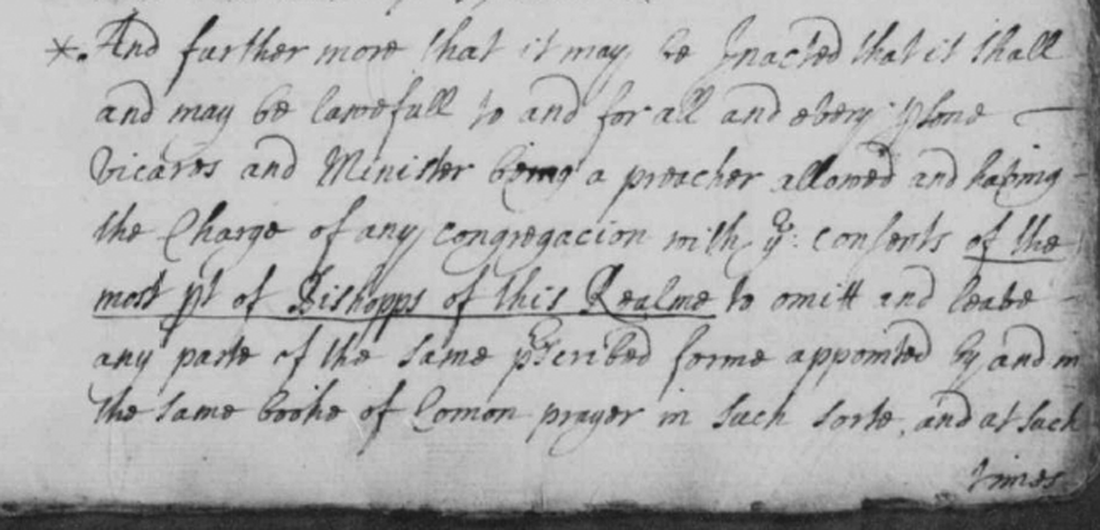
Whether or not Bell intended his answer to Burghley to be evasive, the revised document that emerged from the “conference” was demonstrably a version of the same bill, with the first and second provisions still intact, aside from the fact that a majority of the episcopate was now needed to approve changes to the liturgy. (For that matter, both Bell's and Knollys’ anxiety that the bill not come to a vote as it first stood was a sign that the contents had taken leading members of the House by surprise.) Yet the revised bill went farther than the original in one important aspect, concerning the legal jurisdiction over ministers who transgressed the Act of Uniformity. Three copies of the bill can be found in the State Papers. Copy A, written on a single bi-folio in a typical secretary hand (Hand 1), contains the original bill, identifiable by the telltale line “of the Bishops of that dioces.” The text of Copy B, written in a neat cursive across four folio sides (Hand 2), is identical to Copy A, except that it reads “of the most part of Bishopps of this Realme” and must therefore have been produced after it. Both copies appear, however, to have been marked up by the same person, who drew X's through provision three and underlined the portions of the preamble that were excised from Copy C. (This may or may not have been the same person who eventually crossed out “of the Bishops of that dioces” on Copy A and wrote (Hand 3) in the more stringent requirement instead).Footnote 35
Copy A (TNA, SP 12/86, fols. 198v–199r, written in Hand 1, originally stating that liturgical changes could be made with the permission “of the Bishops of that dioces.” This phrase has been crossed out and the phrase “of the most part of Bishops of the Realme” written in its place in Hand 3.

Copy B (TNA, SP 12/86, fol. 201v), written in Hand 2, requiring that alterations to the Book of Common Prayer be approved by “the most part of Bishopps of this Realme.”

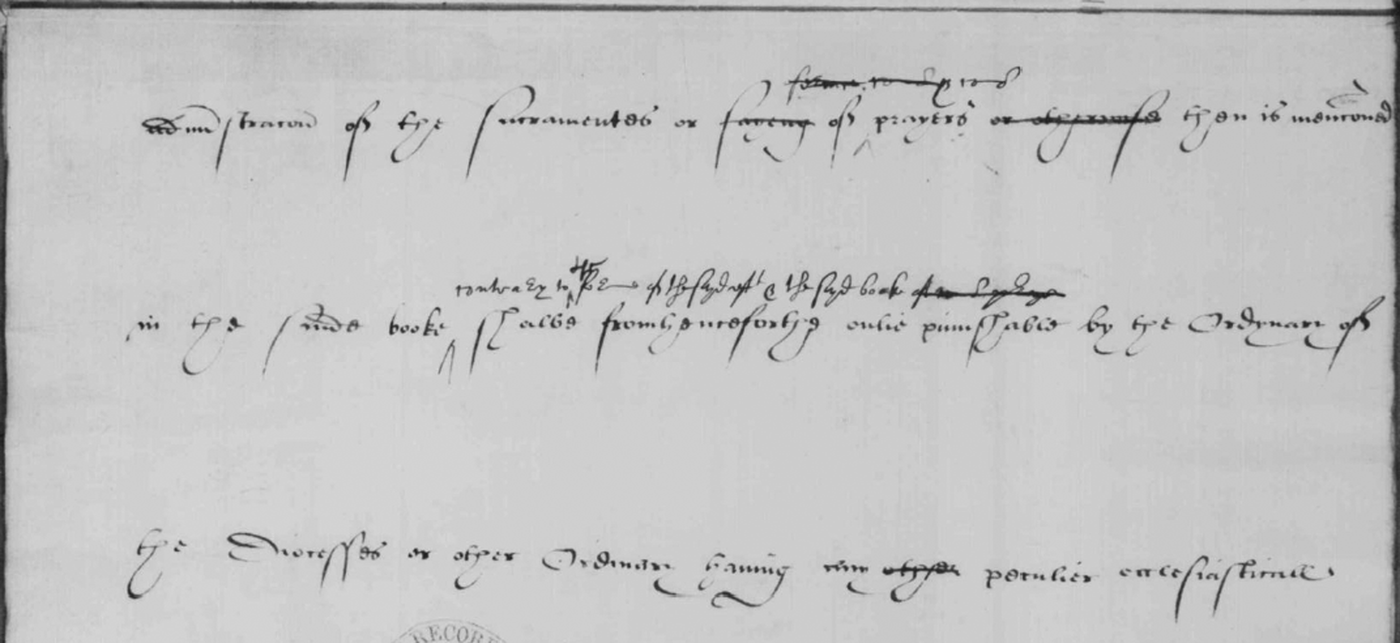
The endorsement on Copy C (“The first reading”) indicates that it is the revised version read aloud on 21 May.Footnote 36 It begins with the truncated preamble and is missing the third provision entirely. It is written in a different secretary hand (Hand 4) on five bi-folios that have been rotated at 90-degree angles, with considerable space left between each line for emendations (which have been made in yet another secretary hand, Hand 5). The second provision is lightly scored out, but this was almost certainly done after the reading had already taken place, perhaps with an eye to placating the remaining opponents. In his diary entry on 21 May, Thomas Cromwell reported that the new bill held that “All other persons using any other service” (aside from “paposticall” ones or those “more superstitious”) than “the service apointed by the said Booke” were to be “lefte to the discretion of the ordinary, or [allowed] to leave any part thereof by consent of most of the bishops.”Footnote 37 Here, indeed, was a novel addition, inserted between the first and second provisions of Copy C, placing these nonconforming godly ministers out of the reach of lay courts. “Every [such] ecclesiastical person,” it read, “shalbe from henceforthe onlie punishable by the Ordynary of the diocesses or other Ordinary having any peculiar ecclesiastical Jurisdiction where such offense shalbe comytted by sequestracion or deprivacion.”Footnote 38
Copy C (TNA, SP 12/86, f. 213r), written in Hand 4, with emendations in Hand 5, reserving punishment for nonconforming godly ministers to the “Ordinary of the Diocesses.”

While the author of the initial version of the bill remains out of conclusive reach, the deviser of this specific section must be found among the committee members who met on 20 May. The effort to make the wording of the first clause clearer and more precise, as well as to close the jurisdictional loopholes left open by it, suggest that the person(s) behind it possessed some legal training. Probable candidates therefore include Christopher Yelverton, who was at this point already a prominent lawyer and still a bold advocate for godly causes, and Vincent Skinner, who befriended some of the most outspoken puritans of Elizabeth's reign during his time at Cambridge and Lincoln's Inn (where he met both Thomas Cartwright, who inaugurated the English Presbyterian movement, and John Stubbe, later the unlucky author of The Gaping Gulfe).Footnote 39 Leaving aside the question of authorship, the clause was based on the assumption that the bishops would be more lenient in their oversight than the justices of the assize had been.
In trying to deal with the specific problem of overzealous prosecution, however, the new clause also mounted a statutory challenge to the Erastianism embedded in the Act of Uniformity. It maintained that papist non-conformity should be dealt with by the full severity of the common law courts, but that its Protestant equivalent ought to be left to the judgment of church officials. This clause would have provided the bishops with new disciplinary powers without requiring direct reform of the canon laws (which Torrance Kirby describes as remaining “stubbornly unregenerate”).Footnote 40 In the most radical interpretation, the specific use of the term “ordynary” (as opposed to “bishop”) looked forward to a post-episcopal church, or one in which the powers in possession of the bishops were devolved or democratized.
Even if the committee had forsaken the second provision of the bill entirely instead of merely amending it (as it seems they planned to do after the first reading on 21 May), the queen's reaction would almost certainly have been the same, given the stakes involved in changing the regulatory provisions of the 1559 settlement. Elizabeth did, however, express concern about the allegations that the Act of Uniformity was being weaponized against godly ministers. In her audience with Knollys on 23 May, she “gave very good words of the good opinion she had of the Howse” on this particular matter and promised “to take good protestantes to her protection.” She appointed Thomas Wilson, MP and Master of Requests, to “enquire the truth … and to bring word … of the names of [the ministers] which were so indited, who preferred [had initiated] the indictment, and what judges or justices did receave the same.”Footnote 41 It should be seen, she pledged, “that as she is termed the defender of the faith, so she wilbe found the protector of true protestantes.” Comfortable words, to be sure, containing the promise of at least a partial redress of grievances. Yet the results of Wilson's investigations do not seem to have survived, while the complaints that had ostensibly prompted the bill persisted for years.
On 4 April 1574, Thomas Sampson wrote a highly suggestive letter to Burghley, on behalf of the
Most painfull and pitiable ministers and laborers molested and hindered by the severe exacting of the law which establisheth the Book of Common Prayer. I do simply confess to your L[ordship] that the substance of that book is such and so good, that it deserveth well to be maintained by law. But … your lordship knoweth that the Holy Sacrament of Baptism may well be ministred without the superfluous sign of the cross; and that the Holy Communion … ministred and received without the perilous gesture of kneeling … but by law, yet, it is not suffered so to be. And therefore, some diligent pastors which without the law have brought it to pass … are by the severity of that law punished and displaced … Yea would I not leave every man to his privat order, but that in this publick order the pastor … by the judgment of the Ordinary (who (in my poore conceipt) is a more meet judge than are the Justices of Assize) might be permitted quietlie to … applie thos things onlie which make to necessary edificacion.Footnote 42
Sampson's argument, of course, exactly mirrored the one laid out by the “Bill Concerning Rites and Ceremonies” two years before, down to the additional proviso in the revised version. Considering the brief shelf life of the bill and the norms mandating the secrecy of parliamentary proceedings (notwithstanding that these norms were not always enforced), it seems that Sampson could only have written to Burghley in such a way had he been responsible for, or at least privy to, the bill's contents and informed of its fate both in and out of committee. While Sampson had been one of the earliest and most vocal opponents of enforcement of clerical dress, by the end of the 1560s he was no longer on the leading edge of godliness, due in large part to his attitudes toward episcopacy.Footnote 43 For the work that Sampson considered essential to the continued reformation of the church, he looked to the bishops as indispensable and sympathetic allies, despite his difficult personal relationships with some of them. In 1573, in the midst of a serious illness, he wrote to Burghley to urge him to press for a reformed discipline, holding up as a model De regno Christi, the rubric that the German theologian Martin Bucer had written for Edward VI's church. The bishops themselves, Sampson claimed, would support the devolution of episcopal power advocated by Bucer. Being “but a stranger” in England, Bucer had apparently written De regno “by report of his familiars … the same which are now archbishops of York [Edmund Grindal] and Canterbury [Matthew Parker], bishop of London … and such like … I am sure, since his death, in private talk, they have much approved his book.”Footnote 44
Sampson may, however, have simply been well connected enough to obtain information about the efforts for reform in Parliament. The precise identity of the author of the “Bill Concerning Rites and Ceremonies” is less significant than what the text reveals about the jurisdictional conflicts created by the Act of Uniformity, how the Elizabethan settlement was wielded in lay hands and the range of adaptive strategies that godly ministers (and their partisans) devised in response—along with the theological and ideological justifications that accompanied them. In the continued absence of legislation allowing for differential responses to “papist” versus “non-papist” violations of the Act of Uniformity, Elizabeth's subjects resorted to ad hoc and experimentalist solutions to protect godly ministers. In the 1580s, for instance, a group of gentlemen from Suffolk submitted a “supplication … for redress of certeyne ignominious injuries” offered to those “paynfull [conscientious] pastors and mynisters of the woorde” who had been “marshalled with the worst malefactors, presented, indicted, arrayned, and condemned for matters as we presume of very slender moment.”Footnote 45 In their letter to the justices, the Privy Council validated the perspective contained in the “supplication,” which was itself a facsimile of the sentiments expressed in the “Bill Concerning Rites and Ceremonies”; it was the fault of “some informers, not well disposed in religion” that “divers good preachers … have been indicted (by colour of law) for things not so much against the matter and very meaning of the law [the Act of Uniformity], as in some show swerving from the letter thereof.”Footnote 46
The bill, of course, used complaints about aggressive indictments and prosecutions as an opportunity to introduce proposals that went much farther than simply protecting godly ministers from harassment. The second provision of the bill seems to have been inspired by attempts at compromise between enterprising ministers and their beleaguered bishops during the recent subscription campaigns for the Thirty-Nine Articles. One vivid example illustrates how the establishment of a statutory doctrine created an opening to argue that ceremonial uniformity was not required for the maintenance of a true church and that the line between “things necessary” and “things indifferent” should be drawn so as to criminalize only “superstitious” and “papist” practices. In the summer or fall of 1571, four ministers—Christopher Goodman, Percival Wyborne, Edward Deering, and John Field (of the Admonition)—“offred up” a “kinde of agreement” to the bishop of London, Edwin Sandys. They stated their “read[iness] to subscribe” to the articles “as consonant to the worde of God for any thinge that [we] presently see or perceive in them.” They declined to wear the vestments but hastened to add that they did not “judge nor condemn others in using the same, for they stand or fall to the lord as we do. Nether would [we] breake the unitie of the Christian faith by withdrawing [our] dutie from preaching to the truth and faith in the Book of Articles contained.” As is evident from this “agreement,” the ministers embraced the doctrine of the church but not all of its ceremonial trappings. They reminded Sandys that “even … you yourselfes [the bishops] confesse some imperfections [in the Prayer Book]: so do [we] likewise much more.” They agreed to “subscribe unto ye same booke for doctrine of faith and administration of sacraments” but only in “so far as they make to edification and as is contained in the said articles.”Footnote 47
Here was a plea to be allowed to remain within the good auspices of a church that possessed a true doctrine, as well as a supplication for the acceptance of limited non-conformity in the areas that did not touch upon it. Nothing seems to have come of this proffered “agreement,” but considering Sandys's own strongly reformist tendencies, especially in matters of liturgy, the outcome would undoubtedly have been different under the protective cover of a statute like the “Bill Concerning Rites and Ceremonies.”Footnote 48 For Field, however, the May 1572 bill would likely have been too similar in spirit and approach to this failed negotiation with Sandys, and too dependent overall on the goodwill and caprice of individual bishops to have held much appeal, especially after his suspension from preaching.
The first and second provisions of the bill were analogous to one another; allowing the bishops to approve omissions of the Prayer Book liturgy was a logical, if substantively bold, corollary to the elimination of statutory penalties against godly non-conformists. The third provision, however, permitting the “mynistracion of the woorde and sacraments, and other godlie exercises of religion” in the manner of the French and Dutch stranger churches, was far more of a departure in kind.Footnote 49 It aimed to break down the legal and spatial constraints that the Elizabethan state placed on continental forms of worship, thereby allowing for multiple liturgies within a church that from its inception had been crafted to be territorially bound and mono-confessional. This portion of the bill also provides another clue as to its authorship, pointing to the generation of Marian exiles who had intimate experience with continental liturgies and still looked to the “best reformed churches in Europe” as their models.Footnote 50 As Karl Gunther has argued, Elizabethan Puritanism was shaped not only in response to the specifics of the 1559 church settlement but also by the “continuation (and in some cases) the reappearance of ideas and tensions that had been developing in the English Reformation” starting in the preceding decades.Footnote 51 For instance, the exile church at Frankfurt, under the guidance of William Whittington, one of the compilers of the Geneva Bible, and John Knox, the firebrand Scottish reformer, adopted what Leo Solt calls a “hybrid order of church service, which combined the Second Prayer Book [of 1552]—minus the Litany and surplice, among other things—with parts of the Genevan order of service.”Footnote 52 In lieu of scripture readings, the congregation recited the Apostle's Creed and a church “constitution” that espoused a reformed discipline.Footnote 53
The “Bill Concerning Rites and Ceremonies”can therefore be seen as a continuation of “troubles at Frankfurt,” in which the English exile community was bitterly divided over the interpolation of “foreign” services with the Edwardian liturgy, with Richard Cox, the future Elizabethan bishop of Ely, leading the charge against the Knoxians.Footnote 54 The bill sought to recreate the atmosphere of improvisation and cross-fertilization that had existed at Frankfurt, only this time on English soil, under the protection of a Protestant queen (who, however, had no desire to play this particular part). In certain ways, the inclusion of this third provision makes it less likely that Thomas Sampson authored the bill, for he sided with Cox's party in 1555, once they had set aside some of the ceremonials he most objected to (including the surplice and kneeling at communion). Yet more than a dozen years since its reestablishment, the Protestant church of England had not yet abandoned even these two practices—indeed, quite the opposite—and the Sampson of Elizabeth's reign may well have looked back on the heady, contentious days at Frankfurt with more approval than had the Sampson of Mary's reign.
The scantiness of the evidence that can be connected to the pre-parliamentary life of the bill is fortunately matched by a rich record of the reception it received once it was unveiled in the House. It is to these debates on 19 and 20 May, recorded in Thomas Cromwell's diary, that we turn to for the remainder of this article. They offer a glimpse into an alternate, potential history of the English Reformation and the ongoing struggle to either accommodate or eliminate a diversity of liturgical practices within the confines of a mono-confessional polity.
Despite their widely divergent attitudes toward the established church, both the parliamentarian critics of the bill and the out-of-doors Presbyterians who seized the initiative in June concurred that fixity and uniformity of ritual were requirements of a rightly reformed English church. Consider, for example, the speech made by someone whom Cromwell refers to as a “Mr. Bamleye,” who defended the first provision of the bill but not the second or third. The consequences for violating the Act of Uniformity ought to “be diverse,” he said, “for the justice that would punish the papist and the offender in small matters with one punishment [is] worthie to be removed.” He also criticized those who “striveth for ceremonie” as “nearer [to] Judiasme” than not. He nonetheless advocated having “one uniform order throughout the realme,” since the “innovacion of rites for the common people taken for [would result in] innovacion of religion.” There may have been “fewe ceremonies in the Apostells’ tyme” and “fewe in the Duch or French [speaking] Church,” he admitted, but this was “because they were not under any monarchies.” For the English church, which recognized the queen as its governor, “then ceremonies [were] necessary.”Footnote 55 Whether this was because a degree of ceremony best accorded with the majesty of queenship, “Bamleye” did not specify, but his Erastianism was clear. (Since no one by the name of “Bamleye” ever served in an Elizabethan Parliament, it seems that Cromwell accidentally left out an “r” when spelling his name and meant to refer to George Bromley, attorney of the Duchy, who was one of the twelve members who sat on the committee to revise the bill. As a supporter of the 1559 religious settlement, Bromley probably approved of scoring out the second provision of the bill, as well as of disallowing changes to the liturgy even with the consent of a “majority of the bishops.”Footnote 56)
Supporters of the bill, however, argued that it would not threaten the integrity of the English church, as uniformity was neither an indispensable nor attainable attribute of true Christianity. In an inelegant metaphor, Sir Henry Gates explained that just as it was “not possible any one meate could like the taste of all of us here present,” so “uniformitye [was] never hitherto obtained, nor ever to be looked for in the Church.” The first Christians, he insisted, had not adhered to a particular set of practices, nor was the apostolic church the only legitimate model for subsequent generations, for “some may brooke [withstand] that by perfection which others cannot beare.”Footnote 57 In this, Gates was echoed by John Audley, who in his only recorded speech in the Commons insisted that “Conformyty [is] not always necessary,” for as “the Jews and Gentils did vary,” so “every consistorie can best oversee itself.”Footnote 58 Audley's reference to “consistories” is telling and suggests that he may have been one of the committee members responsible for the proviso reserving the punishment of godly non-conformists to the “ordinaries” of the diocese. Likewise, he denied that the earliest church was meant to serve as an unchanging model for successive generations. “The Apostells themselves in the beginning made a law for [a] strangled hoode,” he claimed, “and whereof after they made reformacion.” Here were two MPs, godly in their allegiances, whose conception of a valid English church did not depend on establishing a fixed or permanent set of rites and ceremonies to be used in every parish across the realm. While drawing a bright line around what they considered to be papist infractions, they promoted puritan practice from a standpoint that was comparatively more tolerant than the ones occupied either by their more conformist colleagues or their Presbyterian brethren. According to men like Gates and Audley, since a (limited) variety of rituals had existed even in the very early church and (some) change was endemic to the Christian religion, the bill now under consideration would not damage the English church, only open up productive avenues for ministers to sustain their flocks.
By declaring their assurance in the discernment of the bishops, men like Audley hoped to put the bill's opponents on the defensive. Member of Parliament Francis Alford had begun the debates on 19 May by warning about the dangers that would follow if the bishops were permitted to alter the Common Prayer service piecemeal. “[I] would have the matter first treated of in the Convocacion howse,” he pleaded. “Great strifes [I] knoweth hath been about trifles, yet the things necessarie to be observed, for avoiding of sc[h]ismes until a farther general order be taken, [ought] not to be lefte to the particular order of every curat or bishop.”Footnote 59 It was a stroke of luck for the bill's supporters that Alford was the first MP to speak against it. His wife was a known Catholic, and although he would later protest to Christopher Hatton that he “ever from [his] youth hated that religion,” his insistence during this same Parliament that Mary Stuart be granted a fair hearing for her alleged crimes earned him the lasting suspicion and disdain of many of his fellow MPs.Footnote 60 Alford had been careful to note that he approved of the bishops acting corporately in their capacity as the upper house of Convocation (and that he believed the Commons should be led by them in matters of religion), but the MPs who succeeded him on the floor cleverly responded as if he had impugned the judgment of the bishops. Tristram Pistor took pointed aim at Alford, remarking, “It grieveth [me] to hear any mislike so good a bill. If the speaker against the bill were a sheepe of the good shepherd, he could not mislike that which is so referred to the bishops.”Footnote 61 Pistor gave another brief speech in favor of the bill the next day, urging the Commons to take the initiative and revive the reformist energy of the episcopate. “He wisheth the bill to have furtherance,” Cromwell recorded him as saying, “and [thereby] we give life to the bishopps. It shall come to their consideration. He doubteth not that which we have well begun, they will give perfection.”Footnote 62
As Pistor's comments indicate, the bill's supporters sought to utilize the office of the bishop in ways that the bishops themselves had not formally attempted to do. While many among this first generation of Elizabethan bishops were dissatisfied with the existing church settlement, and the bill's preamble averred that the “godly” among them had clandestinely given their assent to Puritan experimentalism, even the most far-reaching proposals that the bishops had developed and promoted in Convocation did not dispense with the requirement of uniformity. The bill's creativity lay in the discretionary powers it awarded to the bishops as individual officers of the church and the way it repositioned their relationship to the Book of Common Prayer, from enforcing a standard order of service to managing (if they so chose) a spectrum of godly liturgies within their own dioceses. It aimed to reduce the vulnerabilities that even the bishops were exposed to in a church ultimately governed by the monarch—vulnerabilities that were on full display in 1576, when Elizabeth forced Edmund Grindal, then archbishop of Canterbury, into retirement for his refusal to suppress the intensive preaching exercises known as “prophesyings.”Footnote 63
Yet when it came to building support for the third provision, the bill's supporters relied on a strikingly different set of arguments. They pivoted from deploring the restrictiveness of the Book of Common Prayer to speaking favorably of the fixity and stability of the French- and Dutch-language services, contending that these qualities provided a sufficient hedge against the confusion that might otherwise result from their incorporation. It was this provision that excited the most opposition in the Commons, not only from suspected papist sympathizers like Francis Alford but also from indisputably godly men like James Dalton, who was also a member of the committee that revised the bill. It was Alford's hope that “neither we to follow the examples of other realms, having more learned men in England than any other dominion which [I] hathe beene in.”Footnote 64 Dalton gave voice to similar feelings when he remarked that he “liketh not the relacion to the Duch and French Church. The same [provision is] a derogacion to the learned men of Englande.” Like “Bamleye,” he also considered uniformity an essential attribute of a functional English church: “This libertie would cause diverse services and diverse sacraments in Englande, which were a dissonancy … The best universal [I] liketh, but no best particular.”Footnote 65 He concluded his speech by cautioning that since “the Duch Church may alter their service” in the future, there could be no effective limit to the kinds of practices permitted under the bill.
Audley, who spoke immediately after Dalton, denied that the bill cast any aspersions on the judgment and training of English divines, or that it would lead to clergymen cherry-picking from a wide array of stranger services. “If it be true, as it is taken,” he began, grandiloquently, that “the referring of the service to the Duch Church were to the sclaunder of the learned of this realm … yt were the greatest derogacion to the death of Christ which might be. But this bill onely referreth to it as a service printed and allowed, not followed because the Duch or French use it, but to one particular for certainty … Neither is it referred to the Duch Church service which may be used, but that which is used.”Footnote 66 The day prior, Robin Snagge had also contended that “nothing in this bill required [is] unreasonable,” because “nothing [is] allowed but that which shalbe allowed by the bishoppes and doth agree with the service used in the Duch and French church, which is also in print and therefore willful ignorance not to know it.”Footnote 67 Both Audley and Snagge placed great emphasis on the fact that the stranger church services had been published—supposedly thus making them knowable, accessible, and unchangeable quantities.
From a distance of more than four centuries, however, it is difficult to determine exactly which service(s) the refugee churches were using in 1572.Footnote 68 According to Brian D. Spinks, the Dutch-speaking congregation under Elizabeth relied on the Christlicke Ordinancie, a largely faithful translation of the liturgical template known as the Forma ac ratio.Footnote 69 The Forma was the work of the exiled Polish reformer John à Lasco, superintendent of the London stranger churches during Edward VI's reign, while the Ordinancie was produced by one of the Dutch-speaking pastors serving under him, Marten Micron. Both were published in Germany in 1554.Footnote 70 Exhaustively detailed, the Forma included, among many other instructions, the exact points at which ministers should lead their parishioners in reciting the Decalogue, the Lord's Prayer, and the Apostle's Creed, as well as the proper way for them to conduct communal confessions. The Forma was free of many of the trappings that English Puritans considered popish (communion was served around a table, not kneeling at the altar, for instance), but it was similar to the Book of Common Prayer in the painstaking way it guided participants through the appropriate proceedings. Spinks also notes, however, that there is evidence that the Dutch stranger church incorporated prayers and psalms from services other than the Forma and Ordinancie. On Easter Sunday, 1571, for example, the worshippers sang a psalm drawn from the liturgy then in use by the Dutch Reformed Church in the Netherlands.Footnote 71 It therefore seems that James Dalton was right to fear that “the Duch Church may alter their service” and that if the “Bill Concerning Rites and Ceremonies” became law, it would soon be stretched beyond its strict meaning to allow for the adoption of liturgies that had not even yet been invented.
Although three copies of the French translation of the Forma ac ratio survive in the archives of the Dutch and French stranger churches, there is no scholarly consensus about whether the Forma functioned as the official liturgy of the latter congregation in the early 1570s. Patrick Collinson contends that Robin Snagge was referring in the parliamentary debates not to the Forma but to a more compact “discipline,” the Forme de police ecclesiastique, written in 1561 by Nicholas des Gallars, an associate of John Calvin's who served as the minister of the French stranger church for a brief spell at the start of Elizabeth's reign.Footnote 72 (This is also the argument of Andrew Spicer, in his studies on the Elizabethan-era revisions to the Forma.)Footnote 73 Spinks, by contrast, argues that the spare Forme de police was not intended to function as a comprehensive order of service. Instead, he says, the “use of the Forma ac ratio in the composition of the “discipline” might well suggest that Lasco's liturgy provided [that is, served as] a basic directory for the worship of the French stranger churches.”Footnote 74 In 1578 and 1579, the French church in London produced revised versions of the Forme de police, but these later editions survive only in manuscript and cannot say much about the exact liturgy in use six or seven years earlier.Footnote 75
The argument that the supporters of the “Bill Concerning Rites and Ceremonies”were content to limit the extent and direction of new reforms is either weakened or corroborated depending on the stranger church service(s) they had to choose from and how exactly these various “orders,” “forms,” and “disciplines” were utilized on the ground. If the French-speaking church relied more on the lean Forme de police rather than the robust Forma ac ratio, or the Dutch-speaking congregants habitually deviated from or added to the Christlicke Ordinancie, then the bill was likely designed with an eye to encouraging similar experimentation in English parishes. It seems, however, that if the stranger churches had a reputation for blatantly straying from their “extant” liturgies (as the text of the bill referred to them), the bill's opponents would have raised a different set of objections during the parliamentary debates, based not on the fear of potential future alterations but on the consistent reality of them.
Some years after its failure, the “Bill Concerning Rites and Ceremonies”entered in to the parliamentary record again, remembered as a crucial missed opportunity in the post-reformation battle between true religion and popery, right order and treason, danger and deliverance. Parliamentary member Peter Wentworth, best known to subsequent generations for his defense of parliamentary free speech, delivered an impassioned oration before the Commons in 1576 that linked Elizabeth's rejection of the bill (which he blamed on the bishops) with her refusal to act against Mary Stuart. When the queen forbade the Commons from advancing any more bills for religion in the 1572 session, “it was as much to say [it was as if she said], Sirs, ye shall not deal in God's Causes, No, ye shal in no wise seek to advance his Glory.” Wentworth claimed that “Divers of this House … said with grieved hearts that God of his Mercy could not prosper the session.” As a result, “his Great indignation was … pourd out upon this House. For he put it into the Queen's Majesty's heart to refuse good and wholesome Laws, for her own Preservation.”Footnote 76 Here the bill's significance transcended its specific terms, becoming merely another sign of how England's imperfect reformation had imperiled its future as a Protestant kingdom.
Yet in its carefully delineated provisions, the bill had actually been the work of a particular group of godly men who rejected both the royal and Presbyterian insistence on a uniform order of worship and argued for a national church that included (a limited variety of) multinational liturgies. Developed concomitantly with the first public pronouncements in favor of Presbyterianism, the bill provided a very different answer to the persistent problem of how to reconcile the heterogeneous development of Protestantism with a territorially confined church and the desire for local autonomy with the wishes of the monarch who gave life to this Protestant identity, however tenuously. The bill's architects sought more than toleration, but less than revolution, hoping only to carve out exceptional spaces within the English church that would accommodate a multiplicity of worship practices. When the Admonition was issued to explosive effect a few weeks later, it was therefore directed as much at these compromising brethren as to the unabashed conformists of the day.