1. Introduction
The study of the shape of self-gravitating bodies is extensive and dates back to the time of Newton itself. It is well known that depending on the density of a dying star, there are several possibilities for the resulting object: white dwarf, neutron star, black hole, etc. The case of a black hole forming is also referred to as gravitational collapse. The literature on these phenomena is extensive and we refer to [Reference Calogero and Leonori6] and [Reference Jia, Kodio, Chapman and Goriely8] for a historical account.
In this paper, we consider the problem of a self-gravitating spherical body. Apart from its apparent ‘simplicity’, this problem plays an important role on the study of the more complex phenomena described above. The proposed variational model combines both mechanical and gravitational responses, the mechanical part based on a model from non-linear elasticity which allows for the characterization of large deformations. Under certain mathematically physical conditions, the extrema of the corresponding energy functional can be characterized via the Euler–Lagrange equations. This combined model has been used by [Reference Beig and Schmidt5], [Reference Calogero and Leonori6] and [Reference Jia, Kodio, Chapman and Goriely8] among others. In [Reference Beig and Schmidt5] the existence of solutions to the Euler–Lagrange equations, with a zero dead load boundary condition on the outer boundary of the body, is established via the implicit function theorem and is valid for ‘small bodies’ of arbitrary shape.
The work in [Reference Jia, Kodio, Chapman and Goriely8] is for spherically symmetric deformations with a zero dead load boundary condition on the outer boundary as well, and combines asymptotic analysis with numerics to get results for varying densities and reference configuration body radius. They used a stored energy function of the form

where $\alpha \ge 0$ , $\beta$
 and $\mu$
 are positive constants, and $f_\alpha (d)=\ln (d)-\alpha d^{-\alpha }(d-1)^4$
 . This material corresponds to a ‘soft’ compressible material for $\alpha =0$
 or small, and to a ‘strong’ compressible material otherwise. For constant reference configuration density $\rho _0$
 , the authors in [Reference Jia, Kodio, Chapman and Goriely8] show numerically that for $\alpha$
 small there exists a critical density $\rho _0^*$
 such that if $\rho _0\le \rho _0^*$
 , then the Euler–Lagrange equations (cf. (3.8)) can have multiple solutions, most of them unstable, while if $\rho _0>\rho _0^*$
 , then there are no solutions, a result which could be interpreted as gravitational collapse. Moreover for $\alpha$
 large, there are solutions for all densities $\rho _0$
 , which appear to be unique.
By adapting the techniques in [Reference Ball1] for polyconvex stored energy functions, the authors in [Reference Calogero and Leonori6] show the existence of minimizers for the resulting energy functional, now for large deformations and arbitrary bodies, and for both, zero dead load and displacement boundary conditions. The stored energy functions used in [Reference Calogero and Leonori6] could be classified as corresponding to ‘strong’ compressible materials (cf. eqns. (13) and (14) in [Reference Calogero and Leonori6]).
In this paper, we look for minimizers of the energy functional for isotropic compressible elasticity and taking into consideration the effect of a gravitational field induced by the body itself. We consider both, the displacement problem in which the outer boundary of the body is subjected to a Dirichlet-type boundary condition, and the one with zero traction on the boundary but with a specified internal pressure function. For a spherically symmetric body occupying the unit ball $\mathcal {B}\in \mathbb {R}^3$ and with radially symmetric mass density, the minimization is done within the class of radially symmetric deformations. Contrary to previous works, the deformations we consider belong to $W^{1,p}(\mathcal {B})$
 with $p<3$
 , and thus may develop singularities. For the particular case of radially symmetric deformations, we study the occurrence or initiation of a cavitation at the centre of the ball and its dependence on the boundary displacement, internal pressure and gravitational-related constants.
In § 2 we introduce the basic model, energy functionals and admissible function spaces, for radial deformations (cf. (2.5)) of a spherically symmetric body. These deformations are characterized by a function $r\,:\,[0,\,1]\rightarrow [0,\,\infty )$ . For the displacement problem, the boundary condition takes the form $r(1)=\lambda$
 . We now show in § 3 that under certain growth conditions on the stored energy function (cf. (3.1) with H1–H3) and for any (radial) reference configuration density function $\rho _0$
 that is bounded, non-negative and bounded away from zero, a minimizer of the energy functional (2.7)–(2.9) exists over the admissible set (2.13).
For the internal pressure problem, we consider an internal pressure function $P:[0,\,\infty )\rightarrow [0,\,\infty )$ satisfying

where $\varepsilon,\,c>0$ are constants. The motivation for this model comes from experiments performed by Gent and Tompkins [Reference Gent and Tompkins7], where samples of polymers were left in a gas under pressure, over a period of time (hours). The pressurizing gas then induces a negative hydrostatic pressure inside the polymer. It was observed that upon release, small holes formed inside the polymer if the initial confining pressure was sufficiently large. Under the same growth conditions as in the displacement problem, we show in § 3 that a minimizer of the energy functionalFootnote 1 (2.14)–(2.15), which includes the model pressure function (1.2), exists over the admissible set (2.16).
Under the additional constitutive assumption (3.6), these minimizers satisfy the Euler–Lagrange equations (3.8) where either $r(0)=0$ or $r(0)>0$
 (cavitation) with zero Cauchy stress at the origin in the displacement problem, and with zero modified Cauchy stressFootnote 2 at the origin for the internal pressure problem. In § 4 we show that for $\lambda$
 or $P_*$
 sufficiently large, these minimizers must satisfy $r(0)>0$
 . The result for the displacement problem is an adaptation to the problem with self-gravity of a similar result in [Reference Sivaloganathan11] for compressible inhomogeneous materials, while that for the internal pressure problem is again an adaption to the self-gravity problem of the corresponding problem treated in [Reference Sivaloganathan12].
In § 5 we collect several results for the displacement problem with $\lambda$ small where the minimizers must have the centre intact. In addition we show in Theorem 5.3 that any minimizer which leaves the centre intact must have strains at the origin less than the critical boundary displacement corresponding to a homogeneous isotropic material made of the material at the centre of the original body. Once again this result is an adaptation to the problem with self-gravity of a similar result in [Reference Sivaloganathan11] for compressible inhomogeneous materials.
Finally in § 6 we present a numerical scheme for the computation of the minimizers of the energy functional for the displacement problem. This method is based on a combination of a gradient flow iteration which works as a predictor, together with a shooting method to solve the EL-equations, that works as a corrector. For constant reference configuration densities, we present several simulations that show the dependence of the cavity radius and minimum energy on the displacement $\lambda$ and density $\rho _0$
 . In addition, we include a simulation for a spherical body with composition resembling that of the planet Mercury.
2. Problem formulation
Consider a body which in its reference configuration occupies the region

where $\left \Vert \cdot \right \Vert$ denotes the Euclidean norm. Let $\mathbf {u}:\mathcal {B}\rightarrow \mathbb {R}^3$
 denote a deformation of the body and let its deformation gradient be

For smooth deformations, the requirement that $\mathbf {u}(\mathbf {x})$ is locally invertible and preserves orientation takes the form

Let $W:\mathcal {B}\times M_+^{3\times 3}\rightarrow \mathbb {R}$ be the stored energy function of the material of the body where $M_+^{3\times 3}=\{ \mathbf {F}\in M^{3\times 3}\,|\,\det \mathbf {F}>0\}$
 and $M^{3\times 3}$
 denotes the space of real 3 by 3 matrices. Since we are interested in modelling large deformations, we assume for fixed $\mathbf {x}\in \mathcal {B}$
 that the stored energy function $W$
 satisfies that $W(\mathbf {x},\,\mathbf {F})\rightarrow \infty$
 as either $\det \mathbf {F}\rightarrow 0^+$
 or $\left \Vert \mathbf {F}\right \Vert \rightarrow \infty$
 .
We assume that the stored energy function, in units of energy per unit volume, describing the mechanical response of the body is given by

for some function $\Phi :\mathcal {B}\times \mathbb {R}_+^3\rightarrow \mathbb {R}_+$ symmetric in its last three arguments, and where $v_1,\,v_2,\,v_3$
 are the eigenvalues of $(\mathbf {F}^t\mathbf {F})^{1/2}$
 , known as the principal stretches. Note that for any fixed $\mathbf {x}$
 , the material response $W(\mathbf {x},\,\cdot )$
 corresponds to an isotropic and frame-indifferent material.
We now restrict attention to the special case in which the deformation $\mathbf {u}(\cdot )$ is radially symmetric, so that

for some scalar function $r(\cdot )$ , where $R=\left \Vert \mathbf {x}\right \Vert$
 . In this case, one can easily check that

In this case, we assume that the dependence of $\Phi$ on $\mathbf {x}$
 in (2.4) is only on $R=\left \Vert \mathbf {x}\right \Vert$
 . We employ throughout this paper the following notation:

with similar notation for any partial derivative $\Phi _{,i}=\frac {\partial \Phi }{\partial v _i}$ of $\Phi$
 . We shall drop the explicit dependence on $R$
 above, whenever $\Phi$
 does not depend explicitly on $R$
 .
The total stored energy functional due to internal mechanical and gravitational forces (see [Reference Calogero and Leonori6]) is given, up to a multiplicative constant of $4\pi$ , by:

where


are the mechanical and gravitationalFootnote 3 potential energy functionals respectively. Here $\rho _0$ is the mass density of the body (mass per unit volume) in the reference configuration, and

is the mass of the ball of radius $R$ in the reference configuration and centred at the origin. We assume that

for some positive constants $k_0$ and $k_1$
 .
Remark 2.1 The function $\rho _0(\cdot )$ is the so-called natural density which refers to the density of the material in a stress-free configuration without gravity. On the other hand, the current density is the mass density function due to the deformation $r(\cdot )$
 with gravity, and is given by $\rho (r(R))=\rho _0(R)/[r^\prime (R)(r(R)/R)^2]$
 . Thus, the assumption that the current density is constant implies that $r^3(R)=KM_R+r^3(0)$
 for some positive constant $K$
 , which essentially determines the deformation.
Remark 2.2 We note that the stored energy function in (2.8) includes as a special case that in which

where now $\phi$ is the energy per unit mass, also called the specific energy density.
In accord with (2.3), we have the inequalities

In the boundary displacement problem, we require that the deformation $\mathbf {u}$ satisfies the boundary condition:

where $\lambda >0$ is given. For (2.5), this reduces to:

The (radial) boundary displacement problem now is to minimize the functional $I(\cdot )$ over the set

Note that $\mathcal {A}_\lambda \ne \emptyset$ as $r_\lambda \in \mathcal {A}_\lambda$
 where $r_\lambda (R)=\lambda R$
 .
To state the internal pressure problem, we let $P:[0,\,\infty )\rightarrow [0,\,\infty )$ be a continuous function satisfying (1.2), and let

The internal pressure problem is now to minimize the functional given by

over the set

Note that $\mathcal {A}\ne \emptyset$ as $\hat {r}(R)\equiv R$
 belongs to $\mathcal {A}$
 . The term $H_P(r(0))$
 in (2.15) represents the work done by the internal pressure to open up a cavity of size $r(0)$
 .
Remark 2.3 Including a term like $P_*\,r^\prime (R)(r(R)/R)^2$ inside the functional $I$
 , specifying a Cauchy stress of $P_*$
 at the centre of the ball, would lead to a functional unbounded from below (see [Reference Ball3]). Growth condition (1.2) not only yields a functional bounded from below as we will show, but it is consistent with the original experiments reported in Gent and Tompkins [Reference Gent and Tompkins7] for the so-called ideal gases.
The following result from [Reference Sivaloganathan12, Lemma 4.1] will be useful for the analysis of this problem in the next section.
Lemma 2.4 let $P:[0,\,\infty )\rightarrow [0,\,\infty )$ be a continuous function satisfying (1.2). Then there exist constants $\alpha >0$
 and $\beta$
 such that

3. Existence of minimizers
In this section, we show that the functionals $I(\cdot )$ in (2.7) and $I_P$
 in (2.15) have minimizers over the sets $\mathcal {A}_\lambda$
 in (2.13) and $\mathcal {A}$
 in (2.16), respectively. We also give physically reasonable conditions for these minimizers to satisfy the Euler–Lagrange equations for the corresponding functionals. The proofs of the results in this section are adaptations of the corresponding ones in [Reference Ball3] due to the presence of the potential energy functional (2.9). We do emphasize that they are not direct consequence of those in [Reference Calogero and Leonori6] as these are for maps in Sobolev spaces $W^{1,p}$
 with $p>3$
 and thus they represent continuous deformations.
Throughout this section and the rest of the paper, we assume that the stored energy function $\Phi$ in (2.8) satisfies that

where $\phi,\,h\,:\,(0,\,\infty )\rightarrow (0,\,\infty )$ are strictly convex and such that
H1: $\phi (v)\ge C v^\gamma$
 for some positive constant $C$ and $1<\gamma <3$;
H2: $\dfrac {h(d)}{d}\rightarrow \infty,\,\quad \mbox {as }d\rightarrow \infty ;$
H3: $h(d)\ge Kd^{-s},\,\quad d>0,\,$
for some positive constant $K$ and $s\ge \gamma ^*={\gamma }/{\gamma -1}$.


If we let

then the specialization of equation (31) in [Reference Calogero and Leonori6] (which follows from the Hardy–Littlewood–Sobolev inequality) to radial map (2.5), together with (2.10) gives that

for some positive constant $C$ independent of $r\in \mathcal {A}_\lambda$
 or $r\in \mathcal {A}$
 .
The following lemma will be needed to prove the next proposition.
Lemma 3.1 Let $u:[0,\,1]\rightarrow \mathbb {R}$ be a non-negative function. Then if $\phi$
 satisfies H1, there exist constants $k_1>0$
 and $k_2$
 such that

Moreover, $k_1$ can be chosen arbitrarily large by properly adjusting $k_2$
 .
Proof. It follows from H1 that $\phi (t)/t\rightarrow \infty$ as $t\rightarrow \infty$
 . Thus, for any given $k_1>0$
 , there exists $M>0$
 such that $\phi (t)\ge k_1t$
 whenever $t\ge M$
 . Hence,

But

Combining this with the previous inequality, we get that

The result follows upon setting $k_2=-({k_1M}/{3})$ .
We now have the following:
Proposition 3.2 Under growth assumption (3.1) with H1 and H3, the functionals $I(\cdot )$ and $I_P(\cdot )$
 are bounded below on $\mathcal {A}_\lambda$
 and $\mathcal {A}$
 , respectively.
Proof. Combining (2.10), (3.1) with H3, and (3.2) we get for some positive constants $K_1,\,K_2$ that

for all $r\in \mathcal {A}_\lambda$ . Since $s\ge \frac {3}{2}$
 , the function $g(x)=K_1x-K_2x^{\frac {1}{3s}}$
 is bounded below for $x\ge 0$
 , and the result for $I(\cdot )$
 follows.
For the functional $I_P(\cdot )$ , in reference to (2.7) and (2.15), we can write that

The first bracketed term can be bounded below as in the first part of this proof. For the second bracket, we begin by noting that using (3.1) we get that

Using lemma 3.1 twice, we can write

where $k_1>0$ is chosen such that $k_1/2>\alpha$
 with $\alpha$
 is as in lemma 2.4. Combining these inequalities with lemma 2.4, we get that

where we used, for the second inequality, that $\log (t)< t$ and that $r(0)\le r(1)$
 . The result for $I_P$
 now follows.
Using this we can now establish the existence of minimizers for $I$ over $\mathcal {A}_\lambda$
 .
Theorem 3.3 Let the stored energy function $\Phi$ in (2.8) satisfy (3.1) with H1–H3. Then there exists $r_\lambda \in \mathcal {A}_\lambda$
 such that

Proof. Since $\mathcal {A}_\lambda \ne \emptyset$ , it follows from proposition 3.2 that $\inf _{r\in \mathcal {A}_\lambda }I(r)\in \mathbb {R}$
 . Let $(r_j)$
 with $r_j\in \mathcal {A}_\lambda$
 for all $j$
 be an infimizing sequence, i.e.

Since $(I(r_j))$ is bounded, it follows from the proof of proposition 3.2 that the sequence

is bounded. Hence, the sequence

must be bounded as well, and thus from (3.2) that $(I_{\mbox {pot}}(r_j))$ is bounded. From this and the boundedness of $(I(r_j))$
 , we get that $(I_{\mbox {mec}}(r_j))$
 is bounded.
From the boundedness of $(I_{\mbox {mec}}(r_j))$ and (3.1), we get that

is bounded. Let $\rho =R^3$ and $u_j(\rho )=r_j^3(\rho ^{1/3})$
 . It follows now that

and that the sequence

is bounded. It follows now from H2 and De La Vallée–Poussin Criterion that for some subsequence $(\dot {u}_k)$ of $(\dot {u}_j)$
 , we have $\dot {u}_k\rightharpoonup w$
 in $L^1(0,\,1)$
 for some $w\in L^1(0,\,1)$
 , and that $(\dot {u}_j)$
 is equi-integrable. Using H3 is easy to show that $w>0$
 a.e. Letting

we get from the equi-integrability of $(\dot {u}_j)$ that $u_k\rightarrow u$
 in $C[0,\,1]$
 . Thus, $r_k\rightarrow r_\lambda$
 in $C[0,\,1]$
 where $r_\lambda (R)=u(R^3)^{1/3}$
 . From these we can conclude $r_k\rightharpoonup r_\lambda$
 in $W^{1,1}(\varepsilon,\,1)$
 and that $\delta _{r_j}\rightharpoonup \delta _{r_\lambda }$
 in $L^1(\varepsilon,\,1)$
 for any $\varepsilon \in (0,\,1)$
 . By the weak lower semi-continuity properties of $I_{\mbox {mec}}(\cdot )$
 (cf. [Reference Ball, Currie and Olver2]), we get that

We get now from the Monotone Convergence Theorem and the arbitrariness of $\varepsilon$ that

This together with the facts that $r_\lambda (0)\ge 0$ , $r_\lambda ^\prime (R)\ge 0$
 a.e., and $r_\lambda (1)=\lambda$
 , shows that $r_\lambda \in \mathcal {A}_\lambda$
 .
To get that $r_\lambda$ is a minimizer of $I$
 over $\mathcal {A}_\lambda$
 , we still have to deal with the potentials $(I_{\mbox {pot}}(r_k))$
 . First note that

where in the last step we used a weighted Holder’s inequality with weight $\rho _0(R)M_RR^2$ . We now show that each of the two integrals on the right-hand side of this inequality are bounded. Upon recalling (2.10), we can take $M_R\le CR^2$
 for some constant $C$
 . Hence,

However, by the weighted Holder’s inequality (with weight $R^2$ ),

with the sequence on the right-hand side bounded. From (3.1) and H1, it follows that

with the sequence on the right-hand side bounded. Combining these results, we can conclude that the sequence

is bounded. Using this in (3.5) we get that

as $k\rightarrow \infty$ , which together with (3.4) implies that

i.e. that $r_\lambda$ is a minimizer.
We now give the corresponding result for the existence of minimizers for $I_P$ over $\mathcal {A}$
 .
Theorem 3.4 Let the stored energy function $\Phi$ in (2.8) satisfy (3.1) with H1–H3 and $P(\cdot )$
 be a continuous function satisfying (1.2). Then there exists $r_P\in \mathcal {A}$
 such that

Proof. Since $\mathcal {A}\ne \emptyset$ , it follows from proposition 3.2 that $\inf _{r\in \mathcal {A}}I_P(r)\in \mathbb {R}$
 . Let $(r_j)$
 with $r_j\in \mathcal {A}$
 for all $j$
 , be an infimizing sequence, i.e.

Since $(I_P(r_j))$ is bounded, it follows from the proof of proposition 3.2 that the sequence $(r_j(1))$
 is bounded, and that

is bounded as well. Hence, the sequence $(H(r_j(0)))$ must be bounded, and

must be bounded as well, and thus from (3.2) that $(I_{\mbox {pot}}(r_j))$ is bounded. From this and the boundedness of $(I_P(r_j))$
 , we get that $(I_{\mbox {mec}}(r_j))$
 is bounded. The rest of the proof is similar to that of theorem 3.3 upon setting

and $r_P(R)=u(R^3)^{1/3}$ , and by the continuity of the functional $H(r(0))$
 over $C[0,\,1]$
 .
For our next result, we shall need the following assumption on the stored energy function $\Phi$ (cf. [Reference Ball4]): there exist constants $M,\, \varepsilon _0\in (0,\,\infty )$
 such that

for all $R\in [0,\,1]$ , $k=1,\,2,\,3$
 , and $\left \vert \alpha _i-1\right \vert <\varepsilon _0$
 for $i=1,\,2,\,3$
 . Henceforth, we use the notation

for the radial component of the Cauchy stress. The techniques in [Reference Ball3] can now be adapted to show the following result.
Theorem 3.5 Assume that the function $\Phi$ satisfies (3.6) and (3.1) with H1–H3. Let $P(\cdot )$
 be a continuous function satisfying (1.2). If $r$
 is any minimizer of $I$
 over $\mathcal {A}_\lambda$
 or $I_P$
 over $\mathcal {A}$
 , we have that $r\in C^1(0,\,1]$
 , $r^\prime (R)>0$
 for all $R\in (0,\,1]$
 , $R^{2}\Phi _{,1}(R,\,r(R))$
 is $C^1(0,\,1]$
 , and

For the functional $I$ , the minimizer $r$
 satisfies (2.12) while for $I_P$
 it must satisfy that

Moreover $r(0)\ge 0$ and if $r(0)>0$
 , then


We note that using (3.8) together with definition (3.7), we get that

If $\rho (r)$ and $p(r)$
 denote the density and pressure (due to gravity), respectively, on the deformed configuration, then

where $g_r$ is the gravity at radius $r$
 in the deformed configuration. Since $g_r=\frac {M_r}{r^2}$
 (setting the gravitational constant $G$
 to one), we get

Here $M_r$ represents the mass within radius $r$
 in the deformed configuration. In terms of the reference configuration, since $M_{r(R)}=M_R$
 by conservation of mass, we have

where $p_0(R)=p(r(R))$ . Integrating this expression from $R$
 to $1$
 , and using that $p_0(1)=0$
 , we get that

Using this we can write (3.11) now as

By the Baker–Ericksen inequality, the right-hand side of this equation is positive whenever $r^\prime (R)<{r(R)}/{R}$ .
The material of the body $\mathcal {B}$ is homogeneous if $\rho _0(R)$
 is constant, still denoted by $\rho _0$
 , and

In this case (3.8) reduces to

and (3.11) reduces to

4. Cavitation
In this section, we show that for large values of $\lambda$ in the displacement problem, and for large values of $P_*$
 in the internal pressure problem, the corresponding minimizer $r$
 of $I(\cdot )$
 over $\mathcal {A}_{\lambda }$
 or $I_P(\cdot )$
 over $\mathcal {A}$
 has to have $r(0)>0$
 .
We assume for some positive constants $c_0$ and $c_1$
 ,

for all $R\in [0,\,1]$ and where $\tilde {\Phi }$
 corresponds to an isotropic and frame-indifferent material that satisfies (3.1) with H1–H3. We further assume that:
H4: For any $\eta >1$
,
\[ \dfrac{v^2}{(v^3-1)^2}\,\tilde{\Phi}\left(\frac{1}{v^2},v,v\right)\in L^1(\eta,\infty). \]


We now state and prove the above mentioned result for the displacement problem. The proof given here of this fact is an adaptation (to the problem with self-gravity) of the technique used in [Reference Sivaloganathan11] to establish a similar fact for compressible inhomogeneous materials.
Theorem 4.1 Let $r$ be a minimizer of functional (2.7) over (2.13) and assume that (4.1) holds where $\tilde {\Phi }$
 satisfies (3.1) with H1–H4. Then for $\lambda$
 sufficiently large, we must have that $r(0)>0$
 .
Proof. We consider an incompressible deformation given by

It follows that $r_{inc}\in \mathcal {A}_\lambda$ for $\lambda \ge 1$
 . If $r_\lambda$
 is any minimizer of $I(\cdot )$
 over $\mathcal {A}_\lambda$
 , then

By [Reference Sivaloganathan10, Proposition 4.10] we have that for $\lambda _1\le \lambda _2$

Hence, for $\lambda _0$ fixed, we get that for $\lambda \ge \lambda _0$
 ,

It follows now that

If $r_\lambda (0)=0$ , it follows (cf. [Reference Ball3]) that

where $r_h(R)=\lambda R$ . Hence,

Since the third integral on the right-hand side of this inequality is fixed, the result now follows as in [Reference Sivaloganathan12] using H2 and H4.
We now state and prove the corresponding result for the internal pressure problem. The proof given here of this fact is an adaptation to the problem for inhomogeneous materials and with self-gravity, of the technique used in [Reference Sivaloganathan11] to establish a similar fact for compressible homogeneous materials.
Theorem 4.2 Let $r_P$ be a minimizer of (2.15) over the set (2.16) with $P(\cdot )$
 satisfying (1.2). Assume that (4.1) holds where $\tilde {\Phi }$
 satisfies (3.1) with H1–H4. Then for $P_*$
 sufficiently large we must have that $r_P(0)>0$
 .
Proof. We consider an incompressible deformation given by

whwere $\varepsilon$ is as in (1.2). It follows that $r_{\varepsilon }\in \mathcal {A}$
 . If $r_P$
 is any minimizer of $I_P(\cdot )$
 over $\mathcal {A}$
 , then

Since $r_\varepsilon (0)=\varepsilon$ , we have that $H_P(r_\varepsilon (0))\ge {1}/{3}P_*\varepsilon ^3$
 . Moreover if $r_P(0)=0$
 , then $H_P(r_p(0))=0$
 . Using these in the above inequality and the non-negativity of $\tilde {\Phi }$
 , we have that

Thus, provided that the potential integral for $r_P$ (second term on the right) is bounded by some constant independent of $P_*$
 , we get that the right-hand side of the inequality above becomes negative for $P_*$
 sufficiently large, contradicting the minimality of $r_P$
 . Thus, we must have that $r_P(0)>0$
 .
To show the uniform boundedness of the potential integral for $r_P$ , we argue by contradiction. That is, assume that for a sequence of functions $\left \{P_k\right \}$
 with the stated properties, we have that

where $r_{P_k}$ is a minimizer of $I_{P_k}$
 with $r_{P_k}(0)=0$
 . From (3.2) (which holds for $r\in \mathcal {A}$
 as well) and (H3), we get

Thus, using (4.2) we get that

It follows from (4.1) that

where we used that $H_{P_k}(r_{P_k}(0))=0$ because $r_{P_k}(0)=0$
 . Combining this with (4.3) gives

If we let $\hat {r}(R)\equiv R$ , then as $\hat {r}\in \mathcal {A}$
 , we get

But by (H3) we have that ${1}/{3s}<1$ , and thus by (4.4) and (4.5) that $I_{P_k}(r_{P_k})\rightarrow \infty$
 , which contradicts (4.6). Thus, the potential integrals must be bounded uniformly among minimizers with $r_P(0)=0$
 .
5. No cavitation results
We now collect some results for the displacement problem under which the minimizer of $I(\cdot )$ over $\mathcal {A}_\lambda$
 for $\lambda$
 sufficiently small must satisfy that $r(0)=0$
 .
We first consider the case of a homogeneous material for which (3.13) holds. The functional $I$ is now given by

We denote by $\lambda _c^h$ the critical boundary displacement for the cavitation problem considered in [Reference Ball3] with stored energy function $\tilde {\Phi }$
 .
Theorem 5.1 Let $r$ be a minimizer of (5.1) over $\mathcal {A}_\lambda$
 . If $\lambda <\lambda _c^h$
 , then $r(0)=0$
 .
Proof. To argue by contradiction, assume that $r(0)>0$ . For $\hat {\lambda }=(\lambda +\lambda _c^h)/2$
 , we let

Since $\lambda <\lambda _c^h$ and $\frac {r(R)}{R}\rightarrow \infty$
 as $R \rightarrow 0^+$
 , we get that $R_0$
 is well defined and $R_0>0$
 . We define

If follows that $\hat {r}\in \mathcal {A}_\lambda$ . Now

as $\hat {r}(R)\le r(R)$ for $R\le R_0$
 . Since $\hat {\lambda }<\lambda _c^h$
 and $r(0)>0$
 , the results in [Reference Ball3] imply that

and thus that $\Delta I>0$ which contradicts the minimality of $r$
 .
We now consider inhomogeneous materials of the form

where $\alpha$ , $\beta$
 and $\gamma$
 are smooth positive functions over $[0,\,1]$
 , and $\phi$
 , $\psi$
 , $h$
 are non-negative convex functions, with $h$
 strictly convex satisfying H2 and H3. We let $d_0$
 be the value of the argument at which $h$
 assumes its global minimum value. Note that $h^\prime (d)<0$
 for $d< d_0$
 .
Theorem 5.2 Let $r$ be a minimizer of (2.7) over $\mathcal {A}_\lambda$
 corresponding to the stored energy function (5.2) with $\beta \equiv 0$
 and $\gamma \equiv 1$
 . Assume that $\alpha ^\prime (R)\le 0$
 for all $R$
 and that $\phi ^\prime (t)\ge 0$
 for all $t$
 . Then if $\lambda ^3< d_0$
 we must have that $r(0)=0$
 .
Proof. As in the proof of theorem 5.1, we argue by contradiction. Thus, we assume that $r(0)>0$ and let $\hat {\lambda }=(\lambda +d_0^{\frac {1}{3}})/2$
 . Define $R_0$
 and $\hat {r}$
 as in the proof of theorem 5.1. Then

as $\hat {r}(R)\le r(R)$ for $R\le R_0$
 . Using the convexity of $\phi$
 , and $h$
 in (5.2), we have now that (see [Reference Ball3, p. 589]):

It follows now, after integrating by parts, that

Thus, $\Delta I>0$ which contradicts the minimality of $r$
 .
For the stored energy function (5.2), it is easy to check that for some constant $C>0$ ,

where

We now denote by $\lambda _c^h$ the critical boundary displacement corresponding to the stored energy function $\Phi (0,\,v_1,\,v_2,\,v_3)$
 . Note that any deformation with finite $\Phi (0,\,v_1,\,v_2,\,v_3)$
 energy has finite $\tilde {\Phi }$
 energy as well. The following result is reminiscent to [Reference Sivaloganathan11, Proposition 12]. It shows that any minimizer which leaves the centre intact must have strains at the origin less than $\lambda _c^h$
 .
Theorem 5.3 Let $r\in \mathcal {A}_\lambda$ satisfy $r(0)=0$
 and that $\ell \in (0,\,\infty ]$
 where

If $\ell >\lambda _c^h$ , then $r$
 can not be a minimizer of $I(\cdot )$
 over $\mathcal {A}_\lambda$
 .
Proof. The following proof is similar to the one of [Reference Sivaloganathan11, Proposition 12] except for the treatment of the gravitational potential and the specific dependence on $R$ of the stored energy function.
For $\varepsilon \in (0,\,1)$ , we let

From the given hypotheses, it follows that

Assume for the moment that $\ell$ is finite, and let $r_c$
 be a cavitating extrema corresponding to $\Phi (0,\,v_1,\,v_2,\,v_3)$
 . We define

where $\alpha _\varepsilon$ is such that $\alpha _\varepsilon r_c(\varepsilon /\alpha _\varepsilon )=\lambda (\varepsilon )\varepsilon$
 . That $\alpha _\varepsilon$
 exists follows from the fact that $\lambda (\varepsilon )>\lambda _c^h$
 for $\varepsilon$
 sufficiently small. Now

With the change of variables $R=\varepsilon U$ with $U\in [0,\,1]$
 , we can rewrite the first term above to get that

We first examine the gravitational integrals. For this, we use that $\rho _0(\cdot )$ is non-negative and bounded above, and that $M_R$
 is bounded by a constant times $R^3$
 . Since

we get that

where $\mu >0$ and $r_c(\mu )/\mu =\ell$
 . Upon recalling that ${r_c(S)}/{S}$
 is a decreasing function of $S$
 , we have that:

As $r(0)=0$ and $\ell >0$
 , the function $r(R)/R$
 is positive and continuous in $[0,\,1]$
 . Thus, if $v_0$
 is its minimum value, we have that for some positive constant $L$
 :

Thus, both gravitational potential terms go to zero faster than $\varepsilon ^3$ .
We now examine the mechanical potential terms in $\Delta I$ . For this, we note that

where for simplicity, we have written

From (5.3) and Taylor’s Theorem, we have that

where we used that $r_c$ has finite $\tilde {\Phi }$
 energy. Thus, the first bracketed term in (5.6) goes to zero with $\varepsilon$
 . For the third term, we note that the functions $r^\prime (S)$
 and ${r(S)}/{S}$
 are $C[0,\,1]$
 and positive. Hence, for some $M>0$
 ,

and since

pointwise, we get by the Lebesgue-dominated convergence theorem that

as $\varepsilon \rightarrow 0^+$ . This together with $\lambda (\varepsilon )\rightarrow \ell$
 yields that

as $\varepsilon \rightarrow 0^+$ . Thus, the third term in (5.6) goes to zero with $\varepsilon$
 as well.
For the second term in (5.6), note that with the change of variables $Z=(\varepsilon /\alpha _\varepsilon )U$ , we get

It follows now that

where the last inequality follows since $\ell >\lambda _c^h$ and $\tilde {r}(U)=\mu ^{-1}r_c(\mu U)$
 is the minimizer for the functional with stored energy $\Phi (0,\,v_1,\,v_2,\,v_3)$
 and boundary condition $\tilde {r}(1)=\ell$
 . Collecting all of the intermediate results so far, we get that $\varepsilon ^{-3}\Delta I<0$
 for $\varepsilon$
 sufficiently small, which contradicts the minimality of $r$
 .
The case $\ell =\infty$ can be handled in a similar fashion using a suitable incompressible deformation on $[0,\,\varepsilon ]$
 in (5.5). See [Reference Sivaloganathan11, Proposition 12] for details.
6. Numerical results
We now give some numerical examples illustrating several of the results from previous sections for the displacement problem. For the calculations, we employ a combination of two numerical schemes: (the predictor) a descent method for the minimization of (2.7) based on a gradient flow iteration; and (the corrector) a shooting method that solves directly the Euler–Lagrange boundary value problem (2.12), (3.8) and (3.10a). The use of adaptive ODE solvers in the shooting method allows for a more precise computation of the equilibrium states, especially near $R=0$ where both strains in our problem tend to develop boundary layers.
A gradient flow iteration (cf. [Reference Neuberger9]) assumes that $r$ depends on a flow parameter $t$
 , and that $r(R,\,t)$
 satisfies


(Here $r_t=\frac {\partial r }{\partial t }$ .) The gradient flow equation leads to a descent method for the minimization of (2.7) over (2.13). After discretization of the partial derivative with respect to ‘$t$
 ’, one can use a finite element method to solve the resulting flow equation. In particular, if we let $\Delta t>0$
 be given, and set $t_{i+1}=t_i+\Delta t$
 where $t_0=0$
 , we can approximate $r_t(R,\,t_i)$
 with:

where $r_i(R)=r(R,\,t_i)$ , etc. (We take $r_0(R)$
 to be some initial deformation satisfying the boundary condition at $R=1$
 , e.g. $\lambda R$
 .) Inserting this approximation into the weak form of (6.1), (6.2), and evaluating the right-hand side of (6.1) at $r=r_i$
 , we arrive at the following iterative formula:

for all functions $v$ with $v(1)=0$
 and sufficiently smooth so that the integrals above are well defined. Given $r_i$
 , one can solve the above equation for $z_i$
 via some finite element scheme, and then set $r_{i+1}=r_i+\Delta t\,z_i$
 . This process is repeated for $i=0,\,1,\,\ldots$
 , until $r_{i+1}-r_i$
 is “small’ enough, or some maximum value of ‘$t$
 ’ is reached, declaring the last $r_i$
 as an approximate minimizer of (2.7) over (2.13).
In the shooting method technique, for given $\nu >0$ , we solve the initial value problem


from $R=1$ to $R=0$
 . The value of $\nu$
 is adjusted so that

In actual calculations, we solve (6.4) from $R=1$ to $R=\varepsilon$
 , where $\varepsilon >0$
 is small, and replace (6.5) with

This equation is solved for $\nu$ via a secant-type iteration, where the initial guess for $\nu$
 is computed using the approximate solution from the predictor step. The solution of (6.6) requires repeated solutions of the initial value problem (6.4) from $R=1$
 to $R=\varepsilon$
 . These intermediate initial value problems are solved with the routine ode45 of the MATLABTM ode suite.
For the simulations, we consider the homogeneous case (5.1) for which the stored energy function $\tilde {\Phi }$ is given by

with

where $p<3$ , $C\ge 0$
 , $D\ge 0$
 and $\gamma,\,\delta >0$
 . The reference configuration is mechanically stress-free provided:

The mass density function $\rho _0$ is taken to be constant. In this case, the differential equation in (6.4a) reduces to (3.14). For the first set of simulations, we used the following values of the mechanical parameters in $\tilde {\Phi }$
 :

with a value of $\varepsilon =0.001$ in (6.6) and in the shooting method. The gradient flow iteration was used as a predictor for the shooting method, with the integrals in (6.3) computed over $(\varepsilon,\,1)$
 as well.
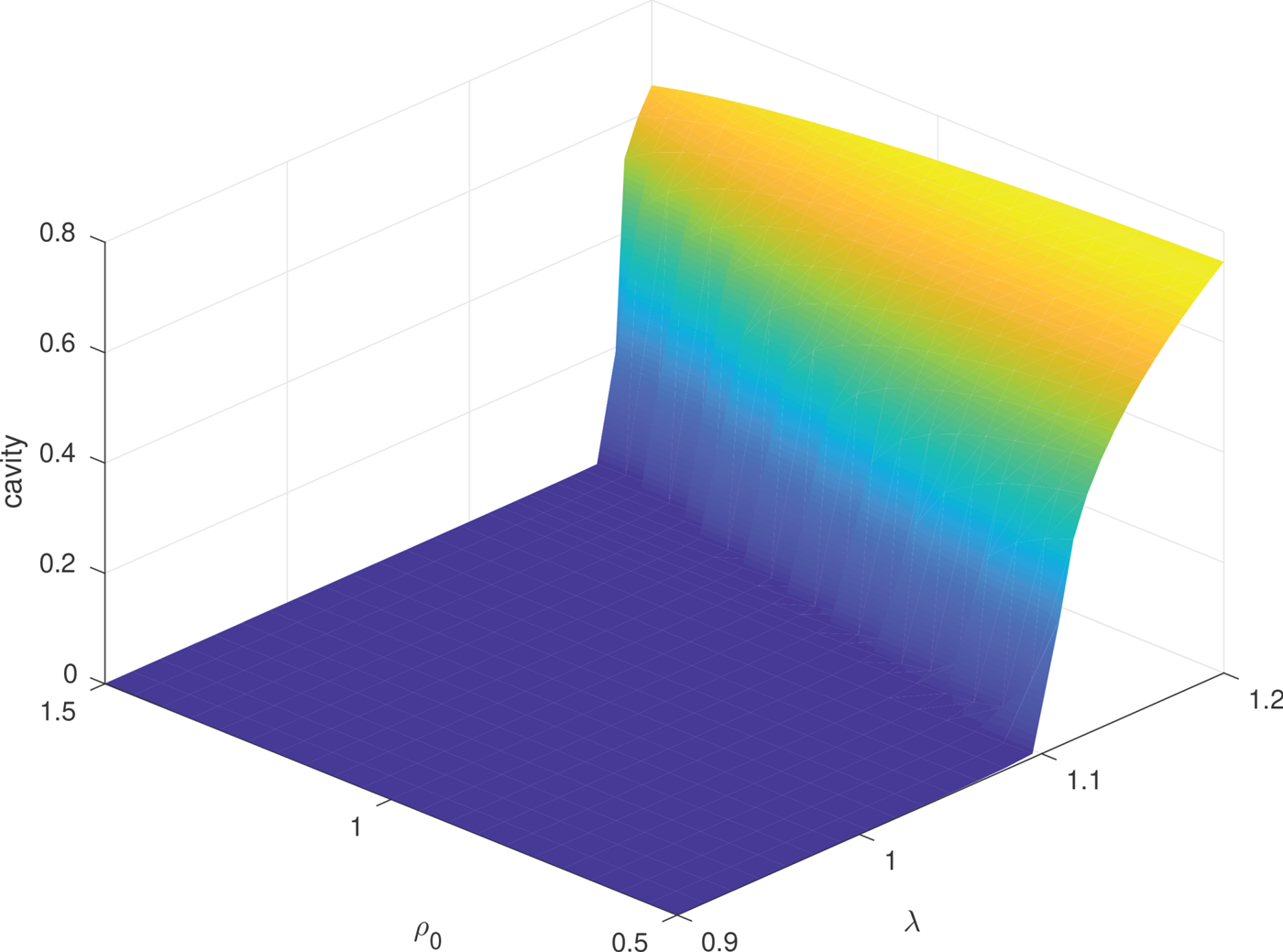
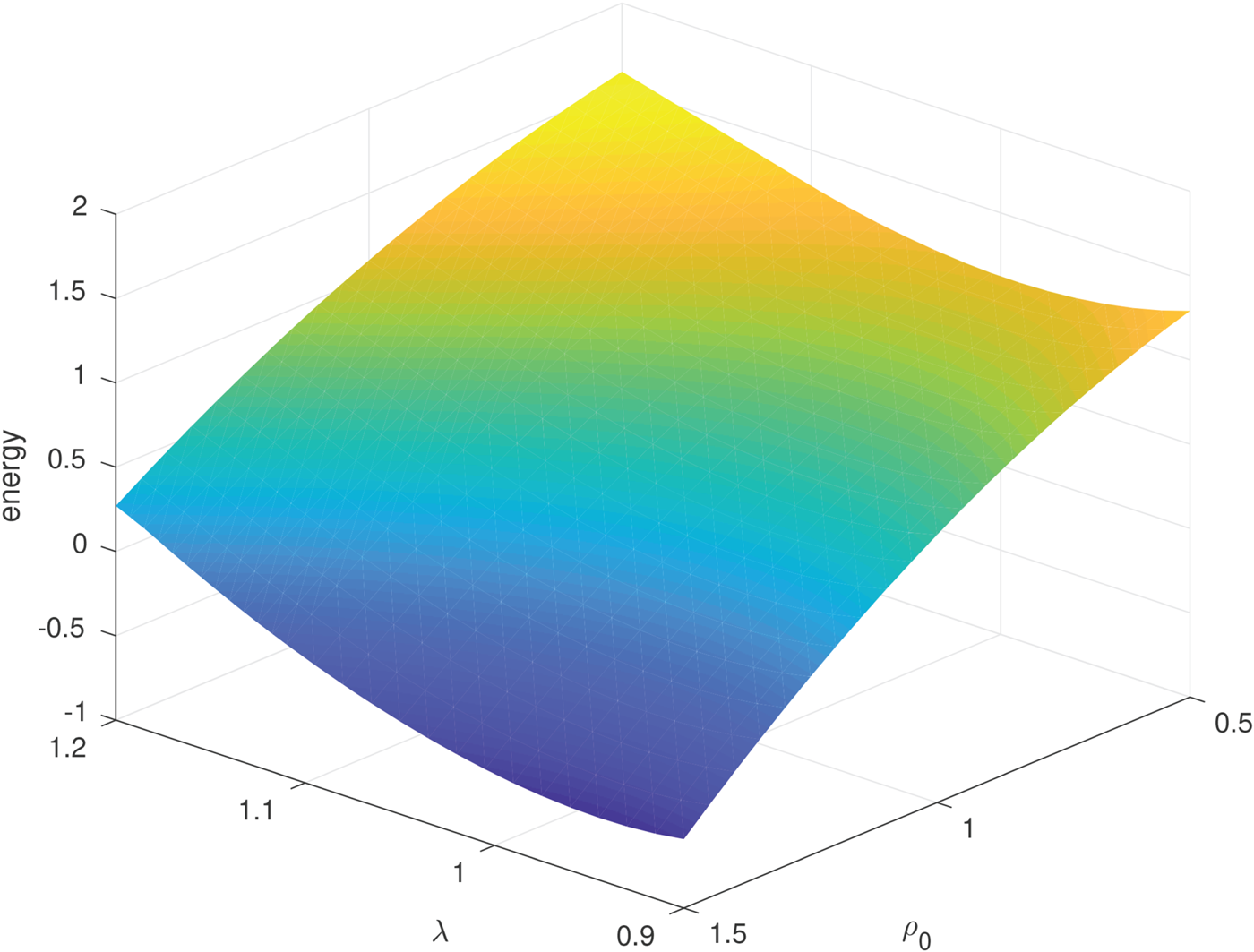
In our first simulation, we show the approximate cavity radius as a function of $\rho _0$ and $\lambda$
 , for values of $\rho _0\in [0.5,\,1.5]$
 and $\lambda \in [0.9,\,1.2]$
 . The resulting surface is shown in figure 1. We note that for fixed values of $\rho _0$
 , the cavity size is essentially zero up to some certain value of $\lambda$
 (the critical boundary displacement corresponding to $\rho _0$
 ), after which the graph becomes concave. This critical boundary displacement appears to be an increasing function of $\rho _0$
 . In figure 2, we show the corresponding surface for the energies of the approximate minimizers. For fixed values of $\lambda$
 , the energy is an increasing function of $\rho _0$
 , while for $\rho _0$
 constant the energy is non-monotone with respect to $\lambda$
 with a convex shape.
Cavity surface.

Energy surface.

Our next simulations are for fixed values of $\lambda$ and $\rho _0$
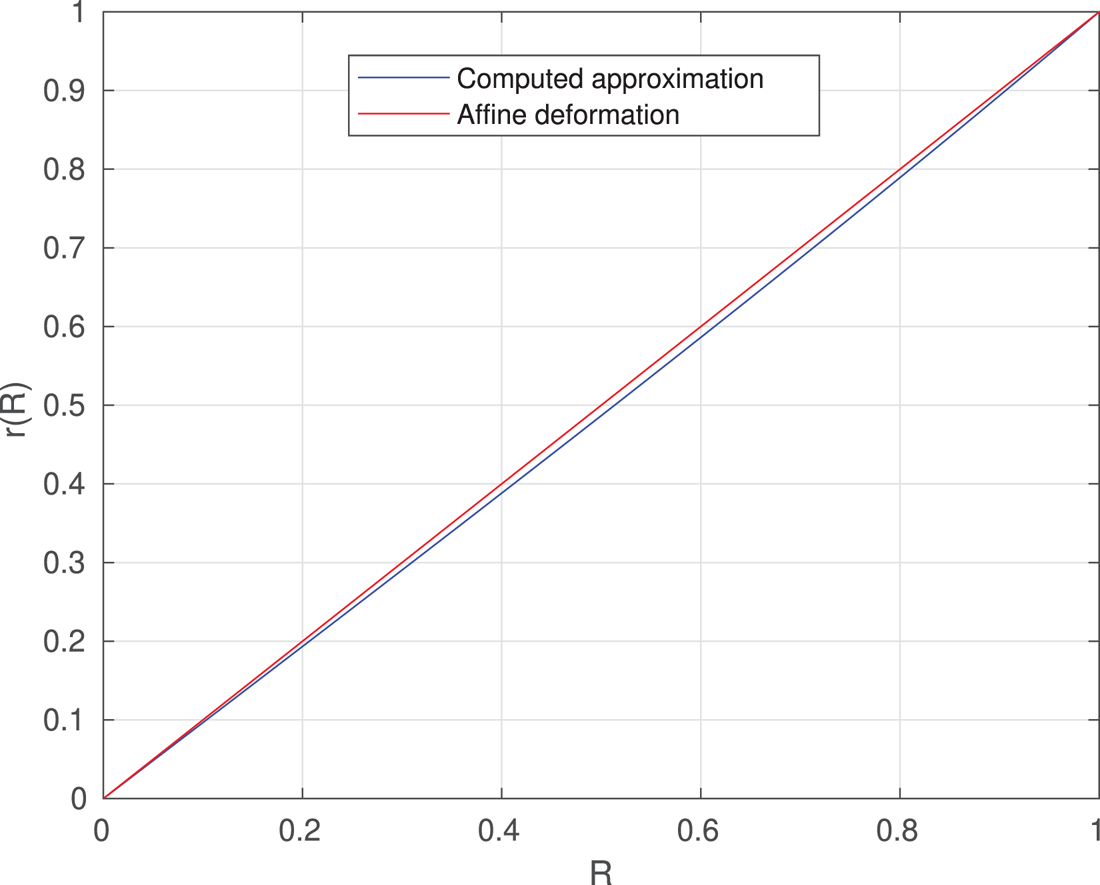
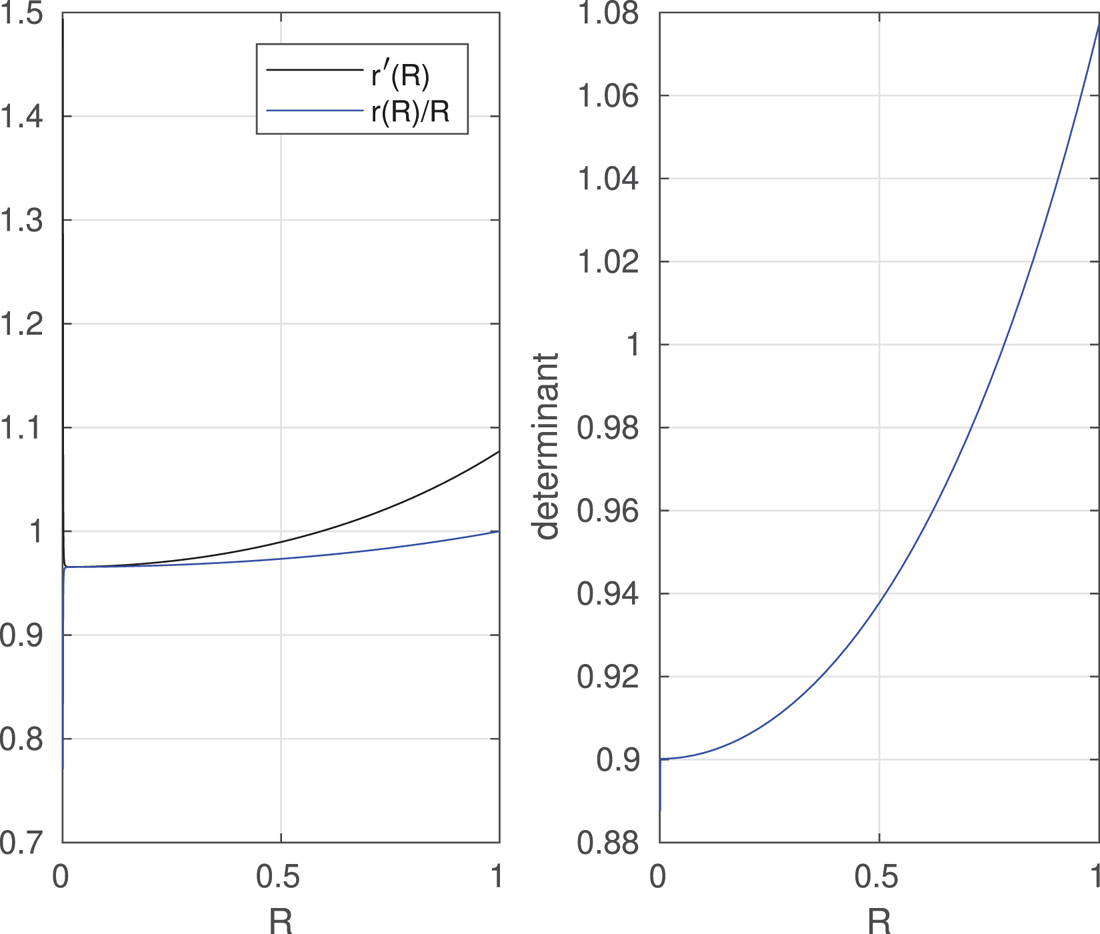
 . In the first case $\lambda =1$
 and $\rho _0=1$
 . In figure 3, we show the computed minimizer $r$
 compared to the affine deformation $\lambda R$
 . The value of $r(0.001)$
 is $7.7078\times 10^{-4}$
 with an energy of $0.49074$
 . Figure 4 shows plots of the strains $r^\prime (R)$
 and ${r(R)}/{R}$
 , and the determinant $r^\prime (R)(r(R)/R)^2$
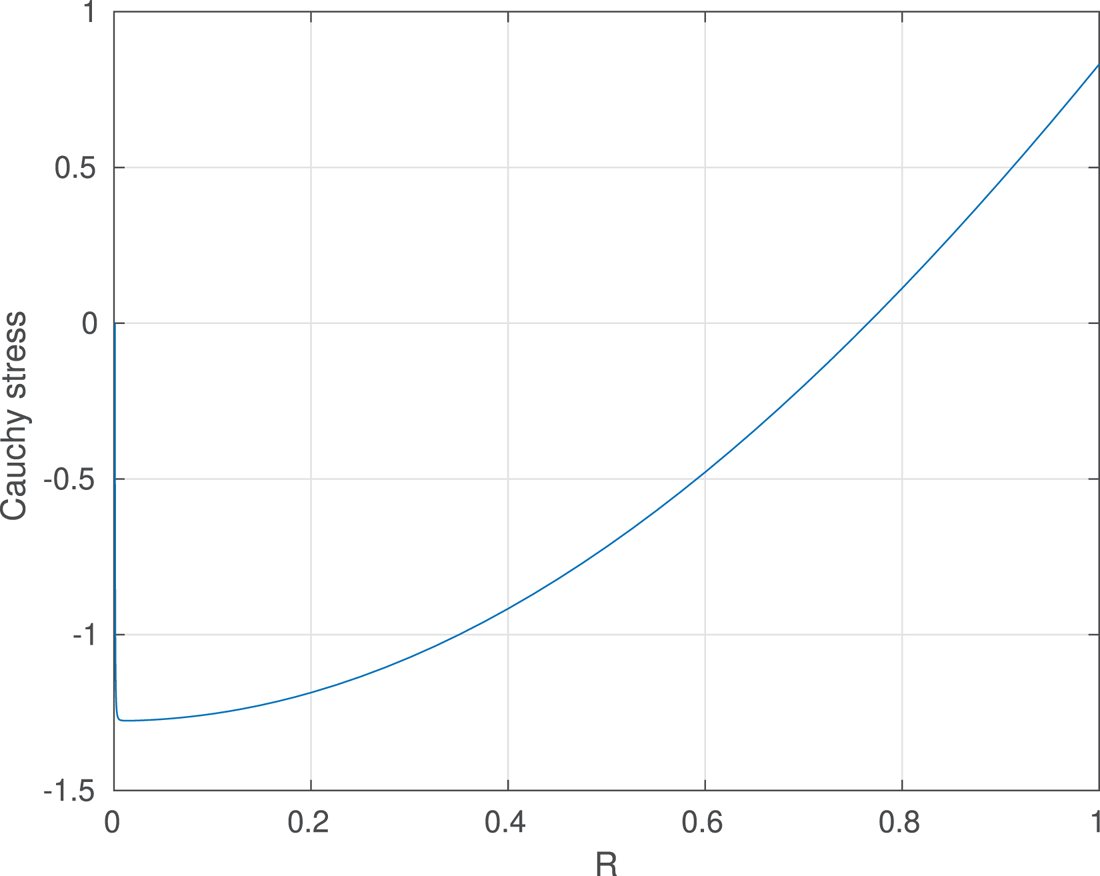
 in this case. Also in figure 5, we show the graph of the corresponding Cauchy stress. We note the boundary layer close to $R=\varepsilon$
 in these plots. This boundary layer is a numerical artefact since the numerical scheme tries to make the Cauchy stress zero, while for this value of $\lambda$
 the value of $r(0)$
 should be zero. Still in this case the numerical scheme converges to the solution with $r(0)=0$
 as $\varepsilon \rightarrow 0^+$
 (cf. [Reference Sivaloganathan10, Section 5]).
Radial displacement for $\lambda =1$ and $\rho _0=1$
 .

Strains and determinant for $\lambda =1$ and $\rho _0=1$
 .

Cauchy stress for $\lambda =1$ and $\rho _0=1$
 .

In our next simulation for the values (6.7), we take $\lambda =1.15$ and $\rho _0=1$
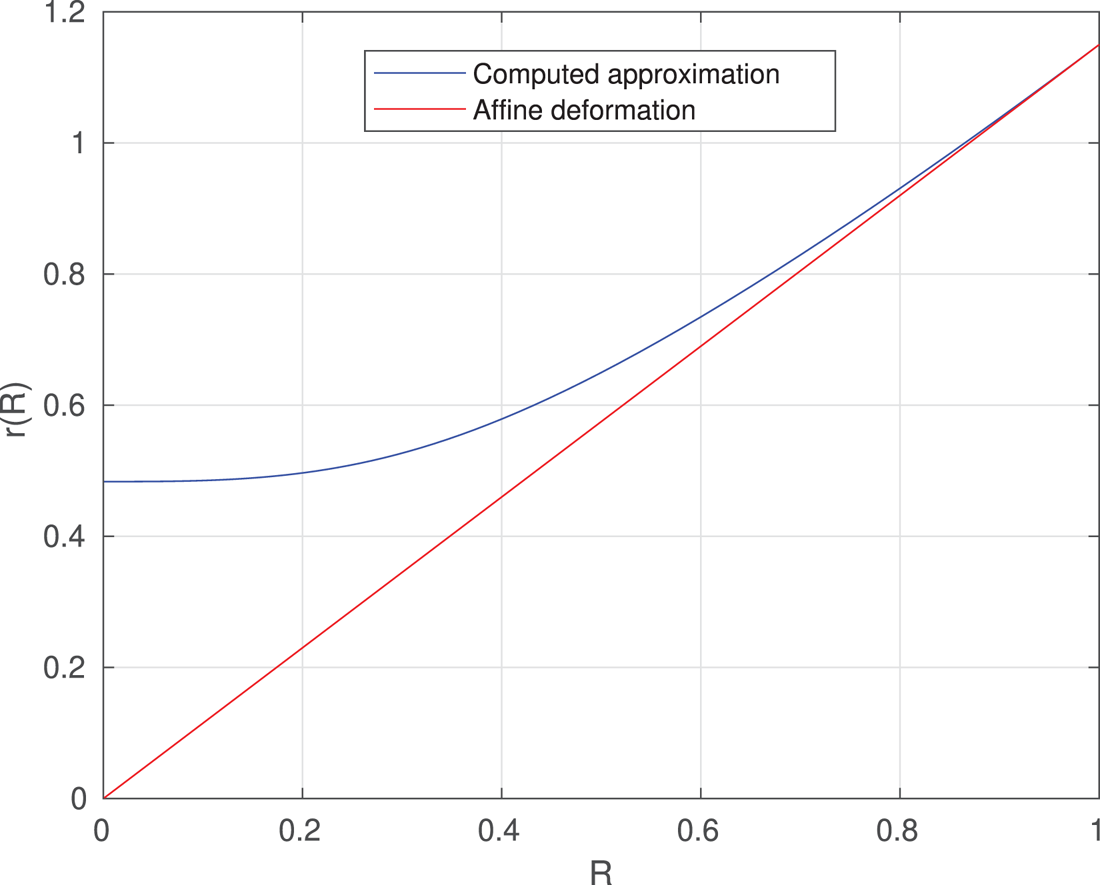
 . In figure 6, we show the computed minimizer $r$
 which corresponds to a cavitating solution. The value of $r(0.001)$
 is $0.48346$
 with an energy of $0.91034$
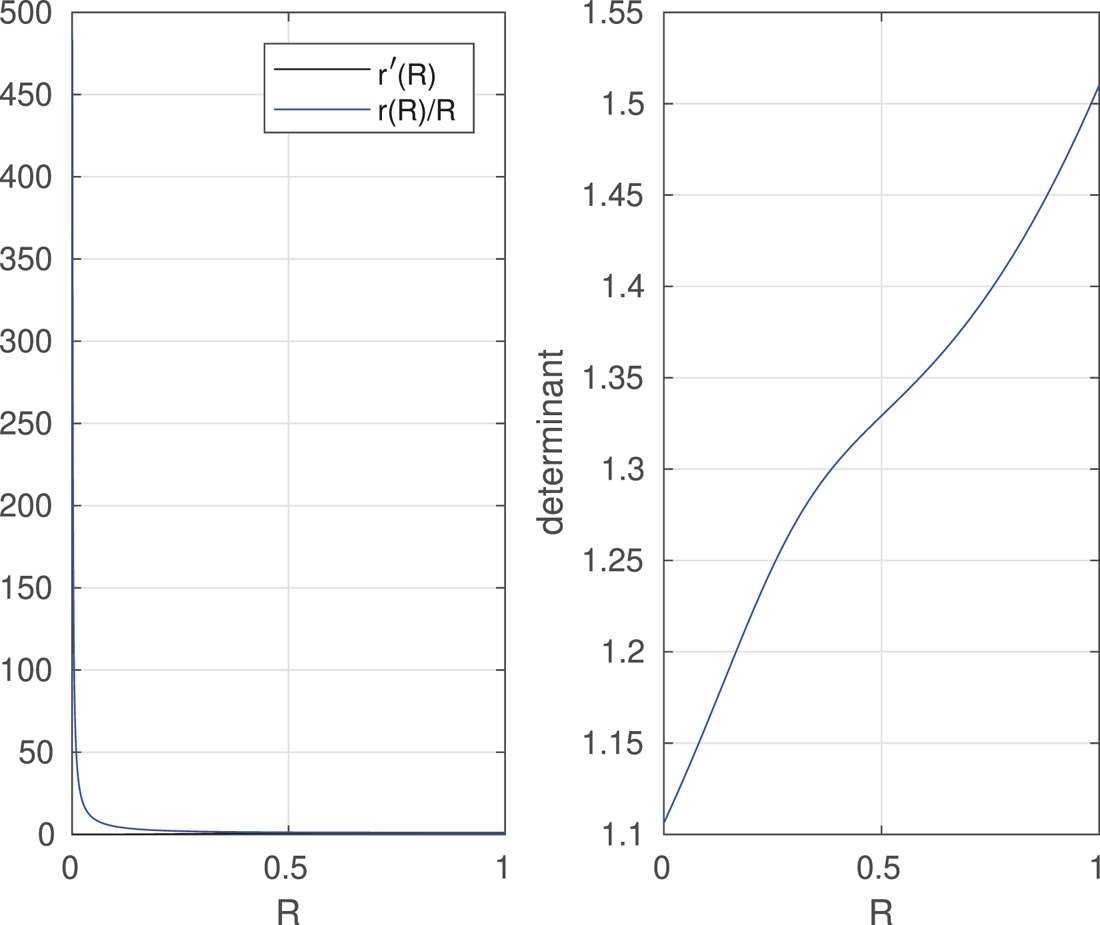
 . Figure 7 shows plots of the strains $r^\prime (R)$
 and ${r(R)}/{R}$
 , and the determinant $r^\prime (R)(r(R)/R)^2$
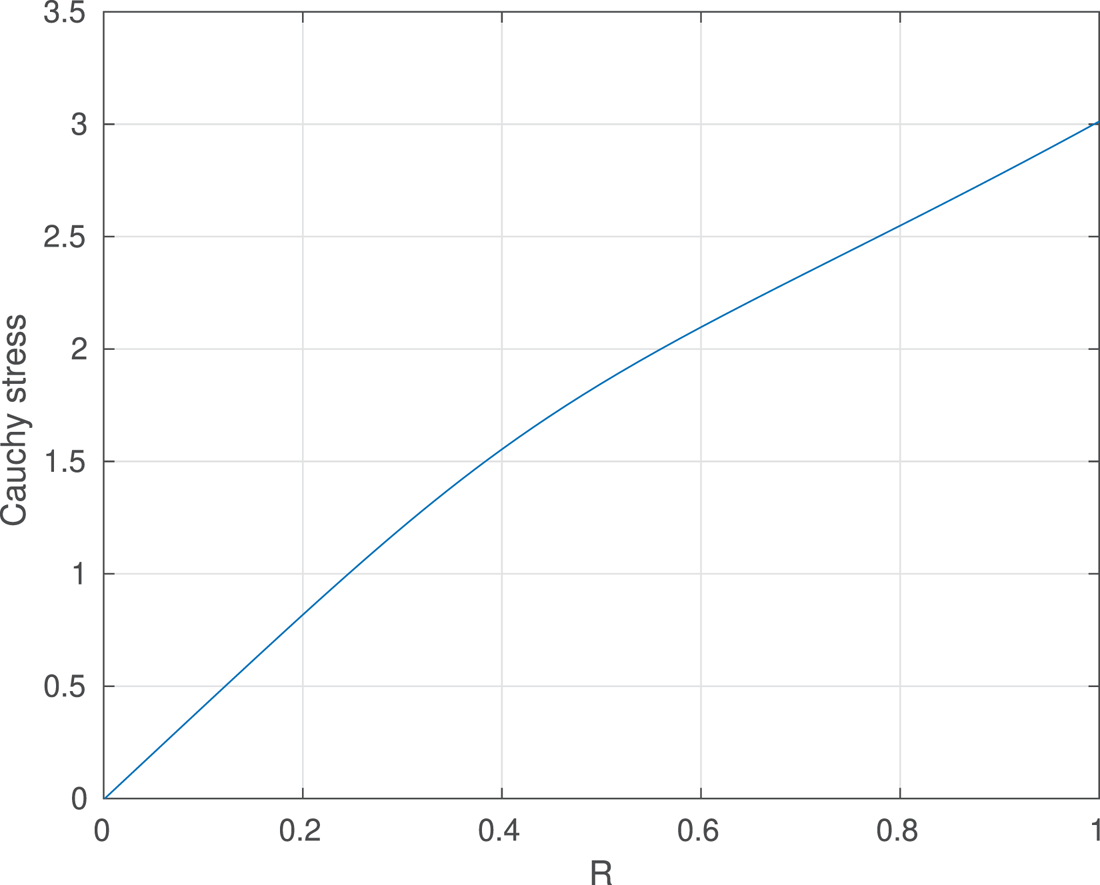
 , and in figure 8, we show the graph of the corresponding Cauchy stress. The boundary layer in $r(R)/R$
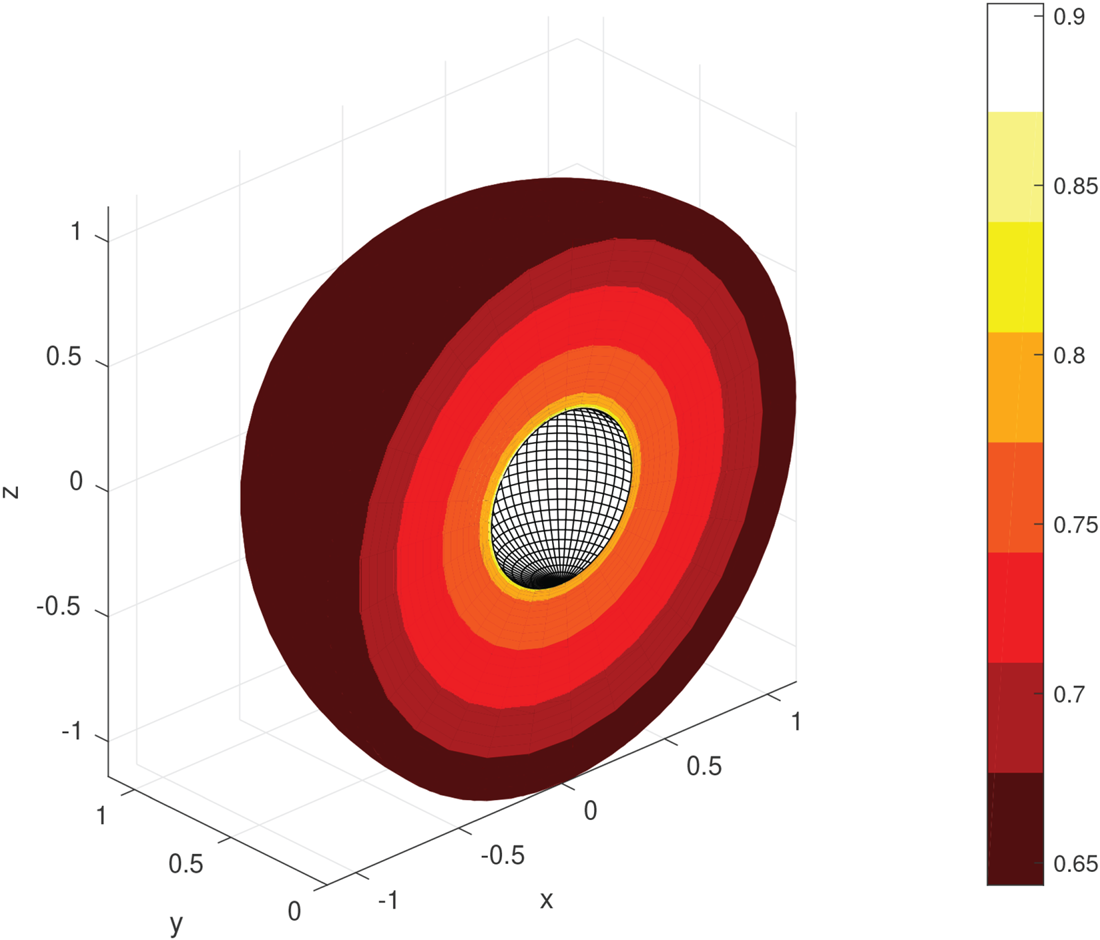
 is now a ‘true’ one associated with the computed cavitating solution. Finally, in figure 9, we show a three-dimensional ‘cut’ of the deformed body with the colouring given by the density in the deformed configuration which is $\rho _0/[r^\prime (R)(r(R)/R)^2]$
 . Note that the density in the deformed configuration is higher near the centre, decreasing towards the outer radius.
Radial displacement for $\lambda =1.15$ and $\rho _0=1$
 .

Strains and determinant for $\lambda =1.15$ and $\rho _0=1$
 .

Cauchy stress for $\lambda =1.15$ and $\rho _0=1$
 .

Deformed configuration with colouring given by the density in the deformed configuration for $\lambda =1.15$ and $\rho _0=1$
 .

Our next numerical example uses values characteristic of the composition of the planet Mercury. Differential equation (3.14) now is over the interval $[0,\,R_0]$ , where $R_0$
 is the planet average radius, and the coefficient $\rho _0^2$
 in the last term must be replaced with $\rho _0^2G$
 , where $G$
 is the gravitational constant. In the normalized variables $R\leftrightarrow R/R_0$
 and $r\leftrightarrow r/R_0$
 , differential equation (3.14) becomes:

Now using that $G\,{=}\,6.674\times 10^{-11}\,\mbox {m}^3\,\mbox {kg}^{-1}\,\mbox {s}^{-2}$ , $R_0\,{=}\,2440\,\mbox {km}$
 and $\rho _0\,{=}\,7860\,\mbox {kg}\,\mbox {m}^{-3}$
 (for an iron planet), we get that

For the mechanical parameters resembling an iron composition as used in [Reference Jia, Kodio, Chapman and Goriely8], we take

In the simulation, we compared the energies of the solution of (6.8) with boundary conditions (6.5) and $r(1)=\lambda$ , to the solution of (6.8) with boundary conditions $r(0)=0$
 and $r(1)=\lambda$
 . We denote these solutions as $r_Z$
 (zero Cauchy stress at origin) and $r_I$
 (centre intact), respectively. For $\lambda$
 small, the solutions of these two boundary value problems are equal. However for the simulations, the first boundary value problem is solved on $[\varepsilon,\,1]$
 with $\varepsilon$
 small, with (6.5) replaced by (6.6). This causes an ‘artificial’ boundary layer close to $R=\varepsilon$
 for the strains corresponding to $r_Z$
 , which disappears as $\varepsilon$
 tends to zero and with $r_Z(\varepsilon )>0$
 but small. The energies of the $r_Z$
 for small $\lambda$
 ’s are consequently slightly larger than those corresponding to $r_I$
 . However, for values of $\lambda$
 larger, the energy of $r_Z$
 is indeed lower than that of $r_I$
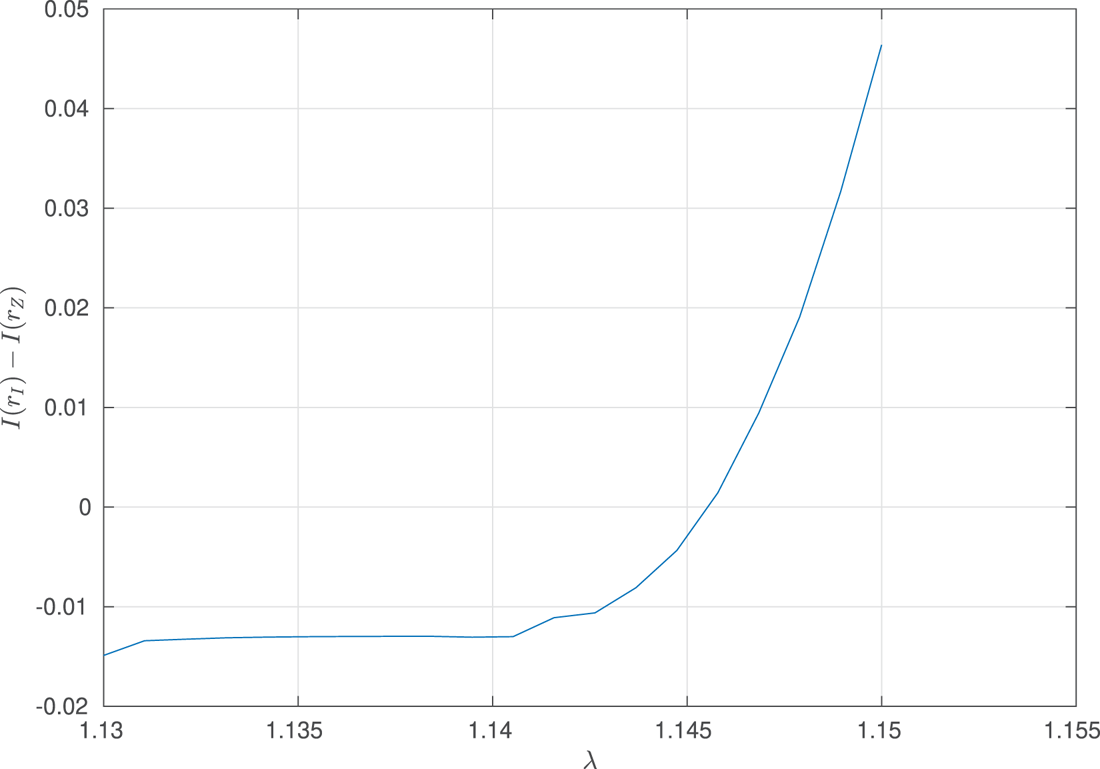
 , an indication that cavitation is energetically favourable. In figure 10, we show a plot of the differences in these energies for a range of values of $\lambda$
 . We recall that the horizontal axis in this graph is in normalized values. Thus, for instance, a value of $\lambda =1$
 would correspond to $2440\,\mbox {km}$
 . The numerical results suggest a critical boundary displacement (for the initiation of cavitation) at about $\lambda =1.145$
 or $2790\,\mbox {km}$
 approximately.
Cavity size vs boundary displacement (in normalized variables) for parameter values resembling the composition of the planet Mercury.

7. Final comments
The usual self-gravitating problem is that in which the centre of the body remains intact ($r(0)=0$ ) and no condition is explicitly prescribed on the outer boundary. This is the problem considered in [Reference Jia, Kodio, Chapman and Goriely8] and is a special case of one of the problems treated in [Reference Calogero and Leonori6]. It is straightforward to check that our results hold in this case as well where the admissible set is now given by

In particular, minimizers exist for all densities $\rho _0$ and satisfy the Euler–Lagrange equation (3.8) with natural boundary condition at $R=1$
 given by $T(1,\,r(1))=0$
 (cf. (3.7)). In reference to the stored energy function (1.1) considered in [Reference Jia, Kodio, Chapman and Goriely8], growth condition (3.1) with H3 places our stored energy function under the ‘strong’ compressibility category. Thus, our result on the existence of minimizers with the centre intact for all densities $\rho _0$
 is consistent with the results in [Reference Jia, Kodio, Chapman and Goriely8] which in turn suggest that there might be uniqueness of solutions of (3.8) in our problem as well.
Another interesting problem is that of a spinning body. In the three-dimensional case, radial solutions to this problem are not possible and a full three-dimensional variational problem must be considered. The two-dimensional problem of a spinning disk can be studied with radial symmetry. However, for cavitation, one would have condition H1 with $0<\gamma <2$ , and it is easy to check that in this case functional (2.7) is in general unbounded below.