Artistic or performative acts of voiding – creating empty spaces and surfaces, light-dimming that exceeds conventional durations, the framing of silence, or monochromatic procedures – are always, by necessity, contained in a material receptacle. As noted by Bergson, ‘the representation of the void is always a representation which is full’.Footnote 1 A concrete act cannot provide direct access to the void, which is an idea, a concept or an experience; it can, however, provoke discourse about it by turning the question about the actual procedure of voiding – ‘what is voided?’ – into a hermeneutic one. In the words of Arthur Danto – who plays with the idea of establishing a museum of monochromes, even if they all look the same – the monochrome ‘has to be addressed on its own terms’.Footnote 2 At the same time, voiding is a common support for a general hermeneutics that contributes to our understanding of particular cases. I would like to suggest one of the hermeneutic angles according to which works of voiding function as in-between mental, cultural and historical zones or spaces. While manifested by material means, an act of voiding is a meeting point between acts of erasure or destruction of the past – acts which are also, at the same time, oriented towards a future action or a potential performance. Another aspect of this voiding, as will be expounded, characterizes this dematerialized zone as a utopia.
Two productions of Chekhov's The Cherry Orchard will serve as the platform for associating the monochromatic procedure and other acts of voiding with spatial aspects. The notion of the void will be discussed while focusing on the notion of potentiality. The Cherry Orchard, as directed by Georgio Strehler and designed by Luciano Damiani at the Piccolo Teatro in Milan in 1974,Footnote 3 no doubt deserves its cultural standing as one of the play's most unique and interesting productions. However, only the general visual characteristics of this well-documented production, like the white veil or canopy that hangs over the stage, the whiteness of the stage, the furniture and the characters’ clothing, are referred to here. The set applies a monochromatic principle more common in visual or plastic art:Footnote 4 a dominant single colour that either voids a surface, an object or a space of all images, or else provides a uniform or seemingly uniform covering to familiar representational nuances.Footnote 5 I will reconsider this production while comparing it to an Israeli production of the play directed by Yevgeny Arye,Footnote 6 designed by Michael Kramenko and playing since 2006 at the Gesher Theater in Tel Aviv. Liubov and Gayev are played with virtuosity and depth by lead actors Yevgenya Dodina alternating with Natalia Manor, and Israel (Sasha) Demidov.Footnote 7
Both of these productions deal with the issue of the ‘void,’ not only because they involve procedures of visual voiding, but also because their designed spaces, while describing a literal place (the fictional existence of the orchard and estate), deliberately negate its independent existence as a reality. Both productions intensify the experience of the void by merging the scenographic voiding with the stage figures’ mental existence of in the gap between past and future – a gap ‘filled up’ with projections; a ‘potential space’ which is also understood as utopian.
Projective space
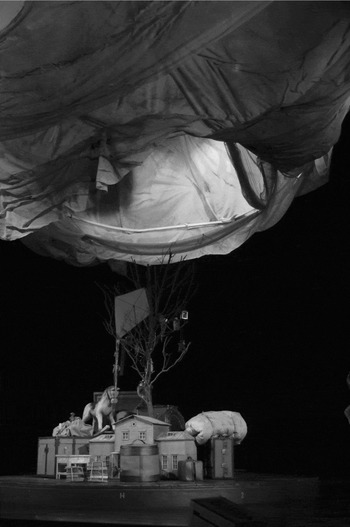
The most notable resemblance between the two productions is a huge white sheet that hangs in a curve above the stage as well as over the front rows of the auditorium. That sheet is made of large pieces of cloth, and serves as a curtain that is raised and hung up at the start of each act. Apart from this element, the productions are quite different. The Gesher Theater proscenium stage is almost empty, and the few objects in the children's room are assembled on a revolving stage-on-stage (Fig. 1). Above this round stage hangs a structure that looks like a miniature model of the estate. In the second act the round stage is filled by a haystack on which the characters, dressed in white, climb and recline. In the third act, a naked tree stands in the centre of the round stage, and in the fourth some objects are piled up around it.
Gesher Theater, The Cherry Orchard, Act IV. By courtesy of the Gesher theater.

The metatheatrical aspect – manifested by the stage-on-stage, the canopy curtain and the maquette-like miniature of the estate – is compounded by a voice-over reading the opening stage directions and characters’ descriptions, by turning the ‘Jewish band’ into a musical–theatrical intermezzo performed between the acts, and by turning the party into a masquerade. The association of these elements with the theatre is an indirect voiding mechanism, negating the appearance of the fictional space as independent reality, presenting it as a patently theatre-dependent image.
Because of this contra-mimetic conceptualization of the spaceFootnote 8 – evident in the monochromatic stage and canopies – the characters are not located in a literal and concrete fictional place. They are under erasure, situated in the gap between ‘Good-bye, old life!’ and ‘Greetings to the new life!’,Footnote 9 as expressed by Ania and Trofimov, respectively, in the fourth act. This existential gap is similar to Ernst Bloch's definition (in The Principle of Hope, as well as in other writings) of the human condition as ‘not yet’ – that is, an experience of continuous imperfection and constant hope for a realization of one's life potential.Footnote 10 The naked tree in the Gesher production – a familiar Beckettian emblem – reflects this sense of permanent anticipation while alluding to an erased past. However, the potentiality that informs this state according to Bloch is also applied to unrealized potentials in the present and the past.Footnote 11
Chekhov's removal of the orchard from the immediate field of vision is inverted in both productions:Footnote 12 the hanging canopy makes the ‘all white’Footnote 13 orchard (as described by Liubov and Gayev) constantly present, filling the stage and extending beyond it. In both productions this abstraction of the orchard intensifies the correspondence between its invisibility and its unreality, since its existence hinges on both perception and imagination. Similar to an empty stage, a neutral masque or a white screen, this space is the departure point for a potential performance whose present realization is manifested as a projection.
Radical whitening is a relatively open invitation to the spectators’ imaginative involvement, and the canopy extension over the spectators manifests and expresses this inclusive tendency. The stage characters diegetically echo this procedure while charging it with dual projections. On the one hand, components of memory – childhood, parents, the Mujhik's identity, or the preservation of cherries – seem to be projected onto the white screen. On the other hand, that screen is the visual support for the future non-idyllic offstage continuation of life, as well as for fantasies of happiness, love, work, graduation and an all-embracing equality. In the Gesher production (in which the canopy/screen appears to be made of patched-up pieces, long past their days of glory), this projecting procedure becomes visually tangible. It is presented literally through projected images (lights and shapes) intended to convey moods, mainly Liubov's, as well as through the theatrical image of a boy, dressed in white, who appears in the window playing a wind instrument, and who crosses the stage with a flying white kite in his hand. This mental image of loss, of the dead Grisha, seems to converge with a naive tangible projection of a new start.
A projective space – a space defined by mental projections or imaginations – thus replaces any semblance of an independent reality. This space, visually intensified in both productions, attests to ‘not yet’ living in a liminal sphere between past and future. Filled by projections, that zone becomes an alternative to (fictional) reality, a space where life is potentiality.
Potential space
Shaped as a gap and relying on projections, this space may be described, in D. W. Winnicott's psychoanalytical terms, as a potential space – an intermediate zone that exists between the internal world of imagination and external reality, a hypothetical area between the mother and the infant at the stage of repudiating the object as not-me. In this area, a transitional object is activated and playing, which is at the root of cultural experience, begins.Footnote 14 While in Chekhov's play the orchard's characterization is dual – a literal element as well as a perception-dependent one – in both productions it is shaped to a greater extent as a subjective space, bordering on an internalization of the reality principle. From this perspective, it can be seen as a psychoanalytical version of a historical condition – presenting the very perception of reality as potentiality.
The space shaped in these productions is characterized as merging with an object prior to its repudiation, as well as by transition. The play stresses Liubov's extreme identification with the orchard, manifested in her line ‘sell me with it’.Footnote 15 Strehler's white characters not only identify with their environment, but also seem to merge with it. In Merleau-Ponty's phenomenological terms, it is a state in which ‘the world is made of the same material as the body’.Footnote 16 The same equivalence is manifested, to a lesser degree, in Arye's version, when the canopy's movement and projections externalize the characters’ frames of mind, serving both as an expression of the basic anomalous union that exists between the characters even as adults, and as a regressive fulfillment of the longing for a union in the wake of separation.
The desire to become one with the object can be compounded by the social–ideological dimension of the utopian experience of unity. According to Fredric Jameson, utopia provides us with a fantastical vision of systematic otherness, which is manifested in a General Will, a vision generated at a moment of mental freedom that takes place beyond history. Rooted in ideology, utopia is inherently unrealizable, thus leaving us with contradictory models that reflect the political complexities of our own social life.Footnote 17 Inclusive and comprehensive – a variation on familiar ideological or economic principles – the monochromatic stage world can be perceived as an optional utopian fulfillment of the General Will, generating a world emptied of differences, a world where the particular is assimilated in the neutral or universal.Footnote 18
The two functions of the stage described above – a psychic desire for mergence, and a social model of unity – may thus be viewed as supplementary aspects of its utopian characterization. Both the idea of mergence and the psychically or socially liberated conduct, which the intermediate space enables, are utopian. There, existence is manifested through games, with particular emphasis on transitional objects. In Strehler's production, the masters, Liubov and Gayev, longingly play with dolls’ tableware and put a spinning top and a music box in motion, and even the train is a toy that crosses the stage. Arye's masters, gathered in the ‘children's island’ on the round stage, ride a white rocking horse and play tag. The very estate house is also a miniaturized transitional object that hangs over the characters’ heads on the round stage, and is ultimately placed among the piled objects at the point when the characters are on the verge of going into outside reality. The playing associated with transitional objects is part of the utopia, as it allows states of passage to be celebrated as a stretched-out moment – a moment in which past and future anxieties do not prevent a sense of freedom. In both productions we can thus identify a dominant gap or a void – a gap between the primary phase of mergence with the object and that of the separation of the subject, which is also a gap between past and future. In both productions this gap is filled with projections, games and transitional objects that establish and sustain that transitional state of being. This spatial void is also a utopian image – an image of life that is not subjugated to the reality principle, but is rather a potential life whose realization is suspended.
In the Piccolo Teatro production, Liubov, dressed in white and on the verge of departure, goes under the white fabric that covers the closet and then comes back out, a few moments later, winding up the coil spring of a music box. Thus, for one more minute, she remains in a space where she can be unified with the past through a transitional object that winds up like a clock. The white fabric is removed from the front of the stage, baring the wooden boards. The space darkens and the darkly dressed Feers, absorbed into it, mumbles unintelligibly for a long time (an extreme performance of a written stage direction). These gestures markedly take language apart while implicitly dismantling the stage and exposing its real foundations. What remains is the present – or a departure point for another story.
In the Gesher Theater production, Liubov and Gayev are alone for a while on the round stage. Before leaving they suddenly run towards each other, embrace and mourn as the stage turns, regressing for a moment to a wild, giggly game of tag. Only the tree remains, and with it the miniature house – an obsolete object. Snowy branches screened on the canopy are both literal and metaphorical projections corresponding to an awareness of the impending end. When Feers enters he strokes the small building and leans his head on it. A child, dressed in white and winding up a music box, comes out of the darkness and rests his head on the other side. A transparent white fabric cylinder descends over the round stage, enveloping both of them just before the curtain comes down. That is the spatial image with which the spectators are left – an eternal enclosed island, of which we can only catch a glimpse. By losing the literal orchard this zone is freed from any dependency on reality or an undefined future, and thus remains a utopian mental space, a space which is at least potentially accessible.