


Introduction
The Indonesian palm oil sector is defined by a fundamental and persistent paradox. On one hand, it serves as a cornerstone of the national economy, a critical source of foreign exchange revenue that surpassed even the oil and gas sector, and a provider of employment for millions of citizens, particularly in rural areas (Indonesian Palm Oil Association 2024; Sunarminto et al. Reference Sunarminto, Mijiarto and Dwi Prabowo2019). The industry’s proponents champion its role in poverty alleviation and its contribution to national development goals, including (but not limited to) food and energy security (Indonesian Palm Oil Association 2024; Li Reference Li2015).
On the other hand, a substantial body of evidence documents the sector’s adverse impacts. This includes deforestation, catastrophic biodiversity loss, significant greenhouse gas (GHG) emissions from land-use change and peatland degradation, and protracted socio-legal conflicts with indigenous and local communities over land tenure (Human Rights Watch 2019b; Maskun et al. Reference Maskun, Naswar and Reza Mubarak2021; Patrenko, Julia, and Searle Reference Patrenko, Julia and Searle2016; Sibhatu Reference Sibhatu2023). This deep-seated tension places palm oil policy at the nexus of Indonesia’s most critical economic, environmental, and social challenges.
It is within this contested policy landscape that the 2024 presidential transition from Joko Widodo (Jokowi) to Prabowo Subianto presented what policy scholars would term a potential “critical juncture” or a moment of flux where significant policy change becomes plausible (True et al. Reference True, Jones, Baumgartner and Paul2006). Such transitions can disrupt established policy networks, introduce new political priorities, and elevate previously marginalized issues onto the national agenda. Given President Prabowo’s distinct political background, nationalist-populist platform, and rhetoric emphasizing national security and self-sufficiency, there was reason to anticipate a potential shift, or “punctuation,” in the trajectory of palm oil governance (Habir and Negara Reference Habir and Dharma Negara2025; Suharsono and Nugroho Reference Suharsono and Nugroho2025).
This paper argues, however, that the Prabowo administration’s palm oil policy does not represent a punctuation or a policy reversal. Instead, it demonstrates a reinforcement and amplification of a durable, pro-industry policy equilibrium meticulously constructed during the preceding Jokowi era. This continuity is not an accident of political inertia but a predictable outcome of the institutional dynamics that define the palm oil policy domain. We contend that this stability is best explained by Punctuated Equilibrium Theory (PET), which illuminates how a resilient “policy monopoly” – a closed network of state and industry actors – has successfully defended the policy status quo (Baumgartner and Jones Reference Baumgartner and Jones1993; Romain et al. Reference Romain, Camille Rivoalen, Pacheco and Zrust2017). This monopoly maintains its dominance by controlling the official “policy image,” marginalizing competing problem definitions, and leveraging a unique, financially self-sustaining institutional architecture that insulates it from broader political pressures (National Collaborating Centre for Healthy Public Policy 2018).
Theoretical framework
Punctuated equilibrium and the resilient policy monopoly
Punctuated Equilibrium Theory (PET) seeks to explain a core observation in politics: policy processes are typically defined by long periods of stability and incrementalism, punctuated by brief, occasional episodes of large-scale, transformative change (Baumgartner and Jones Reference Baumgartner and Jones1993; Joly and Richter Reference Joly and Richter2023; True et al. Reference True, Jones, Baumgartner and Paul2006). Developed by Frank Baumgartner and Bryan Jones, PET moves beyond simple descriptions of stasis and change to offer a causal theory grounded in the cognitive limitations of decision-makers and the structural features of political institutions (Matzke Reference Matzke2020; True et al. Reference True, Jones, Baumgartner and Paul2006). While often invoked to explain dramatic policy shifts, the theory’s real analytical power lies in its dual capacity to also explain the profound forces that maintain stability, often for decades at a time. For understanding the continuity of Indonesian palm oil policy, the mechanisms that prevent punctuation are of paramount importance.
Bounded rationality and policy subsystems
At its core, PET is built on Herbert Simon’s concept of bounded rationality, which posits that human beings and the organizations they create have limited cognitive capacity and attention spans (True et al. Reference True, Jones, Baumgartner and Paul2006). Governments, faced with a vast array of complex problems, cannot possibly attend to all issues simultaneously. To cope, political systems develop a dual processing structure. Most issues are handled through parallel processing within specialized policy subsystems (True et al. Reference True, Jones, Baumgartner and Paul2006). These subsystems, also known as “policy monopolies” or “iron triangles,” are relatively closed communities of experts, bureaucrats, industry representatives, and legislative committee members who manage a specific policy domain out of the public spotlight (Romain et al. Reference Romain, Camille Rivoalen, Pacheco and Zrust2017; True et al. Reference True, Jones, Baumgartner and Paul2006). Within these subsystems, policymaking is characterized by incremental adjustments, bargaining among established interests, and a shared understanding of the policy problem (True et al. Reference True, Jones, Baumgartner and Paul2006).
Conversely, a small number of issues at any given time receive high-level, public attention. These issues are subjected to serial processing, where the attention of macropolitical institutions like the presidency, the full legislature, and the mass media is focused on a single problem (True et al. Reference True, Jones, Baumgartner and Paul2006). It is during these periods of intense, serial attention that the potential for major, non-incremental policy change – a punctuation – emerges. The Indonesian palm oil sector, with its complex web of economic, agricultural, and trade regulations, is a classic example of a policy domain governed for long periods within a dedicated subsystem (Habibie Reference Habibie2018).
Policy image, venues, and conflict expansion
A policy monopoly’s primary tool for maintaining stability and avoiding disruptive macropolitical attention is the control and defense of the policy image (National Collaborating Centre for Healthy Public Policy 2018). The policy image is the dominant way an issue is understood and discussed in political discourse. It defines the nature of the problem, its causes, and the acceptable range of solutions. A stable, positive policy image reinforces the status quo and legitimizes the authority of the existing policy monopoly (National Collaborating Centre for Healthy Public Policy 2018). In the case of Indonesian palm oil, the dominant monopoly has successfully cultivated a powerful policy image centered on economic nationalism, energy security, poverty alleviation, and the commodity’s strategic importance to the state (Indonesian Palm Oil Association 2024; Sahara et al. Reference Sahara, Amaliah, Irawan and Dilla2022). This positive image actively competes with and seeks to marginalize negative images focused on deforestation, biodiversity loss, and human rights violations (Human Rights Watch 2019b; Patrenko et al. Reference Patrenko, Julia and Searle2016).
Punctuation occurs when this control over the policy image breaks down. This typically happens through a process of conflict expansion, where challengers to the status quo (e.g., environmental NGOs, indigenous groups, international organizations) succeed in attracting new participants to the debate (National Collaborating Centre for Healthy Public Policy 2018). A key strategy for expanding conflict is venue shopping, where challengers attempt to move the policy debate from a venue controlled by the monopoly (e.g., the Ministry of Agriculture) to a different institutional venue where they have more influence and where their alternative policy image is more likely to resonate (e.g., the Ministry of Environment, the courts, international forums, or the mass media) (True et al. Reference True, Jones, Baumgartner and Paul2006). If successful, this shift can overwhelm the monopoly’s capacity to control the narrative, forcing the issue onto the macropolitical agenda for serial processing and creating an opportunity for radical change (True et al. Reference True, Jones, Baumgartner and Paul2006).
Institutional friction and error accumulation
The stability maintained by a policy monopoly is not without consequence. PET incorporates the concept of institutional friction, which refers to the institutional and cognitive barriers that limit a government’s ability to process information and adapt to changing conditions (Baumgartner and Jones Reference Baumgartner and Jones1993). A powerful policy monopoly creates high friction, actively resisting new information that contradicts its preferred policy image. This leads to a process of error accumulation, where the negative consequences of a policy – such as environmental degradation, social inequality, or a growing gap between policy and public preferences – build up over time, largely ignored by the insulated subsystem (Baumgartner and Jones Reference Baumgartner and Jones1993). A punctuation can thus be understood as a large-scale, delayed reaction to this accumulated error, occurring only when the problem becomes so severe that it can no longer be contained within the subsystem (Baumgartner and Jones Reference Baumgartner and Jones1993).
The dynamics of PET produce a distinct statistical signature in policy data over time. Long periods of equilibrium result in many small, incremental changes, while punctuations produce a few very large changes. When plotted as a frequency distribution, this pattern of policy change is not normal but leptokurtic, characterized by a high peak at or near zero change and “fat tails” representing the rare but significant punctuations (Baumgartner and Jones Reference Baumgartner and Jones1993; Joly and Richter Reference Joly and Richter2023). This provides a key testable hypothesis, where budgetary allocations or other policy outputs can be analyzed to determine if they fit this pattern of punctuated equilibrium.
A crucial feature that determines the resilience of a policy equilibrium, particularly relevant in the Indonesian context, is the degree of its financial autonomy. While many policy subsystems rely on appropriations from the general state budget – making them subject to macropolitical competition and oversight – some are able to establish their own dedicated funding streams. The Palm Oil Plantation Fund Management Agency (BPDPKS) funded by industry export levies and tasked with subsidizing that same industry, represents a powerful example of a financially autonomous subsystem (Plantation Fund Management Agency 2025b; Silalahi et al. Reference Silalahi, Simatupang and Siallagan2020). This structure creates a closed financial loop, insulating the core policy from budgetary politics and creating a “super-stabilizer” that makes the equilibrium exceptionally resistant to change.
Theoretical extensions: the financially autonomous subsystem and the policy ratchet
While PET has proven a powerful framework for explaining policy stability, the Indonesian palm oil case reveals two structural mechanisms that extend the theory – particularly for resource-based governance in developing economies. First, the financially autonomous subsystem. Standard PET assumes that policy monopolies depend on central budget appropriations, creating a vulnerability: macropolitical actors can redirect funding or impose oversight (Baumgartner and Jones Reference Baumgartner and Jones1993; True et al. Reference True, Jones, Baumgartner and Paul2006). BPDPKS breaks this logic by collecting its own revenues from industry export levies and disbursing them back to the same industry as subsidies. This self-financing architecture constitutes a “super-stabilizer” that insulates the equilibrium not only from shifting public preferences but also from the fiscal constraints that ordinarily discipline state spending. We propose the financially autonomous subsystem as a theoretically distinct category deserving systematic attention in comparative studies of policy stability, especially in commodity-exporting states where off-budget funds are prevalent.
Second, the policy ratchet. PET acknowledges that path dependency raises reversal costs (True et al. Reference True, Jones, Baumgartner and Paul2006), but the biodiesel case reveals a more aggressive dynamic: each mandate escalation (B20→B30→B35→B40→projected B50) actively enlarges the coalition of actors whose livelihoods depend on the program – biodiesel producers, blending facilities, palm oil traders – making reversal progressively more costly with each step. Unlike simple path dependency, the policy ratchet is not passively stable but dynamically self-reinforcing. This challenges PET’s implicit assumption that equilibria remain at a fixed level of entrenchment between punctuations and has important implications for understanding under what conditions punctuation becomes possible at all.
Hypotheses
Drawing on the framework above, we derive four hypotheses with specific observable implications that guide the empirical analysis and against which the evidence is evaluated.
H1 (Incremental Policy Change) If a stable policy monopoly governs the domain, policy outputs will show incremental rather than punctuated change. Observable implication: BPDPKS allocations should show consistent biodiesel dominance across 2015–2024, with no sustained reallocation away from biodiesel; the mean share allocated to biodiesel should be significantly higher than that allocated to smallholder programs.
H2 (Financial Insulation) If a financially autonomous subsystem operates, the biodiesel allocation should dominate BPDPKS spending throughout the period, and that dominance should persist across CPO price fluctuations, fiscal pressures, and changes in presidential administration. Because the incentive is a price-gap payment, annual disbursement will track the spread between biodiesel and fossil diesel index prices; the observable implication is therefore dominance in the great majority of years and rapid reversion after any price-driven dip, rather than an invariant floor.
H3 (Policy Ratchet) If the ratchet mechanism operates, domestic industrial/biodiesel consumption should trend continuously upward across the study period, the export share of production should decline without reversal, and both trends should accelerate rather than stabilize under Prabowo.
H4 (Policy Image Control) If the monopoly successfully controls the policy image, the dominant narrative should remain centered on economic nationalism and energy security across both administrations, with no successful challenger venue shopping producing policy change.
Methods
This study utilizes a mixed-methods approach, combining quantitative analysis of policy outputs with qualitative analysis of policy processes and narratives. The research is structured as a longitudinal, single-case study focused on Indonesian palm oil policy from 2014 to 2026 (forecasted), with the 2024 presidential transition serving as the critical juncture under investigation. Punctuated Equilibrium Theory (PET) provides the overarching analytical framework for interpreting the data.
Quantitative data collection and analysis
To empirically test the hypothesis of a stable, incremental policy equilibrium, we collected and analyzed longitudinal data on key policy outputs and sectoral indicators. The objective was to create a time-series dataset that could reveal the pattern of policy change over the study period. A pattern of consistent, small-scale changes would support the thesis of a stable equilibrium, whereas large, non-linear shifts would indicate a policy punctuation.
The quantitative data was compiled from a range of official and public sources to ensure robustness and allow for cross-verification. The specific datasets include:
-
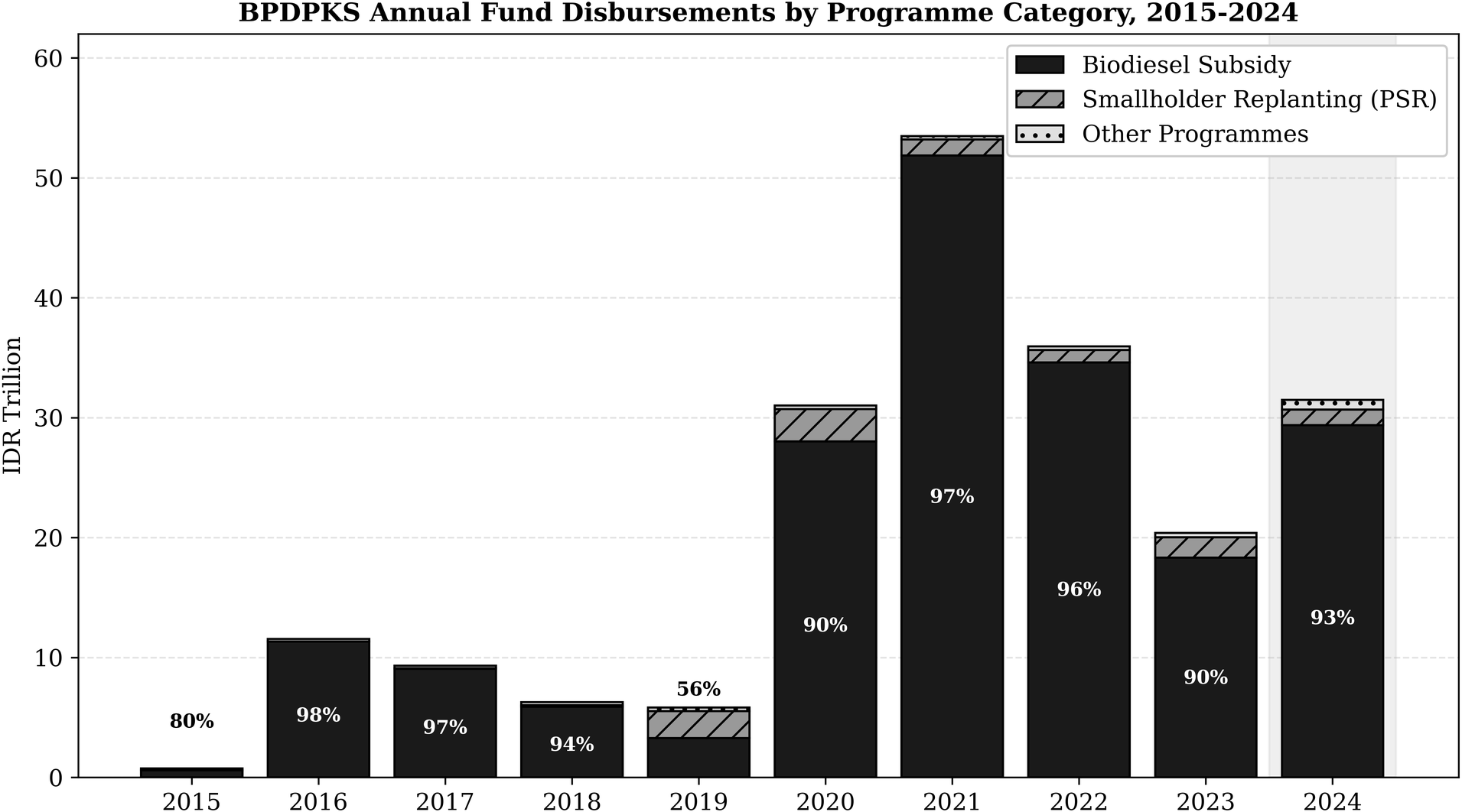
1) BPDPKS Financial Data: Data on levy collection and fund disbursement from 2015 to 2024 were collected from official BPDPKS publications, Indonesian government press releases (e.g., from the Ministry of Finance), and investigative reports from non-governmental organizations (NGOs) and media outlets (e.g., Auriga Nusantara, Betahita.id, InfoSAWIT). This data was used to construct Figure 1, which quantifies the financial priorities of the policy subsystem.
Figure 1.BPDPKS annual fund disbursements by program category, 2015–2024.
Notes: Percentages above or inside bars show the biodiesel subsidy share of total annual disbursement. Values for 2016–2019 are apportioned from published multi-year totals; see the replication codebook.Sources: InfoSAWIT (2023); Plantation Fund Management Agency (2020, 2025a); Putri et al. (Reference Putri, Ifziwarti and Afra2024); The Iconomics (2025); Wicaksono (Reference Wicaksono2023).

-
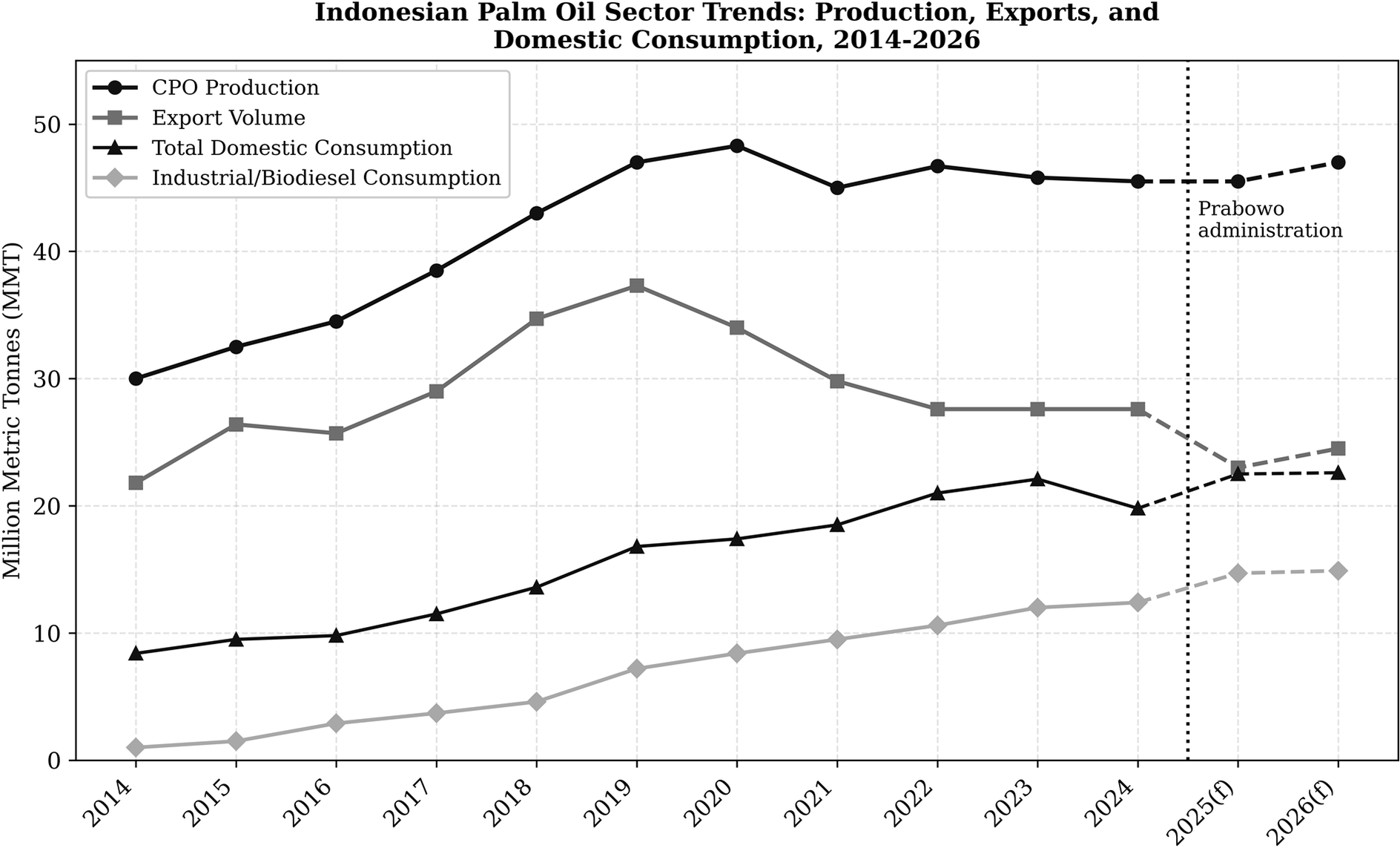
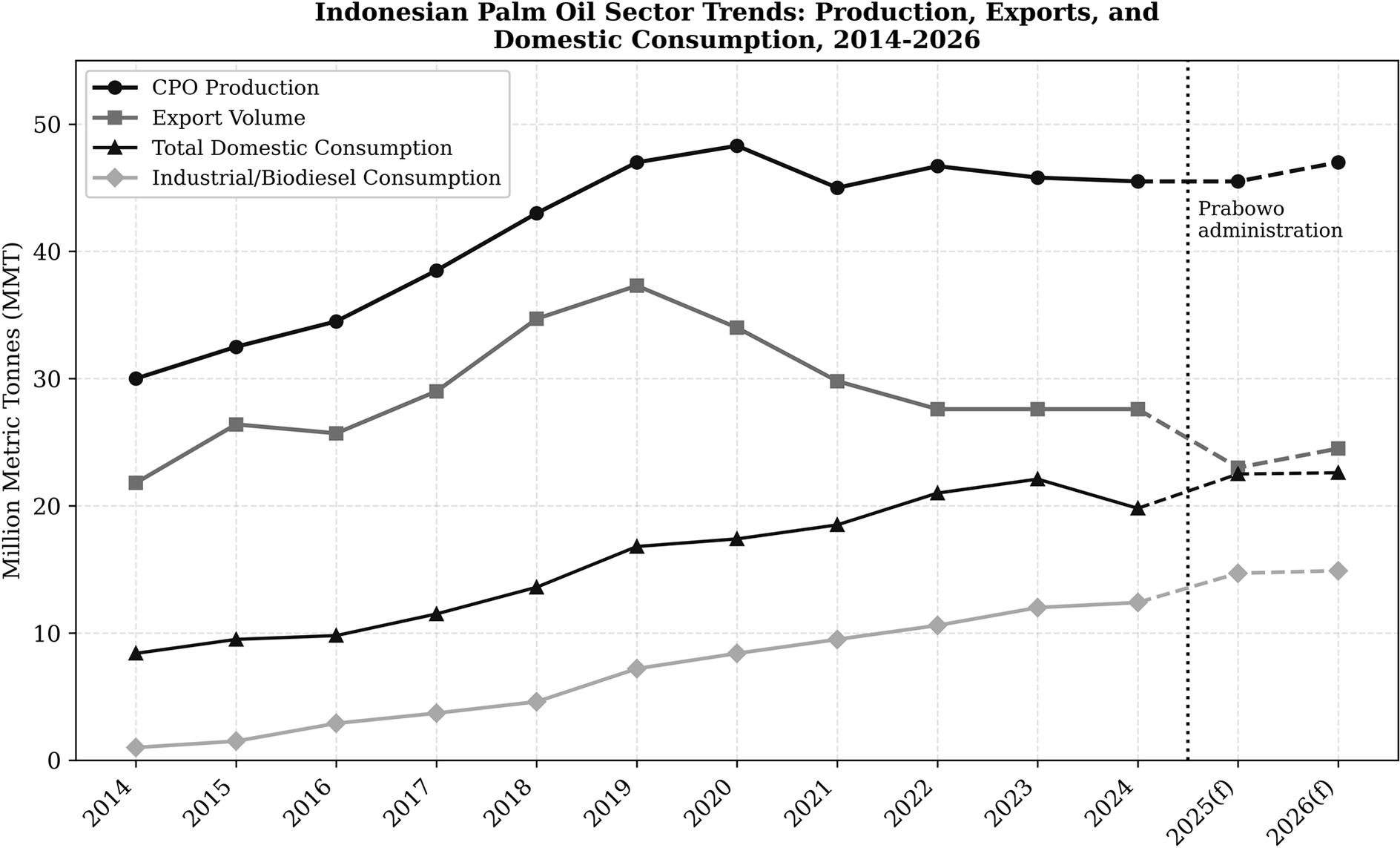
2) Palm Oil Sector Indicators: Data on plantation area, Crude Palm Oil (CPO) production, export volumes, and domestic consumption from 2014 to 2024 were synthesized from multiple sources, including BPS-Statistics Indonesia, the Indonesian Ministry of Agriculture’s Directorate General of Estates, and international agricultural databases such as the USDA Foreign Agricultural Service (GAIN reports) and FAOSTAT. This data forms the basis of Figure 2.
Figure 2.Indonesian Palm Oil Sector Trends: Production, Exports, and Domestic Consumption, 2014–2026.
Notes: Dashed lines indicate forecasts (f). Vertical dotted line marks the October 2024 presidential transition.Sources: BPS-Statistics Indonesia (2019); CRIF (2024); Directorate General of Estates (2022); USDA Foreign Agricultural Service (2024a, 2024b, 2025).
-
3) Forecasted Data: Projections for sectoral indicators and financial commitments for 2025 and 2026 were sourced primarily from USDA GAIN reports, which explicitly model the anticipated impacts of the B40 and B50 biodiesel mandates based on government announcements and industry analysis.
The analysis of this data was primarily descriptive and trend-based. Key metrics, such as the percentage allocation of BPDPKS funds, were calculated to reveal policy priorities. For any given program i in year t, the percentage allocation (Allocation %) was determined using the following formula:
 ${\rm Allocation}{_{\%, i,t}} = \left( {{\rm Disbursement}{_{i,t}}/{\rm Total}\;{\rm Disbursement}{_t}} \right)\; \times \;100$
where Disbursement i,t is the funds disbursed to program i in year t, and Total Disbursement t is the total funds disbursed in that year. Similarly, the “Exportable Surplus” was calculated as a simple measure of the supply and demand balance, providing an indicator of the industry’s market orientation:
 ${\rm{Surplu}}{{\rm{s}}_{\rm{Exportable,t}}}\;\; = {\rm Production}{_{\rm{CPO,t}}}\;\; - {\rm Consumption}{_{\rm{Domestic,t}}}\;$
where Production CPO,t is the total CPO production in year t, and Consumption Domestic,t is the total domestic consumption in the same year. These calculations form the basis of the trend analysis presented in the results section.
Qualitative data collection and thematic analysis
To contextualize the quantitative findings, we conducted a qualitative analysis designed to map the policy processes and narratives that underpin the observed stability. This involved a thematic analysis of public documents. In doing so, we employed a purposive sampling strategy and focus on the specific narratives and actions of key actors within the policy domain: the central policy monopoly (government agencies, industry associations), its challengers (NGOs, community groups), and observers (media, academic researchers). Data collection was conducted between February and April 2025, covering documents published from January 1, 2014, to March 31, 2025. This timeframe was chosen to encompass the full second term of the Joko Widodo administration and the initial months of the Prabowo Subianto administration-to allow for a direct analysis of policy continuity across the transition. The document search used keywords in English and Indonesian (e.g., “palm oil,” “mandatory biodiesel,” “BPDPKS,” “Prabowo palm oil,” “palm oil moratorium”). To ensure relevance and reliability, we established strict inclusion criteria: documents had to be published within our specified timeframe, substantively discuss Indonesian palm oil policy, and originate from credible sources such as official government publications, established news media with editorial oversight (e.g., Kompas, Reuters, Mongabay), or formal reports from recognized stakeholder organizations (e.g., GAPKI, Human Rights Watch). We explicitly excluded documents with only passing mentions of the topic, as well as sources lacking credibility like unverified blogs or advocacy websites without clear methodologies, to maintain analytical objectivity. After removing duplicates and applying these criteria, this process yielded a final qualitative corpus of 46 documents for analysis.
The analysis of these documents followed a multi-stage thematic process guided by the core concepts of Punctuated Equilibrium Theory. The process began with a thorough familiarization phase, involving multiple readings of the entire corpus. We then proceeded to a systematic coding stage, applying a deductive coding frame based on PET’s central tenets: Policy Monopoly, Policy Image, Venue, Institutional Friction, and Error Accumulation. For instance, textual segments where President Prabowo dismissed deforestation concerns were coded under “Policy Image,” while financial reports detailing BPDPKS’s skewed funding were coded under “Policy Monopoly.” Subsequently, these coded segments were collated to develop and refine each theme. To enhance the validity of our interpretations, we consistently employed triangulation by cross-referencing claims across the different source types, such as contrasting official government statements with reports from independent NGOs and media.
Results
The Jokowi Era: constructing the policy equilibrium (2014–2024)
The priorities and stability of the policy equilibrium constructed under Jokowi are evident in the quantitative data on financial flows and sectoral outputs. Analysis of BPDPKS funding reveals a clear and consistent set of preferences, while sectoral statistics illustrate the material consequences of these policy choices. Figure 1 details the collection and disbursement of funds by BPDPKS. The data demonstrates the overwhelming financial priority given to the biodiesel program. Between 2015 and mid-2023, BPDPKS collected approximately IDR 186.6 trillion (over USD 12 billion) in levies. Of this, a staggering IDR 145.56 trillion, or about 78% of the total, was disbursed as incentives for the biodiesel program. In stark contrast, the Smallholder Replanting Program (PSR) received just IDR 7.78 trillion, or roughly 4% of the total funds, over the same period. This vast disparity is not an implementation failure but a structural feature of the policy equilibrium. The biodiesel mandate requires a consistent, large-scale supply of CPO that only integrated corporate plantations can reliably provide. The financial flows of BPDPKS are therefore directed to ensure the success of this core objective, marginalizing the needs of fragmented and less productive smallholders, whose replanting programs consistently fell far short of official targets.
These patterns provide strong support for H1 and qualified support for H2. The mean annual share of BPDPKS disbursements allocated to the biodiesel subsidy across 2015–2024 is 89.2%, compared to a mean of 6.8% for the Smallholder Replanting Programme (PSR). A paired t-test confirms that this difference is highly significant (t = 11.0, p < 0.001), demonstrating that the dominance of the biodiesel program in BPDPKS allocations is not a random fluctuation but a structural feature of the policy equilibrium, sustained across CPO price cycles and across the presidential transition. The biodiesel share stood at or above 80% in nine of the ten years observed, averaging 92.9% across those nine years.
The single exception is instructive rather than disconfirming. In 2019 the biodiesel share fell to 56%, because the incentive is a payment covering the gap between the biodiesel and fossil diesel index prices and therefore contracts when that gap narrows, as it did that year. 2019 also saw the sharpest expansion of smallholder replanting in the program’s history, from 12,609 hectares in 2018 to 90,491 hectares. Crucially, the blending mandate was not paused: the escalation from B20 to B30 was announced in the same year. Financial commitment to the subsystem is price-sensitive; political commitment to the mandate is not. The share rebounded to 90.3% in 2020 and has not since fallen below 89%. What H2 captures, then, is not a fixed floor on annual disbursement but the insensitivity of the subsystem’s priorities to fiscal pressure, price cycles, and changes of administration.
Consistent with H3, domestic industrial/biodiesel consumption grew from 1.0 MMT in 2014 to 12.4 MMT in 2024, a 1,140% increase, while export volume grew only 27% over the same period, with the export share of total production declining from 72.7% to 60.7% without reversal (see Figure 2).
The material impact of this policy orientation is visible in the macro-level indicators of the palm oil sector, presented in Figure 2. Throughout the Jokowi era, total plantation area and CPO production continued to grow steadily, and showing the industry’s underlying momentum. The most telling trend, however, is the fundamental shift in the destination of Indonesian palm oil. While export volumes remained relatively stagnant or grew only modestly, domestic consumption surged. This increase was driven almost entirely by industrial use for the biodiesel program, which grew from negligible levels before 2015 to over 12 MMT by 2023. This data provides empirical evidence for the primary function of the policy equilibrium: to reorient a significant portion of the nation’s largest agricultural commodity away from the global market and toward a state-created, state-subsidized domestic energy market. This inward turn was the central achievement of the policy monopoly built under President Jokowi, and it set the stage for the continuity to come.
The Prabowo presidency: amplifying the equilibrium
The transition to the Prabowo Subianto presidency did not disrupt the established palm oil policy equilibrium; it fortified it. Rather than challenging the policy monopoly he inherited, President Prabowo has emerged as its most powerful champion, and notably using his political capital to harden its core narratives and accelerate its primary policy objectives. His administration’s approach demonstrates a clear case of continuity and amplification; a logical extension of the path dependency created during the Jokowi years.
Forecasts for the palm oil sector under the Prabowo administration provide strong quantitative evidence for this thesis of continuity and amplification. The trends established during the Jokowi era are projected to continue on an incremental path, driven by the intensification of the biodiesel program.
Figure 3 projects key sectoral indicators for 2025 and 2026. CPO production is expected to see modest growth, driven by favorable weather and improved fertilization, though constrained by the slow pace of smallholder replanting (USDA Foreign Agricultural Service 2025). The most dramatic change is the continued surge in domestic consumption, which is forecast to reach 22.6 MMT by 2026, with nearly two-thirds of that (14.9 MMT) absorbed by the industrial sector for biodiesel production (USDA Foreign Agricultural Service 2025). This will further limit the volume of palm oil available for export, and cementing the industry’s inward-looking orientation. These figures show no evidence of a policy punctuation but rather a smooth continuation of the trajectory established post-2015.
The Policy Ratchet: Biodiesel Blend Mandate Escalation and Palm Oil Industrial Consumption, 2015–2026.
Notes: Mandate levels reflect government-announced targets. 2025–2026 are forecast (f) values. Shaded area denotes the Prabowo administration period.Sources: Mettis Global News (2024); Plantation Fund Management Agency (2025a); USDA Foreign Agricultural Service (2025).
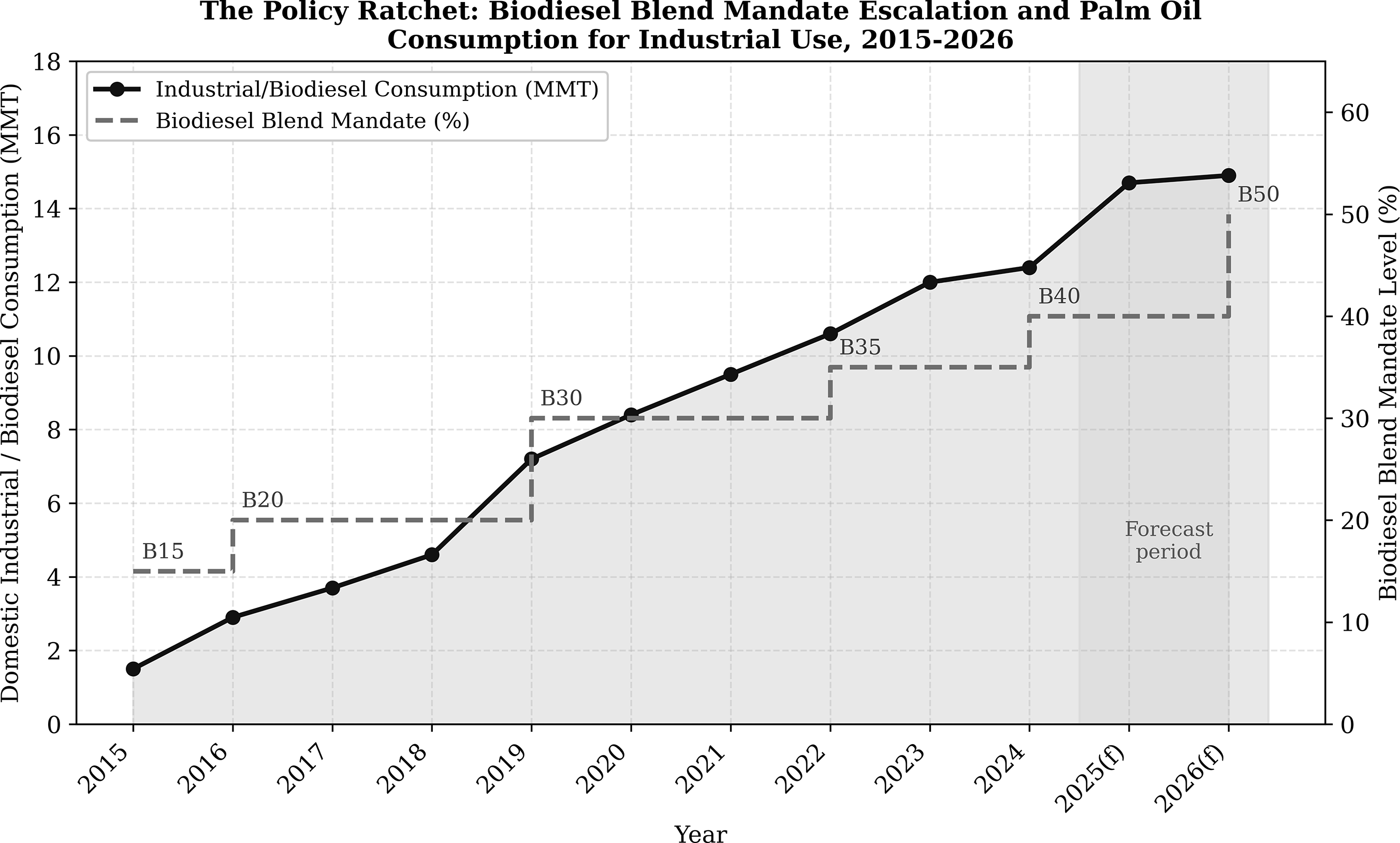
Table 1 quantifies the escalating financial commitment required to sustain and amplify this equilibrium. The move to a B40 mandate in 2025, with a planned allocation of 15.6 billion liters, will require a significant increase in subsidies from the BPDPKS fund. The estimated subsidy for the Public Service Obligation (PSO) portion of diesel fuel alone is projected to be around IDR 35 trillion (USD 2.1 billion) in 2025, a 25% increase from the B35 program in 2024. A future move to B50 would push annual biodiesel demand toward 19–20 billion liters, thus requiring even larger subsidies and likely necessitating an increase in export levies to keep the BPDPKS fund solvent. This demonstrates the powerful feedback mechanism at the heart of the policy monopoly: the escalating mandate creates a growing need for the funding mechanism (BPDPKS), which in turn justifies higher levies on the industry, further enclosing the financial loop and reinforcing the system’s stability.
Projected financial commitments to the biodiesel mandate, 2025–2026

Table 1. Long description
The table has three columns and two rows. The columns are labeled ‘Year’, ‘Biodiesel mandate level’, ‘Projected biodiesel allocation (billion litres)’, and ‘Estimated subsidy required (USD billion)’. The row labels are the years 2025 and 2026. Row 1: 2025, B 40, 15.6, 2.1 (P S O only). Row 2: 2026, B 40 slash B 50 (planned), 16.0 to 19.0, greater than 2.5 (est.).
Note: Figures are forecasts (f) and estimates. The 2025 allocation and subsidy figures are based on government plans and USDA analysis; the subsidy covers the Public Service Obligation portion only. The 2026 figures are based on industry projections for a B50 mandate. The subsidy cost is highly sensitive to the price spread between crude palm oil and fossil diesel.
Sources: Business Today (2025); Mettis Global News (2024); Plantation Fund Management Agency (2025a); USDA Foreign Agricultural Service (2025).
The seamless continuity from Jokowi to Prabowo averted a potential punctuation because there was no “conflict expansion.” The new president’s political ideology and populist goals – national security, resource nationalism, and energy self-sufficiency – were already perfectly congruent with the objectives of the existing policy monopoly. Prabowo did not need to be co-opted by the palm oil subsystem; he arrived as its natural champion, ready to defend its policy image against foreign criticism and amplify its core programs. The 2024 election, therefore, did not challenge the equilibrium but powerfully reinforced it.
Qualitative findings: the anatomy of the policy monopoly
First, the analysis confirms the existence of a powerful and financially autonomous policy monopoly. The establishment of the BPDPKS in 2015 is the central institutional pillar of this monopoly. Policy documents show it was designed to create a closed financial loop, collecting levies from palm oil exporters and channeling the funds back into the industry, primarily to subsidize biodiesel producers. This design, described in official government publications, insulates the core policy from the annual state budget process, a common venue for political contestation, thereby creating what PET would describe as high institutional friction against change.
Second, this monopoly actively constructs and defends a dominant policy image centered on economic nationalism and energy security. Across both the Jokowi and Prabowo administrations, official rhetoric consistently frames the biodiesel program as essential for reducing dependence on imported fossil fuels, saving foreign exchange, and supporting rural livelihoods. This positive image is aggressively defended against competing narratives. For example, President Prabowo’s statement dismissing deforestation concerns by arguing that “oil palms are trees, [they] have leaves that release oxygen” (as cited in Malaysian Palm Oil Council 2025) is a clear attempt to redefine the environmental debate in simplistic terms that favor the industry.
This rhetorical reinforcement has been matched by concrete signals of policy intent. Prabowo has called for a significant increase in oil palm plantation area and has gone so far as to publicly ask military and police personnel to protect “every square inch” of plantations to signal the full weight of the state security apparatus behind the industry (Malaysian Palm Oil Council 2025; Tempo.co 2025). This has been welcomed by industry groups like the Indonesian Palm Oil Association which now openly advocates for palm oil to be formally designated a “National Strategic Object,” a move that would legally entrench the policy monopoly’s de facto power (Indonesian Palm Oil Association 2024).
Third, the monopoly maintains its dominance by marginalizing competing problem definitions and the venues where they are promoted. While the Jokowi administration created international-facing venues like the palm oil moratorium and the ISPO certification scheme, reports from NGOs and media outlets consistently described these as weakly enforced and largely symbolic (Jong Reference Jong2018). The substantive policy venue remains the closed loop between the Coordinating Ministry for Economic Affairs, the Ministry of Energy, BPDPKS, and corporate producers. The “accumulated errors” of this policy – such as land conflicts documented by Human Rights Watch (2019b) and the marginalization of smallholders evident in BPDPKS’s own financial reports – are systematically ignored within this dominant venue.
Finally, the qualitative data shows a clear pattern of continuity and amplification across the presidential transition. In other words, the centerpiece of Prabowo’s economic agenda for the sector is not a new policy but a direct intensification of Jokowi’s signature program: the expansion of the biodiesel mandate. His government is proceeding with the nationwide rollout of the B40 blend in 2025 and has already begun testing for a future B50 mandate (Mettis Global News 2024; USDA Foreign Agricultural Service 2025). The policy logic remains identical to that of his predecessor, centered on the populist and nationalist goals of achieving energy self-sufficiency and reducing the country’s multi-billion-dollar fuel import bill (Habir and Negara Reference Habir and Dharma Negara2025; Malaysian Palm Oil Council 2025; Suharsono and Nugroho Reference Suharsono and Nugroho2025). This escalation acts as a powerful “policy ratchet.” Each increase in the blending mandate deepens the nation’s economic and infrastructural path dependency, which will require more investment in biodiesel refining capacity and making a larger portion of the agricultural economy reliant on the state-subsidized program (USDA Foreign Agricultural Service 2025). Reversing this policy would now trigger a catastrophic collapse in domestic CPO demand, creating a massive market surplus and generating immense political blowback from the powerful corporate actors at the heart of the policy monopoly (Halimatussadiah et al. Reference Halimatussadiah, Nainggolan, Yui, Moeis and Adininggar Siregar2021). This mechanism makes a policy reversal increasingly costly and politically untenable, hence locking in the equilibrium for the foreseeable future.
Evaluating alternative explanations
A rigorous application of PET requires actively considering competing explanations for the observed continuity. Three alternatives deserve serious engagement. The first is elite capture theory, which attributes policy continuity to rent-seeking by politically connected conglomerates capturing state institutions (Cisneros et al. Reference Cisneros, Kis-Katos and Nuryartono2021). The evidence of corporate capture is clear: large integrated firms receive the overwhelming share of BPDPKS subsidies (Putri et al. Reference Putri, Ifziwarti and Afra2024). However, elite capture cannot explain why challengers failed despite multiple institutional openings – the moratorium period, the ISPO scheme – nor why the system possesses the specific architectural features (levy-funded autonomy, biodiesel mandate escalation) that PET’s subsystem dynamics illuminate. PET provides the mechanistic specificity that elite capture lacks.
The second alternative is a market-based explanation: governments maintain palm oil policy simply because CPO is profitable and biodiesel reduces fuel import costs. However, CPO prices fluctuated significantly across the study period, including major downturns in 2019 and 2023, without producing any corresponding policy adjustment. Moreover, subsidy costs increased substantially in 2024–2025 as the price spread widened, yet the mandate was escalated rather than paused. Pure market logic cannot explain this insensitivity to price signals; PET’s institutional friction concept can.
The third alternative is simple path dependency, independent of PET’s fuller apparatus. Sunk costs and established infrastructure are clearly operative. However, path dependency describes the constraint without explaining its active reproduction across a major leadership transition. PET specifies the mechanisms: the financially autonomous subsystem removes budgetary vulnerability; the policy ratchet continuously enlarges the pro-stability coalition; and the dominant policy image prevents alternative frames from reaching the macropolitical agenda. PET’s contribution is precisely this mechanistic elaboration of why the path dependency is so robust.
Discussion
The continuity of Indonesian palm oil policy across a major presidential transition offers a compelling case study in what can be termed “hyper-stability.” The failure of this critical juncture to produce any significant policy punctuation is not an anomaly but a predictable outcome of a deeply entrenched and remarkably resilient policy subsystem. The synthesis of the analysis reveals that this stability is a product of the pre-alignment of the new leader’s interests with the existing policy monopoly, the monopoly’s effective control over the dominant policy image, its unique financial autonomy via the BPDPKS, and the powerful path dependency created by the biodiesel policy ratchet. This durable equilibrium, however, is maintained only by systematically externalizing immense environmental and socio-economic costs.
The stability of this policy domain is exceptional. Unlike policy subsystems in many Western political models, which remain somewhat permeable to macropolitical intervention and budgetary oversight, the Indonesian palm oil monopoly has achieved a state of near-insulation. The fusion of state objectives (energy security) with corporate interests (guaranteed domestic market), all financed by a dedicated, off-budget levy-and-subsidy mechanism, creates a policy fortress that is exceptionally resistant to change (Cisneros et al. Reference Cisneros, Kis-Katos and Nuryartono2021). The transition to a president who not only accepts but champions the monopoly’s core tenets has served to reinforce the fortress walls, ensuring that competing problem definitions remain marginalized.
The “costs of stability”: quantifying the externalities
This durable equilibrium is not benign; its stability is achieved by systematically ignoring or externalizing a vast array of costs, which represent the “accumulated error” in the PET framework. While the policy monopoly focuses attention on metrics like foreign exchange savings from reduced fuel imports, it actively diverts attention from the significant and quantifiable negative consequences of its agenda.
The most significant externality is environmental degradation. Despite a decline from peak levels, deforestation driven by oil palm expansion continues. Between 2001 and 2019, oil palm expansion was directly responsible for the conversion of 3.09 million hectares of natural forest (Sibhatu Reference Sibhatu2023). Critically, a large portion of this expansion occurs on carbon-rich peatlands (Gunarso et al. Reference Gunarso, Hartoyo, Agus, Killeen, Killeen and Goon2013; Patrenko et al. Reference Patrenko, Julia and Searle2016). The drainage of peat for plantations leads to massive and sustained GHG emissions through oxidation and makes these landscapes highly susceptible to fire (Murdiyarso et al. Reference Murdiyarso, Swails, Hergoualc’h, Bhomia and Sasmito2024; Patrenko et al. Reference Patrenko, Julia and Searle2016). The palm oil sector as a whole is estimated to emit an average of 220 million tonnes of CO2 equivalent annually, accounting for nearly one-fifth of Indonesia’s total national emissions (Benedict and Heilmayr Reference Benedict and Heilmayr2024). Studies indicate that producing one ton of refined palm oil in Indonesia emits over 2,100 kg of CO2 equivalent, with land-use change and wastewater treatment being the largest contributors (Wang et al. Reference Wang, Li, Sun, Xie and Li2025). This enormous carbon footprint is a direct cost of the policy equilibrium that is not accounted for in the state’s promotion of biodiesel as a “green” energy source.
Equally important, the dominant policy image of poverty alleviation and shared prosperity masks deep structural inequalities and persistent social harms. Land tenure conflicts are pervasive across the archipelago (Berenschot et al. Reference Berenschot, Dhiaulhaq, Otto Hospes, Adriana and Poetry2022). Indigenous and local communities have lost their ancestral forests and traditional livelihoods with little to no free, prior, and informed consent or adequate compensation (Covey Reference Covey2021; Human Rights Watch 2019b). Human Rights Watch (2019a, 2019b) and other organizations have documented how weak laws and poor government oversight facilitate the deprivation of indigenous land rights, leading to displacement and the loss of cultural identity.
Furthermore, the benefits of the sector are distributed highly unequally. The BPDPKS funding mechanism is a stark illustration of this. While smallholders manage approximately 40% of Indonesia’s oil palm land area, they are systematically marginalized within the policy framework (Hasan et al. Reference Hasan, Ahmad and Mardiana Fahmid2021; Indonesian Palm Oil Association 2024; Pahmi et al. Reference Pahmi, Gunawan, Iskandar and Soemarwoto2023). As shown in Figure 1, they receive a minuscule fraction of the financial support distributed by BPDPKS, which flows overwhelmingly to large corporate biodiesel producers (Putri et al. Reference Putri, Ifziwarti and Afra2024; Wicaksono Reference Wicaksono2023). This structural bias perpetuates a cycle where smallholders struggle with low productivity, lack of access to capital and certified seeds, and weak bargaining power, while the corporate entities essential to the biodiesel mandate are bolstered by state-subsidized profits (Dharmawan et al. Reference Dharmawan, Mardiyaningsih, Komarudin, Ghazoul, Pacheco and Rahmadian2020). Reports also document serious labor rights abuses on plantations, including the use of child labor, forced labor through impossibly high harvesting targets, and gender discrimination, all driven by a system that prioritizes low-cost production (Amnesty International 2016a, 2016b). These accumulated social errors are the hidden subsidy of the stable policy equilibrium.
Conclusion
This paper has argued that the palm oil policy of the Prabowo Subianto administration represents a powerful continuation and amplification of the durable policy equilibrium established under his predecessor, Joko Widodo. Framed through the lens of Punctuated Equilibrium Theory (PET), the analysis demonstrates that the presidential transition did not serve as a “punctuation” point for meaningful policy change. Instead, it reinforced a hyper-stable system governed by a resilient policy monopoly. This argument is substantiated by quantitative analysis of budgetary data from the Palm Oil Plantation Fund Management Agency (BPDPKS) and sectoral statistics, which reveal a consistent, incremental pattern of policy centered on a state-subsidized, domestic biodiesel mandate. The observed continuity is further explained by the alignment between President Prabowo’s nationalist-populist agenda and the pre-existing objectives of the state-industry coalition, the monopoly’s effective control over the dominant policy image, and the institutional insulation afforded by the financially autonomous BPDPKS, as elaborated in the qualitative findings.
The primary theoretical contribution of this study lies in its application of PET to a state-capitalist, developing-country context. It highlights the concepts of the “financially autonomous subsystem” and the “policy ratchet” as powerful mechanisms that generate and sustain hyper-stability. The BPDPKS, operating through a closed loop of industry-funded levies and subsidies, exemplifies how a policy subsystem can shield itself from broader political and fiscal pressures. The escalating biodiesel mandate functions as a policy ratchet, creating deep path dependencies that render policy reversal increasingly costly and politically unviable. This case illustrates that, under specific conditions, policy equilibria can become so deeply entrenched that they endure even major political transitions – such as a change in national leadership – while systematically accumulating and externalizing significant environmental and social costs.
Given the profound resilience of this policy equilibrium, conventional policy recommendations are unlikely to succeed. A PET-informed approach suggests that disrupting this stasis requires a multi-pronged strategy aimed at dismantling the policy monopoly’s control over information, decision-making venues, and financial resources. Therefore, the following strategic interventions are proposed.
First, the dominant policy image must be challenged. The monopoly derives much of its power from its ability to frame palm oil policy through the lens of energy security and economic nationalism. Countering this requires a coordinated effort to shift the public and political narrative. This involves moving beyond qualitative critiques and rigorously quantifying and publicizing the “costs of stability.” Two specific actions are essential: conducting lifecycle GHG accounting to mandate transparent, internationally verified greenhouse gas assessments for the entire biodiesel supply chain – including emissions from land-use change and peatland degradation – and commissioning economic valuations of ecosystem services lost to plantation expansion, such as biodiversity, water regulation, and carbon sequestration. These steps would provide a robust economic counter-narrative to the industry’s claimed benefits.
Second, alternative coalitions and policy venues must be built. Contesting the monopoly’s dominance requires empowering marginalized actors and relocating the debate to more favorable institutional settings. One avenue is the restructuring of BPDPKS funding. A legally mandated reallocation – such as directing 40 percent of the fund, proportional to land ownership, toward independently managed smallholder programs for replanting, certification, and downstream enterprise development – could create a powerful counter-coalition of millions of smallholders with a vested interest in a different policy trajectory. Additionally, strategic litigation and venue shopping could be employed by supporting indigenous communities in launching legal challenges in the Constitutional Court over land rights violations. Simultaneously, the issue could be elevated to international climate finance and trade platforms, linking Indonesia’s access to green funds and preferential trade terms to demonstrable progress in addressing the palm oil sector’s negative externalities.
Third, friction must be introduced into the currently smooth and insulated functioning of the policy subsystem. This can be achieved through new information and accountability mechanisms. One such measure is independent auditing. A fully independent, publicly accessible audit of all BPDPKS financial flows – conducted by an internationally recognized body and reported directly to the legislature and the public – would significantly disrupt the opaque financial loop between the state and corporate producers. Another critical intervention is the implementation of traceability and transparency mandates. Legislation should require publicly accessible traceability for all palm oil used in the domestic biodiesel program, linking specific volumes to specific mills and plantations. Such measures would expose supply chains associated with recent deforestation or land conflicts, forcing a reconsideration of the program’s true social and environmental costs.
These recommendations are not simple fixes but represent deliberate, strategic efforts to disrupt the foundational mechanisms that uphold the current, unsustainable equilibrium. Without such a fundamental challenge to the power of the policy monopoly, Indonesia’s palm oil governance is likely to remain in a state of durable stasis – continuing to generate wealth for a privileged few while externalizing its most profound costs onto the environment and the nation’s most vulnerable communities.
Data availability statement
Replication materials are available in the Journal of Public Policy Dataverse at https://doi.org/10.7910/DVN/Z1F9XE.
Acknowledgements
The authors thank the anonymous reviewers for their constructive feedback, which greatly improved this manuscript.
Funding statement
This research did not receive any specific grant from funding agencies in the public, commercial, or not-for-profit sectors.
Competing interests
The authors declare that they have no competing interests.



 Open access

