The emergence of gaze and social smile toward the second month of life marks the beginning of socioemotional communication in infancy (Messinger & Fogel, Reference Messinger and Fogel2007). Henceforth, infants' increasing social skills in communicating and reciprocating affect enable dyadic forms of affect sharing during face-to-face interactions with the caregiver (Als, Tronick, & Brazelton, Reference Als, Tronick, Brazelton, Lamb, Suomi and Stephenson1979; Tronick, Reference Tronick1989). Mothers' facial expressions are predominantly positive and rarely negative in face-to-face interactions in typical development (Cohn & Tronick, Reference Cohn and Tronick1987; Malatesta & Haviland, Reference Malatesta and Haviland1982). It was suggested that mothers' expressions of positive affect constitute a “frame” for typically developing infants' expression and regulation of affect in early interactions (Als et al., Reference Als, Tronick, Brazelton, Lamb, Suomi and Stephenson1979; Cohn & Tronick, Reference Cohn and Tronick1987; Tronick, Reference Tronick1989). In addition, the synchronous timing of parents' positive affect with infants' positive affect is considered to be an important determinant of the quality of early parent–child interactions that is linked to infants' current and later social, emotional, and psychological functioning (Feldman, Reference Feldman2007; Leclère et al., Reference Leclère, Viaux, Avril, Achard, Chetouani and Missonnier2014). The present study investigated the associations of parents' depression and anxiety symptoms, and of infants' negative temperament with parents' and infants' emotional expressions and gaze during parent–infant face-to-face interactions in a Dutch community sample of parent–infant dyads.
Infants' Face-to-Face Interaction With Mothers Versus With Fathers
The majority of observational studies of parent–infant face-to-face interaction were conducted only with mothers, while less is known about the gaze and facial expressions of affect in father–infant dyads. Available evidence suggests similarities in mothers' and fathers' ability to sensitively respond to their infant (Braungart-Rieker, Garwood, Powers, & Notaro, Reference Braungart-Rieker, Garwood, Powers and Notaro1998). In contrast, differences have been reported in the mothers' versus fathers' expressions of positive affect. Mothers are more positive than fathers, and infants are more positive with their mother than with their father in face-to-face interactions (Belsky, Gilstrap, & Rovine, Reference Belsky, Gilstrap and Rovine1984; Colonnesi, Zijlstra, Van der Zande, & Bögels, Reference Colonnesi, Zijlstra, Van der Zande and Bögels2012; Field, Vega-Lahr, Goldstein, & Scafidi, Reference Field, Vega-Lahr, Goldstein and Scafidi1987; Forbes, Cohn, Allen, & Lewinsohn, Reference Forbes, Cohn, Allen and Lewinsohn2004). It seems that the differences in infants' expressions of positive affect with mothers versus fathers are accounted for by parents' expressions of positive emotion during face-to-face interactions (Forbes et al., Reference Forbes, Cohn, Allen and Lewinsohn2004). Thus, infants seem to tune in to mothers' and fathers' moment-to-moment expressions of positive affect, rather than communicating with fathers versus mothers in qualitatively different ways. In addition to parents' expressions of affect during the interaction, parents' involvement in caregiving, which is an index of infants' overall exposure to the mother versus father in everyday life, may explain the differences in infants' expressions of affect in face-to-face interactions with the mother versus the father.
Depression and Anxiety in Parents, and Parent–Infant Face-to-Face Interactions
Why is it relevant to investigate how depression and anxiety in parents relate to parents' and infants' early communicative behavior in face-to-face interactions? First, depression and anxiety are among the most prevalent psychiatric disorders in early years of parenthood (Bijl, Ravelli, & Van Zessen, Reference Bijl, Ravelli and Van Zessen1998; Jacobi et al., Reference Jacobi, Wittchen, Hölting, Höfler, Pfister and Müller2004; Kessler, Chiu, Demler, & Walters, Reference Kessler, Chiu, Demler and Walters2005; Stuart, Couser, Schilder, O'Hara, & Gorman, Reference Stuart, Couser, Schilder, O'Hara and Gorman1998). Second, offspring's exposure to parents' depression and anxiety in early life is linked to negative emotional, behavioral, and psychological outcomes in infancy and beyond (e.g., Glasheen, Richardson, & Fabio, Reference Glasheen, Richardson and Fabio2010; Halligan, Murray, Martins, & Cooper, Reference Halligan, Murray, Martins and Cooper2007; Murray et al., Reference Murray, Arteche, Fearon, Halligan, Goodyer and Cooper2011; Pawlby, Sharp, Hay, & O'Keane, Reference Pawlby, Sharp, Hay and O'Keane2008). Third, depression and anxiety run in families; thus, the presence of a depressed and/or anxious parent increases the risk of psychopathology in the offspring (Beardslee, Gladstone, & O'Connor, Reference Beardslee, Gladstone and O'Connor2011; Beidel & Turner, Reference Beidel and Turner1997; Goodman, & Gotlib, Reference Goodman and Gotlib1999; Turner, Beidel, & Costello, Reference Turner, Beidel and Costello1987). Fourth, depression and anxiety are characterized by increases in the duration, frequency, and intensity of negative emotions (American Psychiatric Association, 2013). Depressed parents express more flat and negative affect in everyday life. Anxious parents express more fear, anxiety, and worry in reaction to certain situations (or in general, in the case of generalized anxiety disorder). Exposure to parents' negative affect during daily interactions was suggested to be an important mechanism in the parent–infant transmission of depression and anxiety disorders, alone and in interaction with inherited genetic vulnerabilities, epigenetic influences (El-Sayed, Halossim, Galea, & Koenen, Reference El-Sayed, Haloossim, Galea and Koenen2012), and/or temperamental predispositions (Goodman & Gotlib, Reference Goodman and Gotlib1999; Murray, Creswell, & Cooper, Reference Murray, Creswell and Cooper2009).
Studies observing depressed mothers in face-to-face interaction with their infant have revealed that depression affects mothers' and infants' behavior during face-to-face interactions by interfering with mothers' ability to synchronously respond to, and to positively engage with, their infant (Beck, Reference Beck1995; Murray, Halligan, & Cooper, Reference Murray, Halligan, Cooper, Bremner and Wachs2010; Stanley, Murray, & Stein, Reference Stanley, Murray and Stein2004). Mothers with depression and their infants express less positive affect than reference mothers and their infants during face-to-face interactions (e.g., Campbell, Cohn, & Meyers, Reference Campbell, Cohn and Meyers1995; Cohn, Campbell, Matias, & Hopkins, Reference Cohn, Campbell, Matias and Hopkins1990). Moreover, differences were reported in attention allocation of infants to others' positive and negative emotions when the mother has depression. For example, in computerized experiments measuring attention, 3- and 6-month-old infants of depressed mothers spend less time looking at sad (vs. happy) faces than infants of nondepressed mothers (Field, Pickens, Fox, Gonzales, & Nawrocki, Reference Field, Pickens, Fox, Gonzalez and Nawrocki1998). Infants of depressed parents are also more likely to gaze at the mother during mothers' positive facial expressions in face-to-face interactions (Striano, Brennan, & Vanman, Reference Striano, Brennan and Vanman2002). These differences in infants' attention to positive affect may be explained by their increased familiarity with sad (vs. happy) faces in everyday face-to-face interactions in the case of maternal depression (for a review, see Field, Diego, & Hernandez-Reif, Reference Field, Diego and Hernandez-Reif2009). Moreover, there is some evidence on a negative association between parental depression and parent–infant emotional synchrony in mother–infant dyads, but not in father–infant dyads (Feldman, Reference Feldman2003), suggesting that depression may impair mothers' and infants' (but not fathers' and infants') contingent responding to each others' affect. To our knowledge, this is the only study that compared the effect of maternal and paternal depression in face-to-face interactions. Interparental differences in the expressions of affect wait to be explored in naturalistic everyday interactions.
Compared to parental depression, less is known about how parental anxiety affects parents' and infants' gaze, facial expressions, and synchrony during face-to-face interactions. Weinberg and Tronick (Reference Weinberg and Tronick1998) reported higher levels of negative affect in infants of a mixed sample of mothers with depression or anxiety. In another study by Field et al. (Reference Field, Hernandez-Reif, Vera, Gil, Diego and Yando2005), depressed mothers with high trait anxiety were found to show less positive affect (i.e., smiling) and less exaggerated faces in face-to-face interactions at 3 months than depressed mothers with low trait anxiety. Infants of depressed mothers with high trait anxiety were also less positive and more negative than infants of depressed mothers with low trait anxiety. Nicol-Harper, Harvey, and Stein (Reference Nicol-Harper, Harvey and Stein2007) reported reduced sensitivity and emotional tone in mothers with high (vs. low) trait anxiety in face-to-face play interactions with their 10- and 14-month-olds. Comparisons of high (vs. low) trait anxiety groups with similar levels of depression revealed that the effects of parental anxiety held independent of parents' depression. Taken together, the evidence from these studies suggests a further decrease in depressed mothers' positive affect in early interactions in the case of comorbid maternal anxiety disorder. In a sample of mothers with low rates of depression, Murray, Cooper, Creswell, Schofield, and Sack (Reference Murray, Cooper, Creswell, Schofield and Sack2007) observed mothers with social anxiety disorder and generalized anxiety disorder and their infants in face-to-face interactions. Mothers with social anxiety disorder were less positively engaged, and more anxious during the interactions, while they were equally sensitive as control mothers. The effect of maternal generalized anxiety disorder was not significant.
There is also some evidence on the effects of maternal anxiety disorder without comorbid depression on parents' and infants' facial expressions and sensitivity during dyadic face-to-face interactions. Weinberg, Beeghly, Olson, and Tronick (Reference Weinberg, Beeghly, Olson and Tronick2008) investigated mother–infant interactions in mothers with panic disorder without comorbid depression versus mothers with depression and their 3-month-olds in a still face paradigm (a still face interaction preceded and followed by regular face-to-face interaction). Maternal psychopathology was not related to parents' and infants' affect or synchrony. Kaitz, Maytal, Devor, Bergman, and Mankuta (Reference Kaitz, Maytal, Devor, Bergman and Mankuta2010) investigated the effects of maternal anxiety without depression on 6-month-old infants' facial expressions and parents' sensitivity in a series of dyadic interactions, including still face paradigm, free play, teaching, and caregiving episodes. Mother's positive affect was not separately analyzed in this study; thus, no conclusions can be made about the effect of maternal anxiety on mothers' expressions of affect. In turn, no differences were found between healthy and anxious mother–infant dyads in the duration of matched positive affect, or in the duration of infants' positive affect. Anxious mothers displayed more exaggerated behavior, but they were not less sensitive than mothers without diagnosis during teaching and free-play interactions. Taken together, the findings from these studies suggest that anxiety disorders without comorbid depression in mothers may not interfere with mothers' and infants' expressions of affect in early face-to-face interactions.
Although the links between parental anxiety and infants' gaze to parent remains to be investigated in everyday parent–infant face-to-face interactions, findings from computerized experiments measuring the duration of infants' gaze to the pictures of the mother's versus a stranger's face suggest significant associations between infants' gaze to mothers' face and parents' anxiety (but not depression) symptoms in community samples. Jones, Slade, Pascalis, and Herbert (Reference Jones, Slade, Pascalis and Herbert2013) found that 3.5-month-old infants show less interest to the mother's face when the mother has higher levels of anxiety. Different from infants of mothers with lower levels of anxiety who show a preference for their mother's face, infants of mothers with higher levels of anxiety showed no preference between their mothers' and a stranger's face. In contrast, using bimodal face–voice presentations of mothers and strangers, Taylor, Slade, and Herbert (Reference Taylor, Slade and Herbert2014) found that higher levels of maternal anxiety were linked to an increased interest (longer looking duration) to faces (independent of mother vs. stranger) from 3.5-month-old infants. The direction of the association between parents' lifetime anxiety symptoms and infants' gaze to parent awaits to be explored in naturalistic face-to-face interactions.
The Current Study
As summarized above, the available evidence on depression and anxiety-related changes in early parent–infant interactions predominantly comes from clinical samples of mothers with a current diagnosis of depression and anxiety. From a developmental psychopathology perspective, understanding the links between the deviations in early exposure to parents' emotional expressions and infants' current socioemotional development in community samples of depressed/anxious parents and their infants remains crucial for a better understanding of parent-to-infant transmission of depression and anxiety in clinical samples (Cicchetti, Reference Cicchetti, Cicchetti and Cohen2006). In the current study, we investigated how mothers' and fathers' anxiety and depression symptoms, and infants' negative temperament, relate to parents' and infants' gaze, facial expressions, and synchrony during face-to-face interactions in a Dutch community sample of infants and parents. Dichotomizing parental psychopathology based on presence/absence of diagnosis has been a common strategy in the investigation of exposure effects in clinical samples. Because our interest was on exploring the links between the normal variation in parents' depression and anxiety and their interactive behavior in face-to-face situations independent of whether it is beyond or above the clinical threshold, we used the number of symptoms/criteria to measure parental anxiety/depression rather than the presence/absence of diagnosis.
In line with the dyadic nature of parent–infant interactions, it is important to include the effect of infant temperament when studying parents' and infants' emotional expressions during face-to-face interactions. In support for a bidirectional influence, prenatal maternal anxiety and depression seem to predict an increase in infants' difficult temperament (Austin, Hadzi-Pavlovic, Leader, Saint, & Parker, Reference Austin, Hadzi-Pavlovic, Leader, Saint and Parker2005), while neonatal irritability seems to predict increased postnatal maternal depression (Murray, Stanley, Hooper, King, & Fiori-Cowley, Reference Murray, Stanley, Hooper, King and Fiori-Cowley1996). The reciprocal relation between the effect of parents' and infants' negative dispositions on parents' and infants' expressions of affect provides a route whereby parents' and infants' depressed/sad and anxious/fearful dispositions shape each others' behavior. Infants' negative reactivity to novel stimuli, assessed via standardized observations, was used as an early index of infants' negative temperament in the current study (Kagan & Snidman, Reference Kagan and Snidman1991; Moehler et al., Reference Moehler, Kagan, Oelkers-Ax, Brunner, Poustka and Haffner2008).
We examined the links of mothers' and fathers' lifetime depression and anxiety symptoms, and of infants' negative temperament with parents' and infants' gaze and facial expressions, and with parent–infant emotional synchrony during face-to-face interactions between 3.5 and 5.5 months of age. Regarding the interparental differences, based on previous evidence (Belsky et al., Reference Belsky, Gilstrap and Rovine1984; Colonnesi et al., Reference Colonnesi, Zijlstra, Van der Zande and Bögels2012; Forbes et al., Reference Forbes, Cohn, Allen and Lewinsohn2004), we expected mothers to be more positive than fathers, and infants to be more positive with mothers than with fathers. In an additional exploratory step, we tested whether infants' expressions of affect with the mother versus the father are accounted for by parents' expressions of positive affect during the face-to-face interactions and by parents' involvement in caregiving. Regarding parents' lifetime depression, we expected that parents with more symptoms of depression, and their infants express less positive affect, more neutral/negative affect, and less synchrony than reference parents and their infants. Finally, we explored the associations of parents' anxiety symptoms with parents' and infants' expressions of emotion after controlling for parents' depression symptoms.
In regard to the links of lifetime parental anxiety and/or depression symptoms with infants' gaze, we predicted a significant association between parents' anxiety symptoms and the duration of infants' gaze to parent based on previous evidence from Jones et al. (Reference Jones, Slade, Pascalis and Herbert2013) and Taylor et al. (Reference Taylor, Slade and Herbert2014), while the direction of these associations was explored in face-to-face interactions. In an additional exploratory step, we also tested whether infants' gaze to mother versus father is accounted for by parents' gaze to infant during the face-to-face interaction and by parents' involvement in caregiving. Moreover, we explored whether infants' negative temperament predicts infants' gaze, or parents' and infants' facial expressions, alone and in interaction with parental symptoms of depression and anxiety. Finally, we explored the effect of infant gender, because previous studies on the differences between daughters' and sons' face-to-face interactions with mothers and fathers during face-to-face interactions revealed inconsistent findings (e.g., Belsky et al., Reference Belsky, Gilstrap and Rovine1984; Malatesta & Haviland, Reference Malatesta and Haviland1982; Weinberg et al., Reference Weinberg, Beeghly, Olson and Tronick2008).
Method
Participants
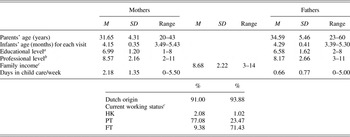
The participants were 101 couples with their firstborn infant (age range = 3.39–5.43 months). Sociodemographic characteristics are presented in Table 1. The families are part of a larger group of participants recruited from the normal population for an ongoing longitudinal study on socioemotional development focusing on the development of self-confidence and shyness (for the details about the recruitment, see Colonnesi et al., Reference Colonnesi, Zijlstra, Van der Zande and Bögels2012). A subsample of infant data (n = 66) was previously analyzed to investigate infants' ability to coordinate emotional expressions with gaze and vocalizations with mothers and fathers (Colonnesi et al., Reference Colonnesi, Zijlstra, Van der Zande and Bögels2012).
Sociodemographic characteristics of the sample

Note: M, Mother; F, father; HK, housekeeper; PT, parttime; FT, fulltime.
a Measured with an 8-point scale from 1 (primary education) to 8 (university).
b Measured with an 11-point scale from 1 (manual labor for which no education is required) to 11 (labor for which a university degree is required).
c Mothers and fathers separately reported income in a 7-point scale from 1 (<500 euros/month) to 7 (>5000 euros/month) per parent. Family income was obtained by summing mothers' and fathers' income.
For this study, mothers and fathers separately visited the lab with their infant. Among participating infants, 64.00% visited with the mother first. The mean difference in infants' age between visits was 0.30 months (SD = 0.30, also see Table 1). Infants' age in mother and father visits was controlled for in the main analyses.
Materials and procedure
Face-to-face interaction
Face-to-face interactions were recorded during the lab visits that each parent made separately with his/her infant. The infant was placed in a bouncer mounted on a table, and the parent sat on a chair, facing the infant. The experimenter asked the parent to interact with his/her infant as he/she would normally do, and left the dyad alone for 5 min. The duration and frequency of parents' and infants' gaze and facial expressions (duration and frequency) were coded in 1-s intervals in the first 4 min of the interaction, using Observer XT 10.5 and 11.5 (Noldus, Trienes, Hendriksen, Jansen, & Jansen, Reference Noldus, Trienes, Hendriksen, Jansen and Jansen2000) together with vocalizations (not used in this study). The original infant protocol from Colonnesi et al. (Reference Colonnesi, Zijlstra, Van der Zande and Bögels2012) was adapted for the coding of parents' behavior.
Gaze
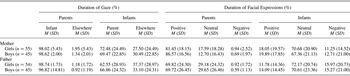
Parents' and infants' gaze were coded into two categories consisting of gaze at the partner versus gaze otherwise. Gaze was included as the index of direct attention during facial expressions, which constitute active attempts to communicate affect with the partner during dyadic face-to-face interactions. There was little variance in the duration of parents' gaze (see Table 2 for descriptives) because all parents' attention was almost always directed at the infant. Parents' gaze was therefore excluded from the analyses.
Descriptives for percentage duration of infants' and parents' gaze and facial expressions

Facial expressions
Parents' and infants' facial expressions were coded into three categories consisting of positive, negative, and neutral facial expressions (see Table 2) based on descriptions of Ekman and Friesen (Reference Ekman and Friesen1978). Two separate groups of observers were trained for coding parents' and infants' facial expressions. Observers were blind to the parents' diagnostic status and infants' temperament. For interobserver reliability, 19.09% of the infant and 20.60% of the parent recordings were double coded. The average Cohen κ was 0.86 (SD = 0.17) for parents' and 0.83 (SD = 0.16) for infants' facial expressions.
Consistent with previous studies (Forbes et al., Reference Forbes, Cohn, Allen and Lewinsohn2004; Kaitz et al., Reference Kaitz, Maytal, Devor, Bergman and Mankuta2010), the majority (62.81%) of the parents never displayed a negative facial expression during the interaction. When they happened, negative facial expressions were usually less than 2 s, and seemed to be part of parents' attempts to imitate or empathize with their baby's negative mood (see Table 2 for descriptives). Hence, parental negative expressions were excluded from further analysis.
Parents' depression and anxiety symptoms
To assess parents' symptoms of psychopathology, the Anxiety Disorder Interview Schedule (ADIS; Di Nardo, Brown, & Barlow, Reference Di Nardo, Brown and Barlow1994) was conducted with both parents at the prenatal measurement (in average 4.99 months before, SD = 1.94, the 4-month measurement for mothers, and 5.24 months before, SD = 1.45, the 4-month measurement for fathers). The ADIS is a semistructured clinical interview based on DSM-IV (American Psychiatric Association, 1994). The lifetime symptom counts in the current study were obtained by summing the current and lifetime anxiety symptoms prenatally reported by the parents in ADIS. The inclusion of lifetime symptoms in the main analyses was justified by previous evidence revealing that lifetime depression diagnoses may be a stronger predictor of the interaction patterns characterizing depressed mother–infant dyads in face-to-face interactions than current depression diagnoses (Forbes et al., Reference Forbes, Cohn, Allen and Lewinsohn2004), and by findings revealing prolonged effects of parental depression on parents' sensitivity despite a decrease in depressive symptoms after treatment (Forman et al., Reference Forman, O'Hara, Stuart, Gorman, Larsen and Coy2007). Nevertheless, we tested the effect of anxiety symptoms in pregnancy on parents' and infants' behavior in the face-to-face interactions in exploratory analyses (by using current symptoms reported by the parents in the prenatal measurement). Parental depressive disorders in the current sample included major depressive disorder and dysthymia, and parental anxiety disorders included social anxiety disorder, generalized anxiety disorder, panic disorder, and posttraumatic stress and acute stress disorders. Two interviewers recoded 10% of the total pool of interviews in the prenatal measurement. Interobserver agreement, based on the presence/absence of a diagnosis, ranged from 90% to 100% (M = 97.71, SD = 2.97). The average Cohen κ was 0.88 (SD = 0.28) for parental diagnoses.
In the sample of the present study, 30.00% of the mothers and 31.31% of the fathers met the criteria for a lifetime and/or prenatal anxiety disorder, 8.00% of the mothers and 8.08% of the fathers met the criteria for lifetime and/or prenatal depression, and 22.00% of the mothers and 11.11% of the fathers met criteria for comorbid lifetime and/or prenatal anxiety and depression. It is important to note that the prevalence of lifetime depression and anxiety diagnoses in the current sample of parents was higher than previously reported lifetime diagnoses in the Netherlands (i.e., 19% for anxiety and 19% for depression; Bijl et al., Reference Bijl, Ravelli and Van Zessen1998) and in Europe (i.e., 15% for anxiety and 24% for depression; King et al., Reference King, Nazareth, Levy, Walker, Morris and Weich2008). This may be explained by more interest/eagerness to participate to this study of shyness and self-confidence by mothers who themselves have predispositions for internalizing psychopathology.
In the prenatal period, 28.00% of the mothers and 20.20% of the fathers met criteria for a current anxiety diagnosis. None of the mothers had prenatal depression, and only 1.01% of the fathers met criteria for prenatal depression diagnosis. In turn, 1% of the mothers and none of the fathers had comorbid depression and anxiety in pregnancy. Thus, the prevalence of anxiety diagnoses in the current sample of parents was higher in the postnatal period while the rates of prenatal depression in mothers and fathers were lower than previously reported prevalence rates (8% for depression and 10% for anxiety; Stuart et al., Reference Stuart, Couser, Schilder, O'Hara and Gorman1998). The lack of current depression seems to have facilitated parents' initiatives to participate.
The symptom counts of anxiety and depression symptoms in parents during and before the prenatal period were summed and used as a continuous index of lifetime psychopathology (M = 5.86, SD = 6.13, range = 0–27 for anxiety; M = 2.08, SD = 3.09, range = 0–10 for depression). Exploratory analyses included the symptom counts of current anxiety disorders obtained by summing symptoms of anxiety reported in the prenatal measurement (M = 2.55, SD = 3.51, range = 0–21 for anxiety; M = 0.15, SD = 0.77, range = 0–5 for depression).
Infants' negative temperament
Infants' negative reactivity was included as an early index of negative temperament. Infants' reactions to four unfamiliar stimuli were observed during mother's visit, and coded following Kagan and Snidman (Reference Kagan and Snidman1991). For the current study, negative reactivity scores were obtained by averaging infants' standardized emotion scores on negative facial expressions (e.g., a crying or fearful face), protest (e.g., whining or fussing), and crying across the four tasks.
The tasks included three nonsocial (visual, auditory, and olfactory) stimuli from Kagan and Snidman (Reference Kagan and Snidman1991) and one social stimulus (a stranger). The infant was placed in a bouncer mounted on a table, and the parent sat on a chair behind the infant during the tasks. The visual stimuli were three mobiles with hanging balls with flashing lights, each presented twice in increasing intensity (with one, three, and seven balls) in six consecutive trials of 20-s intervals with 10-s breaks between trials. The olfactory stimuli were distilled water, water with a low (0.001%) concentration of butanol, and water with a high (0.002%) concentration of butanol, each presented twice in increasing intensity in six trials of 5 s, with 5-s breaks between trials. In each trial, the experimenter held the Q-tip with the olfactory stimuli 3 cm away from the child's nose for 5 s. The auditory stimuli were three tones of increasing intensity (±55, ±65, and ±75 dB), each presented twice in six consecutive trials of 10-s intervals, with 10-s breaks between trials. The social stimulus was a male stranger who gradually approached the infant while greeting him/her and picked him/her up from the chair (four intervals lasting 5 to 15 s). The task started when the stranger knocked on the door and entered the observation room (5 s). After standing close to the door for 10 s, he gradually walked toward the infant (10 s), stopped, and greeted him/her: “Hello (name of the child), I come a bit closer.” Next, the stranger approached the baby until he was 30 cm away from the bouncer. He kneeled down and talked to the infant for 15 s with a friendly but neutral attitude. The stranger then stood up, approached the table, and said to the infant: “I am now going to pick you up.” Finally, the stranger picked up the baby and held him/her on his arm for 15 s while looking at him/her. The task finished with the stranger putting the baby back in the bouncer and leaving the room.
Two observers were trained to code infants' behaviors. Observers were blind to parents' diagnostic status. To test interobserver reliability of obtained scores, 18.89% of the infant recordings were double-coded. Average interrater reliabilities (interclass correlations) across the four tasks was 0.80 (SD = 0.08) for negative facial expressions, 0.68 (SD = 0.32) for protest, and 0.97 (SD = 0.06) for crying. The internal consistency of emotion scores across the four tasks was 0.60. The mean emotion scores were 0.11 (SD = 0.71) for girls and −0.12 (SD = 0.33) for boys.
Data analysis
Outcome variables
Outcome variables for singular occurrences were percentage durations of parents' (positive vs. neutral) and infants' (positive and negative vs. neutral) facial expressions and infants' gaze (to parent vs. elsewhere; see Table 2 for descriptive statistics). The repeated observations of positive, neutral, and negative facial expressions, and of durations of gaze to parent and gaze elsewhere were analyzed together in the multilevel analyses. The outcome variables for consecutive occurrences (sequential synchrony) were parents' and infants' frequencies of following each other’ expressions with synchronous (i.e., positive with positive, and nonpositive with nonpositive) versus with asynchronous (i.e., positive with nonpositive, and nonpositive with positive) expressions. These were obtained via lag-sequential analyses (consecutive occurrences defined as within the following 2-s time lag after the onset of the recipient's behavior). The repeated observations of the frequency of synchrony and asynchrony were analyzed together in the multilevel analyses (see Main Analyses below).
Preliminary analyses
First, we computed the associations of sociodemographic variables (i.e., educational and professional level, monthly income, and parents' involvement in caregiving) with the continuous outcome variables (i.e., the duration of infants' gaze [to partner and elsewhere], the duration of parents' [positive and neutral expressions] facial expressions, and the duration of infants' [positive, neutral and negative] facial expressions). Second, we explored the associations between continuous predictors (i.e., parents' lifetime depressive and anxiety symptoms, and infants' temperament) and continuous outcome variables (i.e., the duration of infants' gaze [to parent and elsewhere], the duration of infants' [positive, neutral and negative] facial expressions, and the duration of parents' [positive and neutral] expressions). All associations were inspected via zero-order correlations, and next with partial correlations after controlling for infants' gender.
Main analyses
Hypotheses on the durations of parents' and infants' expressions of affect and infants' gaze were tested with multilevel models. The structure of the multilevel models for the duration of parents' and infants' facial expressions as the outcomes consisted of the repeated observations of emotion (i.e., the duration of positive vs. neutral expressions for parents, and the duration of positive and negative vs. neutral expressions for infants), nested within parent gender (mother vs. father), nested within family. The structure of the multilevel models for infants' duration of gaze as the outcome consisted of the repeated observations of gaze to parent (vs. elsewhere) nested within parent gender (mother vs. father), nested within family.
Inspection of distributions for the durations indicated sufficient normality: skewness and kurtosis of all variables were <|2|, except for infants' negative temperament. Four outliers (>2.5 SD) were replaced by the next most extreme value at the end of the distribution. Scores on all continuous variables were standardized. The intercept was a fixed effect, along with other predictors. Gaze, positive/negative emotion, and synchrony were dummy-coded with gaze elsewhere, with neutral expressions and with synchrony as reference, respectively. Child and parent gender were dummy-coded with girls and mothers as the reference group, respectively.
Parents' and infants' facial expressions
Durations of parents' and infants' facial expressions were first analyzed with a main effects model including the main effect of emotion (consisting of the repeated observations of durations of positive, negative, and neutral expressions for infants, and of positive and neutral expressions for parents), parent gender, infant age, infant gender and infants' negative temperament, and parents' lifetime depression and anxiety symptoms. Theoretically relevant interactions were then added one-by-one to both models. First, the interaction between parent gender and emotion was included in the models to investigate the differences between emotional expressions in mother–infant versus father–infant face-to-face interactions. Second, to test whether the associations of parents' and of infants' expressions of affect with parents' depression and anxiety symptoms differ between mothers and fathers, the interaction between parent gender and lifetime symptoms was included. Third, the two-way interactions of positive and negative emotion with parental symptoms, and with infants' negative temperament were tested, to see if parents' and infants' expressions of emotion change as a function of parental symptoms or infants' temperament. Fourth, to test differences between same-sex versus opposite-sex dyads, the cross-level interaction between parent gender and infant gender was included. Fifth, the two-way interactions of infants' negative reactivity with parental symptoms were explored to test whether infants' temperament moderates the link between parents' depression and anxiety symptoms and parents' and infants' emotional expressions.
Moreover, we tested parents' facial expressions and parents' involvement in caregiving as additional predictors in this model. In addition to main effects, the two-way interactions of these variables with positive and negative (vs. neutral) emotion were tested to see whether the associations differ across emotion categories. Significant interaction terms were kept in the models and inspected with plots and using the 95% confidence bands representing continuously plotted confidence intervals (Preacher, Curran, & Bauer, Reference Preacher, Curran and Bauer2006).
Infants' gaze
Duration of infants' gaze was first analyzed with a main effects model including the main effect of gaze direction (consisting of the repeated observations of durations of to partner vs. elsewhere, parent gender, infant age, infant gender and infants' negative temperament, and lifetime parental depression and anxiety symptoms). Theoretically, relevant interactions were then added one-by-one to the model. First, the interaction between parent gender and gaze direction was included in the models to investigate the differences between the duration of infants' gaze in mother–infant versus father–infant face-to-face interactions. Second, to explore whether the associations of parental depression and anxiety symptoms with infants' gaze durations differ between parents, the interaction between parent gender and lifetime symptoms was included. Third, the two-way interactions of gaze direction with parental anxiety and depression symptoms, and with infants' negative temperament were tested to see if infants' durations to parent (vs. elsewhere) differ as a function of parental depression and anxiety symptoms, or infants' negative temperament. Fourth, to test differences between same-sex versus opposite-sex dyads, the cross-level interaction between parent gender and infant gender was included in the model. Fifth, the two-way interactions of infants' negative reactivity with parental symptoms were included to the model to test whether infants' temperament moderates the link between parental depression and anxiety symptoms and the duration of infants' gaze.
In an additional step, we tested the duration of parents' gaze to infant, and parents' involvement in caregiving (measured with the number of days that infants were cared by mothers and fathers) as additional predictors of infants' gaze duration. In addition to main effects, the two-way interactions of these variables with gaze were tested in the analyses.
Synchrony
Hypotheses on the frequencies for parents' and infants' sequential synchrony were analyzed via multilevel models. The structure of the multilevel model for the frequencies for parents' and infants' synchrony as the outcome consisted of repeated observations of synchronous versus asynchronous expressions, nested within visits (with mother vs. father), nested within family. A negative binomial distribution was used, because the distributions were highly skewed to the right given that the frequency of parents' and infants' following each others' facial expressions in the interaction was 0 in the majority of cases (63.07% of parents and 55.53% of infants). Predictors were the main effects and two-way interactions of synchrony (synchronous vs. asynchronous), parent gender, and parental lifetime depression and anxiety symptoms. The significance of the effects was evaluated at p ≤ .05.
Exploratory analyses
In addition to the main analyses outlined above, we were interested in exploring one additional research question concerning parents' psychopathology symptoms during pregnancy. To test the effects of parental psychopathology symptoms during pregnancy, we repeated the same multilevel analyses and tested the same interactions on the durations of gaze and facial expressions (described above) with the prenatal symptom counts of anxiety (also referred to as symptoms during pregnancy), instead of lifetime anxiety symptoms. The low variance in prenatal depression symptoms did not allow the exploration of the association between current depression and outcome variables in the current study (i.e., the number of symptoms was zero for 96.00% of mothers and 94.95% of fathers in the current sample.)
In the current sample, 48% of mothers and 59% of fathers did not have any anxiety symptoms during mothers' pregnancy. The normality of the distribution for symptom counts of anxiety became sufficient (skewness and kurtosis of all variables <|2|) after two outlying scores (>2.5 SD) were replaced by the next most extreme value at the end of the distribution. This allowed us to explore parents' anxiety symptoms during pregnancy as an alternative predictor.
Results
Preliminary analyses
First, we inspected the associations between sociodemographic variables and parents' depression and anxiety symptoms. There was a positive association between mothers' involvement in caregiving and their prenatal depressive symptoms (r = .23, p = .027). Mothers with more depression symptoms during pregnancy were more involved in caregiving. Moreover, there were significant zero-order correlations between family income and mothers' lifetime (r = –.22, p = .031) and prenatal (r = –.23 p = .026) anxiety symptoms, as well as between mothers' professional level and their lifetime (r = –.25 p = .015), and prenatally measured (r = –.32, p = .002) anxiety symptoms. Mothers with more symptoms of anxiety had lower family incomes and lower professional levels during and before pregnancy. All the associations remained significant after controlling for infant gender. In turn, none of the associations between sociodemographic variables and fathers' depression and anxiety symptoms were significant.
Second, we inspected the correlations between sociodemographic variables and outcome variables (i.e., parents' and infants' expressions of emotion, and infants' gaze). Among the associations between sociodemographic variables and the duration of parents' emotional expressions, only the correlations between fathers' income and the duration of fathers' positive (r = .29, p = .005), and neutral (r = –.28, p = .006) expressions were significant. Fathers with higher income were more positive and less neutral toward their infant. The associations remained significant after controlling for infant gender. Among the associations between sociodemographic variables and the duration of infants' emotional expressions, the zero-order correlations between mothers' involvement in care and the duration of infants' negative facial expressions (r = –.23, p = .030) was significant. Infants were less negative when the mothers were more involved in care. There was also a negative association between duration of infants' negative facial expressions during father–infant interaction and the family income (r = –.20, p = .050). Both associations remained significant after controlling for infant gender. In turn, none of the associations between infants' gaze and sociodemographic variables was significant.
Third, we investigated the associations between outcome variables and the predictors. Among the raw associations between parents' expressions of affect and the continuous predictors, only the correlation between maternal lifetime depressive symptoms and mothers' expressions of positive affect (r = –.38, p < .001), and between maternal depressive symptoms and maternal expressions of neutral affect (r = .38, p < .001), were significant. Mothers with more depressive symptoms were less positive and more neutral during the interactions. Both associations remained significant after controlling for infant gender. The associations of infants' temperament with fathers' expressions of positive affect (r = –.21, p = .046) and neutral affect (r = .21, p = .042) were significant only after controlling for infants' gender. Fathers of infants with a more negative temperament were less positive and more neutral during face-to-face interactions. Among the raw and partial correlations between infants' expressions of affect and the continuous predictors, only the association between fathers' lifetime depressive symptoms and infants' expressions of positive affect during father–infant interaction was significant after controlling for infants' gender (r = –.21, p = .048). Infants of fathers with more depressive symptoms were less positive during father–infant interactions. In turn, none of the raw or partial associations between infants' gaze and the continuous predictors (i.e., parents' depressive and anxiety symptoms, infants' temperament, and parents' involvement in caregiving) were significant.
Main analyses
The findings from the multilevel models are presented below under separate headings for each outcome variable.
Duration of parents' facial expressions
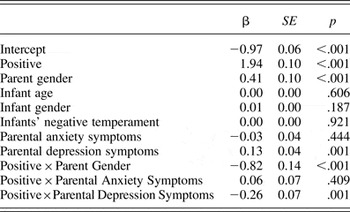
The model for parents' facial expressions is presented in Table 3. Among theoretically relevant interactions that were tested, the two-way interactions between positive (vs. neutral) emotion and parent gender and between positive (vs. neutral) emotion and parental depression (but not anxiety) symptoms were significant in this model. While both parents were more positive than neutral, mothers were significantly more positive than fathers. The two-way interaction between positive (vs. neutral) emotion and parental depression revealed that parents with higher levels of lifetime depression symptoms were less positive (i.e., shorter durations of positive affect). Infants' gender, age, or negative temperament and parents' lifetime anxiety symptoms did not predict parents' expressions of affect during the face-to-face interaction.
Multilevel regression of the percentage duration of parents' expressions of affect (outcome) on parent gender and infant gender, and parental lifetime symptoms

Note: N = 98, R 2 = .64. Positive, Positive (vs. neutral) emotion; Negative, negative (vs. neutral) emotion.
To explore the effects of depression and anxiety symptoms during pregnancy instead of lifetime depression and anxiety, we repeated the same multilevel models with parents' anxiety symptoms obtained in the prenatal measurement. The results were similar to the model presented above; that is, anxiety symptoms were not significantly linked to parents' expressions of emotion.
Duration of infants' facial expressions
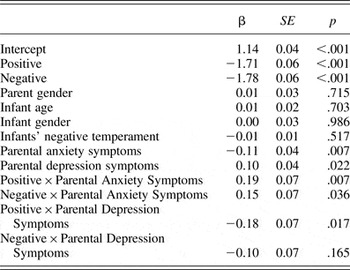
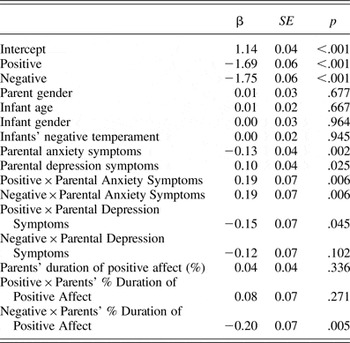
The model for infants' facial expressions is presented in Table 4. Among theoretically relevant interactions that were tested, the two-way interactions of parental lifetime depression and anxiety symptoms with positive and negative (vs. neutral) emotion were significant in this model. More lifetime anxiety symptoms in parents predicted more positive and more negative affect from infants, while more depression symptoms predicted less positive affect. Parent gender and infant gender, age, or negative temperament were not significantly associated with infants' expressions of affect in this model. In the next step, parents' expressions of positive emotion and parents' involvement in caregiving were included as additional predictors to the model presented in Table 4. Parents' involvement in caregiving did not significantly predict the duration of infants' facial expressions, while parents' durations of positive affect did. The models after the inclusion of this variable appears in Table 5. The interaction between the duration parents' positive and negative (vs. neutral) emotion was significant, revealing that infants were less negative when parents were more positive.
Multilevel regressions of the percentage duration of infants' expressions of affect (outcome) on parent and infant gender, and parental lifetime symptoms

Note: N = 98, R 2 = .65. Positive, Positive (vs. neutral) emotion; Negative, negative (vs. neutral) emotion.
Multilevel regression of the percentage duration of infants' expressions of affect (outcome) on parent and infant gender and parental lifetime symptoms after the inclusion of parents' percentage duration of positive affect

Note: N = 95, R 2 = .68. Positive, Positive (vs. neutral) emotion; Negative, negative (vs. neutral) emotion.
To explore the effects of depression and anxiety symptoms during pregnancy instead of lifetime depression and anxiety symptoms, we repeated the same model with parents' anxiety symptoms in the prenatal measurement. Differently from the model above (presented in Table 4), none of the interactions between positive or negative (vs. neutral) emotion and parents' anxiety symptoms were significant in this model.
Duration of infants' gaze to parent (vs. elsewhere)
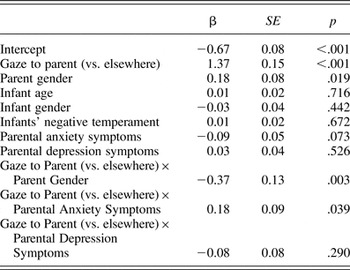
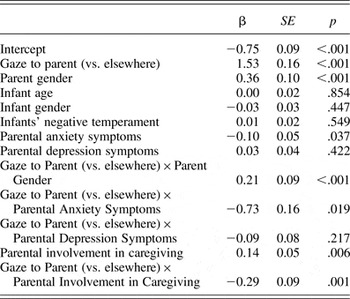
The model for infants' gaze is presented in Table 6. Among theoretically relevant interactions that were tested, the two-way interactions of gaze direction with parent gender and with parental anxiety (but not depression) symptoms were significant in this model. The interaction between gaze and parent gender revealed that infants spent more time gazing at the mother than at the father during face-to-face interactions. The interaction between gaze and parental anxiety symptoms revealed that infants of parents with more anxiety symptoms spent more time looking at the parent, and less time looking elsewhere. Parents' lifetime depression symptoms, or infants' gender, age, or negative temperament were not significantly associated with the duration of infants' gaze. In the next step, the duration of parents' gaze to infant and parents' involvement in caregiving were included as additional predictors to the model presented in Table 6. The duration of parents' gaze to infant did not predict infants' duration of gaze, while parents' involvement in caregiving was linked to the duration of infants' gaze to parent (vs. elsewhere). The model after the inclusion of this variable appears in Table 7. Infants had shorter durations of gaze at the parent when the parents were more involved in caregiving. The alternative exploratory model with anxiety symptoms during pregnancy instead of lifetime depression and anxiety symptoms revealed similar effects to the models presented in Tables 6 and 7.
Multilevel regression of the percentage duration of infants' gaze (outcome) on parent and infant gender, and parental lifetime symptoms

Note: N = 98, R 2 =. 36.
Multilevel regression of the percentage duration of infants' gaze (outcome) on parent and infant gender, and parental lifetime symptoms after the inclusion of parents' involvement in caregiving

Note: N = 96, R 2 = .35.
Frequency of parents' and infants' sequential synchrony of facial expressions
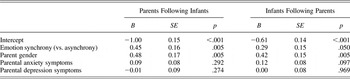
The models for the frequency of parents' (N = 101) and infants' (N = 101) following of facial expressions revealed significant main effects of synchrony and of parent gender, while no other effect was significant (see Table 8). The main effect of synchrony showed that parents more frequently followed infants with synchronous (M = 0.76, SD = 1.22) than with asynchronous (M = 0.49, SD = 0.83) facial expressions. Fathers (M = 0.90, SD = 1.46) followed more frequently with facial expressions than mothers (M = 0.62, SD = 0.92). In line, infants more often followed parents with synchronous (M = 0.92, SD = 1.29) than asynchronous affects (M = 0.69, SD = 1.11), while they more frequently followed father's (M = 1.07, SD = 1.60) than mother's (M = 0.84, SD = 1.23) affect. Parental lifetime symptoms did not predict infants' sequential synchrony.
Multilevel regressions of the frequency of parents following infants and of infants following parents (outcomes) on parent gender and synchrony, and parental lifetime symptoms

Note: N = 101 in both models. Emotion Synchrony: Synchrony (vs. asynchrony).
Discussion
The present study investigated infants' and parents' facial expressions during face-to-face interactions between 3.5 and 5.5 months and explored for the first time the effects of maternal and paternal lifetime symptoms of depression and anxiety, along with infants' negative temperament in a community sample.
Parents' and infants' facial expressions and infants' gaze and synchrony
In line with previous findings (Belsky et al., Reference Belsky, Gilstrap and Rovine1984; Forbes et al., Reference Forbes, Cohn, Allen and Lewinsohn2004), the current findings reveal mothers were more positive than fathers during the interaction. Infants' expressions of positive affect did not significantly differ across mothers and fathers, while the duration of their gaze to parent was longer with the mother than with the father during the interactions. Thus, more positive affect in mothers may have served to elicit longer durations of gaze/attention, but not more positive affect from infants. Current findings also revealed that infants' overall exposure to mothers' versus fathers' (measured by parents' involvement in caregiving), rather than the duration of parents' gaze, was linked to the duration of infants' gaze to parent. Infants showed shorter durations of gaze to parents when parents were more involved in caregiving.
Although both parents and infants more frequently followed each other with synchronous than asynchronous affects, a higher frequency of interactive dynamicity occurred during the father–infant interactions than during the mother–infant interactions, while more stable but positive interaction were observed during the mother–infant interactions compared to the father–infant interactions. Parallel findings in infants' and fathers' synchronization of affect reveal that infants' tune in to moment-to-moment differences in parents' synchronization of affect. Similar variation and dynamicity in infant–father interactions was found in Feldman's study (2003), where mother–infant interactions were characterized by cyclical patterns of low or moderate levels of positive arousal, while father–infant interactions were characterized by several unpredictable peaks of high positive arousal. Feldman suggested that interparental differences in mother–infant and father–infant interactions may be related to the different patterns of affective sharing and positive arousal patterns that mothers and fathers show with their infant. Similarly, Kokkinaki and Vasdekis (Reference Kokkinaki and Vasdekis2015) found that father–infant interactions were characterized by a stronger emotional matching (when one partner is expressing the same facial expression during the other partners' expression) and by a stronger emotional attunement (when one partner matches the shifts of emotional intensity of the other partner). The present study provides further evidence on these differences between fathers' and mothers' interactional style that seem to reflect two different modes to express sensitivity, which is more regulatory and soothing in the case of the mother, and more stimulating and dynamic in the case of the father.
A positive association was previously reported between infants' and parents' expressions of positive affect (Forbes et al., Reference Forbes, Cohn, Allen and Lewinsohn2004). In contrast, current findings revealed a negative association between parents' positive and infants' negative affect: infants were less negative when parents expressed more positive affect. The differences in infants' overall exposure to mothers versus fathers (measured by parents' involvement in caregiving), however, did not predict infants' facial expressions of emotions. Thus, it seems that infants' moment-to-moment exposure to parents' expressions of positive affect, rather than the extent of their overall exposure to parents, determines the dynamics of the early affective exchanges.
Parental lifetime symptoms and infants' negative temperament
Parents with more lifetime depressive symptoms were less positive during face-to-face interactions. In line with previous evidence from clinical samples (Campbell et al. Reference Campbell, Cohn and Meyers1995; Cohn et al., Reference Cohn, Campbell, Matias and Hopkins1990), current findings support the idea that depression interferes with parents' facial expressions of positive affect in face-to-face interactions. Thus, interventions aiming at increasing positive facial expressions in depressed parents during parent–infant face-to-face interactions may be crucial in the prevention of parent–infant transmission of depression (Bureau, Easterbrooks, & Lyons-Ruth, Reference Bureau, Easterbrooks and Lyons-Ruth2009). These are needed in addition to treatments targeting depressive symptoms, because these treatments do not seem to necessarily improve depressed mothers' decreased sensitivity during parent–infant face-to-face interactions or the quality of the parent–child relationship (Forman et al., Reference Forman, O'Hara, Stuart, Gorman, Larsen and Coy2007). The lack of associations between parental lifetime depression symptoms and infants' or parents' sequential synchrony reveals that the effect of parental lifetime depression symptoms may not always be visible in infants and parents' synchrony in face-to-face interactions. Like their parents, infants of parents with more depression symptoms expressed less positive affect in their interactions with the parent. After controlling for parents' expressions of positive affect, infants of parents with depression still expressed more neutral affect. Thus, it seems that infants of parents with more depression are more likely to express neutral affect even after accounting for by parents' positive affect expressions.
Neither maternal nor paternal lifetime anxiety symptoms were linked to parents' expressions of affect or synchrony in the interaction. Taken together with the previous evidence by Kaitz et al. (Reference Kaitz, Maytal, Devor, Bergman and Mankuta2010), findings suggest that anxiety may not affect parents' positive affect expression and parent–infant synchronization in dyadic face-to-face interactions (after controlling for depressive symptoms). We therefore suggest that flat/neutral affect, which is characteristic of depression but not of anxiety, may be mediating the link between parental psychopathology and parents' expressions of affect in early dyadic parent–infant interactions.
It is important to note that although the current findings pointing to a lack of anxiety-related alterations in parents' facial expressions of positive and neutral affect do not preclude the possibility that anxiety-related alterations occur in other aspects of the interactions (e.g., in the vocal or physical domain), or in other types of parent–infant interactions (e.g., triadic interactions when infants are confronted with novel stimuli in the presence of the parent). Because anxious responses of parents are specific to certain external stimuli, the increase in anxious parents' negative emotion expressions may be more salient during parents' and infants' confrontations with these anxiety-provoking stimuli (e.g., Aktar, Majdandžić, De Vente, & Bögels, Reference Aktar, Majdandžić, de Vente and Bögels2013; De Rosnay, Cooper, Tsigaras, Murray, Reference De Rosnay, Cooper, Tsigaras and Murray2006; Murray et al., Reference Murray, De Rosnay, Pearson, Bergeron, Schofield and Royal-Lawson2008) than in face-to-face interactions. It is therefore important to further investigate anxiety-related alterations in parent–infant interactions across different contexts by incorporating the intensity together with the duration and frequency of affect, and by considering the vocal and physical aspects of the positive affective exchanges in addition to facial expressions.
In contrast, lifetime (but not prenatal) symptoms of anxiety did predict infants' expressions of affect. Higher levels of anxiety symptoms in parents were linked to more positive and more negative affect in infants. Thus, in contrast to infants of parents with depression who were found to be less positive and more flat, infants of parents with more anxiety were more emotionally reactive/less emotionally stable than infants of parents without diagnoses in the early interactions. When parents' symptoms were considered only in pregnancy (rather than lifetime), none of the associations between parents' psychopathology and infants' expressions of facial affect were significant. Thus, for anxiety, lifetime rather than prenatal psychopathology explained significant variance in infants' expressions of emotion during the interaction.
Lifetime and prenatal symptoms of anxiety also predicted the duration of infants' gaze to parent. Higher levels of anxiety symptoms in parents were linked to longer durations of gaze at the parent from the infants. In line with previous findings from Taylor et al. (Reference Taylor, Slade and Herbert2014) on infants' interest to bimodal face–voice presentations of mothers and strangers, higher levels of parental anxiety were linked to more interest/attention to parents' face in the interaction. This finding suggests that infants of parents with lifetime anxiety disorders are more attentive to mothers' facial expressions, and they may therefore be more susceptible to variations in parents' expressions of emotion in anxiety-provoking situations. Infants' negative temperament did not predict their affective expressions. Thus, it seems that infants' affective reactions to ambiguous/potentially threatening stimuli may not always match their expressions of affect in the safety of everyday face-to-face interactions.
The findings of the current study should be interpreted considering the following limitations. First, the nonexperimental design of the study precludes any causal inferences on the effect of parental diagnoses and infant temperament on facial expressions during parent–infant face-to-face interactions. Second, the effect of parents' and infants' negative dispositions were analyzed separately on parents' and infants' affect while the bidirectionality of influences in parent–infant interactions was not simultaneously analyzed. Third, because the prevalence of current depression was low in the current sample, the study was underpowered to examine parental depression effects in pregnancy. Fourth, parent psychopathology was measured prenatally, while face-to-face interactions were assessed at 4 months postpartum. Because parents' psychopathology was measured before the interactions, the effect of current depression and anxiety diagnoses could not be examined in the present sample. Considering that prenatal depression and anxiety in parents in the prenatal period is the strongest predictor of postnatal depression and anxiety (Llewellyn, Stove, & Nemeroff, Reference Llewellyn, Stowe and Nemeroff1997; O'Hara and Swain; Reference O'Hara and Swain1996) and that the majority of the postnatally depressed/anxious parents also have depression/anxiety during pregnancy (Heron et al., Reference Heron, O'Connor, Evans, Golding and Glover2004), we would expect depression and anxiety diagnoses to be stable from the prenatal to the postnatal period. Fifth, the current study utilized a highly educated, higher middle-class Dutch sample (Henrich, Heine, & Norenzayan, Reference Henrich, Heine and Norenzayan2010), and the prevalence of depression and anxiety in mothers was different from previous evidence in community samples; thus, the findings may not represent the general population of parents with depressive and anxiety symptoms, and may differ in other cultures (Carra, Lavelli, Keller, & Kärtner, Reference Carra, Lavelli, Keller and Kärtner2013).