Chinese nationalism and national identity construction have garnered much attention in recent years.Footnote 1 Pro-China demonstrations in 2008 during the Olympic torch relay and anti-Japanese demonstrations in spring 2005, September 2010 and September 2012, have raised concerns abroad about the nature of Chinese nationalism and national identity. Will China become an assertive and expansionist power as a result of its decades-long economic boom and growing number of nationalist voices?
Most analysts agree that nationalism is a powerful source of legitimacy for the CCP.Footnote 2 Owing to these legitimacy needs, the Chinese leadership is increasingly sensitive to public opinion – or at least the opinions of its urban elites.Footnote 3 Students form one part of this group and influence politics from both outside and inside the CCP. The CCP regards students and young people in urban areas as more likely to participate in protest movements over foreign policy issues, which makes this segment of the population “most likely of greatest concern to Chinese leaders.”Footnote 4 However, at the same time, the Party particularly looks towards the young and the highly educated for new recruits.Footnote 5 Students have increased their membership share in the CCP during the 2000s and now form one of the largest professional groups of new Party members (29.7 per cent in 2006).Footnote 6
Students have been active in the Chinese nationalist movement but we know little about their opinions, perhaps with the exception of those who are active online. This is part of a bigger problem. Recent research has been keen to point out that Chinese nationalism is “on the rise,” but in addition to conceptual disarray, the lack of a sound empirical dimension is often identified as a clear disadvantage in studies on nationalism.Footnote 7 Allen Carlson criticizes literature on contemporary Chinese nationalism and states that neither those who have warned about rising nationalist sentiment nor those who argue that the trend has been exaggerated have a “great deal of empirical substance.”Footnote 8 Using empirical evidence, this report provides a quantitative perspective to analyse nationalism and patriotism and their links to foreign policy attitudes in China. Although there is a substantial qualitative literature addressing questions related to Chinese nationalism and patriotism, there are few quantitative perspectives. However, quantitative research can offer us important evidence to understand that pro-China attitudes alone do not indicate anti-internationalism or aggressive nationalism, as in China patriotism and nationalism are different constructs with different kinds of links to foreign policy attitudes.
Nationalism and Patriotism as Concepts
For conceptual clarity, it is important to determine whether patriotism and nationalism can be treated as two different constructs. This research treats “nationalism” and “patriotism” as attitudinal clusters. In the survey research presented below, “nationalism” is defined as a view that one's country is superior to other countries and that provides for uncritical support of the home country's actions; “patriotism,” on the other hand, is defined as a feeling of pride and emotional attachment to one's country. The key difference between the concepts is that nationalism compares one nation's qualities with those of other nations, whereas patriotism relates only to internal qualities.
Scholars such as Walker Connor have insisted on treating nationalism and patriotism strictly as separate concepts, but others, such as Anthony Smith, hold that the concepts have significant overlap. Others, like Michael Billig, deny that nationalism and patriotism can be treated as separate concepts.Footnote 9 In 1989, Rick Kosterman and Seymour Feshbach published one of the first widely cited pieces of research analysing patriotism and nationalism empirically with survey material. Their conclusion, based on principal factor analysis, was that patriotism and nationalism can be regarded as empirically distinct. They define patriotism as feelings of attachment to one's country and nationalism as the view that one's country is superior and should be dominant.Footnote 10
Items from Kosterman's and Feshbach's patriotism and nationalism scales have been borrowed by many to study nationalism and patriotism in the Chinese context and elsewhere.Footnote 11 Based on surveys conducted in 2009 in China and in the US, Peter Hays Gries et al. found that nationalism and patriotism were separate constructs in the Chinese data, but that patriotism was associated with nationalism in the American sample. Another central finding was that nationalism, but not patriotism, clearly has an impact on Chinese foreign policy preferences. Moreover, in the Chinese sample, an association between patriotism and internationalism was found, which can have important implications regarding the debate on the nature of Chinese national identity and assertive nationalism.Footnote 12
Another question central to the research related to nationalism and patriotism in China is whether CCP members differ from other respondents. Previous research on the relationship between Party membership and attitudes yields contradictory results. In the context of CCP membership and foreign policy attitudes, Gries et al. found that non-members preferred a slightly tougher US policy than did Party members, but the sample size was too small to draw far-reaching conclusions. According to Gries et al. more research is needed to see if CCP membership affects foreign policy orientations.Footnote 13 In terms of ideological orientation, Gang Guo reports that surveys conducted at universities show that Party members and non-members are hard to distinguish.Footnote 14 In contrast, based on three surveys of urban respondents, Jie Chen found that CCP members were more supportive of the regime's norms and institutions than non-members.Footnote 15 Wenfang Tang and Benjamin Darr's analysis of the 2008 China Survey data showed that CCP members were more nationalistic than the general public.Footnote 16
This research analyses the construction of Chinese national identity and examines whether those Chinese who are more nationalistic or patriotic differ from less nationalistic or patriotic Chinese in their foreign policy attitudes. Secondly, it tests whether it is possible to distinguish CCP members from other respondents.
Methods
Sample
To find out student opinions on different aspects of national identity, Julie Tomaszewski and I conducted a survey at Renmin University of China, Peking University and Tsinghua University between April and June 2007.Footnote 17 These universities were chosen because of their prestige and the likelihood that the students would assume leading roles in society after graduating. Other scholars have selected these same universities as sampling sites for similar reasons.Footnote 18
The questionnaire used in the research was a modified version of the ISSP (International Social Survey Programme) National Identity II questionnaire, which is an international standardized questionnaire used in 34 countries in 2003.Footnote 19 As National Identity II questionnaires had not previously been used in China, some cultural adjustments were needed. The Taiwanese ISSP 2003 National Identity questionnaire was an important reference in making the adjustments. Before the questionnaire was used, it was pre-tested on 12 students studying international relations, economics, history, science and technology, and law. Based on student feedback, small adjustments were made.
Owing to the political sensitivity of the research topic, the survey was conducted as a convenience sample in the university lecture halls used for studying when no teaching is going on.Footnote 20 To see whether our student sample resembled the entire student population in the selected universities, we needed to compare the student profile of the sample with that of the student body at the three universities. Based on a China Daily article, we know that, in 2006, 20 per cent of Tsinghua University's undergraduates were Party members, as were half of the graduate students.Footnote 21 In our Tsinghua sample, approximately 17 per cent of undergraduates and 51 per cent of graduate students were Party members. The 2007 edition of Tsinghua University's yearbook shows that, in 2006, 6.5 per cent of all students belonged to one of the ethnic minorities.Footnote 22 In our sample, the percentage of students from ethnic minorities was 5.5. Also, in 2005, the percentage of female students at Peking University was 45.2; in our Peking University sample, the percentage of female students was 47.3.Footnote 23 Based on this information, the make-up of the sampled students resembled that of the entire student population at Tsinghua University and at Peking University.Footnote 24
The response rate was approximately 95 per cent and we obtained 1,346 valid responses. Of these, 1,270 (94.4%) were collected by Julie Tomaszewski and the author, and 76 (5.6%) by Chinese students. The possible effect of who collected the questionnaire was examined with linear regression models, which showed that who collected the data (ourselves or Chinese students) was not statistically significant regarding any of the statements. This is why no further data are presented here and indicates that our foreign background did not influence students' responses.
The participants' gender ratio was approximately 50:50 (692 men and 641 women), 21 per cent were from Tsinghua University (N = 275), 32 per cent from Peking University (N = 419), 38 per cent from Renmin University of China (N = 507), and 9 per cent from other universities (N = 129).Footnote 25 The respondents had studied on average for 3 years, 270 (21%) of them were CCP members, 34% had applied or were planning to apply for membership, and 590 (45%) were not members. Most of the students were studying technology-related majors (N = 522, 39%) and economics (22.5%). Of the participants, 233 (18%) had grown up in the countryside, 515 (39%) in a town or small city, 279 in a medium-sized city (21%), and the rest (N = 282, 21.5%) had had an urban upbringing. There were 577 (44%) who reported that at least one of their parents had received a higher education (gaodeng jiaoyu 高等教育), and they classified their own social status as, on average, 5.8 on a 10-point scale (from 10 low to 1 high). Their ethnic background was most often Han Chinese (N = 1231, 93%), whereas 91 respondents (7%) classified themselves as belonging to an ethnic minority.
Measures
Nationalism and patriotism
Nationalism and patriotism were both measured using three items, and participants responded to these items on a five-point Likert scale from 5 (“strongly agree”) to 1 (“strongly disagree”). Statement one on the patriotism scale had a 4-item scale from 4 (“very proud”) to 1 (“not proud at all”). Statement two on the patriotism scale was measured on a scale in which 4 indicated “very close” and 1 “not close at all.” Eldad Davidov, Kosterman and Feshbach, Gries et al., Gregory Fairbrother, and Tang and Darr have all used similar statements to measure nationalism and patriotism.Footnote 26 See the Appendix for the list of statements used in the nationalism and patriotism scales.
Foreign policy attitudes
Foreign policy attitudes were measured using statements on international cooperation, protectionism and various issues related to China's international role. The response format ranged from 5 (“strongly agree”) to 1 (“strongly disagree”). The list of Chinese and English terms for the statements is included in the Appendix.
Statistical Analysis
The overall structural validity of the nationalism and patriotism measures were conducted first using exploratory factor analyses (EFA) with varimax rotation.Footnote 27 EFA is a statistical technique used to discover latent variables (“factors”) in a pool of observed variables – in this case, the survey items. We used Eigenvalues (the amount of variance in the original set of variables accounted for by a factor) with a cut-off point of one to decide the reasonable number of factors.Footnote 28 We confirmed the structural validity of the final solution by using confirmatory factor analyses (CFA)/structural equation modelling (SEM) with the LISREL 8.52 software. The goodness-of-fit of the models was judged by (a) the Χ2 test, where the higher the P value, the better fit of the data; and (b) root mean square error of approximation (RMSEA), with lower values indicating better fit. We also used a number of other indices that are less sensitive to a large sample size: Normed Fit Index (NFI), Non-Normed Fit Index (NNFI), and Adjusted Goodness of Fit Index (AGFI). Testing was conducted in two stages. First, the measured variables were loaded to one general latent variable (null model). Second, the two-factor solution was fitted to the data and the significance of the fit change was tested.
The associations between nationalism, patriotism and other explanatory variables were tested using multivariate analysis of variance (MANOVA). The associations of nationalism and patriotism on foreign policy attitudes, and the contribution of potential other explanatory factors to the relationship between nationalism, patriotism and policy attitudes were explored with linear regression models. First, nationalism and patriotism were included; second, gender; and third, gender and all the other potential explanatory factors (university in which the respondent was studying, field of study, years studied, parents' educational background, self-assessed societal ranking, place of origin (rural/urban), Party membership and ethnic background). The regression analyses were performed using SAS 9.2.
Results
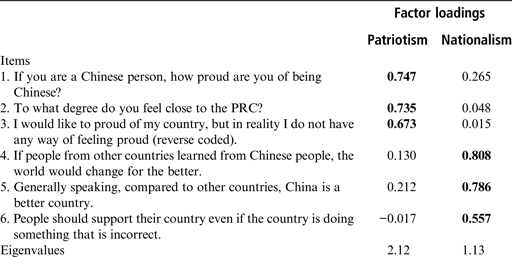
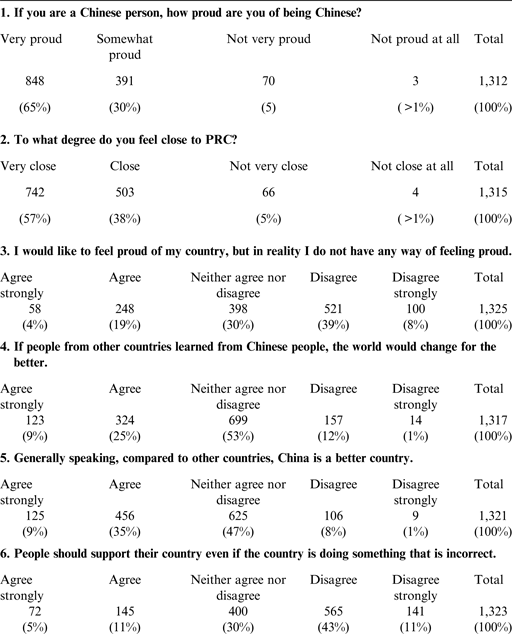
The results of the exploratory factor analyses supported the two-factor solution, in which patriotism and nationalism were separate factors (Eigenvalues of the factors were 2.13, 1.12 and 0.88, and there was no steep drop after that). All of the items had the strongest loading on the corresponding factor, patriotism items loading on factor 1, “patriotism,” and nationalism items loading on factor 2, “nationalism” (see Table 1). The means of the summed up nationalism and patriotism variables were 3.10 (SD 0.64) and 3.79 (SD 0.55), respectively. The correlation between the two variables was modest and positive (r = 0.28, p < 0.001), which indicates that they were relatively independent of one another. Frequencies of the statements on patriotism and nationalism scales are presented in Table 2.
Patriotism and Nationalism Factors (Exploratory Factor Analysis with Varimax Rotation)

Notes: Chinese translations of the items are presented in the Appendix.
Frequencies of Items on Patriotism (1, 2 and 3) and Nationalism (4, 5 and 6) Scales
Notes: Chinese translations of the items are presented in the Appendix.
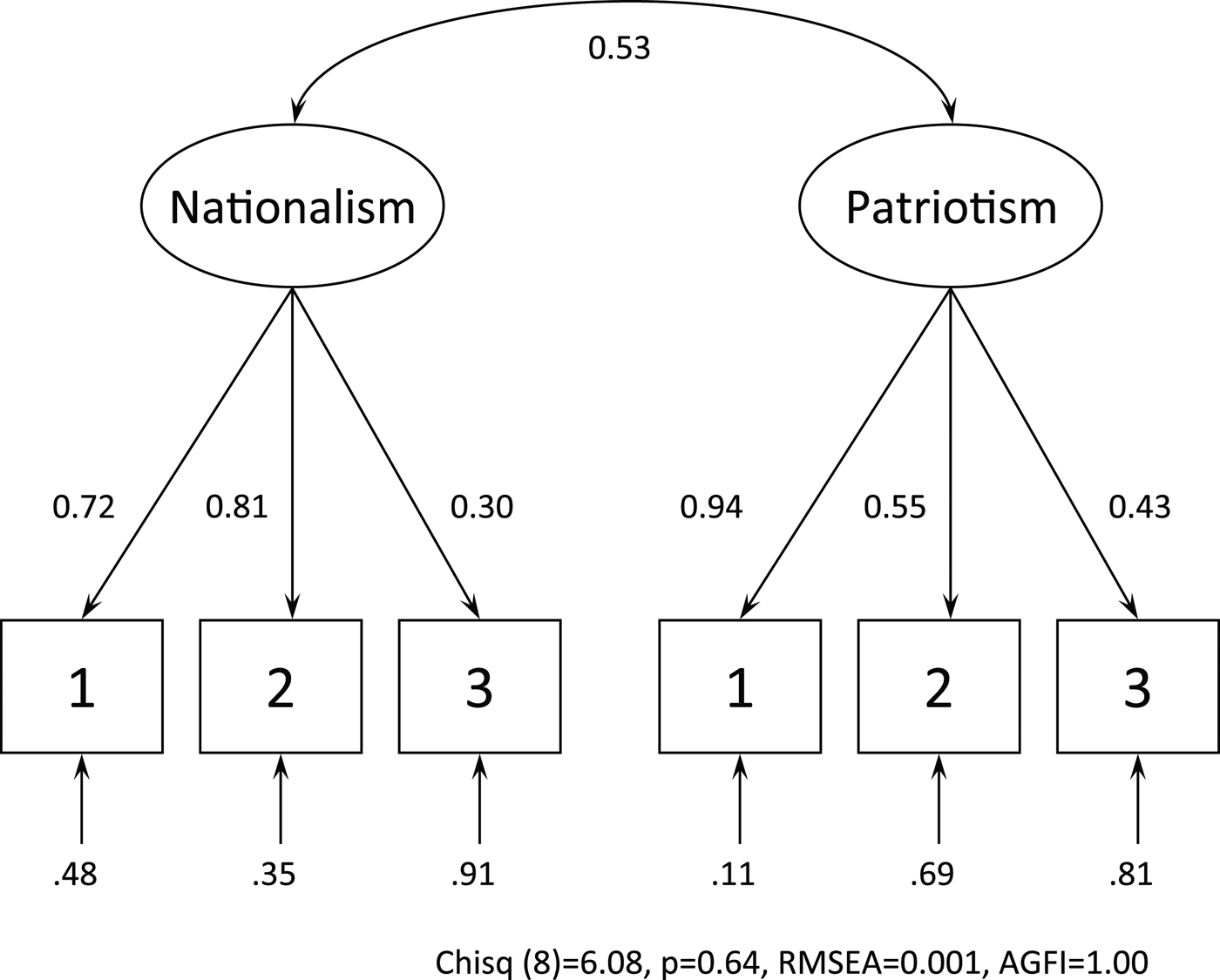
CFA (using latent variables for nationalism and patriotism) showed the following results. The two-factor solution offered significantly better fit (Χ2 (8) = 6.08 p = 0.64, RMSEA = 0.001, NFI = 0.99, NNFI = 1.00, AGFI = 1.00) to the data compared to the one-factor solution (Χ2 (9) = 433.94 p = 0.000, RMSEA = 0.19, NFI = 0.80, NNFI = 0.67, AGFI = 0.77).Footnote 29
The loadings of the items on the corresponding factors ranged from 0.30 to 0.94 and the correlation between the factors was 0.53. This correlation between the latent variables (factors) is higher than that of the sum variables that were done according to the exploratory factor analyses with varimax rotation. In CFA, the loading structure is definite and the association between factors free (Figure 1).
Factor Structure in Confirmatory Factor Analysis
The results from MANOVA revealed that of the other explanatory variables, the university at which participants studied (p = 0.008), CCP membership (p < 0.001) and whether participants were from the countryside or not (p < 0.001) were significantly associated with nationalism. Self-ranked social status, gender, field of study, parents' educational background or ethnic background did not have a statistically significant relationship with nationalism.
Compared to the other universities, the lowest nationalism scores were held by students at Peking University (3.01). The scores among other universities were: 3.07 (Renmin University of China), 3.10 (Tsinghua University) and 3.27 (some other university). The differences between universities could be related to the type of majors mostly studied in each, although field of study itself was not proven to be associated with nationalism. Moreover, Peking University has a reputation of being quite liberal, which can be seen when assessing the attitudes held by its students. For example, in Chen Shengluo's research, students from Peking University evaluated the US political system significantly higher than students from Renmin University, Tsinghua University, Beijing University of Aeronautics and Astronautics, and Beijing Normal University.Footnote 30
Those who were CCP members scored themselves lower (mean 3.13) on the nationalism scale than those who had applied or were planning to apply for membership (means 3.20 and 3.16). Those who were not members ranked themselves lower than others (mean 2.95). Those who classified their place of origin as rural had the highest score in nationalism (mean 3.27). The score for students from small cities was 3.12, those from medium sized cities 3.07 and those from urban areas 2.99.
CCP membership (p < 0.001), a rural background (p = 0.03), and self-ranked social status (p = 0.001) were associated with patriotism. Parents' educational background, gender, field of study or ethnic background did not have a statistically significant relationship with patriotism. Those who were members of the CCP scored higher (mean 3.88) than those who had applied for the membership (mean 3.86), those who had planned to apply for membership (mean 3.83) and those who were not members (mean 3.70). Patriotism was highest among respondents with a rural upbringing (mean 3.90), after which it gradually decreased from students from small or medium-sized cities (range 3.80 to 3.83), to those brought up in urban areas (3.74). Self-ranked social status was negatively associated with patriotism: those who classified themselves higher in the social hierarchy were less patriotic.
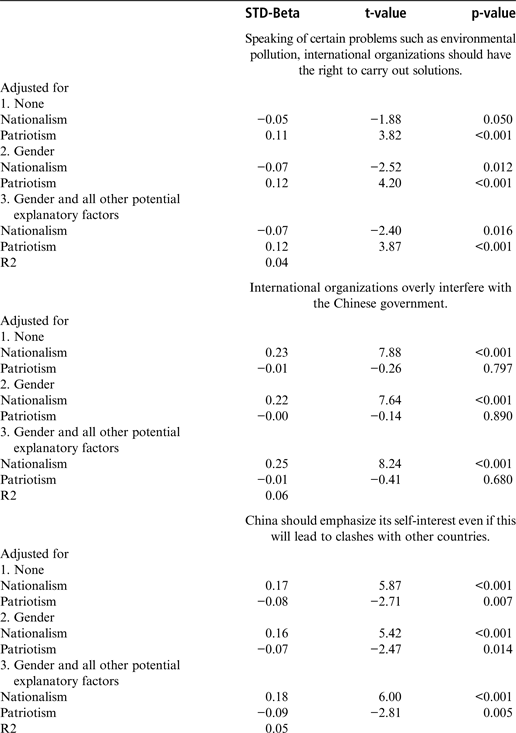
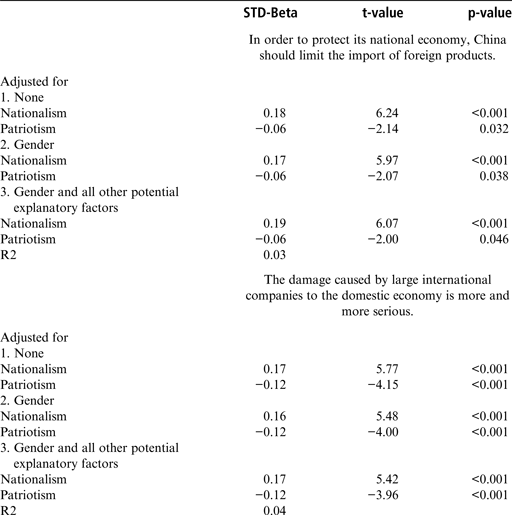
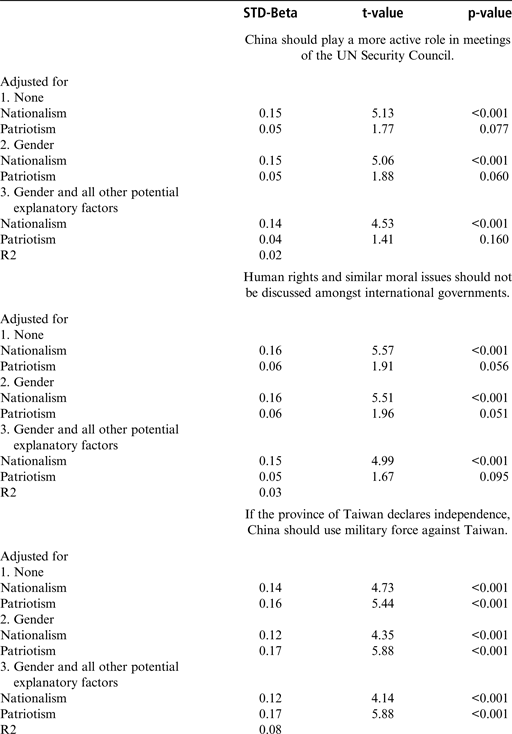
Tables 3, 4 and 5 present linear regression models which show the adjusted associations of nationalism and patriotism with foreign policy attitudes and the contribution of potential confounders to the relationships. The association between nationalism and all attitudes, except for the statement “Speaking of certain problems such as environmental pollution, international organizations should have the right to carry out solutions” in the univariate test, were significant and positive. In other words, respondents with higher nationalism were less likely to favour international cooperation and more likely to prefer protectionist policies and a more prominent international stance. Associations between nationalism and foreign policy attitudes were also quite robust to adjustments for all covariates considered. None of the covariates, or their combination, accounted for more than a small portion of the relationship.
The Associations of Nationalism and Patriotism with Statements Related to International Cooperation
Notes: Adjusted for gender and third, gender and all other potential explanatory factors: university in which the respondent was studying, field of study, years studied, parents' educational background, self-assessed societal ranking, place of origin (rural/urban), membership in the Communist Party and ethnic background. The figures are standardized regression coefficients, t-values and p-values. Chinese translations are presented in the Appendix.
The Associations of Nationalism and Patriotism with Statements Related to Protectionism
Notes: Adjusted for gender and third, gender and all other potential explanatory factors: university in which the respondent was studying, field of study, years studied, parents' educational background, self-assessed societal ranking, place of origin (rural/urban), membership in the Communist Party and ethnic background. The figures are standardized regression coefficients, t-values and p-values. Chinese translations are presented in the Appendix.
The Associations of Nationalism and Patriotism with Various Statements on China's International Role
Notes: Adjusted for gender and third, gender and all other potential explanatory factors: university in which the respondent was studying, field of study, years studied, parents' educational background, self-assessed societal ranking, place of origin (rural/urban), membership in the Communist Party and ethnic background. The figures are standardized regression coefficients, t-values and p-values. Chinese translations are presented in the Appendix.
Patriotism was statistically significantly associated with five statements out of eight. These associations, except for the statements, “Speaking of certain problems such as environmental pollution, international organizations should have the right to carry out solutions” and “If the province of Taiwan declares independence, China should use military force against Taiwan,” were negative. This means that patriotism was associated with an internationalist stance. The adjustments for all of the potential confounders did not significantly change these associations. With the statements “International organizations overly interfere with the Chinese government,” “China should play a more active role in meetings of the UN Security Council” and “Human rights and similar moral issues should not be discussed amongst international governments,” no statistically significant relationship between patriotism and the statement was found.
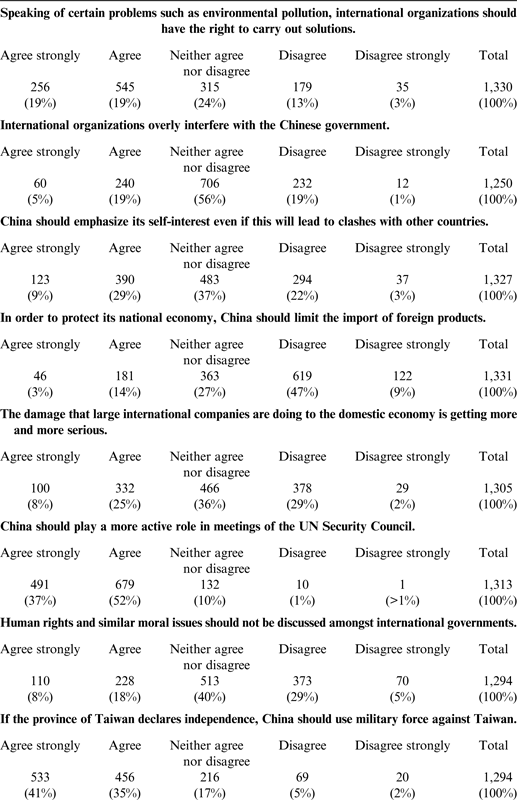
The relationship between nationalism and foreign policy statements was generally stronger than that between patriotism and foreign policy statements. “Patriots” and “nationalists” differed in their views in all other foreign policy statements except for the statement concerning Taiwan, which indicates that the Taiwan issue seems to unite people with otherwise different views. In a survey from 1996, almost 100 per cent of the respondents suggested that they would support the government's decision to use force against Taiwan.Footnote 31 The year 1996 was marked by the Taiwan Strait crisis, which was widely reported in the media, but it seems that the opinions of university students at least have not become more moderate since then. In the 2007 data, only 6.8 per cent of respondents were against or strongly against the use of force if Taiwan declared independence.Footnote 32
Frequencies of Foreign Policy Statements
The linear regression models tested explained a relatively small amount of the variance in the foreign policy attitudes (range 3% to 10%). These outcomes are complex and multifactorial and it is not expected that these two variables will explain much of their variance. The reason for a relatively small amount of variance explained by the models in this study is likely to be because of the large sample size. In general, studies with larger n (over 1,000) tend to yield more conservative results than studies with smaller n. Strong associations found in small n studies are more likely to reflect the impact of random error, and combined with the fact that smaller studies with weak associations are seldom published, publication bias increases the possibility that results from smaller studies are more often reported when extreme.Footnote 33
Conclusions
This study has five main findings. First, in the Chinese context, nationalism and patriotism are empirically distinct. Second, nationalism has stronger links with foreign policy preferences than patriotism. Third, the answer to the research question of whether those Chinese who are more nationalistic or patriotic differ from less nationalistic or patriotic Chinese in their foreign policy attitudes is yes. This research has shown that compared to nationalism, patriotism in China is associated with more cooperative and internationalist attitudes, whereas nationalistic Chinese support economic protectionism and a more prominent international stance. All of these results support the findings of Gries et al.Footnote 34 In discussing nationalism, it should be remembered that because different kinds of foreign policy preferences were associated with nationalism and patriotism, a pro-China attitude alone does not indicate anti-internationalism or aggressive nationalism.
Fourth, the Taiwan question unites people who would otherwise respond differently to other issues. The CCP has long made clear its position on the Taiwan question by emphasizing the one-China policy in diplomatic circles as well as promulgating the anti-secession law in 2005, in which it clearly states that China will use force against Taiwan if it deems it necessary.Footnote 35 Chinese university students agree with the government that Taiwan should not be allowed to become independent, and these results are consistent with other survey results on the Taiwan issue.Footnote 36
Finally, and perhaps most significantly, is the finding that Party membership and place of origin separate respondents. CCP members and students from rural backgrounds were more nationalistic and patriotic than non-members and students with urban upbringings. CCP membership and rural background are associated with two attitudinal clusters with opposite foreign policy preferences, and so it seems that there is some link between nationalism and patriotism after all, even though factoring demonstrated nationalism and patriotism as separate constructs.
Moreover, the association between Party membership and nationalist and patriotic attitudes does not reveal the direction of causality between CCP membership and these attitudes. It is possible that students with more patriotic and nationalist attitudes tend to join the Party more often than others, or that application procedures and training as well as activities organized for members shape students' attitudes. Also, as nationalist and patriotic attitudes were related to opposite opinions in all the other foreign policy statements, excluding the Taiwan question, Party membership alone does not help in predicting foreign policy preferences. Thus, further research is needed to identify individual and societal factors that promote patriotism and nationalism in China.
The association between CCP membership, rural background and higher nationalism was also found in Tang and Darr's research, which used a stratified random sample from 75 counties and county-level urban districts. This research offers a good point of comparison to contextualize my analysis on the elite student sample. Gries et al. did not get similar results in their surveys on associations between nationalism, patriotism and foreign policy views, and other reliable research on these issues is sparse. Attitudes towards foreign policy have been examined very little compared to data on attitudes towards domestic economic and social issues,Footnote 37 and when they have been looked at, Party membership status of respondents has often been ignored.Footnote 38 This is definitely an issue that warrants further research because it may show that there are other latent explanatory variables behind Party membership.
Appendix: Items Used to Measure Nationalism, Patriotism and Foreign Policy Attitudes
Items on China's international role marked with an asterisk (*) were not from the ISSP questionnaire, but instead composed for this research.
Nationalism
1. If people from other countries learned from Chinese people, the world would change for the better (Ruguo shijieshang qita guojia de renmin gengduo de xiang Zhongguoren xuexi, name shijie jiang biande geng meihao 如果世界上其他国家的人民更多地向中国人学习, 那么世界将变得更美好).
2. Generally speaking, compared to other countries, China is a better country (Yibanjiang, biqi qita guojia Zhongguo shi yige genghao de guojia 一般讲, 比起其他国家中国是一个更好的国家).
3. People should support their country even if the country is doing something that is incorrect (Renmin yinggai yonghu tamen de guojia, jishi guojia zai zuo buzhengque de shiqing 人民应该拥护他们的国家, 即使国家在做不正确的事情).
Patriotism
1. If you are a Chinese person, how proud are you of being Chinese (Ruguo ni shi Zhongguoren, zuowei Zhongguoren ni you duo zihao 如果你是中国人, 作为中国人你有多自豪)?
2. To what degree do you feel close to the PRC (Ni dui Zhonghua Renmin Gongheguo de qinmi chengdu zenmeyang 你对中华人民共和国的亲密程度怎么样)?
3. I would like to proud of my country, but in reality I do not have any way of feeling proud (reverse coded) (Wo xiangyao wei wo de guojia gandao zihao, danshi xianshi changchang rang wo meiyou banfa wei zhi gandao name zihao 我想要为我的国家感到自豪, 但是现实常常让我没有办法为之感到那么自豪).
International cooperation
1. Speaking of certain problems such as environmental pollution, international organizations should have the right to carry out solutions (Jiu mouxie wenti laijiang, zhuru huanjing wuran, guoji zuzhi yinggai you quan qiangzhi zhixing jiejue fang'an 就某些问题来讲, 诸如环境污染, 国际组织应该有权强制执行解决方案).
2. International organizations are overly interfering with the Chinese government (Guoji zuzhi dui Zhongguo zhengfu ganshe guoduo 国际组织对中国政府干涉过多).
3. China should emphasize its self-interest even if this will lead to clashes with other countries (Zhongguo yinggai zhongshi zishen liyi, jishi zhe jiang daozhi tong qita guojia de chongtu 中国应该重视自身利益, 即使这将导致同其他国家的冲突).
Protectionism
1. In order to protect its national economy, China should limit the import of foreign products (Wei baohu minzu jingji, Zhongguo yinggai xianzhi waiguo chanpin de jinkou 为保护民族经济, 中国应该限制外国产品的进口).
2. The damage that large international companies are doing to the domestic economy is getting more and more serious (Daxing guoji gongsi dui Zhongguo bentu jingji de sunhai yuelaiyue yanzhong 大型国际公司对中国本土经济的损害越来越严重).
China's international role
1. China should play a more active role in meetings of the UN Security Council (Zhongguo yinggai zai Lianheguo Anquan Lishihui shang banyan geng jiji de juese 中国应该在联合国安全理事会上扮演更积极的角色).*
2. Human rights and similar moral issues should not be discussed amongst international governments (Renquan wenti ji leisi de daode wenti bu ying zai guoji zhengfu jian taolun 人权问题及类似的道德问题不应在国际政府间讨论).*
3. If the province of Taiwan declares independence, China should use military force against Taiwan (Ruguo Taiwansheng xuanbu duli, Zhongguo ying dui Taiwan shiyong wuli 如果台湾省宣布独立, 中国应对台湾使用武力).*