The hallmark of the Fontan palliation is the presence of a functionally univentricular heart, where the venous return from the periphery is directly connected to the pulmonary arteries, creating a portal pulmonary system. Reference Gewillig and Brown1,Reference De Leval and Deanfield2 The result is a passive pulmonary blood flow and cardiac filling, and therefore stroke volume at rest and during exercise is largely determined by pulmonary vascular resistance. Reference Gewillig and Brown1 Although short-term mortality rates are low in the Fontan population (<2%), longitudinal studies have observed a progressive decline in cardiac output with age associated with an increased likelihood of cardiac-related morbidities and mortality. Reference De Leval and Deanfield2 The decline in cardiac function often observed through adolescence and early adulthood in patients with Fontan, combined with diagnosis-related morbidities, presents as a progressive deterioration in physiologic reserve and resistance to stressors, and elevated incidence of physical frailty. Reference Panchangam, White and Goudar3,Reference Studyvin, Birnbaum and Staggs4 As a result, adolescents with Fontan often report elevated levels of fatigue compared to peers, leading to lower participation in moderate-to-vigorous intensity physical activity, further contributing to declines in physical function. Reference McCrindle, Williams and Mital5,Reference White, Willis and Panchangam6
Serial cardiopulmonary exercise testing is often used to monitor declines in physical function in adolescents with Fontan. Low peak cardiorespiratory exercise capacity (VO2 peak) has been well characterised as an independent predictor of increased risk of morbidities and mortality in patients with Fontan physiology. Reference Diller, Giardini and Dimopoulos7–Reference Udholm, Aldweib, Hjortdal and Veldtman10 Although the presence of a functional univentricular heart does not preclude patients from achieving their relative VO2peak, many patients are unable to meet the minimum criteria used to represent peak effort during cardiopulmonary exercise testing in this population (defined as respiratory exchange ratio of >1.1). Reference McCrindle, Zak and Sleeper11–Reference Paridon, Mitchell and Colan13 Subpeak cardiopulmonary exercise testing has limited clinical utility and there is insufficient evidence supporting subpeak exercise parameters’ ability to predict short and long-term outcomes in patients with Fontan circulation. Reference McCrindle, Zak and Sleeper11–Reference Paridon, Mitchell and Colan13
Few studies have focused on predictors of achieving peak exercise criteria (respiratory exchange ratio ≥1.1) in the Fontan population. A 2019 study by Niu and colleagues demonstrated the predictive value for determining prognosis of cardiopulmonary exercise testing may be limited in Fontan patients when they do not achieve respiratory exchange ratio thresholds for peak exercise. Reference Niu, Godoy and Das14 Banks and colleagues proposed that, while the variability in respiratory exchange ratio observed in Fontan patients may be due to peripheral muscle limitations or central cardiovascular limitations, the lack of regularly experiencing higher intensity exercises and a sedentary lifestyle may contribute to their difficulty in reaching maximal effort. Reference Banks, Mccrindle, Russell and Longmuir15
Research exploring predictors and correlates of meeting peak exercise criteria during cardiopulmonary exercise testing in children and adolescents with Fontan palliation is limited. The purpose of this study is to determine the influence of physical activity and other potential predictors related to achieving peak exercise criteria (respiratory exchange ratio ≥ 1.1) during cardiopulmonary exercise testing in children and adolescents with Fontan physiology.
Methods
Design and participants
These data represent a secondary analysis of a cross-sectional study of the associations between VO2peak and echocardiographic measures of ventricular function and deformation in youth with Fontan physiology. Reference Goudar, Forsha, White, Sherman and Shirali16 Participants were prospectively recruited and included children and adolescents (age 8–18 years) with single ventricle physiology who were at least 6 months post-Fontan procedure completion. Exclusion criteria included frequent arrhythmia at rest, physical disabilities limiting their ability to perform a peak cardiopulmonary exercise testing, beta-blocker therapy, height <132 cm (the minimum height required to use the cycle ergometer), or lack of parental consent. Although participants were excluded in the parent study based on their ability to reach peak exercise criteria, all participants were included in this study regardless of their peak exercise respiratory exchange ratio. This study was approved by the Children’s Mercy Kansas City IRB and all participants, and their parents/guardians completed assent/consent prior to any research-related data collection.
Cardiopulmonary exercise testing
The cardiopulmonary exercise testing was performed on an upright cycle ergometer (LODE, Groningen, The Netherlands) using the James cycle protocol consisting of 3-minute stages, resistance increments based on the participant’s body surface area, and a standard pedal cadence of 60–80 rpm. Participants were allowed to pedal >80 rpm as they neared test termination, serving as a final ‘sprint’ to volitional fatigue. Reference James, Kaplan, Glueck, Tsay, Knight and Sarwar17 Heart rate via 12-lead ECG, blood pressure, and arterial oxygen saturation were assessed throughout the exercise test and exercise recovery. Oxygen consumption and oxygen kinetics were measured continuously with a Parvo Medics TrueOne 2400 breath-by-breath metabolic system (Salt Lake City, UT, USA) with appropriately sized Hans Rudolph oronasal facemask and two-way non-rebreathing valve (Kansas City, KS, USA). Participants were encouraged to exercise until volitional fatigue where they were permitted to self-terminate. Breath-by-breath assessment of oxygen consumption was averaged every 20 seconds and criteria for attaining VO2peak was a respiratory exchange ratio of ≥1.1. Highest oxygen consumption achieved during exercise was reported in absolute terms (L/min) and as percent of VO2peak based on age and sex norms published by Cooper et al. Reference Cooper, Weiler-Ravell, Whipp and Wasserman18 Anaerobic threshold was determined using the V-slope method and oxygen uptake efficiency slope was calculated using the methods described by Baba et al. Reference Baba, Nagashima and Goto19
Physical activity
To determine physical activity, a trained interviewer administrated the self-reported Modifiable Activity Questionnaire for Adolescents. Reference Aaron, Kriska, Dearwater, Cauley, Metz and LaPorte20,Reference Kriska, Knowler and LaPorte21 The Modifiable Activity Questionnaire for Adolescents is a past-year recall where participants were asked to identify physical activities that were performed at least 10 times in the past 12 months, not including physical activities performed in school physical education class. The questionnaire also includes four multiple-choice questions focused on the average days/week of hard exercise and light exercise in the past 14 days, the average hours/day of sedentary screen time, and the number of structured activities the adolescent participated in over the past 12 months. We defined, ‘structured activities,’ as physical activities that were managed by a formal group, required registration or sign-up, and had a prearranged schedule for practices or events (e.g., organised sports, dance classes, marching band), and ‘unstructured activities,’ as physical activities that were not externally organised and did not require participants to sign-up or register with a formal organisation (e.g., walking a dog, recreational swim, pick-up game of basketball).
Regarding past-year physical activities, the interviewer initially listed 26 different physical activities (e.g., basketball, football, hiking, dance, swimming) from the questionnaire and if the participant reported that they engaged in one of the listed physical activities >10 times in the past year, they were asked what specific month(s) in the past 12 months they performed the activity (month(s)/year), the days/week they engaged in that activity over those months, and to estimate the average minutes/day duration they participated in that specific activity. Participants were also asked if they engaged in any other physical activities that were not listed and if other activities were performed the same month/year, days/week, and minutes/day criteria were used to describe that activity. Parent/guardians of the participants were able to assist in the recall.
Each physical activity was categorised as ‘structured’ or ‘unstructured’ as previously described and assigned a metabolic equivalent (MET) value based on the intensity of the physical activity derived from the 2011 compendium of physical activities by Ainsworth et al. Reference Ainsworth, Haskell and Herrmann22 Combined frequency, duration, and intensity of physical activities were aggregated into as past-year hours/week and hours/week by absolute intensity of the activity MET-hours/week). Additionally, physical activities performed in 1 month prior to the cardiopulmonary exercise testing were aggregated as past month hours/week and MET-hours/week.
Other potential predictors
Potential non-physical activity predictors of numeric respiratory exchange ratio and binary achieving respiratory exchange ratio of ≥1.1 outcomes include: 1) demographic data (age and biologic sex); 2) body composition data (body mass index, body mass index z-score, body surface area, height, and weight) and 3) cardiac physiology data (underlying diagnosis and ventricular dominance). Data representing other potential predictors were sourced from the participant’s medical record.
Statistical analysis
Categorical variables were summarised by frequency and percentage, and continuous variables were summarised by quartiles. Bivariate associations were assessed as follows: (1) for the binary outcome achieving respiratory exchange ratio ≥1.1, associations with categorical variables were quantified by standardised mean difference based on a unified approach, and by robust standardised mean difference converted from the Wilcoxon rank-sum test statistics for continuous variables Reference Ruscio23 ; (2) for the continuous outcome peak respiratory exchange ratio, a simple regression on each predictor variable was conducted and the association was quantified by an effect size (ϵ 2) for the variance explained statistic. The use of the same metric of effect size allowed comparisons across variables regardless of their scales.
Considering the small sample size, the relatively large number of predictors, and the potential (perfect) multicollinearity issue failing traditional regression methods (e.g. linear and logistic regression), we thus applied a tree-based machine learning method conditional inference forest to investigate variables that might predict peak respiratory exchange ratio and achieving respiratory exchange ratio ≥1.1. Reference Hothorn, Hornik and Zeileis24 We chose tree-based methods over other machine learning algorithms for its ability to automatically capture between-variable interaction when they exist. Conditional inference forest is a variant of the well-known machine learning algorithm random forest and provides correction on the bias of variable importance toward variables with more distinct values in random forest. Reference Breiman25
Before implementation of the conditional inference forest, we excluded variables strongly correlated (with Spearman correlation coefficient 0.9–1.0) and imputed missing values using random forest with 500 trees. For each outcome variable, we extracted 25 (bootstrap) samples with replacement from the original 43 patients’ data. Within each bootstrap sample, we grew 500 trees to optimise the tuning parameter (the number of randomly selected predictors) that minimised root mean square error for the continuous outcome and maximised the area under the precision-recall curve for the binary outcome. Model performance was computed on the “out-of-bag” samples (observations not in the bootstrapped samples). Predictor importance was assessed by conditional permutation importance, and the potential between-predictor interactions was evaluated by Friedman’s H-statistics. Reference Friedman and Popescu26 The analysis was conducted on R program language, version 4.1.3 using the ‘tableone’ and ‘effectsize’ packages for bivariate associations, and the caret and the iml packages for the conditional inference forest analysis. Reference Kuhn27–Reference Yoshida and Tableone31
Results
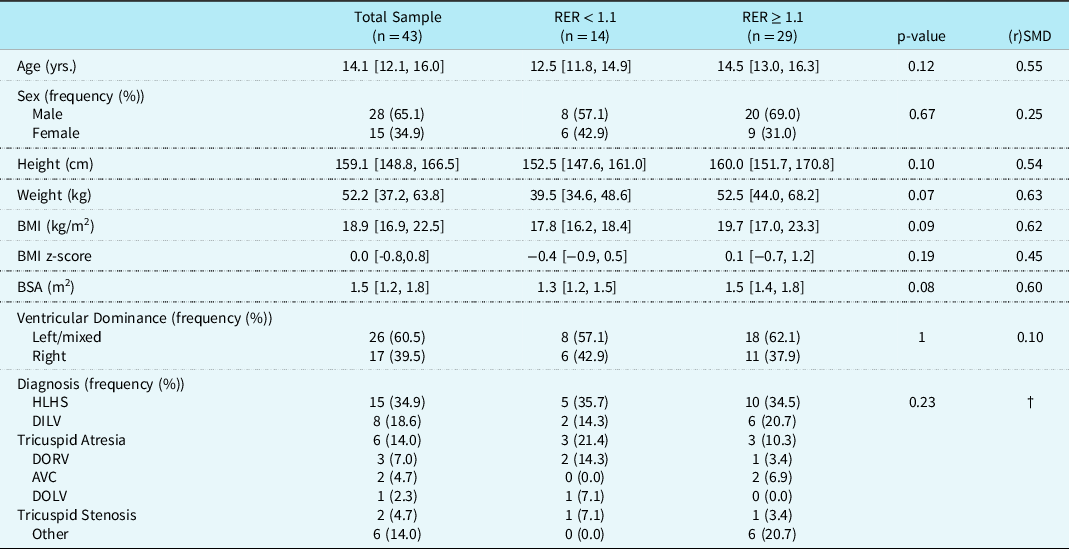
Of the original 45 participants from the parent study, two were excluded due to age (>19 years of age) and a consenting error, leaving an analysis sample of n = 43. Participant’s characteristics are displayed in Table 1. Participants were mostly mid-adolescent, male, normal weight status, and the sample was primarily left or mixed ventricular dominance. All participants received the extra-cardiac Fontan procedure and three (7%) had a fenestration.
Demographic characteristics.

Data are presented as medians [interquartile range] unless otherwise specified.
† Omitted due to data sparsity.
Abbreviations: RER = respiratory exchange ratio; (r)SMD = standardized mean difference; yrs = years; cm = centimeters; kg = kilograms; BMI = body mass index; BSA = body surface area; HLHS = hypoplastic left heart syndrome; DILV = double inlet left ventricle; DORV = double outlet right ventricle; AVC = atrioventricular canal defect; DOLV = double outlet left ventricle. (r)SMD = (robust) standardised mean difference.
The binary outcome of achieving peak exercise (RER ≥ 1.1)
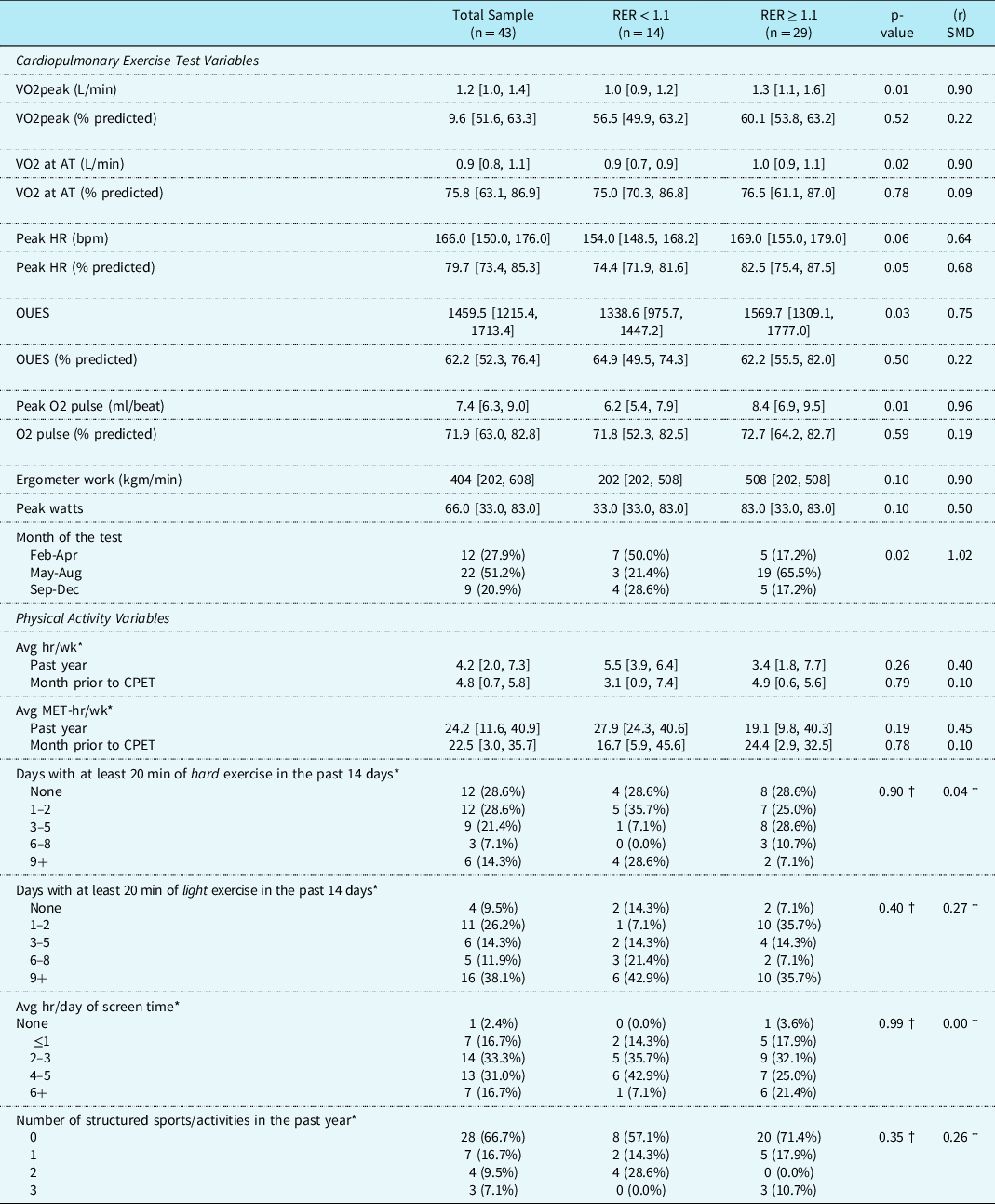
Participants were dichotomised into cohorts of 1) not meeting respiratory exchange ratio criteria (≤1.1) or 2) meeting respiratory exchange ratio criteria (≥1.1) for peak exercise. There were no statistically significant differences in demographic characteristics or diagnosis between cohorts (Table 1). Differences in cardiopulmonary exercise testing and physical activity variables by cohort are described in Table 2. The cohort that met peak respiratory exchange ratio criteria achieved a higher VO2peak (p = 0.01, rSMD = 0.90), oxygen consumption at the anaerobic threshold (p = 0.02, rSMD = 0.90), percent predicted peak heart rate (p = 0.05, rSMD = 0.68), oxygen uptake efficiency slope (p = 0.03, rSMD = 0.75), and peak oxygen pulse (p = 0.01, rSMD = 0.96). Regarding the physical activity variables, we observed cohort differences in the number of structured physical activities in the past year and the month(s) the testing took place; although not reaching conventional statistical significance, differences in average hours per week of physical activity and metabolic equivalents per week in the past year of physical activity, days of light physical activity, and number of structured sports in the past year had small effect sizes (SMD 0.2–0.5). Likewise, demographic variables showed small to medium effect sizes (SMD 0.5–0.8).
Bivariate analysis of CPET and PA by RER group.

Data are presented as medians [interquartile range] unless otherwise specified.
† Variables coded as numeric (None = 0, 1–2 = 1, 3–5 = 2, 6–8 = 3, 9+ = 4) and compared by Wilcoxon rank-sum test.
*Total of 42 subjects due to incomplete information from one subject.
Abbreviations: RER = respiratory exchange ratio; (r)SMD = standardised mean difference; CPET = cardiopulmonary exercise test; AT = anaerobic threshold; OUES = oxygen uptake efficiency slope; O2 pulse = oxygen pulse; avg = average; hr/wk = hours per week; hr/day = hours per day; MET-hr/wk = hours per week by metabolic equivalent.
The conditional inference forest model showed an out-of-bag area of 0.55 under the precision-recall curve (only slightly better than flipping a coin) in classifying the cohorts. While other model performance metrics included 0.66 classification accuracy, 0.40 sensitivity, 0.80 specificity, and 0.64 area under the receiver operating characteristic curve, these metrics could be biased due to the imbalanced outcome classes. However, this model suggested the month of cardiopulmonary exercise testing was the most informative predictor (if permuted, the prediction accuracy would reduce 7%; results not shown).
The continuous outcome of peak respiratory exchange ratio
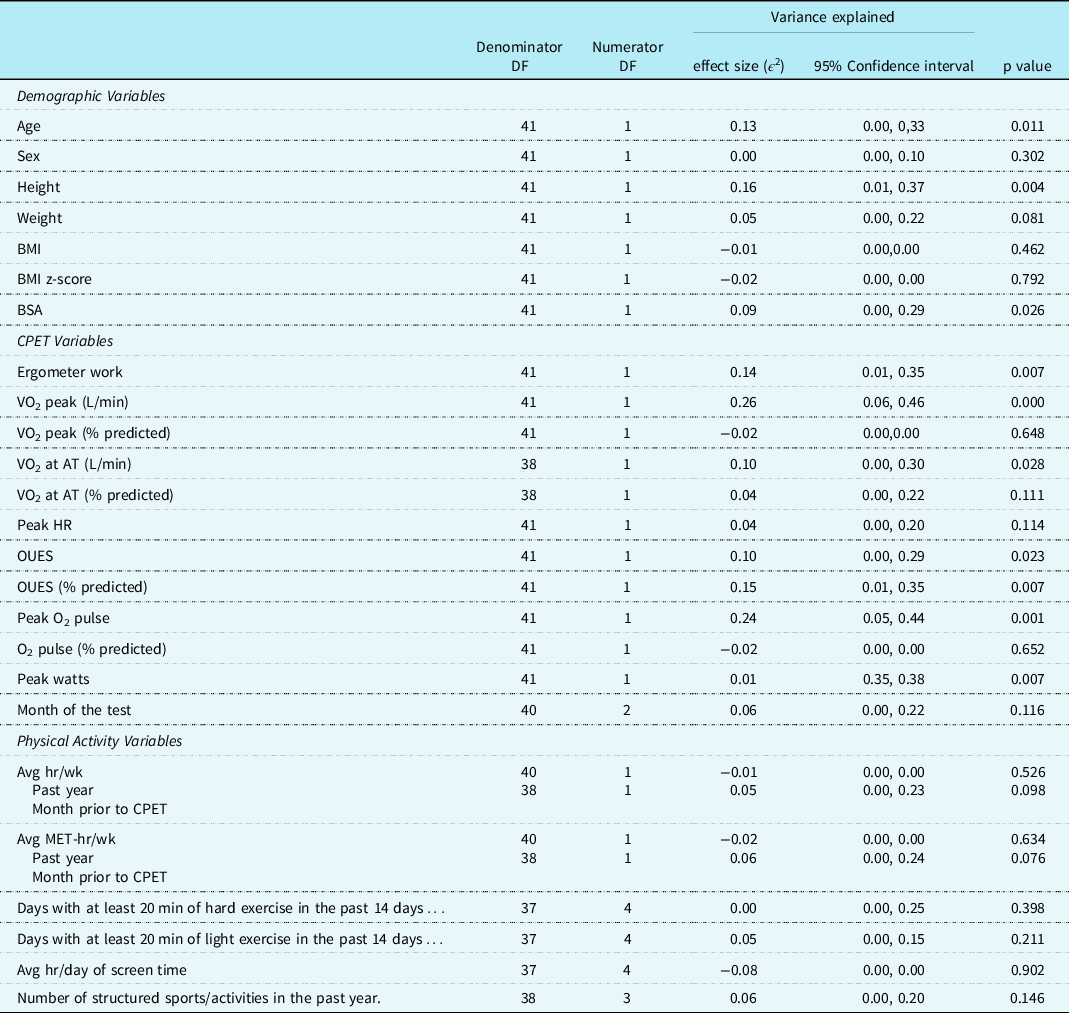
Table 3 demonstrates the bivariate association between peak respiratory exchange ratio and each of the demographic, clinical, physical activity, and cardiopulmonary exercise testing measures, based on simple regression. Peak heart rate and percent predicted peak heart rate were highly correlated with each other (Pearson correlation coefficient = 1). Percent predicted peak heart was not included in the regression analysis to avoid collinearity with peak heart rate. Peak VO2 (p < 0.001, ϵ 2 = 0.26, 95% CI 0.06–0.46) and peak oxygen pulse (p = 0.001, ϵ 2 = 0.24, 95% CI 0.05–0.44) were the top two variables explaining variance in peak respiratory exchange ratio.
Bivariate associations with RER.

Abbreviations: DF = degrees of freedom associated with model errors; RER = respiratory exchange ratio; BMI = body mass index; BSA = body surface area; CPET = cardiopulmonary exercise test; AT = anaerobic threshold; OUES = oxygen uptake efficiency slope; O2 pulse = oxygen pulse; avg=average; PA = physical activity; hr/wk = hours per week; hr/day = hours per day; MET-hr/wk = hours per week by metabolic equivalent.
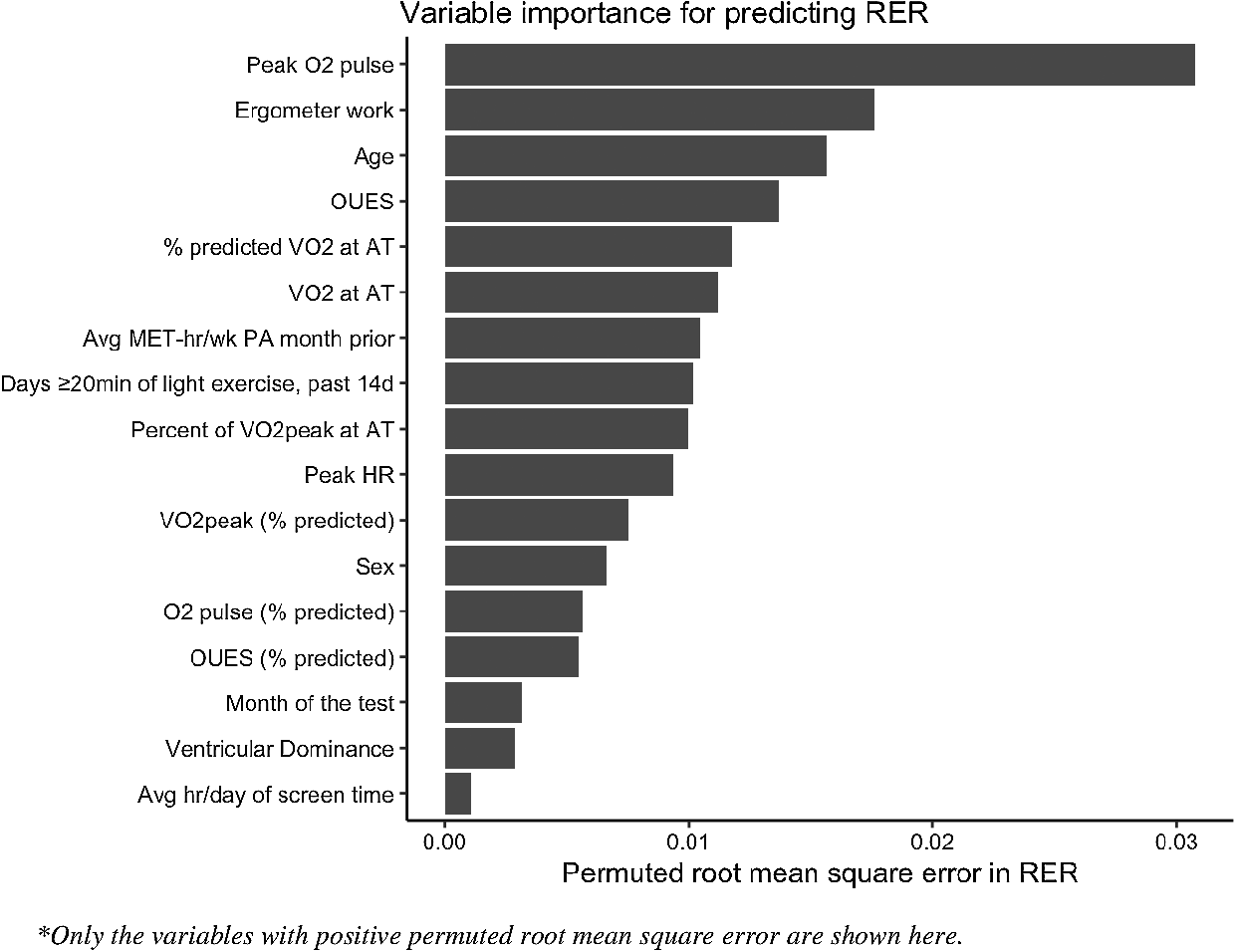
The conditional inference forest model explained 21.4% variance of respiratory exchange ratio and suggested peak oxygen pulse was the most important predictors (if permuted, the root mean square error of predicted values would increase most), followed by cycle ergometer work (kg/min), age, and oxygen uptake efficiency slope (Fig 1). The H-statistics ranged 0.004–0.025, suggesting nearly no interactions across predictors.
Variable importance of predicting RER*.

Discussion
As expected, those who could meet the respiratory exchange ratio threshold of peak exercise were able to exert themselves to a higher relative exercise intensity. Thus, it is not surprising that the cohort that met peak respiratory exchange ratio criteria for peak exercise had a higher VO2 peak and heart rate, and longer exercise duration than those that did not. However, the relationships between peak respiratory exchange ratio and oxygen uptake efficiency slope and oxygen pulse were unexpected. We observed that the oxygen uptake efficiency slope was higher in those who met peak respiratory exchange ratio criteria compared to those who did not. Studies by Niu et al and Giardini et al. observed that the relationship between oxygen uptake efficiency slope and exercise intensity may not be linear, and individuals who reached a higher relative exercise intensity could have a higher oxygen uptake efficiency slope compared to those who did not. Reference Niu, Godoy and Das14,Reference Giardini, Specchia, Gargiulo, Sangiorgi and Picchio32 Analysis revealed that oxygen pulse was the strongest cardiopulmonary exercise testing predictor of meeting peak respiratory exchange ratio. Lack of change in forward stroke volume is known to be one of the primary rate limiters for Fontan patients, as evidenced by plateauing of oxygen pulse during exercise. Reference Goldberg, Avitabile, McBride and Paridon33 Our results suggest that Fontan patients with less augmentation in oxygen pulse may struggle to maintain exercise at high intensities and may terminate prior to reaching peak intensity.
We observed that the average hours/week and MET-hours/week of physical activity both in the past month and past year were not associated with the ability to meet respiratory exchange ratio ≥ 1.1. Previous studies show mixed results concerning the impact of habitual physical activity on cardiorespiratory fitness and other fitness-related variables in youth with CHD. Reference O’Byrne, Desai, Lane, McBride, Paridon and Goldmuntz34–Reference Duppen, Etnel and Spaans36 In a study by O’Byrne et al., there was no association between habitual exercise and VO2 max.Reference O’Byrne, Desai, Lane, McBride, Paridon and Goldmuntz 34 Similarly, Duppen et al., showed that aerobic exercise training did not improve cardiopulmonary exercise in Fontan, whereas there was a significant difference in children with tetralogy of Fallot.Reference Duppen, Etnel and Spaans 36 Children and adolescents with CHD participate in lower intensity physical activities in shorter and more sporadic bouts compared to peers without heart disease, which may limit the effects on cardiorespiratory fitness and their inability to sustain higher intensities of exercise. Reference White, Willis and Panchangam6 It is possible that respiratory exchange ratio may not be an appropriate metric for determining peak exercise in patients with single ventricle physiology. Individuals without heart disease can significantly increase pulmonary flow during exercise through vasodilation of pulmonary arteries. However, individuals with single ventricle physiology lack a sub-pulmonary pump to accelerate pulmonary blood flow. Reference Gewillig and Brown1,Reference Chen, Chen and Chiu12 Thus, it is possible that inefficient transport, ventilation, and perfusion of carbon dioxide and oxygen in the lungs may have unanticipated effects on the expired ratio of oxygen and carbon dioxide. In clinical practice, using cardiopulmonary exercise testing is increasingly used in combination with other objective data to assess functional status. Reference Diller, Giardini and Dimopoulos7 Although peak exercise metrics are often used to determine the level of physiologic reserve, clinicians and researchers should consider other sub-peak metrics to monitor change over time, such as VO2 at the anaerobic threshold or oxygen pulse slope.
Our results suggest there is a relationship between the month/season of the cardiopulmonary exercise testing and the participant’s peak respiratory exchange ratio. Variance in cardiorespiratory fitness or other exercise-related factors has not been extensively studied in children or adolescents with CHD. A prospective cohort study by Kuan et al demonstrated that children and adolescents (ages 9–16 years) with CHD had measurable variation in physical activity by the time of the year. Reference Kuan, Voss, Lopez, Hemphill and Harris37 The authors observed that participants’ steps/day via pedometer correlated with the school year and the greatest number steps/day were in late spring and autumn, and the lowest number of steps/day were in the summer months and winter months. Reference Kuan, Voss, Lopez, Hemphill and Harris37 We observed that of patients reaching peak exercise, 65.5% of exercise tests were performed from May to August, compared to 17.2% in February–April and September–December. Contrary to our other findings, studies have shown that youth with CHD participated in less physical activity in the summer compared to the school year due less availability of structured activities Reference Kuan, Voss, Lopez, Hemphill and Harris37 . For clinical purposes, counselling on physical activity and/or initiation of rehabilitation depending on the season may be beneficial especially in the winter months when exercise tends to decrease. Further research is needed to understand the interactions between season, physical activity, and factors associated with cardiorespiratory fitness.
Limitations
Our study had several limitations that should be addressed. The cardiopulmonary exercise test utilised an incremental cycle protocol. Since the data was collected, ramping style protocols have become the preferred modality for cardiopulmonary exercise testing in this population. It is possible that more participants may have met peak respiratory exchange ratio criteria if a ramping protocol was utilised. Physical activity was determined using self-report measures, which are less accurate than device-based measures of physical activity. The questionnaire allowed for estimates of past-year participation in physical activity and quantification of organised physical activities, whereas the accelerometers are typically worn for 7 days and do not allow for determination of modality or types of activity performed. The Modifiable Activity Questionnaire was administered through trained study personnel interviews with participants which may aid in the accuracy of the recall. Reference Vuillemin, Oppert and Guillemin38 Our sample size was somewhat limited and other relationships could have been realised with a larger study sample.
Conclusion
Many children with Fontan palliation struggle to reach peak exercise criteria curing cardiopulmonary exercise testing. Previous studies have demonstrated that 20–57% of patients with Fontan palliation were not able to meet peak exercise criteria (respiratory exchange ratio ≥ 1.1), impairing the prognostic value of cardiopulmonary exercise testing. Our data demonstrated that self-reported average physical activity did not impact ability to reach peak exercise on exercise testing. There was an association between the month of the test and other exercise variables, including oxygen uptake efficiency slope and peak VO2. Further studies should take into consideration the interactions between season, physical activity, and cardiopulmonary fitness in children and adolescents with Fontan physiology.
Acknowledgements
We would like to acknowledge the participants who took the time to participate in this study.
Financial support
DAW is supported by the NIH and NHLBI (K23HL159325). This research received no specific grant from any funding agency, commercial, or not-for-profit sectors.
Conflicts of interest
The authors certify that they have no affiliations with or involvement in any organisation or entity with any financial interest, or non-financial interest in the subject matter or materials discussed in this manuscript.