Introduction
Trematode eggs demonstrate a diverse range of strategies in their functional biology. After they pass from the definitive vertebrate host to the external environment via sputum, urine or faeces, they may be broadly divided into those that hatch in water or on ingestion by an appropriate snail species. Despite this diversity, all species of eggs are at some stage influenced by external environmental conditions, and are, in general, adapted to aquatic or humid environments, usually dying rapidly under dry situations (Smyth & Halton, Reference Smyth and Halton1983). The majority of species are adapted to hatch under the influence of environmental stimuli, such as light, and may also possess mechanisms that effectively inhibit premature hatching within the definitive host (Smyth & Halton, Reference Smyth and Halton1983).
Temperature, in particular, may act as a trigger for initiating or controlling the rate of egg biological processes, including viability, development, hatching and production. Studies on other life stages of trematodes, such as miracidia, cercariae and metacercariae, have shown that temperature has a complex effect on their biology (Morley, Reference Morley2011, Reference Morley2012; Morley & Lewis, Reference Morley and Lewis2013, Reference Morley and Lewis2015; Berkhout et al., Reference Berkhout, Lloyd, Poulin and Studer2014; Studer & Poulin, Reference Studer and Poulin2014). Thermostability (a plateau in reaction rates caused by temperature-dependent changes in metabolism) is a key feature of most species over optimum temperature ranges, generally associated with latitude, where mid-latitude species show optima between 15 and 25°C (≈20°C) and low-latitude species between 20 and 30°C (≈25°C). Individual parasite strains can demonstrate wide variability in their responses to temperature (Morley, Reference Morley2012; Morley & Lewis, Reference Morley and Lewis2013), with acclimation over both the short term and long term influencing their thermodynamics (DeWitt, Reference DeWitt1955; Morley & Lewis, Reference Morley and Lewis2013). In addition, the functional biology of individual life-history stages, either collectively or of the same species or strain, can respond differently to exposure to identical thermal regimes (Morley, Reference Morley2012; Morley & Lewis, Reference Morley and Lewis2015). Nevertheless, the relative importance of this variable to the physiology of egg biology has neither been quantified nor comparatively analysed between species and, as temperature is intrinsically linked to climate change, an analysis of each component of trematode transmission is essential.
Egg biology and embryonic development, although highly important to trematode life cycles, are in general poorly understood (Jurberg et al., Reference Jurberg, Pascarelli, Pelajo-Machado, Maldonado, Mota and Lenzi2008). Three phases can be identified, which include egg production by the adult parasite, development of the embryo and hatching of mature miracidia, all aspects of which can be either directly or indirectly influenced by abiotic factors.
Parasite egg production is notably higher than in their free-living counterparts. However, trematode output can vary substantially between species, ranging from a few eggs per day to in excess of 25,000 eggs daily (Whitfield & Evans, Reference Whitfield and Evans1983). Yet the success rate of this egg production is very low, with an estimated 50% of schistosome eggs laid by the adult worms failing to escape from the host body (Warren, Reference Warren1978), and only a predicted 17 of 100,000 eggs deposited by the liver fluke Fasciola hepatica on pasture successfully hatching (Wilson et al., Reference Wilson, Smith, Thomas and Anderson1982). Nevertheless, the production of eggs can be influenced by a range of biotic factors, including the density of adult worms, host species, parasite and host strain, and the nutritional status of the host (Ginetsinskaya, Reference Ginetsinskaya1988; Basch, Reference Basch1991; Toledo, Reference Toledo, Fried and Toledo2009). Environmental factors are acknowledged to influence egg production from both endothermic and ectothermic hosts under field conditions (Chubb, Reference Chubb1979; Hanna et al., Reference Hanna, Williamson, Mattison and Nizami1988), yet the only abiotic factor studied experimentally is temperature, which is considered to influence egg productivity in adult trematodes either directly in ectotherms or indirectly, through its effects on endocrine and immune systems, in endothermic species (Morley & Lewis, Reference Morley and Lewis2014).
Embryonation of eggs can occur through three modes of development, which include species that are: (1) undeveloped when laid and undergo their entire embryonation outside the definitive host; (2) partially developed when laid and require only a brief period of embryonation outside the host; and (3) fully embryonated on leaving the host and hatch immediately on reaching water or after ingestion by a snail target host (Smyth & Halton, Reference Smyth and Halton1983). A number of physico-chemical factors can influence embryonation outside the definitive host and these include humidity, oxygen tension, pH, the presence of host faecal material and temperature. Thermal conditions may strongly control the rate of egg development, which can be inhibited both below and above critical temperature thresholds, or increased with rising temperature but within a functional thermal range (Smyth & Halton, Reference Smyth and Halton1983), although a comparative analysis between species has not hitherto been undertaken. However, temperature-driven development of eggs that develop either partially or completely within either the adult worm or tissues of endothermic definitive hosts is likely to be dominated by host-intrinsic rather than extrinsic thermal conditions.
The stimulation of egg hatching is, by necessity, required to take place when environmental conditions outside the definitive host provide a reasonable opportunity for infecting the molluscan host. In turn, the hatching process should be inhibited by physico-chemical conditions typically found within the definitive host, to avoid premature hatching (Smyth & Halton, Reference Smyth and Halton1983). Hatching must be considered in relation to those eggs that hatch in water or within the intestine of the target snail host, but hatching within a mollusc is beyond the scope of the present study, as this has rarely been studied in relation to environmental temperature.
In general, hatching rates can be influenced by exposing eggs to light, temperature or changes in osmotic pressure. However, temperature is often regarded as a secondary stimulus compared to the other two factors, although maximum hatching success is considered to take place over optimum thermal regimes (Smyth & Halton, Reference Smyth and Halton1983).
Previous studies on comparative analysis of egg thermal biology taken from the scientific literature have been concerned only with production as defined by uterine egg counts in adults and the morphological dimensions of egg shells. These studies found that latitude, as a proxy for local temperature, had no influence on these variables, suggesting that phylogenetic constraints were not influencing this parameter (Poulin, Reference Poulin1997; Koehler et al., Reference Koehler, Brown, Poulin, Thieltges and Fredensborg2012). Nevertheless, comparative analyses of physiological aspects of temperature effects on egg release, embryo development and mature miracidial hatching are lacking. The aim of the present study was to determine the influence of different thermal regimes on these three phases of trematode egg biology by applying a thermodynamic approach to data in the scientific literature using the Arhenius critical incremental energy of activation (E*). This is considered a reliable measure of temperature-driven reaction rates and represents the energy that molecules in their initial state must acquire before they can participate in a chemical reaction. A physiological process depends on a catenary series (chain of events) of reactions, each with its characteristic critical thermal increment. At its simplest level, the rate of the entire process is governed by the slowest reaction in the series, and this is the master reaction. Therefore the E* value for a complex physiological activity is the value of its limiting or pacemaker step and generally ranges from 1 to 25 kcal/mole (Hoar, Reference Hoar1983).
Materials and methods
Source of data
Data on egg production, development and hatching under different thermal regimes were obtained from the scientific literature on laboratory studies undertaken at different constant temperatures. In addition, appropriate data on egg production from seasonal field studies was also analysed, as this represented an opportunity to examine one of the few physiological processes studied under natural conditions. These studies were compiled based on searches of the following databases: ‘Web of Knowledge’, ‘Scopus’, ‘CABI Global Health’, ‘Helminthological Abstracts’, ‘PubMed’, ‘Google Scholar’ and ‘Zoological Record’, using mainly combinations and variations of the following terms: ‘trematodes’, ‘egg’, ‘hatching’, ‘development’, ‘production’, ‘fecundity’ and ‘temperature’. Only those studies that presented quantifiable temperature data over at least a 10°C range were used. Searching online databases revealed five laboratory and seven field studies on egg production, 36 studies on egg development and 23 studies on egg hatching. In addition, the effects of latitude and its associated thermal environments on the duration of egg development were assessed from laboratory studies with a single constant temperature within a narrow range of 18–22°C for mid-latitude species (36–60°) and 24–28°C for low-latitude species (≤35°), producing a dataset of 41 mid-latitude and 42 low-latitude studies (references not shown). These latitudinal divisions were derived from the Strahler climatic classification system (Barry & Chorley, Reference Barry and Chorley2003).
Data analysis
The thermodynamics of trematode egg biology was determined using the critical incremental energy of activation (E*). This value was calculated using the original egg production, development or hatching data from each source incorporating a range of temperatures that encompassed increases of approximately 10°C, over core temperature ranges, as follows: 10–20°C (≈15°C), 15–25°C (≈20°C), 20–30°C (≈25°C), 25–35°C (≈30°C), as well as 5–15°C (≈10°C) for egg production only. At low and high ranges, measurements encompassing precise 10°C ranges were not always recorded, although they were within 1–2°C of this range and such small variations are unlikely to substantially change the E* value generated. In studies without precise 5°C increments, data were extrapolated from measurements above and below the temperature readings, typically within 2–3°C of that required. For additional analysis of egg development and hatching, data were separated according to geographical distribution as mid-latitude species (36–60°) and low-latitude species (≤35°).
The critical incremental energy of activation (E* or μ) is a measure of temperature-driven reaction rates and represents the energy that molecules in their initial state must acquire before they can participate in a chemical reaction, and can be considered as a limiting or pacemaker step for complex physiological activity (Hoar, Reference Hoar1983). E* was determined using the following form of the Arrhenius equation (Prosser, Reference Prosser1973):
 $$E{^\ast} = \displaystyle{{ - 2.3R({\rm Log}K_2 - {\rm Log}K_1 )} \over {\displaystyle{1 \over {T_2}} - \displaystyle{1 \over {T_1}}}} $$
where K 1 and K 2 are egg data at absolute temperatures T 1 and T 2 , and R is the gas constant (1.98 cal/mole). For many enzymatic and biological processes in living organisms E* values usually range from 1 to 25 kcal/mole. Normal activation energy is approximately 10 kcal/mole, with many respiratory metabolic processes having values typically of 11 or 16 kcal/mole; positive values indicating an increased activation energy while negative values represent a decreased activation energy (Crozier, Reference Crozier1924; Brandts, Reference Brandts and Rose1967; Hoar, Reference Hoar1983). For determining thermostability, we considered values between 8 and −8 kcal/mole to represent thermostability. All E* values, as well as egg development duration data extracted from single constant-temperature studies, were analysed with Student's t-test using the SPSS computer package (SPSS Inc., Chicago, Illinois, USA).
Results
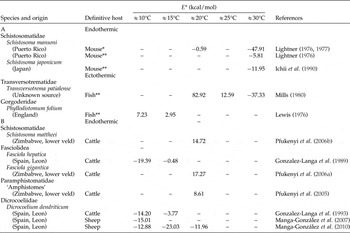
Temperature can strongly influence the functionality of all three phases of trematode egg biology. Studies on egg production have been few in number, and therefore cannot be evaluated statistically (table 1). Nevertheless, general trends in the thermodynamical responses to temperature changes are apparent. Laboratory studies on schistosomes in endothermic hosts show a substantial decline in productivity over high temperatures as measured by the E* value, regardless of whether temperature exposure took place pre- or post-infection (table 1). Within ectothermic hosts, productivity appears to increase from low temperatures, stabilizing at optimum temperatures and, within a single study, declining at high temperatures. Field studies from endothermic hosts suggest that habitat-specific climatic factors tend to structure egg productivity. In a mid-latitude mountainous region, egg productivity E* values decline from an optimum at temperatures below 10°C (table 1). This low thermal optimum is associated with a winter parasite-transmission window, as summer environmental conditions are too harsh to facilitate transmission. In contrast, low-latitude species demonstrate an optimum above 20°C with productivity increasing over the ≈20°C range (table 1).
Characteristics, temperature exposure and E* values of egg production for each trematode species in (A) laboratory (*, pre-infection; **, post-infection) and (B) field studies over temperature ranges of ≈10°C to ≈30°C.

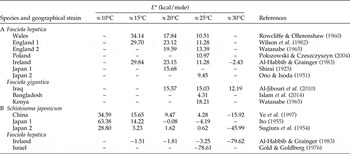
Changes in the rate of egg development with temperature show a response that is typical for invertebrates. Development does not appear to take place below a minimum development temperature threshold (MDTT), although this has rarely been determined for most species. Within the permissible thermal range, increasing temperatures accelerate development, although at relatively high temperatures development slows, eventually achieving a maximum, which should not be interpreted as indicating an optimum. As temperatures continue to rise, a deleterious effect on development occurs. There is some evidence to suggest that species strain differences in developmental thermodynamics may exist, notably for Fasciola gigantica, which demonstrates particularly wide variations in E* values over the ≈25°C range (table 2). However, it is also possible that such differences may be experimental artefacts due to the use of variable protocols.
Strain-specific differences in E* values for egg development (A) and hatching (B) over temperature ranges of ≈10°C to ≈30°C.

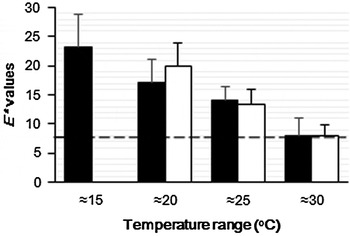
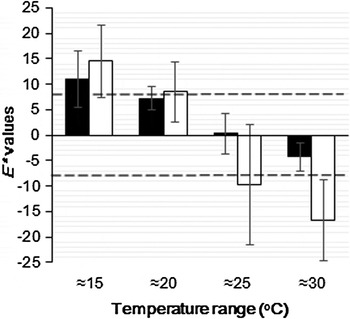
For mid-latitude species E* values demonstrate a trend at the extreme high range of stable thermodynamics, the highest values occurring in mid-temperature ranges of ≈15°C and ≈20°C (fig. 1, supplementary table S1). Thermodynamic responses generally show significant differences at mid latitudes between the low range of ≈10°C and both ≈15°C and ≈20°C ranges (P ≤ 0.032, t ≥ −2.382) where sharp increases in development rates occur as the temperature rises, but no differences occur at ≈10°C compared with the higher ranges of ≈25°C and ≈30°C (P ≥ 0.165, t ≤ −1.545). Similarly, the highest range of ≈30°C is significantly different only from the ≈15°C and ≈20°C ranges (P ≤ 0.024, t ≥ 2.745). Of the mid-temperature ranges, only the ≈15°C and ≈25°C values show significant differences (P = 0.017, t = 2.691). Studies on egg development of low-latitude species tend to be undertaken over a more restricted range of temperatures between ≈20°C and ≈30°C (supplementary table S1). A significant difference in E* values at this latitude occurred only between the ≈20°C and ≈30°C ranges (P = 0.029, t = 2.912).
Mean E* values of egg development over different temperature ranges of mid-latitude (black bars) and low-latitude (white bars) species. ------, Maximum extent of thermostability to 8 kcal/mole. Error bars are standard deviation.

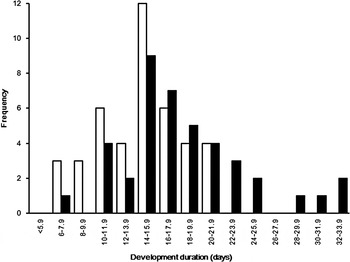
Comparisons of egg development between mid- and low-latitude species showed that there was no significant difference in E* values in the core temperature ranges of ≈20°C, ≈25°C or ≈30°C (P ≥ 0.524, t ≤ −0.673), suggesting that developmental rates did not acclimatize to prevailing latitudinal thermal regimes. This was further supported by comparing the duration of the developmental period in days for single constant-temperature studies between mid and low latitudes at their respective typical temperatures of 18–22°C and 24–28°C (fig. 2). The mean development period in days was significantly longer (P = 0.002, t = 3.160) at mid latitude (mean 17.68 days, SD = 6.334) compared with low latitude (mean 14.02 days, SD = 3.986), as would be expected with a simple response of eggs to temperature changes. Thus when mid- and low-latitude development E* values of studies under different thermal regimes were combined, the differences between total value ranges were significant only between the ≈30°C and all other ranges (P ≤ 0.005, t ≥ 3.261), and between ≈15°C and ≈25°C (P = 0.013, t = 2.853).
Frequency distribution of egg development duration (days) of studies undertaken at single temperatures of 18–22°C for mid-latitude (black bars) and 24–28°C for low-latitude (white bars) species.

Hatching thermodynamics demonstrate a number of changes in E* values over increasing temperature ranges (fig. 3). Both mid- and low-latitude species show high E* values over low temperature ranges of ≈10°C and ≈15°C, where a minimum hatching temperature threshold (MHTT) appears to occur, achieving stability over the ≈20°C range (see supplementary table S2). On the other hand, mid-latitude species retain thermostability over both the ≈25°C and ≈30°C ranges, unlike low-latitude species where a decline in E* values at these ranges is observed.
Mean E* values of egg hatching over different temperature ranges of mid-latitude (black bars) and low-latitude (white bars) species. ------, Maximum extent of thermostability −8 to 8 kcal/mole. Error bars are standard deviation.

For mid-latitude species there were significant differences in E* values between the ≈30°C range and both ≈15°C and ≈20°C ranges (P ≤ 0.011, t ≥ −3.042) and between the ≈20°C and ≈25°C ranges (P = 0.034, t = 2.340). Strain-specific differences in hatching are apparent (table 2), most obviously in Japanese strains of Schistosoma japonicum, indicating that even strains from the same country may demonstrate different thermodynamics. For low-latitude species there were significant differences in E* values between the ≈10°C range and only the higher ranges of ≈25°C and ≈30°C (P ≤ 0.006, t ≥ 3.622). Similarly both ≈15°C and ≈20°C ranges also demonstrated significant differences compared with the higher ranges of ≈25°C and ≈30°C (P ≤ 0.045, t ≥ 2.178). There were no significant differences between low- and mid-latitude E* values over any temperature range (P ≥ 0.097, t ≤ 1.800), suggesting that hatching success was not linked to any prevailing latitudinal thermal regime.
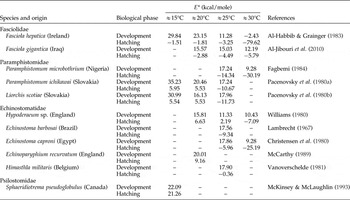
Comparisons of E* values between developmental rates and hatching success over each temperature range between ≈15°C and ≈30°C demonstrated significant differences for total combined mid- and low-latitude values in every range (P ≤ 0.031, t ≥ 2.295). Values were also significantly different for mid-latitude species across the ranges (P ≤ 0.036, t ≥ 2.345) and for low-latitude species at ≈25°C and ≈30°C (P ≤ 0.009, t ≥ 3.178). These results suggest that the two processes have different thermodynamics and function independently of each other, and these differences are most apparent in studies when development and hatching of the same species are considered (table 3), indicating that these two parameters rarely show comparable thermodynamics at any range of temperatures.
Comparisons of the E* values between development and hatching from the same species strains over different temperature ranges.

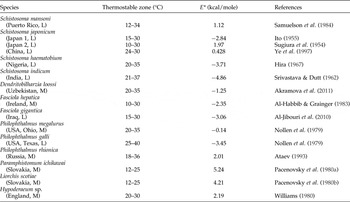
Wide thermostable zones are a common feature of hatching in trematodes (table 4). In general, most species demonstrate stability between at least 20°C and 30°C, with little indication of any differences between mid- and low-latitude trematodes. Nevertheless, strain differences were particularly apparent for S. japonicum, where the range and degree of thermostability of hatching showed distinct variation (table 4).
Values of E* for egg hatching, demonstrating thermostability over relevant wide temperature range; L, low-latitude species; M, mid-latitude species.

Discussion
Temperature can profoundly influence all three biological phases of trematode eggs. However, one of the difficulties in studying egg responses to temperature is the varying experimental methodologies used to isolate eggs. For example, during the 1950s Schistosoma mansoni eggs were generally separated out from faecal samples, compared with more recent investigations where purified eggs were removed from host tissue by sieving. When eggs from these two sources are exposed to the same environmental hatching stimuli contradictory responses can occur, which may be due to different hatching capabilities (Xu & Dresden, Reference Xu and Dresden1990). Nevertheless, widely applicable trends in thermodynamical responses do occur regardless of the methodologies used. Thus, when raw data are converted to E* values less pronounced variations are found, as in the case of source eggs used for analysis of miracidial survival thermodynamics (Morley, Reference Morley2012).
Egg production by adult trematodes is temperature sensitive, although only a few studies have examined this process quantitatively and this analysis must be treated with some degree of caution, particularly the field studies where additional abiotic and biotic parameters may fluctuate, creating a more unstable environment for adult worms. Nevertheless, in some field studies temperature has been demonstrated to be the principal direct or indirect factor influencing egg production, particularly during periods of thermal stress (Amarasinghe & Kumara, Reference Amarasinghe and Kumara2007; Thomas et al., Reference Thomas, Jacquiet and Dorchies2007). In the present study, egg production, which is optimal over specific temperature ranges, is more likely to be associated with thermal regimes present in the latitudes and habitats from which each species originated. A substantial decline in egg production from adult worms in both endothermic and ectothermic hosts occurs at high temperatures, but the mechanism driving this process will depend on the type of host infected. In endotherms, high temperature stress affects the host endocrine and immune systems, which, in turn, disturb the functional biology of their parasites (Morley & Lewis, Reference Morley and Lewis2014). Host feeding also declines (Morley & Lewis, Reference Morley and Lewis2014) and any reduction in nutrient availability can lead to a significant decrease in parasite egg production (Akpom & Warren, Reference Akpom and Warren1975; Ginetsinskaya, Reference Ginetsinskaya1988).
On the other hand, adult trematodes within ectothermic hosts are directly influenced by large increases in temperature. At extremely high temperatures up to 35°C, Mills (Reference Mills1980) suggested that protein denaturation may have resulted in a sharp decrease in egg production by Transversotrema patialense, and this may be applicable to other species. However, there is much qualitative evidence from field studies to show that seasonality in egg production is mainly associated with the maturity of adult trematodes (Chubb, Reference Chubb1979). Thus, at mid latitudes thermal optima may not only show wide ranges in temperatures, dependent on the species, but also are synchronized to maximize the chance of transmission to the next host in the life cycle (Chubb, Reference Chubb1979).
Egg production under experimental cold conditions is more poorly understood, although in homeothermic hosts, such as mice, cold stress appears to have no negative effects (Ichii et al., Reference Ichii, Irie and Yasuraoka1990). Under natural conditions homeotherms may optimize egg productivity during the winter if summer conditions are too harsh (Gonzalez-Lanza et al., Reference Gonzalez-Langa, Manga-Gonzalez, Del-Pozo-Carnero and Hidalgo-Argüello1989; Manga-González et al., Reference Manga-González, Quiroz-Romero, González-Lanza, Minambres and Ochoa2010), whereas in trematodes within heterothermic hosts egg production tends to slow down when hibernation is induced (Morley & Lewis, Reference Morley and Lewis2014). Data on the effects of cold stress on egg production in ectothermic hosts are scarce, but remain more obviously negative due to the resulting drop in host feeding and associated nutrient availability, ensuring a decline in adult worm metabolism (Chubb, Reference Chubb1979; Mills, Reference Mills1980).
The effect of temperature on egg development is a simple process, whereby within the permissible thermal range an increase in temperature speeds up development. There is little evidence to suggest that development rates are optimized relative to latitude or habitat of the species. Thus the physiological optima achieved at high temperatures, where development rates slow to a plateau, is a spurious or misleading designation that has neither functional nor ecological significance (Cossins & Bowler, Reference Cossins and Bowler1987). Typically at such high temperatures trematode egg mortalities or deformities are high (Campbell, Reference Campbell1961), and although the range of temperatures over which development may take place is wide, the range over which a rapid development can be achieved with maximum egg viability is much narrower. Thus, Cossins & Bowler (Reference Cossins and Bowler1987) concluded that the best definition of optimal development conditions were those at which mortality was lowest, rather than those in which the rate was fastest. Nevertheless, optimum conditions will reflect the ecological requirements of each individual species, with some requiring very slow development with low mortality and others needing a more rapid development with a correspondingly higher mortality. Unfortunately, studies on trematode egg mortalities or deformities have rarely been undertaken in conjunction with thermal development studies and therefore the functional optimal temperature range for the majority of species remains to be determined.
Minimum development temperature thresholds are apparent for most species and generally appear to occur at or below 10°C. Such thresholds prevent premature development taking place when conditions are too extreme for miracidial viability and target-host availability. As the developing embryo is dependent on stored glycogen reserves for metabolism (Horstmann, Reference Horstmann1962; Khan et al., Reference Khan, Abidi, Nizami, Irshadullah and Ahmad1991) this inhibited development ensures that the maximum number of viable eggs are available when environmental conditions reach the point of providing triggers that stimulate hatching.
Although rates of egg development do not, in general, appear to be directly influenced by habitat- or latitude-specific temperature conditions, there is some evidence to suggest that thermal regimes to which prior life-history stages are exposed may indirectly influence development. Sexually mature worms of Posthodiplostomum cuticola from the same habitat produce two types of eggs with differing embryonic development periods. Eggs produced by adult worms which develop from metacercariae that overwinter show a longer development period of 28–38 days at 24°C compared with a development period of 10–14 days in eggs originating from adults that developed from metacercariae over the summer (Vladimirov, Reference Vladimirov1961). It is possible that the action of low winter temperatures on metacercariae may play a role in this difference (Ginetsinskaya, Reference Ginetsinskaya1988), although this physiological effect is unlikely to be of substantial ecological significance as there is some degree of overlap in the seasonal occurrence of the two strains of P. cuticola and their thermodynamics are very similar despite differences in the duration of their development (see supplementary table S2). On the contrary, geographical strains of F. hepatica and F. gigantica show some degree of conformity in their developmental thermodynamics, except for some isolated strains with sharp differences from the norm.
Egg-hatching success, in contrast, does appear to be more closely linked with the requirements of parasite transmission and, in some cases, synchronized to responses made to specific environmental triggers. A definitive minimum hatching temperature threshold is present for many species, although for some studies temperatures were not sufficiently low enough to determine specific thresholds, thus making differences between individual strains or mid- and low-latitude species difficult to assess.
For some low-latitude species, hatching success tends to decline at surprisingly low temperatures, suggesting that it may be synchronized to occur only during relatively low diurnal or seasonal thermal regimes, thereby maximizing miracidial viability and extending the time for target-host searching. These factors may also be responsible for the minimum hatching temperature threshold which, in some cases, can be at a higher temperature than the minimum development temperature threshold. However, mid-latitude species do not demonstrate the same decline in hatching rates, and maintain a degree of thermostability to relatively high temperatures. This may reflect the prevailing temperature conditions at these latitudes, where high temperatures are rarely reached, thereby negating the need for thermal adaptation controls for hatching to limited temperature ranges. Alternatively, there may be a bias in the low-latitude dataset towards species that develop entirely within endothermic hosts, whereby such species are inhibited from hatching at levels similar to core body temperatures, thereby preventing premature hatching while still within the host.
There is some evidence to suggest that hatching success in different geographical strains of trematodes peaks at different temperatures. The optimum range for S. japonicum occurs at various temperatures ranging from 10°C to 20°C depending on the parasite strain, and most likely to be influenced by thermal conditions present in individual habitats. Similarly thermostability in hatching over wide but variable temperature ranges is a common feature of many species. This suggests that maximal hatching will occur over a large thermal range and that specific temperature conditions are not a prerequisite. Interestingly, when thermostable zones of egg hatching (present study) and miracidial survival (Morley, Reference Morley2012) are compared in a Nigerian strain of Schistosoma haematobium (Hira, Reference Hira1967, Reference Hira1968), the one species strain where both parameters have been studied, there is an overlap over only a narrow range of 5°C, between 20 and 25°C. In this strain, egg hatching is stable at a higher range than miracidial survival, although it is unknown if this difference is found in other species.
In conclusion, the present study demonstrates that trematode egg biology is influenced by environmental temperature conditions. Both egg production and hatching appear to be optimized by ecological thermal regimes of habitats from which each species originates, thereby determining periods of egg dissemination and miracidial release. Egg development, in contrast, has a more simple and direct physiological relationship with temperature, with only a limited positive influence on parasite transmission. This may explain why so many species undergo partial or total embryonation while in transit through the definitive host. Nevertheless, minimum temperature thresholds for both development and hatching ensure that those eggs deposited in the environment during seasonal mid-latitude cold periods are not entirely wasted and may form the source of early spring infections once molluscan target-hosts become active again. A combination of these three aspects of trematode egg biology suggest that this phase in the life cycle is particularly vulnerable to any fluctuation in temperature, which can, in turn, be induced by global climate change, and is therefore an important factor that needs to be incorporated into future anthropogenic impact assessments.
Supplementary material
To view supplementary material for this article, please visit http://dx.doi.org/10.1017/S0022149X16000249
Financial support
This research received no specific grant from any funding agency, commercial or not-for-profit sectors
Conflict of Interest
None.