Introduction
The scale of warfare increased dramatically during the early modern period. Whereas late medieval armies had consisted of several tens of thousand of soldiers, by the end of the early modern period national states were mobilizing armies of hundreds of thousands of troops. In recent decades historians have increasingly appreciated the important effects of the growing scope of warfare on early modern states and societies. They have begun to label the early modern state as a ‘war machine’, as it typically spent almost three-quarters of its budget on warfare. Historians also appreciate the impact of growing armies on societies. The so-called ‘new military history’ focuses on how changes in military organization impacted society and examines how armies and navies were rooted in society.
The ‘new military history’ offers important and intriguing topics for urban historians. Charles Tilly's seminal Coercion, Capital, and European States highlights the significance of cities in the emergence of the national state in an environment of ever increasing warfare. Tilly attributes great importance to the relative presence or absence of cities for explaining how late medieval and early modern states gathered means to wage war.Footnote 1 In this process, national states emerged and became the context in which cities operated. This had far-reaching effects, as cities were no longer responsible for protecting their citizens. Urban governments had to accept that a large share of local tax revenues would be claimed by national elites who would spend it on warfare and national administration. Urban governments also had to allow that soldiers of national armies would be lodged in the houses of city inhabitants and that supra-local governments would replace medieval protective walls with modern fortifications. In short, cities and local elites lost significant autonomy when they gathered the means to wage war for the central state.Footnote 2
Yet this was hardly a straightforward development.Footnote 3 Cities did not readily surrender autonomy to support expanding national defence and national administration. There is ample evidence of ‘obstructing cities’ that resisted ‘voracious states’.Footnote 4 Indeed, the cities of the ‘urban belt’ were the last to become part of national states.Footnote 5 The case of the seventeenth-century Dutch Republic provides an intriguing example of a densely urbanized region that displayed remarkable potential for initiating new military and state organizations. The Dutch polity was highly decentralized due to the pre-eminence of cities. Recent research into the military achievements of the Dutch Republic during the ‘Golden’ seventeenth century demonstrates that the pre-eminence of cities was not a drawback but in fact an exceptional functionality, allowing a population of about 1.5 million to maintain an army of no less than 75,000 soldiers in the year 1630. Moreover, Dutch troops were well paid and well disciplined.Footnote 6 Decentralization also facilitated achievements in fiscal and administrative arrangements.Footnote 7 In fact, the assembled cities of the Dutch Republic managed to reproduce organizational arrangements at a ‘national’ level that were typical for city-states. Tax compliance and organizational potential were consequently much higher in the Republic than in states with coercive centres, such as France.Footnote 8 The Dutch case challenges traditional views about the role of cities in the process of state building, as its urban autonomy was not necessarily at odds with a strong state. Thus it is essential to look at urban, bottom-up dynamics in the process of state building and the growth of national armies.
This article contributes to the debate about the role of cities and urban governmental elites in facilitating the exceptional military and fiscal achievements of the Dutch Republic during the Dutch Revolt. It elucidates several ways that urban governments facilitated military and fiscal arrangements that typically led to problems elsewhere in Europe. They did so by calling for voluntary billeting, which improved relations between citizens and soldiers, and by smoothing the introduction and collection of taxes. This article also shows how urban governments willingly collaborated with the supra-local state in building new fortifications, despite apparently thwarting their own urban autonomies. These three essential aspects of waging war – the billeting of soldiers, the building of fortifications and the collection of taxes – have been analysed for this article through extensive archival research for the fortified garrison towns of Gorinchem and Doesburg. In arguing for the exceptionality of Dutch arrangements, the findings for the experiences of Gorinchem and Doesburg are framed within an international comparative perspective.
The cases of Gorinchem and Doesburg
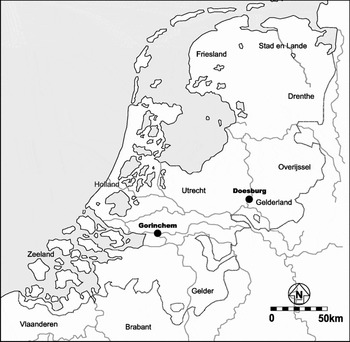
In the final decades of the sixteenth century, Gorinchem and Doesburg became garrison towns of a new state, the Republic of the Seven United Provinces. Henceforth, earthen ramparts replaced the towns’ medieval fortifications and they housed hundreds of soldiers. Yet the two towns were quite dissimilar. Gorinchem was part of the defensive system of the south Holland river delta. As this frontier was multi-layered, Gorinchem was relatively safe and was never besieged. Doesburg, however, lay on the eastern bank of the river IJssel, which was easily crossable in summer. Enemy states often planned attacks at this weak eastern frontier, and it was the strategic task of the Doesburg garrison to repel such aggression. This difference in strategic position resulted in Doesburg usually housing more soldiers than Gorinchem. Moreover, as Doesburg (c. 2,000 inhabitants) was smaller than Gorinchem (c. 6,000 inhabitants), soldiers had greater impact on Doesburg's local society, sometimes even doubling the population.
The Dutch Republic in 1648

Besides differences in demography and strategic position, there also existed differences in political status and influence. Both towns were represented in the sovereign provincial Estates, but Gorinchem had more direct input into decision-making than did Doesburg. Gorinchem was a member of the Estates of Holland, while Doesburg was part of the Estates of Guelders. The province of Holland was far more influential than the province of Guelders in the States-General. The relative power position of a province depended on its quota in the general war budget. Since 1588 every province had assumed responsibility for paying a fixed share of soldiers’ wages and other war costs. The quota system was anchored in the pre-war repartition of the Dutch provinces’ contributions to the Burgundian and Habsburg rulers. Ideally, a province was paymaster of the troops garrisoned within its borders. In practice, however, the province of Holland supplied approximately 60 per cent of the total war budget. Primarily it was the province of Holland that paid troops garrisoned in both Gorinchem and Doesburg.Footnote 9
As the province of Holland provided nearly 60 per cent of the ‘national’ war budget, Gorinchem could participate in discussions about expenditures. Doesburg could hardly do so, as Guelders contributed only 5 per cent of the total war budget. Another limitation of Doesburg's bargaining position was that it was only indirectly represented in the Estates of Guelders. The Estates consisted of delegates of the three Quarters of the province. Doesburg was one of the so-called ‘small towns’ of the Quarter of Zutphen, where the capital town of Zutphen claimed pre-eminence.
Holland contributed far more than did Guelders because of its different economic potential. While Holland experienced a golden age during the seventeenth century, Guelders continued to face economic decline that dated from the late fifteenth century and which was exacerbated by war circumstances.Footnote 10 These differing economic potentials were also reflected in the cases of Gorinchem and Doesburg. While the population of Gorinchem increased from 5,700 in 1560 to 9,300 in 1670, the population of Doesburg remained stagnant at 2,000.Footnote 11
An analysis of these dissimilar towns does not allow for strict comparative research, but it does entail appreciation of diverse war experiences in the Dutch Republic. This article contends that, despite their differences, Gorinchem and Doesburg became part of a common military, administrative and fiscal organization during the decades of protracted warfare.
The regulations concerning the lodging of soldiers
Before the end of the seventeenth century, few early modern states succeeded in incorporating soldiers into civil society. States were unable to pay soldiers punctually or to organize logistics efficiently, and for civilians the lodging of soldiers was a notable burden. The nature of arrangements concerning housing of soldiers is highly indicative of the extent to which the early modern state administered the incorporation of ‘military society’ into ‘civil society’.Footnote 12
In many countries civilians complained about obligations to house troops. In the southern Netherlands it was not until 1598 that the central government provided compensation for billeting soldiers. The central treasury obtained the necessary funds by selling exemptions from obligations to lodge troops. Exemptions were sold to individual families or to whole towns. Officeholders, nobles and ecclesiastics were fully exempt from housing soldiers. Affluent families could buy or be granted exemption, leaving poorer families more heavily burdened with troops. In exchange for financial compensation, hosts were to provide fire, light, vinegar, oil, salt and pepper. The burghers did not always receive the compensation themselves. Soldiers were often paid for their accommodation and expected to compensate their hosts. This arrangement led to numerous conflicts.Footnote 13
In France there was no financial compensation for the lodging of troops until 1636, when commissaires pour les subsistances were appointed to use a new taxe des subsistances to allocate troops in the towns. Despite these organizational efforts new difficulties arose and the new tax revenues were rarely used to compensate for the quartering of soldiers. Moreover, as in the Spanish Netherlands, the exemptions for noblemen, ecclesiastics and officeholders entailed heavier burdens for the hosting households. Furthermore, ‘these exemptions of the most prosperous groups in society were accompanied by even more damaging interventions to ensure that entire communities under the jurisdiction of those with influence and connections should be removed from the tax assessment and spared from the logement of troops’.Footnote 14
In England, arrangements for the housing of military forces changed throughout the seventeenth century. In the 1620s the quartering of troops was one of various frictions between Charles I and the House of Commons. The ‘Petition of Right’ (1628) restricted the sovereign right to burden subjects with soldiers.Footnote 15 Under Cromwell, billeting was occasionally forced upon civilians. Soldiers had to reimburse their hosts according to rates fixed by parliament. In return, host families were to provide food and shelter. Soldiers were frequently unable to compensate these costs. In such cases it was arranged that the quartermaster had to provide a paper ticket with the sum owed.Footnote 16 After the Glorious Revolution the quartering of troops was regarded as a sign of tyranny and was forbidden. Troops were henceforth usually boarded in public houses. The lodging of troops in private dwellings was possible only if the owner agreed and received advance compensation. Only the local civil authorities could compel burghers to lodge troops.Footnote 17
The unwillingness of Dutch towns to accept soldiers was one reason for the outbreak of the Dutch Revolt in the late 1560s. In the Netherlands, as in neighbouring countries, the arrangements for housing soldiers had become a crucial source of complaints by the outset of the Revolt.Footnote 18 During the Revolt's first years, the communities of Gorinchem and Doesburg complained bitterly about soldier misbehaviour and the unfavourable arrangements for housing troops. The inhabitants had to provide meals yet received no compensations.
In December 1576, in response to the myriad complaints from delegates of the voting towns, the Estates of Holland introduced compensation – the logiesgeld – for housing troops.Footnote 19 The city government of Gorinchem negotiated meticulously for extending the arrangements. The right to refuse new garrison troops improved the city council's bargaining position. In 1586, for instance, the burgomasters admitted the company of Captain Barcour only on condition that burgers received the logiesgeld without providing foodstuffs, fire, light, vinegar, oil, salt and pepper. One year later they refused approval of a new tax unless the yield would be partially used for logiesgelden payments.Footnote 20 Combined with improvements in the payment of soldiers, the housing of troops soon became an attractive source of income for inhabitants of garrison towns in Holland and Zeeland. Such towns, even in the early decades of the Revolt, rather than abhorring any idea of lodging of troops, were in fact pleased to receive garrisons.Footnote 21
The situation for the inhabitants of Gorinchem was rather favourable in comparison to Doesburg. In the first two decades of the Revolt, the inhabitants of Doesburg and the surrounding countryside had to provide food and payments to the soldiers. Moreover, there were far more soldiers within the city walls than in Gorinchem. In the winter of 1580/81 the garrison doubled Doesburg's population.Footnote 22 As no funds were available, the Estates of Guelders and the Quarter of Zutphen could not compensate the inhabitants. The undernourished and poorly paid soldiers mutinied repeatedly. In the nearby capital of Zutphen, soldiers became so bothersome that the inhabitants expelled most of the garrison in 1583, leaving the town an easy target for royal troops.Footnote 23 In 1585 Doesburg, having made arrangements with the royal troops, forced its garrison to leave. The town was recaptured by the Republic's troops in 1586.Footnote 24
In 1594 the Estates of Guelders, Overijssel and Brabant, facing such disastrous circumstances, called for financial support from the States-General. The States-General, dominated by the wealthy province of Holland, was prepared to fund wages and compensations for troop accommodation, provided that the stadhouder Footnote 25 and the States-General were permitted to send as many troops to the garrison towns as they deemed necessary. This condition was inspired by the plan of the stadhouder and the States-General to organize a buffer or defensive ring along the eastern and southern borders of the northern Netherlands.Footnote 26 As we will see, they would also provide funds for adjusting the fortifications of the eastern garrison towns (among others).
The arrangements of 1595 also entailed detailed provisions concerning the housing of troops. The Council of State fixed the logiesgelden rates and resolved that host families would provide sleeping facilities but not food, fire, light, vinegar, oil, salt and pepper. As local governments did not need to interfere in the housing of soldiers, inhabitants faced no obligations to house troops. Thus when a new company arrived in a garrison town, the individual soldiers were expected to solicit inhabitants for lodging. The soldiers and their host subsequently had to apprise a newly appointed official, the serviesmeester, of their agreement. Host families received the compensations monthly. The members of the town government were to make arrangements for housing soldiers only when numerous companies were in town. Only such exceptional circumstances could entail temporary obligation for inhabitants to take soldiers into their houses.Footnote 27
These arrangements contrast sharply with arrangements elsewhere in Europe. The inhabitants in the cities of the Dutch Republic faced no obligations to house troops yet did so voluntarily, motivated by financial compensations. A French commanding officer who arrived with his company in Gorinchem in the winter of 1636 was amazed that inhabitants willingly accommodated troops despite having no obligations to do so. The soldiers of his company first had to assemble in battle formation at the central square, along with other arriving companies. Inhabitants then chose one, two or even four soldiers to take to their houses. They never selected soldiers from the same company, most likely as this facilitated better control over the behaviour of their military guests. Soldiers who appeared unhealthy were not chosen, but after receiving new clothes and cleaning local families generally received them as well.Footnote 28
The practice of housing soldiers was equally favourable for Doesburg's inhabitants after the regulations of 1594 were settled. Data on the accommodation of soldiers between 1596 and 1601 confirm that the numbers of hosted soldiers varied greatly between different families. This indicates individual choice in choosing the number of accommodated troops. Some households hosted four, five or even more soldiers, while others hosted just one. One inhabitant, the tax collector Jan Otten, hosted the same soldier, Luym Smith, during several years.Footnote 29
The strong bargaining position of the inhabitants of military towns towards soldiers improved relations, not least as soldiers who misbehaved were unlikely to find lodging. The inhabitants’ strong position was facilitated by the strong bargaining position of towns. Gorinchem negotiated with the Estates of Holland; Doesburg negotiated with the States-General, the stadhouder and the Council of State. Central governments in neighbouring countries generally responded reluctantly to complaints from civilians about the billeting of soldiers, and often granted exemptions to influential social groups. Yet in the Netherlands a broad consensus and strong power position of local communities facilitated early arrangements that fostered better relations between civilians and soldiers. Furthermore, inhabitants could profit financially from the presence of soldiers. Bottom-up dynamics in decision-making and a strong power position of towns vis-à-vis the central state clearly improved an important aspect of state building, namely, civilian control over soldiers.
Construction and maintenance of fortifications
Early modern states also faced the challenges of erecting fortifications. The construction of defensive walls was usually the responsibility of towns, although such projects needed approval from the sovereign.Footnote 30 In the early modern period these projects increasingly became a responsibility of central governments. As states organized defensive buffers with fortified towns at strategic points, military conflicts materialized more frequently along frontiers.Footnote 31 The organization of a durable defensive ring became an important test case for the organizational capacities of the early modern state.
Some states instigated central administrative bodies to co-ordinate the building of fortifications. The English central government undertook efforts to fortify border towns, albeit on a limited scale in comparison with its continental counterparts.Footnote 32 France developed a central institution for fortifications from the late fifteenth century onwards. Although the newly installed ‘controlleurs des fortifications’ usually collaborated harmoniously with most towns, some provinces – including Burgundy and Languedoc – did not accept interference from Paris in their urban defence systems. In these instances cities undertook fortifications themselves. When Paris’ authority increased in the seventeenth century, urban fortifications in these provinces were increasingly brought under the control of royal engineers.Footnote 33
Fortifications became a royal concern in the Habsburg Low Countries as well. From 1540 Charles V appointed inspectors to formulate new plans for improving numerous urban defences. Construction of new fortifications remained the responsibility of local governments, but Brussels increased central inspections and obtained further control. The inspectors were generally recruited in Italy, as northern and central Italian city-states had pioneered major transformations in urban fortifications in response to new practices of siege warfare with firearms. The Habsburg government, in employing Italian experts, encouraged the introduction of their insights in the Low Countries.Footnote 34
How did the highly decentralized Dutch Republic succeed in this important aspect of defence? Did it develop a supra-local administration to co-ordinate the building of fortifications? How did Gorinchem and Doesburg replace their defensive infrastructures? At the outset of the Revolt many Dutch towns still had medieval stonewalls that remained unadapted to the new kind of siege warfare. In the first years of the Revolt, Dutch towns sufficed with various improvised works, from which a new type of fortification emerged. This earthen alternative to the Italian system was cheaper and better adapted to cannon-fire attacks.Footnote 35
Although this new type of fortifications was relatively inexpensive, the city governments of Gorinchem and Doesburg were unable to finance and organize the necessary works without help from other towns or from a supra-local state organization. The stadhouder William of Orange and the Estates of Holland undertook vital initiatives for organizing and financing the buttressing of towns.Footnote 36 From the year 1576, Gorinchem received funds (of unknown amounts) and the fortification master Adriaen Anthonisz developed plans for systematic replacement of the town's defensive infrastructure.Footnote 37 The town government and the Estates of Holland agreed in 1584 on replacing the stonewalls with earthen ramparts and bulwarks in three subsequent phases. Gorinchem was responsible for one third of the total costs that amounted to approximately 250,000 guilders.Footnote 38 This was a significant sum of money, as in this period the annual income of the town treasury did not exceed 20,000 guilders.Footnote 39 Gorinchem's new defence was more or less in place by 1593.
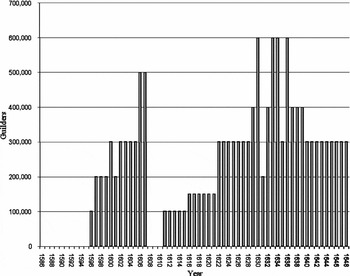
Doesburg and the Estates of the Quarter of Zutphen lacked the funds to make adjustments to the town's defence in response to the new type of siege warfare. In the first two decades of the Revolt Doesburg sufficed with improvisations. As late as 1589 the States-General had begun examining the defensive needs of the eastern frontier.Footnote 40 The deputies of the provinces of Guelders and Overijssel regularly put the need for fortifications on the agenda of the States-General.Footnote 41 From 1595 the States-General began to vote ‘extraordinary’ funds for the fortifications as part of the initiative to buttress the eastern frontier (see Figure 1).Footnote 42 In 1605, after the invasion of Spinola, the stadhouder Maurits and the States-General initiated a major building programme for most garrison towns from Delfzijl at the river Eems to Cadzand. Figure 1 conveys the scale of this initiative, which included Doesburg. After several years, earthen ramparts and bulwarks had replaced the medieval walls.Footnote 43
Extraordinary expenditure of the States-General on fortifications (1586–1648). Source: F.J.G. ten Raa and F. de Bas, Het Staatsche Leger, 1568–1795, parts II–IV (Breda, 1911).

The transformation of Doesburg differed greatly from the infrastructural efforts in Gorinchem. Unlike the city government of Gorinchem, which participated fully in the works and paid one third of the total price, the city government of Doesburg appeared passive. As Doesburg did not pay for its own fortifications, its defence, once the pride of the medieval town, essentially became property of the States-General. The reinforcement of both towns was primarily organized and financed by provincial or ‘national’ state organizations, but Gorinchem exercised greater impact on decision-making than did Doesburg.
Towns could not persevere merely by erecting walls. The earthen variant of the Trace Italienne was cheaper than the stone version but needed constant maintenance. The organization and financing of these maintenance works reveal the solidity of the state organization that had emerged in times of war threats. Did the Estates of Holland and the Council of State continue engaging in urban defences after such threats had diminished and even disappeared? Or did town councils reassume the financial and organizational burden of these fortifications?
After 1600, the Estates of Holland regularly sent delegates to the garrison towns of the province to inspect urban defences and to contract for necessary repairs and improvements. The towns asked the Estates for delegates, as they hoped to receive subsidies. In 1628 the Estates of Holland replaced the ad hoc delegations with a special body for inspection of the fortifications. The chief inspector undertook an annual pre-inspection journey to every garrison town in Holland; two commissioners used his report to visit the garrison towns and contract for necessary maintenance works and repairs. The delegates provided much funding for the works. After the war the Estates of Holland continued to concentrate on defence measures, as indicated by their splitting the inspection body into two parts in 1650.Footnote 44
Gorinchem obtained significant financial aid from the Estates of Holland: from 1625 to 1648 the Estates paid at least 90,000 guilders for various maintenance and repair works.Footnote 45 In comparison to the last decades of the sixteenth century, the town government engaged less in the infrastructural efforts. The delegates of the inspection body made all arrangements with entrepreneurs, without interference from the local government. Gorinchem paid for minor parts of the works. It was only for building entirely new parts of the fortification that the town government agreed to pay one third of the price, as had been customary in 1580 and 1590. Indeed, during the seventeenth century the Estates of Holland acquired the management of Gorinchem's urban defences, just as the States-General and the Council of State had obtained control over Doesburg's fortifications.
The Council of State took full responsibility for the maintenance works of Doesburg. From 1637 the Council of State sent inspectors to the eastern garrison towns every two years. Their interference resembled that of the inspectors in Holland: they inspected fortifications, reported any necessary works and repairs and authorized maintenance contracts. The Council of State assumed almost all financial responsibility for these maintenance works.Footnote 46 In 1672, when a huge French army invaded the Dutch Republic and threatened Gorinchem and Doesburg, there were deficiencies in the fortifications of both towns, yet the quality of their defences proved sufficient.Footnote 47 The French overran Doesburg in June 1672 but this was not a result of inferior fortifications.
Like other, more centralized European states, the Dutch Republic developed central administrative institutions to co-ordinate and stimulate the building of new fortifications along its borders. The Estates of Holland and the Council of State clearly obtained the capacities for adequate organization of fortifications despite the highly decentralized nature of the polity.
Taxation
Another major challenge for early modern cities and states was raising tax monies to fund armies and defensive lines for fortified towns. Many states failed to pay their troops, and mutinies became a recurrent phenomenon. In the southern Netherlands the royal troops mutinied at least 45 times between 1570 and 1609.Footnote 48 In France, before the reforms of the late seventeenth century, the army lived directly at the costs of the civilian population.Footnote 49 Regular taxation had to increase drastically to pay and feed the ever increasing numbers of soldiers. How did states facilitate such increases in taxation? I will focus here solely on direct taxes, as they indicate how tax compliance materialized.
Most European states relied on local officeholders to assess and tax the wealth of the inhabitants of cities. More often than not, local officeholders were reluctant to risk their fellow citizens’ discontent over ever increasing tax demands. In the Low Countries, the tax demands were an important catalyst in the tensions between the Spanish Habsburgs and local power elites in the late sixteenth century. In that context, members of the local government exerted little effort in convincing their fellow citizens to comply with the mounting taxes.Footnote 50 In England, the sixteenth- and seventeenth-century central state experienced difficulties in raising direct taxes, partly because of ‘the ineffectiveness of officeholders, who acted as tax collectors only reluctantly’. The appointment of specialized agencies to raise direct taxes was a necessary step in raising levels of taxation.Footnote 51
In France, the central state generously awarded privileges and exemptions to local officeholders in order to gain their support for the royal cause. Local officeholders could even obtain some of the revenue.Footnote 52 As with billeting, numerous other groups in society were exempted from the duty to participate in direct taxes. By the mid-fifteenth century, only the lower-class, mostly rural communities had to contribute to the ‘taille’, the main direct tax. Town inhabitants were generally exempted from paying the ‘taille’.Footnote 53 The word ‘taillable’ became a synonym of the word ‘commoner’.Footnote 54 Royal efforts to standardize taxation and attack the privileges of financial officers were an important cause of the ‘Fronde’.Footnote 55
What can the cases of Gorinchem and Doesburg tell us about how the decentralized Dutch Republic increased taxation? What was the role of urban elites in collecting direct taxes? Did they actively enhance tax compliance of their fellow citizens? I will focus here on a direct tax on houses and land, the so-called verponding, which was introduced in Holland in 1581 and in Guelders in 1642.
In 1577 the Estates of Holland introduced a 1 per cent tax on the value of houses and land. The Estates substituted this ‘hundredth penny’ with the verponding in 1581.Footnote 56 Henceforth, all inhabitants of the towns and villages had to pay 8.3 per cent of the rental value of houses and 12.5 per cent of the rental value of lands. The ordinary verponding was usually extended with an extraordinary verponding, thus requiring people to pay the tax several times each year.Footnote 57 After some discussion, the contribution of Gorinchem in an ordinary verponding was fixed at 1,000 guilders.Footnote 58
The members of the local government and of the city militia implemented the new taxes. The burgomasters reorganized the town into eight Quarters to facilitate better co-ordination of the collection. The eight captains of the militia assumed responsibility for collecting the tax. They could rely on assistance from members of the city council (the vroedschap). If an inhabitant refused to pay, the burgomasters dispatched the sheriff to stay in the inhabitant's house until payment was made.Footnote 59
After a decade a tax collector was appointed so that militia members no longer collected the verponding. The collector was usually a member of the city council. When the town crier announced collection of a new verponding the inhabitants were expected to bring their contributions to the collector at the town hall.Footnote 60 Nevertheless, the members of the city government remained engaged in the implementation of the tax. Burgomasters and members of the vroedschap regularly contacted inhabitants to adjust the assessment register of the verponding and addressed inhabitants’ complaints about assessed contributions. The burgomasters often granted reductions to individuals. They also endeavoured to collect the contributions of inhabitants who had failed to submit payment to the collector at the town hall.Footnote 61
It is feasible that through these repeated contacts with inhabitants the members of the local government bargained about taxes and engaged their social capital in implementing tax collection. Members of the local government, who participated in decision-making about the intensification of taxes, dedicated themselves to improving the tax collection. In this respect, bottom-up state building and a strong power position of urban elites was clearly an advantage for the emergence of the tax state.
If members of the local government were committed to implementing the verponding, then surely they paid their own contributions on time. Yet there appears to have been some discussion about this matter in the vroedschap of Gorinchem. In 1636, the meeting threatened to expel one of its members, Cornelis Folperts, because he had extensive arrears in his contribution to the verponding. The fact that the city council held a heated debate on the expulsion of Folperts indicates that some members were highly conscientious about their moral duties. The council decided ‘unanimously that the members of the vroedschap and the magistrate have to set an example to the inhabitants and not cause rumours or stimulate the inhabitants to refuse to pay their taxes’.Footnote 62 Despite this explicit ‘unanimity’, not every member agreed, as is reflected by the timing of payment by the members of the vroedschap. Of the 20 members that could be found in the assessment register, most paid earlier than their fellow citizens, yet others paid much later.Footnote 63
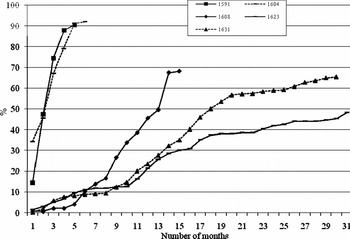
The assessment registers evidence a clear trend in the Gorinchem inhabitants’ timing of their verponding payments (see Figure 2). In the first decades after introduction of the verponding, most people paid relatively promptly. Yet just before the Truce, inhabitants began waiting longer before bringing their contributions to the collector. In the 1630s some people delayed payment for over 30 months.
Moment of payment of the verponding in 1591, 1604, 1608, 1623 and 1631 (accumulated percentages of persons paying per month). Sources: Stadsarchief Gorinchem, inv. nos. 4150, 4166, 4168, 4171 and 4172, Gaarderboeken van de verponding (1591, 1604, 1608, 1623 and 1631).

Taxes did not decrease after the Peace of Munster but tax compliance worsened. There are good reasons to assume that conflicts within the city government undermined the willingness of inhabitants to pay taxes. From 1653 a fierce conflict emerged between two factions within the city government of Gorinchem. The so-called factiestrijd (faction struggle) resulted from competition between members of the local government for lucrative functions inside and outside the town. The collector of the verponding, Arend Van der Colck, was a prominent member of an opposing faction. This greatly hindered collection of the verponding, and arrears of up to 55,000 guilders accumulated during the years of his receivership. Van der Colck was the victim of a riot in 1655, when a mob plundered his house.Footnote 64 Van der Colck's successor faced similar problems in collecting the verponding. In 1657 the city government introduced a new way of ‘execution’: henceforth the front door of the house of any inhabitant who refused payment would be confiscated; it would be returned only after the owner brought his contribution to the city hall. If the owner did not pay within 24 hours, the collector was required to confiscate and auction part of the home's contents.Footnote 65
It is unsurprising that in 1663 the city council decided that the collector would no longer be recruited from among its members. Moreover, they decided that inhabitants would no longer address complaints about the assessment register to members of the city council; instead, such complaints were to be taken to The Hague.Footnote 66 In short, after the Peace of Munster the members of Gorinchem's political elite withdrew from engagement in implementation of direct taxes and no longer engaged their social and moral capital to facilitate efficient collection of taxes. This bottom-up dynamic of the fiscal-military state partially ceased to exist as oligarchic trends undermined the moral and social capital of urban elites. Nevertheless, members of the local government of Gorinchem had lent support in facilitating new ways of taxation in the beginning of the period.
Although the yield of direct taxes covered two-thirds of the contribution from the Quarter of Zutphen to the generality budget, the inhabitants of Doesburg paid only indirect taxes. The war expenses were predominantly borne by the agrarian communities. Only in the last decade of the Revolt did the three Quarters of Guelders accept the proposal of stadhouder Frederic Henry to introduce verponding on land and houses. In 1651 the Quarter of Zutphen finalized preparations for implementing the new tax. Henceforth, the inhabitants of the Quarter had to pay annually 11 per cent of the rental value of their houses and 17 per cent of the rental value of their lands. The inhabitants of Doesburg had to pay 2,829 guilders yearly.Footnote 67
The town government of Doesburg was displeased with the new tax. Along with other ‘small towns’ they complained that its introduction was unnecessary, as many expenses of the Quarter administration were easily reducible. Such expenses included numerous wage and compensation payments for deputies to several meetings within and outside the province. The towns protested that ‘the taxes were not solely used for the financing of defence, as they should be, but frittered away for unnecessary commissions and expenses of the Quarter’.Footnote 68
The complaint of the ‘small towns’ should be regarded against the background of the conflict that had existed since the 1630s between the political elites of the capital town of Zutphen and those of the ‘small towns’. The latter claimed access to the many (lucrative) representative positions at the levels of the Quarter, the province and the generality. As the city government of Zutphen did not meet these demands of the ‘small towns’, they refused to support the introduction of taxes.Footnote 69 In short, during the war a new administrative organization emerged that became an attractive source of income for the urban (and noble) elites of the Quarter. Since the elites of ‘small towns’ were without access to this administrative system, they refused to support the implementation of taxes necessary for its funding.
Hence the city government of Doesburg scarcely supported implementation of the verponding. When deputies of the Court of Guelders arrived in Doesburg in 1648, the burgomasters informed them that the city government could not agree with the assessment register since Doesburg's inhabitants were more burdened than inhabitants of other towns.Footnote 70 In subsequent years, they refrained from paying the contribution to the receiver-general of the Quarter. In 1656, the deputy council of the Quarter contacted the military commander of Doesburg to organize an ‘execution’ of the town. They billeted soldiers in the houses of inhabitants who had refused payment. The city government was furious, as the deputy council had acted without informing the burgomasters and had submitted the town to military control. These actions were a dangerous precedent. The city government feared that the incident stemmed from ‘personal retaliation’: in all likelihood they meant that the city government of Zutphen had been responsible for the unpleasant incident.Footnote 71 Even after these events of 1656, the collection of the verponding did not improve.
Both accounts of the implementation of new direct taxes in Gorinchem and Doesburg point in the same direction. The efforts of members of urban governments were essential in facilitating the large income from taxation in the Dutch Republic. In comparison with England, the local elites, at least at the beginning of the Dutch Revolt, were strong advocates of taxation in order to fund the waging of war. Again, urban autonomy appears to have invigorated processes of state building. However, urban elites ceased to lend their support when they themselves did not profit from increased taxation, such as via lucrative positions or by other remunerations. In this respect, they resembled the position of local elites in France. An important difference with France, however, was that members of the local elites of Dutch towns contributed to the taxes just as their fellow citizens did. Indeed, the fact that members of the urban elite contributed to the taxes stimulated the tax compliance of urban populations.
Conclusions
What do the war experiences of the Dutch garrison towns of Gorinchem and Doesburg demonstrate about the relative impact of urban, bottom-up dynamics in the process of state building? Was the highly decentralized polity of the Dutch Republic capable of initiating the necessary changes in the military, administrative and fiscal organization at a supra-local level in order to endure foreign threats? Was co-operation between the elites of the cities successful or was the lack of a strong ruler a relative disadvantage?
The Dutch Republic was capable of incorporating soldiers into the urban civil societies of both Gorinchem and Doesburg. The inhabitants experienced the quartering of troops as a benefit rather than a burden. The friendly arrangements of the Republic resulted from the broad participation of urban elites in central and provincial decision-making. Notably, urban governments bargained for voluntary billeting and for compensations in exchange for housing soldiers. This fostered good relations between citizens and soldiers. This contrasts sharply with the cities of neighbouring countries, where billeting soldiers remained a burden throughout the seventeenth and eighteenth centuries.
Despite its highly decentralized nature, the Republic was also capable of organizing administrative bodies for the construction and maintenance of fortifications at the provincial and generality level. This was partially the result of top-down initiatives of the stadhouder and bottom-up dynamics of urban governments. Despite the lack of a central ruler, the Republic witnessed an organizational dynamic at a supra-local level.
Taxation increased dramatically in both towns. In Gorinchem, members of the local elite made personal efforts to smooth the introduction and increase of taxes that funded the new military and administrative organization. After a few decades the new state organization began to pay rich awards to the members of the urban elite. They earned remunerations as delegates in various representative bodies or through tax collection. The analysis of the introduction of a land and house tax in Doesburg evidences that local elites refrained from implementation of taxes when they did not profit from the newly emerged state organization. In Gorinchem, tax compliance decreased when local elites conflicted over remunerations that new state organizations paid to members of the local elites. Urban elites in the Dutch Republic, as well as elites elsewhere in Europe, sought profit from increased taxation. Yet they were never exempted from paying the taxes. Their contributions to taxes furthered tax compliance amongst their fellow citizens. Together, these essentially urban dynamics shaped a new state, one that was a strong player in the field of European politics.