Working memory (WM) is viewed as central to the many important cognitive functions that regulate second language (L2) development, particularly at its early stages (e.g., Skehan, Reference Skehan, Granena, Jackson and Yilmaz2016; Wen et al., Reference Wen, Biedroń and Skehan2017). Within instructed second language acquisition (SLA), continuing research efforts have been focused on unearthing how learners’ WM skills are implicated in different learning conditions (see, e.g., Li, Reference Li and Gurzynski-Weiss2017 for an overview), with the larger goal of understanding the joint contributions of learner-internal individual differences and learner-external factors (e.g., type of pedagogical approach) to L2 development. Recently, task modality (i.e., oral vs. written language) has received increased interest, particularly from task-based language learning perspectives, as an important variable hypothesized to impose different cognitive demands on L2 learners (e.g., Gilabert et al., Reference Gilabert, Manchón and Vasylets2016; Kormos, Reference Kormos, Byrnes and Manchón2014; Williams, Reference Williams2012; Zalbidea, Reference Zalbidea2017). The various processes involved in oral and written communication, both of which are ever-present across L2 contexts, have been claimed to draw on differential levels of WM involvement (e.g., Gilabert et al., Reference Gilabert, Manchón and Vasylets2016; Grabowski, Reference Grabowski2010; Kellogg, Reference Kellogg2007). Yet, little empirical attention has been dedicated to investigating how learners’ WM abilities may impact linguistic outcomes derived from oral and written L2 task practice (e.g., Sagarra & Abbuhl, Reference Sagarra and Abbuhl2013), or how they may affect learners’ task experiences, such as their perceptions of the cognitive demands imposed by oral and written tasks.
To help address these gaps, this study sought to examine how individual differences in executive, phonological, and visuospatial WM abilities relate to beginner learners’ L2 morphosyntactic achievement in oral and written task conditions, as well as to their perceptions of task demands (as measured by subjective ratings of required mental effort and task difficulty). To provide a more fine-grained assessment of the associations between WM and L2 grammar achievement, two target structures varying in relative salience were considered in the study.
Background
Theoretical framework: Working memory and SLA
WM comprises “the temporary storage and manipulation of information that is assumed to be necessary for a wide range of complex cognitive activities” (Baddeley, Reference Baddeley2003, p. 189). Cognitive-oriented accounts of SLA, which hold that some degree of attention is necessary for L2 development, view WM as playing a core role in L2 learning, particularly at the initial stages of SLA. WM leads the processes of attention and noticing of L2 forms that occur during initial input processing (Wen et al., Reference Wen, Biedroń and Skehan2017) and also plays an integral role in establishing form-meaning associations (VanPatten, Reference VanPatten and VanPatten2004). In line with this account, Leow (Reference Leow2015) notes that L2 forms in the input that do not receive enough attention or are not consciously processed in WM may eventually be discarded, without any chances of being internalized; in contrast, processing L2 forms with higher depth of processing, in ways that promote L2 development, will entail greater WM involvement. In his aptitude model, Skehan (Reference Skehan, Granena, Jackson and Yilmaz2016) expands this view by considering the contributions of WM to numerous L2 cognitive processes found in both earlier stages (e.g., noticing, pattern recognition) and later stages (e.g., retrieval, error avoidance) of L2 development. Given its manifold roles in SLA, WM is often viewed as a “central component of … language aptitude” (Miyake & Friedman, Reference Miyake, Friedman, Healy and Bourne1998, p. 340), and is found to be largely predictive of L2 proficiency (Linck et al., Reference Linck, Osthus, Koeth and Bunting2014).
Although several models of WM are available (see Sagarra, Reference Sagarra and Chapelle2013), Baddeley’s (Reference Baddeley2007, Reference Baddeley2017) multicomponent model of WM is arguably the most widely assumed in SLA. It proposes a domain-general attentional control system, the central executive, and two independent domain-specific storage systems that briefly hold information in memory, namely, the phonological loop and the visuospatial sketchpad. A fourth component was proposed by Baddeley (Reference Baddeley2000), the episodic buffer, which serves as an interface between the subsystems and long-term memory. The model is hierarchical, with systems operating rather independently.
The central executive component is responsible for controlling attention and “coordinates the flow of information between its slave systems …, determines what information is selected and inhibited, and decides when to shift between tasks or retrieval strategies” (Sagarra, Reference Sagarra and Chapelle2013, p. 1). This component has limited capacity and its level of involvement is determined by the executive attention demands of tasks (Conway et al., Reference Conway, Kane, Bunting, Hambrick, Wilhelm and Engle2005). Because the central executive (henceforth executive WM) is robustly implicated in complex cognition (Baddeley, Reference Baddeley2003), research has shown that executive abilities play a role in numerous L2 skills, including reading comprehension (e.g., Abu-Rabia, Reference Abu-Rabia2003), accuracy and complexity in language production (e.g., Zalbidea, Reference Zalbidea2017), and, of relevance to this study, L2 grammar development (e.g., Lado, Reference Lado2017; Li et al., Reference Li, Ellis and Zhu2019; Serafini & Sanz, Reference Serafini and Sanz2016). Executive WM is commonly measured using complex span tasks, such as reading or listening span tasks (Daneman & Carpenter, Reference Daneman and Carpenter1980) or an operation span task (Turner & Engle, Reference Turner and Engle1989). Both reading/listening and operation span tasks require participants to hold elements (e.g., words) in memory (storage component) while performing a secondary task (processing component), albeit they differ regarding their language dependency: In the reading or listening span tasks, participants judge sentences (verbal task), whereas in the operation span task, they solve math equations (nonverbal task). Although both verbal and nonverbal tasks are predictive of L2 outcomes (e.g., Linck et al., Reference Linck, Osthus, Koeth and Bunting2014), nonverbal tasks can be advantageous for avoiding confounds with language proficiency (e.g., Engle, Reference Engle2002). Recent versions of the operation span task also ask participants to memorize letters (e.g., Unsworth et al., Reference Unsworth, Heitz, Schrock and Engle2005) or other entities (e.g., Hicks et al. [Reference Hicks, Foster and Engle2016] employed Klingon characters) instead of words to avoid confounds with vocabulary knowledge.
The phonological loop comprises a phonological store, which transiently holds phonological information in memory, and a mechanism for articulatory rehearsal similar to internal speech that strengthens weakening memory traces. The loop is also limited in capacity, given that verbal stimuli is held in memory only for a few seconds unless rehearsed. Phonological WM has been related to a multitude of language functions and is argued to be “a good predictor of the ability of children and adults to learn a second language” (Baddeley, Reference Baddeley2003, p. 832). Phonological WM contributes to L2 vocabulary acquisition (e.g., Papagno et al., Reference Papagno, Valentine and Baddeley1991) and fluency development (e.g., O’Brien et al., Reference O’Brien, Segalowitz, Freed and Collentine2007), as well as L2 grammar learning (e.g., N. Ellis & Sinclair, Reference Ellis and Sinclair1996; Martin & N. Ellis, Reference Martin and Ellis2012; Serafini & Sanz, Reference Serafini and Sanz2016; Williams & Lovatt, Reference Williams and Lovatt2003). Short-term phonological capacity (henceforth phonological WM) is commonly measured using nonword recognition and nonword repetition tasks tapping into participants’ auditory storage capacity. Recognition tasks ask participants to judge if two strings of nonwords are presented in the same order, whereas repetition tasks prompt participants to repeat strings of nonwords out loud. Although repetition tasks continue to be most widely used in the field, they have been subject to criticism on account of the articulatory demands of the task, which may conceal memory abilities (O’Brien et al., Reference O’Brien, Segalowitz, Collentine and Freed2006, Reference O’Brien, Segalowitz, Freed and Collentine2007). Hence, recognition tasks are often considered a more accurate or reliable estimate of individuals’ phonological WM (e.g., Martin & N. Ellis, Reference Martin and Ellis2012; O’Brien et al., Reference O’Brien, Segalowitz, Collentine and Freed2006, Reference O’Brien, Segalowitz, Freed and Collentine2007).
The visuospatial sketchpad is theorized to hold the same function as the phonological loop, but for visual and spatial stimuli (Baddeley, Reference Baddeley2017). To date, however, much less is known about the mechanisms of the sketchpad, relative to the central executive and the loop. Even though the sketchpad does not appear to comprise an independent subsystem for rehearsal, as does the loop, rehearsal in the sketchpad “appears to depend on a process sometimes known as ‘refreshing’, involving sustained attention to a selected item” (Baddeley, Reference Baddeley2017, p. 303). Baddeley (Reference Baddeley2003) suggests that visuospatial WM may be implicated in “everyday reading tasks, where it may be involved in maintaining a representation of the page and its layout” (p. 200). Visuospatial WM may also contribute to the acquisition of new scripts or orthographies (Baddeley, Reference Baddeley, Wen, Borges Mota and McNeill2015). A widespread measure of visuospatial short-term memory (henceforth visuospatial WM) is the Corsi block-tapping task (e.g., Kessels et al., Reference Kessels, Van Zandvoort, Postma, Kappelle and De Haan2000). This task, designed as the visuospatial counterpart of phonological WM span tasks, requires participants to retain in memory and subsequently reproduce increasingly longer sequences of visual blocks.
In sum, all components in Baddeley’s model are hypothesized to play some role in language, albeit to a different degree (Baddeley, Reference Baddeley2017). In the following section, we discuss the contributions of WM abilities to L2 development in more detail, with particular attention to how these contributions may differ by relevant task- and form-related factors, such as task modality and target form salience, both of which are variables of interest in the present study.
Memory demands, task modality, and salience in SLA
In the context of cognitive-oriented L2 research, continuing empirical efforts have been dedicated to examining how WM abilities affect L2 development under different pedagogical conditions and for various linguistic targets. Such research is important both from a theoretical and a pedagogical standpoint, as it contributes to refining our understanding of how learners’ cognitive capacities underlie the development of different types of L2 knowledge and skills (e.g., DeKeyser, Reference DeKeyser2012; Skehan, Reference Skehan, Granena, Jackson and Yilmaz2016). It also helps unearth the cognitive burden posed on learners by different L2 task variables, which can inform task sequencing and design decisions (e.g., Robinson, Reference Robinson2003). Against this background, multiple studies have investigated how WM effects may be modulated by the presence of corrective feedback (e.g., recasts) (e.g., Li, Reference Li2013; Révész, Reference Révész2012; see Li, Reference Li and Gurzynski-Weiss2017, for a meta-analytic review), the inclusion of explicit grammatical information (e.g., Lado, Reference Lado2017; Sanz et al., Reference Sanz, Lin, Lado, Stafford and Bowden2014) and, to a much lesser extent, the modality (i.e., oral vs. written) of L2 tasks (e.g., Sagarra & Abbuhl, Reference Sagarra and Abbuhl2013). Scant research has also considered the role of WM abilities alongside relevant linguistic factors, such as the degree of salience of the target form (e.g., Yilmaz, Reference Yilmaz2013). We turn to reviewing empirical WM studies that have examined the role of task modality and target structure salience in detail because these are of primary focus in the present study.
Task-related factors: Modality and working memory
Given that oral and written tasks are hypothesized to pose differential L2 processing constraints, modality emerges as a highly relevant task-related variable to consider in relation to WM. Recent accounts in SLA hold that tasks performed in the oral modality should pose a greater burden on learners’ WM (e.g., Gilabert et al., Reference Gilabert, Manchón and Vasylets2016; Kormos, Reference Kormos, Byrnes and Manchón2014; Williams, Reference Williams2012), due to the heightened temporal demands that exist for producing oral output and processing auditory input in this medium. The nonvisual nature of oral language is also claimed to increase input processing demands in this modality, as “new forms stay available for noticing for just a fraction of a second” (Gilabert et al., Reference Gilabert, Manchón and Vasylets2016, p. 123). In contrast, other accounts suggest that writing can pose heavier demands on learners’ attentional resources relative to speaking (Kellogg, Reference Kellogg2007), given that writing proceeds slower and arguably with greater control, and also entails activating graphemic representations for spelling (e.g., Grabowski, Reference Grabowski2010; Sauerland & Sporer, Reference Sauerland and Sporer2011). With reference to specific WM components, Kellogg (Reference Kellogg, Levy and Ransdell1996) suggests that formulating a verbal message in writing can place substantial demands on WM because this process draws from individuals’ visuospatial WM resources in addition to executive and phonological WM resources.
Despite the existing hypotheses and the ubiquity of oral and written language across multiple L2 learning contexts, scant research has examined WM in relation to the modality of pedagogic tasks in SLA. In an early study, Payne and Whitney (Reference Payne and Whitney2002) investigated the contributions of WM abilities, as measured by a reading span test (executive WM) and a nonword repetition test (phonological WM), to L2 Spanish oral proficiency development. Participants completed interactive tasks in the oral face-to-face modality or a combination of oral and written text-based chat modality. Proficiency was gauged using the American Council on the Teaching of Foreign Languages Oral Proficiency Interview. Findings revealed positive relationships between oral proficiency improvements and phonological WM abilities in both modality groups, although the magnitude of this association was descriptively larger in the face-to-face condition. This led the researchers to suggest that learners with lower phonological WM abilities may benefit more from L2 interaction in the text-chat modality.
In a more recent study, Sagarra and Abbuhl (Reference Sagarra and Abbuhl2013) examined whether learners’ WM capacity as measured by an L1 reading span test (executive WM) affected the extent to which they benefitted from oral and written recasts with various manipulations (e.g., input enhancement). The target forms comprised L2 Spanish gender and number agreement, and recasts were provided within a computerized fill-in-the-blank activity where participants supplied the accurate form of the adjective accompanying a noun. L2 outcomes were assessed with written fill-in-the-blank and oral interactive production tasks. Findings indicated that executive WM capacity was positively associated with L2 written and oral production gains in the oral recast condition only. The researchers proposed that processing oral feedback may impose a heavier processing burden compared to written feedback.
Findings from earlier studies provide some evidence to suggest that WM abilities may play a more determining role in L2 learning through oral tasks relative to written tasks. Nonetheless, more empirical research considering a range of WM measures (including nonverbal measures) tapping into executive, phonological, and visuospatial components is needed to reach a more fine-grained understanding of the contributions of WM alongside modality. Evidence from studies administering both productive and receptive assessment tests in both modalities would also be desirable, as some research has shown that the involvement of WM resources can vary with type of assessment (e.g., Révész, Reference Révész2012).
Form-related factors: Salience and working memory
The notion of target structure salience, which refers to the perceptual, functional-semantic, or other properties that are intrinsic to linguistic forms, has been central in cognitive-oriented L2 research for more than a decade. VanPatten (Reference VanPatten and VanPatten2004) notes that forms with lower perceptual salience “may be skipped over or only partially processed and then dumped from working memory” (p. 8). At the same time, forms that are less salient because their meaning is more opaque or ambiguous (DeKeyser, Reference DeKeyser2005) may require that learners expend a greater amount of cognitive effort in decoding their more complex form-to-meaning associations. These statements have been recently echoed by Leow (Reference Leow2015).
Despite the central relevance of intrinsic salience, we are aware of only one study (Yilmaz, Reference Yilmaz2013) that has considered the contributions of WM abilities alongside target structure salience. Yilmaz (Reference Yilmaz2013) examined whether participants’ executive WM, as measured by an operation span task, impacted their gains on two grammatical forms differing in perceptual salience and L1–L2 similarity in L2 Turkish. Treatment comprised an information-gap activity, which participants completed in one of three conditions: with no feedback, with feedback in the form of recasts, or with feedback in the form of explicit corrections. Learning was assessed using oral production and comprehension tasks as well as a written recognition task. Executive WM abilities were positively associated with L2 development, but only for the more salient structure, which was the only target form for which participants experienced significant L2 improvement. Additionally, in the no-feedback condition, participants with higher span scores were found to outperform participants with lower span scores. Yilmaz’s study highlights the importance of considering the inherent properties of target forms in this domain of research; however, it did not set out to examine the relationship between WM abilities and L2 outcomes in different task modalities. Given the theoretical proposals concerning WM and modality, it is plausible that the greater WM demands arguably required for learning less salient target structures are reduced in the written modality on account of learners’ access to more permanent, visual input.
A review of prior cognitive-oriented L2 research also shows that this domain has primarily investigated learner individual WM differences as they pertain to executive WM (e.g., Li et al., Reference Li, Ellis and Zhu2019; Sagarra & Abbuhl, Reference Sagarra and Abbuhl2013; Yilmaz, Reference Yilmaz2013), with less empirical attention directed at phonological WM (e.g., Payne & Whitney, Reference Payne and Whitney2002; Révész, Reference Révész2012). Nonetheless, visuospatial WM continues to be, by far, the less researched WM component. Indeed, we are aware of only one L2 development study (Sachs, Reference Sachs2010, focused on type of feedback and L2 development) exploring the relevance of visuospatial WM, despite the fact that this WM component can expectedly play a role in pedagogic L2 tasks that draw on visual memory (e.g., Kellogg, Reference Kellogg, Levy and Ransdell1996, Reference Kellogg2007). In the present study, we explore the contributions of executive, phonological, and visuospatial WM for the development of higher- and lower-salience L2 forms through oral and written task practice.
Memory demands and learner task perceptions in SLA
In addition to examining how WM capacity relates to L2 outcomes across pedagogic task conditions, it is also useful to consider how learners’ individual cognitive abilities may relate to their perceptions of task demands. Within task-based language teaching research, studies often gather information on task demand perceptions by administering subjective self-rating scales where learners indicate how much mental effort the task required and how difficult they found the task to be. Ratings of perceived mental effort have been shown to be valid and reliable indicators of overall cognitive load (e.g., Paas & van Merriënboer, Reference Paas and van Merriënboer1994; Révész et al., Reference Révész, Michel and Gilabert2016; Sasayama, Reference Sasayama2016), and are usually positively associated with perceived task difficulty ratings (Robinson, Reference Robinson2001), although the notions of mental effort and task difficulty are not considered structurally equivalent (e.g., Brünken et al., Reference Brünken, Seufert, Paas, Plass, Moreno and Brünken2010; Révész et al., Reference Révész, Michel and Gilabert2016).
Of relevance to this study, cognitive load is expected to reflect the interplay between task-generated processing requirements and learners’ individual characteristics, such as their L2 knowledge or their cognitive abilities (Bachman, Reference Bachman2002; Paas & van Merriënboer, Reference Paas and van Merriënboer1994). Hence, the extent to which learners’ WM or attentional resources can effectively address the various content and linguistic demands imposed by tasks is estimated to affect their linguistic outcomes (e.g., Robinson, Reference Robinson2003), and, expectedly, their task perception ratings. More specifically, L2 task conditions theorized to pose higher and lower attentional demands, such as tasks differing in output and input modality (e.g., Cho, Reference Cho2018), might be perceived as differentially demanding or difficult depending on learners’ WM skills (e.g., Robinson, Reference Robinson2003). This information, along with an exploration of how cognitive resources impact actual L2 performance, can provide a more fine-grained understanding of the extent to which different WM components contribute to shaping learners’ task experiences and their opportunities for L2 development across different modality conditions. Such an approach was adopted in the present study.
The current study
To address the gaps outlined in the preceding text on the contributions of learners’ WM abilities to L2 development across modalities, the following research questions were formulated:
1. To what extent do learners’ executive, phonological, and visuospatial WM abilities predict posttest L2 outcomes drawn from oral and written tasks focused on more and less salient L2 grammar?
2. To what extent do learners’ executive, phonological, and visuospatial WM abilities predict ratings of task demands on oral and written tasks focused on more and less salient L2 grammar?
To jointly advance knowledge in the domains of WM, modality, and salience in SLA, the present study (a) employed WM measures that tapped into executive, phonological, and visuospatial memory abilities; (b) considered modality as a relevant factor associated with both the treatment and the assessment tasks; (c) gathered information on learners’ ratings of perceived mental effort and task difficulty; and (d) targeted two grammatical structures differing along major dimensions of intrinsic salience (perceptual, functional-semantic). Regarding the WM measures of the study, we administered complex and simple span tasks that could control for individual differences in potential confounding factors (e.g., word knowledge, articulatory demands), as identified in prior literature (e.g., Gathercole et al., Reference Gathercole, Pickering, Hall and Peaker2001; Unsworth et al., Reference Unsworth, Heitz, Schrock and Engle2005): Executive WM was gauged using a letter-based automated operation span task (Unsworth et al., Reference Unsworth, Heitz, Schrock and Engle2005), phonological WM was measured with a nonword recognition task (e.g., O’Brien et al., Reference O’Brien, Segalowitz, Collentine and Freed2006, Reference O’Brien, Segalowitz, Freed and Collentine2007), and visuospatial WM was estimated using a forward Corsi block-tapping task (e.g., Kessels et al., Reference Kessels, Van Zandvoort, Postma, Kappelle and De Haan2000).
Method
Participants
Participants were beginning-level learners of L2 Spanish enrolled in introductory-level Spanish foreign language courses at a northeastern US university. Extra credit was awarded for participation in the study. Participant sample selection followed from previous research indicating that individual differences in WM resources are most relevant for L2 development among lower-level L2 learners (e.g., Serafini & Sanz, Reference Serafini and Sanz2016). Participants were randomly assigned to a Speaking or a Writing group, as further detailed in the Procedure and Materials section. After applying a set of exclusion criteria,Footnote 1 L2 performance data from 58 participants (M age = 19.09, SD = 1.35, 37 female) were retained for analysis (Speaking group: n = 28; Writing group: n = 30). A total of 49 participants were enrolled in a first-semester Spanish course, whereas nine participants (Speaking group: n = 5, Writing group: n = 4) were enrolled in a second-semester Spanish course. Both courses followed comparable teaching approaches and met for about 3 hours/week (i.e., the equivalent of 3 credit hours).
Most participants were native English speakers (n = 48), and four reported a second native language in addition to English (Arabic, Greek, Patois, Romanian). Six participants reported Chinese (n = 2), Amharic, Bahasa Indonesia, Turkish, and Urdu as their only native language, but also indicated an early age of exposure to English (M age = 4.58, SD = 1.20). Participants’ language background in the Speaking and Writing groups was comparable in terms of number of foreign languages (Speaking: M(SD) = 1.54 (.79); Writing: M(SD) = 1.40 (.56)), years of Spanish education (Speaking: M(SD) = 3.02 (3.00); Writing: M(SD) = 3.65 (3.32)), age of exposure to Spanish (Speaking: M(SD) = 14.86 (4.30); Writing: M(SD) = 14.60 (4.64)), and overall self-rated Spanish proficiency on a 10-point Likert scale (Speaking: M(SD) = 3.56 (1.45); Writing: M(SD) = 4.02 (1.82)). No significant differences were found between groups for any of these variables.Footnote 2
Target structures: More and less salient forms
Two grammatical constructions were targeted in Spanish: the simple future tense, as shown in (1), and the indirect object clitic, as shown in (2), both in the third-person singular and plural forms:
(1) Él preparará una cena
He prepare-3RD.SING.FUT. a dinner
He will prepare a dinner meal
(2) Ella le da un abrazo
She him/her-3RD.SING.DAT. give a hug
She gives him/her a hug
The future tense involves an inflectional morpheme affixed to an infinitive verb, while the clitic appears as a preverbal dative pronoun in double object constructions. Beyond these morphosyntactic differences, these target forms were selected because they also differ substantially in terms of intrinsic salience, and thus in the likelihood that they will be noticed and further processed in learners’ WM (e.g., N. Ellis, Reference Ellis, Hundt, Mollin and Pfenninger2017; Leow, Reference Leow2015; VanPatten, Reference VanPatten and VanPatten2004).
Given the multidimensional and relative nature of the notion of target form salience, we followed Yilmaz (Reference Yilmaz2013) in operationalizing it with regard to specific salience dimensions: From a perceptual perspective, several factors contribute to making the future form easier to hear or see (Goldschneider & DeKeyser, Reference Goldschneider and DeKeyser2001), and thus more physically salient, relative to the clitic form: stress (both phonetic and visual, with a written accent); sonority, given the presence of a low central vowel (i.e., the highest-ranked phone in Laver’s [Reference Laver1994] scale); and lack of prosodic dependence to another sentential element (in contrast to the clitic form, which is unstressed and depends on the adjacent verb). From a functional-semantic perspective, the meaning of the future form can be more easily deduced from the input (e.g., Bulté & Housen, Reference Bulté, Housen, Housen, Kuiken and Vedder2012; DeKeyser, Reference DeKeyser2005; N. Ellis, Reference Ellis, Hundt, Mollin and Pfenninger2017; VanPatten, Reference VanPatten and VanPatten2004), which also increases this form’s salience relative to the clitic form. Whereas the future form is rather transparently associated with the absolute meaning of futurity expressed by temporal adverbs, the clitic form has low semantic weight (e.g., Ortega & Long, Reference Ortega and Long1997) relative to other elements in the sentence and, in double object constructions, there are other nouns besides the indirect object (e.g., the subject) that learners may potentially interpret as the target coreferent. In view of these differences, L2 Spanish learners are expected to face greater challenges in learning the clitic form relative to the future form (e.g., Housen & Simoens, Reference Housen and Simoens2016). Indeed, prior instructed L2 research has shown that learners tend to face difficulties in their command of Spanish clitic structures (e.g., Ortega & Long, Reference Ortega and Long1997; VanPatten, Reference VanPatten and VanPatten2004), but not future tense morphology (e.g., Leeser, Reference Leeser2007; Russell, Reference Russell2014).
Procedure and materials
The study followed a pretest-posttest-delayed posttest design. There were approximately 2 weeks between sessions. In the first session, participants completed a language background questionnaire, the pretest production and written and aural acceptability judgment tasks, and a measure of executive WM. In the second session, participants completed the treatment (i.e., focused tasks introducing the target structures), responded to the task perception scales, and completed immediate posttests. Lastly, in the third session, participants completed the delayed posttests and measures of phonological and visuospatial WM. They also responded to an exit questionnaire, where they indicated if they had looked up any information about the target structures outside of the testing sessions. We describe each design component in detail in the following text (for study materials, see https://www.iris-database.org).
L2 treatment: Focused tasks
As noted earlier, participants were randomly assigned to a Speaking group or a Writing group, which differed only in terms of the modality in which output was produced (i.e., orally, by speaking out loud into a microphone, or in written form, by typing into a textbox, respectively) and input (feedback) was delivered (i.e., auditorily or visually) throughout treatment. In the pretask phase, all participants read a story in English about a lab scientist who recently discovered a chemical substance that can impart superpowers to humans. Rumors about a planned robbery to steal the substance have reached the scientist, who is requesting participants’ assistance in determining which of two suspects may be behind the robbery. During the pretask, participants read through the background story (see Figure 1) and instructions at their own pace and completed practice items in English.
Sample pretask slides.

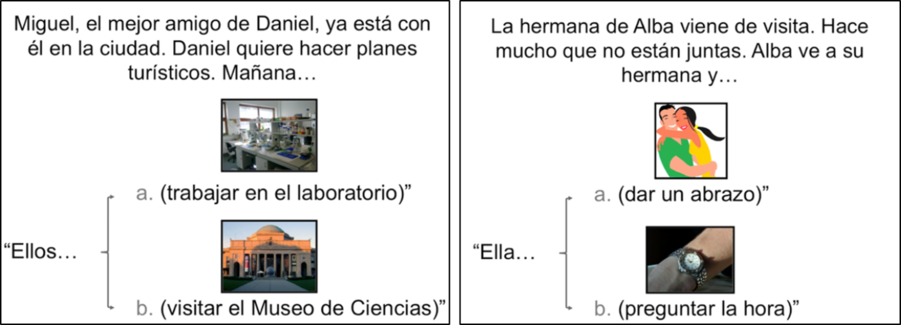
Next, they completed two focused tasks, where they performed as detectives while they gathered information about the two suspects. Tasks were computerized in SuperLab (Cedrus, San Pedro, CA) and participants advanced through them at their own pace. One focused task introduced participants to the future form through the male suspect’s routine, and the other focused task introduced them to the clitic form through the female suspect’s routine. Tasks followed the same design and were administered in a counterbalanced order. For each task item, participants were asked to read a brief prompt about the suspect’s routine and then select which of two possible events provided a logical follow-up to the prompt (see Figure 2). In both modality groups, participants produced a sentence that incorporated their chosen event. In the Speaking group, participants said the sentence out loud into a microphone; in the Writing group, participants typed the sentence into a textbox at the bottom of the screen. As shown in Figure 2, participants were not provided with the target forms in the response slides, but were instead required to formulate any forms that they deemed necessary on their own. After producing each sentence, both groups were exposed to the same targetlike utterances that modeled the use of each structure (e.g., “Él correrá en el parque,” He will run in the park; “Ella le da un abrazo,” She gives her a hug) as feedback, either in auditory (Speaking group) or written form (Writing group). The task did not provide participants with any explicit information about the structures. Each task included 20 items (16 critical and 4 distractors; half singular, half plural). Verbs and other task vocabulary were extracted from the first three chapters of participants’ Spanish textbook. Target verbs included in the treatment and the assessment for the future form contained regular verb stems. Both target structures appeared as the second element in each sentence, which allowed us to account for sentential position as an additional salience dimension.
Sample items in the future-focused (left) and clitic-focused (right) treatment tasks.

To create a larger nonlinguistic goal for completion of the focused task practice (R. Ellis, Reference Ellis2003), participants wrote a short detective report in English for the scientist indicating who they thought was behind the planned robbery and why. This report was completed after performing both tasks and responding to the task perception scales.
Perceived mental effort and task difficulty scales
Immediately after completing each focused task, participants indicated how much mental effort they perceived the task required and how difficult they found the task, using a 9-point Likert scale questionnaire (e.g., 1 = The task was very easy; 9 = The task was very difficult).Footnote 3
L2 assessment
Learners’ L2 grammar development was measured using tests of production and acceptability judgment, as described in the following text.
Production
In the production task, participants were required to read a brief prompt and form a logical follow-up sentence using the information provided in each slide, similar to the focused task used for treatment (although only one event was provided). Three versions of the task were designed, with their administration counterbalanced across sessions and groups. The production assessment included a total of 32 items, 16 focused on each target structure (12 critical items and 4 distractors). Half of the items required oral production, and the other half required written production. The written portion was administered first. All items targeted novel sentences.
Written and aural acceptability judgment
In each acceptability judgment task (AJT), participants were asked to judge the grammatical acceptability of several sentences after reading (written AJT) or listening (aural AJT) to them. Tasks were untimed. Two versions of each task were created and administered in a counterbalanced design. Each participant completed one version in the pretest, the other version in the posttest, and the first version again in the delayed posttest. Each AJT included 24 items, with 12 sentences targeting each of the structures (10 critical and 2 distractor items). Half of the items were acceptable, and half were unacceptable. The AJT stimuli included novel sentences that were not present during treatment. For the future form, utterances differed from treatment in terms of subject number and temporal adverb; for the clitic form, sentences differed in terms of subject and clitic number, as well as in the noun corresponding to the indirect object. One new verb per target form was incorporated in the task.
Working memory measures
Three WM measures were administered to gauge executive, phonological, and visuospatial WM, as further described in the following text.
Executive working memory
Executive WM was measured using an automated operation span task (AOSpan) (Unsworth et al., Reference Unsworth, Heitz, Schrock and Engle2005). The task was administered on the computer using Inquisit Web 5.0.10 and asked participants to solve math equations while maintaining random sets of 3–7 letters in memory. Three sets of each set size were included in the test. Participants were presented with a math problem and, subsequently, they were shown a proposed solution. They were first asked to decide whether the proposed solution was accurate, and were subsequently presented with a letter to keep in memory. After a series of equations, participants were asked to recall the letter set in the observed sequence by selecting the corresponding letters from a letter matrix provided by the program. The test session was preceded by a practice session of letter recall, math task, and a final combined letter recall practice in which each letter was preceded by a math problem. The program instructed participants to solve the math equations as rapidly and accurately as possible. The task also informed participants about the 85% math accuracy criterion (Unsworth et al., Reference Unsworth, Heitz, Schrock and Engle2005).
Phonological working memory
A serial nonword recognition test (NWRT) (e.g., Martin & N. Ellis, Reference Martin and Ellis2012; O’Brien et al., Reference O’Brien, Segalowitz, Collentine and Freed2006, Reference O’Brien, Segalowitz, Freed and Collentine2007) was employed as a measure of phonological WM. The test, which was administered using SuperLab, required participants to judge if the second presentation of a series of nonwords was the same or different from the first presentation. The list of items used in the test was the same as the one in O’Brien et al. (Reference O’Brien, Segalowitz, Collentine and Freed2006) (see also, Gathercole et al., Reference Gathercole, Pickering, Hall and Peaker2001) and consisted of single-syllable nonwords (e.g., “teck,” “padge”) (see Moorman, Reference Moorman2017). Eight lists of nonwords were included in the test, each with five, six, or seven items, for a total of 24 critical trials. There were 750 milliseconds of silence in between nonwords, and 1,500 milliseconds of silence in between the first and the second presentation of each nonword. The task was self-paced, following administration guidelines in O’Brien et al. (Reference O’Brien, Segalowitz, Collentine and Freed2006, Reference O’Brien, Segalowitz, Freed and Collentine2007).
Visuospatial working memory
The Corsi forward block-tapping task (e.g., Kessels et al., Reference Kessels, Van Zandvoort, Postma, Kappelle and De Haan2000), administered on the computer using Inquisit Web 5.0.10, was used as a measure of visuospatial WM. In this task, which has been validated as an indicator of the visuospatial sketchpad capacity (Hanley et al., Reference Hanley, Young and Pearson1991), participants saw patterns of nine blocks on the screen, which lit up in a sequence. Participants were asked to click on the blocks replicating the same sequence in which they were lit. Block sequences increased from two to nine throughout the task and participants had up to two opportunities to respond to each sequence length.
Coding and scoring
L2 assessment
Production accuracy was coded by awarding 1 point for each correctly produced critical item. Half a point was awarded for future or clitic form production and half a point for morphosyntactic accuracy of the target structure. Accent marks were not considered as part of the production scoring protocol. A second researcher coded 10% of the data, selected from the broader dataset of the research project to which this study belongs (see Zalbidea, Reference Zalbidea2020), yielding an intercoder agreement of 99.69%. For the written and aural AJTs, participants received 1 point for each correctly judged critical sentence. Reliability was computed over the immediate and delayed posttests: Cronbach’s alpha was .78 and .69 in the written AJT and .57 and .69 in the aural AJT for the future and clitic forms, respectively. Considering that lower alpha values may be registered with less proficient learner samples (see Plonsky & Derrick, Reference Plonsky and Derrick2016), these indices were deemed acceptable for the study.
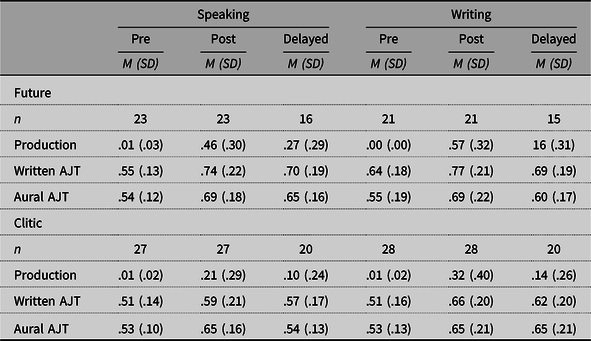
Descriptive statistics for each modality group’s pre-, post-, and delayed posttest performance in the assessment tasks are displayed in Table 1. Both groups experienced descriptive accuracy improvements over time, particularly for the more salient future form. Following studies with a similar research focus (e.g., Li et al., Reference Li, Ellis and Zhu2019), we report descriptive but no inferential statistics on these accuracy data (for the latter, see Zalbidea, Reference Zalbidea2020), as our research questions here centered on the associations between WM measures and L2 outcomes under different modality conditions, as opposed to differences in L2 outcomes between conditions.
Descriptive statistics for the L2 assessment measures

Perceived mental effort and task difficulty scales
Average ratings were calculated for each modality group and focused task. In the Speaking group, participants’ ratings of perceived mental effort averaged 5.14 (SD = 1.73) and 5.65 (SD = 1.44) for the future- and clitic-focused task, respectively. In the Writing group, perceived mental effort ratings averaged 5.55 (SD = 1.54) and 5.57 (SD = 1.50). Regarding perceived task difficulty, the Speaking group’s ratings averaged 4.91 (SD = 1.57) and 5.50 (SD = 1.36) for the future- and clitic-focused tasks, respectively. In the Writing group, task difficulty ratings averaged 5.25 (SD = 1.82) and 5.21 (SD = 1.55) for each task.
Working memory measures
Participants’ AOSpan performance comprised two component scores automatically calculated by the program: a storage component represented by individuals’ total AOSpan score, and a processing component, corresponding to their total math errors. The total AOSpan score is the total sum of correctly recalled letters, while the total math errors represent a combination of both accuracy and speed errors in the math section. Given the dual-task nature of the AOSpan, both scores were considered here so as to capture the storage and the processing dimensions of the task. Performance on the serial NWRT was coded by awarding 1 point for each correctly recognized (i.e., same/different order) set of nonwords, following O’Brien et al. (Reference O’Brien, Segalowitz, Collentine and Freed2006, Reference O’Brien, Segalowitz, Freed and Collentine2007).Footnote 4 Because a technical lapse resulted in SuperLab saving responses to only 23 out of the 24 trials for some participants, average scores were calculated for each individual learner. Lastly, participants’ Corsi block span was automatically calculated by the program. The Corsi span comprises the longest sequence of blocks that participants were able to reproduce (e.g., Kessels et al., Reference Kessels, Van Zandvoort, Postma, Kappelle and De Haan2000).
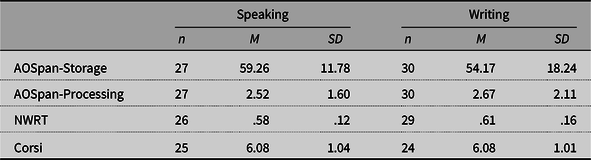
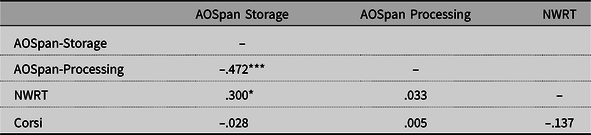
Descriptive statistics for participants’ performance in the WM tests are summarized in Table 2.Footnote 5 No significant differences were found between the Speaking and Writing groups’ WM scores for any measure: AOSpan-Storage (F(1,55) = 1.53, p = .222), AOSpan-Processing (F(1,55) = .09, p = .768), NWRT (F(1,53) = .83, p = .366), or Corsi block span (F(1,47) < .001, p = .991). Correlations among the various WM measures of the study were also computed, as shown in Table 3. Participants’ AOSpan-Storage scores were positively correlated with their NWRT scores, and negatively correlated with their AOSpan-Processing scores. Given the moderate yet inverse association found between the total span and math errors in the AOSpan task, which is suggestive of a trade-off (Conway et al., Reference Conway, Kane, Bunting, Hambrick, Wilhelm and Engle2005), the principal component of participants’ storage and processing scores (calculated using direct oblimin rotation) was employed as a measure of executive WM in subsequent analyses.
Descriptive statistics for the WM measures

Correlation matrix: Executive, phonological, and visuospatial WM measures

Note: ***p < .001; *p < .05.
Analysis
To answer the first research question, multivariate regression analyses were conducted on the immediate and delayed production and judgment accuracy data to determine which WM measure(s) best predicted posttest L2 achievement in each modality group. To answer the second research question, analogous regression analyses were run with participants’ ratings in the perceived mental effort and task difficulty scales as the criterion variables. Models were built using the best-subsets regression method, following Lado (Reference Lado2017). To avoid potential overfitting, Akaike’s Information Criterion with small-sample correction (AICc) was used for variable selection (Burnham & Anderson, Reference Burnham and Anderson2002). Separate models were computed for each target structure. Predictor variables included participants’ AOSpan component scores for executive WM, NWRT scores for phonological WM, and Corsi block span scores for visuospatial WM. Pretest performance was also included in the models (e.g., Li et al., Reference Li, Ellis and Zhu2019). Assumptions for multiple regression were checked following Jeon (Reference Jeon and Plonsky2015).Footnote 6
Results
L2 achievement on more and less salient forms
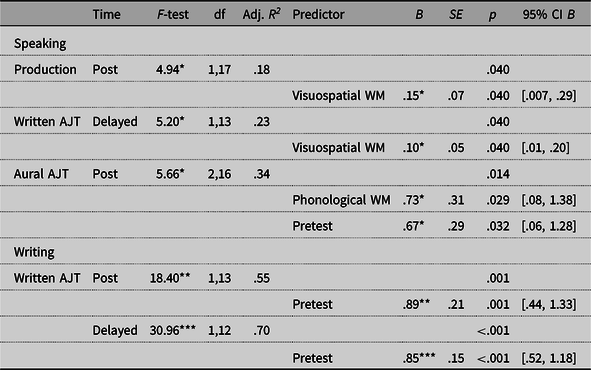
Significant best-subtests regression models for the more salient future form are displayed in Table 4. Results revealed that WM abilities contributed significantly to posttest performance only in the Speaking group. Specifically, the model for immediate future form production accuracy and delayed written acceptability judgment accuracy explained approximately 18% and 23% of variance, respectively, with visuospatial WM as a single positive contributor in both cases. Additionally, the model for immediate aural acceptability judgment accuracy explained approximately 34% of variance, with both phonological WM and pretest performance as significant positive predictors. In the Writing group, only pretest performance was found to be a significant positive predictor of immediate and delayed posttest scores.
Future form: Best-subsets regression models for posttest scores

Note: ***p < .001; **p < .01; *p < .05.
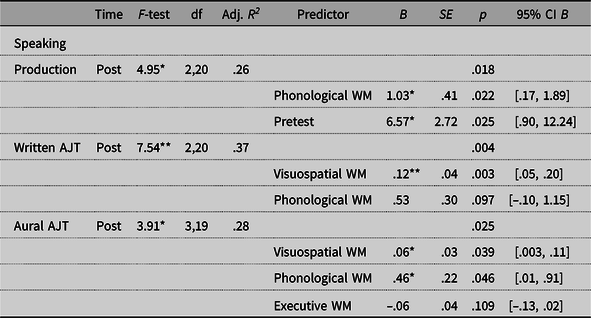
Significant best-subtests regression models for the less salient clitic form are summarized in Table 5. As with the future form, WM abilities contributed to explaining posttest scores in the Speaking group, whereas no significant associations with posttest achievement were found in the Writing group. The model for immediate clitic form production explained approximately 26% of variance, with phonological WM emerging as a significant positive contributor, along with pretest performance. With regard to acceptability judgment accuracy, the models for immediate written and aural AJT performance explained approximately 37% and 28% of variance, respectively. Visuospatial WM emerged as a significant positive predictor in both AJT modalities. In addition, phonological WM was a significant positive predictor in the aural AJT model. Simpler follow-up models computed with only the significant coefficients for visuospatial and phonological WM on the written and aural AJT data converged with these results.Footnote 7
Clitic form: Best-subsets regression models for posttest scores

Note: **p < .01; *p < .05.
To summarize findings in the context of our first research question, regression analyses revealed significant relationships between WM measures and L2 achievement only in the Speaking group. Specifically, phonological WM and visuospatial WM, but not executive WM, contributed to explaining variance in learners’ posttest scores across a range of production and acceptability judgment tasks targeting more and less salient forms.Footnote 8
Perceived mental effort and task difficulty
Regression analyses computed on participants’ task ratings revealed significant effects of WM only in the Speaking group. In particular, the models for perceived mental effort required to perform both the future- and the clitic-focused task were significant in this modality (future-focused task: F(1,16) = 12.20, p = .003, adjusted R 2 = .40; clitic-focused task: F(1,20) = 7.64, p = .012, adjusted R 2 = .24). In both cases, executive WM emerged as the only significant predictor (future-focused task: B = –1.47, SE = .42, 95% CI [–2.36, –.58], p = .003; clitic-focused task: B = –.92, SE = .33, 95% CI [–1.61, –.23], p = .012). The significant negative association between executive WM and ratings of mental effort indicates that participants with lower executive WM capacity perceived the tasks focused on both the higher- and lower-salience target forms to require greater mental effort than did participants with higher executive WM capacity.
Discussion
Working memory, modality, and L2 development
The first research question centered on the relationship between learners’ WM abilities and L2 outcomes following oral and written tasks focused on more and less salient L2 grammar. Regression analyses showed that WM abilities predicted L2 outcomes only in the Speaking condition, and that all associations with morphosyntactic achievement were positive, such that participants with higher cognitive skills in this task modality evidenced more accurate performance after treatment. For the more salient future form, phonological WM was positively associated with immediate aural acceptability judgment accuracy, whereas visuospatial WM was positively related to immediate production and delayed written acceptability judgment accuracy. For the less salient clitic form, phonological WM was positively related to both immediate production and aural acceptability judgment accuracy, and visuospatial WM was a positive contributor to both immediate written and aural acceptability judgment accuracy.
These findings are compatible with earlier research by Sagarra and Abbuhl (Reference Sagarra and Abbuhl2013) and Payne and Whitney (Reference Payne and Whitney2002), where stronger WM relationships emerged with L2 gains derived from participation in the oral modality relative to the written (or mixed) modality. Expanding earlier findings, here we provide evidence that WM abilities are implicated in the oral medium also in the context of form-focused task-based practice where beginning-level learners, without provision of any metalinguistic support, use their own resources to engage in self-directed L2 learning. Systematic WM effects were observed solely in the Speaking group for L2 grammar achievement of both more and less salient target structures. Importantly, these WM effects emerged across various productive and receptive outcome measures in both the auditory and visual modalities. Furthermore, we found that WM was primarily predictive of short-term effects of task-based oral practice, which is consistent with findings in Li’s (Reference Li and Gurzynski-Weiss2017) meta-analysis that the impact of WM becomes most noticeable immediately after L2 instruction.
Findings concerning modality may be explained with reference to the differential memory constraints placed by the oral and written focused tasks. In particular, results support recent proposals that the heightened online pressure component of speaking, along with the lack of permanence and visibility that distinguishes auditory input, posed a greater burden on learners’ short-term memory resources compared to engaging in written output and input practice (e.g., Gilabert et al., Reference Gilabert, Manchón and Vasylets2016; Kormos, Reference Kormos, Byrnes and Manchón2014; Sanz, Reference Sanz, Alatis, Straehle, Ronkin and Gallenberg1996; Williams, Reference Williams2012). In these conditions that characterize the oral modality, the greater retention and attentional filtering abilities that differentiate higher-WM individuals gain relevance as a potential predictor of L2 morphosyntactic achievement. In turn, the absence of any WM effects in the Writing group suggests that the features of the written modality afforded what Schoonen et al. (Reference Schoonen, Snellings, Stevenson, Van Gelderen and Manchón2009) refer to as “a temporary extension of working memory” (p. 81), such that all participants were generally able to effectively coordinate, rehearse, and update memory traces repeatedly and at their own pace over the course of treatment. Accordingly, L2 grammar outcomes achieved in this modality were less susceptible to individual differences in cognitive skills, despite the substantive attentional demands that the L2 output and input processing requirements of the focused tasks posed for beginner learners. This implies that, given certain task requirements, the written medium can “level the playing field” for L2 learners with different WM skills, rendering cognitive capacity a nonpredictive factor in L2 grammar achievement even when less salient, more complex L2 constructions are targeted as the object of learning. We turn to discussing how the various WM components investigated in the study contributed to the observed linguistic outcomes.
Regarding phonological WM, the relationships attested with aural acceptability judgment accuracy for both target structures as well as with clitic form production support the notion that learners with higher phonological WM abilities were better equipped to rehearse relevant L2 forms in the fleeting auditory input and to strengthen weakening memory traces of these forms over the course of the task (e.g., Baddeley, Reference Baddeley2003). This leverage in phonological rehearsal, in turn, might have allowed them to process target forms further during encoding, in ways that positively impacted immediate L2 development (Leow, Reference Leow2015). The fact that phonological WM was predictive of aural acceptability judgment accuracy for both forms also suggests that ability for conscious articulatory repetition of verbal stimuli becomes most relevant when learners analyze auditory L2 input, under conditions that approximate treatment. Together, the associations found with both production and acceptability judgment are compatible with and expand upon prior findings on the relevance of phonological WM for advancing both productive and receptive grammatical skills, especially among less proficient L2 learners (e.g., N. Ellis & Sinclair, Reference Ellis and Sinclair1996; Martin & N. Ellis, Reference Martin and Ellis2012; Serafini & Sanz, Reference Serafini and Sanz2016; Williams & Lovatt, Reference Williams and Lovatt2003).
Concerning visuospatial WM, the relationships observed with future form production, written acceptability judgment accuracy of both forms, and aural acceptability judgment accuracy of the clitic form extend the relevance of visuospatial WM abilities highlighted by Sachs (Reference Sachs2010) to the development of productive and receptive grammatical accuracy. Given the paucity of L2 research on visuospatial WM, it is useful to consider the information-processing operations tapped by the Corsi block-tapping task in proposing plausible explanations for these results. Even though the Corsi task is conventionally used to assess visuospatial WM, Vandierendonck and colleagues (Reference Vandierendonck, Liefooghe and Verbruggen2010) have proposed that executive control processes can be loaded when participants are required to memorize more than three to four blocks. Some research in cognitive psychology also suggests that, in the visuospatial domain (in contrast to the phonological-verbal domain), both simple span tasks (such as the Corsi task) and complex span tasks targeting processing and storage components can implicate executive functioning, which indicates that the visuospatial sketchpad may be more closely linked to the central executive than the loop (see Miyake et al., Reference Miyake, Friedman, Rettinger, Shah and Hegarty2001). In light of this, a plausible account for our findings is that learners with higher visuospatial WM skills in the Speaking group were able to maintain and reproduce the sequential order of relevant morphosyntactic elements in a sentence more effectively, which supported initial L2 grammar development and, in particular, promoted greater accuracy within tasks requiring the assessment of the combinatorial felicity of utterances. This advantage afforded by higher visuospatial WM may have been underscored in the judgment tasks employed in the present study because participants were required to wait until the end of the utterance to determine its acceptability, and errors occurring later in the sentence are said to place higher executive processing demands (e.g., Gangopadhyay et al., Reference Gangopadhyay, Davidson, Ellis Weismer and Kaushanskaya2016).
The associations observed between WM measures and L2 outcomes for both the more and less salient target structures of the study also merit discussion. This pattern of findings would appear not to align with Yilmaz (Reference Yilmaz2013), where WM effects were attested for the more salient, but not the less salient, L2 form; however, Yilmaz notes that absence of WM effects for the lower-salience form in his study may be explained by the fact that no substantial improvements were observed for that L2 target. Here, we found that phonological WM was a positive contributor to accurate production of the clitic form, but not the future form, which suggests that this WM component may be particularly relevant for extracting patterns from input and establishing longer-term representations of them (e.g., N. Ellis, Reference Ellis1996; Speidel, Reference Speidel1993; Williams & Lovatt, Reference Williams and Lovatt2003). According to Speidel (Reference Speidel1993), registration and rehearsal of L2 forms in the phonological loop allows learners to build a depository of phrases in long-term memory from which to draw generalizations and produce L2 grammar. It follows that, given a limited amount of L2 input, learners with higher phonological WM capacity would be able to reach accurate form-meaning connections at a faster rate (Speidel, Reference Speidel1993), and that this advantage would be most pronounced with less salient target structures holding more obscure relationships to their meaning, as is the case with the clitic form. More research is needed to better understand the role of target structure salience and its connections with learners’ WM skills.
Working memory and learners’ perceptions of task demands
The second research question examined the relationship between learners’ WM abilities and their ratings of task demands on oral and written tasks focused on more and less salient L2 grammar. Findings revealed that, in the Speaking condition, executive WM abilities were negatively associated with ratings of perceived mental effort for both the future- and clitic-focused tasks, such that participants with lower executive WM capacity indicated that the pedagogic tasks required exerting greater cognitive effort than did participants with higher executive WM capacity.
As the first study to explore the role of L2 learners’ cognitive individual differences in L2 task demand perceptions, these findings help expand recent research seeking to understand how oral and written task modalities may differentially shape learners’ task experiences (Cho, Reference Cho2018). In particular, results draw attention to the utility of considering theoretically relevant cognitive individual factors as a means to explaining variability in direct measures of overall cognitive load, such as learners’ ratings of perceived mental effort required to perform the task. They also suggest that output-input modality can be a relevant instructional variable impacting the contributions of learners’ WM resources to ratings of overall cognitive load. On a separate note, it is interesting to observe that the fact that perceived mental effort, but not task difficulty, was subject to WM effects in this study appears consistent with current conceptualizations of mental effort as a construct that is structurally distinct from task difficulty (e.g., Brünken et al., Reference Brünken, Seufert, Paas, Plass, Moreno and Brünken2010; Révész et al., Reference Révész, Michel and Gilabert2016). Indeed, our findings suggest that different sources of learner individual differences may account for variance in participants’ perceptions of required mental effort and degree of task difficulty.
The relationship attested between participants’ executive WM abilities and their perceived mental effort ratings may be explained with reference to the processing demands posed by the focused tasks in the Speaking group along with the WM processes gauged by the AOSpan test used in this study. As described earlier, the focused task required participants to read a prompt, select the logical follow-up event, form a sentence incorporating the event, and subsequently process feedback in the form of targetlike model utterances featuring the target structure and the logical event. The design of the task thus prompted participants to involve in executive attention processes (i.e., concurrent maintenance and manipulation of information) at various stages. It is likely that such processes were heightened in the Speaking group relative to the Writing group on account of the nonvisual and transient nature of oral output and input, which arguably imposed greater constraints for monitoring and updating relevant cues online (e.g., Gilabert et al., Reference Gilabert, Manchón and Vasylets2016; Kormos, Reference Kormos, Byrnes and Manchón2014).
On these grounds concerning the conceptual and modality-derived demands of the task, beginner-level L2 learners with lower executive WM resources—and, in particular, less efficient abilities in the executive function of updating and monitoring incoming information that are tapped by the AOSpan test (e.g., McCabe et al., Reference McCabe, Roediger, McDaniel, Balota and Hambrick2010; Miyake et al., Reference Miyake, Friedman, Emerson, Witzki, Howerter and Wager2000)—might have experienced a greater burdening of the central executive, giving way to higher ratings of required mental effort (i.e., overall cognitive load) for the focused tasks in the Speaking condition. Following this account, we propose that executive WM emerged as the best predictor of self-rated mental effort because the high task demands of keeping in memory and updating task-relevant information imposed by the AOSpan test resemble along many dimensions the joint processing demands of the pedagogic L2 tasks learners completed in this study. In all, this suggests that, in response to the demands of the oral focused tasks, learners with lower executive WM capacity evidenced a greater cost of performance in cognitive effort relative to learners with higher capacity, who are expected to maintain and process information more efficiently, and arguably required allocating less effort to the task at hand.
Conclusion and limitations
The aim of this study was to jointly examine the contributions of learners’ executive, phonological, and visuospatial WM skills to L2 outcomes derived from oral and written task-based practice targeting L2 grammar structures of varying salience. Findings show that WM skills are systematically predictive of L2 morphosyntactic achievement and task demand perceptions in the oral modality, but not the written modality. Specifically, in the Speaking group, phonological and visuospatial WM abilities positively contributed to L2 performance across various outcome measures, while executive WM skills were negatively associated with ratings of mental effort. Study findings help advance our understanding of the contributions of different WM components to initial L2 grammar achievement and, more generally, provide new insights into how the relationship between WM and linguistic outcomes for different targets may vary with modality. In so doing, the study contributes to the larger interdisciplinary goal of unearthing how “individual difference variables interact with linguistic and contextual variables” to promote L2 development (DeKeyser, Reference DeKeyser2012, p. 189). Taken together, results are consistent with recent accounts that output and input processing in the oral modality pose a greater burden on learners’ WM relative to the written modality (e.g., Gilabert et al., Reference Gilabert, Manchón and Vasylets2016; Kormos, Reference Kormos, Byrnes and Manchón2014; Williams, Reference Williams2012). Of relevance to L2 instruction, the study supports the notion that pedagogic L2 tasks incorporating output and input opportunities in the written modality, as opposed to the oral modality, can “level the playing field” for learners with different WM skills (e.g., Payne & Whitney, Reference Payne and Whitney2002), even when target forms comprise relatively complex lower-salience grammar. The study is also informative from a methodological perspective, and highlights the utility of considering all components of WM in research seeking to obtain a more global understanding of the cognitive skills underlying instructed L2 development.
The insights derived from this research should be interpreted in light of a number of limitations. Firstly, because the study focused on WM effects on initial L2 morphosyntactic achievement, the participant sample was limited to beginning-level learners with little prior knowledge of the target structures. Given evidence for the decreasing impact of cognitive abilities on L2 performance at increasing proficiency (e.g., Serafini & Sanz, Reference Serafini and Sanz2016), future research may wish to examine how the susceptibility of L2 outcomes derived from written and oral tasks to individual WM skills differs among more advanced L2 learners. Another limitation is that the present study employed a single self-report measure of overall cognitive load, namely, subjective ratings. Although such ratings are reliable and widely used in L2 research (e.g., Révész et al., Reference Révész, Michel and Gilabert2016; Sasayama, Reference Sasayama2016), it would be fruitful for future studies interested in examining WM effects to complement subjective measures like self-rating scales with objective measures to assess cognitive load more fully. Lastly, regarding salience, our study is also limited to the extent that we cannot ascertain how the various dimensions that contribute to making the clitic form a more challenging target relative to the future form impacted the involvement of learners’ WM skills. Further research with larger and diverse samples is warranted to understand the contributions of WM abilities to L2 development under different task modalities more fully. For example, it would be particularly insightful to explore how WM effects differ by modality among L2 learners of varying age groups (e.g., children, older adults), who are expected to differ not only in terms of their WM capacity but also in their relative experience reading and writing the target language.
Acknowledgments
We would like to thank Ronald P. Leow, Lourdes Ortega, and Andrea Révész for their helpful feedback in conducting this study. We are grateful to Colleen Moorman for providing access to the nonword recognition task, and to Meagan Driver, Linxi Zhang, and Aitor Martinez de la Pera for their support with other aspects of this research. We would also like to express our gratitude to the editors and anonymous reviewers for their valuable feedback on the manuscript. Any remaining errors are our own.