

Introduction
Comprehensive Land Claims (CLC) is a political process through which Canada deals with those aboriginal groups who have not signed a treaty or other agreement, such as the 1975 James Bay and Northern Quebec agreement, its immediate forerunner. It may also be used as a means for groups that have signed numbered treaties to challenge aspects of those treaties. CLC was implemented following the Supreme Court judgment in the 1973 Calder case, which stipulated among other things that unceded lands and rights required specific legislation or agreements to extinguish them. This was enunciated further in Section 35 of the Constitution Act of 1982, which recognized and affirmed Aboriginal Rights. The claiming of such rights, however, could still be easily overruled. It was only after several cases in which Aboriginal rights to lands had been rejected on the basis of racist arguments adopted from the 1919 In Re Southern Rhodesia case heard by the Privy Council in London (Asch Reference Asch2002, 26) that the 1997 Delgamuukw decision held that Aboriginal Title could not be extinguished without consultation. Tsilhqot’in in 2014 went further, stating that extinguishment actually required consent. The latter also specified that Aboriginal Title conferred the right to use and control (although not own) unceded Aboriginal land. To date, only twenty-six comprehensive land claims have been completed and, according to Aboriginal Affairs and Northern Development Canada, there were “about a hundred” negotiating tables as of 2014 (Aboriginal Affairs and Northern Development Canada 2014a).
Until the 2014 interim paper “Renewing the Comprehensive Land Claims Policy” (Aboriginal Affairs and Northern Development Canada 2014b), the main explanation of the CLC policy was from a 1986 policy update. Significantly, the 2014 paper emphasizes the “duty to consult” rather than to obtain consent, as would be expected from the Tsilhqot’in decision. But similarly to the Tsilhqot’in decision and the 1997 Delgamuukw judgment, the interim paper leaves open “infringements” on Section 35 rights, which can take place with various unspecified justifications. Echoing earlier iterations of CLC such as the 2003 Summary of Benefits of Settling Land Claims: The Canadian Government’s View, the interim paper repeatedly attributes a strong connection between land claims and economic growth. In addition to clarifying perceived uncertainty over ownership and jurisdiction, CLC is often presented by the government as part of the wider project of “recognition” or “reconciliation,” evolving from the liberal democratic framework of rights. This project is principally bureaucratic, involving clearing up “ambiguities associated with the common law concept of Aboriginal rights” (Aboriginal and Northern Affairs Canada 2003). Recognition is therefore directed towards “turning problems of politics into problems of administration” (Mannheim Reference Mannheim, Wirth and Shils1936, 118).
However, even the assertion that uncertainties and ambiguities exist is duplicitous. Even in Canada’s own jurisprudence, the founding document establishing legal relations between colonizers and Aboriginals, the Royal Proclamation of 1763, guarantees the integrity of all indigenous lands and pledges a fiduciary duty of the Crown to act for the benefit of indigenous peoples. As Borrows (Reference Borrows2002, 113) argues, “the Crown has merely asserted such rights [to sovereignty and lands], and acted as if their unilateral declarations have legal meaning.” Furthermore, Asch (Reference Asch2013) shows that the numbered treaties, regarded by the state as legally binding extinguishments of indigenous ownership of lands, upon closer historical scrutiny reveal that indigenous parties never understood that they were agreeing to permanent forfeiture of their lands. This was brought out in the 1973 Paulette case in which Justice Morrow contended that the surrender of lands was camouflaged in the text of Treaties 8 and 11. While this applies to all of the lands that Canada claims, it equally applies to lands that were not subject to treaties, such as the Inuit Arctic, which were handed over by Britain whose title rested only on simple assertions of sovereignty from scattered explorations. As such the underlying assumption of state sovereignty in CLC is magical, as Taussig (Reference Taussig1997) has described more broadly regarding state powers, or a “spell” as Borrows (Reference Borrows2002, 137) terms it in regard to Canada specifically. Significantly, these metaphysical legal foundations have been rendered highly problematic in international standards such as the 2007 United Nations Declaration on the Rights of Indigenous Peoples and the 1975 Western Sahara case, in which the International Court of Justice ruled it to be illegitimate for one colonial state to simply transfer authority over occupied lands to another one without consulting the indigenous population (Omar Reference Omar2008; Wright Reference Wright2014, 127–36).
Scholarship on CLC is varied. Some analyze how political “outcomes” are produced (Alcantara Reference Alcantara2013), others how specific parts of the claim such as co-management of land (Nadasdy Reference Nadasdy2003; White Reference White2006) or wildlife harvesting (Proctor Reference Proctor, Procter, Feit and Natcher2012) are shaped, and some trace the development of federal policy and legal provisions including the extinguishment requirement (Asch and Zlotkin Reference Asch, Zlotkin and Asch1997; Epstein Reference Epstein, Alfredsson and Stavropolou2002; Mackey Reference Mackey2014). Because the land claims protocol is so complex and multifarious, and the indigenous parties are often negotiating valiantly under exacting and often compromised circumstances, the focus is often positive, looking at how benefits of the process are realized. For example, Alcantara and Nelles (Reference Alcantara and Nelles2014, 199) provide the interpretation of CLC that Aboriginal groups can “successfully work with the Crown to negotiate a settlement that is acceptable to all parties” and that CLC is an example of “multi-level governance.”
However, CLC has long been the subject of critique by both those who have placed it more squarely within the colonial architecture of Canadian aboriginal policy (Tully Reference Tully1995) and others analysing specific cases of CLC, for example the British Columbia treaty process (Blackburn Reference Blackburn2005; Woolford Reference Woolford2011). In this vein, Alfred (Reference Alfred1999, 58) suggests that “rights” granted to Aboriginal peoples are part of colonialism and not a remedy for its effects, since such “rights” are invariably created, controlled, and limited by Canada itself. More recently, Coulthard (Reference Coulthard2014, 15) has argued that, in Canada, “colonial relations of power are no longer reproduced primarily through overtly coercive means, but rather through the asymmetrical exchange of mediated forms of state recognition and accommodation.” In other words, while government officials and liberal analysts depict the various benefits of CLC as elements of “recognition,” this is directed primarily to the incorporation and control of indigenous peoples. Supporting this is the fact that the advent of CLC itself followed only from indigenous contestation of the unilateral declaration of sovereignty from Canada, a declaration that the CLC process assumes to be legitimate, and which defines a major part of the asymmetry Coulthard mentions.
While Coulthard, Alfred, and other scholars have made the argument that “recognition” is a measure of colonial dominance and dispossession in broad terms, few have actually looked at how this dominance operates on the ground specifically relating to land claims agreements in progress. Concentrating on the Innu Nation Tshash Petapen (or “New Dawn”) agreement, a land claim initiated in 1977 that is ongoing, I will argue that the intention of CLC is not to recognise rights or to reconcile in the true sense of those words; its objective is to dispossess, and it does this not simply through what is contained in the text of the agreement, but by creating the social conditions through which agreement itself is achieved. The effects of CLC can be seen in stark relief in groups such as the Innu, that have maintained greater degrees of cultural continuity, and to whom the bureaucratic procedures are more alien and the losses more marked because the hunting and land-based culture has survived for longer. In this essay, I will identify the specific ways in which dispossession operates by reference to:
1. The undemocratic social and political contexts in which agreement is elicited
2. How the agreement depletes the Aboriginal rights of the indigenous party
3. How the agreement depletes indigenous lands
4. How the creation of wealth and debt influence the character and outcomes of the process
1. The Undemocratic Social and Political Contexts for Eliciting Agreement
Over the twenty years that I have been visiting and researching the two Innu communities in Labrador, the leadership of the Innu Nation has been involved in negotiating what came to be called the Tshash Petapen land claims agreement with Canada. Since 1990 when Canada accepted that the Innu had a claim, many of the prominent leaders have passed away, and these were men mostly in their forties or early fifties – Daniel Ashini, Ben Michel, Greg Penashue, Joseph Riche are all no longer with us. Today Anastasia Qupee is the first female Grand Chief, elected in August 2014. These are all individuals whose parents were born in tents on the land and whose own proximity to the land-based culture has been continuous.
Electing leaders is necessary to making a land claim. It first requires that indigenous peoples configure themselves into a political organization, with leaders representing an aboriginal group within the administrative jurisdictions of the state. This organization, which importantly is one contrived principally for the purposes of these or other negotiations, must then petition Canada to claim their lands and rights. Thus, any contention about the independence of Aboriginal governments and thus the democratic nature of the process is immediately problematic because the “Aboriginal” institutions are creations of the state. Additionally, these political bodies are conceptually non-indigenous in their structures, rules, and operations, and are almost always representative only of segments of larger Aboriginal groupings. The Innu Nation, for example, represents only Innu resident in Labrador, and it can claim lands only within that colonial jurisdiction. “Innu Nation” is therefore a misnomer since most Innu actually reside in government villages in Quebec, and the lands in Labrador and Quebec are not discrete territories occupied and used only by Innu who happen to be domiciled in Labrador. Moreover, the people of the various villages across the one or other Province-Quebec peninsula are tightly bound together through history, language, mobility and kinship (Mailhot Reference Mailhot and Harvey1997). The cartographic representations of the Innu and their lands used in the land claims agreement therefore do not represent the natural unity of the Innu peoples (Samson Reference Samson2003, 64–71). Indeed, land use and occupancy studies have noted the constant overlap of territories across the entire Labrador-Quebec peninsula (Tanner Reference Tanner1977; Hammond Reference Hammond1994).
The Tshash Petapen negotiations, leadership salaries, and the running of the Innu Nation operations are financed by Canada, which also provides the Innu Nation with loans to hire technocrats such as anthropologists, scientists, and lawyers to assist in meeting the demands of establishing, maintaining, and negotiating the claim. These individuals are almost always white Canadian nationals, and although many are dedicated advocates of the indigenous cause, some are drawn from the ranks of former Indian Affairs employees. These and others are contracted via consultancy agencies and law firms. In this case, Chignecto provides various advisers, and Olthuis, Kleer and Townsend, based in Toronto, represent the Innu Nation. These businesses are indirectly paid by the government. This fact potentially compromises their impartiality because they are paid by their client’s opponents, whose claim they are employed to negotiate. Because they have very different types of stakes in the CLC process, considerable tensions may exist between hired technocrats and the people of indigenous communities (Samson Reference Samson2003, 57–86; Irlbacher-Fox Reference Irlbacher-Fox2009, 166).
Further, the state party consists of a collection of middle-class civil service employees with secure employment rights, pension plans, and other benefits. They are people living relatively affluent lives far from the places of concern in the land claims. Government bureaucrats operate under the Minister of Aboriginal Affairs and Northern Development, which has had ten Ministers in the last twenty years. The other party consists of an equally fluid turnover of Aboriginal leaders, chosen through an imposed electoral system that has spawned fractious, alcohol-fuelled campaigns that have recently been the subject of controversies over judicial reviews (Rendell Reference Rendell2014; Whiffen Reference Whiffen2014).
Already we can see that there are serious inbuilt asymmetries. While two parties negotiate, the political institutions, protocol, and legal framework through which CLC negotiation occurs is internal to one party, the state, which in turn funds the entire process. Prince and Abele (Reference Prince, Abele and Murphy2005, 246), in reviewing the fiscal relations between Ottawa and indigenous groups, maintain that these “are still rooted in the colonial policies and precepts of the nineteenth century. First Nations and Inuit governments and other Aboriginal organizations in Canada continue to labour within ‘a financial straitjacket.’” This financial straitjacket has a further dimension in that it creates the underlying conditions for a corrupt electoral system. Indigenous politicians are on short terms with financial dependence on their adversaries, little security, and steady inducements to accept donations from businesses with interests in resources on Innu lands. Given these pressures, some candidates have used such funds to buy alcohol for community members in exchange for votes (CBC 2010; CBC 2012a). Great premiums attach to political jobs and great losses can be incurred by being voted out of office, leading to jealousies between different familial alliances in the Labrador villages of Sheshatshiu and Natuashish (formerly Davis Inlet) that comprise the “Innu Nation.” When one party leaves office, it frequently will not cooperate with the incoming party, or even clean up the offices. Like democratic polities everywhere, public office is used for private gain. The main difference is that in the goldfish bowl of small villages occupied by closely related people, Aboriginal political corruption is more visible, while elsewhere it is hidden and legitimized by lobbying and campaign contributions in national laws.
In this context, we may ask how popular consent to the CLC agreement is achieved. The 436-page draft Agreement in Principle (AIP)Footnote 1 is about 132,000 words and is set out in numbered paragraphs, many of which contain the most mind-numbingly perplexing clauses, sub-clauses, and qualifications. One must have a thorough grasp of the English language and its nuances and patience with wearisomely convoluted sentences to make a meaningful evaluation of the AIP. Nonetheless, it was “approved” by over 88 percent of the Innu electorate in a 2011 ballot. This approval can only be based on fragmentary information about the AIP, as indeed was the case throughout the negotiations on the agreement (Gregoire Reference Gregoire2012, 196). At the time of the vote, the Innu Nation issued a $5,000 payment, advanced from a loan, to every adult in each community. Brad Cabana (Reference Cabana2013) published a transcript of an Innu Nation Trustees meeting on 11 July 2011, which recorded that:
Paul RichFootnote 2 made the following motion: The Trust hereby agrees to apply for a loan for approximately $12,500,000 from the Bank of Montreal to provide a per capita payout of $5,000 to each member of the Innu Nation. It was seconded by Mary Jane Edmonds. BMO Trust Company, the corporate trustee, abstained from voting because of the conflict of interest with the application for a loan from the Bank of Montreal. All other trustees voted in favour and the motion was carried.
The overwhelmingly affirmative vote for the agreement was made just before the Bank of Montreal approved the loan. Other steps taken by the leadership at this time included lowering the voting age to 16 and the provision of short summaries of the benefits of the AIP to voters, some of whom went to sparsely attended meetings (Samson and Cassell Reference Samson and Cassell2013). The final draft ratification is pending.
2. The Depletion of Aboriginal Rights
At a very basic level, CLC involves a deal between the state and an indigenous party, under which the most important precondition is that the indigenous leadership, in this case representing divided and traumatized communities (Samson Reference Samson2003; Sider Reference Sider2014), formally acknowledges the state’s authority over them. This is accomplished by the aboriginal party agreeing to “cede, release and surrender” their pre-existing Aboriginal rights and Aboriginal Title or, under the “certainty” clauses, conceding to never assert these rights and titles. Instead of having Aboriginal Title and rights cancelled outright (“extinguishment”), under “certainty,” the aboriginal signatories must pledge that they will never exercise them (Orkin Reference Orkin2003; Blackburn Reference Blackburn2005; Alcantara Reference Alcantara2009). In the Tshash Petapen AIP, extinguishment and certainty are dealt with only in a footnote stating the province’s preferred model is that “Innu hereby cede and release to Canada and the province all the aboriginal rights which Innu ever had, now have or may in future have within Canada” (2.12.2 fn). The AIP itself simply indicates that this issue will be negotiated and that Innu disagree with “cede, release and surrender,” but the choice is restricted to either certainty or extinguishment. To cement the cession of rights that will occur in either case, the AIP contains the following statement:
If the Parties reach the Agreement, Innu will release Canada, the Province and all other Persons from all claims, demands, actions or proceedings, of whatever kind, whether known or unknown, that Innu ever had, now have, or may have in the future, relating to or arising from, any act or omission occurring before the Effective Date that may have interfered with, affected or infringed any aboriginal rights of Innu in Canada… (AIP 2.13.1).
The Innu must therefore agree that they have no claims other than those mentioned in the AIP for any violations of their Aboriginal rights. This applies to past, present and even future violations and can refer to both acts and omissions. So panoptic is the remit of the authority the state grants itself in this paragraph that it rules out any negotiation over what does not at present exist and what may occur in the future. The state awards itself total jurisdiction over the past, the unknown, and the future. If this were not deterrent enough to impede any Innu person to claim rights, there are several other aspects of the AIP that make any future Innu claim superfluous or invalid. The AIP invokes what is called the exhaustion model (Kulchyski Reference Kulchyski2005, 100–01), indicating that it constitutes a “full and final settlement of the aboriginal rights of Innu” and “exhaustively sets out the rights of the Innu” (AIP 2.12.1). It further stipulates that if any Innu party wishes to bring any future legal action against Canada, they must indemnify the government, while the succeeding section, called “Invalidity,” prohibits any party from challenging the validity of any provision in the agreement. Even if a “court of last resort” recognizes any aboriginal right in Innu lands other than those in the agreement, these must be immediately ceded to Canada.
The depletion of rights in the CLC is analogous to a termination measure such as the US Termination Act of 1953, the subsequent US Termination Acts, and Pierre Trudeau’s 1969 White Paper, all of which were intended to end the special status and funding of indigenous peoples, dissolve treaty obligations, and disband reservation or reserve communities. Termination in the US, like the CLC as we shall see, was justified as a measure to assist with economic regeneration. Like the CLC, it was also marked by expeditious measures to elicit consent, and offered quick cash compensation in exchange for terminating the tribal status of, and government services to, indigenous peoples (Deloria Reference Deloria and Martinez2011). The 1969 Canadian White Paper, which would have done much the same, was resisted by indigenous groups and eventually dropped. According to the Mohawk political commentator Russell Diabo (Reference Diabo2013) and the Idle No More movement (2014), the Harper government intended land claims to be the vehicle to resuscitate the termination of collective rights to land in order to enable resource extraction projects on what will become fee simple lands. The most powerful means of termination is through the extinguishment or certainty clauses. While these do not literally terminate an aboriginal group’s relationship with the state, collective ownership and other aboriginal rights that give Aboriginals their unique status are terminated. Regardless of whether we view CLC as a form of termination or simply note the massive diminution of indigenous rights, it is hard to represent it within the framework of liberal democratic pluralism, unless we regard liberalism as Coulthard (Reference Coulthard2014) has, as an ideology of colonial dispossession.
3. The Depletion of Indigenous Lands
If, under the terms articulated above, the agreement is reached, it will legitimize the transfer of Innu land to Canada. Consequently, much of the agreement concerns the demarcation, ownership and disposability of land.
As revealed by Tanner’s Reference Tanner1977 “Land Use and Occupancy” study, historical accounts from explorers and anthropologists (Samson Reference Samson2003, 69–71, 347; Samson Reference Samson2013, 187–92), and the testimonies of numerous elders (Innu Nation 1995; Bouchard Reference Bouchard and Irving2004; Henriksen Reference Henriksen2009; Gregoire Reference Gregoire2012), Innu continue to occupy and use lands that stretch across almost all of Labrador except the northern tip of the Ungava peninsula. Innu travelled in flexible and ever-changing multi-family groupings, traversing the colonial border drawn in 1927 by the Privy Council into north central Quebec and down to the St. Lawrence. Their recent migration paths led up from the rivers flowing into the St. Lawrence into Southern Labrador and up to the Churchill River, others migrated up from Sept-Îles through Western Labrador and Meshikimau (now inundated by the Upper Churchill dam and re-named “Smallwood Reservoir”), and these groups went on into North Central Quebec, sometimes as far as Hudson’s Bay. The Northerly Mushuau Innu travelled across Northern Labrador and Quebec and up to Fort Chimo on Ungava Bay. Despite this extensive territorial occupancy, when the maps for the “settlement area” were printed in the AIP, there were vast areas, principally but not exclusively adjoining the Quebec border, left blank. The blank areas became “Crown land,” and Aboriginal Title to these areas become extinguished in favour of the Crown on the signing of the agreement.
Therefore, collectively used and maintained lands are lost to the Innu in part because CLC is a process negotiated between a state taken in its entirety and the occupants of two villages who comprise a fraction of a mobile but culturally integral indigenous people. Innu Nation only represents Innu who were made sedentary in two villages in Labrador in the mid twentieth century. Other Innu, often part of the same extended families, were registered in villages in north central Quebec near the Labrador border and on the North Shore of the St. Lawrence at the termini of rivers where there had been trading posts. The culturally arbitrary border separating Labrador from Quebec provides the rationale for Innu domiciled in Quebec, whose historical and contemporary lands are on both sides of the border, to have their land rights unilaterally extinguished. Perversely, shared lands that are a long distance from the two Labrador villages, but which may be only a few kilometres from Quebec villages, are turned into Crown land because the use and occupancy of those lands by people now in Quebec is not recognized. By the same token, any agreement with Innu in Quebec means unilateral extinguishment for the members of the “Innu Nation” whose lands are also in Quebec.
Returning to the possible intention of termination, these newly legitimated Crown lands are then thrown open to privatization on the signing of the agreement. The other lands, which are not ceded in this way and which fall within the “Labrador Innu Lands” category in the AIP, are specifically designated as not “Lands reserved for the Indians” within the terms of the 1867 Constitution Act (AIP 2.10.1), indicating that Canada also views these lands as already under its own title. Furthermore, these lands, misleadingly labelled as “under Innu ownership” in the AIP, are subject to numerous permitted incursions from businesses and settlers, that have already squatted on the land. Unlike the Innu, these third parties are categorically not subject to any extinguishment or certainty provisions (AIP 5.3.4). Past violations of the Innu by these non-indigenous squatters involved in mining, logging, road building and hydro-electric development are part of a negotiation over “certainty,” but they are held to be non-reversible. The agreement then builds on these violations by setting up the conditions for further appropriations of Innu lands to the Crown and the corporate interests that it protects. Although the AIP indicates that these issues are still to be negotiated, as it currently stands, Labrador Innu Lands are to be held in fee simple by the “Innu Government,” that is Innu Nation (AIP 5.8.1), and as such may be sold or “alienated” by that body.
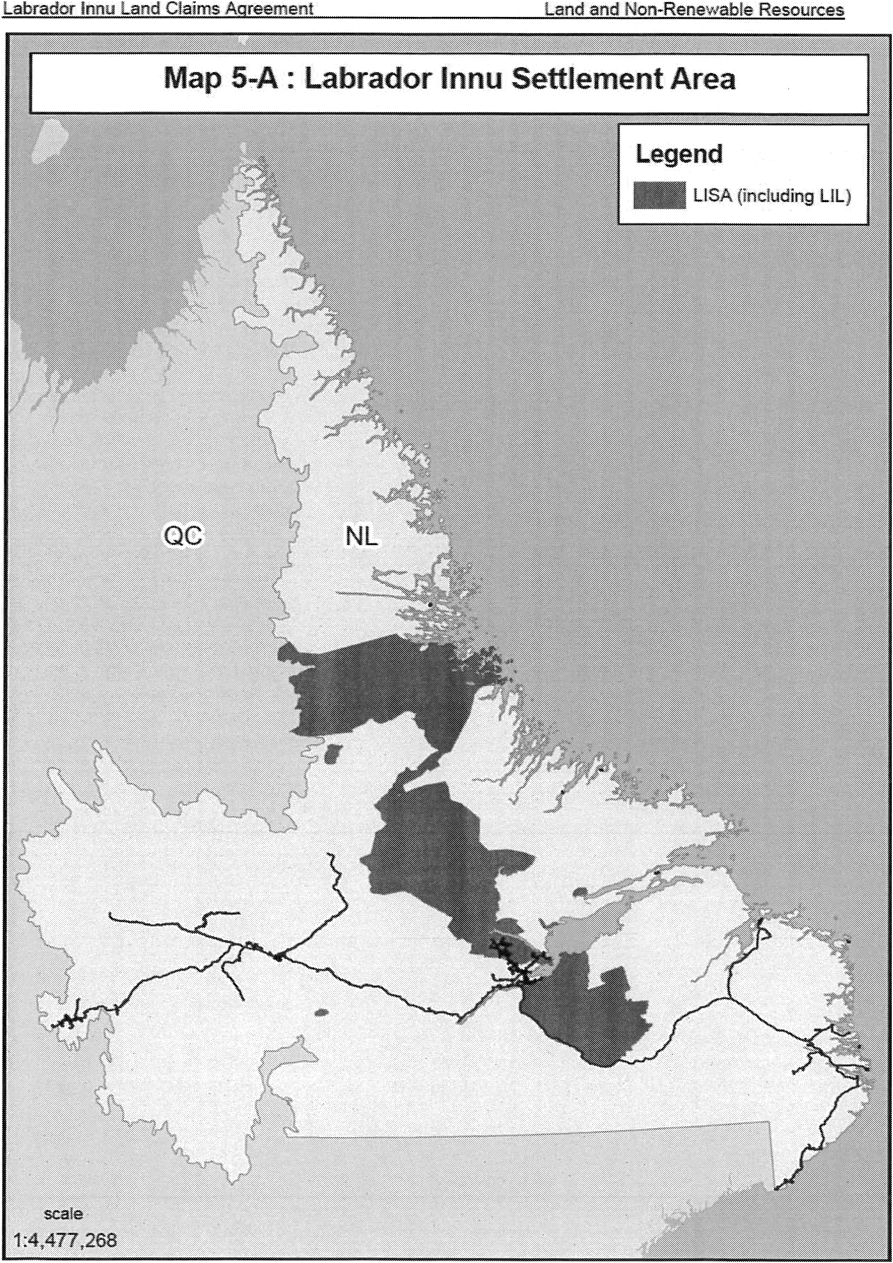
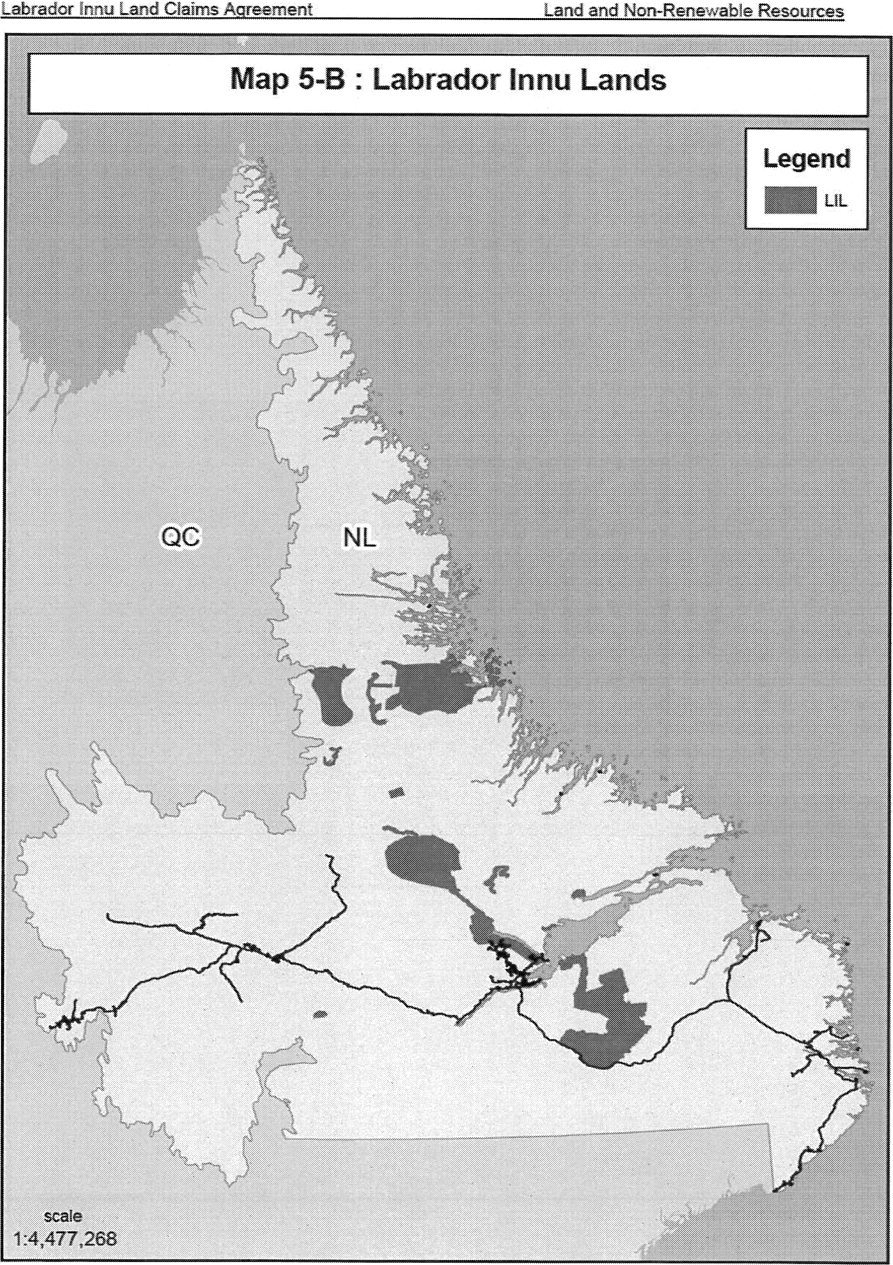
The transfer of what would have been regarded by Innu as collectively owned lands to fee simple lands at the discretion of the Innu Nation is in line with other land claims processes in Canada. Egan and Place (Reference Egan and Place2013) investigated the role of CLC, and more particularly treaties in British Columbia, and found them to be intimately associated with shifting Aboriginal lands to fee simple status. This, they argue, is a means to privatize indigenous lands, while at the same time excluding from negotiation lands that had already, through whatever means, become non-private property. The maps as they stand in the AIP confirm that the extensive and collective land occupancy of the Innu will not only become privatisable, it will be vastly diminished. Figure 1 represents “Labrador Innu Settlement Lands” which cover the area under negotiation. Figure 2 represents “Labrador Innu Lands” where the “Innu government” will have limited jurisdiction, but this is still violable by existing private interests and also may be taken compulsorily for other reasons listed in Chapters 16 and 17 of the AIP as “expropriation” or “alienation.”
Labrador Innu Settlement Lands which cover the area under negotiation. All other Innu lands in Labrador are by default ‘Crown land’.

Labrador Innu Lands where the ‘Innu government’ has limited jurisdiction.
The certainty clauses seal the dispossession illustrated by the maps by ensuring that any aboriginal rights that may invoke sovereignty cannot be exercised. Hence, Aboriginal and Northern Affairs Canada’s (AANDC’s) most recent statement on CLC brings Section 35 of the Constitution Act into the equation, stating that one of the goals of aboriginal rights policy is to reconcile the prior occupation of Aboriginals “with the assertion of Crown sovereignty over Canadian territory” (Aboriginal and Northern Affairs Canada 2014b, 7). Prior indigenous occupation is therefore simply to be “reconciled,” not treated as sovereignty itself.
4. The Leveraging Role of Wealth Creation and Debt
Beyond legitimizing the state assertion of sovereignty, CLC is an important means to facilitate commercial resource extraction. Tshash Petapen cedes most collective Innu lands to the Crown, and, in exchange, Innu in the two Labrador villages receive limited sorts of “self-determination” rights through an “Innu Government.” The self-determination, however, is quite limited and would be meaningless without the financial assistance provided by extractive industries on lands the Crown makes available. In this context, it is easy to see how officials might see the switch from Aboriginal dependence on direct state funds to wage labour and entrepreneurialism as an attractive proposition.
Indeed this switch is implicit in the pronouncements of the government’s Resolving Aboriginal Claims – A Practical Guide to Canadian Experiences (Aboriginal and Northern Affairs Canada 2003, 9) document:
Summary of Benefits of Settling Land Claims: The Canadian Government’s View
gives certainty to ownership and use of lands and resources
propels economic growth by giving certainty and clear rules to investors and the public in general
promotes and strengthens social partnerships between the government and First Nations and among First Nations groups themselves
encourages Aboriginal self-reliance
builds a new and more progressive relationship with Aboriginal peoples, based on mutual respect and trust
avoids expensive lawsuits
promotes investment and employment.
In financial terms, the federal government leads the process of establishing cost-sharing arrangements with the relevant province/territory in order to financially support the settlement of claims and attain certainty. Today, the federal government has cost-sharing arrangements with all provinces involved in comprehensive land claim negotiations.
The business-related imperative of CLC is repeated in the 2014 interim document which promotes “reconciliation” as a means of obtaining a “secure climate for economic and resource development that can benefit all Canadians” and “enabl[ing] Aboriginal peoples to have fair and ongoing access to lands and resources to support their traditional economies and to share in the wealth generated from those lands and resources as part of the broader Canadian economy” (Aboriginal Affairs and Northern Development Canada 2014b, 9). Minister of Aboriginal Affairs and Northern Development Bernard Valcourt echoed these sentiments, arguing that extractive industries are a key component of Canadian economic growth and that this should involve Aboriginal peoples. Addressing questions in the Aboriginal Affairs Committee meeting of 3 December 2014, Valcourt maintained that “the energy sector is but one industry with development opportunities that we could leverage to assist growth for Aboriginal communities.” He went on to announce a $61 million budget allocation for “strategic partnerships” and $10.5 million “to support aboriginal engagement in energy projects as well as economic and business development for the year 2014–2015.” During questioning, Valcourt made it clear that these partnerships would be commercial ones in extractive industries that would be “advancing aboriginal participation in the broader Canadian resource economy.” At the same Committee meeting, Liberal MP Carolyn Bennett revealed that while huge amounts of funding were being released for these energy projects, relatively little was being devoted to improving the basic infrastructure for hygiene and sanitation in aboriginal communities (Aboriginal Affairs and Northern Development Canada Committee 2014).
These statements affirm that a principal goal of CLC is to leverage business opportunities. As Harris (Reference Harris2004), Blackburn (Reference Blackburn2005) and Woolford (Reference Woolford2011, 72) have shown in regard to similar land claims processes in British Columbia, “certainty” over the ownership of land is designed to produce the legal conditions necessary for the “development” of aboriginal lands. Harris (Reference Harris2004) regards the deterritorialization of indigenous peoples as the central act of colonialism. It is put into effect by disciplinary technologies such as the law, and the motive for it is to increase private material prosperity. Following this analysis, prime beneficiaries of CLC are businesses, principally resource extraction companies, and through employment, non-indigenous workers who make up the bulk of the labour force. Presenting extractive industries as providers of money and jobs to Aboriginal populations easily deflects attention from the disproportionate gains businesses make from the transfer of land from collective to fee simple ownership. The economic focus places less attention on the adulteration of the natural ecologies that indigenous communities, and economies have been built upon and this signals that CLC is not only about land dispossession, but cultural dispossession. According to Preston (Reference Preston2013, 43), “‘resource’ extraction projects billed as ‘ethical’ economic opportunities for all Canadians obscure and normalize ongoing processes of environmental racism, Indigenous oppression and violence.”
Yet, as Blackburn (Reference Blackburn2005) argues, there is never any absolute certainty for any party. The state position articulated in the 2003 and 2014 policy documents mentioned above tacitly relies on a “trickle down” economy of rapid wealth accumulation and redistribution through the industrialization of indigenous lands. If and when Tshash Petapen is finally signed, it is assumed that economic and social wellbeing will follow from business and employment opportunities with the new owners of Innu lands. Given that many indigenous people in Canada, and especially the “Innu of Labrador” of the AIP lack the educational and other qualifications for skilled labour, management, and executive positions, opportunities are overwhelmingly for manual labour jobs with subcontractors on relatively short-term building projects. In turn, employment on these projects increasingly compromises participation in the indigenous economy of seasonal hunting, fishing, and gathering, still common among the Innu.
Despite these obvious drawbacks, there are still those who argue that “economic progress” follows land claims in indigenous communities. Such contentions are often based on statistical indices rather than observations of the political and social circumstances in which specific instances of economic progress are supposedly taking place. Aragon’s (Reference Aragón2015) economistic analysis, for example, contends that aboriginal groups who signed treaties have seen a 13 percent increase in their incomes. This analysis of Census data sets, pertaining to groups in Western Canada and the Northwest Territories, concludes that the clarification of property rights in CLC helps reduce the transaction costs of extractive industries that employ Aboriginals. Also typical of the upbeat economic assessment are Saku and Bone (Reference Saku and Bone2000) who claim that aboriginals are looking for a place in Canadian society and that this is achieved through economic development following land claims. In making such an argument, the authors, along with Aragon, ignore the fact that jobs in extractive industries, by far the leading source of new employment in the Far North, are often short term, dangerous, and at odds with traditional uses of the land. New employment and, more pertinently, corporate joint venture partnership with indigenous leaders to enable these industries to operate, as will be discussed below, also create social and economic inequalities among peoples who had hitherto been highly egalitarian. Furthermore, although Saku and Bone (Reference Saku and Bone2000) use the James Bay Agreement as a positive case in point, nothing is said of the many Innu in Quebec and Labrador whose rights and land claims were unilaterally extinguished by that agreement and who received no financial or other benefits (Samson and Cassell Reference Samson and Cassell2013). Even if indigenous organizations have been enriched by CLC, serious questions continue to exist about the creation of inter-group conflicts, cultural erosion, the distribution of incoming monies, and whether, as Aragon admits (Reference Aragón2015, 55), the groups who have yet to sign will benefit economically.
In the case of Tshash Petapen, the promise of employment and revenue sharing from businesses is elaborated through a series of clauses that make it easier for companies to exploit Innu lands while incentivising the Innu Nation to accept this exploitation. In addition to incremental packages of monetary compensation, the “Innu Government” will be awarded shares and small percentages of revenues (but, significantly, not profits) in companies that acquire Innu land. A further enticement to accept massive losses of land is the guaranteeing of “Innu businesses”—essentially, joint venture companies comprised of those in or close to the Innu Nation leadership—contracts for the planning and construction of the linked Lower Churchill hydroelectric power project located at Muskrat Falls and Gull Island on the vast Mista-shipu. The agreement stands or falls on the development of the hydroelectric project. This, however, may be a moot point given that construction on the Muskrat Falls dam has proceeded in advance of the Final Agreement to authorize it. “For greater certainty,” Nalcor, a public energy corporation, already runs this project and obtains uncontested ownership of the area around the sites. The company also benefits from release clauses that relieve it from many responsibilities and liabilities for injuries and loss of property, as well as various types of “inundation.”
Employment can be seen as a way to balance the undoubted harms incurred by the handing over of Innu lands and waters to Nalcor. However, the extent to which Innu workers or even “Innu businesses” will gain from the project beyond the construction phase is uncertain. Once up and running, the hydroelectric plant will necessarily be operated largely by professionally trained technical staff. Relatively unskilled Innu workers are already employed at Muskrat Falls, but the number of Aboriginals employed there is still relatively low (CBC 2013a). Already these employees are facing racism at the workplace (CBC 2013b), and substantial layoffs of Innu and other employees began in November 2014.
The commercial arrangements entered into by Aboriginal groups that are regarded as successes contrast strongly with this scenario. For example, at Membertou, a Mi’kmaq community in Nova Scotia, success has been credited to the “firewall” between the leadership and the commercial sector, as well as the maintenance of collective land ownership, and the prohibition on private communities taking reserve land or individual band members using their lands for commercial purposes (Scott Reference Scott, Anderson, Benson and Flanagan2006). Whether the Mi’kmaq can maintain their communal lands and collectivist orientation in the face of continued pressures to leverage capital is another matter. Although there are undoubtedly other examples of capitalist economic success among Aboriginals in Canada, the “practical sovereignty” that Cornell and Kalt (Reference Cornell and Kalt2006, 8) recommend as a prerequisite for “sustainable, successful economic development” in their analysis of indigenous North American economies is difficult to achieve in circumstances such as those that prevail in the Far North. The close alliances between leaders and sources of capital, familial and political ties of patronage via the imposed electoral system, and immense pressures, in this case via CLC, to relinquish and privatize collective lands all stand in the way of success.
The failure of this type of assisted bootstrap capitalism is often pronounced among peoples of the Far North who have maintained land-based cultural continuity for longer. Rapid influxes of money produced by extractive industries on indigenous lands has often been the precursor to deleterious social change including upsurges in mental health problems, family break-ups, alcoholism, and loss of connections to lands (see York Reference York1990, 88–106; Loney Reference Loney1995; Kirkness Reference Kirkness2000; Gibson and Klinck Reference Gibson and Klinck2005). It is also known that communities dependent on resource extraction labour face massive public health problems and the disruption of communal activities (Goldenberg et al. Reference Goldenberg, Shoveller, Koehoorn and Ostry2010). Promises of economic improvement made subsequent to other land claims agreements such as Nunavut have proved erroneous (Légaré Reference Légaré2008; Wright Reference Wright2014, 212–14).
Furthermore, much of the economic enrichment promised in the Innu Nation agreement is based on financial speculation for future revenues from the sales of electricity. While it may yet prove lucrative, whatever economic benefits accrue to Innu entrepreneurs and the “Innu Government” from the linked Lower Churchill deal must be balanced against the repayment of the ever-enlarging loan to fund the CLC negotiations. So large is the potential debt that, when and if the final draft of the agreement is ratified, there is a provision in the AIP for repayments and grave consequences for defaulting. If the Innu government experiences difficulties in balancing its books, provision is made for “the potential for loans from Canada to the Innu Government against the then unpaid balance of the payments” (23.5.1), thus creating a further cycle of debt. With Tshash Petapen, as with other CLC agreements, a substantial proportion of the compensation will go straight back to Canada to repay the loans.
The production of debt in the CLC recalls an important means of extricating Native Americans from their lands before the Trail of Tears in the American South. Thomas Jefferson “encouraged the Indians to accumulate useful debts at the government stores, and then to liquidate them by land cessions” (Cotterill Reference Cotterill1954, 140). At that time, trade with companies supplying goods to American Indians became a means to build up these debts. Jefferson appointed various Indian Agents in the South with the express purposes of developing trade to this end. Like this system, the forwarding of funds to the indigenous political organization to negotiate the land claim is a “useful debt.” It indicates that the aboriginal party’s participation in the negotiations is dependent upon the largesse of its adversary, which functions as a lien on collective indigenous property.
Conceptually, the production of debt in the CLC is also a development from the system of debt peonage called truck, used in the fur trade in Labrador into the mid 20th century. Here, store goods needed by Innu trappers to survive while trapping for fur companies were forwarded in exchange for the furs. When the furs were brought in this would necessitate more purchases at a company store in order to bring more furs in (Sider Reference Sider2014, 59–66). The genius of CLC is that the funds forwarded to Innu Nation must be used to formalize the relinquishment of Innu land and rights. The indigenous party therefore repays monies to the state that were used to leverage the cession of land and rights from them. We have here a combination of force and fraud, similar to the debt peonage system operating in the Putumayo during the rubber boom of the early 20th century as described by Taussig (Reference Taussig1987, 29). The force of extinguishment is blended with the obligations of debt in such a way that the two processes are almost inseparable.
It is impossible to know what the balance sheet will be at the conclusion of negotiations, but we know that debt is already a problem facing other indigenous groups across Canada. A few years ago it was estimated that land claims negotiation debts in British Columbia were approaching $397 million, with many smaller groups fearing that, at the conclusion of negotiations, all their compensation monies would have to be used to clear the debts (Pemberton Reference Pemberton2010). Over time, the indigenous party accumulates more debt, and although there are other options such as going through the courts to petition Delgamuukw for their rights (Alcantara Reference Alcantara2008), any withdrawal from land claims by Innu Nation will mean repaying the loan. The extension of credit is therefore a powerful incentive to complete the land claim. Alternately, if a group with unceded Aboriginal Title does hold out against land claims and therefore, extinguishment, the Delgamuukw decision includes several justifiable “infringements” of Section 35 rights including Aboriginal Title (Dufraimont Reference Dufraimont2000), so the usurpation of lands without the land claims agreement is always an impending possibility, something left intact by the 2014 Tsilhqot’in decision.
Because infringement is a government option, and many people in indigenous communities are poor, unemployed, and also may have considerable personal debts, companies know that those that want to retain their lands are under duress. Therefore, creating opportunities for individual Aboriginal leaders and other members of these communities to financially benefit from the legal, commercial, and ecological transformation of their lands gives a small aboriginal elite inducement to agree to a permanent shift from collective aboriginal to private corporate ownership of their lands. The 2013 Innu Business Registry shows the vast extent to which Innu individuals are already joint partners in a variety of businesses encamped on Innu lands. One member of a prominent family is documented to have interests in seven different companies, and if one were to look at his extended family, the figure would be approaching thirty (Innu Nation 2014). The offering of relatively quick enrichment may be a lever to conclude a land claim or, in some cases, abandon it. In one case in British Columbia, an agreement to give up the land claim itself resulted in a pay-off with shares in corporations intending to use Aboriginal lands. For abandoning the claim, the Kwikwetlem Chief and economic development officer Ron Geisbrecht personally received $1 million and a bonus of $80,000 in exchange for an $8 million compensation package to the group from the Province (Hopper Reference Hopper2014).
However, the prime beneficiaries of this system are not indigenous people. The external parties who are enriched by the CLC extend beyond the corporate executives to the numerous lawyers, accountants, and consultants who will be necessary for keeping track of all the implementation issues in the CLC, as well as the inevitable overtures from corporations to use Innu lands, and in Tshash Petapen, the possibility, as set out in the AIP, of government options to “expropriate” and “alienate” indigenous lands that are within the settlement areas. A veritable industry composed of largely non-Native professionals will be necessary for complying with the administrative requirements beyond the agreement and for helping to stave off debt. Niezen (Reference Niezen1993, 226–27) has argued that after the James Bay agreement, the Cree became dependent on a vast number of such advisers, thus reducing “self-determination” to administrative efficiency. Since the time of this agreement, consultancy fees have risen to as high as $1,300 per day for services that the state actually requires of the indigenous party (see Scoffield Reference Scoffield2011).
Conclusion: Imposed Law and the State of Exception
The Tshash Petapen land claim agreement accomplishes dispossession through two sociological processes. The first is illustrated in points 1) and 4) above and operates by building upon the social, political, and economic conditions that have been created in the Innu villages subsequent to sedentarization. These conditions include but are not limited to the administrative fragmentation of one whole people into discrete parties in two provincial jurisdictions; requiring state financing of the indigenous party to contest the agreement; unchecked corrupt voting practices on a text which is scarcely comprehensible to those who are asked to assent to it; leveraging wealth creation; producing debt.
Crucially, CLC is not based on any meaningful intellectual exchange with the Aboriginal party as to how conflict over land, property ownership, and rights ought to be handled except within the terms the state itself produces, such as those contained in provisions for “co-management” and other “boards” comprised of aboriginals and state officials to administer the terms of the agreement itself. More importantly, in omitting any negotiation over the powers of the two parties, and the terms and protocol of the process itself, land claims can never be a democratic dialogue. CLC simply regulates the relationship between the state and Aboriginal representatives elected to subsidiary political institutions within the laws of the state itself. The subordinate contestants in this are indigenous peoples whose land has been occupied, or if not literally occupied as is the case of much of the Labrador-Quebec peninsula, claimed to already be within the territorial jurisdiction of the state with whom it is supposedly in contestation. By having “certainty” as its objective, the land claims process merely validates this asserted authority by insisting on the cession of Aboriginal Title and rights that may have previously made the state’s assertion ambiguous.
These processes operate under imposed law, which is articulated under points 3) and 4) above. Imposed law is a form of regulation that does not reflect the values and norms of those who are made subject to it. As Forer (Reference Forer, Burman and Hurrell-Bond1979, 112) notes of the situation of the Potawatomi who were removed from their lands in Illinois and Indiana in the 19th century, imposed law “forces its subjects to seek their rights within the constraints of an alien and hostile legal system without the option of relief from the system.” In Habermas’s (Reference Habermas1975, 98) terms, imposed law could be seen as crucial to the legitimacy of the state, since “the belief in legitimacy […] shrinks to a belief in legality.” Following Mamdani (Reference Mamdani2012), we could say that this legality consists in defining what constitutes the differential and inferior rights of indigenous peoples within the state. By creating authoritative definitions of indigenous peoples’ status, making specific and strategically important divisions between them, and by insisting that their claims be channelled through conceptually non-indigenous bodies, the conditions for almost absolute state control are in place. As described by Mamdani, from Sir Henry Maine onwards this technique of imposed law has been essential to colonial rule.
The messy and murky terrain of how law and the taxonomies within it are arrived at is pertinent to the understanding of CLC. At this level, Habermas’s observations (McCarthy Reference McCarthy and Habermas1975, xvii) on distorted communication are relevant. Since the validity of both the political process of the land claims and the agreement itself are made unquestionable in the AIP, and sovereignty is considered non-justiciable, free communication to resolve conflict over land in Canada becomes impossible. In Habermas’s terms, meaningful counterfactuals are ruled out. The CLC prevents counterfactuals from surfacing, and these include those that might be posed by Aboriginal sovereignty or alternative non-state methods of conflict resolution. The asymmetries in the process mean that both parties do not have the same opportunities to initiate or call into question the statements, explanations, interpretations and justifications. To call Tshash Petapen an “agreement” is to stretch the word to breaking point. Furthermore, open communication is restricted because law is the source of its own legitimacy. The state creates the law, and therefore can invoke it, apply it, and offer rights within it. However, the state itself cannot be prosecuted or punished for violating its own law. Agamben (Reference Agamben and Heller-Roazen1995, 41) has described law as a vital component of the state of exception, a means of sustaining and preserving state power, ultimately guaranteed by the threat of violence.
With regard to Aboriginal rights in Canada, however, imposed law operates to bolster the state’s position with regard to its assertion of power over indigenous peoples and their unceded lands. In this case, the property rights of indigenous peoples who have not signed agreements are not well defined. Therefore, the main safeguard of indigenous land rights, Aboriginal Title, has not been given unambiguous content by Canadian jurists (Mackey Reference Mackey2014, 245), and because of this, the violation of lands is always justifiable through “infringements” and other means (Dufraimont Reference Dufraimont2000). For example, across Labrador-Quebec, indigenous land was violated for hydroelectric generation, mining, settlement, logging, and road building without regard to unextinguished Aboriginal Title (Samson Reference Samson2003, 104–09). The remedy of compensation and impact benefit agreements for these violations is purely post hoc. Similarly, the building of the Muskrat Falls dam and infrastructure before the finalization of the AIP plants facts on the ground. It therefore allows only post hoc remedies. Importantly this underlines that Aboriginal Title has become almost meaningless. State assertions of sovereignty carry far more weight, and a state of exception prevails with regard to Aboriginal land rights in Canada.
The state of exception also enables indigenous groups that have not participated in CLC, including the Innu of Matimekush (Cassell Reference Cassell2013) and the Lubicon Lake Cree (Martin- Hill Reference Martin-Hill2008), to have their rights and title to land unilaterally extinguished with no mention of their Aboriginal Title. In the case of the Innu of Matimekush, rights to their lands, along with those of the Anicinabek and Atikamekw (CNW 2014) were ceded, released and surrendered by other indigenous groups (including those who are so closely related to the dispossessed Innu that within Innu society the signatories are regarded as actually being Innu) in the James Bay and Northern Quebec Agreement and the Northeastern Quebec Agreement of 1978. Regarding the Lubicon Lake Cree, they have largely been denied a land claim because they were left out of a numbered Treaty and would not join other government-configured groups of Cree.
These cases illustrate that both “recognition” through CLC and non-recognition via unilateral extinguishment are acts of dispossession. Land claims are not indicative of a benign process of respect for hitherto unarticulated indigenous rights, but a means of reproducing colonial control over Aboriginal peoples and their lands (Coulthard Reference Coulthard2007, Coulthard Reference Coulthard2014). CLC is not a form of politics in which two sides are battling it out within the democratic legal process, but rather, as Tully (Reference Tully1995, 55) argues, an “unjust dialogue,” one that permits only contorted and corrupt means of extricating consent. It is at odds with the vast body of international jurisprudence which centres consent as essential for a myriad of recognized human rights such as self-determination, development, and, significantly, the right to property (Doyle Reference Doyle2014, 130).