Introduction
Human-induced changes in climate and land use are driving global shifts in biodiversity, community structure, and ecosystem function (Blois et al. Reference Blois, Zarnetske, Fitzpatrick and Finnegan2013, Hansen et al. Reference Hansen, Neilson, Dale, Flather, Iverson, Currie, Shafer, Cook and Bartlein2001, Hawkins et al. Reference Hawkins, Moore, Burrows, Poloczanska, Mieszkowska, Herbert, Jenkins, Thompson, Genner and Southward2008). In conjunction with these changes, enigmatic declines (population declines with an unknown cause) have been reported for several tropical species of reptiles and amphibians. Some of these declines are correlated with changes in species interactions, such as introduction of invasive species (e.g., Fisher & Ineich Reference Fisher and Ineich2012) and declines in prey availability (e.g., Lister & Garcia Reference Lister and Garcia2018). Long-term reptile and amphibian declines at La Selva Biological Station in Costa Rica have been correlated with declining leaf-litter depth (Whitfield et al. Reference Whitfield, Bell, Philippi, Sasa, Bolaños, Chaves, Savage and Donnelly2007). These declines could also be caused by changes in species interactions due to altered litter depth, such as increased depredation or decreased prey availability. Predicting future population shifts for reptiles and amphibians in tropical communities is critical for making informed conservation and management decisions, but impossible without understanding current community dynamics.
Several populations of tropical anole lizards have experienced enigmatic long-term declines that are correlated with changes in climate, leaf-litter depth, and prey availability (Lister & Garcia Reference Lister and Garcia2018, Stapley et al. Reference Stapley, Garcia and Andrews2015, Whitfield et al. 2007, Reference Whitfield, Reider, Greenspan and Donnelly2014). Anoles are widespread, ecologically diverse, and typically occur in high abundances, which makes them a good model system for investigating relationships between population dynamics, species interactions, and habitat characteristics. Because small-bodied tropical anoles are short-lived but reproduce frequently, egg survival is important for population persistence (Andrews Reference Andrews1988, Andrews & Wright Reference Andrews, Wright, Vitt and Pianka1994). Lizard egg survival varies by habitat and microhabitat and, when given a choice, female anoles prefer to oviposit in moist soil over dry or saturated soil, and areas with both soil and leaf-litter over areas with just soil or just leaf-litter (Andrews Reference Andrews1988, DeSana et al. Reference DeSana, Fargevieille and Warner2020, Schlaepfer Reference Schlaepfer2003, Socci et al. Reference Socci, Schlaepfer and Gavin2005). Despite tropical anole declines that are correlated with leaf-litter depth (e.g., Whitfield et al. Reference Whitfield, Bell, Philippi, Sasa, Bolaños, Chaves, Savage and Donnelly2007), relatively few studies have explored the effects of both habitat quality (i.e., litter depth) and predator abundance on lizard egg abundance and survival (but see Andrews Reference Andrews1988, DeSana et al. Reference DeSana, Fargevieille and Warner2020).
Ants are important predators of lizard eggs (Chalcraft & Andrews Reference Chalcraft and Andrews1999, Huang Reference Huang2008, Newman et al. Reference Newman, Thawley and Langkilde2014). Thief ants (Solenopsis [Diplorhoptrum]) were the primary source of mortality for Anolis apletophallus Köhler and Sunyer (Reference Köhler and Sunyer2008) eggs on Barro Colorado Island in Panama (Andrews Reference Andrews1982). Ant density and species composition vary spatially within La Selva, suggesting that predatory ant activity likely differs across microhabitats and forest types (McGlynn et al. Reference McGlynn, Fawcett and Clark2009). It is likely that the vulnerability of lizard eggs to ant depredation varies across habitats and microhabitats depending on local presence and activity of predatory ants, yet this relationship has not previously been tested.
To better understand complex interactions that may drive spatial variation in anole population dynamics, we estimated egg abundance and probability of egg depredation for terrestrial anoles across four forest types (abandoned agroforestry, abandoned plantation, old-growth forest, and secondary forest) and three microhabitats (buttress, fallen log, and leaf-litter) in lowland rainforest at La Selva, Costa Rica. We also examined variation in abundance of prey resources and potential egg predators (predatory ants) of anoles. Based on previous studies, we hypothesized that (H1) lizard egg abundance would be greater in abandoned plantation and buttress plots; (H2) depredation risk would differ across forest type and microhabitat; and (H3) number of lizard eggs would be negatively related to predatory ant abundance.
Study site
This study was conducted at La Selva Biological Station, a 15-km2 biological reserve in the lowland wet forest of Sarapiqui, Costa Rica (datum = WGS84; 10.431720, −84.007057; 35–137 m elev.) across four different forest types: abandoned agroforestry, abandoned cacao and pejibaye plantations, 18–24-year-old secondary forest, and old-growth forest. The abandoned agroforestry, abandoned plantation, and old-growth forest areas were acquired by the station in 1968 and the secondary forest in 1981. Plots were located on alluvial soil in abandoned agroforestry, abandoned plantation and secondary forest areas, and volcanic soil for old-growth plots. The old-growth forest site was dominated by mimosa trees (Pentaclethra sp.) with Capparis pittieri Standl. and colonial palm Bactris porschiana Burret prominent in the forest understory, while secondary forest was dominated by Cecropia insignis Liebm., C. obtusifolia Bertol., Laetia procera (Poepp.) Eichler, and Rollinia microsepala Standl. (Hartshorn & Hammel Reference Hartshorn, Hammel, McDade, Bawa, Hespenheide and Hartshorn1994). The abandoned plantation site had both native and introduced shade tree species as well as cacao, Bactris gasipaes Kunth, laurel, and banana, and the abandoned agroforestry sites include riparian vegetation with Ficus insipida Willd. and Pithecellobium longifolium (Humb. & Bonpl. ex Willd.) Standl. common as well as Piper sp. and palms dominating the understory.
The study was conducted from 11 April through 3 May 2018, during the transition from dry to wet season. This is a time when leaf-litter depth starts to decline, due to increasing decomposition rates and flattening of leaves that accumulated during the dry season. Additionally, while Costa Rican anoles reproduce year-round, there is an increase in the number of gravid female anoles in May (Corn Reference Corn1981). Therefore, the study occurred when the percent of reproductive female Costa Rican anoles is reported to be increasing. Air temperature at the station during the study ranged between 20.01 and 34.96°C (mean = 25.6 ± 3.16 SD). The average daily rainfall was 14.8 ± 23.1 SD mm and the maximum daily rainfall was 118 mm.
Methods
Field methods
We established ten sites within each of the following forest types at La Selva Biological Station: abandoned agroforestry (AA), abandoned plantation (AP), secondary forest (SF), and old-growth forest (OG). At each site, a 3 × 3-m plot was demarcated in each of three microhabitats: open forest floor leaf-litter microhabitat (LL), at a fallen log (FL), and a buttress (BT), for a total of 120 plots across 40 sites. All plots were spaced ≥5 m apart. In each plot, we measured habitat characteristics, number of ants, number of prey invertebrates, lizard egg abundance and survival, and number of lizard observations.
We sampled sites in four randomized blocks of ten sites, with two to three sites of each forest type represented in each block. We sampled one block per week between 11 April and 3 May 2018, until all plots were sampled. Surveys consisted of four consecutive days – the first day, we demarcated plot boundaries with flags, recorded habitat variables, and set out sticky traps to collect data on ant abundance and prey availability; the second day, sticky traps were collected and analyzed in the lab; and on the third and fourth days, we conducted 40-min (0.67 person-hour) quadrat surveys for reptiles, amphibians, and lizard eggs.
For the habitat variables at each plot, we recorded average leaf-litter depth (N = 9 measurements taken with a ruler in the approximate center of nine 0.67-m2 quadrants of the plot), average number of leaf-litter layers (number of leaves pierced by a wire; N = 5 measurements from corners and center of each plot), canopy cover (percent canopy overstory density to the nearest 1%) using a spherical densiometer (Lemmon Reference Lemmon1956; Spherical Crown Densiometer, Concave Model C, Forestry Suppliers), and microhabitat availability (visually estimated percent ground cover of leaf-litter, palms, vines, fallen log, buttress, and bare ground). We measured relative soil moisture in plots using a qualitative hand-feel method (as described in Al-Kaisi Reference Al-Kaisi2000), with four possible categories (‘wet’, ‘moist’, ‘dry’, ‘very dry’). We acknowledge that this was a qualitative and relative measure of soil moisture, but we believe our broad categories of soil moisture adequately captured general conditions (i.e., whether eggs were in wet or dry soil).
To measure invertebrate abundance, we haphazardly set one 158-cm2 sticky insect trap (Trapper Monitor & Insect Glue Trap, TM2600, Bell Laboratories) near the center of each plot for 24 hours. We analyzed sticky traps in the laboratory immediately after collection, identifying all invertebrates to Order and ants to Genus. Invertebrates were classified as ‘prey’ for Anolis humilis Peters Reference Peters1863 if they were members of taxa found in gut contents (e.g., ants, spiders, isopods, Hemipterans, Orthopterans, Dipterans, Coleopterans, and Lepidopteran larvae; Andrews Reference Andrews1979, Lieberman Reference Lieberman1986, Talbot Reference Talbot1979). Thus, we calculated ‘prey availability’ as the number of invertebrates from prey taxa that were collected from sticky traps. We identified ‘predatory ants’ as ants from three genera reported to depredate lizards or lizard eggs: Crematogaster, Pheidole, and Solenopsis (Andrews Reference Andrews1982, Huang Reference Huang2008, Vogel Reference Vogel1983). Sticky traps are a passive trapping method and likely pick up randomly foraging predatory ant workers, with the measure primarily influenced by both ant abundance and activity (Bestelmeyer et al. Reference Bestelmeyer, Agosti, Alonso, Brandão, Brown, Delabie, Silvestre, Agosti, Majer, Alonso and Schultz2000). Logically, sticky trap ant numbers, as compared to something like total ant density, should most accurately reflect the number of predatory ants that would encounter lizard nests in a given 24-h time frame.
To assess lizard and lizard egg abundance in plots, we conducted 0.67 person-hour quadrat sampling for reptiles, amphibians, and lizard eggs in each plot, searching under and around logs, rocks, buttresses, and other microhabitat features and sifting through all leaf-litter and loose topsoil. Quadrat sampling has been used to discover lizard eggs and is more effective than visual encounter surveys for detecting terrestrial amphibians and cryptic leaf-litter lizards in tropical rainforest (Andrews Reference Andrews1988, Doan Reference Doan2003). During quadrat sampling, we discovered 81 reptile eggs, all but 3 of which could be easily identified as Anolis eggs by small size (<12 mm long), elongate shape, and clutch size (1 or 2). When eggs were discovered, we recorded nest microhabitat, approximate egg dimensions (length and width in mm), egg status (intact, hatched, depredated, or unknown), and photographed all lizard eggs. If eggs were intact, we left them in plots and monitored their status every 3–5 days until they were either hatched or depredated. Eggs were identified as ‘hatched’ if they had smooth apical slits, ‘depredated’ if they had irregular holes indicative of invertebrate depredation, and ‘unknown’ if eggs disappeared or the shells were too decomposed to identify whether they were depredated or hatched.
Data analyses
We visualized variation in habitat characteristics (average leaf-litter depth, leaf-litter layers, canopy cover, microhabitat availability, and relative soil moisture) across plots using Non-metric Multidimensional Scaling (NMDS) with a Bray–Curtis distance metric on two axes and colored points by forest type and microhabitat (Oksanen Reference Oksanen2007). We incorporated relative soil moisture in the NMDS by exchanging qualitative metrics (‘wet’, ‘moist’, ‘dry’, ‘very dry’) with a numbering system (1–4), where 4 represented ‘very dry’. We visually confirmed based on arrow length and direction in a biplot that the percent ground cover of buttress, fallen log, and leaf-litter were highly related to their respective microhabitats and removed those three variables from the NMDS. We then used a PERMANOVA test with the adonis() function of the vegan package in R to test for significant differences in environmental variables between forest types and microhabitats (Oksanen et al. Reference Oksanen, Blanchet, Friendly, Kindt, Legendre, McGlinn, Minchin, O’Hara, Simpson, Solymos, Stevens, Szoecs and Wagner2020).
Previous studies have observed that leaf-litter depth differs by microhabitat (e.g., Whitfield & Pierce Reference Whitfield and Pierce2005). To test whether leaf-litter depth differed by forest or microhabitat type in this study, we ran a separate PERMANOVA on leaf-litter depth and number of litter layers with forest type, microhabitat, and their interaction as predictor variables. When a significant effect of microhabitat was detected, we used the pairwise.adonis2() function from the pairwiseAdonis R package to determine which microhabitats differed (Martinez Arbizu Reference Martinez Arbizu2017).
To test whether egg depredation was associated with microhabitat and forest type, we used a binomial logistic regression mixed-effects model using function glmer() in R package lme4 (Bates et al. Reference Bates, Machler, Bolker and Walker2015). We used the probability of egg depredation as our response variable, with egg as the statistical unit to maximize sample size (N = 69, excluding 9 eggs with unknown fate and 3 that were not anole eggs). We used forest type and microhabitat as the predictor variables. We tested whether it was necessary to include an interaction between forest type and microhabitat with a likelihood ratio test of models with and without an interaction and found the interaction was not significant at a 95% confidence interval (df = 4, χ 2 = 8.78, P = 0.07). Furthermore, low and unequal sample sizes confounded interpretation of any interactive effect, so we did not include an interaction in the model. Finally, we included plot as a random effect to account for multiple eggs within one plot. We did not include clutch as a random effect because anoles have clutch sizes of 1 to 2 eggs (Andrews & Rand Reference Andrews and Rand1974, Fitch Reference Fitch1973), and among all eggs analyzed, only two appeared to be from the same clutch based on their proximity. We used Likelihood Ratio Tests to assess significance of fixed effects. To check assumptions for binomial logistic regression, we visualized Cook’s distance and model residuals by fitted model and found that all qualitatively met assumptions. We calculated variance inflation factors for the fixed effects using function check_collinearity() in the R package performance and all were <2, which is lower than the threshold of ≥2.5 for considerable collinearity (Johnston et al. Reference Johnston, Jones and Manley2018, Lüdecke et al. Reference Lüdecke, Ben-Shachar, Patil, Waggoner and Makowski2021).
For analyses with count data (e.g., number of lizard eggs, number of lizard observations), we assessed whether negative binomial or poisson regression models were a better fit for the non-parametric data. We chose the appropriate regression model family based on visualization of the data structure and comparisons of log-likelihood and model AICc. We fitted a generalized linear model with Poisson errors using the glm() function in R to test whether number of lizard eggs differed by the predictor variables predatory ant abundance, forest type, microhabitat, or interactions. Then we used a comparison of model AICc values using aictab() in R package AICcmodavg to determine the best fitting model structure of fixed effects with or without interactions (Mazerolle Reference Mazerolle2020). We found the model with an interaction of forest type and microhabitat but not predatory ant abundance was the best fit: no. eggs ∼ no. predatory ants + forest type*microhabitat (Δ AICc > 3.5).
We used a negative binomial regression model to test whether predatory ant abundance (Crematogaster, Pheidole and Solenopsis) was associated with predictor variables forest type, microhabitat, and the interaction. We also used a negative binomial regression model to assess whether prey availability (number of prey invertebrates captured in sticky traps) differed by predictor variables forest type, microhabitat, or their interaction. A Likelihood ratio test revealed that the negative binomial distribution model fit significantly better than a Poisson regression for number of predatory ants and prey availability (P ≪ 0.01).
We fitted a generalized linear model with Poisson errors to test whether number of lizard observations was associated with forest type, microhabitat, and prey availability. We used a comparison of model AICc values using aictab() in R package AICcmodavg to determine the best fitting model structure of fixed effects with or without interactions (Mazerolle Reference Mazerolle2020). A model without any interactive effects was the best fit for the data: no. lizard observations ∼ prey availability + microhabitat + forest type (Δ AICc > 11).
For all models with count data as an independent variable, we used Likelihood Ratio tests to assess significance of the predictor variables. For models with significant interactions, we used reverse pair-wise comparisons of estimated marginal means with the emmeans() function in R package emmeans to determine which factors were significantly different (Lenth Reference Lenth2023). We checked assumptions of Poisson regression models using goodness-of-fit and Pearson correlation tests between model residuals and the predicted values, as well as any numeric predictor variables (P > 0.2 for all models).
Statistical significance for all analyses was evaluated based on a 95% confidence interval. We calculated partial-η 2 effect sizes for all dependent variables analyzed in Poisson and negative binomial regressions by microhabitat, forest type, and their interaction using the eta_squared() function in the effectsize package (Ben-Shachar et al. Reference Ben-Shachar, Lüdecke and Makowski2020; Table 1). Analyses were conducted in R v. 4.2.2 using additional packages car, ggplot2, see, userfriendlyscience, and vegan (Fox & Weisberg Reference Fox and Weisberg2019, Lüdecke et al. Reference Lüdecke, Makowski, Waggoner and Ben-Shachar2020, Oksanen et al. Reference Oksanen, Blanchet, Friendly, Kindt, Legendre, McGlinn, Minchin, O’Hara, Simpson, Solymos, Stevens, Szoecs and Wagner2020, Peters Reference Peters2018, R Core Team 2022, Wickham Reference Wickham2016).
Effect sizes (partial η 2) with 95% confidence interval [CI] calculated for Poisson and negative binomial regression models

* = value corresponds to very large effect (Field Reference Field2013).
Results
Dissimilarity of habitat among sites was oriented along two NMDS axes: MDS1 primarily reflected area covered by bare ground and palms, leaf-litter depth and layers, and canopy cover (percent overstory density); MDS2 primarily reflected visually estimated percent cover by vines. The habitat variables measured did not differ significantly among the forest types examined (PERMANOVA: F3,119 = 2.23, P = 0.06). However, plots were well separated by microhabitat, with buttress plots having wetter soil, more vines, greater leaf-litter depth and layers, leaf-litter plots having more palms and bare ground cover, and fallen log plots having greater litter depth and layers, canopy cover, and soil moisture (F2,119 = 22.6, P = 0.001; Fig. 1). NMDS stress was 0.09, which was less than the preferred value of 0.1, indicating no risk of drawing false inferences (Clarke Reference Clarke1993). Leaf-litter depth did not differ significantly by forest type but was greater in buttresses than leaf-litter or fallen log microhabitats (PERMANOVA: Forest type – F3,119 = 1.82, P = 0.12; microhabitat – F2,119 = 4.81, P < 0.01; Forest*Microhabitat – F6,119 = 0.94, P = 0.49).
Two-axis NMDS ordination of sampling plots organized by microhabitat. MDS1 and MDS2 represent direction cosines (regression weights) for habitat measurements. Goodness-of-fit tests show that habitat measurement values formed discrete groups by microhabitat (R 2 = 0.318, P = 0.001), but not forest type (R 2 = 0.033, P = 0.280). NMDS stress was 0.09. Abbreviations: RSM = relative soil moisture, OD = overstory density, BG = bare ground.

We observed a 69% survival rate of anole eggs. Probability of depredation was highest for leaf-litter plots in abandoned agroforestry, and there were no lizard eggs in leaf-litter plots from old growth or secondary forest. However, probability of depredation for lizard eggs did not differ by microhabitat or forest type (Likelihood Ratio Test: Forest Type – F3,62 = 1.07, P = 0.15; microhabitat – F2,62 = 2.24, P = 0.10).
The number of lizard eggs varied significantly by microhabitat and the interaction between microhabitat and forest type (Poisson Regression: Forest type – df = 3, χ 2 = 4.30, P = 0.23, partial η 2 = 0.02; microhabitat – df = 2, χ 2 = 41.8, P ≪ 0.01, partial η 2 = 0.21; Forest*Microhabitat – df = 6, χ 2 = 18.3, P < 0.01, partial η 2 = 0.07; Fig. 2). We found significantly fewer lizard eggs in buttress plots that were in old-growth forest than abandoned agroforestry or abandoned plantation (P < 0.03). Buttresses also had significantly fewer lizard eggs than fallen logs in old-growth forest (z = 2.58, P = 0.01). Overall, the number of lizard eggs was lower in leaf-litter plots than other microhabitats, but this effect was only significant in abandoned agroforestry (P < 0.02). The number of lizard eggs was not associated with predatory ant abundance (df = 1, χ 2 = 0.07, P = 0.79).
Predicted number of lizard eggs by forest type and microhabitat. Error bars represent 95% confidence interval. P-values are given for significant differences based on reverse pairwise comparisons of the estimated marginal means. Abbreviations: BT = buttress, FL = fallen log, LL = leaf-litter. AA = abandoned agroforestry, AP = abandoned plantation, OG = old-growth forest, SF = secondary forest.

Predatory ant abundance was greater on average in old-growth forest, and the interaction between forest type and microhabitat was significant (Negative Binomial Regression: Forest Type – df = 3, χ 2 = 4.97, P = 0.17, partial η 2 ≪ 0.01; microhabitat – df = 2, χ 2 = 3.53, P = 0.17, partial η 2 ≪ 0.01; Forest*Microhabitat – df = 6, χ 2 = 42.1, P ≪ 0.01, partial η 2 = 0.06; Fig. 3). Predatory ant abundance was highest in old-growth forest buttress plots both between forest types, and between microhabitats within old-growth forest (P < 0.02). Predatory ant abundance in fallen log plots was significantly higher in abandoned agroforestry than other forest types (P ≪ 0.01) and higher than other microhabitat types within abandoned agroforestry (P ≪ 0.01). Leaf-litter plots in abandoned plantation had significantly more predatory ants than leaf-litter in abandoned agroforestry (P = 0.04).
Predicted number of predatory ants by forest type and microhabitat. Error bars represent 95% confidence interval. Letters indicate significant differences based on comparisons of the estimated marginal means. Abbreviations: BT = buttress, FL = fallen log, LL = leaf-litter. AA = abandoned agroforestry, AP = abandoned plantation, OG = old-growth forest, SF = secondary forest.

In sticky traps, we captured primarily ants, flies, springtails, mites, and crickets, which combined to comprise 89% of all invertebrates captured. Ants, spiders, isopods, Hemiptera, Orthopterans, Dipterans, Coleopterans, and Lepidopteran larvae have been reported as important prey items for A. humilis (Andrews Reference Andrews1979, Lieberman Reference Lieberman1986, Talbot Reference Talbot1979). All these groups were well-represented in sticky trap samples, except for isopods (N = 4) and Lepidopterans (N = 2, 1 adult and 1 larva). Number of prey invertebrates did not differ by microhabitat or forest type, but did differ by the interaction (Negative Binomial Regression: Forest Type – df = 3, χ 2 = 7.78, P = 0.05, partial η 2 = 0.02; microhabitat – df = 2, χ 2 = 0.90, P = 0.64, partial η 2 < 0.01, Forest*Microhabitat – df = 6, χ 2 = 21.5, P < 0.01, partial η 2 = 0.07). Prey availability was higher in buttresses in old-growth forest than buttresses in abandoned agroforestry or secondary forest (P < 0.05), highest in fallen logs in abandoned agroforestry (significantly greater relative to old-growth and secondary forest sites, P < 0.01), and significantly higher in leaf-litter plots in abandoned plantation than leaf-litter in secondary forest or old-growth forest (P = 0.04). In abandoned agroforestry, buttress plots had significantly lower prey availability than fallen log or leaf-litter plots (P < 0.03).
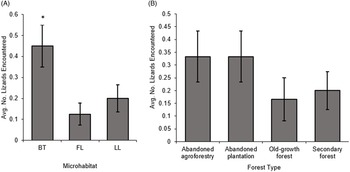
The most frequently observed lizard species in plots was the Leaf-litter Anole (Anolis humilis; 15 out of 30 observations), followed closely by Anolis limifrons Cope 1862 (8 observations). The Litter Gecko (Lepidoblepharis xanthostigma [Noble 1916]) and Brown Forest Skink (Scincella cherriei [Cope 1893]) made up the remaining seven observations. We observed significantly more lizards in buttress microhabitat than fallen log or leaf-litter, but the number of observed lizards did not differ by forest type (Poisson Regression: Forest Type – df = 3, χ 2 = 2.83, P = 0.42, partial η 2 = 0.02; microhabitat – df = 2, χ 2 = 9.42, P < 0.01, partial η 2 = 0.09; Fig. 4). Lizard observations were not statistically related to the number of prey invertebrates captured in sticky traps (df = 1, χ 2 = 2.66, P = 0.10).
Average number of lizard observations by microhabitat (A) and forest type (B). Error bars represent ± 1 SE. * = significantly different. Abbreviations: BT = buttress, FL = fallen log, LL = leaf-litter.

Discussion
Our hypotheses for this study were that (H1) lizard egg abundance would be greater in abandoned plantation and buttresses; (H2) egg survival would differ across forest types and microhabitats; and (H3) number of lizard eggs would be negatively related to predatory ant abundance. Our results provided partial support for H1, with fewer lizard eggs found in leaf-litter plots than buttress or fallen log microhabitat, but no support for the other two hypotheses. Overall, factors influencing lizard reproduction varied more by microhabitat than forest type.
We likely observed statistically fewer lizard eggs in leaf-litter plots because conditions were not favorable for nesting since litter depth was lower and more bare ground was present. Female anoles prefer to oviposit in areas with moist soil and leaf-litter (Andrews Reference Andrews1988, Socci et al. Reference Socci, Schlaepfer and Gavin2005). We observed that fallen logs and buttresses had deeper leaf litter and more soil moisture, creating more favorable nesting conditions. Nests in these microhabitats likely also would have been less exposed to egg predators due to the increased litter cover.
Despite differences in number of lizard eggs among microhabitats, we did not observe a statistical difference in egg fate by forest type or microhabitat, leading us to reject H2. There was a lot of variability in number of lizard observations and lizard eggs between plots (see error bars on Figs. 2, 4). We may not have observed differences between forest types and microhabitats because there is too much variation in species interactions between individual plots. There also were no lizard eggs in leaf-litter plots in old-growth or secondary forest, reducing the power of the analysis.
Lizard egg abundance was not statistically related to predatory ant abundance, leading us to reject H3. Our finding that egg fate did not differ, coupled with no relationship of lizard egg abundance with predatory ant abundance across plots, suggests that egg depredation may not be a primary driver of relationships between habitat variables and lizard populations in this system. This supports previous findings that Anolis humilis occupancy was most strongly affected by leaf-litter, and not predatory spider abundance (Folt Reference Folt2017). Female anoles may be selecting for suitable incubation conditions rather than locations with fewer egg predators.
Our results support previous evidence that lizard abundance is higher around trees with buttresses (Whitfield & Pierce Reference Whitfield and Pierce2005). The number of lizard eggs discovered tended to be highest in fallen logs, rather than buttresses, although this difference was only statistically significant for old-growth forest. Differences in the pattern of lizard observations and numbers of lizard eggs in this study could be explained by adult lizards using slightly different microhabitats than those selected by females for oviposition. Adult lizards likely prefer buttress microhabitats because the leaf-litter is deeper, and the buttress wings provide cover and a vantage point that anoles (our most observed lizard species) can use to survey the forest floor for prey. We acknowledge that our study only measured the number of lizards observed during a short visual encounter survey and did not take detection probability into account, so it is also possible that lizards were simply easier to detect in buttress plots than fallen log or leaf-litter. Studies that use repeated surveys or capture-mark-recapture methods to account for differences in detection are needed to determine variation in lizard abundance by microhabitats.
None of the variables that we measured differed statistically by forest type alone, but many differed by microhabitat or the interaction between forest type and microhabitat. Previous studies have found effects of forest type on herpetofauna, including greater anole abundance observed in abandoned cacao plantations than primary or old-growth forest (Bell & Donnelly Reference Bell and Donnelly2006, Folt & Reider Reference Folt and Reider2013, Heinen Reference Heinen1992, Whitfield et al. Reference Whitfield, Bell, Philippi, Sasa, Bolaños, Chaves, Savage and Donnelly2007). Possibly we did not see differences in lizard observations by forest type alone because our study was relatively short-term and used relatively small plots. Additionally, the lizards that we observed were primarily small leaf-litter species that have relatively small home ranges (i.e., ca. 150-m2 for Anolis humilis, Guyer Reference Guyer1988a). Due to their small size, finer scale differences in environmental conditions found in microhabitats may be more important to leaf-litter lizard populations than large-scale variation in forest type. Perhaps the relative availability of microhabitats such as fallen logs and buttresses should be considered in evaluating suitability of tropical habitats for litter-dwelling herpetofauna, and coarse woody debris and litter depth could be augmented in some cases for reptile conservation (e.g., supplemental coarse woody debris enhanced reptile abundance in recovering Australian woodlands, Manning et al. Reference Manning, Cunningham and Lindenmayer2013).
Our finding of microhabitat-level variation in leaf-litter depth, lizard numbers, and lizard egg abundance supports the idea that spatial variation in leaf-litter on small scales (e.g., individual trees) can drive patterns in leaf-litter lizard abundance, as was proposed in the ‘litter-mosaic hypothesis’ (Folt Reference Folt2017, Guyer Reference Guyer1988b). Anole abundance on Utila Island (Honduras) was related to both habitat quality and prey biomass, with thermal habitat quality having a strong indirect effect through increases in prey biomass (Higgins et al. Reference Higgins, Boyd, Brown, Owen and Algar2021). Results of our study suggest that the environmental conditions provided by leaf-litter may be more important for anole distribution than egg predator or prey abundance, but there could be strong indirect effects of the environment on lizard populations through prey availability or depredation risk that we were unable to detect. Future studies should focus on building comprehensive and predictive anole population growth models capable of analyzing how small-scale variation in prey availability, leaf-litter depth, temperature, rainfall, and depredation risk interact and influence population growth over time.
Conclusion
Rainforests are the most diverse terrestrial ecosystem and exhibit tremendous variation in variables such as species composition, diversity, and abundance across spatial scales (Hill & Hamer Reference Hill and Hamer2004). Prey availability and predatory ant abundance in our study varied by some forest types in interaction with microhabitat, but none of the variables measured differed by forest type alone. Species interactions such as depredation on adult lizards and lizard depredation on invertebrates may vary across microhabitats and forest types in lowland tropical rainforest, but our results suggest that ant depredation on lizard eggs does not. Overall, our study supports microhabitat type and leaf-litter depth being the most important drivers of terrestrial lizard distribution and abundance, matching findings of previous literature (e.g., Folt Reference Folt2017, Lieberman Reference Lieberman1986, Whitfield et al. Reference Whitfield, Reider, Greenspan and Donnelly2014). To better understand drivers of enigmatic tropical reptile and amphibian declines, future studies should focus on spatial scales relevant to the organism of interest (i.e., microhabitat level for small leaf-litter organisms).
Acknowledgements
We would like to thank R. Bares for assisting with fieldwork and J. Mortensen for assistance with statistical analyses. We would also like to thank La Selva Biological Station and Organization for Tropical Studies (OTS) staff, including O. Vargas Ramirez, D. Brenes Madrigal, and B. Matarrita Carranza for making this study possible.
Financial support
Emily Foster Memorial Fellowship (fund 512) and William L. Brown Fellowship (fund 515) through OTS and National Science Foundation Graduate Research Fellowship #DGE-1450079.
Competing interests
None.
Ethical statement
The authors assert that all procedures contributing to this work comply with applicable national and institutional ethical guidelines on the care and use of laboratory or otherwise regulated animals. Research conducted under IACUC protocol#16058 and No SINAC-ACC-087-2018 and No SINAC-ACC-053-2018 permits in Costa Rica.