Introduction
The hill-farming sector plays a vital role in the European sheep industry. In the UK, Pollot and Stone (Reference Pollot and Stone2006) estimated hill breed ewes produce approximately 0.24 of lambs for slaughter. These authors also noted that, due to the stratified breeding structure of the industry, hill breeds contribute, on average, close to 0.50 of the genes of the dams producing the entire lamb slaughter generation. In addition to their role in sheep meat production, hill sheep play an important role in promoting plant biodiversity (ADAS, 2007). However, the sheep industry has recently been under a period of sustained financial pressure and large improvements in production efficiency are required to underpin the industry’s future sustainability.
Genetics has a major effect on the prolificacy of breeding ewes and the quality of lamb carcasses produced. Traditionally, most breeding female replacements for the hill flock are purebred, and therefore do not take advantage of the potential benefits of heterosis and complementarity by using either a crossing sire on hill ewes or crossbred ewes. In hill systems, using a longwool crossing sire or terminal sire breed increased output per ewe, proportionately, by up to 0.24 with concomitant improvements in carcass quality (Carson et al., Reference Carson, Moss, Dawson and Kilpatrick2001). Furthermore, there are indications that crossbred ewes in hill conditions are superior in both reproductive and productive performances compared with purebred sheep (Al-Nakib et al., Reference Al-Nakib, Batement, Findlay, Smith, Smith and Thompson1997). Thus, improving the productive performance of ewes and their progeny by exploitation of heterosis under harsh hill conditions, and incorporating this in future breeding programmes, could significantly improve the viability of the sheep industry within the rural areas of Europe.
In view of this background, a research programme was undertaken to develop, through crossbreeding, improved ewes for the hill sector. The Scottish Blackface is the predominant hill sheep breed in the UK and Ireland (Friggens et al., Reference Friggens, Shanks, Kyriazakis, Oldham and McClelland1997), and is also used in other parts of the world. Therefore, this project involved purebred Blackface ewes crossed with breeds selected for hardiness (Swaledale), maternal and carcass traits (Cheviot and Lleyn) and carcass traits (Texel). This paper reports performance of the first generation of male lambs produced by these crosses, to quantify the effects of sire breed on live weight and carcass gain, feed efficiency, time to slaughter and carcass characteristics of their progeny.
In the sheep industry, lambs from the hill sector are finished for market using a range of production systems, from long-keep grass-based systems to short-keep concentrate-based systems. Diet type (i.e., roughage- v. concentrate-based) can affect lamb growth rates and carcass characteristics (Chestnutt, Reference Chestnutt1994; Carson et al., Reference Carson, Moss, Dawson and Kilpatrick2001). Furthermore, using concentrate diets high in polyunsaturated fatty acids (PUFA), such as diets supplemented with oilseed meals, can beneficially increase PUFA concentration in meat (Lough et al., Reference Lough, Solomon, Rumsey, Elsassaer, Slyter, Kahl and Lynch1992; Ponnampalam et al., Reference Ponnampalam, Sinclair, Egan, Blakeley, Li and Leury2001). However, the effects of using oilseed diets on lamb growth and carcass quality have not been evaluated, and these performance measures are the most important from an economic viewpoint (Conington et al., Reference Conington, Bishop, Waterhouse and Simm2004). Consequently, in the current study, lambs were finished on (i) a low plane of nutrition, based on a fixed allowance of dried grass pellets representing a grass-based system (LP), or (ii) a high plane of nutrition with a diet consisting proportionately of 0.20 dried grass pellets : 0.80 cereal-based concentrate (HP-cereal) offered ad libitum, or (iii) a high plane of nutrition with a diet consisting proportionately of 0.20 dried grass pellets : 0.80 cereal/oilseed based concentrate (HP-cereal/oilseed) offered ad libitum.
Material and methods
Experimental design
Five lamb genotypes were investigated in the current study: Scottish Blackface, Swaledale × Blackface, Cheviot × Scottish Blackface, Lleyn × Scottish Blackface and Texel × Scottish Blackface. Details of the number of lambs and age at start of the experiment are presented in Table 1. Lambs of each genotype from each farm source were allocated at random to one of three dietary treatments. Representative samples of lambs of each genotype were slaughtered at the start of the experiment and on reaching 42 and 50 kg live weight.
Experimental plan; number and age of lambs (days) at start of the study allocated to each slaughter group and diet over 2 years

†LP, 100% dried grass pellets; HP-cereal, 80% cereal-based concentrate : 20% dried grass pellets on a dry matter (DM) basis; HP-cereal/oilseed, 80% cereal/oilseed concentrate : 20% dried grass pellets on a DM basis.
Dietary treatments
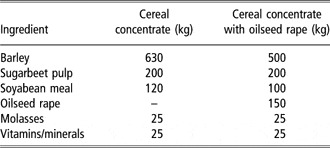
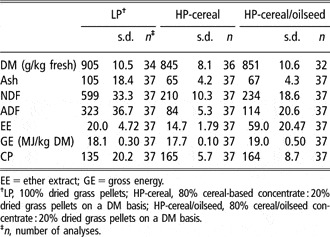
Three dietary treatments were investigated. Lambs allocated to a LP were offered a fixed allowance (0.08 × live weight0.75) of dried grass pellets. Lambs allocated to a HP were offered, ad libitum, either (i) a cereal-based concentrate (0.80 of diet on a dry matter (DM) basis) along with dried grass pellets (0.20 of diet) (HP-cereal) or (ii) a cereal/oilseed concentrate (0.80 of diet) along with dried grass pellets (0.20 of diet) (HP-cereal/oilseed). Ingredient composition of the concentrates and chemical composition of the diets are presented in Tables 2 and 3, respectively.
Ingredient composition of the concentrates (kg inclusion per tonne of concentrate)

Chemical analysis of treatment diets offered (all values g/kg dry matter (DM) unless stated otherwise)

EE = ether extract; GE = gross energy.
†LP, 100% dried grass pellets; HP-cereal, 80% cereal-based concentrate : 20% dried grass pellets on a DM basis; HP-cereal/oilseed, 80% cereal/oilseed concentrate : 20% dried grass pellets on a DM basis.
‡n, number of analyses.
Animals and management
Over 2 years (2002 and 2003), a total of 550 male lambs were sourced from six hill farms participating in a study investigating the relative merits of crossbreeding in the hill sector. Details of the sires and dams of the lambs are reported by Carson and Dawson (Reference Carson and Dawson2005). In brief, 1200 Scottish Blackface ewes were mated over 2 years with Blackface, Swaledale, North Country Cheviot, Lleyn and Texel sires (n = 15 sires per breed). In year 1, all lambs were entire males; in year 2, lambs were randomly allocated to being left entire or castrated within the first 6 weeks of life. On each of the hill farms, eight to ten male lambs of each of the five genotypes in the weight range 25 to 35 kg were randomly selected for the current study.
Lambs were transferred to the Agri-Food and Biosciences Institute, Hillsborough, after weaning. Within each genotype and each farm source, lambs were randomly allocated to a dietary treatment. Finally, within each genotype and dietary treatment, lambs were allocated at random to slaughter at (i) start of the experiment, (ii) on reaching 42 kg live weight and (iii) on reaching 50 kg live weight.
Prior to the start of the trial, all lambs were housed and fed dried grass pellets ad libitum for a 3-week acclimatisation period. During this period, lambs, apart from those allocated to slaughter at the start of the experiment, were given a clostridial vaccine (Ovivac-P; Intervet UK Ltd, Walton, Milton Keynes, UK) and were treated for external and internal parasites (Cydectin; Fort Dodge Animal Health, Southampton, UK). Animals of each genotype on each nutritional regime were housed in groups of four to six (i.e., two to three replicates per year). Each pen of lambs contained at least one lamb from each slaughter weight treatment.
Measurements
During the study, the amounts of the diets offered and refused were recorded daily to determine group DM intakes (DMIs) and to estimate individual DMI. Representative concentrate samples were taken four days per week and dried for the determination of oven DM, before subsequent chemical analysis. The dried concentrate samples were analysed for ash, ether extract (EE), neutral-detergent fibre (NDF), acid-detergent fibre (ADF), gross energy (GE) and nitrogen (N) concentration.
The apparent digestibilities (DM, N, NDF and digestible organic matter in the DM (DOMD)) of the diets were determined using castrated male sheep (four per treatment) (Steen, Reference Steen1986), which were similar to those on experiment.
All lambs were weighed weekly throughout the experiment, and were slaughtered at a local abattoir within 48 h of reaching target slaughter live weight of 42 or 50 kg (±1 kg live weight). Lambs were stunned, eviscerated and skinned, and the carcasses chilled under standard commercial conditions. Dressing proportions were calculated on the basis of field weight and cold carcass weight. The carcasses were commercially graded for conformation (using the EU lamb carcass classification system E.U.R.O.P. (Commission Regulation (EC) No 1249/2008): from E = excellent, P = poor conformation) and fat class (1 = low fat cover; 5 = high fat cover). Linear measurements of body length, depth of side, width of shoulder and circumference of buttock (circumference of the whole hanging carcass on a horizontal plane at the caudal of the base of the tail) were recorded as described by Brown and Williams (Reference Brown and Williams1979).
The carcasses were cut into three barrel-type sections by making two cuts in a transverse plane, separating the bracelet from the loin, between the 12th and 13th ribs, and separating the leg from the loin (USDA, 1996). Subcutaneous fat depth measurements were recorded from the exposed cut surface at the bracelet–loin separation above the eye muscle (longissimus dorsi), 50 mm of the mid-dorsal line, and immediately lateral to the iliocostalis thoracis and perpendicular to the carcass outer surface. Subcutaneous fat depth measurements were recorded from the exposed cut surface at the loin–leg separation above the gluteus medius muscle, 35 mm from the mid-dorsal line, and at the dorsal edge of the obliquus internus abdominis muscle. Total tissue depth over the 12th and 13th rib (both sides), 110 mm from the mid-dorsal line was measured using a simple probe. Perinephric and retroperitoneal fat and both kidneys were removed and weighed.
Chemical analysis
All feed samples were dried, bulked over each measurement week and milled through a 1 mm screen, prior to chemical analysis. Ash concentration was measured by incineration of a 3 g sample in a muffle furnace at 600°C for 6 h (British Standards Institution, 1967). Analyses of NDF and ADF were carried out on 1 g dried samples according to the methods of Van Soest et al. (Reference Van Soest, Robertson and Lewis1991), using boiling solutions of sodium lauryl sulphate and EDTA (ethylenediaminetetraacetic acid). GE concentration was determined in an adiabatic bomb calorimeter using a modification of the method of Porter (Reference Porter1992). The total N of fresh samples of faeces and urine and dried concentrates were analysed by the macro-Kjeldahl method as described by Steen (Reference Steen1989), and expressed as CP (N × 6.25).
Statistical analysis
Live weight gains were calculated by linear regression using individual animal data from the start of the experiment to the point they reached their allocated slaughter weight. A representative sample of lambs was slaughtered at the start of the experiment and their data used to fit linear relationships between carcass weight and initial live weight (kg). Subsequently, these data were used to predict initial carcass weight and calculate carcass gains. Data from 21 lambs (8 and 13, for year 1 and 2, respectively) were treated as missing values; this was spread across the experimental treatments with at least five animals remaining on each dietary treatment/lamb genotype/slaughter group.
All statistical analyses were carried out using the statistical package GenStat 11 (VSN International Ltd, Hemel Hempstead, UK). Given the unbalanced nature of the dataset, the data were analysed using the Residual Maximum Likelihood (REML) procedure for continuous variables. The fixed models used were: (i) Year + farm of origin + sex + fat class + sire breed × dietary treatment and, (ii) Year + farm of origin + sex + cold carcass weight + sire breed × dietary treatment, where the individual animal was the experimental unit. Intakes and feed conversion efficiencies were calculated using the fixed terms for farm of origin + sex + fat class (or cold carcass weight, respective of endpoint tested) + sire breed × dietary treatment with year/pen as random model, to account for the pen being the experimental. Values lying outside two standard deviations from the mean for live weight gain, feed conversions efficiencies and carcass tissue depth measurements were analysed as missing values. Significant differences between means (parameters with a significant effect or interaction) were calculated with the standard error of differences between pairs calculated by GenStat.
Conformation and fat classification were analysed using a proportional-odds model which tested for the main effects of sire breed × dietary treatment factorial, with fitted fixed effects for year of experiment, farm of origin, lamb sex type and fat class or cold carcass weight, as described above. The conformation and fat classification scores at both sides of the ordinal scales were grouped together (i.e., E/U and O/P; 1/2 and 4.5/5, respectively) and frequencies of observations at the various (grouped) scores were calculated.
The primary objective of this study was to investigate the effects of lamb genotype and diet on post-weaning lamb growth and carcass characteristics. Therefore, effects of year, farm of origin and lamb sex type, although included in the statistical model, are not presented or discussed. Results presented are the means of the different levels of the main effects (i.e., sire breed and dietary treatment). In the cases where the sire breed × dietary treatment factorial was found to be significant further tables are provided to present the interaction.
Results
Diets
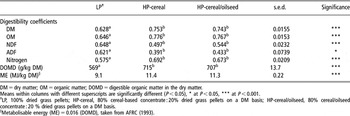
Chemical analyses of the dietary treatments offered for year 1 and 2 are given in Table 3. The dried grass pellets (LP diet) had lower digestibility coefficients for DM (P < 0.001), OM (P < 0.001) and N (P < 0.001), compared with the cereal and cereal/oilseed concentrate-based diets (Table 4). Conversely, dried grass pellets had higher digestibility coefficients for NDF (P < 0.001) and ADF (P < 0.05) than both the cereal and cereal/oilseed-based diets (HP-cereal, HP-cereal/oilseed). The DOMD was significantly lower for the LP diet (P < 0.001).
Apparent digestibilities and metabolisable energy concentrations of the treatment diets (9 d.f.) in year 1 of the experiment

DM = dry matter; OM = organic matter; DOMD = digestible organic matter in the dry matter.
Means within columns with different superscripts are significantly different (P < 0.05), * at P < 0.05, *** at P < 0.001.
†LP, 100% dried grass pellets; HP-cereal, 80% cereal-based concentrate : 20% dried grass pellets on a DM basis; HP-cereal/oilseed, 80% cereal/oilseed concentrate : 20 % dried grass pellets on a DM basis.
§Metabolisable energy (ME) = 0.016 (DOMD), taken from AFRC (1993).
Live weight gain, age at slaughter and carcass weight gain
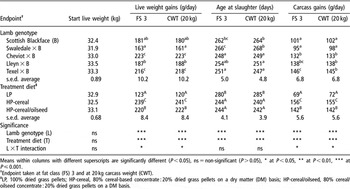
Live weight and carcass gains were lower with the LP compared with HP dietary treatments (P < 0.001) (Table 5).
Effects of lamb genotype and treatment diet on live weight and carcass gains, and age at slaughter

Means within columns with different superscripts are significantly different (P < 0.05), ns = non-significant (P > 0.05), * at P < 0.05, ** at P < 0.01, *** at P ⩽ 0.001.
†Endpoint taken at fat class (FS) 3 and at 20 kg carcass weight (CWT).
‡LP, 100% dried grass pellets; HP-cereal, 80% cereal-based concentrate : 20% dried grass pellets on a dry matter (DM) basis; HP-cereal/oilseed, 80% cereal/oilseed concentrate : 20% dried grass pellets on a DM basis.
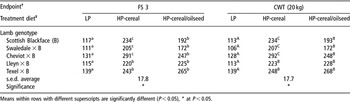
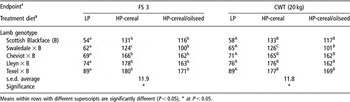
For live weight and carcass gains a significant interaction (P < 0.05) occurred between lamb genotype and dietary treatment (Tables 6a and b, respectively). At a fat class 3-endpoint on the LP dietary treatment, live weight gain did not vary significantly between the genotypes. On both HP treatments, live weight gains were lower in Swaledale cross lambs compared with the Cheviot (P < 0.001) and Texel cross (P < 0.05) lambs. Blackface lambs had lower live weight gains than Cheviot (P < 0.01) on both HP dietary treatments, and lower live weight gains than Texel cross (P < 0.001) lambs when fed the HP-cereal/oilseed treatment. Carcass gains followed a similar pattern. On LP dietary treatment, carcass gains did not vary significantly between most of the lamb genotypes, although Texel cross lambs had higher carcass gains than Blackface and Swaledale cross lambs (P < 0.05). On both HP dietary treatments, carcass gains were lower in Blackface and Swaledale cross lambs compared with the Cheviot, Lleyn and Texel cross lambs (P < 0.01).
Interactions between lamb genotype and treatment diet on live weight gains (g/day)

Means within rows with different superscripts are significantly different (P < 0.05), * at P < 0.05.
Interactions between lamb genotype and treatment diet on carcass gains (g/day)

Means within rows with different superscripts are significantly different (P < 0.05), * at P < 0.05.
At a fat class 3-endpoint, Blackface and Swaledale cross lambs were older at slaughter compared with Cheviot and Texel cross Lambs (P < 0.05 and P < 0.01, respectively). Swaledale lambs were older than Lleyn cross lambs (P < 0.05). At a constant carcass weight endpoint, Blackface and Swaledale cross lambs were older than each of the other genotypes (P < 0.01 and P < 0.001, respectively)
Intake and feed efficiency
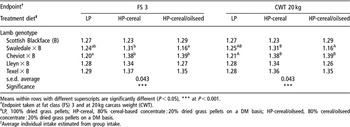
On the LP dietary treatment, intakes were fixed and therefore did not vary significantly between the genotypes (Table 6c). On the HP-cereal diet, daily DMIs were lower in the Blackface compared with the other genotypes (P < 0.05). On the HP-cereal/oilseed treatment, intakes were lower in the Swaledale cross lambs compared with the other genotypes (P < 0.05). Intakes of the Blackface and Lleyn cross lambs were lower than the Cheviot cross lambs (P < 0.05).
Interactions between lamb genotype and treatment diet on dry matter (DM) intakesFootnote § (kg/day)

Means within rows with different superscripts are significantly different (P < 0.05), *** at P < 0.001.
† Endpoint taken at fat class (FS) 3 and at 20 kg carcass weight (CWT).
‡ LP, 100% dried grass pellets; HP-cereal, 80% cereal-based concentrate : 20% dried grass pellets on a DM basis; HP-cereal/oilseed, 80% cereal/oilseed concentrate : 20% dried grass pellets on a DM basis.
§ Average individual intake estimated from group intake.
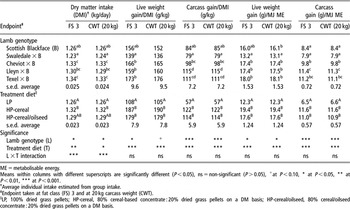
At a fat class 3-endpoint, Swaledale cross had a poorer feed conversion of DMI to live weight gain compared with Lleyn cross (P < 0.05), Cheviot cross (P < 0.01) and Texel cross lambs (P < 0.01), and poorer conversion of metabolisable energy (ME) to live weight gain compared with the other crossbred lambs (P < 0.01; Table 7). At a 20 kg carcass weight endpoint, differences for feed conversion of DMI to live weight gain between the genotypes approached significance (P = 0.051) and conversion of ME to live weight gain was poorer for Swaledale cross compared with Blackface (P < 0.05), Lleyn cross (P < 0.01), Cheviot cross (P < 0.01) and Texel cross lambs (P < 0.001) (Table 7). The efficiencies of carcass gain, at both endpoints, were lowest for Blackface and Swaledale cross lambs and highest for Lleyn cross and Texel cross lambs (P < 0.001). Cheviot cross lambs had intermediate carcass gain efficiency, compared with Swaledale cross and Lleyn cross lambs, for conversion of DMI to carcass gain (P < 0.05). Furthermore, Cheviot cross lambs had intermediate carcass gain efficiency, compared with Blackface Swaledale cross and Lleyn cross lambs, for conversion of ME to carcass gain (P < 0.05). All feed conversion efficiencies were lower for lambs on the LP diet compared with lambs on the HP diets (P < 0.001).
The effects of lamb genotype and treatment diet on dry matter intake and feed conversion efficiencies

ME = metabolisable energy.
Means within columns with different superscripts are significantly different (P < 0.05), ns = non-significant (P > 0.05), +at P < 0.10, * at P < 0.05, ** at P < 0.01, *** at P < 0.001.
†Average individual intake estimated from group intake.
‡Endpoint taken at fat class (FS) 3 and at 20 kg carcass weight (CWT).
§LP, 100% dried grass pellets; HP-cereal, 80% cereal-based concentrate : 20% dried grass pellets on a DM basis; HP-cereal/oilseed, 80% cereal/oilseed concentrate : 20% dried grass pellets on a DM basis.
Carcass weight, classification and dressing proportion
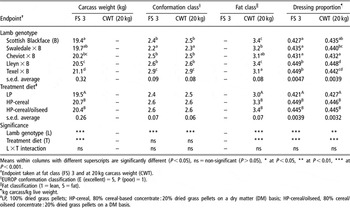
At a fat class 3-endpoint, carcass weights for Blackface and Swaledale lambs were lower than Cheviot, Lleyn and Texel cross lambs (P < 0.05) (Table 8). Carcass weight for Texel cross lambs was higher than the other genotypes (P < 0.05).
The effects of lamb genotype and treatment diet on carcass weight and characteristics

Means within columns with different superscripts are significantly different (P < 0.05), ns = non-significant (P > 0.05), * at P < 0.05, ** at P < 0.01, *** at P < 0.001.
†Endpoint taken at fat class (FS) 3 and at 20 kg carcass weight (CWT).
§EUROP conformation classification (E (excellent) = 5, P (poor) = 1).
||Fat classification (1 = lean, 5 = fat).
¶kg carcass/kg live weight.
‡LP, 100% dried grass pellets; HP-cereal, 80% cereal-based concentrate : 20% dried grass pellets on a dry matter (DM) basis; HP-cereal/oilseed, 80% cereal/oilseed concentrate : 20% dried grass pellets on a DM basis.
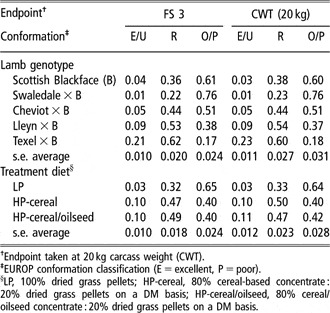
Carcass conformation classification value was highest for Texel cross lambs (P < 0.001) and lowest for Swaledale cross lambs (P < 0.05), and Blackface, Cheviot cross and Lleyn cross lambs had similar conformation classification values (Table 8). Overall, on a proportionate basis, only 0.23 of lambs from Swaledale cross lambs achieved the better E, U and R grades of the EUROP classification scheme compared with 0.40 for Blackface lambs, 0.49 for Cheviot cross lambs, 0.62 Lleyn cross lambs and 0.83 for Texel cross lambs (Table 9a).
The effects of lamb genotype and treatment diet on the proportion of lambs falling into categories of the EUROP classification system

†Endpoint taken at 20kg carcass weight (CWT).
‡EUROP conformation classification (E = excellent, P = poor).
§LP, 100% dried grass pellets; HP-cereal, 80% cereal-based concentrate:20% dried grass pellets on a DM basis; HP-cereal/oilseed, 80% cereal/oilseed concentrate:20% dried grass pellets on a DM basis.
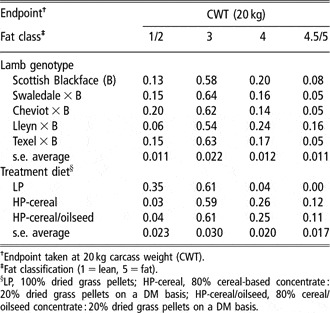
At constant carcass weight, carcasses from Blackface and Lleyn cross lambs had higher fat classifications than those of Texel and Cheviot cross lambs (P < 0.01; Table 8), due to a greater proportion of fat classification scores of 4 and higher (Table 9b).
The effects of lamb genotype and treatment diet on the proportion of lambs falling into the carcass fat classification categories

†Endpoint taken at 20kg carcass weight (CWT).
‡Fat classification (1 = lean, 5 = fat).
§LP, 100% dried grass pellets; HP-cereal, 80% cereal-based concentrate:20% dried grass pellets on a DM basis; HP-cereal/oilseed, 80% cereal/oilseed concentrate:20% dried grass pellets on a DM basis.
At a fat class 3-endpoint, dressing proportions for carcasses from Blackface, Swaledale and Cheviot cross lambs were lower than those of Lleyn and Texel cross lambs (P < 0.05).
Carcass weights, fat scores and dressing proportions were lower for LP compared with HP dietary regimes (P < 0.001). Dietary treatment did not have a significant effect on conformation classification (Table 8).
Carcass fat and tissue depth measurements
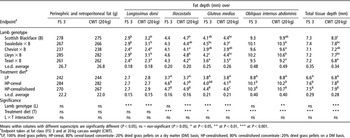
The weight of perinephric and retroperitoneal fat did not vary significantly between the lamb genotypes or dietary treatments (Table 10). At both endpoints, fat depth over the l. dorsi was higher in the Blackface, Swaledale and Lleyn cross lambs compared with the Cheviot and Texel cross lambs (P < 0.01). Fat depth over the loin was higher in the Swaledale and Lleyn cross lambs compared with Texel lambs (P < 0.001 and P < 0.05, respectively). At a constant fat class 3-endpoint, lamb genotype and dietary treatment had no significant effect on fat depth over g. medius and obliquus internus abdominis, and total tissue depth.
The effects of lamb genotype and treatment diet on carcass fat and tissue depth measurements (mm)

Means within columns with different superscripts are significantly different (P < 0.05), ns = non-significant (P > 0.05), * at P < 0.05, ** at P < 0.01, *** at P < 0.001.
†Endpoint taken at fat class (FS) 3 and at 20 kg carcass weight (CWT).
‡LP, 100% dried grass pellets; HP-cereal, 80% cereal-based concentrate : 20% dried grass pellets on a dry matter (DM) basis; HP-cereal/oilseed, 80% cereal/oilseed concentrate : 20% dried grass pellets on a DM basis.
At both endpoints, fat depth over g. medius and obliquus internus abdominis, and total tissue depth were lower (P < 0.001) for lambs on the LP. Carcass fat and tissue depth measurements were similar for lambs fed HP-cereal and HP-cereal/oilseed diets, with the exception of fat depth over the loin, which was higher for HP-cereal/oilseed lambs at a constant carcass weight (Table 10).
Kidney weight
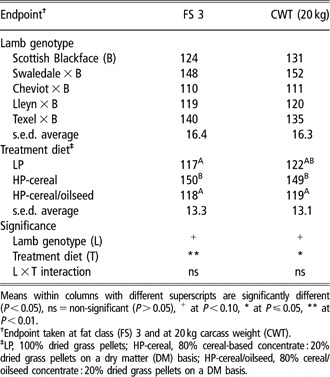
Kidney weights were similar in each of the lamb genotypes (Table 11). At a constant fat class, the kidney weight was greater for HP-cereal lambs compared with HP-cereal/oilseed and LP lambs (P < 0.05). At constant carcass weight, there was only a significant difference (P < 0.05) for kidney weight between the HP-cereal and HP-cereal/oilseed dietary treatments (Table 11).
The effects of lamb genotype and treatment diet on kidney weight (g)

Means within columns with different superscripts are significantly different (P < 0.05), ns = non-significant (P > 0.05), + at P < 0.10, * at P ⩽ 0.05, ** at P < 0.01.
†Endpoint taken at fat class (FS) 3 and at 20 kg carcass weight (CWT).
‡LP, 100% dried grass pellets; HP-cereal, 80% cereal-based concentrate : 20% dried grass pellets on a dry matter (DM) basis; HP-cereal/oilseed, 80% cereal/oilseed concentrate : 20% dried grass pellets on a DM basis.
Carcass linear traits
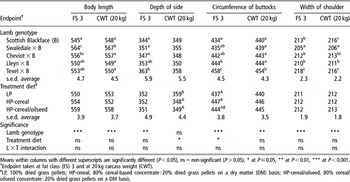
Body length was longer for Swaledale compared with Blackface, Lleyn and Texel cross lambs at both a constant fat class (P < 0.05) and carcass weight (P < 0.01) endpoints (Table 12). At a constant carcass weight endpoint, Swaledale cross lambs had a greater body length than Cheviot cross lambs as well (P < 0.01). At both endpoints, the circumference of buttocks was greater for Texel cross lambs compared with the other lamb genotypes (P < 0.05). Similarly, at a constant fat class, the width of shoulder was significantly greater for Texel cross lambs compared with the other genotypes (P < 0.05). Swaledale cross lambs had narrower shoulder widths compared with the other genotypes (P < 0.05). At a constant fat class endpoint, Texel cross lambs had a greater depth of side than Blackface, Swaledale and Cheviot cross lambs (P < 0.05; Table 12).
The effects of lamb genotype and treatment diet on carcass linear traits (mm)

Means within columns with different superscripts are significantly different (P < 0.05), ns = non-significant (P > 0.05), * at P ⩽ 0.05, ** at P < 0.01, *** at P < 0.001.
†Endpoint taken at fat class (FS) 3 and at 20 kg carcass weight (CWT).
‡LP, 100% dried grass pellets; HP-cereal, 80% cereal-based concentrate : 20% dried grass pellets on a dry matter (DM) basis; HP-cereal/oilseed, 80% cereal/oilseed concentrate : 20% dried grass pellets on a DM basis.
At a constant carcass weight endpoint, depth of side was greater for lambs offered the LP compared with HP (P < 0.05). At a constant fat class endpoint, the circumference of buttocks was lower for lambs on the LP compared with the HP-cereal/oilseed concentrate-based diet (P < 0.01; Table 12).
Discussion
Across Europe, sheep production, especially in less favoured areas, has been declining since the 2003 CAP (Common Agricultural Policy) reform. Hill sheep farming plays a key environmental role within the EU (European Union) and at the same time, makes a crucial contribution to the economy in rural areas. Consequently, it is important to look at options in this sector to improve its economic sustainability. Crossbreeding within hill ewe flocks can deliver significant production benefits through a combination of individual and maternal heterosis, and the use of sire breeds with complementary characteristics, irrespective of ewe breed (Carson et al., Reference Carson, Moss, Dawson and Kilpatrick2001). This paper, therefore, presents novel and important data on the effects of range of sire breeds selected for enhanced hardiness, maternal and/or carcass traits on the relative performance of F1 crossbred male lambs. Thus, inference of information presented here should be applicable to the hill sheep sector beyond these specific breed crosses and could be used as basis for decisions on future breeding structures.
Food intake and lamb growth
In the current study, a wide variation in DMIs were observed, resulting in a lamb genotype by a dietary treatment interaction. Food intakes of animals on the LP were restricted to a fixed allowance (0.085 × live weight0.75) to represent the limited nutrient supply often found on grass-only hill lamb finishing systems. Therefore, only for animals offered the diets supplying HP can real differences in DMI be observed. The majority of the variation found between breeds in food intake on the HP is probably due to differences in genetic potential of mature size (Lewis et al., Reference Lewis, MacFarlane, Simm and Emmans2004). The majority of the DMIs observed were within the upper limit or above the reported range of intake for sheep of 77–81 g DM/kg live weight0.75/day (Etheridge et al., Reference Etheridge, Stockdale and Cranwell1993). Intakes of Swaledale cross lambs on the HP-cereal/oil diet fell below this range (74 g DM/kg live weight0.75/day), but remained well within an earlier reported range of intake for sheep of 20–75 g DM/kg live weight0.75/day (Dermarquilly and Weiss, Reference Dermarquilly and Weiss1971). It is likely that the relatively high metabolic intakes found in the current study reflect that the diets were offered in pelleted concentrate form.
In the current study, dietary treatments produced growth rates representing the range adopted in commercial production systems. Some scaling between the lamb genotypes and the planes of nutrition was observed for live weight gains, indicating that differences in genetic growth potential between the lamb genotypes were expressed to a somewhat larger extent on the HP compared with the LP. This is in contrast to the findings of Lewis et al. (Reference Lewis, MacFarlane, Simm and Emmans2004), who found no benefits of cross breeding in growth response to an improved nutritional environment. Our work, with a wide range of genotypes, indicates clear growth benefits with crossbred lambs on HP.
The live weight and carcass gains in the current study were higher than reported for purebred Blackface lambs, fed either high forage or high concentrate diets, in an earlier study (Carson et al., Reference Carson, Moss, Dawson and Kilpatrick2001). Some of this improved growth performance may be due to the fact that the Blackface sires used in the current study were selected to represent the top 0.10 of recorded animals, on the basis of a breeding index which includes maternal, growth and carcass traits (Hill 2 index) (Conington et al., Reference Conington, Bishop, Waterhouse and Simm1998) as opposed to unrecorded rams used in this earlier study. On an average, live weight and carcass gains of Cheviot cross and Texel cross lambs were higher compared with purebred Blackface lambs on the HP. Moreover, the proportional increase in live weight and carcass gains was similar to that found for Texel × Blackface and purebred Cheviot lambs when compared with Blackface lambs, when fed a high concentrate diet in an earlier study (Carson et al., Reference Carson, Moss, Dawson and Kilpatrick2001). Overall, improved growth performance of the Texel cross and Cheviot cross lambs meant that they were finished 1 to 2 weeks earlier compared to purebred Blackface lambs across the dietary treatments. Although Swaledale and Lleyn have important roles in the national flock (Department of Environment Food and Rural Affairs (DEFRA), 2002), there is little comparative information on the performance of lambs from these breeds and their crosses during the finishing period. This study shows that live weight or carcass growth potential is similar when moving from Blackface to Swaledale × Blackface lambs. Lleyn cross lambs had similar carcass growth potential to Cheviot cross and Texel cross lambs.
Feed-conversion efficiency has a major influence on the economics of lamb finishing as well as affecting the environmental footprint of systems. There are breed differences in feed-conversion efficiency between hill and terminal sire breeds (Lewis et al., Reference Lewis, MacFarlane, Simm and Emmans2004), but when comparing pure hill breed lambs and their crossbred contemporaries, no differences in efficiencies have been found, even if the sire breeds used were terminal sire breeds (Carson et al., Reference Carson, Moss, Dawson and Kilpatrick2001; Lewis et al., Reference Lewis, MacFarlane, Simm and Emmans2004; Macfarlane et al., Reference MacFarlane, Lewis and Emmans2004). In the current study, a wider range of crossing sire breeds were used in comparison to earlier studies, and overall feed conversion efficiencies were found to be higher for Lleyn cross, Cheviot cross and Texel cross lambs, and lower for Swaledale cross and Blackface lambs. Differences may arise from differences in efficiency of nutrient digestion and utilisation, partitioning nutrients into different body tissues or some combination of these (Herd et al., Reference Herd, Oddy and Richardson2004). Differences in fat depth measurements between the lamb genotypes indicate that nutrient partitioning plays at least some role in the observed differences in feed conversion. Furthermore, feed-conversion ratios (either gain to feed or feed to gain) can confound growth rate, body size and appetite with metabolic efficiency. The concept of residual food intake (RFI) has therefore been proposed as a better measure of feed efficiency as it describes feed intake independent on animal’s size and growth (Channon et al., Reference Channon, Rowe and Herd2004). RFI is defined as the difference between actual feed intake and that predicted on the basis of requirements for production and maintenance of body weight. An examination of RFI values (calculated by modelling daily feed intake as described by Channon et al. (Reference Channon, Rowe and Herd2004)) was undertaken within the tested lamb population in the current study. There were no statistically significant differences in RFI between the lamb genotypes, and for each lamb genotype a considerable range in RFI was found (Blackface, −0.33 to +0.19; Swaledale cross, −0.25 to +0.24; Cheviot cross, −0.30 to +0.21; Lleyn cross, −0.31 to +0.24; Texel cross, −0.20 to +0.19 kg DM/day). Archer et al. (Reference Archer, Barwick and Graser2004) concluded that profit was maximised when RFI measurement was included in beef cattle breeding schemes for the top 10% to 20% performance tested bulls. There may be scope for inclusion of (residual) feed intake into the selection objectives of terminal sire breeds to increase growth rate without increasing feed intake (Cammack et al., Reference Cammack, Leymaster, Jenkins and Nielsen2005). This, potentially, could contribute to increasing both economic and environment efficiency within crossbreeding, as well as purebred, sheep production systems. However, the effects of selection for efficiency on reproductive costs need to be taken into account.
As detailed previously, the two different planes of nutrition led to large differences in live weight and carcass gains. On average, lambs gained 0.12 and 0.23 kg/day on the LP and HP, respectively. These values are within the range of growth rates expected for these ME intakes (11.5 v. 14.7 MJ ME/day, respectively) (Agriculture and Food Research Council, 1993). In agreement with earlier work (Ferrell et al., Reference Ferrell, Crouse, Field and Chant1979; Chestnutt, Reference Chestnutt1992; Carson et al., Reference Carson, Moss, Dawson and Kilpatrick2001) feeding a higher plane of nutrition to lambs increased feed efficiency of conversion of ME to live weight and carcass gain, significantly reflecting both higher ME intakes and faster growth. This increased efficiency led to lambs being 5 weeks younger at slaughter; thus, feeding a higher plane of nutrition to cross-bred hill lambs is an effective means to shorten the finishing period.
In the sheep sector, a proportion of hill lambs are finished indoors on high concentrate diets. An objective of the current study was to evaluate the effects of feeding a concentrate containing oilseed (HP-cereal/oil) on lamb growth and carcass quality. In the current study 150 kg/tonne oilseed rape was included in the concentrate. A higher level of oilseed rape (380 kg/tonne) was found to be associated with reduced concentrate intakes (unpublished data). Lower intakes and problems with palatability have been associated with the presence of glucosinolate in oilseed rape. Although current commercial oilseed rape varieties are bred for low levels of alkyl glucosinolates, these can vary considerably between sites and seasons (Tripathi and Mishra, Reference Tripathi and Mishra2007), and oilseed rape used in this experiment was not tested for glucosinolate level. Furthermore, high levels of fat/oil in the diets of ruminants have been shown to adversely affect feed intake due to the negative effects on ruminal fermentation (Haddad and Younis, Reference Haddad and Younis2004). In the current study, the fat content of the HP-cereal/oil diet was 6% and average intakes of lambs on this diet were, apart from Swaledale cross lambs, similar to the cereal-based concentrate. It is possible that Swaledale cross lambs are more sensitive to the effects of fat/oil inclusion in the diet or any anti-nutrients if present. Overall, carcass gain, feed efficiency of conversion of ME to live weight and carcass gain, age at slaughter and carcass weight were similar for lambs finished on both high plane dietary regimes. Thus, results of this study show that there are no negative effects of inclusion for oilseed rape in concentrate-based diets on performance for Blackface lambs and their crosses. Other work has indicated that addition of oilseeds (including rapeseed) to diets can reduce methane emission from rumen fermentation (Machmüller et al., Reference Machmüller, Ossowski and Kreuzer2000) whilst maintaining intake and performance in ruminants (Jordan et al., Reference Jordan, Kenny, Hawkins, Malone, Lovett and O’Mara2006). Thus, feeding a HP diet that includes oilseed rape may be a good strategy to enhance (or maintain) animal productivity whilst decreasing the contribution to the atmospheric methane budget when compared to grass- (or cereal-) based lamb finishing systems.
Carcass characteristics and composition
Lambs are selected in the UK for slaughter according to a combination of live weight and fatness, with the emphasis on market signals (Conington et al., Reference Conington, Bishop, Waterhouse and Simm1998). Thus, the current study was designed to investigate breed differences for carcass at the desired fat class (score 3) and also at a fixed carcass weight of 20 kg, representing the average carcass weight of lambs slaughtered in Northern Ireland (Livestock and Meat Commission (LMC), 2007). In the current study, the carcass weights of the purebred Blackface lambs, adjusted to constant carcass fatness, finished 1.6 kg heavier and 5 weeks earlier when compared to that of purebred Blackface lambs in an earlier study at this Institute (Carson et al., Reference Carson, Moss, Dawson and Kilpatrick2001). As discussed previously, this probably reflects the higher genetic potential of the Blackface sires used in the current study. Overall, improved growth performances of Cheviot cross and Texel cross lambs led to heavier carcasses compared to Blackface lambs, which is consistent with earlier findings (Carson et al., Reference Carson, Moss, Dawson and Kilpatrick2001). Similarly, Lleyn cross lambs produced similar carcass weights to Cheviot cross lambs, reflecting the selection basis of carcass traits as well as maternal traits of the Lleyn breed.
The tissue depth and most carcass fat depth measurements in the current study were highest for Blackface, Swaledale cross and Lleyn cross lambs when compared to the faster growing Cheviot cross and Texel cross lambs. The differences in carcass fatness between these lamb genotypes are likely to reflect their mature weights and at what point in their growth curve they were slaughtered in relation to their mature weight. Generally, genotypes that are heavier at maturity grow faster and contain less fat in their carcasses than do animals of smaller mature size when compared at the same weight (Black, Reference Black1983). However, differences between breeds have been observed over and above those related to variation in mature size. For example, pure- and cross-bred lambs that are produced from Texel sires, compared to other genotypes produce, have leaner carcasses and higher lean to fat ratio in relation to mature size (Lambe et al., Reference Lambe, Navajas, McLean, Simm and Bunger2007).
Improvements in lamb carcass conformation from the hill sheep flock are important, as it remains the basis of many producer payments systems. Kempster et al. (Reference Kempster, Croston and Jones1987) reported that there were small differences between sire breeds, including Texel, in visually assessed carcass conformation. However, the current study shows a clear improvement in conformation, using the EUROP classification system, when Blackface ewes were crossed with Texel sires. This is consistent with the findings of Carson et al. (Reference Carson, Moss, Dawson and Kilpatrick2001). The poor conformation found for the Swaledale-cross lambs, in comparison to most of the other lamb genotypes, is associated with differences in carcass shape, with Swaledale cross lambs having longer body length, smaller circumference of buttocks and narrower shoulders.
In the present study, carcasses from lambs fed the HP diets had higher dressing proportions (+0.018–0.028 kg carcass/kg live weight) compared to lambs fed the LP diet. This is comparable to the range of values reported by other workers comparing animals on a higher plane of nutrition compared to a lower plane of nutrition (Chestnutt, Reference Chestnutt1994; Carson et al., Reference Carson, Moss, Dawson and Kilpatrick2001; Lewis et al., Reference Lewis, MacFarlane, Simm and Emmans2004), reflecting differences in carcass fat and tissue depth measurements. The higher fat classification found for lambs fed the higher plane diets is consistent with earlier reports (Chestnutt, Reference Chestnutt1992; Carson et al., Reference Carson, Moss, Dawson and Kilpatrick2001). The tissue depth and most carcass fat depth measurements found in the current study provide further evidence that the level of subcutaneous fat is higher on higher plane diets, independent of lamb genotype.
Carcass conformation has been shown earlier to be affected by plane of nutrition (Steen, Reference Steen1995) or concentrate level (Carson et al., Reference Carson, Moss, Dawson and Kilpatrick2001). Although, in the current experiment, no overall effect of plane of nutrition on conformation was observed, when corrected to fat classification 3, there was a tendency (P < 0.1) for lambs fed the HP to have better carcass conformation. This shift towards better carcass conformation is due to increased carcass fat and tissue depth measurements as conformation is assessed on the basis of muscle and fat thickness in relation to skeletal size (Kempster et al., Reference Kempster, Croston and Jones1981).
Comparing the high plane diets, the only difference found on fat and tissue depth measurement was that, at constant carcass weight, lamb carcasses had higher fat depth over the g. medius for the diet comprising oilseed rape (HP-cereal/oil) compared to those fed the cereal diet without oilseed (HP-cereal). Earlier work with beef cattle has found that feeding diets containing whole oilseeds increased back fat (Felton and Kerley, Reference Felton and Kerley2004), though others found that diets high in oil did not affect fat thickness (Andrae et al., Reference Andrae, Duckett, Hunt, Pritchard and Owens2001).
Implications
The current study has shown that crossbreeding can have a major effect on lamb performance in the hill sheep sector, which may become more important with increasing concentrate costs. Crossing Blackface ewes with Texel and Cheviot sires resulted in increased lamb performance in terms of lamb growth rates and carcass gains, with leaner and heavier carcasses finished earlier. Using Texel sires can also improve carcass conformation. However, in determining the overall efficiency of sheep meat production, differences of the crossing sire breeds in maternal performance, offspring survival and pre-weaning growth and development also need to be considered, which will be presented in a subsequent paper.
Feeding a HP diet increased lamb growth rates, particularly for lamb genotypes with higher growth potential. A HP diet also improved feed efficiency and considerably shortened the finishing period; however, it also increased carcass fatness. Including oilseed rape in concentrate-based diets may alter fat distribution in the carcass but does not affect lamb performance.
Acknowledgements
The authors are indebted to the following lowland sheep producers for their dedicated help and cooperation in undertaking this study: Mr Stephen Montgomery, Mr Maurice McHenry, Mr Seamus Maginn, Mr Richard Duffin, Mr Samuel Wharry and Mr Ian Buchanan. Thanks are also due to Mr D. Irwin and the staff of the sheep unit, to the Biometrics department and to M. Porter and the laboratory staff. The authors also gratefully acknowledge the Department of Agriculture and Rural Development (DARD) for Northern Ireland and AgriSearch, who provided funding for this project.