In usage-based approaches to acquisition, exposure to exemplars in the input and the engagement of cognitive mechanisms are believed to facilitate the acquisition of constructions (Bybee, Reference Bybee2006, Reference Bybee, Robinson and Ellis2008; Ellis, Reference Ellis2006; Goldberg, Reference Goldberg2006; Tomasello, Reference Tomasello2003). At various stages in the acquisition of a construction, different types of input may be particularly effective. For example, the initial detection of a construction may be aided by input in which that construction appears repeatedly with a limited set of lexical items (i.e., low variability input). The goal of the current study is to compare the effectiveness of low variability input at promoting comprehension of the double-object dative construction in English learned as a second language (L2). Prior to describing in more detail the specific types of low variability input targeted in the current study, we first provide an overview of constructions and usage-based approaches to their acquisition.
CONSTRUCTIONS AND THEIR ACQUISITION
Following Goldberg (Reference Goldberg1995, Reference Goldberg2006), a construction is defined as a pairing of form and meaning that expresses a proposition that is encoded through surface level forms. Constructions represent form-meaning pairings of different sizes and abstractness, ranging from simple, concrete units such as nouns (e.g., cat, flower) to fully schematized argument structures such as the passive construction (Subj aux VPpp [PPby]; Boyd & Goldberg, Reference Goldberg2009; Goldberg, Reference Goldberg2009). Because constructions entail meaning and form, both individual lexical items and the construction itself contribute to the overall interpretation of an utterance. For example, the verb save does not necessarily trigger an association with a beneficiary or recipient (e.g., I saved a little money last month), except when it occurs in a dative construction (e.g., I saved my mom a little money last month; Bencini & Goldberg, Reference Bencini and Goldberg2000).
Constructions are hierarchically organized, with simpler constructions eventually forming higher-level constructions such as transitive, ditransitive, and caused-motion constructions (Akhtar, Reference Akhtar1999; Chan, Reference Chan2010; Childers & Tomasello, Reference Childers and Tomasello2001; Ellis & Ferreira-Junior, Reference Ellis and Ferreira-Junior2009; Goldberg, Reference Goldberg2006; Goldberg, Casenhiser, & Sethuraman, Reference Goldberg, Casenhiser and Sethuraman2004; Matthews, Lieven, Theakston, & Tomasello, Reference Matthews, Lieven, Theakston and Tomasello2007; Year & Gordon, Reference Year and Gordon2009), wh-question constructions (Ambridge, Rowland, Theakston, & Tomasello, Reference Ambridge, Rowland, Theakston and Tomasello2006; McDonough & Kim, Reference McDonough and Kim2009; Rowland, Reference Rowland2007), negative constructions (Cameron-Faulkner, Lieven, & Theakston, Reference Cameron-Faulkner, Lieven and Theakston2007), tense-aspect constructions (Wulff, Ellis, Romer, Bardovi-Harlig, & LeBlanc, Reference Wulff, Ellis, Romer, Bardovi-Harlig and LeBlanc2009), and finite sentential complement constructions (Kidd, Lieven, & Tomasello, Reference Kidd, Lieven and Tomasello2006, Reference Kidd, Lieven and Tomasello2010). Unlike approaches to grammar that emphasize the acquisition of syntactic rules or processing procedures that are independent of the meaning of the individual lexical items in an utterance, construction-based approaches assume that form and meaning are linked.
In terms of the acquisition of constructions, usage-based approaches emphasize the item-based nature of learning, which is often driven by the structural patterns associated with lexical verbs. Because language learning involves the acquisition of a variety of constructions and generalization across those constructions, this process is gradual and requires that learners move from reliance on concrete exemplars to the formation of more abstract schemata. Learning occurs through domain-general mechanisms, such as categorization, schema formation, and analogical processing (Bybee, Reference Bybee, Robinson and Ellis2008; Ellis & Cadierno, Reference Ellis and Cadierno2009; Goldberg & Casenhiser, Reference Goldberg, Casenhiser, Robinson and Ellis2008; Goldberg, Casenhiser, & White, Reference Goldberg, Casenhiser and White2007; Lieven & Tomasello, Reference Lieven, Tomasello, Robinson and Ellis2008). Acquisition involves the creation of an inventory of lexically based frames that occur frequently in the input followed by generalization through analogy to derive complex abstract constructions from those lexical frames (Rowland, Reference Rowland2007; Tomasello, Reference Tomasello2003). In this framework, moving away from a lexically fixed construction to the productive use of construction with a variety of lexical items represents a step in development. Along with general cognitive abilities, input features are also believed to play an important role in the detection and extension of constructions. In addition to general input features, such as perceptual salience and overall frequency (Goldschneider & DeKeyser, Reference Goldschneider and DeKeyser2001), low variability input (which is elaborated in the following sections), is believed to drive the detection of constructions and category formation.
LOW VARIABILITY INPUT AND THE ACQUISITION OF CONSTRUCTIONS
Low variability input is characterized by the repeated occurrence of a construction with little lexical diversity. For example, a conversation between two people who are wrapping presents is likely to contain numerous double-object datives, but their dative utterances will probably contain the same lexical verbs repeatedly, such as give, pass, and hand (e.g., give me the first present, pass me the scissors, hand me the tape, pass me the ribbon, give me the blue paper, hand me a tag). This conversation illustrates low variability because the double-object datives contain only three lexical verbs, and all of the exemplars follow the same basic pattern of [verb + me + a/the N]. Researchers have further distinguished between low variability input that has either a balanced or skewed distribution, which refers to the token frequency of each verb (Casenhiser & Goldberg, Reference Casenhiser and Goldberg2005; Goldberg & Casenhiser, Reference Goldberg, Casenhiser, Robinson and Ellis2008; Year & Gordon, Reference Year and Gordon2009). In balanced input, the distribution of exemplars across lexical verbs is equal, which means that each lexical verb has equally low token frequency. The conversation above illustrates balanced input in that only three lexical verb types occurred in the double-object dative constructions and each verb type had two tokens. In contrast, skewed input contains more exemplars created from one lexical verb (i.e., high-token frequency) while the other lexical verbs occur less frequently (i.e., low-token frequency). In terms of the gift-wrapping example described previously, that conversation would represent skewed input if one lexical verb, such as give, occurred in most of the double-object datives while the other lexical verbs occurred less often (e.g., give me the first present, give me the scissors, hand me the tape, pass me the ribbon, give me the blue paper, hand me a tag). In these examples, both the balanced and skewed input conversations presented the same number of lexical verb types (three) and the same number of tokens (six). The crucial difference is that balanced input presents all three verbs with equally low token frequency, while skewed input presents one verb with high token frequency and two verbs with low token frequency.
The tendency for a single lexical item to account for a large proportion of exemplars is referred to as Zipf's law (Zipf, 1935, as cited in Goldberg, Reference Goldberg2006), with that lexical item (often a verb) considered prototypical of the entire construction. The prototypical exemplar expresses the most representative attributes against which other less representative exemplars are compared. Numerous studies have investigated whether specific constructions, such as ditransitives, locatives, and causatives, are associated with a particular high-frequency verb (Ellis & Ferreira-Junior, Reference Ellis and Ferreira-Junior2009; Goldberg, Reference Goldberg2009; Goldberg, Casenhiser, & Sethuraman, Reference Goldberg, Casenhiser and Sethuraman2005; Goldberg et al., Reference Goldberg, Casenhiser and White2007; Wulff et al., Reference Wulff, Ellis, Romer, Bardovi-Harlig and LeBlanc2009). The double-object dative construction, for example, is prototypically associated with the lexical verb give. Both corpus-based and experimental research have shown that give occurs more frequently in the double-object dative construction and receives high acceptability and preference ratings compared to other lexical verbs (Campbell & Tomasello, Reference Campbell and Tomasello2001; Ellis & Ferreira-Junior, Reference Ellis and Ferreira-Junior2009; Goldberg, Reference Goldberg2009; Gries, Reference Gries2005; Snyder & Stromswald, Reference Snyder and Stromswald1997; Wolfe-Quintero, Reference Wolfe-Quintero1998). Skewed input is believed to promote the organization of exemplars into categories that capture key elements of its form and meaning (Goldberg et al., Reference Goldberg, Casenhiser and White2007). The concrete similarity that exists between exemplars with the same lexical verb makes the underlying construction easier to detect. In other words, the abstract relational structure expressed by a construction will be easier to learn if the exemplars share a concrete feature, such as their lexical verb. The underlying constructional category may be less apparent if the exemplars provide an equal number of a small set of lexical verbs (i.e., balanced input) or are created from a large set of lexical verbs (i.e., high type frequency input).
Empirical support for the benefits of skewed input for category formation has been provided by experimental studies that examined the acquisition of novel constructions with nonce verbs. For example, Goldberg and colleagues (Casenhiser & Goldberg, Reference Casenhiser and Goldberg2005; Goldberg et al., Reference Goldberg, Casenhiser and Sethuraman2004) compared the effectiveness of balanced and skewed input at promoting the comprehension and production of subject–object–verb constructions of appearance by both children and adults. The verbs were nonce words that conformed to English phonological rules, while the nouns in the subject and object slots were actual English nouns. In the appearance construction, the first noun indicates the agent, while the second noun indicates the location where the first noun appears. The novel sentence the rabbit the hat mooped describes a situation in which a rabbit appears on a hat (Casenhiser & Goldberg, Reference Casenhiser and Goldberg2005). The balanced input condition contained five nonce verbs, each of which occurred with low-token frequency (one or two tokens per verb). In contrast, the skewed input condition contained one nonce verb with high-token frequency (four tokens) and four nonce verbs with low-token frequency (one token each). These studies found that although both balanced and skewed input promoted category formation as compared to a control condition, skewed input was more effective than balanced input. A subsequent study (Goldberg et al., Reference Goldberg, Casenhiser and White2007) further explored whether presenting the skewed exemplars first (skewed first input) is more beneficial than randomizing all of the exemplars (skewed random input). Presenting the skewed exemplars first may increase the salience of their underlying similarity and facilitate faster category formation, after which exemplars with other verbs can be more easily assimilated into the category. This study confirmed the benefits of skewed first input compared to skewed random input with first language (L1) English speakers. Additional evidence that skewed input may play a role in language acquisition has been provided by studies which have shown that children tend to rely on a single high-frequency verb when producing sentential complement constructions (Kidd et al., Reference Kidd, Lieven and Tomasello2006, Reference Kidd, Lieven and Tomasello2010), and studies which examined children's acquisition of novel verbs (Maguire, Hirsh-Pasek, Golinkoff, & Brandone, Reference Maguire, Hirsh-Pasek, Golinkoff and Brandone2008).
Only one study to date has compared the effectiveness of skewed and balanced input at facilitating the acquisition of dative constructions in learning English as a second language (L2; Year, Reference Year2009; Year & Gordon, Reference Year and Gordon2009). Six English as a foreign language (EFL) classes of Korean L1 children were randomly assigned to either a skewed condition in which prepositional and double-object dative constructions had more tokens with give, or a balanced condition in which there were an equal tokens created from five lexical verbs. The control classes did not receive any exposure to dative constructions. Because the order of presentation was randomized in the skewed frequency condition, it is comparable to Goldberg's skewed random group. The dative constructions were presented through 80 video clips that had an equal number of prepositional and double-object datives. Acceptability judgment and elicited written production tasks were used to compare the impact of the input conditions on the learners’ knowledge and use of both dative constructions. They found that both skewed and balanced input outperformed the control group, and that there were no differences in their effectiveness.
Year and Gordon (Reference Year and Gordon2009) described a number of factors that may have accounted for the divergent findings from the prior L1 research. Whereas the L1 novel construction research was carried out over a short time period, which might promote reliance on exemplars, their study was carried out over a longer time frame. The longer intervention may have discouraged reliance on exemplars and promoted abstract learning for both input groups. Whereas the L1 studies introduced a single construction, their activities provided both prepositional and double-object datives, which may have led the input to be more “noisy” than the L1 studies. In addition, their study was carried out in a classroom context, which may have encouraged learners to employ explicit learning strategies and to draw upon their metalinguistic knowledge. Finally, whereas the L1 studies focused on the participants’ comprehension of the novel construction, Year and Gordon assessed the impact of the input types on the L2 learners’ judgments of acceptability and written elicited production tasks, which may have encouraged metalinguistic reflection.
In sum, L1 research has indicated that skewed input may be more beneficial for promoting the acquisition of a completely novel construction for child and adult speakers, particularly when the exemplars with the same lexical verb are presented first (Casenhiser & Goldberg, Reference Casenhiser and Goldberg2005; Goldberg et al., Reference Goldberg, Casenhiser and Sethuraman2004, Reference Goldberg, Casenhiser and White2007). However, Year and Gordon (Reference Year and Gordon2009) found balanced input may be as effective as skewed input for EFL learners in classroom contexts. In order to expand the existing L2 research, the current study compares the effectiveness of skewed first, skewed random, and balanced input on EFL learners’ comprehension of the double-object dative construction.
METHOD
Participants
The initial participant pool consisted of 142 Thai EFL learners at a large, public university in Northern Thailand who were enrolled in six classes of the same required English course. Each class was randomly assigned to one of the three input groups (skewed first, skewed random, balanced). After completion of the research activities, the participants’ pretest scores for the dative items (n = 10) were analyzed to identify whether they could accurately interpret the meaning of the double-object dative test items prior to carrying out the treatment task. Participants who scored the same as native English speakers or advanced Thai EFL speakers during pilot testing (7 or higher) were excluded from the study (n = 20), as were participants (n = 44) who had emerging knowledge of the construction (scores of 5 or 6). The pretest scores (4 or less) of the remaining 78 participants were compared against chance (50%), and the one sample t test revealed that they scored significantly lower than chance t (79) = 17.03, p < .000. To summarize the inclusion criteria, only participants whose pretest performance revealed a consistent and incorrect identification of the first noun phrase after the lexical verb as the object undergoing transfer, rather than the beneficiary/recipient, were included in the study.
The final participant pool consisted of 78 Thai EFL learners (46 women and 32 men) distributed across the balanced (n = 23), skewed first (n = 24), and skewed random (n = 31) input groups. There were no differences in the participants’ mean age, years of prior instruction, or degree programs across the three groups. They were all native speakers of Thai with a mean age of 20.1 years (SD = 1.02) who had reported no prior experience living in an environment where English is spoken as a native or official language. They were enrolled in bachelor degree programs in the sciences (40), social sciences (27), and humanities (11), but none were majoring in English or any other languages offered at the university (e.g., French, German and Japanese). They reported having studied English previously for a mean of 11.5 years (SD = 2.06), which consisted of required grammar and reading EFL courses taken in primary and secondary school. They had never taken any standardized tests to assess their proficiency in English, but their functional speaking ability corresponded to the Intermediate Mid level of the American Council on the Teaching of Foreign Languages guidelines. More specifically, the participants could join in simple conversations and answer direct questions about predictable topics of personal and social character. They could create with the language by arranging strings of familiar chunks into sentence-length utterances that contained considerable hesitation (e.g., pauses and reformulations) along with inaccuracies in vocabulary and/or grammar and/or pronunciation. In terms of their reading level, their course textbook was designed for intermediate-level EFL learners and contained texts with Flesch–Kincaid reading ease scores ranging from 65.0 to 70.3 and grade levels ranging from 7.1 to 7.9.
Target structure
The target structure was the double-object dative construction, which has been the focus of considerable research in terms of the semantic, morphological, and discourse constraints that influence its occurrence, productivity, and learnability (Arnold, Wasow, Losongco, & Ginstrom, Reference Arnold, Waswo, Losongco and Ginstrom2000; Goldberg, Reference Goldberg1992; Groefsema, Reference Groefsema2001; Gropen, Pinker, Hollander, Goldberg, & Wilson, Reference Gropen, Pinker, Hollander, Goldberg and Wilson1989; Hollmann, Reference Hollmann2007; Jackendoff, Reference Jackendoff1990; Mazurkewich & White, Reference Mazurkewich and White1984; Wolfe-Quintero, Reference Wolfe-Quintero1998). The core meaning of the double-object dative involves the transfer of possession of an object to a goal, which is typically a human recipient or a beneficiary. In terms of its form, the double-object dative construction contains a subject and lexical verb that is immediately followed by the recipient/beneficiary and then the object undergoing transfer (e.g., the accountant sent her client an invoice). There is a limited number of lexical verbs that can occur in this structure, and various semantic and morphological constraints have been proposed to account for its lack of productivity as compared to prepositional datives. In terms of its discourse context, the double-object dative construction typically occurs when the recipient/beneficiary is given information and is expressed as a pronoun, while the object undergoing transfer appears in the dominant, focusing, or new information position (Arnold et al., Reference Arnold, Waswo, Losongco and Ginstrom2000; Bresnan, Reference Bresnan, Featherston and Sternefeld2007; Bresnan, Cueni, Nikitina, & Baayen, Reference Bresnan, Cueni, Nikitina, Baayen, Bouma, Kraemer and Zwarts2007; Collins, Reference Collins1995; Ferreira, Reference Ferreira1996; Park & Zhang, Reference Park, Zhang, Skarabela, Fish and Do2002; Sawyer, Reference Sawyer, Stringfellow, Cahana-Amitay, Hughes and Zukowski1996; Wolfe-Quintero, Reference Wolfe-Quintero1998). For example, after stating that his parents’ anniversary was next week, a speaker might use a double-object dative such as so I'm sending them a card this afternoon. In this context, the parents are given information and are expressed using them, while a card is the new information. Although it is common to elicit knowledge or production of the double-object dative construction using decontextualized sentences, studies that have embedded dative constructions into discourse contexts have found that both L1 and L2 speakers are sensitive to the given before new principle along with animacy, linguistic form and the “heaviness” of the object and recipient/beneficiary noun phrases (Arnold et al., Reference Arnold, Waswo, Losongco and Ginstrom2000; Bresnan, Reference Bresnan, Featherston and Sternefeld2007; Gries, Reference Gries2003; Marefat, Reference Marefat2005; Park & Zhang, Reference Park, Zhang, Skarabela, Fish and Do2002; Tanaka, Reference Tanaka1987).
Adults acquiring English as an L2 tend to produce more prepositional datives, in which the object undergoing transfer immediately follows the lexical verb and the recipient/beneficiary is expressed in a prepositional phrase (e.g., the accountant sent an invoice to her client), and tend to rate prepositional datives as more acceptable than double-object datives (Hawkins, Reference Hawkins1987; Marefat, Reference Marefat2005; Mazurkewich, Reference Mazurkewich1984; Park & Zhang, Reference Park, Zhang, Skarabela, Fish and Do2002). Among other factors, L2 proficiency and L1 characteristics have been investigated as a potential influence on L2 speakers’ perception and production of double-object datives (Bley-Vroman & Yoshinaga, Reference Bley-Vroman and Yoshinaga1992; Inagaki, Reference Inagaki1997; Marefat, Reference Marefat2005; Izumi & Nishimura, Reference Izumi and Nishimura2002; Oh, Reference Oh2010; Whong-Barr & Schwartz, Reference Whong-Barr and Schwartz2002). For example, cross-sectional studies have reported that both favorable judgments and production of double-object datives increase as English proficiency increases (Marefat, Reference Marefat2005; Tanaka, Reference Tanaka1987). Learners whose L1 allows dative alternation tend to rate English double-object datives more acceptable than learners whose L1 does not allow alternation (Inagaki, Reference Inagaki1997).
In terms of the current participants’ L1 background, in Thai the lexical verb give (hây) is used in a construction which indicates the transfer of an object from an agent to a recipient. However, the word order differs from the double-object dative in English in that the object undergoing transfer follows the lexical verb, while the recipient occurs after the object, as in (1) (examples from Yap & Iwasaki, Reference Yap and Iwasaki1998).

A preposition to/for (k
 ) optionally occurs between the object and recipient, but it tends to occur only when the noun phrase expressing the object undergoing transfer is heavy (Thepkanjana & Uehara, Reference Thepkanjana and Uehara2008). When the optional preposition is used, Thai sentences using hây as the lexical verb have the same word order as English prepositional dative constructions. Other lexical verbs that similarly express the transfer of an object from an agent to a recipient, such as send and build, do not occur in this structure. Instead these lexical verbs are followed by object undergoing transfer, then hây as a postverbal dative/benefactive marker and the recipient, as illustrated in examples (2) and (3).


When hây is used as a postverbal marker, the Thai sentences have the same word order as English prepositional dative constructions. In sum, both usages of hây in Thai, either as a lexical verb or as a postverbal dative/benefactive marker, involve constructions in which the object undergoing transfer of possession always follows the lexical verb. Consequently, if L1 features influence Thai EFL learners’ perceptions of English double-object dative constructions, then they may be more likely to perceive the noun that follows the lexical verb as the object undergoing transfer of possession rather than the recipient. For more information about additional usages of hây in Thai see Thepkanjana and Uehara (Reference Thepkanjana and Uehara2008) and Yap and Iwasaki (Reference Yap and Iwasaki1998).
Target lexical verbs
The lexical verbs targeted in the materials were selected through a multistep process. First, the lexical verbs that occur in the double-object construction that were tested in previous studies were identified (e.g., Inagaki, Reference Inagaki1997; Mazurkewich, Reference Mazurkewich1984; Wolfe-Quintero, Reference Wolfe-Quintero1998). However, one verb (give) was excluded at this step because of its use in Thai as a lexical verb in a similar dative construction and as a dative marker with other lexical verbs. Next, the verbs were checked for occurrence on the General Service List (Baumann & Culligan, Reference Baumann and Culligan1995) in order to eliminate verbs that were likely to be unknown to the participants. Examples of lexical verbs eliminated at this step include issue, slap, award, grant, pose, cite, and steal. The overall frequency of the remaining lexical verbs was then checked in the American conversation subcorpus (5,071,196 words) of the Longman Grammar of Spoken and Written Corpus (Biber, Johansson, Leech, Conrad, & Finegan, Reference Biber, Johansson, Leech, Conrad and Finegan1999). Based on their frequency information, the verbs were assigned to three categories: test set A, test set B, and treatment task. The verbs assigned to test sets A and B were matched in terms of their overall frequency in the corpus (107 and 102 per million words, respectively) and percentage of occurrence in the double-object dative construction (7.8 and 5.7, respectively). In terms of their semantic subclasses, each test contained three verbs from the give class (e.g., pass, hand, feed), two verbs from the creation class (e.g., bake, build), one verb each from ballistic motion (e.g., throw, kick), send (e.g., mail, ship), and future having (e.g., offer, loan) classes. The only difference in the semantic subclasses was that test set A contained one verb each from the communicated message (e.g., read, write) and motion in a direction (e.g., bring, take) classes, while test set B contained two verbs from the communicated message class.
The remaining verbs were assigned to the treatment task. The treatment task verbs included one verb each from the give, send, future having, communicated message, and creation semantic subclasses. These verbs had a higher mean frequency in the corpus (152 per million words) and occurred more frequently in the double-object dative form (21%) than the verbs in the test sets. The mean frequency (overall and occurrence in the double-object dative) of the verbs assigned to the tests was lower than the mean frequency of the verbs in the treatment tasks in order to reduce the possibility that improvement from pretest to posttest could be attributed to performance on individual lexical verbs that are more strongly associated with the double-object dative construction. A complete list of the verbs with their frequency information is provided in Appendix A.
Design
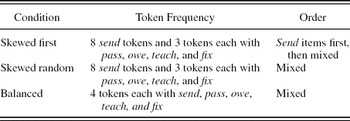
A pretest–posttest design was used to identify which type of input was most effective for facilitating Thai EFL learners’ comprehension of double-object datives. The independent variable was input type, which was operationalized as the token frequency and order of double-object datives during the treatment task: send, owe, teach, pass, and fix (i.e., to fix someone something to eat). It was a between-groups variable with three levels: skewed first, skewed random, and balanced. The token frequency and order of the five lexical verbs are summarized for each level of the independent variable in Table 1. The dependent variable was comprehension of double-object datives, which was operationalized as accurate identification of the object undergoing transfer of possession, as opposed to the recipient/beneficiary.
Input characteristics by condition

Materials
Treatment materials
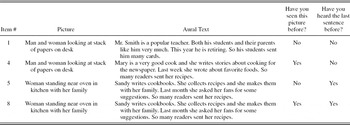
The treatment task was presented as running recognition memory activity in order to reduce the possibility that the participants would adopt a metalinguistic orientation toward the task or the target construction. Their task was to look at a picture while hearing a short scenario, after which they indicated on an answer sheet whether they had seen the picture or heard the last sentence before. The 20 aural texts each contained two to four sentences in which the last sentence contained a double-object dative construction in its prototypical form and context, with the recipient/beneficiary occurring as a pronoun and expressing given information. In terms of the cover task, the pictures and aural texts were manipulated so that there were responses for all logical possibilities based on having seen the picture before (yes/no) and having heard the sentence before (yes/no). This is illustrated through the example items in Table 2, where the same picture is presented as Items 1 and 4 but with different aural texts to elicit no/no and yes/no responses. Also shown in Table 2 are the use of a new picture with a previously presented aural text (no/yes) and the exact repetition of a picture and aural text (yes/yes). These items are from the skewed first treatment materials in which the first eight items presented dative constructions with the verb send. The treatment task contained an equal number of all four response options.
Example treatment task items

Following previous research (Casenhiser & Goldberg, Reference Casenhiser and Goldberg2005; Goldberg et al., Reference Goldberg, Casenhiser and Sethuraman2004; Year & Gordon, Reference Year and Gordon2009) all treatment materials presented low variability input, which contained 20 lexical verb tokens created from five lexical verb types. The five lexical verbs were send, pass, owe, teach, and fix. Both skewed input conditions included eight tokens of send (high-token frequency) and three tokens each for pass, owe, teach and fix (low-token frequency). However, the order of presentation in the skewed input conditions differed so that the skewed first materials presented all of the send tokens first while the skewed random group presented all tokens in mixed order. The balanced input materials included four tokens for each of the five verb types, and all of the tokens were in mixed order. Additional examples of the treatment task dative items are provided in Appendix B.
The aural texts plus three practice items were recorded to audiocassettes by a female L1 speaker of American English, spoken slightly slower than natural speed with brief pauses (0.5 s) at clausal boundaries. Each item was separated by a 3-s pause so that learners had time to select answers for the cover task. All of the pictures that accompanied the aural texts were reproduced onto overhead transparencies. A subset of the treatment items (n = 25) representing all four response options was pilot tested with undergraduate students enrolled at a regional university in the southwest United States (N = 17) in order to determine whether the cover task was too difficult. The task was scored by awarding 1 point for every picture and sentence that was correctly identified as either new or previously presented. The total possible score was 20 points for the picture identification and 20 points for the sentence identification. Their mean accuracy rates were 98% for picture identification and 87% for sentence identification. Based on their feedback after completing the task, three pictures were replaced.
Comprehension tests
There were two comprehension tests that were used for the pretest and posttest respectively, and each test had 20 items consisting of 10 datives and 10 distracters (all dative test items are provided in Appendix C). Each item consisted of a short aural text (two or three sentences) followed by a comprehension question that the learners answered by choosing between two pictures provided on the answer sheet. The texts established an appropriate discourse context for the dative items (i.e., the recipient/beneficiary as given information) or provided enough information to facilitate inferencing for the distracter items. For the dative sentences, both the recipient or beneficiary and the object undergoing transfer were inanimate in order to eliminate the learners’ ability to identify the function of each noun phrase by relying on animacy. Double-object datives with inanimate recipients are less frequent in naturally occurring talk than animate recipients (Bresnan, Reference Bresnan, Featherston and Sternefeld2007; Gries, Reference Gries2003), although they occur more often in New Zealand English than American English (Bresnan & Hay, Reference Bresnan and Hay2008). Prior experimental studies have reported that L1 and L2 English speakers rate double-object datives with inanimate recipients as less acceptable than those with animate recipients but do not categorically reject them (Gropen et al., Reference Gropen, Pinker, Hollander, Goldberg and Wilson1989; Sawyer, Reference Sawyer, Stringfellow, Cahana-Amitay, Hughes and Zukowski1996).
The occurrence of double-object datives with inanimate recipients was checked in three corpora: the American conversation subcorpus (5,071,196 words) and the Wall Street Journal subcorpus (1,807,855 words) of the Longman Grammar of Spoken and Written Corpus (Biber et al., Reference Biber, Johansson, Leech, Conrad and Finegan1999) and the Louvain Corpus of Native English Essays (324, 304 words). Five of the test verbs (i.e., save, offer, show, mail, and sell) occurred with inanimate noun recipients (e.g., the company estimated that the discounts on the products would save the clinics a combined $10 million a year from the Wall Street Journal subcorpus). Recipients expressed with inanimate nouns can be interpreted as metonymically referring to people. In the Wall Street Journal example, the clinics can be interpreted as referring to people who work in the clinics. Half of the dative items on the comprehension tests had recipients that could be interpreted as referring to people. Take, for example, the item Tom took photographs in the park every Saturday. He saw in the newspaper that a crime was committed in the park and they were looking for evidence. So Tom showed the newspaper the photographs. Although inanimate, the noun newspaper can be interpreted as referring to the people who work at a newspaper. For these items, the inanimate nouns are not reversible (i.e., *Tom showed the photographs the newspaper) because photograph cannot be interpreted as referring to humans. However, each test also contained five items in which the inanimate recipient referred to the actual object, such as the item, Mary was decorating her house for Christmas, so she cut the Christmas tree some ribbons. The inanimate nouns in these items are reversible if the discourse context is also manipulated (i.e., Mary was decorating her house for Christmas. She made so many ribbons that she didn't have anywhere to put them. So she cut the ribbons a Christmas tree).
The aural texts were recorded to audiocassettes by a female L1 speaker of American English speaking slightly slower than natural speed, with brief pauses (0.5 s) at clausal boundaries. Each item was separated by a 2-s pause so that learners had time to select an answer choice. All 40 listening comprehension items (dative items and distracters) were pilot tested with 35 native speakers of American English who were undergraduate students at a regional university in the southwest US. The purpose of the pilot test was to ensure that the native speakers could identify the recipient, despite the infrequent occurrence of such double-object datives in naturally occurring talk. They were enrolled in a required first-year composition class and completed the tests during class time. The second author explained that the listening tests were designed for use in a research project with EFL learners, and that the researchers wanted to make sure that native English speakers could understand the instructions, pictures, and aural texts before using the tests in Thailand. The comprehension tests were scored by awarding one point for each dative item for which a learner correctly identified object undergoing transfer of possession, with a total possible score of 10 points per test. The undergraduate students scored 100% for every dative item. Thus, even though the double-object datives were nonprototypical with inanimate noun recipients, the native English speakers did not have any difficulty differentiating between the noun that was the object undergoing transfer of possession and the noun that was the recipient. They provided feedback that some of the pictures on the answer sheets were not clear, so those illustrations were replaced.
The comprehension tests were also administered to Thai EFL learners (n = 17) who were third- or fourth-year students studying bachelor degrees in English, German, and French at the same university as the participants. The purpose of the second pilot test was to ensure that the function of the noun phrases in the dative items could be interpreted correctly by Thai EFL speakers. These students were enrolled in advanced oral or written communication English courses, were taking content courses in English (such as linguistics and literature), and had experience living and studying in L2 environments outside Thailand. Therefore, they were not considered for inclusion in the study and their performance was collected as pilot data. The researcher administered the tests during the learners’ regularly scheduled classes, along with an auditory pattern discrimination test and a test of nonverbal abilities that were being pilot tested for another research study. They were told that the materials would be used in a research project with students at the same university who were not as proficient in English, and their feedback about the difficulty of the materials was requested. One of the comprehension tests was administered first, followed by the auditory pattern discrimination test (15 min), the nonverbal abilities test (30 min), and then, finally, the second comprehension test. The learners’ scores for dative items ranged from 7 to 10 on both tests, with a mean score of 8.12 (SD = 1.12) on the first test and 8.59 (SD = 1.06) on the second test. Despite the nonprototypical usage of the double-object dative, these Thai EFL learners were able to determine which noun was the object undergoing a transfer of possession and which noun was the recipient. They suggested that less proficient Thai EFL learners might be unfamiliar with the vocabulary words for the picture answer choices. Therefore, the procedure for administering the tests to the participants was adjusted to include a vocabulary review.
Procedure
The data collection was carried out over a 2-week interval, with the comprehension pretest administered during Week 1 (15 min), along with two tasks that were administered for other purposes (an auditory pattern detection test and a sentence-writing activity). One week later, the learners completed the treatment task (15 min) and the comprehension posttest (15 min) along with another sentence-writing activity. The order of presentation of the comprehension tests was counterbalanced. The learners were told that the purpose of the research activities was to explore the relationships among different types of memory (for sound and visual input) and different types of L2 tasks (aural sentence comprehension and written sentence production). The researcher explained the instructions for each task and answered any clarification questions. For the listening tests, she elicited the appropriate vocabulary words for the pictures provided as answer choices and wrote them on the board. The audiocassettes with the aural texts were played on the equipment that was available in each classroom, and the overhead projectors in the classrooms were used to show the pictures for the treatment task.
RESULTS
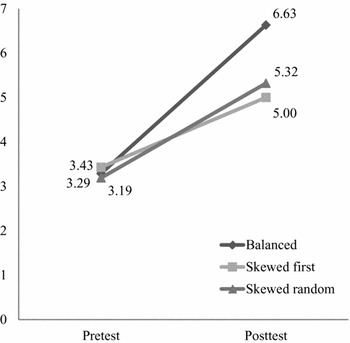
The research question asked which input type was most effective at promoting Thai EFL learners’ comprehension of double-object dative constructions. A mixed analysis of variance was carried out with time as a repeated factor (pretest and posttest), treatment condition as a between-groups factor (balanced, skewed first, and skewed random), and the sentence identification score as a covariate to account for possible variation in the participants’ attention during the cover task. The mean scores by group and time are illustrated in Figure 1. The analysis of variance revealed a significant effect for time, F (1, 74) = 20.24, p < .000, partial η2 = 0.25; and group, F (2, 74) = 3.07, p = .029, partial η2 = 0.09, but no main or interaction effects involving the sentence identification score. More importantly, there was a significant interaction between time and group, F (2, 74) = 5.33, p = .007, partial η2 = 0.13, which was further explored by using Bonferroni adjustments. When scores across time were compared for each treatment group separately, each group scored significantly higher on the posttest than the pretest (p < .000). When group scores were compared at each point in time, there were no significant differences among the pretest scores. However, the posttest scores of the balanced group were significantly higher than the skewed first group (p = .016) and the skewed random group (p = .012), with no significant difference between the skewed groups (p = 1.00).
Mean scores by group and time.

In order to determine whether the groups were performing above chance at the posttest, separate one sample t tests against chance (50%) were carried out with an adjustment for multiple comparisons (.05/3). The only group to perform above chance at the posttest was the balanced group: balanced, t (24) = 4.73, p < .000; skewed first, t (23) = .000, p = 1.00; and skewed random, t (30) = 1.15, p = .258.
DISCUSSION
To summarize the findings, balanced input was most effective for promoting comprehension of double-object dative constructions. As indicated by the learners’ pretest scores, they incorrectly interpreted the first noun phrase after the lexical verb as the object undergoing transfer, which corresponds to the function of direct object noun phrases in English transitives, and the word order associated with dative constructions in Thai. Whereas the treatment task facilitated comprehension of the double-object dative at rates greater than chance (M of 6.63 out of 10) for the balanced input group, learners in the two skewed input groups remained at chance levels on the posttest. Similar to the skewed input conditions, balanced input had low variability with only five lexical verbs occurring in all of the double-object datives. However, unlike the skewed conditions, balanced input provided equal token frequency for each lexical verb. In other words, repeated and equal exposure to constructions created from a small set of lexical items appeared to be more useful than a skewed distribution for these EFL learners.
An interesting question raised by the findings is what exactly the skewed and balanced groups learned about the double-object dative construction during the treatment task. As described previously, the types of dative constructions targeted in the treatment and testing materials were not identical. Whereas the double-object datives provided during the treatment task exemplified its most prototypical and frequent form (human recipients expressed as pronouns), the datives targeted in the test phase were its least prototypical and infrequent form (inanimate recipients expressed as noun phrases). Having inanimate nouns in both the object and recipient slots for the test items reduced the participants’ ability to deduce their functions simply by relying on animacy cues (i.e., the recipient is typically human while the object is generally inanimate). However, because the tests required transfer of learning to a construction that was not presented during the treatment task, determining the exact role of skewed and balanced input in L2 learning is difficult.
As anonymous reviewers pointed out, it is possible that skewed input facilitated detection and abstraction of a narrow pattern, while balanced input facilitated creation of a more general pattern. If the skewed groups associated the double-object dative with the combination of lexical verb + human/pronoun + object, then this association would not facilitate comprehension of the lexical verb + inanimate/noun + object items presented on the tests. However, if the balanced group learned a more general pattern of lexical verb + recipient + object, then this association would facilitate performance on the test items. Some insight into what the skewed and balanced groups may have learned about the double-object dative construction is provided through a more detailed analysis of their posttest performance. Although none of the recipients in the dative test items were pronouns, half of them could be interpreted as metonymically referring to people, such as people who work at a company, magazine, school, restaurant, shop, or newspaper. If the skewed groups learned a narrow pattern with a human pronoun recipient, then their performance on items that were metonymically human might improve from pretest to posttest due to the similarity in animacy. In contrast, if the balanced group formed a more general pattern, then their performance on both item types (i.e., metonymically human and actual objects) should improve from pretest to posttest. To explore this possibility, a post hoc comparison of each group's pretest and posttest scores for the two item types was carried out using paired samples t tests with an adjusted alpha level (.05/6 = .008). The skewed groups showed significant improvement only for the items with metonymically human recipients (p = .005 for skewed first and p < .000 for skewed random). In contrast, the balanced group showed significant improvement for items in which the recipient referred to both a human (p = .002) and an actual object (p < .000).
Because the study was not designed to test whether skewed and balanced input are differentially effective at promoting the detection of narrow versus broad representations, respectively, the post hoc findings should be considered suggestive. More robust support for the differential contribution of balanced and skewed input to category formation is provided by recent work by Goldberg and colleagues (Johnson & Goldberg, 2012). In an attempt to reconcile seemingly contradictory findings in support of both skewed and balanced input, they differentiated between two distinct components of the generalization process: category formation and category extension. During category formation (referred to as vertical generalization), learners must determine what constitutes an abstract category by generalizing across multiple exemplars and recognizing what can and cannot be classified as members of a given category. At the category extension phase (referred to as horizontal generalization), learners must determine how broadly a given category can be applied, such as the limits on its variability, complexity, and abstractness.
Skewed and balanced input may contribute differently to these categorization processes. When forming generalizations from individual exemplars, learners have to make decisions about when an individual exemplar is restricted to a single construction versus when it can be generalized to a broader category. Skewed input provides learners with lexically specific information about a construction, which may promote understanding of that specific item but may hinder their ability to generalize a pattern across more lexically diverse constructions. Research in statistical learning and artificial grammars (Wonnacott, Newport, & Tanenhaus, Reference Wonnacott, Newport and Tanenhaus2008) has described the association between a particular verb and a specific construction as entrenchment and has suggested that it may interfere with generalization and subsequent use with new constructions (see also Ambridge, Pine, Rowland, & Yong, Reference Ambridge, Pine, Rowland and Young2008). The results of the present study suggest that the participants in the skewed input condition may have been affected by the high-token frequency of a single lexical verb. By presenting the same verb with high-token frequency, skewed input may have made it more difficult for learners to recognize the double-object datives with other lexical verbs as belonging to the same general category and may have further restricted the generalizability of the more constrained category (i.e., lexical verb + human recipient + object) to a broader pattern (i.e., lexical verb + any recipient + object). In contrast, balanced input may have provided the learners with more verb-general patterns, which in turn may have increased their ability to recognize it as more inclusive category, and potentially extend it to a broader category (i.e., lexical verb + any recipient + object). Further support for this possibility comes from studies that have investigated the acquisition and processing of verb-argument structures in artificial language learning (Reeder, Newport, & Aslin, Reference Reeder, Newport, Aslin, Taatgen and van Rijn2009, Reference Reeder, Newport, Aslin, Ohlsson and Catrambone2010). These experiments revealed that learners were more likely to generalize across categories after exposure to contexts that were dense and overlapping. Similarly Wonnacott et al. (Reference Wonnacott, Newport and Tanenhaus2008) reported that learners were more inclined to generalize after they had been exposed to language samples that presented contexts with a variety of verbs (i.e., balanced input in the present study).
There are several potential limitations of the study that warrant mention. As an anonymous reviewer suggested, the participant pool may not have been ideal for investigating the double-object dative construction because of their prior exposure to English. With a mean of 11 years of language study in classroom contexts, it is likely that the learners had some prior exposure to English double-object datives, most likely through the occurrence of imperatives in teacher discourse (e.g., give me your paper, tell me your answer). It is less likely, however, that they would have been exposed to the types of constructions presented in the tests, because double-object datives with an inanimate recipient/beneficiary and an inanimate object undergoing transfer rarely occur in naturally occurring talk. Although it was beyond the scope of the current study, future research might explore how skewed and balanced input differentially impact category formation and extension for learners with varying levels of prior knowledge. It might be expected that learners with some existing knowledge of a construction would benefit from balanced input as a way to promote category extension.
A related issue concerns the specific type of double-object dative construction that was targeted on the tests. Although infrequent and somewhat awkward, double-object datives with inanimate recipients are attested forms (Bresnan, Reference Bresnan, Featherston and Sternefeld2007; Bresnan & Hay, Reference Bresnan and Hay2008; Gries, Reference Gries2003) that are not categorically rejected by native speakers (Gropen et al., Reference Gropen, Pinker, Hollander, Goldberg and Wilson1989; Sawyer, Reference Sawyer, Stringfellow, Cahana-Amitay, Hughes and Zukowski1996). The pilot tests with native speakers of English and more advanced Thai EFL learners indicated that both groups could distinguish between the recipients and the objects undergoing transfer of possession, which suggests that the construction is both comprehensible to native speakers and learnable by EFL speakers. We aimed to reduce the unnaturalness of the test items by embedding the double-object datives in discourse contexts that established the recipient as known information and the object undergoing transfer as new information. Although it is common to target decontextualized sentences in empirical research, future studies might explore whether the processes of category formation and expansion are affected by discourse contexts, such as by presenting constructions with a balanced or skewed distribution embedded in more situated language use, such as longer texts or conversations.
Because the study employed a pretest–immediate posttest design, it is not clear whether the advantage of balanced input would persist over time. Researchers have suggested that, over time, both types of input are equally effective for EFL learners studying in classroom contexts (Year & Gordon, Reference Year and Gordon2009). Clearly, future studies that include delayed posttests will provide greater understanding of the longer-term benefit of different input types for promoting comprehension of target constructions. Particularly needed are studies comparing the longer-term impact of input treatment activities in which skewed and balanced input features constructions that have either narrow or general representations. In addition, studies that examine how input not only affects learners’ ability to understand the meaning expressed by target constructions but also influences their productive use of those forms or guides their intuitions about the acceptability of those constructions should also be carried out.
The current study was situated in a foreign-language context where all of the learners share the same L1 and have very similar amounts and types of previous exposure to English. Learners in foreign-language contexts whose primary exposure to the target language has been in formal educational settings with explicit grammar teaching may be less likely to engage implicit learning mechanisms and more inclined to rely on metalinguistic knowledge, which may help account for divergence from the findings of L1 acquisition studies. Studies that have compared the effectiveness of balanced and skewed input under different learning conditions (McDonough & Trofimovich, in press) have found that the effectiveness of skewed input may be limited to implicit learning contexts. In implicit learning contexts, participants may approach the task less analytically, which creates multiple opportunities for them to form, test, and reformulate hypotheses about category formation. In contrast, participants in explicit learning contexts may be more likely to actively search for a repeated feature, which may lead them to focus on a feature that is not relevant for category formation. Although the present study did not instruct the learners to explicitly attend to the language patterns during the treatment task, which was presented with a running-recognition cover task, the participants were EFL learners in a classroom setting. Because of the formal setting, it is possible that they could have been more oriented toward explicit learning. Replication studies are needed involving EFL learners from a wide variety of cultural and linguistic backgrounds as well as studies with L2 learners in second language or multilingual contexts.
CONCLUSION
This study explored which type of input most effectively facilitated the comprehension of double-object datives in L2 English. The findings indicated that the balanced input was more effective for promoting comprehension of the double-object dative construction when transfer of training to new items is required. Thus, the findings suggest that balanced input may promote broader category generalization than skewed input. However, the findings do not warrant the conclusion that skewed input is not beneficial for L2 acquisition. First, claims about the benefits of skewed input were proposed for novel structures (Casenhiser & Goldberg, Reference Casenhiser and Goldberg2005; Goldberg et al., Reference Goldberg, Casenhiser and Sethuraman2004, Reference Goldberg, Casenhiser and White2007), but learners in the current study were not true beginners with zero prior exposure to double-object datives. It is possible that L2 learners without any prior knowledge might find skewed input to be more beneficial for initial detection of a new construction, particularly at the stage when recognition of an abstract but constrained category is required. However, learners in formal learning environments may be influenced by explicit learning strategies that may impact their ability to extract the relevant pattern from skewed input. Clearly, many issues warrant further investigation before any conclusions about the differential impact of balanced and skewed input on L2 learning can be drawn. In particular, it is important for future studies to identify which types of input are facilitative of comprehension over a longer time frame, and whether multiple exposures to that input results in divergent findings.
APPENDIX A
Target verbs by material set

APPENDIX B
Example dative items (treatment task)

APPENDIX C
Dative items on tests
-
(bake) Chef Peter made a pumpkin pie but the center of the pie was flat. So he baked the pie a top crust.
-
(bring) Steve needed to get supplies for his car because it wasn't working. So he brought the car some oil.
-
(build) John's children were playing and broke some furniture, so John built the table a leg.
-
(cook) Peter was an excellent chef, but he didn't like the food his wife prepared. One day she made him a steak dinner, but he thought it was boring so he cooked the steak a sauce.
-
(cut) Mary was decorating her house for Christmas, so she cut the Christmas tree some ribbons.
-
(feed) Bob works at a technology center. He likes to design computer games, so he fed his program some new graphics.
-
(mail) Angie wanted to be a photographer for Harper's Bazaar, so she mailed the magazine some photographs.
-
(offer) Michelle was having trouble with the company, but her partner Tom was doing okay. So he offered the company a loan.
-
(paint) Angie liked her garden and wanted to give it a name, so she painted the garden a sign.
-
(promise) Susie made cookies for her children's lunch. Everyone at school thought they were delicious. So Susie promised the school the recipe.
-
(read) Jim wanted to make an audio recording of an antique book his grandfather had given him. So he read his computer the book.
-
(save) Joan was cleaning her house and found some historical photos. She didn't want them but a local magazine wanted to publish them. So Joan saved the magazine the photos.
-
(sell) Mary was working at a party store around Christmas. A new company was having a holiday party so she sold the company some decorations.
-
(serve) Jim is a health inspector and he discovered a dirty kitchen, so he served the restaurant a warning.
-
(ship) John builds dollhouses for his daughter and her friends. He found some good supplies at a store but it was far away, so he shipped the dollhouse some windows.
-
(show) Tom took photographs in the park every Saturday. He saw in the newspaper that a crime was committed in the park and they were looking for evidence. So Tom showed the newspaper the photographs.
-
(shoot) Susie lived on a farm and liked to play golf in her fields. One day she needed to clean up the fields, so she shot her tractor the golf balls.
-
(throw) Steve was trying to make his apartment look nice. His arm chair had some holes and he wanted to cover them. So he threw the chair some pillows.
-
(trade) Joan had too much ink but needed some paper, but the shop next door had too much paper. So Joan traded the shop some ink.
-
(write) Bob was unhappy with city officials, so he wrote the newspaper a letter.