Plant and insect exudates—used worldwide as adhesives, sealants, paint binders, and medicines—are among the most ubiquitous but often overlooked organic technologies in anthropological research (Fox et al. Reference Fox, Heron and Sutton1995; Helwig et al. Reference Helwig, Monahan and Poulin2008). Identification of these materials helps understand past technologies, material availability and selection, and even the movement of both raw materials and the techniques necessary for use (Langejans et al. Reference Langejans, Aleo, Fajardo and Kozowyk2022). Despite their diverse chemistries and resultant material properties, plant exudates are frequently misidentified in museum collections and early ethnographic accounts. Catalogs often use broad labels such as “pitch,” “mastic,” or “gum”—terms with specific botanical meanings—on a wide variety of visually similar materials. Once recorded, these unverified identifications persist in the literature, obscuring important chemical distinctions and the cultural knowledge behind their use (Stacey et al. Reference Stacey, Heron and Sutton1998).
Exudates are particularly interesting in the American Southwest, where the region’s highly varied ecological zones—from desert lowlands interspersed with pine-covered mountains to the pinyon-juniper highlands in the north—offer an unusually diverse range of plant and animal exudates. Among these, mesquite gum has long been cited in historic accounts and catalog records. Mesquite (Prosopis spp.; Fabaceae, Mimosoideae) encompasses several tree species native to the arid regions of the southwestern United States and northern Mexico. These trees produce a polysaccharide gum often cited for its use as an adhesive and for medicinal applications by the Indigenous peoples of this region, particularly the O’odham (Rea Reference Rea1997; Russell Reference Russell1908). Other reported uses of mesquite gum include the preparation of a dark hair dye, a black pottery paint, a coating for kickballs, an adhesive for pottery repair, and a paint binder (Ascher Reference Ascher1962; Bell and Castetter Reference Bell and Castetter1937; Driver Reference Driver1957; Hodge Reference Hodge1912; Kearney and Peebles Reference Kearney and Peebles1960; Mason et al. Reference Mason, Holmes, Wilson, Hough, Flint, Hoffman and Bourke1891; Nabhan Reference Nabhan2018; Rea Reference Rea1997).
Despite these frequent mentions in historic accounts, mesquite gum has not yet been scientifically identified in artifacts from the American Southwest in museum collections. In surveys of pottery repairs and the archaeological perishable collections at the Arizona State Museum (ASM), there was no evidence that mesquite gum was used as an adhesive. Rather, pine resin and insect lac were identified as the primary adhesive materials. Insect lac, a polyester exudate (shellac) from the lac insect (Tachardiella spp.), was the dominant adhesive material used in the Sonoran Desert, including by the O’odham and Hohokam (Bisulca et al. Reference Bisulca, Pool and Odegaard2018; Pool Reference Pool2023; White et al. Reference White, Odegaard, Shackle, Janet, Catherine, Lynne and David2009).
The absence of mesquite gum in the analytical record raises questions about how these substances were classified, used, and preserved, and whether historical terminology accurately reflects material practice. Adding to the complexity, mesquite trees actually produce two chemically distinct exudates. In addition to the well-known polysaccharide gum, mesquite also produces a polyphenolic exudate (Lambert et al. Reference Lambert, Heckenbach, Hurtley, Wu and Santiago-Blay2009, Reference Lambert, Santiago-Blay, Wu, Contreras, Johnson and Bisulca2021). Ethnobotanical and linguistic records from the O’odham suggest that these differences in mesquite exudates may have been traditionally recognized, although this has yet to be scientifically determined.
This study clarifies the use of mesquite and other exudates by the O’odham, drawing on museum collections, historical descriptions, and comparison to freshly collected reference samples. Materials described as mesquite gum in collections records of O’odham artifacts were characterized to determine if and where mesquite exudates were employed. Identification was based on attenuated total reflectance Fourier transform infrared spectroscopy (ATR-FTIR), which allows for broad but rapid classification of organic materials using only small samples. Additionally, historically collected raw materials were analyzed and compared with firsthand descriptions of their use. Because the polyphenolic exudate of mesquite has not yet been fully characterized, liquid chromatography mass spectrometry (LC-MS) was used to complete a more detailed chemical analysis.
These chemical identifications are placed within the broader understanding of plant and insect exudates in the American Southwest. Results are compared with the archaeological record to explore how O’odham material culture may relate to artifacts from the Hohokam and neighboring traditions. More broadly, this study demonstrates the utility of reanalyzing misidentified organics in existing collections. Even when present only as a minor component of artifacts, exudates preserve evidence of technological choice, plant-use knowledge, and cultural continuity that is otherwise overlooked in the archaeological record.
Mesquite “Gum” in the Material Culture of the O’odham
One of the most reported uses of mesquite gum is as an adhesive, with specific references to its use historically by the Tohono O’odham, Gila River, and Salt River Indian communities. It is described as a glue to adhere stone points and fletching in arrows (Ascher Reference Ascher1962; Bell and Castetter Reference Bell and Castetter1937; Mason et al. Reference Mason, Holmes, Wilson, Hough, Flint, Hoffman and Bourke1891), to attach the handles in gourd rattles (Driver Reference Driver1957), and to repair pottery (Kearney and Peebles Reference Kearney and Peebles1960). Similar uses of mesquite gum have also been described for the Yuma (Driver Reference Driver1957; Forde Reference Forde1931; Kelly Reference Kelly1977), Cocopah (Gifford Reference Gifford1933), and Indigenous peoples of northern Mexico (Hayden Reference Hayden1967).
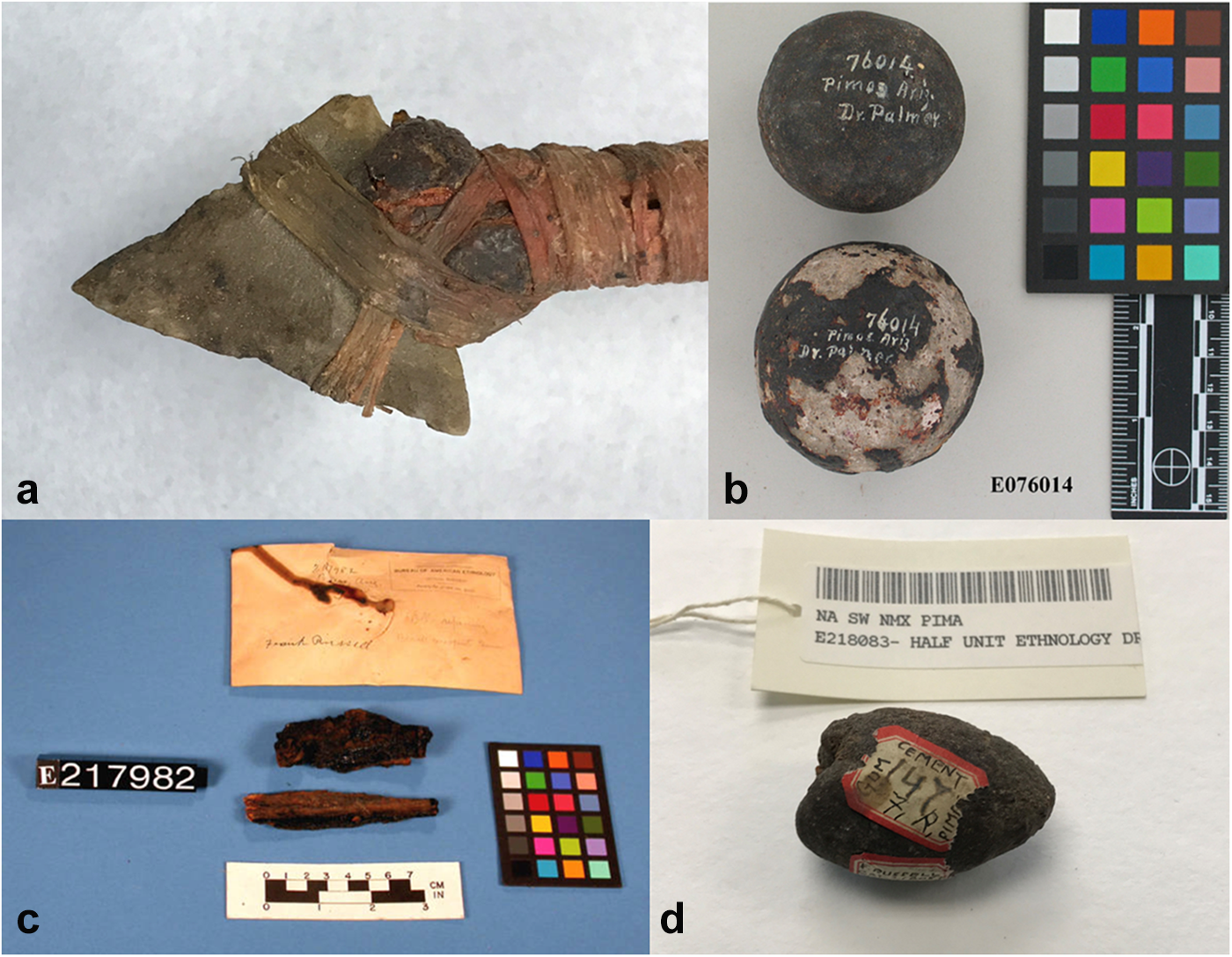
One of the earliest objects in this study that references the use of mesquite gum as an adhesive was collected by William John McGee, a self-taught anthropologist who was director of the American Bureau of Ethnology from 1893 to 1903. During his first expedition, he studied the Tohono O’odham in southern Arizona. Among the artifacts he collected are arrows with a thick black adhesive beneath the sinew wrap (Figure 1a). This material is described as mesquite gum in the catalog record.
Select artifacts examined in this study: (a) arrow, E175047, Department of Anthropology, Smithsonian Institution; the dark adhesive material is described as “mesquite gum” in the catalog record; (b) gummed stone footballs, E76014, Department of Anthropology, Smithsonian Institution; Palmer notes that insect lac was used as a coating; (c) mesquite gum, E217982, Department of Anthropology, Smithsonian Institution; described as “black mesquite gum for mending ollas, etc.” and “olla paint”: (d) cement for mending, described as “palo verde gum formed into a lump”; E218083, Department of Anthropology, Smithsonian Institution. (Color online)

Frank Russell, another anthropologist affiliated with the American Bureau of Ethnology, conducted fieldwork on the Gila River Indian Reservation from 1901 to 1902. In The Pima Indians, Russell (Reference Russell1908) describes several uses of mesquite gum, including its use as a repair material for pottery. Figure 1c shows mesquite bark collected by Russell, described in the catolog records as “mesquite gum used to repair ollas” and “olla paint,” as well as another adhesive sample labeled “palo verde gum.”
Kickballs used in O’odham running games and in long-distance travel are frequently associated with mesquite gum. These balls, made of wood or sometimes stone, were coated in a dark material usually described as a gum from mesquite, or sometimes creosote (Underhill Reference Underhill1941). Robert Roessel, quoting George Webb, an Akimel O’odham and author of A Pima Remembers, provides the following detailed description of kickballs:
A running game, called wee-ichida, was played using a ball made of mesquite wood or of a light volcanic stone called totshak, which means “foam on the water.” Both kinds of balls were dipped in boiling mesquite gum (kwi choovadak) or creosote gum, and allowed to cool. They were then black and as smooth as glass [Reference Roessel1961:59].
It is important to note that creosote gum is not a plant exudate, demonstrating the confusion that can arise from the use of generic terms. What is commonly referred to as “creosote gum” is insect lac, the polyester exudate (shellac) produced by insects (Tachardiella spp.) that inhabit the creosote bush (Sutton Reference Sutton1990).
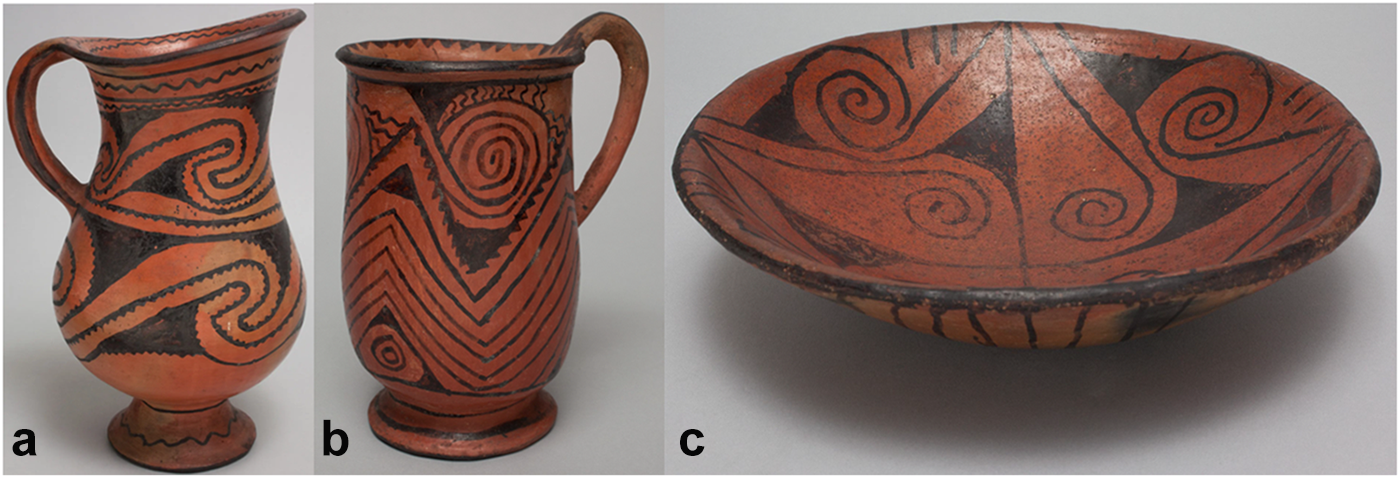
One of the most commonly cited uses of mesquite gum is in the preparation of carbonaceous black paints for the black-on-red vessels of the O’odham. These red vessels, decorated with black geometric designs, were first described in 1852, with numerous references to their trade and sale continuing throughout the latter half of the nineteenth and early twentieth centuries (Fontana et al. Reference Fontana, Robinson, Cormack and Leavitt1962). Figure 2 illustrates two early Akimel O’odham black-on-red vessels that were collected in Arizona and given to the Detroit Institute of Arts (DIA) in 1893. The DIA examples are painted with a carbonaceous black paint, which was verified with X-ray fluorescence spectroscopy.
Akimel O’odham vessels with carbonaceous black decorations, loaned to the DIA in the 1890s by H. V. Jackson: (a) footed pitcher, F72.145, (b) mug, F72.148, and (c) shallow bowl, F72.122. Collection of the Detroit Institute of Arts. (Color online)

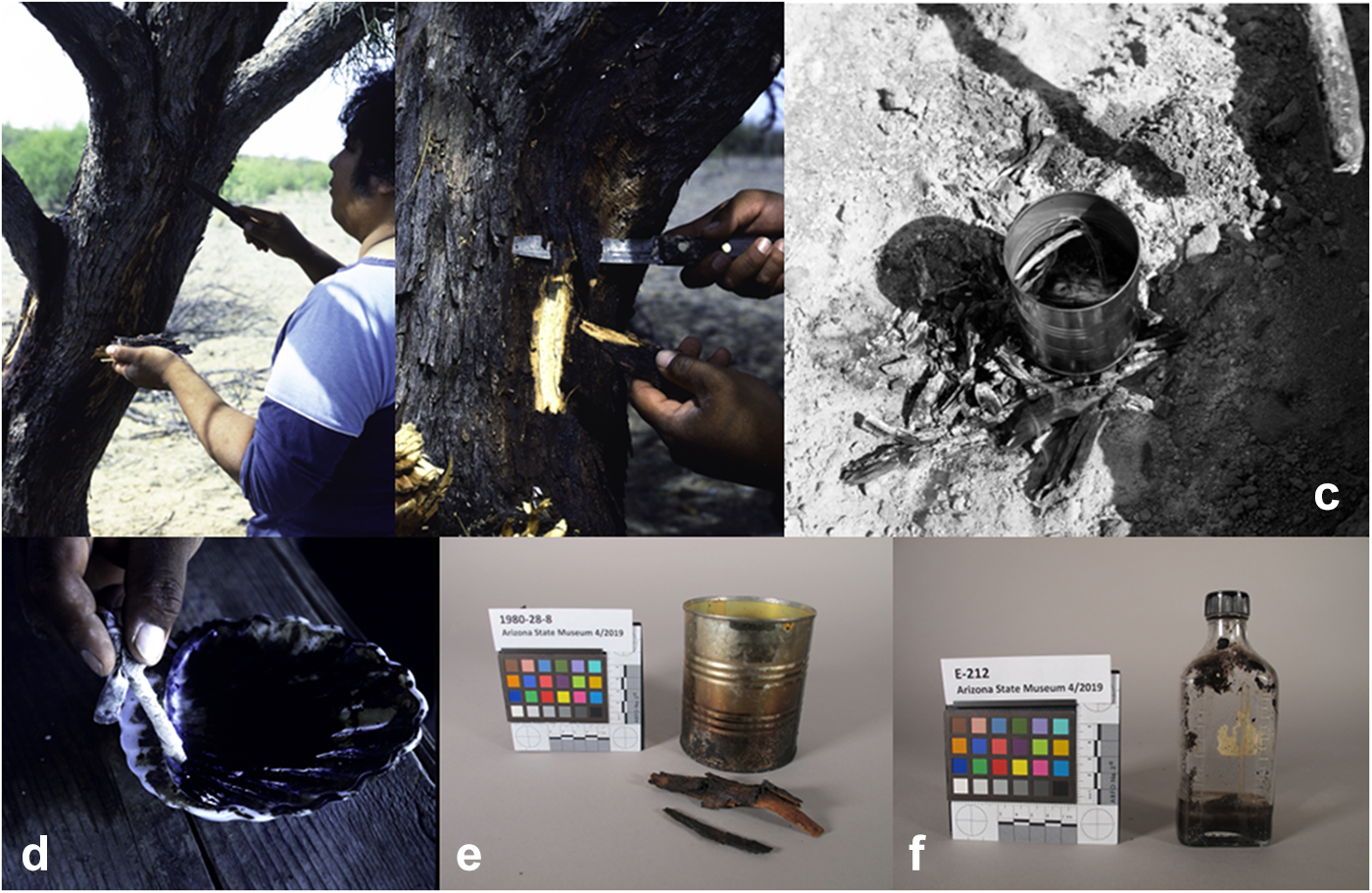
For carbon-based black paints on pottery, identification of the original plant source is not possible because organic materials used to create black designs are carbonized during the firing process. Consequently, the original material cannot be identified from the fired vessels themselves. To investigate the role of mesquite gum in pottery decoration, this study focused on raw materials used to create these carbonaceous black paints. The most detailed documentation of this process comes from Helga Teiwes, a photographer at the Arizona State Museum, who documented the work of Tohono O’odham potter Rupert Angea in 1982. The Angea family, renowned for their pottery, employed traditional practices passed down through generations (Teiwes Reference Teiwes1988). Angea’s methods and materials align closely with historical accounts: mesquite “black gum” or “black bark” was collected, and paint was prepared by boiling black mesquite bark chips in water (Bell and Castetter Reference Bell and Castetter1937; Fernald and Stoeppelmann Reference Fernald and Stoeppelmann1995; Fontana et al. Reference Fontana, Robinson, Cormack and Leavitt1962; Hrdlička Reference Hrdlička1906). As early as 1908, Curtis described this process, noting that black paint was made by “boiling chips of mesquite wood into a syrup” (Curtis Reference Curtis1908:49). This paint was applied to pottery after the initial firing and then refired at a lower temperature to darken the black designs (Curtis Reference Curtis1908:49).
Figure 3 illustrates Angea’s collection and processing of mesquite exudate alongside the mesquite bark chips and prepared mesquite black paint housed in ASM collections. The collection also includes a sample of black mesquite paint from Ida Redbird, a renowned Maricopa potter. Redbird’s methods mirror those described above, as recorded by E. B. Sayles—then ASM director—in the 1940s (Ferg Reference Ferg2014). Similar pottery-making practices using mesquite bark or “gum” for brown and black decorations are also noted for the Yuman peoples, with some variations. For example, the Cocopah applied the black exudate after firing while the pot was still hot instead of refiring (Gifford Reference Gifford1933).
Images from Helga Teiwes, photographer, and collections examined from Arizona State Museum, University of Arizona: (a) “Rupert gathering a handful of black mesquite bark to make black paint”; (b) close-up of collecting showing blackened bark of the mesquite tree; (c) “To prepare black paint, mesquite bark is put in a one-pound coffee can and is half covered with water. The water boils for 10 minutes”; (d) “The paint in the dish is dark brown but it turns black in contact with hot coals”; (e) mesquite bark used to create dye and container for boiling, ASM 1980-28-8; (f) mesquite black dye for painting pottery, ASM E-212. (Color online)

Materials and Methods
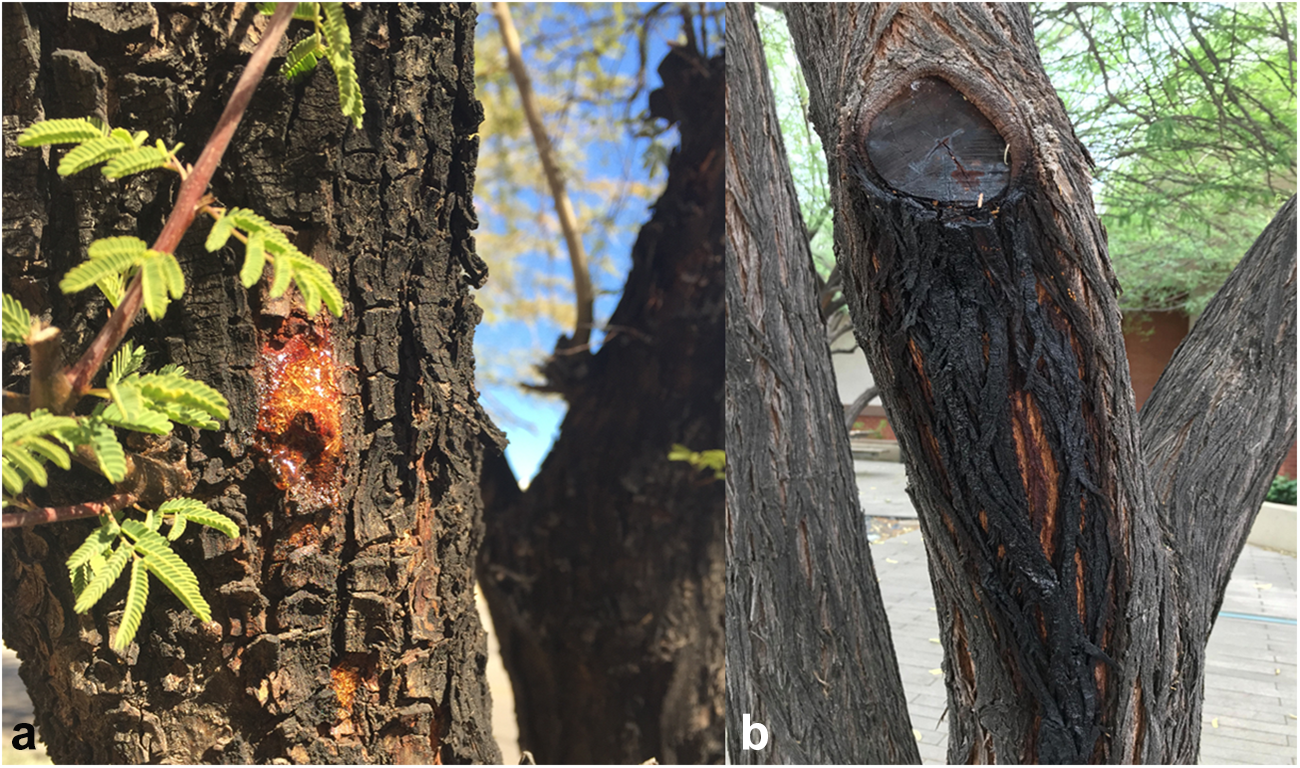
Reference mesquite exudates were collected locally in Tucson and in the University of Arizona Campus Arboretum in the summer of 2019. During collection, it was noted that mesquite exudates occur as two visually distinctive types. The first type is best described as golden amber and is usually found in thick accumulations on the tree, especially near open wounds (Figure 4a). The second type was black and occurred in thin layers on the bark or simply saturated the bark (Figure 4b). Both exudates were collected from several mesquite species. This included velvet mesquite (Prosopis velutina) and honey mesquite (P. glandulosa), which are endemic to the American Southwest and northern Mexico; as well as Argentine mesquite (P. alba), Chilean mesquite (P. chilensis), and common mesquite (P. juliflora), which are endemic to Central and South America. Exudate samples were analyzed directly without processing. For some bark samples, the exudate was also extracted by boiling the bark chips in water and evaporating to replicate the process by which the O’odham create a paint for pottery. For comparison, reference gum Arabic was purchased from Winsor & Newton.
Mesquite exudates: (a) golden-colored mesquite exudate formed as a lump and hardened on the surface of the bark; (b) black mesquite exudate, typically thin and saturated into the bark. (Color online)

Reference lac (shellac) samples employed in this study encompass the species found in the American Southwest and adjacent regions and were fully characterized in a previous study (Bisulca et al. Reference Bisulca, Pool and Odegaard2018). These samples include the following specimens from the Smithsonian National Museum of Natural History (NMNH) at Beltsville Agricultural Research Center, USDA Agricultural Research Service: Tachardiella larreae on Larrea tridentata, Sabino Canyon, Arizona; Tachardiella fulgens on Tamarix sp., Sonora, Mexico; and Tachardiella cornuta on Viguiera stenoloba, Texas. Additionally, freshly collected lac from T. fulgens on Coursetia glandulosa from Sabino Canyon and T. larreae on creosote from the Lower Colorado River area close to Yuma were also included in the reference spectral database. It should be noted that the polyester component of lac (shellac) predominates FTIR spectra and is indistinguishable from shellac from the Asian species used in commercial shellac production when analyzed with FTIR alone.
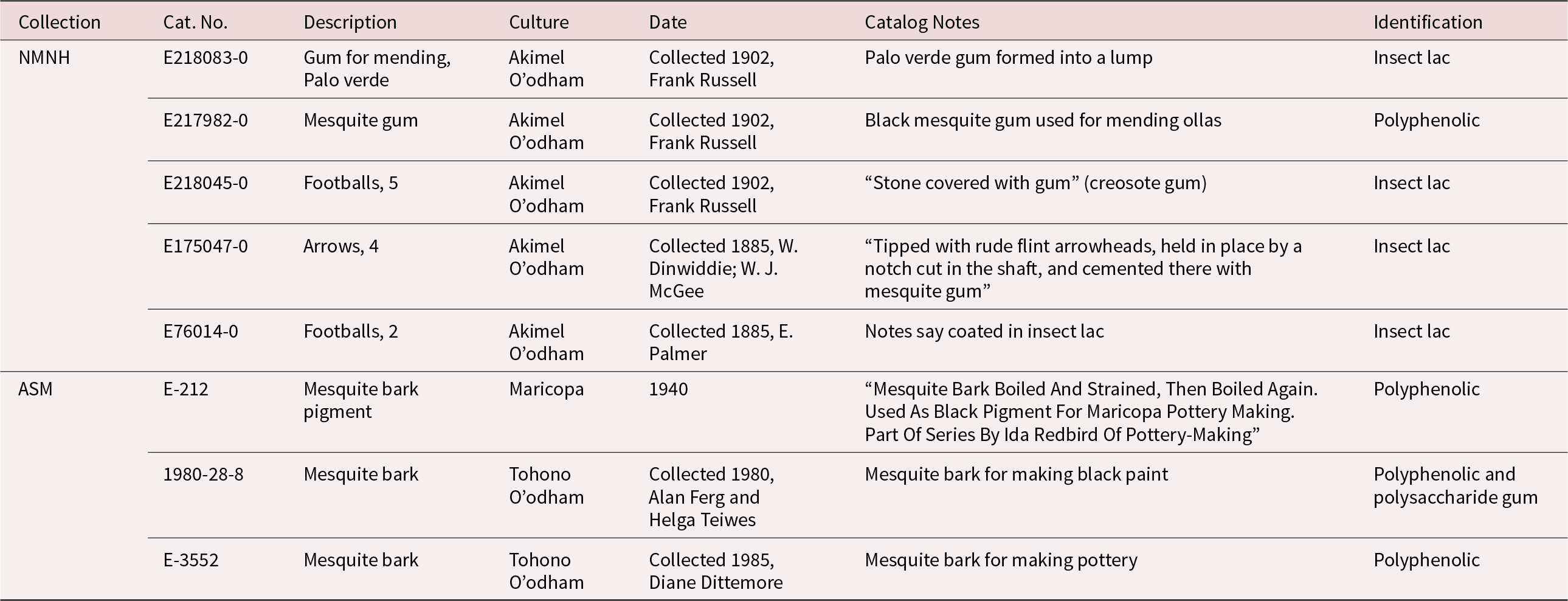
The artifacts examined in this study are listed in Table 1 and are from the collections of the National Museum of Natural History and the Arizona State Museum. These artifacts were selected based on the use of the term “gum” or “mesquite” in catalog records, or they are objects commonly associated with mesquite gum adhesive in the literature. Many of these objects were collected in the nineteenth and early twentieth centuries and therefore document the historic use of mesquite exudates.
FTIR Results of Exudates in Museum Objects.

Table 1 Long description
The table lists museum catalog entries for exudates and related materials analyzed by FTIR, including collection, catalog number, object description, culture, date, catalog notes, and the resulting identification. Five NMNH items associated with Akimel O’odham (gum for mending, two sets of footballs, arrows, and mesquite gum used as cement) are identified as insect lac in four cases and polyphenolic in one case. The insect lac identifications align with notes describing coatings or gum used as adhesive, including one record that explicitly mentions insect lac. Three ASM entries focused on mesquite bark used for pottery pigment or paint (Maricopa and Tohono O’odham) are identified as polyphenolic, with one sample also showing a polysaccharide gum component. Overall, the NMNH Akimel O’odham objects trend toward insect lac for coatings and adhesives, while the ASM mesquite bark materials trend toward polyphenolic signatures consistent with plant-derived pigments. Identifications reflect FTIR spectral matches and should be interpreted alongside catalog notes, since common names like “gum” may refer to different substances across records.
For analysis, small samples (<1mm3) were removed with a scalpel. The samples were examined with a Keyence VHX-7000 microscope equipped with a NIGHTSEA UV light (360–380 nm) for additional UV examination. Samples were then characterized using attenuated total reflectance–Fourier transform infrared spectroscopy (ATR-FTIR) at the Detroit Institute of Arts and at the ASM. FTIR spectroscopy was performed on a Thermo-Nicolet iS10 spectrometer with a Smart iTR attachment, equipped with a He-Ne laser and DTGS detector. Spectra were recorded from 4,000 to 650 cm−1, with 256 scans at 4 cm−1 resolution, using OMNIC software. Reference samples noted above were used to create a searchable spectral database in OMNIC.
For LC-MS analysis, mesquite exudates and experimental mesquite dyestuff were sampled directly using a droplet probe—a prototype surface-sampling instrument developed with Oak Ridge National Laboratory’s Organic and Biological Mass Spectrometry Group (Cank et al. Reference Cank, Henkin, Cook and Oberlies2021). Sampling involved dispensing 4 μL of a 50:50 CH3OH:H2O solvent mixture (Fisher Optima LC-MS grade) at 2 μL/s onto the sample surface, then withdrawing it for analysis. The microextracts were separated using a Waters Acquity UPLC system with a BEH C18 column (2.1 × 50 mm, 1.7 μm) at 40°C and a flow rate of 0.3 mL/min, coupled to a Thermo Q Exactive Plus MS. A 10-minute gradient separation used CH3CN (0.1% formic acid) and H2O (0.1% formic acid), starting at 15% CH3CN, increasing to 100% by 8 minutes, holding until 9.5 minutes, and returning to initial conditions at 10 minutes. UV/Vis data (190–500 nm) were collected via photodiode array detection, and high-resolution mass spectra (m/z 140–2,000, 70,000 resolution) and fragmentations (ddMS2, m/z 200–2,000, 17,500 resolution) were acquired using electrospray ionization (ESI) in positive (3500 V) and negative (2500 V) modes with higher-energy C-trap dissociation (HCD; Cank et al. Reference Cank, Henkin, Cook and Oberlies2021). Data were analyzed using Thermo FreeStyle 1.6.
Results
Reference Materials
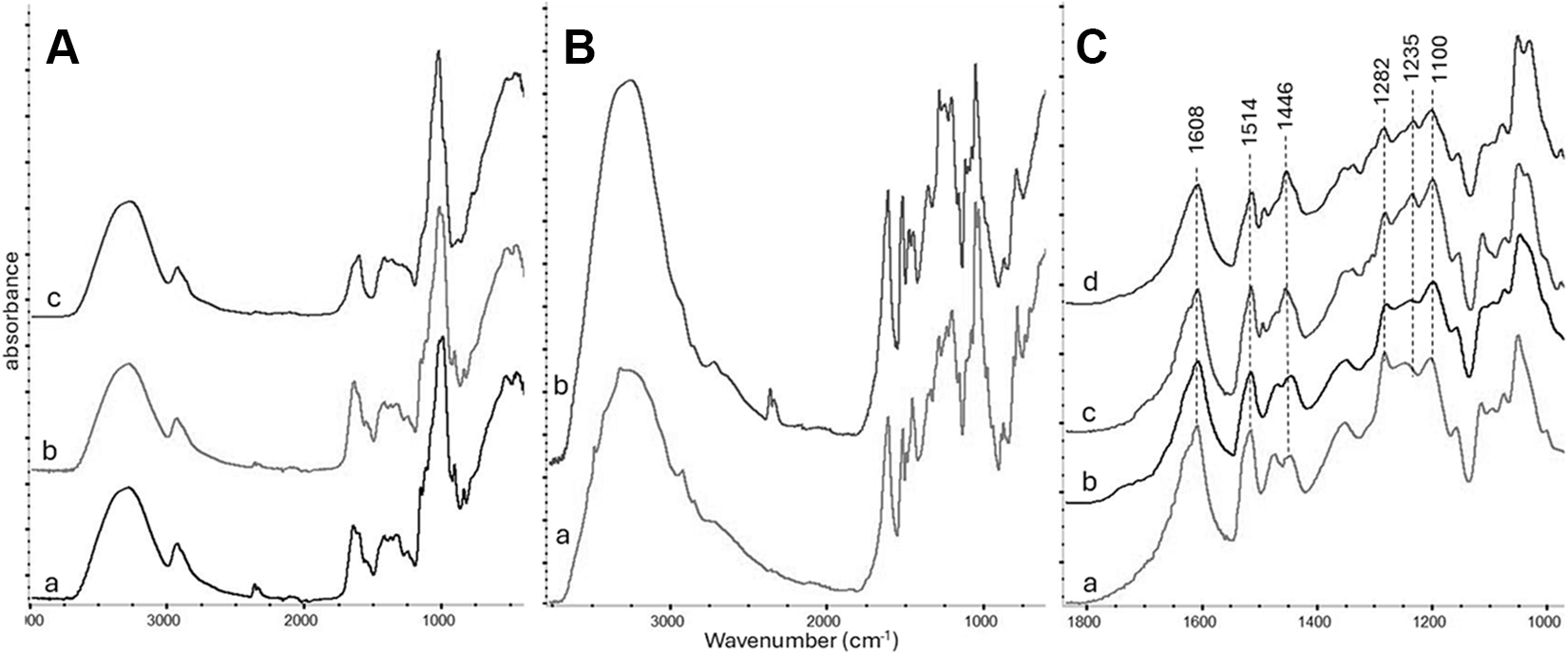
Plant exudates vary chemically not only by taxon but by the specific structure of the plant from which they are produced. They generally can be classified into three major chemical types: terpenoids (commonly referred to as “resins”), polysaccharides (“gums”), and polyphenolics, sometimes termed “kinos.” Golden-yellow exudates from all analyzed mesquite species were consistent with a polysaccharide gum. Figure 5a shows FTIR spectra of yellow exudates collected from velvet mesquite (P. velutina) and honey mesquite (P. glandulosa) alongside modern commercial gum Arabic sold as a paint binder. Polysaccharide spectra are dominated by strong bands due to –OH groups centered at 3,300 cm−1 and C–O at 1,100 cm−1 (Derrick et al. Reference Derrick, Stulik and Landry1999).
FTIR analysis of mesquite exudates (A) FTIR of yellow exudate from Prosopis spp.: (a) P. velutina, (b) P. glandulosa, (c) gum Arabic reference; (B) FTIR of black mesquite exudate from Prosopis spp.: (a) P. velutina, (b) P. glandulosa; (C) fingerprint region of mesquite species analyzed: (a) P. glandulosa, (b) P. alba, (c) P. velutina, (d) P. chilensis.

Figure 5 Long description
The image contains three line graphs labeled A, B and C, each showing FTIR spectra of mesquite exudates. Graph A displays spectra for yellow exudates from different species, with the x-axis labeled Wavenumber (cm superscript minus 1) ranging from 4000 to 1000. The y-axis represents absorbance. Three spectra are labeled a, b and c, showing distinct peaks and troughs, indicating variations in chemical composition. Graph B shows spectra for black exudates, with the same x-axis range and y-axis for absorbance. Two spectra are labeled a and b, with broader peaks compared to graph A, suggesting different chemical structures. Graph C focuses on the fingerprint region of mesquite species, with the x-axis ranging from 1500 to 1000. The y-axis remains absorbance. Four spectra are labeled a, b, c and d, with annotated peaks at 1074, 1044, 1024, 1150 and 1102, highlighting specific chemical bonds. Overall, the graphs compare different exudate types and regions, showing distinct spectral patterns that reflect chemical differences among the samples.
FTIR analysis shows that the black exudate from all analyzed mesquite species is the polyphenolic exudate (Figure 5b). The most diagnostic features in the FTIR spectrum include C=C stretching vibrations at 1,608 cm−1, 1,515 cm−1, and 1,450 cm−1 due to aromatic rings, and a broad band at ∼3,200 cm−1 attributed to O-H stretching. Polyphenolic exudates from trees can contain a wide variety of phenolic compounds, such as flavonoids and phenolic acids. Higher-molecular-weight tannins are formed when the exudate oxidizes and polymerizes upon exudation, forming condensed tannins from flavonoids and hydrolysable tannins from phenolic acids (Locher and Currie Reference Locher and Currie2010). These higher-molecular-weight materials give the exudate its red to dark-brown or black coloration. The lack of a strong carbonyl band between 1,700 and 1,730 cm−1 from free carboxylic acid indicates that gallo- and ellagitannins (hydrolysable tannins) are not present (Grasel et al. Reference Grasel, Flôres Ferrão and Wolf2016). In flavonoids and condensed tannins, the region from 1,350 to 1,100 cm−1, corresponding to C-O stretching vibrations, is structured into three characteristic bands at ∼1,280, ∼1,250, and ∼1,100 cm−1 (Falcão and Araújo Reference Falcão and Araújo2013). Figure 5c shows the fingerprint region, where these bands are observed in the black exudate from all mesquite species analyzed, including the South American species. This indicates that the black phenolic exudate from mesquite is largely composed of flavonoids and condensed tannins, unlike other polyphenolic exudates that may also contain hydrolysable tannins, such as Eucalyptus (Georgiou et al. Reference Georgiou, Popelka-Filcoff, Sokaras, Beltran, Bonaduce, Spangler and Cohen2022).
In reference samples, it was also found that polyphenolic and polysaccharide exudates can co-occur. In some collected samples, areas of polyphenolic (black) and polysaccharide (golden yellow) could be visually distinguished within different areas of the exudate. When co-occurring, the exudate appeared as an amber nodule surrounded by a polyphenolic coating.
High-resolution LC-MS results are consistent with the spectral interpretation of the analyzed reference materials examined by FTIR. The most abundant features in these mesquite (Prosopis spp.) samples are flavonoids—especially mesquitol and/or constitutional isomers—including compounds such as catechin, epicatechin, leucofisetinidin, and robinetinidol, all of which are condensed tannin precursors that have the same monoisotopic exact masses.
Other expected flavonoids—such as demethyltexasin, genistein, 8-hydroxydaidzein, quercetin, aromadendrin/dihydrokaempferol, eriodictyol, naringenin, isovitexin, and vitexin, as well as the related chalcone isoliquiritigenin—appear to be present in some or all of the reference materials. In both LC-MS and FTIR, phenolic acids (e.g., gallic acid, tannic acid) were absent. This is consistent with flavonoid monomer precursors and related flavonoids indicating condensed tannin-based exudates and dyestuffs, as opposed to polyphenolic exudates richer in hydrolysable tannins.
Museum Objects
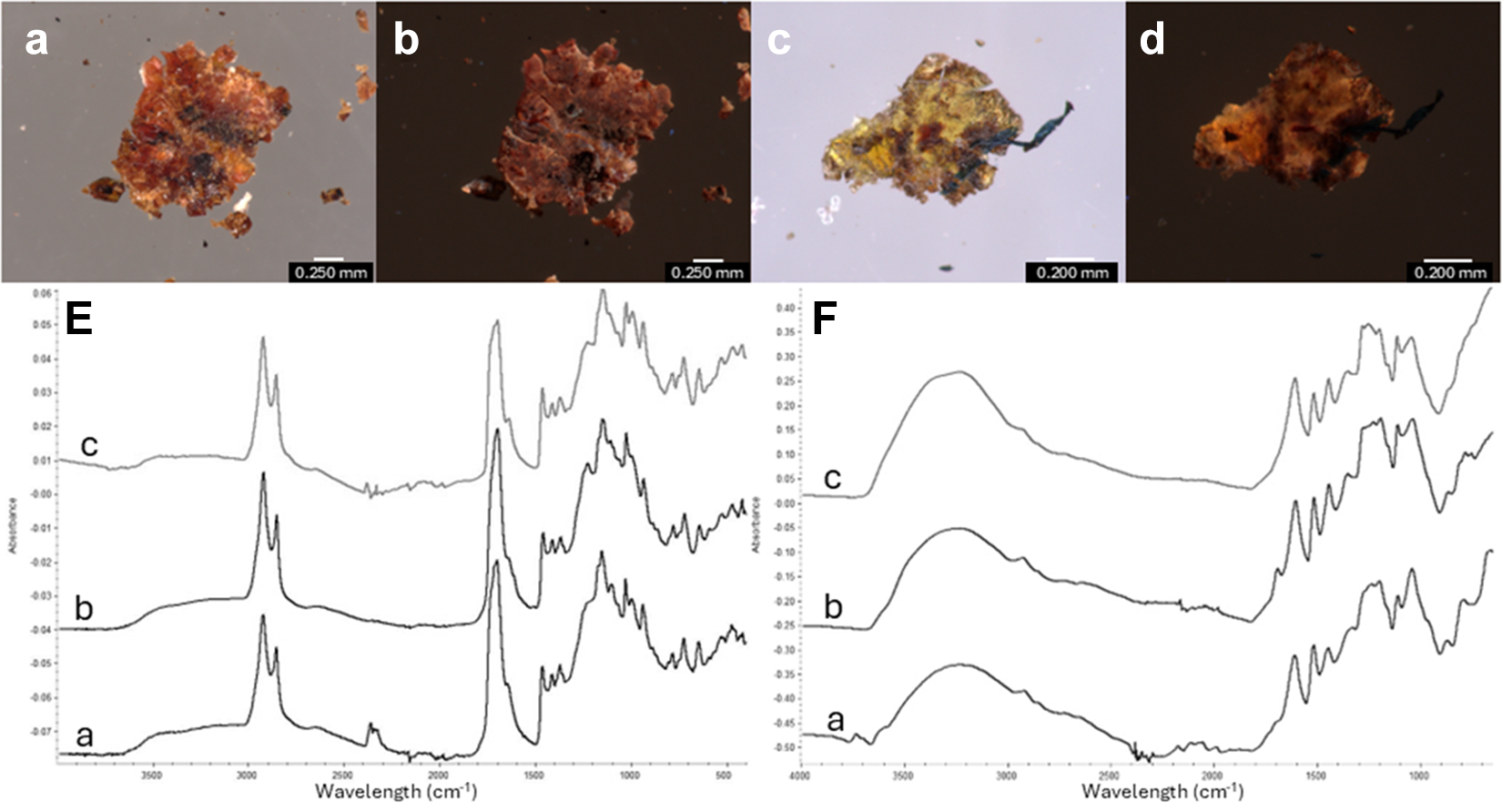
FTIR results for the analysis of objects in collections are summarized in Table 1. Three samples of mesquite exudate on bark, sourced from NMNH and ASM collections, were analyzed. Based on FTIR, all were consistent with a polyphenolic exudate, as determined by comparison with reference spectra described above (Figure 6f). Two of these samples were specifically cited as black paints used to create pottery designs, aligning with expectations that the dark polyphenolic exudate was employed for this purpose.
FTIR results from object samples: (a) sample from kickball, NMNH E076014 (scale bar showing 0.25 mm); (b) sample in (a) under UV light showing orange fluorescence; (c) sample from arrow hafting in E175047 (scale bar showing 0.20 mm); (d) sample in (c) under UV light showing orange fluorescence; (E) FTIR spectra of samples identified as insect lac: (a) arrow hafting in NMNH E175047, (b) kickball coating in NMNH E075014, (c) adhesive in NMNH E218083; (F) FTIR spectra of samples identified as mesquite polyphenolic: (a) mesquite bark pigment in ASM E-212; (b) mesquite bark for making black paint, ASM E-3552; (c) mesquite gum for mending ollas, NMNH E217982. (Color online)

Figure 6 Long description
The composite figure contains six panels grouped into microscopy images and FTIR absorbance spectra for material identification across multiple samples. Image a shows a microscopy image of a sample with a scale bar of 0.25 millimeter. The surface texture appears irregular and fragmented. Image b shows the same sample under UV light, displaying orange fluorescence across the surface. Image c shows a microscopy image of a second sample with a scale bar of 0.20 millimeter. The surface appears similarly irregular with small attached fragments. Image d shows the same second sample under UV light, again displaying orange fluorescence. Image E presents three FTIR absorbance spectra plotted on a single graph. The x-axis is labeled Wavelength in cm superscript -1. The y-axis is labeled with absorbance. Three curves are stacked vertically and labeled a, b and c from bottom to top. Curve a corresponds to arrow hafting sample. Curve b corresponds to kickball coating sample. Curve c corresponds to an adhesive sample. All three curves share a closely similar pattern of absorbance bands, with prominent sharp peaks visible in the mid-range of the x-axis and a broad absorption region toward the lower wavenumber end. The similarity across all three curves supports a shared material classification. Image F presents three FTIR absorbance spectra on a separate graph. The x-axis is labeled Wavelength in cm superscript -1. The y-axis is labeled with absorbance. Three curves are stacked vertically and labeled a, b and c from bottom to top. Curve a corresponds to a bark pigment sample. Curve b corresponds to a bark sample used for black paint. Curve c corresponds to a gum sample used for mending. These three curves share a broad and less sharply defined absorbance pattern across the x-axis range compared to the curves in image E, with wider humps rather than narrow peaks. The overall band shapes across curves a, b and c in image F differ noticeably from those in image E, reflecting a distinct material composition.
Insect lac (shellac), rather than mesquite gum, was found as the adhesive used in all O’odham objects analyzed where adhesive was tested. Two of the removed samples are shown in natural and UV light in Figures 6a–d. Under ultraviolet examination, the samples show an orange fluorescence that is characteristic of insect lac (Bisulca et al. Reference Bisulca, Pool and Odegaard2017; White et al. Reference White, Odegaard, Shackle, Janet, Catherine, Lynne and David2009). FTIR spectra are shown in Figure 6e. The diagnostic features to distinguish this material from other exudates available in the Southwest are a carbonyl band in the range of 1,715–1,730 cm−1, consistent with an ester; and triple bands at 1,470, 1,410, and 1,375 cm−1, characteristic of shellac (Bisulca et al. Reference Bisulca, Pool and Odegaard2018; Derrick et al. Reference Derrick, Stulik and Landry1999).
Although insect lac was identified in three samples from kickballs, it should be noted that this study does not exclude the use of mesquite gum or polyphenolic in all kickballs. In several of the examined objects, little coating material remained. Given that both mesquite polyphenolics and gum are water soluble, it is possible that any such evidence the balls were once coated with these materials has degraded or been lost over time.
Reassessing “Mesquite Gum” in Material Culture of the O’odham
The analytical results enable a reassessment of historic ethnographic descriptions and long-standing catalog identifications. In the examined museum artifacts, mesquite gum—frequently cited as an adhesive in O’odham material culture—was not identified. Instead, insect lac (from Tachardiella spp.) was found to be the predominant adhesive, appearing in arrow hafting, as a coating for kickballs, and as a raw adhesive material. The use of insect lac as opposed to mesquite gum by the O’odham is corroborated by earlier studies on pottery repairs: the ASM pottery project surveyed over 20,000 whole vessels and identified the adhesives in approximately 175 cultural repairs using FTIR analysis. Insect lac was the predominant pottery repair material used in the Sonoran Desert region, with the majority of insect lac repairs on Tohono O’odham vessels (White et al. Reference White, Odegaard, Shackle, Janet, Catherine, Lynne and David2009). Insect lac has also been found in other O’odham artifacts, particularly in tool construction; most commonly, it is molded to create the handle on awls for basket making (Castetter and Underhill Reference Castetter and Underhill1935; Pool Reference Pool2023).
These results extend to the broader archaeological record, where insect lac consistently predominates as the adhesive at sites in the Sonoran Desert. In a survey of ASM’s archaeological perishable collection, Hohokam artifacts with adhesive were rare, but when encountered, insect lac was the predominant adhesive. Five arrow fragments with visible adhesive residues from Ventana and Bat Caves were confirmed as insect lac with FTIR. The adhesive was primarily used to reinforce the nock or in hafting. In one Bat Cave example, lac was used to create thick black decorative bands at the end of the arrow (Bisulca et al. Reference Bisulca, Pool and Odegaard2018). Additional UV-based identifications, as documented by Pool (Reference Pool2023), revealed insect lac in hafting applications from other Hohokam contexts, including an arrow from Casa Grande and arrow points with lac residues from Tanque Verde Cave. Although FTIR is more reliable for chemical identification, the characteristic bright orange fluorescence of insect lac (shellac) under UV provides a confident preliminary identification (Bisulca et al. Reference Bisulca, Pool and Odegaard2017; Mills and White Reference Mills and White1994).
Lac’s use extends beyond the Hohokam core, as evidenced by artifacts from the Magician burial at Ridge Ruin (a Sinagua site near Flagstaff), which included raw sticklac, mosaics with tesserae adhered with lac, ornaments molded from lac, and stone points with lac as a hafting adhesive (Kamp et al. Reference Kamp, Whittaker and William2016; McGregor Reference McGregor1943). Although pine resin dominates as an adhesive in Ancestral Puebloan and Mogollon artifacts, insect lac has also been identified as an adhesive—again, usually in hafting applications and mosaic plaques (Bisulca et al. Reference Bisulca, Pool and Odegaard2018). Given that insect lac is endemic to the desert lowlands, it would have only been available to these northern, higher-elevation regions through trade.
This study also confirmed insect lac as the coating on O’odham kickballs. Comparable artifacts have been identified at Hohokam sites, where a limited number of balls have been found with insect-lac coatings. These balls typically feature a much thicker layer of insect lac over a wood or bone core; in one case, the ball was made entirely of lac (Bisulca et al. Reference Bisulca, Pool and Odegaard2018; Pool Reference Pool2023). At the ballcourt at Casa Grande, 16 stone balls were recovered, two of which showed orange fluorescence under UV light, potentially indicating remnants of lac preserved in surface recesses (Hart Reference Hart2019). The shared use of insect lac in ball construction is noteworthy. Unlike arrows, where insect lac’s superior properties make it the optimal choice, balls can be made from a variety of materials, as evidenced by the diverse types found throughout the greater Southwest (e.g., buckskin, asphaltum, stone). However, balls with stone or wood cores coated in insect lac appear to be unique to the Hohokam and O’odham traditions.
The consistent use of insect lac from Hohokam (ca. AD 500–1450) to historic O’odham contexts indicates a persistent technological tradition. Archaeological evidence confirms the use of insect lac in Hohokam arrow and ball construction, mirroring its use in O’odham material culture for identical uses. The relationship between the O’odham and the Hohokam has long been debated, given that there are some marked differences in material culture (Fontana et al. Reference Fontana, Robinson, Cormack and Leavitt1962; Teague Reference Teague2009). Recent evidence, such as lithic technology and the shared use of obsidian sources in arrowheads, points to a connection through either direct lineage or cultural exchange (Loendorf et al. Reference Loendorf, Fertelmes and Lewis2013). The use of insect lac adds another example of direct continuity in material culture in this complex relationship.
This choice of lac—a rare material—reinforces its significance. Pool (Reference Pool2023), compiling fieldwork observations, ecological data, and prior studies (e.g., Sutton Reference Sutton1990), notes that lac’s limited distribution restricts its availability. This is consistent with Harold S. Colton’s 1943 survey, which deemed lac too rare for commercial shellac production (Colton Reference Colton1943). Moreover, insect lac is a water-insoluble polyester, and it required more complex processing (heating) than a standard gum, which could simply be dissolved in water for application. The use of lac demonstrates specialized material knowledge: its scarcity required ecological knowledge to locate and collect it from specific host plants in the Sonoran Desert, and as a natural polyester polymer, its selection indicates a recognition of its superior strength and durability compared to more readily available exudates of the Southwest. This is most clearly evidenced by its repeated use in hafting, where impact resistance and durability are particularly important.
Given the frequent misidentification of plant and insect exudates, many historical references to generic “pitch,” “resin,” or “mastic” in key Hohokam sites (e.g., Homestead, Casa Grande, Snaketown, Los Muertos, Los Guanos) could potentially be insect lac. This highlights the need for additional analysis and the reevaluation of museum collections. Moreover, the occurrence of lac at sites far from the desert lowland indicates a regional exchange network. This shows a broader significance of lac across the greater Southwest, and its use—particularly among the Hohokam and in continuity with modern Indigenous groups—remains understudied and merits further chemical analysis.
Similar to the adhesive samples, the same pattern of misidentification appears in black pottery decoration. Rather than mesquite gum, the carbonaceous black paint was consistently found to be derived from mesquite polyphenolic exudate and is likely the source for black-on-red pottery. This finding aligns with numerous historic descriptions of the “black bark” of mesquite being the colorant source. One black paint sample contained both the polyphenolic exudate and the polysaccharide gum. As noted in the analysis of reference samples, these two exudates can co-occur. It is also possible that gum was added intentionally. Polysaccharide plant gums are common binders used worldwide in inks and paints, and they would give the paint a thicker body during application. This is consistent with the description in Fontana et alia (Reference Fontana, Robinson, Cormack and Leavitt1962), where the black paint is made from combining both the blackened bark and balls of clear, golden mesquite gum. It should be noted it is possible to use mesquite gum alone to create black designs on pottery, given that any organic will carbonize to black upon firing. However, it seems more likely that in painting designs, the dark polyphenolic would be utilized. One sample (E217982-0) collected by Frank Russell presents a more complex case. Catalog records describe it as mesquite gum used for pottery repair, but this material was identified as the polyphenolic exudate, which lacks adhesive properties. More likely, this material was another example of mesquite polyphenolic used for pottery decoration and is an inaccuracy in early descriptions.
The absence of mesquite gum in the analyzed material culture of the O’odham raises questions about its frequent mention in anthropological literature as an adhesive. This is often simply due to the use of common-use terms that have specific botanical meanings. Misidentifications may also explain this discrepancy. For instance, studies of artifacts in the California Basin have noted confusion between insect lac and “creosote gum” (Fox et al. Reference Fox, Heron and Sutton1995; Stacey et al. Reference Stacey, Heron and Sutton1998; Sutton Reference Sutton1990). Mesquite gum was recognized as a substitute for gum Arabic during early American explorations of the West and was sometimes even referred to as “American gum arabic” (Ker Reference Ker1816; Meehan Reference Meehan1876). By the mid-nineteenth century, it became a small-scale commercial product, primarily used as an adhesive and in candy manufacturing (Anderson and Sands Reference Anderson and Sands1925; Beach Reference Beach1873; Flückiger and Hanbury Reference Flückiger and Hanbury1879). It is possible that early anthropologists, familiar with the commercial uses of mesquite gum, mistakenly identified it in artifacts in which insect lac was actually employed.
Rethinking O’odham Descriptions of Mesquite Exudates
The analytical results of dye preparations show that mesquite exudates were used, but the polyphenolic material—not the polysaccharide gum described in historic sources—appears to be the principal type. In light of the chemical differences between the two types of mesquite exudate, it is worth reevaluating O’odham descriptions of these materials and their uses. Although most anthropological descriptions use the general term “gum” for the mesquite exudates, detailed work by Rea (Reference Rea1997) shows that the Akimel O’odham distinguished between different types of mesquite exudates.
Table 2 lists O’odham terms for the materials discussed in this study alongside their chemical properties. The term kui ushabǐ (“mesquite exudate”)Footnote 1 corresponds to mesquite polysaccharide gum. This material is described as amber-colored and mildly sweet, and its primary use was as a candy (Bell and Castetter Reference Bell and Castetter1937; Rea Reference Rea1997; Russell Reference Russell1908). This is consistent with mesquite polysaccharide gum, which is naturally sweet and is still sold as a candy today. In contrast, the O’odham term kui chuuvadag (also kwi choovadak) is the mesquite polyphenolic exudate. Kui chuuvadag is described as thin, black, and bitter (Hrdlička Reference Hrdlička1908). The process of obtaining this black “gum” typically involves collecting bark. This aligns with mesquite polyphenolic exudate, which is often found saturating the bark, as illustrated in Figure 4b.
O’odham Terms for Exudates and Their Likely Chemical Classification.

Table 2 Long description
The table links three exudate materials with their likely chemical classification, O’odham terms, and basic properties. Mesquite gum is classified as a polysaccharide and is described as water soluble and sweet; its O’odham terms are “kui ushabǐ” and “kuujul ushabǐ,” noted as screwbean pod exudate. Mesquite polyphenolic is classified as polyphenolic and is water soluble but astringent; its O’odham terms are “kui chuuvadag” and “kwi choovadak.” Insect lac is classified as a polyester and is water insoluble; its O’odham term is “shegoi ushabǐ.” Overall, the two mesquite-derived materials share water solubility but differ in taste and mouthfeel, while insect lac contrasts by being insoluble in water. The chemistry labels are presented as likely classifications rather than confirmed analyses.
The O’odham and Indigenous peoples throughout the Southwest frequently describe the black polyphenolic exudate of mesquite for various medicinal purposes. In historic sources, mesquite “black gum” was used as a treatment for numerous ailments—including sore throats and sore eyes (Bovey Reference Bovey2016)—open wounds (Russell Reference Russell1908), and burns or sunburn (Curtin Reference Curtin1984). Palmer (Reference Palmer1878) also notes that when applied as a hair dye, it kills parasites (“unwanted visitors”) in the hair.
The use of this mesquite polyphenolic specifically for medicinal purposes is consistent with the chemistry of plant polyphenolics, and more specifically, flavonoids and condensed tannins, which are the main constituents of mesquite polyphenolic exudate as determined by LC-MS in this study. These compounds are recognized as antioxidants (Dai and Mumper Reference Dai and Mumper2010) and often possess antiseptic properties (Cambie and Ash Reference Cambie and Ash1994). Because polyphenolics have a large number of hydroxy functional groups, they can complex with and precipitate proteins (De Bruyne et al. Reference De Bruyne, Pieters, Deelstra and Vlietinck1999). This gives them astringent, anti-inflammatory, and hemostatic properties (Cambie and Ash Reference Cambie and Ash1994; Hillis Reference Hillis1987, Reference Hillis and Rowe1989; Locher and Currie Reference Locher and Currie2010). Mesquite polyphenolics are more precisely classified as guaiac and guaiac gum exudates, which are named after gum guaiac (Guaiacum officinale), a medicinal polyphenolic exudate that has been utilized for similar ailments (Lambert et al. Reference Lambert, Santiago-Blay, Wu, Contreras, Johnson and Bisulca2021). To the authors’ knowledge, mesquite polyphenolics have not been identified in the archaeology of the Southwest. However, given their water-soluble nature, they are unlikely to survive in the archaeological record.
Interestingly, the Akimel O’odham also describe a third type of mesquite exudate—si’al hikbin—described as a white sap found on trees during the summer. It is “sweeter than the regular kui ushabǐ” (Rea Reference Rea1997) and is mentioned by Russell (Reference Russell1908:75) as another source of candy. Although this specific exudate has yet to be identified and chemically characterized, the sweet taste suggests that this exudate may be a polysaccharide- or monosaccharide-rich material. The different terms used for mesquite exudates demonstrate a deep understanding of mesquite resources in O’odham culture and reinforce the importance of terminology when interpreting historical and ethnographic accounts.
Conclusion
Through the reexamination of museum collections with chemical analysis, this study clarifies the use of plant and insect exudates in the material culture of the O’odham. Although anthropological accounts cite the use of mesquite gum as an adhesive, analytical results identified insect lac (Tachardiella spp.) in the museum objects analyzed. This finding points to a technological continuity from Hohokam archaeological contexts to historic O’odham traditions. Chemical results, in light of historic and linguistic accounts, indicate that the O’odham distinguished between the two mesquite exudates: mesquite polysaccharide gum (kui ushabǐ), used as a candy, and polyphenolic exudate (kui chuuvadag), used as a black dye and in medicinal treatments. Most importantly, this study highlights the need for further exploration of the use of lac in historic and archaeological contexts in the Southwest. Even though insect lac and other adhesives often appear as only a minor component in most artifacts, their identification can reveal patterns in material selection, technological continuity, and regional exchange.
Acknowledgments
The authors would like to thank Mike Jacobs, Gina Watkinson, and Jannelle Weakley at the Arizona State Museum. The authors thank Esther Rimer, Torben Rick, and Gwyn Isaac at the National Museum of Natural History (Smithsonian Institution) for useful discussions. Special thanks to Kristof Cank and Nick Oberlies at the University of South Carolina Greensboro for LC-MS analysis.
Funding Statement
The authors received no external funding for this research.
Data Availability Statement
All data generated or analyzed during this study are included in the article or are available from the corresponding author upon reasonable request.
Competing Interests
The authors declare no competing interests.