Introduction
Kant says patently conflicting things about infinity and our grasp of it. Infinite space is a good case in point. In his solution to the First Antinomy, he denies that we can grasp the spatial universe as infinite, and therefore that this universe can be infinite;Footnote 1 while in the Aesthetic he says just the opposite: ‘Space is represented as a given infinite magnitude’(A25/B39). And he rests these upon consistently opposite grounds. In the Antinomy we are told that we can have no intuitive grasp of an infinite space,Footnote 2 and in the Aesthetic he says that our grasp of infinite space is precisely intuitive.Footnote 3
My main aim in what follows is to resolve this apparent internal conflict. I will discuss Kant's theory of intuition, its Leibnizian background, and how Kant turned that Leibnizian inheritance into separate theories of empirical (sensory) intuition and mathematical intuition. I will argue that these theories interact differently with Kant's notion of infinity—why for Kant there is mathematical infinity, but there is not empirical infinity, and why, indeed, empirically there are several different ways to be non-infinite—and I will point out how that bifurcation will dissolve his apparent inconsistency. In the end, I will show how Kant subtly distinguishes between the space of the Antinomy and the space of the Aesthetic.
But I have a secondary aim as well: I want to display the echoes of this Kantian treatment of infinity and intuition in a famous modern foundational debate in the philosophy of mathematics, the Hilbert–Brouwer Grundlagenstreit of the 1920s. By the time of this debate, infinity had firmly roosted in all of mathematics: infinite sets, infinite sequences, and, of course, the continuum, which combines both factors, were seen to lie at the heart of all mathematics. This posed a challenge for thinkers like Brouwer and Hilbert who struggled to show how this modern infinitary mathematics could be anchored in human intuition.
Let me point out that Hilbert and Brouwer tackled this challenge oppositely. Brouwer, pushed human intuition into the heart of mathematics, and changed that heart accordingly. He banned indirect existence proofs; he filled mathematics with exotically generated objects and with subtle intentional distinctions; and he even outright contradicted known mathematical theorems (for him there are no fully defined discontinuous functions). Hilbert, by contrast, was committed to every aspect of the new infinitary mathematics; and he kept it all. From the very beginning of his career he embraced indirect existence proofs, he clung throughout to all the standard theorems, and his ɛ-symbol brought infinitary thought into mathematical language itself. Human intuition, for him, serves as an outside anchor (in formal systems and their consistency proofs) securing the unfettered heart of mathematics, which proceeds on its own.
Though I spoke of a ‘foundational debate’, I should say that this conflict was anything but a polite debate. There was a political battle,Footnote 4 and there were rhetorical excesses by both sides and their supporters. Hilbert accused Brouwer of a crotchety and emasculating fundamentalism about existence, which would become a ‘dictatorship of prohibitions’ that ‘robs mathematics of [its] most valuable treasures’.Footnote 5 Brouwer accused Hilbert of a ‘thoughtless use’ of non-constructive methods, and of abandoning true intuition in favor of the false security of linguistic expressions and consistency proofs.Footnote 6 And, indeed, Hilbert's non-constructive ɛ-symbol is perhaps the flagship of this approach, and a direct taunt for a Brouwerian constructivist. But behind the pyrotechnics were deep mathematical and philosophical differences. And the main thing I want to argue is that, once we properly understand Kant's views about this issue of intuition and infinity, we will find that both sides are conceptually Kantian!
This sort of cross-generational comparison is perforce a tapestry of textual exegesis together with reconstructive interpretation. I will do a bit of each in what follows, far from the whole story, but enough, I hope, so that I will be in a position to identify the Kantian components of both Brouwer's and Hilbert's programs in the foundations of mathematics. In addition, in the spirit of this volume, I will mention a few more current issues en route as well. I will end with a brief methodological remark.
I. Kant's Theory of Empirical Intuition and Infinity
So let us start with a historical and systematic look at Kant's notion of empirical intuition and its interaction with putative empirical infinity. After that I will turn to his notions of mathematical intuition and mathematical infinity. Historically, Kant is taking a Leibnizian picture and adapting it to his own needs; systematically, that adaptation has cognitive, ontological and semantic sides.
1. Leibniz's theory of intuition and its problem
For Leibniz the paradigm of an intuitive grasp is God's grasp of a complete concept. This is the Leibnizian theme that Kant will adapt. According to Leibniz, when God contemplates (say) Julius Caesar, He has spread before Himself a full description of all Caesar's properties. The complete concept is an elaborate arrangement of elementary predicates which describes everything there is about Caesar. It is indeed ‘predicatively complete’; it contains every relevant predicate or its denial arranged according to the stages of Caesar's life. There is no aspect of Caesar that is not told in his complete concept.Footnote 7
Ontologically, every proper object has such a complete concept. Leibniz envisages a complex combinatorial hierarchy of concepts in which we proceed from the more general at the top, downward to the more specific and in which complete concepts lie at the very bottom (they are infima species). This is actually a source of Leibniz's well-known theory about identity: Caesar's complete concept suffices to distinguish Caesar from any other actual or possible entity, because the complete concept of such an entity will necessarily differ in at least one detail somewhere along the line. Any concept that is less complete—any one that leaves out even a single small determination—must be a general concept; for it will apply to at least two distinct objects. It will describe an ‘aggregate’, which for Leibniz is a deficient sort of entity, not an object. That is why, for him, compound things cannot be objects: their conceptual descriptions will be general. The only true objects are indivisible monads.
Sometimes Leibniz expresses this in terms of unity: aggregates have at best a ‘phenomenal unity’, which unites several things whose descriptions partially overlap. By contrast Caesar's complete concept provides him with a true unity, a principle from which one can deduce everything that there is about Caesar.
Speaking cognitively, this divine grasp is immediate and singular. Immediate: because God directly grasps each of the stages and each of the elementary predicates in a single cognitive swoop. He has no need for linguistic abbreviations (or discursive descriptions) which must subsequently be analyzed or unpacked.Footnote 8Singular: because this grasp suffices to encompass the full object, and to distinguish it from any other actual or possible object. And speaking semantically, Leibniz tells us that deduction from Caesar's complete concept is the condition for an idea to correspond to Caesar himself, and thus the condition for the truth of judgments about Caesar.Footnote 9
There is a confluence in this Leibnizian picture of cognition, ontology and semantics. For, God's cognition, His intuitive grasp of Caesar, delivers the completeness and unity that make Caesar a legitimate object, and His grasp is the basis of truth and correspondence.
But there is a problem too in this neat pristine package. It patently denigrates human knowledge and empirical objects. Cognitively, this package of ideas—God's-eye intuition, objects and truth—belittles human perception. A glance at the pen I am holding in my hand is momentary and incomplete. It tells me nothing about the pen's interior, about its past, or about its future. Metaphysically, the Leibnizian picture reduces extended bodies like the pen to the status of mere aggregates. And, semantically, it denies that judgments based on perception can correspond to any metaphysically significant reality. For, the empirical concepts out of which these judgments are built do not themselves reflect the true nature of things.
Neither Leibniz nor his scientific and philosophical inheritors were prepared to embrace this downgrading of the human and the empirical. Indeed, he and a generation of followers (including the young Kant) struggled to reconcile this tension between pristine metaphysics, on the one hand, and human knowledge of the empirical world on the other. But they did so, says the mature Kant, without success. In his eyes, only his radical critical philosophy successfully bridged this gap.
2. Kant's solution: empirical intuitions
And how did it do that? How does Kant's critical philosophy reconcile the pristine Leibnizian metaphysics with the possibility of human knowledge? Well, in fact, the critical Kant sharpens the problem, and only then solves it.
He sharpens the problem first by accepting the Leibnizian conditions for objects and intuitions. True objects are for Kant, as they were for Leibniz, predicatively complete:
But every thing, as regards its possibility, is likewise subject to the principle of complete determination, according to which if all the possible predicates of things be taken together with their contradictory opposites, then one of each pair of contradictory opposites must belong to it. (A571–2/B599–600)
And an intuitive grasp (an intuition) is immediate; it is singular,Footnote 10 which means it is the arbiter of identity and distinction from other objects; and it is the vehicle of reference to its object.Footnote 11
But then he turns the tables and declares that these objects, of which he is speaking, are empirical objects—the pen, for instance, and other extended things—and these intuitions are none other than our human perceptions, fleeting and partial as they may be. Indeed, he goes further and says that these intuitions differ in kind and not merely in degree of clarity or completeness from conceptual descriptions. No concept, says Kant, can ever be singular or immediate or referential; perceptions alone have to carry those burdens.
And then he relieves the tension between these conflicting demands by redefining and adapting the Leibnizian criteria. Thus, on the ontological side, he relaxes the notion of unity. Empirical objects are organized by sortal concepts (‘pen’, for instance) which dictate what the relevant parts of the object must be and how they are to be organized. These provide the necessary unity for their objects, that is a phenomenal unity—and Kant readily speaks of phenomenal objects—but, says Kant, it is unity enough.Footnote 12
On the cognitive side, our perceptual intuitions must deliver that unity, and must be singular, immediate and referential. Now in Leibniz there was no point to distinguish cognitive unity from singularity; both are straightforward consequences of the immediate grasp of a complete concept, an infima species. But, Kant denies that we humans have any such grasp.Footnote 13 So Kant must distinguish these factors. Regarding unity, one of the pillars of Kant's theory of synthesis is that perceptual intuitions carry with them the appropriate sortal organization. For Kant, seeing is always ‘seeing as’.Footnote 14
As for singularity, for Kant, as it was for Leibniz, this comes from considerations of identity and completeness. My perceptions do pick out individual objects and underlie judgments of identity and difference. Thus, for instance, my pen-intuition alone will suffice to distinguish this pen from any other actual or possible pen. He insists that no conceptual description will ever suffice to do this.Footnote 15 And regarding completeness: true, my fleeting perceptual grasp of the pen leaves out a great deal of information (for instance, it does not tell me how much ink remains in the pen and nor about future or even past states of the pen). Nevertheless, having the perception—seeing the pen—tells me that I can get this information, if I want to. I need only look further and deeper at what I already have in view. And that guarantee of eventual access to all the parts and determination of all the potential predicates is enough, according to Kant, to say that the perception delivers the object's completeness. And as for immediacy, this now means that my perception presents its object in a way that goes beyond any particular conceptual description.
Finally, coming to the semantic side and the Kantian parallel to the Leibnizian notion of correspondence, Kant tells us that when we contemplate objects, only intuition (perceptual intuition for humans) can actually give the objects,Footnote 16 and ‘give’ here really means ‘refer to’. Indeed, when Kant speaks of truth, he quite explicitly defines it as correspondence to (or ‘agreement with’) the object.Footnote 17 And, like Leibniz, Kant too uses intuition to underwrite that correspondence by presenting the object in all its aspects.
But, even more than that, for Kant my pen-intuition (my perception of the pen) actually serves to establish the pen's existence. That is because in presenting the pen to me, my pen-intuition is actually allowing the pen to act upon me, and thus is demonstrating that pen's existence.Footnote 18 But it is important to add that as he did with completeness, here too Kant takes a wide view: any perception that is somehow causally linked to an object serves to establish that object's existence.Footnote 19 Once again, Kant will insist, no concept alone can play that role. Footnote 20
Here, we see one of those more current issues that I promised: Kant's referential notion of truth is based upon a forerunner to the modern causal theory of reference—championed in the 1970s by Saul Kripke and Hilary Putnam—according to which we successfully refer to something in the world by virtue of our causal contact with the thing or stuff in question.Footnote 21 On the other hand, in this regard, Leibniz's theory of reference—based, as it is, on the relation of concepts—foreshadows the so-called ‘descriptivist’ theory of reference that Kripke and Putnam strived to refute.Footnote 22
This then is Kant's updated philosophical package: a four-faceted perceptual intuition, full-fledged empirical objects and a proto-causal theory of reference and truth. And with this humanized package he confronts the challenge of infinity.
3. The un-intuitability of the infinitely large
Kant, as I said, denies that there any infinite empirical objects; he denies that there are infinitely large objects—in particular, he denies that there is an infinitely large physical universe—as well as denying that there are infinitely small physical points. I will first explain his attitude towards the infinitely large, and then about the infinitely small.
A. Far Away Regions
So what is wrong with an infinitely large physical universe (i.e., an infinite expanse inhabited by physical objects)? Why can we not intuit such a thing? It cannot be simply because we are unable to apprehend it in a single perceptual glance. For, after all, we now see that according to Kant, not only my pen, but also the table near which I am sitting, and this room are legitimate intuitable objects. So too is all of London, all of the UK, Europe, the earth, our solar system, our galaxy. None of these latter can be taken in at a single glance, yet each of them is intuitively graspable. So, what is wrong with the sum of the whole increasing series itself, the possibly infinite universe? Why does Kant insist, as we saw at the start, that we can have no intuition of that sum? Here is Kant's official reason:
We cannot therefore say anything at all in regard to the magnitude of the world, not even that there is in it a regress ad infinitum. All that we can do is to seek for the concept of its magnitude according to the rule which determines the empirical regress in it. This rule says no more than that however far we may have attained in the series of empirical conditions, we should never assume an absolute limit, but should subordinate every appearance, as conditioned, to another as its condition, and that we must advance to this condition. (A520–21/B548–49)
Kant is concerned here with the sequential progress of our knowledge about the size of the universe. And here is where I will do some textual exegesis to play out this Kantian train of thought.
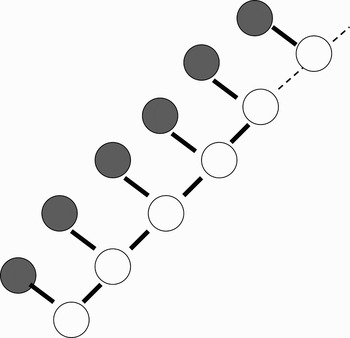
Suppose that we have succeeded in finding physically inhabited regions, i.e., a sequence of 1, 2, 3, … , n objects, each further from here than its predecessor by at least a fixed minimal distance.Footnote 23 This, I say, is as far as we have gone so far; and now we face the question ‘is there a yet further inhabited region (call it an n + 1 st–region)?’ So, we form a scientific task-force to answer this question, and we check back with them regularly, say once a month, starting tomorrow. Speaking now, we know that there are two possible answers we can get tomorrow: yes (we have found a further region housing as it were the n + 1 stobject) or no (we have not yet succeeded in finding such a region). Of course, if the answer is yes, then the search for an n + 1 st region is done. If the answer is no, then that does not mean that there is no such region, but only that the search will continue. Indeed, that means that after the inquiry tomorrow, we are in the same situation we are in now but with respect to the subsequent check (a month from tomorrow). And so in fact—regarding that n + 1 st region—we currently envisage a situation that looks like Fig. 1:
Figure 1.

So long as we do not find such a region, the search continues; if we do, it stops. Speaking right now, we do not know how that will play out. We do not know whether the search will terminate or will go on forever.
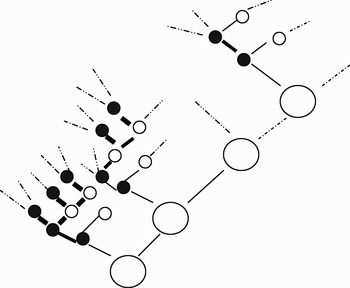
Now, should we ever find an n + 1 st inhabited region, then, of course, we would send off our crew to find an n + 2 nd region, and so on. So in fact what we currently envisage is a more complex situation which looks schematically like this big tree in Fig. 2.
Figure 2.

Each dark circle stands for a situation in which we have found a new region and thus embark upon a fresh start. To say that the inhabited (physical) universe is infinite is to say that for each k-region that is found, there will be a k + 1 st region that will also be found (i.e., this is to say that our actual path will contain an infinite string of dark circles). This is a dynamic notion—a large seek-and-find process—and at no check point in this process can we ever prove that the universe actually is infinite in this sense. For, at each check, there is always the possibility that we will not ever proceed any further; the possibility, that is, of an infinite sequences of light circles. Quite similarly, at no point can we prove that the world is finite, i.e., that the actual path will be all empty from that point on. For, at each dark circle there is always the possibility of a next dark circle.
B. A second modern parallel
As I said, this sketches Kant's reasoning at A520–1/B548–9; but let me at this point mention yet another modern twist. When speaking of the universe as a whole, Kant says not merely that we cannot say that it is finite. He says outright that it not finite.Footnote 24 Now, only the modern ‘assertability theory of truth’ would allow him to move from impossibility of knowledge to actual falsity. This is the theory—in our own time, championed most prominently by Michael Dummett—which equates truth with warranted assertability for human beings. Dummett has striven hard to show that this is the appropriate underlying semantics for ordinary discourse and for scientific discourse in various fields.Footnote 25 And the best way to understand Kant's claims here is to assume that he is indeed a proto-assertabilist.
There is good historical ground for this assumption. Leibniz was himself a proto-assertabilist,Footnote 26 and that is something that Kant would naturally have inherited. But, of course, for Leibniz it is God's knowledge that underlies the assertability theory of truth, while Kant's assertabilism would rest truth on the human knowledge and empirical evidence. In particular, Kant would adapt the idea that I described above, namely that a guaranteed grasp is as good as a psychologically actual grasp. And in this regard Kant's view would be a forerunner of what I call a ‘mild assertabilism’.Footnote 27 This is a theory that allows us to assert ∃xFx even without having in hand an object, a, satisfying Fa, so long as we know that we can eventually come to find an x such that Fx holds. And that is indeed Kant's position, at A225/B273:
the perception which supplies the content to the concept is the sole mark of actuality. We can also, however, know the existence of the thing prior to its perception (…) if only it be bound up with certain perceptions, in accordance with the principles of their empirical connection (the analogies).
He is speaking here about the fact that we can infer the presence of a magnet simply from the observation of the movement of iron filings. But in fact this position underlies his view that we can have intuitive evidence for very large, very small, and very distant objects as well, objects that fall outside our perceptual thresholds.
To be sure, Kant combines his assertability theory together with the correspondence theory of truth that I described above. That indeed is a semantic rendition of his Copernican Revolution: our empirical judgments are true in virtue of meeting the conditions for warranted assertability, and the objects in the world are such that these judgments truly describe them. This in fact puts him very close to Hilary Putnam's modern ‘internal realism’.Footnote 28
C. The non-intuitability of the infinitely large
But all of this—internal realism, mild assertabilism, and a tolerance for very large objects—leads us to expect that Kant will allow us an intuitive grasp of the universe as a whole, and will accept the universe as a legitimate object.
So what is missing? What is missing is the singularity of our grasp; or more specifically the predicative completeness that underlies singularity. For, there is a pair of opposed predicates—finite magnitude/infinite magnitude—which, come what may, will never be decided. Or, put in terms of identity, were we to contemplate a universe that is actually infinite—i.e., whose map contains an infinite sequence of dark circles—then our current grasp (or the grasp at any node along the way in the sequences of explorations) could not determine whether our actual universe is equal to or different from this contemplated infinite one.Footnote 29 So, failing the test of intuition, our grasp, as Kant says, is just a conceptual description (‘the collection of inhabited regions’) not an intuition; and the thing grasped is a collection but not an object.
Let me add two brief points here. First, let me point out that this indeterminacy—which denies to our grasp of the universe the status of being a legitimate intuition—comes from what Kant calls the ‘receptivity’ of intuition. At each check point our scientists must wait for additional information to tell them the outcome of the next check point. They are motivated by the hope that they will get the further information, but that wait could be eternal. That is the fate of empirical science in general. Our inbuilt receptivity entails that such science contains endless conjectures and uncertainty.Footnote 30 For, as Kant says, the key to this knowledge does not lie in us. In this case it means that we can never establish that we are on a path through this tree that will determine that the world is infinite nor one that will show it to be finite.
Secondly, notice that this receptivity and its attendant indeterminacy serve to split the standard distinction between infinite and finite. For here we have a set—the set of occupied regions—which is neither. Actually, the split is even more subtle. Speaking of the expanding series of inhabited regions Kant says:
This is the regressus in indefinitum, which as it determines no magnitude in the object, is clearly enough distinguishable from the regressus in infinitum (A520/B548)
And that contrasting regressus in infinitum concerns Kant's view of the infinitely small (the result of infinite divisibility). This notion of the infinitely small brings different considerations and a different diagram, so let us look at it briefly.
4. The non-intuitability of the infinitely small
Here too there is a process; it is a process of dividing material things into smaller parts and discovering their natures. And once again the question is whether or not that process must stop at some finite point. If so, then there are physical atoms. And here too, Kant will deny us the ability to say either yes or no.
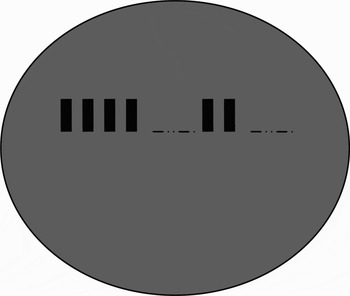
But there is a subtle difference here: for, in this case, Kant is absolutely certain that the process of division does go on forever. As I said, he speaks of it as continuing ad infinitum. The reason is that the material stuff for the smaller and smaller parts is clearly available. We in fact get the following picture regarding the smaller and smaller inhabited special regions (Figure 3).
Figure 3.

Each bar represents another level of fine-tuned micro-structure. We know that we can get to any given level, but nevertheless, Kant still says that we have no intuition of the whole ultimate chain. He is denying that we intuitively grasp this infinite converging sequence of physical regions. As he puts it, we have no intuition of an object which is ‘organized all the way down’.Footnote 31
This is a subtle, almost paradoxical position: The division continues ad infinitum but will not give a manifold with infinitely many smaller and smaller parts. The reason, once again, is receptivity, or more precisely, ignorance due to receptivity. We simply cannot know in advance what the next organizing concept will be; we shall have to see how science plays itself out.Footnote 32 We do not know what the micro-structure of the smaller particles will be like.Footnote 33 So our grasp of each stage fails the criterion of conceptual unity, while our grasp of the whole sequence once again fails the criterion of determinate identity and hence singularity.
The bottom line of the above discussion is then the following: in each of these cases, the infinitely large and the infinitely small, because our knowledge is receptive, we can have no intuitive grasp of the alleged infinite sequence. And, as I said, there is yet a finer division of the ways in which a collection can be non-infinite.
II. Mathematical intuition and mathematical infinity
5. Regulative grasp and the transcendental project
Before turning to Kant's treatment of mathematical intuition and its grasp of infinity, I need first to say a word about what he calls ‘transcendental philosophy’ and its special ‘regulative’ treatment of infinity. Actually, the diagrams that I have been using already give us a glimpse of it. For, in each of them I already do define and grasp an infinite path! I spoke in exactly this way when I described what it would mean for the universe to be in fact infinitely large or finite in extent. So, while the diagrams serve to undermine any grasp of an empirical infinite series, they themselves clearly do presuppose a grasp of infinite series of their own.
Why is this legitimate? Because I was talking here at the level of modeling scientific inquiry; and I was not engaged in scientific inquiry itself. The formal level at which I was talking defines the project that Kant calls ‘transcendental philosophy’. In this project, I abstract away the ‘receptivity’ of ordinary empirical intuition. Thus, for instance, I do not care what object our crew actually announces at a check point, I merely think about what will happen, if there is or is not a new discovery.
Now at this level of abstraction, Kant says, there is no issue of receptivity. I am addressing questions which I have all the resources to solve. They are questions about my own abilities and limitations. And so, Kant will say, there is now no indeterminacy, and no impediment to defining infinite sequences (just as I did above). Drawing these diagrams, and designating the possible paths within them, this is a crucial project. It gives science its direction and goals. This is what Kant calls the regulative force of reason. It tells us about our search, and enjoins us to continue.
Because of this regulative effect on science, this project has what Kant calls objective validity. It is a legitimate scientific enterprise. Objective validity, yes; but scientific knowledge, no! The transcendental project gives only guidance. It formulates objects: objects like an infinite path of light circles in Figure 2 (an object which bespeaks a finite universe) or like a path with infinitely many dark circles (corresponding to a universe that is spatially infinite). But it can never prove that either exists. It is ‘regulative’ but not ‘constitutive’, in Kant's terms. This means that the transcendental project cannot establish the existence of anything in the world. Indeed, there is no actual intuition here at all. Transcendental philosophy sets goals for our epistemic reach; but it cannot provide the requisite material (not the parts of the universe, and certainly not the entire universe itself) to satisfy our intuitive grasp. Any of these infinite paths can be thought about, but none can ever be known to exist.
In our scientific and philosophical lives we may jump back and forth between the empirical and transcendental projects. The jump is like a Wittgensteinian duck/rabbit. For, we must always remember that the two projects are absolutely separate: they have different subject matters, different rules, and indeed incompatible attitudes towards those infinite paths.
6. The grasp of abstract mathematical space
Coming to mathematics, it too abstracts from the receptive, empirical content of experience. If we use my pen to exemplify a cylinder, then we will abstract from its color and tapering. Similarly, we will imagine this room without its people and its furniture, if we want to exemplify a pure mathematical spatial region. We will also ignore its actual size and volume. But, in so doing, we are not thinking merely of an empty empirical region, we are speaking of pure mathematical space. We can imaginatively expand it, contract it, and translate it at will. When we move to this sort of discourse, once again, there should be no indeterminacy here. And indeed Kant quite explicitly says that:
It is not so extraordinary as at first seems the case, that a science should be in a position to demand and expect none but assured answers to all the questions within its domain (quastiones domesticate), although up to the present they have perhaps not been found. In addition to transcendental philosophy, there are two pure rational sciences, (…) namely, pure mathematics and pure ethics. Has it ever been suggested that, because of our necessary ignorance of the conditions, it must remain uncertain what exact relation, in rational or irrational numbers, a diameter bears to a circle? (A480/B508)
I call Kant ‘an epistemic optimist’ in mathematics. He holds that all mathematical problems are ultimately solvable. And he believes that because they are domestic, they pose no need to wait (receptively) for information to come in from the ‘outside’. Thus they pose no threat of an infinite wait.
If we compare this to the empirical situation, then in principle the level of abstraction should once again allow us to grasp an infinite sequence—the expanding sequence of mathematical spatial regions, for instance—for it removes the impediment of ‘receptivity’. And, as we saw at the outset, Kant does indeed tell us that we do grasp infinite mathematical space. This resolves the first part of our opening apparent contradiction: the receptivity of empirical knowledge blocks any grasp of empirical infinity, and thus there is no infinite empirical object. Mathematics, like transcendental philosophy, removes that block; and so we do grasp, and there indeed is, mathematical infinity.
But recall that in the Aesthetic Kant goes a step further. In mathematics, he says, unlike transcendental philosophy, our grasp is a legitimate intuition. That was a second contrast with empirical grasp. And, so presently, I will show you that Kant does indeed provide our grasp of mathematical space with all four marks of a legitimate intuition: unity, singularity, immediacy and reference. Having done so, it will be natural to say that mathematics provides us with more than a merely regulative pull; it provides us with an actual infinite object. It is natural to say this, but it will be only partially true. Mathematics will indeed act constitutively, but only ‘internally’ so. It will not give us an ‘actual’ infinite object, and we will have yet one more subtle Kantian distinction to make.
7. The grasp of mathematical space: unity and singularity
In the case of mathematical space, we are concerned about the process of extending our grasp from region to region: extending a line, if you like, in three-dimensional space.Footnote 34
A) Unity: The unity of space means now that the parts of the space so delivered are related to one another in a graspable organized fashion, and that each part is itself similarly organized. This aspect is codified in the axiomatization of geometry. Each axiom may itself be a synthetic claim,Footnote 35 but in codifying the axioms, in forming the axiomatization, geometers revealed the underlying unity of our grasp of space.
B) Singularity: Clearly this step by step process itself looks again something like Figure 3 above. In this case each balloon represents a stage in our sequence of extensions, and the bars stand for the regions that have been described.
But while this may be a good schematic model of the ‘regulative push’ of Reason, it is not the right model of our grasp of mathematical space itself. In this case we already know exactly what we will reach at each stage. We already know now all of the relevant properties of each and every region that we will, or can reach through this process. There are no ‘wait and see’ imponderables.
Using what I called a mild assertabilism, we can say that even future indicated regions already exist. The situation we have is actually Figure 4.
Figure 4.

So we do have a grasp of mathematical space which delivers all its parts, and decides all the relevant predicates. The regulative force does act constitutively here. This tells us that indeed we do have a grasp of a fully infinite space. And it also tells us that our grasp does pass the test of singularity: it delivers predicative completeness, and it thus distinguishes its object from any other object.
We are thus on the way to validating Kant's claim that the grasp is an intuition. What about immediacy? And what about the reference-granting (and existence-granting) tie to actual perception?
8. The grasp of mathematical space: immediacy
Here, I suggest, we should look at Kant's treatment of the continuity of space, which he rests on the visual image of flowing motion. Imagine, for instance, the smooth motion of a hand before your eyes.
In our time (and in Kant's as well) it is natural to turn to an algebraic or analytical expression to depict that motion. It is now, and was then, standard to use equations to study motion in general. Kant knew this, but nonetheless he resorted to the visual description of motion,Footnote 36 and the metaphor of flowingFootnote 37 to characterize motion. Why?
In one sense Kant is following Aristotle here. He is proposing what I call a ‘viscous’ conception of continuity: a continuum is viscous because its parts stick together, and it is impossible to divide it sharply. Try to cut it, and some part or other will always stick to the knife. Traditionally, the image of a flowing liquid exemplifies this property.
But still mathematics had progressed since Aristotle, and in using visual images here Kant is making an active choice. He is following Euler in a dispute between Euler and D'Alembert about kinematics and mathematics. It is a dispute that came to a head in a disagreement between these two mathematicians about the theory of a vibrating string. D'Alembert, who provided a means to describe the motion of a vibrating string, restricted his treatment to cases in which the initial position of the string was described by an equation. Euler objected that D'Alembert's description was too narrow. He insisted that any general solution to the problem of tracking a vibrating string must be able to consider arbitrary initial conditions, in particular initial conditions which are described by visualizable motion.Footnote 38
I should mention that this disagreement was part of a larger dispute about the role of physical intuition in science and mathematics, a dispute whose roots lay in the Leibnizian tension that I mentioned above. But Euler's position in the specific case of the vibrating string stems from his view that the collection of analytically defined functions does not suffice to give all the ways in which we can pick out points in space. The notion of ‘analytically defined function’ is an avatar of what I above called ‘conceptual grasp’. Euler is effectively saying that conceptual grasp is not enough for the grasp of space. This is, of course, the Kantian version of the condition of immediacy! So Kant sides with Euler and adopts his imagery, because Euler is advocating that the grasp of space must be immediate in Kant's own sense.
So, our grasp of space satisfies the tests of unity, singularity and immediacy. There remains now only the question of reference.
9. The grasp of mathematical space: reference
Here is where the situation is a bit more subtle. On the one hand, clearly Kant believes that mathematical space is ‘given’. That is his precise language in the Aesthetic. ‘Given’ is indeed the code word for reference.
Kant is here exploiting the Leibnizian confluence: the grasp of space meets the criteria of unity, singularity, and immediacy. And therefore in so far as it satisfies these conditions, the grasp will be referential too. Hence, within our mathematical practice, we readily do refer to space. And in mathematics we allow it along with other mathematical objects to exist. So, speaking in purely mathematical terms, we do have the fourth component, reference, and a full-fledged intuition of infinite mathematical space. The Aesthetic's claim is justified.
But, on the other hand, something is missing here: the causal connection to empirical objects is missing. Yes, inside mathematics there are perfectly good existence claims. But, for Kant, the mark of empirical existence is, as we saw, a causal connection to a perceivable object. And that is missing. The same abstraction which gives inner reference in mathematics blocks empirical reference. There is none, we have abstracted too far.
To be sure, mathematics is linked to empirical objects as their form. That relation indeed is the ground for mathematics' ‘objective validity’.Footnote 39 However, mathematical terms do not refer directly to actual empirical objects, but only indirectly, as the forms of such objects. And, from an empirical point of view, mathematical objects in general, and space in particular, have no ontological status:
Space is merely the form of outer intuition (formal intuition). It is not a real object which can be outwardly intuited. Space, as prior to all things which determine (occupy or limit) it, or rather which give an empirical intuition in accordance with its form, is, under the name of absolute space, nothing but the mere possibility of outer appearances (B457 fn.).
Nor do they exist:
But in mathematical problems there is no question of (…) existence at all, but only of the properties of the objects in themselves, solely in so far as these properties are connected with the concept of the objects (A719/B747).
From an empirical point of view, space is a specter, a nexus of possibilities, but no more than that. In this respect, mathematics, like transcendental philosophy is a separate discourse, a separate project. Like transcendental philosophy, mathematics too is concerned with formal possibilities of empirical experience, rather than with the experience itself. Mathematics gives the ‘form’ of perceptions. So like transcendental philosophy, mathematics has its own rules, and its own infinity. We have here the same duck/rabbit as in transcendental philosophy. And like transcendental philosophy, mathematics gets its objective validity only in virtue of the fact that it affects empirical objects by giving them their form.
So, this is the Kantian story that I have put before you: on the one hand, receptive empirical intuition of concrete empirical objects, with its endless conjecture, and its splitting of infinity-related concepts; on the other hand, mathematical intuition with optimism, true infinity, but merely spectral objects.
III. Hilbert and Brouwer
Now the pieces are in place to show you how these themes play out in the twentieth century ‘foundational debate’ between Brouwer and Hilbert. As I said at the start, both of these thinkers were motivated by philosophical as well as mathematical interests, and both wanted to anchor mathematics in human intuition while still accommodating mathematics' need for infinite objects.
10. Brouwer
I shall start with Brouwer. There is a striking difference between Brouwer and Kant on the question of mathematical intuition. For Brouwer, mathematical intuitions give full blooded objects; mathematical objects, to be sure, but objects that exist with no restriction. Thus, for Brouwer, mathematical intuition is fully and directly referential. Moreover, Brouwer's notion of mathematical intuition is not Kantian mathematical intuition, with its built-in epistemic optimism. On the contrary, Brouwer rejects any claim that every mathematical problem is solvable.Footnote 40 Brouwer's version of mathematical intuition is, ultimately, a variation on Kant's empirical package.
Intuition for Brouwer is, as I said, referential; it is also immediate in a very Kantian sense of the term. Brouwer staunchly rejects all attempts to exhaust a mathematical theory by means of formalization or axiomatization. These are the modern versions of D'Alembert's equations and Kant's own ‘conceptual grasps’; and for Brouwer they will never play a constitutive role in mathematics.Footnote 41 And Brouwer, just like Kant, satisfies the criterion of unity by restricting attention to objects of particular sorts: natural numbers, rationals, real numbers, functions and sequences.
Semantically, Brouwerian mathematical intuition, like Kant's empirical intuition, lies at the base of an assertabilist conception of truth. Indeed Brouwer's philosophy is one of the main inspirations for modern assertabilism.Footnote 42 And, like Kant's, Brouwer's is a mild assertabilism: in order to support an existence claim Brouwer does not require an all encompassing grasp that determines all elementary predicates, he is satisfied with a grasp that guarantees that opposing pairs of predicates can be eventually decided. Brouwer's is indeed the modern paradigm of mild assertabilism.
His famous theory of choice sequences highlights this point. A choice sequence is a sequence α of mathematical objects (rational numbers, for instance) which is thought of as growing in time. The determination of its elements might be based upon some algorithm, but it might just as well be dependent upon some non-algorithmic process, even a process of free choice.
Here is a formal definition:
A choice sequence α is given by setting out some preset finite initial segment <α(1), α(2), … , α(n)> together with a growth rule which, given <α(0), α(1), … , α(n), … , α(k)> determines the range of possible choices for α(k + 1).
The important point here is that for Brouwer such a sequence is perfectly intuitable, even though you may well have to wait to determine what occurs at any given stage. Moreover, if you assume the process is eternally continuable, then the sequence is a legitimately infinite object.
Consider for instance the real number r defined as follows:
r = 0.499 … n … such that at some point onward we freely choose the digits in that decimal expansion, or throw a 10 sided die.
For Brouwer this is a perfectly good real number. Although we do not have all the parts (i.e., digits) in hand, we know that we can get each and every one of them. And that is enough to say of each and every one of them that it exists, and thus, of the sequence, that it proceeds to infinity.
Even more striking is the fact that in his most mature work Brouwer actually introduces an explicit mathematical parallel to the receptive side of Kant's empirical discourse. He does this with his notion of sequences generated by the solving of mathematical problems. As an example, let us suppose that we track the progress of a mathematical crew working on Goldbach's conjecture. You might, if you like, think of the entire mathematical community, or some idealized mathematician who has no finite limit to his active research life. The main thing is that we get a progress report once a month. Now let the number r# be defined as follows:
r# = 0.4 d2d3 … dn …, where the dn = 9 if by the nth month, neither a proof nor a refutation has yet been found for Goldbach's conjecture. If the conjecture is decided during month k, then for all j ≥ k, dj =0.
Instead of the astronomical crew that we imagined in the Kantian case we now imagine a mathematical research crew which reports back regularly on its efforts to prove or refute Goldbach's conjecture (of course, any other unsolved mathematical problem will do). The Kantian parallel is quite striking: we need to wait at each stage of research to hear the outcome at that stage. And, indeed, we have the same issue of a possible eternal wait. As I said, Brouwer is quite persuaded that we cannot assume every mathematical problem is solvable. But if the problem is not solvable—if the conjecture is neither provable nor refutable—then, of course, we might go on forever not knowing that, and like Uncle Patros in the novel,Footnote 43 hoping that the solution is just over the horizon.Footnote 44
The real numbers r and r# show us that Brouwer—again like the empirical Kant—admits a degree of indeterminacy into his discourse. Thus, we know that the number r is in the interval [0, 1] and that r is not greater than 1/2; but we do not know, and perhaps may never know whether r = 1/2, (which would happen if the digit 9 is chosen for ever) or whether r < 1/2 (which would happen if some other digit is ever chosen).
And, because of this, Brouwer too will have a ‘splitting of concepts’: for r and r# are not greater than 1/2; but neither can we say that they are less than 1/2 or equal to it. So we have a new finer-grained notion of ‘not greater than’.Footnote 45
Here is one place where Brouwer deviates from Kant's empirical picture of intuition. Notice that it is identity that is undecidable here. Our intuitive grasp of neither r nor r# suffices to distinguish between the number grasped and 1/2. By the same token, these intuitions cannot assure predicative completeness. So, this is indeed a variant of Kant's empirical theory. Brouwer's version dispenses with the Kantian notion of singularity.
But notwithstanding this deviation, it is important to observe that all of this is in service of a mathematical but still deeply Kantian position, i.e. the viscous continuum. Early in his career, Brouwer adopted quite the Kantian description of this viscosity and its intuitive basis:
Having recognized that the intuition of ‘fluidity’ is as primitive as that of several things conceived as forming a unit together, the latter being at the basis of every mathematical construction, we are able to state properties of the continuum as a ‘matrix of points to be thought of as a whole’. (…) However, the continuum as a whole was given to us by intuition; a construction for it, an action that would create from the mathematical intuition ‘all’ its points as individuals, is inconceivable and impossible' Brouwer (1907).
But within ten years of the Dissertation, Brouwer found a way to express this viscosity, and exploited his theory of choice sequences to prove it without appealing to a special intuition of flowing. Here is a precise expression of this viscous continuum:
There are no disjoint non-empty A and B such that ℜ = A ∪ B.
As for proving that it characterizes the continuum: suppose that the continuum could be split at (say) 1/2. If it could, then we could form the two disjoint non-empty sets A = {x|x < 1/2} and B = {x|x ≥ 1/2} and we would indeed have ℜ = A ∪ B. But our two indeterminate numbers r and r# show that this is not possible. For we have seen that they cannot be put into either one of these sets.
Indeed, Brouwer's notorious continuity theorem is simply a general proof of this overall viscosity. For, if the continuum could be split at 1/2, then we could define a discontinuous total function f, such that
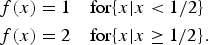
In this case, our two numbers r and r#, give us points at which such a function cannot be defined. And so the function cannot be total. Brouwer's proof of the theorem in general terms shows that the continuum cannot be split anywhere. It is the mathematically most sophisticated statement of viscosity.
So Brouwer's deviant mathematics is not just a crotchety constructivism about existence claims. Even with its deviation on singularity, it is a deeply Kantian view about the interplay of intuitive grasp, receptivity, and infinity (keeping in mind that it is Kant's theory of empirical intuitive grasp that provides the analogy here).
11. Hilbert
Now we can see that, by contrast, the heart of Hilbert's position is Kant's model of mathematical intuition. Quite explicitly Hilbert adopts Kant's epistemic optimism within mathematics, declaring famously: ‘[T]here is no ignorabimus in mathematics’.Footnote 46 Indeed, Hilbert's epistemic optimism was one of the central bones of contention in the debate with Brouwer, and Brouwer sometimes made it seem as though this was for Hilbert a baseless article of faith. But, in fact, Hilbert adopts this view for precisely Kantian reasons. The full quotation is:
There is the problem, find the answer; you can find it just by thinking, for there is no ignorabimus in mathematics (ibid.)
You are assured that you can in principle solve the problem, because it is only a matter of thinking about it. There is no receptivity to block finding the solution.
Moreover, Hilbert follows very closely Kant's picture of the relation of pure mathematics to the empirical realm. Hilbert wants mathematics to proceed internally on its own, even beyond the bounds of empirical intuition. But he insists that those transcendental elements of mathematics are ‘ideal’ (what I called ‘spectral’) objects, with no causal connection to the physical world.
We have established that the universe is finite in two respects, i.e., as regards to the infinitely small and the infinitely large. … (ibid.)
[S]imilarly, to preserve the simple formal rules of ordinary Aristotelian logic, we must supplement the finitary statements with ideal statements (ibid.)
And he wants ideal mathematics to gain ‘objective validity’ by anchoring it in empirical intuition. Formally, that anchoring is by axiomatization in a formal system. But it is important to note that Hilbert strives to show that this anchoring rests on a grasp that meets the needs of a true intuition. And here he adopts two of Kant's conditions of sensory empirical intuition: immediacy and singularity which, in turn, he says, give a grasp of the whole. Indeed, his picture of the empirical component is Kantian even to the point of using surveyability in place of the ‘on the spot’ grasp:
[A]s a condition for the use of logical inference and the performance of logical operations, something must already be given to our faculty of representation, certain extra-logical concrete objects that are intuitively present as immediate experience prior to all thought. If logical inference is to be reliable, it must be possible to survey these objects completely in all their parts, and the fact that they occur, that they differ from one another, and that they follow each other, or are concatenated, is immediately given intuitively, together with the object, as something that can neither be reduced to anything else nor requires reduction. This is the basic philosophical position that I consider requisite for mathematics, and in general for all scientific thinking, understanding and communication (ibid.)
Most of all, Hilbert's notorious ɛ-symbol (sometimes called a choice operator) represents the ideal objects. In particular, ɛxFx picks out an x such that Fx holds, if there is one, and gives nothing, if there is not. Now suppose that F represents one of the infinite sequences about which I have been speaking, and which, in an empirical context, defines a regulative pull. This can be a sequence which might lead to an eternal wait. It could also be a sequence based upon the solution of an as yet unsolved mathematical problem. Then Hilbert's ɛ-Axiom

simply translates quite precisely the Kantian principle that in mathematics the regulative does act constitutively.
So there is no mean spirited taunting here. There is a sophisticated rendition of a deep Kantian principle, right where it should be!
12. Echoes
There is much more to be said both in setting out the Kantian picture and in refining the points of contact with (and of deviation from) the twentieth-century applications. But, for now, let me add just one important caveat.
My subheading speaks of ‘echoes’, and not of ‘influences’. I do not want to claim, or even to hint, that either Brouwer or Hilbert was influenced by reading Kant directly (and indeed reading him in the way that I do) and then applied his insights to their own philosophical penchants. There is substantial historical work to be done about that.
My point here, rather, is that the parallels are interesting even without establishing an historical link. They stem from the issue itself: how can a finite intuitive grasp confront inherently infinitary mathematical thought? The cross-generational comparison that I have sketched teaches us that when we formulate this question in terms of infinite series, then both the question and its potential answers have internal structures that remain stable across the generations.Footnote 47