Introduction
Suicide in late life is a major public health issue worldwide with older adults having the highest rate of suicide, disproportionally high compared to the general population in most countries and increasing in salience with demographic aging (Hawton and Heeringen, Reference Hawton and van Heeringen2009). Particularly in East Asia including China, Japan, and especially South Korea, where the suicide rates account for up to 60% of all worldwide suicide, elderly suicide is a relatively greater problem (Hendin et al., Reference Hendin, Vijayuakumar, Bertolete, Wang, Phillip, Pirkis, Hendin, Phillip and Vijayuakumar2008). The suicide rate in South Korea increased from 21.8 per 100,000 in 2006 to 31.2 per 100,000 in 2010, the highest among countries in the Organization for Economic Cooperation and Development (Korea National Statistical Office, 2011). Furthermore, the suicide rate in elderly population (over 60 per 100,000 in 2010) is the highest among these countries, is still increasing, and should be regarded as one of the most serious public health issues in South Korea. The spectrum of suicidal behavior ranges from suicidal ideation (SI) to actual attempts and finally to completion. SI is closely related to more severe suicidal behavior and is an important predictor of suicide attempt and completion (Posner et al., Reference Posner2011). Additionally inherent burden of SI itself is considerable regardless of other outcomes such as suicidal attempt (van Spijker et al., Reference van Spijker, van Straten, Kerkhof, Hoeymans and Smit2011). Therefore, from a public health perspective, understanding the epidemiology of SI is an important step towards developing and evaluating suicide prevention strategies.
Estimates of the prevalence of SI in elderly adults have varied according to the time frame of enquiry from 0.7% in the prior week (Callahan et al., Reference Callahan, Hendrie, Nienaber and Tierney1996); 4.8%–13% in previous two weeks (Sirey et al., Reference Sirey2008; Almeida et al., Reference Almeida2012); 10.5%–15.9% in previous one month (Saïas et al., Reference Saïas, Beck, Bodard, Guignard and du Roscoät2012); 2%–9.5% in previous one year (Corna et al., Reference Corna, Cairney and Streiner2010); and 5.5%–23.2% in lifetime (Yip et al., Reference Yip, Chi, Chiu, Wai, Conwell and Caine2003). These estimates also vary considerably across studies because of differences in definitions of SI, study samples, assessment scales, and because of recall biases. There have been very few longitudinal investigations of incidence and persistence SI in elderly people. In one longitudinal population-based study of people aged 75 years and above, incidence and persistence rates were 4.4% and 13.3%, respectively (Forsell, Reference Forsell2000). In another one-year follow-up of people aged 65 years and above, newly admitted to visiting nursing homecare, incidence and persistence rates were 5.4% and 36.7%, respectively (Raue et al., Reference Raue, Meyers, Rowe, Heo and Bruce2007).
In terms of etiology, risk factors for late-life suicide include mental disorders (especially major depression), physical illness, pain, functional impairments, adverse life events, and personality dimensions such as low openness to experience and high neuroticism (van Orden and Conwell, Reference van Orden and Conwell2011). Furthermore, at a community level, social connectedness is known to be a modifiable risk factor for suicide (Fässberg et al., Reference Fässberg2012). Much less research has investigated factors associated with SI. Depression has been identified as a risk factor in almost all cross-sectional studies (Yip et al., Reference Yip, Chi, Chiu, Wai, Conwell and Caine2003; Corna et al., Reference Corna, Cairney and Streiner2010; Almeida et al., Reference Almeida2012; Saïas et al., Reference Saïas, Beck, Bodard, Guignard and du Roscoät2012), and others have identified poor health (Saïas et al., Reference Saïas, Beck, Bodard, Guignard and du Roscoät2012), lower social support (Corna et al., Reference Corna, Cairney and Streiner2010; Almeida et al., Reference Almeida2012), marital discord (Corna et al., Reference Corna, Cairney and Streiner2010; Saïas et al., Reference Saïas, Beck, Bodard, Guignard and du Roscoät2012), and financial strain (Yip et al., Reference Yip, Chi, Chiu, Wai, Conwell and Caine2003; Almeida et al., Reference Almeida2012). However, longitudinal data are lacking in older age groups. In a nursing care setting, subjective social support deficit and lower educational level were associated with incident SI (Raue et al., Reference Raue, Meyers, Rowe, Heo and Bruce2007), but to our knowledge, there have been no investigations of factors predicting SI persistence.
Using data from a longitudinal community study of an older Korean population, this study aimed to estimate the prevalence, incidence, and persistence rates of SI over a two-year period, and to investigate psychosocial factors associated with these.
Methods
Study overview and participants
This study was a part of a community-based prospective survey of late-life psychiatric morbidity carried out in Kwangju, South Korea, from 2001 to 2003, in collaboration with the 10/66 Dementia in Developing Countries Research Programme (10/66 Dementia Research Group). The study has been described in detail in several previous publications (Kim et al., Reference Kim2004). In brief, all community residents aged 65 years or over within two geographic catchment areas (one urban, one rural) were systematically identified from national registration lists and were approached to participate at baseline. Attempts were made to follow up all participants two years later (mean (SD) interval 2.4 (0.3) years). SI was identified both at baseline and at follow-up; and all the other data considered in this analysis were obtained at baseline. All participants gave formal written informed consent at each examination. This study was approved by the Chonnam National University Hospital Institutional Review Board.
Suicidal ideation
The presence of SI was identified using the questions from the community version of the Geriatric Mental State (GMS) diagnostic schedule (GMS B3; Copeland et al., Reference Copeland, Dewey and Griffiths-Jones1986), which was administered in identical format at both baseline and follow-up interviews. In this schedule, participants are asked: “Have you ever felt that you would rather be dead? Have you ever felt you wanted to end it all? Have you ever felt like killing yourself?” Reports of fleeting thoughts of suicide are ignored because they are not uncommon in elderly population and may have little clinical significance (Copeland et al., Reference Copeland, Dewey and Griffiths-Jones1986). If participants answer with a more obvious positive response, they are further asked about timing. Based on these questions, one-month prevalence of SI was classified as a binary outcome both at baseline and at follow-up.
Sociodemographic and clinical characteristics
A range of sociodemographic and clinical characteristics potentially associated with SI were considered (van Orden and Conwell, Reference van Orden and Conwell2011). In summary, these comprised age, gender, years of education, living area (rural or urban), accommodation status (owned or rented), past occupation (manual or non-manual), current occupation (employed or not), monthly income (above 200USD or 200USD or less), marital status (with or without spouse), stressful life events, social support deficits, number of physical illnesses, severity of pain, physical inactivity, disability, depressive symptoms, anxiety, insomnia, cognitive function, alcohol consumption, and smoking. Information was obtained from the participant, corroborated by a caregiver where possible. Nine stressful life events over the previous year were investigated, which had been identified as having particular salience for late-life depression (Prince et al., Reference Prince, Harwood, Blizard, Thomas and Mann1997): serious illness (self), serious illness (close relative), bereavement (immediate family), bereavement (other relative or close friend), marital separation, end of a relationship, problem with a close friend or relative, and theft or loss. Positive responses were totaled to generate a summary scale and then divided into four groups (0, 1, 2, 3+). Six social support deficits (Prince et al., Reference Prince, Harwood, Blizard, Thomas and Mann1997) were categorized into the following binary variables: living alone, seeing a relative less often than once a month, seeing a friend less often than once a month, having no close friends, seeing a neighbor less often than once a month, and having no close neighbors. The items were totaled to generate a summary scale and then divided into four groups (0, 1, 2, 3+). Presence of 11 common and generally chronic health problems (Lindesay, Reference Lindesay1990) were evaluated: arthritis or rheumatism; eyesight problems; hearing difficulty or deafness; persistent cough; breathlessness, difficulty breathing, or asthma; high blood pressure; heart disease or angina; gastric or intestinal problems; faints or blackouts; paralysis, weakness, or loss of power in one leg or arm; and skin disorders such as pressure sores, leg ulcers, or severe burns. Positive responses were totaled to generate a summary scale and then divided into four groups (0, 1, 2–3, 4+). Severity of pain caused by any health condition was measured on a Likert scale from 0 (no pain) to 5 (unbearable pain) and then divided into three groups (no pain, mild to moderate pain, severe to unbearable pain). Daily physical activity, taking into account both work and leisure activity, was ascertained and sedentary lifestyle was defined as a binary variable. Disability was assessed by the Korean version of the World Health Organization Disability Assessment Schedule II (WHODAS II; Kim et al., Reference Kim2005), and was divided into dichotomized variable by the summed scores (0 indicated no disability and 1 or above indicated having disability). Depressive symptoms and anxiety were also assessed using the GMS B3 (Copeland et al., Reference Copeland, Dewey and Griffiths-Jones1986), a fully structured diagnostic instrument with an accompanying computerized algorithm (AGECAT) widely used in international epidemiological research, with both disorders defined from respective AGECAT scores on the basis of the conventional 3 or above confidence level in the Stage 2 algorithm. Insomnia was evaluated by the following four questions: (1) Do you have trouble going to sleep? (2) Do you have trouble in staying asleep including awakening early? (3) How often does the problem occur per week? (4) How long has the problem been present? Based on the answers to these questions, insomnia was defined as difficulty in initiation or maintenance of sleep with a frequency of three nights or more per week over at least the last month. Cognitive function was evaluated by the Mini-Mental State Examination (MMSE; Folstein et al., Reference Folstein, Fostein and McHugh1975) and divided into three groups by total scores of MMSE (≤20, 21–24, 25+). As cognitive function is an important correlate of suicidality (Ayalon et al., Reference Ayalon, Mackin, Arean, Chen and McDonel Herr2007), all participants were included in the analysis. A lifetime history of alcohol consumption was obtained, and problem drinkers were defined on the basis of consumption over the previous three months of greater than 14 drinks per week for men or greater than seven drinks per week for women (NIAAA, 1995). A life time history of smoking was obtained, and divided into three groups (non-smoker, ex-smoker, current smoker).
Statistical analysis
Prevalence of SI at baseline was measured. For analysis of “incidence,” the sample was restricted to those without SI at baseline and SI at follow-up was treated as a binary dependent variable. For analysis of “persistence,” the same analyses were carried out restricted to those with SI at baseline. The data were initially assessed using univariate analysis with the three outcomes. Because age and gender could be confounding variables for all other covariates, age- and gender-adjusted odds ratios were calculated from a logistic regression model. Potentially associated factors (p < 0.05) in the univariate analyses were then entered into multivariate logistic regression models to investigate independence. Statistical analyses were carried out using SPSS 18.0 software.
Results
Recruitment, follow-up, and suicidal ideation
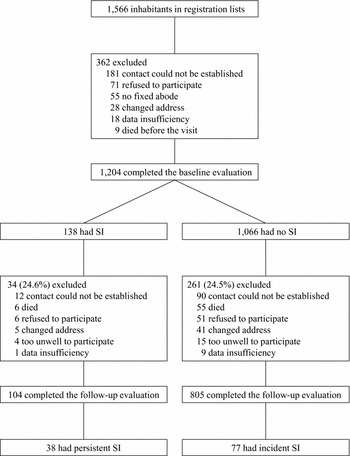
The recruitment process and rates of SI are described in Figure 1. At baseline, participants (N = 1,204) and non-participants (N = 362) did not differ significantly with respect to age (mean (SD) ages, 72.2 (5.9) and 72.4 (6.6) years, respectively) or gender (58% and 62% female, respectively). SI was reported by 138 (11.5%). At follow-up, 909 (75.5%) were re-examined. Those present (N = 909) or not (N = 295) at follow-up were not significantly different at baseline with respect to age (mean (SD) 72.4 (5.7) and 73.0 (6.9) years, respectively), gender (58% and 59% female, respectively), or prevalence of SI at baseline (11.4% and 11.5%, respectively). SI was present in 115 (12.7%) of all 909 followed-up participants. Incidence of SI was defined in 77 (9.6%) of the 805 followed-up participants without baseline SI; and persistence of SI in 38 (36.5%) of the 104 followed-up participants with baseline ideation.
Flow diagram for baseline recruitment and sample follow-up (SI = suicidal ideation).

Univariate associations with suicidal ideation
The univariate associations between baseline characteristics and SI, adjusted for age and gender, are summarized in Table 1. Prevalent SI was significantly associated with the following characteristics: urban residence, rented housing, not currently employed, lower monthly income, increased number of stressful life events, increased number of social support deficits, increased number of physical disorders, more severe pain, physical inactivity, presence of disability, depressive symptoms, anxiety, insomnia, and ex- or current smoking. Baseline factors significantly associated with incident SI (i.e. in participants without SI at baseline) were unmarried status, increased number of stressful life events, increased number of social support deficits, increased number of physical disorders, more severe pain, physical inactivity, depressive symptoms, anxiety, and ex- or current smoking. Persistence of SI (i.e. for participants with SI at baseline) was only significantly associated with increased number of stressful life events, physical inactivity, and depressive symptoms at baseline. Since the baseline depressive symptoms were significantly associated with all SI outcomes, number need to harm (NNH) was calculated for SI (as 100 divided by differences in percentages), indicating the number of people in the exposure group (i.e. with depressive symptoms) that would be required for one less person to have SI. NNH for prevalent, incident, and persistent SI were 3.69, 5.75, and 3.76, respectively. These results indicated that at least one person would have prevalent, persistent, and incident SI for every four to six elderly adults with depressive symptoms.
Univariate associations of baseline demographic characteristics with prevalent, incident, and persistent suicidal ideation (SI) adjusted for age and gender

aSample restricted to participants with no suicidal ideation at baseline.
bSample restricted to participants with suicidal ideation at baseline.
*p < 0.05; †p < 0.01; ‡p < 0.001.
SI = suicidal ideation; OR = odds ratio; CI = confidence interval; WHODAS = World Health Organization Disability Assessment Schedule; GMS = Geriatric Mental State schedule; MMSE-K = Mini-Mental State Examination-Korean Version.
Multivariate associations with suicidal ideation
Multivariate associations between baseline characteristics (simultaneously entered into regression models, including age and gender) and SI identified by logistic regression models are summarized in Table 2. Baseline SI was independently associated with no current employment, lower monthly income, higher number of stressful life events, more severe pain, presence of disability, depressive symptoms, and smoking. Incident SI was independently predicted by unmarried status, social support deficits, more severe pain, depressive symptoms, and current smoking. Persistent SI was independently predicted by higher number of stressful life events and depressive symptoms.
Multivariate associations of baseline characteristics (simultaneously entered into regression models including age and gender) with prevalent, incident, and persistent suicidal ideation. Data are ORs (95% CIs)

N indicated the numbers of events/numbers of participants included in each analysis. The categories in parentheses are the comparator categories.
*p < 0.05; †p < 0.01; ‡p < 0.001.
WHODAS = World Health Organization Disability Assessment Schedule; GMS = Geriatric Mental State schedule.
Discussion
The principal findings of this two-year longitudinal study of community elderly were that: prevalence, incidence, and persistence rates of SI were 11.5%, 9.6%, and 36.5%, respectively; and that commonly unfavorable but different psychosocial factors were associated with each of these outcomes. However, baseline depressive symptoms were associated with prevalent, incident, and persistent SI.
Several conceptual issues should be considered when interpreting these findings. The first concerns the nature and generalizability of the outcomes, because this study only evaluated SI and no data regarding suicidal attempts or the completion of suicide were available. Although a well-validated approach was used, associations with SI clearly cannot be assumed to generalize to more severe outcomes like suicide attempt or completion. However, SI can be assumed to have been present before suicide completion and has been found to be associated with higher risk of this (Posner et al., Reference Posner2011). In particular, SI is more closely related to more severe forms of suicidal behavior in elderly adults compared to young adults (van Orden and Conwell, Reference van Orden and Conwell2011). Therefore, as a related construct understanding its etiology as a marker of risk is important. If SI is only a proxy marker of actual suicide risk, our significant findings might be expected to be stronger in relation to more severe behaviors, although further research would be needed to test this assumption. A second consideration is the relationship between SI and depressive symptoms. Although there is clearly an overlap between outcomes (because SI is a core symptom of depression and both outcomes were derived from the same instrument, the GMS B3), of the 138 participants with SI, only 56 (41%) were also defined as having depressive symptoms according to this instrument. Additionally, although suicidal behavior is typically associated with mental disorders, previous findings have suggested that the genetic and pathophysiological characteristics of suicidal behavior seem to be independent of depression to some extent (Fu et al., Reference Fu2002).
Particular strength of the present study were that prospective data were obtained from a community population using widely validated assessment scales and tools, and that the follow-up rate was reasonable and not apparently differential with respect to risk factors of interest. To our knowledge, this is the first study in an older community population to report factors predicting the incidence and persistence of SI. In addition, there is a need for multidimensional approach in the research of suicide since suicidal behavior is the result of interactions between SI and other multidimensional risk factors (van Orden and Conwell, Reference van Orden and Conwell2011). In the present study, multiple and comprehensive risk factors were evaluated and determinants of SI were drawn by the multivariate analyses. However, a limitation of the study was that information on general physical health and insomnia relied on self-reported diagnoses, and corroboration by medical records was not possible. Second, a prospective analysis was used treating SI as an “incident” outcome – i.e. absent on one occasion and present on another. Although commonly used in epidemiological research, this approach is unlikely to reflect complex symptom trajectories; for example, episodes occurring and then disappearing between the examination points will have been missed. Third, 61 participants died during the follow-up period, but the causes of death were not evaluated. If some participants died of suicide, this might have influenced the incidence or persistence outcomes. Fourth, the sample size resulted in limited power considering the number of SI events and covariates included in the analyses. Finally, the present results were drawn from data obtained nearly ten years ago and should be interpreted cautiously. These findings may not reflect changes that have occurred over the subsequent decade including increased suicidal behavior and changed socio-cultural environments in South Korea.
The strongest and most consistent associations in our longitudinal study were those of depressive symptoms with prevalent, incident, persistent SI. This has been reported repeatedly in cross-sectional studies of older people (Yip et al., Reference Yip, Chi, Chiu, Wai, Conwell and Caine2003; Corna et al., Reference Corna, Cairney and Streiner2010; Almeida et al., Reference Almeida2012; Saïas et al., Reference Saïas, Beck, Bodard, Guignard and du Roscoät2012) and in one longitudinal study for incident ideation (Raue et al., Reference Raue, Meyers, Rowe, Heo and Bruce2007). Our findings suggested that older people with depressive symptoms not only have a higher likelihood of having SI at a given time but also are more likely to develop ideation in the future, and SI in combination with depressive symptoms is more likely to persist. Depressive symptoms in older people is often neglected, underestimated, and untreated in community (Charney et al., Reference Charney2003), and its importance in SI underlies the need for better detection and management.
In the present study, ex- and current smoking were associated with prevalent SI, and current smoking was associated with incident SI. A meta-analysis of prospective cohort studies conducted in the general population found a significant association between smoking status and completed suicide with a dose-dependent relationship (Li et al., Reference Li2012). This association is supported by evidence demonstrating that smoking decreases levels of brain serotonin and is negatively related to suicide (Malone et al., Reference Malone, Waternaux, Hass, Cooper, Li and Mann2003) and that nicotine is a strong activator of the HPA axis (Rohleder and Kirschbaum, Reference Rohleder and Kirschbaum2006), results in dysregulation within the HPA axis, and is associated with suicide. Although the cross-sectional relationship between smoking and SI has been consistently demonstrated (Almeida et al., Reference Almeida2012), the current study is the first using an older community population to report an independent association between smoking and incident SI. This finding suggests that those at a high risk for SI require careful monitoring.
In the present sample, no current employment, lower monthly income, stressful life events, more severe pain, and presence of disability at baseline were also independently associated with SI at baseline. These all clearly represent unfavorable psychosocial status and are consistent with other cross-sectional findings in older age groups (Yip et al., Reference Yip, Chi, Chiu, Wai, Conwell and Caine2003; Ayalon et al., Reference Ayalon, Mackin, Arean, Chen and McDonel Herr2007; Almeida et al., Reference Almeida2012; Saïas et al., Reference Saïas, Beck, Bodard, Guignard and du Roscoät2012), acting potentially through underlying perceptions of life as a burden and of the self as lacking autonomy and personal control (van Orden and Conwell, Reference van Orden and Conwell2011).
In this study, unmarried status, social support deficit, and severe pain at baseline independently predicted incident SI. To our knowledge, these prospective findings in an older community sample are relatively novel and suggest directions for prevention strategies. Since older people who are more socially isolated or who suffer from a painful condition are at increased risk for new occurrence of SI, targeted interventions that promote pain management and social network development should be considered and evaluated. The fact that low social support predicted incidence is interesting, as for depressive symptoms as an outcome it has more often been found to predict persistence rather than onset in prospective community studies (Prince et al., Reference Prince, Harwood, Thomas and Mann1998).
Stressful life events as well as depressive symptoms were independently associated with persistent SI. To our knowledge, this is the first study in an older community population to report factors evaluating persistence of SI, although the cross-sectional association between life events and SI has been reported repeatedly (Yip et al., Reference Yip, Chi, Chiu, Wai, Conwell and Caine2003; Saïas et al., Reference Saïas, Beck, Bodard, Guignard and du Roscoät2012). A number of stressful life events become common with aging, including bereavement, financial stress associated with retirement, living on reduced means, loss of social support, and the social and psychological impacts of physical illness (Conwell and Thompson, Reference Conwell and Thompson2008). Older people may also have difficulties in dealing with such stressors due to impaired decision-making or problem-solving deficit, not to mention accompanying longer-standing risk factors such as poor physical health and social isolation. These unresolved stresses, in turn, result in higher psychological distress, which might be a strong risk factor for persisting SI (Ayalon et al., Reference Ayalon, Mackin, Arean, Chen and McDonel Herr2007).
In conclusion, effective detection, diagnosis, and treatment of depressive symptoms are clearly important strategies for reducing SI, and our findings provide longitudinal support for depressive symptoms as risk factor for both incidence and persistence of this outcome. Additionally, closer monitoring of psychological state and consideration of preventive interventions require perhaps particular evaluation in older people with no spouse, or with wider social support deficits, current smoking, as well as those painful conditions in view of their increased risk. Clinicians and providers of community-based social services should consider specific measures to identify patients with SI although further evaluation is required concerning the most feasible, effective, and acceptable interventions.
Conflict of interest
J-M Kim has received research support from Ministry of Health & Welfare and National Research Foundation of South Korea. R. Stewart is part-funded by the National Institute for Health Research (NIHR) Biomedical Research Centre and Dementia Biomedical Research Unit at South London and Maudsley NHS Foundation Trust and King's College London.
Description of authors’ roles
H-J Kang and J-M Kim conducted the data analysis and drafted the paper. R. Stewart interpreted the data and revised the paper critically. B-O Jeong, S-Y Kim, K-Y Bae, S-W Kim, I-S Shin, and J-S Yoon helped to analyze the data and to draft the paper. All authors approved the final version of the paper to be published.
Acknowledgments
This study was supported by a grant of the Korean Health Technology R&D project, Ministry of Health and Welfare, Republic of Korea (A120004).