INTRODUCTION
Soil fertility depletion on smallholder farms is a major factor contributing to the declining per capita food production in sub-Saharan Africa (SSA). Nutrient losses from harvest offtake, erosion and leaching often exceed inputs from fertilizers or manures. Stroorvogel et al. (Reference Stroorvogel, Smaling and Janssen1993) estimate the annual soil depletion rate in the region at 22 kg of nitrogen (N), 2.5 kg of phosphorus (P) and 15 kg of potassium (K) per hectare. This is equivalent to US$ 4 billion in fertilizer costs (Sanchez, Reference Sanchez2002). Replenishing the lost soil nutrients is, therefore, essential for achieving sustainable household food security in SSA. Strategies for replenishing the lost nutrients include the use of organic and inorganic fertilizers, or the integration of both especially in soils with multiple nutrient deficiencies.
The problem of multiple nutrient deficiencies is widespread throughout SSA, and one region where it is very pronounced is the western Kenya highlands, a densely populated area of the country where population densities in some localities exceed 1000 persons per square kilometre (Swinkels et al., Reference Swinkels, Franzel, Shepherd, Ohlsson and Ndufa1997). The soils in this region have been subjected to continuous cropping for a long time with little or no external inputs (Smaling, et al., Reference Smaling, Stroorvogel and Windmeijer1993). Most of the soils under smallholder production are, therefore, deficient in the major nutrients. Deficiencies of plant available P are particularly severe, a problem attributed to the annual losses of 3–13 kg P ha−1 over several decades (Buresh et al., Reference Buresh, Smithson and Hellums1997). Consequently, crop yields are low and declining, with the yield of maize (the staple food crop in the region) typically being less than 1.0 t ha−1 (Sanchez, Reference Sanchez2002). Therefore, responses of maize to P application in the region are significant even at rates as low as 10 kg P ha−1 (Jama et al., Reference Jama, Swinkels and Buresh1997). Once P deficiency is overcome, N then limits maize growth in nearly all cases. After P and N deficiencies are overcome, K also limits crop productivity in the area, with about 25% of the area under maize in the region estimated to be affected (Lijzenga, Reference Lijzenga1998).
Traditionally, natural fallow was one of the strategies for improving soil fertility and that is still practiced even in this densely populated region, although land allocated to it is typically less than 10% of the cultivated area (Swinkels et al., Reference Swinkels, Franzel, Shepherd, Ohlsson and Ndufa1997). Its effectiveness in improving crop yields is, however, limited by the short duration (typically less than 1 year) of the practice in this densely populated area. Farmyard manure is a common input, but its potential to meet the P needs of crops is also limited because it is usually not available in sufficient quantities on most farms, is low in P content, and its processing and application is labour demanding (Palm et al., Reference Palm, Myers, Nandwa, Buresh, Sanchez and Calhoun1997). Additionally, crop residues that could be used for soil fertility improvement often have competing uses such as fodder for livestock or are used as fuelwood. Thus, the alternative options for P replenishment are either soluble P fertilizers or phosphate rock (PR). Since soluble P fertilizers are prohibitively expensive for most smallholder farmers in SSA (Sanchez, Reference Sanchez2002), there is need to explore the use of PRs that could be a cheaper alternative in some areas.
Minjingu phosphate rock (MPR) from Tanzania has reportedly the highest P content in the East African region and is reactive enough for direct application (Van Kauwenbergh, Reference Van Kauwenbergh1991). It has a high neutral ammonium citrate (NAC) solubility in the range of 2.4%–5.6% P that compares well with the most soluble phosphate rocks in the world. The estimated reserve of this deposit is 10 million tons (Van Straaten, Reference Van Straaten2002). Several agronomic studies in the East African region indicate that MPR can be an effective source of P for crops (Bromfield et al., Reference Bromfield, Hancock and Debenham1981; Ikerra et al., Reference Ikerra, Semu and Mrema2006; Jama and van Straaten, Reference Jama and van Straaten2006). Bromfield et al. (Reference Bromfield, Hancock and Debenham1981), for instance, found MPR to be 75% as effective as TSP (20% P) in five seasons following its application to maize in western Kenya. It can quickly replenish lost available soil P (Jama and van Straaten, Reference Jama and van Straaten2006). The western Kenya soils are generally acidic, about half with pH (H2O) < 5.5, thus providing suitable soil conditions for the use of phosphate rocks (Smithson et al., Reference Smithson, Jama, Delve, van Straaten and Buresh2001).
In soils with multiple nutrient deficiencies, integration of inorganic and organic nutrient inputs is the best strategy for increasing fertilizer use efficiency and for providing a more balanced supply of nutrients for crops (Ikerra et al., Reference Ikerra, Semu and Mrema2006; Jama et al., Reference Jama, Buresh and Place1998; Palm et al., Reference Palm, Myers, Nandwa, Buresh, Sanchez and Calhoun1997). Organic and inorganic inputs cannot be substituted entirely by one another and both are required for sustainable crop production. Additionally, financial returns are normally higher with integrated options of soil fertility management than with either sole organics or inorganics (Place et al., Reference Place, Barret, Freeman, Ramisch and Vanlauwe2003).
At present, our knowledge base on the agronomic effects and financial returns of MPR compared to the more soluble TSP is relatively scanty. This study, therefore, addressed this problem, and did so using different rates of MPR or TSP as P sources while using sesbania fallow, tithonia biomass or urea as the N source.
METHODS AND MATERIALS
Experimental design and management
The trial was conducted on a farmer's field in western Kenya (0°06′N, 34°34′E) beginning in the long rains of March 1996 and ending in the short rains of September 2000. The site was at 1420 m asl, with mean annual rainfall of 1800 mm in two growing seasons per year – the long rains from March to August and the short rains from September to January, with the long rains being the main maize cropping season. The soil was a Kandiudalfic Eutrudox with the following characteristics in the top 0.15 m: pH (1:2.5 soil/water suspension) = 5.1, exchangeable acidity = 1.0 cmolc kg−1, organic C = 14.0 g kg−1, exchangeable Mg = 1.4 cmolc kg−1, exchangeable Ca = 3.4 cmolc kg−1, exchangeable K = 0.08 cmolc kg−1, bicarbonate-ethylenediaminetetraacetic acid (EDTA) extractable P = 2 mg kg−1, clay = 29%, and sand = 39%. Organic C was determined by wet oxidation with heated sulphuric acid-dichromate followed by colorimetric determination of Cr3+ (Anderson and Ingram, Reference Anderson and Ingram1993). Extractable P and exchangeable K were determined by extraction with 0.5 M NaHCO3 + 0.01 M EDTA (pH 8.5). Exchangeable Ca, Mg and acidity were determined by extraction with 1 M KCl.
The experiment was a randomized complete block design with four replications and the following five P treatments: i) no added P; ii) a one-time application of TSP at 250 kg P ha−1 before planting in March 1996; iii) five annual applications of TSP at 50 kg P ha−1 in March of each year from 1996 to 2000; iv) a one-time application of MPR at 250 kg P ha−1 and v) five annual applications of MPR at 50 kg P ha−1. The one-time high application rate represents a P ‘recapitalization’ rate while the annual small one a ‘replenishment’ rate. Based on a Fox and Kamprath isotherm, up to 500 kg P may be required to achieve 0.2 mg P kg−1 in the top 0.15 m layer of the study area's soils (Jama et al., Reference Jama, Buresh and Place1998). The 250 kg P ha−1 used in this study is on the plateau part of the P isotherm response curve.
The plot was 10 m ×10 m. Hybrid maize (H614, H512 or H513) was grown at 53 000 plants ha−1 (0.75 m × 0.25 m spacing) for 5 years or 10 consecutive seasons. MPR was applied as a finely ground powder (>90% passing a 100-mesh sieve), and TSP was applied in commercially available granular form. Both were broadcast and then incorporated to 0.15 m soil depth using hand hoes.
The source of N was either i) urea at 60 kg N ha−1 applied during the long rains only, with a third applied at planting and two-thirds at the nine-leaf stage; ii) green leaf biomass of tithonia (Tithonia diversifolia), which was applied and incorporated with hand hoes at the equivalent of 1.8 t of dry matter per hectare at the start of each long rains, providing about 60 kg N ha−1; or iii) sesbania (Sesbania sesban) biomass grown as a fallow during each short rain season. Tithonia is abundantly available on roadsides and on the boundaries of farms in the study area (Lauriks, Reference Lauriks, Wulf, Carter and Niang1999).
Sesbania seed (Kisii provenance), which was under sown between the maize rows after the first weeding at 0.75 m × 0.25 m spacing, was allowed to grow as a fallow during the following short rains. It was clear-cut in March of each year, just prior to maize planting for the long rain season. Non-woody biomass and litter were incorporated into the soil during land preparation, while wood was removed. Based on previous work on sesbania fallows in the study area (Jama et al., Reference Jama, Buresh and Place1998), leaf litter production can be 2–3 t ha−1 after 6–7 months (Niang et al., Reference Niang, Gathumbi and Amadalo1996), and with typical N content range of 2–2.5% (Jama et al., Reference Jama, Buresh and Place1998), this biomass would be sufficient to provide the 60 kg N ha−1 required. Sesbania fallows occupied the fields each short-rains season except in 1997 when maize was grown in all treatments. In the third season (i.e. 1997 long rains), the plots were split into two halves before maize was sown, and K as KCl was applied to one half at 60 kg K ha−1. This application, which was repeated annually for the next four years, was necessitated by strong K deficiencies noticed in the first year of the study. The K rate was equivalent to the K added by tithonia biomass.
At harvest, maize was oven dried at 60 °C and yield expressed at 150 g kg−1 water content. From the yield-per-hectare data, the relative agronomic effectiveness (RAE) of MPR compared to TSP was calculated. RAE is normally considered as a good measure for such comparisons (Bromfield et al., Reference Bromfield, Hancock and Debenham1981).
Data analysis
The data were analysed using the procedures of GENSTAT (2000). Because of the significant (p ≤ 0.05) differences in yield between years, the data were analysed and reported by year. Reference to statistical significance refers to 5% probability level unless otherwise stated.
Economic analysis
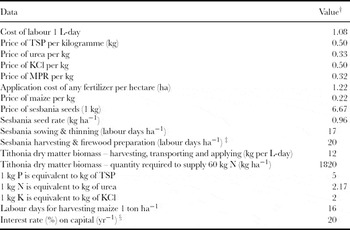
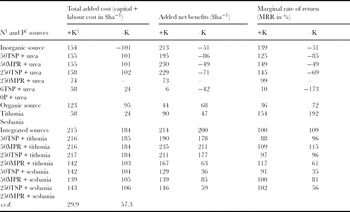
Costs and benefits associated with each agronomic practice were determined using values presented in Table 1. The costs and benefits were compared using partial budgeting, which included only costs and benefits that varied from the control, i.e. costs of fertility-enhancing inputs and the increased maize yield (CIMMYT, 1988). These are added costs and added benefits and unless stated otherwise, all values are based on those prevailing during the long and short rains of the study period.
Values used for cost-benefit analysis of different N and P sources and P rates for soil fertility amelioration in western Kenya.

† Price value of labour, fertilizers, maize and sesbania seeds are in US dollars and the exchange rate is Kenya shillings (Ksh. 60) = 1 US dollar ($). The values are derived from a rapid market survey conducted in 2000.
‡Labour of sesbania harvesting & firewood preparation assumes only 0.5 Mg ha−1 of wood is valued.
§Interest rate was calculated for inputs bought from the market (since tithonia was cut freely from the hedges it was assumed to have no capital value).
A rapid market survey in 2000 in the study area was used across all the five years to determine the prices of TSP, urea, KCl, MPR, fertilizer transport, fertilizer application, tithonia labour, maize and sesbania seeds, maize harvesting, sesbania cutting and incorporation into the soil, and sesbania wood preparation. Only sesbania wood of greater than 2 cm diameter and up to a maximum of 0.2 t ha−1 was valued because there was no market value for twigs in the study area and normally the farmers give some wood to neighbours and friends (Jama et al., Reference Jama, Buresh and Place1998). Markets for MPR were not well developed in western Kenya at the time of the study, but supplies were furnished by a Nairobi-based outfit of the Minjingu Phosphate Company.
For the economic analysis, maize yields were adjusted downwards by 10% to cater for overestimation in the small researcher-managed plots and to reflect what farmers could get in their bigger farms (CIMMYT, 1988). Maize stover was assumed to be of no monetary value given that it is not traded in the local markets. The opportunity cost of cash tied up in the production process was estimated at 20% per year and was applied only to items that had to be bought. All monetary values were converted to US dollars ($) at the mean exchange rate of the Kenyan shilling (Ksh) during the field experiment ($ 1 = Ksh 60).
Dominance analysis was done by arranging all the treatments in order of ascending total variable costs with their corresponding net benefits (CIMMYT, 1988). Any practice whose net benefits were less than or equal to that of another practice with lower variable costs was considered as dominated and thus unlikely to be adopted by farmers. The marginal rate of return for the non-dominated practices (expressed as a percentage) was computed by dividing the marginal net benefits by the marginal costs.
The rate of return to land was computed as the difference between the value of additional maize grain yield and sesbania wood per hectare, and the associated additional costs from the investments made. The rate of return to labour was also calculated as the difference between added gross benefits and total added capital cost, divided by added labour days. Finally, the rate of return to capital was calculated as follows:

Sensitivity analyses were also used to examine the effect of increases in the value of maize, inorganic fertilizers and the cost of labour on the attractiveness of the various interventions tested. The analysis also considered single or simultaneous changes in the price of the maize, fertilizers and labour cost. With respect to maize prices, increases of 25 and 50% were used as they do indeed occur between seasons in the study area (FEWSNET, 2002). Prices of fertilizers can also change considerably between seasons, and doubling between seasons is fairly common in the study area (Mwaura and Woomer, Reference Mwaura and Woomer1999). Increases in fertilizer prices of 50 and 100% were, therefore, used in the analysis. Finally, the effects of increasing labour costs were analysed using increases of 25 and 50%. Labour costs are an important consideration in all the soil fertility management options examined in this study, but more so for tithonia whose application is labour intensive (Gachengo et al., Reference Gachengo, Palm, Jama and Othieno1999; Jama et al., Reference Jama, Palm, Buresh, Niang, Gachengo, Nziguheba and Amadalo2000).
RESULTS AND DISCUSSION
Effect of P sources and rates
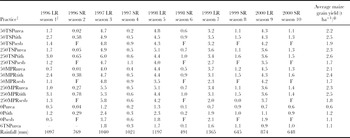
Maize yield increased by 2- to 5-fold with P application (Table 2) compared to the control treatment with no P application, with K added in both cases, and averaged 1.0 t ha−1 over the 10 seasons. No significant differences were, however, found between the two P sources (TSP and MPR) and the two P application rates of 50 and 250 kg P ha−1. On average, yields were higher in the early part of the 10 cropping seasons with the one-time 250 kg ha−1 P ‘recapitalization’ rate. This trend was, however, reversed from the third year with the 50 kg ha−1 P rate increasing while that of the 250 kg P ha−1 began to decline. Nevertheless, all plus-P treatments yielded well over three times more maize than the control, which had no P addition. When compared with the year of best maize yields (i.e. 2000 long rains season), the mean yields of treatments with P application in the long rains averaged about 83%. This was so regardless of the P source or the P rate used. The short-rains season yields were not included because they were generally poor and negligible across all treatments. This is attributed to inadequate rains in this season and to the relatively high disease load, especially maize mosaic virus, compared to the long-rains season.
Maize yield from the +K plots of the 17 practices for N & P sources and P rates at Ochinga in western Kenya.

‡LR, long rainy season; SR, short rainy season; F, sesbania fallows which were planted during the SR only except in 1997. υPotassium application as muriate of potash (KCl) was applied at the rate of 60 kg K ha−1 beginning from the LR of 1997. ‡P sources were either triple superphosphate (TSP) or Minjingu rock phosphate (MPR) at 50 kg P ha−1 applied annually or 250 kg P ha−1 applied once at the beginning of long rains of March 1996. The N sources were urea, tithonia (60 kg N ha−1) and Sesbania sesban (6 months-old fallows). 50TSPurea = 50 kg P ha−1 from TSP and 60 kg N ha−1 from urea; 50TSPtith = 50 kg P ha−1 from TSP and 60 kg N ha−1 from tithonia biomass; 50TSPsesb = 50 kg P ha−1 from TSP and N from sesbania fallows; 250TSPurea = 250 kg P ha−1 from TSP, 60 kg N from urea; 250TSPtith = 250 kg P ha−1 from TSP, 60 kg N ha−1 from tithonia biomass; 250TSPsesb = 250 kg P ha−1 from TSP and N from sesbania fallows; 50MPRurea = 50 kg P ha−1 from MPR and 60 kg N ha−1 from urea; 50MPRtith = 50 kg P ha−1 from MPR and 60 kg N ha−1 from tithonia biomass; 50MPRsesb = 50 kg P ha−1 from MPR and N from sesbania fallows; 250MPRurea = 250 kg P ha−1 from MPR and 60 kg N ha−1 from urea; 250MPRtith = 250 kg P ha−1 from MPR and 60 kg N ha−1 from tithonia biomass; 250MPRsesb = 250 kg P ha−1 from MPR and N from sesbania fallows; 0Purea = 60 kg N ha−1 from urea without P addition; 0Ptith = 60 kg N from tithonia biomass without P addition; 0Psesb = Sesbania fallows as N source without P addition; 6TSPurea = 6 kg P ha−1 from TSP and 60 kg N ha−1 from urea.
The comparable yield response of MPR and TSP in this study is particularly noteworthy. MPR is locally available in the region and it could be a cheaper source of P than imported TSP if more investments were made to develop its production and marketing. Without statistical comparisons, these increases are more-or-less similar. For example, a study by Lijzenga (Reference Lijzenga1998) at 26 P-responsive sites in western Kenya using 100 kg P ha−1 as either MPR or TSP and with inorganic N and K supplied at recommended rates demonstrated an average maize yield response to MPR in the first-season of only 70% relative to that of TSP. Another set of trials on 26 additional farms in western Kenya (Smithson et al., Reference Smithson, Jama, Delve, van Straaten and Buresh2001), using a P rate of 80 kg P ha−1 showed a significant response to added MPR averaging 74% as effective as TSP (range 41–113%).
The RAE of MPR when applied annually at 50 kg P ha−1 without addition of K fertilizer ranged from 50 to 76% across the different N sources used in this study while with K addition it ranged between 75 and 90%. When MPR is applied once at a large initial application of 250 kg ha−1, RAE increased to 65–77% for plots without K and to 92–115% for plots supplied with K fertilizer.
Effect of N sources
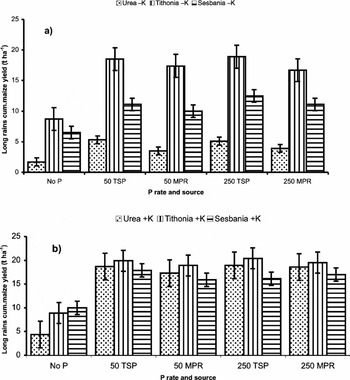
Without K but with P application, cumulative maize yield was highest when tithonia was used as the N source (Figure 1a). The cumulative maize yield was in the decreasing order: tithonia > sesbania > urea. The difference in cumulative maize yield between the inorganic N source (urea), and the organic ones (tithonia and sesbania) was significant. This observation suggests that organic tithonia and sesbania N sources can meet the N and K needs of the crop, plus perhaps other nutrients, if applied in adequate quantities.
Effect of N and P sources, P rates and K fertilizer on cumulative maize yield in western Kenya: a) without K application; b) with K application.

When both P and K were applied, cumulative maize yield was highest for tithonia as the N source, followed by urea and lowest for sesbania (Figure 1b). The differences between tithonia and urea were, however, not significant. This response was not affected by the P source nor by the P rate (Table 2), suggesting that MPR is as good as TSP as a source of P for maize in this P-deficient soil. It also suggests that the single application of a large-recapitalization P dose is as good as the annual application of small doses. Averaged over all the N sources, the cumulative maize yield in the five years of the study was significantly increased by K fertilization (Figure 1b), indicating the extent to which K was limiting maize production at the study site. Exchangeable K levels in the top soil (0–15 cm) averaged 0.08 cmol (+) kg−1. On average, the effect of K fertilizer on maize yield was greatest where tithonia was used as the N source compared to sesbania and urea (Table 2). This could be due to the additional K obtained from tithonia green biomass. K content of tithonia leafy biomass can range from 2.7 to 4.8% on a dry matter basis (Jama et al., Reference Jama, Palm, Buresh, Niang, Gachengo, Nziguheba and Amadalo2000), suggesting its biomass could be an important source of K for crops when applied in adequate amounts.
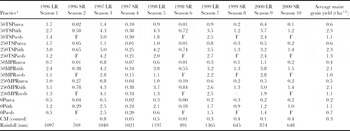
Without K application, average maize yield with urea and annual application of P was not different from that of continuous maize cropping with or without inputs (Table 3). This suggests the need to address K and P deficiencies in these soils simultaneously instead of one at a time. This could be done through compound fertilizers such as NPK or through the combinations of single N and P source fertilizers with tithonia or other organics that are rich in K.
Maize yield from the -K plots of the 17 practices for N & P sources and P rates at Ochinga in western Kenya.

†Treatment description is as in Table 2.
Maize yields were higher with tithonia than urea during the short-rains seasons (Table 3) when the total rainfall could be between one-half and two-thirds of those of the long rains season totals. The yield difference totalled 1.2 t over the four short rains seasons between the tithonia treatment and those with urea but with K applied as well. This observation merits further systematic assessment as it suggests that tithonia has multiple benefits, including buffering the crop against moisture stress in seasons of poor rainfall. This has important implications for farmers, in the study area and many other places in Africa, who practice rain-fed agriculture, which is prone to intermittent droughts. The extent to which sesbania fallows could have such positive dry-season effects also needs to be determined since the in-situ production of sesbania could cut down on costs associated with tithonia biomass transfer.
Sesbania biomass yield
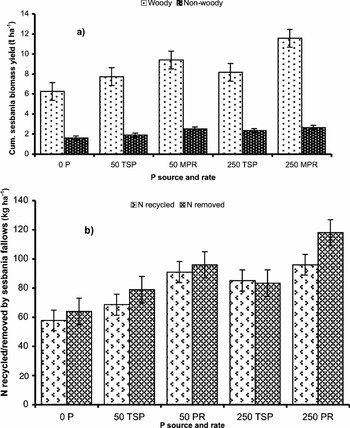
Both woody and non-woody sesbania biomass yields were improved by P application (Figure 2). Compared with the no P treatments, the yields were significantly increased by MPR but not by TSP. The cumulative yield of woody and non-woody biomass ranged from 1.60 t ha−1 with no P application to 2.67 t ha−1 with MPR250 (Figure 2a). Application of K, however, did not improve sesbania biomass yields significantly. Therefore, averaged over the –K and +K treatments, cumulative biomass yields for both MPR rates and the TSP250 rate was significantly higher than the yields with no P treatment.
Effect of P sources and rates on cumulative sesbania biomass yield, N recycled and removed over four short-rain seasons, 1996–2000. No fallow was grown in 1997. a) biomass yield (wood and non-wood fractions); b) N removed through the wood harvested or recycled with non-wood fractions.

The TSP50 treatment did not increase woody and non-woody biomass yields of sesbania significantly over the treatment without any P application. The reasons for this are unclear. In general, the biomass yields of sesbania reported here are substantially lower than those found in other studies, in which sesbania was a sole crop and not intercropped with maize (Ndufa et al., Reference Ndufa, Shepherd, Buresh and Jama1999). We suspect this is due to both the relatively higher soil degradation of the study site, and to the relatively poor growth of sesbania intercropped in the fertilized maize.
Increasing the biomass yield of sesbania through P application is essential because it is supposed to meet a significant proportion of the N requirement of the crop in the systems under test in this study. Over the four seasons for which sesbania fallows were planted, the N returned to the soil through sesbania leaves and small twigs ranged from 95.9 kg N ha−1 with 250 kg P ha−1 using MPR 250 to 57.6 kg N ha−1 without P application (Figure 2b). Although the cumulative N recycled and that removed by sesbania fallows through wood harvested over the four years was similar, continuous removal of N with wood may exacerbate N deficits and limit productivity of this system in the long run. This suggests the need to integrate inorganic N fertilizers with the sesbania fallows, especially after the fourth year, in order to counteract N mining associated with wood harvests. The question of how much supplemental N is required in different soils and production systems are particularly relevant given the increasingly high costs of fertilizers.
Financial benefits
The sources of N and P used influenced considerably the profitability of the different treatments tested. This was so whether K was added or not. For instance, the net added benefits of sesbania as an organic N source with no P but K added (90 USD ha−1) was more than double that with tithonia (44 US$ ha−1) as the N source and 15 times that with urea (6 US$ ha−1) (Table 4). These differences are attributed to the high cost of labour associated with the collection of tithonia and its transfer from roadsides and land outside the cropped land, and the high purchase cost of urea, respectively. The net benefits of urea and tithonia, however, increased by several fold with the addition of P and K. For instance, the net benefit associated with urea averaged 213 US$ ha−1 and were not significantly different from those with tithonia on average (235 US$ ha−1). The difference in net benefit between the two P sources and P rates were also not significant with either urea or tithonia as the N source and with the application of K (Table 4).
Added costs and net benefits of different nutrient sources in western Kenya.

TSP: triple superphosphate; MPR: Minjingu rock phosphate.
† Urea and tithonia were applied at the rate of 60 kg N ha−1.
‡ The 50 kg P ha−1 was applied annually for 5 years while the 250 kg P ha−1 was applied once in the beginning of the long rains of 1996.
§ Potassium was applied as muriate of potash (KCl) at the rate of 60 kg K ha−1.
With P applied, the net benefits of urea and tithonia were higher than with sesbania as the N source, by between 31 and 39% on average. This difference is attributed to the low supply of N from the 7–8-month-old sesbania fallow largely due to its poor initial establishment and growth inside the maize crop. When the maize was harvested and shade reduced, sesbania growth was further suppressed by the weeds that emerged vigorously in the previously fertilized plots.
The relatively large net benefits associated with P application with the urea+K or tithonia+K treatments demonstrate the importance of applying P in these P-deficient soils if significant returns to investments made in N and K applications are to occur. They also demonstrate that with no P application, it makes more economic sense to use either tithonia biomass or sesbania fallows than urea. Tithonia provided some P, in this case 6 kg P ha−1 with the 1.8 t ha−1 required to provide 60 kg N ha−1 that was needed. Surprisingly, the addition of this little amount of P resulted in significantly large net benefits (73 US$ ha−1) compared with the crop that received urea but had no P application (6 US$ ha−1) (Table 4). These benefits could be due to addition of micronutrients or to other effects of the organics beyond the direct supply of nutrients. Both tithonia and sesbania fallows are, for instance, known to improve P availability through processes of enhanced biological cycling and turnover of P in labile pools of soil P (Maroko et al., Reference Maroko, Buresh and Smithson1999; Nziguheba et al., Reference Nziguheba, Palm, Buresh and Smithson1998). This is important for plant growth in soils with medium to high P-fixing properties such as those in the study site. In the case of tithonia, there might have been additional benefits of soil moisture conservation as suggested by the relatively higher yields from this treatment during the short rains seasons (Table 3).
With P but no K application, the net benefit of urea on average became negative, while those of tithonia and sesbania were positive (192 US$ ha−1 and 61 US$ ha−1, respectively). Given the severe limitation of K in the soils of the study site, applying inorganic P (TSP or MPR) and urea without K is highly uneconomical (Table 4). The costs incurred to buy, transport and apply these inorganic fertilizers were too high to be compensated by the resultant maize yield. Both tithonia and sesbania, however, overcame K deficiency either fully or partially. Given the high labour costs associated with tithonia application, the use of sesbania fallow might be economically more attractive. A word of caution is necessary here though. Given that much of the K supplied by sesbania fallows is recycled from the system, there is potential for K depletion over time unless the K that is removed with crop harvested and sesbania wood from the field are replenished through application of fertilizers.
Although urea and tithonia gave similar net benefits with the different P sources and P rates, the total cost associated with tithonia application was about 1.4 times higher than urea with the application of K (216 v. 155 US$) and 1.8 times more without K application (184 v. 101 US$ ha−1) (Table 4). Averaged over the two P sources and P rates, the total costs of tithonia application with K added was higher by 60 US$ ha−1 than those with urea (Table 4). Without K application, the difference is also about 60 US$ ha−1 in favour of tithonia.
Based on calculations from Table 4, these costs seem to be shared equally between those associated with labour and the cost of the K applied, given that there is a drop of only 31 US$ ha−1 in costs when K was not added. These results suggest the need to reduce costs of tithonia application for it to be economically attractive to users. They also suggest that tithonia application can be economical without K application. This is because tithonia applied at the rate of 1.8 tons ha−1 provided adequate levels of K (about 60 kg ha−1) for the maize crop. The K effects of tithonia were also reflected in the net benefits of over 200 USD ha−1 without K compared to urea also without K application.
However, it should be noted that the continuous transfer of tithonia biomass from one field to another may, over time, deplete the source of K. Also, there will probably be limited tithonia available for free if every farmer in the area chose to use it. Perhaps one way to overcome these constraints is to plant tithonia as hedges for soil and water conservation within farms and across the farming landscape. This arrangement could reduce runoff of nutrients including K that is applied to cropped fields through the physical barriers created by the hedges and the subsequent uptake of nutrients from soil held in place. The presence of the hedges on the farms could also reduce the high labour costs associated with tithonia collection from distant areas. The hedges may, however, pose problems of competition with adjacent crops. These and many other issues related to how best to integrate the hedges into the farming systems are worth further investigation.
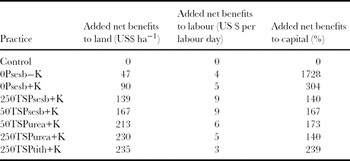
The 250TSPtith + K treatment was nominally the best non-dominated option and had the highest added net benefits of US$ 235 ha−1 (Table 5). However, higher costs associated with this treatment makes 250TSPurea+K more preferable, particularly because most of these costs are for labour, which gives 250TSPtithonia+K the lowest return to labour of any non-dominated treatment. The availability of labour and its cost relative to the value of crops are important considerations because the cutting and carrying of tithonia biomass are labour intensive (Buresh and Niang, Reference Buresh and Niang1997; Palm et al., Reference Palm, Myers, Nandwa, Buresh, Sanchez and Calhoun1997).
Added net benefits to land, labour and capital of the non-dominated practices of N and P sources and P rates in western Kenya.

TSP: triple superphosphate.
Sesbania fallow was more profitable than the control (unfertilized maize) by about 90 US$ ha−1, and had positive returns to land, labour and capital (Table 5). This suggests that smallholder farmers with limited resources to buy fertilizers could benefit by growing sesbania fallows as an organic nitrogen source. However, the returns to investment increased considerably with the addition of P (from either TSP or MPR) and with application of K. Compared to tithonia and urea, the return to investments from the sesbania fallows when P and K were added remain low and seem to be limited by inadequate supply of N. Subsequent research needs to determine ways to improve growth and biomass production of short-duration sesbania fallows in sites and conditions similar to those of this study.
Sensitivity analyses
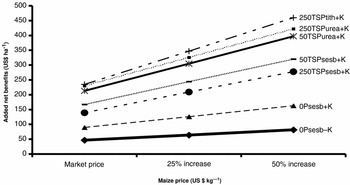
While fertilizer prices in Africa more than doubled in the 1990s, the price of maize remained static or increased only slowly (Jayne et al., Reference Jayne, Govereh, Wanzala and Demeke2003; RATIN, 2008). In the study area, maize prices tend to increase by nearly 50% in the month of June and then stabilize or decrease in August when the first long-rains harvest begins (FEWSNET, 2002). Under conditions of increased maize price, the relative economic attractiveness of the various treatments would increase (Figure 3).
Effect of maize cost on added net benefits of the preferred practices for N and P sources and P rates in western Kenya.

The percentage increase would be highest for 250TSPsesb+K and 250TSPtith+K, in that order. A 25% increase in the value of maize would increase the added net benefits of 250TSPsesb+K by 50% (US$ 139 to 209 ha−1) and those of 250TSPtith+K by 48% (US$ 235 to 347 ha−1). In addition, a 50% increase in the price of maize would double the added net benefits of 250TSPsesb+K (US$ 139 to 278 ha−1) and those of 250TSPtith+K would be increased by 96% (US$ 235 to 460 ha−1). Compared to other practices, the economic attractiveness of 0Psesb-K would remain low even when the price of maize increases by 50% (Figure 3). This is because its maize yield was the lowest among the preferred practices.
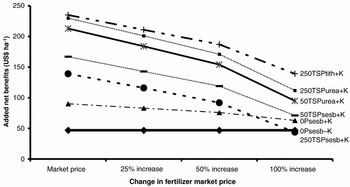
In general, the prices of inorganic fertilizers in African countries (including Kenya) have been increasing since the 1990s because of liberalization of fertilizer markets and removal of government subsidies on farm inputs (Jayne et al., Reference Jayne, Govereh, Wanzala and Demeke2003; Mwaura and Woomer, Reference Mwaura and Woomer1999). The sensitivity analyses conducted (Figure 4) suggests that an increase in the prices of inorganic fertilizers would have negative effects on the added net benefits of all interventions tested. For instance, an increase in fertilizer prices by 50% would reduce the added net benefits of 250TSPsesbania+K, from US$139 to 92 ha−1. An increase of 25% in the fertilizer prices would also reduce the added net benefits of 250TSPsesbania+K by 17%, from US$ 139 to 116 ha−1. A doubling of fertilizer prices would least affect the economic attractiveness of 0Psesb+K but more so that of 250TSPsesbania+K. This is because 0Psesb+K is not a fertilizer intensive practice. The added net benefits of 0Psesb-K would not be affected by an increase in fertilizer prices because it does not have associated fertilizer costs. The added net benefits of 250TSPtith+K would only be reduced by 41% (US$ 235 to 139 ha−1) when fertilizer prices are doubled as compared to 51% reduction in 250TSPurea+K (US$ 230 to 112 ha−1). This is because most of the costs of 250TSPtith+K are associated with labour for cutting and applying tithonia biomass while those of 250TSPurea+K are associated with inorganic fertilizers.
Effect of change in market price of inorganic fertilizers to added net benefits of the preferred practices for N and P sources and P rates in western Kenya.

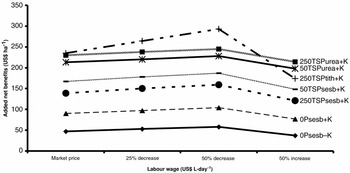
Several studies in western Kenya highlight the importance of considering the benefits of tithonia against the high labour costs involved in its collection and application in the fields (Gachengo et al.,Reference Gachengo, Palm, Jama and Othieno1999; Jama et al., Reference Jama, Palm, Buresh, Niang, Gachengo, Nziguheba and Amadalo2000). The sensitivity analysis conducted revealed that the added net benefits for the preferred practices were strongly influenced by the labour wage rate (Figure 5). Under conditions of reduced labour wage, the relative economic attractiveness of 250TSPtith+K over the other preferred practices would increase. A decrease in labour rate by 25% (US$ 1.08 to 0.81 L-day−1) would increase the added net benefits of 250TSPtith+K by 12% (US$ 235 to 264 ha−1). This decline would increase the added net benefits of 250TSPurea+K by only 3% (US$ 230 to 238 ha−1). A bigger margin of 50% decrease in labour wage (US$ 1.08 to 0.54 L-day−1) would drastically improve the economic attractiveness of 250TSPtith+K (Figure 5). Such a decline would increase the added net benefits of 250TSPtith+K by 25% (US$ 235 to 293 ha−1). In contrast, those of 250TSPurea+K would increase by 7% (US$ 230 to 245 ha−1).
Effect of labour price on added net benefits of the preferred practices for N and P sources and P rates in western Kenya.

Simultaneous increases in the cost of inorganic fertilizers and tithonia, sesbania and maize labour, without an increase in the value of maize would have negative effects on added net benefits of all options considered by between US$ 4 to 77 per hectare (data not presented). It would affect most the 250TSPsesbania+K and 50TSPsesbania+K by reducing their annual net benefits by 40% and 34%, respectively, even if the cost of sesbania seeds is reduced by half. A decline of 50% in the costs of tithonia, sesbania and maize labour and a doubling in the value of maize would result in a large increase in added net benefits even when the costs of inorganic fertilizers increase. This would happen if sesbania fallows were planted for soil fertility improvement and seeds were also extracted from them. This is, indeed, a common practice among farmers in the region.
CONCLUSIONS
This relatively long-term study was conducted at a site with multiple nutrient deficiencies (N, P and K) and provides important insights on various strategies for replenishing fertility of such soils under smallholder farming conditions in Africa. The agronomic benefits of TSP and MPR were similar but TSP had a slight edge over MPR in financial benefits. Both resulted in at least a two-fold maize grain yield increase over the control with no P application. MPR would be an attractive alternative for P replenishment if the costs of transportation to western Kenya could be reduced. Over the five years, the agronomic and economic benefits of the P recapitalization strategies (using either annual maintenance application of 50 kg P ha−1 or a large one-time application of 250 kg P ha−1) were similar and were not influenced by the P sources. The large application rate had a yield advantage over the small annual application one until the third year when the trend was reversed.
Between the N sources, although urea and tithonia had similar net benefits when P was applied, the total cost associated with tithonia was considerably higher. Without P application, sesbania fallow was the most attractive financially. However, it failed to be so with P application, presumably because of inadequate supply of N from the biomass it produced during the 6–7 months period. Sensitivity analysis suggests that the financial attractiveness of the different nutrient sources and combinations was strongly impacted by the price of fertilizers and labour. Labour wage increases affected treatments with tithonia biomass transfer most. The least affected were treatments with sesbania fallows as the N source although their benefits remained low in the absence of P and K application.
Many of these results are general and can be applied to improve the productivity of smallholder maize-based through integrated nutrient management approaches. They highlight the great potential of reactive phosphate rocks such as MPR for direct application in P depleted soils. In the case of MPR, a challenge that needs to be addressed is the high transportation costs from the source (over 800 km) and its dust problems during application. The results also suggest that once P deficiency is overcome, high quality organics such as tithonia and sesbania fallows can provide much of the N needed. They also have the additional benefits of providing K. However, future research needs to identify ways to reduce costs of tithonia application. In case of the fallows, the challenge is producing sufficient biomass and N within a short period in soils of low fertility.
Acknowledgements
We thank Roland Buresh, Pedro Sanchez and Cheryl Palm for their contribution in the design of the trial and James Kinyangi for managing the trial for the most part. We thank Steve Franzel for guidance in economic analyses and Richard Coe for assistance in statistical analyses. We acknowledge the financial support of Swedish International Development Authority (Sida) and the World Agroforestry Centre (ICRAF), Nairobi, Kenya.