Introduction
Seed dispersal is an essential process in plant ecology (Nathan & Muller-Landau Reference Nathan and Muller-Landau2000, Wang & Smith Reference Wang and Smith2002), influencing fitness at the level of the individual and species (Nathan & Muller-Landau Reference Nathan and Muller-Landau2000). At the community level, dispersal underpins patterns of spatial recruitment (Howe & Miriti Reference Howe and Miriti2000, Seidler & Plotkin Reference Seidler and Plotkin2006), strongly influencing the trajectory of species composition across generations. Factors affecting seed dispersal are numerous, including diaspore (i.e. unit of dispersal – seed or fruit) type, size and seed disperser guild (Tamme et al. Reference Tamme, Götzenberger, Zobel, Bullock, Hooftman, Kaasik and Pärtel2014, Vittoz & Engler Reference Vittoz and Engler2007). In tropical forests the majority of woody plant species have fleshy fruits adapted for dispersal by a range of generalist frugivores (Van Schaik et al. Reference Van Schaik, Terborgh and Wright1993), thus dispersal is often non-precise, with seeds being scattered and landing in sites not necessarily optimal for germination and establishment (Wenny Reference Wenny2001). Therefore, despite trees often producing fruit crops far in excess of what frugivores can consume (an adaptation to attract frugivores), the majority of species suffer severe dispersal limitation (Hubbell et al. Reference Hubbell, Foster, O’Brien, Harms, Condit, Wechsler and De Lao1999, Svenning et al. Reference Svenning, Normand and Skov2006). Undispersed fruits fall to the ground where they may suffer predation by animals, or death through intraspecific competition and/or pathogens (Janzen Reference Janzen1970). However, increasing evidence suggests that seeds dispersed into non-optimal habitats or those fallen under the parent tree, are not necessarily destined to such fates. Animals can collect seeds from the ground, move them to different locations and store them for later consumption – e.g. scatterhoarding in caches by rodents (Gómez et al. Reference Gómez, Schupp and Jordano2019) or taken into nests by ants to feed colony members (Pizo & Oliveira Reference Pizo and Oliveira2001). When such seeds are lost or forgotten, they are often in prime locations for germination and establishment (Camargo et al. Reference Camargo, Martins, Feitosa and Christianini2016, Gómez et al. Reference Gómez, Schupp and Jordano2019). Following the pioneering work of Roberts & Heithaus (Reference Roberts and Heithaus1986) on the dispersal of fig seeds by ants, more recent work in the Neotropics has demonstrated the potential for ants to disperse small (<1 g) seeds from non-myrmecochorous diaspores (Passos & Oliveira Reference Passos and Oliveira2002, Pizo & Oliveira Reference Pizo and Oliveira2001) either directly from fallen fruits or by moving seeds first dispersed by birds, into ‘safe’ ant nest sites (Christianini & Oliveira Reference Christianini and Oliveira2010, Passos & Oliveira Reference Passos and Oliveira2002, Reference Passos and Oliveira2004). In this way, ants can alter seed shadows, with potential benefits for seed germination and seedling establishment (Camargo et al. Reference Camargo, Martins, Feitosa and Christianini2016, Christianini & Oliveira Reference Christianini and Oliveira2010). Even if not dispersing seeds, ants may clean seed of fruit pulp where they find them on the ground, which can benefit seed germination (Gallegos et al. Reference Gallegos, Hensen and Schleuning2014, Oliveira et al. Reference Oliveira, Galetti, Pedroni and Morellato1995). These benefits may vary across habitats such as forests and savannas (Camargo et al. Reference Camargo, Rodrigues, Piratelli, Oliveira and Christianini2019), and across habitat edge boundaries (Christianini & Oliveira Reference Christianini and Oliveira2013, Gallegos et al. Reference Gallegos, Hensen and Schleuning2014). While seed dispersal by large ants is often reduced in disturbed sites (Leal et al. Reference Leal, Andersen and Leal2014), small ants may still have a positive impact on regeneration of some species in sites disturbed or under restoration (Gallegos et al. Reference Gallegos, Hensen and Schleuning2014, Zwiener et al. Reference Zwiener, Bihn and Marques2012). The participation of ants in interactions with fruits/seeds seems pervasive at community level (Christianini et al. Reference Christianini, Mayhé-Nunes and Oliveira2012), and benefits are often asymmetric between interaction partners (Giladi Reference Giladi2006, Warren & Giladi Reference Warren and Giladi2014).
While lowland tropical forests are known to harbour high ant diversity and abundance (Guénard et al. Reference Guénard, Weiser and Dunn2012) with many species interacting with fruits and seeds (Holldobler & Wilson 1990), so that their role in seed dispersal is not surprising, the extent to which ants interact with seeds in tropical montane forests, where ants are less diverse and abundant (Bruhl et al. Reference Bruhl, Mohamed and Linsenmair1999, Dunn et al. Reference Dunn, Agosti, Andersen, Arnan, Bruhl, Cerdá and Sanders2009, Sabu et al. Reference Sabu, Shiju, Vinod and Nithya2011), is unclear. However, the fact that a higher relative frequency of tropical montane forest species produce small, bird-dispersed fleshy fruits than lowland tropical forest species (Chapman et al. Reference Chapman, Cordeiro, Dutton, Wenny, Kitamura, Kaplin and Lawes2016) suggests that ants may play a role in seed dispersal after seeds reach the ground and may contribute to plant fitness. To answer this question, here we investigate for the first time, the nature of ant–diaspore interactions in a West African montane landscape. As this is the first study of its kind in this locale, we first identified all ant species we found interacting with diaspores (Agaldo Reference Agaldo2017). Then, based on findings from previous studies elsewhere, we tested four hypotheses:
-
(i) Ants will interact with non-myrmecochorous diaspore species (Christianini et al. Reference Christianini, Mayhé-Nunes and Oliveira2012, Kaspari Reference Kaspari1993, Levey & Byrne Reference Levey and Byrne1993, Pizo & Oliveira Reference Pizo and Oliveira1998) by moving and cleaning.
-
(ii) Ants will clean the flesh of some diaspore species which will enhance seed germination and seedling establishment (Christianini et al. Reference Christianini, Mayhé-Nunes and Oliveira2007, Leal et al. Reference Leal, Wirth and Tabarelli2007, Oliveira et al. Reference Oliveira, Galetti, Pedroni and Morellato1995).
-
(iii) Different communities of ants associated with grasslands, edge habitat and core forest will lead to different dispersal distances in the three habitats (Leal et al. Reference Leal, Andersen and Leal2014, Zelikova & Breed Reference Zelikova and Breed2008).
-
(iv) A relatively large number of ant species will move a relatively small number of diaspore species (Christianini et al. Reference Christianini, Mayhé-Nunes and Oliveira2012, Passos & Oliveira Reference Passos and Oliveira2003, Zwiener et al. Reference Zwiener, Bihn and Marques2012).
Methods
Study area
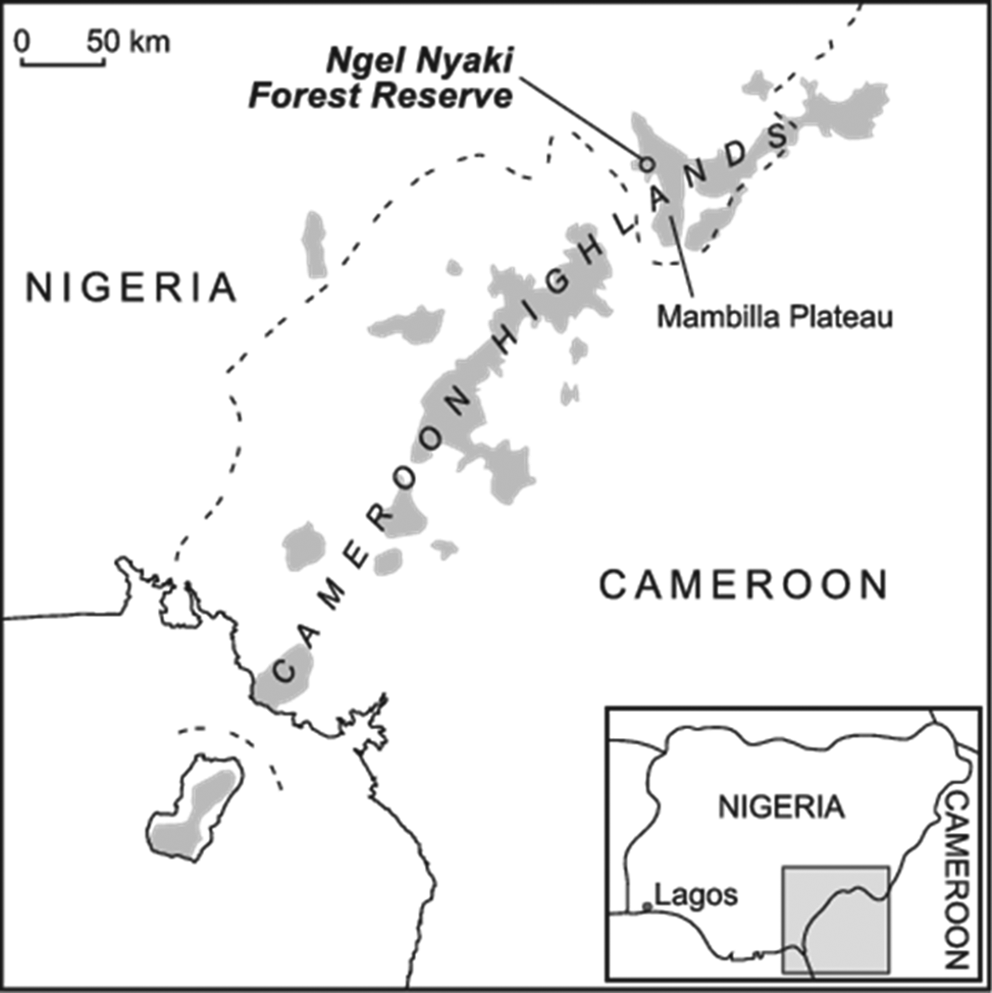
Our study area, Ngel Nyaki Forest Reserve (NNFR) (7.08°N, 11.12°E; Figure 1), is situated in the mountains of Taraba State, Nigeria between 1400–1600 m in elevation (Barnes & Chapman Reference Barnes and Chapman2014, Chapman Reference Chapman2008), with a distinct dry (November–March) and wet season (April–October) (Matthesius et al. Reference Matthesius, Chapman and Kelly2011). The 46 km2 reserve is a mosaic of grassland and forest; there is a 5.2 km2 patch of submontane escarpment forest and small, degraded riparian forest fragments embedded within a matrix of heavily overgrazed Sporobolus pyramidalis grassland (Barnes & Chapman Reference Barnes and Chapman2014, Chapman Reference Chapman2008). The forest has a sharp boundary with the grassland, but when protected from grazing and fire the grasslands become more diverse with increased grass species and woody shrubs (Barnes & Chapman Reference Barnes and Chapman2014). The escarpment forest has a diverse plant and animal community (Beck & Chapman Reference Beck and Chapman2008, Chapman et al. Reference Chapman, Chapman and Chapman2001). There are at least 17 ant morpho species in the area, dominated by an unidentified Pheidole sp. and Myrmicaria opaciventris (Agaldo unpubl. data).
Map of Ngel Nyaki Forest Reserve showing location of study sites. Adapted from Google Maps.

Study design
Because our main aim was to investigate the most common ant–plant interactions, rather than create an exhaustive list of ant species, we used a combination of different sampling methods including active searches (reconnaissance surveys) and baiting methods (removal experiments) as recommended by Agosti et al. (Reference Agosti, Majer, Alonso and Schultz2000). We based our investigations in three sites within NNFR (Figure 1). Sites, at least 0.5 km apart, comprised three habitats: core escarpment forest (hereafter referred to as forest), forest edge (edge) and grassland. Following Gallegos et al. (Reference Gallegos, Hensen and Schleuning2014), at each site we ran two transects separated by a distance of 20 m, each 320 m long, from the core forest, across forest edge and 160 m into the grassland. Observations and experiments were conducted between June 2015 and September 2017.
Reconnaissance surveys
Our reconnaissance surveys involved walking each transect once a month between June and September 2015. Walks were taken between 0730 h – 1300 h, the hours we found ants to be most active, and involved moving at a slow pace (~1 km/h) while searching on the ground ~2 metres on either side of the transect for ant–diaspore interactions. For every interaction observed we recorded interaction type (cleaning/removing tissue on the surface or moving), ant species and plant species (Passos & Oliveira Reference Passos and Oliveira2003). We collected samples of each ant species and stored them in 70% ethanol for later identification using the taxonomic keys of Bolton (Reference Bolton1994). Ant identifications were checked and confirmed by an expert ant taxonomist at Universidade Federal do Paraná, Brazil.
Removal experiments
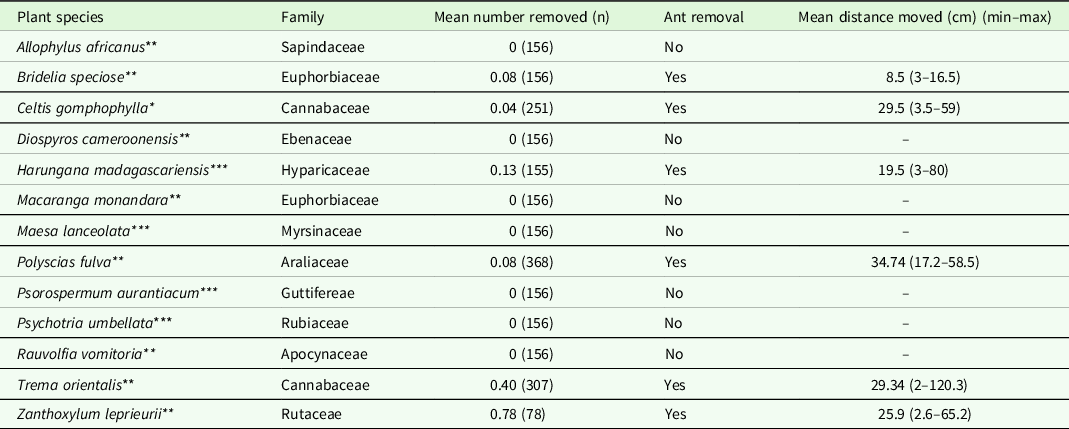
To determine the types of diaspore moved and to what distances, we carried out removal experiments following the methods and sampling intensity of Christianini et al. (Reference Christianini, Mayhé-Nunes and Oliveira2007, Reference Christianini, Mayhé-Nunes and Oliveira2012). First, we collected fruits from 13 woody plant species with small fruit weighing ≤1 g, a weight realistically moved by ants (Pizo & Oliveira Reference Pizo and Oliveira2001). The number of diaspore species we used was limited by the availability of species fruiting at the time of the experiments (Table 1). For each species used in the diaspore removal experiments, we collected fruits from five individual parent trees and removed the seeds from a random sample of these fruits (for seeds used in the experiment), washed the seeds to remove any fruit pulp or fleshy appendage and sun-dried them for 1 h (Roberts & Heithaus Reference Roberts and Heithaus1986). This was done to mimic seed conditions after regurgitation by birds.
Plant species used for diaspore removal experiment in Ngel Nyaki Forest Reserve.

*Core forest tree; **Forest edge/grassland pioneer tree; ***Grassland shrub/tree.
In each experiment we established 13 depots on the ground, 1 m away from the transects described above. Depots comprised a piece of white filter paper (Pizo & Oliveira Reference Pizo and Oliveira2001) on which we placed two fruits and two seeds of the same species. We placed the depots at 5 m, 10 m, 20 m, 40 m, 80 m and 160 m from the forest edge in both directions (i.e. into grassland and forest). Two of us, positioned at least 0.5 m on either side of each depot, recorded every ant–diaspore interaction over a 15 min period. We recorded interactions as: (1) removed diaspore to the nest, (2) consumed diaspore on the spot, (3) no removal/interaction.
We followed all ants that removed diaspores from the point of interaction at the depot to where they deposited or dropped the diaspore and measured the distance to the nearest cm. Experiments were again carried out between 0730 h and 1300 h (Agaldo J. pers obs).
Seed cleaning
Paullinia pinnata (Sapindaceae), widespread across Africa (Zamble et al. Reference Zamble, Carpentier, Kandoussi, Sahpaz, Petrault, Ouk and Martin-Nizard2006), is a common woody vine of NNFR forest edge (Chapman et al. Reference Chapman, Chapman and Chapman2001). Its fruits, 25 mm (± 3) long and (20 ± 2 mm) wide are red when ripe, containing 2–3 seeds 13.5 (± 2) mm long and 7 mm (± 2) wide (NMFP fruit trait data), covered in a dense white aril (Weckerle & Rutishauser Reference Weckerle and Rutishauser2005). When the fruits ripen, the seeds are dispersed by primates and birds (Mascaro et al. Reference Mascaro, Schnitzer and Carson2004).
We knew from initial observations that the P. pinnata aril attracted two common ant species, Pheidole sp. 1 and Mymicaria opaciventris. To determine the rate at which these ants remove the aril and cleaned P. pinnata seeds, we carried out a 5-day experiment, again, based on seed depots. The depots comprised white filter paper, but this time each depot was protected with a mesh cage (0.5 × 0.5 cm mesh) placed over the filter paper and pinned to the ground to exclude large invertebrates and vertebrates. We placed one seed of P. pinnata in each depot. Because P. pinnata is a forest edge species, we placed depots in edge habitat. Our first depot was placed under the outermost canopy tree (0 m), with four more depots at 10 m intervals to 40 m into the forest. We added the seeds to the depots at 0730 h and observed the ant seed cleaning activity on days 1, 2, 3 and 5 at 0730 h. During each observation period, we recorded ant species and number of ants cleaning seeds. We visually assessed the amount of seed appendage removed (‘cleaned’) by ants and grouped the seeds into one of three categories (Pizo & Oliveira Reference Pizo and Oliveira1998): (i) Intact seeds – seeds to which ants paid no attention and had 0% of its aril missing; (ii) still being cleaned – seeds that had between 1–75% of aril missing; and (iii) cleaned – seeds that had between 76–100% of the aril removed by ants.
The effect of ant cleaning
To determine whether seed ‘cleaning’ affects the germination rate and/or seedling biomass of P. pinnata, we designed an experiment to compare: (i) days to emergence of the radicle, (ii) seedling growth rate, (iii) seedling total fresh biomass between intact and cleaned seeds.
During the wet season (July and August 2016), we collected 36 seeds from below five P. pinnata parent plants, making sure all the seeds had been dispersed through ballistic expulsion and were free of any observable insect attack. From these seeds we created two treatments: (i) intact seeds, as they were when collected from the forest floor and (ii) thoroughly cleaned seed, prepared by manually removing all of the aril. We sowed the seeds 5 cm deep into separate 6-litre, black polythene ‘pots’ filled with regular commercial compost. Pots were placed in the plant nursery in a blocked design at the NMFP and checked for germination and growth (measured with a mm tape measure) every 10 days over a period of 40 days. Sixty days after planting, we counted the number of leaves on germinated seedlings in each treatment and the length of each shoot. Following this, we harvested the shoots and roots, measured root lengths and weighed the shoots and roots separately.
Data analysis
We analysed all data using R version 3.2.4 with lme4 and car packages. For all analysis, we considered a P-value less than 0.05 as significant.
Spatial and temporal variation in ant diaspore removal
We used a generalized linear mixed-effect model (GLMM) with a binomial error distribution to assess spatial and temporal variations in ant diaspore removal. The response variable was a combination of diaspore ‘removed’ and ‘not removed’, while independent variables were fixed effects which included ‘habitat’, ‘season – wet and dry’, ‘ant species’, ‘plant species’ and their two-way interactions. The random effects included in the models were ‘transect ID’, ‘site’ and ‘depot ID’.
Effect of ant species and plant species on diaspore removal distance
We used a GLMM with Poisson error distribution to assess how the different ant and plant species affected diaspore removal distance. The response variable was the distance moved and the independent variables were the fixed effects which included ‘ant species’, ‘plant species’ and their interactions. Random effects were ‘transect ID’, ‘depot’ and ‘observation ID’. We compared all models using one-way ANOVA and removed factors with the least significant effects. Akaike Information Criteria (AIC) were used to choose the best-fit model (Crawley Reference Crawley2002, Symonds & Moussalli Reference Symonds and Moussalli2011). When models were not significantly different, we chose the one with the fewest factors as the best-fit model. We used the blmeco package in R for model validation by checking for overdispersion. An observational-level random effect was included in models to account for overdispersion (Harrison Reference Harrison2014).
Seed cleaning rate of Paullinia pinnata
We summarized our census based on the three seed categories (intact seeds, still being cleaned, or cleaned) and used an independent t-test to test the difference in the numbers of Pheidole. sp. 1 and M. opaciventris cleaning diaspores of P. pinnata.
Effect of seed cleaning on Paullinia pinnata germination and seedling growth
We used the G-test of independence to determine if there was a significant difference in the proportion of cleaned versus intact diaspores that germinated. Shoot length, root length, number of leaves and fresh weight of seedlings from intact and cleaned seeds were compared using the unpaired Wilcoxon–Mann–Whitney test.
Results
Ant–diaspore interactions
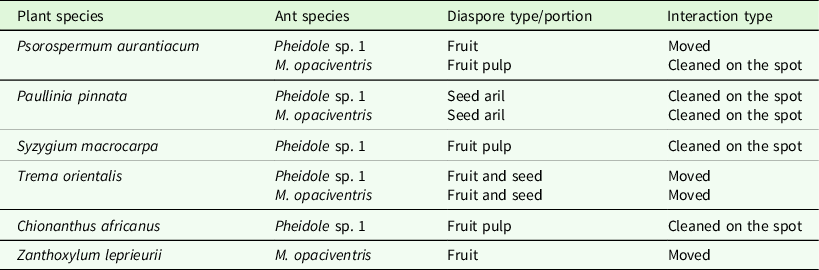
Our 16 h of walking transects yielded 18 ant–diaspore encounters. Two ant species, Myrmicaria opaciventris and Pheidole sp. 1 (both Myrmicinae), interacted with diaspores from six plant species (Table 2). Interactions included moving fruits or seeds, cleaning fleshy pulp from fruits and foraging on seed appendages such as the arils of P. pinnata.
Opportunistic ant–diaspore interactions recorded during reconnaissance survey in Ngel Nyaki Forest Reserve.

Spatial and temporal variation in diaspore removal
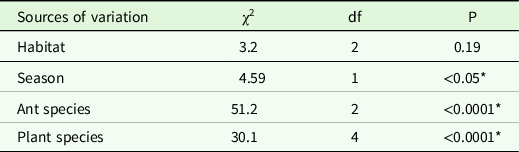
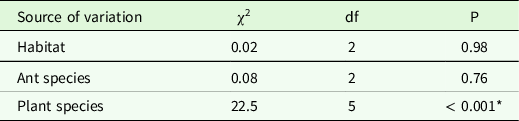
Nineteen per cent (250) of the 1315 diaspores used in the removal experiment were removed by ants. While habitat (grassland, edge or forest) did not affect diaspore removal, season and plant species had significant effects (Table 3). Ants removed more diaspores of Zanthoxylum leprieurii and Trema orientalis than those of Bridelia speciosa, Celtis gomphophylla, Polyscias fulva and Harungana madagascariensis (Table 1). The mean frequency of diaspore removal was higher during the wet season (0.29 ± 0.02, mean ± SE) than the dry season (0.06 ± 0.01).
Results of the generalized linear mixed model with binomial distribution showing the effect of habitat, season, ant species and plant species on diaspore removal. Significance is denoted by an asterisk at P ≤ 0.05.

Results of the generalized linear mixed model with Poisson distribution showing the effect of habitat, ant species and plant species on diaspore removal distance. Significance is denoted by an asterisk at P ≤ 0.05.

Effect of ant and plant species on removal distance
Seventy per cent of the diaspores we observed being moved by ants were ‘lost’ beneath leaf litter and we were unable to follow them further. However, we were able to follow the remaining 30% (75 interactions) all the way into ant nests. Of these, removal distance did not differ across habitats or between ant species but was highly variable within and among plant species. Dispersal distances ranged from 2 cm to 1.24 m with a mean of 28.6 cm, and median of 24 cm (Table 1).
Pheidole sp. 1 was responsible for the majority of all diaspore removals (74%) and M. opaciventris 26%. Of the diaspores moved by Pheidole sp. 1, we observed 36% being moved into ant nests with the remaining 64% being lost from view under leaf litter. Only 12% of diaspores moved by M. opaciventris were followed until the nests, while 88% disappeared into leaf litter.
Seed cleaning rate of P. pinnata
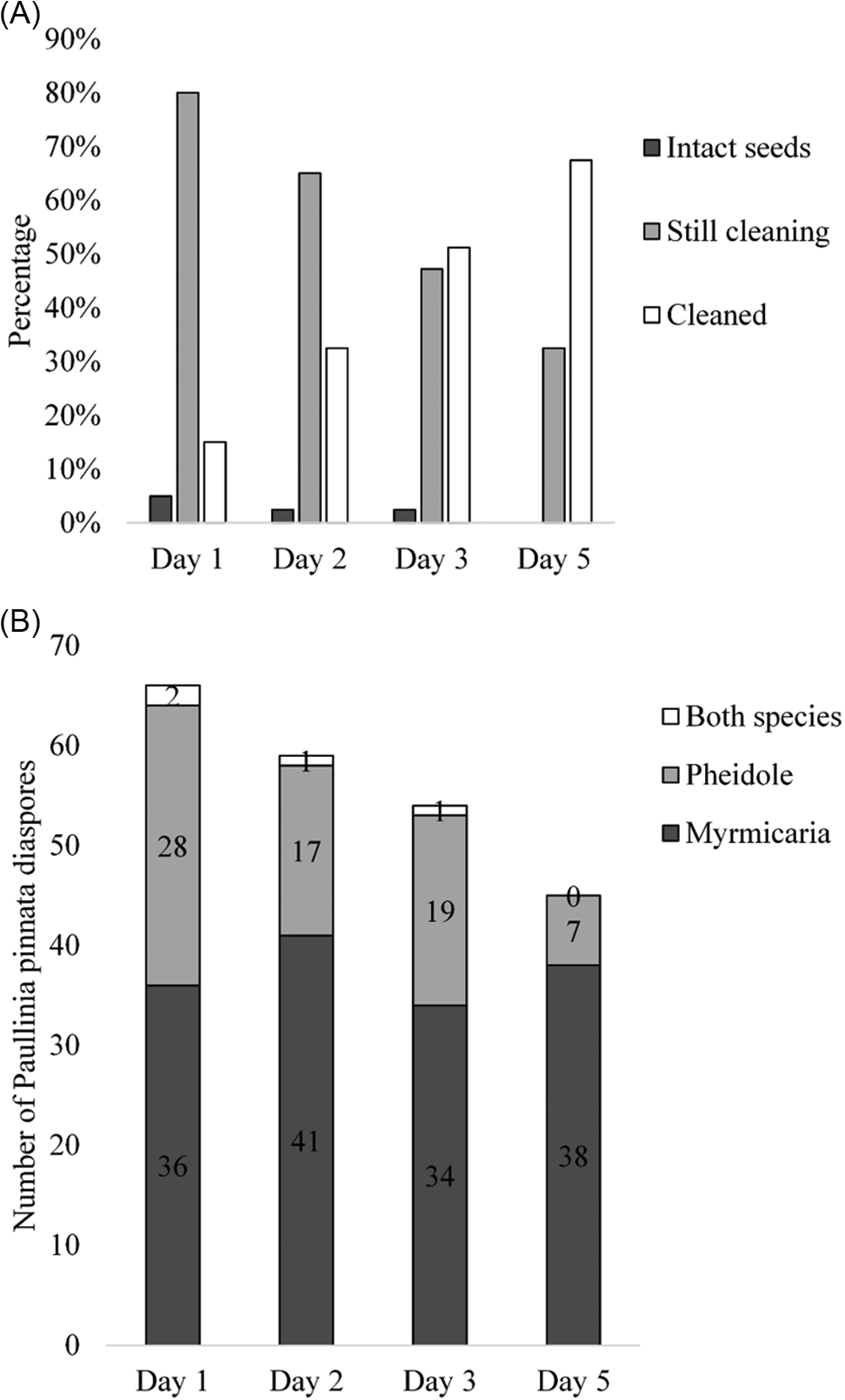
The proportion of seeds cleaned by ants versus those left alone or only partly cleaned after days 1, 2, 3 and 5 of the experiment, are summarized in Figure 2. We found a significant difference between the two ant species (Pheidole sp. 1 and M. opaciventris) in the number of ants cleaning seeds (t = 4.27, df = 6, P <0.005) with a mean of 37.35 ± 1.49 (mean ± SE) for M. opaciventris and 17.75 ± 4.31 for Pheidole sp. 1 (Figure 3). We never observed the two ant species visiting diaspores at the same time.
(A) Seed cleaning rates of Paullinia pinnata by ants, over a 5-day period (number of seeds = 80). (B) Ant species attendance to diaspores of Paullinia pinnata over 5 days. Labels on bars indicate number of depots where Pheidole sp. 1 and Myrmicaria attended seeds either separately or together.

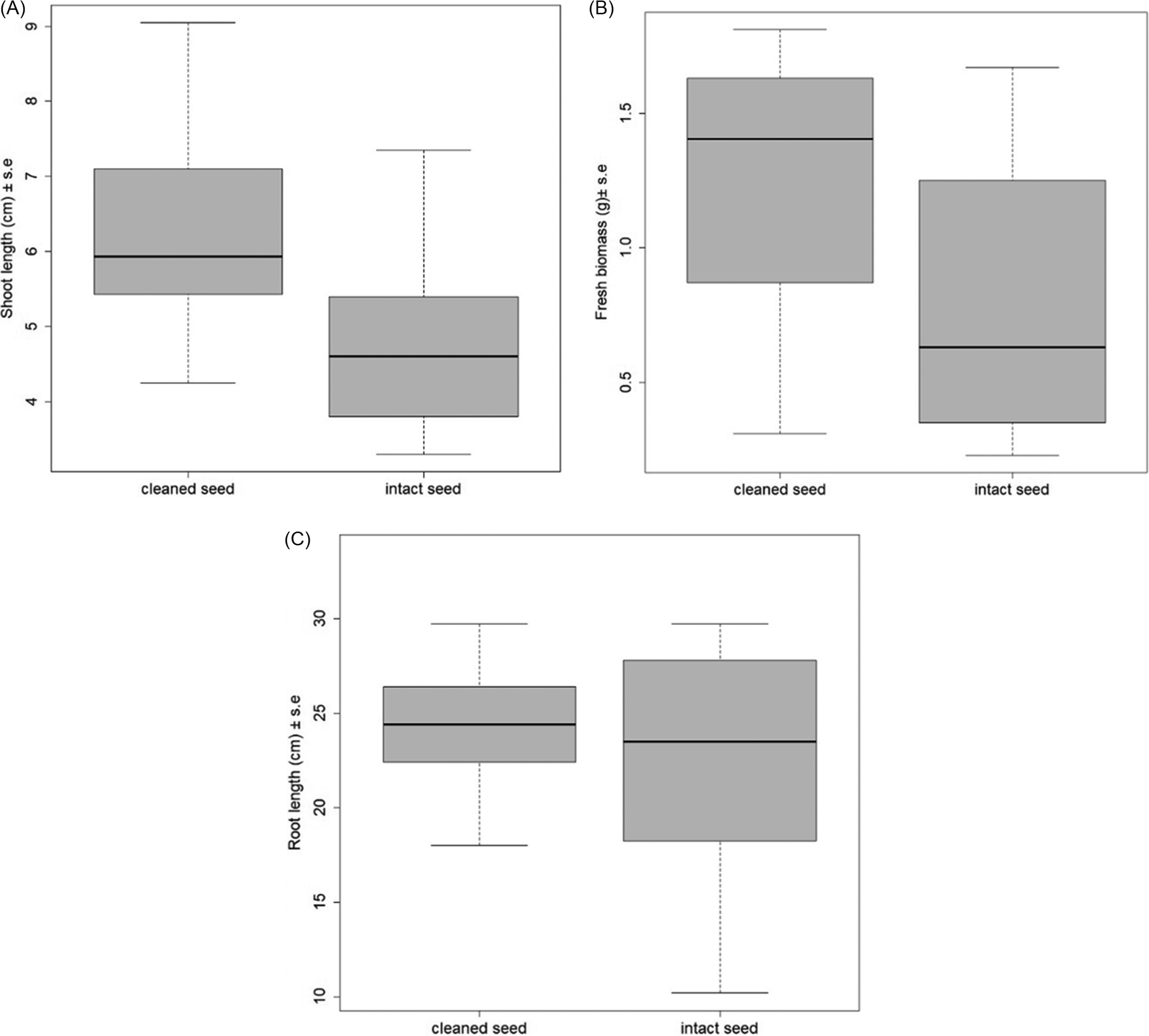
(A) shoot length (cm), (B) wet weight (g) and (C) root length (cm) of seedlings from cleaned and intact seeds of P. pinnata (n = 18 for cleaned seeds, n = 18 for intact seeds). Boxes indicate median and quartiles, with bar limits depicting upper and lower ranges.

Effect of cleaning on the growth of P. pinnata seedlings
Overall, our results suggest that cleaning has a positive effect on seed germination and seedling growth. Shoots from cleaned seeds were on average longer (6.17 ± 0.28 cm, mean ± SE) than intact seeds (4.71 ± 0.26 cm) (W = 270, P <0.001) (Figure 3). Seedlings from cleaned seeds produced more leaves (W = 217.5, P <0.05) and had a higher mean fresh weight (W = 157.5, P = 0.02) than those from intact seeds. Mean fresh weight of seedlings from cleaned seeds was 1.21 ±0.14 g against 0.78 ± 0.13 g from intact seeds. In contrast, the root lengths of seedlings from intact (22 ± 1.66 cm) and cleaned seeds (24.3 ± 1.22 cm) did not differ significantly (t = 0.89, df = 25.3, P = 0.37) (Figure 3).
Discussion
Ant–diaspore interactions
Based on a combination of active searches and depot experiments across three habitats we found only two ant species interacting with 10 non-myrmecochorous diaspore species in ways which may enhance plant fitness: a novel finding with important potential implications for plant regeneration in African forests. Out of 17 species of ground-dwelling ants recorded in NNFR (Agaldo 2018), we observed the small-bodied species Pheidole sp. 1 and Myrmicaria opaciventris (both Myrmicinae), interacting with diaspores of small seeded woody plant species from across the forest. These findings support our first hypothesis based on reports from the Neotropics, that ants may interact in positive ways with non-myrmecochorous diaspores and potentially influence seed fate (Christianini et al. Reference Christianini, Mayhé-Nunes and Oliveira2012, Kaspari Reference Kaspari1993, Levey & Byrne Reference Levey and Byrne1993, Passos & Oliveira Reference Passos and Oliveira2002, Pizo & Oliveira Reference Pizo and Oliveira1998).
Different ant species can have very different interactions with diaspores, with major implications for plant distribution (Magalhães et al. Reference Magalhães, Espírito Santo, Salles, Soares and Oliveira2018). While both ant species we found interacting with diaspores in our study area are small bodied and short ranging, characteristics of the Myrmicinae (Andersen Reference Andersen1995), some of their behaviours differed in ways which could potentially influence plant fitness. Arguably most important is foraging guild – both ant genera include generalist omnivores (Hölldobler & Wilson Reference Hölldobler and Wilson1990), but their diets differ. Pheidole species are granivorous (Levey & Byrne Reference Levey and Byrne1993, O’Dowd & Gill Reference O’Dowd and Gill1984, Pirk et al. Reference Pirk, Di Pasquo and de Casenave2009) and therefore seed predators. In contrast, M. opaciventris feeds on insects and honeydew (Kenne & Dejean Reference Kenne and Dejean1997), with our study being the first to report M. opaciventris interacting with plant diaspores. Another difference is in propensity to move, versus clean, diaspores. Pheidole sp. 1 moved more diaspores from our depots (75%), while M. opaciventris did more seed cleaning on the spot (67%). Moreover Pheidole sp. 1 was responsible for all the distances moved > 1 m and was the only species we observed recruiting to help move seeds. Other species in the genus Pheidole are known to disperse seeds short (< 50 cm) distances (Andersen Reference Andersen1995, Thomson et al. Reference Thomson, Auld, Ramp and Kingsford2016, Zelikova & Breed Reference Zelikova and Breed2008), but Pheidole fallax in dry Costa Rican forests recruits to move seeds greater distances, up to 3 m (Zelikova & Breed Reference Zelikova and Breed2008).
Seed dispersal
We found 19% of diaspores, comprising six of the 13 diaspore species included in the experiment, were moved from depots within 15 min. Fast removal of plant diaspores from the soil surface may decrease seed exposure to predators and enhance plant fitness (Christian Reference Christian2001, Thomson et al. Reference Thomson, Auld, Ramp and Kingsford2016). However, given that the small fruits of Psorospermum aurantiacum were not moved in the experiments, but were seen being moved during the reconnaissance survey, suggests that given greater sampling intensity, more of the 13 species presented may be moved. All diaspores which were moved weighed ≤0.24 g, and mostly comprised fruits and seeds of forest edge/grassland pioneer species (e.g. Polyscias fulva and Trema orientalis) with only one core forest species, the large canopy tree (Celtis gomphophylla) (Table 1).
The maximum distance we observed a diaspore being moved was 124 cm, with the mean distance being only 24 cm. This is considerably less than the 1.99 m estimated by Gómez & Espadaler (Reference Gómez and Espadaler2013) as the global mean removal distance of myrmecochorous diaspores by ants and the mean of 5 m recorded for non-myrmecochorous diaspores in Neotropical savanna (Christianini et al. Reference Christianini, Mayhé-Nunes and Oliveira2007). It is also less than the 3 m recorded for P. fallax in Costa Rica forest (Zelikova & Breed Reference Zelikova and Breed2008). Such relatively short distances in NNFR are not unsurprising, since small ants tend to move diaspores shorter distances than large-bodied ants (Andersen Reference Andersen1988, Gómez & Espadaler Reference Gómez and Espadaler2013, Ness et al. Reference Ness, Bronstein, Andersen and Holland2004). Both density and distribution of ant nests affect foraging (Andersen Reference Andersen1988). While we did not measure nest density during this study, the fact that we observed ants moving diaspores to nest locations not far from experimental depots does suggest that nests may be abundant. Abundant food sources can also decrease the foraging distances of ants by reducing home ranges (Bernstein Reference Bernstein1975). However, as seed production tends to be limited in montane relative to lowland sites (Chapman et al. Reference Chapman, Cordeiro, Dutton, Wenny, Kitamura, Kaplin and Lawes2016) this argument needs further testing. Whatever the reason, and even with the possibility that we missed rare longer distance events, dispersal distances are short in this montane habitat, which may make it unlikely that ants help seeds escape intra-specific, negative density-dependent mortality (Connell Reference Connell1971, Janzen Reference Janzen1970) and gain associated benefits (Andersen Reference Andersen1988, Cain et al. Reference Cain, Milligan and Strand2000, Gallegos et al. Reference Gallegos, Hensen and Schleuning2014). It is worth noting that in Afromontane forests, tree species tend to show more local clumping than in lowland tropical forests (Abiem et al. Reference Abiem, Arellano, Kenfack and Chapman2020, Matthesius Reference Matthesius2006) and Janzen–Connell effects may not be as pervasive (Matthesius et al. Reference Matthesius, Chapman and Kelly2011). With short-distance movement of diaspores into ‘safe sites’ such as ant nests, the probability of germination and establishment may increase (Farji-Brener & Werenkraut Reference Farji‐Brener and Werenkraut2017). Thus, even short distance movement may be important, as ant nests or even leaf litter can afford seeds protection from desiccation (Giladi Reference Giladi2006) and predators (Gorb & Gorb Reference Gorb and Gorb2003, Passos & Oliveira, Reference Passos and Oliveira2004). Rapid ant diaspore removal may reduce diaspore loss to vertebrate predators (Thomson et al. Reference Thomson, Auld, Ramp and Kingsford2016). We found some evidence of this from recording the fate of Trema orientalis seeds moved by ants from the depots and deposited into their nests; after 4 months T. orientalis seedlings were observed growing out of seven of 21 nests (J.A. Agaldo, pers. obs. and unpubl. data). Levey & Byrne (Reference Levey and Byrne1993) show that Pheidole sp. can play a dual role as both seed disperser and predator. From our study, although Pheidole was observed moving diaspores, we were not able to determine if it was acting as a predator or a disperser. Seedlings of T. orientalis that we observed growing in nests were seen in nests of M. opaciventris. Of course, the fate of these seedlings is what matters, and we have no data on the proportion of these seedlings recruited into the next generation, which is a critical question. Overall, our study demonstrates that ants do move a range of small diaspores over short distances and into safe sites. But to what extent ants in this montane ecosystem affect plant fitness remains unclear, and long-term experimentation will be needed to answer this question.
Seed cleaning
From our reconnaissance survey we found that both Pheidole sp. 1 and M. opaciventris cleaned seeds. Our hypothesis that ants will clean seeds and thus enhance germination and seedling growth rate was supported in our experiment with Paullinia pinnata. We found cleaned P. pinnata seeds germinated at a faster rate than uncleaned diaspores and their seedlings were larger, gaining more fresh weight. Larger seedlings tend to show higher resistance to environmental stressors such as herbivory, trampling and desiccation than small seedlings, which is linked to higher early survival (Moles & Westoby Reference Moles and Westoby2004, Verdú & Traveset, Reference Verdú and Traveset2005) and, of relevance to NNFR, may be important in increasing resistance to seasonal variability in moisture (Orrock & Christopher Reference Orrock and Christopher2010). Faster germinating diaspores are also more likely to avoid seed predation because of the limited period of exposure to granivores (Bowers & Dooley Reference Bowers and Dooley1993, Christianini et al. Reference Christianini, Mayhé-Nunes and Oliveira2007). In addition to P. pinnata we observed ants cleaning diaspores of Psorospermum aurantiacum, Syzygium macrocarpa and Chionanthus africanus. It will be important to determine the extent this cleaning aids in seedling recruitment of these species as well.
Different habitats
We found no support for our hypothesis that ant–diaspore interactions would vary among habitats (grassland, edge and forest) (Table 4). While studies elsewhere have shown that removal rates and dispersal distance tend to be modified with disturbance (Christianini & Oliveira Reference Christianini and Oliveira2013, Gallegos et al. Reference Gallegos, Hensen and Schleuning2014, Leal et al. Reference Leal, Andersen and Leal2014), we found no variation across habitats despite the fact that both forest edge and grassland, in contrast to core forest, are highly disturbed. This is most likely because assemblage composition strongly impacts dispersal distances (Palfi et al. Reference Palfi, Spooner and Robinson2017), and in our study the same two small-bodied myrmicinae species are moving seeds across all three habitats. These two ants are the most abundant species in NNFR (J.A. Agaldo, unpubl. data) and it is also possible that they are resilient to disturbances. Indeed, some ant species can persist and interact with diaspores in simplified and disturbed environments (Raimundo et al. Reference Raimundo, Guimaraes, Almeida-Neto and Pizo2004). Myrmicaria opaciventris has been found to occur in and forage in highly altered landscapes such as agricultural fields (Kenne & Dejean Reference Kenne and Dejean1999).
Asymmetrical interactions
Our findings differ significantly from Neotropical reports in the number of ant vs diaspore species involved in the network, so that our final hypothesis was unsupported. For example, while we found only two ant species (Pheidole sp. 1 and M. opaciventris) interacting with 10 diaspore species, Passos & Oliveira (Reference Passos and Oliveira2003) reported 41 ant species interacting with diaspores of 56 plant species in the Brazilian lowland Atlantic forest. One explanation for this difference may be the relatively low ant species richness and diversity recorded at Ngel Nyaki compared with neotropical forests, which contain some of the most diverse ant assemblages on Earth (Guénard et al. Reference Guénard, Weiser and Dunn2012). The smaller number of ant species interacting with fruits may also be due to the pattern of decreasing ant species richness with elevation (Smith et al. Reference Smith, Lau, Jacobs, Monroy, Shuster and Whitham2015), since NNFR is at a higher altitude than the sites where other studies were performed. Notwithstanding, our findings support the hypothesis that interactions between ants and diaspores are diffuse and asymmetrical (Warren & Giladi Reference Warren and Giladi2014).
Limitations
Given our limited sampling and the opportunistic nature of the interactions, increased observation hours and increasing the number of diaspore species used in depot experiments would inevitably increase the diversity of plant species in the interactions we observed. However, we designed our sampling to capture the most common ant–plant interactions and we are confident we have done this. While there is no comparable study elsewhere from African forests to establish comparisons, a similar study of the number of ant species recorded in interactions with true myrmecochorous seeds of Proteaceae in Fynbos shrublands in South Africa indicated that only two ant species performed the bulk (70%) of ant–seed interactions (Christian Reference Christian2001). Indeed, it is not uncommon for a small subset of the ant community to dominate the interactions with seeds at a given site (Gove et al. Reference Gove, Majer and Dunn2007, Warren & Giladi Reference Warren and Giladi2014).
Conclusion
Our study suggests that ants are unlikely to play a major role in the dispersal of non-myrmecochorous diaspores in Afromontane forests, although the significance of movement into safe sites such as nests needs further investigation. By seed cleaning, ants may enhance germination and seedling growth rates in some species, especially those from the forest edge and grassland. Further investigations are essential to expand our findings, since benefits to plants from ant–diaspore interactions can be subtle but nevertheless important to plant fitness (Camargo et al. Reference Camargo, Martins, Feitosa and Christianini2016). Irrespective, seed shadows and spatial patterns of seedling recruitment within the reserve may be altered through the removal of diaspores by ants (Zelikova Reference Zelikova2008), with implications for forest structure.
Based on our findings, we suggest that generalist, opportunistic ant interactions with non-myrmecochorous diaspores will probably be found across the Afrotropics, with more species interacting in lowland than montane forest habitats. It is possible that in Afromontane habitats, diaspore cleaning leading to reduced seed mortality and increased germination may be the more beneficial interaction for non-myrmecochorous diaspores. Given the pervasive reduction in populations of vertebrate frugivores due to habitat loss and hunting that cascades to decreasing seed removal and dispersal distances from parental plants (e.g. Cordeiro & Howe Reference Cordeiro and Howe2003), we believe ants may play an increasing role in seed germination and seedling fate of non-myrmecochorous diaspores in African tropical forests.
Acknowledgements
Retired General TY Danjuma for funding, staff of Nigeria Montane Forest Project for support during fieldwork, Musa Bawuro (RIP) and Thomas, Godson Dangu and Hannah Samuel our field assistants. Dr Shola Olaniyan (Lincoln University New Zealand) and Dr Rodrigo M. Feitosa (Universidade Federal do Paraná, Brazil) for help with ant identifications.