The abundant literature about institutions regards the postwar trade regime as its ‘beau ideal’ (Goldstein et al., Reference Goldstein, Rivers and Tomz2007b: 38). Yet, it was only six years ago that Andrew Rose published the first systematic empirical analysis of its effects. Contravening conventional wisdom, he found that the General Agreement on Tariffs and Trade (GATT) and its successor, the World Trade Organization (WTO), did not exert any significant impact on trade (2004).
Several empirical studies of the regime quickly followed. Joanne Gowa and Soo Yeon Kim (Reference Gowa and Kim2005) report that the GATT exerted a positive and significant impact on trade only between its largest industrial-country members. Arvind Subramanian and Shang-Jin Wei (Reference Subramanian and Wei2007) find that the regime increased the imports of its industrial-country members more generally. Judith Goldstein, Douglas Rivers, and Michael Tomz (2007a, 2007b), expanding Rose's membership roster, show that the GATT/WTO boosts trade between states that acceded to it irrespective of their level of development.
Neither these nor other related papers, however, examine whether the evidence is consistent with the empirical implications of existing theories about international trade institutions.Footnote 1 These theories predict that the impact of a regime is likely to vary across different subsets of its members. They attribute this variation to the political ties and economic attributes that distinguish states, affecting their ability to exploit the benefits regime membership offers. They do not attribute it, however, to the different ways states acceded to the regime, as in Goldstein et al. (Reference Goldstein, Rivers and Tomz2007a, 2007b).
Market-failure theory predicts that trade expansion will be skewed toward the largest member countries, as a regime helps them realize a welfare-improving equilibrium outcome of the Prisoners' Dilemma (PD) game that engages them. A theory based on the politics that an anarchic international system induces implies that the regime will also promote trade between its allied members if at least one of them is a developing country. Alliances encourage trade because they endow their members with a stake in each other's welfare, deterring attempts to shift the terms of trade between them. If an ally is a developing country and its firms must sink costs into dedicated assets in order to export, however increasing intra-alliance trade also requires insurance against the risk of reneging that can accompany waning political–military ties. When a regime supplies this insurance, joint membership in it and in an alliance will increase trade independent of the impact of either alone. For reasons I explain below, industrial countries can self insure against the risk that alliance dissolution creates.
The findings in this paper are consistent with these predictions. The GATT/WTO does indeed exert its strongest impact on trade between its largest member states. As market-failure theory implies, trade also expands to a smaller but still sizeable extent between these states and others with relatively similar factor endowments, consistent with the most-favored nation (MFN) treatment the postwar regime required. Finally, the evidence also conforms to the hypothesis that the regime increases trade when its developing-country members are also members of a political–military alliance. The results here do not, however, support the idea that different routes to membership influence the extent to which the regime affects trade.
Immediately below, I describe briefly the findings of existing studies. Next, I explain the predictions that theories about institutions generate. Finally, I report the results of testing these predictions.
Recent literature
Although no theory predicts that the GATT/WTO will exert uniform effects on its member states, the benchmark analysis in Rose (Reference Rose2004) includes them all in one ‘treatment’ group. He codes states as members if they either joined the organization at its inception or did so thereafter in accord with the accession protocol in effect when they joined. He uses a gravity model, the industry standard, to estimate the effect of regime membership on bilateral trade flows between 1950 and 1999. Including a series of potentially confounding covariates, he finds that membership in the postwar trade regime ‘is not associated with enhanced trade’ (2004: 98, emphasis original). A wide-ranging series of robustness tests, including some that disaggregate member states, does not persuade him to change his conclusion.
Gowa and Kim (Reference Gowa and Kim2005) focus on the principal-supplier rule that governed postwar tariff bargaining. This rule allowed only the state that is the principal supplier of a good to another's market to ask the importing state to cut its tariff on that product. They attribute the adoption of the rule to congressional insistence that only product-by-product tariff cuts would ensure reciprocity and protect import-competing industries. Together with the elimination of agricultural products from the regime's domain, the rule effectively concentrated tariff bargaining on the GATT's largest industrial-country members. Using data through 1994, Gowa and Kim find that the evidence is consistent with their argument: GATT membership expanded trade only between Britain, Canada, France, Germany, and the United States.
Subramanian and Wei focus on four asymmetries that they believe inhered in the regime: (1) only developed countries ‘engaged actively in reciprocal’ tariff cuts, (2) only members participated in tariff bargaining, (3) tariff cuts privileged industrial-country products, and (4) developing countries that acceded to the WTO rather than to its predecessor were more likely to liberalize their trade (2007: 153–156). Their empirical results are consistent with their priors: imports of developed-country member states increase significantly more than do the imports of either developing countries or states in the excluded group; member-country trade exceeds that of nonmembers; trade in manufactures expands; and more recent accession leads to higher developing-country trade.
Goldstein et al. use a data set that includes much more information about the colonial status of states and about preferential trade agreements (PTAs) than Rose uses in his analysis. Their trade data begin in 1946 rather than in 1950 and end in 2004 rather than in 1999. Their most original and important addition, however, is the membership roster they construct. Based on research in the GATT archives, Goldstein et al. conclude that Rose codes as nonmembers many states that actually had standing in the organization. These ‘nonmember participants’ (NMPs) joined the regime in one of three ways: (1) their imperial powers signed them on at the inception of the GATT; (2) they remained in the organization as ‘de facto’ members after gaining independence;Footnote 2 or (3) they acquired ‘provisional’ member status once they began but before they completed the accession process (2007b: 40–43).Footnote 3
Using the expanded membership roster, Goldstein et al. find that regime members trade about 43% more with each other than do states in the excluded group (2007b: 55). They also report that the impact of membership varies across three types of country pairs: (1) formal-member dyads – i.e., country pairs composed of states that signed the 1948 Havana Charter or that later completed a standard accession protocol; (2) NMP dyads – i.e., those that include two states that acceded to the regime in other ways; and (3) ‘mixed’ dyads – i.e., those that include one formal member and one NMP.Footnote 4 Formal members trade about 41% more with each other than do base-group states. The corresponding statistics for mixed-dyad and NMP trade are about 46% and 56%, respectively (2007b: 55).Footnote 5 The authors themselves regard these differences as puzzling, given that all groups ‘had essentially the same rights and obligations’ (2007a: 2011).
I return to this issue below. Next, I explain the hypotheses that two salient theories about institutions generate.
Theory
Market-failure theory
The canonical representation of the free-trade problem in the existing literature is based on the PD game (e.g., Bagwell and Staiger, Reference Bagwell and Staiger2002). In standard trade theory, tariff bargaining conforms to a PD game when it engages ‘large’ states – that is, countries that wield sufficient market power to affect their terms of trade. The dominant strategy of a large state is an ‘optimal’ tariff, an import tax that maximizes the real income gains that accrue as a consequence of the improved terms of trade it generates net of the costs it inflicts as trade volume drops.Footnote 6 If all large countries impose tariffs, however, prices will not change but trade will drop, making each worse off than if they had all adhered to free trade.Footnote 7 As such, states are better off opening their markets to each other's products than imposing trade barriers, as long as they expect their interactions to continue indefinitely, value future relative to present payoffs ‘sufficiently’, and are able to monitor each other's compliance.
Market-failure theory, the most prominent explanation of international institutions, contends that a regime helps large states trapped in a PD game to improve their welfare in at least three ways (Keohane, Reference Keohane1994). First, it reduces the marginal costs states incur when they engage in repeated rounds of bargaining, because it allows them to coordinate relatively cheaply on when, where, and how they will negotiate. Second, its secretariat maintains a record of the tariff cuts its contracting parties agreed upon. Given the dominance of bilateral negotiations in successive tariff rounds, states themselves had few incentives to publicize their cuts. Finally, its dispute-resolution mechanism (DRM) can limit the retaliation that might otherwise ensue in the event a defection occurs.
In contrast, small states do not play a role in market-failure theory. By definition, a small state cannot affect its terms of trade: the effects of any tariff it imposes ‘move through the local prices within the country and thus reside entirely within national boundaries’ (Bagwell, Reference Bagwell2007: 4). As a result, a small country's tariff reduces its aggregate welfare, making free trade its dominant strategy. Thus, large countries have no incentive to engage small states in tariff bargaining, and small states have no reason to bargain with each other.
As in Gowa and Kim (Reference Gowa and Kim2005) then, but for different reasons, market-failure theory predicts that a regime will exert its strongest impact on its largest member states, because it helps them to reach a Pareto-improving equilibrium outcome of the PD game that engages them.Footnote 8 It also implies that the tariff cuts these states make will privilege the goods they produce and exchange, as each has an interest in reducing tariffs only on its own exports (Bagwell et al., Reference Bagwell and Staiger2002: 57). In this view, a principal-supplier rule is endogenous to the policy preferences standard trade theory assigns to states.Footnote 9
When an MFN clause governs tariff bargaining, market-failure theory also predicts an increase in trade involving smaller states if their relative factor endowments are similar to those of the largest regime members. Although the latter will seek to internalize the benefits of their tariff cuts, they are unlikely to succeed completely.Footnote 10 As a result, states with similar production profiles can free ride on the tariff concessions their larger counterparts negotiate.
Historical accounts of the GATT/WTO are consistent with market-failure theory in several important ways. In 1946, the contracting parties themselves noted that MFN treatment meant that ‘importing country A will be interested in granting to exporting country B concessions on products of which B is the main supplier, because … country A will [then] secure the highest concessions from B on other goods which A exports to country B’ (cited in Irwin et al., 2008: 116, n64). The principal-supplier rule, which requires item-by-item exchanges of concessions, also explains why bilateral talks were a staple of postwar bargaining. This was so despite agreement on a linear approach at the Kennedy Round and the assumption by the European Union (EU) at that round of the role that individual representatives of its member countries had previously played.Footnote 11 Participants at the Kennedy Round, for example
quickly found that meaningful concessions usually could be given only between the principal supplier of industrial goods and the major importers. Multilateral negotiations were useful for exchanges of information and for general discussions of structural problems of trade and production … but they did not facilitate [the] specific discussions of reciprocity … that were a necessary part of the exchange of concessions. Consequently, what was a multilateral negotiation in name became a large, complicated series of bilateral (or plurilateral) negotiations in fact. (Winham, Reference Winham1986, 65)
The same was true of later negotiating rounds. During the Tokyo Round, countries typically proposed tariff cuts ‘to the “principal supplier” (the largest exporter) of a particular product’. As such, large states got ‘the most action’, and bilateral bargaining generated the most consequential tariff cuts (Winham, Reference Winham1986: 202).
To reinforce the principal-supplier rule, large states pursued tariff specialization – that is, they defined very narrowly the product to which a particular tariff cut applied (Trebilcock and Howse, Reference Trebilcock and Howse1999: 127). They also engaged in ‘settling-up sessions’ in which tariff cuts that had been agreed upon earlier were subject ‘to threats of withdrawal or revision unless non-reciprocating countries [also] agreed to offer concessions’ (Trebilcock and Howse, Reference Trebilcock and Howse1999: 117). Given the exclusion of textiles and clothing and agricultural products from the domain of the postwar regime and its emphasis on trade in manufactures, smaller industrial countries were the most logical targets of these threats.
In sum, market-failure theory implies that the impact of the postwar regime will vary not only among developed countries but also between them and developing countries. More precisely, it generates three hypotheses: (1) trade expansion will be skewed toward its largest-industrial country members; (2) smaller industrial countries will realize an increase in their trade as a result of the MFN clause; and (3) developing countries, because of their different relative factor endowments and because they were rarely the ‘principal suppliers of anything’, will gain little from the specialization of labor the postwar regime produced (Wilkinson and Scott, Reference Wilkinson and Scott2008: 486).
Security externalities
The extent to which politics motivated the formation of the GATT suggests that market-failure theory alone is unlikely to explain its effects. Even before World War II ended, the United States began planning a multilateral institution designed to preempt a reemergence of the interwar trade blocs. As East–West tensions increased, this institution also seemed to represent a way to stabilize the continental balance of power. Absent the Cold War, it would be hard to explain US support for the creation of what is now the EU, a trade bloc that excluded it from membership and diluted its market power.
The link between trade and international politics finds expression in the theoretical literature in terms of the security externalities that trade generates – that is, the increase in potential political–military power that states realize as a result of the real income gains that trade produces. These externalities offer political–military allies stronger incentives to trade freely with each other than with either neutrals or adversaries (Gowa and Mansfield, Reference Gowa and Mansfield1993; Gowa, Reference Gowa1994). The long-standing US insistence on applying statutory rather than MFN rates to most communist countries reflects the logic of this argument (US Tariff Commission, 1965: 60). In 1999, the United States levied an average tariff of 30% on imports from many former Soviet-bloc countries, roughly ten times the MFN rates it applied to other countries irrespective of their GATT/WTO status (Broda et al., Reference Broda, Limão and Weinstein2008: 2061).
The security-externality argument implies that joint membership in an alliance and in a trade institution can exert a positive impact on trade involving developing countries, an effect that is independent of the impact of either alliances or regime membership alone. The regime can help to insure developing countries against the threat of reneging that may ensue in the event the alliances to which they belong break down. Large industrial states can self insure against this risk: their market power enables them to wield a credible retaliatory threat that deters reneging. Smaller industrial states, because of their similar production profiles and the existence of an MFN clause, can free ride on the insurance large states supply.
Regime-supplied insurance is important when trade between allies involves relation-specific investments. Relatively efficient firms can realize larger profits if they sell both at home and abroad, because larger production runs allow them to exploit scale economies. Producing for export, however, often requires sinking costs into dedicated assets – that is, investments that support transactions with a particular partner. These investments render both the firm and its home country vulnerable to an ex post demand by the destination country to renegotiate the division of the resulting surplus, creating a dynamic-inconsistency problem (Mansfield and Bronson, Reference Mansfield and Bronson1997: 95). Firms, therefore, will sink the required costs only if the destination country can credibly commit to keep its market open.
A political–military alliance that links the importing and exporting countries can enable the destination country to make this commitment. As the income transfer a tariff generates is inefficient, a state interested in maximizing aggregate alliance power has an interest in forgoing taxes on its ally's exports. This makes its open-market commitment credible. If alliance ties unravel, however, the destination country has an incentive to renege on this commitment. While many industrial countries wield a credible threat of retaliation sufficient to deter reneging, developing countries more typically require the help of a third-party DRM to do so.
In practice, the costs associated with filing a claim in the GATT/WTO are formidable for developing countries. Nonetheless, at least 32 of them filed cases between 1975 and 2003 (Davis and Bermeo, Reference Davis and Bermeo2009: 1040). Their utilization rate corresponds roughly to their share of world trade: developing countries initiated about 11% of all disputes begun under the GATT; the corresponding statistic for the WTO is about 33% (Bown, Reference Bown2004: 64). Existing studies also report that defendants in cases brought by developing countries fully liberalize the measures under dispute in 36% of complaints lodged under the GATT and in 50% of the cases they filed under the WTO (Busch and Reinhardt, Reference Busch and Reinhardt2003: 725).
Joint membership in a trade regime and in an alliance, then, can supply a developing-country member state with the deterrent power that makes investing in transaction-specific assets incentive compatible. The hypothesis this implies is that trade involving developing countries will expand when they belong both to the regime and to a political–military alliance. It also implies that omitting a role for alliances risks confounding their effects and those of the GATT/WTO, exaggerating the impact of the postwar regime on developing-country trade.
I turn next to the data.
Empirical analyses
As in earlier studies, I use a gravity model to analyze bilateral trade flows. The dependent variable is the logged value of the annual imports of each state in a country pair from the other between 1946 and 2004. Each analysis includes year fixed effects, which account for factors influencing trade that vary across time but are constant across dyads. As both recent theoretical analyses of the gravity model and concerns about unobserved heterogeneity recommend, I also include dyadic fixed effects to control for characteristics that vary across dyads but are constant across time.Footnote 12 Thus, the coefficient on GATT/WTO membership, for example, measures the change in trade that occurs between two countries when both of them join the regime.
The covariate of principal interest is an indicator variable that assumes a value of one if both states in a dyad are GATT/WTO members, disaggregated as described below. As in Goldstein et al. (Reference Goldstein, Rivers and Tomz2007a, 2007b), other dichotomous variables assign a value of one to dyads in which only one state is a member of the GATT/WTO (onein) and to country pairs in which both states belong to a currency union or a reciprocal or unilateral PTA. I also control for whether states are signatories of agreements negotiated under the Generalized System of Preferences (GSP), which allows developed countries to give developing countries of their choosing unilateral access to their markets.Footnote 13 With two exceptions, I use the Goldstein et al. data to measure these variables.Footnote 14
One exception is population, which their data set does not include. Because it is a standard element of gravity models, I use the Penn World Tables to measure the logged annual value of the product of the population of the states in a dyad (Heston et al., Reference Heston, Summers and Aten2006). For the years between 1946 and 1949, I rely on Angus Maddison's data.Footnote 15 Population data exist for all but about 8,000 observations in the sample. These observations drop out of the sample; sensitivity analyses show that their omission does not affect the results.
The second exception is the Goldstein et al. measure of countries with colonial ties. They state that they distinguish country pairs that include an imperial power and its colony, two colonies of the same empire, or two former colonies of the same metropole (2007b: 51). However, their colonial-indicator variable takes on a value of one only in the roughly 1,600 observations that include two members of an existing empire.Footnote 16 I replace their measure here with two variables. The first assumes a value of one if states in a dyad are current members of the same empires; it is zero otherwise (empires). The second variable takes on a value of one if one or both colonies in a dyad are former members of the same colonial empire (former colonies). In the sample, both dyad members belong to an existing empire in 1,629 dyads. About 25,500 former-colonial dyads exist, accounting for about 7% of the sample.
The recoding of the colonial variable helps to explain the puzzling Goldstein et al. finding that variations in accession affect the influence of the GATT/WTO on trade. The distribution of colonial pairs across the formal, mixed-dyad, and NMP groups is highly skewed. Country pairs that include states with current colonial ties account for less than 1% of formal-member dyads and about 2% of mixed dyads; they are, however, about 20% of NMP country pairs. The corresponding statistics for dyads that include former members of the same colonial empire are 8%, 14%, and 21%, respectively. Because dyad members that share colonial ties, particularly if they are current, are likely to trade more with each other on average, differences in group composition rather than in their mode of accession may explain the finding that the impact of the GATT varies across them.
To test whether this is so, I first distinguish the colonial pairs that are also members of the GATT. I create a variable that assumes a value of one when current colonies are GATT members; it is zero otherwise (GATTmembers/empires). Another variable indicates dyads in which both members of a former-colony pair adhere to the GATT (GATTmembers/former colonies). Almost 80% of both existing and former colonial pairs are regime members. I then account separately for other dyads in each of the formal-member, mixed-dyad, and NMP groups – i.e., each group includes the country pairs that Goldstein et al. originally assigned to them, absent those with colonial links.
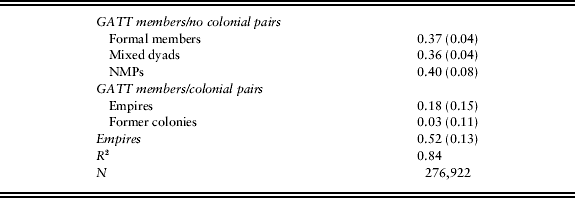
Table 1 reports the results of an analysis that includes these variables, as well as population and all covariates that Goldstein et al. include. Because the WTO required all of its members to formally accede to the organization, neither the mixed-dyad group nor the NMP group exists after 1995. The analysis, therefore, is limited to the years between 1946 and 1994.Footnote 17 As the existing-colony and former-colony variables together are collinear with the dyadic fixed effects, the former-colony variable drops out of the analysis. As is standard, the excluded group consists of: (1) country pairs in which neither state is a GATT member, and (2) dyads in which states do not belong to another group included in the analysis (e.g., a PTA).
Bilateral Trade, 1946–1994: Formal Members, Mixed Dyads, NMPs, and Colonies
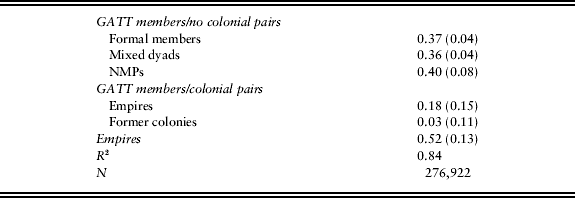
Note: Regressand: logged bilateral trade flows, measured in 1967 US dollars. Directed dyad and year fixed-effects analysis using areg in Stata 11 with robust standard errors clustered on directed dyads in parentheses. Controls for one in dyads, PTAs, currency unions, GSPs, GDP, and population, are included but not reported.
The results show that the effects of the GATT on trade by membership type converge when accession and colonial status are not conflated. In the text, I express the coefficients on the dichotomous variables as the percentage change in trade (i.e., e β–1) relative to the excluded group. Trade between members of the formal-dyad group other than those with colonial ties increases by about 45%.Footnote 18 For the mixed-dyad and NMP group, the corresponding statistics are 43% and 49%. No pair-wise difference between the groups is statistically significant.Footnote 19 As expected, members of an existing colonial empire trade slightly more than twice as much with each other as do states in the excluded group. Joining the GATT, however, has no statistically significant impact on either their trade (p-value=0.23) or on that between former colonies (p-value=0.79). Thus, consistent with Goldstein et al.'s intuition, mode of accession, independent of colonial ties, does not affect trade between GATT members.
Market-failure theory
To test the predictions of market-failure theory, I first disaggregate states into industrial and nonindustrial countries. As in earlier studies, I assign states to industrial status based on the International Monetary Fund (IMF) definition of them. In the industrial-country group are: Australia, Austria, Belgium, Canada, Denmark, Finland, France, Germany, Greece, Iceland, Ireland, Israel, Italy, Japan, Luxembourg, the Netherlands, New Zealand, Norway, Portugal, South Africa, Spain, Sweden, Switzerland, the United Kingdom, the United States, and Yugoslavia (until 1992).Footnote 20
I assign the five largest among them, defined in terms of GDP, to the core group. The relative size of Britain, France, Germany, Japan, and the United States enables each of them to wield considerable market power, making them likely candidates for the role of principal supplier. Accordingly, I create a variable that assigns a value of one to core-group states; it is zero otherwise (core states). All other industrial-country pairs (other-industrial-states) are in another group. It includes, for example, a dyad composed of Austria and Switzerland, as well as a Britain–Austria pair. In the third group are all other country pairs – i.e., those that include either one industrial country and one developing state or two developing countries (nonindustrial dyads).
I then interact each of these groups with GATT/WTO membership (e.g., core-state members). The core-member group includes 1,082 dyads, about one-half of 1% of regime member dyads.Footnote 21 There are about 23,000 other-industrial country pairs in the regime, representing about 10.5% of its members. As each of the three base-group terms (e.g., industrial states) is collinear with the dyadic-fixed effects, they drop out of the analysis. Nonindustrial states account for by far the largest share of regime members.Footnote 22
As is standard, I also control for dyads in which only one state is a GATT/WTO member. However, because the logic of market-failure theory implies that free riding will privilege industrial states in this group, I subdivide these ‘onein’ dyads into two groups: (1) pairs of industrial states (onein/industrial dyads), and (2) all others (onein/otherdyads). In the first of these groups, for example, are France and Spain before 1963 and Britain and Portugal before 1962. Country pairs in which neither state is a regime member are in the base group, provided that they are not members of any other group included as a control variable (e.g., GSP signatories).
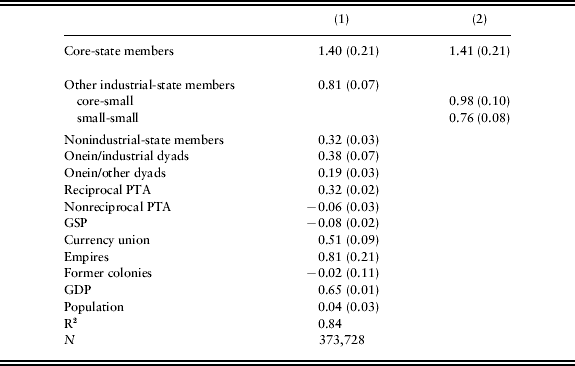
In Table 2, I report the result of an analysis of bilateral trade between 1946 and 2004 that includes the variables indicating each group and all other covariates standard in the literature – that is, membership in PTAs, whether unilateral or not, GSPs, and currency unions; the logged product of the population of each country in each pair in each year; and indicators for states with current or former colonial ties.Footnote 23 As is standard, I also include the logged product of the gross domestic product (GDP) of each country in each pair in each year, as well as directed-dyad and year fixed effects. The model I estimate is:

The Impact of the GATT/WTO on Trade, 1946–2004
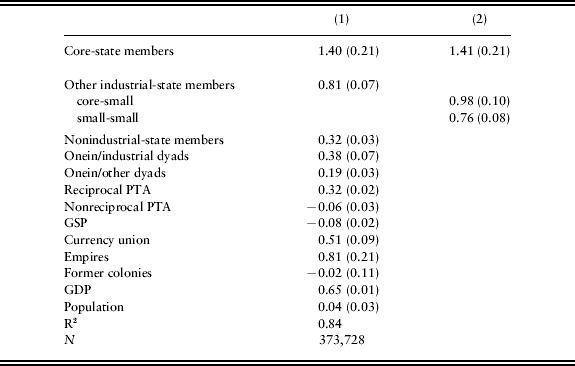
Note: Regressand: logged bilateral trade flows measured in 1967 U.S. dollars. Directed dyad and year fixed-effects analysis using areg in Stata 11 with robust standard errors clustered on directed dyads in parentheses. The analysis in col. 2 includes controls for one in dyads, PTAs, currency unions, GSPs, colonies, GDP, and population but I do not report them here.
The results in the first column of Table 2 are consistent with market-failure theory. They show that the regime exerts its strongest impact on core-state trade: their bilateral imports are three times as high as are those between states in the excluded group. Trade between states in the other-industrial group is significantly smaller than is that of core-group trade, but it is still more than twice as large as trade between countries in the excluded group. The corresponding statistic for other member pairs is about 38%. The difference between each treatment group and the base group is statistically significant, and pair-wise comparisons show that the differences between the groups themselves are also significant.
The results in Table 2, col. 1, also show that the effect of industrial-country status extends to dyads in which only one country is a GATT/WTO member. Trade between states that are both developed countries, only one of which adheres to the regime, is about 46% higher than is trade between base-group members. As a whole, the results of this analysis are consistent with the claim that market-failure theory makes about the dominance of large industrial states in the postwar regime, as well as with their inability to preclude free riding by smaller states with similar relative factor endowments.Footnote 24 This does not, of course, exclude the possibility that the data are also consistent with other theories that generate similar predictions about the impact of the regime on its members.
Table 2 also makes clear that dyadic income exerts a large, positive, and significant impact on bilateral trade flows and that country groups other than the GATT/WTO also affect trade. Most notably, dyads that include two members of existing colonial empires trade more than twice as much with each other as do states in the base group. The corresponding statistics for reciprocal PTAs and currency unions are about 40% and 65%, respectively. In contrast, both unilateral PTAs and GSPs exert small negative effects on trade (p-values=0.054 and ⩽0.0001, respectively). These results are similar to those of other studies.
The logic of market-failure theory and the GATT/WTO practices consistent with it suggest that trade expansion may also vary across the two subsets of states that the ‘other industrial’ group subsumes. Because each core state sought to extract compensation for any benefits its tariff cuts endowed on smaller industrial states, trade should expand to a larger extent between core states and smaller industrial countries than between the latter. To test this idea, I divide the set of other industrial-country regime members into two groups: (1) core states paired with relatively small industrial countries (core-small), and (2) small industrial states paired with each other (small-small).
Table 2, col. 2, reports the results of an analysis that includes variables indicating each of these groups. In the interest of clarity, I report only the estimates on the industrial-group variables; other estimates are identical to those in the first column. As before, core-group trade increases relative to that of the excluded group by a factor of three. Trade between members of other industrial-country pairs varies as market-failure theory implies: it increases by about 165% in the case of core-small state pairs and by about 115% in the case of smaller industrial countries paired with each other. The difference between these two effects is both substantively large and statistically significant.
Thus, the evidence that Table 2 presents is consistent with the prediction of market-failure theory that regime effects will vary systematically both among industrial countries and between industrial countries and developing countries. While the most dramatic trade expansion occurs between core states, trade also expands by progressively smaller but still sizeable amounts in cases in which member-country dyads include either one large and one relatively small industrial country or two relatively small industrial countries.
Security externalities
Market-failure theory does not predict, however, the impact that the GATT/WTO exerts on developing-country trade. Table 2 shows that trade between members of dyads that include at least one developing-country is 38% higher than is trade between states in the excluded group. Although recent work shows that some developing countries do exert market power with respect to some goods (e.g., Broda et al., Reference Broda, Limão and Weinstein2008), it is clear that these states were not central players in the tariff bargaining that occurred under the auspices of the postwar regime.
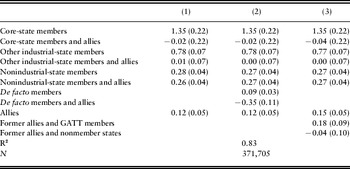
To examine whether the theory linking security and trade can help to better explain the developing-country result, I first create a variable that takes on a value of one when both states in a country pair are allies (allies). To do so, I use data from Brett Ashley Leeds's Alliance Treaty Obligations and Provisions (ATOP) data set.Footnote 25 I code states as allies if they are signatories of a formal agreement in which they pledge ‘to cooperate against military threats’.Footnote 26 As the ATOP data end in 2003, the analyses here do so as well. I interact the ally term with each of the three GATT member terms – pairs of core states, other-industrial countries, and nonindustrial country pairs. The predictions I test are that: (1) allies trade more with each other than do states in the excluded group, and (2) GATT/WTO membership will increase trade between allies when at least one of them is a developing country.
The results in the first column of Table 3 show that the data are consistent with the theory. Allies trade about 13% more with each other than do base-group members, a statistically significant difference. Joint membership in an alliance and in the trade regime has a sizeable and statistically significant impact on trade only in cases involving a developing country. Dual allegiance raises trade in these cases by about 30%, an impact slightly larger than regime membership alone and more than twice as large as alliance ties alone.Footnote 27 As such, trade involving developing countries that are allies and regime members is almost twice that of other states in the same GATT/WTO member (i.e., nonindustrial-country) group.Footnote 28 As the theory about security externalities predicts, the effect of joint membership is actually negative though insignificant in groups that include either core-state members (p-value=0.93) or other industrial states (p-value=0.91).Footnote 29
The Impact of the GATT/WTO and Alliances on Trade, 1946–2003

Note: Regressand: logged bilateral trade flows. Directed dyad and year fixed-effects analysis using areg in Stata 11 with standard errors clustered on directed dyads in parentheses. Controls for PTAs, currency unions, GSPs, current and former colonies, GDP, and population included but not reported.
That it is the GATT/WTO insurance mechanism that matters in these cases emerges more clearly if I distinguish member states based on their ability to avail themselves of it. While NMPs enjoyed most basic rights, the de facto members among them – i.e., the newly independent states that joined the regime without completing a formal accession protocol – did not have the ‘right to assistance in resolving disputes between themselves and contracting parties’ (Goldstein et al., 2007b: 42, n 15). In these cases, the logic of the security-externalities argument implies that the interaction between regime membership and alliance ties should not exert any additional impact on trade.
To test whether membership in both alliances and the regime affects trade when states do not have access to the DRM, I add to the analysis a variable that assumes a value of one in instances in which GATT/WTO dyads include at least one de facto member, as well as a variable that interacts these dyads with the alliance variable. Because all de facto members are former colonies, they are a subset of nonindustrial dyads. The results in Table 3, col. 2, are consistent with the theory. They show that regime membership does not affect trade between allies when either is a de facto member (p-value=0.85).Footnote 30 Thus, regime membership enhances the impact of alliances only if the states they link can access the insurance against reneging it provides.
Finally, the theory implies that the effect on trade of alliance termination should vary with regime membership – that is, trade should decline as alliances end only if the states they linked are not GATT/WTO signatories. Table 3, col. 3, reports the results of an analysis that distinguishes between former allies on this basis. It includes a variable that assumes a value of one when former allies are regime members and another variable that takes on a value of one in other cases of former allies. The results show that no change in trade occurs between former allies if they are regime members (p-value=0.30). Former allies that are not regime members trade significantly less, however, than former allies and regime members. These results are consistent with the existence of a mechanism that promotes trade by helping to insure developing countries against the reneging that can ensue when alliances end.
Conclusion
Taking into account both the economics and politics that produced and affected the operation of the GATT/WTO creates a very different picture of its impact than do existing studies. The analyses here are consistent with the predictions of market-failure theory. They show that the bargaining that occurred under the auspices of the postwar trade regime system privileged trade between its largest industrial-country members. As a consequence of the MFN clause, the tariff cuts these states made also allowed trade to flourish to a smaller but still substantial amount between large and small industrial countries and between the smaller industrial countries themselves.
A comparable increase in trade involving developing countries occurs only in cases which reflect the play of politics in an anarchic international system. Absent its imprint, small countries are vulnerable to hold up if their firms sink costs into exporting. In its presence, it is possible for destination countries to credibly commit not to raise their tariffs ex post. Although waning alliance ties recreate a time-consistency problem, small countries can insure themselves against the risk of reneging in this event when they can access the DRM that regime membership makes possible.
Thus, two processes seem to have governed trade expansion under the auspices of the postwar regime. In one, the GATT/WTO seems to have facilitated the ability of large states to escape the ‘bad’ equilibrium outcome that a single-shot PD game inevitably produces. In the other, the regime enabled small-state allies to reduce the risk associated with production for export. As such, this paper suggests that considerable value added inheres in an analysis of the postwar trade regime that takes into account the economics and politics that both created it and influenced its operation.