The consistency of a person's words and actions is a major part of a person's integrity (Palanski & Yammarino, Reference Palanski and Yammarino2007). People value promises and consider integrity to be a virtue. The alignment between a person's words and deeds is characterized as ‘behavioral integrity’ and thus it is important for managers, workers, and ordinary people as well not only to keep their promises but also to be aware of their behavioral discrepancies (Simons, Reference Simons2002). Whitener, Brodt, Korsgaard, and Werner (Reference Whitener, Brodt, Korsgaard and Werner1998) maintained that consistency and integrity to be the two of five major components for a leader's trustworthy behavior. Bass (Reference Bass1985) believed that integrity as well as trustworthy is key to charismatic leadership. In a global project searching for attributes of charismatic/transformational leadership that is universally endorsed, Den Hartog, House, Hanges, and Ruiz-Quintanilla along with numerous scholars worldwide (Reference Den Hartog, House, Hanges and Ruiz-Quintanilla1999) concluded that integrity was one of the major attributes. Yukl (Reference Yukl2002) believed that when it comes to leader's ethics and behavior, integrity is the essence and the best way to gain follower outcome effects, which even cross cultural boundaries.
Do different genders manifest different inventories on behavior integrity? Do we really consider women more capricious? Previous research on gender differences in decision making, behavior patterns, as well as morality and ethics generated mixed results from time to time (Bartley, Blanton, & Gilliard, Reference Bartley, Blanton and Gilliard2005; Biernat & Fuegen, Reference Biernat and Fuegen2001; Ekin & Tezölmez, Reference Ekin and Tezölmez1999; Nguyen, Basuray, Smith, Kopka, & McCulloh, Reference Nguyen, Basuray, Smith, Kopka and McCulloh2008; Robinson & Heft, Reference Robinson and Heft2002; Ruegger & King, Reference Ruegger and King1992; Stedham, Yamamura, & Beekun, Reference Stedham, Yamamura and Beekun2007; Voss & Van Dyke, Reference Voss and Van Dyke2001; Yang & Wu, Reference Yang and Wu2007). We believe that in this fast growing and ever-changing modern society, generalization on gender differences has reached a limitation. Factors such as contexts, surroundings, environment, and immediate communities should all be taken into account. This calls for a more dynamic, content and context based perspective to examine the underlying behavioral assumptions made by a specific gender under particular circumstances. Therefore, rather than focusing on characteristic-based individual analysis, we employed a social contract perspective, trying to decipher what stands behind and holds the integrity for each gender.
The purpose of this study is to explore gender differences on changes in behavioral integrity and to further examine the ‘signs’ –trends/directions – (Johns, Reference Johns2006, p. 297–298) between the differences under specific contexts. We first look through the concepts of behavioral integrity and then discuss possible changing agents and factors that are ‘behavioral antecedents’ (Simons, Reference Simons2002, p. 28) from various gender research. We extract thoughts from the realm of interaction, situation, and contexts as being salient to situational features, a bundle of stimuli, and a shaper of meaning (Johns, Reference Johns2006). These results are used to encompass a social contract perspective on gender differences. The social contract perspective, whether in the names of the social contract theory (Dunfee, Reference Dunfee1991; Keeley, Reference Keeley1988), Contractarian Business Ethics (Dunfee & Donaldson, Reference Dunfee and Donaldson1995; Wempe, Reference Wempe2004), or the Integrative Social Contracts Theory (ISCT, Donaldson, & Dunfee, Reference Donaldson and Dunfee1994, Reference Donaldson and Dunfee1999), provides reasonable structures and frameworks. The formation of social contracts and socialization is a process. That is, changes develop during these processes. By integrating concepts of social contracts and contextual specific domains, we are then able to speculate how different genders maintain a delicate behavioral balance among individual interests, organizational demands, and the social environment. Following this train of thought, we conducted a study using business scenarios involving 168 people, comprised of 90 young females and 78 males in four different academic institutions, in order to see if gender differences in behavioral integrity really existed. We also strived to find out whether contexts have impact on directions of integrity judgments between different genders.
Behavioral integrity
Integrity is a virtue. Mcfall maintained, ‘A person of integrity is willing to bear the consequences of her convictions’ (Mcfall, Reference Mcfall1987, p. 9). Calhoun (Reference Calhoun1995, p. 253–254) proposed that integrity is a personal virtue that secures the boundary of the self and that integrity serves as a social virtue ‘by standing for something … to protecting it against disintegration, against lost of self-identity, and against pollution by evil.’ Palanski and Yammarino (Reference Palanski and Yammarino2007) ran an impressive investigation on characteristics, theories, and definitions of integrity and came up with the conceptualization of integrity as wholeness, a consistency of words and actions, consistency in adversity, being true to oneself, and as a moral or ethical behavior.
Palanski and Yammarino (Reference Palanski and Yammarino2007, p. 175) also mentioned ‘… a way to develop a better understanding about integrity is to discuss how the aspects of integrity relate to one another’. After considering different understandings of the idea of integrity, Koehn (Reference Koehn2005, p. 125) maintained that integrity ‘possesses an intrinsic value’ and ‘… is a matter of being compassionately alert, always thinking about circumstances and conditions …‘ (p. 127) Koehn's idea bestowed the possibility for the linkage between integrity and social contracts. Connelly, Lilienfeld, and Schmeelk (Reference Connelly, Lilienfeld and Schmeelk2006) found that behavioral integrity and morality are highly correlated. Integrity as measured by an integrity test represented significant correlations which more with overt moral behavior, than with moral reasoning.
Assuming a more practical viewpoint, Simons (Reference Simons2002, Reference Simons2007) focused on the perceived alignment of words and deeds, and his line of reasoning first pursued the merits of integrity, which led to trust, and other performance boosts. In a brief synopsis, Simons’ work has three parts: 1. Behavioral antecedents –factors that affect a ‘manager's actual pattern of word-deed alignment’ such as the manager's need to satisfy diverse constituencies, the manager's awareness of his/her own values, and a manager's personality traits. 2. Perception and interpretation –perceptual filters which affect employee perception, and 3. Consequences –rewards for managers for their keeping intact their trust and performance. We centered to the behavioral antecedents and deliberated gender factor as a research focus on behavioral integrity. We realized that a comprehensive list of antecedents to behavioral integrity is not possible, nor practical. To avoid confusion, we need to point out that Simons’ term ‘behavioral integrity’ is essentially a ‘perceived’ one. In Simon's own words, BI implies an ‘employee perception of a manager's pattern of word-deed alignment’ (Simons Reference Simons2002, p. 19). Even so, Simons (Reference Simons2002) has done an in-depth discussion on the various factors that cause a manager to change his/her behavioral integrity. Yet, before we look further into these antecedents, leaders and managers are comprised of different genders and there are now more female managers, then in the past. The roles of women managers in the business world are definitely gaining more attention.
Gender as an antecedent to Behavioral integrity
Gender differences have long been discussed from various aspects. This also holds true in the realm of behavioral research in gender differences. There are issues on gender-role conflicts (Fallon & Jome, Reference Fallon and Jome2007; Hall & Duvall, Reference Hall and Duvall2003), gender-role expectations (Bartley et al., Reference Bartley, Blanton and Gilliard2005; Eagly & Chrvala, Reference Eagly and Chrvala1986; Robinson & Heft, Reference Robinson and Heft2002), decision-making (Stedham et al., Reference Stedham, Yamamura and Beekun2007; Yang & Wu, Reference Yang and Wu2007), and judgment (Biernat & Fuegen, Reference Biernat and Fuegen2001; Voss & Van Dyke, Reference Voss and Van Dyke2001). In ethical and morality issues, gender distinctions also exist (Ekin & Tezölmez, Reference Ekin and Tezölmez1999; Ruegger & King, Reference Ruegger and King1992). Myyry and Helkama (Reference Myyry and Helkama2002) illustrated that there are value priorities between genders and ‘females and males seemed to focus partially on different issues while interpreting the situation’ (p. 35). Awareness of gender differences is even crucial for successful government policies (Boyd, Reference Boyd2002; Speizer, Whittle, & Carter, Reference Speizer, Whittle and Carter2005; Tamang, Reference Tamang2002).
Although there are quite a few studies on gender differences in decision-making as well as in ethics, morality, and judgment, there are not many studies covering integrity. Nevertheless, we believed that decision-making, a major part of behavioral antecedents, differs between genders and thus behavioral integrity may differ between genders. We also speculated that morality and ethical issues and behavioral integrity are highly related and might be interchangeable in certain domains. We agree with the idea that BI, while maintaining intact through perceptual filters, leads to trust and thus brings performance (Simons, Reference Simons2002, Reference Simons2007).
Social contracts
Behavioral integrity between genders will likely vary with contexts. While gender factors may have impact on behavioral patterns and thus affect their BI, the literature has shown mixed results. For example, Biernat and Fuegen (Reference Biernat and Fuegen2001) reported shifting standards between genders: men are more objective whereas women are more subjective. According to Stedham et al. (Reference Stedham, Yamamura and Beekun2007), females process higher morality judgment than males do. In ethical judgments, females were rated more ethical than that their male counterparts (Nguyen et al., Reference Nguyen, Basuray, Smith, Kopka and McCulloh2008). Nevertheless, some studies show the opposite results that females manifest lower ethics or morality scores. Some studies could not find significant correlations between genders and their differences concerning integrity or ethical issues (Akaah, Reference Akaah1989; Allen, Bacdayan, Kowalski, & Roy, Reference Allen, Bacdayan, Kowalski and Roy2005; Izraeli & Jaffe, Reference Izraeli and Jaffe2000). Khazanchi (Reference Khazanchi1995) studied unethical behavior in information systems and concluded that ‘Although women are better able to recognize unethical actions …, the existence of statistically significant differences vary depending upon the nature of the ethical dilemma’ (p. 14). We speculate that these inconsistent results are due to characterization discrepancies. Theoretically, those studies carefully defined their realm of research and their empirical tests were valid. We think, however, that it might be due to the broadness or particularity that impeded those results from generating widespread applications. That is, although we have to define our boundaries well while doing gender research, the outcome might become too narrow or too broad to generalize how a certain gender acts in certain patterns and that certain genders behave better or worse than others do.
If a gender differs in BI, where could we find the patterns? Contingency is certainly one approach, and yet it is too vague a term. By employing the ideas of contexts and social contracts, we see social contracts are not only contingent but also hierarchical and we do not equate social contracts merely as environmental influence. Social contract is a process in which a person's immediate surroundings are constantly adapting, revolving, and evolving. Through the process of different stages of social contract formation, a person forms his/her beliefs system. Consequently, different levels of group/social norms emerge and behavior patterns could be clarified. To explain a person's attitude, behavior, or choice, we have a new perspective. From looking at the immediate surroundings to see how ‘action-codes’ arise and what they are, we could make hypotheses based on the outcomes of the social contracting process. We surmise that behavioral integrity changes depending on gender and that the changes vary with different surroundings and contexts.
According to Johns (Reference Johns2006, p. 386), context is defined as ‘situational opportunities and constraints that affect the occurrence and meaning of organizational behavior as well as functional relationships between variables.’ In addition, context shapes; contexts ‘reverse signs (p. 397).’ If contexts are there, the next question is raised: what pattern(s) do members in this specific context interact in? That is, how do contexts affect people's behavioral assumptions and patterns? To answer this question, we found views from a ‘social contract,’ ‘contractarian approach,’ or even an ‘ISCT’ to be valuable. Contexts are the specified environment, or society, in which social contracts are derived. Dunfee and Donaldson in the 1990s, and specifically in 1994 and 1995, proposed Contractarian approaches emphasizing ‘consent as a means to provide the needed contexts for rendering normative judgments’ (Dunfee & Donaldson, Reference Dunfee and Donaldson1995, p. 173). Numerous scholars devoted their endeavors to exploring and explaining those contexts and their specific realms of research subjects to solve context specific business situations. They viewed ‘ISCT as a procedural approach to business ethics’ (Salbu, Reference Salbu2000, p. 444), offering ‘… formed by the consent of naturally free and equal individuals …‘ (Tamang, Reference Tamang2002, p. 309). Wempe (Reference Wempe2004) presented a domain-specific contract theory, while Sama and Reisel (Reference Sama and Reisel2005) maintained that ISCT provides conflict resolutions. A good example of utilizing ISCT for the norm-framing process can be found on Cava and Mayer's (Reference Cava and Mayer2007) work. Cava and Mayer elegantly guided us through the analysis by presenting a case of decision making for urban prosperity initiatives.
Donaldson and Dunfee (Reference Donaldson and Dunfee1994, Reference Donaldson and Dunfee1999) described the immediate surroundings of an individual as ‘microsocial’ and the broader, outer parts as ‘macrosocial.’ Therefore, within different levels of social surroundings, different codes of actions were developed. We may call these codes as guidance, norms, cultures, or social contracts. The central argument of the ISCT is that there is no such thing as absolute guidelines that suit every situation in every circumstance. Conflicts and dilemmas will certainly be found in the complex groups and social interactions. Agreements with regard to culture and norms are usually not so straightforward. For example, managers of multinational corporations are normally confronted with cultural codes or norms that differ greatly from their beliefs and yet are totally legitimate and common in a particular environment. To derive reasonable and suitable moves while facing conflicts in different social settings requires not only rationality but also the capabilities of understanding and interacting with social contracts among groups and organizations.
While the construct of ISCT is well established and well-argued (Dunfee, Reference Dunfee2006), in this study, we employ a very broad sense of this concept. Specifically, they are the ideas of contractarian thinking as social contracts, and the ‘micro’ and ‘macro’ layers and levels of social surroundings. We circumvented the usage of some parts of ISCT for we do not (yet) consider them as layers of ethical and moral judgments between genders. Although we see that there are differences in gender behavioral integrity, the differences do not process levels or hierarchies. Similarly, we also stepped away from ‘hypernorms’ of ISCT. Koehn's link between integrity and an individual's outer circumstances and conditions (Koehn, Reference Koehn2005) formulated our social contract perspective in this research. This position was further illustrated by Gosling and Huang (Reference Gosling and Huang2010), which endeavored to bring together integrity and ISCT. Gosling and Huang concluded that integrity is a matter of being consistent under legitimate community norms over time, even at the risk of personal cost.
Contexts
The next question arises as if contexts affect behavioral integrity, what positive or negative directions are observed? Would there be different effects attributed to each gender? Would the differences vary with contexts? How do we define vicinities that appropriately enclose the most components for social contracts negotiated by their members yet avoid overly broad or specific descriptions that may confine the results and restrict applications?
Simons’ (2002) work provided us with an excellent baseline for outlining contexts for gender behavioral integrity differences research. Simons categorized eight ‘behavioral antecedents’ for managers to discern when the managers’ words diverged from their actions. Carefully looking through those antecedents, we found that there emerged quite feasible ways to classify the contexts. This classification provides recognition for memberships’ social contracting and norm-forming activities in specific social groups. In this study, this is depicted by gender norms formed in respective contexts. We classify Simons’ ‘managerial fads & fashions’ and ‘organizational change’ as organizational contexts. Simons’ last three antecedents of behavioral integrity: ‘ambivalent responses to change,’ ‘awareness of own values,’ and ‘personality traits’ are essentially at an individual level. Hence, we can first discuss the relationships between behavioral antecedents and actual patterns of word-deed alignment. We are also looking at ‘the direction of misalignment.’
Public context
From an organizational level perspective, group pressure is a major consideration for factors shaping behavioral integrity. Group pressure takes various variations such as social consensus, concentration of effects, and moral intensity (Jones, Reference Jones1991). Conformity is the other type. The essence of behavioral integrity states that people perform their word-deed alignment and tend to not perform actions that are incongruent to this. However, the ‘vicious pressure’ for individuals to conform to certain groups around certain issues creates a great challenge to holding themselves together. While facing group pressures, individual ethical behavior is often impeded by organizational factors (Jones, Reference Jones1991). From Milgram's (Reference Milgram1963) early experiments of obedience to the infamous ‘group think’ (Janis, Reference Janis1982), we see major attempts devoted to holding ethical decisions for an individual within organizational interactions (Trevino, Reference Trevino1986). Among these, evidence of gender differences on decision-making exists (Speizer et al., Reference Speizer, Whittle and Carter2005). Females were found to be more conformed when the other group members had surveillance over the subjects’ opinions (Eagly & Chrvala, Reference Eagly and Chrvala1986). Nguyen et al. (Reference Nguyen, Basuray, Smith, Kopka and McCulloh2008) found that women exhibited a higher level of ethical judgment and yet the gender effect was reduced after the magnitude of consequence was introduced (Nguyen et al., Reference Nguyen, Basuray, Smith, Kopka and McCulloh2008, p. 426). On the other hand, under group pressure, males tended to show their masculinity by acting as challengers and confronting the authorities. Zikmund, Sciglimpaglia, Lundstrom, and Cowell (Reference Zikmund, Sciglimpaglia, Lundstrom and Cowell1984) once hypothesized that males would conform to group pressure when choosing among feminine products under the assumption that females process more familiarity and expertise than their male counterparts do. Nevertheless, their research showed that males still did not conform to a greater extent than did the females on feminine items. This same nonconformity was seen for the males’ choices for neutral and masculine items. We presume that there is still more or less a male-dominant society in Taiwan as well as in traditional Chinese society. Males are expected not to show their weakness and to be tough while confronting challenges, especially if their act is under witness in public. These observations lead to our first hypothesis:
Hypothesis 1 : Males tend to manifest higher behavioral integrity than females if they are under pressure for conformity in a public, open, and apparent situation.
Private context
A study of ethical choices by managers in different genders in Turkey showed that female managers were found to have higher ethics scores than their male counterparts (Ekin & Tezölmez, Reference Ekin and Tezölmez1999). They also found that the most important influencing factors attributed to each gender's acts were the moral codes of behavior. Stedham et al. (Reference Stedham, Yamamura and Beekun2007) argued, ‘Women judge a situation to be more unethical than men. The consideration of contextual aspects affects both men's and women's conclusions …‘ (p. 172). As for role expectations, both men and women carry heavy burdens of pressures and anticipations from their surrounding social contexts. While their social-role conflicts with their cognitions and beliefs, the struggle for gender-role resolution and congruence is constantly present. Hall and Duvall (Reference Hall and Duvall2003) found that congruence between self expectations and roles is more important than social expectations for women. Specifically, women are trying to keep themselves intact and thus hold their self-expectations in a static state. When norms or cultures of specific genders collide into conflict, resolution processes were activated. Sama and Reisel (Reference Sama and Reisel2005) provided a contingency model of ISCT application to this conflict resolution. Their model implied that there were better chances for females to find their norm resolutions in close communities rather than in larger-scale firms or industries. On the other hand, males would endeavor possibilities to maintain masculinity and protect themselves if they were not under witness in public. These observations lead to the following hypothesis:
Hypothesis 2 : Males tend to manifest lower behavioral integrity if they are under pressure for protecting themselves in a private, closed, and ambivalent situation.
Behavioral integrity scenarios
Contexts refer to variations of surroundings (organizational and individual) as well as situations (public or private, open or close, ambivalent or apparent). To illustrate contexts, we employed scenarios. The scenarios could play as modifiers and filters. They could screen, change, and provide necessary surroundings, situations, and environments in which managers and our survey subjects could be circumscribed and imbedded. The major purpose of this survey using scenarios was to investigate the underlying behavioral assumptions and attitudes of each respondent while he/she was facing a dilemma. However, we are cautious about not choosing scenarios that we consider as extremes. While facing extreme situations, people might do errant things and their behaviors might become out of control. Therefore, we excluded scenarios that ‘test a person's extremes’ because those cases seem to be of a different line of thought and should be studied under a different setting and assumptions (Haviv & Leman, Reference Haviv and Leman2002).
Two scenarios were employed to represent stimuli and provide settings for variables, i.e., public or private situations, in different contexts. Each scenario carries different emphases on contextual domains. The first is in the context of an organizational, apparent setting and was set as a situation where the subject is under conformity pressure. The second is in the context of an individual, ambivalent setting and was set as a situation where the subject is under pressure for personal vulnerability. Feasibility of contexts for student subjects to ‘role play’ businesspersons and managers may raise suspicion. Greenberg and Eskew (Reference Greenberg and Eskew1993) found that for research aiming at studying basic psychological processes within specific contexts, unfamiliarity may otherwise be more beneficial. They stated that asking subjects to play novel roles nevertheless facilitates subjects to have a relatively neutral and uncontaminated way to evaluate.
Scenario 1
You are a newly appointed Head of the Finance Department who has a deep understanding of International Finance. The General Manager of the company recently came back from Malaysia and has announced in a meeting that he is considering inking an agreement with a Malaysian financing company. Everyone hailed the GM thinking that the prospective partner would be beneficial to the company. However, you personally think otherwise, doubting the credibility of the company and their expertise. How would you then handle the situation given the following options?
1. Congratulate the GM and recommend studying the proposal carefully before signing up with this company.
2. Be silent about the matter and express your desire to leave the company.
3. Exert your opinion and express to management that based on your review such a deal is a hoax.
4. Leave the matter for the moment and move on as the need arises.
This scenario defined a context denoting an apparent organizational surrounding. The subject characterized the role of a professional manager whose function in this scenario was relatively open. The dilemma that the survey respondent was facing and the decision to be made by the individual was in the public realm, involving a wide range of group members and superintendents.
Scenario 2
You are a section head of a steel mill and adhere to maintain a policy of order and discipline in the workplace. Specifically, you seek to implement the policy by the book such as the ‘No drinking of alcoholic beverages within the workplace.’ Due to some shortages in raw materials that have affected the entire production schedule, you have asked your staff to work overtime during their rest period. During the break, you noticed that there were a group of people who are drinking alcoholic beverages. How will you attend to this matter, given the following options?
1. Report the incident to the Personnel Department for violating company policy.
2. Report the incident to the Personnel Department and recommend that the said employees be sanctioned for violating company policy.
3. Call the attention of the said employees and make them sign an undertaking stating that they will no longer violate such a policy; otherwise, they shall be dealt with accordingly.
4. You would rather be lenient since you feel that reporting to work during a rest day is a favor to the company. It is enough to reprimand them and tell them to be silent about the matter.
This scenario defined a context denoting an individual ambivalent surrounding. The subject assumed the role of a section head whose function in this scenario is relatively individualized and closed. The dilemma in which the survey respondent was facing and the decision to be made by the individual was relatively private and was only acknowledged by his/her subordinates.
Sample and procedure
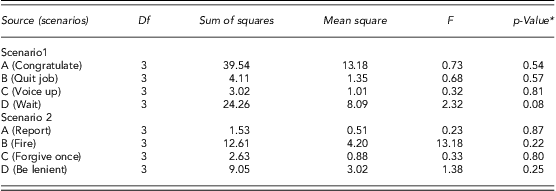
We viewed our subjects as demonstrations of social space surroundings and contexts rather than as studies of sociological research. To get a better coverage of samples, cluster sampling was used. We drew our samples (N = 168, 78 men and 90 women in total) from four different academic institutions in Taiwan. These 168 students were composed of 44 third-year, finance major, private university students, 49 sophomores from a vocational technical college major in engineering, 30 first-year apprentice (equivalent of college freshmen) in a military academy, and 48 first-year MBA students in a national university. These participants were in different schools and in various majors. The ANOVA analysis (Table 1) showed that there was no statistical significant difference among different sample groups. Which meant the division of samples into four schools generated very little effect on our subjects’ behavioral tendencies toward the scenarios. That formed a social space that is as homogenous as possible among the four groups. Hence, it could be easier to describe interactions and social contract forming as a socialization process in general within a group. This sampling design not only made improvements for a relatively small sample size but also enhanced credibility for future generalization toward other groups.
ANOVA for sample clusters (sampling from different schools)
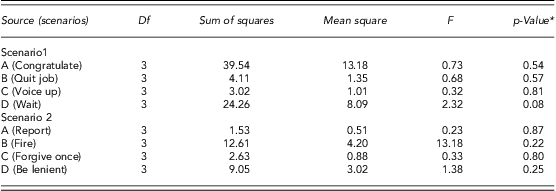
*all NS for p < 0.05.
Survey questionnaires with demographic items and two scenarios were distributed during class sections. As a consequence, the respondent rate was relatively high – only 2 out of 172 were missing. Two incomplete responses were later taken out to form our 168 samples. Since this study was conducted in the country of Taiwan, the original language of the questionnaire was written in (Traditional) Chinese. Scenarios in English presented above were double translated through word-by-word discussions by the authors and native English speakers. We anticipate these scenarios to be used not only for this presentation but also for future comparative research in more countries.
Although clearly stated in the scenarios that that was ‘role-playing’ in essence rather than moral judgment, a reminder was administrated during surveys to avoid confusion. The respondents/students were told to pay special attention on ‘how they will do/react’ as if they were in these situations.
Measurement
Each scenario includes four real-life, commonsense choices that deal with our respondents’ intention of action and attitudes toward the situation. After reading all four choices, the subjects may be able to identify the ‘correct’ or more ethical choices. Should the participant attempt to create a ‘perfect’ answer sheet, we are confident that the answers chosen by the respondents will more closely reflect their true intentions of actions rather than their desire for making good impressions. Because these scenarios do not test a person's limits, we do not think it is necessary for the participants to manipulate the answers to create favorable outcomes.
These two scenarios were intended to investigate the behavioral integrity variations of a respondent. To test BI, the consistency of a person's words and deeds, we first identified the promise that was comprised of the words, and then the action, and finally the deed. In general, the scenarios themselves represented situations where the promises were embedded while the four choices represented intended actions. In scenario one, a promise is embedded as: ‘a newly appointed head of the finance department who has a deep understanding of international finance …‘ The participant in this scenario accepted the job and was supposed to make contributions to enhance competitive advantages for the company. Here the promise is not spoken out yet it could be clearly understood by the respondent. In scenario 2, the promise is relatively obvious because the ‘words’ are right in the scenario, ‘… a head of a steel mill which maintains a policy of order and discipline in the workplace.’ Once the promise was identified, the latter part of both scenarios presented the dilemma to the promised commitment and the challenge to an individual's behavioral integrity. The four choices under each scenario denoted a participant's endeavor of action. By arranging a ‘promise’ in the vignette and an ‘action’ in the choices, a frame of a word-deed alignment was set.
A seven-point Likert Scale was used for calculation. We scored ‘one’ for respondents choosing ‘absolutely impossible to perform this act’ while a score of seven indicated the opinion of ‘definitely will do so.’ The higher the Likert score in a certain choice among four items denotes the stronger endeavor for our survey subject to perform the action he/she chose.
The Delphi method was utilized to rank consistency of promises and actions and provided ‘correct’ answers for each scenario. Five specialists in human resources and management including scholars and national enterprise CEOs and 34 seasoned managers contributed the Delphi process. Specialists designated the ‘rankings’ and the managers helped pretest the scenarios and contributing valuable opinions. Ranks of H, M, and L were used with ‘L’ as the lowest behavioral integrity action chosen, ‘H’ as the most integrated behavior, and ‘M’ being the moderate. The four choices in Scenario One each scored M, L, H, and M respectively in our experts’ opinions, in which we subscribed that action choice C, voice up, is the most integrated move that shows an individual's consistency of words and deeds whereas action choice B, quit job, was the lowest. The four choices in Scenario 2 each scored M, H, M, and L respectively in our experts’ opinions, in which we subscribed that action choice B, firing the workers, is the most integrated move, which shows an individual's consistency of words and deeds. Action choice D, being lenient, is the lowest in our behavioral integrity ratings.
To distinguish whether differences exist and significant distinctions emerge between genders, an independent T-test that compares the means between two gender groups was utilized. Specifically, we would focus on whether statistically significant differences exist between genders who chose the highest BI action – choice C (voice up) in scenario 1, and the lowest BI action – choice D (Being lenient) in Scenario 2.
Findings
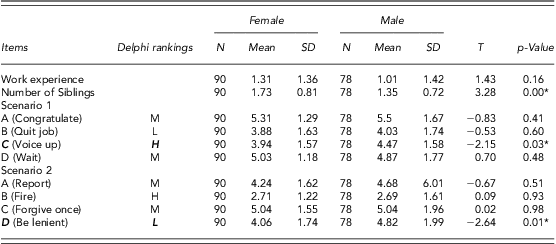
Table 2 summarized the means and standard deviations generated from our participants’ responses to each scenario's action choices. Table 2 also manifested significant differences between genders in action C (voice up), the highest BI move of Scenario 1, and in action D (Being lenient), the lowest BI move of Scenario 2. Both hypotheses had been supported. For public context hypothesis (Hypothesis 1), that is a clear sign that males would not change their words and deed alignment after facing this conformity, group-pressured situation. Moreover, this finding is in accordance with our integrity rating, in which voicing up and confronting the boss for presenting statements in which he/she believes are beneficial to the company. While people can keep their word-deed alignment –here we found males, their behavioral integrity was especially high. For the private context hypothesis (Hypothesis 2), statistically significant differences were evident in the choices of item D (Being lenient), which was an indication of the males’ preferences of lenient behavior and thus change their behavior consistency.
Summary of descriptive statistics, Delphi rankings, and T-test results
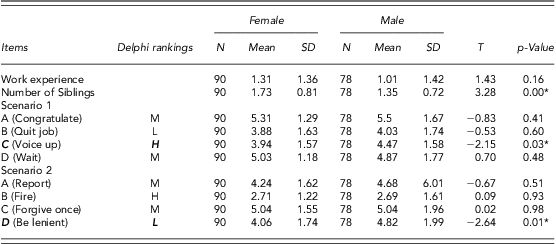
*p < 0.05.
Discussion
Scenario 1
In Scenario 1, we understood how different genders responded in apparent and relatively open and public contexts. The results of the T-tests for independent samples for mean differences showed that Scenario 1, action choice C stood out as statistically significant. This means that different genders did manifest distinctive approaches toward situations under organizational contexts. Specifically, on a Likert 7.0 scale, males scored a mean of 4.47, while females averaged 3.94. As a newly appointed Head of the Finance Department who has a deep understanding of International Finance, the promise was made to perform the best and honest management for the company. Male participants in this study showed their intention to stand upright exerting opinions. Based on professional understandings, they confronted the General Manager and maintained that such a deal was a hoax.
That is a clear sign that males would not change their words and deeds alignment after facing this conformity, group-pressured situation. On the other hand, while considering people who cannot keep their word-deed alignment –here we found females, we consider their behavioral integrity as being low. We have an illustration for hypothesis 1: Males tend to manifest higher behavioral integrity than females if they are under pressure for conformity in a public, open, and apparent situation.
Under male-dominant social settings, female roles in business, whether being clerks or managers, tended to be treated with ‘lower standards’ (Biernat & Fuegen, Reference Biernat and Fuegen2001, p. 718). In organizational, apparent situations, females are under greater group pressure and conformity than males. While meeting members unanimously making speeches supporting the boss, a dilemma was created between confronting the public with a conscience and voicing professional knowledge with the other option of submerging to the majority.
Scenario 2
In Scenario 2, we understood how different genders responded in ambivalent and relatively closed and personal contexts. Our target for hypothesis 2: action choice D, being lenient, was supported by the T-test result. Females and males manifested a distinctive approach toward a private, closed, and ambivalent situation. Specifically, in Likert's 7.0 scale, males scored a higher mean of 4.82, while females averaged 4.07. Male respondents in this scenario would rather negotiate privately with the workers than report this indignity issue to the company authorities that his subordinates were violating company rules. It is a general understanding that drinking at work is not allowed, whether for productivity, morality or safety concerns. In a strict sense of behavior integrity, reporting to the boss was an obvious choice. However, male respondents viewed such a response as being difficult to administer.
Our male subjects indicated a deviation from their word and deed alignment after facing this ambiguous, ethical challenging situation. As a section head of a steel mill, the males had promised to ‘maintain a policy of order and discipline in the workplace’ yet he could not deliver his promise. When people cannot keep their word-deed alignment, we consider their behavioral integrity to be low. The notion that females are more ‘easy-going’ privately seems naïve. Scenario 2 is relatively ‘personal’ and an ‘individual’ level because ‘nobody knows’ and thus they can cover this up. ‘… the greater congruence between roles and societal gender-role expectations leads to better adjustment’ (Hall & Duvall, Reference Hall and Duvall2003, p. 305). In this scenario, better adjustment was demonstrated in female rather than male respondents.
As to the other choices of Scenario 2, we saw no differences in gender that would be more likely to directly report to the boss (action choices A and B). The first reason might because the trouble was caused by the manager's thoughtlessness and because this situation was relatively closed and concerned members only involved within. In Scenario 2, we found contexts that had complex morality concerns and social contracts were demanding with interpersonal interaction considerations. Statement D, being lenient, got the most votes by male respondents was an implication that the males’ BI was lower. On the other hand, the females’ score indicated that they would not try to cover up the scandal. Why females would not do the same thing if they were able to cover the case as males did? The role pressure, namely being a manager, played an important part. A person's behavior is strongly influenced by social roles. ‘A social role attributed to women forces them to be more emotional, nurturing, sensitive, and conforming to rules …‘ (Ekin & Tezölmez, Reference Ekin and Tezölmez1999, p. 30). Female managers may try to be tough and act professionally because they are under role pressures. In a study of sex differences in pain, research found that differences between genders existed yet those differences were quite unknown. From a new perspective of gender-role expectation, Robinson and Heft (Reference Robinson and Heft2002) found that men were perceived to be less willing to report pain than women were and thus they maintained, ‘Sex differences in pain reports may be significantly influenced by an individual's perceptions of gender-role stereotypes.’ Our survey participants, college students in Taiwan, were more Chinese culture oriented than Westernized. Traditional Chinese (or to use a broader term of Asian), expect men to be masculine, tough, and not to show any weakness. In addition, they ‘must be right.’ Maintaining good ‘guanxi (interpersonal connections) and ‘mianzi (face) is an anticipated role-expectation for men (Ang and Leong, Reference Ang and Leong2000). They proposed, ‘Guanxi and mianzi may account for the less ethical and less socially responsible business practices … (2000, p. 139), and that ‘a less Machiavellian tendency may produce the strongest increase in corporate ethics …‘ (2000: 140). Actions, which occur no matter if they are for maneuvering relationships, saving face, or manipulating others from their original promise are treated as word-deed misalignment and thus lower in behavioral integrity.
Implications
Behavioral antecedents affect an individual's behavioral integrity, and this BI makes the impression and perception of others around. By employing contexts and a social contract perspective, we set contexts in an organizational as well as at the individual level, which avoided arbitrary boundaries. Gender BI varies with contexts and had certain patterns. ‘We surmise that developing a more robust theory-based ‘contractual framework’ to view moral issues appears to be a viable solution’ (Nguyen et al., Reference Nguyen, Basuray, Smith, Kopka and McCulloh2008, p. 428). This integration of contexts and behavioral approaches is much in resonance with Trevino's ‘Interactionist model,’ which emphasized the combination of an individual variable, moral development, with situational variables, organizational factors (Trevino, Reference Trevino1986). We provided a more dynamic way to look at the gender issues on behavioral integrity by looking at contexts (situational variables), and social contracts (individuals’ negotiating process with the surroundings).
The virtue of integrity is ‘maintaining healthy relations with all stakeholders’ and even ‘selling more effectively because one is more genuine’ (Koehn, Reference Koehn2005 p. 132–133). Knowledge of gender differences in behavioral integrity helps in implementing and promoting projects as well as resolving conflicts in dealing with difficult situations.’ From a social contract perspective, we see gender factors affect behavioral integrity under various contexts (priority rules in ISCT terms). We provide a way to look at the determinants and antecedents of a person's behavior integrity while in a work place or in society. Consequently, we could be more knowledgeable in explaining when a person's words actually diverge from his/her actions.
Conclusion
Gender differences do exist in behavior integrity. While bringing contexts into consideration, males process higher behavioral integrity under conformity settings and lower under ambivalent situations. A possible explanation could be that gender-role expectation, gender-role conflict, male dominant culture, face saving and quanxi, together with conformity issues all played a role in our findings. Our results further indicated that from contexts and a social contract perspective, a clearer picture arises for exploring the mixed results of various gender differences research. This is particularly true for ethics, morality, and integrity issues. ‘Within different organizational contexts, constraints and opportunities change, occurrence and the meaning of organizational behaviors change as well’ (Johns, Reference Johns2006, p. 386). We may call this cultural difference in a broader sense and cautions should be advised that any direct comparison of results from between different organizational contexts would cause misleading outcomes. Additional studies can be done on more comparisons among more diversified groups and cultures.
Furthermore, the sample in this study clearly revealed a male-centered society in Taiwan, which provides further evidence of conformity pressures for females. Survey data reveals statistically significant differences between the number of siblings for female and male participants. The number of females who had siblings (brothers and sisters) was higher than that of the males (Table 2). Specifically, females averaged 1.7 brothers or sisters while males averaged 1.3. This is presumably because parents would ‘try again’ until they conceived male babies. Consequently, at least in Taiwan, the stereotypes of gender-role expectations are that males should be tough and females should behave with benevolence and conformity.
Future research should make broader comparisons of these scenarios by crossing sectors and countries. Another endeavor could go toward the question that, as emerged from Scenario 2, should strict BI be a goal? Is it practical to keep a promise just to show one's integrity and gain trust? Behavioral integrity, by definition, aligns promises with actions. What would happen if a promise is not thoughtful, or inconsiderate, or even erroneous? We might have seen examples in history where commanders killed their betrayed relatives or soldiers who committed small frauds to keep their orders and rules intact. In our ‘drinking at work’ scenario, we implied that for keeping a strict sense of behavioral integrity, the only action in this scenario was just to fire every drinking worker with no questions asked. Morality and integrity was saved, and yet in practice certain damages might occur. The issue of maintaining a balance between practical situational considerations and building strict behavioral integrity to form trust might become a subject worthy of exploration. The notion of ‘optimal trust’ (Wicks, Berman, & Jones, Reference Wicks, Berman and Jones1999) might inspire further research on investigation for ‘optimal behavioral integrity.’