Introduction
For many years, clinical leaders have expressed concern about the representation of their specialties within the undergraduate curriculum. Medical schools are experiencing time constraints, with subjects such as communication skills and bereavement teaching increasingly represented alongside clinical teaching. This raises the question: are newly qualified doctors suitably skilled to manage patients they are likely to encounter in their daily training and practice?
In the UK, for over 30 years there has been growing concern over the provision of undergraduate ENT teaching,Reference Neil1 with no progress demonstrated despite the introduction of the General Medical Council's (GMC's) recent Modernising Medical Careers and Tomorrow's Doctors initiatives. Up to 60 per cent of graduates embark on a career in general practice,2 with an ENT caseload of up to one-quarter of adult consultationsReference Griffiths3 and half of all paediatric consultations.Reference Donnelly, Quraishi and McShane4 This requires the development of satisfactory knowledge and skill acquired through undergraduate ENT training and appropriate exposure to the specialty. This is particularly important as 40 per cent of general practitioner trainees receive no postgraduate ENT training, and, of those who do, three-quarters consider it inadequate and suggest that more training is required.Reference Clamp, Gunasekaran, Pothier and Sunders5
The GMC's 2011–2013 education strategy requires that medical education produces doctors with appropriate knowledge and skills, provided in an appropriate environment, and by a suitable trainer.6 Therefore, a comprehensive review of the provision of undergraduate ENT education within UK medical schools is both necessary and timely, as a study on this scale has not previously been conducted.
Materials and methods
A postal or online multiple-choice questionnaire with free-text options was distributed to deans of medical schools, to students who had completed their mandatory clinical training, and to ENT consultants in posts in major teaching hospitals as listed by the British Association of Otolaryngologists, Head and Neck Surgeons.
This questionnaire aimed to: (1) evaluate the extent of provision of ENT education across UK medical schools; (2) explore students’ attitudes towards their ENT experiences; and (3) address the role of ENT consultants in training provision, and their attitudes towards the ability of newly qualified doctors to manage common ENT problems.
Results and analysis
A total of 2108 questionnaires were distributed and we received 725 responses (34 per cent), with each of the 30 medical schools with a clinical component represented. Overall, nearly half (47 per cent) of student respondents did not have access to a compulsory ENT placement. The mean duration of a mandatory placement was 8 days. Ten (30 per cent) of the schools did not offer a formal ENT attachment, and one school did not include ENT in their curriculum.
Responses from medical school deans
Questionnaires were sent to all 30 schools with a clinical component. Responses were received from 29 schools, three of which opted not to participate. Of the 26 schools evaluated, one did not include any ENT in their curriculum.
One-third of the evaluated schools (nine schools, 34 per cent) did not offer a formal ENT placement. Components of the attachment varied between schools, comprising either simple teaching or a formal attachment with clinic and theatre attendance. Otorhinolaryngology was sometimes taught in combination with other specialties. The mean duration of exclusively ENT placements was 8.7 days. Of those schools with a formal, compulsory attachment, 16 (92 per cent) offered formal teaching, 15 (86 per cent) offered clinic attendance and 14 (81 per cent) offered operating theatre attendance. At seven of the schools with a formal, compulsory ENT attachment (40 per cent), the curriculum varied between affiliated hospitals. Twenty-three schools (92 per cent) assessed ENT skills and knowledge in examinations.
Responses from medical students
Permission to distribute questionnaires to students was granted by 12 of the 30 schools. Responses from three schools included those from students who had not yet completed their mandatory clinical training, so were discounted. A total of 1800 questionnaires were distributed among senior students of the remaining nine schools, with a response rate of 29 per cent (518 responses).
Nearly half of responding students (243, 47 per cent) had not undertaken a formal ENT attachment, and 65 per cent were not aware if an optional ENT attachment was available to them. Of those who had undertaken a formal ENT placement (either compulsory or optional, total responses 314), seven students undertook the attachment within a primary care setting, 91 (29 per cent) undertook it in a district general hospital affiliated with their medical school and 216 (69 per cent) undertook it at their main teaching hospital.
Of the responding students who had undertaken a placement, over one-third (35 per cent, 97 responses) said their expectations had not been met.
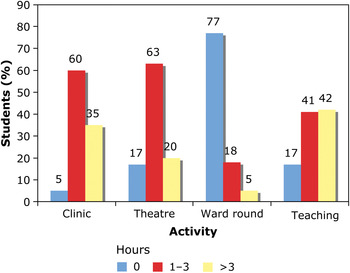
The clinical opportunities available during ENT placements are shown in Figure 1. Linked blind coding of schools and associated teaching hospitals facilitated anonymous representation and analysis.
Frequency of clinical exposure and teaching during ENT placements.

Responses from ENT consultants
Questionnaires were sent to 278 consultants at 57 teaching hospitals. The response rate of 64 per cent (179) represents 96 per cent (55) of teaching hospitals. One-hundred and sixty-three consultants (91 per cent, and representing 93 per cent (51) of teaching hospital ENT departments) offered an ENT placement.
Replies from different consultants at the same hospitals were generally concordant, although six departments returned replies stating that both an ENT attachment was and was not available. Of these, the majority response was considered accounting for 163 responses, and 54 departments offering a placement.
Of the 54 ENT departments offering a placement, 20 (37 per cent) offered only a mandatory placement, two (4 per cent) offered an optional placement only and 12 (22 per cent) offered both. In eight departments offering a mandatory placement ENT was taught in combination with other disciplines such as neurology, general surgery, chronic illness, disability, care of the elderly and respiratory medicine. Twelve departments did not specify whether the placement was optional or mandatory.
Of compulsory placements offered, the mean duration was 7.2 days (range 1–30, mode 10 days offered by 25 per cent (13) of departments followed by 5 days offered by 24 per cent (12) of departments, median 6 days). The mean duration of an optional placement was 28 days (range 10–60 days, mode 20 days, median 22.5 days).
Of consultants offering placements, 66 per cent (108) offered a placement following a request by the medical school, 26 per cent (43) were offered by the consultant and medical school in partnership and 5 per cent (eight) were offered primarily by the consultant. A total of 2.5 per cent (four) declined to answer.
Seventy-nine (48 per cent) consultants who responded designed the placement curriculum, 47 (29 per cent) were designed by both the consultant and the medical school and 31 (19 per cent) consultants followed medical school curricula. Eighteen consultants declined to answer.
Clinical exposure was dependent on the consultant questioned. In total 91 per cent of consultants offered operating theatre attendance, 98 per cent clinic attendance, 78 per cent formally taught students and 69 per cent taught clinical skills during the placement.
All consultants were asked if, in their opinion, newly qualified doctors were proficient in dealing with common ENT problems that do not require referral. Over three-quarters felt that they were not, but 13 per cent declined to answer or their answers were unclassifiable. Twenty-six consultants (15 per cent) also expressed the opinion that low proficiency levels were due to a lack of time devoted to ENT and that longer placements were required.
Discussion
The current survey results indicated that not all student respondents had received a formal ENT attachment. There was a 25 per cent decrease in the frequency of such student attachments, compared with 2004 survey results.Reference Mace and Narula7 The current survey indicated that an average placement lasted 8 days (which is a minor improvement compared with 7.4 days in 2004).Reference Mace and Narula7 One school did not include ENT in its curriculum at all.
Of the students who did undertake an ENT attachment, over one-third were dissatisfied, and many students suggested that longer placements were needed. Those students who did enjoy their placements expressed a wish to further their understanding. Students’ opinions are shown in Appendices 1 and 2.
At present, one-quarter of ENT placements are undertaken as part of a rotation, which includes other specialties such as neurology, geriatrics, respiratory medicine or surgery. However, otolaryngology is a separately recognised specialty with different pathologies and management. There remains great curriculum variability between schools, and also between teaching hospitals affiliated with the same medical school. Not all of our student respondents were able to attend ENT clinics, and almost one-fifth were not able to attend theatre, despite evidence suggesting that, for most students, theatre attendance helps students meet their learning expectations.Reference Lee, Montague and Hussain8
Although 96 per cent of major teaching hospitals were represented in the current study, it should be noted that representation was not 100 per cent. Thus, our respondents’ opinions may not reflect the view of the majority.
As over half of all recent UK medical graduates progress to careers within the community,2 a deficiency in undergraduate ENT teaching will have implications for those pursuing careers in general practice. A lack of undergraduate ENT exposure may also affect the choice to pursue a career in ENT. The National Health Service (NHS) is currently shifting the burden of patient follow up away from specialist consultations and towards community and out-patient care. Therefore, it is prudent for newly qualified doctors to be trained to manage ENT problems adequately.
These concerns are not new, and have been substantiated by previous studies.Reference Mace and Narula7, Reference Lund9 Educational exposure to ENT may be delivered at a postgraduate level. However, one study found that nearly half of junior doctors working in accident and emergency departments had received no postgraduate ENT teaching at all.Reference Sharma, Machen, Clarke and Howard10 This emphasises still further the need for satisfactory undergraduate teaching.
• There is widespread concern about inadequate provision of UK undergraduate ENT teaching
• In this study, nearly half of UK medical students had no compulsory ENT placement; many had no attachment at all
• The duration of UK ENT placements had changed little over the past seven years
• Students were dissatisfied with the provision and quality of ENT teaching
• Many ENT consultants considered newly qualified doctors to lack proficiency in handling basic ENT conditions that should be manageable in primary care
Some of our student respondents undertook their ENT placements in a general practice setting. Although this setting involves a significant ENT caseload, a comprehensive understanding of ENT is best gained through satisfactory departmental exposure. The GMC's Modernising Medical Careers initiative and the structure of specialty training both demand an early career focus. However, there is currently a low intake of junior trainees into ENT departments, and the specialty may not be attracting those with potential interest and suitable skills. The main factors affecting student career choice are career progression, on-call commitment and the experience of teachers as role models,Reference Ranta, Hussain and Gardiner11 and these cannot be appreciated without relevant exposure. There are also more medical schools now than 10 years ago and, together with a trend towards self-directed learning, this may be contributing to the waning representation of, and interest in, ENT.
We found that 15 per cent of ENT consultants recommend that longer attachments were necessary; some suggested that time allocated to students within their department (ranging from 3 to 10 days) was not enough; two consultants suggested that 20 days were needed. Realistically, this may be difficult to achieve.
One consultant suggests teaching would be best delivered at postgraduate level. Although ENT teaching given at postgraduate level is valued greatly by the few who receive it, as discussed above, some receive no formal teaching in ENT at all.Reference Sharma, Machen, Clarke and Howard10
One consultant commented that students may fail the ENT portion of the clinical examination yet still pass the year. In our study, all schools offering ENT placements did formally assess ENT in examinations. One must therefore consider if these shorter ENT attachments are increasingly assessment-orientated and not in concordance with the GMC's Tomorrow's Doctors ideal of lifelong learning.
Conclusion
Our recommendations to improve undergraduate ENT teaching are as follows.
First, there needs to be a substantial increase in the proportion of students undertaking ENT placements during their undergraduate training.
Second, due to medical school time constraints and curriculum demands, it may be difficult to extend the duration of ENT placements significantly. The limited time available must therefore be utilised efficiently.
Third, further study may be required both to ascertain the necessary core knowledge and skills that can be realistically acquired in a limited time period, and to inform subsequent curriculum appraisal.
Finally, we note that web-based learning modules can be readily accessed, for example via the ENT UK website. Many ENT procedures are conducted endoscopically or via an operating microscope, and thus could be easily recorded and used for Web-based teaching purposes. In addition, telemedicine learning resources are well received by students.Reference Gul, Wan and Darzi12 Thus, we would recommend the use of such resources.
Appendix 1. Student opinions on ENT placements
‘I didn't know what to expect. It was very brief with no teaching, really enjoyed the surgery!’
‘It was too brief!’
‘Needs more structure and repeat in 5th year.’
‘Didn't learn tracheostomy care or how to interpret audiograms.’
‘Felt despite clinic attendance my history skills were not practised.’
‘All we had was one morning in clinic and one afternoon in theatre. The staff were great and what I experienced was useful but there is a limit to what you can learn in such a short space of time.’
‘It wasn't an “attachment” as such as it was our [district general hospital] placement and all of us were either with other medicine or surgical firms; we had weekly teaching sessions by one of the ENT registrars, who was really good. But could have done with seeing more of the clinical side of things.’
‘I felt that it was not satisfactory and a longer placement could be held in place of project option in year 4.’
‘Clinic is heavily consultant/[specialist registrar] dependent. My guy was boring as hell.’
‘A brief overview, yes, but do not really feel that competent in the subject in a clinical setting.’
‘The attachment was far too quick, and the one scheduled clinic my group had, the consultant didn't show up until there were only 2 hours left. I don't think 2 hours observing in an ENT clinic is adequate preparation.’
‘Only one week placement as part of junior surgery – little time to take much from it.’
‘…I have so little experience of ENT.’
Appendix 2. Student opinions on considering ENT as a career
‘Not really, but hard to decide as lack of exposure.’
‘Would do, but little information seems to be available to medical students.’
‘We had such bad teaching in it at [the] hospital, although I would still consider it.’
‘If I was considering surgery then ENT would be one of my top choices.’
‘Great specialty; broad range of tissues and regions to operate on. Adults and children. Curative, palliative and life-improving. Good hours. ENT surgeons are lovely people.’