I. INTRODUCTION
Ferrite refinement has long been known for its unique role in increasing both strength and toughness of steel. The thermomechanically controlled processing developed from the combination of deformation and transformation (or heat treatment), which are the two basic means of solid state processing of steels, aimed to obtain fine grains and excellent comprehensive mechanical properties in steels.Reference Dong and Sun1 Generally, three types of controlled rolling exist, namely, austenitic recrystallization zone, austenitic nonrecrystallization zone, and dual-phase zone, which are distinguished by phase region. Furthermore, austenite refinement solely occurs via recrystallization without ferrite generation in the austenite recrystallization region, in which ferrite refinement by single-pass compression is insignificant. When the deformation is extended to the austenitic nonrecrystallization zone, the mechanism for ferrite refinement is strain-induced ferrite transformation (SIFT), and the temperature should be close to A r3. Briefly, the temperature region for ferrite refinement by SIFT is very definite. The ferrite refinement temperature range can be expanded by using deformation in the (γ + α) region.
The microstructure consists of untransformed austenite and pro-eutectoid ferrite in the dual-phase region; thus, warm deformation affects the austenite and ferrite. The manner of austenite deformation is the same as that for the nonrecrystallization region of austenite, and the recrystallization of deformed ferrite is preferred to nucleate at lattice defects, such as grain boundaries and deformation bands, thereby transformed into fine equiaxed ferrite.Reference Wang and Lei2–Reference Hurley and Hodgson4 The finer ferrite subgrains resulted in increased yield strength, as well as enhanced dislocation density during deformation in the dual-phase region. Various mechanisms for the ferrite refinement during warm deformation exist, such as SIFT, discontinuous dynamic recrystallization of ferrite (DDRX), and continuous dynamic recrystallization of ferrite (CDRX).Reference Beladi, Kelly, Shokouhi and Hodgson5–Reference Gourdet and Montheillet10 The dual-phase microstructure with a grain size of approximately 4–5 µm was obtained via SIFT in low-alloy steels, as described by Hong and Lee.Reference Hong and Lee11 Recently, Huang et al.Reference Huang and Froyen12–Reference Huang, Yang and Sun14 demonstrated that ultrafine ferrite grains (mean grain size of approximately 3 µm) can be achieved via heavy deformation in the ferrite and dual-phase regions of low-carbon steels based on DRX and deformation induced ferrite transformation (DIFT). Eghbali and Abdollah-zadeReference Abdollah-zadeh and Eghbali15 also investigated the mechanism of ferrite grain refinement in the low-carbon Nb-microalloyed steel by warming torsion between A r1 and A r3, they concluded that the ferrite refinement mechanism was CDRX.
When deformation occurred in the dual-phase region below A r3, the probability of producing coarse irregularly shaped dendrite pro-eutectoid ferrite increased, which resulted in a hard-to-control microstructure. Hence, limited evidence exists for the ferrite refinement in the low-temperature zone of the dual-phase region. In the present study, warm compression deformation in the (γ + α) region was conducted on the Cu–P–Cr–Ni–Mo weathering steel by Gleeble 3500 simulator (St. Paul, MN) with a constant strain rate of 0.01 s−1 to analyze the mechanism of ferrite grain refinement and microstructure evolution via optical microscopy and electron backscatter diffraction (EBSD). Such research on ferrite grain refinement mechanism during warm compression provided a theoretical basis for the formulation of a controlled rolling process in dual-phase steels.
II. EXPERIMENTAL PROCEDURE
The material used in this experiment was a self-designed Cu–P–Cr–Ni–Mo weathering steel with the following composition (mass fraction, %): 0.10C, 0.45Si, 0.42Mn, 0.008S, 0.075P, 0.65Cr, 0.22Ni, 0.28Cu, and 0.43Mo. The phase-transformation temperatures of A r3 and A r1 were 865 and 734 °C, respectively. The experimental steel was melted in a 200 kg vacuum induction furnace, forged into a 21 mm-thick square rod, and normalized for 2 h at 970 °C to meet the performance requirement. The forged square rod was cut into axial compression specimens of Φ10 mm2 × 15 mm2 to promote homogeneous deformation.
The specimens were reheated to 1150 °C with a heating rate of 10 °C·s−1 for 5 min in the vacuum chamber of a Gleeble 3500 simulator under an argon atmosphere, followed by cooling at a rate of 5 °C·s−1 to the various designed deformation temperatures (850, 800, 775, and 750 °C), then held for 5 s to homogenize the temperature throughout the samples. The two types of deformation schedules used in this study were named schedule-1 and schedule-2. In schedule-1, the samples were deformed by a single pass with a strain of 1.2 and strain rate of 0.01 s−1 at different temperatures, followed by water quenching. In schedule-2, the samples were initially cooled to the deformation temperature of 750 °C at 5 °C·s−1 and then isothermally deformed with a single-pass strain of various amounts at a strain rate of 0.01 s−1 before water quenching.
All the specimens were observed from the center section in the longitudinal plane, which was parallel to the direction of compression. The observed microstructures were etched with 4 vol% nital after the specimens were polished using standard metallographic procedures. The evolution of microstructure and grain boundary misorientation during the simulated warm-rolling process was investigated by EBSD. The samples for EBSD were electrochemically polished using a polishing solution containing 10% HClO4 + 5% C3H8O3 + 85% C2H5OH for approximately 3 s at 18 V.
III. RESULTS AND DISCUSSION
A. Effect of strain on evolution of microstructure and misorientation
1. Microstructure evolution
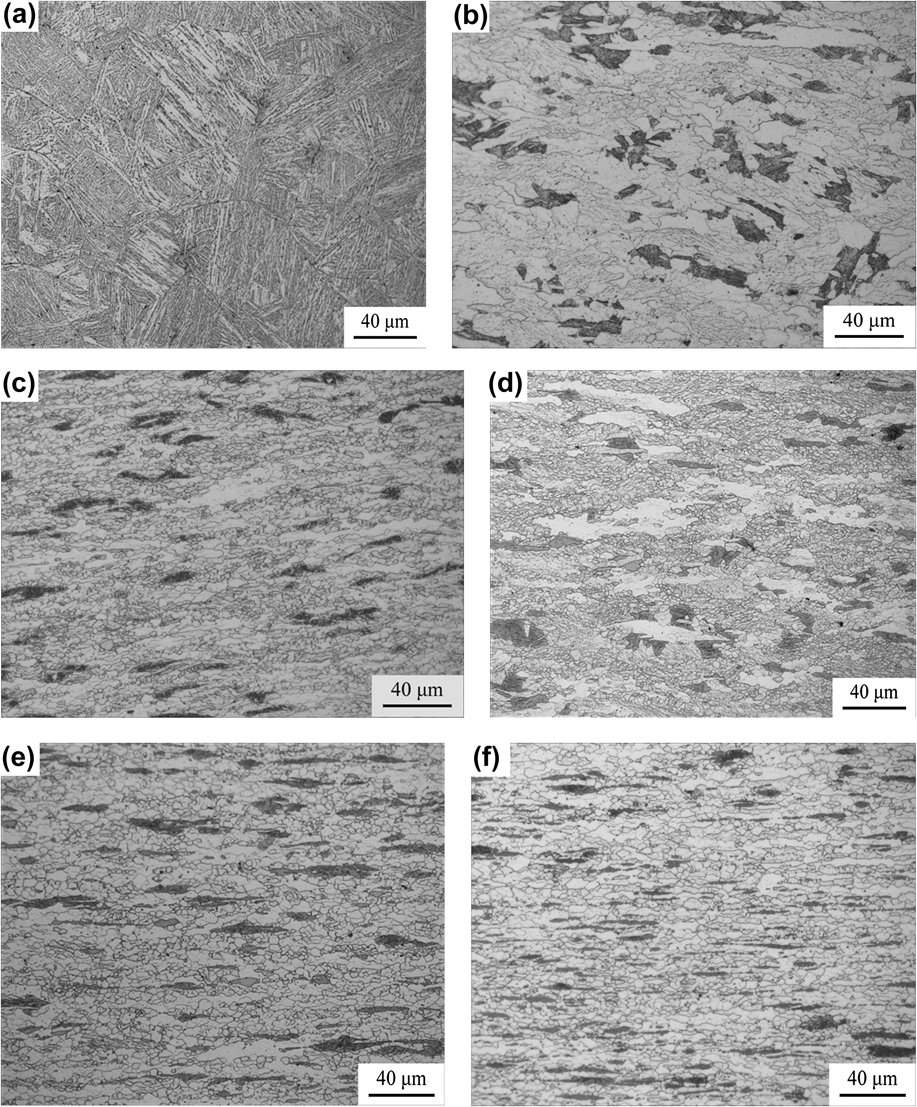
Figure 1 shows the microstructure evolution of ferrite at different strain levels during warm deformation at 750 °C with a strain rate of 0.01 s−1. With increasing strain, the volume fraction of the transformed ferrite clearly increased, whereas the ferrite grain size decreased. What can be seen in Fig. 1(a) is a martensite structure that corresponds to the high temperature austenite after quenching. Thus, the strain was entirely imposed on the austenite phase at the beginning of deformation. At the strain of 0.36, a large amount of pro-eutectoid ferrite developed along the prior austenite boundaries; the microstructure was mixed with few equiaxed fine ferrite grains formed at the elongated ferrite grain boundaries, martensite, and numerous elongated ferrite grains with many substructures; finally, the transformed ferrite volume fraction reached approximately 75% [Fig. 1(b)]. These results may be attributed to the increase of dislocation density at the defect sites, where ferrite nuclei were preferentially formed during deformation. By contrast, deformation at 750 °C, which was above A r1, showed a tissue with a large chemical force for phase transformation. Thus, with the increase in strain, the stress became more prone to concentrate on the ferrite phase than on the austenite. Many deformed ferrite grains with substructures were also developed. A further increase in the strain up to 0.69 resulted in numerous fine equiaxed ferrite grains in the elongated ferrite matrix with a mean grain size of approximately 1.4–3 μm [Fig. 1(c)]; the ferrite fraction increased to approximately 87%. Moreover, most of the grain boundaries did not remain straight, suggesting proliferation by bulging of original ferrite grain boundaries. However, elongated regions without equiaxed ferrite grains existed, which presumably corresponded to the new transformation of ferrite from austenite. As the strain increased to 0.91, 1.2, and 1.4, considerably finer equiaxed ferrite grains arranged in the deformed ferrite matrix in chain type; furthermore, the number of equiaxed ferrite grains increased, and the ferrite volume fraction increased slightly [Figs. 1(d)–1(f)].
Microstructures of experimental steel warm deformed at 750 °C at a strain rate of 0.01 s−1 to different strains: (a) 0; (b) 0.36; (c) 0.69; (d) 0.91; (e) 1.2; (f) 1.4.

The formation of ferrite from austenite depended on the following two factorsReference Hong and Lee11: first, the driving force of phase transformation resulted from subcooling, which depended on the difference between the phase transformation temperature A r3 and deformation temperature; second, the stored energy determined by the deformation which led to the destabilization of austenite. Both factors accelerated the transformation of austenite to ferrite at the deformation temperature of 750 °C. Moreover, the ferrite fraction increased with increasing strain at the early stage at 750 °C, and the transformation fraction of ferrite subsequently reached an equilibrium state with a certain strain, such as 0.69 [Fig. 1(c)]. As the strain further increased, the ferrite instead of the austenite was subjected to more strain, leading to the easier dynamic recovery of ferrite than austenite under the same condition. The occurrence of numerous deformation defects in ferrite, such as deformation bands, can be ascribed to the large deformation, thus resulted in considerably more substructures introduced into ferrite grains and promoted the formation of ferrite preferential nucleation sites. As the deformation energy is reached the level of the recrystallization activation energy, fine equiaxed recrystallization ferrite grains can be obtained along the transformed ferrite grain boundaries and deformation bands. Furthermore, the deformation temperature of 750 °C, which was above A r1, belongs to the low-temperature (γ + α) region and resulted in small critical nucleation size of the ferrite. Finally, numerous fine equiaxed recrystallization ferrite grains formed as the strain is further increased.
B. EBSD analysis
Figure 2 shows the typical sections of the boundary misorientation maps for the ferrite phase obtained from the EBSD data of the tested warm-deformed steel with various strains at 750 °C and at a constant strain rate of 0.01 s−1. In the boundary maps, the grain boundaries are distinguished by three colors based on the misorientation angle (θ). The dark lines refer to misorientation angles greater than 15°, whereas the red and green lines represent the low-angle boundaries (LABs) of 7° < θ ≤ 15° and 2° < θ ≤ 7°, respectively. Several LABs were introduced into the elongated ferrite grains, and the high-angle boundaries (HABs) were as many as LABs at a strain of 0.69 [Fig. 2(a)]. As the strain is increased to 0.91, LABs decreased slightly rather than increased [Fig. 2(b)]. The original grains were subdivided by the formation of LABs; thus, many subgrains existed in the ferrite grains, which formed new grains with HABs. When the strain increased to 1.2, very fine equiaxed ferrite grains surrounded by HABs were generated along the initial ferrite grain boundaries, indicating that these fine grains were formed by fragmentation of the initial grains [Fig. 2(c)]. The HABs and a large fraction of fine grains indicated the presence of ferrite via CDRX at the strain of 1.2. The stacking fault energy of ferrite was high; thus, the strain accumulated in the softer ferrite instead of the harder austenite during deformation, which promoted the possible presence of ferrite via CDRX.Reference Huang and Froyen12,Reference Najafi-zadeh, Jonas and Yue16 The fragmentation of grains resulted from the activation of different slip systems and deformation coordination. At this stage of deformation, the microstructure was heterogeneous, consisting of considerably fine equiaxed ferrite grains and few relatively coarse grains. Moreover, many incomplete HABs within the large ferrite grains existed. When the strain is increased to 1.4, the volume fraction of HABs increased as a result of the shift of LABs to HABs.
Evolution of LABs (2° < θ ≤ 7°, red lines, and 7° < θ ≤ 15°, green lines) and HABs (15° < θ, dark lines) of ferrite warm deformed to different strains at 750 °C with a strain rate of 0.01 s−1: (a) 0.69; (b) 0.91; (c) 1.2; (d) 1.4.
Figure 3 reveals the distributions of misorientation angles between the ferrite grains calculated from EBSD results. The angle distribution of the misorientation of ferrite grain boundaries showed that numerous LABs were clearly introduced in the ferrite grains when the ferrite transformation reached a certain value [Fig. 3(a)] as the ferrite grain cluster with LABs formed along the original austenite grain boundaries, and briefly, the contribution of LABs to the total distribution was as many as HABs at approximately 48.04% [Fig. 3(a)]. What seen from the misorientation distribution plots is the change in the percentage of LABs, this does not necessarily mean that no LABs are formed in the ferrite grains, the fraction of LABs decreased slightly instead when the ferrite transformation reached 0.91 [Fig. 3(b)] because of the rearrangement and disappearance of dislocations in ferrite grains. Thus, a percentage of approximately 3.5% LABs with smaller misorientation was vanished. Conversely, the fraction of high-angle misorientation boundaries increased when the strain is increased to 0.91 [Fig. 3(b)]. Notably, the misorientation of subgrains gradually decreased with an increase in the deformation, and some LABs shifted to HABs when the strain was 1.2 [Fig. 3(c)]. Thus, the main part of the misorientation distribution shifted to higher misorientation angles between 15° and 60° [Fig. 3(d)]. Normally, the grains with HABs remain fine ferrite grains, whereas the grains with LABs coalesce and form bigger grains. Thus, ferrite grains that were dynamically formed from mainly HABs were relatively stable against coarsening if the ferrite grains with HABs.
Distribution of misorientation angles in ferrite deformed to different strains at 750 °C with a strain rate of 0.01 s−1: (a) 0.69; (b) 0.91; (c) 1.2; (d) 1.4.
C. Effects of temperature on microstructure evolution and misorientation
1. Microstructure
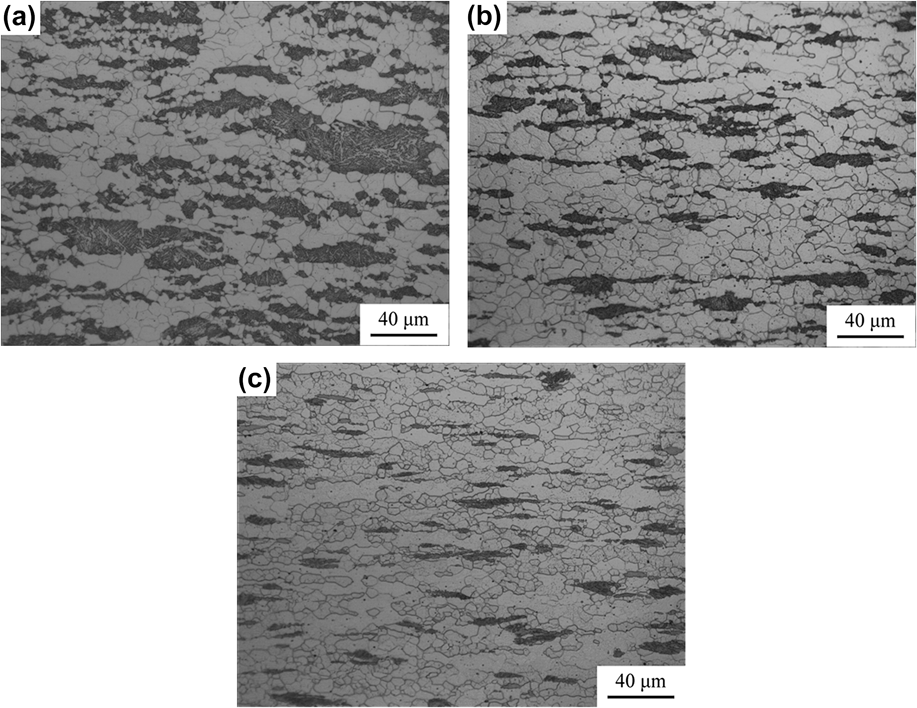
Figure 4 shows the microstructures obtained at different deformation temperatures with a strain of 1.2 and a strain rate of 0.01 s−1. Microstructures with a significant discrepancy determined by the deformation temperatures within the (γ + α) region were revealed. At 850 °C, which was below the A r3, the equiaxed and inhomogeneous ferrite grains were obtained with a transformed fraction of approximately 65%, and the average grain size of the ferrite was approximately 7.2 μm. The occurrence of equiaxed ferrite grains can be attributed to the SIFT of austenite to ferrite.Reference Eghbali and Abdollah-zadeh17,Reference Kim, Kim, Lim and Kim18 After deformation at 800 °C, the mixed microstructure consisted of equiaxed ferrite, deformed ferrite with substructures, and deformed austenite [Fig. 4(b)]. In this case, the transformed ferrite fraction was approximately 80%. As the temperature decreased to 775 and 750 °C, which were above the A r1, finer equiaxed ferrite grains were generated at the grain boundaries of the deformed ferrite [Figs. 4(c) and 1(e)]. The grain size of the new equiaxed ferrite was approximately 1.4 μm, and the volume fraction of the ferrite reached approximately 88%. Generally, a decreased temperature resulted in an increased chemical driving force. Metallographic analysis showed that with the decrease in deformation temperature, the volume fraction of ferrite transformation increased; conversely, when the grain size of the ferrite is decreased, the distribution of the ferrite grain size was heterogeneous.
Microstructures of experimental steel warmed deformed to a strain of 1.2 at a strain rate of 0.01 s−1 at different temperatures: (a) 850 °C; (b) 800 °C; (c) 775 °C.
D. EBSD analysis
Figures 5 and 6 show the boundary misorientation maps and misorientation angle distributions of ferrite phase obtained from the EBSD data at various temperatures ranged from 850 to 750 °C, with a strain of 1.2 and a strain rate of 0.01 s−1. The boundary misorientation maps showed that several LABs were generated in individual ferrite grains at 850 °C [Fig. 5(a)]. LABs located in the austenite grains and formed subgrains can be observed at 850 and 800 °C, which led to the subdivision of grains and dynamic transformation of SIFT [Figs. 5(a) and 5(b)]. As the deformation temperature decreased, more HABs were introduced into the ferrite grains, and the size of the subgrains and LABs further decreased [Figs. 5(b), 5(c), and 2(c)]. Moreover, the distribution of misorientation angles indicated that the fraction of LABs gradually decreased with the decrease in temperature from 44% at 850 °C to 32% at 750 °C [Figs. 6(a)–6(c) and 4(c)]. Namely, some LABs shifted to HABs as temperature declined and indicated the occurrence of CDRX.
Evolution of LABs (2° < θ ≤ 7°, red lines, and 7° < θ ≤ 15°, green lines) and HABs (15° < θ, dark lines) of ferrite warm deformed at different temperatures to a strain of 1.2 and at a strain rate of 0.01 s−1: (a) 850 °C; (b) 800 °C; (c) 775 °C.
Distribution of misorientation angles in the ferrite of warm deformed samples at different temperatures with a strain of 1.2 and a strain rate of 0.01 s−1: (a) 850 °C; (b) 800 °C; (c) 775 °C.
Three different mechanisms for the refinement of ferrite grains during warm deformation exist as follows: (i) SIFTReference Beladi, Kelly, Shokouhi and Hodgson5,Reference Santos, Bruzszek, Rodrigues and Pereloma6 , (ii) DDRX,Reference Tsuji, Matsubara and Saito7 and (iii) CDRX.Reference Song, Ponge, Raabe and Kaspar8–Reference Gourdet and Montheillet10 At 750 °C, which was below the A r3 but above the A r1, the ferrite grains were the dominant microstructure at the strain of 0.69 [Fig. 1(c)]. Presumably, SIFT can be ruled out, and dynamic recrystallization was responsible for the ferrite refinement. Discontinuous dynamic recrystallization involved nucleation and growth of new grains within the original ferrite via the bulging of grain boundaries was generally observed in low and middle stacking-fault energy materials, such as Cu, austenite, Ni, and stainless steels. In high stacking-fault energy materials, dynamic recovery is considered as the only operating mechanism.Reference Najafi-zadeh, Jonas and Yue16,Reference Gao, Xu, Song and Xia19 However, the DRX of ferrite has been found to occur in highly pure irons, interstitial-free steels,Reference Najafi-zadeh, Jonas and Yue16 ferrite stainless steel,Reference Gao, Xu, Song and Xia19 and low-carbon steels deformed in the dual-phase region. To date, no evidence can confirm that the new equiaxed ferrite subgrains were generated by DDRX. Thus, in the present study, DDRX can be ruled out.
Some previous investigations discovered that the CDRX of ferrite can occur in high stacking-fault energy materials. The CDRX is a phenomenon in which misorientation across sub-boundaries of ferrite continuously increases when the amount of strain is increased until the sub-boundaries change to HABs to subdivide the ferrite grains.Reference Gourdet and Montheillet9 The optical microstructures showed that equiaxed fine ferrite generated in the deformed ferrite grains at a strain of 0.69 [Fig. 1(c)]. Moreover, the fraction of equiaxed fine ferrite grains increased with deformation. EBSD analysis indicated that many LABs were introduced in the deformed ferrite at the strain of 0.69 [Figs. 2(a) and 3(a)]; with further increase in the strain, LABs shifted to HABs, which led to ferrite grain refinement. Thus, heavy deformation in the dual-phase region (e.g., 750 °C) resulted in the CDRX of the deformed ferrite. Furthermore, as the temperature is decreased, the ability of CDRX was strengthened.
IV. CONCLUSIONS
Optical microstructures and EBSD analysis showed that when the strain was over 0.69 with a strain rate of 0.01 s−1 at 750 °C, the transformation fraction of ferrite slightly increased, whereas the volume fraction of equiaxed ferrite grains quickly increased, and the newly formed fine equiaxed ferrite grain size reached approximately 1.4–3 μm. Moreover, the LABs of ferrite continuously decreased with increasing strain and the LABs shifted to HABs. Thus, the ferrite can be refined by grain fragmentation during warm compression, and the main mechanism of ferrite refinement was CDRX.
With the decrease in deformation temperature from 850 to 750 °C, the amount of the transformation fraction of ferrite increased, whereas the grain size of the ferrite decreased. However, the distribution of ferrite grain size was heterogeneous. At high temperature of the dual-phase region (e.g., 850 and 800 °C), several LABs were introduced into the austenite grains and forming subgrains. Subsequently, the subgrains gradually formed grains, which led to the subdivision of grains and dynamic transformation of SIFT. As the deformation temperature decreased to the low-temperature zone (e.g., 775 and 750 °C), the large number of HABs and fine equiaxed ferrite grains suggested the CDRX of the ferrite. Furthermore, with the decrease in deformation temperature, the ability of CDRX was improved. Therefore, CDRX was responsible for ferrite grain refinement in the (γ + α) region.
Supplementary Material
To view supplementary material for this article, please visit http://dx.doi.org/jmr.2015.231.
ACKNOWLEDGMENTS
This work was supported by the National Natural Science Foundation (Grant No. 51104130) and the Natural Science Foundation of Hebei Province (Grant No. E2012203137), P.R. China.