1 How morphologically conditioned is Dene phonology?
Dene (Athabaskan) languages, as they have been traditionally described (e.g. Hoijer Reference Hoijer1946, Li Reference Li1946), are assumed to exhibit massive amounts of morphological conditioning in their phonological grammars. In American Structuralist descriptions of Dene languages, it was often assumed, albeit implicitly, that the distribution of phonological elements was grammatically determined – this in spite of the principle of the separation of levels (Howren Reference Howren1979: 11–12). With the advent of generative phonology, this morphological conditioning was made explicit, with morphological information built directly into the conditioning environment of phonological rules (Howren Reference Howren1968, Reference Howren1979, Coleman Reference Coleman1976, Hargus Reference Hargus1988). The most extreme examples of morphological conditioning proposed in the Dene literature centre around two conjugation markers, /s/ and /n/, whose morphophonemics are particularly complex, because they carry with them a floating tone to their immediate left (Rice & Hargus Reference Rice, Hargus, Cook and Rice1989). Some previous descriptions of these conjugation markers are illustrated by the following quotations:
Further checking is required on the wh perfectives, especially the third plural and first person plural/indefinite forms. The low tone which results from deletion of the perfective prefix at a conjunct boundary does not always appear. Also, where more than one prefix precedes the perfective marker, low tone or stress sometimes appears on the second syllable to the left of the mode in non-third person forms (Ackroyd Reference Ackroyd1982: 116).
In short, the conjunct form of the- is either zero as in the forms with a local subject or H(h)- as in the forms with a non-local subject, where h- (which derives from the-) is subject to deletion by another constraint, i.e. *CCC (prohibition of a tri-consonantal sequence) (Cook Reference Cook2004: 159).
If these statements are taken literally as descriptions of phonological processes, these would be quite unusual from a typological perspective. The kind of morphological conditioning exemplified above finds formal expression either in theories which allow the morphology to manipulate phonological material directly (Anderson Reference Anderson1992, Stump Reference Stump2001, Reference Stump2016) or in those in which each phonological construction may be associated with its own distinct cophonology (Inkelas Reference Inkelas1998, Reference Inkelas2014, Inkelas & Zoll Reference Inkelas and Zoll2007).
As they are described in the literature, the behaviour of the Dene /s/ and /n/ conjugations would seem to be one of the most extreme cases of ‘interdependence of grammar and phonology’ (Howren Reference Howren1979: 12) ever reported. However, the fact that morphological conditioning has been used extensively in the description of Dene languages does not constitute proof that it is required. One striking feature of these previous descriptions, which rely so heavily on morphological conditioning, is that they make little or no use of much of the representational apparatus of modern generative phonology – including autosegmental phonology (Goldsmith Reference Goldsmith1976), metrical phonology (Hayes Reference Hayes1995) and level ordering (Kiparsky Reference Kiparsky2000). Once the full descriptive power of this apparatus is applied to the problem of the /s/ and /n/ conjugations, the need for most types of morphological conditioning disappears. This observation is formulated explicitly as the hypothesis in (1).
-
(1)


Hypotheses similar to the Domain Reference Hypothesis have been proposed previously in the literature on the phonology–syntax interface (Selkirk Reference Selkirk1984, Kaisse Reference Kaisse1985, Hayes Reference Hayes, Inkelas and Zec1990). According to the Domain Reference Hypothesis, phonological constraints may refer to morphological domains such as ‘base’ or ‘affix’ (see §2.4), as well as the edges of these domains, as in the literature on Generalised Alignment (McCarthy & Prince Reference McCarthy, Prince, Beckman, Dickey and Urbanczyk1995). The kinds of morphological information to which the phonology does not have access, according to the hypothesis in (1), are morphosyntactic features such as ‘3rd person’ or ‘perfective’, as well as parts of speech. For example, a phonological constraint such as *Coda3person (‘no syllable coda in the 3rd person’) is not allowed, according to (1). By phonological constraint, we mean any constraint which operates in the phonological component of the grammar, and refers to phonological material.
In arguing for (1), we are not claiming that all alternations which are observed in morphological paradigms must be derived in a language's synchronic phonology. In some, there are principled reasons why a certain alternation must instead be assigned to the historical phonology of a language. In §7, we will examine such a case, and treat it as lexically listed allomorphy. The result is that the Domain Reference Hypothesis limits phonological abstractness: any alternation which cannot be derived without morphological conditioning must be treated as lexically listed allomorphy.
Unless otherwise specified, all data in this paper are taken either from Jaker & Cardinal (Reference Jaker and Cardinal2020)Footnote 1 or from the first author's unpublished fieldnotes. Our in-depth analysis and case study of the reflexes of the /s/ and /n/ conjugations in Tetsǫ́t’ıné (the /θe/ and /ɲe/ conjugations respectively) leads to our main empirical claim: what appears to be an extreme case of morphologically conditioned phonology is actually just a somewhat more complex than usual case of phonological opacity, resulting from the layered, polysynthetic prefixing morphology of the language, upon which is superimposed a simple left-to-right iambic stress system.
All of the major analytic tools we will be using in our analysis have been argued for previously in the literature on independent grounds. Iambic stress systems are well-known (Hayes Reference Hayes1995), as is the observation that H tone should be aligned with metrical stress (de Lacy Reference de Lacy2002, Reference de Lacy and Lacy2007). Consonant deletion conditioned by metrical structure has also been previously proposed (González Reference González2003). Level ordering has a long history in phonology (Kiparsky Reference Kiparsky1982, Reference Kiparsky1985, Reference Kiparsky2000, Mohanan Reference Mohanan1986), and previous work on Dene languages in a Lexical Phonology framework has argued that either four (Rice Reference Rice1989, Jaker Reference Jaker2012) or five (Hargus Reference Hargus1988) lexical levels are required. Our proposal is perhaps novel in that we employ all of these analytic devices simultaneously. What is unusual about Tetsǫ́t’ıné is probably just the complexity of its layered morphology: phonological processes, while transparent at the stratum at which they apply, are often rendered opaque on the surface, buried beneath subsequent layers of affixation. Probably for this reason, they have until now largely escaped the attention of phonologists and descriptive linguists working on Dene languages.
In order to provide proof for the Domain Reference Hypothesis, in principle one should examine every example of morphologically conditioned phonology that has been proposed in the literature, and propose an alternative analysis that respects the hypothesis. This would obviously be rather impractical. Instead, we choose to focus here on a single case, one which would seem to require extensive morphological conditioning, and show that, using Stratal OT, morphological conditioning is not required. We suggest that other, less extreme, cases of morphological conditioning which have been proposed in the literature could be dealt with in a similar way. While maintaining the Domain Reference Hypothesis requires us to use several types of representational devices – autosegmental phonology, metrical phonology and, most importantly, strata – all of these are independently motivated in the literature. Furthermore, we consider the Domain Reference Hypothesis to be theoretically desirable a priori: a theory which allows phonological constraints to refer only to phonological material is typologically much more restrictive than one which allows unconstrained reference to morphosyntactic features.
The remainder of this paper is organised as follows. In §2 we provide background on the Stratal OT model as it relates to the Dene verb, while in §3 we provide background on Tetsǫ́t’ıné. §4–§6 constitute the core of our analysis. In §4 we examine stress–tone interactions, in §5 we analyse foot-medial consonant deletion and in §6 we provide an account of the directionality of tone mapping. In §7 we propose criteria by which some alternations must be regarded as lexically listed allomorphy, and in §8 we return to the question of morphologically conditioned phonology.
2 Stratal Optimality Theory
In this section, we provide background on the Stratal OT model (Kiparsky Reference Kiparsky2000), as it relates to our analysis. We choose to present our formal model before considering the data because many of the descriptive generalisations in §4–§6 require reference to level ordering.
2.1 Stratal OT and the Dene verb
Dene languages are traditionally described using a formal ordering device called a template (Rice Reference Rice2000). In this model, each prefix contains, as part of its lexical entry, information about the linear position to which it belongs. In the version of this model proposed for Slave (Rice Reference Rice1989), the verb consists of a root near the right edge, followed by a single suffix position and preceded by 13 prefix positions, as shown in (2).
-
(2)

There is strong evidence, from a phonological perspective, that the positions in (2) are arranged into some kind of hierarchical structure, with prefixes added outwards from the root, in successive layers. The first to note this was Li (Reference Li1946), who coined the terms ‘conjunctive’ and ‘disjunctive’ to describe different groups of prefixes. This distinction between conjunct and disjunct prefixes in the Dene linguistics literature corresponds, loosely, to the Stem level ~ Word level distinction in Lexical Phonology.
Later analyses of the phonological structure of the Dene verb in terms of Lexical Phonology include Rice (Reference Rice1989) and Hargus (Reference Hargus1988), who show that the phonological structure of the Dene verb consists of more levels than just the Stem level and Word level assumed for many other languages (see also Mohanan Reference Mohanan1986 for a proposal with multiple levels). In fact, a total of five levels are proposed by Rice (Reference Rice1989) for Slave, five by Jaker (Reference Jaker2012) for the Wıìlıìdeh dialect of Tłı̨chǫ and six by Hargus (Reference Hargus1988) for Sekani: five lexical levels (1–5) as well as the Postlexical level. Hargus (Reference Hargus1988: 74) attributes this unusually complex phonological structure to the highly complex nature of Dene verbal morphology:
The biggest difference between the lexical phonologies of Athabaskan [Dene] languages and those of other languages is thus that more lexical levels are required in Athabaskan languages than are usually found in other languages. However, this is a natural extension of the model, not a forced departure from it. Moreover, it is an understandable departure, given the complexity of Athabaskan morphology.
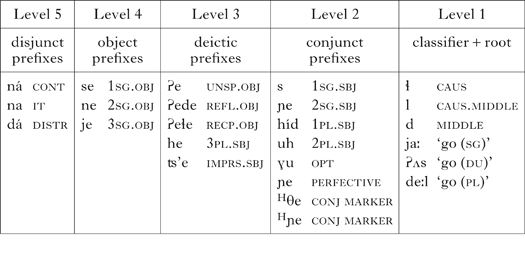
The order of morphemes in the Dene verb, and the selection and blocking relations which exist between template positions, pose a challenge for nearly all generative models of morphology and syntax (Rice Reference Rice2000). In this paper, we will not address the issue of how discontinuous morphological dependencies within the template in (2) can be accounted for within a Lexical Phonology framework (see Jaker et al. Reference Jaker, Welch, Rice, Siddiqi, Barrie, Gillon, Haugen and Mathieu2020), although we suggest that these may be accounted for by restrictions on semantic compatibility. Here, we will merely point out that template positions with similar function tend to be grouped together. A consequence of this is that the set of prefixes contained within each level seem to form morphological natural classes, at least to some extent. For example, Level 1 prefixes contribute voice/valence information, and Level 2 prefixes contribute subject agreement and aspect. It has been proposed that the Level 3 prefixes contribute number agreement (Rice & Saxon Reference Rice and Saxon1994), Level 4 prefixes contribute object agreement and Level 5 prefixes add lexical and adverbial information (Jaker et al. Reference Jaker, Welch, Rice, Siddiqi, Barrie, Gillon, Haugen and Mathieu2020), as in (3).Footnote 2
-
(3)
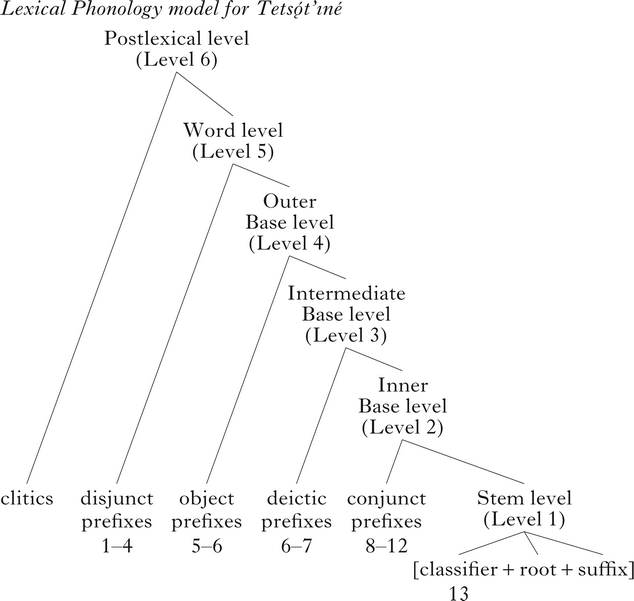
Prefixes are assigned to levels on the basis of two main sets of criteria. The first criterion is linear order: prefixes belonging to earlier levels occur closer to the root than prefixes belonging to later levels. The second criterion is participation in phonological processes. All other things being equal, a Level 1 prefix will participate in all Level 1–6 phonological processes, a Level 2 prefix in all Level 2–6 processes, but not those of Level 1, a Level 3 prefix in all Level 3–6 processes, but not those of Levels 1–2, etc. Example of prefixes assigned at the various levels in our model are given in Table I.
Examples of prefixes introduced at Levels 1–5 (Jaker & Cardinal 2020: ch. 5).

2.2 Stratal OT and phonological variation
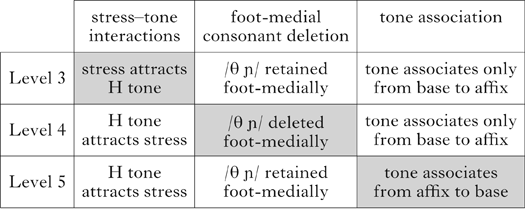
Within the Stratal OT literature, the extent to which the ranking of phonological constraints must be constant across levels is an open question (see Kaplan Reference Kaplan2020 for discussion). In the case of Tetsǫ́t’ıné, most of the constraint rankings are in fact the same across all levels: all levels of the phonology are largely identical in their segmental inventory, syllabification and patterns of syllable weight, and all levels exhibit a generally left-to-right iambic stress pattern. In this paper, however, for presentational purposes, those constraint rankings which are constant across all levels of the phonology are largely ‘factored out’ of the analysis; candidates which violate these basic rankings will not be considered in the tableaux below. Instead, we will focus on those constraint rankings which vary across levels, especially where such reranking results in phonological opacity. In particular, we will focus on three dimensions of phonological variation across levels: stress–tone interactions, foot-medial consonant deletion and tone association. These three dimensions of variation are summarised in Table II. Due to space constraints, we restrict the scope of our analysis to Levels 3–5.
Phonological variation across levels in Tetsǫ́t’ıné.

Based on Table II, we can see that there is evidence for what might be described as at least three different cophonologies within the same language: each of these levels exhibits unique phonological behaviour, with respect to some phonological process. However, the processes in Table II also interact serially with respect to one another: processes at later levels may render processes at earlier levels opaque. This combination of cophonological variation and phonological opacity suggests the need for a model with multiple grammars which are serially ordered with respect to one another, such as is found in Stratal OT.
2.3 Stratal OT and phonological opacity
Stratal OT also provides a theory of phonological opacity. It allows for constraints to be ranked differently at different levels, and this reranking of constraints across levels can give rise to phonological opacity – indeed, we claim that this is the only source of opacity in phonological grammars (Kiparsky Reference Kiparsky2000). A corollary of this claim is that phonological processes within a given level are predicted to always interact transparently.
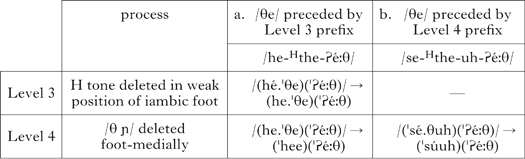
If we combine this claim about opacity with the assumptions regarding the relationship between phonological and morphological structure described in §2.1, we also predict a relationship between opacity and morphological structure. In the case of two phonological processes, A and B, where A takes place at Level n and B takes place at Level n + 1, we predict that only an affix belonging to Level n could be subject to an opaque interaction between A and B. To illustrate, we will anticipate an example from later in this paper: the opaque interaction between foot-medial consonant deletion and H-tone deletion. At Level 3, H deletes in the weak position of an iambic foot, while at Level 4, the consonants /θ/ and /ɲ/ delete foot-medially. This is illustrated in Table III with the examples (ˈhee)(ˈɁéːθ) ‘they kicked’ and (ˈsúuh)(ˈɁéːθ) ‘you (pl) kicked me’.Footnote 3 Recall that /he/ (3pl.sbj) is a Level 3 prefix, while /se/ (1sg.obj) is a Level 4 prefix.
Opaque interaction of H-tone deletion and foot-medial consonant deletion.

In (a), H-tone deletion overapplies on the surface, because the later process of foot-medial consonant deletion has removed its conditioning environment. Specifically, the vowel from which H was deleted is no longer in the weak position of an iambic foot. In (b), on the other hand, H-tone deletion does not apply at all, because /se/ is a Level 4 prefix, which does not enter the derivation until after H-tone deletion has been ‘turned off’. Rather, there is only one process, foot-medial consonant deletion, which applies transparently. This example serves to illustrate that Stratal OT predicts when and where instances of opaque phonological interaction will be found, based on morphological structure. Thus Stratal OT provides a unified theory of word formation and phonological opacity. We also note here that, in the absence of level ordering, the examples in Table III would require morphological conditioning: we would have to say that H-tone deletion occurs with the prefix /he/ and similar prefixes, but not with /se/ and similar prefixes.
2.4 Stratal OT and modularity
In (1), we claimed that the only morphological entities to which phonological constraints may refer are domains and domain edges. In this section, we will clarify exactly which morphological domains are assumed to exist under a Stratal OT model. We begin with the definitions of ‘affix’ and ‘base’ in (4).
-
(4)

This distinction between affix and base is similar to the well-established distinction between stem and affix adopted in the literature on positional faithfulness (Beckman Reference Beckman1998), the difference being that, in a Stratal OT model with more than three levels, the base is not necessarily a stem, but could be the output of any of Levels 1 to 5 of the phonology, becoming part of the input to a later level.
At any given level of the phonology, we assume that any affixes which are introduced at that level are separated from the base by a morpheme boundary, and that the phonology may refer to these morpheme boundaries, as well as to whether a morphological constituent is part of an affix or the base. After the phonological evaluation for that level has been completed, however, internal morphological boundaries are (by default) erased by the Bracket Erasure Convention (Pesetsky Reference Pesetsky1979). More precisely, we adopt the definition of Conditional Bracket Erasure in (5), based on Hargus (Reference Hargus1988: 249). In our definition, a label is a special index added to a set of brackets, which indicates the level at which these brackets entered the derivation.
-
(5)

The reason that bracket erasure needs to be conditional is that there is evidence in Dene languages that the stem boundary is an exception to bracket erasure (Hargus Reference Hargus1988: 248–249).Footnote 4 Formally, this means that the external brackets assigned at the end of Level 1 carry a special index [ ]1, which protects them from being erased at subsequent levels. An illustration of how bracket erasure works in our model is given in (6), using the examples (ˈɬá.se)(ˈhĩĩɬ)(ˈθər) ‘they killed me’, which contains prefixes at Levels 1, 2, 3, 4 and 5, and (se.ˈhe)(neɬ.ˈʃeː) ‘they raise me’, which has prefixes at Levels 1, 2, 3 and 4. In these examples, numerical subscripts indicate the level to which each prefix belongs. Superscript H represents a floating H tone.
-
(6)
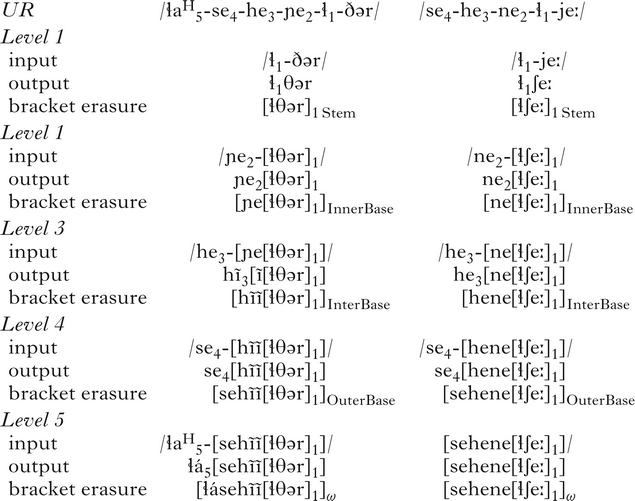
As illustrated in (6), most brackets which are introduced during the course of the derivation are deleted at the end of each cycle by bracket erasure. The exception to this is the stem boundary, which marks the left and right edges of the stem, which is introduced at the end of Level 1: this is a ‘labelled bracket’, whose special index [ ]1 marks it as an exception to bracket erasure. This means that the stem boundary will still be visible to later levels of the phonology – and can be referred to, for example, to explain positional faithfulness effects (Beckman Reference Beckman1998).Footnote 5 However, since our main focus in this paper is on prosodic constituency and syllabification, for clarity of exposition we will omit morphological brackets from all subsequent examples.
2.5 Summary
Because phonological structure reflects morphological structure, and phonological opacity arises only across levels, Stratal OT makes restrictive predictions about where opacity will be found. What we will see in this paper is that these predictions are borne out in Tetsǫ́t’ıné: whether a prefix undergoes a phonological process opaquely, transparently or not at all depends almost entirely upon the level to which the prefix is assigned, relative to the phonological processes in question.
3 Background on Tetsǫ́t’ıné
In this section we will provide some background on the Tetsǫ́t’ıné dialect. In §3.1 we describe where this dialect is spoken, in §3.2 we describe the phonemic inventory of the dialect and in §3.3 we make explicit our assumptions regarding syllabification.
3.1 Speakers and language status
Tetsǫ́t’ıné is the most highly divergent dialect of the Dëne Sųłıné (Chipewyan) language (ISO: CHP), and is spoken in Canada's Northwest Territories, primarily north and east of Great Slave Lake. While there are no official statistics specifically on the Tetsǫ́t’ıné dialect, the government of the Northwest Territories estimates there are approximately 660 speakers of all dialects of Dëne Sųłıné in the Northwest Territories.Footnote 6 The first description of the Tetsǫ́t’ıné dialect is Haas (Reference Haas1968), based on a single speaker from Dettah (T’éschëla), Johnny Abel. It is referred to there as Yellowknife Chipewyan.
3.2 Phoneme inventory
Regarding consonants, we follow convention in the Dene linguistics literature in transcribing the ‘plain’, ‘aspirate’ and ‘ejective’ stop and affricate series as in (7). In (7), we also posit an underlying contrast between alveolar /n/ and alveo-palatal /ɲ/, a distinction which also has been proposed for Slavey (Rice Reference Rice1989: 61–62). However, just as in Slavey, underlying /ɲ/ surfaces as alveolar [n] when it is pronounced; the evidence that it is underlyingly palatal comes from its effect on neighbouring vowels, as well as the fact that /n/ lenites to [r] intervocalically, whereas /ɲ/ deletes and triggers nasalisation of neighbouring vowels (Jaker & Cardinal Reference Jaker and Cardinal2020: §1.2.2).
-
(7)
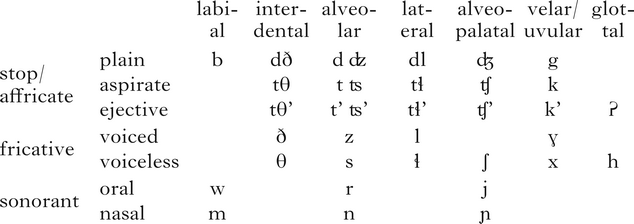
The vowels in (8) are given in broad phonemic transcription. We assume that the vowels /uː ʊ oː u o/ are distinguished from the other vowels by roundness, rather than backness, although nothing in our analysis depends on this assumption. Note that we do not assume a feature [central], but rather employ this term in an informal descriptive sense.Footnote 7
-
(8)
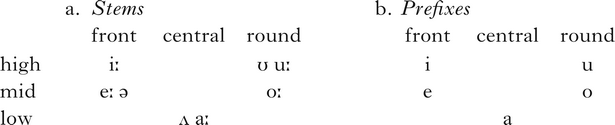
In (8), we see that there are different vowel inventories in stems and prefixes. In stems, we find a contrast between what in the Dene linguistics literature are called full and reduced vowels (Krauss Reference Krauss1964). This contrast consists phonetically of a combination of duration and quality differences for each full ~ reduced vowel pair (/eː/ ~ /ə/, /aː/ ~ /ʌ/, /uː/ ~ /ʊ/). The full vowels (/iː eː aː oː uː/) are long, tense and peripheral, while the reduced vowels (/ə ʌ ʊ/) are short, lax and centralised. From a phonological perspective, we assume that this is a length contrast between bimoraic and monomoraic vowels in stems. This contrast between full and reduced vowels is neutralised in prefixes, such that prefix vowels surface as short by default.
Nevertheless, long vowels do arise in prefixes under some circumstances. We make the following representational distinction between long vowels in stems and those in prefixes. In stems, long vowels consist of a single root node associated with two moras. In prefixes, long vowels (which derive from a sequence of two adjacent vowels underlyingly) are represented as two separate root nodes, each associated with one mora. This representational distinction is reflected in our transcription: we represent long vowels in prefixes as a double vowel, e.g. /aa/, whereas we represent long (i.e. ‘full’) vowels in stems with length marks, i.e. as /aː/. Support for this distinction comes from the distribution of contour tones: long vowels in stems may contrast only two tones, H (High, represented with an acute accent) and L (Low, which is not marked in the transcriptions), whereas long vowels in prefixes contrast four different tones: H, L, LH (Rising) and HL (Falling) (Jaker & Cardinal Reference Jaker and Cardinal2020: §2). Thus H, L, LH and HL tones on long vowels in prefixes are represented as /áá aa aá áa/ respectively.
3.3 Syllabification and syllable weight
We assume that all word-medial consonant clusters are syllabified as [VC.CV] in Tetsǫ́t’ıné. For the purposes of this paper, all coda consonants are treated as non-moraic. That is, in the data we will examine, all heavy syllables are heavy by virtue of containing a long vowel, not as a result of having coda consonants.
4 Stress–tone interactions
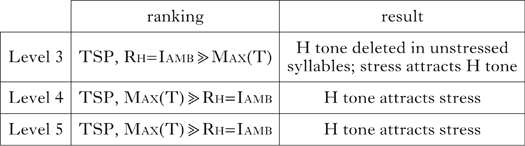
In this section we will examine stress–tone interactions. We will see that, at all levels of the phonology, there is a high-ranked constraint TSP, which aligns stress with H, and is based on the Tone-to-Stress Principle of Yip (Reference Yip2001); see also de Lacy (Reference de Lacy2002, Reference de Lacy and Lacy2007). This is defined in (9). Potential mismatches are repaired in different ways at different levels of the phonology. At Level 3, H tone is moved or deleted to match the stress pattern, due to the ranking Rh=Iamb ⪢ Max(T) (§4.1, §5.2). At Levels 4 and 5, on the other hand, the position of H tone is maintained, and trochaic feet are created when necessary, due to the ranking Max(T) ⪢ Rh=Iamb (§4.2).
-
(9)

Instrumental work by the first author and Phil Howson shows that stress in Tetsǫ́t’ıné is realised mainly by a combination of intensity and duration cues, and acoustic evidence is consistent with a left-to-right iambic stress pattern. The stress markings in the remainder of this paper are based on the first author's subjective impressions; these are consistent with instrumental measurements.
4.1 Tone mobility and deletion (Level 3)
At Level 3, the prosody of Tetsǫ́t’ıné follows a strict left-to-right iambic stress pattern, and any mismatches between the positions of stress and H tone are repaired by moving or deleting H. Descriptively, the basic generalisations can be stated in terms of syllable count. When the /θe/ or /ɲe/ conjugation marker is preceded by one syllable, its H tone is deleted, as in (10a, b). When it is preceded by two syllables, H is retained, as in (c). Finally, when it is preceded by three syllables, H moves one syllable leftwards, as in (d). In (10c, d), /θe/ occurs in a special syncopated allomorph, /Hθ/. In §7, we provide arguments that this form involves lexically listed allomorphy, and that this syncopated allomorph should not be derived in the synchronic phonology.
-
(10)

The conjugation markers /θe/ and /ɲe/ are described as pre-accenting prefixes in the Dene linguistics literature (e.g. Rice & Hargus Reference Rice, Hargus, Cook and Rice1989). The directionality of tone mapping will be examined in detail in §6. Briefly, we explain the fact that tone does not associate to the right of /θe/ and /ɲe/ in (10) by means of systematic underspecification (Kiparsky Reference Kiparsky, Hargus and Kaisse1993): tone prefers to associate to affix vowels, which are unspecified for tone, rather than to base vowels, whose tone is specified earlier in the derivation.
It is also worth noting that the process of tone mobility shown in (10d) is not restricted to the /θe/ and /ɲe/ conjugation markers, but is a fully general process at Level 3, applying to lexically preassociated tones as well. This is illustrated in (11), where the H of the /hí/ conjugation marker moves one syllable to the left at Level 3, to align with stress.
-
(11)
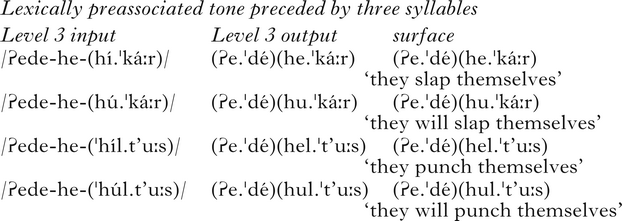
Based on these data, we represent the underlying forms of the /θe/ and /ɲe/ conjugation markers as /Hθe/ and /Hɲe/ in all subsequent examples. We will begin by examining H-tone deletion when the conjugation marker /θe/ is preceded by a single syllable, as shown in (12) for the form (ˈhee)(káːr).
-
(12)
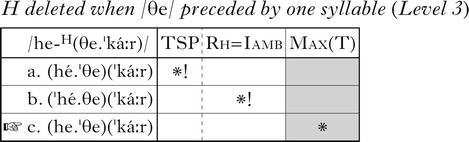
Candidate (12a) is an iamb with a HL tone pattern, violating TSP. Candidate (b) is a trochee, which violates Rh=Iamb. The winning candidate is therefore (c), which violates the lowest-ranked constraint Max(T). Not included are candidates such as *(he.ˈθé)(ˈkáːr), with rightward movement of tone, since at Level 3 tone associates only from the base to the affix, never to the base itself. An account of this directionality of tone association is provided in §6.
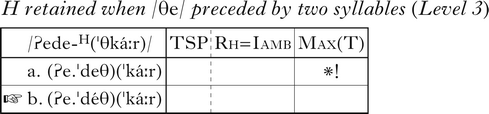
In (12), the ultimate cause of H-tone deletion is that, by left-to-right iambic foot parsing, conjugation H tone falls in the weak position of an iambic foot. For the same reason, when the conjugation markers /θe/ or /ɲe/ are preceded by two syllables, the syllable where H falls is in the strong position of an iambic foot – that is, an even-numbered syllable. In this case, there is no conflict between TSP and Rh=Iamb, and so H is retained. Deleting H in this context would incur a gratuitous violation of Max(T), as shown in (13) for (Ɂe.ˈdéh)(ˈkáːr) from (10c) (the output of Level 3 is (Ɂe.ˈdéθ)(ˈkáːr), prior to debuccalisation of coda fricatives; cf. Jaker Reference Jaker2015).
-
(13)
Finally, when the /θe/ or /ɲe/ conjugation marker is preceded by three syllables, an alternative repair strategy becomes available. It is possible to simultaneously satisfy TSP, Rh=Iamb and Max(T) by moving H one syllable leftwards.Footnote 8 The example in (14) is (Ɂe.ˈdé)(heh.káːr) from (10d), with coda /θ/ preserved, as above (recall from §3.3 that coda consonants are weightless).
-
(14)
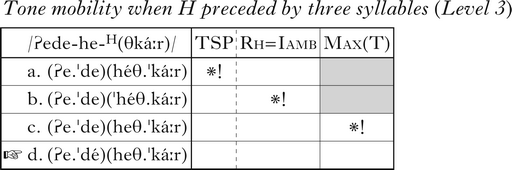
To summarise, Level 3 in Tetsǫ́t’ıné is a very strict left-to-right iambic system, where any mismatches between stress and tone are repaired by moving or deleting H.Footnote 9
4.2 Alignment of stress with H tone (Levels 4 and 5)
At Levels 4 and 5, the prosody of Tetsǫ́t’ıné is less strictly iambic. While the prosody of Levels 4 and 5 is still iambic by default, metrical parsing can also give rise to trochaic feet, wherever two syllables with a HL tone sequence need to be parsed into a single metrical foot. In other words, at Levels 4 and 5, mismatches between stress and tone are repaired by creating trochaic feet, while H tones are left intact. This is illustrated in (15a), which has trochaic feet with the Level 4 prefixes /se/, /ne/ and /je/, and in (15b), where we see trochaic feet with the Level 5 prefix /ná/.
-
(15)
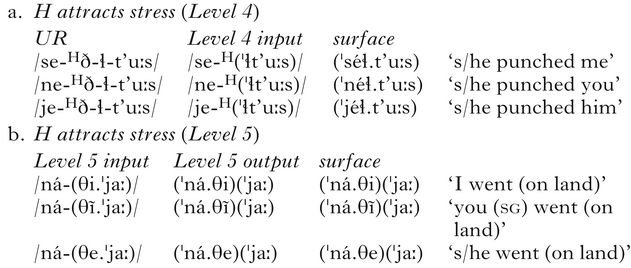
In (15a), the /θe/ conjugation marker appears as a voiced and syncopated allomorph, /H∅ð/. The voiced fricative /ð/ ‘disappears’ via coalescence with the following consonant /ɬ/ in these examples – see §7 for more discussion of this allomorph. The floating H in the input to Level 4 presupposes that this tone was not deleted in the output of Level 3, in spite of the tone-deletion process seen in §4.1. Informally, we assume that in the absence of a suitable vocalic host, a tone may remain floating in the output of Level 3, whereas in the presence of a suitable host vowel, i.e. a Level 3 prefix, the floating H tone must either associate or be deleted (see §6.1).
In (15b), the prefix /ná/ has H on the surface because it is lexically preassociated to a H tone. In §6.3, we will see that the floating H tones of /Hθe/ and /Hɲe/ do not associate to Level 5 prefixes, because they are deleted in the output of Level 4.
Based on these examples, we may deduce that, while the TSP remains undominated at Levels 4 and 5, the relative ranking of Max(T) and Rh=Iamb is reversed. Therefore, creating trochaic feet is preferred over deleting H tones, as illustrated in (16) for (ˈséɬ.t'u:s) and (ˈná.θi)(ˈjaː).Footnote 10
-
(16)
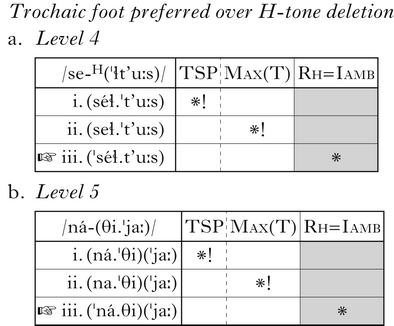
In both (16a) and (16b), candidate (i) represents an iambic foot with a HL tone pattern, candidate (ii) an iambic foot with a LL tone pattern and candidate (iii) a trochaic foot with a HL tone pattern. In both cases, candidate (iii) is the winner, thus providing evidence for the ranking TSP, Max(T) ⪢ Rh=Iamb.
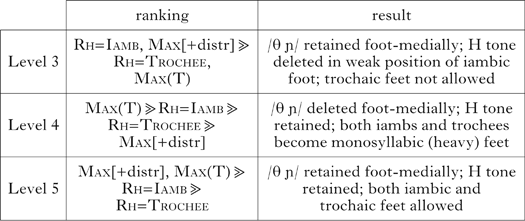
We have not yet considered candidates where the floating tone associates onto the base, such as *(seɬ.ˈt’úːs). Briefly, this is because the tones of the base have already been specified earlier in the derivation, while the tones of new affixes are not yet specified. This intuition is formalised in §6.1, where we provide a complete analysis of the directionality of tone association. A summary of the constraint rankings related to stress–tone interactions is given in Table IV.
Stress–tone interactions at Levels 3–5.

In summary, potential misalignments between stress and tone are repaired in different ways at different levels of Tetsǫ́t’ıné phonology. If the misaligned H tone would fall on a Level 3 prefix (/Ɂe, Ɂede, Ɂeɬe, he, ts'e/), it is either moved or deleted. If it would fall on a Level 4 prefix (/se, ne, je, nuhe, hube/) or a Level 5 prefix (/ná, na, xá, xa/, etc.), then a trochaic foot is created, in order to maintain the tone pattern. In the absence of strata, these differences would have to be accounted for by morphological conditioning, with different constraint rankings indexed to different groups of affixes. In Stratal OT, all constraint rankings are fully general at the stratum at which they apply.
5 Foot-medial /θ/- and /ɲ/-deletion
In the previous section, we saw that the /θe/ and /ɲe/ conjugation markers are similar in that they are both accompanied by a H to their immediate left (Rice & Hargus Reference Rice, Hargus, Cook and Rice1989). In this section, we will see that these two prefixes also pattern together in another way. Their initial consonants, which are interdental and palatal respectively, are both [+distributed] (the feature [+distributed] characterises the articulation of certain consonants, where lingual contact is spread out over an extended area; Hayes Reference Hayes2009: 85). Since /θ/ and /ɲ/ share this feature, they also exhibit similar phonological patterning. Specifically, both /θ/ and /ɲ/ can be shown to delete foot-medially, in order to create a foot consisting of a single heavy syllable. In this section, we show that foot-medial deletion of /θ/ and /ɲ/ occurs at Level 4, but not at Level 3 or 5. In addition, we provide evidence that this consonant-deletion process interacts opaquely with the H-tone deletion process seen earlier in §4.1, resulting in overapplication of H-tone deletion on the surface in cases where the /θe/ and /ɲe/ conjugation markers are preceded by a Level 3 prefix. When the same conjugation markers are preceded by a Level 4 prefix, however, the output is transparent. Thus Stratal OT correctly predicts a relationship between phonological opacity and morphological structure.
5.1 Data
We will begin by examining the /θe/ conjugation marker. When it is preceded by a Level 4 prefix, a H tone is assigned to the preceding vowel and the initial consonant /θ/ deletes, resulting in a long vowel with HL tone, as shown in (17a). When the /θe/ conjugation marker is preceded by a Level 3 prefix, on the other hand, /θ/ also deletes, but, in addition, H is deleted, as shown in (17b).
-
(17)
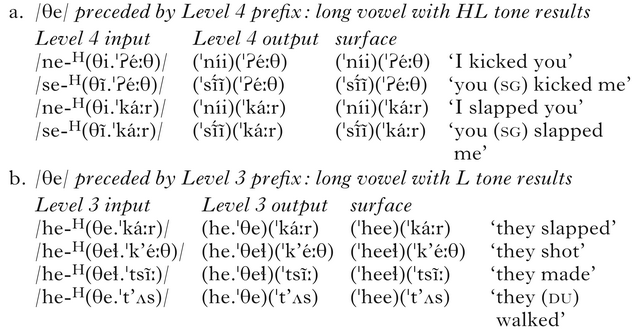
If we consider foot-medial /θ/- and /ɲ/-deletion in relation to the process of H-tone deletion seen in §4.1, we can see that consonant deletion removes the conditioning environment for H-tone deletion. That is, when deletion of a foot-medial consonant changes a disyllabic iambic foot with a HL tone pattern into a monosyllabic foot with a HL tone, the TSP is no longer violated. The single syllable within the foot is stressed, and therefore the TSP is satisfied by any of the four tones – H, L, LH or HL.Footnote 11
What we observe in (17a), therefore, is a transparent interaction of these two processes. Even if H-tone deletion were active at Level 4, it would not apply in this case, because its environment has been removed by foot-medial consonant deletion. On the other hand, in (17b) we observe ‘overapplication’ of H-tone deletion: although the environment for H-tone deletion has been removed on the surface, it has already applied, and its effect is still visible, in that it results in a long vowel with L tone, rather than HL tone. In other words, H-tone deletion and foot-medial consonant deletion interact opaquely, in counterbleeding order.
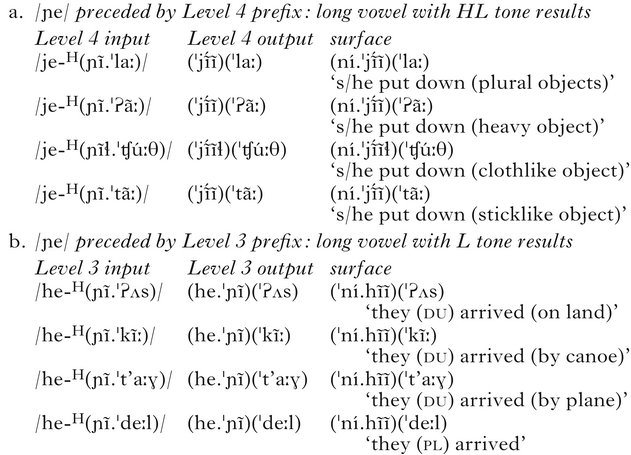
We may surmise that the reason for this opaque interaction is that foot-medial consonant deletion had not yet applied at Level 3. Therefore, the foot-medial deletion of /θ/ and /ɲ/ must be a Level 4 process. Furthermore, the difference between the transparent application of a phonological process in (17a) and the opaque interaction in (17b) is predicted by Stratal OT, where all processes on the same level interact transparently. Since the prefixes /se/ and /ne/ in (17a) only enter the phonology at Level 4, they do not participate in Level 3 phonological processes. Therefore, they only undergo the Level 4 process of foot-medial consonant deletion transparently. On the other hand, the prefix /he/ in (17b) enters the phonology at Level 3, and is therefore subject to both Level 3 and Level 4 phonological processes. This allows for the possibility that Level 3 and 4 processes may interact opaquely, which is indeed what we find in (17b). Again, Stratal OT correctly predicts a relationship between phonological opacity (or transparency) and morphological structure.
The same pattern described above – transparent interaction following a Level 4 prefix, and opaque interaction following a Level 3 prefix – is also found with the /ɲe/ conjugation, as illustrated in (18). Deletion of the initial consonant of the /ɲe/ conjugation marker yields a long vowel with HL tone when preceded by a Level 4 prefix, as shown in (18a), and a long vowel with L tone when preceded by a Level 3 prefix, as in (b). In these examples, the prefix /ní/ (terminative) does not enter the derivation until Level 5.
-
(18)
One alternative hypothesis which would be consistent with the data just presented would be that /θ/ and /ɲ/ are deleted at Level 5, rather than Level 4. In the case of /θ/, this hypothesis is easily excluded: /θ/ is preserved following a Level 5 prefix, as shown in (19).
-
(19)
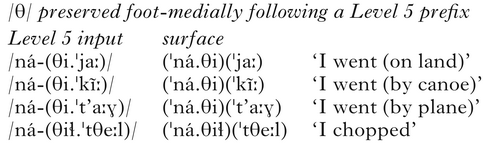
In Stratal OT, failure of /θ/-deletion to apply following a Level 5 prefix is readily explainable if it is a Level 4 process: the Level 5 affixes have simply entered the derivation too late for /θ/-deletion to apply. We may thus conclude that /θ/ is deleted at Level 4. On the other hand, the fact that /ɲ/ is not deleted at Level 5 is less immediately obvious, since it is in fact deleted following a Level 5 prefix, as shown in (20).
-
(20)
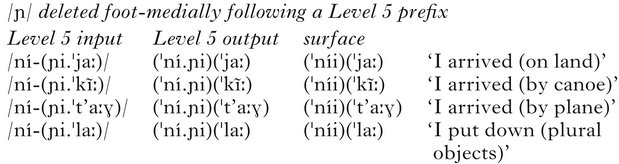
There are two main reasons to believe that /ɲ/ is retained at Level 5 (and deleted postlexically), as suggested by the representations in (20). The first is vowel length: given independently known facts about distribution of long and short vowels in prefixes, if /ɲ/ were deleted at Level 5, we should expect a short vowel in the surface forms in (20), rather than the long vowels which we observe (Jaker Reference Jaker2020). The second reason is that there is independent evidence that /ɲ/ deletes at Level 6 (the Postlexical level), in that /ɲ/ is deleted following Level 6 prefixes (i.e. preverbal clitics), as shown in (21).
-
(21)
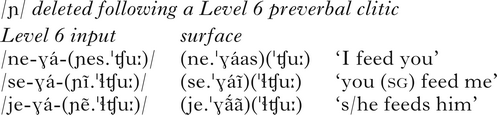
Given independent evidence that /ɲ/-deletion occurs at Level 6, following a Level 6 prefix, it is reasonable to assume that deletion of /ɲ/ following a Level 5 prefix, as shown in (20), also occurs at Level 6.
In this section we have seen evidence that deletion of the consonants /θ/ and /ɲ/, which bear the feature [+distributed], occurs foot-medially at Level 4, but not Level 3 or 5. It follows, therefore, that whatever markedness constraints are responsible for the deletion of /θ/ and /ɲ/ are high-ranked and active at Level 4, but are dominated by faithfulness constraints at Levels 3 and 5. In the next section, we will examine which markedness constraints in particular are responsible for deletion of /θ/ and /ɲ/ foot-medially.
5.2 Deletion of foot-medial /θ/ and /ɲ/ (Level 4)
In this section, we will explore which markedness constraints are responsible for the deletion of /θ/ and /ɲ/ foot-medially at Level 4. We propose that this deletion is prosodically motivated, in that deletion of a foot-medial consonant serves to create a monosyllabic (heavy) foot, the most harmonic foot type in Tetsǫ́t’ıné. The reason for this is that such a foot simultaneously satisfies Rh=Iamb and Rh=Trochee, as has been previously proposed in the literature (Green Reference Green and Watkins2005, Topintzi Reference Topintzi2008: 157). The first step in formalising this proposal is to define the constraints involved. Following Hyde (Reference Hyde2002: 31), we adopt the Headedness Condition, whereby every foot has one and only one strong syllable designated as its head. The constraints Rh=Iamb and Rh=Trochee can thus be formulated in terms of headedness, as in (22).
-
(22)
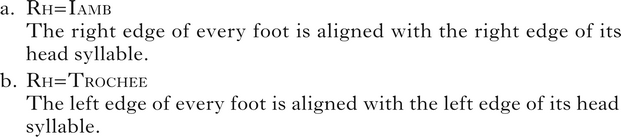
The head of a monosyllabic foot is simultaneously aligned with both the left edge and the right edge. According to this view, an iambic language is, by definition, a language in which Rh=Iamb outranks Rh=Trochee. This does not preclude Rh=Trochee also being active in an iambic system – such as in this case, by forcing foot-medial consonant deletion. This is illustrated in (23) for (ˈhee)(ˈkáːr).
-
(23)
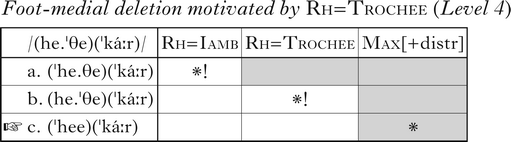
This same constraint ranking can also derive deletion of foot-medial /ɲ/, as in (18), since, as we have seen, /ɲ/ and /θ/ are both [+distributed].Footnote 12 (23) is an example of consonant deletion applying to a foot which would otherwise be an iamb, if the foot-medial consonant were retained. We saw previously that Tetsǫ́t’ıné has both iambic and trochaic feet at Levels 4 and 5, the latter motivated by the TSP. Therefore, the ranking in (23) predicts that foot-medial consonant deletion will also apply to a foot that would otherwise be a trochee (due to the TSP), in order to satisfy Rh=Iamb. This is shown in (24) with (ˈníi)(ˈɁéːθ).
-
(24)
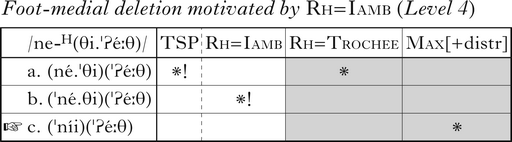
One fact unaccounted for in (24) is the directionality of tone mapping. That is, we have not yet excluded candidates such as *(ˈnií)(ˈɁéːθ), with LH rather than HL tone. This issue will be addressed in §7, where we will argue that tone prefers to associate to affix vowels rather than base vowels, since affix vowels enter the derivation unspecified for tone.
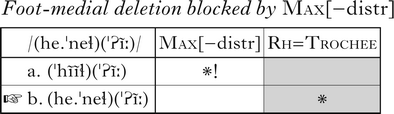
To underscore the importance of [+distributed], in (25) we show that alveolar /n/, which is [―distributed], is retained foot-medially in the form (he.ˈneɬ)(ˈɁĩː) ‘they see’ (Jaker & Cardinal Reference Jaker and Cardinal2020: §6.3.4). This provides evidence for ranking Max[―distr] over Rh=Trochee.
-
(25)
5.3 Retention of foot-medial /θ/ and /ɲ/ (Level 3)
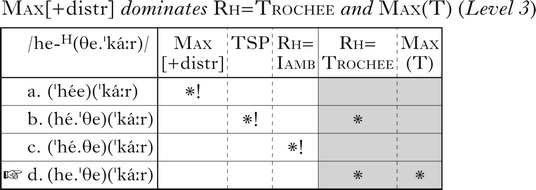
In §5.1, we established that, even when /θ/ and /ɲ/ delete following a Level 3 prefix, this deletion occurs at Level 4: they are retained foot-medially at Level 3. If the key faithfulness constraint violated by /θ/ and /ɲ/ deletion is Max[+distr], as we saw in §5.2, then their failure to delete at Level 3 could be explained by Max[+distr] being higher-ranked at this level of the phonology. In this section, our goal is to establish exactly which constraints Max[+distr] dominates – that is, which possible repair strategies are ruled out by Max[+distr] being high-ranked.
In §4.1, we saw that when the /θe/ and /ɲe/ conjugation markers are preceded by just one syllable at Level 3, a process of H-tone deletion applies. That is, H is deleted in the weak branch of an iambic foot, in order to satisfy the TSP. Max[+distr] contributes to this process in the following way. If /θ/ and /ɲ/ could be deleted foot-medially, it would be possible to create a monosyllabic (heavy) foot with HL tone, simultaneously satisfying TSP, Rh=Iamb, Rh=Trochee and Max(T), as in candidate (26a). On the other hand, the winning candidate, (d), satisfies Max[+distr] but violates Rh=Trochee and Max(T). It follows, therefore, that Max[+distr] outranks both Rh=Trochee and Max(T).
-
(26)
5.4 Retention of foot-medial /θ/ and /ɲ/ (Level 5)
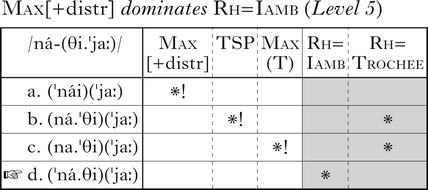
At Level 5 the prosodic pattern is less strictly iambic than at Level 3, and HL tone patterns result in trochaic feet, as we saw in §4.2. In (27), we can see that Max[+distr] outranks Rh=Iamb. This is because the winning candidate, (d), contains a disyllabic trochaic foot which retains foot-medial /θ/. Contrast this with the losing candidate, (a), which deletes foot-medial /θ/ but satisfies Rh=Iamb.
-
(27)
5.5 Summary
In this section, we have seen that, at Level 4, Max[+distr] is ranked at the bottom of the constraint hierarchy, so that /θ/ and /ɲ/ are deleted foot-medially in both iambic and trochaic feet, in order to create monosyllabic (heavy) feet. On the other hand, at both Levels 3 and 5, Max[+distr] is undominated, and /θ/ and /ɲ/ are always retained foot-medially. These rankings are summarised in Table V. Since TSP is undominated at all levels of the phonology, it is omitted from Table V.
Foot-medial consonants at Levels 3–5.

In a monostratal version of OT, the different behaviour of /θ/ and /ɲ/ following different affixes would have to be accounted for by each group of affixes being associated directly with its own unique constraint ranking. In Stratal OT, both phonological constraints and phonological processes are fully general, in that they apply to all affixes that are present on the stratum at which they apply.
6 Directionality of tone mapping
In this section we address the directionality of tone mapping. First, we briefly review why the question of directionality is relevant to the present paper. In §4.1 we noted that it would in principle be possible to avoid H-tone deletion (in a form such as (ˈhee)(ˈʦ’ə́r)) if it were possible for H to associate rightwards. Similarly, in §4.2, we noted that the form (ˈníi)(ˈɁéːθ), with HL tone, seems to fare just as well as the ungrammatical form *(ˈnií)(ˈɁéːθ), with LH tone, according to the constraints introduced thus far.
We propose that the leftward association of tone we observe at Levels 3 and 4 follows from a more general representational property of tone in the language. We will adopt a systematic underspecification analysis of tone (Kiparsky Reference Kiparsky, Hargus and Kaisse1993). This means that, in the lexicon, most vowels are either /H/ or unspecified for tone. During the course of the derivation, the vowels which are underlyingly unspecified have their tone filled in as L by default, unless they need to associate to a H tone for some reason – such as coalescence or association with a floating H tone.
There is reason to believe that the absence of L tones in URs in Tetsǫ́t’ıné is not an absolute ban: specifically, in relation to tonal ablaut in stems, there are alternating stems, non-alternating H stems and non-alternating L stems, which suggests that at least some stems must be lexically specified as L (Jaker & Cardinal Reference Jaker and Cardinal2020: §5.2.3). Therefore, it seems that the absence of tones in URs would not be best achieved with a Morpheme Structure Constraint. Rather, we suggest that tonally unspecified URs are most harmonic for morphemes whose surface tones alternate (Inkelas Reference Inkelas1995); thus tonal underspecification can be derived via Lexicon Optimisation.
When this theory of tonal specification is combined with the level-ordered model of the Dene verb in §2, any material inherited from the previous level (the base) will be fully specified for tone, whereas any non-H affix vowels will be unspecified. For floating tones, this means that if a floating tone associates to the base, it has to displace an already existing tone, thus incurring a violation of Max(T). On the other hand, if a floating tone associates to a non-H affix vowel, which is unspecified for tone, no Max(T) violation is incurred. This is illustrated in (28) for (ˈséɬ.t'uːs) ‘s/he punched me’.
-
(28)
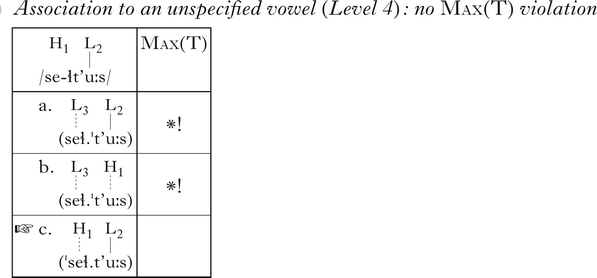
As shown in (28), associating a H tone to an unspecified affix vowel makes it possible for all tones in the input to be associated, without any violations of Max(T). Based on this analysis, we will regard leftward association of H tone as the expected or general case; the attested cases of rightward tone association, which we will examine in §6.3, will require additional explanation.
6.1 Tone association from base to affix (Level 3)
In this section, we address two questions: when H tone appears to be deleted in the output of Level 3, is it truly deleted, or does it remain floating in the output? And secondly, why is rightward association of H not available as a repair strategy?
We will begin with the question of floating tones. If H tone remained floating in the output of Level 3 when preceded by one syllable, we would expect this floating tone to resurface when a Level 4 affix such as /se/ is added. Instead, /se/ surfaces with L, as shown in (29).
-
(29)
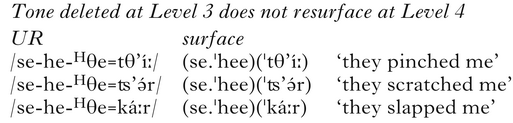
We may therefore deduce that, when H appears to delete at Level 3, as in the examples in (10a) and (b), it is truly deleted, and does not remain floating in the output. At the same time, we cannot say that there is an absolute ban on floating tones in the output of Level 3, since we have examples of such tones in the input to Level 4, as in (30). It follows that floating H was not deleted at Level 3 in these examples.
-
(30)
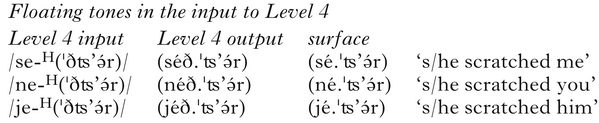
If floating tones are allowed in the output of Level 3, Max(T) must outrank *Float (‘every tone must be associated with a tone-bearing unit in the output’). This is illustrated in (31), where we derive H(ˈðʦ’ə́r) (which serves as the base for the input forms in (30)).
-
(31)
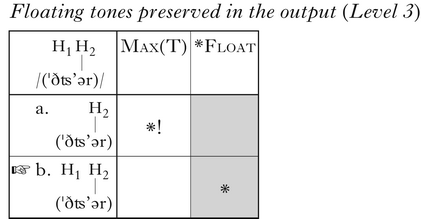
But if floating tones are preferred over tone deletion, then what mechanism ensures the deletion of the floating tones when preceded by one syllable, as in (10a, b) and (29)? Intuitively, it seems that deletion of a floating tone only occurs in the presence of a preceding vowel. We propose to formalise this intuition using the constraints in (32).
-
(32)

ContigAssoc(T) demands that a sequence of associated tones not be interrupted by a floating tone; floating tones are allowed only at domain edges. This is illustrated in (33) for (ˈhee)(ˈʦ’ə́r). In order to satisfy both of the constraints in (32), the only options are to either associate the floating H tone, as in (33c), or to delete it, as in (d).
-
(33)
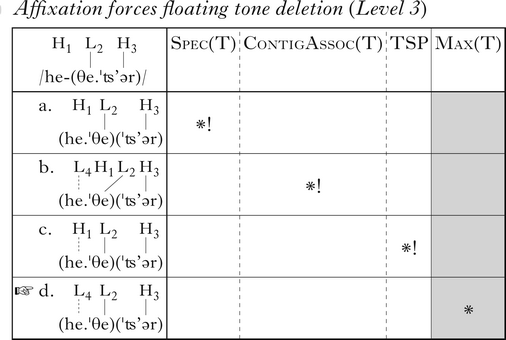
(33) shows why floating tones are deleted at Level 3 when preceded by an affix. The most relevant candidate is (b), which is excluded because a floating H tone is not allowed between two associated L tones. We assume an additional undominated constraint Contig(T), not shown in (33), which rules out candidates similar to (b), but with H1L4L2H3, where H1 is floating. That is, we assume that tones must be inserted at the left edge, rather than infixed. Finally, we assume that multiply linked tones are ruled out by an alignment constraint which prohibits spreading of tones across a morpheme boundary. This rules out candidates similar to (d), but with L2 spanning two syllables and H1 floating.
In order to rule out rightward association of floating tone, we require one additional constraint; in (34) we use MaxAssoc(V, T) (based on Myers Reference Myers1997), which penalises the delinking of vowels from tones with which they were already associated in the input.
-
(34)
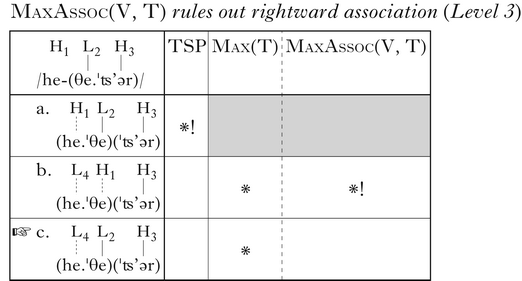
MaxAssoc(V, T) is active only when the winning candidate involves tone deletion, as in (33) and (34). When the winning candidate does not involve tone deletion, Max(T) by itself is sufficient to rule out rightward association, as shown in (35a) for (Ɂe.ˈdéɬ)(ˈt'uːs) ‘he punched himself’ and (35b) for (Ɂe.ˈdé)(heɬ.ˈt'uːs) ‘they punched themselves’.
-
(35)
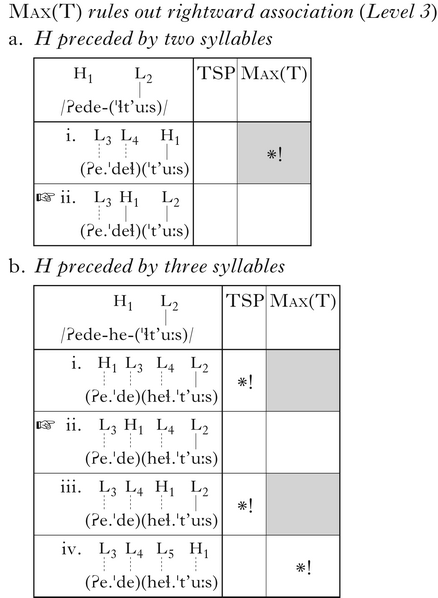
As shown above, Max(T) and MaxAssoc(V, T) are able to block rightward association of floating tones, and result in leftward tonal association (and sometimes deletion) instead. The systematic underspecification analysis presupposes a level-ordered model: leftward association incurs fewer faithfulness violations, because new (non-H) affixes entering the derivation are not yet specified for tone.
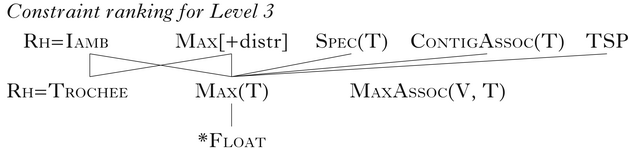
When the ranking arguments in (31)–(35) are combined with those in §5.3, the result is the constraint ranking in (36).
-
(36)
6.2 Tone association from base to affix (Level 4)
Here we will address the question of why, when /θ/ and /ɲ/ delete foot-medially at Level 4, we find a HL tone in forms such as (ˈníi)(ˈɁéːθ), rather than a rising tone, as in *(ˈnií)(ˈɁéːθ). Given our assumptions regarding the systematic underspecification of tone, a single constraint, Max(T), is sufficient to account for this pattern, as shown in (37).
-
(37)
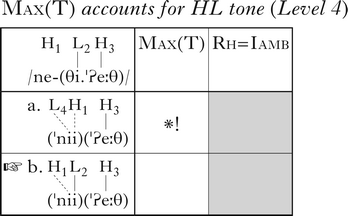
A complete constraint hierarchy for Level 4 will be given in §6.3, where we consider evidence that if the floating H tone has not associated to a vowel by the output of Level 4, it is deleted.
6.3 Tone association from affix to base (Level 5)
We now examine a class of cases which pose a challenge to our account as presented thus far. At Level 5, there are several prefixes which are accompanied by their own accent, including /ɬa, sa, na, ja/. Unlike the /θe/ and /ɲe/ conjugation markers, all of these prefixes are post-accenting: in most environments, they place a H tone on the immediately following vowel. Historically, these prefixes are all derived from disyllabic LH tone sequences (/ɬeɣá, seɣá, neɣá, jeɣá/, etc.), as still found in other dialects of Dëne Sųłıné. In the examples in (38), we somewhat informally represent these prefixes as being associated with a floating H to their immediate right (/ɬaH, saH, naH, jaH/) – bearing in mind that the precise UR of these affixes is part of what is at issue in explaining their behaviour.
-
(38)
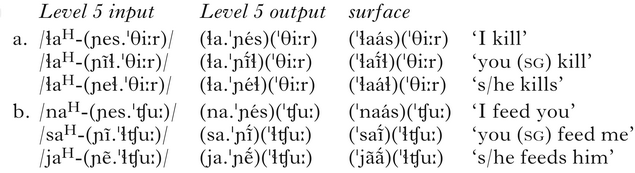
The main fact to be explained in the forms in (38) is that rising tones are found in all of the surface forms, rather than falling tones. This seems to go against the predictions of the systematic underspecification analysis developed in §6.1 and §6.2. Specifically, our analysis would seem to predict that the floating H associated with these post-accenting prefixes ought to associate to the prefix itself, since this would avoid any violations of Max(T). This would then result in HL tones on the surface.
We propose that the reason for this rightward tone association is that the post-accenting prefixes are actually accompanied by an LH contour underlyingly, i.e. /ɬaLH, saLH, naLH/, etc. This in a way reflects their historical origins as disyllabic sequences. A consequence of this is that at the level of representation at which tone association applies, Level 5, there are more tones than tone-bearing units. As shown in (39), one of the input tones must be deleted in all candidates; in the winning candidate, (b), this is achieved by aligning H with the strong position of an iambic foot.
-
(39)

In (39) we have added a constraint Max(H), which prohibits the deletion of H tones, and outranks Max(L). The ranking Max(H) ⪢ Max(L) is independently motivated in cases of coalescence at Level 5, e.g. /ná-ɣu-s-ðər/ → (ˈnós.θər) ‘I will live’, where, under our analysis, a H tone from an affix displaces a preexisting L tone from the base. When the foot-medial consonant /ɲ/ of the winning candidate, (39b), is deleted postlexically (at Level 6), the result is a long vowel with rising tone, as in (38). However, we assume that at Level 3, Max(H) must be sufficiently low-ranked to allow H-tone deletion to occur.
A possible alternative analysis, suggested by a reviewer, is that there is a constraint which prohibits floating H from associating to the affix which introduces it (e.g. van Oostendorp Reference Oostendorp, Blaho, Bye and Krämer2007). However, floating H tone does associate to the affix itself, in 3rd person plural forms, as shown in (40). The result is a set of light–heavy trochees with a HL tone pattern. Regarding the stress pattern in these examples, we note that while a light–heavy weight pattern makes the most harmonic possible iamb, according to the Weight-to-Stress Principle (WSP; Prince Reference Prince1990), a HL tone pattern makes the most harmonic possible trochee, according to the TSP (de Lacy Reference de Lacy2002, Reference de Lacy and Lacy2007). Thus Tetsǫ́t’ıné surface stress prioritises the TSP over the WSP.
-
(40)
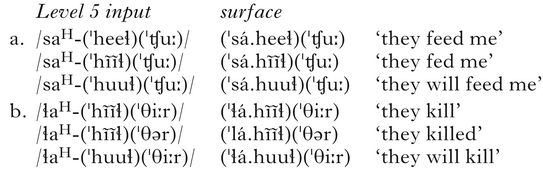
We do not have an explanation as to why exactly this happens in the 3rd person plural forms, although it most likely has to do with the fact that it is only in these forms that the following syllable contains a long vowel. Thus it is possible, for example, that there is a faithfulness constraint against overwriting tones which are already associated to long vowels.
There is one final set of facts relating to the /θe/ and /ɲe/ conjugation markers which remains to be explained. As has been observed in other Dene languages (Hargus Reference Hargus1988: 161, Rice Reference Rice1989: 529, 537), conjugation H tone does not map onto a Level 5 prefix in Tetsǫ́t’ıné. Some examples are given in (41).
-
(41)
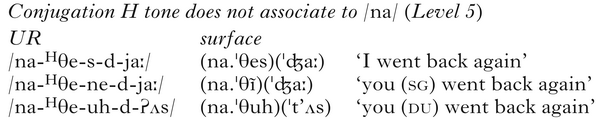
However, it is not the case that there is a general prohibition on H tone associating to Level 5 prefixes. This does happen in cases of vowel coalescence, as in (42).
-
(42)
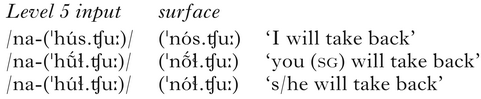
Therefore, we suggest that the reason for H not associating to the disjunct prefixes in (41) is that there is no H in the input to Level 5. Rather, any floating tones which would remain floating in the output of Level 4 are deleted, due to the ranking *Float ⪢ Max(T). This is illustrated in (43).
-
(43)
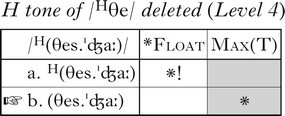
After conjugation H tone has been deleted by the Level 4 phonology, the form (na.ˈθes)(ˈʤaː) can be derived by simple affixation of /na/, and no further violations of Max(T) are incurred.
Based on the ranking arguments developed in this section, the complete constraint rankings for Levels 4 and 5 are given in (44).
-
(44)
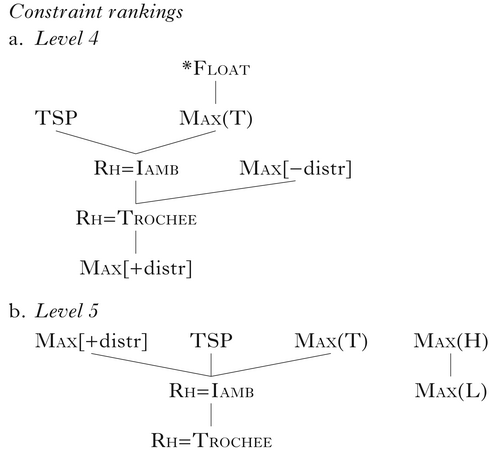
In summary, in this section we have accounted for the general preference for leftward tonal association in Tetsǫ́t’ıné by a combination of systematic underspecification and level ordering, whereas we have accounted for the rightward association that occurs with certain Level 5 prefixes by means of a floating LH contour which accompanies these affixes. In a monostratal theory it would be necessary to posit different constraint rankings associated with different groups of affixes, in order to derive rightward association in some cases and leftward association in others. In our analysis, however, constraints do not directly refer to different groups of affixes, or even directionality per se; rather, directionality is derived from more general principles such as the interaction of underspecification and Max(T).
7 Allomorphy, opacity and abstractness
In this paper, we have shown how many of the facts relating to the /θe/ and /ɲe/ conjugation markers can be derived by positing a combination of level ordering, iambic prosody and autosegmental phonology, without the need for morphological conditioning, as stated in our hypothesis in (1). However, we do not claim that all facts relating to the /θe/ and /ɲe/ conjugation markers must be accounted for in the synchronic phonology. Some alternations belong to the historical phonology of a language, and must be treated as lexically listed allomorphy.
By allomorphy, we mean that a single morpheme has multiple underlying forms which are selected in different local inward environments (Carstairs Reference Carstairs1987, Kiparsky Reference Kiparsky and Singh1996). In the present examples, we assume that allomorph selection takes place in the morphological component of the grammar. We assume that affixation consists of a series of Merge operations in the lexicon (Wunderlich Reference Wunderlich1996), and that each allomorph contains, as part of its lexical entry, information about other affixes with which it may or may not merge.
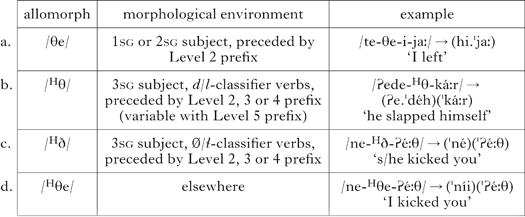
In this model, it seems that the /θe/ conjugation marker has three additional lexically listed allomorphs, used in particular morphological contexts: a toneless allomorph, /θe/, used in the 1st and 2nd persons when preceded by a Level 2 prefix, a voiceless syncopated allomorph, /Hθ/, used in the 3rd person singular of a d/l-classifier verb when preceded by a Level 2, 3 or 4 prefix, and a voiced syncopated allomorph, /Hð/, used in the 3rd person singular of a ∅/ɬ-classifier verb when preceded by a Level 2, 3 or 4 prefix. The distribution of these allomorphs is summarised in Table VI.
Allomorphs of the /θe/ conjugation marker.

Since the allomorphs in (a)–(c) differ from the elsewhere allomorph in (d) in properties which are easily within the power of most phonological grammars to modify (tone deletion, vowel syncope and fricative voicing), it is reasonable to ask why they should not also be derived in the synchronic phonology. We propose that the syncopated allomorph in (c) was derived, historically, from the elsewhere allomorph in (d), as shown in (45), by a combination of vowel lengthening in open syllables followed by vowel syncope.
-
(45)
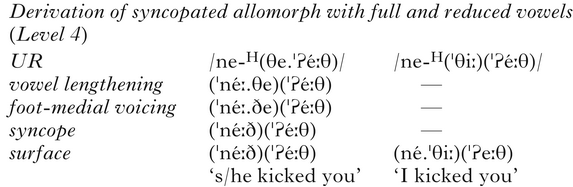
As shown by the rule-based derivation in (45), historically the /θe/ conjugation marker was followed by a full vowel in the 1st and 2nd persons, and a reduced vowel in the 3rd person. This meant that in the 1st and 2nd persons, the vowel of the object agreement prefix (e.g. /se, ne, je/) remained reduced, in order to be incorporated into a single (light–heavy) iambic foot with the conjugation marker, whereas in the 3rd person, the vowel lengthened to a full vowel (due to the presence of H), to create a heavy–light trochaic foot. If we add an additional rule that syncopates reduced vowels following full vowels, the result is vowel syncope in the 3rd person, but not in the 1st and 2nd persons.
In Stratal OT, there are two sets of criteria that can be used to determine whether an alternation belongs in the synchronic phonology, or should be treated as allomorphy. One is changes in phonemic inventories. In the case above, the derivation requires reference to a vowel-length contrast in prefixes which existed historically, but for which there is no other evidence in the modern language. Thus one type of sound change which can cause an alternation to become morphologised is a change in the phonemic inventory of a language. The second criterion is opacity: in Stratal OT, it is assumed that there is no phonological opacity within a stratum (Kiparsky Reference Kiparsky2000). Note that the derivation in (45) is opaque: vowel lengthening must precede syncope, and overapplies on the surface. The set of rules in (45) would all have to take place at Level 4, since syncope does not apply following a Level 5 prefix (e.g. we find (ˈná.θe)(ˈjaː) ‘s/he went’, not *(ná)(ðjaː) or *(ná)(jaː)). Therefore, according to both sets of criteria, the variant forms of the /θe/ conjugation marker listed in Table VI must be treated as allomorphs, not derived in the synchronic phonology.
8 Conclusion: phonological opacity and morphological structure
We have shown that the phonological processes of Tetsǫ́t’ıné take effect within one of five hierarchically ordered domains of word structure, and that none of them are directly conditioned by specific morphemes or morphological categories. We will conclude with some remarks on the potential generality and implications of these findings.
Most languages investigated so far have two lexical strata, Stem and Word, and a postlexical stratum. A growing body of research on morphologically complex languages is finding more richly articulated word structures. Researchers on other Dene languages have long argued for either four lexical strata (Rice Reference Rice1989 on Slavey) or five (Hargus Reference Hargus1988: 74 on Sekani). Evidence for additional lexical strata has also been discovered in Mamaindé (Eberhard Reference Eberhard1995), Kimatuumbi (Odden Reference Odden1996), Choguita Rarámuri (Caballero Reference Caballero2008) and Kinande (Jones Reference Jones2014), all of them with exceptionally rich morphologies. The case for postlexical stratification in some languages – typically a stratum for clitic groups and/or small phrases – is also robust (Kaisse Reference Kaisse1985, Reference Kaisse, Inkelas and Zec1990, Clark Reference Clark1990, McHugh Reference McHugh, Inkelas and Zec1990, Rubach Reference Rubach2011, Reference Rubach2016, Jones Reference Jones2014, Gjersøe Reference Gjersøe2016).
Importantly, additional strata do not undermine Stratal OT, insofar as they abide by the principles of the theory. Indeed, they provide new opportunities to put the theory to the test. The strata must be consistent with the hierarchical organisation of the morphology and syntax, and the theoretical commitments about the phonological interactions between the strata and their morphological domains must be met. Under these ground rules, the number of strata in all languages has turned out to be small, and – importantly – correlated with their morphosyntactic complexity. Adding lexical strata in polysynthetic languages, or articulating the postlexical phonology into phrasal strata, increases the possible depth of opacity and cyclic effects. For example, languages for which more than one postlexical stratum can be empirically justified should allow opacity and cyclic effects within postlexical phonology, and this is exactly what some of these studies confirm. While systems with three strata allow maximally two layers of opacity, each additional stratum predicts the possibility of one more layer. This is quite different from Sympathy constraints (McCarthy Reference McCarthy1999) and OT-CC precedence constraints (McCarthy Reference McCarthy2007), which are motivated only by the opacity they are supposed to account for, and can reconstruct the effect of rule ordering of arbitrary depth.
Our conjecture that phonology does not make direct reference to morphology is at odds with most current theorising. Distributed Morphology allows the controversial device of Readjustment Rules: ‘phonological rules that are triggered by certain morphemes, or that are specified to apply to certain morphemes and not others’ (Embick Reference Embick2015: 202). Cophonology Theory (Inkelas Reference Inkelas2014) lets classes of lexical items have their own phonological strata, unordered with respect to those of the others, and Indexed Constraint Theory (Pater Reference Pater and Parker2009) breaks up phonological constraints into separately rankable subconstraints indexed to particular morphemes, morphological categories and perhaps lexemes. Though different in many ways, both open the door to morphological conditioning of phonology (for comparison see Inkelas & Zoll Reference Inkelas and Zoll2007 and Inkelas Reference Inkelas2014: 225–226). These theories make relatively weaker predictions than Stratal OT with regards to the phonology–morphology interface, by nullifying the transitivity relation between the strata, and withdrawing the predictions about the correlation of phonology with morphological structure and constituency, including the key generalisations about opacity and its relation to cyclicity that are a cornerstone of Stratal OT.
We suggest that apparent cases of morphological conditioning put forward by proponents of these theories can, like the Tetsǫ́t’ıné data presented here, be analysed within Stratal OT through a combination of prosodic and representational mechanisms. We believe that Prosodic Morphology and representational solutions have been underestimated in many other cases as well, and that a deeper look at the empirical landscape that gives them fair consideration will be rewarded with a sharper understanding of the morphology–phonology interface.