1. Introduction
This paper considers the historical origins of three question particles in the Niuean language, a Polynesian language belonging to the larger group of Oceanic, which forms part of the Austronesian language family. Examples with the Niuean question particles, nakai, ka and kia, are provided in (1a–c). The question particles (also referred to herein as Q particles: Q1, Q2, and Q3) will be discussed in detail later in the paper, after we lay some preliminary groundwork regarding the issues at stake.
- (1)
(a) Mooli nakai?
true q1
‘Is that so?’
(b) Mooli ka?
true q2
‘Is that so?’
(c) Mooli kia?
true q3
‘Is that so?’
Central to our argument is a broad view of yes–no questions. We take a view, following Ultan (Reference Ultan and Greenberg1978), that a yes–no question is one which is structurally distinct from a declarative structure (syntactically or phonologically), and typically, but not always, craves a response, which can take various forms (see Levinson Reference Levinson2010). From this perspective, the term yes–no question covers question types often referred to in different ways, for example sentential interrogatives, neutral polar questions and even tag questions. We argue that such an analysis of questions is necessary if we are to explain the origin of question particles in Niuean.
The language most closely related to Niuean is Tongan, both languages belonging to the Tongic sub-group of Polynesian (Pawley Reference Pawley1966). Although the two languages share phonological and morphological innovations, Otsuka (Reference Otsuka2006) has shown that the two languages differ syntactically in a number of respects, including in their question-formation strategies. Tongan does not use a yes–no particle to signal a yes–no question. While Niuean can form yes–no questions using only intonation, the use of a yes–no question particle in Niuean is the unmarked option. Given that Tongan does not have any yes–no question particles and Niuean has three such particles, this raises questions as to the historical development of these yes–no particles in Niuean.
Polynesian languages from other sub-groups have particles with similar functions but these particles have a completely different form. For example, Pukapukan has Q particles pe and me (Salisbury Reference Salisbury2002); Samoan has ‘aa, requesting confirmation of a possible event’ (anonymous JL referee, p.c). This suggests that Niuean Q particles are not inherited from Proto-Polynesian (PPn), but rather have come into existence independently.Footnote 2 It is also somewhat puzzling that the forms in so many of these languages appear unrelated.
The question particles in other Polynesian languages are also characterised as somewhat variable in position, and partly because of this characteristic, many are categorised as adverbs (see Mosel & Hovdhaugen Reference Mosel and Hovdhaugen1992 for Samoan, Besnier Reference Besnier2000 for Tuvaluan). The Niuean yes–no particles, on the other hand, are more grammatical in nature, with the most canonical Q particle (nakai (Q1)) obligatorily appearing in post-predicate position as in (2)Footnote 3 and other question particles (ka (Q2), and kia (Q3)), and appearing either in post-predicate or in clause-final position, as shown for kia in (3a–b).Footnote 4
(2) Kua kai nakai e Moka e apala?
perf eat q1 erg.p Moka abs.c apple
‘Did Moka eat the apple?’(Massam Reference Massam2003: 1)
- (3)
(a) … Ko e vagahau Niue tūmau kia a koe?
pred c speak Niue always q2 abs.p 2.sg
‘Do you always speak in Niuean?’(NOFIP5)
(b) Kai e Mele e apala kia?
eat erg.p Mele abs.c apple q2
‘Did Mele eat the apple?’(Massam Reference Massam2003: 2)
By far the most usual typological positions for Q particles are the leftmost or rightmost periphery of the sentence (Greenberg Reference Greenberg and Greenberg1963, Dryer Reference Dryer, Haspelmath, Dryer, Gil and Comrie2005). The post-predicate position of Q particles raises questions for the syntax of the left periphery (see Massam Reference Massam, Mercado, Potsdam and deMena Travis2010), suggesting a structural analysis in which the predicate raises to the left of the Q particle. In our analysis, the post-predicate position of Niuean Q particles stems from the claim that the earliest Q particle to develop, kia, had a strong attitudinal component, resulting in its post-predicate position, in which position later Q particles also developed.
The focus of this paper is to argue for the sources of the synchronic Q particles in Niuean. It is worth pointing out that there are many ways in which the proposed developments in this paper meet the criteria that have been set for grammaticalisation processes. The fixing of word order, along with other aspects of the Q particle developments to be discussed below, is in line with views of grammaticalisation (e.g. Traugott Reference Traugott1988, Lehmann Reference Lehmann2002, Hopper & Traugott Reference Hopper and Traugott2003), whereby independent lexical items become more and more dependent on the structures in which they are embedded, and whereby grammatical items take on new grammatical functions. This second key process of grammaticalisation is the extension of usage (Heine & Kuteva Reference Heine and Kuteva2002), and this plays an important role in the grammaticalisation of all three Q particles. Other core aspects of grammaticalisation, such as semantic bleaching, de- and re-categorialisation, and phonetic reduction (Hopper & Traugott Reference Hopper and Traugott1993, Heine & Kuteva Reference Heine and Kuteva2002, Lehman Reference Lehmann2002) apply to some of the Q particles but not all. In much of our discussion of Q particles, there is also evidence of the Principle of Persistence, where traces of the original meaning remain ‘visible’ in the semantics of the new use (see Hopper Reference Hopper, Traugott and Heine1991), evidence of Structural Persistence, where the component structure has a motivating role as to how structures relate as a whole and to the rebracketing of constituents (see Breban Reference Breban2009), and evidence of general frequency effects (see Rodriguez Louro & Harris Reference Rodríguez Louro and Harris2013). In our discussion of Niuean Q particles, the grammaticalisation of each Q particle creates the requisite conditions for the creation of other Q particles through a step-wise process (see van Gelderen Reference Van Gelderen2008, Breban et al. Reference Breban, Vanderbiesen, Davidse, Brems, Mostelmans, Davidse, Breban, Brems and Mortelmans2012), which we have diagrammed in word tables presented in next section. While some of the grammaticalisation is diachronic, the third Q particle, ka, is a synchronic development where the sources of change are visible, providing evidence of ongoing change.
Before we turn to detailed discussion of question particles in Niuean, we first provide background on relevant structural features of the Niuean language, including the structure of imperatives and negatives, which will figure in later discussion.
2. The structure of niuean clauses
In order to understand the structure of yes–no questions, we first present a brief description of relevant features of Niuean syntax. We draw on data collected from unpublished oral and written interviews conducted in 2000–2001 as part of the Pasifika Languages of Manukau Project. Each interview lasted approximately 90 minutes. The question particles in the interviews were from the interviewer, a Niuean female in her late twenties. Although the questions came with a scripted text for the interviewer to follow, the wording of the questions often did not match the script, and in many instances, the scripted question particle nakai was replaced by another of the question particles (for further details see Massam, Starks & Ikiua Reference Massam, Starks, Ikiua, Moyse-Faurie and Sabel2011). Because of the nature of this dataset, many examples are much longer than those typical of elicited examples but richer in that they provide information about the context in which the questions are uttered. The interview data are supplemented by published descriptions of Niuean grammar (McEwen Reference McEwen1970, Seiter Reference Seiter1980, Whittaker Reference Whittaker1982, Sperlich Reference Sperlich1997, Kaulima & Beaumont Reference Kaulima and Beaumont2002, Massam Reference Massam2003, and the Vagahau Niue/Learn to speak the Niue Language website http://www.learnniue.com, Ministry of Pacific Island Affairs, Wellington, accessed 21 January 2011) and by acceptability judgements of bilingual speakers in elicited fieldnotes.
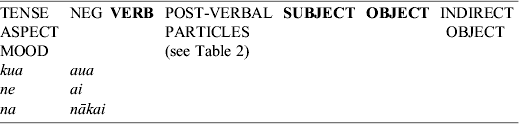
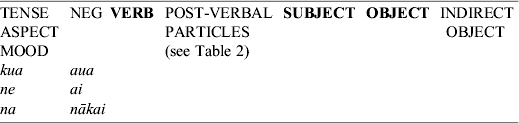
Syntactically, Niuean is an ergative case marking language with VSO word order. As noted in footnote 4 above, the language has extensive argument drop, with the result that the predicate can constitute the final major constituent in the sentence. Niuean shares with other Polynesian languages the use of pre-verbal and post-verbal grammatical particles. As many of these play important roles in the grammaticalisation of the question particles in Niuean, they are described in detail below. The pre-verbal particles include those that indicate tense–aspect–mood (TAM) (kua ‘perfect’, ne ‘past’, na ‘uncertain past’, etc.) and those that signal negation (NEG). These are outlined in Table 1.Footnote 5 There are three NEG morphemes: (a)ua in imperative clauses, and ai or n ākai in both declarative and interrogative structures.Footnote 6 The latter two NEG particles differ in their TAM marking, with the former having greater restrictions (see Seiter Reference Seiter1980 for details).Footnote 7 TAM particles and NEG appear to be inter-related in other ways. NEG cannot occur with certain TAM markers (e.g. the actual present tense marker ko e or the progressive marker hāne) (Seiter Reference Seiter1980: 15).
Surface order of elements in the Niuean clause. Bold marks the basic syntactic categories in the clause.
The order of the post-verbal particles and adverbials is outlined in Table 2. These include directional adverbs, manner adverbs, instrumental applicatives, universal quantifiers, locative resumptive pronouns, aspectual adverbs, focus or emphatic particles, the perfect marker tuai and Q particles. The Q particles are located at the far right of the post-verbal elements, shown as Q in Table 2, next to the emphatics and perfect marker tuai.Footnote 8
Surface order of Niuean post-verbal particles.

There are two exceptions to the order of the post-verbal particles in Table 2, which shed light on our analysis of the question markers in Niuean later in the paper, since they draw a connection between pre-verbal and post-verbal positions. One pertains to the perfect marker tuai. In affirmative clauses, tuai occurs in post-verbal position, before Q, as in Table 2 and in (4a) below.Footnote 9 However, in negative clauses, it appears in pre-verbal position after NEG, as illustrated in Table 3 (which also shows that lā and ka and kia can occur here) and in (4b) (Seiter Reference Seiter1980, Massam Reference Massam, Carnie and Guilfoyle2000).
- (4)
(a) Kua ligi tuai e au e kapiniu tī ma-au.
perf pour perf erg.p 1.sg abs.c cup tea for-2.sg
‘I have poured a cup of tea for you.’(Seiter Reference Seiter1980: 8 ex. (19a))
(b) Kua nākai tuai liu e tahi.
perf neg perf turn abs.c sea
‘The tide has not turned.’(Seiter Reference Seiter1980: 15 ex. (41b))
Another particle that can appear after NEG, as shown in Table 3, is the emphatic particle lā ‘just, yet’, which occurs to the immediate left of tuai in post-verbal position in affirmative clauses, as in (5a) below. In negative clauses, lā appears in pre-verbal position, immediately after NEG, as in (5b).
- (5)
(a) Kitia lā e koe e pusi a pogipogi.
see emph erg.p 2.sg abs.c cat art tomorrow
‘You will see the cat tomorrow.’
(b) Ai lā kitia e au e pusi.
neg emph see erg.p 1.sg abs.c cat
‘I have not yet seen the cat.’(Seiter Reference Seiter1980: 15 ex. (42))
Of the five emphatic particles in Niuean (Seiter Reference Seiter1980: 22),Footnote 10lā is the only one that behaves in this way. Other emphatic particles occur in post-verbal position in both affirmative and negative clauses.
Clause structure showing the central position of the verb.

The only other post-verbal particles that can appear after NEG are the Q particles kia and ka, as indicated in Table 3. In affirmative clauses, kia and ka occur in the rightmost post-verbal position, as is illustrated in Table 2 and exemplified in numerous places throughout this paper (see e.g. example (3a) above and many examples in Sections 5.2 and 5.3). In negative clauses, these Q particles can occur in their regular post-verbal position as illustrated by the respective positioning of kia in (6a) and ka in (7a), or they can occur pre-verbally, immediately to the right of NEG, as illustrated by the respective positioning of kia in (6b) and ka in (7b). The pre-verbal position in negated sentences is considered less marked. When both a Q particle and lā occur in the pre-verbal position, Q follows the emphatic particle lā as in (7b).Footnote 11
- (6)
(a) Nākai kai kia e Mele e apala?
neg eat q2 erg.p Mele abs.c apple
‘Didn't Mele eat the apple?’(Massam Reference Massam2003: ex. (4a))
(b) Ai kia kitia he tau fanau e manulele?
neg q2 see erg.c pl children abs.c bird
‘The children didn't see the bird, did they?’
- (7)
(a) Ai kitia ka he tau fanau e manulele?
neg see q3 erg.c pl children abs.c bird
‘The children didn't see the bird, did they?’
(b) Nākai lā ka hoko mai a Moka?
neg yet q3 arrive dir3 abs.p Moka
‘Isn't Moka here yet?’
We now turn to imperative and interrogative structures. In imperatives, the subject noun phrase is deleted, and the structure has no TAM, as in (8a) and (8b).
- (8)
(a) Tā mai ki a au e toki.
bring dir1 gl.p pers 1.sg abs.c axe
‘Bring me an axe.’(Seiter Reference Seiter1980: 147 ex. (58))
(b) Tū hako.
stand up
‘Stand up.’(learnniue.co.nz)
When the subject NP is present, an imperative structure is interpreted as an exhortation, offer or suggestion, as in (9a) and (9b). In other words, the pragmatic force of the imperative is reduced.
- (9)
(a) Fina age a koe apogipogi!
go.out dir3 abs.p 2.sg tomorrow
‘Why not come out tomorrow?’(Seiter Reference Seiter1980: 58 ex. (148a))
(b) Mohe mitaki a koe!
sleep good abs.p 2.sg
‘Have a good sleep.’(learnniue.co.nz)
These structures also have no TAM. Such structures may also be preceded by the particle kia, as in (10), described later.
(10) Kia tō lahi e uhi!
exhrt fall greatly abs.c rain
‘May it rain heavily!’(Seiter Reference Seiter1980: 9 ex. (24a))
Interrogatives do have subject noun phrases and a full range of TAM. Wh-interrogative words (e.g. hai ‘who’, heigoa ‘what’, fē ‘where’, fēfē ‘how’, etc.) occur in-situ to the right of the post-verbal particles as in (11a), or can be moved from their argument position into clause-initial position by the addition of the predicate marker ko, as illustrated in (11b). Yes–no question particles do not occur in clause-initial position and involve different types of structures, to be outlined shortly.
- (11)
(a) Fifili e hai a koe ke vagahau?
choose erg.p who abs.c 2.sg sbjv speak
‘Who chose you to speak?’(Seiter Reference Seiter1980: 106 ex. (49a))
(b) Ko hai ne fifili a koe ke vagahau?
pred who nfut choose abs.p 2.sg sbjv speak
‘Who chose you to speak?’(Seiter Reference Seiter1980: 109 ex. (58a))
3. Yes–no question particles
In this section we outline the basic data involving the three yes–no question particles in Niuean, looking first at nakai, then at kia, then at ka. In the following section we summarise their characteristics before proceeding to explore the historical development of the particles.
3.1 Nakai questions
The particle nakai has one main fixed position in post-predicate position (Seiter Reference Seiter1980, Sperlich Reference Sperlich1997, Massam Reference Massam2003), as in (12).
(12) Kua kai nakai e Moka e apala.
perf eat q1 erg.p Moka abs.c apple
‘Did Moka eat the apple?’(Massam Reference Massam2003: ex. (1))
It cannot occur in wh-questions, as in (13).
(13) *Ko hai nakai e tagata i kō?
pred who q1 abs.c person gl.p dem
‘Who is that person there?’(Massam Reference Massam2003: ex. (6c))
The Q particle cannot occur in questions negated by either of the sentential negators nākai or ai (Massam Reference Massam2003), as illustrated in (14).
(14) *Nākai/ai kai nakai e Moka e apala?
neg eat q1 erg.p Moka abs.c apple
‘Didn't Moka eat the apple?’(Massam Reference Massam2003: ex. (4c))
The fact that nakai cannot co-occur with ai suggests that the restriction is a structural one between nakai and NEG and is not due to the simple similarity in form between nakai and nākai. This is an important point that we will return to later, in Section 4.2.
When the discourse context of the yes–no questions is examined, we find that nakai forms neutral unmarked questions. In oral interviews, nakai questions tend to request information on new topics, as in (15), where the interviewer is changing the subject to ask a new, neutral question.
(15) Fā fenoga atu nakai a koe ke he motu ko Niue?
hab journey dir2 q1 abs.p 2.sg gl.c loc.c island pred Niue
‘Do you usually travel to Niue?’(NMMIP5)
A second use for nakai is in a fixed tag, which can occur alone, or as a tag on an existing nākai question, as in (16). Q and P at the start of each turn mark questioner and participant, respectively. The translations provided are those of the translator, and they have not been tampered with, in order to preserve the translator's sense of the meaning of the original Niuean sentence. We often include the discourse context and answers, even though these make the examples long, as they provide clues as to the discourse uses of the various Q particles.
(16) Q: mitaki, fā fano nakai a koe ke he tau
good usual go q1 abs.p 3.sg gl.c loc.c pl
fakafetuiaga he tau Niue, e po.ke nākai?
event gen.c pl Niue yes or neg
Q: ‘Right, do you go to other Niuean events?’
P: fano
go
P: ‘(I) go.’(Massam et al. Reference Massam, Starks, Ikiua, Moyse-Faurie and Sabel2011: ex. (9))
3.2 Kia questions
The other two Q particles are more flexible in their position. As mentioned earlier, kia can occur in post-predicate or in sentence-final position, as illustrated in (17)–(18).Footnote 12
(17) … Ko e vagahau Niue tūmau kia a koe?
pred c language Niue always q2 abs.p 2.sg
‘Do you always speak in Niuean?’ (NOFIP5)
(18) Kai e Mele e apala kia?
eat erg.p Mele abs.c apple q2
‘Did Mele eat the apple?’(Massam Reference Massam2003: ex. (2))
It should be noted that the latter position is relatively rare, in fact it has been found thus far only in our elicitation. Unlike nakai questions described earlier, kia can occur in wh-questions, as in (19).
(19) Ko hai kia ne manako a Moka ki ai?
pred who q2 nfut like abs.p Moka loc.p resprn
‘Who does Moka like?’(Massam Reference Massam2003: ex. (6))
This would suggest that kia is a general question word (like Japanese ka) rather than a yes–no Q particle in the strict sense. Strictly yes–no particles are relatively rare in the languages of the world (Haspelmath et al. Reference Haspelmath, König, Oesterreicher and Raible2001), but appear to be also attested in at least one other Polynesian language, Samoan. Given the syntactic distribution, Otsuka (Reference Otsuka2006) argues that Samoan does not have a yes–no Q particle but rather a general Q marker.
A further characteristic of kia questions relates to negation. The form kia can occur in negated questions, with a NEG particle nākai or ai. In such questions, as noted above, the Q particle can appear in its usual post-verbal position, as in (20), or can appear pre-verbally after NEG, as in (21).
(20) Nākai kai kia e Mele e apala?
neg eat q2 erg.p Mele abs.c apple
‘Didn't Mary eat the apple?’(Massam Reference Massam2003: ex. (4a))
(21) Ai kia mohe a Moka he mohega tote?
neg q2 sleep abs.p Moke loc.c bed small
‘Didn't Moka sleep in the small bed?’(Massam Reference Massam2003: ex. (3a))
The majority of response types to kia questions are full predicates or sentences. This suggests that kia questions should be classified primarily as alternative or disjunctive questions, in which case the question asks whether or not X or Y is true. This categorisation concurs with our analysis of the pragmatically marked nature of kia questions. They are used in a variety of ways, for example, to seek out additional information, as in (22). In these examples, Q refers to the questioner and P refers to the Participant in the interview.
(22) Q: Ki Hakupu.
gl.p Hakupu
‘To Hakupu.’
P: E.
right
‘Right.’
Q: Ō hui nī kia?
go foot emph q2
‘Just walked?’
P: Ō hui nī he mogo pogipogi to liliu
go foot emph loc.c time morning fut return
mai he mogo afiafi ka hili e aoga,
dir1 loc.c time evening when finish abs.c school
pihia nā pogi.
thus emph tomorrow
‘Go by foot in the morning time and come back in the evening time after school, same tomorrow.’(NOFIP5)
A kia question can also serve as a leading question, as in (23).
(23) Q: Fēfē haau a kitiaaga ki a lautolu
what gen.2.sg lig view gl.p pers 3.pl
ia he magaaho nei, kua kua pihia
dem loc.c time dem perf perf thus
kia haau a manatu ha kua kitekite
q2 gen.2.sg lig thought because perf look
atu a koe ke he tau fānau
dir3 abs.p 2.sg gl.c loc.c pl children
he magaaho nei, nākai makaukau lahi a
gen.c time dem neg determined very abs.p
lautolu ka.ha ke pehē fakaako e vagahau
3.pl right sbjv thus learn abs.c language
Niue po.ke fakaaoga e vagahau Niue.
Niue or use abs.c language Niue
‘What is your view about them at this time – do you feel that way because you look at the children these days (and) they are not very determined to, say, learn the Niue language or use the Niue language?’
P: Mooli lahi, mooli lahi.
true very true very
‘Very true, very true.’ (NMMIP5)
A kia question can end with po ke ‘or’, as in (24). This differs from nākai questions which take the more restrictive optional yes–no question tag, e po ke nākai ‘yes or no’, as illustrated earlier in (16).
(24) E, ti ko e vagahau pālagi nī kia tūmau po.ke …
yes so pred c language English emph q2 always or
‘Right, so speak always in English or …’ (NOFIP5)
Kia questions have one other characteristic. They often co-occur with an emphatic particle. In (25), the kia question co-occurs with the emphatic particle nī.Footnote 13
(25) E, kua vagahau pālagi tei a.ia ka ko e
yes perf speak English almost then but pred c
tapu Niue ne finatu a koe ki ai ka
church Niue nfut attend abs.p 2.sg gl.p there if
pehē ko e magaaho nī he tau Niue, ko
thus pred c time emph loc.c pl Niue pred
e heigoa e vagahau ne fakaaoga e lautolu ke
c what lig language nfut use erg.p 3.pl sbjv
fakatutala ka hili e tapu? Vagahau Niue nī kia?
talk when finish abs.c church language Niue emph q2
(NOFIP5)
‘Yes, then speak English then. But the Niue church that you attend…if it is only the time for the Niueans, what is the language they use to speak when the church is finished? Just speak in Niuean only?’
3.3 Ka questions
Ka has the most syntactic flexibility of all Q particles. It can appear in post-predicate position, as in (26), sentence-finally, as in (27), and in a range of other positions, such as after a non-predicate fragment, in (28), or even on its own, in (29). Its most common position is sentence-final.
(26) ko e hā ne malona ai e na e, kua leva
pred c why nfut broken there prt prt prt perf long.time
ka e malona?
q3 abs.c broken
‘Why is this broken, has it been broken for long?’(NMMIP5)
(27) e, pihia he kitia e koe ka?
yes thus loc.c see erg.p 2.sg q3
‘Yes, is that how you see it?’ (NOFIP5)
(28) matini hila ka?
machine electric q3
‘Electric machine, eh?’ (NOFIP5)
(29) P: Ti mamate e tau kulene ia haaku ai kitia
so die abs.cpl grandparents dem gen.1.sg neg see
e au.
erg.p 1.sg
‘… and died, those grandparents of mine, I did not see them.’
Q: Ka?
q3
‘Really?’ (NOFIP5)
NEG can co-occur with ka, as in (30).
(30) Ai ka mohe a Moka he mohega tote.
neg q3 sleep abs.p Moka loc.c bed small
‘Didn't Moka sleep in the small bed?’ (Massam Reference Massam2003: ex. (3b))
The latter characteristic would group ka and kia questions together. However, ka questions cannot occur in wh-questions, as illustrated in (31).
(31) *Ko hai ka e tagata i kō?
pred who q3 abs.c person gl.p dem
‘Who is that person there?’ (Massam Reference Massam2003: ex. (6b))
This is the only respect in which ka questions are more like nakai questions than kia questions. The presence of a wh-word is a signal of the information-seeking status of this structure. This co-occurrence restriction might suggest that ka is not a proto-typical yes–no question marker. This fits well with available information on response types, described below.
Ka is pragmatically marked. It is typically found in spoken rather than written discourse, and of the three question particles, questions with ka are the most likely to receive a minimal response. Ka questions, like kia questions, often follow up on information presented in the prior discourse. Ka appears in rhetorical questions, as in (32a–b).Footnote 14
- (32)
(a) ‘Ko e ō mai ka mua i tahi?’ he hūhū mai he akoako.
pred c go dir2 q3 2.du gl.p sea as ask dir2 erg.c pastor
‘“Finished for the day?”, asks our pastor.’
(b) ‘Ko e tau ika nī ka ia ha mua
pred c pl fish emph q3 that gen 2.du
ne hī?’ he vagahau he Matua Fifine mo e malimali.
nfut catch as language gen parent woman com c smile
‘“Is this all you caught?”, asks Mum with a smile.’
It also appears as a follow up to a previous question or statement, as in (33).
(33) Q: Ka e iloa nakai e koe ka pehē ko e Tonga?
but lig know q1 erg.p 2.sg if thus pred c Tongan
‘But would you know if it is a Tongan?’
P: Kehe foki ha Tonga leo.
different also gen.p Tongan voice
‘Tongans’ pronunciation is also different.’
Q: E, iloa e leo Tonga ka?
yes know abs.c voice Tongan q3
‘Yes, you know the Tongan pronunciation, eh?’ (NOFIP5)
The difference between ka and kia appears to be that whereas a ka question follows up on the previous question with no expectation that the situation is not true, a kia question appears to question the validity of information presented in previous turns. Therefore, although kia and ka form marked structures, the former is information-seeking whereas the latter is not. This would explain why the former, but not the latter, can appear in wh-questions. The final difference between kia and ka is that ka can appear on its own, where it appears to function as a discourse particle, as in (29) above and (34). The discourse particle status of ka is also evident from its preferred syntactic position in sentence-final position.
(34) P: Ko e Niue e matua taane ka e fanau i Ausetalia.
pred c Niuean abs.c parent male but lig born loc.p Australia
‘The father is Niuean but born in Australia.’
Q: Ka.
q3
‘Eh?’(NOFIP 5)
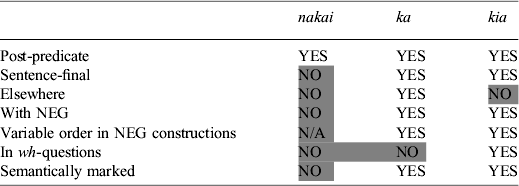
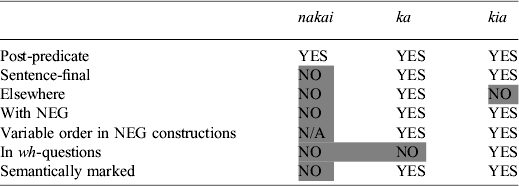
Summary of the distribution of the question particles. Shading marks differences between the particles.
3.4 Summary of yes–no question particle properties
The data thus far would suggest that nakai is associated with unmarked questions. It occurs in neutral contexts with a full range of response types. It can only occur in a core sentential, post-predicate position. In terms of typological classification, one could argue that Niuean does not have three yes–no Q particles. There is only one true unmarked yes–no question particle, nakai. Kia typically forms questions that have a negative bias, whereas ka serves as a discourse or confirmation particle, albeit one that usually occurs in a core sentential position, i.e. post-predicate, rather than in a typical peripheral position of a discourse particle. Table 4 outlines the distribution of the three forms presented thus far. From a syntactic point of view, it could be argued that nakai appears in a fixed position, whereas kia and ka can adjoin to other elements to provide various focus interpretations. We will now leave aside the issue of the syntactic and pragmatic status of the particles, and focus on their potential origins.
4. The origin of Q particles
4.1 Kia questions
The particle kia occurs in yes–no questions as shown above, but it also appears in mild imperatives or exhortatives (Seiter Reference Seiter1980, Sperlich Reference Sperlich1997), as illustrated in (35).
(35) Kia hau a koe ki hinei!
exhrt come abs.p 2.sg gl.p here
‘(You) come here!’(Sperlich Reference Sperlich1997: 153)
It is likely that both uses date back to the Proto-Polynesian form (PPn. *kia subjunctive). The original subjunctive usage would help account for both the strong attitudinal component expressed in the kia imperative and the pragmatic overtones evident in both kia questions and kia imperatives.Footnote 15 Of the Niuean structures, we assume that the mild imperative structure developed first. This proposed trajectory is supported by comparative evidence from Pukapukan, where the subjunctive ke < PPn. *kia is used to express commands but not yes–no questions (Salisbury Reference Salisbury2002: 539) and New Zealand Maori, where kia is an attitudinal TAM marker with imperative meaning (Bauer Reference Bauer1997: 99), but not a Q particle.
Another key component of our argument relates to the Principle of Persistence, where semantic features remain visible in subsequent structures. Seiter (Reference Seiter1980: 59) states that kia imperatives differ in pragmatic force from regular imperatives in that they ‘imply that the speaker has no control over the addressee’. As such, kia imperatives lack a key feature associated with other typical imperative structures. Kia questions are also pragmatically marked. Sperlich (Reference Sperlich1997) has noted that kia questions typically demand an answer. Thus, kia imperatives are less imperative-like than other imperatives, and kia questions are more imperative-like than either a nakai or a ka question.
In order to consider this claim, we need to examine the structures in more detail, all of which are present in modern-day Niuean. As stated earlier, in prototypical imperative structures, the subject noun phrase is deleted, and the clause has no TAM. When the subject NP is present, an imperative is interpreted as an offer or suggestion, as in (9) above. In other words, the pragmatic force of the imperative is reduced with an overt subject.
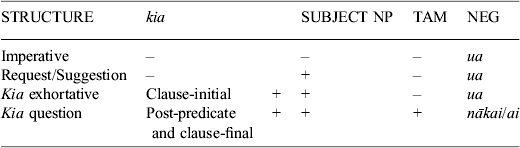
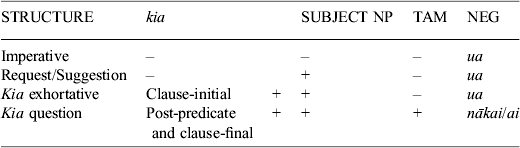
Kia imperatives differ structurally from offers and suggestions by the addition of the particle kia, as illustrated in Table 5, with a further shift in pragmatic force. Kia imperatives thus differ from kia questions in their syntactic position, clausal negation, and TAM. The latter two features, type of negative particle and the TAM marking, are dictated by clause structure. The only anomaly concerns the syntactic position of the particle kia.
Differences between imperatives, requests, exhortatives and kia questions.
Several factors are likely to have played a role in the positioning of kia in yes–no questions. Central to the argument is the strong attitudinal component associated with the kia particle. Attitudinal markers are typically realised in Niuean as post-verbal particles (i.e. lā, nī, etc.), where they occur in the right periphery of the predicate (see Table 2 above). Attitudinal particles tend to co-occur, and it is not uncommon to have two or three such particles in a clause (Seiter Reference Seiter1980: 24). One common particle in imperative structures is the attitudinal particle lā. The Niuean language website (learnniue.co.nz) provides examples of lā in imperative structures, as in (36)–(37). Although Seiter (Reference Seiter1980: 58) does not provide any examples, he notes that kia imperatives typically co-occur with the emphatic particle lā.
(36) Ala lā.
waken just
‘Wake up.’(learnniue.co.nz)
(37) Fano lā.
go just
‘Go please.’(learnniue.co.nz)
Since both kia and lā have a strong attitudinal component and both regularly co-occur in mild imperatives, it is not difficult to see why kia may have been re-interpreted grammatically as an attitudinal particle. Once re-interpreted, kia would be free to co-occur with other attitudinal particles and this would provide the necessary conditions for kia to attract syntactic patterning similar to other attitudinal particles, and in particular the particle lā. Once this connection is made, other factors fall into place. There is a syntactic shift of kia to post-verbal position in affirmative clauses, and the adoption of an alternative pre-verbal order in negative clauses. The position of kia after lā would be expected if the former particle is a newer addition, as later particles are known to attach as peripheral elements. A later and weaker link might also help to account for why the Q particle kia can appear both after the verb and in sentence-final position.
Positing the origin of kia as an attitudinal marker accounts for a wide range of additional features in Niuean. It would explain the acceptability of kia in wh-questions, and its frequent co-occurrence with other emphatic markers. It would also account for the acceptability of multiple yes–no Q particles (Massam Reference Massam2003). The shift from an attitudinal marker to a question marker would be the next natural outcome, and would also have other ramifications, for example, once kia is interpreted as a question particle, its post-predicate position would be affirmed if a Q feature causes movement of the predicate into a left peripheral CP domain position, as suggested above. This movement would not take place in exhortatives (and optionally in negatives), leaving kia in pre-verbal position in such sentences. A summary of the development is presented in (38).
(38) Development of kia as a question particle
• Proto-Polynesian subjunctive kia developed a mild imperative (command) use with an attitudinal component (compare the Pukapukan subjunctive used for commands).
• The mild imperative frequently co-occurs with the post-predicate attitudinal particle (l ā).
• The co-occurrence of particles with similar semantics in similar structures creates the first set of conditions for a recategorialisation of kia as an attitudinal particle.
• A second structure which employs imperative verbs (but without the kia particle) is suggestions/requests. These structures are less imperative-like as they place more importance on the hearer, and are thus more question-like.
• Requests/suggestions differ from imperatives in that they have an overt subject NP, reaffirming VSO word order and the post-predicate positioning of attitudinal particles, creating the second set of necessary conditions for the recategorialisation of kia.
• Together, the two structures create the necessary ambiguity for the recategorialisation of kia as an attitudinal marker and the creation of a pragmatically marked question construction in Niuean (which demands an answer).
The reanalysis of kia as a Q particle with marked semantic uses would create a need for an unmarked question marker. If kia questions developed earlier than nakai, the development of an alternative word order for kia in affirmative and negative clauses could serve as a catalyst for the development of nakai as a post-predicate question marker. We turn now to discuss the origin of nakai as a question particle.
4.2 Nakai questions
The most likely origin of the nakai Q particle is the Niuean negative particle nākai. In this section we will argue for the development, outlined in (39), of this lexical item from being a NEG particle to being used also (with a slightly different form) as a Q particle.
(39) Development of nakai as an unmarked Q
• Proto-Oceanic NEG weakens and the resulting Polynesian languages develop alternative ways of strengthening NEG.
• The resulting Niuean form is the past tense marker (*na) and NEG (*kai). The past tense marker (na) also continues to occur as a TAM marker in Niuean, where it signals past uncertainty. The vowel lengthens (for unknown reasons).
• The weakening of NEG continues with structural consequences, with TAM continuing to attach to NEG but the post-predicate particles, with the exception of lā and tuai, now attaching to the predicate rather than NEG.
• The marked Q particle kia establishes a link between NEG and post-predicate position and creates a semantic niche for an unmarked Q particle.
• The semantic relationship between the irrealis markers NEG and Q allow the NEG particle nākai to fill this gap, and typological considerations re-inforce the preverbal position of NEG. The post-verbal position of Q is due to analogy with the marked Q particle kia and the typological need for Q and NEG to be distinct.
• When nakai occurs in post-predicate position as Q, it attaches as a clitic and loses a mora, further distinguishing NEG from Q.
We are positing that the Q particle nakai developed from the negative particle nākai. As the negative particle nākai is unknown outside of Niuean, we provide a little background on the possible origin of this particle. Lynch, Ross & Crowley (Reference Lynch John and Crowley2002) argue that the original negative forms in Proto-Oceanic lost some of their semantic force, and were subsequently reinforced. The reinforcements later replaced the original negator (in the manner of Jespersen's Cycle, Jespersen Reference Jespersen1917) or, in some cases, resulted in discontinuous forms (see e.g. Hooper Reference Hooper1993 on Tokelauan). This natural process helps to account for the diverse range of forms in Oceanic and by default the present-day Polynesian forms. In some of the daughter languages, NEG is derived on PPn *kai (Neg imperative) and phonological mergers between TAM and NEG (Clark Reference Clark1976, Salisbury Reference Salisbury2002). The TAM markers may have served as strengtheners as it is relatively common for languages to add a strengthener (see Dryer Reference Dryer, Hammond, Moravcsik and Wirth1988; Whaley Reference Whaley1997: 227–228) because negatives carry an important message, which needs to be unambiguously presented to the hearer. The Niuean NEG consists of the PPn TAM marker *na (past tense) and the PPn negative morpheme *kai ‘negative past tense’ (Clark Reference Clark1976).Footnote 16 A likely explanation for the Niuean form is that the past tense marker would have added greater uncertainty to the negative event or state. In Niuean, na refers to either a past event with some uncertainty or to an ongoing truth (Seiter Reference Seiter1980: 4), and this added marker of uncertainty may have contributed to a connection between NEG and Q. As this merger appears to be unknown outside of Niuean, we can assume that the NEG particle is a relatively recent historical change. If na were originally used to strengthen kai, this would entail that there had been a natural weakening of NEG. As the semantic force of NEG weakens, it is possible that its use could extend to other irrealis states and events.
Comparative data provide useful pragmatic information about Q which supplements the ideas presented above. Negative yes–no questions are used as requests and as invitations in some Polynesian languages (e.g. Pukapukan, see Salisbury Reference Salisbury2002: 499), and this could have been the case in pre-Niuean. If requests and invitations were originally formulated in Niuean with negative constructions, such a link would contribute to the potential use of NEG as a yes–no question marker in Niuean. The additional modern-day supplementary means of asking questions, by using the expression, e po ke nākai ‘yes or no’ illustrated in (16) above, would have further supported this connection.Footnote 17
Similarities between NEG and Q are well-documented typologically due to their shared semantic properties, and this may have also been a contributing factor. Both negatives and questions are non-veridical (Giannakidou Reference Giannakidou1998), being concerned with polarity, and dealing with uncertain or unrealised events or states, and they modify truth conditions of the embedded proposition (Horn Reference Horn1989, Horn & Kato Reference Horn, Kato, Horn and Kato2000a, among others). This semantic similarity has structural outcomes. For example, in English both yes–no questions and negation licence polarity items such as any. In other languages, the two often have similar forms: (Vietnamese khong, see Feuillet Reference Feuillet, Boucher and Fournier1994,, Inga chu see Whaley Reference Whaley1997: 227),Footnote 18 similar behaviour (do-support in English), or cannot co-occur, as they occupy the same underlying or surface syntactic slot (Québec French, see Morin Reference Morin2006, Reference Morin, Aboh, van der Linden, Quer and Sleeman2009). In Paduan, word order inversion appears in affirmative yes–no questions, but not in the negative, arguably because the two occupy the same slot, and are thus incompatible (Zanuttini Reference Zanuttini1997).
A similar, but not identical, argument could be put forth for Niuean. As with Québec French, the yes–no Q particle and the negative morpheme cannot co-occur, as shown in example (14) above. Although NEG and Q appear in different surface slots, the co-occurrence restrictions suggest that the forms for NEG and Q are linked in some fundamental way and we contend that this is because of their common origin historically, and possibly also their common merge position synchronically (Laka Reference Laka1994), assuming, as suggested above, a syntactic analysis in which the predicate moves to a position to the left of the Q marker, but does not move in case of negation. Negation and questions are not totally identical as there is no known language in which the two are not distinct, with negation tending to appear before the verb in VSO languages (Dryer Reference Dryer, Hammond, Moravcsik and Wirth1988, Horn Reference Horn1989, Feuillet Reference Feuillet, Boucher and Fournier1994). All of these examples are evidence of Structural Persistence of the vestiges of the original.
A recent development suggests the link between Q particles and focus exists in some languages but not others (see Ginsburg Reference Ginsburg2008). The latter may be of relevance here. Since sentential negation is associated with irrealis mood, Zanuttini (Reference Zanuttini1997) and Portner & Zanuttini (Reference Portner, Zanuttini, Horn and Kato2000), among others, have attempted to link such structures together, assigning Tense–Aspect–Mood and Negation to a NEG Phrase. Zanuttini has also presented an interesting argument, that incompatability constraints between negation and questions, and between questions and imperatives, show that the structures are closely aligned.There is an important syntactic difference between Q and NEG that needs to be explained. As illustrated in Tables 1 and 2 above, Q follows the predicate in Niuean, whereas NEG precedes the predicate. To explain this, we return to the assumption that NEG had verb-like properties in Proto-Polynesian and had TAM marking, post-predicate particles and complements, as is the case in a number of contemporary Polynesian languages (see Chung Reference Chung1970, Payne Reference Payne and Shopen1985). As the status of NEG weakens and it loses many of its verbal properties, including its ability to take TAM markers (perhaps because the TAM status is filled by the past uncertain particle na), and to attract a full range of post-predicate particles, there are consequences on the grammatical system. While the TAM markers continue to occupy a fixed position directly before the verb in negative clauses (TAM NEG V), the weakening of the verbal status of NEG results in an inability to attract post-predicate particles, with post-predicate particles now occurring in post-predicate position in both affirmative and negative clauses, with only the post-predicate particles on the far rightmost periphery remaining attached to NEG. As noted earlier in the paper (Section 2), this results in the rightmost particles, tuai and lā, occupying a post-verbal position in affirmative clauses and a pre-verbal (post-negative) position in negative clauses (see examples (4) and (5) above). The Q particle kia also now occurs to the right of the particles tuai and lā and occurs in negative and positive questions. The existence of alternative positions of the post-predicate particles tuai and lā in negative and affirmative structures and the ability for the marked Q particle kia to appear in its usual post-predicate position, as in (17) and (19) above, or to attach to NEG and occur in pre-verbal position, as in (21) above, creates the requisite surface conditions for NEG to occupy post-predicate position in its change from a NEG to Q.Footnote 19
Typological considerations further support this view of change. VSO languages have a tendency to place NEG in pre-verbal position (Dahl Reference Dahl1979, Dryer Reference Dryer, Hammond, Moravcsik and Wirth1988), which may well have helped nakai keep its syntactic position. Although in VSO languages Q also tends to occur in clause-initial position, there is a clear typological need for negative forms to be distinguished from question markers (Horn Reference Horn1989). Feuillet (Reference Feuillet, Boucher and Fournier1994) even goes so far as to claim that there is no known language in which NEG and Q are identical in form and structure. This need to avoid potential ambiguity is likely to have further supported the differing syntactic positioning and a further change. NEG and Q have a similar but not identical form (nakai vs. nākai). The difference between NEG and Q is likely due to the typological need for NEG and Q to be distinguishable. The difference in mora between the Q and the NEG is likely due to their different positioning in the clause. The Niuean Q particle attaches as the rightmost constituent of the verb phrase, which is a clitic-like position, whereas the negation marker does not cliticise, but appears before the predicate. Clitics are known to differ from free particles in a number of respects, including prosodic integration and a reduction in form (Zwicky Reference Zwicky1985, Aikhenvald Reference Aikhenvald, Dixon and Aikhenvald2003, Stebbins Reference Stebbins2003). A reduction in mora (vowel length) would be a natural outcome of grammaticalisation, which often co-occurs with phonetic reduction. The development proposed for nakai as a Q particle is outlined above in (39), at the beginning of this section.
4.3 Ka questions
In this section we argue for the development of the Q particle ka from a discourse particle, as outlined in (40).
(40) Origin of ka as a question marker
• Kaha is a fixed verbal phrase, which appears in a wide variety of interrogative and non-interrogrative contexts.
• Kaha is reinterpreted as a discourse particle due to its frequent sentence-final position.
• As a discourse particle, kaha attaches to S (sentence), where it was prone to phonetic reduction; kaha reduces to kaː
• As a grammatical particle, kaː is subject to a phonological rule: Word-final monosyllabic words with grammatical functions have short vowels (kaː – ka).
• Homophonous forms with irrealis functions (e.g. ka ‘future, but, if’) reinforce the irrealis status of ka.
• In discourse, post-predicate position often equates with sentence-final position.
• Once these links are drawn, further links are made between the homophonous morpho-phonemic variant of kia [ka] and its syntactic positioning in affirmative and negative clauses.
Both observable phonetic synchronic varability and the absence of ka as a Q particle in contemporary Niuean grammars (Seiter Reference Seiter1980) suggest that this question particle is a very recent development. The only mention of any Q particle ka in Seiter's grammar is as a morpho-phonemic variant of the Q particle kia. Although this morpho-phonemic variant is likely to have played a role in the development of the ka question particle, discussed below, it is not the likely origin of the particle.
The most likely origin of ka is the lexical item kaha ‘that's it/that's right’. The two items have similar semantics, providing or requesting confirmation from the listener. The confirmational phrase origin also helps explain syntactic restrictions on ka questions. As stated earlier (Section 3.3), ka cannot occur in wh-questions, which are information-seeking rather than confirmational. Another piece of evidence for this origin comes from the answers to ka questions, which are largely confirmational responses rather than yes or no responses.
As a lexical item, kaha ‘that's right’ is frequent in the data, and, as illustrated in (41), it sometimes has no status as a question particle. It serves simply as a sentential tag.
(41) Maloloː na au ne nofo ai fano he aoga
well pst 1.sg nfut stay neg go loc.c school
a ia mo e tau gahua lima ha matulu
abs.p 3.sg and lig pl work hand gen.c1.excl.pl
tau community kaha
pl community right
‘Well I was the one who stayed home and did not go to school, we worked our handicrafts, that's right.’ (Massam et al. Reference Massam, Starks, Ikiua, Moyse-Faurie and Sabel2011: ex. (26))
At other times, as in the example in (42), kaha appears in structures in yes–no questions.
(42) Q: ne mukamuka a koe kaha?
pst easy abs.p 3.sg right
‘because it is easy for you, is that right?’ (Massam et al. Reference Massam, Starks, Ikiua, Moyse-Faurie and Sabel2011: ex. (25))
P: Yeh
‘Yeah.’
It is likely that an alternative means of forming yes–no questions, by intonation, is acting as the marker of Q here. Examples such as (43), where kaha co-occurs with ka, strongly suggest that kaha, when it appears in Q structures, does not signal a yes–no question.
(43) Uafulumahiva e tau a ia haau kaha ka?
twenty-nine lig year abs.p 3.sg gen.2.sg right Q
‘You were twenty-nine years then, right?’
There is ample evidence that the phonological reduction in the form of the yes–no question particle is a recent change. The particle appears in a range of phonetic forms in the speech of the Niuean interviewer in the Pasifika Languages of Manukau Project. The variants form a synchronic cline with the bisyllabic kaha at one end and the monosyllabic Q particle ka on the other. Between the two ends are two additional forms, kaː and kā.Footnote 20 The form kaː contains a long vowel that is further back, probably due to the loss of the segment [h]. The reduction in mora with compensatory backing would be a natural grammatical process when a lexical item gradually loses its independent status and becomes a clitic particle. The other variant is kā, with a long mid-front vowel. Both forms are relatively infrequent. The most common variant, ka, is a natural outcome of grammatical constraints on vowel length in Niuean, where all monosyllabic grammatical items show no contrast in vowel length. The short vowel provides strong evidence that the question particle is now fully grammaticalised. The co-occurrence of kaha and ka, as in example (43), would also support this claim.
Once kaha came to be phonetically reduced, the question particle came to resemble other particles in Niuean that have an irrealis function: ka ‘but’, ka ‘if/when’ and ka ‘future subordinate’. One of these irrealis particles occurs in the fixed expression ka i ko NP ‘but what about NP’, as illustrated in (44), and is relatively frequent in conversation.
(44) Ka i ko e haau a tama?
but cause pred c gen.2.sg lig child
‘What about your child?’(NOFIP5)
The structure is used to introduce intonation-based questions, which follow on from other discourse in ways somewhat similar to those of ka questions. A second construction, with a clause-initial irrealis marker, ka + S ‘but S’, also occurs frequently in conversation, where it functions as a discourse marker. In this context, it can introduce yes–no questions, as in (45).
(45) Ka e iloa nakai e koe ka pehē ko e Tonga?
but lig know q1 erg.p 2.sg if thus pred c Tongan?
‘But would you know if it is a Tongan?’(NOFIP5)
Both of these structures might have helped to create a link between ka as a confirmation marker and ka as Q particle.
The yes–no Q particle, ka, does not appear in clause-initial position. It occurs in post-predicate position in affirmative clauses and pre-predicate position in negative clauses. It also attaches to NPs, occurs on its own, and appears in sentence-final position. The latter syntactic positioning can be explained, in part, as derived from kaha. As a single stand-alone lexical item, kaha appears on its own, and as a confirmational tag, it often occurs in clause-final position. Its other positions, as a post-predicate particle in affirmative clauses and as a pre-predicate particle in NEG clauses need further explanation. As mentioned above, post-predicate position often equates with sentence-final position, where the following arguments are not overtly realised in the discourse context, providing ambiguity in learner input. The frequent use of a sentence-final post-predicate Q particle would provide ambiguous models for language learners, potentially leading to its use in post-predicate non–sentence-final constructions.
The syntactic positioning is likely triggered by another factor. Both ka and kia questions share similar phonological form under certain morpho-phonological conditions. Seiter (Reference Seiter1980) notes that when kia occurs in post-predicate position and is followed by the case marker a, it is realised as ka. This phonetic similarity between this morpho-phonemic variant of kia and the particle ka could have created the necessary ambiguity to promote the use of ka in post-predicate non–sentence-final position.
This extension of ka from sentence-final to non–sentence-final post-predicate position would result in all three Q particles in the Niuean language occuring in post-predicate position. Once this association is made, it would be fairly certain that the pre-predicate positon of ka in negative questions would be a natural consequence. The trajectory is sketched above in (40), at the beginning of this section.
5. Conclusion
Niuean Q particles differ from Q particles in other Polynesian languages in both their form and their syntactic nature. The Niuean Q particles do not resemble Q particles in any other Polynesian language, and they are subject to much tighter grammatical constraints than Q particles in other languages. They appear to have undergone a process of grammaticalisation through which less grammatical items become more grammatical and continue to take on new grammatical functions (Hopper & Traugott Reference Hopper and Traugott2003), and both the original forms and the newer Q particles are present (Lichtenberk Reference Lichtenberk, Traugott and Heine1991). This paper addresses the question: Where did the Niuean yes–no particles originate?
The paper postulates that kia originates from the Niuean mild imperative particle with the same form, that nakai originates from a NEG particle with a similar phonetic form, nākai, and ka originates from the confirmational phrase kaha ‘that's it’. Instead of seeing these as unrelated changes, we see each as a series of interconnected step-wise changes which range from purely diachonic to ongoing syntactic changes. We argue that kia, a particle which signals a polite imperative and also signals requests and suggestions, provided the semantic impetus for further changes. The particle has a strong attitudinal component, which would have led to its new position in the rightmost periphery of the predicate (see Table 2). This change would create a semantic niche for the development of an unmarked Q. The semantic connection between NEG and Q, together with the weakened grammatical status of Polynesian NEG and the need for an unmarked Q, created the requisite conditions for NEG to fill the role of an unmarked Q. Vestigal traces of Structural Persistence are apparent here in the modern-day co-occurrence restrictions of NEG and Q. We posit that in Niuean, ka is derived via a synchronic grammaticalisation, promoted by a combination of phonological, semantic and structural ambiguity in the language. The recent nature of the construction would explain vestigal traces of alternate phonological forms in speaker's utterances. Its origin as a discourse particle explains other aspects of its behaviour, such as why it cannot occur in information-seeking wh-questions.
At the beginning of this paper, we asked why there were so many Q particles, and why they appeared in the position they did. Our analysis shows that the three yes–no Q particles have different functions. A detailed analysis of the function and distribution of the particles suggests that the number of yes–no Q particles can vary depending on the criteria used to define them. Nakai is clearly a prototypical yes–no Q particle. The Q particle occurs as a central component of the clause, and signals an unmarked question. Kia is less prototypical. It is a more semantically marked construction. This is typologically expected, as those languages with more than one Q particle typically have a second particle that is semantically more marked. Kia is also syntactically marked, as it occurs in wh-questions as well as yes–no questions, and it might be considered to be an information-seeking question. The particle ka has some properties which suggest that it is a core Q particle, yet at the same time, it has other properties that suggest it is more peripheral to the clause. Given its marked status, it might be classified as ‘non-core’, and thus a discourse particle, rather than a yes–no question particle. This relates to the broader issue of how yes–no questions are defined and what is and is not regarded as a question. To explain the history of the three Niuean particles, we need to show how all three pattern together, a point which may not be easily made if one or more of the particles are classified differently, and considered to be something other than a Q particle in a narrow sense.
Although we have explored the historical process behind the placement of the Q particles, the syntactic post-verbal positioning of Q particles still has a number of unresolved issues (see Massam Reference Massam, Mercado, Potsdam and deMena Travis2010), especially because it appears to involve a historical movement downwards from the CP domain (see Roberts & Roussou Reference Roberts and Roussou2002, van Gelderen Reference Van Gelderen2004). A syntactic analysis positing verb fronting around Q (but not NEG, for example) could be explored further to address this issue. Clearly, more research into the details of the developments of Q particles in Niuean and in Polynesian is needed to untangle the remaining complexities that lie therein.