Introduction
Post partum anestrous persisting beyond 50 to 60 days after calving is common in high-producing dairy cows and it is one of the main factors that increases the length of the inter-calving interval (Opsomer et al., Reference Opsomer, Gröhn, Hertl, Coryn, Deluyker and de Kruif2000; Lamming and Royal, Reference Lamming and Royal2001; López-Gatius et al., Reference López-Gatius, Santolaria, Yániz, Rutllant and López-Béjar2001). This problem can be caused either by a failure of cyclic cows to show estrous behavior or by a failure of the cows to re-commence cycling after calving. Cows can remain acyclic because of the presence of persistent follicular cysts, persistent corpora lutea or inactive ovaries with no follicular development beyond the early antral stage (Mwaanga and Janowski, Reference Mwaanga and Janowski2000; Stevenson, Reference Stevenson2001). The presence of inactive ovaries is accompanied by a lack of estrus and the absence of corpora lutea (Markusfeld, Reference Markusfeld1987). Thus, anestrous cows with inactive ovaries have very low circulating concentrations of plasma progesterone (Opsomer et al., Reference Opsomer, Gröhn, Hertl, Coryn, Deluyker and de Kruif2000; López-Gatius et al., Reference López-Gatius, Santolaria, Yániz, Rutllant and López-Béjar2001). The percentage of cows with low progesterone concentrations during the post partum period can vary from 12% to 29% depending on farm and environmental conditions (Moreira et al., Reference Moreira, Orlandi, Risco, Mattos, Lopes and Thatcher2001; Santos et al., Reference Santos, Bartolome, Cerri, Juchem, Hernandez, Trigg and Thatcher2004). Plasma progesterone profiles have been used to classify normal and abnormal patterns of progesterone in the post partum period (Lamming and Royal, Reference Lamming and Royal2001). One abnormal pattern, described as ‘delayed post partum ovulation’, is characterized by the presence of inactive ovaries with no follicular development, low plasma progesterone levels, extended intervals to first ovulation and low conception rates (Lamming and Royal, Reference Lamming and Royal2001).
The effect of heat stress during the warm season on fertility has been described (De Rensis and Scaramuzzi, Reference De Rensis and Scaramuzzi2003). Heat stress reduces gonadotropin-releasing hormone (GnRH) and LH secretion (Madan and Johnson, Reference Madan and Johnson1973; Wise et al., Reference Wise, Armstrong, Huber, Hunter and Wiersma1988; Gilad et al., Reference Gilad, Meidan, Berman, Graber and Wolfenson1993) and the degree of dominance of the selected follicle, it reduced the steroidogenic capacity of theca and granulosa cells and it caused low blood estradiol concentrations (Badinga et al., Reference Badinga, Thatcher, Diaz, Drost and Wolfenson1993; Wolfenson et al., Reference Wolfenson, Thatcher, Badinga, Savio, Meidan, Lew, Braw-Tal and Berman1995 and Reference Wolfenson, Lew, Thatcher, Graber and Meidan1997; Roth et al., Reference Roth, Meidan, Braw-Tal and Wolfenson2000). The reported effects of heat stress on plasma progesterone concentrations in dairy cows show marked discrepancies: studies have reported increased (Abilay et al., Reference Abilay, Johnson and Madam1975; Trout et al., Reference Trout, McDowell and Hansen1998; Wilson et al., Reference Wilson, Marion, Spain, Spiers, Keisler and Lucy1998), decreased (Rosenberg et al., Reference Rosenberg, Herz, Davidson and Folman1977; Jonsson et al., Reference Jonsson, McGowan, McGuigan, Davison, Hussain, Kafi and Matschoss1997; Ronchi et al., Reference Ronchi, Stradaioli, Verini Supplizi, Bernabucci, Lacetera, Accorsi, Nardone and Seren2001) or unchanged (Roth et al., Reference Roth, Meidan, Braw-Tal and Wolfenson2000; Guzeloglu et al., Reference Guzeloglu, Ambrose, Kassa, Diaz, Thatcher and Thatcher2001) concentrations of plasma progesterone during the warm season (for review see De Rensis and Scaramuzzi, Reference De Rensis and Scaramuzzi2003). These endocrine changes are associated with reduced follicular activity, altered ovulatory mechanisms and decreased oocyte and embryo quality. Both appetite and dry matter intake are reduced by heat stress (Hansen and Aréchiga, Reference Hansen and Aréchiga1999; Ronchi et al., Reference Ronchi, Stradaioli, Verini Supplizi, Bernabucci, Lacetera, Accorsi, Nardone and Seren2001), thus prolonging the period of post partum negative energy balance and increasing the calving–conception interval, particularly in high-producing cows.
Some treatment programs have been used to induce estrus and ovulation in non-cycling dairy cows. These programs, involving progesterone or PGF2α with GnRH or equine chorionic gonadotrophin have been used with limited success in anestrous cows (Jubb et al., Reference Jubb, Brightling, Malmo, Larcombe, Anderson and Hides1989; Xu et al., Reference Xu, Verkerk, Mee, Morgan, Clark, Burke and Burton2000a and Reference Xu, Burton, McDougall and Jolly2000b). There are numerous reports showing the effectiveness of estrous synchronization with GnRH and PGF2α in conjunction with fixed-time artificial insemination, the so-called ‘Ovsynch’ protocols on the reproductive performance of normal, cyclic dairy cows (for review see Rabiee et al., Reference Rabiee, Lean and Stevenson2005) and in non-cyclic, post partum cows (Bartolome et al., Reference Bartolome, Archibald, Morrissey, Hernandez, Tran, Kelbert, Long, Risco and Thatcher2000; López-Gatius and López-Béjar, Reference López-Gatius and López-Béjar2002; Murugavel et al., Reference Murugavel, Yániz, Santolaria, López-Béjar and López-Gatius2003; Yániz et al., Reference Yániz, Murugavel and López-Gatius2004), but there are few studies evaluating the efficacy of these protocols during the warm and cold seasons of the year (Cartmill et al., Reference Cartmill, El-Zarkouny, Hensley, Rozell, Smith and Stevenson2001; De Rensis et al., Reference De Rensis, Marconi, Capelli, Gatti, Facciolongo, Franzini and Scaramuzzi2002).
In the Ovsynch protocol, GnRH is used to induce ovulation of the dominant follicle or luteinization of follicles in the pre-deviation stage of development. However, exogenous GnRH increases plasma LH concentrations for only 5 to 6 h (Chenault, Reference Chenault1990) or about half the time of the natural LH surge and therefore the following corpus luteum may not be fully functional. GnRH and human chorionic gonadotropin (hCG) have similar effects on the ovary (Rajamahendran and Sianangama, Reference Rajamahendran and Sianangama1992; Fricke et al., Reference Fricke, Reynolds and Redmer1993) and are equally effective at inducing accessory corpora lutea (Rajamahendran and Sianangama, Reference Rajamahendran and Sianangama1992; Sianangama and Rajamahendran, Reference Sianangama and Rajamahendran1996; Schmitt et al., Reference Schmitt, Barros, Fields, Fields, Diaz, Kluge and Thatcher1996b) but GnRH may promote the development of corpus lutea with sub-optimal progesterone-secreting ability when compared with hCG (Schmitt et al., Reference Schmitt, Barros, Fields, Fields, Diaz, Kluge and Thatcher1996b). Thus, progesterone concentrations are greater in hCG-treated dairy cows (Schmitt et al., Reference Schmitt, Barros, Fields, Fields, Diaz, Kluge and Thatcher1996b; Diaz et al., Reference Diaz, Schmitt, De La Sota, Thatcher and Thatcher1998; Santos et al., Reference Santos, Thatcher, Pool and Overton2001). This could be due to hCG with its longer half-life, providing a longer period of LH-like stimulation to the follicles and developing corpora lutea, and furthermore, hCG as opposed to GnRH, has direct gonadotrophic effects on the ovary rather than indirect effects involving the release of endogenous gonadotrophins. The use of hCG has other advantages over GnRH. It does not delay luteolysis or extend the length of the estrous cycle (Macmillan et al., Reference Macmillan, Segwagwe and Pino2003), it reduces the occurrence of early estrus among Ovsynch-treated animals, which is desirable with timed insemination (Geary et al., Reference Geary, Salverson and Whittier2001) and it reduces the incidence of embryonic mortality. All these effects of hCG could be particularly important in heat stressed animals when the activity of the hypothalamo-hypophyseal ovarian axis may be compromised (De Rensis and Scaramuzzi, Reference De Rensis and Scaramuzzi2003), therefore a modified Ovsynch protocol in which hCG is substituted or GnRH was evaluated in the present study.
Seasonal effects on luteal activity during the post partum were evaluated in 253 dairy cows in Northern Italy. In study 1, plasma progesterone concentrations were determined during the post partum period and in study 2 cows were synchronized and inseminated at a fixed time using two regimes based on the Ovsynch protocol.
Materials and methods
The trial was conducted around Parma, in the north of Italy, between November 2002 and November 2003. Multiparous, lactating Holstein dairy cows from two farms were used. The cows were housed indoors, milked twice a day and fed a total mixed ration ad libitum. All the animals were subjected to a gynecological examination prior to the study, and cows with ovarian cysts or endometritis were excluded, as were cows that had retained placentae or that had had twins at the previous calving. The cows used in this study had a mean ± s.e.m. milk yield of 33.3 ± 0.36 kg/day at the start of treatment.
The cows were scored for body condition using a five-point body condition score (BCS) scale: 1 = thin to 5 = fat (Edmonson et al., Reference Edmonson, Lean, Weaver, Farver and Webster1989). Only cows that scored between 2.5 and 4.0 were included in the study and the average ± s.e.m. BCS of cows in the study was 3.2 ± 0.02. Efforts were made to reduce variation in the general health and nutritional state of the animals, so that observed effects of the treatment and season could not be attributed to uncontrolled factors such as nutrition or the clinical condition of the cows.
Study 1
Blood was collected from the tail vein of all cows on days 14, 21, 28, 35, 42, 49 and 56 post partum. The blood collected into heparinized tubes was immediately centrifuged and the plasma removed and stored at –20°C. The plasma was analyzed by radioimmunoassay, for the concentration of progesterone (Dawuda et al., Reference Dawuda, Scaramuzzi, Leese, Hall, Drew and Wathes2004). The sensitivity of the assay was 0.15 ng/ml and the intra-assay and inter-assay coefficients of variation were 5% and 12%, respectively.
Animals were classified as luteal (progesterone >1.5 ng/ml in at least two consecutive samples) and non-luteal (progesterone <1.5 ng/ml for all samples; López-Gatius et al., Reference López-Gatius, Santolaria, Yániz, Rutllant and López-Béjar2001; Santos et al., Reference Santos, Bartolome, Cerri, Juchem, Hernandez, Trigg and Thatcher2004).
Study 2
Three study groups were established on day 63 post partum, when in a normal dairy herd, cyclic ovarian activity is normally, fully resumed (Rhodes et al., Reference Rhodes, McDougall, Burke, Verkerk and Macmillan2003). The groups were (1) control (CONT; untreated cows, n = 92); (2) GPG, the cows received GnRH (Buserelin 12 μg) on day 0 of the study followed by PGF2α (Luprostiol 15 mg) on day 7 and a second dose of GnRH (Buserelin 12 μg) 24 h later (n = 80); and (3) HPH, the cows received the same treatment as the GPG group, but GnRH was substituted with hCG (Chorluton 3000 IU; n = 81). In the GPG and HPH groups, the cows were inseminated at a fixed time between 16 and 22 h after the second GnRH or hCG injection. Control cows were inseminated at natural estrus. Because the effects of GPG and HPH on pregnancy rate were not significantly different, data were pooled as the single treatment group (TREAT).
Estrus was detected by visual observation by experienced herd personnel and was supported with information from pedometers attached to the cows. The animals were all inseminated as part of the routine veterinary management of the herd with pooled, frozen-thawed semen from bulls with good fertility and the inseminations were carried out by the veterinary surgeon supervising the herd. Pregnancy was diagnosed by palpation per rectum at 40 to 60 days post-insemination.
The definition of the first service-conception rate was the percentage of cows that became pregnant at the first insemination. The definition of pregnancy rate was the percentage of cows that became pregnant by day 135 post partum, regardless of how many times they were inseminated. The calving-to-conception interval was the number of days between calving and the insemination that produced a pregnancy. The defined breeding period after calving over which insemination was carried out was 135 days after calving.
Data collection and analysis
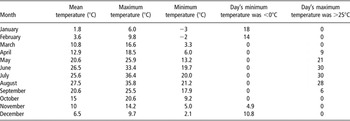
The year was divided into warm (May–September) and cold (October–April) seasons (Table 1). In study 1, the effect of season on the proportion of cows with and without luteal activity was analyzed by the χ 2 test. In study 2, the effects of season and treatment on pregnancy rate at first service and pregnancy rate at day 135 post partum were analyzed using the χ 2 test and the effects of season and treatment on the number of days from calving to conception were analyzed by Kruskal–Wallis non-parametric ANOVA. The effects of farm, inseminator and milk production were all included in the initial ANOVA, but because they were all non-significant, the data were pooled for the final analysis. Cows that were removed from the herd before pregnancy diagnosis were not included in the analyses (MacDougall and Compton, Reference MacDougall and Compton2005).
Monthly values for the mean, minimum and maximum daily temperatures, the mean number of days in a month that the minimum temperature was below 0°C and the mean number of days in a month that the maximum temperature was above 25°C

Results
Study 1
A total of 128 animals were sampled on all sampling days (days 14 to 56 post partum) during the cold period (October to April) and 125 animals during the warm period (May to September). The proportion of cows without luteal activity from calving to day 56 post partum was 47/253 (18.5%). Of the 47 cows without luteal activity, 42 (89%) were detected during the warm months of the year and five were detected during the cold months of the year and the effect of season was highly significant (P < 0.001).
Study 2
No differences were detected between control and treated cows for mean daily milk production at day 60 post partum (38 ± 9.7 and 40 ± 2.1 kg for CONT and TREAT, respectively). The mean lactation numbers were 3.4 ± 1.9 and 4.1 ± 1.8 for CONT and TREAT, respectively.
The use of GnRH or hCG in the Ovsynch protocol had no effect on pregnancy rates at first service (27% and 28%) or at day 135 post partum (69% and 69%) for GnRH and hCG groups, respectively.
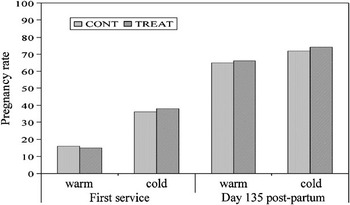
Pregnancy rates during the warm months of the year were 16% and 15% at first service and 65% and 66% at day 135 post partum for the CONT and TREAT groups, respectively (Figure 1). Pregnancy rates during the cold months of the year were 36% and 38% at first service and 72% and 76% at day 135 post partum for the CONT and TREAT groups, respectively (Figure 1). There was an effect of season (P < 0.05) but not of treatment on pregnancy rate.
The effect of warm (May to September) and cold (October to April) seasons on pregnancy rate at first service and at day 135 post partum. After insemination at estrus (CONT) or fixed time insemination following synchronization with a regime based on the use of either GnRH or hCG and PGF2α (TREAT). There was effect of season (P < 0.05) but not of treatment on pregnancy rate.

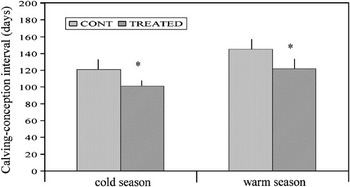
Treatment reduced (P < 0.001) the number of days from calving to conception during both the cold (121 ± 3.1 and 101 ± 3.2 days for CONT and TREAT, respectively; Figure 2) and warm seasons (145 ± 3.1 and 122 ± 3.2 days for CONT and TREAT, respectively; Figure 2). First service-conception rate for TREAT cows with luteal activity was 38% (52/137), for cows without luteal activity (i.e. cows that had not demonstrated a progesterone rise by day 56) it was 18% (6/34) (P < 0.05).
The average s.e.m. number days from calving to conception following insemination at estrus (CONT) or fixed-time insemination following synchronization with a regime based on the use of either GnRH or hCG and PGF2α (TREAT) (*P < 0.001) during cold (October to April) and warm (May to September) seasons.

Discussion
The post partum period of the lactating dairy cow is a time of high energy demand that is associated with high milk yield, negative energy balance, loss of body condition and, in some cases, extended periods of post partum infertility (Wiltbank et al., Reference Wiltbank, Gümen and Sartori2002; Rhodes et al., Reference Rhodes, McDougall, Burke, Verkerk and Macmillan2003). The period of post partum infertility is extended by a number of other factors in addition to negative energy balance and high milk production; these include maternal age, endometritis, mastitis, lameness and other ‘on-farm’ management factors (Gröhn and Rojala-Schultz, Reference Gröhn and Rojala-Schultz2000; Opsomer et al., Reference Opsomer, Gröhn, Hertl, Coryn, Deluyker and de Kruif2000; Kruip et al., Reference Kruip, Wensing and Vos2001). Great care was taken in our study to remove or control as many of these associated factors so that any observed treatment effects were not confounded. The percentage of cows classified as non-luteal in this study were broadly similar to other published reports (Lamming and Darswash, Reference Lamming and Darswash1998; López-Gatius et al., Reference López-Gatius, Santolaria, Yániz, Rutllant and López-Béjar2001). They were slightly lower than that reported by Lamming and Darswash (Reference Lamming and Darswash1998) and higher than that reported by López-Gatius et al. (Reference López-Gatius, Santolaria, Yániz, Rutllant and López-Béjar2001). These variations are probably related to differences in physiological and environmental factors in the various investigations.
Some studies have reported increased, others decreased or unchanged, plasma progesterone concentrations during the summer months in dairy cows (for review see De Rensis and Scaramuzzi, Reference De Rensis and Scaramuzzi2003). In the present study, the prevalence of animals without luteal activity during the post partum was greatest during the warm season of the year, indicating that heat stress might be compromising luteal activity. From a clinical point of view, this observation suggests that when managing the effects of summer heat stress on fertility in dairy cows, it may be important to consider a role for exogenous progesterone.
Ovsynch-treated cows conceived earlier than untreated cows and this effect could have an important economic impact on the dairy farm. There were no differences in pregnancy rates to first service and at day 135 post partum between GnRH and hCG. Therefore the suggestion that hCG acting independently of the pituitary gland to enhance post-ovulatory luteal function (Rajamahendran and Sianangama, Reference Rajamahendran and Sianangama1992; Schmitt et al., Reference Schmitt, Diaz, Barros, de la Sota, Drost, Fredriksson, Staples, Thorner and Thatcher1996a; Diaz et al., Reference Diaz, Schmitt, De La Sota, Thatcher and Thatcher1998) is superior to GnRH in the Ovsynch protocol is not supported by the results of this study. In cows with luteal activity, Ovsynch treatment produced first service-conception rates of 38% and these are similar to those reported in contemporary research (Rabiee et al., Reference Rabiee, Lean and Stevenson2005). In cows without luteal activity, the response to treatment was very low (18%), indicating that Ovsynch treatment is not very effective in this type of animal.
In conclusion, the present study shows that (i) heat stress during the warm season of the year can compromise luteal activity and that (ii) Ovsynch protocols did not modify pregnancy rate at first service or at day 135 post partum but they did have a positive effect on the calving–conception interval.
Acknowledgments
This research was supported by grants from the Ministero degli Esteri, Italia (legge 401/1990, programma Scient. & Tecnol. Italia-Vietnam 2002–2005, prot no. 269/1966) and FIL 2001. We thank Mrs Ros Foot for technical assistance with the progesterone assays, and INTERVET Italy for donating the prostaglandin, GnRH analog and hCG used in this study.