In their book on early communication and language, Nadel & Camaioni (Reference Nadel and Camaioni1993) employed the metaphor of an orchestra to account for the rich repertoire of communicative behaviors that toddlers utilize concurrently with their first words. In previous studies on paralinguistic development, specific attainments have been investigated in depth. Such investigations require detailed information and were therefore conducted with relatively small sized and highly selective samples. Although previous research documented the emergence and changes over time of specific attainments such as eye contact, mutual gaze, pointing and vocalizations, these behaviors' possible interrelations at the outset of speech were not yet fully explored (Reddy, Reference Reddy and Barrett1999). The goal of the present study was to identify interrelations among the various prelinguistic behaviors that children utilize during the period when they also begin to utter their first words.
At the outset of speech, toddlers utilize several means of communication with adults. It has been claimed that these communicative means enhance the learning of new words (Carpenter, Nagell & Tomasello, Reference Carpenter, Nagell and Tomasello1998). In the visual domain, toddlers follow adults' gaze and pointing to identify which external objects are being labeled (Butterworth & Jarrett, Reference Butterworth and Jarrett1991). In the vocal domain, canonical babbling as well as long sequences of jargon babble co-occur with early words. These vocalizations are used by the toddler to attract the adult's attention and are also interpreted by adults as attempts to produce conventional words (Dromi, Reference Dromi, Salkind and Margolis2002; Stoel-Gammon, Reference Stoel-Gammon, Wetherby, Warren and Reichle1998; Veneziano, Reference Veneziano, Smith and Locke1988). Joint attention comprises the major prelinguistic developmental achievement that predicts the emergence of speech. During the first nine months of life, infants are involved in either social transactions or the physical manipulations of objects. Shortly before learning their first words, they start to integrate social and object schemes and begin to display triadic engagements involving adult, child and object (Adamson, Reference Adamson1995; Tomasello, Reference Tomasello, Moore and Dunhum1995). Following this developmental achievement, infants begin to collaborate with adults in mutual play with objects and in viewing picture books together, and infants also begin to utter words (Carpenter et al., Reference Carpenter, Nagell and Tomasello1998; Mundy, Kasari, Sigman & Ruskin, Reference Mundy, Kasari, Sigman and Ruskin1995).
Pointing constitutes another communicative attainment that augments the learning of words and is frequently recorded in toddlers concurrently with early words (Caprici, Iverson, Pizutto & Volterra, Reference Caprici, Iverson, Pizutto and Volterra1996). With the emergence of speech, toddlers begin to utilize referential gestures for communication. Caselli & Volterra (Reference Caselli, Volterra, Volterra and Erting1990) introduced the distinction between deictic gestures (showing, reaching, giving and pointing) and referential gestures that are used as symbolic manual labels for objects and actions. They argued that referential gestures are closely linked to conventional words and therefore the rate of gesture accumulation over time resembles that of spoken words.
Typically developing children begin to utter first words around their first birthday, and continue to use single words for several months and sometimes for up to a whole year (Dromi, Reference Dromi, Salkind and Margolis2002). Evaluations of vocabulary size in large groups of children have noted remarkable individual differences during the second year of life (Fenson, Dale, Reznick, Bates, Thal & Pethick, Reference Fenson, Dale, Reznick, Bates, Thal and Pethick1994).
Early words are mainly composed from segments that the child uses in babbling. Schwartz & Leonard (Reference Schwartz and Leonard1982) proposed that patterns of lexical selection and avoidance reflect the child's production capabilities during the first few months of speech. Only when the productive vocabularies contain between 50 to 100 different words do the influences of babbling on the lexicon decline. At age 1 ; 6, children who have relatively larger lexicons usually show larger inventories of sounds and syllable structures than children with smaller productive lexicons. Precocious word learners at this age have much larger phonetic inventories than typically developing children (Stoel-Gammon, Reference Stoel-Gammon, Wetherby, Warren and Reichle1998).
Researchers disagree with reference to the continuity or discontinuity that might exist between vocalizations and words. Some researchers reported that vocalizations in the prelinguistic phase predict the rate of word learning during the second year of life, whereas others did not find correlations between babbling at age 1 ; 0 and lexicon size at age 1 ; 8 (e.g. Camaioni, Casselli, Longobardi & Volterra, Reference Camaioni, Caselli, Longobardi and Volterra1991; Stoel-Gammon, Reference Stoel-Gammon, Wetherby, Warren and Reichle1998). Vihman (Reference Vihman1996) claimed that the complexity observed in prespeech vocalizations correlates with the age of learning first words and with the number of different words that the child uses during the first few months of production.
The current study focused on the initial period in which children begin to utter first words. Our goal was to examine the range of non-linguistic behaviors that children utilize during this period. How do various non-verbal behaviors interrelate with each other at the outset of speech? What are the communicative behaviors that co-occur more often with first words? Previous research led us to the following hypotheses regarding children at the outset of speech: (1) Children who use pointing more often will also use more words; (2) Children who use babbling and jargon more frequently will have larger vocabularies; (3) Children who produce referential gestures will also use words for communication; and (4) Joint engagement in book reading as well as social games with adults will increase at the period of learning first words. A relatively large and representative sample of Israeli toddlers was recruited to test these hypotheses. The parents of these toddlers were guided in how to observe their children at home in everyday contexts of physical care and during social activities. They collected the data via a systematic parent questionnaire.
METHOD
Participants
The sample consisted of 154 typically developing Israeli toddlers (77 boys and 77 girls) who were born in Israel to monolingual Hebrew-speaking parents. Participants' ages ranged from 12 to 15 months (M=13·27, SD=1·05). Mothers had at least a high-school education (M=13·60 years, SD=1·90), and fathers' education was slightly lower (M=13·51, SD=2·31). The sample included 111 toddlers from a city in northern Israel (Haifa), and 43 toddlers from rural settlements in southern Israel.
Urban subsample
The city toddlers participated in a longitudinal research project (N=758) examining the effects of different early childcare settings on attachment behaviors (see Sagi, Koren-Karie, Gini, Ziv & Joels, Reference Sagi, Koren-Karie, Gini, Ziv and Joels2002). When infants approached their first-year visit at the university lab, we randomly selected 330 participants for the current investigation. Of these, 111 mothers returned the completed questionnaires and hence were included in the present sample. This response rate of 34 percent is typical of questionnaire-based studies conducted with normal populations (Sinai-Carmona, Oren & Levin-Epstein, Reference Sinai-Carmona, Oren and Levin-Epstein2007).
We compared the sociodemographic characteristics of our urban sample of 111 participants with those of the remainder of the Haifa Childcare Study (n=647) from which we extracted our participants. No significant differences (p>0·05) emerged from a series of t-tests between the current sample and the Haifa sample: SES standardized composite score based on residential location and density (current sample: M=–0·003, SD=0·71; remainder of the full sample: M=–0·001, SD=0·76); mothers' education (current sample: M=13·54, SD=2·02; remainder of the full sample: M=13·52, SD=2·20); fathers' education (current sample: M=13·17, SD=2·32; remainder of the full sample: M=13·41, SD=2·46); mothers' age (current sample: M=29·00, SD=4·46; remainder of the full sample: M=29·21, SD=4·83); fathers' age (current sample: M=32·36, SD=5·21; remainder of the full sample: M=32·34, SD=5·04); number of children in the family (current sample: M=2·11, SD=1·06; remainder of the full sample: M=2·10, SD=1·02); and child's weight at birth in grams (current sample: M=3324·13, SD=389·62; remainder of the full sample: M=3308·40, SD=431·50). Thus we concluded that the current sample was representative of the diverse Israeli urban population (Sagi et al., Reference Sagi, Koren-Karie, Gini, Ziv and Joels2002).
Rural subsample
An additional 43 participants represented a relatively homogeneous cultural group of toddlers living in Israeli rural settlements, who were randomly selected from toddlers attending a regular medical check-up in the local pediatric clinic around their first birthday. Out of 54 parents who were invited to participate in our study and asked to complete a questionnaire at home and to return it within two weeks, 43 did so. This high response rate of 88 percent is explained by the recruitment conditions, where a familiar medical doctor assigned the questionnaire to parents.
Urban vs. rural subsamples
In series of t-tests, we compared the sociodemographic characteristics of the urban and the rural subsamples. No significant differences (p>0·05) emerged between the two groups of participants regarding the following background variables: prestige of parental occupation (urban: M=3·17, SD=1·12; rural: M=3·41, SD=0·64); mothers' years of education (urban: M=13·54, SD=2·02, rural: M=14·00, SD=1·54); and child's weight at birth in grams (urban: M=3324·13, SD=389·62; rural: M=3240·73, SD=518·45). However, significant differences did emerge (with a Bonferroni correction adjustment for the number of tests, p<0·01) between the two groups regarding two demographic characteristics: the number of children in the family (urban: M=2·11, SD=1·06; rural: M=3·63, SD=1·85; t(53·13)=5·06, p<0·01) and fathers' years of education (urban: M=13·17, SD=2·32; rural: M=14·56, SD=2·32; t(77·03)=3·33, p<0·01). These sociodemographic comparisons convinced us that it is legitimate to treat the current sample of 154 Israeli participants as a subsample representing the urban as well as the rural Israeli population.
Instrument
During the early 1990s, Camaioni and her colleagues developed a structured questionnaire that guides parents in how to directly observe the prelinguistic behaviors of their own children at home (Camaioni, Caselli, Volterra & Luchenti, Reference Camaioni, Caselli, Volterra and Luchenti1992). Unlike the MacArthur-Bates Communicative Development Inventories (CDI) that are very often used in studies of early language (Fenson et al., Reference Fenson, Dale, Reznick, Bates, Thal and Pethick1994), the Camaioni et al. instrument requires parents to actually observe their child at home prior to completing the questionnaire. Observations take place in the physical contexts in which care is provided for the child, and also during social-routine play contexts in which the parent and the child interact with each other.
Camaioni et al. (Reference Camaioni, Caselli, Longobardi and Volterra1991) reported initial results on the external and predictive validity as well as reliability of the questionnaire. Their Italian sample was small, consisting of only 23 infants divided into three age levels: 1 ; 0, 1 ; 4 and 1 ; 8. Reliability was tested on a subgroup of 12 children, with both the parents and a trained observer completing the questionnaires in the home. Inter-judge agreement between parents and experienced observers yielded significant positive correlations for almost all variables (with correlation coefficients ranging from 0·59 to 0·77, p<0·01).
Dromi, Ben-Shahar-Treitel, Guralnik and Ringwald-Frimerman (Reference Dromi, Ben-Shahar-Treitel, Guralnik and Ringwald-Frimerman1992) translated the Camaioni et al. parent questionnaire into Hebrew. The validity of the Hebrew version of the questionnaire – the Hebrew Parent Questionnaire for the assessment of Communication and Early Language (HPQ-CEL) – was tested on a sample of 48 deaf children aged 0 ; 6 to 4 ; 1. The results of this study revealed that the instrument was appropriate for use with Hebrew-speaking toddlers (Dromi, Reference Dromi2003).
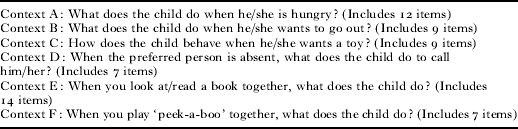
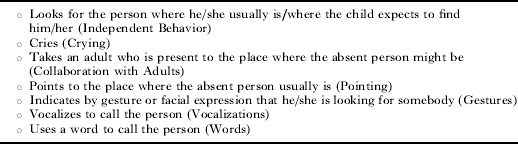
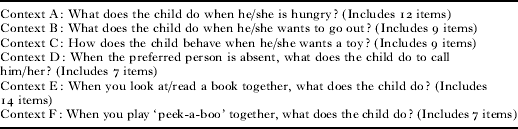
The HPQ-CEL parent questionnaire presents six questions that guide parental observation in the different contexts (see Table 1). Each question is followed with a closed inventory of motor, gesture, vocal and linguistic responses that may be observed in each context. Parents are asked to indicate how frequently the child produces each response along a 3-point scale: never (0), sometimes (1) or often (2). Table 2 illustrates the set of seven optional responses for Context D, concerning how the child calls someone he/she wants.
Questions that guided parents in the six contexts of observation
Response set of options for question 4: ‘When the preferred person is absent, what does the child do to call him/her?’
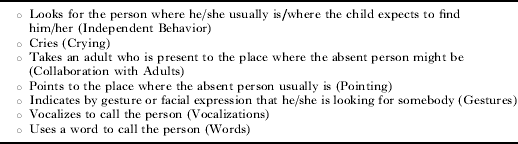
note: Camioni et al.'s (Reference Camaioni, Caselli, Volterra and Luchenti1992) response categories appear in parentheses.
The HPQ-CEL also contains two closed lists of 15 early words (e.g. ‘dog’/‘bow wow,’ ‘car’, ‘daddy’) and 15 gestures (e.g. bye-bye, clapping hands, shaking head for no) that young children frequently produce at the onset of speech. In each list, parents are asked to mark which words/gestures their child already produces. At the end of each list, parents also receive encouragement to add additional words or gestures that their child may use. The score in each of the two lists ranges from 0 to 16, where 16 indicates that the child produces words or gestures that are not specified in the checklists.
In order to investigate the internal organization of questionnaire items in the six observation contexts, and to compare it with the categories suggested by Camaioni et al. (Reference Camaioni, Caselli, Volterra and Luchenti1992), we performed computations of the correlation matrix as well as exploratory factor analysis using SPSS software. This analysis extracted seven factors with Eigenvalues greater than 1, which in total accounted for 41·31% of the variance. These factors were: Crying, Vocalizations, Collaboration with Adults, Pointing, Words, Joint Engagement in a Peek-a-Boo Game and Triadic Interaction in Book Reading. Appendix A presents the seven factors, their reliability coefficients (Cronbach's alpha) and the factor loadings for the response items in each factor. Cronbach's alphas of the seven factors ranged from 0·58 to 0·83.
Importantly, the factors derived in our analysis were almost identical to the original categories for analysis that were proposed by Camaioni et al. (Reference Camaioni, Caselli, Volterra and Luchenti1992) for the original version of the questionnaire. We wish, however, to highlight the differences that emerged between the two versions. The current factor analysis of the HPQ-CEL extracted only five of the seven factors proposed by Camaioni et al. Two factors did not emerge as unified constructs in the current study. The first was the response category termed Independent Behaviors, that included items such as ‘walking towards the kitchen to indicate hunger,’ or ‘searching for a missing object/person’. We assume that these non-communicative behaviors may have been context-dependent and therefore did not show a unified underlying structure. Gestures (other than pointing) also constituted a non-coherent category in the present study. Gesture items did not converge to a unified factor and also were not included in any of the other factors that emerged in this analysis. In addition to the five factors in Camioni et al.'s original instrument, two unique factors emerged in the present analysis: Joint Engagement in a Peek-a-Boo Game and Triadic Interaction in Book Reading. The last factor included items related to the child's attempts to refer to pictures in the book (e.g. ‘The alternation of gaze between the adult and the picture in the book’ or ‘Pointing to different pictures in the book’). Interestingly, the two additional factors comprised items that appeared to be context dependent.
Procedure
Parents in the city received the HPQ-CEL during their visit to Haifa University Developmental Lab when their toddlers were around age 1 ; 0. Parents in the rural area received the HPQ-CEL during their annual visit in the pediatric clinic for their toddler's regular 12-month check-up and immunization. A research assistant explained the study goal to the parents and received written consent for participation. During this meeting parents also received written materials for home perusal, which included: (a) an explanation of the rationale for administering the HPQ-CEL; (b) a summary of the questionnaire's goals; and (c) operational definitions of the terms ‘vocalizations’, ‘gestures’, ‘pointing’ and ‘words’, and a few examples for each category. The following definitions were explained to the parents and also were included in the written introduction to the questionnaire:
Vocalizations: Non-conventional vocal productions such as vowels or syllables that do not convey constant meanings in different contexts and that parents hear when the child is playing or when the child approaches them (e.g. rrrrrr …, bababa …, dadikula …).
Gestures: A movement with hands or face that represent a consistent meaning and that is directed at the adult in order to convey a request or to describe an object. Eye contact needs to accompany the gesture (e.g. bye-bye when leaving the room, rocking arms from side to side to show that a doll is going to sleep, hand to ear to represent conversation on the telephone).
Pointing: A hand movement aimed at directing the attention of a partner towards an external stimulus – a means for establishing joint attention. May be used as a communicative act for showing, declaration and requesting.
Words: Consistent verbal expressions that convey conventional meanings. Includes misarticulated words that the parent recognizes but are not yet articulated in adult form (adu instead of kadur ‘a ball’; o instead of od ‘more’; ada instead of aba ‘daddy’; am, a baby word to ask for food).
The parents were instructed to first gain familiarity with the questionnaire and only later to observe their child in each of the six contexts at home in order to complete it. The questionnaires had to be returned to the lab or the pediatric clinic within a period of no more than two weeks.
RESULTS
Gesture and word lexicon size at the beginning of the second year of life
Two measures were used in this study to characterize participants' lexical and communicative behaviors: (a) a frequency estimate by parents of how often their children used words in six observational contexts; and (b) a checklist on which parents marked common first words used by their child and added words that their child produced but which did not appear on the list. As expected, our participants varied with respect to the size of their productive lexicons.
The mean score for the early word checklist was 6·225 (SD=3·89), and the scores ranged from 0 to 16, where 16 indicated that the child produced more than the 15 listed words. Inspection of the distribution of the number of words produced indicated that 26% of the participants produced between 0 and 5 words, 39% produced between 6 and 10 words, 11·5% produced between 11 and 15 words, and only 3·2% of the parents reported that their children produced more than 15 words.
The mean score for the early gesture checklist was 8·03 (SD=2·42), and the scores ranged from 2 to 15. We also examined the distribution of the number of gestures that the parents reported their children produced: 13·6% of the participants produced between 1 and 5 different gestures, 70·3% produced between 6 and 10 different gestures, and 16·1% produced between 11 and 13 different gestures. A significant positive correlation emerged between the total number of words and the total number of gestures (r=0·57, p<0·01). These findings indicated that the majority of our participants were indeed at the outset of speech. Most children did not use a productive lexicon that exceeded 15 different words, and the number of different gestures and words that they produced resembled each other in quantity.
Pearson correlations between the reported use of words in the six home contexts (i.e. the score for words in the HPQ-CEL observational contexts) and the scores in the checklist of words revealed a significant high positive correlation (r=0·71, p<0·01). The strong association between the parental report based on direct observations of children's behaviors in the six contexts and the parental report via the checklist substantiates the validity of parents' direct observation. It indicates that the research procedure of asking parents to first observe their child in various everyday contexts, and only then to use a structured questionnaire for reporting their findings, is as valid as the more commonly utilized practice of parents' recognition of words in a checklist.
Range of communicative behaviors at the outset of speech
To characterize the range of prelinguistic behaviors, as well as their relative frequency of appearance, we calculated the mean scores for each HPQ-CEL factor. Each child behavior was reported by the parent as used frequently (scored 2), as used sometimes (scored 1) or as never used (scored 0). The sum of all scores for each factor (e.g. pointing, vocalizations) was divided by the number of items appearing in the six contexts of observations throughout the instrument. Moreover, a composite general score of communication was calculated for each participant on the basis of the sum of scores in all HPQ-CEL items.
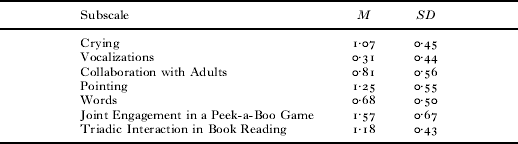
Table 3 presents the group means and standard deviations for each of the seven factors ranging from 0 to 2. As seen in the table, the two most prevalent behaviors that were reported by the parents in the current sample were Joint Engagement in a Peek-a-Boo Game and participation in Triadic Interactions in Book Reading. Pointing was also a noticeable behavior that occurred more often than Collaboration with Adults, Words, or Vocalizations. Note that, unlike our hypothesis, Vocalizations was the lowest category reported by parents, while Crying was documented quite frequently in the different observational contexts.
Means and standard deviations of the seven HPQ-CEL subscales
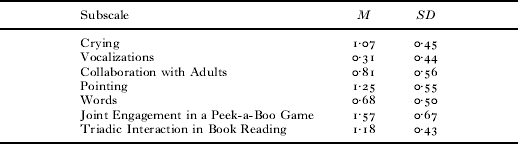
note: Each subscale ranged from 0 to 2.
We used profile analysis, test of flatness, to compare the mean scores across the HPQ-CEL subscales. This analysis tested whether all the dependent variables (i.e. the different subscales' mean scores) elicited the same average responses (see Tabachnick & Fidell (Reference Tabachnick and Fidell2001) for the rationale and detailed explanations of these statistical procedures). Using Hotelling's criterion, the profile deviated significantly from flatness (F(6, 148)=139·25, p=0·000, ηp2=0·85), indicating that the different behavior subscales' mean scores differed from one another. Next, pair-wise comparisons between the subscales (using Bonferroni adjustment for multiple comparisons) revealed significant differences between all possible pairs of behaviors excluding Pointing with Triadic Interaction in Book Reading, Crying with Pointing, and Crying with Triadic Interaction in Book Reading. This pattern indicates that at the beginning of the second year of life toddlers indeed show a wide range of non-verbal communicative means as well as words.
Mothers' education and child's age and communication
In light of the present sample's heterogeneity with respect to sociodemographic variables, we decided to explore the relations between mothers' education and participants' scores in communication and words. The age range in the present study was relatively restricted. However, due to toddlers' individual rate of learning words, it was also of interest to examine the relations between participants' chronological age and their communication and lexical scores. As dependent variables, we used the early word checklist score and the composite general communication score (summed HPQ-CEL items). Results indicated that neither maternal education nor child chronological age explained significant variance for either dependent variable. For the dependent variable of total number of words (checklist score), β coefficients were 0·37 for chronological age (p=0·19) and −0·09 for maternal education (p=0·56). For the dependent variable of the composite HPQ-CEL communications score, β coefficients were 0·04 for chronological age (p=0·06) and 0·01 for maternal education (p=0·43). Thus, neither sociodemographic variable played a significant role in determining the toddler's range of communicative behaviors or quantity of different words in the emerging lexicon.
Interrelations between the different communicative behaviors
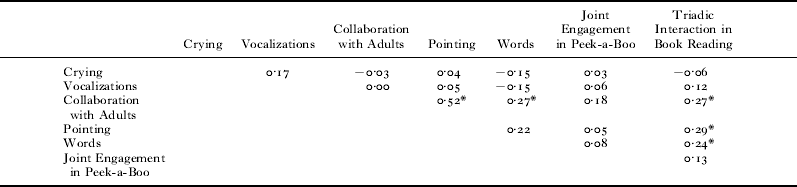
To explore the interrelations among the various communicative behaviors that co-occur at the outset of speech, Pearson correlations were calculated (see Table 4). Due to the large number of computations, we set the alpha level to 0·01. This analysis indicated that the various behaviors were not strongly associated with each other (r<0·30). The only significant positive correlation that exceeded the 0·01 level emerged between Collaboration with Adults and Pointing (r=0·52).
Pearson correlations between prelinguistic behaviors
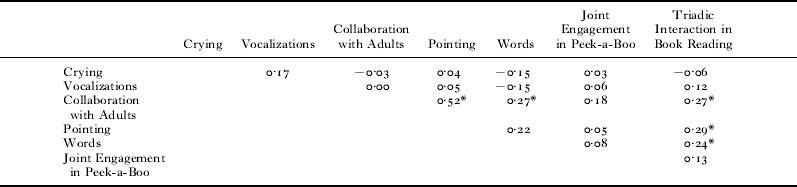
* p<0·01.
As seen in Table 4, Collaboration with Adults was positively correlated with Pointing, with Words, and with Triadic Interaction in Book Reading. Triadic Interaction in Book Reading was also positively correlated with Pointing and with Words. Contrary to our hypothesis, the correlations between Pointing and Words were not significant at the 0·01 level. Altogether, our results indicated that those behaviors that involved social interaction with adults positively inter-correlated with each other. We will return to this point in the Discussion section.
To further examine the relations between communication and early speech, we performed a stepwise regression analysis. The dependent variable consisted of the total number of different words according to the closed checklist, and the independent variables comprised the mean scores in six out of the seven HPQ-CEL factors (we excluded the score on Words from this analysis). Only two behaviors entered the regression model. The first was Collaboration with Adults (β=0·38, p<0·001), and the second was Vocalizations (β=–0·17, p<0·05). Collaboration with Adults explained 14·6% of the variance in the size of the lexicon, whereas Vocalizations explained only an additional 3% of the variance. This finding indicates that participants who had higher scores in Collaboration with Adults and those who had lower scores in Vocalizations produced more words at the beginning of the second year of life.
DISCUSSION
The current sample of 154 Israeli parents, who varied with respect to their urban or rural lifestyle, demonstrated a high level of cooperation in administering the home observations with the aid of a structured questionnaire. The robust association between parents' direct observations of child behaviors and the parent-reported word and gesture checklists corroborates the validity of parents' direct observation. This finding supports earlier reports that parents from diverse Western cultures and a range of educational backgrounds can reliably report on young children's communicative abilities and early vocabularies (Fenson et al., Reference Fenson, Dale, Reznick, Bates, Thal and Pethick1994).
The questionnaire data collected in the present study confirmed previous reports that children use a range of prelinguistic behaviors at the outset of speech. The relative frequency with which these behaviors are used in home contexts varies. Some prelinguistic behaviors are noticed by parents often, whereas others are hardly reported. Our results from the current relatively large Israeli sample are comparable with published results on the range and prevalence of prelinguistic behaviors in a much smaller sample of toddlers in Italy. Camaioni et al. (Reference Camaioni, Caselli, Longobardi and Volterra1991) obtained similar outcomes from a sample of 23 Italian infants, utilizing the same instrument as in the present study. Similarly to their Italian peers, the Israeli children were reported by parents as using vocalizations less frequently than words.
Association between maternal education, child age and early words
No significant links were identified in the current Israeli sample between mother's education, child's chronological age and the vocabulary size at the beginning of the second year of life. This result substantiates the claim that early in development intrinsic factors rather than extrinsic factors dictate the rate of learning. That is, individual differences in the age when talking begins may best be explained by the child's biological and maturational characteristics rather than by environmental conditions (e.g. mother's education, exposure to language, etc.; Mundy & Gomez, Reference Mundy and Gomez1998; Siegel, Reference Siegel1982).
Crying at the outset of speech
The question of whether crying is a communicative behavior is intriguing. Camaioni et al. (Reference Camaioni, Caselli, Volterra and Luchenti1992) defined crying as a non-communicative behavior with no intentional value. Dromi (Reference Dromi2003) found that children with deafness often cry when they cannot use a more advanced means of communication. Crying was recorded for the current sample of typically developing children in all six contexts of observation; yet it did not correlate with other communicative behaviors. We therefore speculate that crying may be an emotional state that could represent temperament and mood rather than a communicative behavior.
Association between pointing and early words
The first hypothesis, that children who use pointing more often would also have more words, was not confirmed. From the parent observational data reported here, we learned that pointing and words did not correlate during the period we studied. Prior research documented that pointing is initially recorded concurrently with the emergence of first words (Caselli, Reference Caselli, Volterra and Erting1990). Research also indicated that children tend to point to objects and to external events when they learn new words (Tomasello, Reference Tomasello, Moore and Dunhum1995). We propose that the relative frequency of pointing changes throughout the second year of life. Replication of the current study with participants who are older, who have approached or already passed the lexical spurt period, will shed light on this proposal that still awaits direct testing.
Association between vocalizations and early words
The second hypothesis, that children who vocalize more would have more words, was also rejected. Instead, our results indicated that children who had larger vocabularies tended to babble and use jargon less, suggesting that as the child becomes more efficient in communication via words, the need decreases for vocalizations as means for communication. We have formulated two plausible explanations for this finding. First, parents are naïve observers and may therefore not be as sensitive to vocalizations as they are to conventional words that they easily recognize in their children's output (Veneziano, Reference Veneziano, Smith and Locke1988). Second, in the developmental phase we studied, toddlers may use means for communication other than vocalizations. During this phase, children begin to show objects, to point and to gesture.
Ben-Itzhak & Levin (Reference Ben-Itzhak and Levin1995) studied the symbolic development of deaf babies and hearing controls during the first eighteen months of life. They reported that participants (with and without hearing deficits) rarely produced vocalizations during the video-recorded home sessions. They hypothesized that vocalizations are context dependent and that infants may babble more when they are alone. Further empirical studies are needed on the relationship between vocalizations and words, and on how the relative frequency of each may change over time and context. Particular reference should be paid to individual differences between children with respect to their maturational abilities as reflected in articulatory skills (Stoel-Gammon, Reference Stoel-Gammon, Wetherby, Warren and Reichle1998; Vihman, Reference Vihman1996). A close analysis of production data from children at the outset of speech may highlight the interesting interrelations between vocalizations and words in this fascinating period.
Association between gestures and early words
The third hypothesis, that children who produce referential gestures would also use words for communication, was supported. Our results indicated a positive significant correlation between the lists of words and gestures, thus supporting the argument that at the beginning of the second year of life conventional words and referential gestures emerge concurrently (e.g. Iverson & Thelen, Reference Iverson and Thelen1999; Goodwyn, Acredolo & Brown, Reference Goodwyn, Acredolo and Brown2000). Caselli & Volterra (Reference Caselli, Volterra, Volterra and Erting1990) have argued that referential gestures and conventional words initially develop at a similar rate, as their generation reflects the child's underlying ability to symbolically represent reality. The results of the present study indicate that even parents who are not experts in observing and documenting gestures (Dromi, Reference Dromi2003) can observe such phenomena when guided by a structured questionnaire. It has been proposed that the parallel growth function of gestures and words undergoes a change later, in the one-word stage, when the productive lexicon of words extends further but the lexicon of gestures remains relatively small (Dromi, Reference Dromi2003; Zinober & Martlew, Reference Zinober and Martlew1985). The precise timing when the growth paths of gestures and words separate is a question for future research.
Associations between various prelinguistic behaviors at the outset of speech
Interrelations between the different prelinguistic behaviors indicated few significant correlations, suggesting that prelinguistic behaviors co-exist, and each, in fact, has its own unique and independent status as well as course of evolution. Two prelinguistic behaviors stood out as interrelated. These were Collaboration with Adults and Triadic Interaction in Book Reading. Both behaviors share an important common characteristic: involving social engagement between the child and the adult.
Collaboration with adults
An examination of the relationship between prelinguistic behaviors and the size of emergent vocabularies revealed that those participants who gained higher scores in Collaboration with Adults also had larger vocabularies. Collaboration with Adults was defined in the present study as mutual engagement that did not involve overt signaling of clear communicative intents. It often involved direct physical manipulation of the adult, like pushing the adult toward the door when the child wanted to go out, handing a box to the adult as a request to open it, pushing the mother to the kitchen when hungry, and so on. This behavior significantly correlated with Pointing, with Words, and with Triadic Interaction in Book Reading. It also explained the significant variance in the number of different words in the checklist. Our parent report data provide strong support for the theoretical claim that social partnership between the child and the adult is highly important during the transition to speech. This claim coincides with the idea that social understanding is the major key for effective learning of conventional language (Tomasello, Reference Tomasello, Moore and Dunhum1995; Tomasello & Farrar, Reference Tomasello and Farrar1986).
Social games and book reading at the outset of speech
Several researchers have argued that interactive social games considerably increase in frequency and in length as children become more capable of word learning (Reddy, Reference Reddy and Barrett1999; Tomasello, Reference Tomasello, Moore and Dunhum1995). Book reading was termed by Sugarman (Reference Sugarman and Golinkoff1983) as the ‘crown’ of the prelinguistic period. She argued that this behavior is the best predictor for the beginning of speech. Book reading involves coordination between social and object schemes, which develop in parallel tracks during the first year of life. The coordination between these two schemes promotes the development of the concept of ‘self’ and ‘other’ and opens the way to understanding referencing (Adamson & Chance, Reference Adamson, Chance, Wetherby, Warren and Reichle1998). Camaioni & Laicardi (Reference Camaioni and Laicardi1985) found that between the ages of 0 ; 6 and 1 ; 1 the frequency of social games dramatically increases. The rate of social games remains stable between the ages of 1 ; 1 and 1 ; 6, while the rate of word learning increases.
Triadic engagement in book reading is an ideal context for establishing shared knowledge and for scaffolding vocabulary development. When the child points to a specific picture in the book, the mother looks at the same picture and usually names it or describes it in simple sentences. Similarly, when the mother points to a page in the book or to any part of it and labels it, those toddlers who already possess the ability to coordinate objects and social schemes can map the name onto its referent. In a longitudinal study on the transition to language, Ringwald-Frimerman (Reference Ringwald-Frimerman2003) followed five mother–child dyads over an eleven-month period when children were 0 ; 7 to 1 ; 6. Her results indicated that in triadic interactions mothers provided highly informative linguistic input to the child. Ringwald-Frimerman identified a strong link between the frequency and length of triadic engagement with objects and the number of words in children's productive lexicon at age 1 ; 6. She concluded that symbolic learning is highly facilitated in episodes of triadic joint engagement. The significant positive correlation observed here between Triadic Interaction in Book Reading and the number of words in early vocabularies points to the co-occurrence of these two behaviors and thus supports the proposal that the context of joint book reading facilitates early word learning in children who are already equipped with the mechanisms necessary for vocabulary learning.
CONCLUSION
At the outset of this article we cited Nadel & Camaioni's (Reference Nadel and Camaioni1993) orchestra metaphor for describing the multidimensional nature of communication and language during the second year of life. The empirical data that we collected via the utilization of a structured parent report instrument provided compelling support for the notion that the transition into conventional language takes place within a rich context of non-verbal communicative behaviors. We now know that these behaviors relate to each other in interesting and complex ways at different time-points throughout the second year of life. Future studies with participants who are linguistically more sophisticated than the current cohort will further empirical exploration of the fascinating role played by each behavior in the construction of human language.
APPENDIX A
Factor analysis of the Hebrew Parent Questionnaire for Communication and Early Language (HPQ-CEL)