Smoking during pregnancy (SDP) has been consistently linked with externalizing problems in offspring, particularly in males (reviews in Cnattingius, Reference Cnattingius2004; Huizink & Mulder, Reference Huizink and Mulder2006; Wakschlag & Hans, Reference Wakschlag and Hans2002; Wakschlag, Pickett, Cook, Benowitz, & Leventhal, Reference Wakschlag, Pickett, Cook, Benowitz and Leventhal2002). It has been associated with parent-reported conduct problems (CPs; Ernst, Reference Ernst2001), arrest history from national crime registries (Brennan, Grekin, & Mednick, Reference Brennan, Grekin and Mednick1999; Rasanen et al., Reference Rasanen, Hakko, Isohanni, Hodgins, Jarvelin and Tiihonen1999), contact with police obtained by city police records (Gibson, Piquero, & Tibbets, Reference Gibson, Piquero and Tibbets2000), oppositional defiant disorder (Wakschlag & Keenan, Reference Wakschlag and Keenan2001), conduct disorder (Fergusson, Woodward, & Horwood, Reference Fergusson, Woodward and Horwood1998; Wakschlag & Hans, Reference Wakschlag and Hans2002; Wakschlag & Keenan, Reference Wakschlag and Keenan2001; Wakschlag et al., Reference Wakschlag, Lahey, Loeber, Green, Gordon and Leventhal1997; Weissman, Warner, Wickramaratne, & Kandel, Reference Weissman, Warner, Wickramaratne and Kandel1999), and attention-deficit / hyperactivity disorder (Mick, Biederman, Faraone, Sayer, & Kleinman, Reference Mick, Biederman, Faraone, Sayer and Kleinman2002; Rodriguez & Bohlin, Reference Rodriguez and Bohlin2005).
Reviews of the literature note that the association is consistent with a causal connection because the association is specific to externalizing problems, has been found across diverse samples and measures, demonstrates a dose–response relationship, and is consistent with findings from basic research (Cnattingius, Reference Cnattingius2004; Wakschlag et al., Reference Wakschlag, Pickett, Cook, Benowitz and Leventhal2002). The interest in SDP as a cause of externalizing problems is driven, at least in part, by the possibility of identifying a risk factor that is amenable to intervention. Many researchers, however, have noted that methodological considerations render causal interpretations impossible at this time because children cannot be randomly assigned to nicotine exposure conditions; the association between SDP and offspring behavior may be because of risk factors associated with SDP rather than the influence of prenatal nicotine exposure (Fergusson, Reference Fergusson1999; Wakschlag et al., Reference Wakschlag, Pickett, Cook, Benowitz and Leventhal2002). Although associations between SDP and offspring characteristics may be because of more than just nicotine (Huizink & Mulder, Reference Huizink and Mulder2006), we use the phrase “prenatal nicotine exposure” to refer to SDP throughout the article for ease of presentation.
It is important to note that SDP is correlated with many factors that are also correlated with externalizing problems is children. SDP is correlated with low socioeconomic status (Matthews, Reference Matthews2001; Zimmer & Zimmer, Reference Zimmer and Zimmer1998), early age of pregnancy (Cnattingius, Reference Cnattingius2004; Zimmer & Zimmer, Reference Zimmer and Zimmer1998), race (Zimmer & Zimmer, Reference Zimmer and Zimmer1998), prenatal care (Zimmer & Zimmer, Reference Zimmer and Zimmer1998), maternal depression (Breslau, Kilbey, & Andreski, Reference Breslau, Kilbey and Andreski1993), history of maternal delinquency (Fergusson, Reference Fergusson1999), paternal antisocial behavior (Maughan, Taylor, Caspi, & Moffitt, Reference Maughan, Taylor, Caspi and Moffitt2004), and the family environment (Brook, Brook, & Whiteman, Reference Brook, Brook and Whiteman2000), just to name a few possible confounds to the association between SDP and offspring externalizing problems. Most studies have relied on statistical controls of possible confounds by including measured covariates, such as parental antisocial behavior, parenting practices, family cohesion, and socioeconomic status, in the analyses. Researchers have also utilized case–control studies (Mick et al., Reference Mick, Biederman, Faraone, Sayer and Kleinman2002). Overall, associations between SDP and offspring externalizing behaviors have remained significant in most of the extant SDP studies when the measured covariates are included in the analyses (Cnattingius, Reference Cnattingius2004; Wakschlag et al., Reference Wakschlag, Pickett, Cook, Benowitz and Leventhal2002). Some parental variables, however, such as ongoing exposure to secondhand smoke (Maughan, Taylor, Taylor, Butler, & Bynner, Reference Maughan, Taylor, Taylor, Butler and Bynner2001), maternal report of conduct disorder as a teenager (but not adult externalizing problems; Silberg et al., Reference Silberg, Parr, Neale, Rutter, Angold and Eaves2003), and antisocial behavior of both parents (Maughan, Taylor, Caspi, & Moffitt, Reference Maughan, Taylor, Caspi and Moffitt2004), mediate a majority of the relation between SDP and CP.
In addition to the numerous potential environmental risk factors associated with SDP, a number of researchers have noted that genetic confounds may mediate the relationship between SDP and offspring externalizing problems (D'Onofrio et al., Reference D'Onofrio, Turkheimer, Eaves, Corey, Berg and Solaas2003; Fergusson, Reference Fergusson1999; Moffitt, Reference Moffitt2005; Silberg et al., Reference Silberg, Parr, Neale, Rutter, Angold and Eaves2003; Wakschlag et al., Reference Wakschlag, Pickett, Cook, Benowitz and Leventhal2002). Mothers who smoke during pregnancy may pass down genetic risk for externalizing problems to their offspring, a form of passive gene–environment correlation (rGE; Scarr & McCartney, Reference Scarr and McCartney1983). Passive rGE occurs when genetic factors common to both the parent and the offspring are correlated with one or more measures of the family environment. Genetic risk for antisocial behavior may contribute to a mother's likelihood of SDP and may confer vulnerability to externalizing problems when inherited by offspring. Standard correlational research approaches, in which environmental and genetic risks are confounded, are ineffective in delineating whether associations between externalizing problems and SDP are because of environmental causation or passive rGE (D'Onofrio et al., Reference D'Onofrio, Turkheimer, Eaves, Corey, Berg and Solaas2003; Moffitt, Reference Moffitt2005; Rutter, Pickles, Murray, & Eaves, Reference Rutter, Pickles, Murray and Eaves2001). Moreover, most of the genetically informed studies of SDP and externalizing problems in offspring (Button, Thapar, & McGuffin, Reference Button, Thapar and McGuffin2005; Knopik et al., Reference Knopik, Sparrow, Madden, Bucholz, Hudziak and Reich2005; Maughan et al., Reference Maughan, Taylor, Caspi and Moffitt2004; Thapar et al., Reference Thapar, Fowler, Rice, Scourfield, van den Bree and Thomas2003) have used an approach, including a measure of SDP in a standard twin study, that assumes the relation is purely environmental (Purcell & Koenen, Reference Purcell and Koenen2005; Turkheimer, D'Onofrio, Maes, & Eaves, Reference Turkheimer, D'Onofrio, Maes and Eaves2005). Therefore, previous studies have been unable to explore the possibility that passive rGE accounts for observed relations between SDP and externalizing.
The standard twin design may be of limited utility in differentiating between causation and passive rGE (Thapar et al., Reference Thapar, Fowler, Rice, Scourfield, van den Bree and Thomas2003), but alternative behavior genetic designs are effective in examining the processes underlying intergenerational associations (see review by Rutter, Pickles, Murray, & Eaves, Reference Rutter, Pickles, Murray and Eaves2001). In particular, the children of twins (CoT) design is well suited for studying SDP because the approach can delineate between environmental processes related specifically to a risk factor shared by siblings, genetic transmission from parents to their offspring, and environmental confounds that vary between families (reviews in D'Onofrio et al., Reference D'Onofrio, Turkheimer, Eaves, Corey, Berg and Solaas2003, Reference D'Onofrio, Turkheimer, Emery, Slutske, Heath and Madden2005; Gottesman & Bertelsen, Reference Gottesman and Bertelsen1989; Heath, Kendler, Eaves, & Markell, Reference Heath, Kendler, Eaves and Markell1985; Rutter et al., Reference Rutter, Pickles, Murray and Eaves2001). D'Onofrio and colleagues (2003) explored the association between SDP and offspring birth weight as a model system and found that genetic confounds did not mediate the intergenerational association. Recently, Knopik et al. (Reference Knopik, Heath, Jacob, Slutske, Bucholz and Madden2006) utilized the CoT design to explore the association between parental alcoholism and SDP with offspring ADHD. The analyses suggest that the association between parental alcohol dependence and offspring ADHD is genetically mediated and that genetic risk transmitted from parents to their offspring accounts for a significant portion of the SDP-offspring ADHD relation.
The current article explores the association of SDP and offspring externalizing in a sample of women from the National Longitudinal Survey of Youth (NLSY79) and their children (CNLSY), a sample that confers many advantages. The sample is a nationally representative household sample of women and their children, and the survey included measures related to CPs, oppositional defiant problems (ODPs), and attention-deficit/hyperactivity problems (ADHPs). Previous analyses in the NLSY79 have documented characteristics of families related to SDP (Zimmer & Zimmer, Reference Zimmer and Zimmer1998), and the associations between SDP and offspring health, behavior problems, and academic achievement have been illustrated in offspring of the NLSY79 (Li & Poirier, Reference Li and Poirier2003).
Finally, the sample provides the opportunity to delineate genetic and environmental processes related to SDP and offspring externalizing. There is a history of using the NLSY79 to explore causal mechanisms using differences within and between families, the theoretical basis of the approach used in this article. For example, researchers have used the data set to explore the relation between birth order and intelligence (Wichman, Rodgers, & MacCallum, Reference Wichman, Rodgers and MacCallum2006), maternal alcohol and illicit drug use and offspring psychopathology (Chatterji & Markowitz, Reference Chatterji and Markowitz2001), teenage childbearing and the women's later adjustment (Geronimus & Korenman, Reference Geronimus and Korenman1992), and maternal age at first birth and offspring adjustment (Turley, Reference Turley2003).
Multiple adult females from the same household and multiple offspring per mother were included in the NLSY79 and CNLSY studies. This clustering of data permits the association between SDP and offspring problems to be decomposed in two ways. First, children exposed to greater SDP can be compared to their own siblings exposed to more or less SDP. This within-mother effect controls for genetic and environmental factors shared by children with the same mother, whether they are full or half siblings. If SDP causes offspring externalizing problems, the association would be present when siblings who differ in their exposure to prenatal nicotine are compared (e.g., Rodgers, Cleveland, van den Oord, & Rowe, Reference Rodgers, Cleveland, van den Oord and Rowe2000). Second, the externalizing problems of children of adult siblings who differ in their average level of SDP can be compared. The adult NLSY79 sample was originally based on households and included sibling pairs, referred to as the NLSY household level in the analyses. The clustering allowed children exposed to more SDP to be compared to their cousins with less exposure to prenatal nicotine. This comparison is a within-adult–sibling effect. Furthermore, because the NLSY79 has adult sibling pairs who differ in their genetic relatedness, this cousin comparison can be analyzed contingent on the genetic risk associated with SDP. The NLSY is a very powerful design for such purposes because it contains information on genetic relatedness across two generations: for the original NLSY79 youth (Rodgers, Buster, & Rowe, Reference Rodgers, Buster and Rowe2001; Rodgers, Rowe, & Buster, Reference Rodgers, Rowe and Buster1999) and the children of the mothers of the NLSY (CNLSY; Rodgers, Rowe, & Li, Reference Rodgers, Rowe and Li1994; Rodgers, Rowe, & May, Reference Rodgers, Rowe and May1994). These analyses are an extension of the CoT Design, taking advantage of multiple genetically informative groups in the NLSY79 and CNLSY. The methodological controls provided by family relationships in this design were also combined with traditional statistical controls provided by the inclusion of measured family characteristics, thus providing a rigorous, quasiexperimental test of whether associations between SDP and externalizing problems are causal.
Method
Sample
Mother generation sample
The NLSY79 survey was funded by the Bureau of Labor Statistics as a comprehensive study of the future US workforce. It included a nationally representative sample of 6,111 14- to 21-year-old youths who were not in the military, as well as a supplemental oversample of 3,652 African American and Hispanic youth. The current study used 6,283 females from the combined sample, because there is cross-generational information only for the females and their children. The probability sample for the NLSY79 was selected using a stratified and clustered design. Primary sampling units consisting of standard metropolitan statistical areas and counties were selected randomly, proportionate to population size. Smaller units (census block groups or enumeration districts) within each primary sampling unit were then randomly selected, with households randomly selected in the third or fourth step. In the initial NLSY79 assessment, the response rate was 90%. Participants were reinterviewed annually from 1979 through 1994 and every 2 years since then. Retention rates during follow-up assessments were 90% or better during the first 16 waves and have since stayed above 80%.
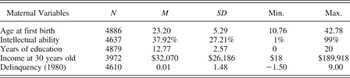
Of the 6,283 women in the NLSY79 sample, 4,886 had given birth to at least one child by the 2002 report. The sample was racially diverse: 1,002 mothers were Hispanic (16.0%), 1,561 were Black (24.8%), and 3,720 were non-Black, non-Hispanic (59.2%). The characteristics of the sample with children are presented in Table 1. The women reported the highest grade they completed, with 20 years being the maximum. For income, one outlier over $350,000 was removed from the data set so that the value would not improperly skew the results. However, the woman was not removed from the models because the analyses used analytical tools that accounted for missing values. No other variables had outliers that were found to skew the results.
Sample characteristics for National Longitudinal Survey of Youth parents

Note: Delinquency is the number of delinquent activities during the previous year regressed on mother's age when she completed the Self-Reported Delinquency Interview.
Kinship links
The NLSY79 mother generation is genetically informative because data were collected on all qualified individuals who resided in the sampled households, which included both full sibling, half sibling, and other types of kinship pairs. Approximately 60% of all within household kinship links have been found to be classifiable as twins, full siblings, half siblings, and cousins using the data available up to the 1992 survey. Consistent with previous research using the NLSY, the following estimates of the genetic relatedness (R coefficients) were used in the study: R = 0.125 for cousins, R = 0.25 for half siblings, R = 0.375 for ambiguous siblings, R = 0.50 for full siblings, and R = 0.75 for same-gender twins of unknown zygosity (Rodgers, Reference Rodgers1996). Most of these values are the standard measures of correlation between different levels of kinship relatedness that can be derived from the quantitative genetic model (e.g., Falconer, Reference Falconer1981). There are two exceptions. The same-gender twins of unknown zygosity contain half monozygotic (MZ) and half dizygotic (DZ) twins in the population, so that we assigned an R coefficient halfway between those of MZ twins (R = 1.0) and DZ twins (R = 0.5). For the siblings that are either full or half siblings (but who could not be classified by the linking algorithm into either category), we also assigned an R coefficient halfway between that of full siblings (R = 0.50) and half siblings (R = 0.25). Although there are more full siblings than half siblings in the population, past research using these kinship links has suggested that there are only minor differences between using the midrange values and others that account for the unequal numbers of full and half siblings.
The kinship links in the NLSY79 sample have been validated using several different mechanisms. First, in the original development of these kinship links, a validity study was run by estimating genetic influences on gender-standardized adult physical height. Consistent with a large literature that indicates heritability for height (h 2) of about .90, the h 2 for adult height using these kinship links was .88 in the NLSY79 sample; both meta-analytic and the validity study estimates of χ2 were quite small (Rodgers, Reference Rodgers1996). Second, a number of published studies using these kinship links contain sensitivity analyses to ascertain the sensitivity of biometrical estimates to the assumptions involved in using these links (e.g., the use of R = 0.375 described above), which informs the use of these kinship links in this and other more recent studies. Third, we have evidence of concurrent validity by using findings based on these kinship links and comparing them to those from other studies. For example, compare results on age at first intercourse from Rodgers et al. (Reference Rodgers, Rowe and Buster1999), to the molecular genetic results from Miller et al. (Reference Miller, Pasta, MacMurray, Chiu, Wu and Comings1999); compare Rodgers et al. (Reference Rodgers, Buster and Rowe2001) delinquency patterns to those in Miles and Carey (Reference Miles and Carey1997); or compare the multivariate patterns across education and IQ in Neiss, Rowe, and Rodgers (Reference Neiss, Rowe and Rodgers2002) to those from Tambs, Sundet, Magnus, and Berg (Reference Tambs, Sundet, Magnus and Berg1989).
Offspring generation sample
Biannual assessments of the children of women in the NLSY79 began in 1986, with an initial response rate of 95% and subsequent average response rate of 90% (Chase-Lansdale, Mott, Brooks-Gunn, & Phillips, Reference Chase-Lansdale, Mott, Brooks-Gunn and Phillips1991). In 1986, 95% of the biological offspring of NLSY79 mothers were assessed. This response rate has stayed high, with an average response rate of 90%. The interview rate in 2000 was 77%, primarily because approximately 40% of the eligible 15- to 19-year-olds in the African American and Hispanic oversample groups were not assessed because of budgetary limitations. The low response was not a major concern in the current analyses because we explored externalizing problems in 4- to 10-year-old offspring. The full offspring sample was eligible to be reassessed in 2002, however, and the overall response rate returned to 93%.
Three types of interviews were conducted concerning the offspring generation. Mothers were asked to report on their children's characteristics, including behavior, temperament, and home environment. Beginning in 1988, children between the ages of 10 and 14 years were interviewed directly about their interactions with parents, responsibilities, use of leisure time, relationships with peers, expectations, and delinquent activities. Finally, beginning in 1994, adolescents aged 15 years and over were interviewed extensively on family interactions, substance abuse, delinquent activities, and other issues relating to transitions to adulthood. The current analyses are based on maternal report of offspring ages 4–10 years.
The analyses in the current paper were drawn from 11,192 children of the mothers from the 2002 NLSY79. The offspring included 4,886 (43.66%) who were first borns, 3,705 (33.10%) who were second borns, 1,747 (15.61%) who were third borns, 637 (5.69%) who were fourth borns, and 217 (1.94%) who were fifth borns. Fifty-one percent (N = 5,703) of the offspring were male, with 49% being female (N = 5,484). Of the 11,192 children, 8,889 offspring were of appropriate age to have been assessed with the Behavior Problem Index (BPI; see described later) and thus were used in the current analyses. Nineteen percent of the offspring included in the analyses were assessed once with the BPI, 22% were assessed twice, 38% were assessed three times, and 22% were assessed four times. In general, mothers of children for whom data are available are slightly older, more educated, wealthier, and have higher aptitude scores, as measured by the Armed Services Vocational Aptitude Battery (see below) than mothers of children with no available data. Therefore, mother's age at first birth, highest level of education, income, and intellectual abilities were controlled in the analyses.
It should be noted that a consistent and problematic source of selection bias is rapidly disappearing from research using the children of the NLSY79 mothers. Past research has been plagued by the fact that, until all childbearing by the NLSY79 cohort is completed, the children were necessarily born to the younger mothers. Because well over 95% of all childbearing was completed by the 2002 survey, and because we used relatively young children in our analyses, this form of selection bias was relatively small (though certainly worth noting). Further, the bias reported above in the opposite direction reported above may approximately compensate.
Measures
Maternal characteristics
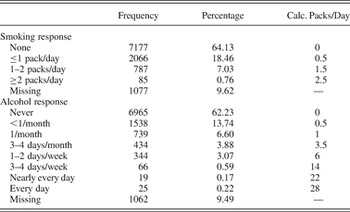
In every wave since 1983, the NLSY79 females were asked about their frequency of smoking and alcohol use during 12 months prior to their most recent pregnancy and during pregnancy. Table 2 includes the response categories for smoking and alcohol use during pregnancy, as well as the conversions to packs/day of smoking and days/month of drinking. Of the 8,889 offspring analyzed the current study, the mothers reported their SDP for 6,503 (73%) within approximately 1 year of the birth. Because few children in the current analyses were born before 1979, mothers reported their SDP for 90% of their children within 4 years of each birth. Unfortunately, we have no measure of offspring's exposure to secondary smoke. When such exposure has been assessed in previous studies, however, maternal SDP almost always been found to account for unique variance in predicting offspring CPs (Brook et al., Reference Brook, Brook and Whiteman2000; Day, Richardson, Goldschmidt, & Cornelius, Reference Day, Richardson, Goldschmidt and Cornelius2000; Griesler, Kandel, & Davies, Reference Griesler, Kandel and Davies1998; Weissman et al., Reference Weissman, Warner, Wickramaratne and Kandel1999), with one exception (Maughan et al., Reference Maughan, Taylor, Taylor, Butler and Bynner2001).
Smoking and drinking during pregnancy responses for each pregnancy

Because previous studies using the NLSY identified characteristics of families related to SDP (Zimmer & Zimmer, Reference Zimmer and Zimmer1998), a number of maternal characteristics were included in the analyses. When they were 15–22 years old, the NLSY79 mothers (and future mothers) were asked about their engagement in 12 delinquent behaviors during the previous year using a version of the Self-Reported Delinquency Interview (Elliott & Huizinga, Reference Elliott and Huizinga1983). This measure, which was also administered to the offspring generation, is reliable and valid and is the benchmark measure used in contemporary delinquency research (Loeber, Farrington, Stouthamer-Loeber, & Van Kammen, Reference Loeber, Farrington, Stouthamer-Loeber and Van Kammen1998; Moffitt, Reference Moffitt1990; Moffitt, Caspi, Dickson, Silva, & Stanton, Reference Moffitt, Caspi, Dickson, Silva and Stanton1996). For more details see Rodgers et al. (Reference Rodgers, Buster and Rowe2001). Symptom counts were regressed on the woman's age at which she completed the survey.
Mother's age at first birth was calculated by subtracting the mother's date of birth from her first child's date of birth. Maternal age at each birth was not calculated because previous research has noted that age at first birth, and not maternal age specific to each birth, predicts offspring delinquency in the NLSY (Turley, Reference Turley2003). Total net family income reported by mothers at age 30, which includes included income from all adults in the household at that time, and highest degree attained by mothers (as of the 2002 survey) were used as measures of families' socioeconomic status. Total net family income was a summary variable calculated from all income received in the household, including government support and food stamps, by the mother and her spouse. Income from cohabitating partners was not included.
During the summer and fall of 1980, NLSY79 respondents completed the Armed Services Vocational Aptitude Battery, which measured knowledge and skill in 10 areas. A composite score derived from select sections of the battery (word knowledge, paragraph comprehension, math knowledge, and arithmetic reasoning) was used to construct an approximate and unofficial Armed Forces Qualifications Test score for each participant, an approximate IQ equivalent. Raw scores were standardized, summed, and converted to a percentile for a measure of maternal intellectual ability. Multiple imputation (Little & Rubin, Reference Little and Rubin1987) was used to account for the maternal characteristics that were missing (see below).
Offspring CP, ODP, and ADHP
At each wave, mothers rated their 4- to 10-year-old children's behavior problems using the BPI. The BPI was created by selecting items from the Child Behavior Checklist (CBCL; Achenbach, Reference Achenbach1978) that had the strongest correlations with CBCL factor scores (Peterson & Zill, Reference Peterson and Zill1986). Mothers rated each of their children in each assessment wave using a 3-point scale for each item: 3 = often true, 2 = sometimes true, and 1 = not true. We used BPI items to create three a priori scales based on DSM constructs. However, confirmatory factor analysis of the 13 externalizing items were conducted with MPlus (Muthén & Muthén, Reference Muthén and Muthén1998–2005) to account for the dichotomous variables, and the results support the three factor solution (results available upon request). The items measuring CP included the following: (a) cheats or lies, (b) breaks things on purpose or deliberately destroys his/her own or another's things, (c) disobedient at home, (d) disobedient at school, (e) has trouble getting along with teachers, (f) does not feel sorry after misbehaving, and (g) bullies other children. ODP included the following: (a) argues too much, (b) is stubborn, sullen or irritable, and (c) has a very strong temper and loses it easily. ADHP included the following: (a) has difficulty concentrating, (b) impulsive or acts without thinking, and (c) restless or overly active, cannot sit still. We obtain standardized Z scores for CP, ODP, and ADHP within each age and, for children assessed repeatedly, calculated the average score. Therefore, each measure represents the average number of problems between the ages of 4 and 10 years.
The child CP items used in the CNLSY overlap substantially with those used in previous population-based longitudinal studies (Fergusson & Horwood, Reference Fergusson and Horwood2002; Moffitt et al., Reference Moffitt, Caspi, Dickson, Silva and Stanton1996). Moreover, the ADHP and ODP items are very similar to those used in several studies of the development of CPs that yielded results very similar to studies that used full DSM measures of ADHD and ODD (Lahey, McBurnett, & Loeber, Reference Lahey, McBurnett, Loeber, Sameroff, Lewis and Miller2000). The average CP for males (M = 0.16, SD = 1.09, N = 4,531) was larger than for females (M = −0.17, SD = 0.87, N = 4,358; t = 15.63, p < .0001). Similar results were found for ODP (M males = 0.05, SD males = 1.02, M females = −0.06, SD females = 0.97; t = 5.28, p < .0001) and ADHP (M males = 0.18, SD males = 0.88, M females = −0.18, SD females = 0.92; t = 17.70, p < .0001).
Results
Maternal characteristics associated with SDP
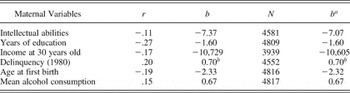
Estimates of the relations between SDP and maternal intellectual abilities, years of education, income, delinquency, age at first birth, and mean alcohol consumption across all pregnancies are in Table 3. Correlations and unstandardized regression weights are presented. The regression weights were calculated based on the data set with no missing values (using listwise deletion for those with missing values) and with five multiply imputed data sets for the sample of women who had children so that the entire sample, including those with missing values, could be analyzed (Little & Rubin, Reference Little and Rubin1987; Schafer, Reference Schafer1997). The multiply imputed data sets were based on average maternal smoking and alcohol consumption across pregnancies, intellectual abilities, years of education, income at the age of 30, delinquency, and age at first birth.
Relations with mean maternal smoking during pregnancy across all pregnancies

Note: The regression coefficients represent the mother's average smoking during pregnancy across all of her pregnancies regressed on each maternal characteristic. All parameters are significant at p < .001.
aRegression estimate based on five multiply imputed data sets for the women who had children.
bEstimate based on maternal income standardized with M = 0 and SD = 1.
Mothers who smoked more on average during their pregnancies were more likely to have lower intellectual abilities. For every unit increase in packs/day, maternal intellectual abilities were over seven percentage points lower. Every pack/day was associated with a decrease in over 1.5 years of completed education and more than $10,000 in yearly income at the age of 30. The average packs/day was also associated with maternal delinquency (an increase in .70 reported delinquent activities in the past year), a decrease of 2.32 years in age at first birth, and a .69 increase in days of alcohol consumption per month during pregnancy. Average SDP was also related to maternal race, F (2, 4816) = 78.40, p < .0001. The differences among the three groups were all significant, using the Tukey Studentized procedure: Hispanic (M = 0.10, SD = 0.25, N = 823); Black (M = 0.18, SD = 0.35, N = 1,249), and non-Black, non-Hispanic (M = 0.29, SD = 0.48, N = 2,747). The findings are consistent with previous reports using the NLSY (Zimmer & Zimmer, Reference Zimmer and Zimmer1998).
Association between SDP and child behavior problems
Mean comparisons
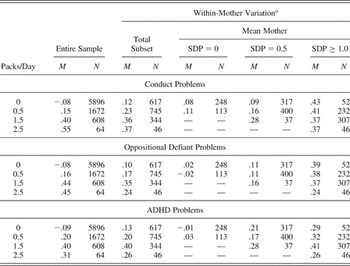
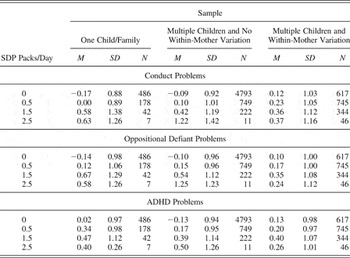
For descriptive purposes, Table 4 presents the mean of CP, ODP, and ADHP by number of packs smoked during the pregnancy and the sample of offspring. The left column shows the mean (partialed for gender of offspring) and sample size for all of the offspring in the entire sample. The results for CP illustrate a dramatic rise in behavior problems as the number of packs/day increased. The second column presents results for a subset of offspring of women for whom there was variation in SDP within their pregnancies (e.g., the mother did not smoke during one pregnancy and smoked during another, or she varied the amount of cigarettes she smoked among her pregnancies). This subset includes 704 mothers and 1,752 offspring. Offspring who were not exposed to prenatal nicotine, but whose mother smoked during other pregnancies (M = 0.12) had an increase relative to the estimate in the entire sample (M = −0.08). Furthermore, offspring who were exposed to large amounts of prenatal nicotine (approximately 2.5 packs/day), but whose mother smoked less during other pregnancies (M = 0.37), had fewer behavior problems than children in the entire sample exposed to the same level of SDP (M = 0.55). The results suggest that at least part of the association between SDP and offspring CP is not because of prenatal nicotine exposure.
Mean behavior problems by smoking during pregnancy and maternal sample

Note: All means are presented in Z scores.
aSample only includes women with multiple pregnancies during which they reported different levels of smoking during pregnancy.
The comparison between the subset of mothers with variation in their SDP to the entire sample, however, is largely a between-family comparison. To partially control for these between-family differences, mean offspring externalizing problems are presented for three groups of women in the subset, based on their mean level of smoking across all of their pregnancies: a low level (average mother SDP M = 0), a medium level (M = 0.5), and a high level (M = >1.0). In the first subset (low mean mother SDP), offspring specifically exposed 0 or 0.5 packs/day did not differ greatly in their CP (0.08 vs. 0.11, respectively). In the medium mean mother SDP group, exposure to increased individual-level SDP was somewhat associated with more CP (M 0 = 0.09, M 0.5 = 0.16, M 1.5 = 0.28), but this trend was not statistically significant. Furthermore, offspring in the high mean mother SDP group did not exhibit greater CP if they were exposed to more prenatal nicotine (M 0 = 0.43, M 0.5 = 0.41, M 1.5 = 0.37, M 2.5 = 0.37). The results suggest that offspring CP were strongly associated with a mother's mean SDP across all pregnancies but only minimally, if at all, related to individual-level exposure to SDP.
Similar patterns can be found for associations of SDP with ODP and ADHP. In the entire sample externalizing problems increased with higher levels of SDP; however, the relation was attenuated in the total subset of offspring whose mothers who had variation in SDP among pregnancies. Furthermore, offspring ODP and ADHP appeared to be significantly related to the average level of mother SDP in all pregnancies; yet, within the three subgroups, offspring externalizing problems were not more prevalent as the individual-specific measure of SDP increased. We caution that the comparisons in Table 4 still include between families effects, as the table does not specifically contrast offspring within the same nuclear family. More advanced statistical approaches are required to compare within-mother variation in SDP and behavior problems. The mean analyses, nevertheless, imply that the association between SDP and offspring externalizing problems may largely occur only between mothers. Again, if SDP were to cause offspring externalizing problems, the association would be found at all levels of analysis.
Hierarchical linear models (HLMs)
The offspring of cousins/siblings/twins represents a nested three-level design: the offspring level, the mother level, and the NLSY household level (for more details, see D'Onofrio et al., Reference D'Onofrio, Turkheimer, Emery, Slutske, Heath and Madden2005; Lynch et al., Reference Lynch, Turkheimer, Emery, D'Onofrio, Mendle and Slutske2006; Mendle et al., Reference Mendle, Turkheimer, D'Onofrio, Lynch, Emery and Slutske2006). Because offspring are nested under mothers, who are nested under households, observations are not independent. The association between SDP and offspring behavior problems can be studied within regression analyses using HLMs to account for the nested nature of the data, as well as provide appropriate standard error estimates and significance testing (Raudenbush & Bryk, Reference Raudenbush and Bryk2002).
Six HLMs were fit for each externalizing measure. Model 1 included SDP specific to each child (variable name under the heading SDP − packs = offspring), child gender, and the interaction of the SDP and offspring gender because previous research has indicated the effect of SDP is larger for male offspring (Wakschlag et al., Reference Wakschlag, Pickett, Cook, Benowitz and Leventhal2002). The first model compares offspring whose mothers smoked during their pregnancy with unrelated (e.g., not siblings or cousins) offspring whose mothers did not smoke. Because the measures of externalizing were standardized, the coefficients represent the effect size (Cohen d) associated with each increase in packs smoked/day. Each HLM includes three variance parameters, which represent the variance in externalizing problems attributable to the three levels in the analysis. Model 2, represents the standard approach to control for differences between mothers who differ in their SDP by including measured covariates to help statistically account for confounds. The model included maternal intellectual ability, years of education, income, delinquency, and age at first birth.
Model 3 calculated the average number of packs/day a mother smoked during all of her pregnancies (SDP – packs = mother) and included it in the model as a second-level variable. The parameter associated with the second-level variable estimated whether mothers who smoke more on average have children who have more externalizing problems on average. The offspring-level SDP variable (SDP – packs = offspring[C]) was calculated as the difference between the SDP during the specific pregnancy and the average maternal SDP. If there was no variation in SDP within a mother, the value was zero. Therefore, the offspring-level SDP variable in Model 3 compared siblings in the same family in which the mother smoked more during one pregnancy than the others, while holding constant the average SDP for each mother. The parameter associated with the offspring-level SDP variable in Model 3, the within-mother effect, provided a stronger test of the causal connection between SDP and offspring externalizing, because it was not confounded by factors that vary between mothers. Model 4 included the measured covariates to combine the statistical and methodological approaches.
Model 5 included the third level of the data to calculate the average number of packs/day all women from a household smoked during all of their pregnancies (SDP – packs = household). The parameter associated with this third-level variable measures whether mothers and aunts, women from the original NLSY households who smoked more on average have children who had more externalizing problems on average. This variable compared children whose mother and aunts smoked more during their pregnancies with unrelated children whose mother and aunts smoked less. In Model 5, the maternal level SDP (SDP – packs = mother[C]) was the deviation between the third level average household SDP and average maternal SDP. The parameter associated with this variable compared cousins who differed in their exposure to prenatal nicotine, holding constant the average SDP of women in the NLSY household. The parameter is the within-adult sibling effect and is free of confounds that vary between unrelated adult siblings. The offspring-level SDP variable in Model 5 compared siblings who differed in their prenatal nicotine exposure, while holding constant the average maternal and NLSY average household SDP constant. Finally, Model 6 added the statistical covariates to the methodological controls from Model 5. Algebraic representations of the models can be found elsewhere (D'Onofrio et al., Reference D'Onofrio, Turkheimer, Emery, Slutske, Heath and Madden2005).
All analyses were conducted on five multiply imputed data sets to analyze all available data and avoid bias introduced by individuals or families with missing data. The imputed data were based on the maternal characteristics included as covariates and offspring-specific measures of maternal SDP and alcohol consumption. Any lack of precision because of missing values is represented by larger standard errors around the parameters. Unstandardized regression parameters were utilized because of the difficulty comparing standardized coefficients when exploring causal processes (Kim & Ferree, Reference Kim and Ferree1981; Kim & Mueller, Reference Kim and Mueller1976). A comparison of the between and within parameters can only be made with unstandardized parameters.
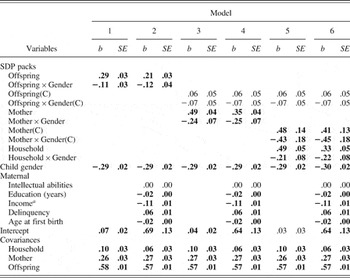
The parameters from the HLMs for CP are presented in Table 5. The results of Model 1 suggest that SDP (offspring) was associated with offspring CP, with the relation being larger for male (b = .29) offspring than female offspring (b = .29 − .11 = .18). Because the interaction between offspring gender and SDP was significant in the first model, the interaction of offspring gender and SDP at each level was included in the models. Model 2 illustrates how statistically controlling for measured covariates slightly reduced the effect of SDP (b males = .21 and b females = .21 − .12 = .09). It is difficult to interpret the coefficients associated with the maternal covariates because the coefficients were the result of a simultaneous regression analysis. In Model 3, the mean maternal SDP across all pregnancies (mother) was associated with offspring CP (b males = .49 and b females = .49 − .24 = .25). However, when offspring were compared to their siblings who differed in prenatal nicotine exposure (offspring[C]), there was no association (b males = .06 and b females = .06 − .07 = −.01). The same pattern of results occurred in Model 4 when the measured covariates were included. The mean maternal SDP was associated with offspring CP (b males = .35 and b females = .35 − .25 = .10), but there was no effect within mothers (b males = .06 and b females = .06 − .07 = −.01). In Model 5, the average NLSY Household SDP (household) was associated with offspring CP (b males = .49 and b females = .49 − .21 = .28). Furthermore, there was an association with maternal SDP corrected for average household SDP (mother[C]), (b males = .48 and b females = .48 − .43 = .05), but there was no association when siblings were compared (b males = .06 and b females = .06 − .07 = −.01). In Model 6, the average SDP at the household level (b males = .33 and b females = .33 − .22 = .11) was significantly associated with offspring CP when statistical covariates were included in the analyses. Average maternal SDP, holding constant average household SDP (b males = .41 and b females = .41 − .45 = −.04.) was significantly associated for males. In contrast, offspring SDP, holding constant the average household and maternal SDP (b males = .06 and b females = .06 − .07 = −.01), was not significantly associated for either gender.
Parameter estimates from hierarchical linear models for conduct problems

Note: SDP, smoking during pregnancy. All parameters are unstandardized. Parameters in bold are significant at p < .05. Child gender is coded male = 0 and female = 1. Offspring(C) represents the within-mother effect of SDP. Mother(C) represents the within-adult sibling effect.
aIncome was converted to a Z score so that the parameter could be accurately estimated in standard units.
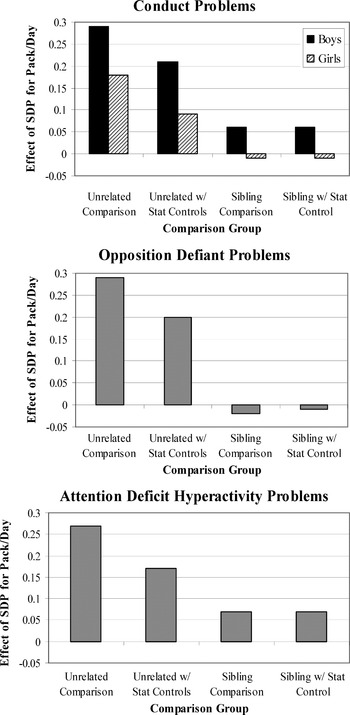
Figure 1 presents unstandardized regression parameters for Level 1 SDP from Models 1–4, for each measure of offspring externalizing. Figure 1 illustrates how the effect sizes associated with SDP drop for both males and females in each successive model. The association between SDP and offspring CP was evident when comparing unrelated children (Model 1), was slightly reduced when including statistical controls (Model 2), and was further attenuated for boys and nonexistent for girls when comparing siblings who differ in their exposure to prenatal nicotine, with or without statistical controls (Models 3 and 4). In other words, the average amount of SDP in adult siblings was related to the average CP in all their children (cousins), and the average amount of SDP for a mother across all of her pregnancies was associated with the average CP in all her children. However, siblings who were exposed to more prenatal nicotine did not have higher CP than their brothers and sisters exposed to less prenatal nicotine. This pattern of results is not consistent with the hypothesis that SDP causes CP. If SDP truly caused CP, the association would be found at all three levels of the analysis, particularly when comparing siblings (e.g., Rodgers et al., Reference Rodgers, Cleveland, van den Oord and Rowe2000).
Associations between smoking during pregnancy (SDP) and offspring externalizing problems using different methodological and statistical controls. Note there was no interaction between SDP and offspring gender for oppositional defiant problems and attention-deficit/hyperactivity problems.

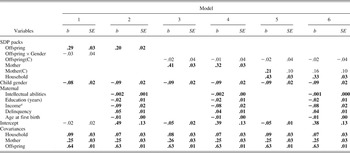
Table 6 presents results for ODP. In Model 1, SDP (offspring) was associated with ODP (b = .29), but there is no interaction with offspring gender. Therefore, subsequent models did not include the interaction between SDP and offspring gender. In Model 2, controlling for measured characteristics of the mothers slightly reduced the association (b = .20). In Model 3, however, only the mean maternal SDP across all of her pregnancies (mother) was associated with offspring ODP (b = .41). There was no relation when siblings were compared (offspring[C]; b = −.02). In Model 4, the measured covariates reduced the association with average maternal SDP. In Model 5, offspring ODP was associated with average household (household; b = .43) and maternal SDP (mother[C]; (b = .21) but not with the offspring level SDP (b = −.02). Finally, Model 6 indicated that when covariates are added to the model, offspring ODP was only associated with household-level SDP (b = .33), which is a comparison of unrelated offspring. Again, Figure 1 shows how the use of different comparison groups drastically influences the effect sizes associated with SDP.
Parameter estimates from hierarchical linear models for opposition defiant problems

Note: SDP, smoking duirng pregnancy. All parameters are unstandardized. Parameters in bold are significant at p < .05. Child gender is coded male = 0 and female = 1. Offspring(C) represents the within-mother effect of SDP. Mother(C) represents the within-adult sibling effect.
aIncome was converted to a Z score so that the parameter could be accurately estimated in standard units.
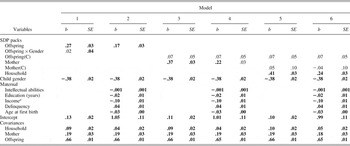
The HLM results for ADHP are presented in Table 7. The pattern is similar to that of ODP. SDP was associated with offspring ADHP in Model 1 (offspring; b = .27), and offspring gender did not moderate the association. The magnitude of the relation was slightly reduced in Model 2 (b = .17). In Models 3 and 4, average maternal SDP (mother) was associated with ADHP, but the sibling comparison (offspring[C]) suggested a small association that was not statistically significant (bs = .07). In Models 5 and 6, the association between SDP and offspring ADHP was primarily found at the household level (household; b = .41 and .24). The comparison of cousins (mother[C]) and siblings (offspring[C]) who differed in exposure to prenatal nicotine found small associations between ADHP and SDP.Footnote 1 Figure 1 notes the small association between SDP and offspring ADHP when siblings who differed in their exposure to prenatal nicotine were compared.
Parameter estimates from hierarchical linear models for attention-deficit/hyperactivity disorder problems

Note: SDP, smoking during pregnancy. All parameters are unstandardized. Parameters in bold are significant at p < .05. Child gender is coded male = 0 and female = 1. Offspring(C) represents the within-mother effect of SDP. Mother(C) represents the within-adult sibling effect.
aIncome was converted to a Z score so that the parameter could be accurately estimated in standard units.
Structural equation modeling
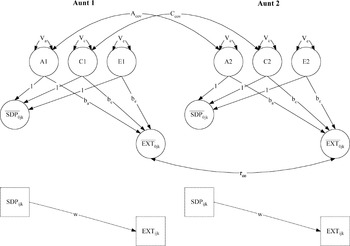
The HLM results suggested that the association between SDP and each measure of externalizing is because of unmeasured confounds that are shared by family members. Consequently, we used multilevel structural equation models (SEMs) to examine whether the relevant confounds were genetic or environmental in origin (Harden et al., Reference Harden, Lynch, Turkheimer, Emery, D'Onofrio and Slutske2007). The two-level SEM is illustrated in Figure 2. The first member of an adult sibship and her respective children are represented on the left side of the figure; the second member and her children are represented on the right side of the figure. The figure is divided into two portions, representing relations between SDP and externalizing problems within children with the same mother and between unrelated children (described in more detail below). This graphical convenience is not meant to imply that these portions of the model are estimated separately; analogous to the estimation of level-specific regressions in HLM, both portions are estimated simultaneously. The reader is referred to Mehta and Neale (Reference Mehta and Neale2005) for a more complete didactic on multilevel SEM and its equivalence to HLMs.
The structural equation model for the offspring of siblings and twins; SDP, smoking EXT, offspring externalizing. (—) The maternal and National Longitudinal Survey of Youth household level of the analysis and (- - -) the offspring level (within maternal). See Harden et al. (Reference Harden, Lynch, Turkheimer, Emery, D'Onofrio and Slutske2007) for a comparison to the specific children of twins model.

The bottom portion of the model (in broken lines) reflects relationships within children with the same mother. The externalizing problems of the ith child in the jth nuclear family of the kth twin family (EXTijk) is predicted by his or her own exposure to prenatal nicotine (SDPijk), as represented by the path labeled w. To the extent the child exposed to more SDP than his or her siblings also reports more externalizing problems than his or her siblings, this is reflected in the w path.
The top portion of the model (in unbroken lines) reflects relationships between related mothers and their children. Average maternal SDP across all pregnancies are represented here by the latent variables labeled SDP0jk. In addition, similar to the standard twin design path model, the variance in average SDP is decomposed into three components: variance because of additive genetic influences (V a), variance because of other environmental influences that make the adult siblings more similar (V c), and variance because of environmental influences that make the adult siblings in the same household different (V e). The covariance parameters between the latent genetic parameters (A cov) were constrained so that the genetic correlations were appropriate for each group. The covariance of the shared environmental factors (C cov) was constrained such that the correlation equaled 1.0, the standard correlation for the shared environmental latent factors (Neale & Cardon, Reference Neale and Cardon1992). Readers may be more familiar with a twin model parameterization in which the A, C, and E components are standardized to a variance of 1.0 and the paths from them are freely estimated. The current model is simply a reparamaterization with the paths fixed to one and the variances freely estimated. Because the paths are fixed to 1, the scale of each component is defined by the maternal SDP variable, and the total variance in maternal SDP is the sum of the estimated variances of the A, C, and E components. Dividing the estimated variance of each component by the total variance of average maternal SDP yields the familiar proportions of the heritability (h 2), shared environment (c 2), and nonshared environment (e 2). For more detail concerning variations on twin and family models, see Neale and Cardon (Reference Neale and Cardon1992).
The average number of externalizing problems in children with the same mother (EXT0jk) is then regressed on the variance components of SDP: A, C, and E. The model is similar to the standard bivariate genetic analysis (Neale & Cardon, Reference Neale and Cardon1992), except that the model estimated the unstandardized variance components in order to compare the intergenerational paths (b a, b c, and b e) on the same scale. The b a parameter estimates the effect of genetic factors common to both maternal SDP and child externalizing (passive rGE). The b c parameter estimates the effect of environmental factors that both make adult siblings similar for SDP and influence offspring externalizing. The model, therefore, controls for environmental factors that make adult siblings similar and influence offspring externalizing. Finally, the b e parameter estimates whether mothers who differ in their levels of SDP for nongenetic reasons (as reflected in variance component V e) have children who differ in their average number of externalizing problems.
If SDP caused offspring externalizing, the within-mother (w) and nonshared environmental intergenerational path (b e) would be large. These parameters estimate how differences between child siblings in prenatal nicotine exposure are associated with externalizing at the offspring level (i.e., if a child sibling exposed to more prenatal nicotine had more externalizing problems than his/her sibling exposed to less), as well as how differences between adult siblings in SDP are associated with externalizing at the maternal level (i.e., if one mother smoked more than her adult sibling and had children who had more externalizing problems on average). If the relation is not causal, a comparison of the genetic (b a) and common environmental (b c) parameters would elucidate the source of the confounds. A residual correlation between the cousins in the offspring generation (r co) was also estimated to account for the covariance among cousins not accounted for by the SDP status of their mothers. The correlation was estimated separately in the different groups to account for differing levels of genetic and environmental relatedness.
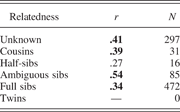
The SEM were initially fit with data from the cousin, half sibling, ambiguous sibling, and full sibling families.Footnote 2 Thirty-seven sibling pairs and their offspring were dropped from the analyses because the NLSY household included multiple pairs of varying genetic relatedness (e.g., some participants were related as full siblings but others were related as cousins, even though they lived in the same household). The analysis of clustered data in which participants within a single cluster (NLSY household) belong to multiple groups (e.g., full siblings and cousins) was not permitted in Mplus (Muthén & Muthén, Reference Muthén and Muthén1998–2005). Pairs of individuals in households of unknown genetic relatedness were also not included in the first model because these pairs could not help separate the estimates of genetic and environmental influences. The decomposition of the variance in SDP is based on the correlations among the different adult sibling pairs in the NLSY, found in Table 8. The parent-level correlations were relatively stable as the genetic relatedness of the siblings increase, suggesting that the shared environmental factors account for most of the covariance between siblings. Similarly, SEMs estimated the variance attributable to additive genetic factors (V a) to be zero. Moreover, the intergenerational parameter associated with genetic variance (b a) was unstable (i.e., b a was large but had very large standard errors), a result that frequently occurs when one latent variance component is negligible (D'Onofrio et al., Reference D'Onofrio, Turkheimer, Eaves, Corey, Berg and Solaas2003).
Correlations between adult siblings in average smoking during pregnancy across all pregnancies
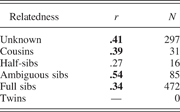
Note: Correlations in bold are significant at p < .05. The correlations were not corrected for multiple sibling pairs per family. There were no twin pairs where both female twins had reports of smoking during pregnancy.
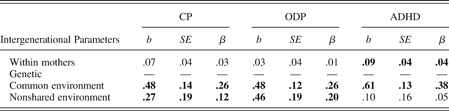
Therefore, the parameters associated with genetic factors (V a and b a) were constrained to be zero in the subsequent models, making the SEMs a between and within level of SDP at the nuclear family and NLSY household levels. The subsequent SEMs included all adult sibling pairs, including those in the NLSY where the genetic relatedness of the siblings was unknown. All sibling pairs were included in this model because they were informative about environmental factors that make individuals growing up in the same household similar. The models were estimated using MLR, a maximum likelihood estimator with standard errors that are robust to nonnormality (Muthén & Muthén, Reference Muthén and Muthén1998–2005). The SEM indicated that shared environmental factors accounted for 61% of the variance (V c = .083, SE = .01) of mean SDP at the maternal level, and nonshared environmental influences accounted for 39% (V e = .054, SE = .01).
The SEM for CP fit the data well (χ2 = 40.72, df = 13, root mean square error of approximation [RMSEA] = .015). The within-mother parameter was minimal (w = .07), consistent with HLM results. Environmental factors that vary between families (b c = .48) and within-adult-sibling families (b e = .27) accounted for the association between SDP and CP. Overall, SDP accounted for 0.1% of the variance in offspring CP within mothers and 8% of the variance between mothers. The intergenerational parameters from the SEMs, including unstandardized estimates, standard errors, and standardized estimates, are found in Table 9. The SEM for ODP also fit the data well (χ2 = 42.93, df = 13, RMSEA = .015). For ODP, the results indicated a negligible association with SDP within mothers (w = .03). Environmental factors that make adult siblings similar (b c = .48) and unique (b e = .46) both contributed to the association between SDP and ODP. SDP accounted for no variance in ODP within mother but accounted for 11% of the variance in ODP between mothers. Finally, the SEM for ADHP (χ2 = 37.08, df = 13, RMSEA = .014) indicated a small association within mothers (w = .09). The parameter associated with nonshared environmental influences was comparable to the within-mother effect but was not statistically significant (b e = .10). Environmental factors that very between families accounted for most of the intergenerational associations (b c = .61). SDP accounted for only 0.1% of the variance in ADHP within mothers but 14.4% of the variance between mothers.
Structural equation modeling results for smoking during pregnancy offspring externalizing
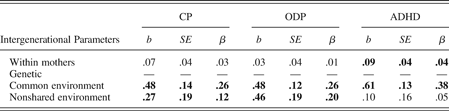
Note: Because the initial structural equation modeling indicated that no variance in smoking during pregnancy was due to additive genetic factors, the path from the genetic latent factor was dropped from the structural equation modeling. Parameters in bold are significant at p < .05.
Discussion
The current article used the clustered design in the NLSY sample to explore the association between SDP and three measures of offspring externalizing problems (CP, ODP, and ADHP). The present comparisons of unrelated children were consistent with the results of previous studies (Wakschlag et al., Reference Wakschlag, Pickett, Cook, Benowitz and Leventhal2002) in several respects: (a) CP, ODP, and ADHP problems were significantly associated with SDP; (b) each association followed a dose–response relationship; (c) the number of CP demonstrated by children exposed to SDP was higher for male children; and (d) each association remained significant after statistically controlling for associated maternal characteristics. In addition to the use of statistical covariates used in previous studies, the current analyses utilized the multiple levels of the NLSY to account for unmeasured confounds. If SDP caused higher conduct and oppositional problems, the relation would have been evident both when comparing related (e.g., within mothers) and unrelated children (e.g., Rodgers et al., Reference Rodgers, Cleveland, van den Oord and Rowe2000). However, when children were compared with their siblings who differed in their exposure to SDP, the offspring did not differ with respect to conduct and oppositional defiant problems. SDP accounted for no more than 0.1% of the within-nuclear family variance in offspring CPs. In contrast, SDP accounted for 8–14% of the between-nuclear family variance in offspring CPs. These results suggest that previous studies found a relationship between SDP and offspring CPs not because SDP causes increased risk for conduct or oppositional problems, but because environmental influences that vary between families confound associations between SDP and offspring externalizing. This finding is generally consistent with another CoT study of SDP and ADHD (Knopik et al., Reference Knopik, Heath, Jacob, Slutske, Bucholz and Madden2006), as well as with studies that have included more precise measurement of adult characteristics that may confound the relation, such as maternal and paternal antisocial characteristics (Maughan et al., Reference Maughan, Taylor, Caspi and Moffitt2004) and maternal delinquency during adolescence (Silberg et al., Reference Silberg, Parr, Neale, Rutter, Angold and Eaves2003).
The present findings indicate that environmental influences that are risk factors for both maternal SDP and offspring externalizing underlie the previously observed intergenerational associations between SDP and offspring CPs. This has important implications for future research on the causes of CPs. The present findings imply that the salient aspects of the familial or social environment that are robustly associated with both SDP and offspring CPs have not been the focus of the research on the etiology of externalizing problems. Because SDP is significantly related to offspring CPs after controlling for essentially all of the parent and family characteristics that have been examined as risk factors for offspring CPs (Wakschlag & Hans, Reference Wakschlag and Hans2002), the present findings suggest that aspects of the family or social environment that are unrelated to maternal antisocial behavior, maternal age, and other well-studied risk factors are responsible for the relations to SDP. Hopefully, the present findings will lead to an expanded search for these environmental risk factors. The important clues offered by these findings is that they are correlated with SDP, but not correlated with the risk factors that have been controlled in this and previous studies of SDP.
The present analyses, however, suggest a minimal role of SDP with offspring ADHP problems, but the magnitude of the association was greatly reduced compared to previous observations. A recent review has documented a small association between SDP and ADHP after controlling for various confounds (Linnet et al., Reference Linnet, Dalsgaard, Obel, Wisborg, Henriksen and Rodriguez2003), and the small association, consistent with a direct causal effect of SDP on offspring ADHP, may be related to the influence of SDP on birth weight (Knopik et al., Reference Knopik, Heath, Jacob, Slutske, Bucholz and Madden2006).
The current article used two analytical approaches to explore the associations between SDP and offspring externalizing because each approach has its own advantages and limitations. HLMs were used because they enabled the inclusion of every family and offspring. Furthermore, interactions between variables (e.g., SDP and offspring gender) and the effects of measured family characteristics can be more easily and directly included. Although the HLMs indicate that the relation between SDP and offspring externalizing is not causal, it is difficult to identify whether the origin of relevant confounds are genetic or environmental within the HLM approach. Interpreting the between and within-family parameter estimates from the multiple family groups in the NLSY (cousins, half-siblings, ambiguous siblings, full siblings, and twins) becomes quite computationally burdensome (results not shown). In contrast, the SEM approach provides a more straightforward approach to identifying the intergenerational effects of genetic, common environmental, and nonshared environmental influences. The SEM approach, however, cannot include adult sibships that differed in genetic relatedness from other pairs within their household. Furthermore, the sibling correlations and SEM suggest no influence of genetic factors on SDP, in contrast to other reports with larger samples (D'Onofrio et al., Reference D'Onofrio, Turkheimer, Eaves, Corey, Berg and Solaas2003; Knopik et al., Reference Knopik, Sparrow, Madden, Bucholz, Hudziak and Reich2005). Accordingly, we conclude that the results suggest that the confounds are environmental rather than genetic in origin. Analyses with larger samples will be required to more specifically elucidate the magnitude of genetic and common environmental processes responsible for the intergenerational association. Regardless of the nature of the confounds, the analyses question whether associations between SDP and offspring externalizing in young children are causal.
There are a number of additional limitations of the current study. First, all of the analyses are based on self-report measures completed by the mother. The retrospective report of SDP may have resulted in underreporting or greater measurement error (Wakschlag et al., Reference Wakschlag, Pickett, Cook, Benowitz and Leventhal2002), but there is a high correlation between self-reported smoking status and serum cotinine measures (McDonald, Perkins, & Walker, Reference McDonald, Perkins and Walker2005). The reliability of retrospective reports is also similar to the recall of other substance use (Petitti, Friedman, & Kahn, Reference Petitti, Friedman and Kahn1981). Furthermore, mothers who report SDP may be more likely to report higher externalizing in their children. The magnitude of intergenerational associations in the current paper, however, are consistent with studies that used more sophisticated measurement strategies (Wakschlag et al., Reference Wakschlag, Pickett, Cook, Benowitz and Leventhal2002). Second, because of the complexity of the analyses we did not analyze the longitudinal responses of the offspring across the age range (4–10 years old); rather, we relied on the average across the years. Future analyses that explore offspring characteristics associated with SDP would benefit from using analytical strategies, such as growth curve models, that can account for individual differences in initial level and change across time (e.g. Willett, Singer, & Martin, Reference Willett, Singer and Martin1998). Third, our findings are limited to measures of externalizing in young children and may not reflect the underlying mechanisms responsible for the association between SDP and adult criminal activity (Brennan et al., Reference Brennan, Grekin and Mednick1999; Rasanen et al., Reference Rasanen, Hakko, Isohanni, Hodgins, Jarvelin and Tiihonen1999). Fourth, no father information was included in the analyses. Limited information on the fathers is available in the NLSY, and the association between SDP and offspring externalizing could be because of higher rates of paternal delinquency (Maughan et al., Reference Maughan, Taylor, Caspi and Moffitt2004). Methodological work on CoT design has highlighted its strength with characteristics of individuals (such as SDP), but inasmuch as SDP is influenced by the women's spouses, the interpretation of the parameters may be somewhat restricted (Eaves, Silberg, & Maes, Reference Eaves, Silberg and Maes2005). Fifth, we only explored whether offspring gender moderated the influence of SDP, but there may be vulnerability factors (both environmental and genetic in origin) that make individuals more susceptible to the influence of SDP.
Sixth and finally, as is the case with all comparisons using different levels of analyses, the design rests on a number of assumptions about women who have multiple offspring and who vary in the levels of SDP among the pregnancies. The design assumes that women who have only one child are similar to women with multiple offspring, because the within-mother parameter is based solely on women with multiple children. Furthermore, the analyses assume that women who have multiple pregnancies and variation in SDP are similar to women who have multiple offspring but smoked at the same level in each pregnancy, including their ability to accurately report SDP. Again, the within-mother parameter can only be estimated based on women with variation in SDP among her pregnancies.Footnote 3 Ultimately, the limitations of the current article underscore the necessity of replicating the analyses in other samples and exploring the consequences of SDP in animal studies, which have the advantage of random assignment.
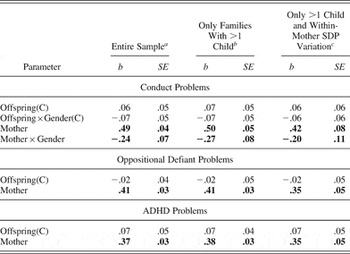
Comparison of smoking during pregnancy parameter results from Model 3 using different samples

Note: SDP, smoking during pregnancy; ADHD, attention-deficit/hyperactivity disorder. See Tables 5–7 for more details.
aParameters are based on the complete analysis presented in the paper.
bThe sample only included offspring from families with more than one child.
cThe sample only included offspring from families with multiple children and where there was variation within mothers in SDP.
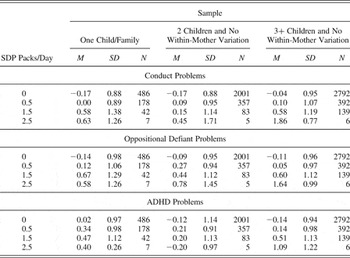
Comparison of offspring externalizing by pack and detailed family structure

Note: SDP, smoking during pregnancy; ADHD, attention-deficit/hyperactivity disorder.
Comparison of offspring externalizing in samples with no variation

Note: SDP, smoking during pregnancy; ADHD, attention-deficit/hyperactivity disorder.
The study highlights the importance of using research designs that can pull apart different risk mechanisms and account for nonmeasured confounds (Rutter et al., Reference Rutter, Pickles, Murray and Eaves2001). Furthermore, the results underline the limitations of solely relying on measured covariates to account for confounds. Even though the initial HLMs that compared unrelated children included a measure of maternal delinquency to control for the intergenerational transmission of externalizing problems, there was still an association between SDP and offspring externalizing. If we only relied on the measured covariates we would have drawn the incorrect conclusion. Methodologically, these results support the importance of using design innovations as well as statistical controls to study risk mechanisms rather than just identifying risk factors (Moffitt, Reference Moffitt2005; Rutter et al., Reference Rutter, Pickles, Murray and Eaves2001).
Similar to other genetically informed studies of familial characteristics, such as parental divorce (D'Onofrio et al., Reference D'Onofrio, Turkheimer, Emery, Slutske, Heath and Madden2006), the underlying processes associated with a risk factor depend on the specific outcome measure being studied. SDP appears to have a specific environmental association with offspring birth weight, inasmuch as genetic factors, common environmental, and measured covariates do not confound the relation (D'Onofrio et al., Reference D'Onofrio, Turkheimer, Eaves, Corey, Berg and Solaas2003; see footnote 3). However, CP and ODP in young children associated with SDP are completely because of characteristics that lead to both SDP and offspring externalizing behaviors, not the consequences of SDP. As a result, each risk factor and specific measure of adjustment needs to be studied independently with designs that can separate the risk mechanisms.
Finally, we must state that we were surprised by the results of the analyses, given the existent research on SDP (although no previous research has allowed for control over unobserved heterogeneity to the extent that ours has). We want to stress the need to replicate the current findings. Furthermore, we certainly concur with other researchers (e.g., Maughan et al., Reference Maughan, Taylor, Caspi and Moffitt2004) in stressing the importance of reducing SDP because of its effects on a wide range of range of developmental characteristics, particularly neurobehavioral functioning (Cnattingius, Reference Cnattingius2004; Huizink & Mulder, Reference Huizink and Mulder2006). Animal research has shown that prenatal nicotine exposure has neurotoxic effects (review in Wakschlag et al., Reference Wakschlag, Pickett, Cook, Benowitz and Leventhal2002). Thus, the findings of the current analyses are limited to externalizing problems during childhood. The current article, though, emphasizes that women who smoke during pregnancy are different than mothers who do not. Although the research literature has noted a number of characteristics of mothers and families associated with SDP, the analyses in the current article suggest that unmeasured characteristics accounted for the associations between SDP and offspring externalizing problems. Perhaps there are more differences than previously imagined between mothers who smoke during pregnancy than those who do not. Therefore, addressing the myriad of risk factors associated with SDP may be a more effective approach of minimizing externalizing problems in offspring than specifically focusing on reducing SDP.