The Carniolan Society for Agriculture and Useful Arts, often somewhat loosely called the Carniolan Farming Society, worked between the years 1767 and 1787 in the Habsburg duchy of Carniola on the southern border of Holy Roman Empire, which now forms the central western part of Slovenia with its capital Ljubljana (Laibach), northeastern Italy with the city of Duino, and a part of Croatian Istria with the city of Pazin.Footnote 1 The official name of the Society (referred to as Society or Carniolan Society in this article) was Kaiserlich Königliche Gesellschaft des Ackerbaues und nützlicher Künste im Herzogthume Krain. It published two important periodicals: the Sammlung nützlicher Unterrichte (Collection of useful instructions) and a weekly magazine titled Wöchentliches Kundschaftsblatt des Herzogthum Krain (Weekly news of the Duchy of Carniola). Both publications promoted intellectual and scientific developments of the time and reflected a progressive spirit of Enlightenment and rationalism, characteristic of the eighteenth century in Europe.
The Society's life span, 1767 to 1787, also marks the beginning of organized efforts to improve agricultural and general economic efficiency, which were part of a comprehensive reform process in the Habsburg monarchy. The Carniolan Society, through its publications, certainly influenced that process. Not only did it search for practical solutions to economic problems, but it also engaged with theoretical dimensions in discussions based on the prevailing economic doctrines of the time, German cameralism and French physiocracy. Apart from that, the Society actively promoted science, education, research, and innovation in general; it popularized agricultural and technical innovations and contributed to the awareness of the importance of technological advancement for the progress of society. The progressive stance of the Society regarding economic, technical, and developmental issues is even more interesting because Carniola had in the preceding centuries been exposed to much heavier economic devastation from recurring Ottoman invasions compared with other Austrian Habsburg lands, and therefore lagged in terms of productivity and wealth.
In the first section of this article, we outline the historical circumstances, especially the progressive spirit of Enlightenment and scientific and technological advancement, which in the eighteenth century spurred the establishment of a wave of agricultural and economic societies throughout Europe and the Habsburg monarchy. The second section presents the goals of the Carniolan Society and its membership, including some of its most prominent figures. The third and fourth sections analyze European economic thought in the eighteenth century that characterized the thinking of the Society's members, thought that was dominated by the ideas of mercantilism and physiocracy. These schools of thought contributed to a growing concern among the ruling classes and intellectuals for the ways in which knowledge and technological advancement were critical to the long-term economic performance of their countries. The fifth section describes the Carniolan Society's progressive activities in education and research, especially establishing schools and promoting scientific experiments and innovation. It was this interest in the creation and dissemination of knowledge that made the agricultural and economic societies typical institutions of the Enlightenment period; the Carniolan Society was no exception in this respect. In the last three sections, we present the Society's publications, which promoted the mercantilist and physiocratic economic ideas of the time and dealt with various aspects of economic efficiency as well as with practical issues of economic life. The essays initiated by the Society's prize competitions—and published in the Society's yearly proceedings—especially brought forward many interesting practical proposals as well as some quite advanced theoretical concepts.
Historical Background: The Transition to Liberalism and the Rise of Economic Societies in Europe
Historians of economic thought consider the eighteenth century to be a period of transition from mercantilism to classical liberalism, a period in which restrictive state policies and pervasive regulation, typical for the mercantilist era, were becoming increasingly incompatible with entrepreneurial economic ambitions and began to be considered as barriers to economic progress.Footnote 2 By contrast, liberal ideas gained ground during this period and the free market was increasingly seen as a mechanism that could lead the economy and society toward a desirable “natural order,” which was one of the crucial concepts of Enlightenment philosophy. This transition in economic thought began in England, where ideas about the benefits of free trade already appeared in the second half of the seventeenth century, and was then transferred to other European countries. In Germany and Austria, where mercantilism had acquired the form of cameralism, the support for the pervasive role of the state in economic life tended to be more persistent.Footnote 3 Nonetheless, liberal ideas here too entered economic thought and opened it up to theoretical novelties and entrepreneurial spirit. In France, the critique of mercantilism came from a unique economic school, called physiocracy, which opposed all government restrictions and favored freedom of business enterprise, individualist effort, and private property. Its specific feature, however, was that it considered agriculture to be the only productive economic activity (resulting in tangible surplus), while manufacturing and other sectors were considered useful but sterile in terms of producing net surplus. Although the physiocratic school remained limited to France, its ideas about fostering agriculture found many supporters in other European countries, including the Austrian monarchy.
The transition toward classical liberalism in the eighteenth century was accompanied by an interest in scientific and technological advancement, which increased comparisons of economic conditions among European states and made the ruling classes as well as the intellectual public aware of the need to improve the “productive powers” of their countries. One expression of this awareness was the wave of societies that sprang up throughout Europe with the explicit aim of improving the economic basis of their respective countries. Although the names of these societies differed, they all clearly pointed to their intention to encourage agriculture, manufacturing, and trade. Usually these societies were called “agricultural” or “economic.” One of the first such societies was the Honourable Society of the Improvers in the Knowledge in Agriculture in Scotland, which was founded in 1723. In England, the Society for the Encouragement of Arts, Manufactures and Commerce was founded in 1754. The Society of Agriculture, Commerce and Arts of Brittany (Société d'agriculture, de commerce et des arts des États de Bretagne), founded in 1757, was the first of this type in France. In Switzerland, the Economic Society in Bern (Die Ökonomische Gesellschaft Bern) was established in 1759. Agricultural and economic societies were also organized in Germany (e.g., in Hamburg), Sweden (e.g., in Stockholm), Italy (e.g., in Milan), Russia (e.g., in St. Petersburg), and elsewhere. They were established at the level of countries, towns, counties, regions, and so on, and according to some estimates, their number in eighteenth-century Europe exceeded five hundred.Footnote 4
These societies were patriotic in character. Their basic objective was to help their own state increase and fully use its economic potential and thus fare better in competition between states.Footnote 5 This did not mean, however, that the economic societies were closed or sought protective policies. On the contrary, although they were nationally or locally oriented, as their mission was to improve the economic situation in their geographical area, these societies were at the same time typically open, looking for inspiration abroad, comparing themselves with sister societies in other countries, cooperating and exchanging experience with them, emulating their practices, inviting honorary foreign members, and so on. According to Jani Marjanen, “[T]hey displayed what could in modern terms be described as transnational imagination, a vision of belonging to a common movement of similar societies in Europe.”Footnote 6 There is no doubt that this was an enlightened movement, intended to reform, improve, and liberalize economic life in line with technological progress and scientific discoveries of the time. It also needs to be mentioned that the societies were not against the state. Rather, they served the state as consultative bodies. They proposed changes in institutional settings and regulative practices to stimulate productivity, increase production, and improve the well-being of the population.
As in other European countries, the main purpose of organizing these societies in Austria was to spread knowledge about new agricultural techniques, stimulate interest in new methods of cultivation, promote modern farming equipment and novelties in crafts and manufacturing, disseminate information about interesting scientific discoveries, conduct various experiments, set up educational institutions, encourage exchange of ideas and practices, and thus help improve all branches of farming and manufacturing. In fact, the agricultural societies in Austrian monarchy were part of a much broader scheme within which Maria Theresa and Joseph II planned to carry out enlightened reforms intended to raise—by amending the regulatory framework and promoting technological advancement—the productivity of agriculture and industry; stimulate commerce and expand communications; and improve the economic and administrative efficiency of the monarchy in general. The ultimate goal of this broad reform process was, of course, strengthening the state. However, Maria Theresa set out on this task in a comprehensive and enlightened manner, which relied on progressive economic ideas of the time and produced not only economic but also deeper social consequences.Footnote 7 The spirit of the Enlightenment, combined with pragmatic economic views of advanced cameralist authors on the one side and fresh ideas of physiocratic thought on the other, thus represented the ideological background of Theresian and Josephian reforms. As we shall see, the Carniolan Society for Agriculture and Useful Arts was a typical expression of this progressive, reform-oriented combination of practicality and theoretical considerations.
The Carniolan Society's Goals and Membership
In the second half of the eighteenth century, agricultural societies were established in many of the Habsburg lands, including Bohemia, Moravia, Upper Austria, Lower Austria, and Tyrol.Footnote 8 The Carniolan Society for Agriculture and Useful Arts was founded in 1767. Agricultural societies in the duchies of Carinthia (1765), Styria (1766), and Gorizia/Görz/Gorica (1765) were also established in the vicinity of the Carniolan Society, which covered the duchy of Carniola (Krain). The Carniolan Society was originally founded as an advisory and consultative body to the provincial governor. As with other similar societies in the monarchy, the general guidelines for its activities were established by the central court office and, probably, by the Council of State. That body had been established in 1760 at the initiative of state chancellor Wenzel Anton Kaunitz with the purpose of coordinating and supervising the reform process in the monarchy. In the first two years, the Society was subordinated to the provincial commercial committee (Kommerzkonsess) in Ljubljana, which determined, based on the court's guidelines, the Society's working agenda, and was the body to which the Society reported about its work. From 1769 on, however, the Society was directly subordinated to the provincial governor's office, which forwarded the Society's reports to the central court office.Footnote 9 In line with the enlightened reform spirit of the monarchy, the Society was expected to contribute to the raising of the agricultural production in the local environment, so that domestic agriculture would be capable of supplying more raw materials needed for the increased production of the growing manufacturing industry, as well as more food for the population and more fodder for cattle. Providing larger quantities of domestic raw materials (as well as of other resources) also meant reducing the need for imports and thus increasing the level of self-sufficiency, which was a classical mercantilist requirement. Therefore, the main goal of the Society was to find ways to improve the variety of agricultural production (e.g., stimulating the introduction of new crops like potatoes) and promoting the use of better or innovative agricultural techniques (e.g., a more intensive system of crop rotation, where no land could lie fallow but was rather planted with fodder plants, which was at the same time beneficial for stock farming). In accordance with this goal, the Society advocated the intensive cultivation of all arable land in the country (no plots of land should be left uncultivated) and promoted industrial plants (such as flax, hemp, and white mulberry), new ways of fertilizing the fields, apiculture (beekeeping and related production of honey), and rational usage of resources such as wood (suggesting replacing it with coal where possible).Footnote 10 In addition to this, the Society's goal was to raise the level of craftsmanship and manufacturing in Carniola, mainly through popularizing knowledge about (or directly stimulating) research and experiments that could potentially result in technological innovations in various productions (e.g., in the production of paper, sugar).
The creation and dissemination of knowledge was an important goal of the Society. Two points need to be mentioned with respect to this: First, from the beginning of its work, the Society was deeply involved in educational activities in Ljubljana. The role of its Jesuit members was of prime importance here, most notably of Gabriel Gruber (1740–1805), a versatile engineer and scientist, who later also became the Superior General of the Jesuits. And secondly, the Society relied on printed periodicals to spread knowledge about technical and scientific achievements among its learned members and sympathizers. In fact, the Carniolan Society was among the first of its kind to publish its work.Footnote 11 This is an important feature and placed it ahead of many other agricultural societies of the time.
Membership of the agricultural and economic societies in the Austrian monarchy was, according to Rita Krueger, generally reserved for
a self-selected group of people who were educated, well versed in agricultural issues and methods based on practical experience, scientifically inclined, and politically moderate. Such “requirements” set them immediately apart from the majority of the rural population. These institutions de facto excluded uneducated peasants, who were hindered not so much by social norms as by their inability to communicate ideas effectively in written form. In the opinion of the reformers, peasants were also too likely to be excessively cautious in the implementation of new crops and farming methods, and were therefore inappropriate as members of societies whose intents included scientific inquiry into just such innovations.Footnote 12
The membership of the Carniolan Society confirms the previously described pattern. Namely, its membership combined the old noble aristocracy like the Auerspergs, the newly ennobled wealthy bourgeoisie like Žiga Zois (1747–1819), the literati of the educated bourgeois like the Jewish physician Johann Haymann (1732–99) or professor of anatomy and surgery Balthasar Hacquet (1739–1815), as well as the clergy. Although no peasants are to be found in the membership, some members occasionally argued that even peasants of the lowest class could be beneficial to the Society as members.Footnote 13 There were, however, two factors excluding peasantry from the membership. One was high illiteracy in the countryside. The other was the language that peasantry used. Peasants were mainly Slovenian speakers (speakers of Slovenian dialects) and most did not speak German, which was the predominantly used language in the Society.
No low-profile manufacturers were admitted to the membership of the Society. But some manufacturers did attend Gruber's lectures on mechanics and civil engineering that were paid by the Society. Most of the priests who joined the Society were Jesuits. As the intellectual elite of the Carniolan Society, the Jesuits worked in close social and economic relations with the newly ennobled wealthy bourgeoisie. This was especially obvious in the navigational projects led by Gruber.Footnote 14 Without the support of the leading families in Carniola—Mühlbacher, Taufferer, Apfaltrer, Liechtenberg, Hallerstein, Breckerfeld, and Auersperg—Gruber (who was a foreigner, born and raised in Vienna) would have not been able to carry out his ambitious projects, especially the creation of a canal in Ljubljana.Footnote 15
The number of domestic members of the Society remained very stable over the years (around forty), whereas the number of foreign honorary members constantly rose, reaching thirty-seven in 1782. The leaders of the Carniolan Society were mostly noblemen, counts coming from the families such as Auersperg, Rosenberg, Lamberg, and Hohenwart. The provincial governor filled the official role of Protector of the Society and after 1769 the Society was directly subordinated to him. The founding meeting of the Society for Agriculture and Useful Arts took place in Ljubljana on 26 October 1767 and was held under the auspices of the provincial governor of Carniola, Count Heinrich von Auersperg. The first president of the Society was the Governor's Councilor and freemason Joseph Brigido von Brezovica (1736–1817). His secretary during the first two years was Dr. Valentin von Modesti. After 1778, the first permanent secretary of the Society was Brigido's protégé Balthasar Hacquet, the already mentioned professor of surgery, who became a member of the Society in 1772.
The Society's first leaders, Heinrich von Auersperg and Joseph Brigido, resigned in February 1773, after Heinrich left Ljubljana to take over the position of Governor of Galicia, a region that had been recently annexed to Habsburg's lands.Footnote 16 In 1775 Count Maria Barbo Dizma Wachsenstein from the Lower Carniola Rakovnik branch of the famous Barbo family became secretary of the Society. In 1779, the actuary of the Society was Paul Joseph Semen, an official from the ironworks Železniki family. In 1784 the president of the Society became Georg Jacob Hohenwart (1714–1808), who had been president of the regional court in Ljubljana in 1770. In its last decade, as already mentioned, the permanent secretary of the Society was Hacquet, whose “humble” opinion later was that the Society immediately ceased to function after he had left Ljubljana for Lvov in Galicia in 1787. However, his departure from Ljubljana was probably not so decisive. The Society ran into financial troubles when Emperor Joseph II suppressed imperial support for the organization.Footnote 17 In 1787 the Society did not get any governmental grants and it stopped all activities for more than three decades. The collapsed imperial patronage of the Society and related financial troubles were part of the broader imperial politics of Joseph II, aimed at the centralization and consolidation of the Habsburg monarchy. This left no great opportunities for the development of peripheral centers of erudition. Joseph also suppressed the theological and philosophical faculties in Ljubljana as well as many prosperous monasteries in Carniola.
Economic Ideas in Eighteenth-Century England and France: Late Mercantilism and Physiocracy
In the eighteenth century, the mercantilist doctrine, which emerged at the beginning of the modern age with the purpose of increasing—by protectionist policies—the wealth (i.e., the reserves of gold and silver) of the European absolutist monarchies, was on the decline. Already in the second half of the seventeenth century, John Locke (1632–1704) and Dudley North (1641–91) criticized mercantilist views by claiming that stock of precious metals is not the ultimate form of a country's wealth and that wealth should rather be judged by the investment, entrepreneurial activities, technological advancement, and growth.Footnote 18 The only way to achieve these goals was through free domestic markets and free international trade. International trade was no longer understood as a zero-sum game, but rather as a mutual process from which all participating countries could profit. Another critical theoretical insight came from David Hume (1711–76), who clearly explained that there was a natural tendency of the balance of trade toward equilibrium (price-specie flow mechanism), which made the mercantilist efforts to gain a permanent surplus redundant and senseless. Besides, mercantilist regulatory policies for manufacturing, intended to guarantee the quality of manufactured goods, turned out to be counterproductive in the long run because they hindered innovation and technological progress. For the same purpose of guaranteeing the quality of products, the state also granted rights to production and trade of particular products, which, however, frequently produced corruption. Successful businesses were carried out by various court protégés or those who successfully lobbied the state administration. Liberally oriented authors rightly claimed that guaranteeing the quality of production should be left to the process of market competition. All these views contributed to the spread of the spirit of the Enlightenment, which was founded on the concepts of reason and freedom. In fact, Locke's theoretical propositions, especially his “three pillars of liberty,” belong to the core of the Enlightenment philosophy that permeated the European intellectual aspirations of the eighteenth century.Footnote 19
In the middle of the eighteenth century, the French physiocratic school, although relatively short-lived, contributed to European economic thought by supporting the idea of economic liberalism. Physiocracy developed as a reaction against the mercantilist policy led by the French finance minister Jean-Baptiste Colbert. While Colbert favored manufacturing and discriminated against agriculture, the physiocrats claimed that agriculture was the only productive sector of the economy that could produce a surplus (produit net). Manufacture and trade, they claimed, were in fact sterile. Therefore they argued for free corn trade and for the introduction of the free market, not only in agriculture but also in all other sectors of the economy. Free entrepreneurial initiative and private property were already seen as the cornerstones of a natural order (ordre naturel) by two precursors of French physiocracy, Pierre de Boisguilbert (1646–1714) and Richard Cantillon (c. 1680–1734). Boisguilbert was the first to use the famous phrase “laissez faire la nature,” which soon became synonymous with economic liberalism. Cantillon introduced the figure of entrepreneur into economic theory, which was later used by Francois Quesnay (1694–1774), whose idea was to reform French agriculture with capitalist farmers who, by that time, had already emerged in some of the regions in France. Les fermiers were innovative farmer entrepreneurs cultivating large areas of land, rented by the landowners; using modern agricultural techniques; and attaining high productivity. At the theoretical level, Quesnay's Tableau Économique was the first attempt to model macroeconomic flows, which clearly showed that rents, accruing to the landowners, represented the surplus of the economy and should therefore be taxed.
Physiocratic ideas made Paris the center of European economic thought in the mid-eighteenth century. Many economists from elsewhere came to France, including Adam Smith, who was already preparing The Wealth of Nations at the time.Footnote 20 As a critic of mercantilism, he was deeply influenced by the physiocratic ideas about the importance of productivity and free trade, which he later developed into a broader framework of economic growth analysis. However, reforming the economy in line with the physiocratic ideas was far from easy. When Anne Robert Jacques Turgot (1727–81), one of the last French physiocrats, became a minister of the economy and finance in 1774, he attempted to reduce the state administration, tax landlords, and deregulate the corn trade, all of which aimed to abolish long-established privileges. Turgot was soon forced to resign, and, as J. K. Galbraith later commented, because reform from above was obviously not possible, the revolution from below became inevitable.Footnote 21 After the revolution, the physiocratic school ceased to exist, but the tradition of liberalism in France remained alive throughout the nineteenth century, for example in the works of Jean Baptiste Say (1767–1832) and Frédéric Bastiat (1801–50).
Mercantilism in Austria: Cameralist Ideas and the Dominance of Joseph von Sonnenfels
In the German states and Austria, mercantilist ideas existed in the form of cameralism, which was very resistant to critiques and, in comparison with England and France, lasted much longer than mercantilism as a leading economic doctrine. Cameralism aimed to increase the financial, economic, and military power of the state and paid much more attention to the improvement of state administration than did English and French mercantilism. Whereas English mercantilists were predominantly businessmen, the most influential cameralists were state administrators or university professors, like Johann Heinrich von Justi (1717–71)—who taught cameralist science in Vienna—or Ludwig von Seckendorf (1626–92)—a seventeenth-century cameralist, who emphasized the importance of domestic resources and self-sufficiency in agriculture and industry.Footnote 22 The most important Austrian cameralist was Joseph von Sonnenfels (1733–1817), professor of financial and political sciences in Vienna, who is considered to be “[o]ne of the most successful transmitters of the ‘Enlightened policies’ to less advanced social strata in the Habsburg monarchy.”Footnote 23 His famous course on Polizey- and Cameralwissenschaften together with the corresponding textbook were designed to create competent and loyal state officials for different levels of the administrative apparatus, capable of not simply carrying out the orders of the central authorities but also actively promoting a spirit of reform and innovation.Footnote 24 Although a cameralist, Sonnenfels was already more liberally oriented. While he still favored the absolutist state, he nevertheless emphasized the welfare of the individual. Like the physiocrats, he opposed the exemption of the aristocracy from paying taxes.Footnote 25 His firm belief that the true goal of the state should be the happiness of its citizens (“die Glückseligkeit der Bürger”) resembles the proposal of the Italian Enlightenment thinker Cesare Beccaria (1738–94) that the state should aim at creating “the maximum happiness divided among the greatest number,” a proposal that later strongly influenced utilitarian approaches in economic thought.Footnote 26 Nevertheless, the strong role of the state and the priority of collective national interests over individual interests remained at the heart of cameralist tradition.Footnote 27
Mercantilist ideas appeared in texts by Carniolan authors already in the seventeenth century. Jurij Vohinic (Wohiniz) (1618–84) and Ivan Štefan Florijančič (1663–1709) discussed monetary issues from the mercantilist perspective in Latin and German. In the eighteenth century, the leading Carniolan mercantilist was Franc Rakovec Raigersfeld (1697–1760), who, as a member of the state committee for the reform of custom duties, proposed many cameralist measures designed to stimulate technological progress, increase exports, reduce imports, and improve the balance of payments. He opposed the power and influence of the guilds, which he saw as a serious barrier to industrial progress. According to him guild members should become free craftsmen and entrepreneurs. Raigersfeld also suggested introducing transparent statistical evidence about foreign trade, which would serve as a basis for setting tariffs and regulations.Footnote 28 His son Mihael Raigersfeld (1744–83) studied law and cameralist science in Vienna from 1761 to 1767 and was one of the most talented students of Sonnenfels. From 1769 to 1774, he served as secretary of the Carniolan Society.Footnote 29 Marko Pohlin (1735–1801) was another Carniolan author who promoted pragmatic measures based on cameralist as well as physiocratic ideas and aimed at improving farming methods in Carniola. Unlike other contemporary Carniolan authors, he already wrote in the Slovenian language. His book Kmetam za potrebo inu pomoč (A manual for farmers) (1789) was an adaptation of the German bestseller Noth- und Hilfsbüchlein für Bauersleute (1788), written by Rudolph Zacharias Becker (1752–1822), a representative of the German Enlightenment. In accordance with physiocratic teachings, the book provided advice for efficient farming, also offering instructions to ordinary people about topics like healthy nutrition, proper clothing, and hygiene.
A key feature that developed in Austria under the influence of cameralist and physiocratic ideas was the awareness of the importance of knowledge and skills. Increasing both the literacy of the population and the capabilities and education of those officials who served at all levels of administration, as well as innovative manufacturers and skillful workers and farmers in production, became a priority for the court. A significant part of the Theresian reform program was dedicated to the reform and improvement of the schooling system, and to the establishment of new educational facilities. Thanks to its Jesuit members, the Carniolan Society played a significant role in this process.
The Society's Activities in Education and Research: Establishing Schools and Promoting Innovation
The Carniolan Society strongly influenced education in Ljubljana. As already mentioned, the Jesuits were especially instrumental in this respect. They represented the driving force in the organization of an educational system in the monarchy. Until the state suppression of the Jesuit order in 1773, the order had an absolute monopoly over formal institutional secondary and higher public education in Inner Austria, and also played a highly important role in Carniolan education and sciences. In 1704 the Jesuits had established their semi-university-level philosophical studies in Ljubljana with regular lectures on physics in the second year, which also covered some aspects of agriculture, and a chair of mathematics (which was sometimes vacant because of money shortages).Footnote 30 It is logical that all chairs for lecturers that the Society later established were connected to the Jesuits’ higher philosophical studies in Ljubljana. A similar symbiosis developed between the Agricultural Society of Carinthia and the Jesuits’ higher studies in Klagenfurt.
At the initiative of the Society, two chairs were organized as part of the Jesuit philosophical studies in Ljubljana. In 1768 the Society founded the chair of mechanics, which was held by Gabriel Gruber, and in 1771, they created a chair of agriculture held by Johann Ghiell (Giell) (1734–c. 1786). In 1774 the Society hired one of the first experimental physicists in Ljubljana, the ex-Jesuit Franz Ferdinand Lukas Mühlbacher (1744–1826), who later left for Galicia. Between the school years 1768/69 and 1784/85, Gruber was professor of drawing, geometry, mechanics, and hydraulics. He also covered engineering sciences, civil engineering, and mapping, and there was also a special section for the construction of ships. On Sundays, Gruber also lectured at the craft school, asking the Society several times to obtain awards for his most talented students. After Gruber left for Russia in January 1785, his student Joseph Maria Schemerl took over the chair in mechanics and the lectures at the craft school. Schemerl stopped lecturing in 1787 after the state no longer supported the Society. The withdrawal of government support also ended the spinning courses that the Society organized in many towns in Carniola. In Carniola, spinning yarn was popular among peasants who wanted to earn some extra income. The Society worked to bring improvements in the technology of spinning, which at the time were being made in other Austrian regions, to Carniola.Footnote 31 Spinning schools for children were also often organized in cooperation with shrewd textile manufacturers, who smelled profits in the “learning-by-doing” teaching process.Footnote 32 Although the Society promoted such schools as providing useful knowledge for teenagers between twelve and sixteen years of age, it is obvious that such practice also meant taking advantage of cheap child labor.Footnote 33
The Society's members encouraged and were themselves engaged in research, experimental activities, and innovation. One of the most renowned scientists among them was Johann Anton Scopoli (1723–88), a physician, botanist, and zoologist who made the first scientific descriptions of several plants, birds, and insects from Carniola. He corresponded with Carl von Linné, who respected him and showed great interest in his work. Gregor Schöttl (1732–77), the Jesuit professor of physics, was engaged in the Society's experiments intended to increase the yearly production of corn. These experiments were mostly about soaking corn seeds in various liquids (e.g., rainwater) to improve and quicken their sprouting.Footnote 34 Scopoli also presented to the Society a paper sample sent to him by Jakob Schäffer from Regensburg.Footnote 35 Scopoli proposed making paper from sawdust under his instructions. The project was carried out at the paper mill in Radeče on the right bank of the Sava River between Ljubljana and Zagreb. In the spring and summer of 1769 the Provincial Government ordered Gruber to test and evaluate the quality of the paper made from wood sawdust in the Radeče paper mill, but Gruber did not approve the enterprise. He was attempting to produce blue wrapping paper for the sugar trade and succeeded in developing his own process for its manufacture.
In his Ljubljana workshop Gruber also studied a spinning wheel with two spindles that Scopoli had proposed to the Society in 1769. Another member of the Society, Count Johann Nepomuk Ursini Blagay (1729–c. 1806) also tested the innovation and argued that it was not useful for spinning hemp. Gruber also suggested inventions to protect horse tracks and to drain river branches that impeded navigation. In 1770, he renovated the hydraulic pump for lifting water from the Sava River in Kranj and improved the sailing of his boats. He studied the performance of several types of wood in the water and found the advantages of oak for building ships. In the summer of 1778, at the initiative of the Society, he tested the usefulness of cinnabar varnish, which was offered in 1767 as the protection against grubs and rotting of wooden objects in the water. The novelty could well have become important in the construction of ships, but Gruber refused it, because he believed it was more appropriate to use oil paints, which were common in those times. Gruber experimented with schists as a substitute for roof shingles. He was also known for some construction innovations, which were used both in the building of the canal in Ljubljana as well as in many buildings he and his brother designed in Ljubljana, Bohemia, Polotsk in Belarus, and St. Petersburg.
On 20 April 1774, Gallenberg's committee meeting of the Society concluded that three of its members should travel around Carniola, collect material for the political history of the region, note the natural resources, and make suggestions for their use and proliferation. The three travelers were Giell, Millbacher (Mühlbacher), and Hacquet. On 27 June 1774, the order for travelers was signed by Secretary of Society, Count Sigismund Gallenberg (1751–1800), and Actuary of Society, Leopold Wismann.Footnote 36 The data collected by Hacquet and his companions were later used by historian and Society member Anton Tomaž Linhart (1756–95) in his Versuch einer Geschichte von Krain und den übrigen Ländern der südlichen Slaven Österreiches, published in 1788 and 1791.
The Society's Publications: Yearly Proceedings and Weekly Magazine
From a broader European perspective, the founding of the Carniolan Society coincided with the decline of mercantilism and rise of economic liberalism. In the Austrian monarchy, however, economic thought in the second half of the eighteenth century was still dominated by cameralism, and cameralist doctrine represented the background to Austrian reforms. Nevertheless, as we have seen, the most influential figure for Austrian economic theory and policy during this period, Joseph von Sonnenfels, was not a rigid cameralist, but rather a progressive and broad-minded intellectual open to all novel ideas including the physiocratic ones coming from France.Footnote 37 Under his influence the court set out to liberalize trade and industry by reforming regulations and to invigorate agriculture by improving the position of the peasants. This openness to diverse ideas and approaches was reflected in the publications of the Society, especially in its Sammlungen nützlicher Unterrichte, yearly proceedings delivered to the Society's members, in which contributions ranged from physiocratic ones, dealing with agricultural techniques and the like, to those purely cameralist, dealing with trade and monetary issues.
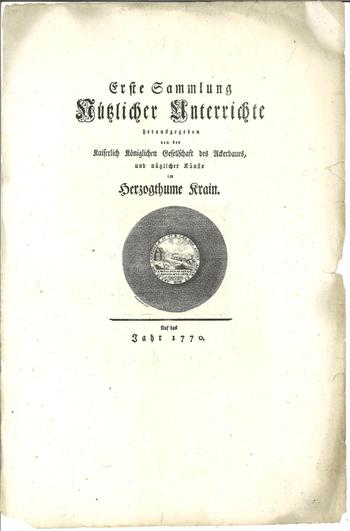
Four volumes of Sammlung nützlicher Unterrichte included relatively extensive treatises dealing with practical and theoretical issues. In these proceedings the Society also published the award-winning essays (Wettschrifften), which came in as a response to the prize questions announced by the Society's committee once a year. The first volume of proceedings was released in 1770 (see Figure 1), the second volume in 1771, the third in 1776, and the last one in 1779.Footnote 38
Cover page of Sammlung nützlicher Unterrichte, vol. 1 (1770) (Archives of the Republic of Slovenia, SI AS 533, KKD [Sammlung] Nützlicher Unterrichte).

In addition to the Sammlung, the Society also published, for a short period, Wöchentliches Kundschaftsblatt, a pragmatic weekly magazine intended to popularize its activities. The weekly, which was published between 1775 and 1776, brought economic and technical news from the monarchy and abroad.Footnote 39 In its first year, the articles concentrated mostly on practical matters like agricultural techniques, stock breeding, pest control, and market prices of agricultural products. In the second year, to attract more readers, the editors introduced new sections dealing with topics like political events, the weather, and accidents, and included advertisements of local traders and obituaries. Because the Wöchentliches Kundschaftsblatt was the first and only periodic publication in Carniola, advertising in it was a matter of prestige for the local elite of traders and manufacturers, who in this way aimed at increasing their reputation in the local environment. Among other interesting contributions, the weekly brought a German translation of the debate on the updated technology of constructing buildings, which was originally published in Paris in 1774.Footnote 40 There were articles on the agricultural soil science and notes about potential new ways of sugar production.Footnote 41 Also, the authors wrote about the newly introduced rhubarb, the “fire patent” (measures to prevent fire), a new type of saw, and other innovations.Footnote 42 But despite the efforts of the editors to include diverse and interesting topics, the weekly did not reach the wider audience as intended. One of the main reasons was certainly high illiteracy rate among the peasant population in Carniola. Additionally, the weekly was published in the official standard German language, which was not spoken or read by the majority of people in the countryside in Carniola.Footnote 43 Another reason was pride. The peasants believed that they had accumulated enough knowledge and skills through years of hard work and that they did not need advice. So even the peasants who understood German, most of them were based in Gottscheer-land south of Ljubljana, were reluctant to be given instructions about how to perform their work.Footnote 44 Although the final farewell letter of the editor pointed to several problems of the weekly, low circulation was probably the main reason that the Society stopped publishing it at the end of the second year.Footnote 45
Main Contributors to the Society's Publications and Their Innovative Ideas and Experiments
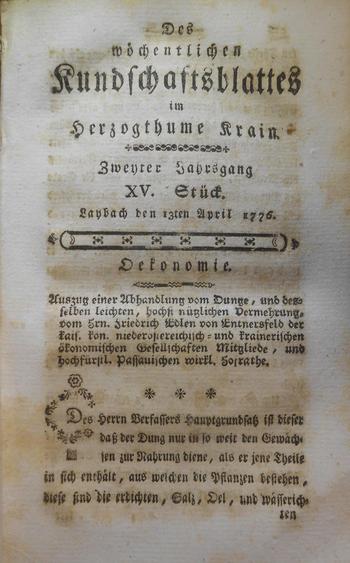
Most of the contributions to the Wöchentliches Kundschaftsblatt were unsigned. The editor may possibly have been Schöttl, Hacquet, or the printer Eger, who later served also as Ljubljana mayor (1782–85).Footnote 46 A frequent contributor to the Society's publications was Friedrich Franz Edler von Entnersfeld (1731–97), a member of farming societies in Graz, Ljubljana, Klagenfurt, Vienna, and St. Petersburg, and a counselor of the princely court in Passau. As a researcher, he was especially interested in the advantages of fertilization. In 1777, the Styrian Agricultural Society acknowledged his work on forestry with an award. Entnersfeld was a member of the Carniolan Society for Agriculture and Useful Arts from its beginning. In 1776, he wrote three articles in the Wöchentliches Kundschaftsblatt dealing with a new type of saw, manure (see Figure 2), and the rational use of seeds. Entnersfeld was also an enthusiastic inventor. Together with Gruber he designed a ship that could navigate against the current (Maschinenschiff), a prototype of which was tested on the River Mur in Graz.Footnote 47 He also designed and built a practical stove (called Maschine) to be used in private households. The invention was offered to the Styrian Agricultural Society in Graz with the pioneering use of a specially polished iron. The stove was one fathom (six feet) high and almost reached the ceiling. It was two feet broad and a foot-and-a-half long. Its temperature was measured using a mercury thermometer of Réaumur. There were three different models of the stove, and the value of the invention was appraised at about one hundred ducats.
Cover page of Wöchentliches Kundschaftsblatt, vol. 2, no. 15 (13 April 1776) containing the first part of the abbreviated version of Entnersfeld's treatise on manure (Library of the National Museum of Slovenia) (Photo: Courtesy of the National Museum of Slovenia).

Two other contributions to the weekly are worth mentioning. One is a report on Jean Jacques Paulet (1740–1826), who lectured at the universities of Montpellier and Paris, and his work on the cattle plague.Footnote 48 The report also contained a description by a local physician (Gerbec) of a disease, which had raged in Hungary in 1710 and broke out again in the rest of Europe in 1745. Among the other themes tackled in the magazine was also the practical use of solar energy to prevent the chemical heating of grain.Footnote 49 Another notable contribution is a report on Abbot Fontana's research into the circulation of fluids in plants.Footnote 50 In 1772 Felice Fontana (1730–1805), who was professor of logic and physics in Pisa and later in Florence, discovered gas adsorption on the hot wood charcoal, which was used to improve the vacuum. Marsilio Landriani (1751–1815) of the then Habsburg Brera in Milan described this achievement in a letter to Joseph Priestley, who successfully repeated Fontana's experiment in 1775. The Dutchman Jan Ingenhousz (1730–99) described the invention in 1782, but he doubted that Fontana's method could replace vacuum pumping.Footnote 51
The weekly also covered the American Revolution and reported about Benjamin Franklin's publications and his Poor Richard's Almanack.Footnote 52 The early promotion of Franklin's works in the Kundschaftsblatt reflects the broad international reach of the Carniolan Society's members. Again, the Jesuit connection probably played a decisive role. A leading Jesuit Rudjer Bošković (1711–87), who visited Ljubljana at least three times, was one of Franklin's best friends. The whereabouts of freemason Franklin were certainly extremely interesting to the leading freemasonic members of the Carniolan Society such as Joseph Brigido von Brezovica, Žiga Zois, Joseph Maffei de Glattfort (1742–1807)—a mathematician and Gabriel Gruber's assistant—and Tobias Gruber (1744–1806)—Gabriel's brother.
The weekly also described scientific experiments that measured the effects of wind.Footnote 53 The author was Giuseppe Toaldo (1719–97), a priest who was also a member of the Bologna Academy and a corresponding member of the Scientific Society in Montpellier. Toaldo held the chair of astronomy and meteorology at the University of Padua and was the first director of the observatory set up in 1761. He also wrote about meteorites and earthquakes. The weekly noted his success in academic competitions, which certainly affected Joseph Kalasanc, Baron Erberg (or his father), from Ljubljana who purchased Toaldo's book. Toaldo was interested in the theory of winds with its practical implications as well as the impact of rain and snow. He also presented Newton's and Franklin's opinions about plants’ dependence on air or light.Footnote 54
The 1776 edition of the Sammlung nützlicher Unterrichte featured Entnersfeld's treatise on the disease of fruit seeds. In the 1779 edition Entnersfeld published an interesting treatise on feeding livestock and barns, in which he referred to the court counsellor Franz Anton von Raab (1722–83), another foreign member of the Carniolan Society, who also widely published on Bohemian agriculture and economy.Footnote 55 Entnersfeld mentioned the use of a special Dutch salt for curing livestock and praised the works of the Russian general practitioner Johann Bernhard Fischer (1685–1772). In the already mentioned research on forestry, Entnersfeld praised the natural conditions in Styria. He referred to Count Buffon, Du Hamel, Réaumur, Cramer, and Beckmann, and discussed the efforts of von Lamberg and the Archbishop of Vienna Migazzi.Footnote 56
Another frequent contributor was Balthasar Hacquet, who held his own publications in the Sammlung in high esteem. On 1 October 1789, he mailed the fourth volume of the Sammlung, which contained his observations about an endemic horse disease, from Lvov to the Academy in St. Petersburg. He also enclosed the fourth part of his Oryctographia Carniolica, published in Leipzig in 1789. The son of the famous mathematician Leonhard Euler, Johann Albrecht Euler (1734–1800), who became the secretary of St. Petersburg Academy in 1769, read Hacquet's letter to St. Petersburg Academicians on 25 February 1790 and expressed his gratitude to Hacquet.Footnote 57
Prize Competition Questions and Theoretical Issues in the Award-Winning Essays
During its two decades of operation, the Carniolan Society, like other such societies in Europe, issued prize competition questions. The purpose of these questions was twofold: to bring suggestions about how to solve concrete practical problems (e.g., problems with the communal pastures, dispersed land plots of the peasants, soaring prices of corn and instability of its supply) and to confront various theoretical perspectives on these practical problems. The questions had to be confirmed by the court, which also provided funds for the award-winning essays. The court favored practically oriented questions. In 1772, it even prohibited theoretical questions and requested the Society to follow the example of the practical questions proposed by the agricultural societies in the Prussian states. However, the Carniolan Society did not agree with this, so from 1772 it issued two questions a year: a theoretical one, with an award financed from domestic resources, and a practical one, with an award financed by the court. Even when the questions were practical, the essays written by the participants were often theoretically oriented and based on scientific approaches.
In 1767 the Society posed the question of whether communal pastures were beneficial or harmful to the country. Franz Jamnik, manager of manor Rifnik near Celje, won the award, but the Society also praised the essay submitted by the Jesuit professor of physics Johann Pogrietschnig (1722–c. 1782) with the motto Labor omnia vincit. Both authors argued against communal pastures, although from somewhat different perspectives. The authors of the essays pointed out the poor condition of the communal pastures and attributed it to the fact that, while these pastures were extensively used, nobody really cared about their maintenance (e.g., manuring). Consequently, the situation was constantly deteriorating. They were obviously aware of the problem, which emerges when a limited resource is freely accessible and overused. In economic theory, this problem later came to be known as “the tragedy of the commons” and was a critical question all over Europe. The suggested solution in the winning essay focused on the issue of incentives and aimed at distributing communal land to individual farmers who, by proper cultivation, would improve its quality. As a result, more food for people and more raw materials for manufacturing would be produced and their prices would decrease.Footnote 58 The members of the Society's committee that judged the essays were Ignaz von Purg (1725–70), the temporary secretary of the Society; the physician Haymann, author of several treatises on fertilization; and Bruno Ortner (1722–1800), Bistra Convent's Procurator-Prelate.Footnote 59 The debate on the issue of communal pastures reappeared in Wöchentliches Kundschaftsblatt in 1776.Footnote 60 It is interesting that the majority of the participants in the debate favored the “liberalist” solution, based on the individual initiative of peasants and not the control or intervention by the state, as one would expect given the continued prevalence at that time of mercantilist thought.Footnote 61
Despite Maria Theresa's preference for practical issues, the Society launched another theoretical question in 1773, asking which sectors of the economy would be most conducive to improving the income of citizens and farmers in Carniola. In 1774 only one essay arrived, so the Society relaunched the same award question with a new submission deadline of the end of 1775. The committee, consisting of three ex-Jesuit members of the Society—Johann Giell, Joseph James Maffei de Glattfort, and Gregor Schöttl—gave the award to the professor of economics from Göttingen, Johann Beckmann (1739–1811), while special praise went to Karl von Zallheim (1746–87).Footnote 62 A great deal of ideas about potential additional earnings of Carniolan farmers came in, all focusing on crafts or trades that were easy to learn, none requiring expensive tools, and for which there were sufficient raw materials in the vicinity. The products should be robust (fine products should still be produced by specialized craftsmen in towns); the best material was supposedly wood, which was abundant in Carniola. The suggested trades were therefore transporting wood, making simple wooden products for everyday usage, or producing charcoal, as well as lime burning and making yarn from flax or hemp fibers.Footnote 63 The referees obviously had no qualms about child labor because the author of the winning essay advised parents that children between five and twelve years of age should work in domestic crafts while those older than twelve should help on the fields.Footnote 64
Highly dispersed land parcels cultivated by peasants were one of the major obstacles to higher productivity in Austrian agriculture, which was present also in Carniola. Therefore, the Society's prize question in 1768 (repeated in 1769) focused on this problem. The received essays proposed several ways of land concentration (through voluntary exchange of land parcels, rectification of land parcels, etc.). The author of the winning essay also suggested that feudal vassals should become local landlords and that judicial, police, and tax services should be organized within each local economic entity. The ensuing concentration of land would lead to higher productivity, and the peasants would also have more time to cultivate their own plots of land as well as for pursuing various forms of craftsmanship.Footnote 65
The physiocratic influence was also present in essays that answered the Society's question in 1772 about how to stabilize the supply of corn at reasonable prices. The prize winner was Swedish economist Johann Friedrich Kryger (1707–77). The question was what kind of pragmatic legislation would be needed in a country with good infrastructure (i.e., roads and navigable rivers) to prevent the perils of shortages and high prices of corn and to stimulate agriculture. Gallenberg, Blagay, Giell, and Hacquet—the members of the Society's prize committee—chose Kryger's essay, which argued for legislation that promoted free trade in corn. Special praise was also given to the essay of the Venetian botanist Francesco Grisellini (1717–87), who expressed similar ideas as Kryger.Footnote 66 In their essays, Kryger and Grisellini argued for the liberalization of corn trade, both within the state and internationally.Footnote 67 Kryger also strongly criticized the feudal system that limited the personal freedom of peasants, and Grisellini emphasized the importance of having good infrastructure (i.e., ports, roads, navigable rivers), which would help free trade and lead to proper prices of the means of subsistence.Footnote 68 This was also essentially the position of the French physiocrats.Footnote 69 We need to mention here that Grisellini's “proper price” of corn probably did not refer to the lowest price (covering just the costs of production), but rather—as in the writings of the physiocrats—to the price that would enable a long-term development of agriculture. The physiocrats envisioned a society of rich and progressive farmers. This can also be deduced from a slightly enigmatic Quesnay's saying that “[a]bundance and cheapness are not wealth, scarcity and dearness are misery, abundance and dearness are opulence.”Footnote 70 In the background is the physiocratic concept of bon prix, that is, a price that is formed through the process of competition and is profitable enough to stimulate farmers to reinvest their profits in machinery and improvement of technology that leads toward long-term growth of production.Footnote 71 It could be said that this concept was a distant precursor of the so-called reproductive price that emerged in economic theory in the twentieth century as a strategic price, where the profit margin is set with the aim of providing sufficient funds for constant investing in modernization of equipment and thus maintaining of long-term competitiveness.Footnote 72
In the last volume of the proceedings, Kryger published another economic treatise that had no physiocratic features, but is nevertheless worth mentioning for its theoretical merits.Footnote 73 This treatise dealt with the consequences of increasing the money stock. Here Kryger moved away from the orthodox mercantilist position that money stock automatically increases the wealth of the state and claims that there should be a balanced relationship between the money stock, population size, and aggregate production. Growth of money supply should be accompanied by population growth and (because of larger labor supply) also by an increase in production. If additional money stock ends only in consumption, this results in inflation that soon causes several other problems. It is important that additional money (coming into circulation either from new gold mines or through bank loans) is followed by rise of employment and growth of output. In this way, the stability of prices is maintained, which is one of the main preconditions for the country's prosperity. In some respects, Kryger's analysis resembled Cantillon's approach in Essai sur la Nature du Commerce en Général (Essay on the Nature of Trade in General) (1755), and it is possible that he knew this work. Cantillon believed that the effect of the rise of money supply depends on the recipients of the additional money: If the money comes into the hands of lavish consumers, the prices will rise; if it reaches those who tend to save, the loanable funds will increase and the interest rate will decrease, which will stimulate the investment and employment. Kryger's treatise is undoubtedly a theoretical masterpiece that can be compared with the works of late mercantilists or early classics such as William Petty (1623–87), John Locke, Richard Cantillon, and David Hume.
The practically oriented Wöchentliches Kundschaftsblatt, however, rarely tackled any theoretical issues. That being said, the last issue of the first volume offers a typical physiocratic statement that “land is the ultimate source of all our achievements” and that “the only way to increase the wealth of countries is to cultivate all land and all estates in the most efficient manner possible.”Footnote 74 In the same issue we learn that, to achieve this goal, an economic school had been established in Carniola to develop and disseminate theoretical and practical knowledge on efficient agriculture.Footnote 75 In the second year, there were some more articles with theoretical economic thoughts such as that “economics is a practical science about how to acquire property in an honest way and how to use it properly,” “the soul of economy is human diligence and clever handling with money,” “the goal of economics is happiness of individuals as well as of families and of the state as a whole,” and the welfare of state is built through the happiness of individuals.Footnote 76 This obvious shift of emphasis to the level of the individual shows that the idea of economic individualism promoted by English and French liberal economists was gradually entering also the Austrian economic thought.
Conclusion
The Carniolan Society for Agriculture and Useful Arts gathered almost all the established educated men and literati of Carniola at that time under one roof. These men had generally begun their study of agriculture, craftsmanship, and economy under the influence of the prevailing cameralist and physiocratic principles. The Society was aware of the importance of education, and many of its members actively participated in establishing technical, agricultural, and economic education in Ljubljana. The Society saw itself as an educational instrument in the economic and technical knowledge it disseminated through its two types of publications. Whereas the weekly Wöchentliches Kundschaftsblatt was intended to reach a broader, domestic, educated audience in Carniola or other parts of Inner Austria and was therefore practically oriented, the proceedings, Sammlung nützlicher Unterrichte, also dealt with theoretical issues and had some characteristics of an elite academic journal that dealt with agricultural questions not only in Carniola but also in Central and North European networks. Yearly announcements of prize questions were also meant to stimulate discussion in various fields and to contribute to the development of innovative ideas and critical reasoning, which reflected the prevailing currents in European economic and social thought of the time (i.e., the concept of natural order, rationalism, liberalism, individualism, entrepreneurship). The prize essays contained considerations about some advanced economic issues (e.g., the relation between money and production, strategic long-term price, problems of incentives and productivity) that could be compared with the achievements of the early English and French classics, and have remained relevant up to present times.
The international links of the Society were also enviable by European standards. The membership included many respected foreign scientists and thinkers, and the Society was closely linked through mutual members to similar groups in Udine, Milan, and Savoy. Several members of the Society were also members of similar societies in Inner Austria in Carinthia, Styria, or Gorizia. Cooperation between foreign experts and local scientists produced some interesting experiments and innovations. For the domestic population, the Society's publications served as an important source of information about technical, agricultural, and economic novelties in the world. On the other side, the Society's publications, especially its proceedings, were not known only in Carniola or in the Austrian monarchy but attained international recognition as well because contributions came from quite distant European countries. All this suggests that, although relatively short-lived, the Carniolan Society for Agriculture and Useful Arts played an important and progressive role within the broad framework of reform-oriented processes that were launched by the state administration in the second half of the eighteenth century with the intention to modernize the Habsburg monarchy and to improve its economic performance at all levels.