Introduction
Hearing loss is very common: in 2004–2005, approximately 13 per cent of Australians were affected by total or partial hearing loss.1 Among South Australians aged 15 years and older, 20.2 per cent have sensorineural hearing loss (SNHL), 0.4 per cent have conductive hearing loss and 1.6 per cent have mixed hearing loss.Reference Wilson, Walsh, Sanchez, Davis, Taylor and Tucker2 In 2003, adult-onset hearing loss was ranked as the eighth leading specific cause of burden of disease and injury, comprising 2.5 per cent of total disability-adjusted life-years.3
The most common type of SNHL is presbycusis or age-related hearing loss.4 Hence, as the Australian population ages it is likely that the number of people suffering from hearing loss will increase.3
Many pharmacological and medical therapies may be used to treat SNHL, including external listening devices such as hearing aids.Reference Kim and Barrs5 While hearing aids may provide adequate amplification for many patients, it is estimated that only one out of every five people who could benefit from a hearing aid actually uses such a device.6 Use may be discontinued due to discomfort, perceived social stigma or the requirements of regular maintenance.Reference Backous and Duke7–Reference Counter9 Conventional hearing aids generally occlude the ear canal, which may exacerbate conditions such as otitis media and otitis externa. Additionally, patients with high-frequency hearing loss may find that a hearing aid does not perform well in the presence of background noise; and some patients may be unable to use conventional hearing aids due to absence or malformation of the external ear.Reference Chang8, Reference Counter9
Hearing loss may lead to many adverse outcomes in both adults and children. It can hinder interpersonal communication which may lead to social isolation, reduced quality of life, and stress for family and friends.Reference Moeller10 Affected adults may be unable to work productively, while affected children may have language and developmental difficulties. Furthermore, hearing loss has a lifelong impact on educational and employment opportunities.Reference Chang8, Reference Moeller10–Reference Coates, Morris, Leach and Couzos12
The active middle-ear implant is a device that aims to correct hearing loss by stimulating the middle ear. The basic components include a microphone, audio processor, battery, receptor and vibration transducer which attaches to the ossicular chain.Reference Manrique, Valdivieso, Ruba, Gimeno-Vilar, Montes-Jovellar and Manrique13 The transducer produces vibrational energy that vibrates the ossicular chain.Reference Kulkarni and Hartley14 Active middle-ear implants are surgically implanted into the middle ear and generally do not obstruct the external ear canal, which is particularly relevant for patients with chronic otitis externa and media. Middle-ear implants may improve or remove many of the problems associated with hearing aid use, and fully implantable middle-ear implants also allow patients to swim and wash while wearing the device.Reference Backous and Duke7
However, middle-ear implants have several safety issues. Implantation involves a surgical procedure, which usually requires general anaesthesia, while device failure requires further surgery. Implantation may lead to damage of the chorda tympani or facial nerve, or to the decline of cochlear function due to the drilling and suctioning noises generated during implantation.Reference Snik and Cremers15 The procedure poses a risk to the ossicular chain, particularly when it involves middle-ear implant types that require disarticulation and reconnection of the chain during implantation. Mass loading of the ossicular chain may lead to residual hearing loss, the extent of which is directly related to the weight of the middle-ear implant and its location within the middle ear.Reference Hough, Dyer, Matthews and Wood16, Reference Vincent, Fraysse, Lavieille, Truy, Sterkers and Vaneecloo17 Finally, in addition to the above, implantation-related issues, some types of middle-ear implant may require restriction of the use of magnetic resonance imaging, electroconvulsive therapy or radiotherapy to the head.Reference Manrique, Valdivieso, Ruba, Gimeno-Vilar, Montes-Jovellar and Manrique13
It is evident that the potential safety issues associated with middle-ear implants are more severe than those associated with external hearing aids. Hence, a clinician considering implantation of a middle-ear implant must be convinced of the device's improved effectiveness compared with that of an external hearing aid.
This systematic review aims to inform readers of the effectiveness of active middle-ear implants compared with external hearing aids.
Methods and materials
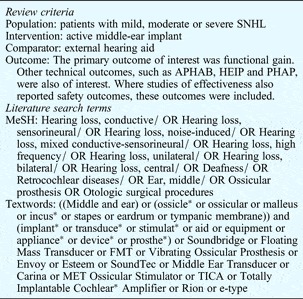
Prior to searching the literature, we specified our review criteria as regards the specific population, intervention, comparator and outcome of interest, and then used these criteria to establish our search terms (Table I). Searches were conducted using the PubMed, Embase Cochrane Library and Current Contents databases, in order to identify relevant studies and reviews for the period between database inception and March 2012.
Review criteria and literature search terms

SNHL = sensorineural hearing loss; APHAB = Abbreviated Profile of Hearing Aid Benefit; HEIP = Hough Ear Institute Profile; PHAP = Profile of Hearing Aid Performance; FMT = floating mass transducer; MET = middle-ear transducer
Only comparative studies were eligible for inclusion. Initial eligibility on the basis of study citation was conservatively determined by one reviewer (if unclear from the abstract, the full text paper was obtained). One reviewer then assessed each of the retrieved full text articles for eligibility, while another assessed papers of doubtful eligibility. When consensus could not be reached, a third reviewer independently assessed the paper in question and the majority decision prevailed. The bibliographies of all included studies were hand-searched for any relevant references which may have been missed by the literature search. Data were extracted by one researcher and checked by a second using standardised data extraction tables developed a priori. Data were only extracted and reported if stated in the text or tables of the study, or if they could be accurately extrapolated from the information presented.
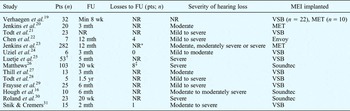
The evidence presented in the selected studies was assessed and classified according to the evidence level hierarchy defined by the National Health and Medical Research Council.18 A total of 14 comparative studies were identified and included in this systematic review (Table II). The studies employed a variety of active middle-ear implant devices, including the Envoy Esteem (Envoy Medical Corporation, St Paul, Minnesota, USA), Otologics Middle Ear Transducer (Otologics, LLC, Boulder, Colorado, USA), Soundtec Direct Drive Hearing System (Soundtec, Oklahoma City, Oklahoma, USA) and Vibrant Soundbridge (Med-El, Innsbruck, Austria).
Studies included

*Speech scores were reported only for US patients; various patient numbers were reported throughout results with no details provided (e.g. 178, 214, 160). †50 of these 53 were fitted with a D audio processor. ‡Eight patients had not completed testing at the time of writing. FU = follow up; pts = patients; MEI = middle-ear implant; Min = minimum; wk = weeks; NR = not reported; VSB = Vibrant Soundbridge; MET = Otologics Middle Ear Transducer; mth = months; yr = years
The studies were critically appraised using criteria based on the CONSORT statement.Reference Altman, Schulz, Moher, Egger, Davidoff and Elbourne32 While all studies provided inclusion criteria, four studies failed to provide exclusion criteria.Reference Uziel, Mondain, Hagen, Dejean and Doucet24, Reference Thill, Gerard, Garin and Offeciers27, Reference Todt, Seidl, Gross and Ernst28, Reference Roland, Shoup, Shea, Richey and Jones30 Inclusion criteria generally included symmetrical SNHL and chronic, therapy-resistant external otitis. Patients were generally excluded if they suffered from any physical, psychological or emotional disorder that would interfere with surgery or with their ability to perform test or rehabilitation procedures, or if they had diseases of the external ear canal, middle ear or temporal bone. One study reported retrospective data collection; the remaining studies did not report the method of data collection.Reference Verhaegen, Mylanus, Cremers and Snik19 Five studies enrolled patients consecutively, while the remaining studies did not report their enrolment method.Reference Hough, Dyer, Matthews and Wood16, Reference Uziel, Mondain, Hagen, Dejean and Doucet24–Reference Matthews26, Reference Fraysse, Lavieille, Schmerber, Enee, Truy and Vincent29 Sample sizes ranged from 5 to 282 patients, although approximately half of the studies recruited fewer than 20 patients each.Reference Hough, Dyer, Matthews and Wood16, Reference Chen, Backous, Arriaga, Garvin, Kobylek and Littman22, Reference Uziel, Mondain, Hagen, Dejean and Doucet24, Reference Thill, Gerard, Garin and Offeciers27, Reference Todt, Seidl, Gross and Ernst28, Reference Snik and Cremers31 Thirteen studies reported on the length of patient follow up; in these studies, follow up ranged from 2 months to 1.5 years.Reference Todt, Seidl, Gross and Ernst28, Reference Snik and Cremers31 Four studies reported losses to follow up and detailed reasons for these losses.Reference Chen, Backous, Arriaga, Garvin, Kobylek and Littman22, Reference Uziel, Mondain, Hagen, Dejean and Doucet24, Reference Matthews26, Reference Snik and Cremers31
Interventions were generally well described, with most of the studies detailing both the implantation procedure and the implant utilised. However, studies generally lacked detail with regard to the technical settings of the implant, with only two studies reporting such details.Reference Luetje, Brackman, Balkany, Maw, Baker and Kelsall25, Reference Snik and Cremers31
Most studies provided objective measurements of success in terms of functional gain and/or speech recognition. Some included subjective measures of success such as the Abbreviated Profile of Hearing Aid Benefit inventory and various quality of life scales (either validated or non-validated). Adverse events, if present, were generally adequately described.
Eight studies provided p values when reporting statistical differences between treatment groups.Reference Jenkins, Atkins, Horlbeck, Hoffer, Balough and Arigo20, Reference Todt, Seidl and Ernst21, Reference Jenkins, Niparko, Slattery, Neely and Fredrickson23–Reference Luetje, Brackman, Balkany, Maw, Baker and Kelsall25, Reference Todt, Seidl, Gross and Ernst28, Reference Fraysse, Lavieille, Schmerber, Enee, Truy and Vincent29, Reference Snik and Cremers31 Several studies appeared to have been supported in some manner by middle-ear implant device manufacturers.Reference Hough, Dyer, Matthews and Wood16, Reference Jenkins, Atkins, Horlbeck, Hoffer, Balough and Arigo20, Reference Chen, Backous, Arriaga, Garvin, Kobylek and Littman22, Reference Matthews26, Reference Thill, Gerard, Garin and Offeciers27, Reference Fraysse, Lavieille, Schmerber, Enee, Truy and Vincent29, Reference Snik and Cremers31
Results and analysis
Fourteen comparative studies reported on the effectiveness of active middle-ear implants versus external hearing aids. Only four of these studies clearly stated that they used an optimal, best-fit or ‘state of the art' hearing aid. A variety of effectiveness outcome measures were reported, including functional gain, Abbreviated Profile of Hearing Aid Benefit inventory, Hough Ear Institute Profile, Profile of Hearing Aid Performance, speech discrimination, Hearing in Noise Test, and Speech Perception in Noise.
Functional gain
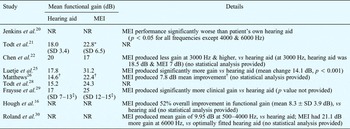
Nine studies reported on the mean functional gain provided by the middle-ear implant compared with that of an external hearing aid.Reference Hough, Dyer, Matthews and Wood16, Reference Jenkins, Atkins, Horlbeck, Hoffer, Balough and Arigo20–Reference Chen, Backous, Arriaga, Garvin, Kobylek and Littman22, Reference Luetje, Brackman, Balkany, Maw, Baker and Kelsall25, Reference Matthews26, Reference Todt, Seidl, Gross and Ernst28–Reference Roland, Shoup, Shea, Richey and Jones30 Where reported, the D processor was generally used. One study also compared the functional gain provided by two different digital audio processors (D and Signia) with that provided by a hearing aid.Reference Todt, Seidl and Ernst21 The gain provided by the D processor at 0.5, 1, 2 and 4 kHz was 22.8 dB (standard deviation (SD), 6.5 dB) and the gain provided by the Signia processor was 29.8 dB (SD, 2.9 dB). The differences between the processors were not statistically significant; therefore, in Table III, the mean functional gain for middle-ear implant patients corresponds to that provided by the D processor.
Mean functional gain in sensorineural hearing loss patients: hearing aid and active middle-ear implant results

*D-type audio processor. †Estimated from figure. ‡Result as originally presented. MEI = middle-ear implant; NR = not reported; SD = standard deviation
One study commented that the lower functional gains noted for hearing aids may have been due to patients' inability to comfortably tolerate higher gain settings, due to the feedback and distortion that may occur when amplification is increased.Reference Hough, Dyer, Matthews and Wood16
Two studies also assessed functional gain at individual frequencies.Reference Hough, Dyer, Matthews and Wood16, Reference Fraysse, Lavieille, Schmerber, Enee, Truy and Vincent29 In the first study, the middle-ear implants with a D processor provided significantly greater gain for seven of the nine measured frequencies (excluding 250 and 4000 Hz; no statistical analysis provided), compared with hearing aids.Reference Fraysse, Lavieille, Schmerber, Enee, Truy and Vincent29 The maximum gain provided by the middle-ear implant at each frequency was reported to be 20–25 dB better at 500–2000 Hz and at 8000 Hz (no statistical analysis provided), compared with a hearing aid. Maximum gains at 3000–6000 Hz varied by 5 to 15 dB in favour of the middle-ear implant (no statistical analysis provided). The second study assessed the functional gain of middle-ear implants versus hearing aids at 2000, 3000 and 4000 Hz.Reference Hough, Dyer, Matthews and Wood16 The functional gain provided by the middle-ear implant at these frequencies was on average 42 per cent higher than that obtained with an optimally fitting hearing aid (mean ± SD, 9.6 dB ± 7.4 dB; no statistical analysis provided).
Overall, nine studies reported patients' mean functional gain after middle-ear implant implantation compared with a hearing aid. One study found that middle-ear implants were significantly superior to hearing aids (p < 0.001), while another study found that hearing aids were generally significantly superior to middle-ear implants (p < 0.05). Six of the remaining seven studies found that middle-ear implants were better than hearing aids, although no clinically significant difference (i.e. ≥10 dB) was generally seen.
Abbreviated Profile of Hearing Aid Benefit
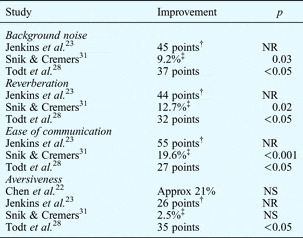
Four studies reported results for the Abbreviated Profile of Hearing Aid Benefit inventory subscales, comparing middle-ear implants versus hearing aids (Table IV).Reference Chen, Backous, Arriaga, Garvin, Kobylek and Littman22, Reference Jenkins, Niparko, Slattery, Neely and Fredrickson23, Reference Todt, Seidl, Gross and Ernst28, Reference Snik and Cremers31 Two studies did not clearly state whether or not comparisons were made to a hearing aid, although this appeared to have been the case.Reference Jenkins, Niparko, Slattery, Neely and Fredrickson23, Reference Snik and Cremers31 One additional study provided an average measure across the ease of communication, background noise and reverberation subscales, and reported that the middle-ear implant provided a statistically significant mean score improvement of 7.2 points, compared with a hearing aid (no p value provided).Reference Matthews26
Aphab improvement in sensorineural hearing loss patients after active middle-ear device implantation*

* Compared with hearing aid assisted results. †Study did not clearly state whether score represented the improvement compared with the hearing aid assisted result, or merely the score achieved with the middle-ear implant. ‡Study did not clearly state whether baseline was with or without a hearing aid. APHAB = Abbreviated Profile of Hearing Aid Benefit inventory; NR = not reported; NS = not significant; Approx = approximately
Six studies reported narrative effectiveness outcomes for middle-ear implants compared with hearing aids, using the Abbreviated Profile of Hearing Aid Benefit inventory.Reference Jenkins, Atkins, Horlbeck, Hoffer, Balough and Arigo20, Reference Chen, Backous, Arriaga, Garvin, Kobylek and Littman22–Reference Uziel, Mondain, Hagen, Dejean and Doucet24, Reference Thill, Gerard, Garin and Offeciers27, Reference Roland, Shoup, Shea, Richey and Jones30 Generally, middle-ear implants were preferred over hearing aids.Reference Jenkins, Atkins, Horlbeck, Hoffer, Balough and Arigo20, Reference Chen, Backous, Arriaga, Garvin, Kobylek and Littman22–Reference Uziel, Mondain, Hagen, Dejean and Doucet24, Reference Thill, Gerard, Garin and Offeciers27 One study found that patients reported significantly fewer speech comprehension difficulties with the middle-ear implant compared with their pre-operative hearing aid (no statistical analysis provided).Reference Thill, Gerard, Garin and Offeciers27 In another study, patients with severe hearing loss reported greater benefit (p < 0.001) on the ease of communication, reverberation and background noise subscales when using middle-ear implants compared with hearing aids, but also experienced more aversiveness to sounds.Reference Jenkins, Niparko, Slattery, Neely and Fredrickson23 A further study found no significant difference between middle-ear implants and hearing aids regarding the ease of communication, reverberation and background noise subscales.Reference Roland, Shoup, Shea, Richey and Jones30
Overall, most of the studies reported that use of the middle-ear implant resulted in improved Abbreviated Profile of Hearing Aid Benefit inventory outcomes, compared with use of hearing aids. This improvement was statistically significant in three studies.Reference Matthews26, Reference Todt, Seidl, Gross and Ernst28, Reference Snik and Cremers31
Hough Ear Institute Profile
Three studies reported effectiveness outcomes using the Hough Ear Institute Profile.Reference Hough, Dyer, Matthews and Wood16, Reference Matthews26, Reference Roland, Shoup, Shea, Richey and Jones30 All patients had either moderate or severe SNHL.
The first study (n = 10) reported that feedback was eliminated, the occlusive effect was reduced (no data provided) and the sound quality was increased by 27.3 per cent (±26.5 SD) when using the middle-ear implant (no statistical analysis provided).Reference Hough, Dyer, Matthews and Wood16 It was unclear whether these improvements were compared with unaided hearing or with hearing aid assisted hearing. Patients' overall subjective satisfaction improved 16.7 per cent with a middle-ear implant, compared with hearing aid assisted hearing (no statistical analysis provided).
The second study (n = 103, of which 94 patients responded) reported that the middle-ear implant was rated by 99 per cent of patients as having the least amount of feedback (no statistical analysis provided).Reference Matthews26 It was unclear whether this outcome was measured in comparison with unaided hearing or hearing aid assisted hearing. In terms of sound quality, 89 per cent of patients preferred their middle-ear implant over their hearing aid (no statistical analysis provided). Occlusion was reported by 54 per cent of patients with hearing aids and by 23 per cent of patients with middle-ear implants (no statistical analysis provided). Of the 94 responding patients, 89 per cent preferred the middle-ear implant (presumably to their hearing aid) in terms of overall satisfaction.
The third study (n = 23) found that, although average daily use of middle-ear implants or hearing aids did not vary for most patients, middle-ear implants provided better sound fidelity and less feedback compared with hearing aids (no data or statistical analysis provided).Reference Roland, Shoup, Shea, Richey and Jones30 Sixteen patients reported feedback with their hearing aid, and 14 of these patients noted that feedback was completely alleviated with their middle-ear implant. Twelve patients reported occlusion with their hearing aid, and nine of these patients noted that occlusion was absent with their middle-ear implant. Overall satisfaction was approximately 32.6 per cent higher with middle-ear implants than with optimally fitted hearing aids (no statistical analysis provided). A total of 95.6 per cent of patients expressed an overall preference for the middle-ear implant over an optimally fitted hearing aid (no statistical analysis provided).
Overall, three studies, reporting on a total of 127 patients, found that patient satisfaction was generally higher with the middle-ear implant than with the hearing aid, although no statistical analyses were performed.Reference Hough, Dyer, Matthews and Wood16, Reference Matthews26, Reference Roland, Shoup, Shea, Richey and Jones30
Profile of Hearing Aid Performance
One study reported effectiveness outcomes using the Profile of Hearing Aid Performance inventory.Reference Luetje, Brackman, Balkany, Maw, Baker and Kelsall25 A significantly greater number of patients reported improvement when the middle-ear implant was used, compared with pre-operative use of their hearing aid, in all seven subscales of the Profile of Hearing Aid Performance inventory (p = 0.001).
Speech discrimination
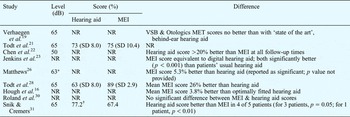
Overall, nine studies reported patients' speech discrimination in quiet conditions (Table V). Three studies reported that middle-ear implants were better than hearing aids, with improvements ranging from 5.3 to 26 per cent.Reference Hough, Dyer, Matthews and Wood16, Reference Matthews26, Reference Todt, Seidl, Gross and Ernst28 Two studies reported that hearing aids were better than middle-ear implants, and reported significant improvements in four patients (p = 0.05 for three patients; p < 0.01 for one patient).Reference Chen, Backous, Arriaga, Garvin, Kobylek and Littman22, Reference Snik and Cremers31 The remaining studies did not report any significant differences between middle-ear implants and hearing aids.Reference Verhaegen, Mylanus, Cremers and Snik19, Reference Todt, Seidl and Ernst21, Reference Jenkins, Niparko, Slattery, Neely and Fredrickson23, Reference Roland, Shoup, Shea, Richey and Jones30 One study recommended that, for patients with SNHL without external otitis (thus allowing the use of a hearing aid), a hearing aid should be the first choice up to SNHL of 95 dB HL.Reference Verhaegen, Mylanus, Cremers and Snik19
Speech discrimination in quiet in sensorineural hearing loss patients: hearing aid and active middle-ear implant results

*Decibels sound pressure level. †Calculated from data provided. Level = presentation level; MEI = middle-ear implant; NR = not reported; VSB = Vibrant Soundbridge; MET = Middle-Ear Transducer
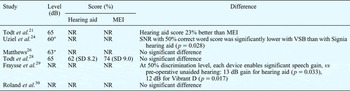
Six studies reported outcomes for speech discrimination in noise (Table VI).Reference Todt, Seidl and Ernst21, Reference Uziel, Mondain, Hagen, Dejean and Doucet24, Reference Matthews26, Reference Todt, Seidl, Gross and Ernst28–Reference Roland, Shoup, Shea, Richey and Jones30 One study found that, overall, 50 per cent speech comprehension was achieved at significantly lower (i.e. more difficult) signal to noise ratios with middle-ear implants than with hearing aids (p = 0.028).Reference Uziel, Mondain, Hagen, Dejean and Doucet24 The remaining studies generally found that there was no significant difference between middle-ear implants and hearing aids.Reference Todt, Seidl and Ernst21, Reference Matthews26, Reference Todt, Seidl, Gross and Ernst28–Reference Roland, Shoup, Shea, Richey and Jones30
Speech discrimination in noise scores in sensorineural hearing loss patients: hearing aid and active middle-ear implant results

*Decibels sound pressure level. Level = presentation level; MEI = middle-ear implant; NR = not reported; SNR = signal to noise ratio; VSB = Vibrant Soundbridge
Hearing in Noise Test
One study used the Hearing in Noise Test for patient assessment, but only one patient was assessed.Reference Chen, Backous, Arriaga, Garvin, Kobylek and Littman22 When using a middle-ear implant, this patient's ability to understand speech was improved by 88 per cent in quiet conditions and by 62 per cent in noise, compared with a hearing aid (no statistical analysis provided).
Speech Perception in Noise
Two studies reported outcomes using the Speech Perception in Noise test.Reference Hough, Dyer, Matthews and Wood16, Reference Luetje, Brackman, Balkany, Maw, Baker and Kelsall25
In one study, sentences were presented using a +8 signal to noise ratio, to 10 patients.Reference Hough, Dyer, Matthews and Wood16 An average 17 per cent improvement in low predictability sentence scores (i.e. 1.3 words correct with ±3.3 SD) was reported with a middle-ear implant, compared with an optimally fitted hearing aid (no statistical analysis provided).Reference Hough, Dyer, Matthews and Wood16
The second study employed the Revised Speech Perception in Noise test in 50 patients who received a middle-ear implant with a D audio processor.Reference Luetje, Brackman, Balkany, Maw, Baker and Kelsall25 After device implantation, patients demonstrated a mean 6 per cent increase in aided speech intelligibility in the presence of background noise. The mean change in low predictability word scores was not significant, comparing middle-ear implant versus hearing aid results (p = 0.11). After device implantation, 12 patients (24 per cent) showed significant improvement in low predictability word scores, 31 (62 per cent) showed no significant change and 7 (14 per cent) showed deterioration, compared with hearing aid assisted hearing (no statistical analyses provided). As a group, the patients' mean low predictability word score improved four-fold, comparing middle-ear implants versus hearing aids (no statistical analysis provided).
Overall, neither of the two studies that evaluated patients using the Speech Perception in Noise test reported a significant improvement after middle-ear device implantation, compared with hearing aid assisted hearing.Reference Hough, Dyer, Matthews and Wood16, Reference Luetje, Brackman, Balkany, Maw, Baker and Kelsall25
Safety outcomes
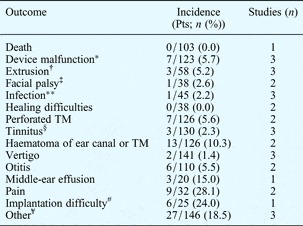
Two studies, with a total of 38 patients, did not report on safety outcomes following middle-ear device implantation.Reference Verhaegen, Mylanus, Cremers and Snik19, Reference Uziel, Mondain, Hagen, Dejean and Doucet24 A further two studies, with a total of 28 patients, reported that there were no complications.Reference Todt, Seidl and Ernst21, Reference Todt, Seidl, Gross and Ernst28 The safety outcomes reported in the 10 remaining studies are presented in Table VII.Reference Hough, Dyer, Matthews and Wood16, Reference Jenkins, Atkins, Horlbeck, Hoffer, Balough and Arigo20, Reference Chen, Backous, Arriaga, Garvin, Kobylek and Littman22, Reference Jenkins, Niparko, Slattery, Neely and Fredrickson23, Reference Luetje, Brackman, Balkany, Maw, Baker and Kelsall25–Reference Thill, Gerard, Garin and Offeciers27, Reference Fraysse, Lavieille, Schmerber, Enee, Truy and Vincent29–Reference Snik and Cremers31
Safety outcomes after active middle-ear device implantation

*No benefit (n = 4); intermittent device ‘cut out’ (n = 1); breakdown of connecting lead between floating mass transducer and receiver unit (n = 2; devices were explanted and reimplanted with good results, and the problem subsequently solved by the manufacturer). †In all cases, microphone and wire leads extruded; all were revised with soft tissue coverage and healed without difficulty. ‡Secondary, incomplete facial palsy which disappeared six weeks after onset. **Device-related wound infection (medication unsuccessful, surgical debridement performed, device explanted). §Led to device explantation (n = 1); encountered after implantation and rectified before device activation (n = 1). #Mainly involving fixation of floating mass transducer on long process of incus. ¥Including development of perisynaptic defect (middle-ear implant subsequently explanted and a cochlear implant implanted; n = 1); explantation due to acute psychiatric problems (n = 1); fullness or pressure sensation (n = 2); light-headedness (n = 1); ear canal abrasion (n = 3); nausea and/or vomiting (n = 1); taste disturbance (n = 3); electromagnetic interference (n = 15). Studies = studies reporting outcome; TM = tympanic membrane
In addition to the adverse events reported in Table VII, middle-ear device implantation may cause a decline in residual hearing, due either to the noise generated during surgery or to mass loading of the ossicular chain.Reference Snik and Cremers15 Additionally, manipulation of the ossicular chain may introduce conductive hearing loss. Most included studies reported on residual hearing loss, and considered a mean threshold change of greater than 5 dB across all frequencies to be clinically significant. Nine studies reported that no significant decline in mean residual hearing occurred after middle-ear device implantation.Reference Hough, Dyer, Matthews and Wood16, Reference Todt, Seidl and Ernst21, Reference Jenkins, Niparko, Slattery, Neely and Fredrickson23, Reference Luetje, Brackman, Balkany, Maw, Baker and Kelsall25–Reference Roland, Shoup, Shea, Richey and Jones30 However, six studies reported that individual patients suffered a decline in mean residual hearing after middle-ear device implantation (Table VIII).Reference Jenkins, Atkins, Horlbeck, Hoffer, Balough and Arigo20, Reference Todt, Seidl and Ernst21, Reference Luetje, Brackman, Balkany, Maw, Baker and Kelsall25, Reference Todt, Seidl, Gross and Ernst28, Reference Fraysse, Lavieille, Schmerber, Enee, Truy and Vincent29, Reference Snik and Cremers31
Decline in residual hearing following implantation of active middle-ear implants

HL = hearing loss; yr = years; MEI = middle-ear implant
One study reported on stapedius reflex thresholds and found that, in patients with recordable pre-operative acoustic reflexes, there were no absent reflexes at the same frequencies at three months post-activation.Reference Luetje, Brackman, Balkany, Maw, Baker and Kelsall25 This study also found that 1.9 per cent of patients (1 of 53) had an irregular tympanogram; however, this was attributed not to the surgical procedure but to an upper respiratory tract infection. Another study recommended the routine use of a facial nerve monitor to help prevent facial nerve damage.Reference Fraysse, Lavieille, Schmerber, Enee, Truy and Vincent29
Discussion
While there have been significant improvements in hearing aid technology in recent years, the majority of people who would benefit from the use of such devices do not use them.Reference Haynes, Young, Wanna and Glasscock33, Reference Sprinzl and Riechelmann34 In addition, of those individuals who are fitted with a hearing aid, many either stop wearing the device or use it infrequently, while others persist with their hearing aids despite receiving only limited benefit.Reference Sprinzl and Riechelmann34, Reference Kochkin35 The active middle-ear implant provides a viable treatment alternative for SNHL patients who either do not benefit from conventional hearing aids or choose not to wear one. Therefore, the aim of this systematic review was to assess the effectiveness of the active middle-ear implant compared with external hearing aids, in patients with SNHL.
Fourteen comparative studies were included in this review. These studies assessed a variety of middle-ear implant devices. Most studies assessed the Vibrant Soundbridge; however, the Otologics Middle Ear Transducer, Envoy Esteem and Soundtec devices were also assessed. Thus, there were differences between the components and attachments used, comparing these four middle-ear implant devices. Additionally, the included studies displayed considerable variability regarding patient enrolment, study design and length of follow up.
None of the included studies represented level II evidence (i.e. a randomised, controlled trial), according to the National Health and Medical Research Council categorisation system.18 The lack of high level evidence is probably related to the relative newness of the middle-ear implant procedure, and also to ethical issues regarding randomising patients to receive different types of surgical implantation.
The reporting of effectiveness outcomes was compromised by the lack of uniform outcome measurements. While the primary technical outcome measure (functional gain) was identified a priori, not all studies reported this outcome. Effectiveness outcomes were further compromised by the fact that some studies reported baseline measurements for a digital, best fit or state of the art hearing aid, while others used the patient's own hearing aid. Furthermore, some studies did not clearly state whether baseline measures were taken with or without a hearing aid in place. It appears that there is currently considerable variability in hearing aid management prior to consideration for middle-ear device implantation.
Overall, the evidence for the effectiveness of middle-ear implants compared with hearing aids comprises varied outcomes. Nine studies reported on the primary outcome of functional gain: one found that middle-ear implants were significantly better than hearing aids, while another reported that hearing aids were generally significantly better than middle-ear implants. Six studies found that middle-ear implants were better than hearing aids, although generally no clinically significant difference (i.e. ≥10 dB) was seen. Therefore, middle-ear implants appear to be at least as effective as hearing aids in providing improved hearing outcomes in patients with SNHL.
Implantation of active middle-ear devices requires a surgical procedure; therefore, the potential safety issues associated with middle-ear implant use are more serious compared with those associated with external hearing aids. In the studies included in this review, the most commonly reported adverse events following middle-ear device implantation included middle-ear effusion, haematoma of the ear canal or tympanic membrane, and pain. Across the three studies that reported it, device malfunction occurred in 5.7 per cent of patients.
In Australia at present, clinical expert opinion suggests that there is probably a sizeable unaddressed pool of patients who may be eligible to receive the active middle-ear implant. This untreated pool of patients may exist for several reasons, including patient comorbidity, inequity of service distribution, cost, cultural factors and waiting lists. It is likely that eligible patients who have not yet received an implantable device suffer persistent hearing loss or make do with a poorly functioning external hearing aid. The availability of the active middle-ear implant within the Australian public health system would provide this patient population with a potential treatment option.
Conclusion
The active middle-ear implant is a treatment alternative for patients with SNHL who do not benefit from, or who choose not to wear, conventional hearing aids.
This systematic review assessed evidence for the effectiveness of the active middle-ear implant, compared with external hearing aids, for patients with SNHL. Fourteen comparative studies were identified for inclusion, employing a variety of middle-ear implant devices, including the Envoy Esteem, Otologics Middle Ear Transducer, Soundtec Direct Drive Hearing System and Vibrant Soundbridge.
Of the nine studies that reported the primary outcome of functional gain, one found middle-ear implants significantly better than hearing aids, another found hearing aids significantly better than middle-ear implants, and six of the seven remaining studies found no clinically significant difference (i.e. ≥10 dB) between the two devices.
Commonly reported adverse events following device implantation included middle-ear effusion, haematoma of the ear canal or tympanic membrane, and pain. In the three studies reporting adverse events, device malfunction occurred in 5.7 per cent of patients.
The evidence compiled in this review suggests that the active middle-ear implant is as effective as the external hearing aid in improving hearing outcomes in patients with SNHL.
Acknowledgements
This assessment was conducted on behalf of, and funded by, the Medical Services Advisory Committee of the Australian Government Department of Health and Ageing. The authors would like to thank members of the Medical Services Advisory Committee Advisory Panel (Dr Shiong Tan, Associate Professor Kirsty Douglas, Associate Professor Melville Da Cruz, Dr John Malouf, Associate Professor Christopher Perry, Mr Jason Ridgway and Ms Alexandra Rivers) for their assistance in this assessment. The authors would also like to thank Ms Vicki Xafis for her assistance with finalisation and submission of the manuscript.