D'Alema, di’ una cosa di sinistra.
Di' una cosa, anche non di sinistra, di civiltà.
… Di’ qualcosa. Reagisci.
Aprile, 1998 Dir. Nanni Moretti
Introduction: ‘mismatched shards of China’
In its last post (9 July 2012), the founders of the short-lived but highly productive Italian blog ‘Cineresie: new perspectives on contemporary China’ reflected on their failed attempt at bridging the gaps between academia and journalism in the flexible, inclusive, independent format of an Italian-language blog. In their farewell, the bloggers declared temporary defeat but reiterated their ongoing commitment to provide alternative perspectives on China. ‘Unfortunately, we have not been able to transmit the desire to experiment and create a dialogue off the grid, between academics and journalism … but we continue to believe in the need to open up a debate about China in our country too, incorporating different experiences and professions, without clichés, stereotypes, and avoiding the practice of copying and pasting from English-language websites’Footnote 1 (my emphasis).
Four years later (2016), the blog revived as ‘Chinoiresie: mismatched shards of China’, relocating – but, I argue, not erasing – the Italian experience in a transnational collaborative project. While reference to Italian language and/or Italian context has effectively disappeared, the new website has a clear line of continuity with the original ‘Cineresie’, as also indicated in the preservation of its name, albeit returned to its more internationally recognisable French form. As explained on the blog's homepage, the neologism ‘blends the image of “chinoiserie” – a foreign interpretation and imitation of Chinese artistic traditions, a term that over time has come to assume the meaning of a cliché, a stereotypical view of China – with the concept of “heresy” – an unorthodox view aimed at challenging a given truth (“Chinoiresie”)’. The declared goal is to ‘offer our readers those “mismatched shards of China” that we have collected through our personal engagement with this country’ (my emphasis) and ‘lay bare the challenging processes involved in constructing knowledge about China, with the awareness that (T)truth [sic] will remain a mere chimera’. Chinoiresie retains a blogging section – i.e., its collection of essays (zawen) – and additionally hosts the Little Red Podcast. In this richer – both financially and editorially – English-language platform with an expanded transnational group of contributors, the project was relaunched, with the support of the Australian Centre on China in the World, and the European Union Horizon 2020 research and innovation programme. Since early 2019, the online open-access journal Made in China, which was originally also created and hosted on Chinoiresie, has moved (and further expanded) to a new independent website (Made in China Journal).
The tale of the death and rebirth of Cineresie/Chinoiresie is my departure point to investigate the Italian contribution to a civically-oriented and personally-engaged activist production and dissemination of information about China.Footnote 2 Such information focuses on a critical understanding of widespread inequality in an increasingly repressive China and its connection with the broader inequities and discriminations brought about by globalisation. Lending not only attention but also solidarity to the subaltern both in the PRC and in Italy, this approach to contemporary China can be described as ‘sinologia di sinistra’ or, more accurately, activist sinology.Footnote 3 Because it develops at ‘the margins of geopolitical nation-states and their hegemonic productions’ (Shih Reference Shih2011, 710) activist sinology contributes to sinophone studies’ broader critique of China-centrism and develops a localised resistance against the homogenising and sinicising discourse on which the China dream is premised.Footnote 4
In particular, I investigate the role played by documentary filmmaking in supporting and promoting this activist approach. My focus is on small-screen, relatively low-budget documentaries that inhabit the precarious and fluid production and distribution spaces of independent online platforms, mostly outside or only marginally intersecting with film and/or TV channels run by national and transnational entertainment companies. From an authorial perspective, both the Italian national and linguistic identity is challenged by the increasing mobility, by choice or necessity, of the producers. I propose that these documentaries are better understood as Italian-accented, rather than Italian-made. I am adapting Hamid Naficy's conceptualisation of accented cinema (Naficy Reference Naficy2001) in which the linguistic concept of accent is used as a marker for an alternative, antihegemonic type of cinema emerging from post-colonial, exilic, diasporic experiences.
For Naficy, being accented means not conforming to dominant cinematic content and standardised forms and relying on alternative (non-mainstream) modes of production and circulation. Naficy defines accent as a broader concept that also applies to films that are not necessarily produced by exiled filmmakers or focusing on diasporic subjects, but are characterised by ‘liminal subjectivity and interstitial location in society and film industry’ (Naficy Reference Naficy2001, 23). Accent therefore captures well the liminal and deterritorialised location of both these online documentaries and their subjects. I propose that they contribute to activist sinology's counter-discourse about China, by critiquing centrism(s) and developing a transnational or, in fact, a nation-resistant approach to the issue of displacement and oppression.
In order to understand the activist and potentially subversive nature of these Italian-accented documentaries, I begin by contextualising them in the dominant Italian-centred discourse on Global China.
An Italian-centred, opportunistic discourse on Global China
It may be useful to start by stating the obvious: whether online or offline, the Italian discourse on contemporary China is far from a popularity contest in which only two main factions – those who like and those who do not like China – debate against each other over the benefits or the harm generated by the current Chinese government and its policies. As is often the case, grey areas, conflicted loyalties, and critical awareness are present on both sides of the argument. However, it is still possible to identify the growing prevalence of a positive, sympathetic, and even celebratory, discourse on Global China – and, by extension, Global Italy. When surfing the Italian internet for content about contemporary China, the recurrent term is indeed opportunity and the dominant message is that engaging with this country is a chance not to be missed because Global China can be key for Italy's own global success story.Footnote 5 Unsurprisingly, it is in business that most opportunities are identified, but it is also suggested that China may have other lessons for Italy to heed. The context of this opportunistic discourse is the lavishly publicised Belt and Road Initiative (‘Belt and Road Portal’ 2019), which can be considered Global China's key selling point.Footnote 6 On the Chinese-language internet, the ubiquitous references to this initiative echo and expand the discourse of opportunity, in which an already successful Global China leads the way for other countries – including Italy – to achieve mutual benefits.Footnote 7
Global China as an exciting experience: soft infomercial
The utilitarian emphasis on benefits has expanded beyond business and has also reached other domains, including tertiary education. Many university programmes refer to knowledge of China (and/or the Chinese language) as a key to accessing Global China's opportunities. An advertising video for the summer school on ‘Understanding Global China’, organised by the Centro Studi sulla Cina Contemporanea (CSCC) in collaboration with the University of Rome Tor Vergata, exemplifies the core message of this discourse, in which utilitarian pragmatism and cultural essentialism are used to celebrate a fashionable new relationship between China and Italy, as they both embrace globalisation as inevitable and beneficial.Footnote 8
The video (dir. Aiello, 2017) is a fast-paced infomercial in which the opportunity to learn more about China is presented as an exciting, life-changing experience. The global nature of this opportunity is conveyed via English-language commentaries and subtitles, multi-ethnic speakers, and an Italian location (Rome) as a backdrop. Captions invite us to ‘get inspired by outstanding scholars’ and experience ‘a full immersion in China's transformation’. Several testimonials express excitement about the unique opportunity to meet world-leading academics, praising the summer school's perfect organisation (‘the atmosphere was so vibrant that I was completely mind-blown’), and are all emphatically appreciative of the newly gained insights about prospects for Italy and Europe to develop business relationships with China.
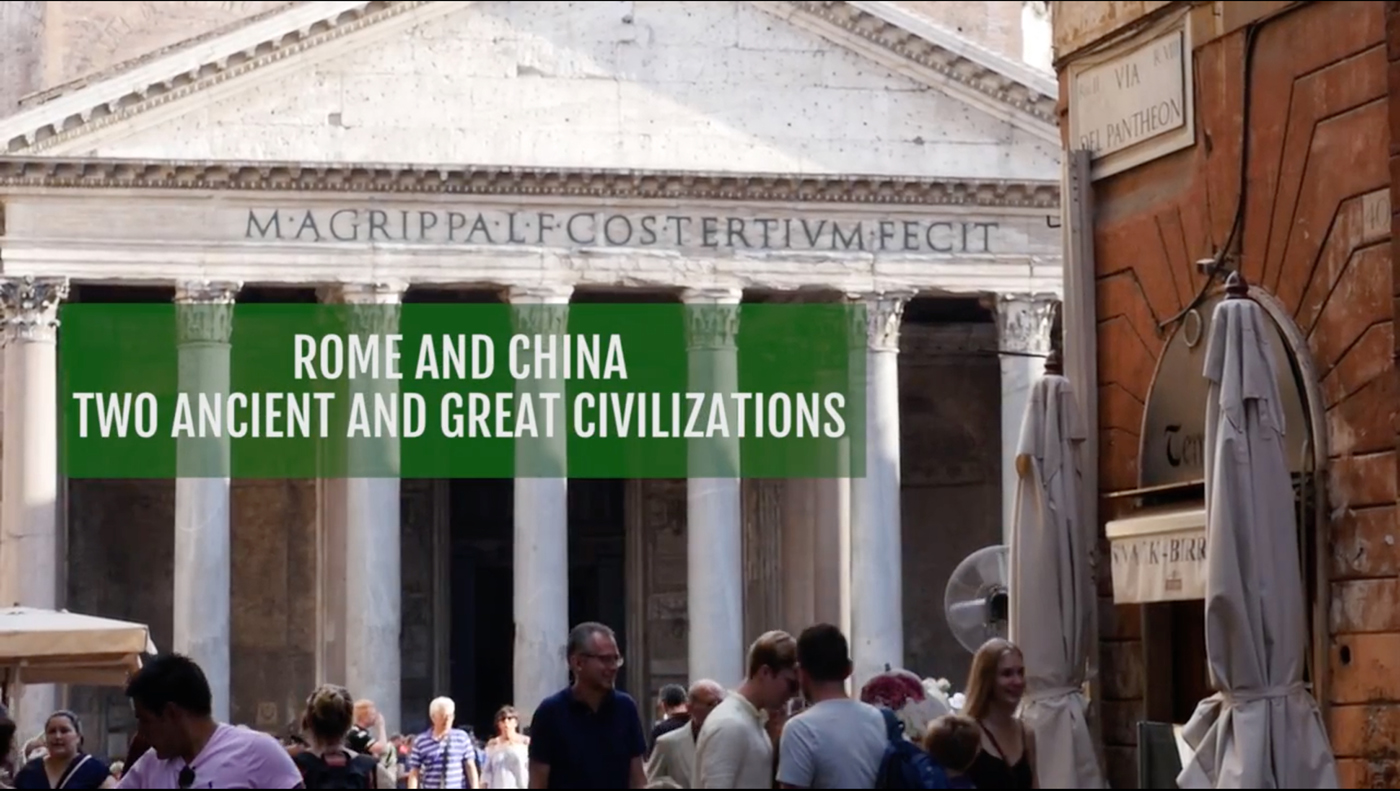
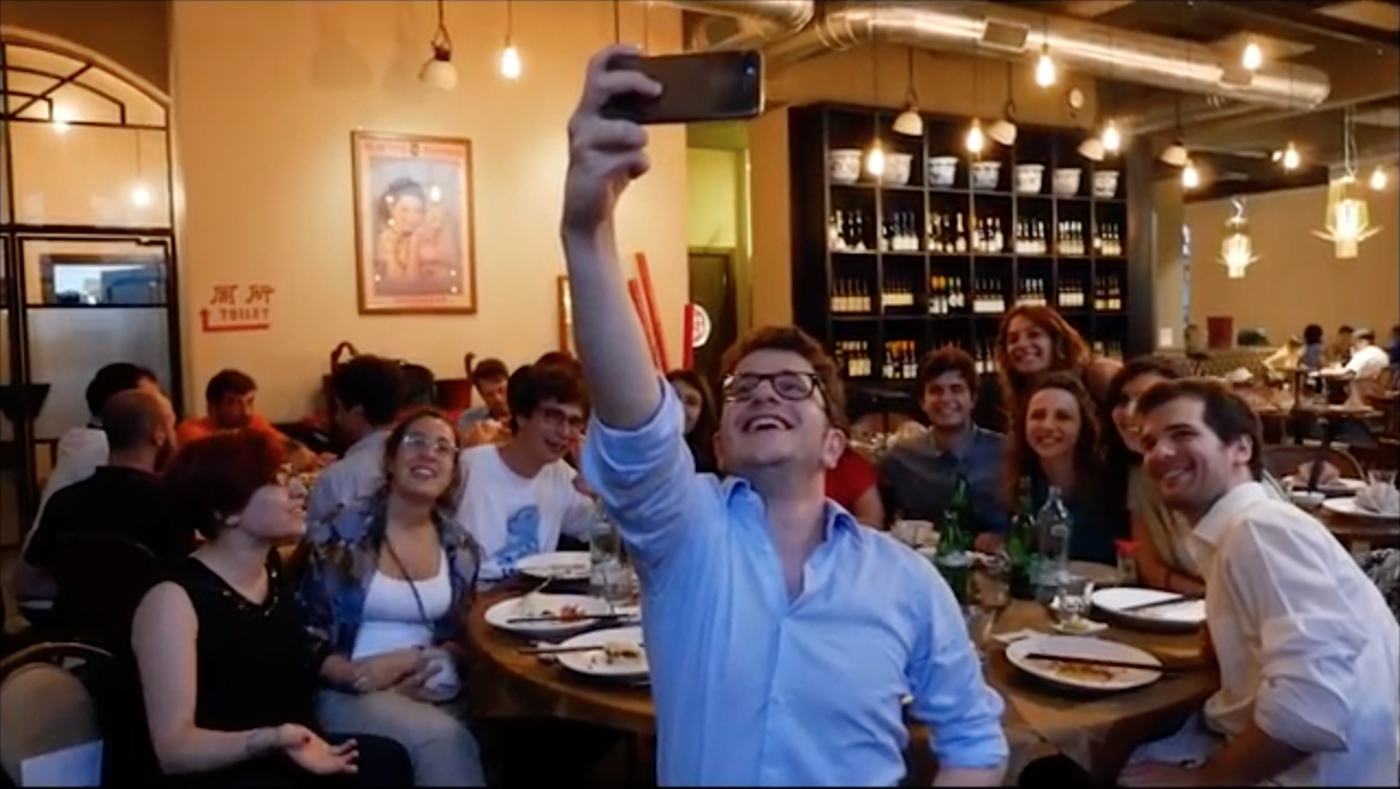
Moving out of the enclosed space of the workshop, a series of touristic imageries shows Rome's hills, sunshine, good food, and happy people drinking coffee from small Italian espresso cups, with the caption ‘a special environment for your networking’. Both Italy and China are participants on a journey from a glorious past to an even brighter future, as the captions superimposed over the montage of picture-perfect images declare without any subtlety: ‘Rome and China: two ancient and great civilisations’. The video concludes with additional comments from participants – ‘I adored it’, ‘definitely recommend it’ – echoing the enthusiastic testimonials presented at the beginning and, as the end-credits scroll, we are left with more happy images of (mostly young) men and women eating Italian food and taking selfies.
Summer school on ‘Understanding Global China’, screen shot

Summer school on ‘Understanding Global China’, screen shot

As clearly shown by its visual narrative, the video effectively presents Global China as a valuable opportunity for Global Italy, showing a convergence of people and institutions from academia, business and politics, all seemingly keen to develop this new advantageous alliance.
To be fair, the summer school itself should not be dismissed as an acritical celebration of the China Dream or, even worse, a bleak subjugation of academia to the demands of global capitalism. Many of the presenters and the institutions involved are far from being blind supporters of Global China's economic rise and are not only aware but also critical of how its ideological rhetoric is used to conceal serious social and political backlashes.Footnote 9 However, the promotional video is evidence of subtler, more gradual compromises that have in fact characterised many academic institutions in Western liberal democracies. Universities are increasingly under pressure to negotiate their intellectual freedom with both economic imperatives and political diplomacy. A case in point is the widespread controversy surrounding the opportunities deriving from the support of Confucius Institutes to universities around the world and the possible costs in terms of academic integrity that such opportunities may require.Footnote 10
Global China as a lesson to learn: expert propaganda
Conversely, the quasi-absence of a critical discussion about the human and ethical issues of China's economic rise and a much more unapologetic appreciation of the Chinese model as an alternative to the shortcomings of western neoliberal democracies have become intertwined with the rise of populism in Italy. Michele Geraci is an example of how academic expertise on China has been used to support such a populist turn. Recently appointed as under-secretary of state in the Ministry of Economic Development, Geraci has become one of the most vocal contributors to the discourse of Global China as a site of opportunities for Italy. His online presence includes documentaries, blogs, and a series of videocasts, mostly collected on his blog (Geraci), but also accessible on YouTube and other platforms. In particular, two documentaries that Geraci has produced as part of his series on Economy and Society in China, namely The Rural Economy and Microcredit, are also both hosted on the blog of the founder of the populist Movimento 5 Stelle (Five Star Movement), Beppe Grillo. Relying on the authority of one expert narrator – Geraci – these educational-propagandistic documentaries use the same core message of soft infomercials as the summer school promotional video, but magnify their claims to argue that Global China is not only an opportunity but also a model to follow.
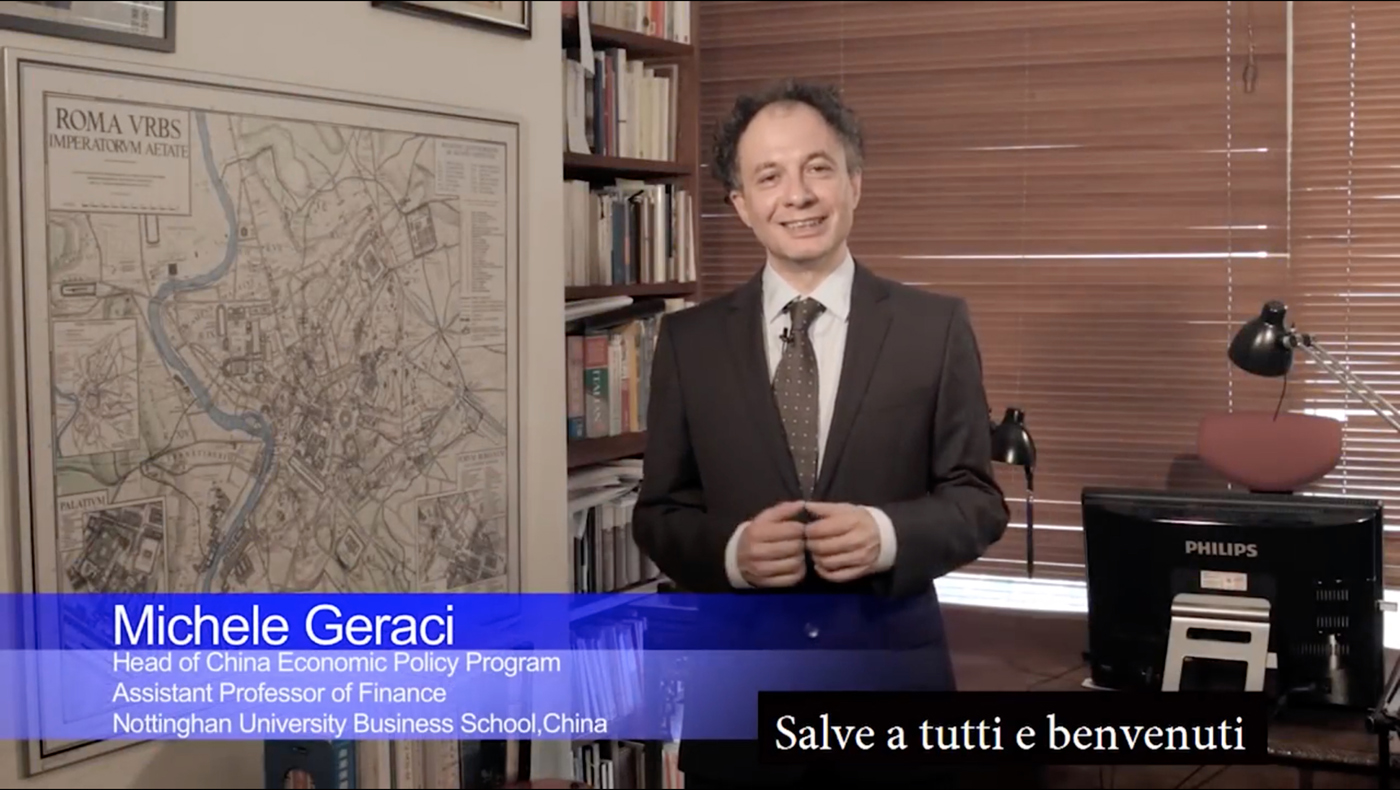
The Rural Economy addresses the role played by the rural economy in China and makes quite clear its pragmatic, self-serving rationale. Geraci notes that ‘in order to understand the Chinese economic development model and the business opportunities that China offers we need first to understand how the rural economy operates and this is true no matter if your business activities relate to manufacturing electronic products, textiles, or any other sector’ (my emphasis). Geraci's expert authority is shown to have both academic gravitas and journalistic dynamism. At the beginning and end of the documentary, Geraci is in an office filled with books in the background and a large map of Roma Vrbs Imperatorum Aetate in the foreground. This rhetorically frames the China-Italy relationship with a clear reference to the trope of a shared status of ancient civilisations that was also a feature of the promotional video of the summer school.
The Rural Economy, screen shot

Later we see Geraci on location in China, in the fields, informally dressed and directly interacting with farmers. In the documentary Geraci speaks in English, but we also hear him addressing interviewees in Chinese and everything is subtitled in Italian. Charts and data about farmers’ income mapped over the past 50 years are shown as evidence of China's success, which is applauded as exceptional (‘this is an unprecedented achievement in the history of humankind’).
The video also shows a few upbeat testimonials by farmers, all beaming, declaring that life in the countryside is good, less polluted. Some, however, complain that their income is too low and identify moving to the city as a solution to improve their lives, but these more critical, if not negative, assertions are subsequently mitigated, if not dismissed, by Geraci, who notes that rural life is not so bad. He argues that, even though income from agricultural activities is still extremely low, there is no food shortage, given that supplies are guaranteed by both their fields and those of the neighbours, and farmers can enjoy a great deal of relaxation because the busiest times of sowing and harvest last only a few weeks. These statements are misleading, to say the least. Labour in the fields is certainly much more extensive than only a few weeks (my emphasis) and food is far from guaranteed, especially if coming from the neighbours’ fields, not one's own.
In order to support the larger claim that the Chinese model offers not only business opportunities but also solutions to address Italy's own social issues, the struggles of the Chinese are minimised, if not altogether denied. In the documentary, the farmers’ wish to migrate to urban centres is not attributed to their need to alleviate their harsh life. Instead, the documentary maintains that life in the countryside is actually quite good and migrants are simply following the ‘natural’ human drive to search for a better life.
The documentary thus reflects a generally positive assessment of China's controlled internal immigration, which Geraci has identified as one of the keys of China's success (Geraci Reference Geraci2017). In interviews, videocasts and opinion pieces, Geraci has repeatedly referred to this system as a highly effective model of planning that allows millions of migrants to settle in cities where they will find jobs, transportation and accommodation ready to welcome them, noting that ‘they are not abandoned to themselves, thanks to the infrastructure system of transport built in advance and to the buildings where they can live and work’ (Geraci 2017). Once again, the assessment of how efficient and welcoming Chinese cities are in hosting these migrants is deceptive. Activist sinology exposes quite different realities, showing that the ‘welcome’ is not only inefficient but also unjust and discriminatory.
A counter-discourse on subaltern China: activist sinology
In stark contrast to the glossy discourse about Global China in which Italy is claimed to be an equal, global, companion, activist sinology's counter-discourse is based on those for whom opportunities are in fact very limited, or revealed to be mere deceptions. Their journey towards a ‘better life’ leads to a deterioration rather than an improvement of their conditions. China's and Italy's ambitions as globalised nation-states are no longer the principal features in this discourse, but constitute its context: in the foreground are the migrants themselves, who are approached not as indistinct masses or unscrutinised individuals, but as localised subjects with personal, complex stories. Blogs such as Cineresie/Chinoiresie are evidence of such counter-discourse, which actively seeks to focus on the voice of the global poor and promote international solidarity.
Who are the collectors of these ‘mismatched shards of China’? One way of describing them could be ‘bloggers’, as their work is largely produced and circulated via digital platforms and social media. They have studied China both in books and on the ground; they are writers, photographers, filmmakers, journalists and academics. Unlike conventional academics, who are both supported and constrained by their national institutional boundaries, these activist sinologists often work alongside – rather than within – institutions, in a transnational and personal engagement with the subjects whose stories they wish to document.
They view the suffering of the Chinese as an unacceptable price for, rather than an inevitable cost of, the Global China Dream. Working across different media, they show that social inequalities, ethnic cleansing, and human rights abuses are an integral part, rather than a minor backlash, of China's success. They view research as inseparable from practice – a practice in which the subaltern must be allowed to speak with their own voice. Because it openly exposes and critiques the arrogant and cruel greediness of global capitalism, this counter-discourse shares many of the social and political concerns of the left, which, especially in Italy, many have declared dead or at the very least, decadent.
It is indeed possible to see heretic projects like Chinoiresie as a generational turning of a page on decades of leftist self-indulgence, complicit silence and inaction. Nanni Moretti's feature film Aprile captures the times in which an increasingly weak and hypocritical Italian left appeared to have irreparably lost its ethical integrity. In a famous scene, Nanni watches a televised debate during the 1996 election campaign and he is exasperated by the silence of Massimo D'Alema (leader of the Democratic Party of the Left), who is listening to Silvio Berlusconi (leader of the centre-right party Forza Italia). Following Berlusconi's agitated remarks against the Italian judicial system, Nanni yells at the TV set, asking D'Alema to speak out and react: ‘D'Alema, say something leftist, even say something non-leftist, of civiltà, … anything, react!’. Nanni's lament marks an important shift from ‘leftist’ to ‘of civilità’. I have left the term untranslated, because, as the scene clearly suggests, Nanni's civiltà is much more than civility, or civil politeness: rather, it refers to accountable and actively engaged citizenship. It (re)defines being leftist as speaking and acting in support of values such as justice, equity, human dignity and solidarity.
In an increasingly unjust, unequal and degrading globalised world, activist sinology therefore offers a concrete answer to Nanni's frustration and call to action. Its practice-based research and research-based practices speak out in solidarity with the people whose lives are spent and often shattered in accomplishing the large-scale achievements that are celebrated by the supporters of Global China's unprecedented success.
Chinoiresie’s manifesto offers clear evidence of this shift towards an activist approach to knowledge on China. On its homepage, the description of Chinoiresie’s goals is prefaced by two quotes. The first is from Lu Xun, the putative father of the intellectual conscience of modern China, who, although a key figure of the leftist May Fourth Movement, never joined the CCP and died in 1937, long before the party officially took power in 1949. The other quote is from Simon Leys – pen name of Pierre Ryckmans, the iconoclastic Australian National University-based Belgian scholar, often described as both anti-communist and anti-capitalist. These opening quotes show that the editors wish to frame their project in leftist social concerns, democratic and egalitarian values identifiable with the pre-Maoist intellectual discourse (such as the New Culture Movement), while also distancing themselves from both the old – i.e., post Second World War, cold war – ideology that shaped communism both in the People's Republic of China and elsewhere, and the more recent controversies surrounding the rise of the New Left.
The reference to Simon Leys also evokes a controversy surrounding Maria-Antonietta Macciocchi's book Dalla Cina, published by Feltrinelli in 1971. Leys was one of the strongest critics of the Italian left's fascination with the PRC and idolising of Maoism in the 1970s, which failed to see the unpalatable oppression and repression of millions of Chinese people.Footnote 11 In 1981, he forcefully attacked Macciocchi's book as a clear example of ‘stupidity’, completely ungrounded in terms of research.Footnote 12 Macciocchi's work became the epitome of clichéd and unsupported views about China that were blindly buying into the hegemonic discourse promoted by the Chinese state.
Leys’ attack on Macciocchi's lack of knowledge about China, and in particular, her unfounded claims and distorted views on the Cultural Revolution, connects interestingly with the discourse on the success of Global China that is embraced by the populist new right of the present. Chinoiresie made a similar, albeit less vitriolic, critique of the view presented by Geraci in an opinion piece published on Beppe Grillo's blog (Geraci Reference Geraci2018). In this piece, Geraci details how China can be the panacea for Italy's problems, offering an exemplary model for all sorts of policies. Indeed, Geraci's expert knowledge on China may not be as groundless as Macciocchi's – who, unlike Geraci, neither spoke any Chinese nor spent any significant amount of time in China. Yet his analysis is nonetheless misleading and openly compromised by ideological bias and a political agenda. In what can indeed be considered as an example of Italian-accented activist sinology, the signatories of this collective response critique Geraci, noting how his admiring view of the economic and social successes of Xi Jinping's Dream and his advocacy for modelling Italy's government on the Chinese example are blind to the reality of the suppression of basic human rights that is conveniently dismissed in the celebration of both national and global achievements (‘The Chinese Panacea?’ 2018).
I turn now to some of the specific ways in which today's activist sinology sheds light on this reality of suppression. My focus is in particular on the role played by small-screen documentaries as tools for ethnographic research, but also as locations for digital storytelling and social activism. These light (i.e., with insignificant weight in terms of production costs, distribution reach, profit gains, popularity ambitions) small-screen movies can create significant disturbance in the dominant ideology (Voci Reference Voci2010). While the individual reach of these small-screen videos may be low in terms of the measurable ‘views’ and/or ‘likes’ that are tracked by most video-hosting servers, we should also take into consideration the largely untraceable but meaningful ripple effects that characterise online digital cultures, in which values and meanings are created not by aggregating, but by ‘spreading’ content in multiple directions (Jenkins, Ford and Green Reference Jenkins, Ford and Green2013).
Italian-accented documentaries: from Antonioni's China to small-screen Chinas
In both general and academic search engines, keyword searches on Italian documentaries about China with a focus on social (rather than cultural or historical) content still mostly lead to Michelangelo Antonioni's Chung Kuo – Cina (1972), with a relatively small group of other movies. Even after more than 45 years, Antonioni's controversial encounter with 1970s Maoist China still dominates scholarship, blogs and news.Footnote 13 The most recent evidence of Antonioni's enduring legacy is Seeking Chung Kuo (Xunzhao Zhongguo), produced by Beijing SDT Media, narrated by Italian journalist Gabriele Battaglia. The documentary was broadcast on the Chinese TV channel CCTV4 on 20 March 2019, the first episode in From Chung Kuo to China (Cong Zhongguo dao Zhongguo), a series that contrasts 1970s China, as captured by foreign-made documentaries, with contemporary China, by revisiting the same locations and retracing and interviewing the same people. In line with the official discourse of Global China, the past is mainly evoked to celebrate today's successes. However, at times, Chung Kuo’s old footage and soundbites as well as Battaglia's narration create accented ruptures in an otherwise arguably mainstream documentary. For instance, when referring to Antonioni's low angle/tilted shot of the Nanjing bridge, which was harshly criticised as purposely attempting to reduce the grandeur of socialist China's achievements, the Chinese subtitles selectively cut Battaglia's specific references to the Cultural Revolution's political environment, but both Antonioni's original footage and Battaglia's commentary still convey a more complicated, albeit veiled, narrative.
With a few exceptions – such as Carlo Lizzani's La Muraglia Cinese (1958) and Sergio Giordani's five-episode series Cina allo Specchio (1996) – no Italian documentary has engaged with China as both a place and an idea, with the same level of resources and ambitions as Antonioni's Chung Kuo – Cina.Footnote 14 Furthermore, documentary filmmaking has also moved (like many other cinematic practices) out of the institutionalised and commercialised spaces of film and TV production and distribution, and has increasingly turned to online platforms. Online we can view more recent ‘light’ small-screen documentaries, produced either individually or by small teams, coming from a combination of backgrounds in Chinese studies, filmmaking, and journalism. These productions also intersect with the broader counter-discourse developed by contemporary Italian documentary that has focused on ‘minor, marginalised subjectivities’ and ‘expanded the realm of the visible and opened up a new set of questions’ (Angelone and Clò Reference Angelone and Clò2011, 85) and in particular, with the more radically activist social documentary (Ardizzoni Reference Ardizzoni2013) that has sought to contribute to change.
I have sampled eleven documentaries, all produced in the past ten years. While by no means an exhaustive list, they provide a good overview of the content and context of small-screen documentaries on contemporary China. They are a mix of professional and semi-professional videos, shot both in China (Abbondanza di Frutta, Cine Tempestose, Dreamwork China, Inside Beijing, Inside the Chinese Closet, Mingong, Small Fish) and in Italy (Doris & Hong, Giallo a Milano, Ovunque splenda il sole ci sono i cinesi, Siamo cinesi siamo italiani). Rather than approaching China as a place and an idea, these small-screen documentaries explore localised and declaredly subjective stories, in the broader context of the economic rise of Global China and associated migration flows. Like the realities captured by Antonioni, which contradicted (and angered) the Chinese leadership of the time, the realities captured by these contemporary documentarians contradict the dominant rhetoric of the current China Dream and its supporters. Unlike Michele Geraci's expert narrative, they avoid universalist claims about China's trajectory towards global success and instead point to unsolved contradictions.
Among the Italy-based stories, Ovunque splenda il sole ci sono i cinesi (Wherever the Sun Shines, Chinese can be Found) is an example of a (quasi-)accidental amateur production; it is a largely self-funded project by two Italian graduate students from the University of Venice, who at the time were working as translators and cultural mediators in the Veneto region, and were motivated by a quest for more authentic representations of the Chinese migrants whom they encountered in their everyday interactions. More professionally produced, Siamo cinesi siamo italiani (We are Chinese, we are Italian) records the work, life choices and cultural negotiations of five young Italian-Chinese: Alessandro, Jin, Ling, Valentina, and Yang. While sharing a broader focus on issues of identity, each story is emphatically presented as a singular experience in a specific time and space, and records both personal struggles and professional successes, thus emphasising diversity – and inequality – among the Chinese migrants.
Siamo cinesi siamo italiani has a comparatively high visibility, given that its five episodes are available not only on MTV, which produced them, but also on YouTube and through Associna, which contributed to the making of the documentaries and has posted them on its website and social media. Siamo cinesi siamo italiani’s ripple effects include the significant online presence of one of its protagonists, Yang Shi (or, following the Chinese name convention, Shi Yang), who has produced a TED talk, has been a guest on the popular TV programme Iene, on Italia 1 (both videos are also available on YouTube), and has published a book on his own experience, Cuore di seta: la mia storia italiana (Heart of Silk: My Italian Story).
Among the China-based documentaries, Abbondanza di frutta: storie di italiani nel Guangdong (Abundance of Fruit: Stories of Italians in Guangdong) and Cine Tempestose (Wuthering Chinas) have the most markedly Italian perspective, as they focus on Italians living in China as relatively privileged, insulated guests or sojourners. Possibly because of this Italian perspective (i.e., personal Italian stories of encounters with Chinese places and people), they are the only small-screen documentaries that have been broadcast on Italian national digital TV channels, which also contributed to their production (respectively Rai 5 and Rai 3). While some interviewees may convey orientalist and homogenising views about the Chinese people, these productions are not mainstream (Abbondanza di frutta was broadcast on national TV, but at 11.50pm) and they can still be viewed as part of a critical discourse about global China. They offer a plurality of perspectives (e.g., in Cine tempestose, the Italian student who became an academic; the entrepreneur who discovers the complexity of China's cultural, social, and political world) and include commentaries on the social and economic issues faced by the Chinese (especially in Abbondanza di frutta).
Italian-accented documentaries in focus: subaltern China, wandering perspectives and visual conjectures
Documentaries focusing on migrant workers in China and issues of discrimination linked to both their rural background and their sinophone identities align much more directly with the subaltern. For example, Mingong examines the floating population's conflicted departure from the native village to join the urban workforce, seeking to uncover individual stories of suffering and hope. The documentary was produced as part of the project ‘The Village and the City: China grapples with itself’ and was the winner of the 2015 Fuorirotta competition. The ripple effects of this documentary include a direct connection with Andrea Segre, one of the founders of Fuorirotta. Segre is the director of Io sono Li (Shun Li and the Poet), which has also attracted considerable scholarly attention (Bertozzi Reference Bertozzi2014, Chung and Luciano Reference Chung and Luciano2014, Snaidero Reference Snaidero, Perry and Foley2016). This oblique link between the relatively unknown small-screen documentary Mingong and the multi-award-winning silver screen feature film Io sono Li, can also easily become a direct hyperlink not only to this film and Segre's work, but also to similar – albeit not necessarily China-focused – critical explorations of hybrid identities, isolation and longing for Heimat, in urban contexts shaped by migration, mobility and dislocation.
Dreamwork China and Small Fish advance the most radical critical stance, by forcefully exposing the social inequities and discrimination left unsolved or actually produced by globalisation. Produced by Cineresie’s co-founders, Tommaso Facchin and Ivan Franceschini, Dreamwork China and Small Fish are directly linked to activist sinology's declared goals, i.e., ‘[to] offer “mismatched shards of China” … collected through our personal engagement with this country’. Not only do these documentaries seek to give voice to marginalised subjects, but they also openly operate at the margins, independently from both commercial and governmental institutions that are either uninterested in these subjects or are in fact actively contributing to their marginalisation.
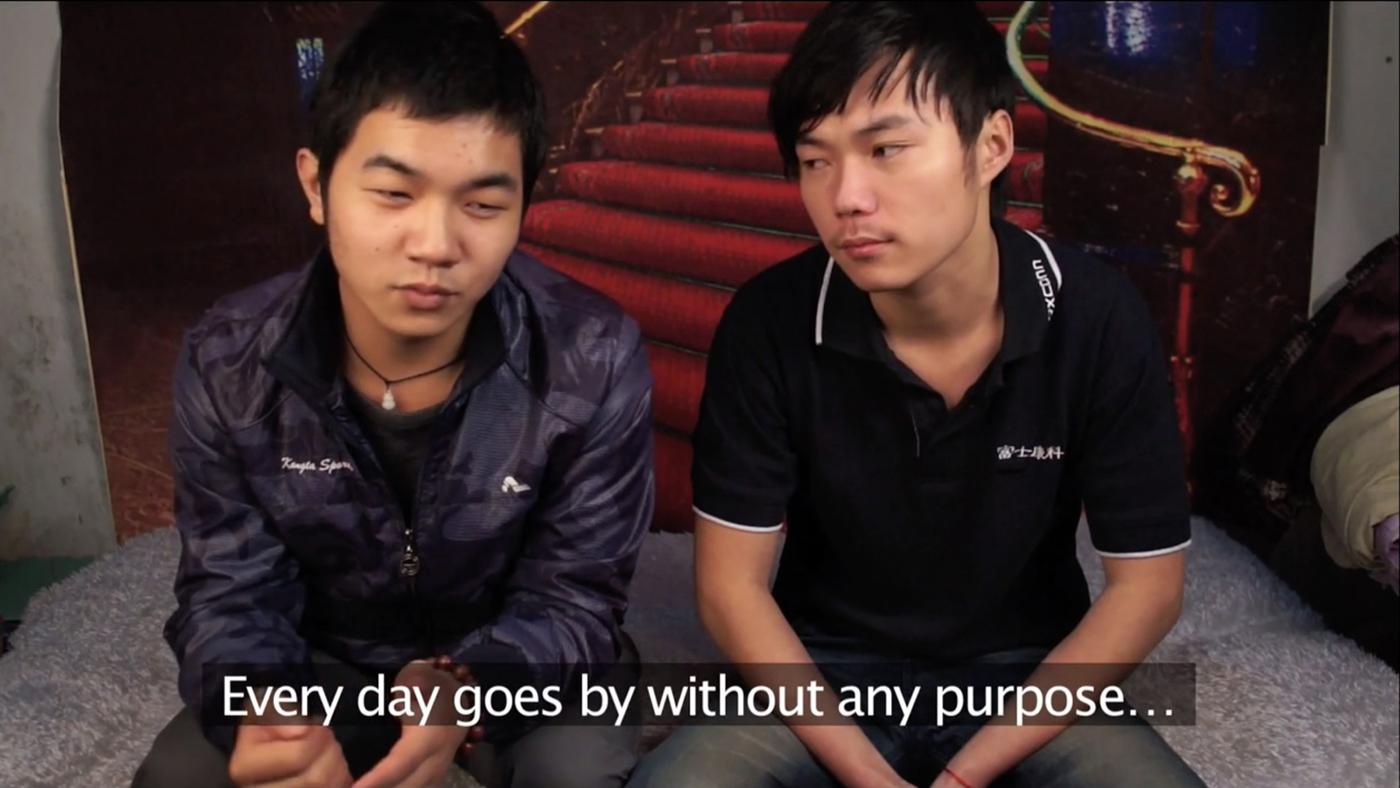
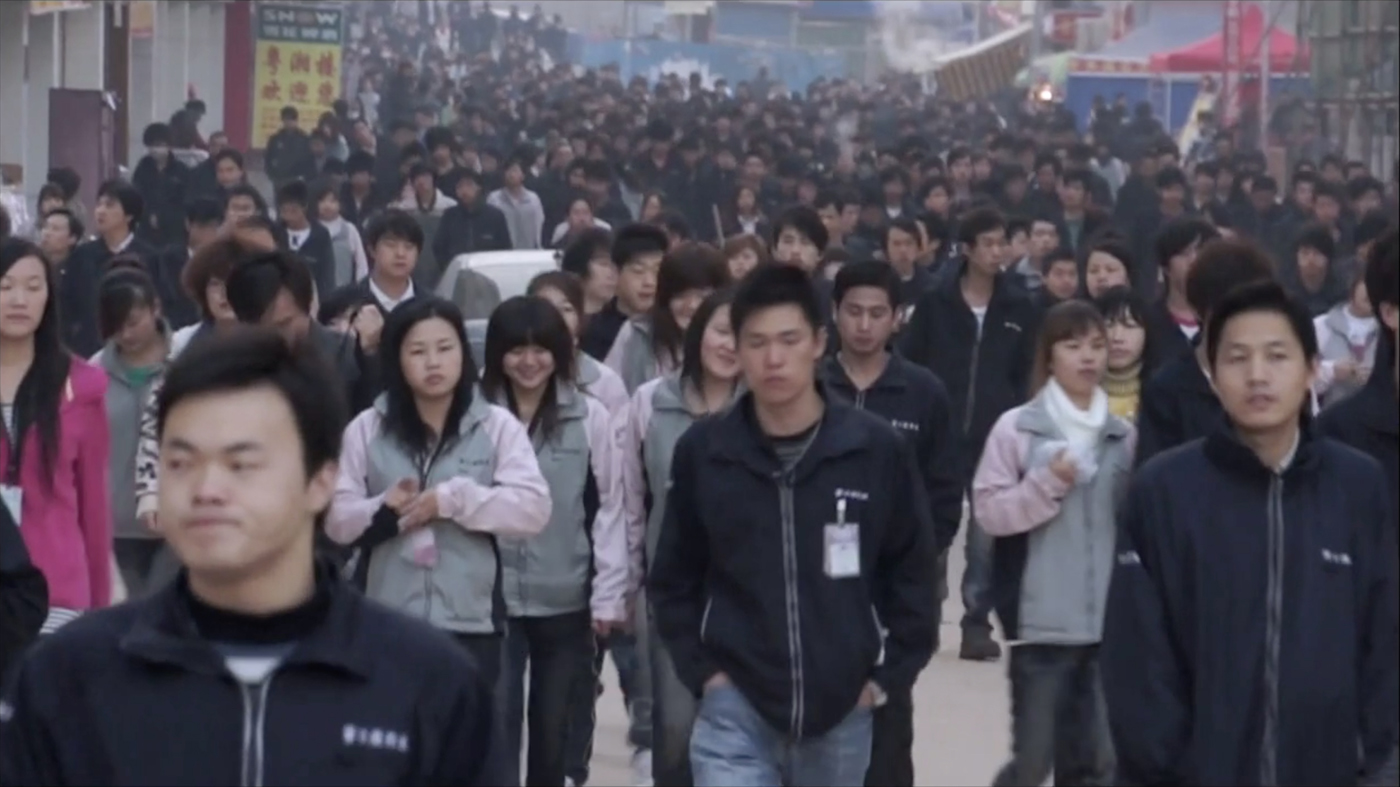
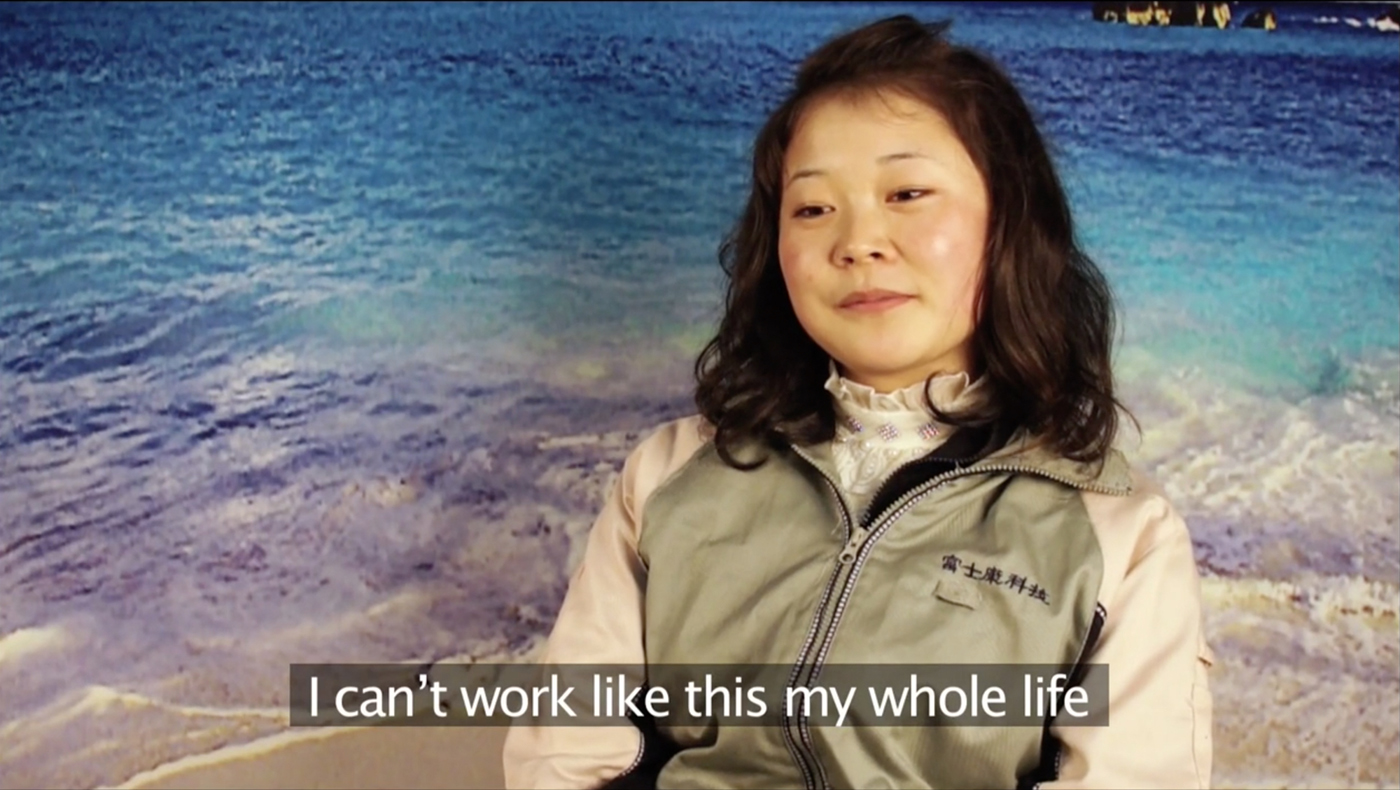
Dreamwork China is an assemblage of short interviews with electronics giant Foxconn workers in which they share fragments of their life stories, struggles and hopes. As also noted in the video's captions, Foxconn produces components for global brands such as Apple, Intel, HP, Nokia, Microsoft and Sony Ericsson, and employs one million workers in China, 400,000 of whom are in Shenzhen. In the video, there is no expert explanation of the role played by Foxconn in the Global China Dream, but instead the focus is on individual labourers. Rather than knowledgeable or authoritative narrators, the filmmakers are inquirers, who are there to observe and listen. On a black screen, two captions inform us that the video takes place in Guangdong province, in southern China, between the end of 2010 and early 2011, in a photographic studio on the periphery of Shenzhen, situated in front of a Foxconn factory where ‘the authors stayed for weeks’ to complete their interviews.Footnote 15 The interviews take place against panels with colourful backgrounds (such as green forests, blue oceans) and are intercut with images of the interviewees’ photo shoots. As they pose joyfully, they are temporarily relocated in ‘dream’ locations, away from the harsh and dull working conditions that they describe in the interviews.Footnote 16 In contrast to these intimate monologues and individualised photo shoots, crowds of workers are shown as they walk through the grey urban environment in which the factory is located.
Dreamwork China, screen shot

Dreamwork China, screen shot

Each story is presented in several alternating fragments. The interviewees talk about missing their homes, their long (ten-hour) working days, repetitive daily routines, relaxation time limited mainly to eating and sleeping. Some display an ambivalent acceptance of their condition, noting that elsewhere the situation is even worse (‘at least we have one or two days of rest each week’). Others describe it as a life without a purpose, unbearably stressful. One young woman declares that she does not want to spend all her life at Foxconn; she is studying to become an aesthetician and break out of the cycle, reclaiming her right to do something else and be someone else, not just a migrant labourer. The documentary ends on a medium close-up of her ambiguously sad smile, while her words express both desperation and determination: ‘I can't work like this my whole life: my parents are migrant workers, so am I, and maybe my children will be too … that's unbearable’.
Dreamwork China, screen shot

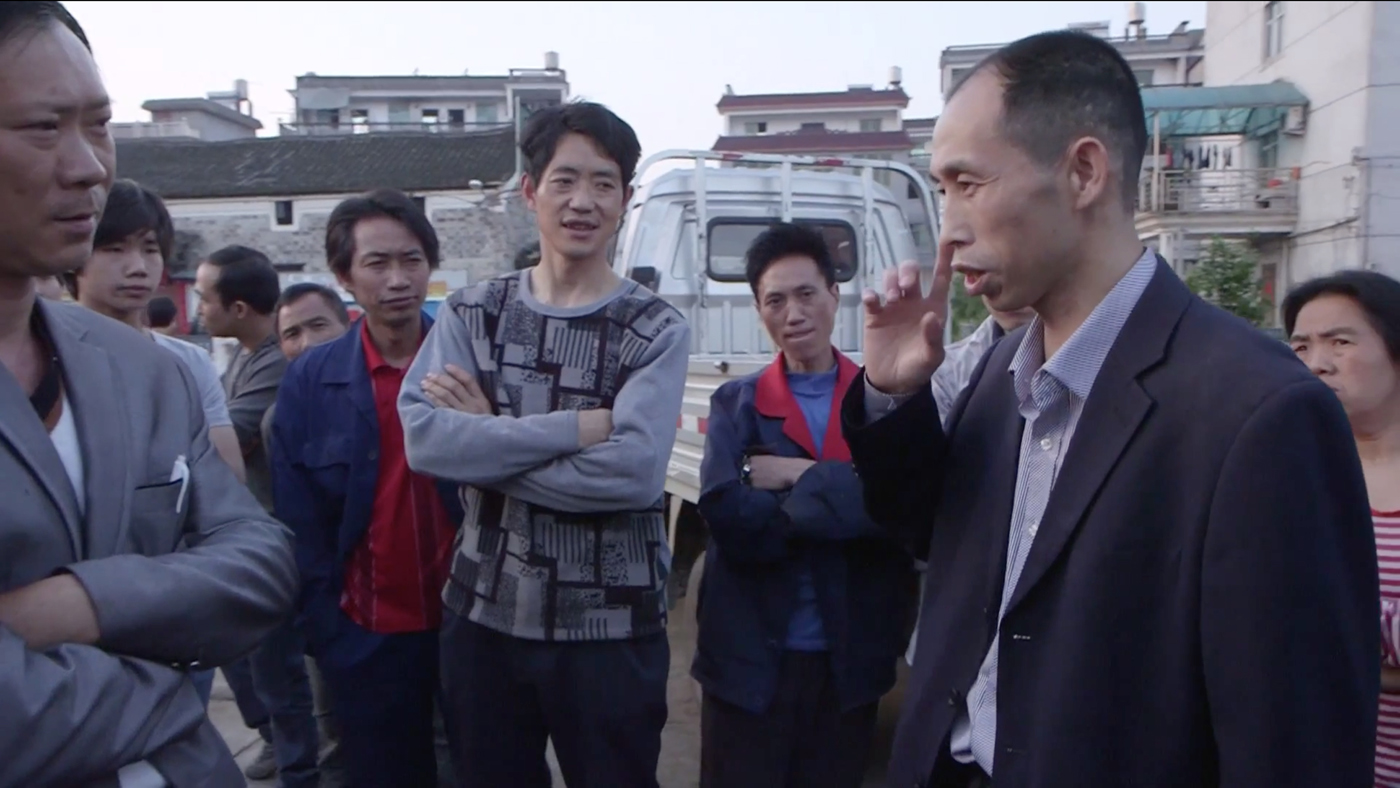
Small Fish can be seen as a conceptual sequel to Dreamwork China as it documents the limited success of a workers’ support centre – Small Fish – and its founder, Huang Caigen, in ‘providing legal aid and support to workers whose rights have been violated’. The location is Yongkang in Zhejiang province, considered ‘the largest metal hardware district in China’. Here ‘there are about 600,000 workers coming from China's rural areas’ and ‘most of them work illegally in family-run workshops’. If Dreamwork China records the seemingly dead-end stories of Foxconn's low-paid employees, Small Fish suggests a possible, albeit constricted, route for the development of a civil society in which the workers’ rights can be recognised and defended. In the specific case of Yongkang's metal hardware factories, workers are submitted to an exploitative schedule that requires them to work every day – far beyond regular working hours, often up to 18 hours non-stop – with only one or two days of rest per month. In the absence of a contract, their biggest struggle is to recover from work-related injuries (85 per cent of the cases supported by Small Fish) and Mr Huang's goal is to help them get the full compensation owed to them by law, but that they are regularly denied. Chinese labour laws are disregarded and government departments regularly side with the companies, pressuring workers to accept less than their full entitlements.
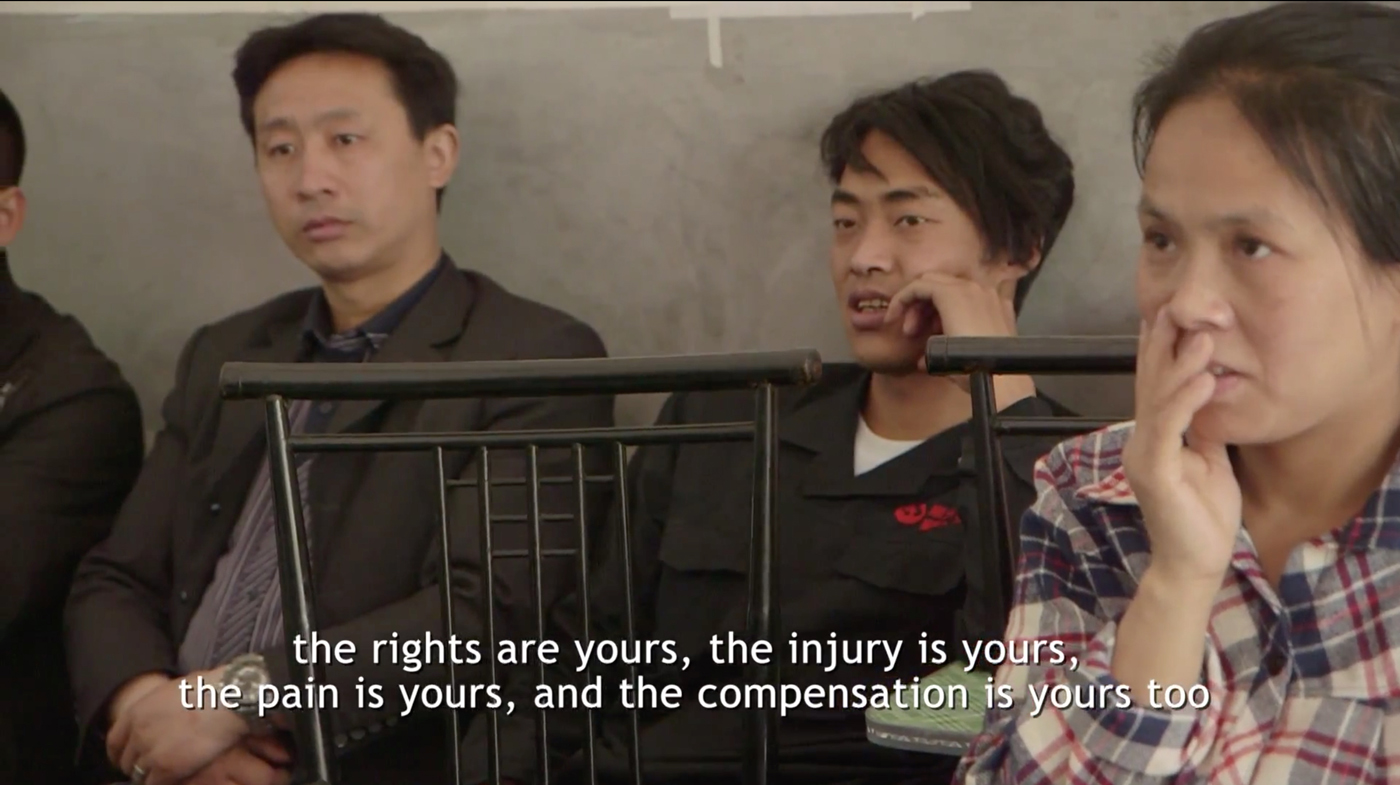
Mr Huang sees these workers as companions, rather than customers. Solidarity is what motivates his activism. In the last scene, he sits in his small office surrounded by them, and says:
I have not attended any law school, I studied myself because I wanted to sue my boss and after that I thought that I should help you too. And I hope you will be able to fight as well. The rights are yours, the injury is yours, the pain is yours, and the compensation is yours too.
Small Fish, screen shot

Small Fish, screen shot

In this documentary, the filmmaker's presence is almost completely erased and the focus is even more forcefully on the labourers. The interview format is not completely abandoned; people often still speak directly to the camera, but with no reference to the interviewer (who was occasionally overheard in Dreamwork China). The fly-on-the-wall observational style is further emphasised as the camera also captures Mr Huang's actions and his discussions with fellow workers among themselves, seemingly undisturbed by the presence of the camera. The fact that the labourers are not talking to ‘us’ – the interviewer and the audience – but to each other, is a reminder that the labourers should own and control their narrative, and it is their agency that needs to be recognised and supported.
Echoing Chinoiresie’s manifesto, Dreamwork China and Small Fish do not seek to create self-contained, persuasive narratives that claim to offer a comprehensive ‘truth’; instead, their goal is to show us truthful ‘shards of China’. The documentaries’ denunciation of the normalised exploitation of masses of young migrant workers is purposely implicit. In contrast to the educational, structured, ‘tell-to-teach’ format of expert propaganda, their ‘exhibitionist’ format relies on observational style, wandering perspectives, minimalist editing work, open-ended, episodic or split narratives.Footnote 17 The filmmakers place their cameras and themselves alongside and within the workers’ roaming, rootless life in order to capture what they do and what they say. These close encounters suspend – albeit temporarily – the alienating space and time in which their lives are entrapped and open up location in which the workers can reflect on the harshness of their condition and imagine, or even fight for, a better life.
Dreamwork China and Small Fish are not isolated, occasional incursions into the discourse about subaltern China by Italian activist sinologists. Most importantly, they are closely related to the content, form, and modalities of production and dissemination of Chinese independent documentary (Zhongguo duli jilupian), which has developed since the early 1990s.Footnote 18 Many Chinese filmmakers have focused in their work on the floating population's harsh and even inhuman conditions.Footnote 19 Like their Chinese counterparts, Dreamwork China and Small Fish are also constructed as ‘visual conjectures’ (Voci Reference Voci2004), developed from peripheral and subjective perspectives, mostly concerned with showing – rather than explaining – realities that are often invisible in mainstream media and are completely absent from the joyful infomercials or the expert propaganda focusing on Global China as the land of opportunities. In these – both Italian and Chinese – accented visual conjectures, subaltern China has no centralised, official, authoritative entry point, but requires us to wander in the unofficial, undocumented, unprotected, and even illicit lives of the marginalised, to watch and listen.
Concluding thoughts: de-centred China and the return of ‘concern’
It has now been over 30 years since the publication of Paul Cohen's ground-breaking book Discovering History in China (1985) in which he reflected on the previously largely unchallenged ‘Western’ (and more specifically American) ethnocentric bias through which the Chinese past had been examined, retold and critiqued. He famously advocated a ‘China-centred’ approach through which Chinese history could be understood without being framed by default in issues, theories, and methodologies derived from Western historiography. More recently, in the new introduction to the 2010 edition of the book, Cohen re-evaluates ‘the potential limits of the China-centred approach posed by recent developments in the Chinese history field’ (Cohen Reference Cohen2010, xlii), in light of the broader shift in Chinese studies brought about by comparative, regional, and sinophone approaches to the study of China. He notes that ‘[t]he difficulty arises when we move into research areas … that either decenter China by linking it to transnational processes … or general intellectual issues or in some way problematize its meaning’ (Cohen Reference Cohen2010, lii, my emphasis).
Activist sinology, as these Italian examples demonstrates, addresses this difficulty, by taking a China-centred approach and yet carefully de-centring China, and by linking it to transnational processes such as the displacement and exploitation/oppression of workers brought about by globalisation. In particular, I have argued, accented documentaries that focus on the (exilic) experiences of the displaced are among the most powerful media through which such de-centring can take place.
While these documentaries do not engage in the same level of critique of global capitalism, collectively, albeit inorganically, they contribute to the fragmentation of China into multiple, localised, diversified, and dissonant stories. The protagonists of these documentaries are better understood as sinophone, as their diverse backgrounds and life experiences powerfully challenge the homogenising rhetoric of One China and its centripetal claims that demand loyal belonging based on a unifying common language (putonghua), the glorious past of its civilisation (wenming) and the global ambitions – the China Dream (Zhongguo meng) – of its nation-state, the PRC. They often speak an accented Chinese or different sinitic languages, or in fact Italian, and they are situated at the ideological and geopolitical periphery of the One China, which either misrepresents them or makes them invisible.
In addition to embracing a de-centred, accented approach to China, activist sinology is openly concerned about growing inequality and human/labour rights abuse, and recognises the necessity of engaging more directly with the social and political implications of the construction of knowledge about China. In The End of Concern, a detailed account and insightful critical discussion of the American-based Committee of Concerned Asian Scholars (CCSA) established in 1968 and dissolved in 1979, Fabio Lanza scrutinises the ambitions and limitations of activism in Asian Studies’ academic discourse (Lanza Reference Lanza2017). Lanza's narrative originates ‘in personal, political, and intellectual terms – by taking stock of an ending, by registering an absence, by marking a disappearance’. The disappearance to which Lanza refers is that of ‘concern’ – which was rooted in leftist ideologies and debates (global Maoism) and required scholars to speak up, take a stand, and, at least, engage with the question of ‘how to act politically and how to overcome the limitations imposed by the professional practices of the scholar’(Lanza Reference Lanza2017, 91).Footnote 20
This study has shown that ‘concern’ has reappeared, albeit on different grounds. As a declaredly hybrid and inclusive discursive space in which to ‘experiment and create a dialogue off the grid, between academics and journalism’, activist sinology has opened up a third alternative to the Hamletic dilemma ‘to be, or not to be, a scholar’ (Lanza Reference Lanza2017, 67). In the digital, nomadic, transnational space of blogs, vimeo channels, and multimedia websites like Chinoiresie, concerned engaged practitioners and researchers on China meaningfully contribute to an alternative production and dissemination of knowledge that invite us to see, think and act in ways that are not driven by the search for opportunistic gains, but by human solidarity.
Acknowledgements
I would like to thank the editors of Modern Italy, Penelope Morris and Mark Seymour, who organised the Italy and Asia: Past and Present symposium, and the guest editors, Maurizio Marinelli and Wessie Ling, whose combined vision and efforts led to this special issue. I am particularly grateful to the activist sinologists who have generously shared their works and ideas, and to the and the anonymous referees for their insightful comments.
Note on contributor
Paola Voci is an associate professor at the University of Otago. She specialises in Chinese visual cultures, and, in particular, documentary, animation, and other hybrid digital video practices. She is the author of China on Video, a book that analyses and theorises light movies made for and viewed on computer and mobile screens, and co-editor of Screening China's Soft Power, a book focusing on the role played by film and media in shaping China's global image. Her current research is on handmade cinema, shadow play and animation and other amateur, vernacular practices and their contribution to the archaeology of the moving image.