Take-Home Points
▪ Most psychopharmacologists are aware of the superior efficacy of clozapine, but its utilization remains low.
▪ The main barrier to utilization is unfamiliarity with how to avoid or manage potentially difficult side effects.
▪ Gaining experience with this agent is an important aspect of the modern practice of psychopharmacology, as in many cases side effects can be managed adequately, enabling the potential therapeutic advantages of clozapine to be realized.
What Is So Great About Clozapine?
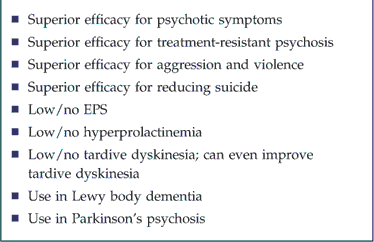
Most psychopharmacologists are aware of the special efficacy advantages of clozapine in the treatment of schizophrenia, namely, that it has generally greater efficacy than all other antipsychotics, especially when administered after adequate response to other antipsychotics has failed.Reference McEvoy, Lieberman and Stroup1-Reference Stahl5 In fact, there is an international consensus, reflected in treatment guidelines,Reference Stahl, Morrissette and Citrome6 that clozapine is recommended as the treatment of choice for patients who have failed to respond to other antipsychotics. In addition, clozapine is well known to be the only antipsychotic documented to reduce suicide in schizophrenia.Reference Meltzer, Alphs and Green7 Clozapine is also the preferred antipsychotic for psychosis associated with either Lewy body dementia or Parkinson's disease (Table 1).Reference Stahl5, Reference Stahl8 All antipsychotics can reduce violence in psychotic patients,Reference Fazel, Zetterqvist, Larsson, Långstrom and Lichtenstein9 but clozapine seems to have by far the most robust actions in reducing aggression, hostility, and violence in schizophrenia.Reference Frogley, Taylor, Dickens and Picchioni10-Reference Brown, Larkin and Sengupta14
Encouraging adoption of clozapine: potential advantages
In terms of tolerability, although clozapine is often thought of mostly as a drug with many side effects, clozapine in fact induces few if any extrapyramidal side effects, does not seem to cause tardive dyskinesia (and may even be helpful for some patients with tardive dyskinesia), and fails to elevate prolactin levels, which is quite different from the tolerability profiles of many other antipsychotics (Table 1).Reference Stahl5, Reference Stahl8 So with all these things going for it, why is clozapine used in only a small percentage of patients, and possibly in only about 1 in 10 of the patients for whom it might be indicated, especially in certain settings and in certain countries like the U.S.?Reference Nielsen, Dahm, Lublin and Taylor3, Reference Meltzer4
What's the Problem with Clozapine?
Due to side effects that can be greater than some other antipsychotics in many patients, and the need for blood monitoring, which can be costly and a hassle, clozapine is not a first-line treatment for schizophrenia.Reference Meltzer4-Reference Stahl, Morrissette and Citrome6, Reference Stahl8 In fact, many prescribers avoid using clozapine altogether. One study suggests that many psychiatrists have few if any patients on clozapine, or rarely start a new patient on this drug.Reference Nielsen, Dahm, Lublin and Taylor3 “Side effects” is the usual explanation for why clozapine seems to be avoided by many psychopharmacologists,Reference Nielsen, Dahm, Lublin and Taylor3, Reference Meltzer4 resulting in the possibility that up to 10-fold more patients may benefit or need this agent than are getting it in current practice in the U.S.Reference Meltzer4
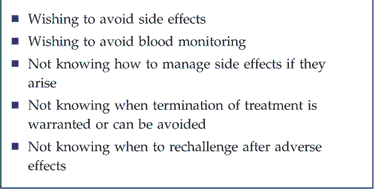
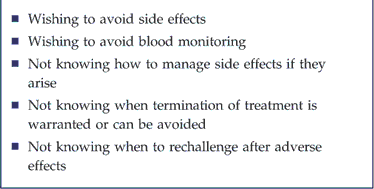
The full explanation for the low use of clozapine, however, may be a bit more nuanced than simply problems with side effects. Namely, if a prescriber lacks experience managing patients with clozapine, and also is not comfortable with how to monitor for complications, prevent them, and deal with them should they arise, that prescriber may over-value potential side effects compared to potential benefits, and thus not use clozapine. A list of potential barriers to the use of clozapine is given in Table 2. A common myth among some psychiatrists is that clozapine is too dangerous, and its risk–benefit ratio makes clozapine generally not worth prescribing.Reference Nielsen, Dahm, Lublin and Taylor3, Reference Meltzer4 However, as a recent study has shown,Reference Tiihonen, Lönnqvist and Wahlbeck15 despite potential complications from clozapine use, including weight gain and diabetes, it actually has a lower mortality rate than other antipsychotics, presumably due to its reduction of suicide, which is a frequent cause of death in this population.Reference Meltzer, Alphs and Green7
Barriers to adopting clozapine
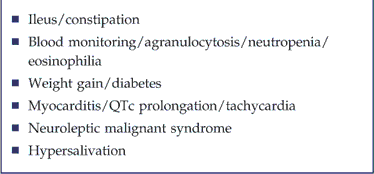
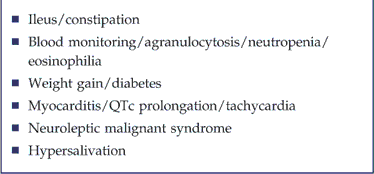
In fact, clozapine can be used safely (Table 3), because there is now a good deal of information available in the literature not only on its efficacy,Reference McEvoy, Lieberman and Stroup1-Reference Tiihonen, Lönnqvist and Wahlbeck15 but also pragmatic tips on how to deal with side effects (eg, Refs.Reference Stahl8, Reference Cohen, Bogers, van Dijk, Bakker and Schulte16-Reference Meyer and Cummings23). For example, there are informed suggestions about what to monitor beyond just white blood cell counts,Reference Cohen, Bogers, van Dijk, Bakker and Schulte16 and criteria for when to terminate clozapine treatment when a side effect does arise, versus continuing treatment while the side effect is managed.Reference Nielsen, Correll, Manu and Kane17 Managing neutropenia is now informed by the new understandings about the prevalence of neutropenia in the general population, especially in various ethnic groups.Reference Hsieh, Everhard, Byrd-Holt, Tisdale and Rodgers18, Reference Rajagopal19 Clinicians may come across patients who have benefitted from clozapine, but whose medication has been stopped either correctly, or even incorrectly by an overly worried prescriber. There are now criteria for when and how to rechallenge such patients with clozapine.Reference Manu, Sarpal, Muir, Kane and Correll20 Finally, side effects such as hypersalivationReference Sockalingam, Shammi and Remington21 and constipationReference Nielsen and Meyer22, Reference Meyer and Cummings23 can also be managed if they arise.
Removing barriers to adopting clozapine: learn how to avoid or manage key side effects, including when to continue, discontinue, or rechallenge
Conclusion
It may be time to take another look at clozapine and adopt this orphan into a modern practice of psychopharmacology.